International Journal of Engineering and Management Research e-ISSN: 2250-0758 | p-ISSN: 2394-6962
Volume- 9, Issue- 2, (April 2019)
www.ijemr.net https://doi.org/10.31033/ijemr.9.2.7
55 This work is licensed under Creative Commons Attribution 4.0 International License.
Domestic Wastewater Treatment by Root Zone Technology Option:
Colacassia Plant
Poonam Thorat1
, Sayyad Saniya2
, Salman Shaikh3
, Raashida Shaikh4
and Atul Sonawane5
1
Student, Department of Civil Engineering, JMCT Polytechnic, MSBTE, INDIA
2
Student, Department of Civil Engineering, JMCT Polytechnic, MSBTE, INDIA
3
Student, Department of Civil Engineering, JMCT Polytechnic, MSBTE, INDIA
4
Student, Department of Civil Engineering, JMCT Polytechnic, MSBTE, INDIA
5
HOD, Department of Civil Engineering, JMCT Polytechnic, MSBTE, INDIA
1
Corresponding Author: surekha_st16@rediffmail.com
ABSTRACT
Root Zone Technology is one of the low cost
methods to treat wastewater. With the help of this system we
can treat the Non-Point sources with best results. To achieve
this goal we have to divide the Non-Point sources into
constructed channels within the river bank followed by root
zone bed or if the Non-Point Sources is coming from natural
nallas we can provide this system within its Channel. We
have prepared channel on which I have developed the root
zone bed and have lab analysis of rector out put on number
of parameters. Flow rate and Detention time are the two
factors on which channels are to be designed. Therefore I
am changing the flow rate and finding out the change in
parameter with respect to detection time. The optimization
is when we get best result with maximum flow. I have got
satisfactory results for the detention time of Three day,
Seven day and twenty one day and Three day. With the help
of this data I have designed the root zone bed system for the
selected actual Domestic Sources.
Keywords— Domestic Wastewater, Root Zone, COD,
BOD, TSS, TDS
I. INTRODUCTION
Root zone treatment is one of the natural and
attractive methods of treating domestic, industrial and
agricultural wastes. It is an engineered method of
purifying wastewater as it passes through artificially
constructed wetland area. It is considered as an effective
and reliable secondary and tertiary treatment method. The
root zone treatment is a natural maintenance free system
where the sewage wastewater is purified by the roots of
wetland plants. The root zone process functions according
to the law of nature, to effectively purify domestic and
industrial effluents. The process incorporates the self-
regulating dynamics of an eco system.
Root zone systems are artificially prepared wetlands
comprising of clay or plastic lined excavation and
emergent vegetation growing on gravel/sand mixtures and
is also known as constructed wetland. This method
combines mechanical filtration, chemical precipitation and
biological degradation in one step for the treatment of
wastewater. A number of factors like low operating cost,
less energy requirement and ease of maintenance attribute
to making root zone system an attractive alternative for
wastewater management. The term root zone encompasses
the life interactions of various species of bacteria, the
root of the wetland plants, soil, air, sun and of course,
water.
Application of root zone technology is finding
wider acceptability in developing and developed
countries, as it appears to offer more economical and
ecologically acceptable solution to water pollution
management problem Root zone systems whether natural
or constructed, constitute an interface between the aquifer
system and terrestrial system that is the source of the
pollutants. These are reported to be most suitable for
schools, hospitals, hotels and for smaller communities.
II. LITERATURE REVIEW
Nanda Sahil (2017) has studied on Root Zone
waste water Treatment for domestic sewage the
wastewater is collected from the septic tank when that
overflows is transferred to the plant. On the plant, a pit of
essential dimension is made. The clarified sewage from
the septic tank is made to pass through the Root Zone pit.
The length and breadth of the pit depends on the volume
of the wastewater to be treated per day. The pit is lined by
sealing with low Density Polypropylene sheets or rolls. If
necessary, other types of civil structure can be made into
the treatment tank. The pit is filled layer by layer with
layered media ofadequate porosity.
Mane Mahesh et.al. (2017) has studied on
Introduction to Waste Water Treatment by Root Zone
Technique . In This study Increasing urbanization and
human activities exploit and affect the quality and
quantity of the water resources. This has resulted in
pollution of freshwater bodies due to increased generation
of domestic waste, sewage, industrial waste etc. This
paper reviews the Root Zone Treatment System which
are planted filter beds consisting of soil gravel, sand and
fine aggregate. This Technique uses a natural way to
effectively treat domestic and industrial effluents. RZTS
are well known in temperate climates and are easy to
operate having less installation, low maintenance, and
operational costs and incorporates the self-regulating
dynamics of an artificial soil eco-system.
International Journal of Engineering and Management Research e-ISSN: 2250-0758 | p-ISSN: 2394-6962
Volume- 9, Issue- 2, (April 2019)
www.ijemr.net https://doi.org/10.31033/ijemr.9.2.7
56 This work is licensed under Creative Commons Attribution 4.0 International License.
Parmar jigar et.al. (2016) has studied on
Experimental study on post treatment of dairy wastewater
is using hybrid reed bed technology in this Study give
knowledge about dairy waste and the dairy waste and
their effective treatment. He had use hybrid reed plant for
treatment of Dairy waste. It give from this study
confirmed that the Hybrid reed bed system was highly
effective on removing BOD up to 14 mg/L and COD at
up to 110 mg /L at 36 hours detention time with a removal
efficiency of BOD is 97%, and COD is 92% for dairy
wastewater. Reductions in TDS and TSS were not
significant. Initially the pH of Dairy waste sample was
more alkaline but due to the techniques implemented the
pH was brought up much near to the neutral axis.
Irfan Naseemul et.al. (2015) has studied on
Holistic Household Waste Management at Source- An
Experimental Study. He has discuss related grey water
and kitchen solid waste management. Simple sand filter
bed method of treatment and the sand filter with reeds are
experimented and compared for Waste water
management. It also suggests the method of using PVC
pipes for making compost from the kitchen waste.
Phragmites australis (locally known as nanal) and canna
Indica (locally known as cannas) were used as reed plants
for waste water treatment. This paper presents the method
of construction of reed bed and the effectiveness of
removal of various contaminants using root zone treatment
process. The quality parameters of raw water and treated
water samples were compared and discussed.
Shitole Dhiraj (2014) has studied on Feasibility
Study of Low Cost Treatment for Non Point Sources He
had explain about non point source and their treatment. In
present scenario the river water has become wastewater
due to disposal of city waste through which it flows. Due
to improper and ill-planned infrastructure development,
the sewerage network & treatment facility are inadequate.
At any places, this leads to the development of illegal
sewage, resulting into Non- Point sources. Most of the
existing wastewater treatment plants are getting over The
Root Zone Bed System is one of the low cost methods to
treat wastewater. With the help of this system we can
treat the Non-Point sources with best results.
III. MATERIAL AND METHODOLOGY
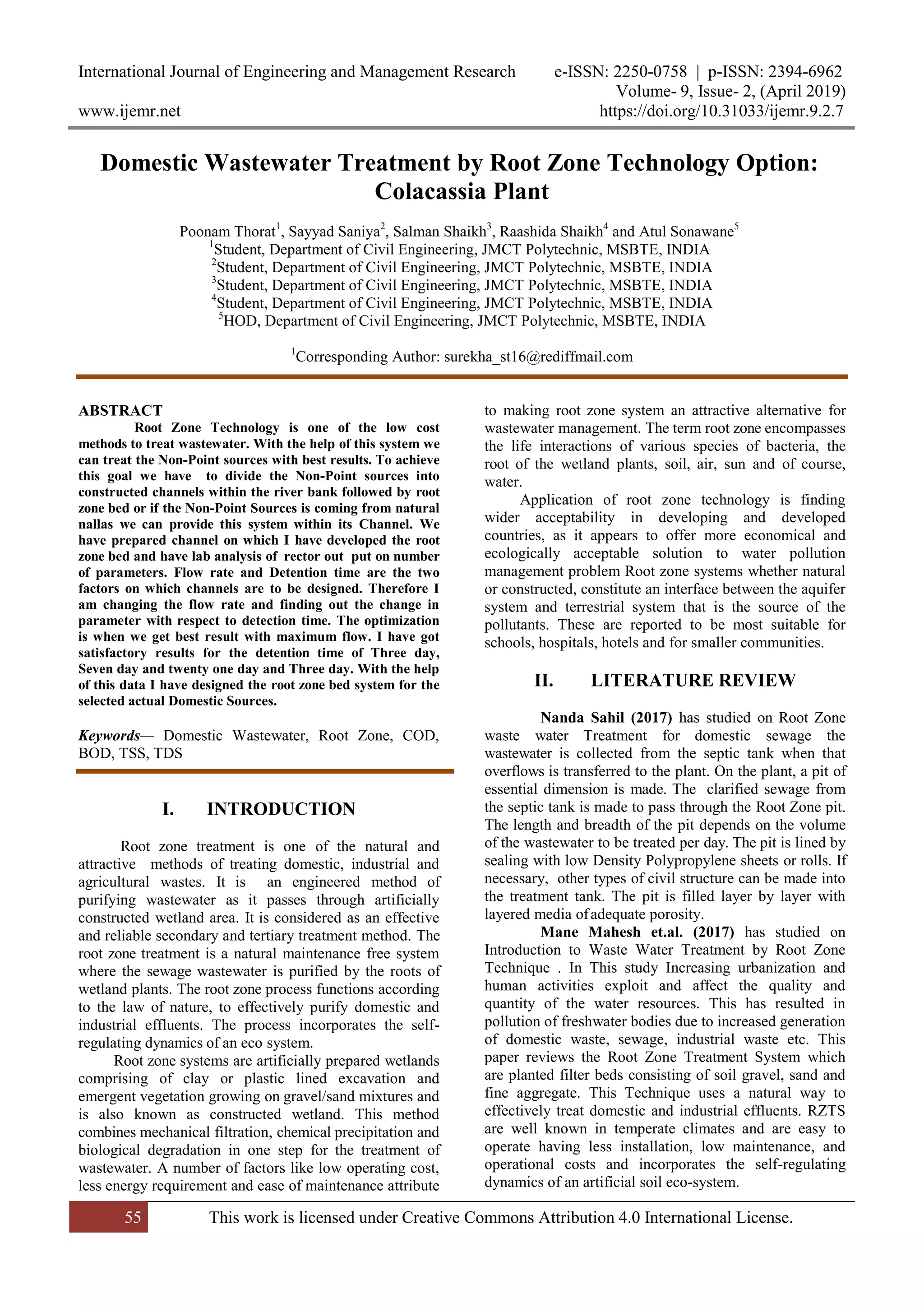
1. Construction Wetland: I have designed constructed
wetland of size 1.5m x 0.5m x 0.3m for both Colacassia
and canna plant.
Consider length of reactor 1.5m, height 0.5m
and thickness 0.3m. In above figure shows section and
plan of constructed reactor. At lower level consider
200mm thick with aggregate 20mm size. Middle layer
200mm thick with natural sand and top layer of 100mm
thick with black cotton soil.
The aggregate cleaned by water before keeping
in reactor similarly cleaned sand by water before keeping
in reactor. Filled all layers simultaneously in reactor and
keep it for one day. Prepare two system parallel for canna
plants and Colacassia plants.
2. Arrangement of Reactor: The rectangular tub with
plant bed was provided with 100 slope with slight
elevation at the bottom of backside of tub and kept in the
slanting position. Inlet and outlet flow rates were adjusted
by using bucket and timer. Inlet flow and outlet flow of
wastewater were adjusted to maintain Hydraulic
Retention Time (HRT) of 3days,7days and 15days.
All dimensions are in meter
Figure 1 Plan and Section of root zone system
.
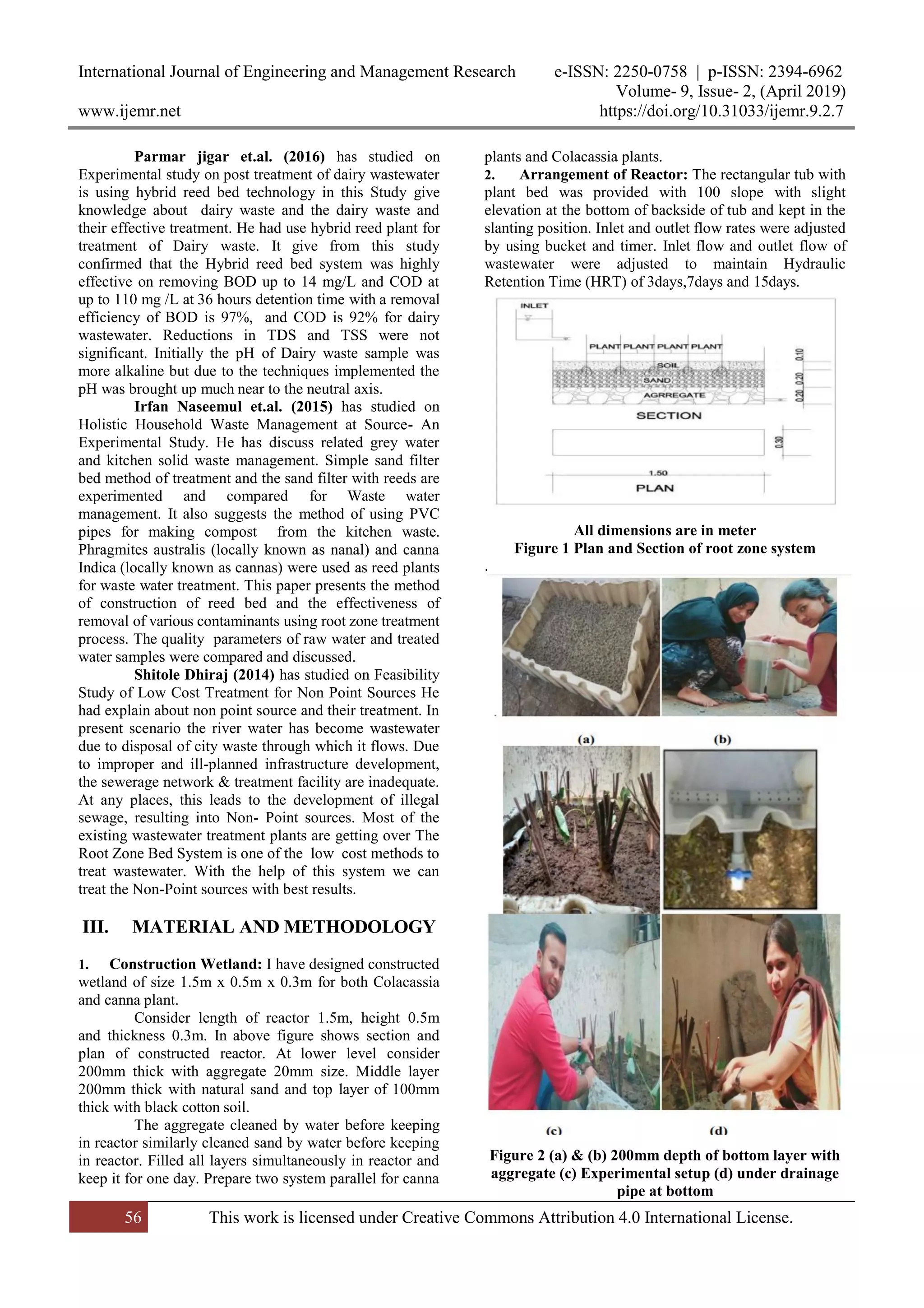
Figure 2 (a) & (b) 200mm depth of bottom layer with
aggregate (c) Experimental setup (d) under drainage
pipe at bottom
International Journal of Engineering and Management Research e-ISSN: 2250-0758 | p-ISSN: 2394-6962
Volume- 9, Issue- 2, (April 2019)
www.ijemr.net https://doi.org/10.31033/ijemr.9.2.7
57 This work is licensed under Creative Commons Attribution 4.0 International License.
3. Planting Arrangement: Reeds can be planted as
rhizomes, seedlings or planted clumps. Clumps can be
planted during all seasons at 2 Nos / m2. Rhizomes grow
best when planted in Premonsoon and t 4 – 6 rhizomes
can be planted per m2. Seedlings should be planted in
Pre-monsoon with 3 – 5 seedlings per m2. Planting
should be done from supporting boards to avoid
compaction of the filter media. Initially the plants should
be kept well watered, but not flooded. With well-
developed shoots, the growth of weeds can be suppressed
by periodical flooding. During the first growth period a
sufficient supply of nutrients is required. If wastewater is
used for initial watering precautions like avoidance of
stagnation have to be taken to inhibit the formation of
H2S within the filter bed.
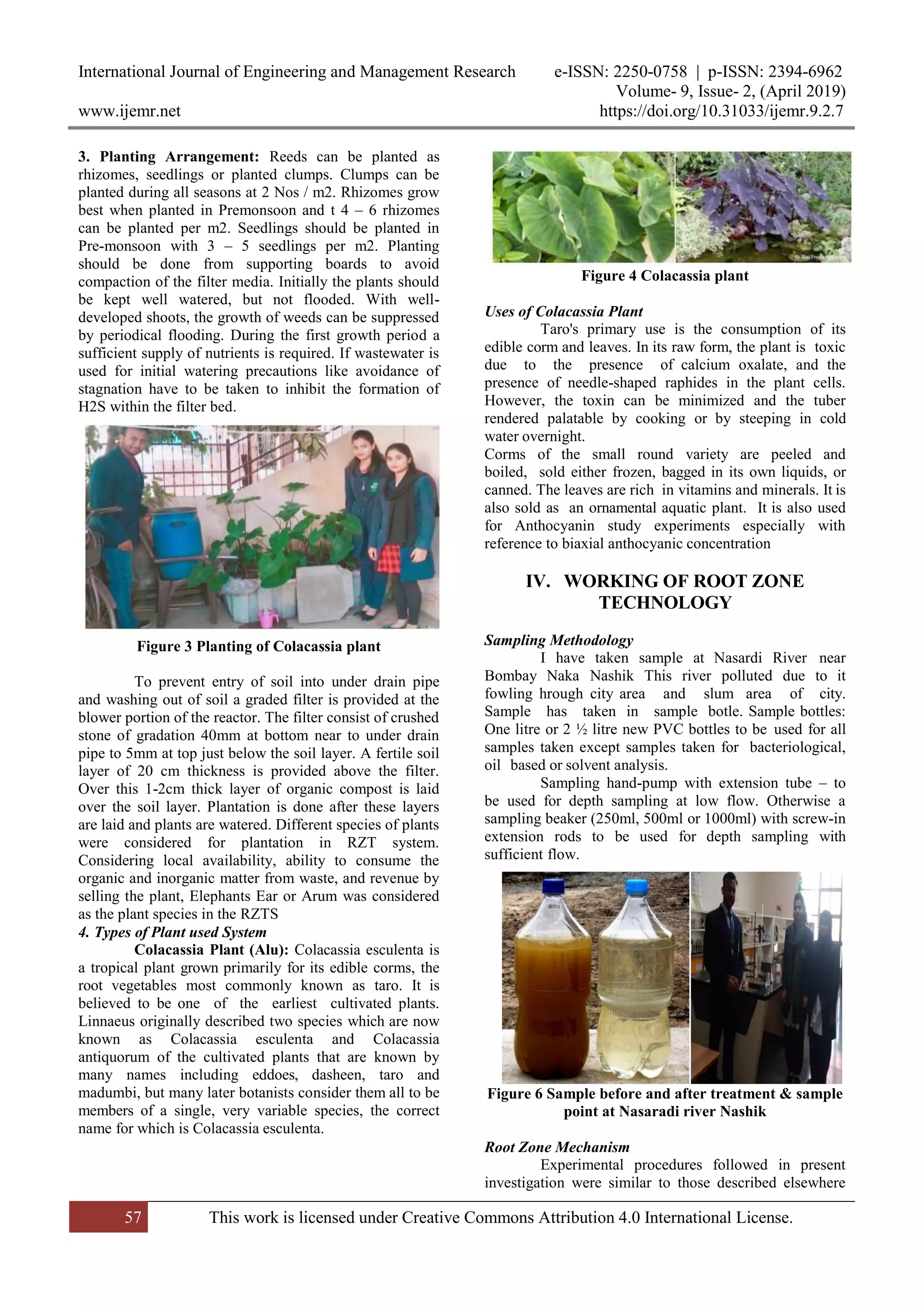
Figure 3 Planting of Colacassia plant
To prevent entry of soil into under drain pipe
and washing out of soil a graded filter is provided at the
blower portion of the reactor. The filter consist of crushed
stone of gradation 40mm at bottom near to under drain
pipe to 5mm at top just below the soil layer. A fertile soil
layer of 20 cm thickness is provided above the filter.
Over this 1-2cm thick layer of organic compost is laid
over the soil layer. Plantation is done after these layers
are laid and plants are watered. Different species of plants
were considered for plantation in RZT system.
Considering local availability, ability to consume the
organic and inorganic matter from waste, and revenue by
selling the plant, Elephants Ear or Arum was considered
as the plant species in the RZTS
4. Types of Plant used System
Colacassia Plant (Alu): Colacassia esculenta is
a tropical plant grown primarily for its edible corms, the
root vegetables most commonly known as taro. It is
believed to be one of the earliest cultivated plants.
Linnaeus originally described two species which are now
known as Colacassia esculenta and Colacassia
antiquorum of the cultivated plants that are known by
many names including eddoes, dasheen, taro and
madumbi, but many later botanists consider them all to be
members of a single, very variable species, the correct
name for which is Colacassia esculenta.
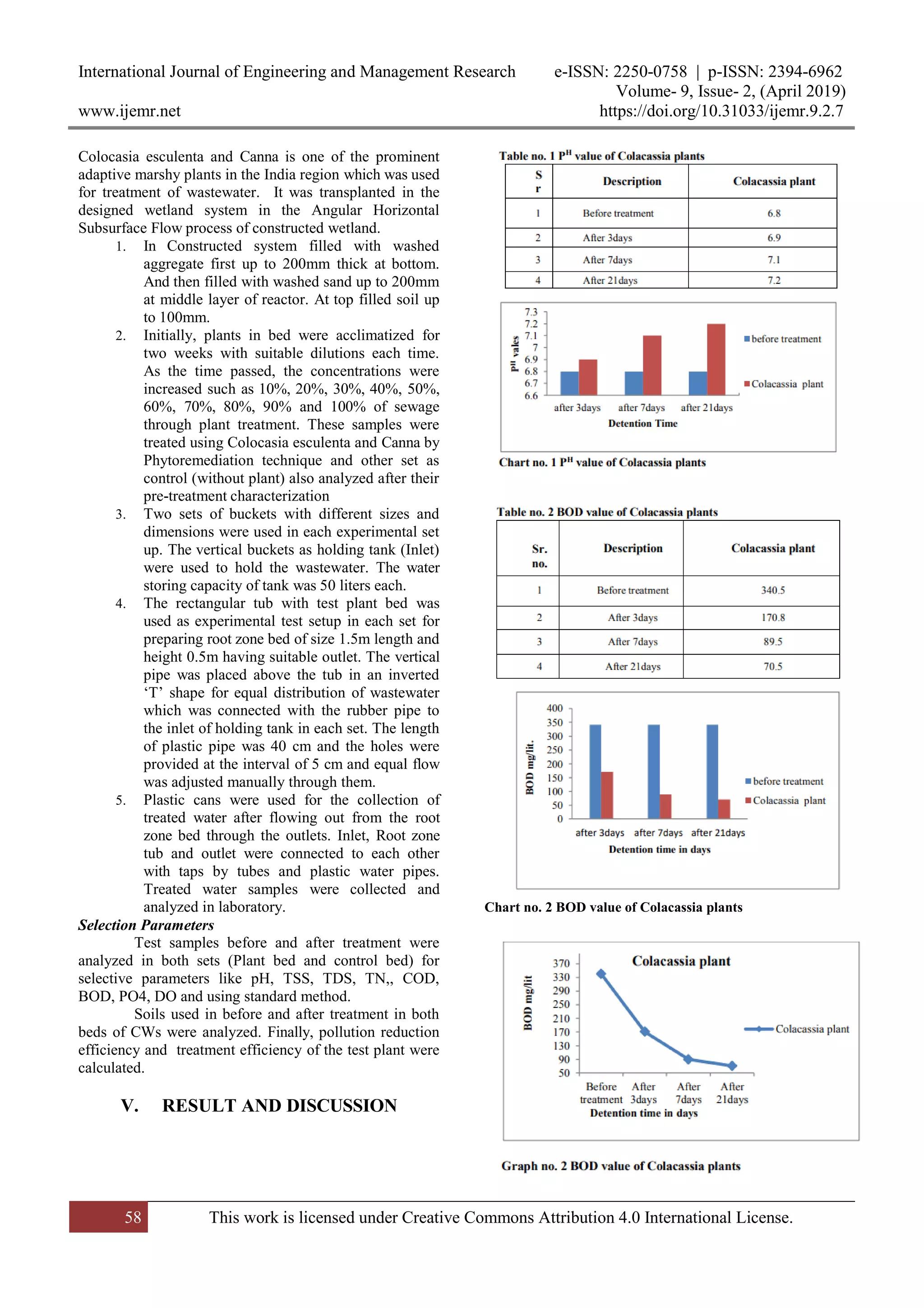
Figure 4 Colacassia plant
Uses of Colacassia Plant
Taro's primary use is the consumption of its
edible corm and leaves. In its raw form, the plant is toxic
due to the presence of calcium oxalate, and the
presence of needle-shaped raphides in the plant cells.
However, the toxin can be minimized and the tuber
rendered palatable by cooking or by steeping in cold
water overnight.
Corms of the small round variety are peeled and
boiled, sold either frozen, bagged in its own liquids, or
canned. The leaves are rich in vitamins and minerals. It is
also sold as an ornamental aquatic plant. It is also used
for Anthocyanin study experiments especially with
reference to biaxial anthocyanic concentration
IV. WORKING OF ROOT ZONE
TECHNOLOGY
Sampling Methodology
I have taken sample at Nasardi River near
Bombay Naka Nashik This river polluted due to it
fowling hrough city area and slum area of city.
Sample has taken in sample botle. Sample bottles:
One litre or 2 ½ litre new PVC bottles to be used for all
samples taken except samples taken for bacteriological,
oil based or solvent analysis.
Sampling hand-pump with extension tube – to
be used for depth sampling at low flow. Otherwise a
sampling beaker (250ml, 500ml or 1000ml) with screw-in
extension rods to be used for depth sampling with
sufficient flow.
Figure 6 Sample before and after treatment & sample
point at Nasaradi river Nashik
Root Zone Mechanism
Experimental procedures followed in present
investigation were similar to those described elsewhere
International Journal of Engineering and Management Research e-ISSN: 2250-0758 | p-ISSN: 2394-6962
Volume- 9, Issue- 2, (April 2019)
www.ijemr.net https://doi.org/10.31033/ijemr.9.2.7
58 This work is licensed under Creative Commons Attribution 4.0 International License.
Colocasia esculenta and Canna is one of the prominent
adaptive marshy plants in the India region which was used
for treatment of wastewater. It was transplanted in the
designed wetland system in the Angular Horizontal
Subsurface Flow process of constructed wetland.
1. In Constructed system filled with washed
aggregate first up to 200mm thick at bottom.
And then filled with washed sand up to 200mm
at middle layer of reactor. At top filled soil up
to 100mm.
2. Initially, plants in bed were acclimatized for
two weeks with suitable dilutions each time.
As the time passed, the concentrations were
increased such as 10%, 20%, 30%, 40%, 50%,
60%, 70%, 80%, 90% and 100% of sewage
through plant treatment. These samples were
treated using Colocasia esculenta and Canna by
Phytoremediation technique and other set as
control (without plant) also analyzed after their
pre-treatment characterization
3. Two sets of buckets with different sizes and
dimensions were used in each experimental set
up. The vertical buckets as holding tank (Inlet)
were used to hold the wastewater. The water
storing capacity of tank was 50 liters each.
4. The rectangular tub with test plant bed was
used as experimental test setup in each set for
preparing root zone bed of size 1.5m length and
height 0.5m having suitable outlet. The vertical
pipe was placed above the tub in an inverted
‘T’ shape for equal distribution of wastewater
which was connected with the rubber pipe to
the inlet of holding tank in each set. The length
of plastic pipe was 40 cm and the holes were
provided at the interval of 5 cm and equal flow
was adjusted manually through them.
5. Plastic cans were used for the collection of
treated water after flowing out from the root
zone bed through the outlets. Inlet, Root zone
tub and outlet were connected to each other
with taps by tubes and plastic water pipes.
Treated water samples were collected and
analyzed in laboratory.
Selection Parameters
Test samples before and after treatment were
analyzed in both sets (Plant bed and control bed) for
selective parameters like pH, TSS, TDS, TN,, COD,
BOD, PO4, DO and using standard method.
Soils used in before and after treatment in both
beds of CWs were analyzed. Finally, pollution reduction
efficiency and treatment efficiency of the test plant were
calculated.
V. RESULT AND DISCUSSION
Chart no. 2 BOD value of Colacassia plants
International Journal of Engineering and Management Research e-ISSN: 2250-0758 | p-ISSN: 2394-6962
Volume- 9, Issue- 2, (April 2019)
www.ijemr.net https://doi.org/10.31033/ijemr.9.2.7
59 This work is licensed under Creative Commons Attribution 4.0 International License.
International Journal of Engineering and Management Research e-ISSN: 2250-0758 | p-ISSN: 2394-6962
Volume- 9, Issue- 2, (April 2019)
www.ijemr.net https://doi.org/10.31033/ijemr.9.2.7
60 This work is licensed under Creative Commons Attribution 4.0 International License.
VI. CONCLUSION
Construction Wetlands are being extensively used
in developing countries to treat domestic, agricultural and
industrial wastewater and urban and highway runoff for
current status of application of root zone system
especially used for domestic’s wastewater.
It is concluded from above project that the method
of RZT is capable to reduce pollutant level shown below.
1. The Initial PH of before treatment is 6.8 and
after treatment by Colacassia plant RZT s
7.2
2. BOD decreasing by Colacassia root zone
after 3days, 7days, 21days and are 50%,
74%, 79% respectively..
3. COD decreasing by Colacassia root zone
after 3days, 7days, 21days are 52%, 78%,
82% respectively
4. TDS decreasing by Colacassia root zone
after 3days, 7days, and 21days are 33%,
39%, 47% respectively.
5. TSS decreasing by Colacassia root zone after
3days, 7days, and 21days are 29%, 60%,
65% respectively.
6. Nitrogen decreasing by Colacassia root zone
after 3days, 7days, and 21days are 54%,
77%, 81% respectively
7. Phosphate decreasing by Colacassia root
zone after 3days, 7days, 21days are 30%,
64%, 70% respectively.
The overall study strongly recommends the use
of CWs for treatment of domestic waste water for
pathogenic bacteria, besides pollutants.
ACKNOWLEDGMENT
At the outset, I wish to express my deep sense of
gratitude to my project guide Prof. Atul Sonawane for
his guidance and encouragement, without which it would
have been not possible. I would like to thank Prof. Atul
Sonawane, Head, civil Engineering Department for his
encouragement, guidance and allowing us to use the all
facilities in the department. I am also grateful to Principal
Prof. Almas Khan who has been a constant source of my
inspiration. At the last I also like to thank my family. I am
also thankful to my friends who has helped me
completion of this project report.
REFERENCES
[1] Bansari M Ribadiya & Mehali J. Mehatal. (2014).
Treatment of municipal and industrial wastewater by reed
bed technology. Journal of Engineering Research and
Application, 4(12), 15-18.
[2] Chavan B.L. & Dhulap V.P. (2013). Developing a
pilot scale angular horizontal subsurface flow constructed
wetland for treatment of sewage through
phytoremediation with colocasia esculenta. International
Journal of Environmental Sciences, 2(2), 6-14.
[3] Calheiros, Cristina S.C. Antonio O.S.S. Rangel, &
Paula M.L. Castro. (2007). Constructed wetland systems
vegetated with different plants applied to the treatment of
tannery wastewater. Water Research, 41, 1790-1798.
[4] Desai Binita & Pratibha Desai. (2014). Root-zone
technology as energy efficient and cost effective for
sewage water treatment biomed research. International
Journal of Pharmacy & Bioscience, 01, 1-6.
[5] Dhulap V.P. & S.S. Patil. (2014). Removal of
pollutants from sewage through constructed wetland
using pennisetum purpureium. Europian Academic
Research, II, 52-64.
[6] George Alex Eobin & Tiwari Gaurav. (2014). Multi-
stage organic water filter system. Global Humanitarian
Technology Conference, 458-461.
[7] Irfan Naseemul & M V Molykutty. (2015). Holistic
household waste management at source- An experimental
study, International Journal of Latest Technology in
Engineering, Management & Applied Science, IV(XI), 12-
16.
[8] Joshi S. & S.S. Patil. (2009). Ecoplanning and
ecotechnological solutions for the wastewaters from point
and Non-Point sources of modern urbanization in the
Ujjani Reservoir Catchment. International Journal of
Pharmacy & Bioscience, I, 45-68.
[9] Kumer Makvana & Manish K.Sharma. (2013).
Assessment of pathogen removal potential of root zone
technology from domestic wastewater. Universal Journal
of Environmental Research and Technology, 3, 401-406.
[10] Mane Mahesh, Bhupen Patil, Mohite Powar, Yatin
Gohil, & Akshaya Ghalimath. (2017). Introduction to
waste water treatment by root zone technique.
International Research Journal of Engineering and
Technology, 04, 1691-1694.
[11] Mthembu M.S., Odinga CA, Swalaha FM, & Bux F.
(2013). Constructed wetlands: A future alternative
wastewater treatment technology. African Journal of
Biotechnology, 12(29), 4542-4553.

Domestic Wastewater Treatment by Root Zone Technology Option: Colacassia Plant

  • 1.
    International Journal ofEngineering and Management Research e-ISSN: 2250-0758 | p-ISSN: 2394-6962 Volume- 9, Issue- 2, (April 2019) www.ijemr.net https://doi.org/10.31033/ijemr.9.2.7 55 This work is licensed under Creative Commons Attribution 4.0 International License. Domestic Wastewater Treatment by Root Zone Technology Option: Colacassia Plant Poonam Thorat1 , Sayyad Saniya2 , Salman Shaikh3 , Raashida Shaikh4 and Atul Sonawane5 1 Student, Department of Civil Engineering, JMCT Polytechnic, MSBTE, INDIA 2 Student, Department of Civil Engineering, JMCT Polytechnic, MSBTE, INDIA 3 Student, Department of Civil Engineering, JMCT Polytechnic, MSBTE, INDIA 4 Student, Department of Civil Engineering, JMCT Polytechnic, MSBTE, INDIA 5 HOD, Department of Civil Engineering, JMCT Polytechnic, MSBTE, INDIA 1 Corresponding Author: surekha_st16@rediffmail.com ABSTRACT Root Zone Technology is one of the low cost methods to treat wastewater. With the help of this system we can treat the Non-Point sources with best results. To achieve this goal we have to divide the Non-Point sources into constructed channels within the river bank followed by root zone bed or if the Non-Point Sources is coming from natural nallas we can provide this system within its Channel. We have prepared channel on which I have developed the root zone bed and have lab analysis of rector out put on number of parameters. Flow rate and Detention time are the two factors on which channels are to be designed. Therefore I am changing the flow rate and finding out the change in parameter with respect to detection time. The optimization is when we get best result with maximum flow. I have got satisfactory results for the detention time of Three day, Seven day and twenty one day and Three day. With the help of this data I have designed the root zone bed system for the selected actual Domestic Sources. Keywords— Domestic Wastewater, Root Zone, COD, BOD, TSS, TDS I. INTRODUCTION Root zone treatment is one of the natural and attractive methods of treating domestic, industrial and agricultural wastes. It is an engineered method of purifying wastewater as it passes through artificially constructed wetland area. It is considered as an effective and reliable secondary and tertiary treatment method. The root zone treatment is a natural maintenance free system where the sewage wastewater is purified by the roots of wetland plants. The root zone process functions according to the law of nature, to effectively purify domestic and industrial effluents. The process incorporates the self- regulating dynamics of an eco system. Root zone systems are artificially prepared wetlands comprising of clay or plastic lined excavation and emergent vegetation growing on gravel/sand mixtures and is also known as constructed wetland. This method combines mechanical filtration, chemical precipitation and biological degradation in one step for the treatment of wastewater. A number of factors like low operating cost, less energy requirement and ease of maintenance attribute to making root zone system an attractive alternative for wastewater management. The term root zone encompasses the life interactions of various species of bacteria, the root of the wetland plants, soil, air, sun and of course, water. Application of root zone technology is finding wider acceptability in developing and developed countries, as it appears to offer more economical and ecologically acceptable solution to water pollution management problem Root zone systems whether natural or constructed, constitute an interface between the aquifer system and terrestrial system that is the source of the pollutants. These are reported to be most suitable for schools, hospitals, hotels and for smaller communities. II. LITERATURE REVIEW Nanda Sahil (2017) has studied on Root Zone waste water Treatment for domestic sewage the wastewater is collected from the septic tank when that overflows is transferred to the plant. On the plant, a pit of essential dimension is made. The clarified sewage from the septic tank is made to pass through the Root Zone pit. The length and breadth of the pit depends on the volume of the wastewater to be treated per day. The pit is lined by sealing with low Density Polypropylene sheets or rolls. If necessary, other types of civil structure can be made into the treatment tank. The pit is filled layer by layer with layered media ofadequate porosity. Mane Mahesh et.al. (2017) has studied on Introduction to Waste Water Treatment by Root Zone Technique . In This study Increasing urbanization and human activities exploit and affect the quality and quantity of the water resources. This has resulted in pollution of freshwater bodies due to increased generation of domestic waste, sewage, industrial waste etc. This paper reviews the Root Zone Treatment System which are planted filter beds consisting of soil gravel, sand and fine aggregate. This Technique uses a natural way to effectively treat domestic and industrial effluents. RZTS are well known in temperate climates and are easy to operate having less installation, low maintenance, and operational costs and incorporates the self-regulating dynamics of an artificial soil eco-system.
  • 2.
    International Journal ofEngineering and Management Research e-ISSN: 2250-0758 | p-ISSN: 2394-6962 Volume- 9, Issue- 2, (April 2019) www.ijemr.net https://doi.org/10.31033/ijemr.9.2.7 56 This work is licensed under Creative Commons Attribution 4.0 International License. Parmar jigar et.al. (2016) has studied on Experimental study on post treatment of dairy wastewater is using hybrid reed bed technology in this Study give knowledge about dairy waste and the dairy waste and their effective treatment. He had use hybrid reed plant for treatment of Dairy waste. It give from this study confirmed that the Hybrid reed bed system was highly effective on removing BOD up to 14 mg/L and COD at up to 110 mg /L at 36 hours detention time with a removal efficiency of BOD is 97%, and COD is 92% for dairy wastewater. Reductions in TDS and TSS were not significant. Initially the pH of Dairy waste sample was more alkaline but due to the techniques implemented the pH was brought up much near to the neutral axis. Irfan Naseemul et.al. (2015) has studied on Holistic Household Waste Management at Source- An Experimental Study. He has discuss related grey water and kitchen solid waste management. Simple sand filter bed method of treatment and the sand filter with reeds are experimented and compared for Waste water management. It also suggests the method of using PVC pipes for making compost from the kitchen waste. Phragmites australis (locally known as nanal) and canna Indica (locally known as cannas) were used as reed plants for waste water treatment. This paper presents the method of construction of reed bed and the effectiveness of removal of various contaminants using root zone treatment process. The quality parameters of raw water and treated water samples were compared and discussed. Shitole Dhiraj (2014) has studied on Feasibility Study of Low Cost Treatment for Non Point Sources He had explain about non point source and their treatment. In present scenario the river water has become wastewater due to disposal of city waste through which it flows. Due to improper and ill-planned infrastructure development, the sewerage network & treatment facility are inadequate. At any places, this leads to the development of illegal sewage, resulting into Non- Point sources. Most of the existing wastewater treatment plants are getting over The Root Zone Bed System is one of the low cost methods to treat wastewater. With the help of this system we can treat the Non-Point sources with best results. III. MATERIAL AND METHODOLOGY 1. Construction Wetland: I have designed constructed wetland of size 1.5m x 0.5m x 0.3m for both Colacassia and canna plant. Consider length of reactor 1.5m, height 0.5m and thickness 0.3m. In above figure shows section and plan of constructed reactor. At lower level consider 200mm thick with aggregate 20mm size. Middle layer 200mm thick with natural sand and top layer of 100mm thick with black cotton soil. The aggregate cleaned by water before keeping in reactor similarly cleaned sand by water before keeping in reactor. Filled all layers simultaneously in reactor and keep it for one day. Prepare two system parallel for canna plants and Colacassia plants. 2. Arrangement of Reactor: The rectangular tub with plant bed was provided with 100 slope with slight elevation at the bottom of backside of tub and kept in the slanting position. Inlet and outlet flow rates were adjusted by using bucket and timer. Inlet flow and outlet flow of wastewater were adjusted to maintain Hydraulic Retention Time (HRT) of 3days,7days and 15days. All dimensions are in meter Figure 1 Plan and Section of root zone system . Figure 2 (a) & (b) 200mm depth of bottom layer with aggregate (c) Experimental setup (d) under drainage pipe at bottom
  • 3.
    International Journal ofEngineering and Management Research e-ISSN: 2250-0758 | p-ISSN: 2394-6962 Volume- 9, Issue- 2, (April 2019) www.ijemr.net https://doi.org/10.31033/ijemr.9.2.7 57 This work is licensed under Creative Commons Attribution 4.0 International License. 3. Planting Arrangement: Reeds can be planted as rhizomes, seedlings or planted clumps. Clumps can be planted during all seasons at 2 Nos / m2. Rhizomes grow best when planted in Premonsoon and t 4 – 6 rhizomes can be planted per m2. Seedlings should be planted in Pre-monsoon with 3 – 5 seedlings per m2. Planting should be done from supporting boards to avoid compaction of the filter media. Initially the plants should be kept well watered, but not flooded. With well- developed shoots, the growth of weeds can be suppressed by periodical flooding. During the first growth period a sufficient supply of nutrients is required. If wastewater is used for initial watering precautions like avoidance of stagnation have to be taken to inhibit the formation of H2S within the filter bed. Figure 3 Planting of Colacassia plant To prevent entry of soil into under drain pipe and washing out of soil a graded filter is provided at the blower portion of the reactor. The filter consist of crushed stone of gradation 40mm at bottom near to under drain pipe to 5mm at top just below the soil layer. A fertile soil layer of 20 cm thickness is provided above the filter. Over this 1-2cm thick layer of organic compost is laid over the soil layer. Plantation is done after these layers are laid and plants are watered. Different species of plants were considered for plantation in RZT system. Considering local availability, ability to consume the organic and inorganic matter from waste, and revenue by selling the plant, Elephants Ear or Arum was considered as the plant species in the RZTS 4. Types of Plant used System Colacassia Plant (Alu): Colacassia esculenta is a tropical plant grown primarily for its edible corms, the root vegetables most commonly known as taro. It is believed to be one of the earliest cultivated plants. Linnaeus originally described two species which are now known as Colacassia esculenta and Colacassia antiquorum of the cultivated plants that are known by many names including eddoes, dasheen, taro and madumbi, but many later botanists consider them all to be members of a single, very variable species, the correct name for which is Colacassia esculenta. Figure 4 Colacassia plant Uses of Colacassia Plant Taro's primary use is the consumption of its edible corm and leaves. In its raw form, the plant is toxic due to the presence of calcium oxalate, and the presence of needle-shaped raphides in the plant cells. However, the toxin can be minimized and the tuber rendered palatable by cooking or by steeping in cold water overnight. Corms of the small round variety are peeled and boiled, sold either frozen, bagged in its own liquids, or canned. The leaves are rich in vitamins and minerals. It is also sold as an ornamental aquatic plant. It is also used for Anthocyanin study experiments especially with reference to biaxial anthocyanic concentration IV. WORKING OF ROOT ZONE TECHNOLOGY Sampling Methodology I have taken sample at Nasardi River near Bombay Naka Nashik This river polluted due to it fowling hrough city area and slum area of city. Sample has taken in sample botle. Sample bottles: One litre or 2 ½ litre new PVC bottles to be used for all samples taken except samples taken for bacteriological, oil based or solvent analysis. Sampling hand-pump with extension tube – to be used for depth sampling at low flow. Otherwise a sampling beaker (250ml, 500ml or 1000ml) with screw-in extension rods to be used for depth sampling with sufficient flow. Figure 6 Sample before and after treatment & sample point at Nasaradi river Nashik Root Zone Mechanism Experimental procedures followed in present investigation were similar to those described elsewhere
  • 4.
    International Journal ofEngineering and Management Research e-ISSN: 2250-0758 | p-ISSN: 2394-6962 Volume- 9, Issue- 2, (April 2019) www.ijemr.net https://doi.org/10.31033/ijemr.9.2.7 58 This work is licensed under Creative Commons Attribution 4.0 International License. Colocasia esculenta and Canna is one of the prominent adaptive marshy plants in the India region which was used for treatment of wastewater. It was transplanted in the designed wetland system in the Angular Horizontal Subsurface Flow process of constructed wetland. 1. In Constructed system filled with washed aggregate first up to 200mm thick at bottom. And then filled with washed sand up to 200mm at middle layer of reactor. At top filled soil up to 100mm. 2. Initially, plants in bed were acclimatized for two weeks with suitable dilutions each time. As the time passed, the concentrations were increased such as 10%, 20%, 30%, 40%, 50%, 60%, 70%, 80%, 90% and 100% of sewage through plant treatment. These samples were treated using Colocasia esculenta and Canna by Phytoremediation technique and other set as control (without plant) also analyzed after their pre-treatment characterization 3. Two sets of buckets with different sizes and dimensions were used in each experimental set up. The vertical buckets as holding tank (Inlet) were used to hold the wastewater. The water storing capacity of tank was 50 liters each. 4. The rectangular tub with test plant bed was used as experimental test setup in each set for preparing root zone bed of size 1.5m length and height 0.5m having suitable outlet. The vertical pipe was placed above the tub in an inverted ‘T’ shape for equal distribution of wastewater which was connected with the rubber pipe to the inlet of holding tank in each set. The length of plastic pipe was 40 cm and the holes were provided at the interval of 5 cm and equal flow was adjusted manually through them. 5. Plastic cans were used for the collection of treated water after flowing out from the root zone bed through the outlets. Inlet, Root zone tub and outlet were connected to each other with taps by tubes and plastic water pipes. Treated water samples were collected and analyzed in laboratory. Selection Parameters Test samples before and after treatment were analyzed in both sets (Plant bed and control bed) for selective parameters like pH, TSS, TDS, TN,, COD, BOD, PO4, DO and using standard method. Soils used in before and after treatment in both beds of CWs were analyzed. Finally, pollution reduction efficiency and treatment efficiency of the test plant were calculated. V. RESULT AND DISCUSSION Chart no. 2 BOD value of Colacassia plants
  • 5.
    International Journal ofEngineering and Management Research e-ISSN: 2250-0758 | p-ISSN: 2394-6962 Volume- 9, Issue- 2, (April 2019) www.ijemr.net https://doi.org/10.31033/ijemr.9.2.7 59 This work is licensed under Creative Commons Attribution 4.0 International License.
  • 6.
    International Journal ofEngineering and Management Research e-ISSN: 2250-0758 | p-ISSN: 2394-6962 Volume- 9, Issue- 2, (April 2019) www.ijemr.net https://doi.org/10.31033/ijemr.9.2.7 60 This work is licensed under Creative Commons Attribution 4.0 International License. VI. CONCLUSION Construction Wetlands are being extensively used in developing countries to treat domestic, agricultural and industrial wastewater and urban and highway runoff for current status of application of root zone system especially used for domestic’s wastewater. It is concluded from above project that the method of RZT is capable to reduce pollutant level shown below. 1. The Initial PH of before treatment is 6.8 and after treatment by Colacassia plant RZT s 7.2 2. BOD decreasing by Colacassia root zone after 3days, 7days, 21days and are 50%, 74%, 79% respectively.. 3. COD decreasing by Colacassia root zone after 3days, 7days, 21days are 52%, 78%, 82% respectively 4. TDS decreasing by Colacassia root zone after 3days, 7days, and 21days are 33%, 39%, 47% respectively. 5. TSS decreasing by Colacassia root zone after 3days, 7days, and 21days are 29%, 60%, 65% respectively. 6. Nitrogen decreasing by Colacassia root zone after 3days, 7days, and 21days are 54%, 77%, 81% respectively 7. Phosphate decreasing by Colacassia root zone after 3days, 7days, 21days are 30%, 64%, 70% respectively. The overall study strongly recommends the use of CWs for treatment of domestic waste water for pathogenic bacteria, besides pollutants. ACKNOWLEDGMENT At the outset, I wish to express my deep sense of gratitude to my project guide Prof. Atul Sonawane for his guidance and encouragement, without which it would have been not possible. I would like to thank Prof. Atul Sonawane, Head, civil Engineering Department for his encouragement, guidance and allowing us to use the all facilities in the department. I am also grateful to Principal Prof. Almas Khan who has been a constant source of my inspiration. At the last I also like to thank my family. I am also thankful to my friends who has helped me completion of this project report. REFERENCES [1] Bansari M Ribadiya & Mehali J. Mehatal. (2014). Treatment of municipal and industrial wastewater by reed bed technology. Journal of Engineering Research and Application, 4(12), 15-18. [2] Chavan B.L. & Dhulap V.P. (2013). Developing a pilot scale angular horizontal subsurface flow constructed wetland for treatment of sewage through phytoremediation with colocasia esculenta. International Journal of Environmental Sciences, 2(2), 6-14. [3] Calheiros, Cristina S.C. Antonio O.S.S. Rangel, & Paula M.L. Castro. (2007). Constructed wetland systems vegetated with different plants applied to the treatment of tannery wastewater. Water Research, 41, 1790-1798. [4] Desai Binita & Pratibha Desai. (2014). Root-zone technology as energy efficient and cost effective for sewage water treatment biomed research. International Journal of Pharmacy & Bioscience, 01, 1-6. [5] Dhulap V.P. & S.S. Patil. (2014). Removal of pollutants from sewage through constructed wetland using pennisetum purpureium. Europian Academic Research, II, 52-64. [6] George Alex Eobin & Tiwari Gaurav. (2014). Multi- stage organic water filter system. Global Humanitarian Technology Conference, 458-461. [7] Irfan Naseemul & M V Molykutty. (2015). Holistic household waste management at source- An experimental study, International Journal of Latest Technology in Engineering, Management & Applied Science, IV(XI), 12- 16. [8] Joshi S. & S.S. Patil. (2009). Ecoplanning and ecotechnological solutions for the wastewaters from point and Non-Point sources of modern urbanization in the Ujjani Reservoir Catchment. International Journal of Pharmacy & Bioscience, I, 45-68. [9] Kumer Makvana & Manish K.Sharma. (2013). Assessment of pathogen removal potential of root zone technology from domestic wastewater. Universal Journal of Environmental Research and Technology, 3, 401-406. [10] Mane Mahesh, Bhupen Patil, Mohite Powar, Yatin Gohil, & Akshaya Ghalimath. (2017). Introduction to waste water treatment by root zone technique. International Research Journal of Engineering and Technology, 04, 1691-1694. [11] Mthembu M.S., Odinga CA, Swalaha FM, & Bux F. (2013). Constructed wetlands: A future alternative wastewater treatment technology. African Journal of Biotechnology, 12(29), 4542-4553.