Documentation 101 Natalie Bermudez, RN, BSN, MS Clinical Educator for Telemetry For Novice and Experienced Nurses New to Bethesda Memorial Hospital
Nursing Documentation “ Documenting your patient’s care has always been important. But with health care growing increasingly complex, expert documentation skills have become indispensable.” (Seeber-Combs, 2006, p. 1)
Nursing Documentation Cost constraints, sicker patients, and nurses’ growing roles further emphasize the need for a properly documented medical record. (Seeber-Combs, 2006, p. 1)
Nursing Documentation “ When you document effectively, your patient’s medical record reflects your professionalism.” (Seeber-Combs, 2006, p. 1)
Reasons for Documentation Continuity-of-Care Tool Patient Protection Device Quality Management Aid Legal Safety Net (Seeber-Combs, 2006, p. 1)
Documentation Systems Source-Oriented Problem-Oriented Narrative Notes Focus Charting (DAR) PIE Documentation Charting By Exception (Seeber-Combs, 2006)
Charting By Exception When you use CBE, you document only abnormal or significant findings or deviations from established norms. (Seeber-Combs, 2006, p. 7)
Charting By Exception This system eliminates lengthy, repetitive notes and makes trends or changes in the patient’s condition more obvious. (Seeber-Combs, 2006, p. 7)
Documentation Made Easy Document what the patient tells you Document what you assess Document what you do Document outcomes of what you do Document what you teach
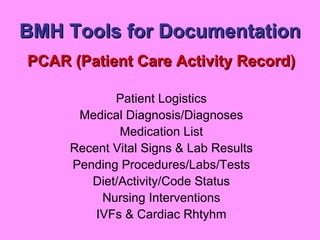
BMH Tools for Documentation PCAR (Patient Care Activity Record) Patient Logistics Medical Diagnosis/Diagnoses Medication List Recent Vital Signs & Lab Results Pending Procedures/Labs/Tests Diet/Activity/Code Status Nursing Interventions IVFs & Cardiac Rhtyhm
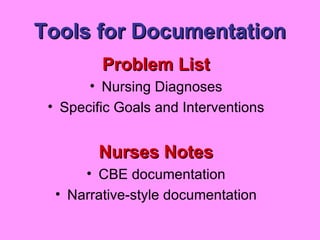
Tools for Documentation Problem List Nursing Diagnoses Specific Goals and Interventions Nurses Notes CBE documentation Narrative-style documentation
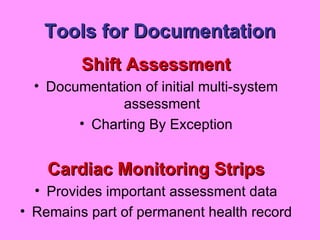
Tools for Documentation Shift Assessment Documentation of initial multi-system assessment Charting By Exception Cardiac Monitoring Strips Provides important assessment data Remains part of permanent health record
Tools for Documentation Flow Sheets and Checklists IV Site Neuro-checks PCA Pumps Post-Cardiac Catheterization
Incident Reports Medication errors or harm to clients, staff, or visitors Risk management tool Use to track trends and patterns For Quality Assurance Not for punitive measures Kept separately of health record
Legal Aspects A patient chart is a legal document Any documentation on the patient’s chart is permanent Assure that only pertinent information is entered
Telephone Orders Only registered nurses may obtain a telephone order A telephone order may only be taken via the telephone All telephone orders must have the date and time the order is received Must also include name of RN and physician
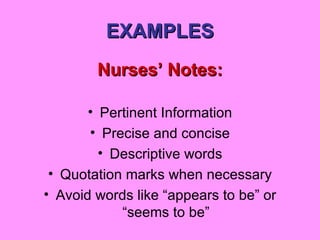
EXAMPLES Nurses’ Notes: Pertinent Information Precise and concise Descriptive words Quotation marks when necessary Avoid words like “appears to be” or “seems to be”
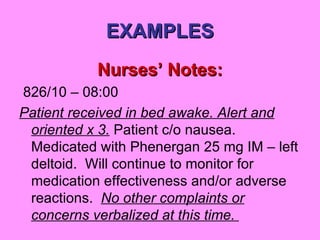
EXAMPLES Nurses’ Notes: 826/10 – 08:00 Patient received in bed awake. Alert and oriented x 3.  Patient c/o nausea.  Medicated with Phenergan 25 mg IM – left deltoid.  Will continue to monitor for medication effectiveness and/or adverse reactions.  No other complaints or concerns verbalized at this time.
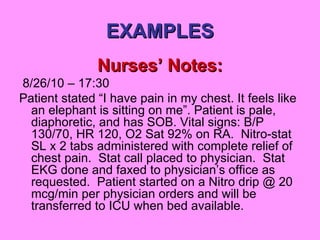
EXAMPLES Nurses’ Notes: 8/26/10 – 17:30 Patient stated “I have pain in my chest. It feels like an elephant is sitting on me”. Patient is pale, diaphoretic, and has SOB. Vital signs: B/P 130/70, HR 120, O2 Sat 92% on RA.  Nitro-stat SL x 2 tabs administered with complete relief of chest pain.  Stat call placed to physician.  Stat EKG done and faxed to physician’s office as requested.  Patient started on a Nitro drip @ 20 mcg/min per physician orders and will be transferred to ICU when bed available.
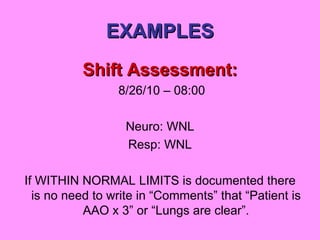
EXAMPLES Shift Assessment: 8/26/10 – 08:00 Neuro: WNL Resp: WNL If WITHIN NORMAL LIMITS is documented there is no need to write in “Comments” that “Patient is AAO x 3” or “Lungs are clear”.
EXAMPLES Shift Assessment: 8/26/10 – 08:00 If you documented the shift assessment @ 0800, then it is not necessary to document a narrative assessment in the Nurse’s Notes for the same time.
EXAMPLES Shift Assessment is done: 8/26/10 – 08:00 AAO x 3. No neuro deficits. Lungs are clear/diminished at bases bilaterally. O2 sat with 2L NC is 100%. Oral mucosa and nailbeds are pink with adequate CR.  Heart sounds are regular; no murmurs. Rhythm is sinus 70’s.  Abdomen soft, non-tender. Bowel sounds are positive x 4; last BM 9/29/07.  Foley catheter in place draining clear, yellow urine. MAE. Ambulates to bathroom independently; steady gait. 0/9% NaCL @ 50 ml/hr infusing to LFA IV site; no redness or swelling at insertion site.
EXAMPLES Admission Assessment & Nursing Admission History
EXAMPLES Nursing Admission History/Assessment Needs to be completed ASAP Includes Home Meds Immunization & TB History Past Medical/Surgical History Social History Assessment Needs to be Thorough
EXAMPLES Problem List: Documentation needs to be completed for each problem on the list once per shift If problem goals have been met, problem may be removed from the list (Resolved) Problem list may be updated to include new problems
EXAMPLES PCAR: Needs to be initiated on admission and updated by nursing on an as needed basis Communication tool for nurses!!!!!!!!!!!!
EXAMPLES PCAR: Routine Activities… Conditioning Parameters… Call Physician If…
EXAMPLES Telephone Orders: All telephone orders should be verified by repeating the orders to the physician Label verbal orders with RBTO RBTO = Read Back Telephone Order All telephone orders need to be signed by physician with date and time within 48 hours!!!
EXAMPLES Verbal Orders: 8/26/10 19:00 1) Start IV Nitro drip @ 20 mcg/min and titrate for chest pain relief. 2) Stat EKG 3) Cardiac enzymes every 6 hours x 3, first set stat 4) O2 2L NC, titrate to keep O2 sat  >  92% RBTO: Dr. Von Sohsten/N. Bermudez, RN
Incident Reports What is an incident report? What info do I include in an incident report? Do I document the event/occurrence in the nurses’ notes? How should I document the occurrence … what should I say?
Documentation in a Nutshell Documentation should tell a story without making it sound like a novel!!! Parts of documentation are like pieces of a puzzle Document facts Avoid judgments or suggestive comments
Documentation in a Nutshell Be sure to TIME and DATE all entries Change TIME and DATE to the actual time of occurrences Incident Reports should not be documented as such Document details of incident only
Documentation in a Nutshell Remember that the patient chart is a  LEGAL  document
Reference Seeber-Combs, C. (2006).  Mosby’s surefire documentation: How, what, and when nurses need to document,  (2 nd  ed. ). St. Louis, MO: Mosby Elsevier.

Documentation 101 - BMH/Tele

  • 1.
    Documentation 101 NatalieBermudez, RN, BSN, MS Clinical Educator for Telemetry For Novice and Experienced Nurses New to Bethesda Memorial Hospital
  • 2.
    Nursing Documentation “Documenting your patient’s care has always been important. But with health care growing increasingly complex, expert documentation skills have become indispensable.” (Seeber-Combs, 2006, p. 1)
  • 3.
    Nursing Documentation Costconstraints, sicker patients, and nurses’ growing roles further emphasize the need for a properly documented medical record. (Seeber-Combs, 2006, p. 1)
  • 4.
    Nursing Documentation “When you document effectively, your patient’s medical record reflects your professionalism.” (Seeber-Combs, 2006, p. 1)
  • 5.
    Reasons for DocumentationContinuity-of-Care Tool Patient Protection Device Quality Management Aid Legal Safety Net (Seeber-Combs, 2006, p. 1)
  • 6.
    Documentation Systems Source-OrientedProblem-Oriented Narrative Notes Focus Charting (DAR) PIE Documentation Charting By Exception (Seeber-Combs, 2006)
  • 7.
    Charting By ExceptionWhen you use CBE, you document only abnormal or significant findings or deviations from established norms. (Seeber-Combs, 2006, p. 7)
  • 8.
    Charting By ExceptionThis system eliminates lengthy, repetitive notes and makes trends or changes in the patient’s condition more obvious. (Seeber-Combs, 2006, p. 7)
  • 9.
    Documentation Made EasyDocument what the patient tells you Document what you assess Document what you do Document outcomes of what you do Document what you teach
  • 10.
    BMH Tools forDocumentation PCAR (Patient Care Activity Record) Patient Logistics Medical Diagnosis/Diagnoses Medication List Recent Vital Signs & Lab Results Pending Procedures/Labs/Tests Diet/Activity/Code Status Nursing Interventions IVFs & Cardiac Rhtyhm
  • 11.
    Tools for DocumentationProblem List Nursing Diagnoses Specific Goals and Interventions Nurses Notes CBE documentation Narrative-style documentation
  • 12.
    Tools for DocumentationShift Assessment Documentation of initial multi-system assessment Charting By Exception Cardiac Monitoring Strips Provides important assessment data Remains part of permanent health record
  • 13.
    Tools for DocumentationFlow Sheets and Checklists IV Site Neuro-checks PCA Pumps Post-Cardiac Catheterization
  • 14.
    Incident Reports Medicationerrors or harm to clients, staff, or visitors Risk management tool Use to track trends and patterns For Quality Assurance Not for punitive measures Kept separately of health record
  • 15.
    Legal Aspects Apatient chart is a legal document Any documentation on the patient’s chart is permanent Assure that only pertinent information is entered
  • 16.
    Telephone Orders Onlyregistered nurses may obtain a telephone order A telephone order may only be taken via the telephone All telephone orders must have the date and time the order is received Must also include name of RN and physician
  • 17.
    EXAMPLES Nurses’ Notes:Pertinent Information Precise and concise Descriptive words Quotation marks when necessary Avoid words like “appears to be” or “seems to be”
  • 18.
    EXAMPLES Nurses’ Notes:826/10 – 08:00 Patient received in bed awake. Alert and oriented x 3. Patient c/o nausea. Medicated with Phenergan 25 mg IM – left deltoid. Will continue to monitor for medication effectiveness and/or adverse reactions. No other complaints or concerns verbalized at this time.
  • 19.
    EXAMPLES Nurses’ Notes:8/26/10 – 17:30 Patient stated “I have pain in my chest. It feels like an elephant is sitting on me”. Patient is pale, diaphoretic, and has SOB. Vital signs: B/P 130/70, HR 120, O2 Sat 92% on RA. Nitro-stat SL x 2 tabs administered with complete relief of chest pain. Stat call placed to physician. Stat EKG done and faxed to physician’s office as requested. Patient started on a Nitro drip @ 20 mcg/min per physician orders and will be transferred to ICU when bed available.
  • 20.
    EXAMPLES Shift Assessment:8/26/10 – 08:00 Neuro: WNL Resp: WNL If WITHIN NORMAL LIMITS is documented there is no need to write in “Comments” that “Patient is AAO x 3” or “Lungs are clear”.
  • 21.
    EXAMPLES Shift Assessment:8/26/10 – 08:00 If you documented the shift assessment @ 0800, then it is not necessary to document a narrative assessment in the Nurse’s Notes for the same time.
  • 22.
    EXAMPLES Shift Assessmentis done: 8/26/10 – 08:00 AAO x 3. No neuro deficits. Lungs are clear/diminished at bases bilaterally. O2 sat with 2L NC is 100%. Oral mucosa and nailbeds are pink with adequate CR. Heart sounds are regular; no murmurs. Rhythm is sinus 70’s. Abdomen soft, non-tender. Bowel sounds are positive x 4; last BM 9/29/07. Foley catheter in place draining clear, yellow urine. MAE. Ambulates to bathroom independently; steady gait. 0/9% NaCL @ 50 ml/hr infusing to LFA IV site; no redness or swelling at insertion site.
  • 23.
    EXAMPLES Admission Assessment& Nursing Admission History
  • 24.
    EXAMPLES Nursing AdmissionHistory/Assessment Needs to be completed ASAP Includes Home Meds Immunization & TB History Past Medical/Surgical History Social History Assessment Needs to be Thorough
  • 25.
    EXAMPLES Problem List:Documentation needs to be completed for each problem on the list once per shift If problem goals have been met, problem may be removed from the list (Resolved) Problem list may be updated to include new problems
  • 26.
    EXAMPLES PCAR: Needsto be initiated on admission and updated by nursing on an as needed basis Communication tool for nurses!!!!!!!!!!!!
  • 27.
    EXAMPLES PCAR: RoutineActivities… Conditioning Parameters… Call Physician If…
  • 28.
    EXAMPLES Telephone Orders:All telephone orders should be verified by repeating the orders to the physician Label verbal orders with RBTO RBTO = Read Back Telephone Order All telephone orders need to be signed by physician with date and time within 48 hours!!!
  • 29.
    EXAMPLES Verbal Orders:8/26/10 19:00 1) Start IV Nitro drip @ 20 mcg/min and titrate for chest pain relief. 2) Stat EKG 3) Cardiac enzymes every 6 hours x 3, first set stat 4) O2 2L NC, titrate to keep O2 sat > 92% RBTO: Dr. Von Sohsten/N. Bermudez, RN
  • 30.
    Incident Reports Whatis an incident report? What info do I include in an incident report? Do I document the event/occurrence in the nurses’ notes? How should I document the occurrence … what should I say?
  • 31.
    Documentation in aNutshell Documentation should tell a story without making it sound like a novel!!! Parts of documentation are like pieces of a puzzle Document facts Avoid judgments or suggestive comments
  • 32.
    Documentation in aNutshell Be sure to TIME and DATE all entries Change TIME and DATE to the actual time of occurrences Incident Reports should not be documented as such Document details of incident only
  • 33.
    Documentation in aNutshell Remember that the patient chart is a LEGAL document
  • 34.
    Reference Seeber-Combs, C.(2006). Mosby’s surefire documentation: How, what, and when nurses need to document, (2 nd ed. ). St. Louis, MO: Mosby Elsevier.