NAME – MONIKA KUMARI NHAGAT
REGISTRATION NO. – 12105732
COURSE – POL 226
ASSIGNMENT TOPIC – ASEAN
 The Association of Southeast Asian Nations is a regional organization
which was established to promote political and social stability amid
rising tensions among the Asia-Pacific’s post-colonial states.
 The motto of ASEAN is “One vision, One identity, One
community”.
 8th August is observed as ASEAN Day.
 ASEAN Secretariat – Indonesia, Jakarta.
 INDONESIA
 MALAYSIA
 PHILLIPINES
 SINGAPORE
 THAILAND
 BRUNEI
 VIETNAM
 LAOS
 MYANMAR
 CAMBODIA
 ASEAN was established with the singing of the ASEAN declaration (Bangkok
Declaration) by its founding fathers. Founding fathers : Indonesia, Malaysia,
Philippines, Singapore and Thailand.
 1990s – Membership doubled after the changing conditions in the region following
the end of the Vietnam war in 1975 and the Cold War in 1991. Addition of
Brunei(1984),Vietnam(1995), Laos and Myanmar(1997) and Cambodia(1999).
 1995 – members signed a deal to create a nuclear-free zone in Southeast Asia.
 1997 – Adoption of ASEAN Vision 2020.
 2003 – Bali Concord 2 for the established of an ASEAN community.
 2007 – Cebu Declaration, to accelerate the establishment of ASEAN community
by 2015.
 2008 – ASEAN Charter comes into force and becomes a legally binding agreement.
 2015 – launch of ASEAN Community.
 ASEAN COMMUNITY IS COMPROMISED OF THREE PILLARS :
ASEAN POLITICAL- SECURITY COMMUNITY
ASEAN ECONOMIC COMMUNITY
ASEAN SOCIO-CULTURAL COMMUNITY
 To accelerate economic growth, social progress and cultural development for a
prosperous and peaceful community of southeast Asian Nations.
 To promote regional peace and stability through abiding respect for justice and the
rule of law and adherence to the principles of the United Nations charter.
 To promote active collaboration and mutual assistance on matters of common
interest in the economic, social, cultural, technical, scientific and administrative
fields.
 To collaborate for greater utilization of agriculture and industries, the expansion of
their trade, the improvement of transport and communication facilities and the
raising of the living standards of peoples.
 To promote Southeast Asian studies.
TAC OF 1976 –
 Mutual respect for the independence, sovereignty, equality, territorial integrity
and national identity of all nations.
 The right of every state to lead its national existence free from external
interference, subversion pr coercion.
 Non- interference in the internal affairs of one another.
 Settlement of differences or disputes by peaceful manner.
 Renuciation of the threat or use of force.
 Effective cooperation among themselves.
 Chairmanship – rotates annually ( based on the alphabetically order of the English
names of Member States).
 ASEAN Summit – the supreme policy making body, it sets the direction of ASEAN
policies and objectives. Under the charter, meets twice a year.
 ASEAN Ministerial Councils – 4 important new bodies to support the summit.
 ASEAN Coordinating council(ACC)
ASEAN Political-security community council
ASEAN Economic community council
ASEAN Socio-cultural community council
 Decision Making - The primary mode is consultation and consensus.
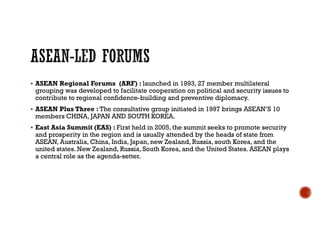
 ASEAN Regional Forums (ARF) : launched in 1993, 27 member multilateral
grouping was developed to facilitate cooperation on political and security issues to
contribute to regional confidence-building and preventive diplomacy.
 ASEAN Plus Three : The consultative group initiated in 1997 brings ASEAN’S 10
members CHINA, JAPAN AND SOUTH KOREA.
 East Asia Summit (EAS) : First held in 2005, the summit seeks to promote security
and prosperity in the region and is usually attended by the heads of state from
ASEAN, Australia, China, India, Japan, new Zealand, Russia, south Korea, and the
united states. New Zealand, Russia, South Korea, and the United States. ASEAN plays
a central role as the agenda-setter.
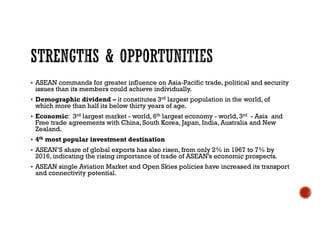
 ASEAN commands for greater influence on Asia-Pacific trade, political and security
issues than its members could achieve individually.
 Demographic dividend – it constitutes 3rd largest population in the world, of
which more than half its below thirty years of age.
 Economic: 3rd largest market - world, 6th largest economy - world, 3rd - Asia and
Free trade agreements with China, South Korea, Japan, India, Australia and New
Zealand.
 4th most popular investment destination
 ASEAN’S share of global exports has also risen, from only 2% in 1967 to 7% by
2016, indicating the rising importance of trade of ASEAN’s economic prospects.
 ASEAN single Aviation Market and Open Skies policies have increased its transport
and connectivity potential.
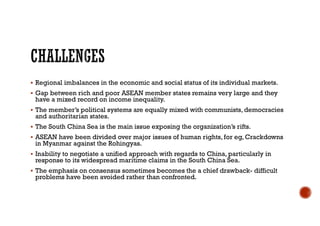
 Regional imbalances in the economic and social status of its individual markets.
 Gap between rich and poor ASEAN member states remains very large and they
have a mixed record on income inequality.
 The member’s political systems are equally mixed with communists, democracies
and authoritarian states.
 The South China Sea is the main issue exposing the organization’s rifts.
 ASEAN have been divided over major issues of human rights, for eg, Crackdowns
in Myanmar against the Rohingyas.
 Inability to negotiate a unified approach with regards to China, particularly in
response to its widespread maritime claims in the South China Sea.
 The emphasis on consensus sometimes becomes the a chief drawback- difficult
problems have been avoided rather than confronted.
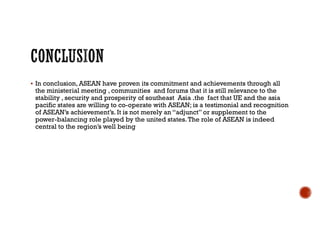
 In conclusion, ASEAN have proven its commitment and achievements through all
the ministerial meeting , communities and forums that it is still relevance to the
stability , security and prosperity of southeast Asia .the fact that UE and the asia
pacific states are willing to co-operate with ASEAN; is a testimonial and recognition
of ASEAN’s achievement’s. It is not merely an “adjunct” or supplement to the
power-balancing role played by the united states.The role of ASEAN is indeed
central to the region’s well being
DOC-20230322-WA0014..pdf

DOC-20230322-WA0014..pdf

  • 1.
    NAME – MONIKAKUMARI NHAGAT REGISTRATION NO. – 12105732 COURSE – POL 226 ASSIGNMENT TOPIC – ASEAN
  • 2.
     The Associationof Southeast Asian Nations is a regional organization which was established to promote political and social stability amid rising tensions among the Asia-Pacific’s post-colonial states.  The motto of ASEAN is “One vision, One identity, One community”.  8th August is observed as ASEAN Day.  ASEAN Secretariat – Indonesia, Jakarta.
  • 3.
     INDONESIA  MALAYSIA PHILLIPINES  SINGAPORE  THAILAND  BRUNEI  VIETNAM  LAOS  MYANMAR  CAMBODIA
  • 4.
     ASEAN wasestablished with the singing of the ASEAN declaration (Bangkok Declaration) by its founding fathers. Founding fathers : Indonesia, Malaysia, Philippines, Singapore and Thailand.  1990s – Membership doubled after the changing conditions in the region following the end of the Vietnam war in 1975 and the Cold War in 1991. Addition of Brunei(1984),Vietnam(1995), Laos and Myanmar(1997) and Cambodia(1999).  1995 – members signed a deal to create a nuclear-free zone in Southeast Asia.  1997 – Adoption of ASEAN Vision 2020.  2003 – Bali Concord 2 for the established of an ASEAN community.  2007 – Cebu Declaration, to accelerate the establishment of ASEAN community by 2015.
  • 5.
     2008 –ASEAN Charter comes into force and becomes a legally binding agreement.  2015 – launch of ASEAN Community.  ASEAN COMMUNITY IS COMPROMISED OF THREE PILLARS : ASEAN POLITICAL- SECURITY COMMUNITY ASEAN ECONOMIC COMMUNITY ASEAN SOCIO-CULTURAL COMMUNITY
  • 6.
     To accelerateeconomic growth, social progress and cultural development for a prosperous and peaceful community of southeast Asian Nations.  To promote regional peace and stability through abiding respect for justice and the rule of law and adherence to the principles of the United Nations charter.  To promote active collaboration and mutual assistance on matters of common interest in the economic, social, cultural, technical, scientific and administrative fields.  To collaborate for greater utilization of agriculture and industries, the expansion of their trade, the improvement of transport and communication facilities and the raising of the living standards of peoples.  To promote Southeast Asian studies.
  • 7.
    TAC OF 1976–  Mutual respect for the independence, sovereignty, equality, territorial integrity and national identity of all nations.  The right of every state to lead its national existence free from external interference, subversion pr coercion.  Non- interference in the internal affairs of one another.  Settlement of differences or disputes by peaceful manner.  Renuciation of the threat or use of force.  Effective cooperation among themselves.
  • 8.
     Chairmanship –rotates annually ( based on the alphabetically order of the English names of Member States).  ASEAN Summit – the supreme policy making body, it sets the direction of ASEAN policies and objectives. Under the charter, meets twice a year.  ASEAN Ministerial Councils – 4 important new bodies to support the summit.  ASEAN Coordinating council(ACC) ASEAN Political-security community council ASEAN Economic community council ASEAN Socio-cultural community council  Decision Making - The primary mode is consultation and consensus.
  • 9.
     ASEAN RegionalForums (ARF) : launched in 1993, 27 member multilateral grouping was developed to facilitate cooperation on political and security issues to contribute to regional confidence-building and preventive diplomacy.  ASEAN Plus Three : The consultative group initiated in 1997 brings ASEAN’S 10 members CHINA, JAPAN AND SOUTH KOREA.  East Asia Summit (EAS) : First held in 2005, the summit seeks to promote security and prosperity in the region and is usually attended by the heads of state from ASEAN, Australia, China, India, Japan, new Zealand, Russia, south Korea, and the united states. New Zealand, Russia, South Korea, and the United States. ASEAN plays a central role as the agenda-setter.
  • 10.
     ASEAN commandsfor greater influence on Asia-Pacific trade, political and security issues than its members could achieve individually.  Demographic dividend – it constitutes 3rd largest population in the world, of which more than half its below thirty years of age.  Economic: 3rd largest market - world, 6th largest economy - world, 3rd - Asia and Free trade agreements with China, South Korea, Japan, India, Australia and New Zealand.  4th most popular investment destination  ASEAN’S share of global exports has also risen, from only 2% in 1967 to 7% by 2016, indicating the rising importance of trade of ASEAN’s economic prospects.  ASEAN single Aviation Market and Open Skies policies have increased its transport and connectivity potential.
  • 11.
     Regional imbalancesin the economic and social status of its individual markets.  Gap between rich and poor ASEAN member states remains very large and they have a mixed record on income inequality.  The member’s political systems are equally mixed with communists, democracies and authoritarian states.  The South China Sea is the main issue exposing the organization’s rifts.  ASEAN have been divided over major issues of human rights, for eg, Crackdowns in Myanmar against the Rohingyas.  Inability to negotiate a unified approach with regards to China, particularly in response to its widespread maritime claims in the South China Sea.  The emphasis on consensus sometimes becomes the a chief drawback- difficult problems have been avoided rather than confronted.
  • 12.
     In conclusion,ASEAN have proven its commitment and achievements through all the ministerial meeting , communities and forums that it is still relevance to the stability , security and prosperity of southeast Asia .the fact that UE and the asia pacific states are willing to co-operate with ASEAN; is a testimonial and recognition of ASEAN’s achievement’s. It is not merely an “adjunct” or supplement to the power-balancing role played by the united states.The role of ASEAN is indeed central to the region’s well being