$10.00 | January/Febuary 2013
PM40069240
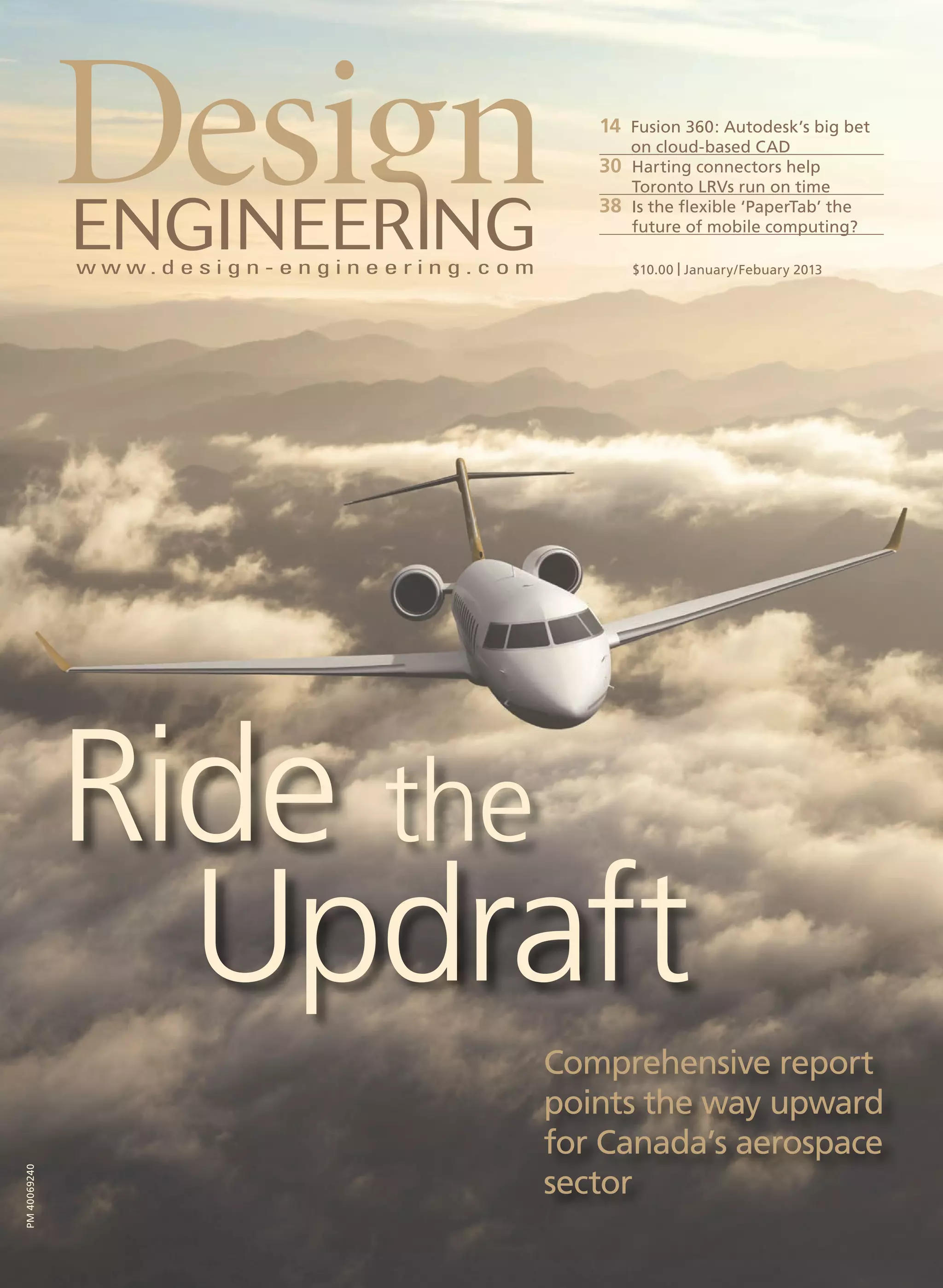
Ride the
Updraft
14 Fusion 360: Autodesk’s big bet
on cloud-based CAD
30 Harting connectors help
Toronto LRVs run on time
38 Is the flexible ‘PaperTab’ the
future of mobile computing?
Comprehensive report
points the way upward
for Canada’s aerospace
sector
1A-DES.indd 1 2013-02-08 8:58 AM
Festo Inc.
Tel: 1 877 GO FESTO
Fax: 1 877 FX FESTO
festo.canada@ca.festo.com
www.festo.ca/grippers
Variety as standard
Standard and versatile. Tough and leakproof but always
compact and powerful—Festo’s range of products for
gripping and positioning is truly comprehensive.
New: miniature standard grippers DHxS.
Powerful, precise and resilient.
2-3-DES.indd 2 13-02-05 7:03 AM
Imageurs thermiques compacts
Compact Thermal Imagers
®
®MD
Because of transmission frequency regulations, these wireless products
may only be used in the United States, Canada and Europe.
En raison de la réglementation sur les fréquences de transmission, ces produits
sans fil peuvent être utilisés seulement aux États-Unis, au Canada et en Europe
Note: Not for Export - US and Canada only
Ne peux pas être exporté - Usage aux États-unis et au Canada seulement
© COPYRIGHT 2013 OMEGA ENGINEERING, INC. TOUS DROITS RESERVES
© COPYRIGHT 2013 OMEGA ENGINEERING INC. ALL RIGHTS RESERVED
MD
976 Bergar
Laval, Québec
Canada H7L 5A1
omega.ca
Visit/Visitez omega.ca/osxl-i_series
OSXL-i7
$
2095
OSXL-i5
$
1695
Point-and-Shoot, Lightweight
Thermal Imaging Cameras
"Point-and-shoot", caméras à
imagerie thermique légères
Compact Infrared Cameras with
On-Board Visual Camera, Wi-Fi
Connectivity, P-i-P and Bright LED Light
iPad®
not
included
OSXL-E Series/Série
Starts at
À partir de
$
2995
Visit/Visitez omega.ca/osxl-e
Caméras compactes infrarouges
avec écran visuel intégré, connectivité
Wi-Fi, PiP et écran à DEL brillant
iPAD®
pas inclus
High-Resolution Infrared Thermal
Imaging Camera 640 x 480 IR
Resolution, Measures Temperature
to 1202°F
OSXL-T620
$
20,450
Caméra à imagerie thermique
à infrarouge à haute résolution
de 640 x 480, pour des mesures
de température jusqu'à 1202 ° F
Visit/Visitez omega.ca/osxl-t620
om
2-3-DES.indd 3 13-02-05 7:03 AM
Schaeffler Introduces a Genuine Breakthrough
in Condition Monitoring:
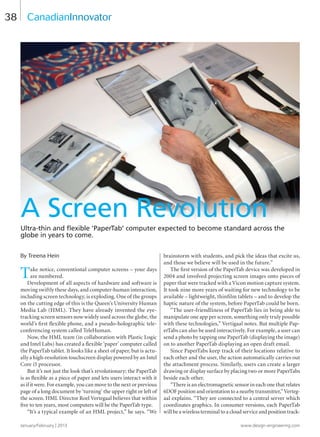
WiProM with FisNet is the industry’s first truly cost-effective diagnostic
tool for analyzing the performance of vital plant equipment such as
motors, pumps and generators. WiProM’s portable design allows for

quick and easy deployment, while the proprietary FisNet wireless
network transmits the data to a monitoring center (yours or ours) for
analysis.
Real Solutions - Real Savings
Whenacustomerfacedthedauntingtaskofperformingend-of-warranty
inspections on scores of gearboxes and generators, Schaeffler was
called upon for a solution. A permanent online monitoring system
was deemed cost-prohibitive, and the facility was not staffed with
highly trained data analysis experts.
Armed with a single yellow carrying case containing a WiProM
diagnostic unit, Schaeffler experts set about the task of analyzing
factors such as meshing of gears and generator performance. Within
three weeks, Schaeffler was able to provide condition monitoring
data that has, so far, saved the customer over $1 million.
We rest our (yellow) case.
www.schaeffler.ca
Superior-quality products.
Comprehensive reliable solutions.©2013
4-5-DES.indd 4 13-02-05 1:01 PM
5IN THE NEWS
8 Canadian Aerospace
Pioneer inducted to
Hall of Fame
8 Creaform
appoints VP
10 Canadian High
Commissioner visits
Delcam
10 McGill, ÉTS launch
Aerospace Education
Centre
10 System integrators
confident of 2013
outlook
10 Canadian mech-
animals make CES
2013 appearance
11 Ontario repeals
‘Industrial Exception’
11 Lockheed buys
Aveos
12 Harting Canada
appoints President
and CEO
Annual Subscription Rate
In Canada: $52.95 (1 year)
$71.95 (2 year)
Outside Canada: $99.95 (1 year)
Single Copy
In Canada: $10.00
Outside Canada: $22.00
Directory Rates
In Canada: $27.00
Outside Canada: $45.00
Reader Service
Contact Information
ecallaghan@bizinfogroup.ca
T: Toronto 416 442 5600 X 3538
Elsewhere -866-543-7888
Mail:
Business Information Group
Design Engineering Circulation Dept
80 Valleybrook Drive
North York, ON
M3B 2S9
Printed in Canada
READER SERVICES
Contents | Volume 59, No. 1
8 Design News
NRC test reveals 100% biofuel better than
conventional jet fuel
14 CAD Report
Cloud-Assisted CAD: Autodesk’s
Internet-dependent Fusion 360 modeling
application reveals CAD giant’s big bet
on general acceptance of Cloud-based
software
33 Idea Generator
The latest in industrial products including
sensors, automation, fluid power, motors
and drives
38 Canadian Innovator
A Screen Revolution: Ultra-thin and flexible
‘PaperTab’ computer expected to become
standard across the globe in years to come
Columns
20 What a Drag
CFD analysis software helps Louis Garneau
helmet make cycling less of a drag
26 Ride the Updraft
Comprehensive report points the way
upward for Canada’s aerospace sector
30 In Transit
Harting connectors help Bombardier’s
Toronto LRV transit vehicles run on time
Features
8
20
38
14
26
www.design-engineering.com January/February | 2013
ic
as
or
ss
or
ty
as
m
th
M
ng
in
ng
30
8
COVERPHOTO:BOMBARDIERINC.
4-5-DES.indd 5 13-02-05 1:01 PM
6 EditorialViewpoint
I enjoy hearing from you so please contact me at
MMcLeod@design-engineering.com and your letter
could be published in an upcoming issue.
@
www.design-engineering.com
Editor
Michael McLeod (416) 442-5600 ext. 3231
mmcleod@design-engineering.com
Publisher
Alan Macpherson (416) 510-6756
AMacPherson@design-engineering.com
Group Editorial Director
Lisa Wichmann (416) 510-5101
LWichmann@canadianmanufacturing.com
Accounts Manager
Laura Gergley (416) 510-5230
lgergley@design-engineering.com
Technical Field Editor
Pat Jones, P. Eng.
Art Director
Kathy Smith (416) 442-5600 ext. 3215
KSmith@plant.ca
Market Production Manager
Jessica Jubb (416) 510-5194
jjubb@bizinfogroup.ca
Circulation Manager
Cindi Holder (416) 442-5600 ext. 3544
CHolder@bizinfogroup.ca
BIG Magazines LP
Executive Publisher
Tim Dimopoulos
Vice-President of Canadian Publishing,
Alex Papanou
President of Business Information Group,
Bruce Creighton
Publications Mail Agreement #40069240
ISSN: 0011-9342 (Print), 1929-6452 (Online)
Privacy Notice: From time to time we make our
subscription list available to select companies and
organizations whose product or service may interest
you. If you do not wish your contact information to
be made available, please contact us via one of the
following methods:
Phone: 1-800-668-2374 Fax: 416-442-2191
E-mail: privacyofficer@businessinformationgroup.ca.
Mail to: Privacy Officer, 80 Valleybrook Drive,
North York, ON M3B 2S9
Subscriber Services: To subscribe, renew your
subscription or to change your address or information
contact us at 1-800-387-0273. Subscription Price:
Canada: $52.95 for 1 year; $71.95 for 2 years; $10 for
single copy. Outside Canada: $99.95 for 1 year; $22
for single copy. Directory/buyer’s guide: Canada $27;
Outside Canada $45.
Design Engineering, established in 1955, is published
6 times per year except for occasional combined,
expanded or premium issues, which count as two
subscription issues. Published by BIG Magazines LP, a
division of Glacier BIG Holdings Company Ltd.
Tel: 416-442-5600, Fax: 416-510-5140
80 Valleybrook Dr., Toronto, ON M3B 2S9.
Contents of this publication are protected by copyright
and must not be reprinted in whole or in part without
permission of the publisher. DE receives unsolicited
features and materials (including letters to the editor)
from time to time. DE, its affiliates and assignees may
use, reproduce, publish, re-publish, distribute, store and
archive such submissions in whole or in part in any form
or medium whatsoever, without compensation of any
sort. DE accepts no responsibility or liability for claims
made for any product or service reported or advertised
in this issue. DE is indexed in the Canadian Business
Index by Micromedia Ltd., Toronto, and is available
on-line in the Canadian Business & Current Affairs
Database. We acknowledge the financial support of the
Government of Canada through the Canada Periodical
Fund (CPF) for our publishing activities.
January/February | 2013 www.design-engineering.com
As this issue goes to press, Boeing’s 787 Dreamliner makes the headlines daily
with new speculation as to what has grounded the world’s largest and most
ambitious jumbo jet. So far, inspectors’ fingers have pointed to the 787’s lithium-
ion batteries. Unique to the platform, the 63-pound pack is used as a backup power
source for several 787 systems and has come under criticism for being too big and
dense and thereby susceptible to the thermal runaway problems.
Of course, the ‘no fly’ order is only the latest in a series of troubles, punctuated
by manufacturing delays and cost overruns, for the ill-fated jet. As a result, some
industry observers look beyond the immediate technical glitches and point to the
fact that Boeing modularized the 787’s design and outsourced too much of its
manufacture to international suppliers.
In this respect, the Dreamliner’s development problems vaguely echo those
EADS’ Airbus A380 experienced six years earlier. Among other problems, the
A380’s planned rollout was doomed when multiple countries, most notably France
and Germany, vied for their piece of the jumbo jet’s construction. Each country
developed the jet’s major components but were allowed to define their own design
technologies and systems.
As a result, when the different systems were brought together, the A380’s critical
wire harnesses proved too short, forcing a major re-design that cost the company
$6 billion. While that may seem like an argument against modularization and
outsourcing, the fault lay in German engineers created the wiring bundles in Catia
v4 while their French counterparts designed the fuselage wiring spaces with the
completely re-coded and ultimately incompatible Catia v5. The differences in the
way the two versions of the MCAD suite dealt with something as fundamental as
dimensions led to the A380’s nightmarish delays and cost over-runs.
Todesignthe787,BoeingmadesurenottorepeatAirbus’PLM-relatedmistakes.
Instead, as the Harvard Business Review argues, the problems stem from a source
farmorehuman.Itsassessmentstatesthat,followingBoeing’smergerwithMcDon-
ald Douglas, executives from the defense contractor rose to prominence within the
company and brought their risk adverse culture to bear on the 787’s planning.
Consequently, Boeing off-loaded the financial and technical burden of design-
ing and building the 787’s various systems without first fully understanding how
the pieces would fit together. Given the interconnectedness of those parts, any
major design changes in one system caused redesigns to ripple through other
suppliers’ plans and inevitably put mounting pressure on them to meet projected
costs and deadlines.
As yet, the Dreamliner is not expected to book major flight any time soon. The
FAA is only now considering the possibility of Boeing conducting test flights. Yet
evenwhentheultimatecauseisfoundandrectified,thepublic’s(aswellasprospec-
tive 787 buyers’ and investors’) perception of the aircraft may remain permanently
tainted. Ultimately, it may be the intensely competitive atmosphere in which devel-
opmentofthehighlycomplexandcapital-intensiveaircraftwasrushedthroughthe
design and build process that grounded the 787 and led to the bad dream Boeing
has yet to wake up from.
Mike McLeod
A Dream Deferred
6-7-DES.indd 6 13-02-07 11:06 AM
www.automationdirect.com
1-800-633-0405
Go online or call to get complete information,
request your free catalog, or place an order.
The new Do-more H2 series
CPUs leverage industry- proven
I/O hardware to create an
incredibly powerful PLC -
at an incredible bargain.
Program Do-more with the completely new - and
FREE - Do-more Designer software. Download
online - with the built-in simulator, you don’t even
need hardware to try it out.
Or, choose a Do-more starter
kit to get going with a simple
working system, plus a coupon
for 30 days free online video
training.
H2-DM1E-START $626 with H2-DM1E CPU
H2-DM1-START $536 with H2-DM1 CPU
So visit www.do-moreplcs.com for the details, watch
overview videos, and download the free software to
take it for a spin.
• Lots of program memory
• Fast program execution
• Easy-to-use instruction set
• Integrated Ethernet on the CPU
• Fast I/O for counting and motion applications
• Easy-to-use communications
H2-DM1E $399 (1) USB port for programming,
(1) full-duplex serial port,
(1) Ethernet port
The popular H2-DM1E CPU includes:
• Over 1M bytes total memory
(includes program, data and documentation)
• Program/monitor/debug over any embedded
communication port.
• Supports up to 256 I/O locally and thousands more with
optional Ethernet remote I/O.
• Supports inexpensive serial port expansion for connection
to bar code readers, printers, etc
• H2-DM1 CPU (no Ethernet port) also available, for $299
And each Do-more CPU comes with a coupon for
a 30-day free trial of online video training.
Starter Kit
Free standard shipping is available for orders totaling over $49 U.S.(except for orders which require LTL shipping,see
Web site for details). Also,save on brokerage fees when shipping standard ground to Canada - you can choose to allow
AutomationDirect to nominate a broker for your shipment for parts shipping via standard ground. This can save you big on brokerage fees.
See Web site for details and restrictions - www.automationdirect.com/canada
Our shipping policies make it easier than ever to
order direct from the U.S.!
6-7-DES.indd 7 13-02-05 1:16 PM
8
Canadian Aerospace Pioneer
Inducted to Hall of Fame
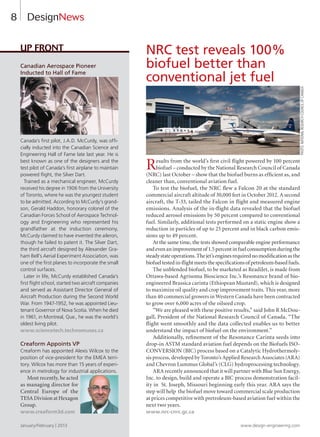
Canada’s first pilot, J.A.D. McCurdy, was offi-
cially inducted into the Canadian Science and
Engineering Hall of Fame late last year. He is
best known as one of the designers and the
test pilot of Canada’s first airplane to maintain
powered flight, the Silver Dart.
Trained as a mechanical engineer, McCurdy
received his degree in 1906 from the University
of Toronto, where he was the youngest student
to be admitted. According to McCurdy’s grand-
son, Gerald Haddon, honorary colonel of the
Canadian Forces School of Aerospace Technol-
ogy and Engineering who represented his
grandfather at the induction ceremony,
McCurdy claimed to have invented the aileron,
though he failed to patent it. The Silver Dart,
the third aircraft designed by Alexander Gra-
ham Bell’s Aerial Experiment Association, was
one of the first planes to incorporate the small
control surfaces.
Later in life, McCurdy established Canada’s
first flight school, started two aircraft companies
and served as Assistant Director General of
Aircraft Production during the Second World
War. From 1947-1952, he was appointed Lieu-
tenant Governor of Nova Scotia. When he died
in 1961, in Montreal, Que., he was the world’s
oldest living pilot.
www.sciencetech.technomuses.ca
Creaform Appoints VP
Creaform has appointed Alexis Wilcox to the
position of vice-president for the EMEA terri-
tory. Wilcox has more than 15 years of experi-
ence in metrology for industrial applications.
Most recently, he acted
as managing director for
Central Europe of the
TESA Division at Hexagon
Group.
www.creaform3d.com
Up Front NRC test reveals 100%
biofuel better than
conventional jet fuel
Results from the world’s first civil flight powered by 100 percent
biofuel – conducted by the National Research Council of Canada
(NRC) last October – show that the biofuel burns as efficient as, and
cleaner than, conventional aviation fuel.
To test the biofuel, the NRC flew a Falcon 20 at the standard
commercial aircraft altitude of 30,000 feet in October 2012. A second
aircraft, the T-33, tailed the Falcon in flight and measured engine
emissions. Analysis of the in-flight data revealed that the biofuel
reduced aerosol emissions by 50 percent compared to conventional
fuel. Similarly, additional tests performed on a static engine show a
reduction in particles of up to 25 percent and in black carbon emis-
sions up to 49 percent.
At the same time, the tests showed comparable engine performance
andevenanimprovementof1.5percentinfuelconsumptionduringthe
steadystateoperations.Thejet’senginesrequirednomodificationasthe
biofueltestedin-flightmeetsthespecificationsofpetroleum-basedfuels.
The unblended biofuel, to be marketed as ReadiJet, is made from
Ottawa-based Agrisoma Bioscience Inc.’s Resonance brand of bio-
engineered Brassica carinta (Ethiopean Mustard), which is designed
to maximize oil quality and crop improvement traits. This year, more
than 40 commercial growers in Western Canada have been contracted
to grow over 6,000 acres of the oilseed crop.
“We are pleased with these positive results,” said John R McDou-
gall, President of the National Research Council of Canada. “The
flight went smoothly and the data collected enables us to better
understand the impact of biofuel on the environment.”
Additionally, refinement of the Resonance Carinta seeds into
drop-in ASTM standard aviation fuel depends on the Biofuels ISO-
CONVERSION (BIC) process based on a Catalytic Hydrothermoly-
sis process, developed by Toronto’s Applied Research Associates (ARA)
and Chevron Lummus Global’s (CLG) hydroprocessing technology.
ARA recently announced that it will partner with Blue Sun Energy,
Inc. to design, build and operate a BIC process demonstration facil-
ity in St. Joseph, Missouri beginning early this year. ARA says the
step will help the biofuel move toward commercial scale production
at prices competitive with pretroleum-based aviation fuel within the
next two years.
www.nrc-cnrc.gc.ca
DesignNews
January/February | 2013 www.design-engineering.com
4
3
3
2
2
1
1
PHOTO:NATIONALRESEARCHCOUNCILOFCANADA
8-13-DES.indd 8 13-02-07 7:36 AM
513-521-4261
Cincinnati, OH
888-WAINBEE
Wainbee Limited
Mississauga, Ontario
For the past 50 years, Clippard has been
providing quality cylinders for thousands of
applications around the world. Cylinders
that are responsible for millions of
production cycles. Cylinders that
provide outstanding performance
and payback.
On-line configurator
makes orderingsimple!
air cylinders
40”
35”
30”
25”
20”
15”
10”
5”
0“
ble for millions of
s. Cylinders that
ding performance
n-line configurmakes orderingsimple!
On
m
More Sizes • More Styles • More Accessories
Performance that Engineers have Learned to Trust
the finest.
fast!
e Learne
They have 1000's of
Items Ready to Ship the
Same Day!
Totally Interchangeable-
Upgrade Now!
8-13-DES.indd 9 13-02-05 1:02 PM
10
Canadian High Commissioner
Visits Delcam
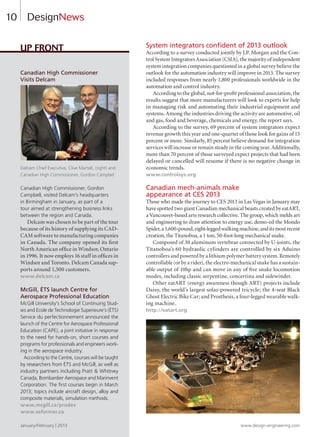
Delcam Chief Executive, Clive Martell, (right) and
Canadian High Commissioner, Gordon Campbel
Canadian High Commissioner, Gordon
Campbell, visited Delcam’s headquarters
in Birmingham in January, as part of a
tour aimed at strengthening business links
between the region and Canada.
Delcam was chosen to be part of the tour
because of its history of supplying its CAD-
CAM software to manufacturing companies
in Canada. The company opened its first
North American office in Windsor, Ontario
in 1996. It now employs 16 staff in offices in
Windsor and Toronto. Delcam Canada sup-
ports around 1,500 customers.
www.delcam.ca
McGill, ÉTS launch Centre for
Aerospace Professional Education
McGill University’s School of Continuing Stud-
ies and Ecole de Technologie Superieure’s (ÉTS)
Service du perfectionnement announced the
launch of the Centre for Aerospace Professional
Education (CAPE), a joint initiative in response
to the need for hands-on, short courses and
programs for professionals and engineers work-
ing in the aerospace industry.
According to the Centre, courses will be taught
by researchers from ÉTS and McGill, as well as
industry partners including Pratt  Whitney
Canada, Bombardier Aerospace and Marinvent
Corporation. The first courses begin in March
2013; topics include aircraft design, alloy and
composite materials, simulation methods.
www.mcgill.ca/prodev
www.seformer.ca
Up Front System integrators confident of 2013 outlook
According to a survey conducted jointly by J.P. Morgan and the Con-
trol System Integrators Association (CSIA), the majority of independent
system integration companies questioned in a global survey believe the
outlook for the automation industry will improve in 2013. The survey
included responses from nearly 1,800 professionals worldwide in the
automation and control industry.
According to the global, not-for-profit professional association, the
results suggest that more manufacturers will look to experts for help
in managing risk and automating their industrial equipment and
systems. Among the industries driving the activity are automotive, oil
and gas, food and beverage, chemicals and energy, the report says.
According to the survey, 69 percent of system integrators expect
revenue growth this year and one-quarter of those look for gains of 15
percent or more. Similarly, 85 percent believe demand for integration
services will increase or remain steady in the coming year. Additionally,
more than 70 percent of those surveyed expect projects that had been
delayed or cancelled will resume if there is no negative change in
economic trends.
www.controlsys.org
Canadian mech-animals make
appearance at CES 2013
Those who made the journey to CES 2013 in Las Vegas in January may
have spotted two giant Canadian mechanical beasts created by eatART,
a Vancouver-based arts research collective. The group, which melds art
and engineering to draw attention to energy use, demo-ed the Mondo
Spider,a1,600-pound,eight-leggedwalkingmachine,anditsmostrecent
creation, the Titanoboa, a 1 ton, 50-foot-long mechanical snake.
Composed of 30 aluminum vertebrae connected by U-joints, the
Titanoboa’s 60 hydraulic cylinders are controlled by six Aduino
controllers and powered by a lithium polymer battery system. Remotely
controllable (or by a rider), the electro-mechanical snake has a sustain-
able output of 10hp and can move in any of five snake locomotion
modes, including classic serpentine, concertina and sidewinder.
Other eatART (energy awareness though ART) projects include
Daisy, the world’s largest solar-powered tricycle; the 4-seat Black
Ghost Electric Bike Car; and Prosthesis, a four-legged wearable walk-
ing machine.
http://eatart.org
DesignNews
January/February | 2013 www.design-engineering.com
8-13-DES.indd 10 13-02-07 7:36 AM
11
Ontario repeals ‘Industrial
Exception’ from Professional
Engineering Act
Professional Engineers Ontario (PEO)
announced that, effective March 1, 2013,
those responsible for professional engi-
neering work in relation to production
machinery or equipment must be
licensed by the provincial engineering
regulatory organization.
In January, Ontario approved a
change to the Professional Engineers Act that will remove
the so-called industrial exception later this year. In addi-
tion, Ontario has also approved a regulatory provision to
help employers make the transition to the new requirement.
Namely, employers, who file a transition plan with the
PEO by March 1, will have up to one year to meet the
requirement.
“Repealing the industrial exception in the Professional
Engineers Act will improve oversight to help workers and
the public stay safe and promote more efficient and produc-
tive workplaces,” said Attorney General John Gerretsen.
To help in the transition to the new regulations, the PEO
says it will waive its license application fee for new graduates,
immigrants and employees who apply for a license by March
1. PEO says it will also assist employees
through the one-year compliance period
by providing application and Engineering
Intern Program (EIT) seminars and
administering its professional practice
exams on job sites. Instructional webinars
and a frequently asked questions section
about the new requirement are also avail-
able on the PEO web site.
www.peo.on.ca
Lockheed Buys Aveos
Lockheed Martin Canada Inc. has entered into an agree-
ment to purchase certain assets of the engine maintenance,
repair and overhaul business of Montreal’s Aveos Fleet
Performance Inc.
According to Lockheed, the engine MRO assets provide
capabilities to perform a range of services on the CF34 and
CFM56 engine families, which include engines that power
the regional Embraer and Canadian RJ jets and the Airbus
320 family, respectively.
The facility will be named Kelly Aviation Center Montreal
and become part of Lockheed Martin Aeronautics’ engine
MRO line of business.
www.lockheedmartin.ca
DesignNews
www.design-engineering.comJanuary/February | 2013
8-13-DES.indd 11 13-02-07 7:36 AM
12 DesignNews
January/February | 2013 www.design-engineering.com
Large Aperture Direct-Drive Rotary Stages
Aerotech’s ALAR series direct-
drive rotary stages provide
superior angular positioning
and velocity control with
apertures to 325 mm and
loads to 600 kg. The
combination of a large
aperture, high load and
direct-drive motor make the
ALAR series a versatile, high
speed (up to 300 rpm), no
backlash, superior accuracy
solution for your application.
For more information on
Aerotech’s ALAR series,
contact one of our
Application Engineers today
or visit our website at
www.aerotech.com.
Dedicated to the Science of Motion
Aerotech, Inc., 101 Zeta Drive, Pittsburgh, PA 15238
Ph: 412-963-7470 • Fax: 412-963-7459 • Email: sales@aerotech.com
www.aerotech.com AH0510D_PPG
A e r o t e c h W o r l d w i d e
United States • France • Germany • United Kingdom • China • Japan • Taiwan
325 mm
200 mm
150 mm
100 mm
•5 different aperture sizes
(100 mm, 150 mm, 200 mm,
250 mm, 325 mm) in SP models
with higher stiffness or LP models
for low profile
•High axial load capacity of
120-600 kg
•Cog-free motor provides smooth
motion and zero backlash
•45-300 rpm continuous rotation
speed
•Perfect for applications with
payloads that must be at the
center of rotation; great for
AZ roll gimbal applications
•Vac 10-6
torr compatible versions
•Large apertures and high
resolution make it an excellent
choice for building coudé path
optics and telescopes
German interconnect company, HARTING Tech-
nology Group named Jon DeSouza president 
CEO of HARTING Canada, in January. DeSouza,
who retains his existing responsibilities as execu-
tive VP of sales for HARTING North America, says
the company’s intention is to build a local sales
and support structure to support the Canadian
market. In HARTING Technology Group’s 2012
fiscal year, the Americas experienced the largest
revenue growth of any region – 13.6 percent to
more than 50 million euros – with Canada con-
tributing a significant portion of that growth.
“Our North America strategy is focused on prox-
imity to our customers and distributor base where
both the US and Canada play very important, but
distinguished roles,” says DeSouza. “The first step
was to establish HARTING Canada, Inc. with head-
quarters in Montreal and Claude Gravel as our
Canadian regional sales manager. Now, we’re ready
for the next step in building our sales team: The
appointment of an area sales manager to focus on
Ontario, which will be announced soon.”
www.harting.ca
The Harting team (from left): Claude Gravel, regional sales manager, Harting
Canada Inc.; Rolf Meyer, president and CEO of Harting Inc. of North America; Philip
Harting, senior vice-president, Harting Technology Group, Espelkamp, Germany;
Jon DeSouza, president and CEO, Harting Canada Inc. Torsten Ratzmann, senior
vice-president operations, Harting AG, Espelkamp/Germany.
Harting Canada appoints President and CEO
Y
i
8-13-DES.indd 12 13-02-07 7:36 AM
Engineers Canada is the business name of the Canadian Council of Professional Engineers.
Great-West Life and key design are trademarks of The Great-West Life Assurance Company (Great-West), used under licence by its subsidiaries,
London Life Insurance Company (London Life) and The Canada Life Assurance Company (Canada Life). As described in this advertisement,
the group retirement and savings products are issued by London Life and the payout annuity products are issued by Canada Life.
Sponsored by:
You see the world differently–
including your retirement
See the difference lower investment
management fees could make to
your retirement savings. Join the
group plan sponsored by Engineers
Canada for professional engineers
and geoscientists.
Find out more – call
1-866-788-1293 ext. 5786 and
reference plan number 35408.
Scan this QR code to get the app
May not work on all mobile devices
My group advantage app
Let the numbers speak for themselves.
Visit www.engineerscanadafsp.grsaccess.com/app
8-13-DES.indd 13 13-02-05 1:02 PM
January/February | 2013 www.design-engineering.com
14
by Ralph Grabowski
At Autodesk University 2012, Autodesk strongly pushed two
themes: The cloud; and that the company is uniquely
poised to solve the full range of the world’s messy problems—
provided designers use their software. Of the two, running
software in the cloud seemed to me the more concrete outcome.
Autodesk CEO Carl Bass created controversy last April
when he told a TechCrunch interviewer that, within two to
three years, the only way to use every one of his company’s
products will be online. Company representatives attempted
to reinterpret his remarks but then contradicted one another.
One told the media that Bass meant customers would have
a choice, between running software on a public cloud or on
a private one; another insisted that Autodesk would always
produce software for the desktop. I do like one term the
executives used, “cloud-assisted desktop,” but that’s not what
Bass said.
Autodesk University provided time for the CAD press to
question the CEO, and here he seemed to say that while all
Autodesk software would run in the cloud, it would not be
cloud-only. Other executives insisted desktop software would
be available for decades to come.
Like executives at Dassault Systemes, Bass is confident
customers will eventually find cloud-based software more
compelling than desktop versions. Problems that concern
customers—like security, privacy and reliability—will even-
tually “fall by the wayside,” but he didn’t explain how.
A consultant I met at the show said, yes, clients are inter-
ested in server-based software, but only when it runs on
computers in their own offices. At this point, Autodesk’s cloud
offerings run on Amazon’s EC2 servers primarily.
Fusion 360
The highlight of the show was Fusion 360, the new semi-online
version of the Fusion 3D direct modeling software. (Fusion
has been shipping free with Inventor and AutoCAD and as a
stand-alone package for Macs.) What we know about Fusion
360 is limited to what Autodesk showed at AU, and so what I
describe here might not be the same in the released version.
Autodesk says the new software will be suitable for the
following tasks:
• Industrial design through 3D surface modeling, pow-
ered by the T-Splines technology Autodesk acquired
a year ago.
• Mechanical design through 3D solids modeling, pow-
ered by their own ACIS-based ShapeManager kernel.
• Collaboration through a dashboard, powered by their
home-grown DesignFeed social
networking facility and cloud-
based PLM 360 project manage-
ment system.
When we start up Fusion 360,
we will see a dashboard that lists
all of the projects we are working
on, either on our own or with other
engineers. Another view shows just
the models we are working on.
Project files are stored in the cloud.
This makes it easier for more than
one person to view and work on
projects. One other benefit: When
we lose our laptop — you know,
the one carrying all our files —
then the Fusion 360 files are still
accessible once the software is
installed on the replacement
machine.
We will be able to drag and drop
Cloud-Assisted CAD
Autodesk’s Internet-dependent Fusion 360 modeling application reveals CAD giant’s big
bet on general acceptance of Cloud-based software.
CADReport
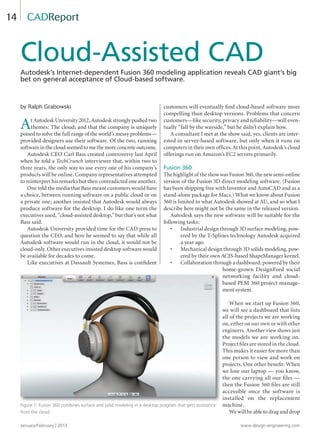
Figure 1: Fusion 360 combines surface and solid modeling in a desktop program that gets assistance
from the cloud.
14-17-DES.indd 14 13-02-05 1:04 PM
14-17-DES.indd 15 13-02-05 1:04 PM
16
files into Fusion 360, such as from AutoCAD,
Inventor, Pro/E, and Solidworks, as well as
neutral file formats, like STEP and JT. For the
most part, the format will not matter, because
the files will be translated automatically in
the cloud. Fusion 360’s own files are saved in
a newish file format called F3D, already used
by the Mac version.
The user interface of the editing environ-
ment looks somewhat like the current version
of Fusion, but is even more sparse. Autodesk
says there will be more real-time assistance
provided to users.
We will be able to interactively edit faces
of solids as if they were surfaces without need-
ing to switch between states, as we currently
have to in AutoCAD. Naturally, real-time
shading is built-in, but full rendering will be
operated in the cloud.
Borrowing from AutoCAD WS’s timeline, Fusion 360 will
let us go back to see earlier revisions of the model by just
dragging a slider bar.
Autodesk thinks this software will be used primarily by
small business. Unlike current releases of Fusion, Fusion 360
will not be free. Autodesk mentioned term pricing, which I
take to mean that we are expected to pay by the project or
yearly. There will definitely be no perpetual license, as we are
used to paying and which Autodesk describes in negative
terms as a “high, up front fee.”
Fusion 360 will run on PCs and Macs. You can sign up as
a beta tester at autodesk.com/fusion360. The software is due
CADReport
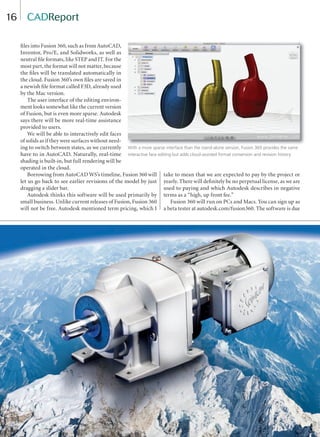
With a more sparse interface than the stand-alone version, Fusion 360 provides the same
interactive face editing but adds cloud-assisted format conversion and revision history.
14-17-DES.indd 16 13-02-05 1:04 PM
17
to be released in the Spring 2013, a vague time frame that
extends into late June. I expect it is no coincidence that this
is pretty much the same time when Dassault Systemes expects
to release its Enovia-based Solidworks “V6.” Fusion 360 will
be the direct competitor to Solidworks V6, which probably is
also a hybrid desktop-cloud program.
While no further announcements were made, I expect
Autodesk to also release companion software, such as for
viewing F3D files on portable devices, probably for Apple’s
iPad first.
Fusion 360 Technical Details
Fusion 360 took Autodesk about three years to develop as a
hybrid program. Executives told me that the toughest part
was making much of the code multi-threaded so that it could
run on the desktop and the cloud at the same time, with no
intervention of the operating system. Fusion 360 multi-
threads Boolean calculations; ShapeManager modeling
kernel operations; and graphics. In addition, Autodesk said
they can throttle the amount of cloud-assisted operations
from their end.
Multi-threading allows a program to run on more than
one core of a computer’s CPU. Today’s CPUs tend to have four
or more cores, yet most software cannot take advantage of
the power. This is because multi-threading is such a tough
programming task that it’s applied only to limited areas, such
as loading drawings and rendering them.
It is multi-threading that allows Fusion 360 to run some
tasks automatically in the cloud, such as file translation,
rendering and finite element analysis. If you’ve been follow-
ing Autodesk Labs, you know that all these elements have
already been operating in the cloud. For instance, should you
have AutoCAD 2013, you can test cloud rendering for a few
files free.
The Road Ahead
I see Fusion 360 as a stepping stone between desk-bound
Inventor and cloud-only MCAD; perhaps a future release will
be cloud-only, making the dream of CEO Bass a reality.
In my estimation, Autodesk likes the idea of cloud-only
software because it locks in customers and their subscription
payments, while eliminating the scourge of piracy. Those of
us who remember the original “cloud” of the 70s (running
programs on terminals connected to central mainframe
computers) wonder why anyone would want to return to that
kind of loss of control.
Putting everything on the cloud is a gamble for Autodesk.
The next years will reveal if customers find it compelling
enough to follow en masse. DE
www.autodesk.com
CADReport
NORDPremium
Efficiency
Welcome
to the top
NORD standards have
always been set at the
highest possible level.
Today, more than ever, less is more...be it power
consumption or designing the most compact and
efficient equipment.
Stringent global Premium Efficiency Standards have
been met by combining the latest technologies and
optimized materials with legendary NORD innovation
to reach the summit of the category.
NORD Premium Efficiency.
It’s lonely at the top.
I n n o va t I o n b e y o n d t h e o r d I n a r y
1.800.668.4378
14-17-DES.indd 17 13-02-05 1:04 PM
January/February | 2013 www.design-engineering.com
3Dtechnology is all around us.
It’s changing how we design
and manufacture products, make
movies, heal our bodies and interact
with the world. Work that used to take
place on a page or screen now
reaches into space. And faster than
ever before, 3D technology is
transforming our world.
To see the impact of 3D, look to the
realm of design. Designers led the
way in embracing 3D CAD and then
3D printing, incorporating more and
more physical models into their
iterations and thinking with their
heads and their hands. And they’ve
reaped the benefits: design problems
surface sooner and solutions are less
costly. Inspiration happens faster.
Ultimately, products are better and
consumers are happier. Black 
Decker makes a safer tree trimmer
and Lamborghini makes a faster car
because reviews and trials are more
frequently executed on models very
much resembling a final product.
Now, 3D printing applications are
expanding from design into production,
and freeing manufacturers to build
without traditional restrictions. DDM
stands for direct digital manufacturing,
a way to produce a finished product,
part or tool straight from a computer
design. More importantly, DDM means
the rewards of faster, leaner, smarter
methods are coming to the production
floor. When we at Stratasys (and
publications like The Economist, Forbes
and The New York Times) call 3D
printing “the next industrial revolution,”
we’re not exaggerating.
A hundred years ago, the assembly
line changed the world with mass
production. It brought luxuries to the
middle class, good wages to workers
and economies of scale to investors.
Today, companies like BMW already
know that DDM is mass production’s
heir apparent. One factory-floor fixture,
a nameplate-application device, offers
an elegant example. Liberated from
tooling constraints, BMW engineers
reduced the device’s weight by half
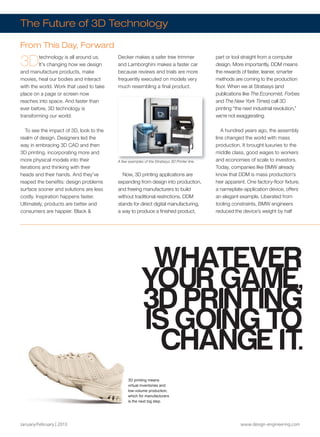
A few examples of the Stratasys 3D Printer line.
The Future of 3D Technology
From This Day, Forward
A few examples of the Stratasys 3D Printer line.
Live: 14.851” x 4.75”
WHATEVER
YOUR GAME,
3D PRINTING
IS GOING TO
CHANGE IT.
3D printing means
virtual inventories and
low-volume production,
which for manufacturers
is the next big step.
Stratasys Merger.FINAL.indd 18 13-02-05 1:27 PM
www.design-engineering.com January/February | 2013
and replaced its blocky stock-metal
handles with ergonomic grips — a
great relief to workers who might lift
the fixture hundreds of times per shift.
Today, NASA can shape a complex,
human-supporting vehicle suitable for
Martian terrain, despite the fact that
its parts are too complex to machine,
too rapidly iterated to outsource and
too customized for traditional tooling.
In a 3D world, we leave behind
injection molding, casting and
machining, gaining economy without
the scale. 3D printing leads us
beyond mass production and into
mass customization. It’s how a
researcher at a Delaware hospital
creates a durable ABS-plastic
exoskeleton customized to perfectly
fit one child, Emma, allowing her to
play, explore and hug for the first
time. Then that researcher can make
a 3D-printed exoskeleton to fit a
different child. And another.
And a dozen more. Now 15 children
with rare disorders can raise their
hands because of mass
customization.
Ideas born today — your ideas
— are freer to solve problems faster
than ever before. Now, two
innovators who helped spark this
revolution have fused to lead the
charge together, and more great
changes are at hand.
Welcome to the new Stratasys,
leader of the next industrial
revolution.
— By David Reis, Stratasys CEO
This rover includes about 70 FDM parts, including
housings, vents and fixtures.
A pediatric engineering research lab has developed
and 3D-printed custom devices for their smallest
patients.
ADVERTISEMENT
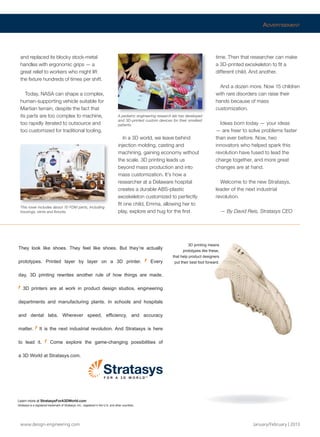
3D printing means
prototypes like these,
that help product designers
put their best foot forward.
They look like shoes. They feel like shoes. But they’re actually
prototypes. Printed layer by layer on a 3D printer. Every
day, 3D printing rewrites another rule of how things are made.
3D printers are at work in product design studios, engineering
departments and manufacturing plants. In schools and hospitals
and dental labs. Wherever speed, efficiency, and accuracy
matter. It is the next industrial revolution. And Stratasys is here
to lead it. Come explore the game-changing possibilities of
a 3D World at Stratasys.com.
Learn more at StratasysForA3DWorld.com
Stratasys is a registered trademark of Stratasys, Inc., registered in the U.S. and other countries.
TM
F O R A 3 D W O R L D
Stratasys Merger.FINAL.indd 19 13-02-05 1:27 PM
January/February | 2013 www.design-engineering.com
20
By Geneviève Dutil  Titus Sgro
As anyone who has ever ridden a bicycle on a windy day
will testify, aerodynamics play a big part in cycling.
Perhaps more than any other sport, competitive cycling is
dominated by aerodynamics, as cyclists, clad in aerodynamic
clothing and helmets, are forced to adopt uncomfortable
crouched position on their bikes, minimizing their frontal
area and reducing their exposure to the oncoming air.
This is most apparent in Individual Time Trial (ITT), which
is a key component of triathlon, track and road races. With no
other riders to draft behind, the ITT is known as “the race of
truth,” a brutal contest of man and machine against the clock.
Since minimizing drag delivers more speed for a given
power output, all serious cyclists wear a specially designed
aerodynamic helmet in a time trial, in order to guide the
air around the head, and prevent gross separation behind
what would otherwise be a bluff body.
Since they were first introduced to the sport almost 25
years ago, cycling helmets have been the subject of much
engineering attention, with the aim of further reducing the
drag signature of the rider.
However, there is more to a time trial helmet than just
drag reduction. To be successful, an aero-helmet also has
to be properly ventilated (preventing the rider from over-
heating at maximum effort), impact resistant (protecting
the rider’s head in the event of a crash), and constructed
from lightweight materials.
Ahead of the Pack
Quebec-based Louis Garneau has been a leader in the design
and production of sports gear for over twenty-five years. Its
founder and CEO, after whom the company is named, was a
successful cyclist with over 150 victories in thirteen years of
racing on both, the road and track. Garneau represented
Canada at the 1984 Los Angeles Olympics.
In 2002, Louis Garneau introduced the Prologue helmet,
the first aero-helmet that provided impact protection in addi-
tion to aerodynamic advantage. Before its arrival, time trial
helmets were basically just head-mounted aerodynamic fair-
ings that offered no protection to the rider in the event of a
crash.
The Prologue was the first aero-helmet to attain certifica-
tion to the U.S. CPSC bicycle helmet standard, meaning that
it was also the first aero-helmet that could legally be sold to
the general public.
In fact, two years after the arrival of the Prologue, cycling’s
governing body, the UCI, introduced a rule stating that all
helmets used in competition must meet the less stringent
European EN 1078 bicycle helmet safety standard.
CADBeat
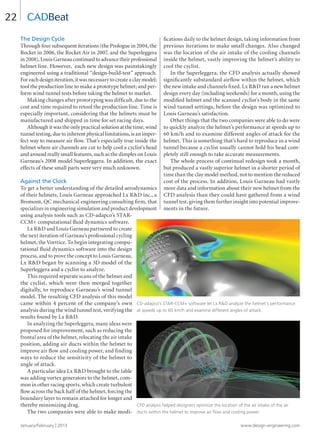
Louis Garneau’s U.S.
CPSC certified Vorttice
helmet was developed
using CFD software
from CD-adapco.
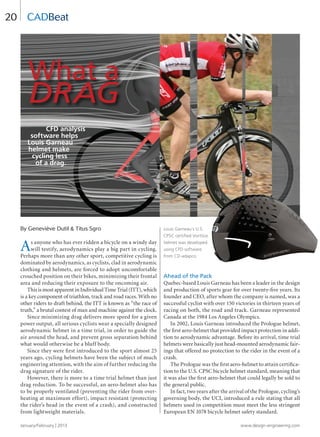
What a
DRAG
CFD analysis
software helps
Louis Garneau
helmet make
cycling less
of a drag.
N
T
m
r
D
w
tu
R
c
R
a
•
•
•
T
n
5
T
c
w
v
p
th
C
v
RSM2800 A
20-25-DES.indd 20 13-02-05 1:05 PM
Novotechnik U.S., Inc. • 155 Northboro Road • Southborough, MA 01772 • Tel: 508-485-2244 Fax: 508-485-2430
The RSM2800 Magnetic Encoder counts turns,
measures angles down to the last degree, and
remembers shaft positions without power
Don’t try this with other encoders: imagine your machine
with the RSM2800 inside both lose power and are still
turning without power; when power is restored, the
RSM2800 reports the correct position including the
counts that occurred with no power!
RSM2800 magnetic encoders provide the level of reliability
and accuracy sought in demanding applications like:
• Material Handling • Agricultural Machines
• Forklifts • Cable Extension Transducers
• Overhead Doors • Medical Equipment
The RSM2800 is based on Novotechnik’s patented
non-contact multi-turn for absolute
5,760° (16 turns) measurement.
This new wear-free technology
combines advanced capabilities
with mechanical simplicity in a
very compact and sturdy housing to
provide for longer life and lower cost
than optical encoders.
Contact us for samples or for complete specs,
visit www.novotechnik.com/rsm
RSM2800 Specifications:
Absolute multi-turn
Up to 16 turns
Up to 0.1° resolution
Up to 0.1%
independent linearity
Outputs: 0.1 to 10V
or 4 to 20 mA
or 0.25 to 4.75V
Housing OD=30 mm
IP rating options:
IP54 or IP67
No gears, no optics,
no batteries
I
I
I
I
I
I
I
I
I
I
I
I
I
I
I
I


RSM2800 Ad-DE 12/2/11 10:07 AM Page 1
20-25-DES.indd 21 13-02-05 1:05 PM
January/February | 2013 www.design-engineering.com
22
The Design Cycle
Through four subsequent iterations (the Prologue in 2004, the
Rocket in 2006, the Rocket Air in 2007, and the Superleggera
in 2008), Louis Garneau continued to advance their professional
helmet line. However, each new design was painstakingly
engineered using a traditional “design-build-test” approach.
For each design iteration, it was necessary to create a clay model;
tool the production line to make a prototype helmet; and per-
form wind tunnel tests before taking the helmet to market.
Making changes after prototyping was difficult, due to the
cost and time required to retool the production line. Time is
especially important, considering that the helmets must be
manufactured and shipped in time for set racing days.
Although it was the only practical solution at the time, wind
tunnel testing, due to inherent physical limitations, is an imper-
fect way to measure air flow. That’s especially true inside the
helmet where air channels are cut to help cool a cyclist’s head
and around really small features, such as the dimples on Louis
Garneau’s 2008 model Superleggera. In addition, the exact
effects of these small parts were very much unknown.
Against the Clock
To get a better understanding of the detailed aerodynamics
of their helmets, Louis Garneau approached Lx RD inc., a
Bromont, QC mechanical engineering consulting firm, that
specializes in engineering simulation and product development
using analysis tools such as CD-adapco’s STAR-
CCM+ computational fluid dynamics software.
Lx RD and Louis Garneau partnered to create
the next iteration of Garneau’s professional cycling
helmet, the Vorttice. To begin integrating compu-
tational fluid dynamics software into the design
process, and to prove the concept to Louis Garneau,
Lx RD began by scanning a 3D model of the
Superleggera and a cyclist to analyze.
This required separate scans of the helmet and
the cyclist, which were then merged together
digitally, to reproduce Garneau’s wind tunnel
model. The resulting CFD analysis of this model
came within 4 percent of the company’s own
analysis during the wind tunnel test, verifying the
results found by Lx RD.
In analyzing the Superleggera, many ideas were
proposed for improvement, such as reducing the
frontal area of the helmet, relocating the air intake
position, adding air ducts within the helmet to
improve air flow and cooling power, and finding
ways to reduce the sensitivity of the helmet to
angle of attack.
A particular idea Lx RD brought to the table
was adding vortex generators to the helmet, com-
mon in other racing sports, which create turbulent
flow across the back half of the helmet, forcing the
boundary layer to remain attached for longer and
thereby minimizing drag.
The two companies were able to make modi-
fications daily to the helmet design, taking information from
previous iterations to make small changes. Also changed
was the location of the air intake of the cooling channels
inside the helmet, vastly improving the helmet’s ability to
cool the cyclist.
In the Superleggera, the CFD analysis actually showed
significantly substandard airflow within the helmet, which
the new intake and channels fixed. Lx RD ran a new helmet
design every day (including weekends) for a month, using the
modified helmet and the scanned cyclist’s body in the same
wind tunnel settings, before the design was optimized to
Louis Garneau’s satisfaction.
Other things that the two companies were able to do were
to quickly analyze the helmet’s performance at speeds up to
60 km/h and to examine different angles of attack for the
helmet. This is something that’s hard to reproduce in a wind
tunnel because a cyclist usually cannot hold his head com-
pletely still enough to take accurate measurements.
The whole process of continual redesign took a month,
but produced a vastly superior helmet in a shorter period of
time than the clay model method, not to mention the reduced
cost of the process. In addition, Louis Garneau had vastly
more data and information about their new helmet from the
CFD analysis than they could have gathered from a wind
tunnel test, giving them further insight into potential improve-
ments in the future.
CADBeat
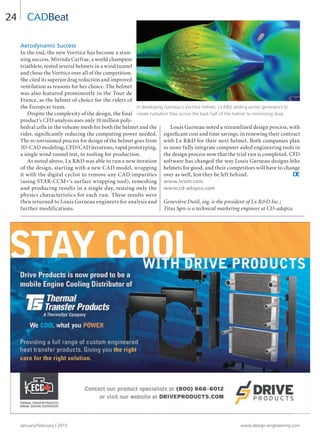
CD-adapco’s STAR-CCM+ software let Lx RD analyze the helmet’s performance
at speeds up to 60 km/h and examine different angles of attack.
CFD analysis helped designers optimize the location of the air intake of the air
ducts within the helmet to improve air flow and cooling power.
20-25-DES.indd 22 13-02-05 1:05 PM
20-25-DES.indd 23 13-02-05 1:05 PM
January/February | 2013 www.design-engineering.com
24
Aerodynamic Success
In the end, the new Vorttice has become a stun-
ning success. Mirinda Carfrae, a world champion
triathlete, tested several helmets in a wind tunnel
and chose the Vorttice over all of the competition.
She cited its superior drag reduction and improved
ventilation as reasons for her choice. The helmet
was also featured prominently in the Tour de
France, as the helmet of choice for the riders of
the Europcar team.
Despite the complexity of the design, the final
product’s CFD analysis uses only 10 million poly-
hedral cells in the volume mesh for both the helmet and the
rider, significantly reducing the computing power needed.
The re-envisioned process for design of the helmet goes from
3D-CAD modeling, CFD/CAD iterations, rapid prototyping,
a single wind tunnel test, to tooling for production.
As noted above, Lx RD was able to run a new iteration
of the design, starting with a new CAD model, wrapping
it with the digital cyclist to remove any CAD impurities
(using STAR-CCM+’s surface wrapping tool), remeshing
and producing results in a single day, reusing only the
physics characteristics for each run. These results were
then returned to Louis Garneau engineers for analysis and
further modifications.
Louis Garneau noted a streamlined design process, with
significant cost and time savings, in renewing their contract
with Lx RD for their next helmet. Both companies plan
to more fully integrate computer aided engineering tools in
the design process now that the trial run is completed. CFD
software has changed the way Louis Garneau designs bike
helmets for good, and their competitors will have to change
over as well, lest they be left behind. DE
www.lxsim.com
www.cd-adapco.com
Geneviève Dutil, ing. is the president of Lx RD Inc.;
Titus Sgro is a technical marketing engineer at CD-adapco.
CADBeat
In developing Garneau’s Vorttice helmet, Lx RD adding vortex generators to
create turbulent flow across the back half of the helmet to minimizing drag.
DEX full pag20-25-DES.indd 24 13-02-05 1:05 PM
www.design-engineering.com January/February | 2013
A one day tabletop show highlighting the
latest design and manufacturing technologies
for the OEM market
An effective forum for face-to-face interactions where engineers,
product developers, machine builders and systems integrators
can discuss, network, solicit advice and ‘kick the tires’ on the
latest technologies and applications that drive your business.
Featured technologies include:
• CAD/CAE • additive manufacturing • reverse engineering
• motors • drives • motion control • automation
• fluid power• power transmission • adhesives  fasteners
… and much more
www.DEX2013.com
FREE admission for ALL attendees!
Registration is required:
Exhibit sales have started and space is filling quickly!
To discuss exhibit and sponsor options, contact:
Alan Macpherson Laura Gergley
Publisher National Accounts Manager
416-510-6756 416-510-5230
dex@design-engineering.com lgergley@design-engineering.com
CHOOSE FROM TWO GREAT LOCATIONS!
May 7 - Coquitlam, British Columbia - NEW!
October 30 - Mississauga, Ontario
DEX full page ad 2013.indd 1 13-01-29 2:23 PM20-25-DES.indd 25 13-02-05 1:05 PM
January/February | 2013 www.design-engineering.com
26 CoverStory
By Jim Anderton
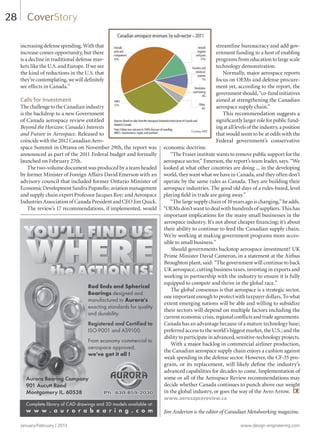
By the numbers, Canada is an aerospace overachiever. Rank-
ing 35th in population globally, we have the world’s fifth
largest aerospace industry in absolute terms. Only the US,
France, Germany and Great Britain exceed our share. When
measured relative to the size of national economies, Canada is
even more impressive, behind only the United States.
In the current economic reality, however, can we maintain
our position? Despite global recessionary pressures, the future
looks bright, according to Aerospace Industries Association
of Canada president and CEO Jim Quick.
“Based on our information, we’re expecting that major
OEM’s like Boeing, Airbus and Bombardier that we are on
track for the next 20 years to see a dramatic increase in pas-
senger travel,” says Quick. “That means 34,000 new aircraft;
it’s the equivalent of 4.5 trillion dollars’ worth of work.”
Aging Fleets, More Orders
Those opportunities have emerged because of a “perfect storm”
of global economic factors favouring civil aerospace. The
dramatic rise of the developing world—in particular the
“BRIC” economies of Brazil, Russia, India and China—has
left those nations’ indigenous aerospace sectors lagging in
large commercial airframe and engine capacity, although
all four have the technology to build airliners.
However, growing demand for air travel isn’t the only
driver of commercial aircraft orders. Fuel costs, which
account for over half of many airlines operation costs, are
stubbornly high. While modern aircraft like Boeing’s 787
Dreamliner offer up to 20 percent lower fuel burn per pas-
senger mile compared to current airliners, they are expen-
sive—a 787-8 carries a list price of over 200 million dollars.
However, interest rates are at generational lows, and the
airline fleet is aging.
Air Canada’s fleet is an example. According to airfleets.
net, Air Canada’s average fleet age is 12.3 years, with the
A320 aircraft averaging 19.4 years. Aircraft used for short
haul domestic routes can become uneconomic after 20 years
of service and over 200 airlines use the A320, so the replace-
ment market is enormous. Boeing alone carries a three year
delivery backlog.
The potential for Canadian suppliers is obvious. Boeing’s
director of business development and global strategy for the
firm’s commercial airplane business, Dustin Robinson,
describes the environment.
“Boeing spent 900 million dollars with more than 400
Canadian suppliers in 2011,” he says. “World air travel has
grown five percent per year since 1980, despite four recessions,
two Gulf Wars, an oil shock and 9-11. We predict that com-
mercial airplanes will generate 1.2 trillion dollars in sales
opportunity over the next twenty years.”
Robinson feels this growth will result in changes to the
way parts are sourced by major OEM’s.
“We’re working closely with our suppliers to address
supply chain issues,” he says. “It’s one of the most significant
challenges we have in new programs ... it can be a significant
enabler to program success. We’ve spent a lot of time look-
ing at financing; with a growth of 40 percent, we will have
constraints. It will take capital and technology.”
It will also take a new approach from Tier One and Two
suppliers to the firm.
“We have a fewer number of suppliers than in past pro-
grams,” Robinson adds. “We will focus on those suppliers
but recognize the need to manage the whole supply chain
in a highly competitive market. There was a view that infor-
mation sharing with Boeing will work against you, usually
a ‘cost down’. We really want to work together to achieve
cost efficiencies....when Boeing requests a price reduction
from a supplier, someone in the chain will ultimately pay
for it in a highly competitive environment.”
Just who will pay isn’t clear, but several Tier Two and
Three suppliers contacted but who declined to be named,
expressed doubt that major OEM’s will be able to push cost
cutting entirely down to the bottom of the supply chain.
They cite already tight margins and the increasing special-
ization and certification of downstream suppliers. If your
shop is a certified supplier and has years of experience with
landing gear trunnions for example, competition will more
likely come from foreign firms than Canadian companies.
Ride the
Updraft
Comprehensive report points the way upward for Canada’s aerospace sector.
PHOTO: BOMBARDIER INC.
26-29.2-DES.indd 26 13-02-05 1:06 PM
www.design-engineering.com January/February | 2013
27CoverStory
The Global Challenge
Protecting Canadian suppliers from that threat will require a
new emphasis on net benefits analysis and tighter control over
technology transfer and intellectual property rights.
“The single largest challenge is the globalization of the
industry,” says AIAC’s Jim Quick. “It’s changing how you
build and structure the supply chains. At some point, platforms
having 300 suppliers will have 50, because major OEMs are
asking their supply chains to take on more and larger segments
of the work. You’ll see that kind of phenomenon down through
the Tier Ones to tiers Three and Four. This is the way the
industry is evolving.”
Veteran aerospace manufacturing consultant Dr. Kevin
Michaels notes that consolidation is ongoing, citing a recent
deal in the lucrative landing gear segment.
“The United Technologies Corporation/Goodrich merger
could be a harbinger of further Tier One consolidation in the
future,” he says. “One reason is a changing supply chain
strategy from OEMs. They want to simplify
their supply chains. Rolls- Royce went from
400 suppliers in 1977 to less than 50 for the
firm’s new Trent jet engine program. OEM’s
now want to source complete aircraft sys-
tems, not just parts.”
Michaels cites Nexcelle, a joint venture
between U.S. major GE Aviation and France’s
SAFRAN as an example, as well as Rolls
Royce’s collaboration with United Technolo-
gies’ Pratt  Whitney engine business.
Michaels also notes that the major deals
conceal a larger movement further down
the supply chain.
“Tier Four supplier consolidation is under
reported,” he says. “These are the raw materi-
als suppliers and are consolidating quickly.
Smaller firms here could go the way of the
family farm.”
Different Rules, Different Game
Globalization and consolidation are nothing
new in manufacturing, but the aerospace
industry’sdefensesectoroperatesbydifferent
priorities than the civil market. Both emerg-
ingandadvancedcountriesregardindigenous
defense manufacturing capability as a source
of national pride and a security issue. At the
same time, the advanced technologies inher-
ent in modern weapons programs add issues
of secrecy and supplier security qualification.
On the price side, many programs are
decades-long, making total life cycle costs
difficult to predict and highly political.
Nowhere is this more true that in the ongo-
ing CF-35 procurement debate. At press
time, the issue was “reset” by Minister of
Public Works and Government Services and Minister for
Status of Women Rona Ambrose, who publicly released the
selection criteria for fighter aircraft.
“Last April, we set out a Seven-Point Plan to hit the reset
button on the process to replace the CF-18 aircraft,” the Min-
ister said. “With the release of the Terms of Reference that will
guide the evaluation of alternative fighter aircraft, we are dem-
onstrating that we are serious about looking at all available
options to replace the CF-18’s.”
While “all available options” doesn’t exclude the CF-35, the
operationalrequirementswerewrittenaroundtheuniquestealth
capability of the aircraft, making a new selection process dif-
ficult and possibly too lengthy to deliver aircraft before the
current CF-18 airframes reach their maximum allowable flight
hours. And export markets will be dominated by fiscal restraint
for some time to come, adds Quick.
“Ithinktherearetwoenvironments,”hesays.“Onthedefense
side, we’re seeing two phenomena. Emerging economies are
Courtesy AIAC
Courtesy AIAC
26-29.2-DES.indd 27 13-02-05 1:06 PM
January/February | 2013 www.design-engineering.com
28
increasing defense spending. With that
increase comes opportunity, but there
is a decline in traditional defense mar-
kets like the U.S. and Europe. If we see
the kind of reductions in the U.S. that
they’recontemplating,wewilldefinitely
see effects in Canada.”
Calls for Investment
ThechallengetotheCanadianindustry
is the backdrop to a new Government
of Canada aerospace review entitled
Beyond the Horizon: Canada’s Interests
and Future in Aerospace. Released to
coincidewiththe2012CanadianAero-
space Summit in Ottawa on November 29th, the report was
announced as part of the 2011 Federal budget and formally
launched on February 27th.
The two-volume document was produced by a team headed
by former Minister of Foreign Affairs David Emerson with an
advisory council that included former Ontario Minister of
EconomicDevelopmentSandraPupatello;aviationmanagement
and supply chain expert Professor Jacques Roy; and Aerospace
IndustriesAssociationofCanadaPresidentandCEOJimQuick.
The review’s 17 recommendations, if implemented, would
streamline bureaucracy and add gov-
ernment funding to a host of enabling
programs from education to large scale
technology demonstration.
Normally, major aerospace reports
focus on OEMs and defense procure-
ment yet, according to the report, the
governmentshould,“co-fundinitiatives
aimed at strengthening the Canadian
aerospace supply chain.”
This recommendation suggests a
significantlylargerroleforpublicfund-
ingatalllevelsoftheindustry,aposition
that would seem to be at odds with the
Federal government’s conservative
economic doctrine.
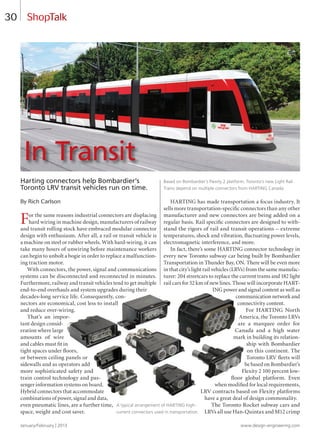
“The Fraser institute wants to remove public support for the
aerospace sector,” Emerson, the report’s team leader, says. “We
looked at what other countries are doing ... in the developing
world, they want what we have in Canada, and they often don’t
operate by the same rules as Canada. They are building their
aerospace industries. The good old days of a rules-based, level
playing field in trade are going away.”
“The large supply chain of 10 years ago is changing,” he adds.
“OEMs don’t want to deal with hundreds of suppliers. This has
important implications for the many small businesses in the
aerospace industry. It’s not about cheaper financing; it’s about
their ability to continue to feed the Canadian supply chain.
We’re working at making government programs more acces-
sible to small business.”
Should governments backstop aerospace investment? UK
Prime Minister David Cameron, in a statement at the Airbus
Broughton plant, said: “The government will continue to back
UK aerospace, cutting business taxes, investing in exports and
working in partnership with the industry to ensure it is fully
equipped to compete and thrive in the global race.”
The global consensus is that aerospace is a strategic sector,
one important enough to protect with taxpayer dollars. To what
extent emerging nations will be able and willing to subsidize
their sectors will depend on multiple factors including the
currenteconomiccrisis,regionalconflictsandtradeagreements.
Canada has an advantage because of a mature technology base;
preferred access to the world’s biggest market, the U.S.; and the
abilitytoparticipateinadvanced,sensitive-technologyprojects.
With a major backlog in commercial airliner production,
the Canadian aerospace supply chain enjoys a cushion against
weak spending in the defense sector. However, the CF-35 pro-
gram, or its replacement, will likely define the industry’s
advanced capabilities for decades to come. Implementation of
some or all of the Aerospace Review recommendations may
decide whether Canada continues to punch above our weight
in the global industry, or goes the way of the Avro Arrow. DE
www.aerosapcereview.ca
Jim Anderton is the editor of Canadian Metalworking magazine.
CoverStory
Rod Ends and Spherical
Bearings designed and
manufactured to Aurora's
exacting standards for quality
and durability.
Registered and Certified to
ISO-9001 and AS9100.
From economy commercial to
aerospace approved,
we've got it all !
Aurora Bearing Company
901 Aucutt Road
Montgomery IL. 60538
Complete library of CAD drawings and 3D models available at:
w w w . a u r o r a b e a r i n g . c o m
Aurora-Where_the_Action_Is:Aurora 11/5/10 2:27 PM Page 1
Courtesy AIAC
24784_CN_DM13
26-29.2-DES.indd 28 13-02-05 1:06 PM
Produced and managed
by UBM Canon
ubmcanonevents.com
Register today at:
DM-CanadaShow.com
Promo code: AB
Leave your office behind and expand your skill set at Design  Manufacturing Canada.
CONNECTIONS
like these cannot be made at your desk!
May 14-16, 2013
Toronto Congress Centre
Toronto, ON
Industry Peers Thought Leaders Ideas and InspirationNew Technologies
24784_CN_DM13
• Increase your knowledge and your network by
engaging with like-minded peers and industry
thought leaders.
• Test drive the technologies of tomorrow.
• Collaborate with world-class suppliers to create
custom solutions that can’t be found online.
• Engineer fresh ideas through
face-to-face discussions.
26-29.2-DES.indd 29 13-02-06 7:18 AM
January/February | 2013 www.design-engineering.com
30
Harting connectors help Bombardier’s
Toronto LRV transit vehicles run on time.
By Rich Carlson
For the same reasons industrial connectors are displacing
hard wiring in machine design, manufacturers of railway
and transit rolling stock have embraced modular connector
design with enthusiasm. After all, a rail or transit vehicle is
a machine on steel or rubber wheels. With hard-wiring, it can
take many hours of unwiring before maintenance workers
can begin to unbolt a bogie in order to replace a malfunction-
ing traction motor.
With connectors, the power, signal and communications
systems can be disconnected and reconnected in minutes.
Furthermore, railway and transit vehicles tend to get multiple
end-to-end overhauls and system upgrades during their
decades-long service life. Consequently, con-
nectors are economical, cost less to install
and reduce over-wiring.
That’s an impor-
tant design consid-
eration where large
amounts of wire
and cables must fit in
tight spaces under floors,
or between ceiling panels or
sidewalls and as operators add
more sophisticated safety and
train control technology and pas-
senger information systems on board.
Hybrid connectors that accommodate
combinations of power, signal and data,
even pneumatic lines, are a further time,
space, weight and cost saver.
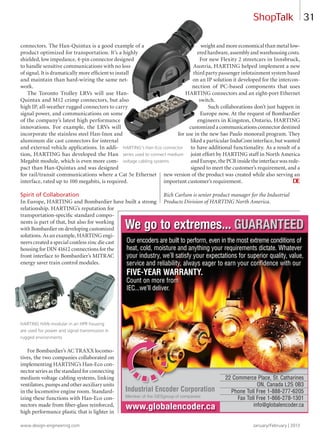
HARTING has made transportation a focus industry. It
sells more transportation-specific connectors than any other
manufacturer and new connectors are being added on a
regular basis. Rail specific connectors are designed to with-
stand the rigors of rail and transit operations – extreme
temperatures, shock and vibration, fluctuating power levels,
electromagnetic interference, and more.
In fact, there’s some HARTING connector technology in
every new Toronto subway car being built by Bombardier
Transportation in Thunder Bay, ON. There will be even more
in that city’s light rail vehicles (LRVs) from the same manufac-
turer: 204 streetcars to replace the current trams and 182 light
rail cars for 52 km of new lines. Those will incorporate HART-
ING power and signal content as well as
communication network and
connectivity content.
For HARTING North
America, the Toronto LRVs
are a marquee order for
Canada and a high water
mark in building its relation-
ship with Bombardier
on this continent. The
Toronto LRV fleets will
be based on Bombardier’s
Flexity 2 100 percent low-
floor global platform. Even
when modified for local requirements,
LRV contracts based on Flexity platforms
have a great deal of design commonality.
The Toronto Rocket subway cars and
LRVs all use Han-Quintax and M12 crimp
ShopTalk
A typical arrangement of HARTING high-
current connectors used in transportation.
Based on Bombardier’s Flexity 2 platform, Toronto’s new Light Rail
Trains depend on multiple connectors from HARTING Canada.
In Transit
30-31.1-DES.indd 30 13-02-05 1:37 PM
www.design-engineering.com January/February | 2013
31
connectors. The Han-Quintax is a good example of a
product optimized for transportation. It’s a highly
shielded, low impedance, 4-pin connector designed
to handle sensitive communications with no loss
of signal. It is dramatically more efficient to install
and maintain than hard-wiring the same net-
work.
The Toronto Trolley LRVs will use Han-
Quintax and M12 crimp connectors, but also
high IP, all-weather rugged connectors to carry
signal power, and communications on some
of the company’s latest high performance
innovations. For example, the LRVs will
incorporate the stainless steel Han-Inox and
aluminum die cast connectors for internal
and external vehicle applications. In addi-
tion, HARTING has developed the Han
Megabit module, which is even more com-
pact than Han-Quintax and was designed
for rail/transit communications where a Cat 5e Ethernet
interface, rated up to 100 megabits, is required.
Spirit of Collaboration
In Europe, HARTING and Bombardier have built a strong
relationship. HARTING’s reputation for
transportation-specific standard compo-
nents is part of that, but also for working
with Bombardier on developing customized
solutions. As an example, HARTING engi-
neers created a special coatless zinc die cast
housing for DIN 41612 connections for the
front interface to Bombardier’s MITRAC
energy saver train control modules.
For Bombardier’s AC TRAXX locomo-
tives, the two companies collaborated on
implementing HARTING’s Han-Eco con-
nector series as the standard for connecting
medium voltage cabling systems, linking
ventilators, pumps and other auxiliary units
in the locomotive engine room. Standard-
izing these functions with Han-Eco con-
nectors made from fiber-glass reinforced,
high performance plastic that is lighter in
weight and more economical than metal low-
ered hardware, assembly and warehousing costs.
For new Flexity 2 streetcars in Innsbruck,
Austria, HARTING helped implement a new
third party passenger infotainment system based
on an IP solution it developed for the intercon-
nection of PC-based components that uses
HARTING connectors and an eight-port Ethernet
switch.
Such collaborations don’t just happen in
Europe now. At the request of Bombardier
engineers in Kingston, Ontario, HARTING
customized a communications connector destined
for use in the new Sao Paulo monorail program. They
liked a particular InduCom interface, but wanted
to have additional functionality. As a result of a
joint effort by HARTING staff in North America
and Europe, the PCB inside the interface was rede-
signed to meet the customer’s requirement, and a
new version of the product was created while also serving an
important customer’s requirement. DE
Rich Carlson is senior product manager for the Industrial
Products Division of HARTING North America.
ShopTalk
We go to extremes... GUARANTEEDWe go to extremes... GUARANTEED
www.globalencoder.ca
22 Commerce Place, St. Catharines
ON, Canada L2S 0B3
Phone Toll Free 1-888-277-6205
Fax Toll Free 1-866-278-1301
info@globalencoder.ca
Industrial Encoder Corporation
Member of the GESgroup of companies
Our encoders are built to perform, even in the most extreme conditions of
heat, cold, moisture and anything your requirements dictate. Whatever
your industry, we’ll satisfy your expectations for superior quality, value,
service and reliability, always eager to earn your confidence with our
FIVE-YEAR WARRANTY.
Count on more from
IEC...we’ll deliver.
Our encoders are built to perform, even in the most extreme conditions of
heat, cold, moisture and anything your requirements dictate. Whatever
your industry, we’ll satisfy your expectations for superior quality, value,
service and reliability, always eager to earn your confidence with our
FIVE-YEAR WARRANTY.
Count on more from
IEC...we’ll deliver.
HARTING’s Han-Eco connector
series used to connect medium
voltage cabling systems
HARTING HAN-modular in an HPR housing
are used for power and signal transmission in
rugged environments
30-31.1-DES.indd 31 13-02-05 1:37 PM
DMR_EssentialComponents_September-2011-outline_01.indd 1 8/15/2011 12:43:40 PM
32-37-DES.indd 32 13-02-05 1:08 PM
www.design-engineering.com January/February | 2013
33
Sensors
Rotary Encoder
POSITAL introduced its heavy-duty absolute rotary
encoders that feature shock- and vibration-resistant
magnetic measuring elements housed in 316L stain-
less steel housings. Designed for rugged environ-
ments, the encoder features seals on the shaft entry
and cable connection (IP68 and IP69K level protec-
tion), and shafts that can withstand mechanical forces of up to 300 N (67 pounds). The
magnetic encoders contain 13-bit resolution (8192 steps per revolution) and multi-turn
models are available with a range limited only by memory size. Its internal rotation
counter uses a self-powered technology that enables these devices to keep track of
their absolute position even when movement occurs during control system power
outages. The encoders are available with a simple serial (SSI) interface or CANopen,
DeviceNet and SAE J1939 field bus interfaces. Analog interfaces (4-20mA or 0-10V) are
also available.
www.fraba.com
Capacitive Proximity Sensor
AutomationDirect’s line of capacitive proximity
sensors now includes 12mm metal round bodied
DC models with shielded and unshielded mounting
options, PNP, normally-open outputs, potentiom-
eter adjustment and M12 quick disconnect.
Unshielded 18mm DC plastic bodied models with
selectable normally-open/normally-closed outputs feature logic auto detection. Additional
unshielded 30mm models feature AC and DC versions with plastic housings and have
programmable normally-open or normally-closed outputs. Rectangular plastic DC
sensors, designed for sight glass applications, feature selectable normally-open or
normally-closed outputs and are fitted with a two-meter three-wire axial cable. All units
are cULus, CE and RoHS rated and have a limited lifetime warranty.
www.automationdirect.com
Miniature LVDT Position Sensors
Macro Sensors rolled out its Miniature AC-Operated
LVDT Position Sensors for high pressure and tem-
perature environments. Offering a lightweight, low
mass core and a compact 3/8-inch diameter, the
CD 375 Series operate in temperature extremes of
-65°F to +400°F (-55°C to +200°C) and operating
pressures of 35 kpsi. To accommodate such high
pressure, the sensor case is vented to equalize pres-
sure inside and outside the LVDT linear position sensor. Available sizes range from ±0.025
inch (±0.63mm) to ±1.0 inch (±25.0mm). Customizable with Teflon bore liners, metric
threaded cores and lead wire exit points, the CD 375 Series LVDTs operate with any
conventional differential input LVDT signal conditioners.
www.macrosensors.com
Vacuum Thermocouple Assemblies
Omega’s new TCV series of Stainless Steel thermocouple
probe assemblies with M12 connector are available in
standard lengths of 3, 6, and 12 inches with a grounded
or ungrounded thermocouple junction at the tip.
Standard probes are available in K, T and E calibra-
IdeaGenerator
www.diequa.com
630-980-1133
See our complete
product line!
DieQua offers
more gearboxes
plus application experience to help
select the best one for your needs
• 1-75 HP Capacity
• Motorized or Adapters
• Right Angle or Inline
• Shaft Mount Designs
• Multi-Stage Ratios
• Modular Design
Helical Gearmotors
• 7 sizes, 28-110mm CD
• Fret-free Connection
• NEMA or IEC Adapters
• Coupling Input
• Aluminum Housings
• 2-Side Worm Support
Worm Reducers
• Precision or Economy
• Inline or Right Angle
• 40-155mm Frames
• Low Backlash
• 1 and 2 Stage Ratios
• Lubricated for Life
Planetary Gearheads
• 3 Backlash Levels
• Shafts or Hollow Bores
• Single or Dual Outputs
• 11 sizes, 25-200mm CD
• Capacity: 10-7000 Nm
• 20,000 Hour Ratings
Servo Worm Gearheads
• 9 Sizes
• 1-250 HP Capacity
• Low Backlash Option
• Ratios from 1:1 to 6:1
• Output Shaft Options
• Machined Housings
Spiral Bevel Gearboxes
• Add-On Options
• ModifiedDimensions
• High Speed Applications
• Special Environments
• Special Duty Needs
• Custom Designs
Special Designs
43:40 PM
32-37-DES.indd 33 13-02-05 1:08 PM
January/February | 2013 www.design-engineering.com
34
tions. Single or dual thermocouple construction is optional.
Designed for vacuum furnace, food processing and storage, food
products in transit, and fish farming in order to record environ-
mental conditions to comply with health and safety regulations.
www.omega.ca
Touch Probes
HEIDENHAIN intro-
duced two Touch
Probes — the TS 460
for workpiece mea-
surement and the TT
460 for tool mea-
surement — featuring hybrid technology, and offering radio and
infrared signal transmissions. The dual signal transmission of
these new touch probes enables the user to select either mode,
combining the advantages of radio or of infrared signals. The
radio transmission uses the 2.4 GHz frequency band and has 16
channels. The range is usually 15m and infrared transmission has
a range of 7m. On both the TT 460 and TS 460, the optical
sensor is free of wear, and so provides the specified probing
reproducibility even after a large number of probing processes
(5 million switching cycles during type testing).
www.heidenhain.us
Automation
Robot Controller
DENSO introduce its
high-speed RC8 control-
ler, a compact (12 x 18 x
3.75 inches), 3-kW out-
put industrial robot
controller that is 60
percent smaller and 45
percent lighter than the company’s previous model. The RC8 can
communicate with more than 100 different types of devices
using the company’s ORiN open-resource interface networking
system. Its communications interfaces include 100 Base-T Eth-
ernet, mini/hand I/O, RS-232C and USB as standard, plus CC-Link,
DeviceNet, EtherCAT, EtherNet/IP, parallel discrete I/O, Profibus
and Profinet as optional. It features a Microsoft Windows-based
graphical user interface and is ISO and UL safety compliant.
Optional accessories include a 7.5-inch color touchscreen; a mini
pendant with a 128 x 64 pixel LCD display, up to two additional
axes and conveyor tracking. DENSO’s Wincaps III 3D simulation
software allows offline programming and remote monitoring of
robot operation.
www.densorobotics.com
IdeaGenerator
• Free 3D CAD models.
• Outstanding customer support.
• Request your free catalog today!
Tel: (516) 302-0152
amspsupport@amsp.biz
www.allmetricsmallparts.com
aMsp MAKES IT EASIER
to find Kipp products you are looking for like
their innovative adjustable levers. Kipp’s
levers come in a rainbow of colors and are
sure to add style to any application.
32-37-DES.indd 34 13-02-05 1:08 PM
www.design-engineering.com January/February | 2013
35
Industrial PC
BR unveiled its Automation PC 910, a
box PC featuring Intel’s third generation
Core i3, Core i5 or Core i7 CPUs with up
to four cores combined with the QM77
Express chipset. As with previous Auto-
mation PC models, the user is able to
mix and match CPU performance with
different sized main units as needed.
The Automation PC 910 now has a serial
ATA-based CFast card combined with standard PC solid state
drives and hard disks. These devices are also equipped with two
Gigabit Ethernet ports, one serial and one modular serial port
such as RS485 or CAN together with USB 3.0 ports.
www.br-automation.com
Safety Relay
Wieland Electric Inc. has expanded its
line of universal safety relays to include
a small 22.5mm wide version. The SNO
4083KM safety relays are used for con-
ventional safety tasks in mechanical and
system engineering and applications in
lift engineering (according to EN 81-1)
or in controls for industrial combustion
plants (according to EN 50156-1). For
increased safety, all of these applications can be implemented
without the user having to press a control button or connect
additional configuration terminals. Wieland’s SNO 4083KM relays
can be used in safety-oriented applications up to PL e / Category
4 according to EN ISO 13849-1 and SILCL 3 according to EN
62061. The SNO 4083KM safety relays also feature a wide tem-
perature operating range of -25ºC to 65ºC.
www.wielandinc.com
EtherCAT Box I/O
Beckhoff Automation introduced its EP1518
EtherCAT Box, a I/O device that integrates
32-bit fast-pulse counters, digital inputs with
sensor diagnostics and adjustable filter char-
acteristics. The EP1518 is IP 67-rated and has
eight 24VDC inputs as well as an EtherCAT
input port and output port. The device also
counts fast pulses with a counting frequency
of up to 1 kHz. All eight inputs of the EP1518
are equipped with an up/down counter and
gate input that can be deactivated. Two of
the eight inputs are available for standard
32-bit up/down counters, however all eight signal inputs on the
EP1518 IP 67 box are transmitted as “normal” digital signals over
the EtherCAT network. In addition, the EtherCAT Box is equipped
with short-circuit detection via diagnostics of the sensor supply.
The software-based adaptation of the inputs can be adjusted
by filter characteristics between 10 μs and 100 ms.
www.beckhoff.com
IdeaGenerator
32-37-DES.indd 35 13-02-05 1:08 PM
January/February | 2013 www.design-engineering.com
36
Fluid Power
Pneumatic Air Cylinders
AutomationDirect has added its
F-Series all stainless steel air cyl-
inders to its NITRA pneumatic
product line. The non-repairable
round body pneumatic air cylin-
ders are interchangeable with
other popular brands. The double-
acting cylinders have a 250 psi operating pressure and are
constructed with corrosion resistant 300 series stainless steel
and Teflon-based rod and pivot bushings. The Urethane rod
wiper keeps wash down solutions out of the cylinder. The series
includes bore sizes from ¾-inch to two inches and stroke lengths
from ½-inch to 18 inches to meet a broad range of applications.
Models feature nose, rear pivot, and double-end mounting
options and models are available with magnetic piston for posi-
tion indication.
www.automationdirect.com
Air Nozzle
EXAIR introduced its Pico Super Air Nozzle, which produces a
focused air pattern that measures 1.3-inches in diameter when
positioned 6 inches away from the target
surface. Amplification of entrained air-
flow and a blowing force of 5 ounces
are achieved with minimal air consump-
tion of only 4.9 SCFM at 80 PSIG. The
Pico Super Air Nozzle meets the OSHA
standards for dead-end pressure 29 CFR
1910.242(b) and noise requirements 29
CFR 1910.95(a), assuring safe operation.
The Pico Super Air Nozzle has a M5 x
0.5 air inlet, but is also available with a 1/8 NPT male compressed
air inlet. In addition, there is a version constructed of PEEK plas-
tic for non-marring protection.
www.exair.com
Motors and Drives
Hypoid Gearmotor
Bison Gear and Engineering launched the PowerSTAR, a hypoid,
maximum efficiency, right-angle gearmotor. The motor features
ground gearing to provide quiet operation and low backlash preci-
sion and is equipped with finned edges for cooler operating tem-
peratures and multiple mounting configurations. The initial product
IdeaGenerator
WWW.BOKERS.COM/DE
FREE CATALOG  BROCHURE
Call 1-888-WASHERS
1-888-927-4377 • sales@bokers.com
612-729-9365 • FAX 612-729-8910
WWW.BOKERS.COM/DE
612-729-9365 • FAX 612-729-8910
WASHERS 
STAMPINGS
www.masterbond.com
154 Hobart Street, Hackensack, NJ 07601 USA
+1.201.343.8983 • main@masterbond.com
High Peel and Shear
Strength Adhesive
EP21TDCHT Epoxy System
• Toughened and flexibilized
• Resists vibration and mechanical shock
• Serviceable from -100ºF to +350ºF
2015AS_3.375x4.875.indd 1 9/9/11 2:35 PM
32-37-DES.indd 36 13-02-05 1:08 PM
37
offering includes both 1/8 and 1/5 HP single-phase
115V and three-phase 230V inverter duty motor
options on the 725 gearbox in 13
standard ratios offering output torque
from 59-878 in-lbs. Other frame sizes
and gearing packages are scheduled,
the company says.
www.bisongear.com
Servo Drives
Metronix launched its ARS
2000 SE line of intelligent
servomotor drives available in
a choice of six single- or three-
phase continuous output
power ratings from 0.5 to 6
kVA. The line features a compact design with integrated line
and motor filters plus an integrated brake chopper and braking
resistor. In addition, the drives incorporate an increased over-
current capability of four times the continuous output rating and
the integration of Safe Torque Off (STO) functional safety. The
new drives also feature a universal encoder interfacing capabil-
ity. Standard communications interfaces include the CAN field-
bus, which is compatible with the DS 402 CANopen device
profile. One further feature is an SD Card interface, which can
be used to store firmware and operating parameters.
www.metronix.de
AC Drives
Rockwell Automation has extended the
ratings of its Allen-Bradley PowerFlex 755
AC drives to 1500 kW/2,000 hp. This latest
frame extension features 400/480/600/690
volt ratings and N-1 technology that allows
users to configure the drive to utilize one,
two or all three of its power structures. The
common DC-bus option allows users to
connect the PowerFlex 755 AC drive to a
DC-bus configuration, which takes advantage of dif-
ferent drive cycles to share energy. Like all PowerFlex 755 drives,
the latest frame size includes an embedded Ethernet port and
multiple option slots. Option modules include I/O, feedback,
safety, additional communications and auxiliary power supply.
www.rockwellautomation.com
IdeaGenerator
To advertise your solution in this section call Alan Macpherson at 416.510.6756
Dust Collectors NEW - Full Line Literature Guide
This impressive NEW guide outlines dozens of N.R. Murphy dust collectors, installations, capacities,
styles and models. A must for any reference library. N.R. Murphy Limited has been in business over 70
years and has thousands of satisfied customers. “Dust Collectors are all we do; so get it done right
the first time. Just Ask the Experts.”
Contact: 4nodust@nrmurphyltd.com
Visit us at: www.nrmurphy.com
OMEGA Introduces DC Current Data Logger
OMEGA Introduces DC Current Data Logger Omega introduces its new series of DC Current Data
Loggers. The OM-CP-PROCESS101A is a low cost logger with 10 year battery life, 4 Hz reading rate,
multiple start/stop function, ultra high speed download, 1 million reading storage capacity, memory
wrap, battery life indicator, optional password protection and programmable high and low alarms.
Two current input ranges are available: 20mA and 160 mA.
Contact: info@omega.ca
Visit us at: www.omega.ca
DesignSolutions
Clippard Offers Miniature Pneumatic Products Catalog for
Scientific/Medical Applications
A leader in miniature pneumatics, Clippard provides the scientific/medical industry a variety of products
and solutions. The product range is illustrated in a color brochure featuring the most complete line
of miniature fluid power products for the medical, pharmaceutical analytical and dental fields. To get
your copy today please visit our website at the address printed below.
Contact: sales@clippard.com
Visit us at: www.clippard.com/scientific-a
www.design-engineering.com January/February | 2013
32-37-DES.indd 37 13-02-05 1:08 PM
January/February | 2013 www.design-engineering.com
38
By Treena Hein
Take notice, conventional computer screens – your days
are numbered.
Development of all aspects of hardware and software is
moving swiftly these days, and computer-human interaction,
including screen technology, is exploding. One of the groups
on the cutting edge of this is the Queen’s University Human
Media Lab (HML). They have already invented the eye-
tracking screen sensors now widely used across the globe, the
world’s first flexible phone, and a pseudo-holographic tele-
conferencing system called TeleHuman.
Now, the HML team (in collaboration with Plastic Logic
and Intel Labs) has created a flexible ‘paper’ computer called
the PaperTab tablet. It looks like a sheet of paper, but is actu-
ally a high-resolution touchscreen display powered by an Intel
Core i5 processor.
But it’s not just the look that’s revolutionary; the PaperTab
is as flexible as a piece of paper and lets users interact with it
as if it were. For example, you can move to the next or previous
page of a long document by ‘turning’ the upper right or left of
the screen. HML Director Roel Vertegaal believes that within
five to ten years, most computers will be the PaperTab type.
“It’s a typical example of an HML project,” he says. “We
brainstorm with students, and pick the ideas that excite us,
and those we believe will be used in the future.”
The first version of the PaperTab device was developed in
2004 and involved projecting screen images onto pieces of
paper that were tracked with a Vicon motion capture system.
It took nine more years of waiting for new technology to be
available – lightweight, thinfilm tablets – and to develop the
haptic nature of the system, before PaperTab could be born.
“The user-friendliness of PaperTab lies in being able to
manipulate one app per screen, something only truly possible
with these technologies,” Vertigaal notes. But multiple Pap-
erTabs can also be used interactively. For example, a user can
send a photo by tapping one PaperTab (displaying the image)
on to another PaperTab displaying an open draft email.
Since PaperTabs keep track of their locations relative to
each other and the user, the action automatically carries out
the attachment process. Similarly, users can create a larger
drawing or display surface by placing two or more PaperTabs
beside each other.
“There is an electromagnetic sensor in each one that relates
6DOF position and orientation to a nearby transmitter,” Verteg-
aal explains. “They are connected to a central server which
coordinates graphics. In consumer versions, each PaperTab
will be a wireless terminal to a cloud service and position track-
CanadianInnovator
A Screen Revolution
Ultra-thin and flexible ‘PaperTab’ computer expected to become standard across the
globe in years to come.
38-40-DES.indd 38 13-02-05 1:09 PM
39
ing would be relative rather than absolute as it is now.”
The most powerful aspect of being able to use several
PaperTabs together is ease-of-use, which is one-part efficiency
and one-part effectiveness, in Vertegaal’s view. “With their
low weight, PaperTabs excel at being moved around a desk
in comparison to a hard tablet, and this is critical to using
their multi-display window systems,” he says. “That doesn’t
necessarily make them more efficient than using a traditional
window system with a mouse, but there is less concentration
and mental effort involved, and you don’t need to step
through apps.”
Vertegaal and his colleagues believe PaperTabs are more
useful with “ultimately any application.” He says. “Think about
reading the newspaper with a Papertab broadsheet that is fold-
able, thus portable while commuting. Think about no longer
having to print on paper, or map out data or architectural
drawings that require large sheets. Think about playing board
games with multiple people anywhere, anytime. Think about
offices where people can work on and compare or copy from
many files simultaneously. And so on.” He adds, “We have
finally arrived at the paperless office by inventing a computer
that works just like paper. If you can’t beat ‘em, join ‘em.”
The most challenging aspect of the PaperTab’s creation
was getting the position tracking and touch to work, and
getting the sheets of film sandwiched such that they would
be flexible and sufficiently thin.
New Lab Design
With a complete re-design and makeover of The Human Media
Lab, finished in May 2012, development of new technologies
will be easier than ever. The design was a collaboration between
Vertegaal and world-renowned designer Karim Rashid.
“Labs and other work environments have, up to this point,
been designed as functional, linear spaces not very conducive
to innovative thinking,” Vertegaal explains. “Instead, we
created creative space to think, a cantilevered table to col-
laborate around and other areas for focus work.”
A star feature is the huge interactive flexible display that
employs ‘gesture technology’ as seen in movies like ‘Minority
Report.’ In addition, eye trackers recognize when people in
adjoining cubicles are looking at each other, and turns the
translucent glass between them transparent so they can com-
municate. “This may be the way people interact with comput-
ers in the future,” says Vertegaal. “They will be seamlessly
integrated into the surrounding space.” DE
www.hml.queensu.ca
Treena Hein is a Pembroke, Ont.-based freelance writer.
CanadianInnovator
YOUR
SUCCESS
IS OUR
BUSINESS
Complete design and manufacturing
capabilities under one roof.
to your power transmission
or motion control project.
Call today - You can’t afford to wait.
2101 Jericho Turnpike • New Hyde Park, NY 11040
T. 800.819.8900 • F. 516.326.8827 • sdp-sisupport@sdp-si.com • www.sdp-si.com
• 50 Years of Experience
• Dependable Quality and Service
• 4 Manufacturing Plants Totaling
147,000 Square Feet
to your power transmissionto your power transmission
Let SDP/SI provide the missing piece
SDP: ISO 9001 Registered • SI: ISO 9001  AS9100 Registered
Advertiser Website Page
Aerotech, Inc. www.aerotech.com 12
All Metric Small Parts www.allmetricsmallparts.com 34
Aurora Bearing Company www.aurorabearing.com 28
Automation Direct www.automationdirect.com 7
Baldor Electric Company www.baldor.com 40
Beckhoff Automation www.beckhoff.ca 15
Boker’s Inc. www.bokers.com 36
Clippard Instrument www.clippard.com 9
Daemar Inc. www.daemar.com 32
Diequa Corp. www.diequa.com 33
Drive Products Inc. www.driveproducts.com 24
Encoder Products Co. www.encoder.com 34
Festo Canada Inc. www.festo.ca 2
Great-West Life www.engineerscanadafsp.grsaccess.com/app 13
Industrial Encoder Corp. www.globalencoder.ca 31
Master Bond Inc. www.masterbond.com 36
Myostat Motion Control Inc. www.myostat.ca 11
Nord Gear Ltd. www.nord.com 16-17
Novotechnik US Inc. www.novotechnik.com 21
Omega Engineering Inc. www.omega.ca 3
Proto Labs Inc. www.protolabs.com 23
RotoPrecision Inc. www.rotoprecision.ca 35
Schaeffler Canada Inc. www.ina.com 4
Stock Drive Products www.sdp-si.com 39
Stratasys www.stratasys.com 18-19
UBM Canon www.DM-Canadashow.com 29
Advertisers Index
www.design-engineering.com January/February | 2013
38-40-DES.indd 39 13-02-05 1:09 PM
All Applications Accepted
• Energy Efficient
• Unmatched Quality
• Superior Reliability
• Quickest Delivery Available
• Made in the USA
Special flange, foot or face-mount configurations,
custom shafts, custom windings, unique performance
requirements…whatever the application, Baldor can
often build and ship your motors in two weeks or less!
With decades of experience and more than 250,000
different custom motor specifications under our belts,
you spec it and we’ll build it faster and better than
anyone in the industry.
baldor.com 479-646-4711
©2011 Baldor Electric Company
38-40-DES.indd 40 13-02-05 1:09 PM

Dng de-02012013

  • 1.
    $10.00 | January/Febuary2013 PM40069240 Ride the Updraft 14 Fusion 360: Autodesk’s big bet on cloud-based CAD 30 Harting connectors help Toronto LRVs run on time 38 Is the flexible ‘PaperTab’ the future of mobile computing? Comprehensive report points the way upward for Canada’s aerospace sector 1A-DES.indd 1 2013-02-08 8:58 AM
  • 2.
    Festo Inc. Tel: 1877 GO FESTO Fax: 1 877 FX FESTO festo.canada@ca.festo.com www.festo.ca/grippers Variety as standard Standard and versatile. Tough and leakproof but always compact and powerful—Festo’s range of products for gripping and positioning is truly comprehensive. New: miniature standard grippers DHxS. Powerful, precise and resilient. 2-3-DES.indd 2 13-02-05 7:03 AM
  • 3.
    Imageurs thermiques compacts CompactThermal Imagers ® ®MD Because of transmission frequency regulations, these wireless products may only be used in the United States, Canada and Europe. En raison de la réglementation sur les fréquences de transmission, ces produits sans fil peuvent être utilisés seulement aux États-Unis, au Canada et en Europe Note: Not for Export - US and Canada only Ne peux pas être exporté - Usage aux États-unis et au Canada seulement © COPYRIGHT 2013 OMEGA ENGINEERING, INC. TOUS DROITS RESERVES © COPYRIGHT 2013 OMEGA ENGINEERING INC. ALL RIGHTS RESERVED MD 976 Bergar Laval, Québec Canada H7L 5A1 omega.ca Visit/Visitez omega.ca/osxl-i_series OSXL-i7 $ 2095 OSXL-i5 $ 1695 Point-and-Shoot, Lightweight Thermal Imaging Cameras "Point-and-shoot", caméras à imagerie thermique légères Compact Infrared Cameras with On-Board Visual Camera, Wi-Fi Connectivity, P-i-P and Bright LED Light iPad® not included OSXL-E Series/Série Starts at À partir de $ 2995 Visit/Visitez omega.ca/osxl-e Caméras compactes infrarouges avec écran visuel intégré, connectivité Wi-Fi, PiP et écran à DEL brillant iPAD® pas inclus High-Resolution Infrared Thermal Imaging Camera 640 x 480 IR Resolution, Measures Temperature to 1202°F OSXL-T620 $ 20,450 Caméra à imagerie thermique à infrarouge à haute résolution de 640 x 480, pour des mesures de température jusqu'à 1202 ° F Visit/Visitez omega.ca/osxl-t620 om 2-3-DES.indd 3 13-02-05 7:03 AM
  • 4.
    Schaeffler Introduces aGenuine Breakthrough in Condition Monitoring: WiProM with FisNet is the industry’s first truly cost-effective diagnostic tool for analyzing the performance of vital plant equipment such as motors, pumps and generators. WiProM’s portable design allows for quick and easy deployment, while the proprietary FisNet wireless network transmits the data to a monitoring center (yours or ours) for analysis. Real Solutions - Real Savings Whenacustomerfacedthedauntingtaskofperformingend-of-warranty inspections on scores of gearboxes and generators, Schaeffler was called upon for a solution. A permanent online monitoring system was deemed cost-prohibitive, and the facility was not staffed with highly trained data analysis experts. Armed with a single yellow carrying case containing a WiProM diagnostic unit, Schaeffler experts set about the task of analyzing factors such as meshing of gears and generator performance. Within three weeks, Schaeffler was able to provide condition monitoring data that has, so far, saved the customer over $1 million. We rest our (yellow) case. www.schaeffler.ca Superior-quality products. Comprehensive reliable solutions.©2013 4-5-DES.indd 4 13-02-05 1:01 PM
  • 5.
    5IN THE NEWS 8Canadian Aerospace Pioneer inducted to Hall of Fame 8 Creaform appoints VP 10 Canadian High Commissioner visits Delcam 10 McGill, ÉTS launch Aerospace Education Centre 10 System integrators confident of 2013 outlook 10 Canadian mech- animals make CES 2013 appearance 11 Ontario repeals ‘Industrial Exception’ 11 Lockheed buys Aveos 12 Harting Canada appoints President and CEO Annual Subscription Rate In Canada: $52.95 (1 year) $71.95 (2 year) Outside Canada: $99.95 (1 year) Single Copy In Canada: $10.00 Outside Canada: $22.00 Directory Rates In Canada: $27.00 Outside Canada: $45.00 Reader Service Contact Information ecallaghan@bizinfogroup.ca T: Toronto 416 442 5600 X 3538 Elsewhere -866-543-7888 Mail: Business Information Group Design Engineering Circulation Dept 80 Valleybrook Drive North York, ON M3B 2S9 Printed in Canada READER SERVICES Contents | Volume 59, No. 1 8 Design News NRC test reveals 100% biofuel better than conventional jet fuel 14 CAD Report Cloud-Assisted CAD: Autodesk’s Internet-dependent Fusion 360 modeling application reveals CAD giant’s big bet on general acceptance of Cloud-based software 33 Idea Generator The latest in industrial products including sensors, automation, fluid power, motors and drives 38 Canadian Innovator A Screen Revolution: Ultra-thin and flexible ‘PaperTab’ computer expected to become standard across the globe in years to come Columns 20 What a Drag CFD analysis software helps Louis Garneau helmet make cycling less of a drag 26 Ride the Updraft Comprehensive report points the way upward for Canada’s aerospace sector 30 In Transit Harting connectors help Bombardier’s Toronto LRV transit vehicles run on time Features 8 20 38 14 26 www.design-engineering.com January/February | 2013 ic as or ss or ty as m th M ng in ng 30 8 COVERPHOTO:BOMBARDIERINC. 4-5-DES.indd 5 13-02-05 1:01 PM
  • 6.
    6 EditorialViewpoint I enjoyhearing from you so please contact me at MMcLeod@design-engineering.com and your letter could be published in an upcoming issue. @ www.design-engineering.com Editor Michael McLeod (416) 442-5600 ext. 3231 mmcleod@design-engineering.com Publisher Alan Macpherson (416) 510-6756 AMacPherson@design-engineering.com Group Editorial Director Lisa Wichmann (416) 510-5101 LWichmann@canadianmanufacturing.com Accounts Manager Laura Gergley (416) 510-5230 lgergley@design-engineering.com Technical Field Editor Pat Jones, P. Eng. Art Director Kathy Smith (416) 442-5600 ext. 3215 KSmith@plant.ca Market Production Manager Jessica Jubb (416) 510-5194 jjubb@bizinfogroup.ca Circulation Manager Cindi Holder (416) 442-5600 ext. 3544 CHolder@bizinfogroup.ca BIG Magazines LP Executive Publisher Tim Dimopoulos Vice-President of Canadian Publishing, Alex Papanou President of Business Information Group, Bruce Creighton Publications Mail Agreement #40069240 ISSN: 0011-9342 (Print), 1929-6452 (Online) Privacy Notice: From time to time we make our subscription list available to select companies and organizations whose product or service may interest you. If you do not wish your contact information to be made available, please contact us via one of the following methods: Phone: 1-800-668-2374 Fax: 416-442-2191 E-mail: privacyofficer@businessinformationgroup.ca. Mail to: Privacy Officer, 80 Valleybrook Drive, North York, ON M3B 2S9 Subscriber Services: To subscribe, renew your subscription or to change your address or information contact us at 1-800-387-0273. Subscription Price: Canada: $52.95 for 1 year; $71.95 for 2 years; $10 for single copy. Outside Canada: $99.95 for 1 year; $22 for single copy. Directory/buyer’s guide: Canada $27; Outside Canada $45. Design Engineering, established in 1955, is published 6 times per year except for occasional combined, expanded or premium issues, which count as two subscription issues. Published by BIG Magazines LP, a division of Glacier BIG Holdings Company Ltd. Tel: 416-442-5600, Fax: 416-510-5140 80 Valleybrook Dr., Toronto, ON M3B 2S9. Contents of this publication are protected by copyright and must not be reprinted in whole or in part without permission of the publisher. DE receives unsolicited features and materials (including letters to the editor) from time to time. DE, its affiliates and assignees may use, reproduce, publish, re-publish, distribute, store and archive such submissions in whole or in part in any form or medium whatsoever, without compensation of any sort. DE accepts no responsibility or liability for claims made for any product or service reported or advertised in this issue. DE is indexed in the Canadian Business Index by Micromedia Ltd., Toronto, and is available on-line in the Canadian Business & Current Affairs Database. We acknowledge the financial support of the Government of Canada through the Canada Periodical Fund (CPF) for our publishing activities. January/February | 2013 www.design-engineering.com As this issue goes to press, Boeing’s 787 Dreamliner makes the headlines daily with new speculation as to what has grounded the world’s largest and most ambitious jumbo jet. So far, inspectors’ fingers have pointed to the 787’s lithium- ion batteries. Unique to the platform, the 63-pound pack is used as a backup power source for several 787 systems and has come under criticism for being too big and dense and thereby susceptible to the thermal runaway problems. Of course, the ‘no fly’ order is only the latest in a series of troubles, punctuated by manufacturing delays and cost overruns, for the ill-fated jet. As a result, some industry observers look beyond the immediate technical glitches and point to the fact that Boeing modularized the 787’s design and outsourced too much of its manufacture to international suppliers. In this respect, the Dreamliner’s development problems vaguely echo those EADS’ Airbus A380 experienced six years earlier. Among other problems, the A380’s planned rollout was doomed when multiple countries, most notably France and Germany, vied for their piece of the jumbo jet’s construction. Each country developed the jet’s major components but were allowed to define their own design technologies and systems. As a result, when the different systems were brought together, the A380’s critical wire harnesses proved too short, forcing a major re-design that cost the company $6 billion. While that may seem like an argument against modularization and outsourcing, the fault lay in German engineers created the wiring bundles in Catia v4 while their French counterparts designed the fuselage wiring spaces with the completely re-coded and ultimately incompatible Catia v5. The differences in the way the two versions of the MCAD suite dealt with something as fundamental as dimensions led to the A380’s nightmarish delays and cost over-runs. Todesignthe787,BoeingmadesurenottorepeatAirbus’PLM-relatedmistakes. Instead, as the Harvard Business Review argues, the problems stem from a source farmorehuman.Itsassessmentstatesthat,followingBoeing’smergerwithMcDon- ald Douglas, executives from the defense contractor rose to prominence within the company and brought their risk adverse culture to bear on the 787’s planning. Consequently, Boeing off-loaded the financial and technical burden of design- ing and building the 787’s various systems without first fully understanding how the pieces would fit together. Given the interconnectedness of those parts, any major design changes in one system caused redesigns to ripple through other suppliers’ plans and inevitably put mounting pressure on them to meet projected costs and deadlines. As yet, the Dreamliner is not expected to book major flight any time soon. The FAA is only now considering the possibility of Boeing conducting test flights. Yet evenwhentheultimatecauseisfoundandrectified,thepublic’s(aswellasprospec- tive 787 buyers’ and investors’) perception of the aircraft may remain permanently tainted. Ultimately, it may be the intensely competitive atmosphere in which devel- opmentofthehighlycomplexandcapital-intensiveaircraftwasrushedthroughthe design and build process that grounded the 787 and led to the bad dream Boeing has yet to wake up from. Mike McLeod A Dream Deferred 6-7-DES.indd 6 13-02-07 11:06 AM
  • 7.
    www.automationdirect.com 1-800-633-0405 Go online orcall to get complete information, request your free catalog, or place an order. The new Do-more H2 series CPUs leverage industry- proven I/O hardware to create an incredibly powerful PLC - at an incredible bargain. Program Do-more with the completely new - and FREE - Do-more Designer software. Download online - with the built-in simulator, you don’t even need hardware to try it out. Or, choose a Do-more starter kit to get going with a simple working system, plus a coupon for 30 days free online video training. H2-DM1E-START $626 with H2-DM1E CPU H2-DM1-START $536 with H2-DM1 CPU So visit www.do-moreplcs.com for the details, watch overview videos, and download the free software to take it for a spin. • Lots of program memory • Fast program execution • Easy-to-use instruction set • Integrated Ethernet on the CPU • Fast I/O for counting and motion applications • Easy-to-use communications H2-DM1E $399 (1) USB port for programming, (1) full-duplex serial port, (1) Ethernet port The popular H2-DM1E CPU includes: • Over 1M bytes total memory (includes program, data and documentation) • Program/monitor/debug over any embedded communication port. • Supports up to 256 I/O locally and thousands more with optional Ethernet remote I/O. • Supports inexpensive serial port expansion for connection to bar code readers, printers, etc • H2-DM1 CPU (no Ethernet port) also available, for $299 And each Do-more CPU comes with a coupon for a 30-day free trial of online video training. Starter Kit Free standard shipping is available for orders totaling over $49 U.S.(except for orders which require LTL shipping,see Web site for details). Also,save on brokerage fees when shipping standard ground to Canada - you can choose to allow AutomationDirect to nominate a broker for your shipment for parts shipping via standard ground. This can save you big on brokerage fees. See Web site for details and restrictions - www.automationdirect.com/canada Our shipping policies make it easier than ever to order direct from the U.S.! 6-7-DES.indd 7 13-02-05 1:16 PM
  • 8.
    8 Canadian Aerospace Pioneer Inductedto Hall of Fame Canada’s first pilot, J.A.D. McCurdy, was offi- cially inducted into the Canadian Science and Engineering Hall of Fame late last year. He is best known as one of the designers and the test pilot of Canada’s first airplane to maintain powered flight, the Silver Dart. Trained as a mechanical engineer, McCurdy received his degree in 1906 from the University of Toronto, where he was the youngest student to be admitted. According to McCurdy’s grand- son, Gerald Haddon, honorary colonel of the Canadian Forces School of Aerospace Technol- ogy and Engineering who represented his grandfather at the induction ceremony, McCurdy claimed to have invented the aileron, though he failed to patent it. The Silver Dart, the third aircraft designed by Alexander Gra- ham Bell’s Aerial Experiment Association, was one of the first planes to incorporate the small control surfaces. Later in life, McCurdy established Canada’s first flight school, started two aircraft companies and served as Assistant Director General of Aircraft Production during the Second World War. From 1947-1952, he was appointed Lieu- tenant Governor of Nova Scotia. When he died in 1961, in Montreal, Que., he was the world’s oldest living pilot. www.sciencetech.technomuses.ca Creaform Appoints VP Creaform has appointed Alexis Wilcox to the position of vice-president for the EMEA terri- tory. Wilcox has more than 15 years of experi- ence in metrology for industrial applications. Most recently, he acted as managing director for Central Europe of the TESA Division at Hexagon Group. www.creaform3d.com Up Front NRC test reveals 100% biofuel better than conventional jet fuel Results from the world’s first civil flight powered by 100 percent biofuel – conducted by the National Research Council of Canada (NRC) last October – show that the biofuel burns as efficient as, and cleaner than, conventional aviation fuel. To test the biofuel, the NRC flew a Falcon 20 at the standard commercial aircraft altitude of 30,000 feet in October 2012. A second aircraft, the T-33, tailed the Falcon in flight and measured engine emissions. Analysis of the in-flight data revealed that the biofuel reduced aerosol emissions by 50 percent compared to conventional fuel. Similarly, additional tests performed on a static engine show a reduction in particles of up to 25 percent and in black carbon emis- sions up to 49 percent. At the same time, the tests showed comparable engine performance andevenanimprovementof1.5percentinfuelconsumptionduringthe steadystateoperations.Thejet’senginesrequirednomodificationasthe biofueltestedin-flightmeetsthespecificationsofpetroleum-basedfuels. The unblended biofuel, to be marketed as ReadiJet, is made from Ottawa-based Agrisoma Bioscience Inc.’s Resonance brand of bio- engineered Brassica carinta (Ethiopean Mustard), which is designed to maximize oil quality and crop improvement traits. This year, more than 40 commercial growers in Western Canada have been contracted to grow over 6,000 acres of the oilseed crop. “We are pleased with these positive results,” said John R McDou- gall, President of the National Research Council of Canada. “The flight went smoothly and the data collected enables us to better understand the impact of biofuel on the environment.” Additionally, refinement of the Resonance Carinta seeds into drop-in ASTM standard aviation fuel depends on the Biofuels ISO- CONVERSION (BIC) process based on a Catalytic Hydrothermoly- sis process, developed by Toronto’s Applied Research Associates (ARA) and Chevron Lummus Global’s (CLG) hydroprocessing technology. ARA recently announced that it will partner with Blue Sun Energy, Inc. to design, build and operate a BIC process demonstration facil- ity in St. Joseph, Missouri beginning early this year. ARA says the step will help the biofuel move toward commercial scale production at prices competitive with pretroleum-based aviation fuel within the next two years. www.nrc-cnrc.gc.ca DesignNews January/February | 2013 www.design-engineering.com 4 3 3 2 2 1 1 PHOTO:NATIONALRESEARCHCOUNCILOFCANADA 8-13-DES.indd 8 13-02-07 7:36 AM
  • 9.
    513-521-4261 Cincinnati, OH 888-WAINBEE Wainbee Limited Mississauga,Ontario For the past 50 years, Clippard has been providing quality cylinders for thousands of applications around the world. Cylinders that are responsible for millions of production cycles. Cylinders that provide outstanding performance and payback. On-line configurator makes orderingsimple! air cylinders 40” 35” 30” 25” 20” 15” 10” 5” 0“ ble for millions of s. Cylinders that ding performance n-line configurmakes orderingsimple! On m More Sizes • More Styles • More Accessories Performance that Engineers have Learned to Trust the finest. fast! e Learne They have 1000's of Items Ready to Ship the Same Day! Totally Interchangeable- Upgrade Now! 8-13-DES.indd 9 13-02-05 1:02 PM
  • 10.
    10 Canadian High Commissioner VisitsDelcam Delcam Chief Executive, Clive Martell, (right) and Canadian High Commissioner, Gordon Campbel Canadian High Commissioner, Gordon Campbell, visited Delcam’s headquarters in Birmingham in January, as part of a tour aimed at strengthening business links between the region and Canada. Delcam was chosen to be part of the tour because of its history of supplying its CAD- CAM software to manufacturing companies in Canada. The company opened its first North American office in Windsor, Ontario in 1996. It now employs 16 staff in offices in Windsor and Toronto. Delcam Canada sup- ports around 1,500 customers. www.delcam.ca McGill, ÉTS launch Centre for Aerospace Professional Education McGill University’s School of Continuing Stud- ies and Ecole de Technologie Superieure’s (ÉTS) Service du perfectionnement announced the launch of the Centre for Aerospace Professional Education (CAPE), a joint initiative in response to the need for hands-on, short courses and programs for professionals and engineers work- ing in the aerospace industry. According to the Centre, courses will be taught by researchers from ÉTS and McGill, as well as industry partners including Pratt Whitney Canada, Bombardier Aerospace and Marinvent Corporation. The first courses begin in March 2013; topics include aircraft design, alloy and composite materials, simulation methods. www.mcgill.ca/prodev www.seformer.ca Up Front System integrators confident of 2013 outlook According to a survey conducted jointly by J.P. Morgan and the Con- trol System Integrators Association (CSIA), the majority of independent system integration companies questioned in a global survey believe the outlook for the automation industry will improve in 2013. The survey included responses from nearly 1,800 professionals worldwide in the automation and control industry. According to the global, not-for-profit professional association, the results suggest that more manufacturers will look to experts for help in managing risk and automating their industrial equipment and systems. Among the industries driving the activity are automotive, oil and gas, food and beverage, chemicals and energy, the report says. According to the survey, 69 percent of system integrators expect revenue growth this year and one-quarter of those look for gains of 15 percent or more. Similarly, 85 percent believe demand for integration services will increase or remain steady in the coming year. Additionally, more than 70 percent of those surveyed expect projects that had been delayed or cancelled will resume if there is no negative change in economic trends. www.controlsys.org Canadian mech-animals make appearance at CES 2013 Those who made the journey to CES 2013 in Las Vegas in January may have spotted two giant Canadian mechanical beasts created by eatART, a Vancouver-based arts research collective. The group, which melds art and engineering to draw attention to energy use, demo-ed the Mondo Spider,a1,600-pound,eight-leggedwalkingmachine,anditsmostrecent creation, the Titanoboa, a 1 ton, 50-foot-long mechanical snake. Composed of 30 aluminum vertebrae connected by U-joints, the Titanoboa’s 60 hydraulic cylinders are controlled by six Aduino controllers and powered by a lithium polymer battery system. Remotely controllable (or by a rider), the electro-mechanical snake has a sustain- able output of 10hp and can move in any of five snake locomotion modes, including classic serpentine, concertina and sidewinder. Other eatART (energy awareness though ART) projects include Daisy, the world’s largest solar-powered tricycle; the 4-seat Black Ghost Electric Bike Car; and Prosthesis, a four-legged wearable walk- ing machine. http://eatart.org DesignNews January/February | 2013 www.design-engineering.com 8-13-DES.indd 10 13-02-07 7:36 AM
  • 11.
    11 Ontario repeals ‘Industrial Exception’from Professional Engineering Act Professional Engineers Ontario (PEO) announced that, effective March 1, 2013, those responsible for professional engi- neering work in relation to production machinery or equipment must be licensed by the provincial engineering regulatory organization. In January, Ontario approved a change to the Professional Engineers Act that will remove the so-called industrial exception later this year. In addi- tion, Ontario has also approved a regulatory provision to help employers make the transition to the new requirement. Namely, employers, who file a transition plan with the PEO by March 1, will have up to one year to meet the requirement. “Repealing the industrial exception in the Professional Engineers Act will improve oversight to help workers and the public stay safe and promote more efficient and produc- tive workplaces,” said Attorney General John Gerretsen. To help in the transition to the new regulations, the PEO says it will waive its license application fee for new graduates, immigrants and employees who apply for a license by March 1. PEO says it will also assist employees through the one-year compliance period by providing application and Engineering Intern Program (EIT) seminars and administering its professional practice exams on job sites. Instructional webinars and a frequently asked questions section about the new requirement are also avail- able on the PEO web site. www.peo.on.ca Lockheed Buys Aveos Lockheed Martin Canada Inc. has entered into an agree- ment to purchase certain assets of the engine maintenance, repair and overhaul business of Montreal’s Aveos Fleet Performance Inc. According to Lockheed, the engine MRO assets provide capabilities to perform a range of services on the CF34 and CFM56 engine families, which include engines that power the regional Embraer and Canadian RJ jets and the Airbus 320 family, respectively. The facility will be named Kelly Aviation Center Montreal and become part of Lockheed Martin Aeronautics’ engine MRO line of business. www.lockheedmartin.ca DesignNews www.design-engineering.comJanuary/February | 2013 8-13-DES.indd 11 13-02-07 7:36 AM
  • 12.
    12 DesignNews January/February |2013 www.design-engineering.com Large Aperture Direct-Drive Rotary Stages Aerotech’s ALAR series direct- drive rotary stages provide superior angular positioning and velocity control with apertures to 325 mm and loads to 600 kg. The combination of a large aperture, high load and direct-drive motor make the ALAR series a versatile, high speed (up to 300 rpm), no backlash, superior accuracy solution for your application. For more information on Aerotech’s ALAR series, contact one of our Application Engineers today or visit our website at www.aerotech.com. Dedicated to the Science of Motion Aerotech, Inc., 101 Zeta Drive, Pittsburgh, PA 15238 Ph: 412-963-7470 • Fax: 412-963-7459 • Email: sales@aerotech.com www.aerotech.com AH0510D_PPG A e r o t e c h W o r l d w i d e United States • France • Germany • United Kingdom • China • Japan • Taiwan 325 mm 200 mm 150 mm 100 mm •5 different aperture sizes (100 mm, 150 mm, 200 mm, 250 mm, 325 mm) in SP models with higher stiffness or LP models for low profile •High axial load capacity of 120-600 kg •Cog-free motor provides smooth motion and zero backlash •45-300 rpm continuous rotation speed •Perfect for applications with payloads that must be at the center of rotation; great for AZ roll gimbal applications •Vac 10-6 torr compatible versions •Large apertures and high resolution make it an excellent choice for building coudé path optics and telescopes German interconnect company, HARTING Tech- nology Group named Jon DeSouza president CEO of HARTING Canada, in January. DeSouza, who retains his existing responsibilities as execu- tive VP of sales for HARTING North America, says the company’s intention is to build a local sales and support structure to support the Canadian market. In HARTING Technology Group’s 2012 fiscal year, the Americas experienced the largest revenue growth of any region – 13.6 percent to more than 50 million euros – with Canada con- tributing a significant portion of that growth. “Our North America strategy is focused on prox- imity to our customers and distributor base where both the US and Canada play very important, but distinguished roles,” says DeSouza. “The first step was to establish HARTING Canada, Inc. with head- quarters in Montreal and Claude Gravel as our Canadian regional sales manager. Now, we’re ready for the next step in building our sales team: The appointment of an area sales manager to focus on Ontario, which will be announced soon.” www.harting.ca The Harting team (from left): Claude Gravel, regional sales manager, Harting Canada Inc.; Rolf Meyer, president and CEO of Harting Inc. of North America; Philip Harting, senior vice-president, Harting Technology Group, Espelkamp, Germany; Jon DeSouza, president and CEO, Harting Canada Inc. Torsten Ratzmann, senior vice-president operations, Harting AG, Espelkamp/Germany. Harting Canada appoints President and CEO Y i 8-13-DES.indd 12 13-02-07 7:36 AM
  • 13.
    Engineers Canada isthe business name of the Canadian Council of Professional Engineers. Great-West Life and key design are trademarks of The Great-West Life Assurance Company (Great-West), used under licence by its subsidiaries, London Life Insurance Company (London Life) and The Canada Life Assurance Company (Canada Life). As described in this advertisement, the group retirement and savings products are issued by London Life and the payout annuity products are issued by Canada Life. Sponsored by: You see the world differently– including your retirement See the difference lower investment management fees could make to your retirement savings. Join the group plan sponsored by Engineers Canada for professional engineers and geoscientists. Find out more – call 1-866-788-1293 ext. 5786 and reference plan number 35408. Scan this QR code to get the app May not work on all mobile devices My group advantage app Let the numbers speak for themselves. Visit www.engineerscanadafsp.grsaccess.com/app 8-13-DES.indd 13 13-02-05 1:02 PM
  • 14.
    January/February | 2013www.design-engineering.com 14 by Ralph Grabowski At Autodesk University 2012, Autodesk strongly pushed two themes: The cloud; and that the company is uniquely poised to solve the full range of the world’s messy problems— provided designers use their software. Of the two, running software in the cloud seemed to me the more concrete outcome. Autodesk CEO Carl Bass created controversy last April when he told a TechCrunch interviewer that, within two to three years, the only way to use every one of his company’s products will be online. Company representatives attempted to reinterpret his remarks but then contradicted one another. One told the media that Bass meant customers would have a choice, between running software on a public cloud or on a private one; another insisted that Autodesk would always produce software for the desktop. I do like one term the executives used, “cloud-assisted desktop,” but that’s not what Bass said. Autodesk University provided time for the CAD press to question the CEO, and here he seemed to say that while all Autodesk software would run in the cloud, it would not be cloud-only. Other executives insisted desktop software would be available for decades to come. Like executives at Dassault Systemes, Bass is confident customers will eventually find cloud-based software more compelling than desktop versions. Problems that concern customers—like security, privacy and reliability—will even- tually “fall by the wayside,” but he didn’t explain how. A consultant I met at the show said, yes, clients are inter- ested in server-based software, but only when it runs on computers in their own offices. At this point, Autodesk’s cloud offerings run on Amazon’s EC2 servers primarily. Fusion 360 The highlight of the show was Fusion 360, the new semi-online version of the Fusion 3D direct modeling software. (Fusion has been shipping free with Inventor and AutoCAD and as a stand-alone package for Macs.) What we know about Fusion 360 is limited to what Autodesk showed at AU, and so what I describe here might not be the same in the released version. Autodesk says the new software will be suitable for the following tasks: • Industrial design through 3D surface modeling, pow- ered by the T-Splines technology Autodesk acquired a year ago. • Mechanical design through 3D solids modeling, pow- ered by their own ACIS-based ShapeManager kernel. • Collaboration through a dashboard, powered by their home-grown DesignFeed social networking facility and cloud- based PLM 360 project manage- ment system. When we start up Fusion 360, we will see a dashboard that lists all of the projects we are working on, either on our own or with other engineers. Another view shows just the models we are working on. Project files are stored in the cloud. This makes it easier for more than one person to view and work on projects. One other benefit: When we lose our laptop — you know, the one carrying all our files — then the Fusion 360 files are still accessible once the software is installed on the replacement machine. We will be able to drag and drop Cloud-Assisted CAD Autodesk’s Internet-dependent Fusion 360 modeling application reveals CAD giant’s big bet on general acceptance of Cloud-based software. CADReport Figure 1: Fusion 360 combines surface and solid modeling in a desktop program that gets assistance from the cloud. 14-17-DES.indd 14 13-02-05 1:04 PM
  • 15.
  • 16.
    16 files into Fusion360, such as from AutoCAD, Inventor, Pro/E, and Solidworks, as well as neutral file formats, like STEP and JT. For the most part, the format will not matter, because the files will be translated automatically in the cloud. Fusion 360’s own files are saved in a newish file format called F3D, already used by the Mac version. The user interface of the editing environ- ment looks somewhat like the current version of Fusion, but is even more sparse. Autodesk says there will be more real-time assistance provided to users. We will be able to interactively edit faces of solids as if they were surfaces without need- ing to switch between states, as we currently have to in AutoCAD. Naturally, real-time shading is built-in, but full rendering will be operated in the cloud. Borrowing from AutoCAD WS’s timeline, Fusion 360 will let us go back to see earlier revisions of the model by just dragging a slider bar. Autodesk thinks this software will be used primarily by small business. Unlike current releases of Fusion, Fusion 360 will not be free. Autodesk mentioned term pricing, which I take to mean that we are expected to pay by the project or yearly. There will definitely be no perpetual license, as we are used to paying and which Autodesk describes in negative terms as a “high, up front fee.” Fusion 360 will run on PCs and Macs. You can sign up as a beta tester at autodesk.com/fusion360. The software is due CADReport With a more sparse interface than the stand-alone version, Fusion 360 provides the same interactive face editing but adds cloud-assisted format conversion and revision history. 14-17-DES.indd 16 13-02-05 1:04 PM
  • 17.
    17 to be releasedin the Spring 2013, a vague time frame that extends into late June. I expect it is no coincidence that this is pretty much the same time when Dassault Systemes expects to release its Enovia-based Solidworks “V6.” Fusion 360 will be the direct competitor to Solidworks V6, which probably is also a hybrid desktop-cloud program. While no further announcements were made, I expect Autodesk to also release companion software, such as for viewing F3D files on portable devices, probably for Apple’s iPad first. Fusion 360 Technical Details Fusion 360 took Autodesk about three years to develop as a hybrid program. Executives told me that the toughest part was making much of the code multi-threaded so that it could run on the desktop and the cloud at the same time, with no intervention of the operating system. Fusion 360 multi- threads Boolean calculations; ShapeManager modeling kernel operations; and graphics. In addition, Autodesk said they can throttle the amount of cloud-assisted operations from their end. Multi-threading allows a program to run on more than one core of a computer’s CPU. Today’s CPUs tend to have four or more cores, yet most software cannot take advantage of the power. This is because multi-threading is such a tough programming task that it’s applied only to limited areas, such as loading drawings and rendering them. It is multi-threading that allows Fusion 360 to run some tasks automatically in the cloud, such as file translation, rendering and finite element analysis. If you’ve been follow- ing Autodesk Labs, you know that all these elements have already been operating in the cloud. For instance, should you have AutoCAD 2013, you can test cloud rendering for a few files free. The Road Ahead I see Fusion 360 as a stepping stone between desk-bound Inventor and cloud-only MCAD; perhaps a future release will be cloud-only, making the dream of CEO Bass a reality. In my estimation, Autodesk likes the idea of cloud-only software because it locks in customers and their subscription payments, while eliminating the scourge of piracy. Those of us who remember the original “cloud” of the 70s (running programs on terminals connected to central mainframe computers) wonder why anyone would want to return to that kind of loss of control. Putting everything on the cloud is a gamble for Autodesk. The next years will reveal if customers find it compelling enough to follow en masse. DE www.autodesk.com CADReport NORDPremium Efficiency Welcome to the top NORD standards have always been set at the highest possible level. Today, more than ever, less is more...be it power consumption or designing the most compact and efficient equipment. Stringent global Premium Efficiency Standards have been met by combining the latest technologies and optimized materials with legendary NORD innovation to reach the summit of the category. NORD Premium Efficiency. It’s lonely at the top. I n n o va t I o n b e y o n d t h e o r d I n a r y 1.800.668.4378 14-17-DES.indd 17 13-02-05 1:04 PM
  • 18.
    January/February | 2013www.design-engineering.com 3Dtechnology is all around us. It’s changing how we design and manufacture products, make movies, heal our bodies and interact with the world. Work that used to take place on a page or screen now reaches into space. And faster than ever before, 3D technology is transforming our world. To see the impact of 3D, look to the realm of design. Designers led the way in embracing 3D CAD and then 3D printing, incorporating more and more physical models into their iterations and thinking with their heads and their hands. And they’ve reaped the benefits: design problems surface sooner and solutions are less costly. Inspiration happens faster. Ultimately, products are better and consumers are happier. Black Decker makes a safer tree trimmer and Lamborghini makes a faster car because reviews and trials are more frequently executed on models very much resembling a final product. Now, 3D printing applications are expanding from design into production, and freeing manufacturers to build without traditional restrictions. DDM stands for direct digital manufacturing, a way to produce a finished product, part or tool straight from a computer design. More importantly, DDM means the rewards of faster, leaner, smarter methods are coming to the production floor. When we at Stratasys (and publications like The Economist, Forbes and The New York Times) call 3D printing “the next industrial revolution,” we’re not exaggerating. A hundred years ago, the assembly line changed the world with mass production. It brought luxuries to the middle class, good wages to workers and economies of scale to investors. Today, companies like BMW already know that DDM is mass production’s heir apparent. One factory-floor fixture, a nameplate-application device, offers an elegant example. Liberated from tooling constraints, BMW engineers reduced the device’s weight by half A few examples of the Stratasys 3D Printer line. The Future of 3D Technology From This Day, Forward A few examples of the Stratasys 3D Printer line. Live: 14.851” x 4.75” WHATEVER YOUR GAME, 3D PRINTING IS GOING TO CHANGE IT. 3D printing means virtual inventories and low-volume production, which for manufacturers is the next big step. Stratasys Merger.FINAL.indd 18 13-02-05 1:27 PM
  • 19.
    www.design-engineering.com January/February |2013 and replaced its blocky stock-metal handles with ergonomic grips — a great relief to workers who might lift the fixture hundreds of times per shift. Today, NASA can shape a complex, human-supporting vehicle suitable for Martian terrain, despite the fact that its parts are too complex to machine, too rapidly iterated to outsource and too customized for traditional tooling. In a 3D world, we leave behind injection molding, casting and machining, gaining economy without the scale. 3D printing leads us beyond mass production and into mass customization. It’s how a researcher at a Delaware hospital creates a durable ABS-plastic exoskeleton customized to perfectly fit one child, Emma, allowing her to play, explore and hug for the first time. Then that researcher can make a 3D-printed exoskeleton to fit a different child. And another. And a dozen more. Now 15 children with rare disorders can raise their hands because of mass customization. Ideas born today — your ideas — are freer to solve problems faster than ever before. Now, two innovators who helped spark this revolution have fused to lead the charge together, and more great changes are at hand. Welcome to the new Stratasys, leader of the next industrial revolution. — By David Reis, Stratasys CEO This rover includes about 70 FDM parts, including housings, vents and fixtures. A pediatric engineering research lab has developed and 3D-printed custom devices for their smallest patients. ADVERTISEMENT 3D printing means prototypes like these, that help product designers put their best foot forward. They look like shoes. They feel like shoes. But they’re actually prototypes. Printed layer by layer on a 3D printer. Every day, 3D printing rewrites another rule of how things are made. 3D printers are at work in product design studios, engineering departments and manufacturing plants. In schools and hospitals and dental labs. Wherever speed, efficiency, and accuracy matter. It is the next industrial revolution. And Stratasys is here to lead it. Come explore the game-changing possibilities of a 3D World at Stratasys.com. Learn more at StratasysForA3DWorld.com Stratasys is a registered trademark of Stratasys, Inc., registered in the U.S. and other countries. TM F O R A 3 D W O R L D Stratasys Merger.FINAL.indd 19 13-02-05 1:27 PM
  • 20.
    January/February | 2013www.design-engineering.com 20 By Geneviève Dutil Titus Sgro As anyone who has ever ridden a bicycle on a windy day will testify, aerodynamics play a big part in cycling. Perhaps more than any other sport, competitive cycling is dominated by aerodynamics, as cyclists, clad in aerodynamic clothing and helmets, are forced to adopt uncomfortable crouched position on their bikes, minimizing their frontal area and reducing their exposure to the oncoming air. This is most apparent in Individual Time Trial (ITT), which is a key component of triathlon, track and road races. With no other riders to draft behind, the ITT is known as “the race of truth,” a brutal contest of man and machine against the clock. Since minimizing drag delivers more speed for a given power output, all serious cyclists wear a specially designed aerodynamic helmet in a time trial, in order to guide the air around the head, and prevent gross separation behind what would otherwise be a bluff body. Since they were first introduced to the sport almost 25 years ago, cycling helmets have been the subject of much engineering attention, with the aim of further reducing the drag signature of the rider. However, there is more to a time trial helmet than just drag reduction. To be successful, an aero-helmet also has to be properly ventilated (preventing the rider from over- heating at maximum effort), impact resistant (protecting the rider’s head in the event of a crash), and constructed from lightweight materials. Ahead of the Pack Quebec-based Louis Garneau has been a leader in the design and production of sports gear for over twenty-five years. Its founder and CEO, after whom the company is named, was a successful cyclist with over 150 victories in thirteen years of racing on both, the road and track. Garneau represented Canada at the 1984 Los Angeles Olympics. In 2002, Louis Garneau introduced the Prologue helmet, the first aero-helmet that provided impact protection in addi- tion to aerodynamic advantage. Before its arrival, time trial helmets were basically just head-mounted aerodynamic fair- ings that offered no protection to the rider in the event of a crash. The Prologue was the first aero-helmet to attain certifica- tion to the U.S. CPSC bicycle helmet standard, meaning that it was also the first aero-helmet that could legally be sold to the general public. In fact, two years after the arrival of the Prologue, cycling’s governing body, the UCI, introduced a rule stating that all helmets used in competition must meet the less stringent European EN 1078 bicycle helmet safety standard. CADBeat Louis Garneau’s U.S. CPSC certified Vorttice helmet was developed using CFD software from CD-adapco. What a DRAG CFD analysis software helps Louis Garneau helmet make cycling less of a drag. N T m r D w tu R c R a • • • T n 5 T c w v p th C v RSM2800 A 20-25-DES.indd 20 13-02-05 1:05 PM
  • 21.
    Novotechnik U.S., Inc.• 155 Northboro Road • Southborough, MA 01772 • Tel: 508-485-2244 Fax: 508-485-2430 The RSM2800 Magnetic Encoder counts turns, measures angles down to the last degree, and remembers shaft positions without power Don’t try this with other encoders: imagine your machine with the RSM2800 inside both lose power and are still turning without power; when power is restored, the RSM2800 reports the correct position including the counts that occurred with no power! RSM2800 magnetic encoders provide the level of reliability and accuracy sought in demanding applications like: • Material Handling • Agricultural Machines • Forklifts • Cable Extension Transducers • Overhead Doors • Medical Equipment The RSM2800 is based on Novotechnik’s patented non-contact multi-turn for absolute 5,760° (16 turns) measurement. This new wear-free technology combines advanced capabilities with mechanical simplicity in a very compact and sturdy housing to provide for longer life and lower cost than optical encoders. Contact us for samples or for complete specs, visit www.novotechnik.com/rsm RSM2800 Specifications: Absolute multi-turn Up to 16 turns Up to 0.1° resolution Up to 0.1% independent linearity Outputs: 0.1 to 10V or 4 to 20 mA or 0.25 to 4.75V Housing OD=30 mm IP rating options: IP54 or IP67 No gears, no optics, no batteries I I I I I I I I I I I I I I I I RSM2800 Ad-DE 12/2/11 10:07 AM Page 1 20-25-DES.indd 21 13-02-05 1:05 PM
  • 22.
    January/February | 2013www.design-engineering.com 22 The Design Cycle Through four subsequent iterations (the Prologue in 2004, the Rocket in 2006, the Rocket Air in 2007, and the Superleggera in 2008), Louis Garneau continued to advance their professional helmet line. However, each new design was painstakingly engineered using a traditional “design-build-test” approach. For each design iteration, it was necessary to create a clay model; tool the production line to make a prototype helmet; and per- form wind tunnel tests before taking the helmet to market. Making changes after prototyping was difficult, due to the cost and time required to retool the production line. Time is especially important, considering that the helmets must be manufactured and shipped in time for set racing days. Although it was the only practical solution at the time, wind tunnel testing, due to inherent physical limitations, is an imper- fect way to measure air flow. That’s especially true inside the helmet where air channels are cut to help cool a cyclist’s head and around really small features, such as the dimples on Louis Garneau’s 2008 model Superleggera. In addition, the exact effects of these small parts were very much unknown. Against the Clock To get a better understanding of the detailed aerodynamics of their helmets, Louis Garneau approached Lx RD inc., a Bromont, QC mechanical engineering consulting firm, that specializes in engineering simulation and product development using analysis tools such as CD-adapco’s STAR- CCM+ computational fluid dynamics software. Lx RD and Louis Garneau partnered to create the next iteration of Garneau’s professional cycling helmet, the Vorttice. To begin integrating compu- tational fluid dynamics software into the design process, and to prove the concept to Louis Garneau, Lx RD began by scanning a 3D model of the Superleggera and a cyclist to analyze. This required separate scans of the helmet and the cyclist, which were then merged together digitally, to reproduce Garneau’s wind tunnel model. The resulting CFD analysis of this model came within 4 percent of the company’s own analysis during the wind tunnel test, verifying the results found by Lx RD. In analyzing the Superleggera, many ideas were proposed for improvement, such as reducing the frontal area of the helmet, relocating the air intake position, adding air ducts within the helmet to improve air flow and cooling power, and finding ways to reduce the sensitivity of the helmet to angle of attack. A particular idea Lx RD brought to the table was adding vortex generators to the helmet, com- mon in other racing sports, which create turbulent flow across the back half of the helmet, forcing the boundary layer to remain attached for longer and thereby minimizing drag. The two companies were able to make modi- fications daily to the helmet design, taking information from previous iterations to make small changes. Also changed was the location of the air intake of the cooling channels inside the helmet, vastly improving the helmet’s ability to cool the cyclist. In the Superleggera, the CFD analysis actually showed significantly substandard airflow within the helmet, which the new intake and channels fixed. Lx RD ran a new helmet design every day (including weekends) for a month, using the modified helmet and the scanned cyclist’s body in the same wind tunnel settings, before the design was optimized to Louis Garneau’s satisfaction. Other things that the two companies were able to do were to quickly analyze the helmet’s performance at speeds up to 60 km/h and to examine different angles of attack for the helmet. This is something that’s hard to reproduce in a wind tunnel because a cyclist usually cannot hold his head com- pletely still enough to take accurate measurements. The whole process of continual redesign took a month, but produced a vastly superior helmet in a shorter period of time than the clay model method, not to mention the reduced cost of the process. In addition, Louis Garneau had vastly more data and information about their new helmet from the CFD analysis than they could have gathered from a wind tunnel test, giving them further insight into potential improve- ments in the future. CADBeat CD-adapco’s STAR-CCM+ software let Lx RD analyze the helmet’s performance at speeds up to 60 km/h and examine different angles of attack. CFD analysis helped designers optimize the location of the air intake of the air ducts within the helmet to improve air flow and cooling power. 20-25-DES.indd 22 13-02-05 1:05 PM
  • 23.
  • 24.
    January/February | 2013www.design-engineering.com 24 Aerodynamic Success In the end, the new Vorttice has become a stun- ning success. Mirinda Carfrae, a world champion triathlete, tested several helmets in a wind tunnel and chose the Vorttice over all of the competition. She cited its superior drag reduction and improved ventilation as reasons for her choice. The helmet was also featured prominently in the Tour de France, as the helmet of choice for the riders of the Europcar team. Despite the complexity of the design, the final product’s CFD analysis uses only 10 million poly- hedral cells in the volume mesh for both the helmet and the rider, significantly reducing the computing power needed. The re-envisioned process for design of the helmet goes from 3D-CAD modeling, CFD/CAD iterations, rapid prototyping, a single wind tunnel test, to tooling for production. As noted above, Lx RD was able to run a new iteration of the design, starting with a new CAD model, wrapping it with the digital cyclist to remove any CAD impurities (using STAR-CCM+’s surface wrapping tool), remeshing and producing results in a single day, reusing only the physics characteristics for each run. These results were then returned to Louis Garneau engineers for analysis and further modifications. Louis Garneau noted a streamlined design process, with significant cost and time savings, in renewing their contract with Lx RD for their next helmet. Both companies plan to more fully integrate computer aided engineering tools in the design process now that the trial run is completed. CFD software has changed the way Louis Garneau designs bike helmets for good, and their competitors will have to change over as well, lest they be left behind. DE www.lxsim.com www.cd-adapco.com Geneviève Dutil, ing. is the president of Lx RD Inc.; Titus Sgro is a technical marketing engineer at CD-adapco. CADBeat In developing Garneau’s Vorttice helmet, Lx RD adding vortex generators to create turbulent flow across the back half of the helmet to minimizing drag. DEX full pag20-25-DES.indd 24 13-02-05 1:05 PM
  • 25.
    www.design-engineering.com January/February |2013 A one day tabletop show highlighting the latest design and manufacturing technologies for the OEM market An effective forum for face-to-face interactions where engineers, product developers, machine builders and systems integrators can discuss, network, solicit advice and ‘kick the tires’ on the latest technologies and applications that drive your business. Featured technologies include: • CAD/CAE • additive manufacturing • reverse engineering • motors • drives • motion control • automation • fluid power• power transmission • adhesives fasteners … and much more www.DEX2013.com FREE admission for ALL attendees! Registration is required: Exhibit sales have started and space is filling quickly! To discuss exhibit and sponsor options, contact: Alan Macpherson Laura Gergley Publisher National Accounts Manager 416-510-6756 416-510-5230 dex@design-engineering.com lgergley@design-engineering.com CHOOSE FROM TWO GREAT LOCATIONS! May 7 - Coquitlam, British Columbia - NEW! October 30 - Mississauga, Ontario DEX full page ad 2013.indd 1 13-01-29 2:23 PM20-25-DES.indd 25 13-02-05 1:05 PM
  • 26.
    January/February | 2013www.design-engineering.com 26 CoverStory By Jim Anderton By the numbers, Canada is an aerospace overachiever. Rank- ing 35th in population globally, we have the world’s fifth largest aerospace industry in absolute terms. Only the US, France, Germany and Great Britain exceed our share. When measured relative to the size of national economies, Canada is even more impressive, behind only the United States. In the current economic reality, however, can we maintain our position? Despite global recessionary pressures, the future looks bright, according to Aerospace Industries Association of Canada president and CEO Jim Quick. “Based on our information, we’re expecting that major OEM’s like Boeing, Airbus and Bombardier that we are on track for the next 20 years to see a dramatic increase in pas- senger travel,” says Quick. “That means 34,000 new aircraft; it’s the equivalent of 4.5 trillion dollars’ worth of work.” Aging Fleets, More Orders Those opportunities have emerged because of a “perfect storm” of global economic factors favouring civil aerospace. The dramatic rise of the developing world—in particular the “BRIC” economies of Brazil, Russia, India and China—has left those nations’ indigenous aerospace sectors lagging in large commercial airframe and engine capacity, although all four have the technology to build airliners. However, growing demand for air travel isn’t the only driver of commercial aircraft orders. Fuel costs, which account for over half of many airlines operation costs, are stubbornly high. While modern aircraft like Boeing’s 787 Dreamliner offer up to 20 percent lower fuel burn per pas- senger mile compared to current airliners, they are expen- sive—a 787-8 carries a list price of over 200 million dollars. However, interest rates are at generational lows, and the airline fleet is aging. Air Canada’s fleet is an example. According to airfleets. net, Air Canada’s average fleet age is 12.3 years, with the A320 aircraft averaging 19.4 years. Aircraft used for short haul domestic routes can become uneconomic after 20 years of service and over 200 airlines use the A320, so the replace- ment market is enormous. Boeing alone carries a three year delivery backlog. The potential for Canadian suppliers is obvious. Boeing’s director of business development and global strategy for the firm’s commercial airplane business, Dustin Robinson, describes the environment. “Boeing spent 900 million dollars with more than 400 Canadian suppliers in 2011,” he says. “World air travel has grown five percent per year since 1980, despite four recessions, two Gulf Wars, an oil shock and 9-11. We predict that com- mercial airplanes will generate 1.2 trillion dollars in sales opportunity over the next twenty years.” Robinson feels this growth will result in changes to the way parts are sourced by major OEM’s. “We’re working closely with our suppliers to address supply chain issues,” he says. “It’s one of the most significant challenges we have in new programs ... it can be a significant enabler to program success. We’ve spent a lot of time look- ing at financing; with a growth of 40 percent, we will have constraints. It will take capital and technology.” It will also take a new approach from Tier One and Two suppliers to the firm. “We have a fewer number of suppliers than in past pro- grams,” Robinson adds. “We will focus on those suppliers but recognize the need to manage the whole supply chain in a highly competitive market. There was a view that infor- mation sharing with Boeing will work against you, usually a ‘cost down’. We really want to work together to achieve cost efficiencies....when Boeing requests a price reduction from a supplier, someone in the chain will ultimately pay for it in a highly competitive environment.” Just who will pay isn’t clear, but several Tier Two and Three suppliers contacted but who declined to be named, expressed doubt that major OEM’s will be able to push cost cutting entirely down to the bottom of the supply chain. They cite already tight margins and the increasing special- ization and certification of downstream suppliers. If your shop is a certified supplier and has years of experience with landing gear trunnions for example, competition will more likely come from foreign firms than Canadian companies. Ride the Updraft Comprehensive report points the way upward for Canada’s aerospace sector. PHOTO: BOMBARDIER INC. 26-29.2-DES.indd 26 13-02-05 1:06 PM
  • 27.
    www.design-engineering.com January/February |2013 27CoverStory The Global Challenge Protecting Canadian suppliers from that threat will require a new emphasis on net benefits analysis and tighter control over technology transfer and intellectual property rights. “The single largest challenge is the globalization of the industry,” says AIAC’s Jim Quick. “It’s changing how you build and structure the supply chains. At some point, platforms having 300 suppliers will have 50, because major OEMs are asking their supply chains to take on more and larger segments of the work. You’ll see that kind of phenomenon down through the Tier Ones to tiers Three and Four. This is the way the industry is evolving.” Veteran aerospace manufacturing consultant Dr. Kevin Michaels notes that consolidation is ongoing, citing a recent deal in the lucrative landing gear segment. “The United Technologies Corporation/Goodrich merger could be a harbinger of further Tier One consolidation in the future,” he says. “One reason is a changing supply chain strategy from OEMs. They want to simplify their supply chains. Rolls- Royce went from 400 suppliers in 1977 to less than 50 for the firm’s new Trent jet engine program. OEM’s now want to source complete aircraft sys- tems, not just parts.” Michaels cites Nexcelle, a joint venture between U.S. major GE Aviation and France’s SAFRAN as an example, as well as Rolls Royce’s collaboration with United Technolo- gies’ Pratt Whitney engine business. Michaels also notes that the major deals conceal a larger movement further down the supply chain. “Tier Four supplier consolidation is under reported,” he says. “These are the raw materi- als suppliers and are consolidating quickly. Smaller firms here could go the way of the family farm.” Different Rules, Different Game Globalization and consolidation are nothing new in manufacturing, but the aerospace industry’sdefensesectoroperatesbydifferent priorities than the civil market. Both emerg- ingandadvancedcountriesregardindigenous defense manufacturing capability as a source of national pride and a security issue. At the same time, the advanced technologies inher- ent in modern weapons programs add issues of secrecy and supplier security qualification. On the price side, many programs are decades-long, making total life cycle costs difficult to predict and highly political. Nowhere is this more true that in the ongo- ing CF-35 procurement debate. At press time, the issue was “reset” by Minister of Public Works and Government Services and Minister for Status of Women Rona Ambrose, who publicly released the selection criteria for fighter aircraft. “Last April, we set out a Seven-Point Plan to hit the reset button on the process to replace the CF-18 aircraft,” the Min- ister said. “With the release of the Terms of Reference that will guide the evaluation of alternative fighter aircraft, we are dem- onstrating that we are serious about looking at all available options to replace the CF-18’s.” While “all available options” doesn’t exclude the CF-35, the operationalrequirementswerewrittenaroundtheuniquestealth capability of the aircraft, making a new selection process dif- ficult and possibly too lengthy to deliver aircraft before the current CF-18 airframes reach their maximum allowable flight hours. And export markets will be dominated by fiscal restraint for some time to come, adds Quick. “Ithinktherearetwoenvironments,”hesays.“Onthedefense side, we’re seeing two phenomena. Emerging economies are Courtesy AIAC Courtesy AIAC 26-29.2-DES.indd 27 13-02-05 1:06 PM
  • 28.
    January/February | 2013www.design-engineering.com 28 increasing defense spending. With that increase comes opportunity, but there is a decline in traditional defense mar- kets like the U.S. and Europe. If we see the kind of reductions in the U.S. that they’recontemplating,wewilldefinitely see effects in Canada.” Calls for Investment ThechallengetotheCanadianindustry is the backdrop to a new Government of Canada aerospace review entitled Beyond the Horizon: Canada’s Interests and Future in Aerospace. Released to coincidewiththe2012CanadianAero- space Summit in Ottawa on November 29th, the report was announced as part of the 2011 Federal budget and formally launched on February 27th. The two-volume document was produced by a team headed by former Minister of Foreign Affairs David Emerson with an advisory council that included former Ontario Minister of EconomicDevelopmentSandraPupatello;aviationmanagement and supply chain expert Professor Jacques Roy; and Aerospace IndustriesAssociationofCanadaPresidentandCEOJimQuick. The review’s 17 recommendations, if implemented, would streamline bureaucracy and add gov- ernment funding to a host of enabling programs from education to large scale technology demonstration. Normally, major aerospace reports focus on OEMs and defense procure- ment yet, according to the report, the governmentshould,“co-fundinitiatives aimed at strengthening the Canadian aerospace supply chain.” This recommendation suggests a significantlylargerroleforpublicfund- ingatalllevelsoftheindustry,aposition that would seem to be at odds with the Federal government’s conservative economic doctrine. “The Fraser institute wants to remove public support for the aerospace sector,” Emerson, the report’s team leader, says. “We looked at what other countries are doing ... in the developing world, they want what we have in Canada, and they often don’t operate by the same rules as Canada. They are building their aerospace industries. The good old days of a rules-based, level playing field in trade are going away.” “The large supply chain of 10 years ago is changing,” he adds. “OEMs don’t want to deal with hundreds of suppliers. This has important implications for the many small businesses in the aerospace industry. It’s not about cheaper financing; it’s about their ability to continue to feed the Canadian supply chain. We’re working at making government programs more acces- sible to small business.” Should governments backstop aerospace investment? UK Prime Minister David Cameron, in a statement at the Airbus Broughton plant, said: “The government will continue to back UK aerospace, cutting business taxes, investing in exports and working in partnership with the industry to ensure it is fully equipped to compete and thrive in the global race.” The global consensus is that aerospace is a strategic sector, one important enough to protect with taxpayer dollars. To what extent emerging nations will be able and willing to subsidize their sectors will depend on multiple factors including the currenteconomiccrisis,regionalconflictsandtradeagreements. Canada has an advantage because of a mature technology base; preferred access to the world’s biggest market, the U.S.; and the abilitytoparticipateinadvanced,sensitive-technologyprojects. With a major backlog in commercial airliner production, the Canadian aerospace supply chain enjoys a cushion against weak spending in the defense sector. However, the CF-35 pro- gram, or its replacement, will likely define the industry’s advanced capabilities for decades to come. Implementation of some or all of the Aerospace Review recommendations may decide whether Canada continues to punch above our weight in the global industry, or goes the way of the Avro Arrow. DE www.aerosapcereview.ca Jim Anderton is the editor of Canadian Metalworking magazine. CoverStory Rod Ends and Spherical Bearings designed and manufactured to Aurora's exacting standards for quality and durability. Registered and Certified to ISO-9001 and AS9100. From economy commercial to aerospace approved, we've got it all ! Aurora Bearing Company 901 Aucutt Road Montgomery IL. 60538 Complete library of CAD drawings and 3D models available at: w w w . a u r o r a b e a r i n g . c o m Aurora-Where_the_Action_Is:Aurora 11/5/10 2:27 PM Page 1 Courtesy AIAC 24784_CN_DM13 26-29.2-DES.indd 28 13-02-05 1:06 PM
  • 29.
    Produced and managed byUBM Canon ubmcanonevents.com Register today at: DM-CanadaShow.com Promo code: AB Leave your office behind and expand your skill set at Design Manufacturing Canada. CONNECTIONS like these cannot be made at your desk! May 14-16, 2013 Toronto Congress Centre Toronto, ON Industry Peers Thought Leaders Ideas and InspirationNew Technologies 24784_CN_DM13 • Increase your knowledge and your network by engaging with like-minded peers and industry thought leaders. • Test drive the technologies of tomorrow. • Collaborate with world-class suppliers to create custom solutions that can’t be found online. • Engineer fresh ideas through face-to-face discussions. 26-29.2-DES.indd 29 13-02-06 7:18 AM
  • 30.
    January/February | 2013www.design-engineering.com 30 Harting connectors help Bombardier’s Toronto LRV transit vehicles run on time. By Rich Carlson For the same reasons industrial connectors are displacing hard wiring in machine design, manufacturers of railway and transit rolling stock have embraced modular connector design with enthusiasm. After all, a rail or transit vehicle is a machine on steel or rubber wheels. With hard-wiring, it can take many hours of unwiring before maintenance workers can begin to unbolt a bogie in order to replace a malfunction- ing traction motor. With connectors, the power, signal and communications systems can be disconnected and reconnected in minutes. Furthermore, railway and transit vehicles tend to get multiple end-to-end overhauls and system upgrades during their decades-long service life. Consequently, con- nectors are economical, cost less to install and reduce over-wiring. That’s an impor- tant design consid- eration where large amounts of wire and cables must fit in tight spaces under floors, or between ceiling panels or sidewalls and as operators add more sophisticated safety and train control technology and pas- senger information systems on board. Hybrid connectors that accommodate combinations of power, signal and data, even pneumatic lines, are a further time, space, weight and cost saver. HARTING has made transportation a focus industry. It sells more transportation-specific connectors than any other manufacturer and new connectors are being added on a regular basis. Rail specific connectors are designed to with- stand the rigors of rail and transit operations – extreme temperatures, shock and vibration, fluctuating power levels, electromagnetic interference, and more. In fact, there’s some HARTING connector technology in every new Toronto subway car being built by Bombardier Transportation in Thunder Bay, ON. There will be even more in that city’s light rail vehicles (LRVs) from the same manufac- turer: 204 streetcars to replace the current trams and 182 light rail cars for 52 km of new lines. Those will incorporate HART- ING power and signal content as well as communication network and connectivity content. For HARTING North America, the Toronto LRVs are a marquee order for Canada and a high water mark in building its relation- ship with Bombardier on this continent. The Toronto LRV fleets will be based on Bombardier’s Flexity 2 100 percent low- floor global platform. Even when modified for local requirements, LRV contracts based on Flexity platforms have a great deal of design commonality. The Toronto Rocket subway cars and LRVs all use Han-Quintax and M12 crimp ShopTalk A typical arrangement of HARTING high- current connectors used in transportation. Based on Bombardier’s Flexity 2 platform, Toronto’s new Light Rail Trains depend on multiple connectors from HARTING Canada. In Transit 30-31.1-DES.indd 30 13-02-05 1:37 PM
  • 31.
    www.design-engineering.com January/February |2013 31 connectors. The Han-Quintax is a good example of a product optimized for transportation. It’s a highly shielded, low impedance, 4-pin connector designed to handle sensitive communications with no loss of signal. It is dramatically more efficient to install and maintain than hard-wiring the same net- work. The Toronto Trolley LRVs will use Han- Quintax and M12 crimp connectors, but also high IP, all-weather rugged connectors to carry signal power, and communications on some of the company’s latest high performance innovations. For example, the LRVs will incorporate the stainless steel Han-Inox and aluminum die cast connectors for internal and external vehicle applications. In addi- tion, HARTING has developed the Han Megabit module, which is even more com- pact than Han-Quintax and was designed for rail/transit communications where a Cat 5e Ethernet interface, rated up to 100 megabits, is required. Spirit of Collaboration In Europe, HARTING and Bombardier have built a strong relationship. HARTING’s reputation for transportation-specific standard compo- nents is part of that, but also for working with Bombardier on developing customized solutions. As an example, HARTING engi- neers created a special coatless zinc die cast housing for DIN 41612 connections for the front interface to Bombardier’s MITRAC energy saver train control modules. For Bombardier’s AC TRAXX locomo- tives, the two companies collaborated on implementing HARTING’s Han-Eco con- nector series as the standard for connecting medium voltage cabling systems, linking ventilators, pumps and other auxiliary units in the locomotive engine room. Standard- izing these functions with Han-Eco con- nectors made from fiber-glass reinforced, high performance plastic that is lighter in weight and more economical than metal low- ered hardware, assembly and warehousing costs. For new Flexity 2 streetcars in Innsbruck, Austria, HARTING helped implement a new third party passenger infotainment system based on an IP solution it developed for the intercon- nection of PC-based components that uses HARTING connectors and an eight-port Ethernet switch. Such collaborations don’t just happen in Europe now. At the request of Bombardier engineers in Kingston, Ontario, HARTING customized a communications connector destined for use in the new Sao Paulo monorail program. They liked a particular InduCom interface, but wanted to have additional functionality. As a result of a joint effort by HARTING staff in North America and Europe, the PCB inside the interface was rede- signed to meet the customer’s requirement, and a new version of the product was created while also serving an important customer’s requirement. DE Rich Carlson is senior product manager for the Industrial Products Division of HARTING North America. ShopTalk We go to extremes... GUARANTEEDWe go to extremes... GUARANTEED www.globalencoder.ca 22 Commerce Place, St. Catharines ON, Canada L2S 0B3 Phone Toll Free 1-888-277-6205 Fax Toll Free 1-866-278-1301 info@globalencoder.ca Industrial Encoder Corporation Member of the GESgroup of companies Our encoders are built to perform, even in the most extreme conditions of heat, cold, moisture and anything your requirements dictate. Whatever your industry, we’ll satisfy your expectations for superior quality, value, service and reliability, always eager to earn your confidence with our FIVE-YEAR WARRANTY. Count on more from IEC...we’ll deliver. Our encoders are built to perform, even in the most extreme conditions of heat, cold, moisture and anything your requirements dictate. Whatever your industry, we’ll satisfy your expectations for superior quality, value, service and reliability, always eager to earn your confidence with our FIVE-YEAR WARRANTY. Count on more from IEC...we’ll deliver. HARTING’s Han-Eco connector series used to connect medium voltage cabling systems HARTING HAN-modular in an HPR housing are used for power and signal transmission in rugged environments 30-31.1-DES.indd 31 13-02-05 1:37 PM
  • 32.
    DMR_EssentialComponents_September-2011-outline_01.indd 1 8/15/201112:43:40 PM 32-37-DES.indd 32 13-02-05 1:08 PM
  • 33.
    www.design-engineering.com January/February |2013 33 Sensors Rotary Encoder POSITAL introduced its heavy-duty absolute rotary encoders that feature shock- and vibration-resistant magnetic measuring elements housed in 316L stain- less steel housings. Designed for rugged environ- ments, the encoder features seals on the shaft entry and cable connection (IP68 and IP69K level protec- tion), and shafts that can withstand mechanical forces of up to 300 N (67 pounds). The magnetic encoders contain 13-bit resolution (8192 steps per revolution) and multi-turn models are available with a range limited only by memory size. Its internal rotation counter uses a self-powered technology that enables these devices to keep track of their absolute position even when movement occurs during control system power outages. The encoders are available with a simple serial (SSI) interface or CANopen, DeviceNet and SAE J1939 field bus interfaces. Analog interfaces (4-20mA or 0-10V) are also available. www.fraba.com Capacitive Proximity Sensor AutomationDirect’s line of capacitive proximity sensors now includes 12mm metal round bodied DC models with shielded and unshielded mounting options, PNP, normally-open outputs, potentiom- eter adjustment and M12 quick disconnect. Unshielded 18mm DC plastic bodied models with selectable normally-open/normally-closed outputs feature logic auto detection. Additional unshielded 30mm models feature AC and DC versions with plastic housings and have programmable normally-open or normally-closed outputs. Rectangular plastic DC sensors, designed for sight glass applications, feature selectable normally-open or normally-closed outputs and are fitted with a two-meter three-wire axial cable. All units are cULus, CE and RoHS rated and have a limited lifetime warranty. www.automationdirect.com Miniature LVDT Position Sensors Macro Sensors rolled out its Miniature AC-Operated LVDT Position Sensors for high pressure and tem- perature environments. Offering a lightweight, low mass core and a compact 3/8-inch diameter, the CD 375 Series operate in temperature extremes of -65°F to +400°F (-55°C to +200°C) and operating pressures of 35 kpsi. To accommodate such high pressure, the sensor case is vented to equalize pres- sure inside and outside the LVDT linear position sensor. Available sizes range from ±0.025 inch (±0.63mm) to ±1.0 inch (±25.0mm). Customizable with Teflon bore liners, metric threaded cores and lead wire exit points, the CD 375 Series LVDTs operate with any conventional differential input LVDT signal conditioners. www.macrosensors.com Vacuum Thermocouple Assemblies Omega’s new TCV series of Stainless Steel thermocouple probe assemblies with M12 connector are available in standard lengths of 3, 6, and 12 inches with a grounded or ungrounded thermocouple junction at the tip. Standard probes are available in K, T and E calibra- IdeaGenerator www.diequa.com 630-980-1133 See our complete product line! DieQua offers more gearboxes plus application experience to help select the best one for your needs • 1-75 HP Capacity • Motorized or Adapters • Right Angle or Inline • Shaft Mount Designs • Multi-Stage Ratios • Modular Design Helical Gearmotors • 7 sizes, 28-110mm CD • Fret-free Connection • NEMA or IEC Adapters • Coupling Input • Aluminum Housings • 2-Side Worm Support Worm Reducers • Precision or Economy • Inline or Right Angle • 40-155mm Frames • Low Backlash • 1 and 2 Stage Ratios • Lubricated for Life Planetary Gearheads • 3 Backlash Levels • Shafts or Hollow Bores • Single or Dual Outputs • 11 sizes, 25-200mm CD • Capacity: 10-7000 Nm • 20,000 Hour Ratings Servo Worm Gearheads • 9 Sizes • 1-250 HP Capacity • Low Backlash Option • Ratios from 1:1 to 6:1 • Output Shaft Options • Machined Housings Spiral Bevel Gearboxes • Add-On Options • ModifiedDimensions • High Speed Applications • Special Environments • Special Duty Needs • Custom Designs Special Designs 43:40 PM 32-37-DES.indd 33 13-02-05 1:08 PM
  • 34.
    January/February | 2013www.design-engineering.com 34 tions. Single or dual thermocouple construction is optional. Designed for vacuum furnace, food processing and storage, food products in transit, and fish farming in order to record environ- mental conditions to comply with health and safety regulations. www.omega.ca Touch Probes HEIDENHAIN intro- duced two Touch Probes — the TS 460 for workpiece mea- surement and the TT 460 for tool mea- surement — featuring hybrid technology, and offering radio and infrared signal transmissions. The dual signal transmission of these new touch probes enables the user to select either mode, combining the advantages of radio or of infrared signals. The radio transmission uses the 2.4 GHz frequency band and has 16 channels. The range is usually 15m and infrared transmission has a range of 7m. On both the TT 460 and TS 460, the optical sensor is free of wear, and so provides the specified probing reproducibility even after a large number of probing processes (5 million switching cycles during type testing). www.heidenhain.us Automation Robot Controller DENSO introduce its high-speed RC8 control- ler, a compact (12 x 18 x 3.75 inches), 3-kW out- put industrial robot controller that is 60 percent smaller and 45 percent lighter than the company’s previous model. The RC8 can communicate with more than 100 different types of devices using the company’s ORiN open-resource interface networking system. Its communications interfaces include 100 Base-T Eth- ernet, mini/hand I/O, RS-232C and USB as standard, plus CC-Link, DeviceNet, EtherCAT, EtherNet/IP, parallel discrete I/O, Profibus and Profinet as optional. It features a Microsoft Windows-based graphical user interface and is ISO and UL safety compliant. Optional accessories include a 7.5-inch color touchscreen; a mini pendant with a 128 x 64 pixel LCD display, up to two additional axes and conveyor tracking. DENSO’s Wincaps III 3D simulation software allows offline programming and remote monitoring of robot operation. www.densorobotics.com IdeaGenerator • Free 3D CAD models. • Outstanding customer support. • Request your free catalog today! Tel: (516) 302-0152 amspsupport@amsp.biz www.allmetricsmallparts.com aMsp MAKES IT EASIER to find Kipp products you are looking for like their innovative adjustable levers. Kipp’s levers come in a rainbow of colors and are sure to add style to any application. 32-37-DES.indd 34 13-02-05 1:08 PM
  • 35.
    www.design-engineering.com January/February |2013 35 Industrial PC BR unveiled its Automation PC 910, a box PC featuring Intel’s third generation Core i3, Core i5 or Core i7 CPUs with up to four cores combined with the QM77 Express chipset. As with previous Auto- mation PC models, the user is able to mix and match CPU performance with different sized main units as needed. The Automation PC 910 now has a serial ATA-based CFast card combined with standard PC solid state drives and hard disks. These devices are also equipped with two Gigabit Ethernet ports, one serial and one modular serial port such as RS485 or CAN together with USB 3.0 ports. www.br-automation.com Safety Relay Wieland Electric Inc. has expanded its line of universal safety relays to include a small 22.5mm wide version. The SNO 4083KM safety relays are used for con- ventional safety tasks in mechanical and system engineering and applications in lift engineering (according to EN 81-1) or in controls for industrial combustion plants (according to EN 50156-1). For increased safety, all of these applications can be implemented without the user having to press a control button or connect additional configuration terminals. Wieland’s SNO 4083KM relays can be used in safety-oriented applications up to PL e / Category 4 according to EN ISO 13849-1 and SILCL 3 according to EN 62061. The SNO 4083KM safety relays also feature a wide tem- perature operating range of -25ºC to 65ºC. www.wielandinc.com EtherCAT Box I/O Beckhoff Automation introduced its EP1518 EtherCAT Box, a I/O device that integrates 32-bit fast-pulse counters, digital inputs with sensor diagnostics and adjustable filter char- acteristics. The EP1518 is IP 67-rated and has eight 24VDC inputs as well as an EtherCAT input port and output port. The device also counts fast pulses with a counting frequency of up to 1 kHz. All eight inputs of the EP1518 are equipped with an up/down counter and gate input that can be deactivated. Two of the eight inputs are available for standard 32-bit up/down counters, however all eight signal inputs on the EP1518 IP 67 box are transmitted as “normal” digital signals over the EtherCAT network. In addition, the EtherCAT Box is equipped with short-circuit detection via diagnostics of the sensor supply. The software-based adaptation of the inputs can be adjusted by filter characteristics between 10 μs and 100 ms. www.beckhoff.com IdeaGenerator 32-37-DES.indd 35 13-02-05 1:08 PM
  • 36.
    January/February | 2013www.design-engineering.com 36 Fluid Power Pneumatic Air Cylinders AutomationDirect has added its F-Series all stainless steel air cyl- inders to its NITRA pneumatic product line. The non-repairable round body pneumatic air cylin- ders are interchangeable with other popular brands. The double- acting cylinders have a 250 psi operating pressure and are constructed with corrosion resistant 300 series stainless steel and Teflon-based rod and pivot bushings. The Urethane rod wiper keeps wash down solutions out of the cylinder. The series includes bore sizes from ¾-inch to two inches and stroke lengths from ½-inch to 18 inches to meet a broad range of applications. Models feature nose, rear pivot, and double-end mounting options and models are available with magnetic piston for posi- tion indication. www.automationdirect.com Air Nozzle EXAIR introduced its Pico Super Air Nozzle, which produces a focused air pattern that measures 1.3-inches in diameter when positioned 6 inches away from the target surface. Amplification of entrained air- flow and a blowing force of 5 ounces are achieved with minimal air consump- tion of only 4.9 SCFM at 80 PSIG. The Pico Super Air Nozzle meets the OSHA standards for dead-end pressure 29 CFR 1910.242(b) and noise requirements 29 CFR 1910.95(a), assuring safe operation. The Pico Super Air Nozzle has a M5 x 0.5 air inlet, but is also available with a 1/8 NPT male compressed air inlet. In addition, there is a version constructed of PEEK plas- tic for non-marring protection. www.exair.com Motors and Drives Hypoid Gearmotor Bison Gear and Engineering launched the PowerSTAR, a hypoid, maximum efficiency, right-angle gearmotor. The motor features ground gearing to provide quiet operation and low backlash preci- sion and is equipped with finned edges for cooler operating tem- peratures and multiple mounting configurations. The initial product IdeaGenerator WWW.BOKERS.COM/DE FREE CATALOG BROCHURE Call 1-888-WASHERS 1-888-927-4377 • sales@bokers.com 612-729-9365 • FAX 612-729-8910 WWW.BOKERS.COM/DE 612-729-9365 • FAX 612-729-8910 WASHERS STAMPINGS www.masterbond.com 154 Hobart Street, Hackensack, NJ 07601 USA +1.201.343.8983 • main@masterbond.com High Peel and Shear Strength Adhesive EP21TDCHT Epoxy System • Toughened and flexibilized • Resists vibration and mechanical shock • Serviceable from -100ºF to +350ºF 2015AS_3.375x4.875.indd 1 9/9/11 2:35 PM 32-37-DES.indd 36 13-02-05 1:08 PM
  • 37.
    37 offering includes both1/8 and 1/5 HP single-phase 115V and three-phase 230V inverter duty motor options on the 725 gearbox in 13 standard ratios offering output torque from 59-878 in-lbs. Other frame sizes and gearing packages are scheduled, the company says. www.bisongear.com Servo Drives Metronix launched its ARS 2000 SE line of intelligent servomotor drives available in a choice of six single- or three- phase continuous output power ratings from 0.5 to 6 kVA. The line features a compact design with integrated line and motor filters plus an integrated brake chopper and braking resistor. In addition, the drives incorporate an increased over- current capability of four times the continuous output rating and the integration of Safe Torque Off (STO) functional safety. The new drives also feature a universal encoder interfacing capabil- ity. Standard communications interfaces include the CAN field- bus, which is compatible with the DS 402 CANopen device profile. One further feature is an SD Card interface, which can be used to store firmware and operating parameters. www.metronix.de AC Drives Rockwell Automation has extended the ratings of its Allen-Bradley PowerFlex 755 AC drives to 1500 kW/2,000 hp. This latest frame extension features 400/480/600/690 volt ratings and N-1 technology that allows users to configure the drive to utilize one, two or all three of its power structures. The common DC-bus option allows users to connect the PowerFlex 755 AC drive to a DC-bus configuration, which takes advantage of dif- ferent drive cycles to share energy. Like all PowerFlex 755 drives, the latest frame size includes an embedded Ethernet port and multiple option slots. Option modules include I/O, feedback, safety, additional communications and auxiliary power supply. www.rockwellautomation.com IdeaGenerator To advertise your solution in this section call Alan Macpherson at 416.510.6756 Dust Collectors NEW - Full Line Literature Guide This impressive NEW guide outlines dozens of N.R. Murphy dust collectors, installations, capacities, styles and models. A must for any reference library. N.R. Murphy Limited has been in business over 70 years and has thousands of satisfied customers. “Dust Collectors are all we do; so get it done right the first time. Just Ask the Experts.” Contact: 4nodust@nrmurphyltd.com Visit us at: www.nrmurphy.com OMEGA Introduces DC Current Data Logger OMEGA Introduces DC Current Data Logger Omega introduces its new series of DC Current Data Loggers. The OM-CP-PROCESS101A is a low cost logger with 10 year battery life, 4 Hz reading rate, multiple start/stop function, ultra high speed download, 1 million reading storage capacity, memory wrap, battery life indicator, optional password protection and programmable high and low alarms. Two current input ranges are available: 20mA and 160 mA. Contact: info@omega.ca Visit us at: www.omega.ca DesignSolutions Clippard Offers Miniature Pneumatic Products Catalog for Scientific/Medical Applications A leader in miniature pneumatics, Clippard provides the scientific/medical industry a variety of products and solutions. The product range is illustrated in a color brochure featuring the most complete line of miniature fluid power products for the medical, pharmaceutical analytical and dental fields. To get your copy today please visit our website at the address printed below. Contact: sales@clippard.com Visit us at: www.clippard.com/scientific-a www.design-engineering.com January/February | 2013 32-37-DES.indd 37 13-02-05 1:08 PM
  • 38.
    January/February | 2013www.design-engineering.com 38 By Treena Hein Take notice, conventional computer screens – your days are numbered. Development of all aspects of hardware and software is moving swiftly these days, and computer-human interaction, including screen technology, is exploding. One of the groups on the cutting edge of this is the Queen’s University Human Media Lab (HML). They have already invented the eye- tracking screen sensors now widely used across the globe, the world’s first flexible phone, and a pseudo-holographic tele- conferencing system called TeleHuman. Now, the HML team (in collaboration with Plastic Logic and Intel Labs) has created a flexible ‘paper’ computer called the PaperTab tablet. It looks like a sheet of paper, but is actu- ally a high-resolution touchscreen display powered by an Intel Core i5 processor. But it’s not just the look that’s revolutionary; the PaperTab is as flexible as a piece of paper and lets users interact with it as if it were. For example, you can move to the next or previous page of a long document by ‘turning’ the upper right or left of the screen. HML Director Roel Vertegaal believes that within five to ten years, most computers will be the PaperTab type. “It’s a typical example of an HML project,” he says. “We brainstorm with students, and pick the ideas that excite us, and those we believe will be used in the future.” The first version of the PaperTab device was developed in 2004 and involved projecting screen images onto pieces of paper that were tracked with a Vicon motion capture system. It took nine more years of waiting for new technology to be available – lightweight, thinfilm tablets – and to develop the haptic nature of the system, before PaperTab could be born. “The user-friendliness of PaperTab lies in being able to manipulate one app per screen, something only truly possible with these technologies,” Vertigaal notes. But multiple Pap- erTabs can also be used interactively. For example, a user can send a photo by tapping one PaperTab (displaying the image) on to another PaperTab displaying an open draft email. Since PaperTabs keep track of their locations relative to each other and the user, the action automatically carries out the attachment process. Similarly, users can create a larger drawing or display surface by placing two or more PaperTabs beside each other. “There is an electromagnetic sensor in each one that relates 6DOF position and orientation to a nearby transmitter,” Verteg- aal explains. “They are connected to a central server which coordinates graphics. In consumer versions, each PaperTab will be a wireless terminal to a cloud service and position track- CanadianInnovator A Screen Revolution Ultra-thin and flexible ‘PaperTab’ computer expected to become standard across the globe in years to come. 38-40-DES.indd 38 13-02-05 1:09 PM
  • 39.
    39 ing would berelative rather than absolute as it is now.” The most powerful aspect of being able to use several PaperTabs together is ease-of-use, which is one-part efficiency and one-part effectiveness, in Vertegaal’s view. “With their low weight, PaperTabs excel at being moved around a desk in comparison to a hard tablet, and this is critical to using their multi-display window systems,” he says. “That doesn’t necessarily make them more efficient than using a traditional window system with a mouse, but there is less concentration and mental effort involved, and you don’t need to step through apps.” Vertegaal and his colleagues believe PaperTabs are more useful with “ultimately any application.” He says. “Think about reading the newspaper with a Papertab broadsheet that is fold- able, thus portable while commuting. Think about no longer having to print on paper, or map out data or architectural drawings that require large sheets. Think about playing board games with multiple people anywhere, anytime. Think about offices where people can work on and compare or copy from many files simultaneously. And so on.” He adds, “We have finally arrived at the paperless office by inventing a computer that works just like paper. If you can’t beat ‘em, join ‘em.” The most challenging aspect of the PaperTab’s creation was getting the position tracking and touch to work, and getting the sheets of film sandwiched such that they would be flexible and sufficiently thin. New Lab Design With a complete re-design and makeover of The Human Media Lab, finished in May 2012, development of new technologies will be easier than ever. The design was a collaboration between Vertegaal and world-renowned designer Karim Rashid. “Labs and other work environments have, up to this point, been designed as functional, linear spaces not very conducive to innovative thinking,” Vertegaal explains. “Instead, we created creative space to think, a cantilevered table to col- laborate around and other areas for focus work.” A star feature is the huge interactive flexible display that employs ‘gesture technology’ as seen in movies like ‘Minority Report.’ In addition, eye trackers recognize when people in adjoining cubicles are looking at each other, and turns the translucent glass between them transparent so they can com- municate. “This may be the way people interact with comput- ers in the future,” says Vertegaal. “They will be seamlessly integrated into the surrounding space.” DE www.hml.queensu.ca Treena Hein is a Pembroke, Ont.-based freelance writer. CanadianInnovator YOUR SUCCESS IS OUR BUSINESS Complete design and manufacturing capabilities under one roof. to your power transmission or motion control project. Call today - You can’t afford to wait. 2101 Jericho Turnpike • New Hyde Park, NY 11040 T. 800.819.8900 • F. 516.326.8827 • sdp-sisupport@sdp-si.com • www.sdp-si.com • 50 Years of Experience • Dependable Quality and Service • 4 Manufacturing Plants Totaling 147,000 Square Feet to your power transmissionto your power transmission Let SDP/SI provide the missing piece SDP: ISO 9001 Registered • SI: ISO 9001 AS9100 Registered Advertiser Website Page Aerotech, Inc. www.aerotech.com 12 All Metric Small Parts www.allmetricsmallparts.com 34 Aurora Bearing Company www.aurorabearing.com 28 Automation Direct www.automationdirect.com 7 Baldor Electric Company www.baldor.com 40 Beckhoff Automation www.beckhoff.ca 15 Boker’s Inc. www.bokers.com 36 Clippard Instrument www.clippard.com 9 Daemar Inc. www.daemar.com 32 Diequa Corp. www.diequa.com 33 Drive Products Inc. www.driveproducts.com 24 Encoder Products Co. www.encoder.com 34 Festo Canada Inc. www.festo.ca 2 Great-West Life www.engineerscanadafsp.grsaccess.com/app 13 Industrial Encoder Corp. www.globalencoder.ca 31 Master Bond Inc. www.masterbond.com 36 Myostat Motion Control Inc. www.myostat.ca 11 Nord Gear Ltd. www.nord.com 16-17 Novotechnik US Inc. www.novotechnik.com 21 Omega Engineering Inc. www.omega.ca 3 Proto Labs Inc. www.protolabs.com 23 RotoPrecision Inc. www.rotoprecision.ca 35 Schaeffler Canada Inc. www.ina.com 4 Stock Drive Products www.sdp-si.com 39 Stratasys www.stratasys.com 18-19 UBM Canon www.DM-Canadashow.com 29 Advertisers Index www.design-engineering.com January/February | 2013 38-40-DES.indd 39 13-02-05 1:09 PM
  • 40.
    All Applications Accepted •Energy Efficient • Unmatched Quality • Superior Reliability • Quickest Delivery Available • Made in the USA Special flange, foot or face-mount configurations, custom shafts, custom windings, unique performance requirements…whatever the application, Baldor can often build and ship your motors in two weeks or less! With decades of experience and more than 250,000 different custom motor specifications under our belts, you spec it and we’ll build it faster and better than anyone in the industry. baldor.com 479-646-4711 ©2011 Baldor Electric Company 38-40-DES.indd 40 13-02-05 1:09 PM