DK-TRACKER
Version: 1.0.0
PRESENTED BY:
KUR MAYIK NYOK LOILA MARTIN OLIVER
INDEX: 2009-JIT-034 INDEX: 2009-JIT-009
UNIVERSITY OF JUBA
COLLEGE OF COMPUTER SCIENCE & IT
DEPARTMENT OF INFORMATION TECHNOLOGY
CONTENTS
1. INTRODUCTION
2. PROBLEM STATEMENT
3. GOAL
4. OBJECTIVES
5. DATA COLLECTION METHODS
6. HOW DK-TRACKER WORKS
7. DK-TRACKER USERS
8. DK-TRACKER KEY FEATURES
9. DK-TRACKER KEY BENEFITS
10. CONCLUSION & FEATURE WORK
11. REFERENCES
1. INTRODUCTION
 A software bug is an error, flaw, mistake, failure, or fault in a computer program or
system that produces an incorrect or unexpected result, or causes it to behave in
unplanned ways (Shaffie et al., 2010) [1].
 There is a fact that no software that is solid and perfectly developed in a way that there
will be no need for additional module (updates, enhancement).
 Bug reporting consists of tasks such as investigation, information gathering, testing and
debugging throughout the whole process Developers create the bugs
 Bug tracking system is a software application that keeps track of reported software
bugs in software development projects.
 In other way it is a tool that facilitates fixing of bugs faster and ensures the quality of
software being developed or being used.
2. PROBLEM STATEMENT
 Scoop Trust Organization (STO) located at Thong-piny residential area, is
one of the leading Internet Service Providers (ISP) in South Sudan.
 It has ventured into the business of internet provider, VSAT installations
and web development.
 The company receives calls and emails to get notified of the issues that
clients have.
 This method and traditional ways of communication is too slow that it
takes long and sometimes difficult issues are being ignored and skipped.
3. GOALS
 Get out from traditional ways of reporting, assigning and fixing reported
issues.
 Speed-up processes of fixing issues by coping up with current technology.
4. OBJECTIVES
 To analyze traditional way of reporting bugs in Scoop Trust
Organization.
 To design appropriate online bug tracking system to replace
the traditional used by the organization.
 To develop a prototype DK-Tracker for Scoop Trust
Organization.
 Test DK-Tracker online bug tracking system for final release.
5. DATA COLLECTION METHODS
 Document review
Document include bug reports, system guideline of the system being used in Scoop
Trust Organization.
 On-site Observation
First-hand knowledge of all activities, operations, processes of the system on-site was
obtained
 Internet Resources
Google Books, journals and articles that has related information.
 Interview Conducted
done with the potential users to collect information about the current system
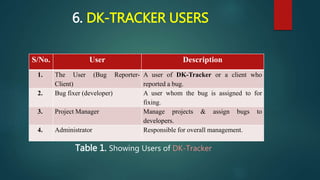
6. DK-TRACKER USERS
S/No. User Description
1. The User (Bug Reporter-
Client)
A user of DK-Tracker or a client who
reported a bug.
2. Bug fixer (developer) A user whom the bug is assigned to for
fixing.
3. Project Manager Manage projects & assign bugs to
developers.
4. Administrator Responsible for overall management.
Table 1. Showing Users of DK-Tracker
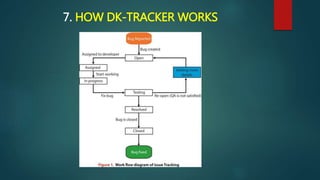
7. HOW DK-TRACKER WORKS
8. DK-TRACKER KEY FEATURES
 Easy to navigate through the site for inexperienced users.
 UI meet modern technology (Platforms).
 Support any web browser.
 The system is web-based for instant delivery of reports (the use of the
databases).
 Multi-lingual interface. (Feature work)
9. DK-TRACKER KEY BENEFITS
 DK-Tracker will maintain a database of problem
reports.
 DK-Tracker will allow individuals or groups of
developers to keep track of outstanding bugs in the
developed websites effectively.
 DK-Tracker will have ability to track bugs and
changes, communicate with members, submit and
review patches, and manage quality assurance.
 DK-Tracker has security mechanism.
10. CONCLUSION & FEATURE WORK
 Plug-in:
Plug-ins quicken the access to the system, and guide the user direct to the system page without
entering web address.
 Live chatting:
embedded in the system in order to allow live communication in a chatting room.
 Multi-lingual:
the system is presently will be using only English language.
 Help page:
For the best practice it is advisable to have an online help document that can be downloaded by
the users to guide them through the use of the system.
11. References
1. Zatul Amilah Shaffieir, Mudiana Mokhsin, and Saidatul Rahah Hamidi (2010) – International Journal of Computer Applications.
2. Akhilesh Babu Kolluri1, K. Tameezuddin2, Kalpana Gudikandula3. Effective Bug Tracking Systems: Theories and Implementation.
3. International Journal of Scientific & Engineering Research, Volume 4, Issue 7, July-2013 134 ISSN 2229-5518.
4. Sandeep Singh “Analysis of Bug Tracking Tools”. http://www.ijser.org/paper/Analysis-of-Bug-Tracking-Tools.html
5. Gabriela Avram, Anne Sheehan and Daniel K. Sullivan. Defect Tracking Systems in Global Software Development – a work practice
study
6. Sujata Solanke and Prof. Prakash N. Kalavadekar (2014). “Defect Tracking System”.
7. Jiri Janak (2009). “Issue Tracking System”.
8. Ian Sommerville 2011, ninth edition - Software Engineering.
9. V.B. Singh and Krishna Kumar Chaturvedi, (2011). “Bug Tracking and Reliability Assessment System (BTRAS)”.
10. Yogita Sharma & Aman Kumar Sharma (2015). “Comparative Study of the Bug Tracking Tools” Volume 5, Issue 3.
http://www.ijarcsse.com
11. Dane Bertram (2009). The Social Nature of Issue Tracking in Software Engineering.
12. Donald S. Le Vie, Jr. Information Development Director Integrated Concepts, Inc. Understanding Data Flow Diagrams.
13. João-Paulo Barros, Luis Gomes - From Activity Diagrams to Class Diagrams.
14. Aware Sachin B., Pawar Keda S. And Bombale Ravindra R., (2015) “Defect Tracking System” Volume 5, Issue 1.
THE END

Dk tracker presentation

  • 1.
    DK-TRACKER Version: 1.0.0 PRESENTED BY: KURMAYIK NYOK LOILA MARTIN OLIVER INDEX: 2009-JIT-034 INDEX: 2009-JIT-009 UNIVERSITY OF JUBA COLLEGE OF COMPUTER SCIENCE & IT DEPARTMENT OF INFORMATION TECHNOLOGY
  • 2.
    CONTENTS 1. INTRODUCTION 2. PROBLEMSTATEMENT 3. GOAL 4. OBJECTIVES 5. DATA COLLECTION METHODS 6. HOW DK-TRACKER WORKS 7. DK-TRACKER USERS 8. DK-TRACKER KEY FEATURES 9. DK-TRACKER KEY BENEFITS 10. CONCLUSION & FEATURE WORK 11. REFERENCES
  • 3.
    1. INTRODUCTION  Asoftware bug is an error, flaw, mistake, failure, or fault in a computer program or system that produces an incorrect or unexpected result, or causes it to behave in unplanned ways (Shaffie et al., 2010) [1].  There is a fact that no software that is solid and perfectly developed in a way that there will be no need for additional module (updates, enhancement).  Bug reporting consists of tasks such as investigation, information gathering, testing and debugging throughout the whole process Developers create the bugs  Bug tracking system is a software application that keeps track of reported software bugs in software development projects.  In other way it is a tool that facilitates fixing of bugs faster and ensures the quality of software being developed or being used.
  • 4.
    2. PROBLEM STATEMENT Scoop Trust Organization (STO) located at Thong-piny residential area, is one of the leading Internet Service Providers (ISP) in South Sudan.  It has ventured into the business of internet provider, VSAT installations and web development.  The company receives calls and emails to get notified of the issues that clients have.  This method and traditional ways of communication is too slow that it takes long and sometimes difficult issues are being ignored and skipped.
  • 5.
    3. GOALS  Getout from traditional ways of reporting, assigning and fixing reported issues.  Speed-up processes of fixing issues by coping up with current technology.
  • 6.
    4. OBJECTIVES  Toanalyze traditional way of reporting bugs in Scoop Trust Organization.  To design appropriate online bug tracking system to replace the traditional used by the organization.  To develop a prototype DK-Tracker for Scoop Trust Organization.  Test DK-Tracker online bug tracking system for final release.
  • 7.
    5. DATA COLLECTIONMETHODS  Document review Document include bug reports, system guideline of the system being used in Scoop Trust Organization.  On-site Observation First-hand knowledge of all activities, operations, processes of the system on-site was obtained  Internet Resources Google Books, journals and articles that has related information.  Interview Conducted done with the potential users to collect information about the current system
  • 8.
    6. DK-TRACKER USERS S/No.User Description 1. The User (Bug Reporter- Client) A user of DK-Tracker or a client who reported a bug. 2. Bug fixer (developer) A user whom the bug is assigned to for fixing. 3. Project Manager Manage projects & assign bugs to developers. 4. Administrator Responsible for overall management. Table 1. Showing Users of DK-Tracker
  • 9.
  • 10.
    8. DK-TRACKER KEYFEATURES  Easy to navigate through the site for inexperienced users.  UI meet modern technology (Platforms).  Support any web browser.  The system is web-based for instant delivery of reports (the use of the databases).  Multi-lingual interface. (Feature work)
  • 11.
    9. DK-TRACKER KEYBENEFITS  DK-Tracker will maintain a database of problem reports.  DK-Tracker will allow individuals or groups of developers to keep track of outstanding bugs in the developed websites effectively.  DK-Tracker will have ability to track bugs and changes, communicate with members, submit and review patches, and manage quality assurance.  DK-Tracker has security mechanism.
  • 12.
    10. CONCLUSION &FEATURE WORK  Plug-in: Plug-ins quicken the access to the system, and guide the user direct to the system page without entering web address.  Live chatting: embedded in the system in order to allow live communication in a chatting room.  Multi-lingual: the system is presently will be using only English language.  Help page: For the best practice it is advisable to have an online help document that can be downloaded by the users to guide them through the use of the system.
  • 13.
    11. References 1. ZatulAmilah Shaffieir, Mudiana Mokhsin, and Saidatul Rahah Hamidi (2010) – International Journal of Computer Applications. 2. Akhilesh Babu Kolluri1, K. Tameezuddin2, Kalpana Gudikandula3. Effective Bug Tracking Systems: Theories and Implementation. 3. International Journal of Scientific & Engineering Research, Volume 4, Issue 7, July-2013 134 ISSN 2229-5518. 4. Sandeep Singh “Analysis of Bug Tracking Tools”. http://www.ijser.org/paper/Analysis-of-Bug-Tracking-Tools.html 5. Gabriela Avram, Anne Sheehan and Daniel K. Sullivan. Defect Tracking Systems in Global Software Development – a work practice study 6. Sujata Solanke and Prof. Prakash N. Kalavadekar (2014). “Defect Tracking System”. 7. Jiri Janak (2009). “Issue Tracking System”. 8. Ian Sommerville 2011, ninth edition - Software Engineering. 9. V.B. Singh and Krishna Kumar Chaturvedi, (2011). “Bug Tracking and Reliability Assessment System (BTRAS)”. 10. Yogita Sharma & Aman Kumar Sharma (2015). “Comparative Study of the Bug Tracking Tools” Volume 5, Issue 3. http://www.ijarcsse.com 11. Dane Bertram (2009). The Social Nature of Issue Tracking in Software Engineering. 12. Donald S. Le Vie, Jr. Information Development Director Integrated Concepts, Inc. Understanding Data Flow Diagrams. 13. João-Paulo Barros, Luis Gomes - From Activity Diagrams to Class Diagrams. 14. Aware Sachin B., Pawar Keda S. And Bombale Ravindra R., (2015) “Defect Tracking System” Volume 5, Issue 1.
  • 14.