DISTILLATION
Mr. A.T. Sharma
Assistant Professor
Department of Pharmaceutics
Nanded Pharmacy College, Nanded
Distillation
Definition: Separation of components of a liquid mixture by a process
involving vaporization and subsequent condensation at another place.
• Feed – Distilland
• Condensed liquid – Distillate/ condensate
Applications:
o Separation of volatile oils
o Purification of organic solvents
o Manufacture of official preparations
o Refining of petroleum products
o Recovery of solvents
o Quality control methods
o Separation of drugs
o Purification of drugs
Theory
• Binary mixtures: When two liquids are miscible with each
other in all proportions. E.g. alcohol and water, water and
acetone
• Ideal solutions: Solution in which there is no change in the
properties of the components other than dilution, when
they are mixed to form a solution. E.g. methanol and water
• Heat is neither evolved or absorbed during mixing
• Characterized by an important physicochemical property –
vapour pressure
• Obeys Raoult’s law.
• Components have similar structure
• Perfect solutions.
• E.g. benzene and toluene
• According to an ideal solution, component with greater VP
will be distilled first.
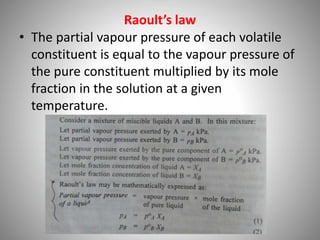
Raoult’s law
• The partial vapour pressure of each volatile
constituent is equal to the vapour pressure of
the pure constituent multiplied by its mole
fraction in the solution at a given
temperature.
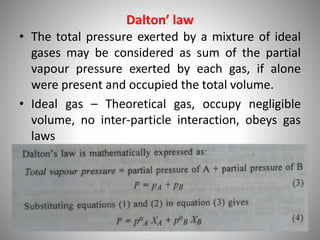
Dalton’ law
• The total pressure exerted by a mixture of ideal
gases may be considered as sum of the partial
vapour pressure exerted by each gas, if alone
were present and occupied the total volume.
• Ideal gas – Theoretical gas, occupy negligible
volume, no inter-particle interaction, obeys gas
laws
Real solutions: Solutions deviating from Raoult’s
law.
• Due to solute-solute. Solvent-splute, solvet-
solvent unequal interactions
• Chloroform and acetone
• Either lower or enhance VP of mixture with
respect to ideal behaviour.
• Positive deviation
• Negative deviation
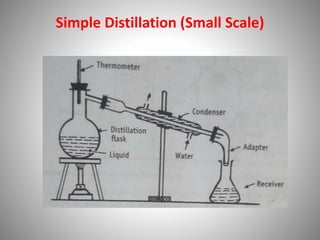
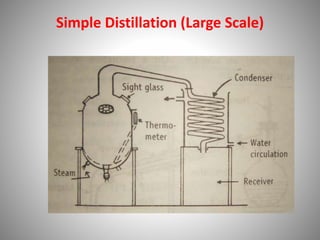
Simple Distillation
Principle:
• Conducted at b.p. of liquid
• Higher relative volatility – better separation
• Vapours transferred – condensed
• Purification/ Separation
Construction:
o Distillation flask with side arm
o Condenser with jacket
o Receiver flask and adapter
Simple Distillation (Small Scale)
Simple Distillation (Large Scale)
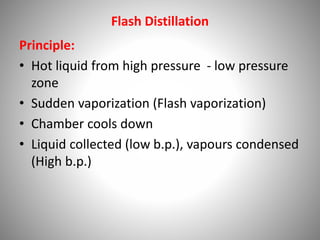
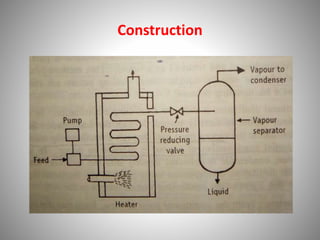
Flash Distillation
Principle:
• Hot liquid from high pressure - low pressure
zone
• Sudden vaporization (Flash vaporization)
• Chamber cools down
• Liquid collected (low b.p.), vapours condensed
(High b.p.)
Construction
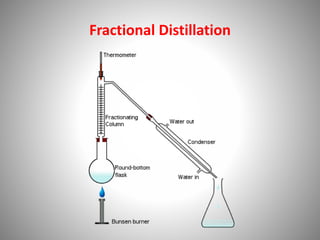
Fractional Distillation
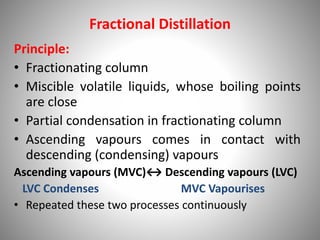
Principle:
• Fractionating column
• Miscible volatile liquids, whose boiling points
are close
• Partial condensation in fractionating column
• Ascending vapours comes in contact with
descending (condensing) vapours
Ascending vapours (MVC)↔ Descending vapours (LVC)
LVC Condenses MVC Vapourises
• Repeated these two processes continuously
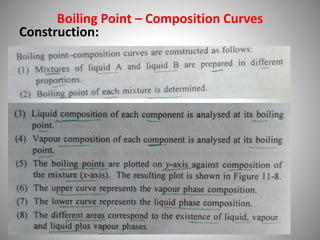
Boiling Point – Composition Curves
Construction:
Binary Mixtures
• Type I – Miscible Liquids
• Type II – Minimum Boiling Point Azeotropic
Mixtures
• Type III – Maximum Boiling Point Azeotropic
Mixtures
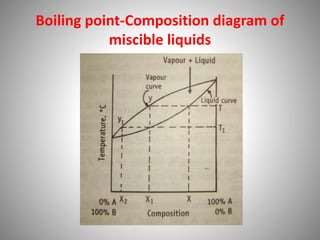
Type I – Miscible Liquids (Zeotropic Solutions)
• Boiling point of the mixture is always between
those of pure components
• Neither a maximum or a minimum in the
composition curves
• E.g. Benzene + Toluene
Carbon tetrachloride + cyclohexane
Water + methanol
Boiling point-Composition diagram of
miscible liquids
Azeotropic mixtures:
o Constant boiling mixtures
o Can not be separated completely by simple
distillation
o Equal volatilities
o Distills unchanged
o E.g. 89.43% mixture of ethanol and water at
atmospheric pressure……Relative Volatility is
1.0
o Can not be separated by simple distillation
Type II – Minimum Boiling Point
Azeotropic Solutions
• The azeotropic mixture has a lower boiling point than
that of the component with the least boiling point
• A minimum value in the boiling point-composition
curve
• At minimum boiling point temperature, liquid
composition remains constant, equal to vapour
composition
• Coincidence at the trough
• E.g. Chloroform + acetone, Pyridine + acetic acid,
Water + nitric acid
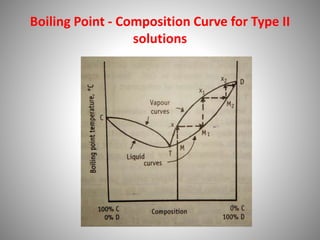
Boiling Point - Composition Curve for Type II
solutions
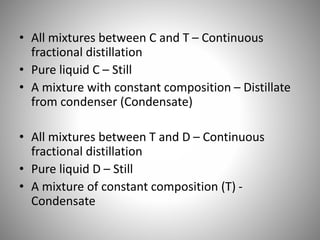
• All mixtures between C and T – Continuous
fractional distillation
• Pure liquid C – Still
• A mixture with constant composition – Distillate
from condenser (Condensate)
• All mixtures between T and D – Continuous
fractional distillation
• Pure liquid D – Still
• A mixture of constant composition (T) -
Condensate
Type III – Maximum Boiling Point Azeotropic
Solutions
• Azeotropic mixture has a higher boiling point
than that of the component with higher boiling
point
• A maximum value in the boiling point –
composition curve
• At maximum boiling point temperature, liquid
composition remains constant and equal to
vapour composition.
• Coincidence at peak
• E.g. Benzene + ethanol, Water + ethanol
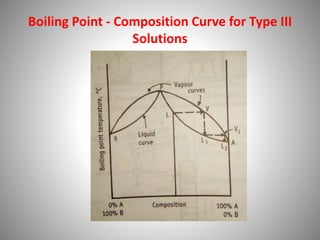
Boiling Point - Composition Curve for Type III
Solutions
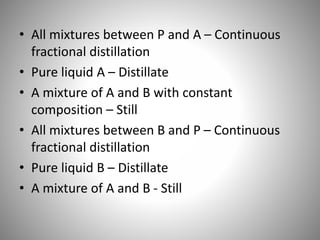
• All mixtures between P and A – Continuous
fractional distillation
• Pure liquid A – Distillate
• A mixture of A and B with constant
composition – Still
• All mixtures between B and P – Continuous
fractional distillation
• Pure liquid B – Distillate
• A mixture of A and B - Still
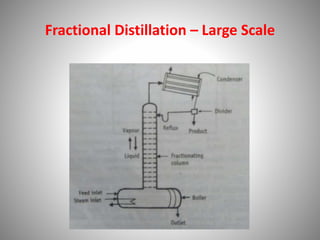
Fractional Distillation
Fractional Distillation – Large Scale
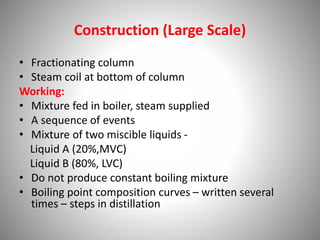
Construction (Large Scale)
• Fractionating column
• Steam coil at bottom of column
Working:
• Mixture fed in boiler, steam supplied
• A sequence of events
• Mixture of two miscible liquids -
Liquid A (20%,MVC)
Liquid B (80%, LVC)
• Do not produce constant boiling mixture
• Boiling point composition curves – written several
times – steps in distillation
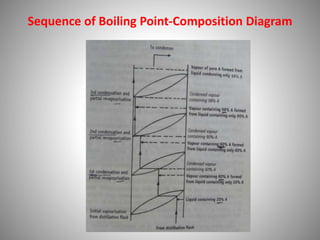
Sequence of Boiling Point-Composition Diagram
Steps:
• Lowest pair of curves – when boiling point
reached – vapours contain 60% of A
• These vapours condensed – liquid reheated to
b.p. – vapours contain 90% of A
• Vapours contain 98% of A (pure component)
• Condensed in condenser
• Proportion of component B in ascending
vapours decreases progressively
• Distillation ends – MVC (A) in receiver and LVC
(B) in still
Fractionating Columns
• A long vertical tube in which vapour passes
upward and gets partially condensed
• Condensate flows down the column – flask
Advantages:
o Large cooling surface
o Obstruction to ascending vapour – easy
condensation
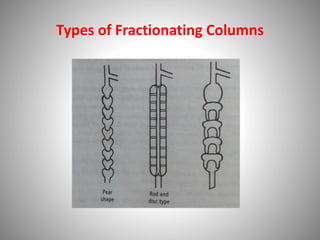
Types:
• Packed column
• Plate column
Types of Fractionating Columns
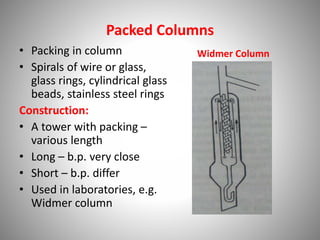
Packed Columns
• Packing in column
• Spirals of wire or glass,
glass rings, cylindrical glass
beads, stainless steel rings
Construction:
• A tower with packing –
various length
• Long – b.p. very close
• Short – b.p. differ
• Used in laboratories, e.g.
Widmer column
Widmer Column
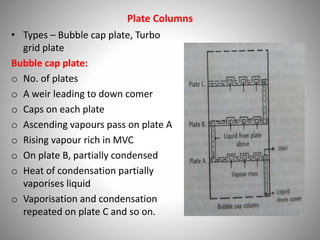
Plate Columns
• Types – Bubble cap plate, Turbo
grid plate
Bubble cap plate:
o No. of plates
o A weir leading to down comer
o Caps on each plate
o Ascending vapours pass on plate A
o Rising vapour rich in MVC
o On plate B, partially condensed
o Heat of condensation partially
vaporises liquid
o Vaporisation and condensation
repeated on plate C and so on.
Distillation under Reduced Pressure
Principle:
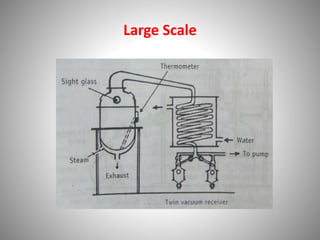
• Liquid distilled at a temperature lower than its b.p. –
vacuum applied by vacuum pump, suction pump
• Liquid boils when VP equals atmospheric Pressure
• Atm. Pressure reduced – b.p. decreases – liquid boils at
low temperature
• E.g. water boils at 100⁰C at atm. Pressure 760mm Hg.
• At 40⁰C, VP of water is 70mm Hg.
• If atm. Pressure reduced to 70mm Hg, water boils at
40⁰C
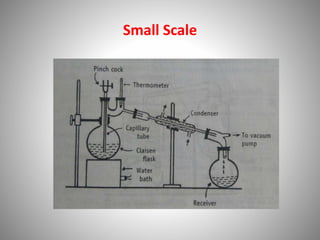
Assembly of apparatus
• A double neck flask, Claisen flask
• Thermometer in one neck
• Second neck – fine capillary tube
• Water bath
• Condenser, receiver
• Vacuum pump through adapter to receiver
• Manometer
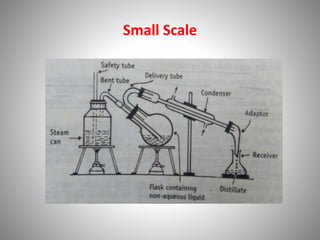
Small Scale
Large Scale
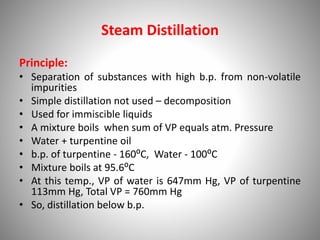
Steam Distillation
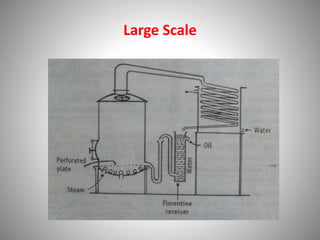
Principle:
• Separation of substances with high b.p. from non-volatile
impurities
• Simple distillation not used – decomposition
• Used for immiscible liquids
• A mixture boils when sum of VP equals atm. Pressure
• Water + turpentine oil
• b.p. of turpentine - 160⁰C, Water - 100⁰C
• Mixture boils at 95.6⁰C
• At this temp., VP of water is 647mm Hg, VP of turpentine
113mm Hg, Total VP = 760mm Hg
• So, distillation below b.p.
Small Scale
Large Scale
Molecular/ Evaporative/ Short Path Distillation
Principle:
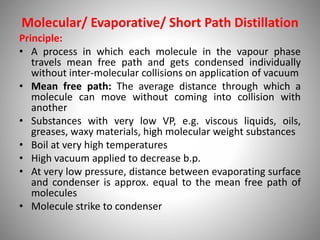
• A process in which each molecule in the vapour phase
travels mean free path and gets condensed individually
without inter-molecular collisions on application of vacuum
• Mean free path: The average distance through which a
molecule can move without coming into collision with
another
• Substances with very low VP, e.g. viscous liquids, oils,
greases, waxy materials, high molecular weight substances
• Boil at very high temperatures
• High vacuum applied to decrease b.p.
• At very low pressure, distance between evaporating surface
and condenser is approx. equal to the mean free path of
molecules
• Molecule strike to condenser
Theory
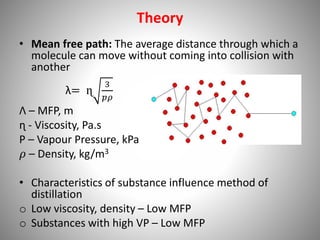
• Mean free path: The average distance through which a
molecule can move without coming into collision with
another
Îť= Éł
3
𝑝𝜌
Λ – MFP, m
Éł - Viscosity, Pa.s
P – Vapour Pressure, kPa
𝜌 – Density, kg/m3
• Characteristics of substance influence method of
distillation
o Low viscosity, density – Low MFP
o Substances with high VP – Low MFP
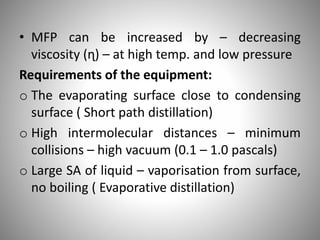
• MFP can be increased by – decreasing
viscosity (ɳ) – at high temp. and low pressure
Requirements of the equipment:
o The evaporating surface close to condensing
surface ( Short path distillation)
o High intermolecular distances – minimum
collisions – high vacuum (0.1 – 1.0 pascals)
o Large SA of liquid – vaporisation from surface,
no boiling ( Evaporative distillation)
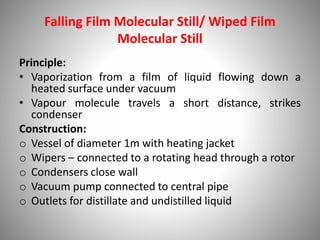
Falling Film Molecular Still/ Wiped Film
Molecular Still
Principle:
• Vaporization from a film of liquid flowing down a
heated surface under vacuum
• Vapour molecule travels a short distance, strikes
condenser
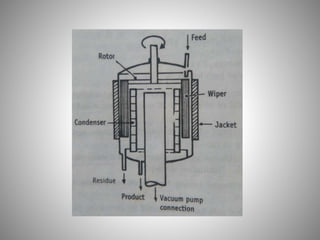
Construction:
o Vessel of diameter 1m with heating jacket
o Wipers – connected to a rotating head through a rotor
o Condensers close wall
o Vacuum pump connected to central pipe
o Outlets for distillate and undistilled liquid
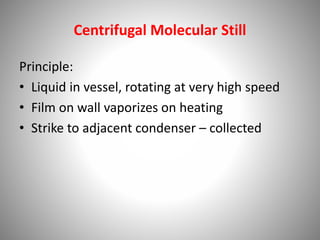
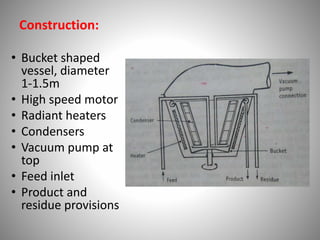
Centrifugal Molecular Still
Principle:
• Liquid in vessel, rotating at very high speed
• Film on wall vaporizes on heating
• Strike to adjacent condenser – collected
Construction:
• Bucket shaped
vessel, diameter
1-1.5m
• High speed motor
• Radiant heaters
• Condensers
• Vacuum pump at
top
• Feed inlet
• Product and
residue provisions
THANK YOU…!!!
(Disclaimer: The images and diagrams in this presentation
have been downloaded from the google source. I am grateful
to all the publishers & the google.)

DISTILLATION.pptx

  • 1.
    DISTILLATION Mr. A.T. Sharma AssistantProfessor Department of Pharmaceutics Nanded Pharmacy College, Nanded
  • 2.
    Distillation Definition: Separation ofcomponents of a liquid mixture by a process involving vaporization and subsequent condensation at another place. • Feed – Distilland • Condensed liquid – Distillate/ condensate Applications: o Separation of volatile oils o Purification of organic solvents o Manufacture of official preparations o Refining of petroleum products o Recovery of solvents o Quality control methods o Separation of drugs o Purification of drugs
  • 3.
    Theory • Binary mixtures:When two liquids are miscible with each other in all proportions. E.g. alcohol and water, water and acetone • Ideal solutions: Solution in which there is no change in the properties of the components other than dilution, when they are mixed to form a solution. E.g. methanol and water • Heat is neither evolved or absorbed during mixing • Characterized by an important physicochemical property – vapour pressure • Obeys Raoult’s law. • Components have similar structure • Perfect solutions. • E.g. benzene and toluene • According to an ideal solution, component with greater VP will be distilled first.
  • 4.
    Raoult’s law • Thepartial vapour pressure of each volatile constituent is equal to the vapour pressure of the pure constituent multiplied by its mole fraction in the solution at a given temperature.
  • 5.
    Dalton’ law • Thetotal pressure exerted by a mixture of ideal gases may be considered as sum of the partial vapour pressure exerted by each gas, if alone were present and occupied the total volume. • Ideal gas – Theoretical gas, occupy negligible volume, no inter-particle interaction, obeys gas laws
  • 6.
    Real solutions: Solutionsdeviating from Raoult’s law. • Due to solute-solute. Solvent-splute, solvet- solvent unequal interactions • Chloroform and acetone • Either lower or enhance VP of mixture with respect to ideal behaviour. • Positive deviation • Negative deviation
  • 7.
    Simple Distillation Principle: • Conductedat b.p. of liquid • Higher relative volatility – better separation • Vapours transferred – condensed • Purification/ Separation Construction: o Distillation flask with side arm o Condenser with jacket o Receiver flask and adapter
  • 8.
  • 9.
  • 10.
    Flash Distillation Principle: • Hotliquid from high pressure - low pressure zone • Sudden vaporization (Flash vaporization) • Chamber cools down • Liquid collected (low b.p.), vapours condensed (High b.p.)
  • 11.
  • 12.
    Fractional Distillation Principle: • Fractionatingcolumn • Miscible volatile liquids, whose boiling points are close • Partial condensation in fractionating column • Ascending vapours comes in contact with descending (condensing) vapours Ascending vapours (MVC)↔ Descending vapours (LVC) LVC Condenses MVC Vapourises • Repeated these two processes continuously
  • 13.
    Boiling Point –Composition Curves Construction:
  • 14.
    Binary Mixtures • TypeI – Miscible Liquids • Type II – Minimum Boiling Point Azeotropic Mixtures • Type III – Maximum Boiling Point Azeotropic Mixtures
  • 15.
    Type I –Miscible Liquids (Zeotropic Solutions) • Boiling point of the mixture is always between those of pure components • Neither a maximum or a minimum in the composition curves • E.g. Benzene + Toluene Carbon tetrachloride + cyclohexane Water + methanol
  • 16.
  • 17.
    Azeotropic mixtures: o Constantboiling mixtures o Can not be separated completely by simple distillation o Equal volatilities o Distills unchanged o E.g. 89.43% mixture of ethanol and water at atmospheric pressure……Relative Volatility is 1.0 o Can not be separated by simple distillation
  • 18.
    Type II –Minimum Boiling Point Azeotropic Solutions • The azeotropic mixture has a lower boiling point than that of the component with the least boiling point • A minimum value in the boiling point-composition curve • At minimum boiling point temperature, liquid composition remains constant, equal to vapour composition • Coincidence at the trough • E.g. Chloroform + acetone, Pyridine + acetic acid, Water + nitric acid
  • 19.
    Boiling Point -Composition Curve for Type II solutions
  • 20.
    • All mixturesbetween C and T – Continuous fractional distillation • Pure liquid C – Still • A mixture with constant composition – Distillate from condenser (Condensate) • All mixtures between T and D – Continuous fractional distillation • Pure liquid D – Still • A mixture of constant composition (T) - Condensate
  • 21.
    Type III –Maximum Boiling Point Azeotropic Solutions • Azeotropic mixture has a higher boiling point than that of the component with higher boiling point • A maximum value in the boiling point – composition curve • At maximum boiling point temperature, liquid composition remains constant and equal to vapour composition. • Coincidence at peak • E.g. Benzene + ethanol, Water + ethanol
  • 22.
    Boiling Point -Composition Curve for Type III Solutions
  • 23.
    • All mixturesbetween P and A – Continuous fractional distillation • Pure liquid A – Distillate • A mixture of A and B with constant composition – Still • All mixtures between B and P – Continuous fractional distillation • Pure liquid B – Distillate • A mixture of A and B - Still
  • 24.
  • 25.
  • 26.
    Construction (Large Scale) •Fractionating column • Steam coil at bottom of column Working: • Mixture fed in boiler, steam supplied • A sequence of events • Mixture of two miscible liquids - Liquid A (20%,MVC) Liquid B (80%, LVC) • Do not produce constant boiling mixture • Boiling point composition curves – written several times – steps in distillation
  • 27.
    Sequence of BoilingPoint-Composition Diagram
  • 28.
    Steps: • Lowest pairof curves – when boiling point reached – vapours contain 60% of A • These vapours condensed – liquid reheated to b.p. – vapours contain 90% of A • Vapours contain 98% of A (pure component) • Condensed in condenser • Proportion of component B in ascending vapours decreases progressively • Distillation ends – MVC (A) in receiver and LVC (B) in still
  • 29.
    Fractionating Columns • Along vertical tube in which vapour passes upward and gets partially condensed • Condensate flows down the column – flask Advantages: o Large cooling surface o Obstruction to ascending vapour – easy condensation Types: • Packed column • Plate column
  • 30.
  • 31.
    Packed Columns • Packingin column • Spirals of wire or glass, glass rings, cylindrical glass beads, stainless steel rings Construction: • A tower with packing – various length • Long – b.p. very close • Short – b.p. differ • Used in laboratories, e.g. Widmer column Widmer Column
  • 32.
    Plate Columns • Types– Bubble cap plate, Turbo grid plate Bubble cap plate: o No. of plates o A weir leading to down comer o Caps on each plate o Ascending vapours pass on plate A o Rising vapour rich in MVC o On plate B, partially condensed o Heat of condensation partially vaporises liquid o Vaporisation and condensation repeated on plate C and so on.
  • 33.
    Distillation under ReducedPressure Principle: • Liquid distilled at a temperature lower than its b.p. – vacuum applied by vacuum pump, suction pump • Liquid boils when VP equals atmospheric Pressure • Atm. Pressure reduced – b.p. decreases – liquid boils at low temperature • E.g. water boils at 100⁰C at atm. Pressure 760mm Hg. • At 40⁰C, VP of water is 70mm Hg. • If atm. Pressure reduced to 70mm Hg, water boils at 40⁰C
  • 34.
    Assembly of apparatus •A double neck flask, Claisen flask • Thermometer in one neck • Second neck – fine capillary tube • Water bath • Condenser, receiver • Vacuum pump through adapter to receiver • Manometer
  • 35.
  • 36.
  • 37.
    Steam Distillation Principle: • Separationof substances with high b.p. from non-volatile impurities • Simple distillation not used – decomposition • Used for immiscible liquids • A mixture boils when sum of VP equals atm. Pressure • Water + turpentine oil • b.p. of turpentine - 160⁰C, Water - 100⁰C • Mixture boils at 95.6⁰C • At this temp., VP of water is 647mm Hg, VP of turpentine 113mm Hg, Total VP = 760mm Hg • So, distillation below b.p.
  • 38.
  • 39.
  • 40.
    Molecular/ Evaporative/ ShortPath Distillation Principle: • A process in which each molecule in the vapour phase travels mean free path and gets condensed individually without inter-molecular collisions on application of vacuum • Mean free path: The average distance through which a molecule can move without coming into collision with another • Substances with very low VP, e.g. viscous liquids, oils, greases, waxy materials, high molecular weight substances • Boil at very high temperatures • High vacuum applied to decrease b.p. • At very low pressure, distance between evaporating surface and condenser is approx. equal to the mean free path of molecules • Molecule strike to condenser
  • 41.
    Theory • Mean freepath: The average distance through which a molecule can move without coming into collision with another λ= ɳ 3 𝑝𝜌 Λ – MFP, m ɳ - Viscosity, Pa.s P – Vapour Pressure, kPa 𝜌 – Density, kg/m3 • Characteristics of substance influence method of distillation o Low viscosity, density – Low MFP o Substances with high VP – Low MFP
  • 42.
    • MFP canbe increased by – decreasing viscosity (ɳ) – at high temp. and low pressure Requirements of the equipment: o The evaporating surface close to condensing surface ( Short path distillation) o High intermolecular distances – minimum collisions – high vacuum (0.1 – 1.0 pascals) o Large SA of liquid – vaporisation from surface, no boiling ( Evaporative distillation)
  • 43.
    Falling Film MolecularStill/ Wiped Film Molecular Still Principle: • Vaporization from a film of liquid flowing down a heated surface under vacuum • Vapour molecule travels a short distance, strikes condenser Construction: o Vessel of diameter 1m with heating jacket o Wipers – connected to a rotating head through a rotor o Condensers close wall o Vacuum pump connected to central pipe o Outlets for distillate and undistilled liquid
  • 45.
    Centrifugal Molecular Still Principle: •Liquid in vessel, rotating at very high speed • Film on wall vaporizes on heating • Strike to adjacent condenser – collected
  • 46.
    Construction: • Bucket shaped vessel,diameter 1-1.5m • High speed motor • Radiant heaters • Condensers • Vacuum pump at top • Feed inlet • Product and residue provisions
  • 47.
    THANK YOU…!!! (Disclaimer: Theimages and diagrams in this presentation have been downloaded from the google source. I am grateful to all the publishers & the google.)