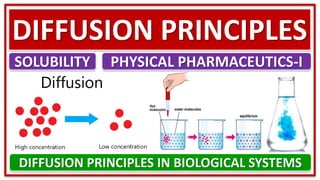
DIFFUSION PRINCIPLES
SOLUBILITY PHYSICAL PHARMACEUTICS-I
DIFFUSION PRINCIPLES IN BIOLOGICAL SYSTEMS
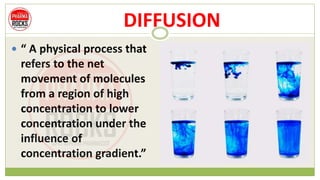
DIFFUSION
 “ A physical process that
refers to the net
movement of molecules
from a region of high
concentration to lower
concentration under the
influence of
concentration gradient.”
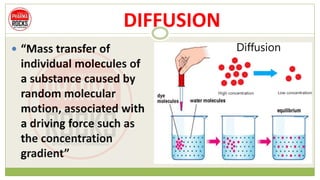
DIFFUSION
 “Mass transfer of
individual molecules of
a substance caused by
random molecular
motion, associated with
a driving force such as
the concentration
gradient”
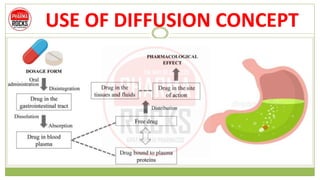
USE OF DIFFUSION CONCEPT
 Diffusion phenomena applied in pharmaceutical
sciences include:
 1. Release of drug from dosage form
 2. Ultrafiltration, microfiltration, dialysis,
hemodailysis.
 3. Permeation & distribution of drug in living tissues
 4. Estimation of molecular weight of polymers
 5. Prediction of absorption & elimination of drug.
USE OF DIFFUSION CONCEPT
TYPES OF DIFFUSION
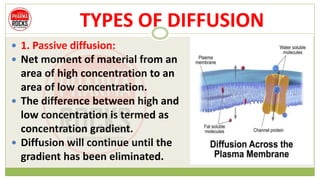
 1. Passive diffusion:
 Net moment of material from an
area of high concentration to an
area of low concentration.
 The difference between high and
low concentration is termed as
concentration gradient.
 Diffusion will continue until the
gradient has been eliminated.
TYPES OF DIFFUSION
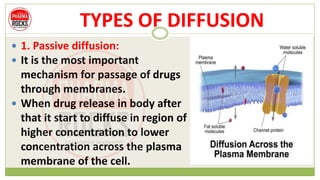
 1. Passive diffusion:
 It is the most important
mechanism for passage of drugs
through membranes.
 When drug release in body after
that it start to diffuse in region of
higher concentration to lower
concentration across the plasma
membrane of the cell.
TYPES OF DIFFUSION
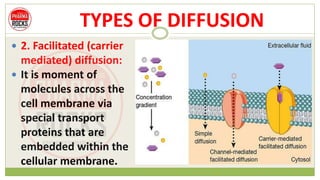
 2. Facilitated (carrier
mediated) diffusion:
 It is moment of
molecules across the
cell membrane via
special transport
proteins that are
embedded within the
cellular membrane.
TYPES OF DIFFUSION
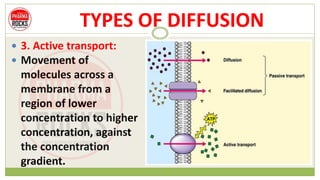
 3. Active transport:
 Movement of
molecules across a
membrane from a
region of lower
concentration to higher
concentration, against
the concentration
gradient.
TYPES OF DIFFUSION
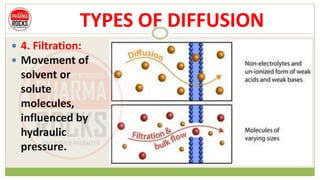
 4. Filtration:
 Movement of
solvent or
solute
molecules,
influenced by
hydraulic
pressure.
LAWS OF DIFFUSION
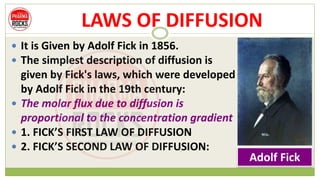
 It is Given by Adolf Fick in 1856.
 The simplest description of diffusion is
given by Fick's laws, which were developed
by Adolf Fick in the 19th century:
 The molar flux due to diffusion is
proportional to the concentration gradient
 1. FICK’S FIRST LAW OF DIFFUSION
 2. FICK’S SECOND LAW OF DIFFUSION:
Adolf Fick
FICK’S FIRST LAW OF DIFFUSION
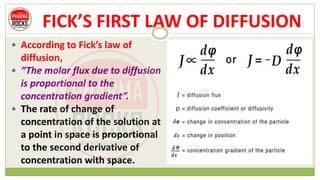
 According to Fick’s law of
diffusion,
 “The molar flux due to diffusion
is proportional to the
concentration gradient”.
 The rate of change of
concentration of the solution at
a point in space is proportional
to the second derivative of
concentration with space.
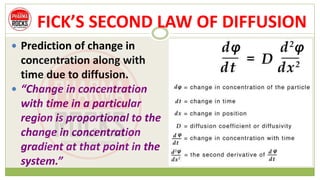
FICK’S SECOND LAW OF DIFFUSION
 Prediction of change in
concentration along with
time due to diffusion.
 “Change in concentration
with time in a particular
region is proportional to the
change in concentration
gradient at that point in the
system.”
LAWS OF DIFFUSION
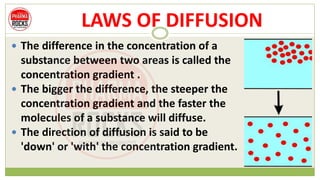
 The difference in the concentration of a
substance between two areas is called the
concentration gradient .
 The bigger the difference, the steeper the
concentration gradient and the faster the
molecules of a substance will diffuse.
 The direction of diffusion is said to be
'down' or 'with' the concentration gradient.
LAWS OF DIFFUSION APPLICATIONS
 Fick’s law is applicable for two miscible liquids when they
are brought in contact and diffusion takes place at a
macroscopic level.
 Pharmaceutical application in drug release and absorption
of medicine to provide pharmacological action
 Applications in food industries.
 Fabrication of semiconductor: Diffusion equations from
Fick’s law are used to fabricate integrated circuits.

DIFFUSION PRINCIPLES IN BIOLOGICAL SYSTEMS

  • 1.
    DIFFUSION PRINCIPLES SOLUBILITY PHYSICALPHARMACEUTICS-I DIFFUSION PRINCIPLES IN BIOLOGICAL SYSTEMS
  • 2.
    DIFFUSION  “ Aphysical process that refers to the net movement of molecules from a region of high concentration to lower concentration under the influence of concentration gradient.”
  • 3.
    DIFFUSION  “Mass transferof individual molecules of a substance caused by random molecular motion, associated with a driving force such as the concentration gradient”
  • 4.
    USE OF DIFFUSIONCONCEPT  Diffusion phenomena applied in pharmaceutical sciences include:  1. Release of drug from dosage form  2. Ultrafiltration, microfiltration, dialysis, hemodailysis.  3. Permeation & distribution of drug in living tissues  4. Estimation of molecular weight of polymers  5. Prediction of absorption & elimination of drug.
  • 5.
  • 6.
    TYPES OF DIFFUSION 1. Passive diffusion:  Net moment of material from an area of high concentration to an area of low concentration.  The difference between high and low concentration is termed as concentration gradient.  Diffusion will continue until the gradient has been eliminated.
  • 7.
    TYPES OF DIFFUSION 1. Passive diffusion:  It is the most important mechanism for passage of drugs through membranes.  When drug release in body after that it start to diffuse in region of higher concentration to lower concentration across the plasma membrane of the cell.
  • 8.
    TYPES OF DIFFUSION 2. Facilitated (carrier mediated) diffusion:  It is moment of molecules across the cell membrane via special transport proteins that are embedded within the cellular membrane.
  • 9.
    TYPES OF DIFFUSION 3. Active transport:  Movement of molecules across a membrane from a region of lower concentration to higher concentration, against the concentration gradient.
  • 10.
    TYPES OF DIFFUSION 4. Filtration:  Movement of solvent or solute molecules, influenced by hydraulic pressure.
  • 11.
    LAWS OF DIFFUSION It is Given by Adolf Fick in 1856.  The simplest description of diffusion is given by Fick's laws, which were developed by Adolf Fick in the 19th century:  The molar flux due to diffusion is proportional to the concentration gradient  1. FICK’S FIRST LAW OF DIFFUSION  2. FICK’S SECOND LAW OF DIFFUSION: Adolf Fick
  • 12.
    FICK’S FIRST LAWOF DIFFUSION  According to Fick’s law of diffusion,  “The molar flux due to diffusion is proportional to the concentration gradient”.  The rate of change of concentration of the solution at a point in space is proportional to the second derivative of concentration with space.
  • 13.
    FICK’S SECOND LAWOF DIFFUSION  Prediction of change in concentration along with time due to diffusion.  “Change in concentration with time in a particular region is proportional to the change in concentration gradient at that point in the system.”
  • 14.
    LAWS OF DIFFUSION The difference in the concentration of a substance between two areas is called the concentration gradient .  The bigger the difference, the steeper the concentration gradient and the faster the molecules of a substance will diffuse.  The direction of diffusion is said to be 'down' or 'with' the concentration gradient.
  • 15.
    LAWS OF DIFFUSIONAPPLICATIONS  Fick’s law is applicable for two miscible liquids when they are brought in contact and diffusion takes place at a macroscopic level.  Pharmaceutical application in drug release and absorption of medicine to provide pharmacological action  Applications in food industries.  Fabrication of semiconductor: Diffusion equations from Fick’s law are used to fabricate integrated circuits.