The Impact of Affordable Care Act on Retail Employees in Southern United States
Submitted by
Jeetendra Narayan Dash
A Dissertation Presented in Partial Fulfillment
of the Requirements for the Degree
Doctorate of Business Administration
Columbia Southern University
Orange Beach, Alabama
March 11, 2015
Abstract
President Barrack Obama signed the Affordable Care Act (ACA) into law in March
2010, to expand health coverage to millions of uninsured Americans. Coverage to the
low-income Americans through federal subsidies is feasible because majority of
Americans get health coverage through the Employer-Sponsored Insurance (ESI). If the
employees already enrolled with the ESI migrate to the ACA marketplace and avail
premium subsidies just as the individuals, who have no access to the ESI, the viability of
the ESI will be questionable and the ACA will fail to achieve the goal. The researcher
conducted a survey of 203 front-line retail executives in the Southern United States to
see if and to what degree migration of the retail employees would occur in the Southern
United States. The current study sample data did not support migration of the employees
from the ESI to the ACA marketplace. In the current study, Age, Ethnicity, and annual
household income of the employees are somewhat likely to influence the decision of the
employees to migrate from the ESI to the ACA marketplace. None of the variables were
however a factor in overall modeling of relationship among the variables. Majority of
the employees in the present research study continue to value the employment-based
health coverage and do not have however a clear understanding of the act.
Keywords: Employer-Sponsored Insurance, Affordable Care Act, Affordable Care
Act marketplace
iv
Dedication
I dedicate the dissertation to my late parents, Mr. Ram Narayan Dash and Mrs.
Kshetramani Dash, who did not live long to see me immigrating to the United States and
reaching the goals of my academic pursuits. I also dedicate this dissertation to my wife,
Soma, who patiently tied her future happiness to my educational dream and missed her
family for years. Finally, I dedicate my dissertation to my brother-in-law Dr. Mishra and
family in Massachusetts, who always take a genuine pride in my success.
v
Acknowledgements
To Dr. Michelle Manganaro, my Chair, who sustained my hope and helped me
accomplish my educational goals. I am equally grateful to Dr. Stephen Onu, member of
my dissertation committee, for his thoughtfulness and valuable suggestions throughout
the dissertation process. Thanks Dr. Rounds, Dr. Cates, Dr. Nelson, and Dr. Zee for the
support early in the research process. Sincere thanks to Dr. Gary Piercy, Director, DBA
program, IRB, and the CSU staffs, who relentlessly strive to make the journey of the
students worthwhile.
I remain grateful to the health care research experts, who reviewed the
questionnaire for face validity. Dr. Johnathan Gruber, MIT economist, who was the
architect of health care reform in Massachusetts, and played a significant role in health
care reform at the federal level, was too generous to look at the questionnaire. Professor
Katie Keith, Georgetown University Health Policy Institute’s Center on Health Insurance
Reforms and monitoring implementation of the ACA, was kind enough to do a thorough
review of the questionnaire and provide valuable suggestions for substantial improvement
of the questionnaire. Emily Pattat, director of marketing research and analysis,
ALSAC/ST. Jude Children’s Research Hospital, helped improve the look and feel, and
survey-worthiness of the questionnaire.
I remain indebted to Dr. Paul Fronstin, Director, Employee Benefit Research
Institute, Washington D.C., for his kind permission to use the questions used in the 2012
health confidence surveys. Finally, I express my heartfelt gratitude to the retail executives
in the Southern United States, whose participation in the survey was seminal to the
eventual production of this dissertation manuscript.
vi
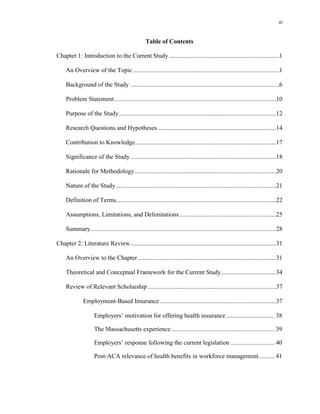
Table of Contents
Chapter 1: Introduction to the Current Study ......................................................................1
An Overview of the Topic .............................................................................................1
Background of the Study ...............................................................................................6
Problem Statement.......................................................................................................10
Purpose of the Study....................................................................................................12
Research Questions and Hypotheses ...........................................................................14
Contribution to Knowledge..........................................................................................17
Significance of the Study.............................................................................................18
Rationale for Methodology..........................................................................................20
Nature of the Study......................................................................................................21
Definition of Terms......................................................................................................22
Assumptions, Limitations, and Delimitations..............................................................25
Summary......................................................................................................................28
Chapter 2: Literature Review.............................................................................................31
An Overview to the Chapter ........................................................................................31
Theoretical and Conceptual Framework for the Current Study...................................34
Review of Relevant Scholarship..................................................................................37
Employment-Based Insurance ..........................................................................37
Employers’ motivation for offering health insurance............................... 38
The Massachusetts experience.................................................................. 39
Employers’ response following the current legislation ............................ 40
Post-ACA relevance of health benefits in workforce management.......... 41
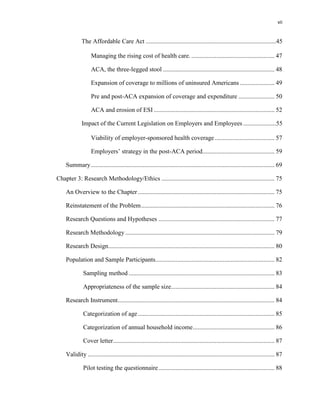
vii
The Affordable Care Act ...................................................................................45
Managing the rising cost of health care. ..................................................... 47
ACA, the three-legged stool ....................................................................... 48
Expansion of coverage to millions of uninsured Americans ...................... 49
Pre and post-ACA expansion of coverage and expenditure ....................... 50
ACA and erosion of ESI ............................................................................. 52
Impact of the Current Legislation on Employers and Employees .....................55
Viability of employer-sponsored health coverage ...................................... 57
Employers’ strategy in the post-ACA period.............................................. 59
Summary..................................................................................................................... 69
Chapter 3: Research Methodology/Ethics ........................................................................ 75
An Overview to the Chapter ....................................................................................... 75
Reinstatement of the Problem..................................................................................... 76
Research Questions and Hypotheses .......................................................................... 77
Research Methodology ............................................................................................... 79
Research Design.......................................................................................................... 80
Population and Sample Participants............................................................................ 82
Sampling method ............................................................................................. 83
Appropriateness of the sample size.................................................................. 84
Research Instrument.................................................................................................... 84
Categorization of age ....................................................................................... 85
Categorization of annual household income.................................................... 86
Cover letter....................................................................................................... 87
Validity ....................................................................................................................... 87
Pilot testing the questionnaire.......................................................................... 88
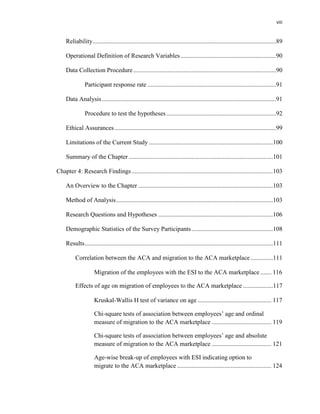
viii
Reliability.....................................................................................................................89
Operational Definition of Research Variables.............................................................90
Data Collection Procedure...........................................................................................90
Participant response rate ..................................................................................91
Data Analysis...............................................................................................................91
Procedure to test the hypotheses......................................................................92
Ethical Assurances.......................................................................................................99
Limitations of the Current Study ...............................................................................100
Summary of the Chapter ............................................................................................101
Chapter 4: Research Findings ..........................................................................................103
An Overview to the Chapter ......................................................................................103
Method of Analysis....................................................................................................103
Research Questions and Hypotheses .........................................................................106
Demographic Statistics of the Survey Participants....................................................108
Results........................................................................................................................111
Correlation between the ACA and migration to the ACA marketplace ..............111
Migration of the employees with the ESI to the ACA marketplace ....... 116
Effects of age on migration of employees to the ACA marketplace ...................117
Kruskal-Wallis H test of variance on age ............................................... 117
Chi-square tests of association between employees’ age and ordinal
measure of migration to the ACA marketplace ...................................... 119
Chi-square tests of association between employees’ age and absolute
measure of migration to the ACA marketplace ...................................... 121
Age-wise break-up of employees with ESI indicating option to
migrate to the ACA marketplace ............................................................ 124
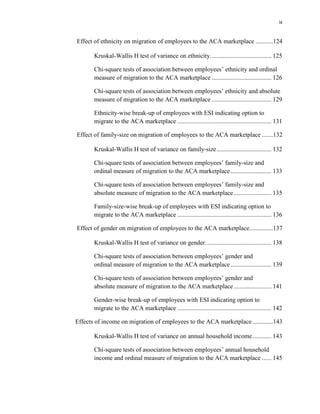
ix
Effect of ethnicity on migration of employees to the ACA marketplace ...........124
Kruskal-Wallis H test of variance on ethnicity....................................... 125
Chi-square tests of association between employees’ ethnicity and ordinal
measure of migration to the ACA marketplace ...................................... 126
Chi-square tests of association between employees’ ethnicity and absolute
measure of migration to the ACA marketplace ...................................... 129
Ethnicity-wise break-up of employees with ESI indicating option to
migrate to the ACA marketplace ............................................................ 131
Effect of family-size on migration of employees to the ACA marketplace .......132
Kruskal-Wallis H test of variance on family-size................................... 132
Chi-square tests of association between employees’ family-size and
ordinal measure of migration to the ACA marketplace.......................... 133
Chi-square tests of association between employees’ family-size and
absolute measure of migration to the ACA marketplace........................ 135
Family-size-wise break-up of employees with ESI indicating option to
migrate to the ACA marketplace ............................................................ 136
Effect of gender on migration of employees to the ACA marketplace...............137
Kruskal-Wallis H test of variance on gender.......................................... 138
Chi-square tests of association between employees’ gender and
ordinal measure of migration to the ACA marketplace.......................... 139
Chi-square tests of association between employees’ gender and
absolute measure of migration to the ACA marketplace........................ 141
Gender-wise break-up of employees with ESI indicating option to
migrate to the ACA marketplace ............................................................ 142
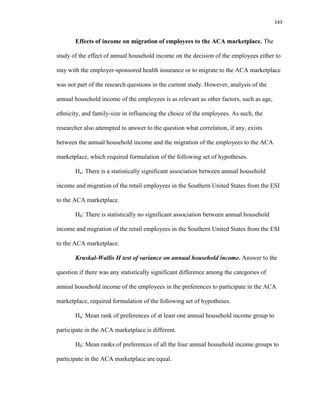
Effects of income on migration of employees to the ACA marketplace .............143
Kruskal-Wallis H test of variance on annual household income............ 143
Chi-square tests of association between employees’ annual household
income and ordinal measure of migration to the ACA marketplace ...... 145
x
Chi-square tests of association between employees’ annual household
income and absolute measure of migration to the ACA marketplace .... 147
Income-wise break-up of employees with ESI indicating option to
migrate to the ACA marketplace. ........................................................... 150
PLUM-ordinal regression analysis ..................................................................... 151
Attitude of the Employees toward the Job-Based Health Coverage and the ACA... 152
Views on the employer-sponsored health insurance........................................ 152
Confidence in the employer............................................................................. 159
Views on the ACA........................................................................................... 160
Attitude toward choice of plan......................................................................... 161
Knowledge and confidence to buy the ACA coverage.................................... 162
Conclusions............................................................................................................... 164
Chapter 5: Summary, Conclusions, and Recommendations........................................... 172
An Overview to the Chapter ..................................................................................... 172
Summary of Findings................................................................................................ 173
Conclusions............................................................................................................... 174
Correlation between the ACA and migration of the retail employees to the ACA
Marketplace......................................................................................................... 180
Correlation between the outcome variable and the factor variables....................181
Age and migration of the employees to the ACA marketplace ...........................181
Age-wise break-up of employees with ESI indicating option to
migrate to the ACA marketplace ............................................................ 182
Ethnicity and migration of the employees to the ACA marketplace ...................182
Ethnicity-wise break-up of employees with ESI indicating option to
migrate to the ACA marketplace ............................................................ 183
xi
Family-size and migration of the employees to the ACA marketplace...............183
Family-size-wise break-up of employees with ESI indicating option to
migrate to the ACA marketplace ............................................................ 184
Gender and migration of the employees to the ACA marketplace ......................184
Gender-wise break-up of employees with ESI indicating option to
migrate to the ACA marketplace. ........................................................... 185
Annual income and migration of the employees to the ACA marketplace .........185
Income-wise break-up of employees with ESI indicating option to
migrate to the ACA marketplace ............................................................ 186
PLUM-ordinal regression analysis ..................................................................... 186
Employees’ attitude toward the ESI and the ACA ............................................. 187
Recommendations..................................................................................................... 190
Employer-sponsored insurance in the post-ACA period ............................. 191
Response of the retail employers to the current legislation ......................... 192
Managing the workforce.............................................................................. 192
Probable consequences of the current legislation ........................................ 192
References....................................................................................................................... 195
Appendix A: Survey Questionnaire................................................................................ 227
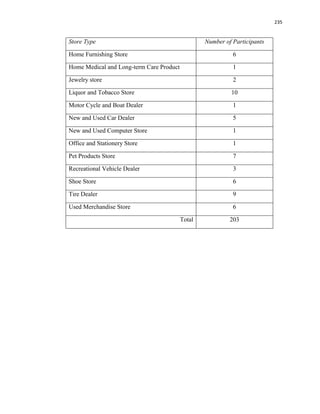
Appendix B: Participants Listed by Store Type ............................................................. 234
Appendix C: Permission from the Economic Policy Institute to Use Figure 1 .............. 236
Appendix D: Permission from the Kaiser Family Foundation to Use Figure 2.............. 237
Appendix E: Permission from the Congressional Research Service to Use Figure 3 .... 239
Appendix F: Permission from the Commonwealth Fund to Use Figure 4 and 5........... 241
Appendix G: Permission to Use Figure 6 in U.S. Chamber of Commerce Publication . 243
Appendix H: Permission from New England Journal of Medicine to Use Figure 7 ...... 244
xii
Appendix I: Permission from the Heritage Foundation to Use Figure 8.........................246
Appendix J: Permission to Use Survey Questions...........................................................248
Appendix K: Participant Consent Form...........................................................................249
Appendix L: Site Authorization Permission Request Letter............................................251
Appendix M: Site Authorization Letter ...........................................................................252
Appendix N: Internal Review Board (IRB) Conditional Approval Letter ......................253
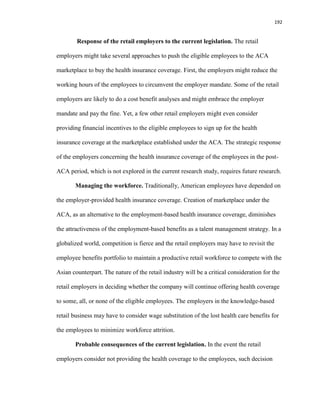
Appendix O: Certificate of Completion of NIH Training ...............................................254
xiii
List of Tables
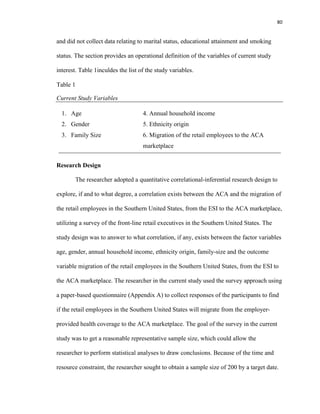
Table 1. Current Study Variables...................................................................................... 80
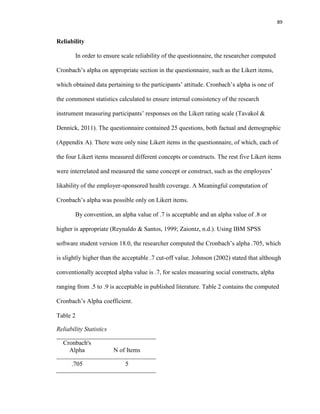
Table 2. Reliability Statistics............................................................................................ 89
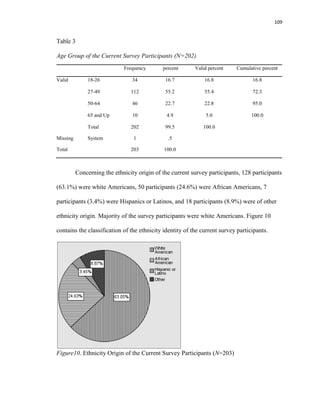
Table 3. Age Group of the Current Survey Participants (N=202) .................................. 109
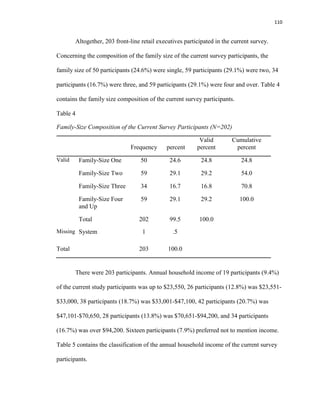
Table 4. Family-Size Composition of the Current Survey Participants (N=202)........... 110
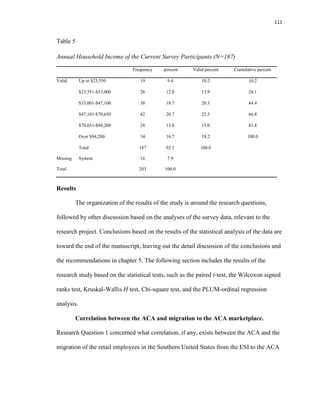
Table 5. Annual Household Income of the Current Survey Participants (N=187)......... 111
Table 6. Paired Samples Statistics: Pre ACA and Post ACA Participation of
Employees in the Employer-Sponsored Insurance (N=195) ............................ 114
Table 7. Paired Samples Test: Pre ACA and Post ACA Participation of Employees in
the Employer-Sponsored Insurance (N=195) ................................................... 114
Table 8. Wilcoxon Signed Ranks Test: Pre ACA and Post ACA Comparison of the
Mean Rank of Employees’ Participation in the ESI (N= 195) ......................... 115
Table 9. Wilcoxon Signed Ranks Test: Hypothesis Test Summary (N=195) ................ 116
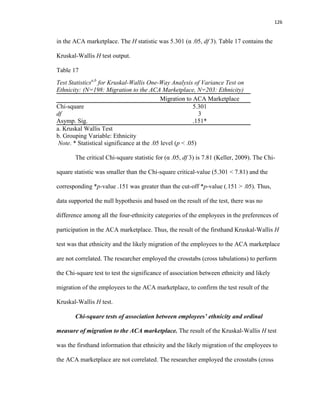
Table 10. Test Statisticsa,b
for Kruskal-Wallis One-Way Analysis of Variance Test
on Age (N=198:Migration to the ACA Marketplace, N=202: Age)............... 118
Table 11. Chi-square Tests of Association between Employees' Age and Ordinal
Measure of Migration to the ACA Marketplace (N=197) .............................. 120
Table 12. Symmetric Measure of Association between Employees’ Age and Ordinal
Measure of Migration to the ACA Marketplace (N=197) .............................. 120
Table 13. Chi-square Test of Association between Employees’ Age and Absolute
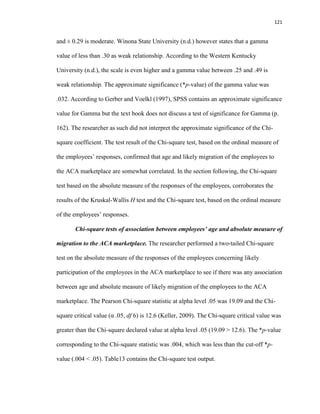
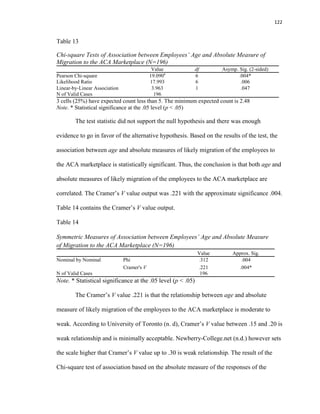
Measure of Migration to the ACA Marketplace (N=196) ...............................122
Table 14. Symmetric Measure of Association between Employees’ Age and
Absolute Measure of Migration to the ACA Marketplace (N=196)............... 122
xiv
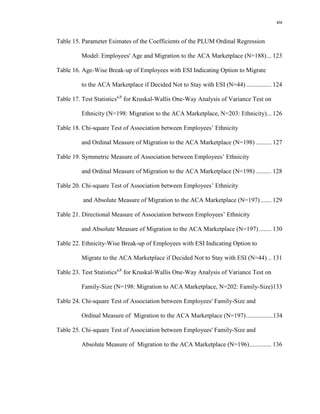
Table 15. Parameter Esimates of the Coefficients of the PLUM Ordinal Regression
Model: Employees' Age and Migration to the ACA Marketplace (N=188)... 123
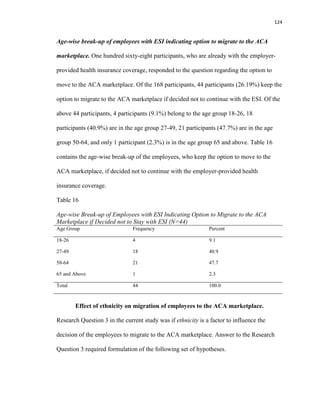
Table 16. Age-Wise Break-up of Employees with ESI Indicating Option to Migrate
to the ACA Marketplace if Decided Not to Stay with ESI (N=44) ................ 124
Table 17. Test Statisticsa,b
for Kruskal-Wallis One-Way Analysis of Variance Test on
Ethnicity (N=198: Migration to the ACA Marketplace, N=203: Ethnicity)... 126
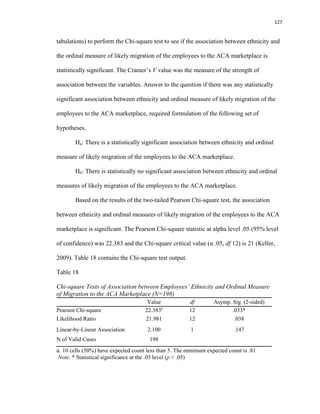
Table 18. Chi-square Test of Association between Employees’ Ethnicity
and Ordinal Measure of Migration to the ACA Marketplace (N=198) .......... 127
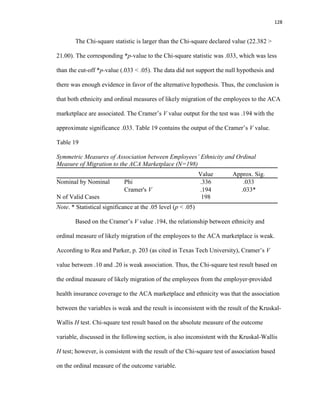
Table 19. Symmetric Measure of Association between Employees’ Ethnicity
and Ordinal Measure of Migration to the ACA Marketplace (N=198) .......... 128
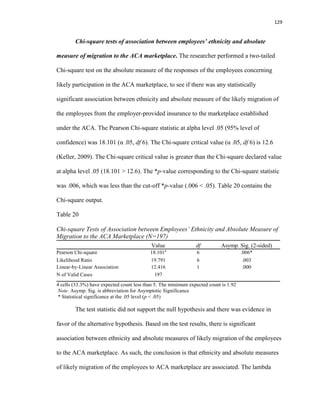
Table 20. Chi-square Test of Association between Employees’ Ethnicity
and Absolute Measure of Migration to the ACA Marketplace (N=197)....... 129
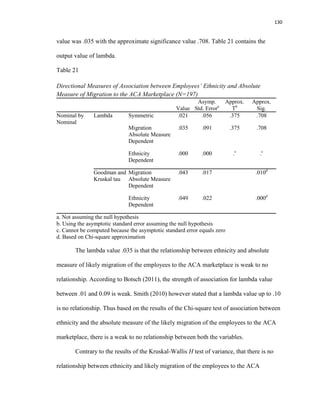
Table 21. Directional Measure of Association between Employees’ Ethnicity
and Absolute Measure of Migration to the ACA Marketplace (N=197)........ 130
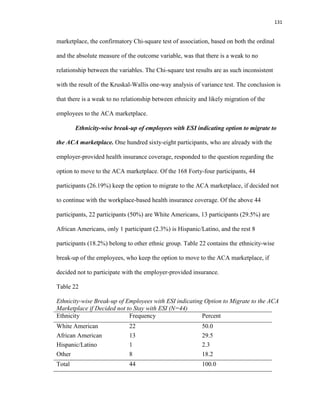
Table 22. Ethnicity-Wise Break-up of Employees with ESI Indicating Option to
Migrate to the ACA Marketplace if Decided Not to Stay with ESI (N=44) .. 131
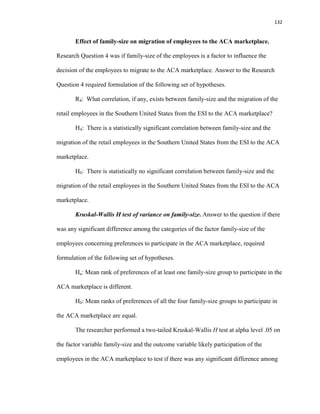
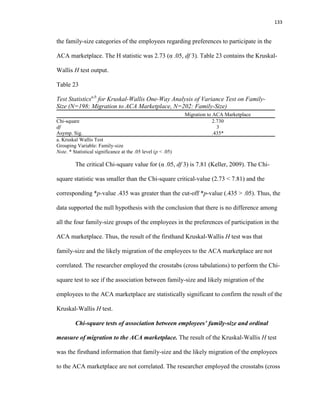
Table 23. Test Statisticsa,b
for Kruskal-Wallis One-Way Analysis of Variance Test on
Family-Size (N=198: Migration to ACA Marketplace, N=202: Family-Size)133
Table 24. Chi-square Test of Association between Employees' Family-Size and
Ordinal Measure of Migration to the ACA Marketplace (N=197).................134
Table 25. Chi-square Test of Association between Employees' Family-Size and
Absolute Measure of Migration to the ACA Marketplace (N=196).............. 136
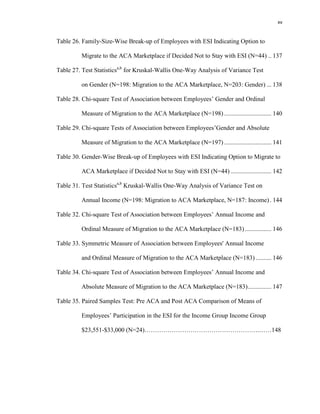
xv
Table 26. Family-Size-Wise Break-up of Employees with ESI Indicating Option to
Migrate to the ACA Marketplace if Decided Not to Stay with ESI (N=44) .. 137
Table 27. Test Statisticsa,b
for Kruskal-Wallis One-Way Analysis of Variance Test
on Gender (N=198: Migration to the ACA Marketplace, N=203: Gender) ... 138
Table 28. Chi-square Test of Association between Employees’ Gender and Ordinal
Measure of Migration to the ACA Marketplace (N=198) .............................. 140
Table 29. Chi-square Tests of Association between Employees’Gender and Absolute
Measure of Migration to the ACA Marketplace (N=197) .............................. 141
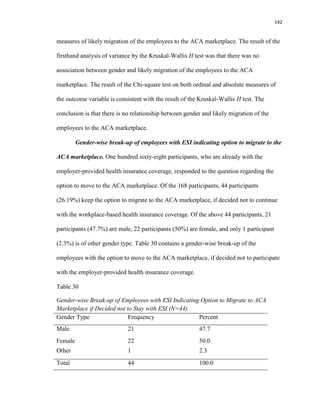
Table 30. Gender-Wise Break-up of Employees with ESI Indicating Option to Migrate to
ACA Marketplace if Decided Not to Stay with ESI (N=44) .......................... 142
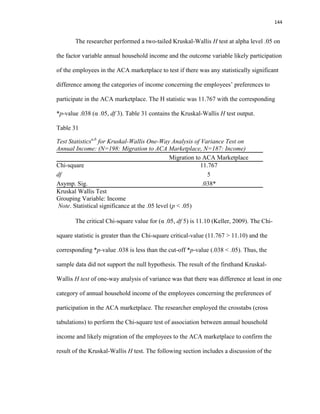
Table 31. Test Statisticsa,b
Kruskal-Wallis One-Way Analysis of Variance Test on
Annual Income (N=198: Migration to ACA Marketplace, N=187: Income). 144
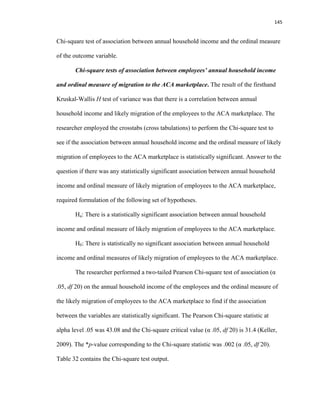
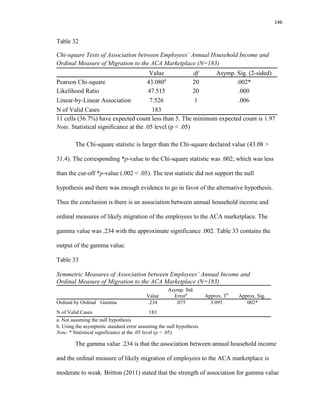
Table 32. Chi-square Test of Association between Employees’ Annual Income and
Ordinal Measure of Migration to the ACA Marketplace (N=183)................. 146
Table 33. Symmetric Measure of Association between Employees' Annual Income
and Ordinal Measure of Migration to the ACA Marketplace (N=183) .......... 146
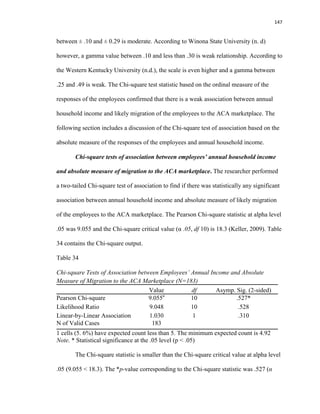
Table 34. Chi-square Test of Association between Employees’ Annual Income and
Absolute Measure of Migration to the ACA Marketplace (N=183)............... 147
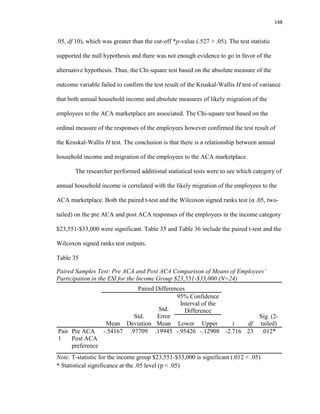
Table 35. Paired Samples Test: Pre ACA and Post ACA Comparison of Means of
Employees’ Participation in the ESI for the Income Group Income Group
$23,551-$33,000 (N=24)……………………………………………….……148
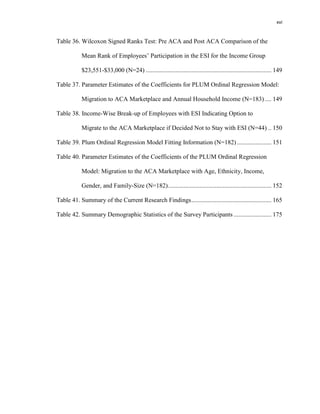
xvi
Table 36. Wilcoxon Signed Ranks Test: Pre ACA and Post ACA Comparison of the
Mean Rank of Employees’ Participation in the ESI for the Income Group
$23,551-$33,000 (N=24) ................................................................................ 149
Table 37. Parameter Estimates of the Coefficients for PLUM Ordinal Regression Model:
Migration to ACA Marketplace and Annual Household Income (N=183) .... 149
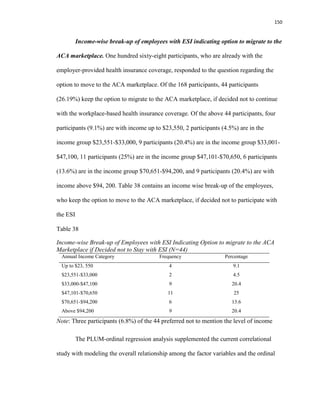
Table 38. Income-Wise Break-up of Employees with ESI Indicating Option to
Migrate to the ACA Marketplace if Decided Not to Stay with ESI (N=44) .. 150
Table 39. Plum Ordinal Regression Model Fitting Information (N=182)...................... 151
Table 40. Parameter Estimates of the Coefficients of the PLUM Ordinal Regression
Model: Migration to the ACA Marketplace with Age, Ethnicity, Income,
Gender, and Family-Size (N=182).................................................................. 152
Table 41. Summary of the Current Research Findings................................................... 165
Table 42. Summary Demographic Statistics of the Survey Participants ........................ 175
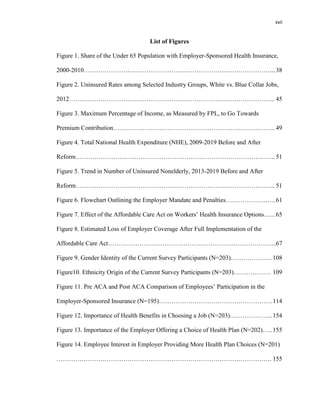
xvii
List of Figures
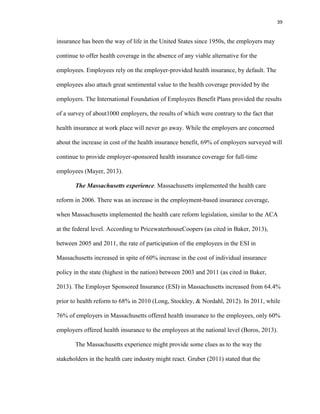
Figure 1. Share of the Under 65 Population with Employer-Sponsored Health Insurance,
2000-2010………………………………………………………………………………..38
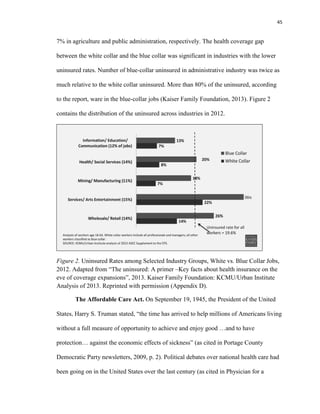
Figure 2. Uninsured Rates among Selected Industry Groups, White vs. Blue Collar Jobs,
2012……………………………………………………………………………………... 45
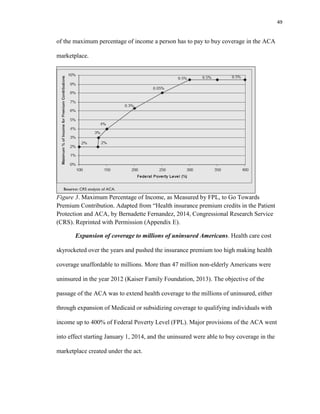
Figure 3. Maximum Percentage of Income, as Measured by FPL, to Go Towards
Premium Contribution…………………………………………………………………... 49
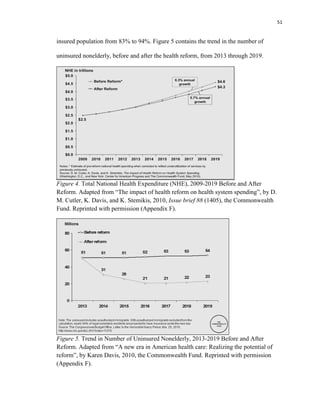
Figure 4. Total National Health Expenditure (NHE), 2009-2019 Before and After
Reform…………………………………………………………………………………... 51
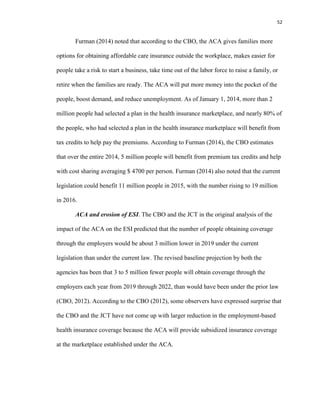
Figure 5. Trend in Number of Uninsured Nonelderly, 2013-2019 Before and After
Reform…………………………………………………………………………………... 51
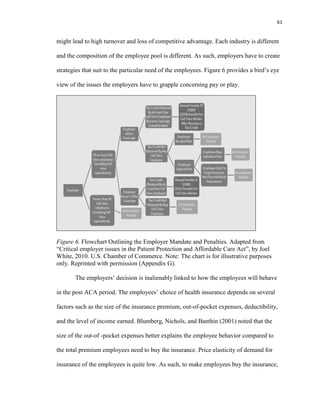
Figure 6. Flowchart Outlining the Employer Mandate and Penalties……………………61
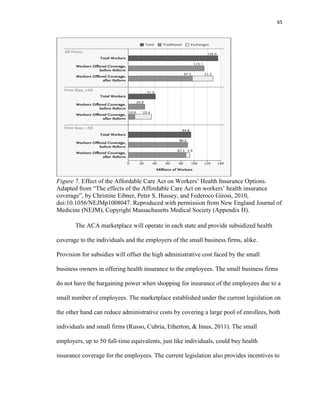
Figure 7. Effect of the Affordable Care Act on Workers’ Health Insurance Options…...65
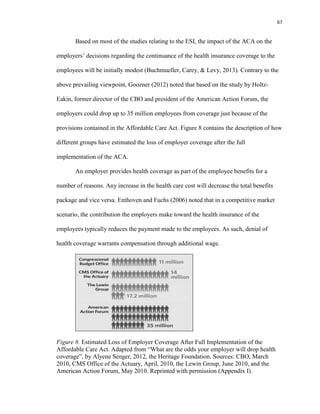
Figure 8. Estimated Loss of Employer Coverage After Full Implementation of the
Affordable Care Act……………………………………………………………………...67
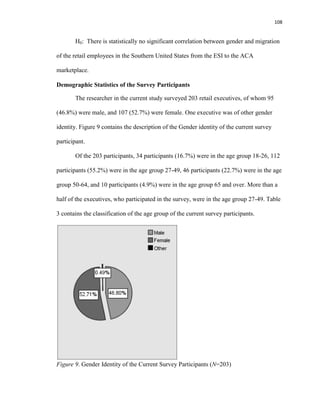
Figure 9. Gender Identity of the Current Survey Participants (N=203)……………….. 108
Figure10. Ethnicity Origin of the Current Survey Participants (N=203)……………… 109
Figure 11. Pre ACA and Post ACA Comparison of Employees’ Participation in the
Employer-Sponsored Insurance (N=195)………………………………………………114
Figure 12. Importance of Health Benefits in Choosing a Job (N=203)………………...154
Figure 13. Importance of the Employer Offering a Choice of Health Plan (N=202)…..155
Figure 14. Employee Interest in Employer Providing More Health Plan Choices (N=201)
…………………………………………………………………………………………. 155
xviii
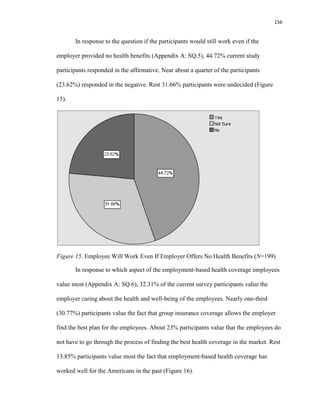
Figure 15. Employee Will Work Even If Employer Offers No Health Benefits (N=199)
…………………………………………………………………………………………. 156
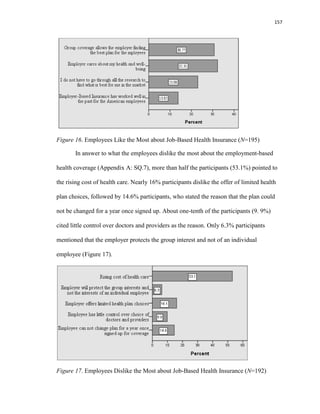
Figure 16. Employees Like the Most about Job-Based Health Insurance (N=195)…… 157
Figure 17. Employees Dislike the Most about Job-Based Health Insurance (N=192)…157
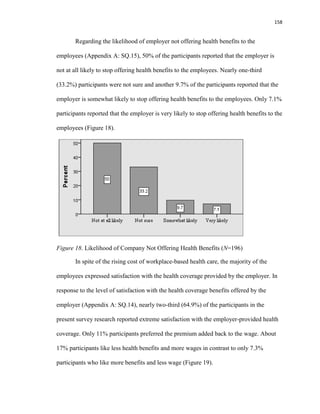
Figure 18. Likelihood of Company Not Offering Health Benefits (N=196)…………...158
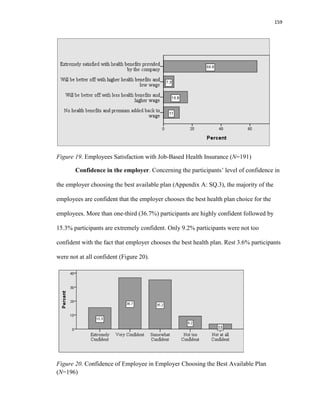
Figure 19. Employees Satisfaction with Job-Based Health Insurance (N=191)………. 159
Figure 20. Confidence of Employee in Employer Choosing the Best Available Plan
(N=196)…………………………………………………………………………………159
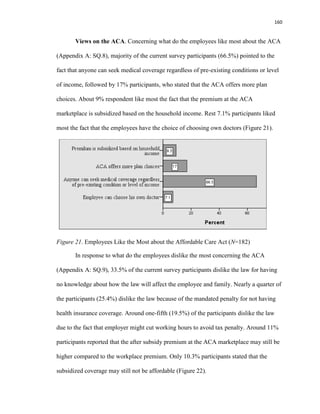
Figure 21. Employees Like the Most about the Affordable Care Act (N=182)……….. 160
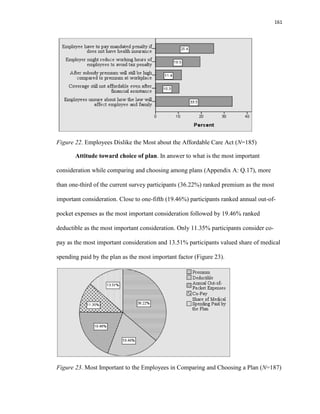
Figure 22. Employees Dislike the Most about the Affordable Care Act (N=185)……..161
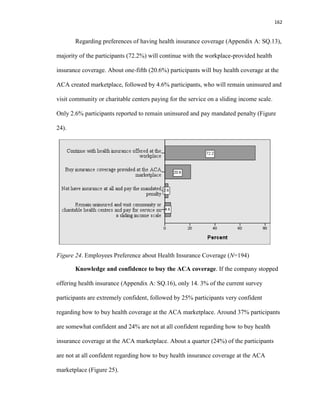
Figure 23. Most Important to the Employees in Comparing and Choosing a Plan (N=187)
…………………………………………………………………………………………..161
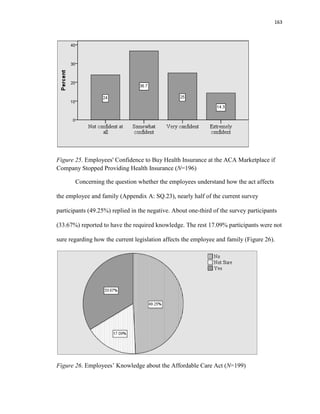
Figure 24. Employees Preference about Health Insurance Coverage (N=194)………...162
Figure 25. Employees' Confidence to Buy Health Insurance at the ACA Marketplace if
Company Stopped Providing Health Insurance (N=196)………………………………163
Figure 26. Employees’ Knowledge about the Affordable Care Act (N=199)………….163
Figure 27. Employees’ Opinion about Employer Communicating More Regarding How
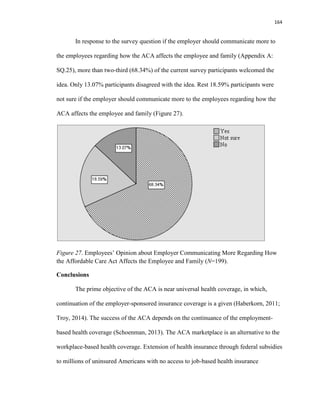
the Affordable Care Act Affects the Employee and Family (N=199)………………….164
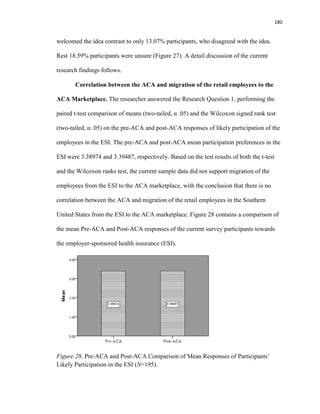
Figure 28. Pre-ACA and Post-ACA Comparison of Mean Responses of Participants’
Likely Participation in the ESI (N=195)………………………………………………..180
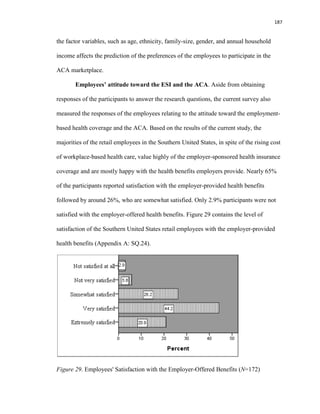
Figure 29. Employees' Satisfaction with the Employer-Offered Benefits (N=172)……187
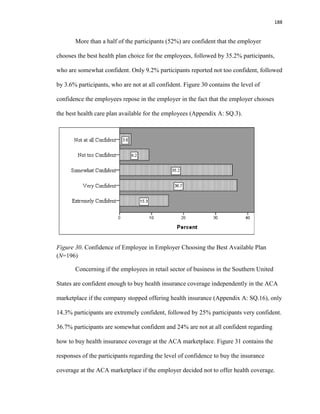
Figure 30. Confidence of Employee in Employer Choosing the Best Available Plan
(N=196)…………………………………………………………………………………188
xix
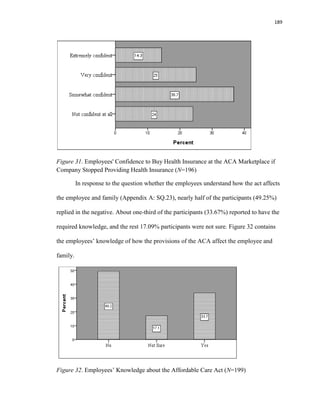
Figure 31. Employees' Confidence to Buy Health Insurance at the ACA Marketplace if
Company Stopped Providing Health Insurance (N=196)………………………………189
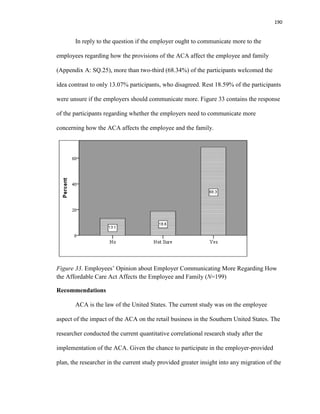
Figure 32. Employees’ Knowledge about the Affordable Care Act (N=199)………….189
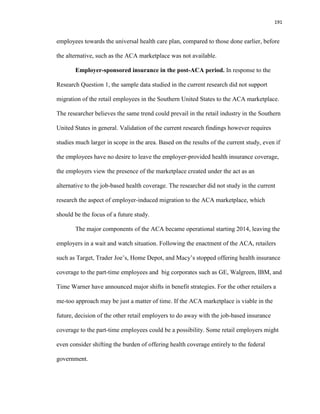
Figure 33. Employees’ Opinion about Employer Communicating More Regarding How
the Affordable Care Act Affects the Employee and Family (N=199)………………….190
1
Chapter 1: Introduction to the Current Study
An Overview of the Topic
President Barrack Obama signed the Patient Protection and Affordable Care Act
(PPACA), commonly known as the Affordable Care Act (ACA), into law in March 2010.
The goal of the current piece of legislation is to improve the health care system of the
nation by extending the health insurance coverage to millions of uninsured Americans.
The provisions of the act include incentives, which will influence the decisions of the
employers and the employees regarding the health coverage benefits. According to the
Congressional Budget Office (CBO):
there is clearly a tremendous amount of uncertainty about how employers and
employees will respond to the set of opportunities and incentives under [the
ACA]… there is uncertainty regarding many other factors, including the future
growth rate of private insurance premiums and the number of individuals and
families who will have income in the eligibility ranges for Medicaid, CHIP, and
marketplace subsidies. Moreover, the models … are generally based on observed
changes in behavior in response to modest changes in incentives, but the
legislation enacted in 2010 is sweeping in its nature. (as cited in Schoenman,
2013, p. 10)
According to the CBO and the Joint Committee on Taxation (JCT) estimate, the ACA
could lower federal budget deficit by $143 billion between 2010 and 2019 (Lambrew,
2012) and save about $1 trillion between 2020 and 2029 (Waldron, 2012). The current
legislation is also likely to affect the way the employers manage the health care benefits
of the employees, and eventually, the organizational cost structure.
2
Since the Second World War, the ESI has been the backbone of health care
coverage in the United States (Blumenthal, 2006; Entoven & Fuchs, 2006; Glied, 2005, p.
37). Eventual success of the ACA is dependent on the durable concept of the ESI
(Blumberg, Buettgens, Feder, & Holahan, 2011). By 2000, the ESI was at the highest
level covering almost 66.8% of non-elderly Americans in the United States (Blumenthal,
2006). In contrast, in most other advanced nations, such as Canada and western European
nations, the respective governments assume the responsibility of providing health
coverage (Blumenthal, 2006; Rodwin, 1987). From the employers’ perspective, the
management uses the Employer-provided health insurance as a strategic component of
employee benefits package, for managing the workforce.
A steady drop in availability of the ESI coverage occurred across the United
States between 2000 and 2010 (Gould, 2012; Greene, 2013). In the survey by the U.S.
Census Bureau (2011), more than half of the Americans (55.1%) had employment-based
health insurance coverage and the rate had steadily declined from 64.4% to 56.5%
between 1997 and 2010 (Janicki, 2013). According to Sonier, Au-Yeung, and Auringer
(2013), the state-by-state analysis of trends in the ESI report in April 2013, by Robert
Wood Johnson Foundation agreed to the above assertion that the ESI sharply declined
between 2000 and 2010. In 2010-2011, the employers provided health insurance
coverage to nearly 60% of non-elderly population, compared to about 70% in 1999-2000.
The average individual annual premium almost doubled from $2,490 in 2000 to $5,081 in
2011, and the average total annual premium for a family for the same period went up by
125%, from $6,414 to $14,447 (Sonier, Au-Yeung, & Auringer, 2013). Between 2000
and 2010, the stagnating wage and the soaring insurance premium were the reasons for
3
the employees to stop seeking health insurance even if offered by the employers (Randall,
2013).
The rising cost of health care and the consequent increase in the health insurance
premium over the years resulted in a drop in the employment-based coverage (Cutler,
2003). The health care cost, which kept increasing over the years, currently accounts for
around 17% of Gross Domestic Product (GDP), and is likely to reach 20% of GDP by
2021 (Kaiser Health News, 2012). According to Hogberg, a section of Americans
maintain the view that federal government could adequately address the health care issues
of the nation, while other Americans view excessive government interference in the
administration of health care is inconsistent with the system of free market economy
adopted by the nation (as cited in Discoverthenetworks.org, n.d.). The current health care
legislation, which went into full effect starting January 1, 2014, is likely to expand health
care coverage to most Americans and contain the exploding cost. The new law will
change the way both the employers and the employees perceive and value the
employment-based health insurance.
Under the ACA, provision for the health insurance of the employees by the
employers is not mandatory (Harvard Pilgrim HealthCare, n.d.; Kaiser Family
Foundation, 2013). The act requires that the employers with fifty or more full-time
employees pay a fine, should the employers decide not to provide health insurance to the
full-time employees. The act requires the employers to provide affordable coverage
(HealthCare.gov, n.d.) to the eligible employees to avoid additional penalty, which is
referred to as the Employer mandate (Chaikind & Peterson, 2010; U.S. Chamber of
Commerce, 2013). Starting 2018, the act also requires the employers to pay Cadillac
4
health plan tax (Gold, 2010; Justice, 2012) for providing high value insurance plans to the
employees.
From the employees’ perspective, the employees should also decide who manages
the future health care of the employees and how. Under the current legislation, the
employees have the choices either to have health coverage, such as, participating in the
employer-sponsored health insurance or buying the health insurance in the marketplace,
also referred to as the exchange, created under the ACA (Health Insurance 101, 2011).
The marketplace includes provision for health coverage to the individuals, who have no
health insurance or who fail to get coverage at the workplace. Individuals, who neither
participate in the ESI plan nor buy personal health insurance in the marketplace, will
have to pay the federally mandated penalty, referred to as the Individual mandate (Baker,
2013; Cigna, 2013). Definitions of the terms used in the current study have been included
in a separate section of the manuscript.
The eventual success of the health care system under the current legislation is
dependent on how well the current legislation capitalizes on and augments the already
established employment-based health care system in the country (Haberkorn, 2011). The
previous system included provision for health coverage through a combination of private
workplace-based insurance and provision for the elderly and the poor by the government,
through Medicare and Medicaid entitlement programs. The Employment-based
insurance, which has been the chief source of providing health insurance, however failed
to include all the employees. The low-wage employees remained uninsured and declined
the health insurance, even if the employers offered coverage (Cunningham, Schaefer, &
Hogan, 1999). Additionally, another associated issue is healthy and young Americans,
5
according to Young (n.d.), do not want to buy health coverage. First, the current
legislation capitalizes on the existing employment-based health insurance making health
insurance more affordable to the employees, and second, the act includes subsidies to the
individuals, who the employers cannot provide coverage.
The success of the hybrid health care system under the current legislation, such as
augmenting the old system with additional features to include universal health coverage,
depends on the shared responsibilities among all the participants in the system, such as
the government, the insurance companies, the employers, the employees, the individuals,
and other stakeholders (Democratic Policy and Communication Center, n.d.; Sussman,
Blendon, & Campbell, 2009). According to the Democratic Policy and Communication
Center (n. d.), the ACA is a framework for everyone to play the part to ensure success of
the new health care system. The Democratic Policy and Communication Center (n.d.)
noted that the government includes provision for affordable and quality coverage; health
insurance companies will operate with new rules and new roles; there will be alignment
among the hospitals, physicians, and other medical providers to improve the quality and
outcome of health care. Additionally, pharmaceutical companies and medical device
companies will help finance the cost of affordable health coverage to the Americans;
employers with fifty or more full time employees will pay fine for not offering health
coverage or for providing unaffordable health coverage; and individuals, who remain
uninsured but can afford health coverage, will have to pay tax penalty.
Health insurance coverage under the current legislation to millions of uninsured
American through subsidies is feasible on the assumption that the employers will
continue to provide health insurance coverage to the majority of the employees, as usual
6
(Blumberg et al., 2011). One of the major factors that might make the health care system
of the nation envisioned that in the ACA work less efficiently is the migration of the
employees from the employer-offered health insurance coverage to the ACA marketplace
(Orentlicher, 2014; Troy & Wilson, 2014). In the event employees opt out of health
coverage at the workplaces, there will be a marked increase in the employer-sponsored
health insurance premium, leading to eventual abandonment of the employment-based
health insurance, the current legislation capitalizes on (Merhar, 2014; Regopoulos &
Trude, 2004; Ubel, 2013).
Background of the Study
The employees in the United States have always depended on the employment-
based health insurance (ESI) as the chief source of health insurance coverage. On an
average, more than 60% of the employees in the United States get the health coverage
through the employers (Sonier et al., 2013). Maxwell (2012) noted that the practice of
offering health insurance coverage through employment became more popular during and
after the Second World War, in response to the federal wage regulation (p. 52). Since
employers were restricted in giving higher wages, the employers used health insurance
coverage as a term of employment to manage a talented workforce and ensure
competitiveness. The workplace also contained a mechanism for smooth accountability
of the insurance premium as the employers deduct the insurance premium during the pay
period from employees’ wages. The employment-based health insurance as such proved
to be a dependable source of health insurance coverage in the United States (Hermer,
2006; Schoenman, 2013).
7
Although stable for more than half a century, between mid-1950s and 2010, the
employment-based health insurance was not free from issues before the current
legislation (Enthoven & Fuchs, 2006). First, the administrative cost of employment-based
insurance continued to be as high as 11% of insurance premium. Second, there was
inequitable cost sharing among the stakeholders in the health care management process.
Third, employment-based insurance failed to extend coverage to other segments of the
population, such as the low-wage employees, whose health care issues over the years
remained unaddressed (Collins, Schoen, & Colasanto, 2003).
Employment-based health insurance also impeded job mobility as the employer-
offered health coverage is tied with the employees’ jobs. The loss of job very often leads
to the loss of health coverage (Warren, 2005). The situation was worse for the employees
with existing medical conditions in the absence of a viable alternative. Blumenthal (2006)
stated that a heavy reliance on the employer-provided health insurance, which has
evolved in the United States over the last 70 years from 1940 to 2010 in an unplanned
way, is an accident of history. According to Reinhardt, if the planners of the health care
system were to start the ESI from the scratch, the planners would probably structure the
health care system differently (as cited in Blumenthal, 2006).
The worst economic recession since the great depression shattered the U.S.
economy and many Americans lost jobs (Farber, 2011). The health care system in the
U.S. being mainly employment-based, a significant number of people went without the
health insurance. The timing of the current legislation was perfect for many needing
essential health benefits (Collins, Doty, Robertson, & Garber, 2011). Even during the
sluggish recovery during the last few years through the government incentive programs,
8
employers did not add as many jobs as expected. Workers, who got the jobs back, ended
up mostly with part-time, low-wage jobs (Raum & Agiesta, 2013). The low-wage
employees would rather have the cost of the insurance premium added back to the
compensation package than participate in the employer-offered insurance (Maxwell 2012,
pp. 36-37). With the insurance premium soaring between 2000 and 2010, and the
economy having a recovery from the worst recession, health care benefit as part of the
employee compensation package no longer seemed an attractive option to many
employers. Fronstin (2007) noted that there was a clear message from the associations
representing employers that a comprehensive and viable alternative must replace the
current systems of employment-based health insurance.
The goal of the ACA is health insurance coverage to millions of uninsured, and
containment of the soaring cost of health care benefits. The act also contains provision to
prohibit some of the unfair practices of the insurance companies such as charging higher
insurance premiums to people with medical conditions and putting a lifetime dollar limits
on coverage (The White House, 2012). The current legislation is a hybrid mechanism,
which includes provision for health insurance to millions of uninsured Americans. First,
the current legislation capitalizes on the employment-based insurance system by making
employer-offered health coverage more robust (Blumberg et al., 2011). Second, under the
current legislation, persons, who are not covered at the workplace, could get health
coverage at the ACA marketplace in each state. Additionally, based on the annual
household income of the taxpayers, the government subsidizes the insurance premium on
a sliding income scale (Kaiser Family Foundation, 2014).
9
Evaluation of the costs and benefits associated with the health insurance offer,
according to Maxwell (2012), is an important consideration in deciding whether an
employer offers health insurance to the employees or not (p. 43). The employers consider
the costs of offering health coverage from the angle of the premiums, administrative
costs, the quality of the plans offered, and access to the coverage offered. The perception
that a provision for benefits replaces a portion of the employees’ compensation varies
among companies based on the size and nature of business (Maxwell, 2012, p. 83).
Participation of more eligible employees in the employer-sponsored health insurance plan
allows the employer to minimize the average insurance premium per employee (United
States Department of Labor, 2001). Larger firms are therefore more likely to have
provision for health insurance to the employees because of the low probability of adverse
selection in a large group of employees (Maxwell, p. 10).
Access to health care in the case of an emergency has always been there in the
United States (Drum, 2007). The concern is how to contain the rising cost of health care
and how to pay for the health care cost of the nation. With the cost of insurance premium
rising, the employers dropped many employees and in fact, many young healthy people,
according to Young (n.d.), do not want to pay for the coverage. To avoid the above
scenario, the ACA requires all the participants in the health care system to pay fair share
of the health care cost of the nation. According to the Democratic Policy Communication
Center (n.d.), healthcare reform will not be comprehensive unless the reform reaches out
individuals, employers, providers, and the insurance industry. Without payment coming
from the healthy people, the health care cost will be high and the burden of insurance cost
would fall disproportionately on the people in poor health conditions (Sandrock,
10
Singleton, Manna, & Diamond LLC, 2011, p. 6). Greater emphasis under the current
legislation is on the employment-based health insurance, because the system is already
working for the majority of Americans (Blumberg et al., 2011). In addition, the current
legislation includes a mechanism for collection of the insurance premium (Sandrock et
al., 2011, p. 6).
Gibbs noted that the employment-based health insurance coverage is one of the
important components of health care management in the United States and the goal of the
current legislation is to make the employment-based health insurance coverage more
robust (as cited in Troy, 2014). The success of the employment-based insurance depends
on the employees’ acceptance of the workplace-based health insurance. If the employees
decide to buy the health insurance at the ACA marketplace instead, the viability of the
ACA will be questionable (Orentlicher, 2014). Migration of employees from the
employer-provided insurance to the ACA marketplace will increase workplace insurance
premium, leading to eventual abandonment of the employer-sponsored health coverage
(Merhar, 2014; Regopoulos & Trude, 2004). The current research study will explore if
and to what degree, the employees will decide to opt out of the ESI, and migrate to the
ACA marketplace to buy the health insurance coverage.
Problem Statement
The goal of the ACA is expansion of health coverage to the low-income
Americans, who do not have access to health coverage through the employers (Merlis,
2011). Health coverage to the low-income Americans through federal subsidies is
possible because the vast majority of Americans get health coverage through the ESI
(Blumberg et al., 2011). Stability of the ESI is as such integral to the viability and
11
eventual success of the legislation (Blumberg et al., 2011; Orentlicher, 2014). If the
employees, who have insurance coverage through the employers migrate to the
marketplace created under the act, and avail the subsidies just as the low-income
individuals, who have no health coverage at the workplace, future existence of the ESI
will be questionable (Enthoven & Fuchs, 2006; Regopoulos & Trude, 2004). Migration
of the employees from the workplace-based health insurance to the ACA marketplace
will undermine the eventual success of the act (Orentlicher, 2014; Troy & Wilson, 2014).
The problem of the current research is that it is not known, if and to what
degree, a correlation exists between the ACA and migration of the retail employees in the
Southern United States, from the ESI to the ACA marketplace. As the first annual
enrollment period under the ACA ends, understanding the changes in the employer-
provided health insurance coverage (ESI) is important since most Americans receive
health insurance coverage through the employers (Avalere Health LLC, 2011; Claxton,
Levitt, Brodie, Garfield, & Damico, 2014). Austin, Luan, Wang, and Bhattacharya (2013)
noted that as the implementation of the act continues, any change in the rate of
participation is of special interest to the policy makers and the research analysts.
Keeping up with the spiraling health care cost, insurance premium markedly kept
increasing and thinning out of the job-based insurance was already well under way
(Enthoven & Fuchs, 2006). The findings of the current research study include greater
insight into the attitude of the retail employees when alternative such as marketplace
under the ACA is available. The current research study could help the retail employers
understand if sponsoring health insurance of the employees in the post-ACA period
makes good business sense. Health insurance being a major component of the employee
12
benefits, the study involves determination of critical input in redesigning the employee
benefits and developing appropriate talent management strategy in a globalized world,
where competition, especially from the Asian retail counterpart, is stiff.
Based on actual data, the results of the present study contains vital clues as to the
reason why a section of the employees in the retail sector of the Southern United States
business will decide to leave the employer-provided health coverage and buy health
coverage at the ACA marketplace. The findings of the current study will consequently
help the employers perform cost-benefit analysis and take strategic decisions relating to
redesigning the future health benefits package of the employees. The current research
study also contains important clues to the health care policy planners in the Southern
United States, to ensure all the stakeholders in the health care system sharing the cost of
health care of the nation equitably. Equitable sharing of the cost of the nation’s health
care is fundamental to the success of the ACA (Democratic Policy and Communication
Center, n.d.).
Purpose of the Study
Continuance of the employment-based health insurance is imperative for the
eventual success of the health care legislation (Haberkorn, 2011; Schoenman, 2013).
Expansion of health insurance coverage to millions of low-income Americans through
federal subsidies is a viable proposition because the majority of the Americans get health
insurance coverage through employment (Blumberg et al., 2011). If the employees, who
are already covered through the employer, migrate to the marketplace created under the
ACA and seek health coverage availing the federal subsidies, the problem will be serious
for the employment-based insurance system (Merhar, 2014; Regopoulos & Trude, 2004).
13
Migration of the employees from the employer-provided insurance to the ACA
marketplace will defeat the very purpose of the current legislation to extend insurance
coverage to millions of low-income Americans, who have no access to health coverage
through employment (Orentlicher, 2014; Troy & Wilson, 2014).
The purpose of the current quantitative study was to explore, if and to what
degree, a correlation exists between the ACA and migration of the retail employees in the
Southern United States, from the ESI to the ACA marketplace, utilizing a paper-based
survey of the front-line retail executives in the Southern United States. The researcher
employed the SPSS Predictive Analytics Software student version 18.0 to analyze and
interpret the survey data to draw conclusions. The result of the present study was
extended to other retailers operating in the Southern United States.
Employers have always evaluated the efficacy of workplace-based health
insurance from a cost-and-benefit perspective (Maxwell, 2012, p. 43). The most
important factor that could affect the employers’ decision to sponsor health insurance
coverage is the establishment of the marketplace under the ACA, as an alternative to the
workplace-based health insurance coverage. The outcome of the current study might
require the retail employers in the Southern United States to revisit the employees’
benefits portfolio and perform a cost-benefit analysis to ensure offering health coverage
is still relevant to attract and retain the type of workforce the retailers need. In addition,
the employees, who have been dependent on the employer-sponsored health coverage so
far, might have to look for alternatives available within means, in response to the
changing health care mandates. Based on actual data, evaluation of the reaction of the
employees to the employer-provided health insurance is critical in understanding the
14
success of the health care reform and relevance of the act to the employers, employees,
policy makers, and labor unions. The literature search in the area of the research topic led
the researcher to test the following hypotheses pertinent to the research problems.
Research Questions and Hypotheses
R1: What correlation, if any, exists between the ACA and the migration of the
retail employees in the Southern United States, from the ESI to the ACA marketplace?
H1: There is a statistically significant correlation between the ACA and the
migration of the retail employees in the Southern United States, from the ESI to the ACA
marketplace.
H0: There is statistically no significant correlation between the ACA and the
migration of the retail employees in the Southern United States, from the ESI to the ACA
marketplace.
R2: What correlation, if any, exists between age and the migration of the retail
employees in the Southern United States, from the ESI to the ACA marketplace?
H2: There is a statistically significant correlation between age and migration of
the retail employees in the Southern United States from the ESI to the ACA marketplace.
H0: There is statistically no significant correlation between age and migration of
the retail employees in the Southern United States from the ESI to the ACA marketplace.
R3: What correlation, if any, exists between ethnicity and migration of the retail
employees in The Southern United States from the ESI to the ACA marketplace?
H3: There is a statistically significant correlation between ethnicity and migration
of the retail employees in the Southern United States from the ESI to the ACA
marketplace.
15
H0: There is statistically no significant correlation between ethnicity and
migration of the retail employees in the Southern United States from the ESI to the ACA
marketplace.
R4: What correlation, if any, exists between family size and migration of the
retail employees in the Southern United States from the ESI to the ACA marketplace?
H4: There is a statistically significant correlation between family size and
migration of the retail employees in the Southern United States from the ESI to the ACA
marketplace.
H0: There is statistically no significant correlation between family size and
migration of the retail employees in the Southern United States from the ESI to the ACA
marketplace.
R5: What correlation, if any, exists between gender and migration of the retail
employees in the Southern United States from the ESI to the ACA marketplace?
H5: There is a statistically significant correlation between gender and migration
of the retail employees in the Southern United States from the ESI to the ACA
marketplace.
H0: There is statistically no significant correlation between gender and migration
of the retail employees in the Southern United States from the ESI to the ACA
marketplace.
In the current study, the researcher tested the null hypotheses using statistical
interpretation of the responses of the employees, who are eligible for employer-sponsored
health insurance coverage. The researcher designed the current survey to elicit responses
from the participants that allowed a quantitative test of the null hypothesis. Executives of
16
the retail chains and individual retail stores operating in the Southern United States
participated in the current survey. The researcher excluded from the study the restaurant
business, which is strictly not retailing. In the current study, the researcher utilized a
paper-based questionnaire (Appendix A) as the survey instrument. The retail executives
in the Southern United States are composed of people with varied skill sets and diverse
backgrounds. Several factors such as age, ethnicity, educational level, household income,
family size, and nationality affect the orientation of the employees concerning the
decision as to whether to accept the employer-offered health insurance, buy health
coverage at the ACA marketplace, or not to have health insurance at all, and pay the fine.
The researcher statistically analyzed and interpreted the current survey data to provide an
objective analysis of the employees’ attitude toward the employment-based insurance,
when the ACA contains provision for alternative health insurance coverage. In the
current research study, the researcher performed both descriptive and inferential
statistical analyses on the collected data to draw conclusions and generalize.
While emphasis in the current research study was to find answers to the above
questions, findings of the current study contained critical information regarding the
attitude of the employees toward several additional questions relevant to the current
research. Utilizing the questionnaire (Appendix A) the researcher elicited responses of
the participants to additional questions, such as if the employee will have at least some
form of insurance or not; participants’ liking and disliking for the type of coverage; and
the like. From the employees’ perspective, there is a probability that some of the
employees will not participate in any health insurance plan and pay the fine. The
employees considering not having insurance coverage might consider visiting the
17
federally supported Community Health Centers and other non-profit healthcare providers
and pay for the services based on sliding income scale. From the employers’ perspective,
the management might consider a trade-off between providing health insurance to the
employees and paying the fine. Whether the management will continue to consider
Employer-Sponsored Insurance a strategic component of employee benefit package for
recruiting and retaining a talented workforce was also part of the research focus.
Contribution to Knowledge
The researcher conducted the current research study at a point of time when the
full impact of the ACA on the American business was not apparent. As such, all the
arguments, whether in favor of or in opposition, are projections. Both employers and
employees of the corporate America are yet to have a complete understanding of the
implication of the current legislation. The predictions based on the studies carried out
concerning the decline in the workplace-based health coverage were before major
components of the ACA went into effect. The current health care legislation went into
effect starting January 1, 2014. The predictions as such were hypothetical in nature. The
present study, supported by actual data, explored if and to what degree, a correlation
exists between the ACA and migration of the retail employees in the Southern United
States, from the ESI to the ACA marketplace. The researcher conducted a quantitative
study utilizing a survey (Appendix A) of retail employees in the Southern United States.
The findings of the current study involved finding vital information concerning how the
ACA could influence the health insurance choices of the Southern United States retail
employees.
18
There is little research in the Southern United States concerning the impact of the
current health care legislation on the employees in retail sector of business. The findings
of the current study measured the attitude of the employers and the employees towards
the ESI and could form the basis of future research. The findings of the current study
contain clues as to why a section of employees in retail corporations would migrate to the
ACA marketplace. Additionally, the current study could provide critical information to
the employers to make a cost-benefit analysis to determine if retail corporations operating
in the Southern United States need to redesign the health benefits package offered to the
employees as part of the talent management strategy.
The current research study is also important to the policy planners in the field of
health care since the findings of the current study contain relevant information to ensure
there is equitable sharing of insurance cost among the stakeholders in the health care
system of the nation. Capturing what goes on in the mind of the employees concerning
the employment-based insurance could help the employers reassess the usefulness of
health insurance as a strategic component in managing the future workforce. Employers
have the option of either play (offer health insurance) or pay (the tax penalty). The study
contains information for the employer to take greater insight into both short-term and
long-term effect of either of the above choices. The current study in essence could help
employers take better judgment concerning the health care decision to ensure
competitiveness and sustainability in a globalized world.
Significance of the Study
Enactment of the current health care legislation in 2010 amidst fierce political
debate brings in major changes to the existing health care practices (Emanuel, 2014). The
19
crafters of the current legislation intend the legislation to capitalize on, and not to replace
the stable employment-based insurance coverage (Schoenman, 2013; Yale Journal of
Medicine and Law, 2009). The impact of the current legislation will be numerous for
both the employers and employees. The employers provide the health insurance to the
employees for strategic reasons (Blumberg et al., 2011), and the employees highly value
the employers assuming the responsibility of providing health insurance coverage and
peace of mind concerning health. Most of the provisions of the current legislation were
effective beginning 2014, and the proposed time line for full implementation of the act is
by 2018 (Kaiser Family Foundation, n.d.). The employers and the employees as such will
have to reconsider the relevance of the employment-based health insurance coverage.
The employers will reassess the cost structure relating to the health insurance
offer, the effect of such offer on the organizational bottom-line, and take into account
other strategic considerations in offering group health plan (NORC at University of
Chicago, 2014; Towers Watson & Co., 2012). The employees’ decision whether to
participate in the employer-sponsored group plan or make independent purchases of
health insurance in the marketplace, depends on whether the employers continue to offer
health insurance or not. Singhal, Stueland, and Ungerman (2011) noted the employers
needed to take a dynamic view of the reaction of both the competitors and the employees
toward the workplace-based health insurance coverage in the post-current legislation
period.
The present study contains valuable information for the employers in retail
business in deciding whether the employers should continue to offer health insurance to
the employees or not. The study could have information for the employers to understand
20
the changing health care landscape, who might even consider offering health coverage to
the full-time employees only, while strategically leveraging the part-time employees. An
accurate effect of the current legislation on the retail business is difficult to assess at
present since most of the current legislation went into effect in 2014 and full
implementation of the act might be complete by 2018 (Kaiser Family Foundation, n.d.).
Implementation of the major components of the act as per the timeline is also equally
important. Without much empirical studies, precise prediction of how employers and
employees would react to the current legislation is difficult. As such, any study in the
area is useful from the perspective of all the stakeholders operating in the field of health
care. In essence, through the present study, the corporate employers operating in retail
business could have better appreciation of the relevance of employment-based health
insurance in the changing health care landscape.
Rationale for Methodology
The current study required an objective answer to the question whether the
employees would accept the health insurance offered at the workplace or move onto the
ACA marketplace to buy the health insurance. The researcher employed a quantitative
research study over a qualitative one for the purpose, as the quantitative research method
leads to interpretation of the numerical data that is more concrete. State University of
New York at Cortland (n.d.) stated, “only quantitative data can be analyzed statistically,
and thus more rigorous assessments of the data are possible” (para. 1). The study
measured the variables to test the hypotheses. Results from a survey renders well to a
quantitative study (Social Science Research and Instructional Center, 1998). A carefully
21
designed survey could mimic the real life situation for an individual to decide the type of
insurance one should have.
A Likert-type scale, a nominal scale, and a category scale measured the responses
of the survey participants. The researcher systematically analyzed the quantitative
response data of the participants using statistical methods, leading to more meaningful
conclusion and predictions. The researcher was able to objectively interpret and
generalize the data through the study of quantitative data. In the context of the present
study, prediction of the behavior of the employees of retail business in the Southern
United States in general, was possible. A qualitative research study, opposed to a
quantitative one, is much more subjective (Imperial County Office of Education, 2006),
and objective assessment of subjective data is difficult.
Nature of the Study
This study is a quantitative study of employees’ response to the provisions of the
ACA. The study contains a practical insight into the impact of the employers’ decision
and the mandates of the current legislation on the employees’ decision in choosing
among the types of insurance coverage available. The researcher chose the retail chains
and individual retail stores in the Sothern United States. The results of the current study
contained information to extrapolate the results to other stores in the Southern United
States retail business. The study population was the front-line, floor level executives, who
are eligible to participate in the employer-sponsored health insurance coverage. The
researcher conducted a sample survey of 203 retail executives (Appendix B) in the
context of the current research problems. The researcher utilized a paper-based
questionnaire (Appendix A) as data collection tool. The researcher used both descriptive
22
and inferential statistics to perform statistical analyses of the primary quantitative data
obtained in the survey. The researcher employed the SPSS Predictive Analytics Software
(PASW) student version 18.0, to analyze and interpret the current survey data. Tables and
figures supported interpretations of the current data.
Definition of Terms
Affordable coverage. Coverage is considered unaffordable if the required
employee contribution towards the cost of self-only coverage exceeds 9.5% of the
employees’ household income. Coverage fails to provide minimum value if the coverage
fails to pay at least 60% of the total allowed cost of benefits provided under the plan
(HealthCare.gov, n.d.).
Actuarial value. An estimate of total average costs for covered benefits that a
plan will cover (American Association of Retired Persons, n.d.).
Annual out of pocket expenses. The maximum dollar amount a group member is
required to pay out of pocket during a year (U.S. Bureau of Labor Statistics, 2002, p. 5).
Cadillac health plan tax. Excise tax for carrying high-cost plans above specified
limits starting 2018 such as employers will be assessed 40% excise tax on the annual
value of employer provided health coverage exceeding $10,200 for individual coverage
and $27,500 for family coverage. The value of coverage includes both employer and
employee contributions (Gold, 2010; Justice, 2012).
Co-pay. A form of medical cost sharing in a health insurance plan that requires an
insured person to pay a fixed dollar amount when a medical service is received (U.S.
Bureau of Labor Statistics, 2002, p. 1).
23
Cost sharing. The charges for a covered health benefit that an insured person
must pay, such as a copayment, coinsurance, or deductible payment (American
Association of Retired Persons, n.d.).
Deductible. A fixed dollar amount during the benefit period that an insured
person pays-usually a year-before the insurer starts making payment for covered medical
services (U.S. Bureau of Labor Statistics, 2002, p. 1).
Employer mandate. Requirement that employers with more than fifty full-time
employees provide and contribute to the cost of health insurance for the employees or pay
a fine (Chaikind & Peterson, 2010; U.S. Chamber of Commerce, 2013).
Employer-sponsored health insurance. Health coverage an individual gets
through his or her (or a spouse’s) job, as an active or retired employee (American
Association of Retired Persons, n.d.).
Federal poverty level (FPL). A measure of income level issued annually by the
US Department of Health and Human Services. Federal poverty levels are used to
determine eligibility benefits and programs (American Association of Retired Persons,
n.d.).
Health insurance. A contract that requires the health insurer to pay some or all of
the health care costs in exchange for a premium (Centers for Medicare and Medicaid
Services, n.d.).
Health insurance exchange. Also called Exchange or The Marketplace is a
structured market place for the sale and purchase of health insurance. Marketplace, which
will be operating in states by Jan.1, 2014, will serve as a venue under ACA to provide
health insurance to an estimated twenty-nine millions of people by 2019 (Health
24
Insurance 101, 2011). Through the marketplace, one can shop online and receive help by
phone or in person to find the plan that works for his or her family. The marketplace
allows one to compare plans and costs on an apples-to-apples basis. One can also
determine what kind of financial help he or she may be able to obtain to pay for
premiums and copayments. Marketplace is sometimes referred to as Health Insurance
Exchange (American Association of Retired Persons, n.d.).
Individual mandate. Requirement that individuals have minimum essential
coverage or face a tax penalty (Baker, 2013; Cigna, 2013).
Migration absolute measure. Measure on a nominal/category scale of employees’
responses of likely participation in the employer-provided health insurance.
Migration ordinal measure. Measure on an ordinal scale of employees’ responses
of likely participation in the employer-provided health insurance.
Minimum essential coverage. The type of coverage and individual needs to meet
the individual responsibility requirement (Individual Mandate) under the Affordable Care
Act. This includes coverage bought in a Health Insurance Marketplace, job-based
coverage, Medicare, Medicaid, the Children’s Health Insurance Program (CHIP),
TRICARE, and certain other coverage (American Association of Retired Persons, n.d.).
Out-of-pocket costs. Health care or prescription drug costs that an insured person
must pay because Medicare or other insurance does not cover them. Out-of-pocket costs
include deductibles, coinsurance, and copayments for covered services that are not
covered by a health plan (American Association of Retired Persons, n.d.).
Out-of-pocket limit. The most a subscriber pay during a policy period (usually a
year) before the health plan begins to pay 100% of the allowed amount. This limit never
25
includes the premium, balance-billed charges, or health care the health plan does not
cover. Some health plans do not count all of the copayments, deductibles, coinsurance
payments, out-of network payments, or other expenses toward this limit (American
Association of Retired Persons, n.d.).
Patient Protection and Affordable Care Act. Also known as the Affordable Care
Act, president Obama signed into law on March 23, 2010, putting in place comprehensive
reforms that improve access to affordable health coverage for everyone and protect
consumers from abusive insurance company practices. The law allows all Americans to
make health insurance choices that work while guaranteeing access to care for our most
vulnerable, and provides new ways to bring down costs and improve quality of care
(Furman, 2014; The White House, 2013; Waldron, 2012).
Plan premium. Amount of money as agreed upon paid for coverage of medical
benefits for a defined benefit period (U.S. Bureau of Labor Statistics, 2002).
Retail executives. The term executives in the context of the current study refer to
the first-line supervisors such as floor level supervisors, managers, and leads in the
context of retail business. The term executives do not refer to the officers of the
companies, who have access to special corporate privileges.
Assumptions, Limitations, and Delimitations
The following assumptions were present in the current study:
1. The researcher assumed that the participants understood the provisions of the
current health care legislation.
26
2. The researcher assumed that the personal and economic behavior of the
individuals, doctors, patients, and other stakeholders in the health care system
would be rational.
3. The researcher assumed that there would be no material changes to the rules and
regulations of the current legislation.
Discussion of limitations of the current study is relevant in evaluating the true
merit of the study. The impact of the current health care legislation is chiefly predictive in
nature in the absence of any empirical research. The implementation of the current
legislation is not yet complete and the changes are not apparent. Most of the components
of the current legislation went into full effect in 2014 and the full implementation might
take place by 2018 (Kaiser Family Foundation, n.d.). Nothing is definitive at this point,
regarding what goes on in the mind of the employers, and the employees, toward the
current legislation. Answers to the research problems are as such partly conclusive and
partly predictive.
The retailers in the Southern United States greatly differ in the composition of
workforce and nature of business. Some of the corporate retailers employ employees with
greater knowledge-based skill sets compared to others. Corporate retailers that require
more knowledge-based employees are more likely to provide health insurance as a
business strategy for talent management and sustain productivity. The above fact will
restrain generalization of the conclusion based on the 203 sampled executives working as
front-line supervisors for the national retail chains and the individual retail stores.
However, the participants in this study sample are distributed and worked in varied store
27
types to represent the retail businesses in the Southeastern United States. The following
limitations were present in the study:
1. Limited resource availability did not allow the researcher to go for a larger sample
size. The sample size in the current study was 203 front-line retail executives.
According to Krejcie and Morgan, the ideal sample size at 95% confidence level,
drawn from the population of 577 retail executives identified in the Southern
United States would be between 226 and 234 (siegle, n.d.).
2. Lack of probability sampling was another limitation. In the process of obtaining
the targeted sample size of 200 front-line retail executives, the researcher used as
many as 97 shopping centers of the 109 identified. However, the survey of the
retail executives in the Sothern United States shopping centers, included varieties
of retail stores and appear in clusters, thus closely represent the characteristics of
the retail business in the Southern United States.
3. The researcher confined the current study to executives only and not considering
all the eligible employees in the current study population. Although the researcher
originally planned to include the employees in all categories, the idea was
dropped since the management considered the research topic sensitive now for all
categories of employees to participate. The researcher believes, in coming years
participation of all categories of employees in similar studies should not be a
problem. A detailed discussion of the limitations of the current study is provided
in the research methodology section (chapter 3) of the manuscript.
The current health care legislation changes the health care landscape of the nation.
Both employers and the employees will be mutually influenced by the decisions either
28
take. The current research study provides in general information regarding the impact of
the ACA on employers and employees in retail settings. The researcher explored if and to
what degree, a correlation exists between the ACA and the migration of the retail
employees in the Southern United States from the ESI to the ACA marketplace. The
study as such explored if and to what degree, the employees of big retail corporations,
and individual retail stores in the Southern United States will continue to participate in
the employer-offered insurance plan, rather than buying the coverage independently at
the ACA marketplace. The study conducted a sample survey of 203 floor level executives
working for retail chains and individual retail stores in the Southern United States. The
researcher employed statistical methods to analyze the current survey data to arrive at
conclusions and generalize. The following delimitations were present in the current
study:
1. The current study participants did not include employees working in the non-retail
environment and the would-be-entrepreneurs, who are trying to start self-owned
business in America.
2. While the study provided some insight into the overall impact of the ACA on the
corporate America in general, the current study did not investigate in detail the
way ACA could affect the corporations, which are not in retail business.
Summary
In conclusion, majority of the employees in the United States get the health
insurance coverage through the employers. The current health care legislation is the law
of the United States and will bring in sweeping changes in the health care system across
the nation. The current legislation will affect both the employers and the employees. The
29
employers will try to understand the impact of the current legislation and reposition to
address the issues brought about by the changes in the health care law. There is also
compelling reasons to understand the insurance purchasing behavior of the employees in
the changed health care scenario. The employees’ demand for the job-based health
insurance coverage is a function of premium prices, out-of-pocket-expenses, and the
quality of the plan offered by the employers. The federal government provides subsidies
in the ACA marketplace, the amount of which will also influence the health insurance
choices of the employees.
According to the Avalere Health LLC (2011) analyses, the micro-simulation
models estimates from the RAND Corporation, the Urban Institute, the Lewin Group, and
the CBO have concluded that the ACA would leave the health insurance coverage offered
at the workplace largely intact. According to Blumberg et al. (2011), some prominent
economists thought the incentive provision in the current piece of legislation could
induce a large-scale migration of employees from the employer-sponsored coverage,
while others forecasted a more modest migration of low and modest earning employees
to the marketplace. Blumberg et al. (2011) stated that the migration of the low and
modest earning employees would occur to take advantage of the publicly subsidized
coverage as premium contributions continue to increase. The actual influence of the ACA
on the ESI could however, result from how the employees value the workplace-based
health coverage over the alternative, the ACA marketplace.
As discussed in the preceding section, several surveys captured the reactions of
the employers in recent times. There is however, a need for analyses of additional data on
the employees’ responses to the provisions of the ACA with respect to specific industries
30
where the migration from employment based health care is very likely to happen. The
retail business is one such industry that employs a large fraction of the low-paid, low-
skilled employees. In the United States, the retail trade sector is the largest employer
(United States Department of Labor Employment and Training Administration, n.d.) and
employs about 15.5 million people (Lichtenstein, 2009; U.S. Bureau of Labor Statistics
(n.d.). If the retail sector of business ends providing health coverage, the health care cost
estimated in the Affordable Health Care Act will go up (Orentlicher, 2014; Schoenman,
2013). The current study focused on investigating the aspect of employee response to the
ESI under the current legislation, which is missing.
Concerning the remainders of the manuscript, chapter 2 contains a comprehensive
review of the scholarly contribution in the area of the research topic. The review of the
current literature thematically provided the body of knowledge relevant to the present
study and placed the study in right context. The section provides the reader an easy
understanding of the progression of the employer-sponsored health care system over the
years and how the legislation influences the employers and the employees. Chapter 3
includes the research methodology, the research design, and the procedures adopted in
the current study to investigate and measure the reaction of the front-line retail executives
towards the employer-offered health insurance coverage. Chapter 4 contains an
explanation concerning the current survey data analysis and interpretation. Finally,
Chapter 5 includes the interpretation of the results and the probable implications of the
findings on the retail employees in the Southern United States along with a few
recommendations.
31
Chapter 2: Literature Review
An Overview of the Chapter
The objective of the current study was to examine if the employees’ perception of
the employer-sponsored health insurance coverage will change after the health care
current legislation. The employees might prefer the health coverage provided at the ACA
marketplace to the traditional health insurance coverage available at the workplace, job-
based health coverage has been the way of life for the American workers since the
Second World War, although the coverage is steadily declining since the 1980s
(Enthoven & Fuchs, 2006; Schoenman, 2013). The success of the current health care
legislation depends on the smooth continuance of the ESI coverage (Schoenman, 2013).
If the ACA drives the employees to sign up for the health coverage at the ACA
marketplace instead of accepting the health coverage at the workplace, the job-based
health coverage will further weaken leading to ultimate demise of the employment-based
health coverage (Ubel, 2013). The employees, as such, through reactions toward ESI,
provide important clues to assess the future of the ESI and consequently, the ultimate
success of the health care reform current legislation.
A thorough review of the literature in the area of employment-based health
coverage was necessary for a comprehensive understanding of the health care system in
the United States. The origin and evolution of the health care system over the years
provided a justification for the present enquiry. The body of literature provided patterns,
trends, issues, and controversies concerning the health care system of the nation. The
researcher thematically searched the scholarly contributions in the topic area through key
phrases such as the employment-based health insurance, the Affordable Care Act, and the
32
impact of the affordable care act on the employers and the employees. The review of the
literature highlighted the study findings, opinions, controversies and the research gap in
the research area, which formed the starting point of the present study.
This study was an evaluation of the health care system of the nation and the health
coverage decisions of the individuals and other stakeholders in the health care system,
within a multi-conceptual framework. Although rational choice theory is dominant in
understanding and modeling the health insurance decisions, theory often fails to explain
adequately the behavior of the individuals. The underlying assumption in theory is that
individuals are rational, and the individuals try to optimize the wellbeing by maximizing
benefits and minimizing costs. Insurance business in general capitalizes on uncertainties
and individuals have limited information for precise evaluation of health related risks.
The rational choice theory as such fails an explanation concerning certain types of
behavior patterns the individuals expressed (Niankara, 2006). Theory of bounded
rationality, which is limited by availability of information, cognitive abilities, and time
and resource, better explains the rationality of individuals and understanding of health
insurance decisions by individuals (Hindle, 2009).
The Affordable Care Act embeds in the pluralistic concepts of health insurance
that reflect the multi-cultural Americans of varied socio-economic make-up. According
to Hoffman (2011), the ACA is reflective of the conceptual pluralism underlying the
policies of the current legislation and matches the aspirations of the Americans, who
largely vary in the conception of health insurance. Most of the political and philosophical
concepts, such as political justice, distributive justice, and capability approach are
consistent with the idea that all individuals deserve high quality health care equally. The
33
above political and philosophical concepts considerably influence the health care
landscape of the nation and provide a framework in reshaping the health coverage
landscape of the nation. Davis and Walter (2011) noted that the principle of fair equality
and opportunity by Daniels et al. is an extension of theory of justice as fairness originally
proposed by Rawls. Individual health, according to Daniels et al, makes a significant
contribution to protecting a range of opportunities open to all individuals. The principle
of fair equality and opportunity provides justification for distribution of social resources
with special emphasis on improving the position of the less fortunate individuals in the
society and reduces disparities in health care access (Cust, 1993; Davis & Walter, 2011).
The above aside, Sen and Nussbaum, proponents of the capability approach,
provide a second moral foundation, which refers to the constitutional principles that the
government should provide basic health care to all, in order to ensure adequate respect
for human dignity. The capability approach by Sen and Nussbaum (as cited in Davis &
Walter, 2011; Stanton, 2007) forms the basis of the human development index developed
by the United Nations (Davis & Walter, 2011; Stanton, 2007). The theory provides
justification that the society should pursue for all people the human capabilities, such as,
the freedom to achieve functioning, which allows an individual to pursue what he or she
wants to do, and wants to be (Davis & Walter, 2011). According to Nussbaum work (as
cited in Davis & Walter, 2011), the health of an individual provides the foundation for
other pursuits of life, and the government as such should promote health care for all, to
ensure all people meet the minimum standard of capability (as cited in Davis & Walter,
2011). Knadig put forth the argument by John Rawls that a society in which the most
34
fortunate help the least fortunate is not only a moral society, but also a logical society (as
cited in Sorrell, 2012).
Theoretical and Conceptual Framework for the Current Study
The United States senator from Massachusetts Edward Kennedy (as cited in
Knadig, 2011) stated:
While the explicit ethical justification is that health reform is decisive for the
nation’s future prosperity, health coverage is above all an ethical issue; at stake
are not just the details of policy, but fundamental principles of social justice and
the nation’s character…What we face is above all a moral issue; at stake are not
just the details of policy, but fundamental principles of social justice and the
character of our country. (p. 11)
The ACA embeds in a multi-conceptual framework to meet the desires of the
heterogeneous American population, marked by varied social, economic, and moral
standing. According to Hoffman (2011), there are three dominant theories to the
American conception of health insurance. The first theory propounded by Pender (as
cited in University of Michigan, n.d.) is that health insurance should promote health.
Theory requires spending the insurance dollars on the medical interventions to produce
the most health benefits for dollars spent, contrast to lower-value interventions such as
end-of-life care. The second theory propounded by Graetz and Mashaw (1999) is that
health insurance should mitigate financial vulnerabilities resulting from health care
spending. Theory requires providing financial security to the Americans against medical
bankruptcies. The third theory is the classic image of liability insurance, which protects
the insured against health risks, which the insured might not reasonably avoid. Hoffman
35
(2011) stated that the above three overlapping conceptions of health insurance could
work in unison to reflect the policies of the ACA, that conceptualizes multiple visions.
The concept of health insurance did not exist less than a century ago in the United
States (Hermer, 2006). As the field of medical science advanced rapidly through
research, and the hospitals started offering health care to patients, the cost of health care
kept on increasing. According to Hermer (2006), in the United States the concept of
health insurance did not start until 1929. Health insurance, just like all other forms of
insurance, operates on the concept of risk. The insurance companies underwriting the risk
recognize the fact that the insurance companies could spread the risk over large number
of individuals. In a given year, only a fraction of the individuals will require treatment
and others will not. The premium collected from the individual subscribers will be
enough to pay for the cost of treatment in a given year. The insurance companies vary the
premium among the individuals based on the age, medical history, and habits, to ensure
individuals pay the premium based on the recognized risks the individuals pose. The
current legislation however restricts insurance companies to charge higher premium to
people with pre-existing conditions, and to put a cap on the total lifetime benefits
(HealthCare.gov, n.d.).
Ruger (2007) stated that the neo-classical economic perspective provides
justification for health insurance coverage with the assumption that individuals make
rational decisions to maximize the preferred outcomes, and corporations, including the
ones in insurance business, operate to maximize profit. The employers and the employees
as such make cost-benefit analysis to maximize the outcome of the insurance decisions.
United States, which is based on a free market economy, ensures the best form of
36
resource allocation and efficiency (Economy Watch, 2010). The risk-averse individuals
should be able to assess the risk in a rational manner. The individuals however do not.
According to Roll’s work (as cited in Bruner, n.d.), the individuals, based on empirical
studies, do not always make rational choices concerning the risks (as cited in Bruner,
n.d.). Ruger (2007) noted that most individuals fail to segregate between the greater risks
from the smaller ones to optimize the preferred outcomes.
Dacher (n.d.) stated that from moral perspective, the Aristotelian concept of
human flourishing, which assumes an innate potential of each individual to live a life of
enduring happiness, penetrating wisdom, optimal well-being, and authentic love and
compassion, provides the moral foundations of health insurance. If Aristotelian concept
of human flourishing is the end goal, then not just treating the sick, but providing security
for the vulnerabilities of the individuals through provision of health insurance is a moral
necessity. The political goal as such in the context should be developing public policy to
minimize the loss from individual health vulnerabilities.
Within the framework of neo-classical economic model, any social welfare rests
on the individual’s willingness to buy the commodity, such as health insurance, to reduce
the vulnerabilities. An alternative to the neo-classical economic model is the ‘welfare
economics and the capability approach’ propounded by Sen (Kuklys, 2005). According to
Sen, an individual’s access to the means, when exposed to such risks, is integral in
managing the risks adequately (as cited in Deneulin, Nebel, & Sagovsky, 2006). The
welfare economics and the capability approach, which emphasizes on capacitating the
vulnerable by providing access to means, has a moral dimension in addition to the
individual preferences to optimize the outcome of preferences through rational decisions.
37
Lack of access to the means to mitigate risks makes people insecure, diminish well-being,
and impede human flourishing (Dacher, n.d).
Several principles in medical ethics also support right to health care and equal
access. From the perspective of right to health care and equal access, a march towards
universal health care is laudable and justified (as cited in United States Conference of
Catholic Bishops, 1993). A resolution of Catholic Bishops of the United States reasoned
that every person has a right to adequate health care. The right flows from the sanctity of
human life and the dignity that belongs to all human persons, who are made in the image
of God. “Health care is more than a commodity; it is a moral imperative; it is a basic
human right; an essential safeguard of human life and dignity” (United States Conference
of Catholic Bishops, 1993, p. 1).
Review of Relevant Scholarship
Employment-based insurance. The employment-based health insurance system
has assumed a dominant position in providing health coverage to the vast majority of
Americans for more than half a century since 1950s (Collins, White, & Kriss, 2007;
Reinhardt, 2013). At the same time, the ESI has undergone several structural changes
such as the design and the cost, leading to drop in the rate of coverage. The employers
have always looked for ways to redesign insurance coverage in response to the rising cost
of health care (Bernstein, 2009). Keeping with the rising cost of health care, the trend has
been increased insurance premium and increased cost sharing such as copay and
coinsurance (Cutler, 2003; Komisar, 2013; RAND Corporation, 2011; United States
General Accounting Office, 1997). Between 2000 and 2010, the share of non-elderly
population with the employer-provided health insurance coverage in the United States
38
has dropped from 69.2% to 58.3%. Figure1 contains the description of the decline in the
ESI coverage between 2000 and 2010.
Figure 1. Share of the Under 65 Population with Employer-Sponsored Health Insurance,
2000-2010. Adapted from “Employer Sponsored Health Insurance coverage continues to
decline in a new decade”, by Gould Elise, 2012, Economic Policy Institute. Reprinted
with Permission (Appendix C).
Employers’ motivation for offering health insurance. The employers’
motivation to offer health insurance coverage to the employees arises from a number of
considerations. First, the employers want to recruit and retain the best in the market to
stay competitive. However, the employers may not look at the employer-sponsored health
insurance benefit the same way as the employers used to, with the ACA marketplace
running effectively. Availability of a viable and robust marketplace under the ACA might
do away with the employers’ motivation to provide health insurance to the employees
(Avalere Health LLC, 2011). Second, the fact that the employment-based health
39
insurance has been the way of life in the United States since 1950s, the employers may
continue to offer health coverage in the absence of any viable alternative for the
employees. Employees rely on the employer-provided health insurance, by default. The
employees also attach great sentimental value to the health coverage provided by the
employers. The International Foundation of Employees Benefit Plans provided the results
of a survey of about1000 employers, the results of which were contrary to the fact that
health insurance at work place will never go away. While the employers are concerned
about the increase in cost of the health insurance benefit, 69% of employers surveyed will
continue to provide employer-sponsored health insurance coverage for full-time
employees (Mayer, 2013).
The Massachusetts experience. Massachusetts implemented the health care
reform in 2006. There was an increase in the employment-based insurance coverage,
when Massachusetts implemented the health care reform legislation, similar to the ACA
at the federal level. According to PricewaterhouseCoopers (as cited in Baker, 2013),
between 2005 and 2011, the rate of participation of the employees in the ESI in
Massachusetts increased in spite of 60% increase in the cost of individual insurance
policy in the state (highest in the nation) between 2003 and 2011 (as cited in Baker,
2013). The Employer Sponsored Insurance (ESI) in Massachusetts increased from 64.4%
prior to health reform to 68% in 2010 (Long, Stockley, & Nordahl, 2012). In 2011, while
76% of employers in Massachusetts offered health insurance to the employees, only 60%
employers offered health insurance to the employees at the national level (Boros, 2013).
The Massachusetts experience might provide some clues as to the way the
stakeholders in the health care industry might react. Gruber (2011) stated that the
40
Massachusetts experience is beyond the apprehension that the current legislation could
signal the end of the employer-based health insurance. Each state and industry types are
however different. Based on an in-depth analysis of Massachusetts experience by the
Health Research Institute of PricewaterCoopers (as cited in PRNewswire, 2013), two
major factors played significant role in influencing the Massachusetts experience, First,
the individual mandate, which acts as a catalyst for increased demand for coverage.
Second, the tax implications of the premium for both the employers and the employees
(as cited in PRNewswire, 2013).
Employers’ response following the current legislation. Following the enactment
of the ACA, there has been speculation regarding how many employers will stop offering
health insurance coverage to the employees (Buchmueller, Carey, & Levy, 2013). While
some observers maintained that the aggregate effect of the ACA provisions on the
employers would be small, others believed the year 2014 would mark the end of the
employment-based health coverage (McCanne, 2013). According to Buchmueller, Carey,
and Levy (2013), micro-simulation models based on sound economic principles have
predicted that there will be relatively small declines in the employment-based health
coverage, consequent to the enactment of the ACA.
The employers take into consideration a host of factors in deciding whether to
offer health insurance to the employees or not. In the event employers decide to drop
coverage in the coming years, the provisions of the ACA might not be the only reason.
Janicki (2013) noted that there is already a noticeable declining trend in the workplace-
based health coverage. Researchers could use the declining trend in workplace-based
41
health coverage as a benchmark to measure the impact of the ACA on the employment-
based health coverage.
The major factors that affect the employers’ decision to offer health insurance
coverage are wages, employees’ demand, and the insurance regulations. With the
availability of the alternative, such as the ACA marketplace, employers need to consider
additional factors such as the new taxes, employer mandate, individual mandate,
subsidies, marketplace created under the act, and the employer reporting requirements.
Provisions of the ACA, when in full effect, are likely to change the economics of the
firms’ decision whether to offer health coverage to the workers or not. According to
Austin et al. (2013), the ACA alters the financial incentive structure, which will influence
the employers’ decisions to offer health coverage to the workers.
Post-ACA relevance of health benefits in workforce management. The
employers may have to decide if health insurance coverage should continue to be an
important component in the employee benefits package (Downs, 2010). The Employers
evaluate the efficacy of the workplace-based health insurance from a cost-and-benefit
perspective (Maxwell, 2012, p. 43). Several large companies such as Walgreen, IBM, and
Time Warner have announced major shifts in benefit strategies (Deloitte, 2013; Jasper
2013). According to the projection by S and P Capital IQ, a division of McGraw Hill
Financial, by 2010, 90% of the companies are likely to abandon ESI (Mercer, 2014). The
most important factor that could affect the employers’ decision to sponsor health
coverage is the establishment of the marketplace under the ACA, an alternative to the
workplace-based health insurance coverage.
42
According to Towers Watson and Co. (2012), the marketplace established under
the act as an alternative to the traditional employer-provided health care system, might
require the employers revisit the employees’ benefits portfolio and perform a cost-benefit
analysis to ensure offering health coverage is still relevant to attracting and retaining the
workforce. A research by McKinsey and Company is in favor of radical restructuring of
the employer-sponsored health benefits following the passage of the Affordable Care Act
(Singhal et al., 2011). In addition, the employees, who have been dependent on the
employer-sponsored health coverage so far, may have to look for alternatives available
within means, in response to the changing health care mandates.
The employment-based health coverage, which is a durable mechanism for health
insurance coverage in the United States, has been declining steadily since 2000 (Gould,
2012; Greene, 2013). Historically, the employers have considered health insurance as part
of the employees’ benefit package for three primary reasons. First, the employees value
health care the most in the benefit package and as such, employers use health benefits as
a tool to recruit and retain the employees. The case in point is if the ACA marketplace
turns out to be viable and well-functioning, the marketplace might prove to be a
dependable alternative to the ESI (Avalere Health LLC, 2011). The ESI will also lose
relevance if the state of unemployment in the economy does not improve because the
employers will have access otherwise to large pool of applicants and will be under no
pressure to use the offer of health insurance as a recruitment strategy.
Second, until the historic current legislation took place, health coverage through
the employers was the most effective alternative of access to the health insurance
coverage. The ACA brought about the insurance market reforms with regulatory changes,
43
which prevented making insurance premium unduly prohibitive regardless of health
status (HealthCare.gov, n.d.). The ACA will allow the individuals to buy the health
coverage independently in the marketplace established under the act, if the individuals
choose so. The ACA marketplace thus provides an effective alternative to the ESI. Third,
the employers provide health coverage to the employees to augment organizational
productivity, critical in a competitive environment.
The employers encourage the employees to maintain better health, which is
supported by the ACA through provisions for wellness program (United States
Department of Labor, 2014). As such, the employers also value the intangibles that
eventually contribute to the organizational bottom-line and accordingly design the
workers’ benefit package. While the ACA provisions provide incentives for the
employers to continue to offer health coverage to the employees, sponsoring health
insurance is still optional for the employers and does not stop the employers from
considering the ACA marketplace as an effective alternative to the ESI.
The employer-sponsored health insurance system continues to dominate the
health care landscape in the United States despite steady decline over the years. In 2011,
nearly 90% of the privately insured Americans under the age 65 received the health
insurance coverage through the employers (Schoenman, 2013). The ACA capitalizes on
the durable concept of the employment-based health coverage and the act includes
provision for tax credits to the low-income individuals and the smaller employers. Critics
of the current health care legislation however argue that the ACA triggered the end of the
Employment-based health coverage (Card, 2014; McCanne, 2013). An accurate
prediction regarding the future of the ESI is however not that simple, given the numerous
44
ACA provisions with the characteristics to incentivize or penalize both the employers and
the individuals.
The Employers’ offer of health coverage to the employees varies as well
according to the size of the firm and the composition of the workforce. Schoenman
(2013) stated that only 31% of the small firms with predominantly low wage employees
provided health coverage to the workers in the year 2000, and in 2012, the figure was
down to about 18%. Health coverage provision for smaller firms with high-wage workers
also declined between 2010 and 2012. Health coverage offer rate for workers of both
high-wage and low-wage however remains steady and consistently high over the same
period for large employers. Steady decline in the rate of ESI offer and enrollment,
coupled with the trend in rising cost of health care over the years pushed the premium
further. In 2013, the average yearly premium for coverage through the employer was
around $5,900 for an individual and about $16,300 for a family (Schoenman, 2013).
Additionally, stagnation in wage over the years and increase in the administrative costs
compounded the problem by making health coverage premium prohibitive for many
employees, even if the employer offered health benefits. Between 2003 and 2013,
premiums have increased by 80% (Kaiser Family Foundation, 2013).
Many workers, especially the low-income employees were unable to afford health
coverage for the simple reason that the premium is exorbitant, even if the employers
offered the health coverage (Cunningham, Schaefer, & Hogan, 1999). Analysis across
industries by Kaiser Family Foundation in the October 2013 involved greater insight into
the health insurance coverage information in the United States, on the eve of expansion
of the ACA marketplace. The uninsured rates across industries ranged between 39% and
45
7% in agriculture and public administration, respectively. The health coverage gap
between the white collar and the blue collar was significant in industries with the lower
uninsured rates. Number of blue-collar uninsured in administrative industry was twice as
much relative to the white collar uninsured. More than 80% of the uninsured, according
to the report, ware in the blue-collar jobs (Kaiser Family Foundation, 2013). Figure 2
contains the distribution of the uninsured across industries in 2012.
Figure 2. Uninsured Rates among Selected Industry Groups, White vs. Blue Collar Jobs,
2012. Adapted from “The uninsured: A primer –Key facts about health insurance on the
eve of coverage expansions”, 2013. Kaiser Family Foundation: KCMU/Urban Institute
Analysis of 2013. Reprinted with permission (Appendix D).
The Affordable Care Act. On September 19, 1945, the President of the United
States, Harry S. Truman stated, “the time has arrived to help millions of Americans living
without a full measure of opportunity to achieve and enjoy good …and to have
protection… against the economic effects of sickness” (as cited in Portage County
Democratic Party newsletters, 2009, p. 2). Political debates over national health care had
been going on in the United States over the last century (as cited in Physician for a
46
National Health Program, n.d.). There has been disagreement among the health care
advocates over the importance of universal health care coverage. The debate is often
concerning whether the market or the government that should assume the responsibility
of the healthcare system. There had been an ongoing debate over the way public
subsidies should be designed. Unlike other nations, where health care is tax-funded, the
United States stayed away from a federally policy to provide health care for all (as cited
in Physicians for a National Health Program, n.d.). The federal government provided a
piece-meal solution for individuals living in poverty, people, who are elderly, federal
employees, and incentives to private employers for covering employees (Minow, n.d.).
Some Republicans continue to oppose President Obama’s health care overhaul law and
remain hardcore critique of the law, even today. There has been continued effort at
repealing the law, regardless of the fact that the Supreme Court upheld most of the
components of the current legislation and declared the legislation constitutional (Adam,
2012).
The ACA is the most significant piece of current social policy legislation in
almost 50 years. The cost implication of the expansion of health coverage to the majority
of the uninsured is high. The major cost in making the current legislation effective is in
making the health insurance affordable for low-income families. Affordability of health
coverage will require providing subsidies to the eligible Americans to buy insurance in
the ACA marketplace and expanding Medicaid to accommodate children and adults, who
are unable to buy insurance in the marketplace. Buettgens, Garrett, and Holahan (2010)
stated that nearly 50 million non-elderly Americans were without insurance before the
enactment of the ACA. The objective of the current legislation is to provide health
47
coverage to more than half of the uninsured Americans. Employment-based insurance,
according to Buettgens et al. (2010), is likely to remain around 56.4%, around the same
without the health care reformation.
Managing the rising cost of health care. The health care costs in the United
States currently accounts for 17% of gross domestic product (Gruber, 2011; Kaplan &
Porter, 2011). There has been a more than five-fold increase in the health care costs since
1950s and if the current trend continues, the health care cost is likely to reach 38% of
GDP by 2075 (Boyle, Lahey, & Czervionke, 2008; Lesky, Rhodes, & Rice, 2012). The
ACA contains several mechanisms to meet the cost of providing health coverage to
millions through subsidies and to reduce the federal deficit. The law will reduce the
federal deficit by $143 billion over the next 10 years and $1 trillion over the next 20
years (Sorian, 2011). Completely repealing the ACA on the other hand would increase
the deficit by $100 billion over 10 years and more than a trillion dollars in the next ten
years (Sebelius, 2013).
The information from the survey data for 2013 by Towers Watson and Co. was
that increase in the health care cost between 2012 and 2013 was the lowest in 15 years
(Towers Watson & Co., 2013). According to Gruber (2010), there were genuine concerns
regarding how to reduce the rate of growth in the health care cost; there is no dearth of
good ideas to bend down the cost curve but there is no evidence regarding the approach
that would work best. Given the uncertainty about how to control the rising cost of health
care, the ACA will not solve problems associated with the cost, although the current
legislation is historic and a move in the right direction (Gruber, 2010).
48
ACA, the three-legged stool. The core of the ACA replicates the same three-
legged stool concept adopted in the Massachusetts health care reform in 2006 (Gruber,
2010). The objective of the ACA is to fix the broken non-employer insurance market and
expand health insurance coverage to the uninsured Americans. According to Gruber
(2010), the first leg of the stool refers to the regulations, that require insurance companies
to offer insurance to any applicant with premiums based on age and (tobacco use), and
not on the underlying health status of the applicant. The second leg of the stool requires
most individuals to stay either insured or pay a tax penalty. Affordability of health
coverage is critical to enforcing the second leg of the current legislation. As such, the
third leg of the current legislation makes insurance coverage affordable by providing
federal subsidies to tax payers with household income less than 400% of Federal Poverty
Level (FPL).
ACA includes provision for subsidized health coverage to eligible individuals at
the ACA marketplace to make health coverage affordable. The premium tax credit to
individuals varies based on the household income of the tax filers. In some cases, the
premium credit may cover the entire insurance premium, thus requiring the individual to
pay nothing toward the premium. In other cases, the premium will vary based on the level
of income. According to Gabe (2013), the ACA marketplace caps the premium at 2% for
tax filers with income level between 100% and 133% of Federal Poverty Level (FPL) and
caps the premium at 9.5% for tax filers with income ranging between 300% and 400% of
FPL. The ACA requires the tax filers with income in between the above two bands to pay
premiums ranging between 2% and 9.5% of the income. Figure 3 contains the description
49
of the maximum percentage of income a person has to pay to buy coverage in the ACA
marketplace.
Figure 3. Maximum Percentage of Income, as Measured by FPL, to Go Towards
Premium Contribution. Adapted from “Health insurance premium credits in the Patient
Protection and ACA, by Bernadette Fernandez, 2014, Congressional Research Service
(CRS). Reprinted with Permission (Appendix E).
Expansion of coverage to millions of uninsured Americans. Health care cost
skyrocketed over the years and pushed the insurance premium too high making health
coverage unaffordable to millions. More than 47 million non-elderly Americans were
uninsured in the year 2012 (Kaiser Family Foundation, 2013). The objective of the
passage of the ACA was to extend health coverage to the millions of uninsured, either
through expansion of Medicaid or subsidizing coverage to qualifying individuals with
income up to 400% of Federal Poverty Level (FPL). Major provisions of the ACA went
into effect starting January 1, 2014, and the uninsured were able to buy coverage in the
marketplace created under the act.
50
Pre and post-ACA expansion of coverage and expenditure. Rising health care
cost affected American competitiveness in the global economy (Johnson, 2012), pushed
too many families to bankruptcy, and escalated the nation’s long-term federal deficit. The
goal of the health care reform was to contain the alarming increase in health care cost
resulting in federal deficit. Employment-based health coverage, admittedly the bedrock of
American healthcare system, failed as a means of providing health coverage to all the
uninsured Americans and continued to decline over time. The purpose of the ACA
enactment in 2010 was to make health coverage affordable to millions of uninsured
Americans. The objective of the current legislation is to extend coverage to millions of
uninsured, reduce health care costs through several regulations, and provide cost control
mechanism. According to the CBO estimate (as cited in Furman, 2006), over the 10 year
period 2013 through 2022, the ACA could reduce federal deficit by $109 billion. The
CBO also estimated that each year, over the period 2023 through 2032, the ACA will
reduce on an average a deficit of 0.5% of GDP, resulting in a total deficit reduction of
$1,6 trillion between 2023 and 2032 (as cited in Furman, 2006).
Cutler, Davis, and Stremikis (2010) estimated that over the period 2010 and 2019,
on net, the combination of the provisions in the ACA would reduce health care spending
by 590 billion. The annual growth in health expenditure is likely to fall from 6.3% to
5.7%. Figure 4 contains a before and after health reform comparison of estimation of total
national health care expenditure from 2009 through 2019. According to the CBO
estimation (as cited in Davis, 2010), nearly 51 million non-elderly people were uninsured
in 2013. The number of uninsured included unauthorized immigrants. The CBO also
provided the estimation that by 2019, health reform will increase the proportion of the
51
insured population from 83% to 94%. Figure 5 contains the trend in the number of
uninsured nonelderly, before and after the health reform, from 2013 through 2019.
Figure 4. Total National Health Expenditure (NHE), 2009-2019 Before and After
Reform. Adapted from “The impact of health reform on health system spending”, by D.
M. Cutler, K. Davis, and K. Stemikis, 2010, Issue brief 88 (1405), the Commonwealth
Fund. Reprinted with permission (Appendix F).
Figure 5. Trend in Number of Uninsured Nonelderly, 2013-2019 Before and After
Reform. Adapted from “A new era in American health care: Realizing the potential of
reform”, by Karen Davis, 2010, the Commonwealth Fund. Reprinted with permission
(Appendix F).
52
Furman (2014) noted that according to the CBO, the ACA gives families more
options for obtaining affordable care insurance outside the workplace, makes easier for
people take a risk to start a business, take time out of the labor force to raise a family, or
retire when the families are ready. The ACA will put more money into the pocket of the
people, boost demand, and reduce unemployment. As of January 1, 2014, more than 2
million people had selected a plan in the health insurance marketplace, and nearly 80% of
the people, who had selected a plan in the health insurance marketplace will benefit from
tax credits to help pay the premiums. According to Furman (2014), the CBO estimates
that over the entire 2014, 5 million people will benefit from premium tax credits and help
with cost sharing averaging $ 4700 per person. Furman (2014) also noted that the current
legislation could benefit 11 million people in 2015, with the number rising to 19 million
in 2016.
ACA and erosion of ESI. The CBO and the JCT in the original analysis of the
impact of the ACA on the ESI predicted that the number of people obtaining coverage
through the employers would be about 3 million lower in 2019 under the current
legislation than under the current law. The revised baseline projection by both the
agencies has been that 3 to 5 million fewer people will obtain coverage through the
employers each year from 2019 through 2022, than would have been under the prior law
(CBO, 2012). According to the CBO (2012), some observers have expressed surprise that
the CBO and the JCT have not come up with larger reduction in the employment-based
health insurance coverage because the ACA will provide subsidized insurance coverage
at the marketplace established under the ACA.
53
The original projection of the CBO’s was for 3 million lower on the net with the
ESI by 2019. The sources of the projected net reduction are as follows. An Increase in the
ESI of about six-seven million because of individual mandate; A reduction of about 8 to
9 million with ESI because of the firms dropping insurance offer; and a reduction of
about 1 to 2 million due to individuals dropping ESI and buying subsidized coverage in
the marketplace (CBO, 2010). The CBO reevaluated a number of scenarios and came up
with the revised figure of 20 million fewer people with workplace-based health coverage
by 2019 (as cited in Fronstin, 2013).
Avalere Health LLC (2011) noted that following the CBO’s publication of the
estimates of the ACA, Holtz-Eakin and Smith (2010) questioned if employers in greater
number will drop the ESI than projected in the CBO (2010) model. The employers
pointed that the ACA marketplace subsidies is substantial to encourage the employees to
get the health coverage at the marketplace. Holtz-Eakin, the former CBO director, even
predicted significant erosion of as much as 35 million individuals in the ESI soon after
2014 (as cited in Avalere Health LLC, 2011). Significant changes to the ESI market will
have considerable impacts across the health care industry and currently there is
considerable debate surrounding conflicting projections of the future of the ESI (Avalere
Health LLC, 2011).
According to Avelere Health (2011), using micro-simulation models, RAND
Corporation, The Lewin Group, Booz and Company, Urban Institute and Robert Wood
Johnson Foundation, and the CBO, have come up with similar projections regarding the
size of the ESI market in the post-ACA implementation period that there will be smaller
declines (or even gains) in employment-based coverage in the ACA phase 2010 to 2016.
54
Estimated changes in the ESI market according to RAND Corporation: 8.7%, the Lewin
Group: -1.8%, Booz and Company: -4.5%, Urban Institute: little net change, the CBO: -
1.9%. The above estimates provide information regarding the changes in the ESI
compared to the baseline projections made before the implementation of the ACA
(Avalere Health LLC, 2011).
Holtz-Eakin, the former director of the CBO, in a highly publicized analysis
however came up with contradictory findings. The analysis predicted significant erosion
in the ESI market soon after 2014. According to Holtz-Eakin analysis, the estimated
change in the employment-based health coverage from 2010 to 2016 is predicted at -
22.3% (as cited in Avalere Health, 2011). In addition, a case in point is the Massachusetts
experience. Following the health care reform in Massachusetts, between 2006 and 2009,
employment-based health coverage increased by 0.6%, contrary to expectation, while the
ESI offer rate declined across the nation by 4% (Gruber, 2011).
Notwithstanding the fact that the CBO and the JCT have been very careful in
modeling the health care system and the provisions of the ACA, there is great degree of
uncertainty regarding how the employers and the employees will react to the set of
opportunities and incentives under the current legislation. An accurate estimation of the
effect of the ACA on the ESI is not so easy and straightforward as the massive change to
the health care involves assumptions and projections regarding wide array of economic,
technical, and behavioral factors (CBO, 2012). Projections made by the CBO and the JCT
are based on certain key assumptions regarding the employers’ behavior. One such key
assumption, according to the CBO (2012), is that might influence the projections is that
the employers might undertake widespread restructuring of the workforces than reflected
55
in the baseline projections. The above restructuring could occur by shifting more of the
lower-wage workers into separate firms; contracting for the services of more such
workers from other companies, or shifting the workforces towards part-time workers
instead of full-time workers (CBO, 2012).
Impact of the current legislation on employers and employees. The employers
have been providing health insurance coverage to more than 60% of Americans since the
Second World War. The employer-Sponsored Insurance reached the peak in 2000 and
started dwindling since then, because of the increased cost of health care and consequent
rise in insurance premium (White & Reschovsky, 2012). Between 1999 and 2011, the
number of people covered by the workplace-based health insurance declined by 15%
nationally (Greene, 2013). According to the study by the Towers Watson and Co. (2013),
over the next three years, 80% of the participants of the 583 best performing companies
in the United States reported that the companies would raise the share of premiums paid
by the employees. Although the United States employers are committed to provide health
care to the active employees in the short-run, say next five years, the employers are not
committed to a longer period. Only 26% of the participants are confident that the
organizations should extend health care coverage to employees 10 years from now
(Towers Watson and Co., 2013).
A recent survey conducted by International Foundation of Employee Benefit
Plans however provides results to the contrary that most employers will not drop health
coverage because of the current legislation. About 70% of benefit professionals
responded that the companies would definitely keep offering health coverage to the full
time employees next year when many of the provisions of the ACA take effect. Only 1%
56
of the participants responded that the companies would definitely not offer coverage to
full-time employees and 2% responded that the chances of the companies offering health
coverage to the employees are highly unlikely (Huff Post, 2013).
The goal of the ACA is to capitalize on the existing employment based insurance
(Blumberg et al., 2011). A majority of the non-elderly Americans obtain coverage
through the private employers. Financing greater portion of the cost of health care of the
nation through employment-based health coverage will allow subsidizing the insurance
premium of millions and provide coverage in the ACA marketplace. However, the
presence of marketplace created under the act might diminish the role of employers in
providing health insurance coverage to the employees, leading to total disappearance of
the employment-based health insurance coverage (Eibner, Hussey, & Girosi, 2010).
Blumberg et al. (2011) noted that health benefit is often used as a strategic tool to
allure high-skilled employees only. The employers are less likely to use health coverage
as a tool to attract low-skilled, low-earning employees. Attempts have been made in the
past to model the behavior of the employers and the employees towards play-or-pay
(Merlis, 2011). Firms vary in the earning distribution to employees. For example, when
one firm might employ 80% high earning employees, another might just require 30% of
the type. While an employer with more low-skilled employees might be tempted to drop
the coverage and pay the penalty, the case may be different where a firm predominantly
employs high-skilled employees earning higher income. The high-earning employees
attach greater value on employers’ coverage of healthcare compared to the low-earning
employees. Firms with a mixture of high and low income employees may not do away
57
with the health plans altogether. Firms might modify the plans to meet the requirement of
the Affordable Care Act (Merlis, 2011).
In the United States, the economy is an important factor in determining the
complex interaction between health insurance and employment is. The immediate
reaction of the employers in economic downturn is to trim the workforce, reduce benefits,
and restricts benefit eligibility (Cascio, n.d.). There is a clear association between the
intensity of economic recession and loss of health insurance coverage (Bernstein, 2009).
Globalization is linked with the level of compensation met to the employees, although a
direct link between the health insurance coverage and globalization is hard to establish
(Blumenthal, 2006).
Viability of employer-sponsored health coverage. A study by McKinsey and
Company in 2011 of 1300 private employers of varied industries, geographies, and
employer sizes, across the country provides the results that 30% of the employers will
definitely stop offering health insurance to the employees (as cited in Singhal et al.,
2011). Additionally, 30% of the employers would economically gain from dropping
coverage even if the employers compensate employees otherwise through other benefits
or substituting with higher salaries. Contrary to the employers’ belief, the survey provides
the result that 85% of the employees and almost 90% of the high-earning employees will
continue to stay at the jobs, even if the employers stop offering health insurance
coverage. About 60% of the employees would however expect increase wages if the
employer stopped offering health coverage. A departure from the employer-sponsored
health insurance will make sense not only for many companies but for the lower-income
employees, as well. According to Singhal et al. (2011), as the employees in the post-ACA
58
period become the choosers of health insurance given the alternative available, the
employees expect the employers to assume the role of health care facilitators instead of
health care sponsors.
There are significant challenges for the employers under the current legislation, as
the ACA requires additional informational requirements from the employers in the form
of mandatory reporting to the employees and government (Kushner, 2012). Non-
compliance to the mandatory requirements of the current legislation could be expensive.
The ACA is a huge piece of legislation and contains several components. Each of the
components would take time to implement and correct the existing issues in effectively
providing health care. The magnitude of health care reform discourages some employers
to provide health insurance and rather pay the fine. However, the real issue for the
employers is regarding making the right choice. Employers, in an attempt to make short-
term adjustment to the market, might be tempted to drop coverage to some of the
employees the employers want to keep, but such approach may not augur well in the long
haul.
Justice (2012) noted that the findings of the study, conducted by Truven Health
Analytics, are relevant in the context of the above discussion. In 2012, the study was in
response to the speculation that the employers will be economically better off dropping
the coverage and paying the fine than covering the employees under the current
legislation. The study involved 33 large employers in different industry types. Based on
the results of the above study, there was no immediate or long run cost advantage to the
employers in dropping health benefits. If the employers eliminate health benefits, the
employees will have significant reduction in the overall compensation. In addition,
59
subsidizing payments made by the employees to buy the health insurance independently
in the ACA marketplace will cost more for the employers (Justice, 2012).
Assessment of the ramification of the current sweeping legislation would be too
early. However, understanding the potential impact in the area of employment by
understanding the way employers behave towards the current legislation is important
(Maxwell, 2012, p. ix). Most of the components embedded in the current health care
legislation would come to effect in 2014. As employers evaluate the socio-economic
effect of the current legislation, the employers might think beyond either dropping or
keeping the health insurance for the employers. According to Singhal et al. (2011), the
CBO, had previously estimated that in 2014 around 7% of the employees covered under
the ESI would have to switch to the subsidized health insurance coverage at the ACA
marketplace. Based on the results of another survey by California Health and
Employment, between 50% and 60% of employers might pursue alternatives to the ESI
as the employers evaluate the risks and opportunities, when most of the provisions of the
ACA are in effect (Maxwell 2012, p. 37). Several other employers however, as Sbranti
(2012) noted, are looking for ways to circumvent health insurance for the employees by
routinely hiring part-time employees.
Employers’ strategy in the post-ACA period. Before the enactment of the ACA,
providing health insurance to the employees had been voluntary. The current legislation
now makes play or pay mandatory for the employers. As such, employers have to
scrutinize the entire employee benefits package and not just the health care benefits. The
employers have to take a comprehensive view of the impact of the current legislation on
employment, productivity, and all other aspects of business. There is no one-size-fit-all
60
approach and the impact of the ACA will be much broader than expected (Schuman et
al., 2013).
The employers have several strategic alternatives to address the issue pertaining
to providing health insurance coverage to the employees. Schuman et al. (2013) noted
one such strategy is limiting the working hours of the employees to less than 30 hours so
that the employees are not treated as full time equivalents. Limiting the working hours
will limit the number of full time equivalent employees the employers have to offer
health insurance, should the employers decide to continue offering health insurance
coverage to the employees. While limiting the working hours of the employees will limit
the employers’ exposure to mandated penalty, reducing the working hours of the
employees might expose the employers to high turnover rate, which would prove costly.
The second strategy for the employers would be providing health insurance to the
employees as an employment strategy. Contribution toward health insurance premium by
the employers is considered tax deductible and providing health insurance will create
competitive advantages for the employers. The employers have to provide affordable
plans to prevent the employees migrating from the employer-provided health insurance
coverage to the ACA marketplace to avail subsidies. While providing affordable plans
would prevent the employees from availing subsidies and subjecting the employers to pay
tax penalty, premium charged by the employers, legally considered affordable, may not
be truly affordable for the employees.
The third strategy would be to pay the fine, which might prove more cost
effective to the employers than providing health coverage to the employees, even if tax
penalty under the current legislation is not tax deductible. The strategy of paying fine
61
might lead to high turnover and loss of competitive advantage. Each industry is different
and the composition of the employee pool is different. As such, employers have to create
strategies that suit to the particular need of the employees. Figure 6 provides a bird’s eye
view of the issues the employers have to grapple concerning pay or play.
Figure 6. Flowchart Outlining the Employer Mandate and Penalties. Adapted from
“Critical employer issues in the Patient Protection and Affordable Care Act”, by Joel
White, 2010. U.S. Chamber of Commerce. Note: The chart is for illustrative purposes
only. Reprinted with permission (Appendix G).
The employers’ decision is inalienably linked to how the employees will behave
in the post ACA period. The employees’ choice of health insurance depends on several
factors such as the size of the insurance premium, out-of-pocket expenses, deductibility,
and the level of income earned. Blumberg, Nichols, and Banthin (2001) noted that the
size of the out-of -pocket expenses better explains the employee behavior compared to
the total premium employees need to buy the insurance. Price elasticity of demand for
insurance of the employees is quite low. As such, to make employees buy the insurance,
62
the government will have to provide large enough premium subsidies to elicit much
change in employees’ acceptance behavior. According to Cooper and Shone, about 80%
of employees accept health coverage when offered by the employers (as cited in
Blumberg et al., 2001). Faber and Levy stated that based on recent studies the employees
are more likely to decline the employers offer than in the past (as cited in Blumberg et al.,
2001).
The objective of the ACA is to expand health insurance coverage to more than
twenty-five million Americans through several mechanisms (Austin et al., 2013). The
current legislation will alter the financial incentive structure for the employers, which
will consequently influence the decision of the employers regarding offer of health
insurance benefits to the employees. The decision of the employers will affect the federal
outlays and revenue. Using the nationally representative Medical Expenditure Panel
Survey data set, the authors at the Health Affairs modeled the sensitivity of federal costs
for the insurance marketplace coverage provision of the ACA. The authors of the Health
Affairs assessed revenues and subsidy outlays for premiums and cost sharing for
individuals purchasing private insurance through the ACA marketplace. Based on the
results of the above assessment, changing theoretical premium contribution levels by just
$100 could induce 2.25 million individuals to migrate to the marketplace and increase
federal outlays by $6.7 billion. “Policy makers and analysts should pay especially careful
attention to participation rates as the act’s implementation continues” (Austin et al., 2013,
p. 1531).
The goal of the ACA is to expand health coverage to millions of uninsured
capitalizing on the already established Employer-Sponsored Health Insurance (ESI).
63
However, critics of the health care reform refute the claim stating that ACA is a job-killer
and a precursor to the ultimate demise of the employment-based health coverage (Sherter,
2013). The employers may not follow the same rigorous assessment as the CBO and Joint
Committee of Taxation (JCT), of the cost and benefit associated with offering health
coverage to the employees. The employers will mostly go by the dictates of
commonsense that there is an alternative available in the market, which provides
subsidized health coverage to individuals. A case in point is retailers such as Target,
Home Depot, Walmart, Macy’s, and Trader Joe’s and a few others dropped offering
health coverage to the part-timers (O’Connor, 2014) as soon as the employers understood
that the ACA marketplace would go into effect beginning 2014. The decisions were
instant, before even realizing the full consequences of the ACA.
Surveys of employers regarding the plans to offer health coverage to the
employees provide conflicting results. The CBO (2012) noted that Mercer conducted a
survey in 2011that revealed that about 9% of all surveyed employers with 500 or more
employees are likely to stop offering health coverage to the employees after 2014.
McKinsey and Company conducted another survey in June 2011 and based on the results
of the study, about 30% of employers would drop health coverage to the workers after
2014. In addition, more than 50% of employers with a high awareness of the ACA
provisions stated to definitely or probably drop coverage to the employees after 2014
(Singhal et al., 2011). Given the numerous provisions of the ACA, whether any survey of
either employers or employees conducted today will provide accurate predictions of
employers’ future decisions about offering health coverage to the employees, is difficult
to determine.
64
RAND Corporation simulated the effects of the ACA to predict how and why
health insurance markets are likely to change after implementation of the current
legislation. The ACA based scenarios, such as, the individual mandate, penalties for firms
with more than 50 employees that do not offer coverage, expansion of Medicaid to cover
individuals with income less than 133% of the FPL, and federal subsidies to individuals
with income below 400% of FPL, and firms with 100 or fewer employees were part of
the modeling. Although the model allowed employers to drop coverage in the wake of the
health reform, the team at RAND estimated a large net increase in the employer-
sponsored health insurance offer (Eibner, Hussey, & Girosi, 2010). Based on the
simulated model, the prediction was that the number of employees offered health
coverage would go up from 115.1 million (84.6% of approximately 136 million US
employees) to 128.7 million. Figure 7 provides the description of the effect of the ACA,
as simulated, for firms with 50 or less employees, and firms with more than 50
employees.
The result of the study by RAND Corporation was consistent with the
Massachusetts health care reform experience in 2006. Contrary to expectation, there was,
an increase in the employer-sponsored health insurance coverage, although the employer
penalty was much less compared to that of under the Affordable Care Act (Blumberg,
Holahan, & Buettgens, 2014). Migration of the employees from the large employers to
the ACA marketplace, are insignificant, compared to that of the small business, where
migration of the employees is significant (Figure 7). Employees in small business will
find buying health coverage at the marketplace under the ACA advantageous.
65
Figure 7. Effect of the Affordable Care Act on Workers’ Health Insurance Options.
Adapted from “The effects of the Affordable Care Act on workers’ health insurance
coverage”, by Christine Eibner, Peter S. Hussey, and Federoco Girosi, 2010,
doi:10.1056/NEJMp1008047. Reproduced with permission from New England Journal of
Medicine (NEJM), Copyright Massachusetts Medical Society (Appendix H).
The ACA marketplace will operate in each state and provide subsidized health
coverage to the individuals and the employers of the small business firms, alike.
Provision for subsidies will offset the high administrative cost faced by the small
business owners in offering health insurance to the employees. The small business firms
do not have the bargaining power when shopping for insurance of the employees due to a
small number of employees. The marketplace established under the current legislation on
the other hand can reduce administrative costs by covering a large pool of enrollees, both
individuals and small firms (Russo, Cubria, Etherton, & Imus, 2011). The small
employers, up to 50 full-time equivalents, just like individuals, could buy health
insurance coverage for the employees. The current legislation also provides incentives to
66
offer health insurance coverage by penalizing the large employers, with more than 50
full-time equivalents, that do not offer coverage.
Holahan and Garret (2011) stated that the opponents of the ACA have made
strong claim that the current legislation will kill jobs in an already fragile economy.
However, Buettgens et al. (2010) noted that the above claim is not sustainable
considering the fact that the overall economic effect of the law is simply too small
relative to the overall size of the economy, to have noticeable effect on the level of
employment. The net federal spending over the six years from 2014 to 2019, according to
the CBO estimation (as cited in Buetttgens, Garrett, & Holahan, 2010), is $439 billion.
The projected Gross Domestic Product (GDP) for the same period is around $116 trillion.
The new spending will be only about 0.38% of Gross Domestic Product (as cited in
Buetttgens, Garrett, & Holahan, 2010).
Using a different modeling approach and considering spending from all sources,
the Center on Medicare and Medicaid Services (CMS) actuaries estimated that the
increase in national expenditure pertaining to the health reform amounts to $311 billion
over 10 years, which is 0.17% of Gross Domestic Product (GDP) over 10 years between
2010 and 2019. The expansion of health insurance coverage through new Medicaid
coverage and income related subsidies will increase federal spending on health care to the
tune of $938 billion over 10 year period, 2014 through 2019. Taxes on insurers, medical
device and pharmaceutical manufacturers, individual with income over $200,000, and
couples with income over $250,000 will provide for the new health care spending
(Buetttgens et al., 2010).
67
Based on most of the studies relating to the ESI, the impact of the ACA on the
employers’ decisions regarding the continuance of the health insurance coverage to the
employees will be initially modest (Buchmueller, Carey, & Levy, 2013). Contrary to the
above prevailing viewpoint, Goozner (2012) noted that based on the study by Holtz-
Eakin, former director of the CBO and president of the American Action Forum, the
employers could drop up to 35 million employees from coverage just because of the
provisions contained in the Affordable Care Act. Figure 8 contains the description of how
different groups have estimated the loss of employer coverage after the full
implementation of the ACA.
An employer provides health coverage as part of the employee benefits for a
number of reasons. Any increase in the health care cost will decrease the total benefits
package and vice versa. Enthoven and Fuchs (2006) noted that in a competitive market
scenario, the contribution the employers make toward the health insurance of the
employees typically reduces the payment made to the employees. As such, denial of
health coverage warrants compensation through additional wage.
Figure 8. Estimated Loss of Employer Coverage After Full Implementation of the
Affordable Care Act. Adapted from “What are the odds your employer will drop health
coverage”, by Alyene Senger, 2012, the Heritage Foundation. Sources: CBO, March
2010, CMS Office of the Actuary, April, 2010, the Lewin Group, June 2010, and the
American Action Forum, May 2010. Reprinted with permission (Appendix I).
68
Based on many of the analysis including the analysis by the CBO, RAND
Corporation, and Urban Institute, the ESI will remain largely intact in the short run.
While the near-term changes in the aggregate ESI is not likely, erosion of the ESI in the
longer-term, such as in a decade or two, could be a possibility, if the marketplace created
under the act succeeds in offering greater value (as cited in Avalere Health LLC, 2011).
The long-run stability of the Employer-Sponsored Health Insurance (ESI) is also
dependent on the future state of economy, growth in the health care cost, and the
reactions of the leading employers, who might pass on a me-too effect to others
employers, by being the first ones to drop the health coverage to the employees.
The current legislation will bring in sweeping changes in the health care
landscape of the nation and the way Americans receive the health coverage, especially in
the individual and small business market. The ACA provisions will provide millions of
uninsured Americans accesses to the health coverage and alter the way the employees
usually get health insurance coverage. Predictions by different research groups regarding
the stability of the Employer-Sponsored Health Insurance (ESI) in the longer-term have
varied. There are serious doubts regarding the stability of the employer-sponsored health
insurance coverage in the long haul. Long-term prediction of the impact of the ACA on
the stability of the Employer-Sponsored Health Insurance (ESI) is difficult and the fact
that operational marketplace might signal the end of the Employer-Sponsored Health
Insurance (ESI), is only predictive in nature.
Employers design the employees’ benefit packages based on what the employees
want and value. Employers’ offer of health insurance coverage is one such important
benefit employees look for when looking for employment. Continuance and stability of
69
the Employer-Sponsored Health Insurance (ESI) in the future largely depends on how
much the workers value the workplace-based health coverage, given the availability of
the ACA marketplace. The provisions of the ACA have reformed the insurance market,
allowing the workers to think and plan beyond what the employees used to do before the
reform. As employers evaluate the options available under the act, the reactions of the
employees have great bearing on the future offer of health insurance coverage by the
employers. Whether the current legislation will make or break the ESI involved waiting
time. All that is happening in the field of health care right now is in a state of flux. Based
on the findings of the recent study by Kaiser Family Foundation, four in ten Americans
are not aware of the fact that Affordable Care Act is the law of the United States
(Parnass, 2013).
Summary
Employer-sponsored health coverage is the most dependable source of health
insurance coverage in the United States, although there has been a gradual but steady
decline in the rate of coverage since 1980 (Levit, Olin, & Letsch, 1992; United States
General Accounting Office, 1997). Rising health care costs coupled with stagnant earning
over the years is the reason for the decline in employment-based health insurance
coverage (Blumenthal, 2006; Enthoven & Fuchs, 2006; Komisar, 2013). According to the
CBO (2010), the United States spends the highest percentage (17%) of the nation’s gross
domestic product (GDP) on health care in the world. Since the rate of health care
spending outweighs the rate of growth of the economy, by 2080 health care spending is
projected to be 40% of the United States Economy (Gruber, 2011). Employer-sponsored
health insurance in the United States is however not an intelligent design and evolved in
70
an unplanned way. Economist Uwe Reinhardt said, “If we had to do it over again, no
policy analyst would recommend this model” (as quoted in Blumenthal, 2006, p. 82).
The goal of the ACA is not to replace but to capitalize on the relative stability of
the employer-sponsored health insurance system, already in place. Subsidization of the
health insurance premium and expansion of coverage to millions of low-income
uninsured Americans is politically feasible since the majority of Americans are covered
through the employers (Blumberg et al., 2011). Any change to the primary source of
coverage to the Americans is as such important to the researchers (Avalere Health LLC,
2011). Major changes in the health care system of the nation will occur following the
ACA, especially in the individual and small business markets. Avalere Health LLC
(2011) stated that the changes are through Medicaid expansion, creation of American
Health Benefit (AHB) marketplace, the individual mandate, and the employer mandate.
The current legislation will extend health coverage to millions of uninsured and change
the way some receive coverage at present.
The projection of the CBO is that the ACA would increase health insurance
coverage by about 32 million people in 2016 and about 34 million people in 2021. The
ACA would raise federal government spending by almost $1 trillion between 2012 and
2021, but would raise revenues and reduce spending by even more so that the bill overall
reduced the federal budget deficit (CBO, 2010; Gruber, 2011). However, according to
Kaiser Family Foundation (2011), the ACA could provide access to health coverage to
about 24 million people through American Health Benefit (ABH) marketplace by 2019.
The overall Employer-Sponsored (ESI) market is likely to remain relatively stable
after 2014. The micro simulation model estimations from the Rand Corporation, the
71
Urban Institute, the Lewin Group, and the CBO are in agreement with the prediction
(Avalere Health LLC, 2011; Fronstin, 2013). The long-term impacts of the current
legislation on Employer-Sponsored (ESI) are however difficult to predict. There is less
certainty (and less research) on the longer-term effect (Fronstin, 2013). Situation like the
ACA marketplace enrolling greater number of Americans and functioning well relative to
the employment-based coverage arrangement might accelerate erosion of the Employer-
Sponsored (ESI) in the end such as 10 to 20 years (Avalere Health LLC, 2011).
Impacts of the ACA on the Employer-Sponsored (ESI) will be different from firm
to firm depending on the factors such as the size of the firm, composition, and the sector
in which the firm operate. The large employers are likely to take some time making long-
term large employer actions difficult to predict. The ESI is likely to decline among the
firms with low-wage workers, small firms, and for early retirees. (Avalere Health LLC,
2011). Retail employers such as Target, Walmart, Macy’s, and Trader Joe’s, stopped
offering health insurance coverage to the part-time workers with the advent of the current
health care legislation (O’ Connor, 2014). Majority of employers however have no plan
to drop coverage, which is a key element of employee benefit package and is highly
valued by the workers (Huff Post, 2013).
Although many employers might not drop coverage, subsidies offered at the ACA
marketplace might induce strategic change in labor contracts in other ways, because the
ACA marketplace vs. Employer-Sponsored (ESI) decisions are irrelevant for workers,
who fall into the income range that makes the group of workers potentially eligible for
subsidies (Burkhauser, Lyons, & Simon, 2011). Some employers will revisit the workers
benefit package from strategic perspective in wake of the current legislation since health
72
insurance coverage will no more be as attractive as a key benefit as used to be (Singhal et
al., 2011; Towers Watson & Co., 2013). Some employers might drop coverage and pay
the $2,000 fine and employ workers in families with income up to 200-250% of the FPL,
as that is the income range in which the ACA marketplace subsidies are financially
beneficial, despite the loss of tax benefits and $2000 fine resulting from no longer
offering the ESI (Burkhauser et al., 2011). The JCT estimates the employers will pay $52
billion over 10 years in penalties for non-compliance of the mandatory requirements of
the Affordable Care Act (US Chamber of Commerce, 2013).
Under the ACA, low to medium income families will benefit from subsidized
health insurance provided at the ACA marketplace only when the employer does not
offer coverage or offers unaffordable coverage. According to Burkhauser et al. (2011),
the above condition creates a firewall that prevents unintended movement of the
employees out of the employer-sponsored insurance to the subsidized coverage at the
ACA marketplace. The ACA might induce employees to reduce working hours to
maintain Medicaid or avail federal subsidies at the marketplace. The CBO estimated that
the ACA would reduce the number of hours worked by Americans by 1.5% to 2% during
an 8 years stretch from 2017 to 2014. The estimated decrease in hours worked, according
to the CBO, translates into 2 million fewer full-time equivalent (FTE) jobs in 2017 and
2.5 million fewer full-time equivalent (FTE) jobs in 2024 (Collins, 2014; Lowes, 2014).
Many workers expressed satisfaction with the health benefits the workers
currently have and express little to no interest in changing the current mix of benefits and
wages offered by the employers (Fronstin, 2013). Nevertheless, more than 85% of
employees would remain at the jobs even if the employer stopped offering ESI, although
73
around 60% would expect increased compensation (Singhal et al., 2011). There will be
economic gain to at least 30% of employers from dropping coverage even if the
employers completely compensated the employees for the change through other benefit
offerings or higher wages. According to Burkhauser et al. (2011), in firms whose
workforce consists of lower and higher income households, low-income workers will
benefit if the company drops insurance coverage to the employees; however, the higher-
income workers will not benefit because they would lose coverage and not be eligible to
obtain subsidized health insurance provided under the ACA.
As debates and controversies continue to surround the future of the ESI system,
the eventual success of the current health care legislation depends on the relative stability
of the workplace-based health coverage (Troy & Wilson, 2014). Employers view health
insurance as a key provision in the employee benefits package because workers value and
want workplace-based health coverage. Employers’ decision to offer health coverage as
such is incumbent on the employees’ preferences concerning health insurance coverage.
An accurate prediction of the future of the ESI requires evaluation of the responses of
both the employers and the employees. Study of what goes on in the mind of the
employees concerning the ESI is therefore pertinent.
According to Claxton, Levitt, Brodie, Garfield, and Damico (2014), as the first
year of enrollment under the ACA ended, understanding changes in the employer-
provided health insurance coverage is important since most Americans are covered
through the employers. Any change to the ESI, according to Avalere Health LLC (2011),
is of significant interest. Austin et al. (2013) stated that the extent to which the employers
will provide health insurance to the low-income employees, instead of the employees
74
buying coverage at the ACA marketplace, is a vital input in the determination of the cost
of health care to the federal government. Identification of the above research gap led the
researcher to the research question, if the employees will continue to have the health
coverage with the employers or prefer buying the health coverage at the ACA
marketplace.
There has been considerable research by the CBO, Kaiser Family Foundation, the
RAND Corporation, Urban Institute, and McKinsey International, and Avalere Health
LLC, who have used micro-simulation models to estimate employers’ attitude toward the
ESI and make predictions regarding the future. There is little research however to capture
the reactions of the employees toward the employment-based health insurance
arrangement in the post ACA period, as the review of the literature in the area of research
topic provides. The present study contains information concerning the workers’
perspective, bypassed so far, by conducting a quantitative study of the front-line retail
executives in the Southern United States. A majority of the retail executives, who work as
front-line supervisors in the retail industry are likely to view subsidized health coverage
offered at the ACA marketplace favorably, relative to the traditional health coverage
offered at the workplace. The study conducted a survey utilizing a paper-based
questionnaire (Appendix A) to collect data to make prediction regarding the future of the
ESI, based on the responses of the willing participants. The following chapter (chapter 3)
explains in details the research methodology, the research design, and the procedures the
researcher adopted in the current study to investigate and measure the reaction of the
front-line retail executives towards the employer-offered health insurance coverage.
75
Chapter 3: Research Methodology/Ethics
An Overview to the Chapter
The goal of the ACA was to augment the long established employer-provided
health coverage system (Blumberg et al., 2011). The retail employers should continue to
offer health benefits to the employees, and the employees should continue to enroll in the
employment-based health care plans. The above assumption is critical to the eventual
success of the ACA (Orentlicher, 2014; Troy & Wilson, 2014). To ensure businesses with
more than fifty employees provide health coverage to the full-time employees, the current
health care legislation included penalty for the employers, who do not offer health
insurance to the eligible employees (Haberkorn, 2011).
The result of the study, conducted in April 2013 by Robert Wood Johnson
Foundation (RWJF), was contrary to the expectation under the ACA. The participation of
non-elderly employees in the workplace-based health coverage declined from 70% in
1999-2000 to 60% in 2010-2011, and the average annual premium more than doubled for
the same period (as cited in Davis, 2013). Many analysts projected a rapid decline in the
traditional ESI market (Ahlquist, Borromeo, & Saxena, 2011), and fewer than half of the
Americans younger than age 65 years could expect to receive health insurance through
employers (Pentecost, 2007; Snowbeck, 2012).
The predictions above that there could be a rapid decline in the workplace-based
health coverage were before the health care law was operational. The prediction was
hypothetical in nature. The health care law became operational starting January 2014.
The objective of the present study, supported by actual data, was to explore, if and to
what degree, a correlation exists between the ACA and migration of the retail employees
76
in the Southern United States, from the ESI to the ACA marketplace. The researcher
conducted a quantitative correlational study utilizing a paper-based survey of the retail
employees in the Southern United States (Appendix A). The study includes an evaluation
of how the ACA could affect the health insurance choices of the retail employees in the
Southern United States.
Reinstatement of the Problem
The affordability for the employer to provide health insurance depends on the
majority of the employees eligible to participate in the ESI, enrolling in the health
insurance offered by the employer. Participation of more eligible employees in the ESI
plan allows the employer to choose the health insurer that minimizes the average
insurance premium per employee (United States Department of Labor, 2001). Frakt
(2010) stated that the ACA marketplace is likely to have a less expensive alternative to
the employer-provided health care offering (as cited in Burkhauser et al., 2011). Thurm
(2013) also noted that some employers are likely to drop health coverage to let employees
take advantage of the subsidies available at the ACA marketplace. Migration of the
employees from the ESI coverage to the ACA marketplace will increase the insurance
premium of the job-based health coverage. Increasing insurance premium and greater
sharing of the health care cost (Galewitz, 2010) could make the employment-based health
coverage less effective, leading to eventual abandonment of the workplace-based health
coverage (Merhar, 2014; Regopoulos & Trude, 2004; Ubel, 2013).
Employment-based health insurance coverage in the United States has been an
accepted way of life for the Americans (Blumenthal, 2006). Continuance of the ESI, with
health insurance coverage to the majority of the Americans, is integral to the survival of
77
the Affordable Care Act (Orentlicher, 2014; Troy & Wilson, 2014). Without stability in
the ESI, the prime goal of the ACA to provide health insurance coverage through federal
subsidies to the vast majority of Americans, who are not covered through the employers,
will not be possible (Blumberg et al., 2011).
The purpose of this study was to explore, if and to what degree, a correlation
exists between the ACA and migration of the retail employees in the Southern United
States, from the ESI to the ACA marketplace, utilizing a paper-based survey of the front-
line retail executives in the Southern United States. A quantitative correlational research
study was conducted at different retail stores in the Southern United States. Retail
executives, who are first line supervisors, participated in the survey. The researcher
utilized a paper-based questionnaire as the survey instrument to collect data (Appendix
A). Statistical analyses of the survey responses data provided answers to the current
research questions. Based on the research problem, the researcher proposed to explore the
validity of the claim that migration of the retail employees from the employer-based
health insurance plan to the ACA exchange might lead to abandonment of the workplace-
based health insurance and undermine the eventual success of the ACA (Merhar, 2014;
Orentlicher, 2014; Regopoulos & Trude, 2004; Troy & Wilson, 2014; Ubel, 2013).
Research Questions and Hypotheses
R1: What correlation, if any, exists between the ACA and the migration of the
retail employees in the Southern United States, from the ESI to the ACA marketplace?
H1: There is a statistically significant correlation between the ACA and the
migration of the retail employees in the Southern United States, from the ESI to the ACA
marketplace.
78
H0: There is statistically no significant correlation between the ACA and the
migration of the retail employees in the Southern United States, from the ESI to the ACA
marketplace.
R2: What correlation, if any, exists between age and the migration of the retail
employees in the Southern United States, from the ESI to the ACA marketplace?
H2: There is a statistically significant correlation between age and migration of
the retail employees in the Southern United States from the ESI to the ACA marketplace.
H0: There is statistically no significant correlation between age and migration of
the retail employees in the Southern United States from the ESI to the ACA marketplace.
R3: What correlation, if any, exists between ethnicity and migration of the retail
employees in the Southern United States from the ESI to the ACA marketplace?
H3: There is a statistically significant correlation between ethnicity and migration
of the retail employees in the Southern United States from the ESI to the ACA
marketplace.
H0: There is statistically no significant correlation between ethnicity and
migration of the retail employees in the Southern United States from the ESI to the ACA
marketplace.
R4: What correlation, if any, exists between family size and migration of the
retail employees in the Southern United States from the ESI to the ACA marketplace?
H4: There is a statistically significant correlation between family size and
migration of the retail employees in the Southern United States from the ESI to the ACA
marketplace.
79
H0: There is statistically no significant correlation between family size and
migration of the retail employees in the Southern United States from the ESI to the ACA
marketplace.
R5: What correlation, if any, exists between gender and migration of the retail
employees in the Southern United States from the ESI to the ACA marketplace?
H5: There is a statistically significant correlation between gender and migration
of the retail employees in the Southern United States from the ESI to the ACA
marketplace.
H0: There is statistically no significant correlation between gender and migration
of the retail employees in the Southern United States from the ESI to the ACA
marketplace.
Research Methodology
The researcher employed a quantitative research method to test the hypotheses.
Leedy and Ormrod (2010) stated that quantitative studies represent the mainstream
approach to research involving concepts, variables, and hypotheses (p. 95). A quantitative
study produces quantifiable data, which could predict, within certain limits, the behavior
of a larger population within a certain tolerance limit. According to Babbie, “quantitative
research focuses on gathering numerical data and generalizing the data across groups of
people” (as cited in University of South Carolina Libraries, n.d., para 1). The researcher
considered a quantitative study approach the most appropriate for the present study
because the variables used in the study such as age, ethnicity origin, annual household
income, family size, gender, and migration to the ACA marketplace could be numerically
measured. The researcher focused only on the variables related to the research questions
80
and did not collect data relating to marital status, educational attainment and smoking
status. The section provides an operational definition of the variables of current study
interest. Table 1inculdes the list of the study variables.
Table 1
Current Study Variables
1. Age 4. Annual household income
2. Gender 5. Ethnicity origin
3. Family Size 6. Migration of the retail employees to the ACA
marketplace
Research Design
The researcher adopted a quantitative correlational-inferential research design to
explore, if and to what degree, a correlation exists between the ACA and the migration of
the retail employees in the Southern United States, from the ESI to the ACA marketplace,
utilizing a survey of the front-line retail executives in the Southern United States. The
study design was to answer to what correlation, if any, exists between the factor variables
age, gender, annual household income, ethnicity origin, family-size and the outcome
variable migration of the retail employees in the Southern United States, from the ESI to
the ACA marketplace. The researcher in the current study used the survey approach using
a paper-based questionnaire (Appendix A) to collect responses of the participants to find
if the retail employees in the Southern United States will migrate from the employer-
provided health coverage to the ACA marketplace. The goal of the survey in the current
study was to get a reasonable representative sample size, which could allow the
researcher to perform statistical analyses to draw conclusions. Because of the time and
resource constraint, the researcher sought to obtain a sample size of 200 by a target date.
81
The researcher assumed that the statistical analyses based on the sample data
would describe tendency of the study population concerning the research questions. The
researcher invited the front-line executives in the Southern United States to participate in
the survey. Executives in restaurant business, who are strictly not in retail business, were
not part of the current survey. In the process of obtaining the targeted sample size of 200,
the researcher covered 97 of the 109 shopping centers identified for the purpose of the
survey.
Attitude survey approach collects information regarding participants’ opinion,
thoughts, and feelings regarding issues pertaining to participants’ well-being (Iowa State
University Extension and Outreach, n.d.). Starting January 2014, The ACA became
operational but not fully implemented yet. Eventual acceptance of the ACA on the merit
of the act is a subject matter beyond the scope of the current study. The researcher only
elicited the probable responses of the participants in the context of the research, by a
careful analysis of thoughts, feelings, and opinions. Compared to other research designs,
survey research is less demanding in terms of cost and time (Cherry, n.d. & Wyse, 2012).
As a research strategy, the survey research allowed the researcher to take a snapshot of
employees’ responses when all the components of the ACA are in a state of flux, and the
employees are yet to understand the full implications of the current legislation. There
have been several studies in the area of health care benefits using the quantitative
research methods such as Impact of Health Care Benefits on Employee Job Satisfaction
(Chin-Pyke, 2013), Modeling the Impact of Pay or Play Strategies on Employer Health
Costs (Justice, 2012), Views on Employment-Based Health Benefits: Findings from the
2012 Health Confidence Survey (Fronstin, 2012), and Performance in the Era of
82
Uncertainty (Towers Watson & Co., 2012). The researcher also used quantitative
methodology to design a survey-based quantitative research in the present study.
Population and Sample Participants
The researcher drew the sample from a population of 577 front-line retail
executives identified in the Southern United States. The retail executives are widely
distributed geographically. The researcher confined the current study to retail executives
since most of such employees in retail business are offered employer-provided health
coverage. Recent changes to the employee benefits included terminating health benefits
to part-time employees of a few premier retail chain stores such as Target, Home Depot,
Walmart, and Trader Joe’s (O’Connor, 2014). Yet, study of the responses of the
employees, who remain eligible to participate in the employer’s health care system,
regarding choice for the ACA marketplace, the available alternative, was a unique
opportunity, which was the main objective of the current investigation. A few
independent retail business owners, who work in similar retail environment in similar
positions, were also part of the sample.
After the enactment of the ACA in 2010, a few premier retail organizations such
as Macy’s, Target, Home Depot, Walmart, and Trader Joe’s stopped offering health
coverage to the part-time employees (Martucci, n.d.; O’Connor, 2014) and is optional for
the full-time associates including the floor level executives. The ACA marketplace
includes provision for federal subsidies up to 400% of Federal Poverty Level (FPL), such
as income up to $46,000 for an individual, and $94,000 for a family of four (James,
2013). The majority of the retail executives, make within the above limit or even less.
According to the U.S. Bureau of Labor Statistics (2014), the national estimate of mean
83
annual wage of the front-line supervisors of retail sales workers for 2013 was $41,450.
As such, the retail executives could shop to compare the workplace-based health plans
with that of what the ACA marketplace provides, just the same way other hourly retail
employees would do. In addition, the retail store jobs being highly volatile, comparison
of health plans offered at the workplace with that of offered at the ACA is equally
important to both the floor level executives and the regular hourly employees.
Sampling method. The retail executives are similar in interest and by design are
often accessible as a group at shopping centers. The researcher employed a cluster
sampling method to collect data. Conceptually, cluster sampling considers the units in a
population as not only members of the total population but as members of naturally-
occurring in clusters, in the population (California State University at Long Beach, n.d.).
The shopping centers are marked by homogeneity among the shopping centers and
heterogeneity within individual units. Leedy and Ormrod (2010) stated that “cluster
sampling method is appropriate in larger population, where the population consists of
discrete clusters with similar characteristics and the units within each cluster are as
heterogeneous as units in the overall population” (p. 212).
The data collection tool was a paper-based questionnaire (Appendix A). Over a
month and a half, the researcher personally visited 539 retail stores in the Southern
United States, soliciting participation of the retail executives. Altogether, there were 206
completed and returned survey, of which three were not acceptable. Of the three not
acceptable, two participants refused to return the signed consent forms and an employee,
who was not an executive, completed the third one. The sample size available for
statistical analysis was 203 completed surveys (Appendix B).
84
Appropriateness of the sample size. The researcher aimed at a sample size of at
least 200 retail executives. Anglim (2011) noted that in psychological studies, a sample
size of 100 is adequate, a sample size of 200 is good, and a sample size of 400 and above
is great. The above are grounded in the 95% confidence intervals (Anglim, 2011; Kline,
2005; Harrington, 2009). A sample size of 203 allowed the researcher to perform all the
statistical operations required for the purpose of the current study and draw conclusions
within a reasonable tolerance limit.
Assuming 95% level of confidence, a good estimation of the margin of error is
given by 1/√n. According to Niles, 1/√n approach is sufficient since the relationship
between the sample size and the margin of error is predictable (as cited in Science
Buddies, n.d.). For a sample size of 200, the margin of error is 7.1% (Hunter, 2010; Penn
State University, n.d.). The sample size the researcher used for statistical analyses is 203,
nearly the same size as above, thus the margin of error would be about 7%.
Research Instrument
The research instrument was a paper-based questionnaire (Appendix A), which
contained 25 questions, factual and demographic. The variables of current study interest
were age, household income, gender, ethnicity origin, family-size, and migration to the
ACA marketplace. The questionnaire contained questions that covered all the dimensions
of the research, such as the participants’ attitude and behavior. The researcher analyzed
the participants’ response to Survey questions SQ10 and SQ 11 (Appendix A) to
investigate and answer the Research Question 1, if and to what degree, a correlation
exists between the ACA and the migration of the retail employees in the Southern United
States from the ESI to the ACA marketplace. The researcher analyzed the participants’
85
response to a few demographic questions toward the end of the questionnaire concerning
the participants’ age, ethnicity origin, family size, and gender to find answer to the
Research Questions 2, 3, 4, and 5. Research Questions 2, 3, 4, and 5 explored if each of
the variables were independently correlated with likely migration of the employees to the
ACA marketplace. Other variables such as level of educational attainment, smoking
status, and marital status of the employees were not part of the study in order to focus on
the variables associated with the research questions.
The types of measurement scales used to collect the responses of the participants
were nominal and ordinal. The questionnaire measured participants’ attitudes, opinions,
and responses to a few demographic questions. Some of the survey questions were
nominal measures by classifying the responses into two or more categories, for example,
participants’ response to the variable ethnicity. Other survey questions were ordinal
measures of the variables, with values in sequence such as values either increase or
decrease in a particular order, for example, measurement of family size. Respondent’s
age and household income were ordinal measures in discrete categories. The responses of
the participants’ reaction and attitude to some questions measured on a Likert-type rating
scale how strongly a respondent either likes or dislikes something. Use of Likert-type
scales is common in the social sciences and attitude research projects (Croasmun &
Ostrum, 2011).
Categorization of age. The questionnaire collected measurable data regarding
household income and age in discrete categories. Categorization of age was according to
relevance to the health care law. For example, the first category of age was kept between
18 and 26 since the retail stores do not employ a person below the age 18, and until age
86
26 an employee, as the ACA mandates, can stay on the parent’s health plan. The next two
age categories took into consideration the importance of health coverage to an employee
at different ages. The last age group was for the obvious reason that employees, who are
in 65 and above age category, are eligible for Medicare and may need insurance neither at
the workplace, nor at the marketplace created under the act.
Categorization of annual household income. Categorization of the household
income of the respondent employees was according to the level of income that makes the
employees eligible to avail federal subsidies, should the employees decide to buy health
coverage independently in the marketplace. Employees deciding to buy health plans in
the ACA marketplace are eligible to avail federal premium subsidies of varying amount
up to 400% of Federal Poverty Line (FPL) (Heilbrunn, 2013). Categorization of
household income of the employees as such was for a family of four, considering the
above fact. For example, for the year 2013-2014, income up to $23,550, which is 100%
of FPL, is in the first category. The second category ranged between $23,551 and
$33,000 (138% of FPL), since such group is eligible for Medicaid. The other three
categories of household income were determined based on 200%, 300% and 400% of the
Federal Poverty Level (FPL), respectively.
The questionnaire contained questions that allowed the researcher to collect data
to test the research hypotheses. The questionnaire included survey questions such as SQ1,
SQ2, SQ3, SQ15, SQ16, and SQ24, used previously by Fronstin (2012) in the health
confidence surveys. The above questions are relevant for the current survey research
since the questions assessed the post-ACA-enactment attitude of the employees on
employment-based health benefits. The researcher obtained permission from Fronstin,
87
director, to use the survey questions used in the 2012 health confidence surveys
(Appendix J).
Cover letter. A cover letter/consent form (Appendix K) accompanied the
questionnaire the researcher employed in the current survey (Appendix A). The cover
letter/consent form briefly explained the purpose of the study, the reason why the
research was important, and the time taken to complete the survey. The cover letter
oriented the participants to finish the questionnaire and obtained the consent of the
willing participants to the survey. The letter ensured anonymity of the participants and
allowed the participants to refuse to answer questions participants may not feel
comfortable to answer. The researcher promised the participants a detailed or a summary
of the report on request, upon completion of the research study. The researcher coded and
stored the information on the questionnaire using Excel spreadsheets upon completion
and return of the completed survey. Additionally, the researcher carefully handled the
missing answers, such as the refused answers or skipped answers while coding, so that
the missing answers were not part of the calculation of any statistic.
Validity
The researcher requested three experts, two of whom are associated with the
health care reform in the United States, to provide feedback to ensure face validity of the
survey instrument (Appendix A) employed in the current study. Gruber, MIT economist,
who was the architect of the health care reform in Massachusetts and played a significant
role in constructing the ACA at the federal level, had a cursory look at the questionnaire
(J. Gruber, personal communication, December 16, 2013). Keith at the Georgetown
University Health Policy Institute’s Center on health insurance reforms and monitoring
88
implementation of the ACA, made a thorough review of the questionnaire, which brought
in substantial improvement to the questionnaire (K. Keith, personal communication,
December 17, 2013). Pattat, director of marketing research and analysis, ALSAC/ST.
Jude Children’s Research Hospital, also helped improve the look and feel of the survey
instrument (E. Pattat, personal communication, December 17, 2013).
Pilot testing the questionnaire. A pilot testing of the survey questionnaire
ensures survey worthiness of the instrument (National Statistical Service, n.d.). The
researcher pilot tested the survey with a small group of nine willing participants in the
Southern United States, to check overall reliability and validity of the Survey instrument.
The participants for the pilot test are similar in characteristics as the prospective sample
participants for the current survey. The researcher solicited survey participants in the
Southern United States. The composition of the prospective participants in the Southern
United States is diversified in terms of age, gender, ethnicity, national origin, income, and
educational qualification. The researcher used judgment in selecting the participants for
the pilot study pertaining to the current study. The participants for the pilot study are in
the Southern United States, the researcher lives. The nine participants, the researcher
requested for the pilot study, vary in age, gender, ethnicity, national origin, income, and
educational qualification. Two of the nine participants did not fill out the questionnaire.
One of the questionnaires returned partially complete and as such was not part of the
evaluation. The researcher performed statistical analyses on the pilot study data and
computed Cronbach’s alpha coefficient, to ensure internal consistency and reliability
(Reynaldo & Santos, 1999) of the appropriate section of the survey instrument (Appendix
A).
89
Reliability
In order to ensure scale reliability of the questionnaire, the researcher computed
Cronbach’s alpha on appropriate section in the questionnaire, such as the Likert items,
which obtained data pertaining to the participants’ attitude. Cronbach’s alpha is one of
the commonest statistics calculated to ensure internal consistency of the research
instrument measuring participants’ responses on the Likert rating scale (Tavakol &
Dennick, 2011). The questionnaire contained 25 questions, both factual and demographic
(Appendix A). There were only nine Likert items in the questionnaire, of which, each of
the four Likert items measured different concepts or constructs. The rest five Likert items
were interrelated and measured the same concept or construct, such as the employees’
likability of the employer-sponsored health coverage. A Meaningful computation of
Cronbach’s alpha was possible only on Likert items.
By convention, an alpha value of .7 is acceptable and an alpha value of .8 or
higher is appropriate (Reynaldo & Santos, 1999; Zaiontz, n.d.). Using IBM SPSS
software student version 18.0, the researcher computed the Cronbach’s alpha .705, which
is slightly higher than the acceptable .7 cut-off value. Johnson (2002) stated that although
conventionally accepted alpha value is .7, for scales measuring social constructs, alpha
ranging from .5 to .9 is acceptable in published literature. Table 2 contains the computed
Cronbach’s Alpha coefficient.
Table 2
Reliability Statistics
Cronbach's
Alpha N of Items
.705 5
90
Operational Definition of Research Variables
Age. The length of time a person has lived since birth, measured in years (Oxford
Advanced Learner’s Dictionary).
Ethnicity. A class or kind of people unified by community of interests, habits, or
characteristic (Webster’s Ninth New Collegiate Dictionary).
Family size (household). The count of all members of a household under one roof
(The Free Dictionary).
Household income. Household Income means the adjusted gross income as
defined in sec.62 of the United States Internal Revenue Code, of all members of a
household (This is the Adjusted Gross Income amount reported on IRS Form 1040)
(Defining Household Income, n.d.).
Migration of retail employees. Decision of retail employees to move from the
Employment-Based insurance plan to the ACA based insurance plan.
Data Collection Procedure
Data collection is the most important aspect of any type of research. In the current
study, the researcher administered a paper-based questionnaire (Appendix A) with clear
instructions as to how to fill out the questionnaire. Retail stores, both national retail
chains and individual stores, were venue for sampling the participants and administering
the survey questionnaire. Only the retail executives, such as the managers, supervisors,
and the leads participated in the current survey. The researcher personally distributed the
questionnaires (Appendix A) and the consent forms (Appendix K) to the willing
participants and collected the questionnaires upon completion. Thus, the cost and
administration time relating to data collection was kept to the minimum. The researcher
91
requested the willing participants to read and sign the participant consent forms before
the participants filled out the questionnaires.
Over a month and a half, the researcher personally visited 539 retail stores and
206 executives participated in the current survey. Three completed surveys were not
acceptable. Two of the three participants decided not to sign the consent form and an
employee, who was not an executive, completed the third one. Eleven willing participants
signed the consent forms but decided not to complete the survey. Other prospective
participants expressed unwillingness to participate in the survey, upon solicitation. The
participants completed 176 questionnaires on the day solicited and completed the rest 37
on separate dates. The researcher followed up with the participants, who agreed to
complete the survey, to increase the rate of participation. Altogether 203 completed
surveys contributed data to the statistical analyses.
Participant response rate. The researcher employed a couple of strategies to
increase the response rate of the participants. First, the wording of the questions in the
questionnaire and the instruction on how to fill the questionnaire, were clear. Second, to
help increase the response rate, the researcher offered the willing participants a small
incentive of three drawings of $50 gift card each, to complete the survey. At the
conclusion of the current survey, the researcher randomly drew three signed participant
consent forms out of the 203 completed surveys and handed over each of the three
winners the $50 Kroger MasterCard Gift Card.
Data Analysis
Analyses of the data begin with making a list of the variables and making claims
regarding the supposed relationship (Nardi, 2003, p. 140). The next logical step is to label
92
the measured variables according to level of measurement such as nominal, ordinal, or
interval (Nardi, 2003, p. 34). Labeling the variables according to level of measurement
facilitates analysis of different groups of data with appropriate statistical techniques
(Nardi, 2003, 141). The prime objective of the data analysis is to demonstrate whether the
factors exert significant influence on the outcome variable in order to infer something
regarding a population from which the sample was selected (Nardi, 2003, p. 140). The
current study required demonstrating how the outcome variable varies in response to
different categories of the factor variables such as age, gender, ethnicity, annual
household income, and family-size considered in the research study.
Procedure to test the hypotheses. Formulation of a hypothesis, which guides the
entire research project, is central to a research design (Leedy & Ormrod, 2010, p. 4;
Nardi, 2003, p. 36). Formulation of hypothesis operationalizes the research concept by
identifying the research variables and specifying the relationship between the variables
(Nardi, 2003, p. 36). A hypothesis is a proposition derived from an informed reading of
the literature, a theory, or personal observations and experience (Kendra, n.d.; Nardi,
2003, p. 36). According to Leedy and Ormrod (2010), a hypothesis is a reasonable guess
or logical supposition, which is a tentative explanation for the phenomenon under
investigation (p. 4).
The current study tested the following set of hypotheses pertaining to the research
question below.
R1: What correlation, if any, exists between the ACA and the migration of the
retail employees in the Southern United States, from the ESI to the ACA marketplace?
93
H1: There is a statistically significant correlation between the ACA and the
migration of the retail employees in the Southern United States, from the ESI to the ACA
marketplace.
H0: There is statistically no significant correlation between the ACA and the
migration of the retail employees in the Southern United States, from the ESI to the ACA
marketplace.
The hypothesis H0 was that there is statistically no significant correlation between
the ACA and the migration of the retail employees in the Southern United States, from
the ESI to the ACA marketplace. The factors that influence the employees’ decision
either to stay with the employer-sponsored health insurance or to move to the ACA
marketplace are age, level of household income, family size, gender, ethnicity origin of
the employees. A few other variables such as marital status and level of educational
attainment might influence the employees’ migration to the ACA marketplace. The
researcher however decided not to ask questions relating to both the above variables and
focus on the variables related to the research questions in the current study.
Seeking answer to the Research Question 1 whether there is a correlation between
the ACA and the decision of the retail employees in the Southern United States to
migrate to the ACA marketplace was understood by comparing and analyzing the change
in preferences of the employees in the ESI in the pre-ACA and post-ACA period. The
result of the paired t-test comparison of mean preferences of the participants in the
workplace-based health insurance was the answer to the Research Question 1 if there is
any statistically significant difference between the average values of the same
measurement under pre-ACA and post-ACA scenarios. If the mean difference is
94
statistically insignificant, it means the ACA does not change the preferences of the
employees to participate in the employer-provided health insurance, with the conclusion
that there is no correlation between the ACA and the decision of the employees to move
out of the workplace insurance plan and migrate to the ACA marketplace to buy
alternative form of health coverage.
In order to formulate the null and alternative hypotheses, the two statistics were
µ1 and µ2. µ1 represents the mean value of the sum total of the employees’ responses to
the health coverage at the workplace without the implementation of the ACA and µ2
represents the mean value of the employees’ responses to the health coverage at the
workplace with the implementation of the ACA.
Of all the survey questions to which the researcher solicited responses of the
participants, responses to the current survey questions SQ10 and SQ11 (Appendix A)
were relevant to testing the hypotheses relating to the Research Question 1.
Question 10: If ACA were not available to you, how likely are you to participate
in your workplace-based health care plan?
[ ] Least likely
[ ] Somewhat likely
[ ] Likely
[ ] Very Likely
[ ] Most likely
Question 11: Now that ACA plans are available, how likely are you to participate
in your employer-sponsored healthcare plan?
[ ] Least likely
95
[ ] Somewhat likely
[ ] Likely
[ ] Very Likely
[ ] Most likely
Current survey questions such as SQ10 and SQ11 in questionnaire (Appendix A)
operationalized employees’ attitude toward workplace-based health coverage, without
and with the ACA alternative, on a five-point measure on a Likert-type rating scale from
least likely to most likely. The sum of the measures on the Likert-type rating scale was
the value of participants’ overall liking. The researcher provided a better picture of
employees’ reaction to the employment-based health coverage, based on the employees’
responses to the questions SQ10 and SQ11, combined with the responses to questions
SQ12 and SQ24.
The value assigned to the responses to the above two survey questions SQ10 and
SQ11 ranged between 1 and 5, with value 1 being the response least likely and value 5
being the response most likely. The researcher statistically analyzed the difference in
mean value of the employees’ response to see if there is statistically any significant
difference between the mean responses of the group exposed to two different scenarios:
Pre-ACA and post-ACA reaction of the employees to the employer-provided health
insurance coverage. The researcher performed a paired t-test at alpha (α) level 0.05 (two-
tailed) on the collected numeric data utilizing the SPSS Predictive Analytics Software
(PASW) Student Version 18.0. Comparison of the computed t-statistic with the critical t-
value and the corresponding *p-value was answer to if there was enough evidence to
reject the null hypothesis in favor of the alternative hypothesis (Keller, 2009, p. 355).
96
Wilcoxon signed ranks test, appropriate for the ordinal data, confirmed, and corroborated
the test result of the paired t-test.
The objective of the current study was to observe the pattern of relationship
between the outcome variable and the factor variables and make reasonable predictions
based on the observations. Several Chi-square-based non-parametric tests such as the
Kruskal-Wallis H test, the Chi-square tests for association was answer to the Research
Questions 2, 3, 4, and 5 in the current study. The researcher performed the Kruskal-
Wallis H test of variance, appropriate for the ordinal response data and non-parametric
equivalent of the One-way Analysis of Variance (ANOVA), to determine association
between the outcome variable likely migration of the employees to the ACA marketplace
and the factor variables, such as age, ethnicity, family-size, and gender, and annual
household income. The researcher performed the Chi-square test of association to
confirm or reject the result of the Kruskal-Wallis H test, and to determine the strength of
association between the factor variables and the outcome variable. The PLUM-ordinal
regression Analysis modeled the overall relationship between the outcome variable and
the factor variables.
The tests either rejected or failed to reject the null hypothesis. Research Question
1 in the current study was what correlation, if any, exists between the ACA and the
migration of the retail employees in the Southern United States, from the ESI to the ACA
marketplace. In case the tests failed to reject the null hypothesis, the conclusion would be
the Affordable Care Act has not changed the preference of the retail employees in the
Southern United States in the employment-based health coverage. The meaning of the
above would be there is no correlation between the ACA and the migration of the retail
97
employees in the Southern United States from the ESI to the ACA marketplace. On the
contrary, if there was not enough evidence to reject the null hypothesis in favor of the
alternative hypothesis, the conclusion would be the ACA has changed the preferences of
the retail employees in the Southern United States in the ESI. The conclusion in the
above case would be there is a correlation between the ACA and the migration of the
retail employees in the Southern United States from the ESI to the ACA marketplace.
In the event the data did not support the null hypothesis and there was evidence to
the contrary, a genuine research question would be whether the employees not accepting
the workplace-based health coverage, are signing up in the ACA marketplace as
expected. In case there was rejection of the null hypothesis pertaining to Research
Question 1, the researcher formulated another set of hypotheses to find answer to the
question whether the employees not accepting the workplace-based health coverage are
signing up in the ACA marketplace, as is the expectation. The proposed second set of
hypotheses was as under.
Ha: Some employees will decide not to have any type of health coverage.
H0: The employees will decide to have some type of health coverage.
The researcher analyzed the absolute response of the employees to the survey
question SQ12 in the questionnaire to test the second set of hypotheses for statistical
significance of the employees’ response if there was rejection of the null hypothesis in
Research Question 1.
Question 12: If you decide not to accept your health coverage at the workplace,
will you buy coverage in the ACA exchange?
[ ] Yes
98
[ ] No
[ ] Not sure
There are a few other possibilities for employees, who may not get coverage at
the workplace. First, the employees might decide to buy the health insurance coverage
independently in the exchange established under the ACA or the employees might decide
to visit the federally approved community center or charitable health care organizations
for care and pay on a sliding income scale. The researcher analyzed the responses of the
participants to the survey question SQ13 in the questionnaire to present the available
options and the proportion of employees deciding to go with different types of health care
options.
Question 13: What is your preference about health insurance coverage?
[ ] Continue with the health insurance offered at the workplace
[ ] Buy my own independently at the exchange
[ ] Not have health insurance at all and pay the penalty, as required.
[ ] Visit community or charitable health centers and pay my part on a sliding income
scale
Employees’ response to the current survey contained data to test the hypotheses
concerning the present research and to take insight into the employees’ reaction toward
the employment-based health insurance coverage and the Affordable Care Act. The
researcher employed the Statistical Package for the Social Sciences (SPSS) Predictive
Analytics Software (PASW) student version 18.0, to perform appropriate descriptive
statistics on the data, for data analysis and data interpretation. Additionally, tables and
figures supported the data interpretations. Keller (2009) stated, “Descriptive statistics
99
deals with methods of organizing, summarizing, and presenting data in a convenient and
informative way” (p. 2).
Ethical Assurances
The current research study involved human participants. The researcher ensured
ethical assurances pertaining to the current study involving human participants. Leedy
and Ormrod (2010) stated that in studies involving human participants, the participants
must not experience emotional or physical distress at any stage of participation in the
research, and the study must allow for informed consent (p. 101). In the current study, the
participants did not experience any form of physical or psychological distress at any stage
of the research. The participants committed to the current survey only after signing the
informed consent form (Appendix K). Thirty-nine retail executives belonging to a
national retail chain participated in the current survey after the researcher requested the
site authorization letter (Appendix L) and obtained the permission to conduct the survey
(Appendix M). Collection of data began after obtaining formal approval of the Internal
Review Board (IRB) at Columbia Southern University (CSU) (Appendix N) and the
Chair of the dissertation committee.
The researcher ensured the participants’ anonymity, as information identifying the
participants would not be connected with the survey. In the current study assurance of
anonymity superseded assurance of confidentiality since there is no link between the
responses of the participants and the identity of the participants. The survey allowed the
participants to skip any question the participants did not want to answer. According to
Nardi (2003), should the situation demand a trade-off between ethical assurance and
quality of the research, ethical assurance will always have precedence over the quality of
100
research (p. 29). The researcher ensured ethical assurance in the entire process of the
current research study, such as sampling, measurement, analyses, interpretation of data,
and dissemination of the findings.
For greater understanding of the level of ethical assurance requirement, the
researcher recently completed the web-based training course Protecting Research
Participants imparted by the National Institute of Health (NIH) Office of Extramural
Research (Appendix O). The researcher is a naturalized citizen of the United States and
has adequately familiarized himself with the culture of the nation over the years. In
addition, the researcher has also completed two web-based courses, Cultural Competency
for Health and Human Services Professionals imparted by University of Wisconsin-
Extension, and Diversity Awareness course imparted by Federal Emergency Management
Agency (FEMA).
Limitations of the Current Study
Discussion of the limitations allows measuring the true worth of the contribution
the current study makes in the area of research. Critical evaluation of the methodology
the researcher used in the current research and the research skill of the researcher are as
such relevant. One of the most important limitations of the current study was the sample
size. Two hundred and three retail executives participated in the survey (Appendix B).
Limited resource availability did not allow the researcher to go for a larger sample size.
The researcher drew the sample from a population of 577 front-line retail executives
identified in the Southern United States. According to Krejcie and Morgan the ideal
sample size for a study population between 550 and 600, at 95% level of certainty, would
be between 226 and 234(as cited in Siegle, n.d.). Lack of probability sampling was the
101
second limitation. The researcher identified altogether 109 shopping centers in the
Southern United States. In the process of obtaining the targeted sample size of 200 front-
line retail executives, the researcher used as many as 97 shopping centers of the 109
identified. However, the survey of the retail executives in the at the shopping centers,
which included varieties of retail stores in clusters, closely represents the characteristics
of the retail business in the Southern United States. The third limitation was confining the
current study to the executives only and not considering all the eligible employees in the
study population. The researcher dropped the idea of all categories of employees
participating in the current survey, since the management considered the research topic
sensitive for all categories to participate, and restricted the survey to front-line executives
only. The researcher believes, in coming years participation of all categories of
employees in similar studies should not be a problem.
Summary of the Chapter
The health care system of the nation is in the process of a major overhaul. Since
1950s, for more than half a century, the employment-based health coverage has been the
backbone of American health care system (Blumenthal, 2006; Troy & Wilson, 2014).
Perpetuation of the employment-based health insurance is critical to the success of the
Affordable Care Act (Blumberg et al., 2011). The rising health care cost and stagnant
earning for the middle-class have resulted in a steady decline in the ESI (Komisar, 2013;
Levit, Olin, & Letsch, 1992). The trend that the health care cost was on the rise and the
employment-based health coverage is steadily on the decline is an appropriate baseline
for measurement of the impact of health reform.
102
With the health care cost rising and the employment-based health coverage
steadily declining, ACA could be an incentive to the employees to move from the
employer-provided health coverage to the ACA marketplace. If employees abandon the
employer-offered health coverage and migrate to the ACA marketplace, employment-
based health coverage will be expensive, leading to eventual abandonment of the
workplace-based health coverage offered by the employer (Regopoulos & Trude, 2004;
Merhar, 2014; Ubel, 2013). An unstable employment-based health insurance system will
consequently affect the success of the ACA (Enthoven & Fuchs, 2006; Orentlicher,
2014). The objective of the current study was quantitative evaluation of the attitudes of
the retail employees towards the job-based health coverage. Chapter 4 contains a detailed
description of how the current survey data was analyzed and interpreted.
103
Chapter 4: Research Findings
An Overview to the Chapter
The purpose of this study was to explore, if and to what degree, a correlation
exists between the ACA and migration of the retail employees in the Southern United
States, from the ESI to the ACA marketplace, conducting survey of the front-line retail
executives in the Southern United States. The researcher conducted the quantitative
correlational study at the retail stores utilizing a survey. The researcher employed a
paper-based questionnaire (Appendix A) as the survey instrument to collect data.
The study population comprised of retail executives of diverse socio-economic
background in front-line supervisory roles in the Southern United States. Restaurant
businesses, which are strictly not retailing, were not part of the current study. The
researcher identified 109 shopping centers for the survey and visited 97 of the 109
shopping centers for the survey. The participating retail executives were in the Southern
United States. Two hundred and three retail executives in front-line supervisory roles in
varieties of retail store types participated in the survey and contributed data for the
statistical analyses (Appendix B). The researcher contacted the current study participants
in person at the stores and requested the participants to complete the paper-based
questionnaire after signing the consent form (Appendix K). The researcher personally
hand delivered the questionnaires to the participants and collected the completed
questionnaires.
Method of Analysis
The researcher analyzed the survey response data using the SPSS Predictive
Analytics Software (PASW) Student Version 18.0, to arrive at statistical conclusions. The
non-parametric equivalents, appropriate for analyzing the ordinal response data, either
104
substituted or supplemented the parametric statistical methods, the researcher originally
planned to analyze the participants’ response data. For example, the Wilcoxon signed
ranks test, the equivalent statistical test for the ordinal response data, supplemented the
statistical test such as t-test comparison of means. Similarly, the Kruskal-Wallis H test for
analysis of variance, the nonparametric equivalent appropriate for analysis of ordinal
output variable, substituted the originally planned One-way Analysis of Variance
(ANOVA). The researcher employed the non-parametric Chi-square test of association
and the PLUM-ordinal regression analysis to find relationship between the outcome
variable and the factor variables. The paired t-test and the Wilcoxon signed ranks test
answered the Research Question 1. The Kruskal-Wallis H test for analysis of variance
and the Chi-square test for association answered the Research Questions 2, 3, 4, and 5.
The PLUM-ordinal regression analysis modeled the relationship between the outcome
variable and the factor variables.
As part of the correlational study, the current study required to test if factor
variables, such as age, ethnicity, family-size, and gender, and annual household income
are likely to influence the migration of the employees to the ACA marketplace. The
researcher performed several Chi-square-based non-parametric tests such as the Kruskal-
Wallis H test, the Chi-square tests for association, and the PLUM ordinal regression
analysis on the factor variables to see if the factor variables are related to the outcome
variable. Analyses of the absolute responses of the survey participants to current survey
questions SQ12 and SQ24 (Appendix A) measured the likely migration of the retail
employees in the Southern United States.
105
The Kruskal-Wallis H test is a non-parametric equivalent to the parametric test
ANOVA, when the outcome variable is ordinal (Northern Arizona University, n.d.;
Stieve, n.d.). The Kruskal-Wallis H test checks if there is a possible difference between
various groups (MacFarland, 1998). The researcher performed the Kruskal-Wallis H test
on each set of the factor variable and the outcome variable for a firsthand clue as to any
significant difference among the categories of the factor variables. If a Kruskal-Wallis H
test result was significant, the Chi-square test was performed on the same set of data to
either confirm or reject the result of the Kruskal-Wallis H test. Chi-square test, according
to American University (n.d.), tests the independence of factor variables.
The researcher interpreted the Chi-square coefficients, such as gamma, lambda,
and Cramer’s V, to measure the strength of relationship between the set of factor variable
and the outcome variable, if the Chi-square statistic was statistically significant. Gamma
measures the strength of association between the ordinal variables and lambda measures
the strength of association between the nominal variables (American University, n.d.).
Cramer’s V measures the strength of association between the nominal and the ordinal
variables (Los Angeles Valley College, n.d.).
The researcher performed the PLUM Ordinal Regression Analysis for modelling
the overall relationship between the explanatory variables, such as age, ethnicity, family-
size, gender, annual household income, and the outcome variable likely migration of the
employees to the ACA marketplace. Ordinal regression is the most appropriate approach
for a regression analysis where the outcome variables are ordinal (University of North
Texas, n.d.; University of Strathclyde, n.d.).
106
The outcome variable in the study was ordinal because the data relating to the
variable were obtained from the survey participants using a Likert-type scale. Survey
questions SQ10 and SQ11 in the questionnaire obtained the ordinal outcome responses of
the participants on a Likert-type scale (Appendix A). Participants’ response to the survey
question SQ12 in the questionnaire contained the absolute response such as yes, no, or
not sure on a nominal or category scale. The researcher analyses the absolute responses
of the participants to corroborate the results of the analyses of the ordinal response data.
The researcher tested the following hypotheses concerning the research questions
employing statistical methods approaches pertinent to the variables and the measures
available in the SPSS package.
Research Questions and Hypotheses
R1: What correlation, if any, exists between the ACA and the migration of the
retail employees in the Southern United States, from the ESI to the ACA marketplace?
H1: There is a statistically significant correlation between the ACA and the
migration of the retail employees in the Southern United States, from the ESI to the ACA
marketplace.
H0: There is statistically no significant correlation between the ACA and the
migration of the retail employees in the Southern United States, from the ESI to the ACA
marketplace.
R2: What correlation, if any, exists between age and the migration of the retail
employees in the Southern United States, from the ESI to the ACA marketplace?
H2: There is a statistically significant correlation between age and migration of
the retail employees in the Southern United States from the ESI to the ACA marketplace.
107
H0: There is statistically no significant correlation between age and migration of
the retail employees in the Southern United States from the ESI to the ACA marketplace.
R3: What correlation, if any, exists between ethnicity and migration of the retail
employees in the Southern United States from the ESI to the ACA marketplace?
H3: There is a statistically significant correlation between ethnicity and migration
of the retail employees in the Southern United States from the ESI to the ACA
marketplace.
H0: There is statistically no significant correlation between ethnicity and
migration of the retail employees in the Southern United States from the ESI to the ACA
marketplace.
R4: What correlation, if any, exists between family size and migration of the
retail employees in the Southern United States from the ESI to the ACA marketplace?
H4: There is a statistically significant correlation between family size and
migration of the retail employees in the Southern United States from the ESI to the ACA
marketplace.
H0: There is statistically no significant correlation between family size and
migration of the retail employees in the Southern United States from the ESI to the ACA
marketplace.
R5: What correlation, if any, exists between gender and migration of the retail
employees in the Southern United States from the ESI to the ACA marketplace?
H5: There is a statistically significant correlation between gender and migration
of the retail employees in the Southern United States from the ESI to the ACA
marketplace.
108
H0: There is statistically no significant correlation between gender and migration
of the retail employees in the Southern United States from the ESI to the ACA
marketplace.
Demographic Statistics of the Survey Participants
The researcher in the current study surveyed 203 retail executives, of whom 95
(46.8%) were male, and 107 (52.7%) were female. One executive was of other gender
identity. Figure 9 contains the description of the Gender identity of the current survey
participant.
Of the 203 participants, 34 participants (16.7%) were in the age group 18-26, 112
participants (55.2%) were in the age group 27-49, 46 participants (22.7%) were in the age
group 50-64, and 10 participants (4.9%) were in the age group 65 and over. More than a
half of the executives, who participated in the survey, were in the age group 27-49. Table
3 contains the classification of the age group of the current survey participants.
Figure 9. Gender Identity of the Current Survey Participants (N=203)
109
Table 3
Age Group of the Current Survey Participants (N=202)
Frequency percent Valid percent Cumulative percent
Valid 18-26 34 16.7 16.8 16.8
27-49 112 55.2 55.4 72.3
50-64 46 22.7 22.8 95.0
65 and Up 10 4.9 5.0 100.0
Total 202 99.5 100.0
Missing System 1 .5
Total 203 100.0
Concerning the ethnicity origin of the current survey participants, 128 participants
(63.1%) were white Americans, 50 participants (24.6%) were African Americans, 7
participants (3.4%) were Hispanics or Latinos, and 18 participants (8.9%) were of other
ethnicity origin. Majority of the survey participants were white Americans. Figure 10
contains the classification of the ethnicity identity of the current survey participants.
Figure10. Ethnicity Origin of the Current Survey Participants (N=203)
110
Altogether, 203 front-line retail executives participated in the current survey.
Concerning the composition of the family size of the current survey participants, the
family size of 50 participants (24.6%) were single, 59 participants (29.1%) were two, 34
participants (16.7%) were three, and 59 participants (29.1%) were four and over. Table 4
contains the family size composition of the current survey participants.
Table 4
Family-Size Composition of the Current Survey Participants (N=202)
Frequency percent
Valid
percent
Cumulative
percent
Valid Family-Size One 50 24.6 24.8 24.8
Family-Size Two 59 29.1 29.2 54.0
Family-Size Three 34 16.7 16.8 70.8
Family-Size Four
and Up
59 29.1 29.2 100.0
Total 202 99.5 100.0
Missing System 1 .5
Total 203 100.0
There were 203 participants. Annual household income of 19 participants (9.4%)
of the current study participants was up to $23,550, 26 participants (12.8%) was $23,551-
$33,000, 38 participants (18.7%) was $33,001-$47,100, 42 participants (20.7%) was
$47,101-$70,650, 28 participants (13.8%) was $70,651-$94,200, and 34 participants
(16.7%) was over $94,200. Sixteen participants (7.9%) preferred not to mention income.
Table 5 contains the classification of the annual household income of the current survey
participants.
111
Table 5
Annual Household Income of the Current Survey Participants (N=187)
Frequency percent Valid percent Cumulative percent
Valid Up to $23,550 19 9.4 10.2 10.2
$23,551-$33,000 26 12.8 13.9 24.1
$33,001-$47,100 38 18.7 20.3 44.4
$47,101-$70,650 42 20.7 22.5 66.8
$70,651-$94,200 28 13.8 15.0 81.8
Over $94,200 34 16.7 18.2 100.0
Total 187 92.1 100.0
Missing System 16 7.9
Total 203 100.0
Results
The organization of the results of the study is around the research questions,
followed by other discussion based on the analyses of the survey data, relevant to the
research project. Conclusions based on the results of the statistical analysis of the data are
toward the end of the manuscript, leaving out the detail discussion of the conclusions and
the recommendations in chapter 5. The following section includes the results of the
research study based on the statistical tests, such as the paired t-test, the Wilcoxon signed
ranks test, Kruskal-Wallis H test, Chi-square test, and the PLUM-ordinal regression
analysis.
Correlation between the ACA and migration to the ACA marketplace.
Research Question 1 concerned what correlation, if any, exists between the ACA and the
migration of the retail employees in the Southern United States from the ESI to the ACA
112
marketplace. Answer to the Research Question 1 required formulation of the following
set of hypotheses.
H1: There is a statistically significant correlation between the ACA and the
migration of the retail employees in the Southern United States, from the ESI to the ACA
marketplace.
H0: There is statistically no significant correlation between the ACA and the
migration of the retail employees in the Southern United States, from the ESI to the ACA
marketplace.
Workplace-based health insurance coverage has been a dependable source of
health insurance coverage over the years since the 1960s and the ACA marketplace is an
alternative form of health insurance coverage to the employees (Blumenthal, 2006;
Schoenman, 2013). With the ACA at the backdrop, evaluation of changes in employees’
preferences, if any, towards the employer-provided health insurance coverage is the key
to understanding correlation, if any, exists between the ACA and the employees’ decision
to move to the ACA marketplace. A paired t-test comparison of mean preferences of the
employees in the pre-ACA and post-ACA period contained a clear understanding of the
changes, if any, in the employees’ attitude towards the health insurance coverage at the
workplace provided by the employer.
A paired t-test for comparison of means tested the hypotheses concerning the
Research Question 1. A paired t-test for comparison of means was appropriate since the
measures of responses of the same group of participants were under two different
conditions. Survey question SQ10 and SQ11 in the questionnaire (Appendix A) obtained
113
data relating to the participation preferences of the employees in the employer-provided
health insurance, in the pre-ACA and post ACA scenarios.
The t-value was -.061 with the corresponding *p-value .952 (two-tailed
significance). The t-value was negative because the mean value of the second set of data
was greater than the mean value of the first set of data. The mean value of likely
participation of the employees in the employer-provided health insurance without
considering the ACA marketplace was 3.3897. The mean value of likely participation of
the employees in the employer-provided health insurance considering the ACA
marketplace was 3.3949. The order of the two means in computation of t-statistic is
completely arbitrary and the absolute t-value requires comparison with the critical t-value
(Lee, 2014; Rising, 2013; University of Victoria, n.d.).
The critical t-value for two-tailed test (df 194, α .05) is 1.973 (Keller, 2009). The
t-value calculated at 95% confidence level (alpha level .05) was less than the t-critical
value (.061 < 1.973). The *p-value corresponding to the calculated t-value is .952 (two-
tailed, α .05). The *p-value corresponding to the calculated t-value was larger than the
cut-off p-value .05 (.952 > .05). Based on the test result, there is statistically no
significant difference between the mean values of preferences of the employees in the
ESI, in the pre-ACA and post-ACA period. The data supports the null hypothesis, with
the conclusion that ACA does not influence the decision of the retail employees in the
Southern United States to migrate from the employer-provided health insurance coverage
to the marketplace established under the ACA. Thus, the conclusion is that there is no
correlation between the ACA and the migration of the retail employees in the Southern
United States from the employer-provided health insurance coverage to the ACA
114
marketplace. Table 6 and Table 7 contain the result of the t-test. Figure 11 contains the
description of the comparison of the mean participation preferences of the employees in
the employer-sponsored health insurance (ESI), in the pre-ACA and post-ACA period.
Table 6
Paired Samples Statistics: Pre ACA and Post ACA Participation of Employees in the
Employer-Sponsored Insurance (N=195)
Mean N Std. Deviation Std. Error Mean
Pair 1 ESI participation before ACA & 3.3897 195 1.34006 .09596
ESI participation after ACA 3.3949 195 1.34815 .09654
Table 7
Paired Samples Test: Pre ACA and Post ACA Comparison of Employees’
Participation in the Employer-Sponsored Insurance (N=195)
Paired Differences
t df
Sig. (2-
tailed)Mean
Std.
Deviation
Std.
Error
Mean
95% Confidence
Interval of the
Difference
Lower Upper
Pair
1
Pre-ACA &
Post-ACA
ESI
participation
-.00513 1.18190 .08464 -.17206 .16180 -.061 194 .952*
Note. Absolute t-value, ignoring the sign, is compared with the critical t-value
* Statistical significance at the .05 level (p < .05)
Figure 11. Pre ACA and Post ACA Comparison of Employees’ Participation in the
Employer-Sponsored Insurance (N=195)
115
According to Winter and Dodou (2010), there is disagreement among scholars
whether parametric statistic such as t-statistic, contrast to a non-parametric statistic, is
appropriate to analyze ordinal data obtained on a Likert scale. Wilcoxon signed ranks test
is frequently in use as the non-parametric version of the paired t-test, performed on the
independent units of analysis in pre and post treatment scenarios (Boston University
Public Health, 2013; Rosner, Glynn, & Lee, 2006). As such, the researcher performed the
Wilcoxon signed ranks test, which is the paired t-test equivalent for ordinal data, on the
same set of data to confirm the results of the paired t-test. The Wilcoxon Signed Ranks
tested the same set of hypotheses pertaining to Research Question 1.
H1: There is a statistically significant correlation between the ACA and the
migration of the retail employees in the Southern United States, from the ESI to the ACA
marketplace.
H0: There is statistically no significant correlation between the ACA and the
migration of the retail employees in the Southern United States, from the ESI to the ACA
marketplace.
Table 8 and Table 9 contain the output for the Wilcoxon signed ranks test and the
summary of the hypothesis test summary of the Wilcoxon Signed Ranks test.
Table 8
Wilcoxon Signed Ranks Test: Pre ACA and Post ACA Comparison of the Mean Rank
of Employees’ Participation in the ESI (N=195)
N Mean Rank Sum of Ranks
ESI participation before ACA &
ESI participation after ACA
Negative Ranks 44a
42.81 1883.50
Positive Ranks 42b
44.23 1857.50
Ties 109c
Total 195
a. Pre ACA Participation < Post ACA Participation
b. Pre ACA Participation > Post ACA Participation
c. Pre ACA Participation = Post ACA Participation
116
Table 9
Wilcoxon Signed Ranks Test: Hypothesis Test Summary (N=195)
Null Hypothesis Test Sig. Decision
The median of
differences between
Pre-ACA Response
and Post-ACA
Response equals 0.
Related-Samples
Wilcoxon Signed
Ranks Test
.954*
Retain the null
hypothesis
Note. Asymptotic significances are displayed
* Statistical significance at the .05 level (p < .05)
The output *p-value is .954 (α .05, two-tailed test). The *p-value (α .05, two-
tailed test) is greater than the cut-off *p-value (.954 > .05). Thus, the sample data
supported the null hypothesis and there was not enough evidence to go in favor of the
alternative hypothesis. The result of the Wilcoxon signed ranks test is consistent with the
result of the paired t-test that the ACA does not influence the participation preferences of
the retail employees in the Southern United States in the employer-provided insurance in
the post-ACA period. Thus, the conclusion is that there is no correlation between the
ACA and the decision of the retail employees in the Southern United States to migrate
from the employer-provided health insurance coverage to the ACA marketplace.
Migration of the employees with the ESI to the ACA marketplace. Responses of
the current survey participants to the survey question SQ24 (Appendix A) contained
information regarding participants, who are already with the ESI plan. The researcher
analyzed the response to survey question SQ12 (Appendix A) to find answer concerning
employees’ migration to the ACA marketplace. Based on the analyses of the data in
response to SQ12 and SQ24, 168 participants, who are enrolled with the ESI, responded
to the question concerning migration to the ACA marketplace. Of the above 168
117
participants, 44 participants (26.19%) keep the option to move to the ACA marketplace,
53 participants (31.55%) reported no desire to move, and the rest 71 participants
(42.26%) were not sure. Under each factor variable, the following section includes a
detailed break-up of the 44 participants, who are already with the employer-provided
health insurance coverage, and keep the option to migrate, if decided not to stay with the
employer-provided health insurance coverage.
Effects of age on migration of employees to the ACA marketplace. Research
Question 2 in the current study was if age is a factor to influence the decision of the
employees to migrate to the ACA marketplace. Answer to the Research Question 2
required formulation of the following set of hypotheses.
R2: What correlation, if any, exists between age and the migration of the retail
employees in the Southern United States, from the ESI to the ACA marketplace?
H2: There is a statistically significant correlation between age and the migration
of the retail employees in the Southern United States from the ESI to the ACA
marketplace.
H0: There is statistically no significant correlation between age and the migration
of the retail employees in the Southern United States from the ESI to the ACA
marketplace.
Kruskal-Wallis H test of variance on age. Answer to the question if there was
statistically any significant difference among the age categories regarding likely
participation of the employees in the ACA marketplace, required formulation of the
following set of hypotheses.
118
Ha: Mean rank of preferences of at least one age group to participate in the ACA
marketplace is different.
H0: Mean ranks of preferences of all the four age groups to participate in the ACA
marketplace are equal.
The researcher performed a two-tailed Kruskal-Wallis H test at alpha level .05 on
the factor variable age and the outcome variable likely participation of the employees in
the ACA marketplace to test if there was any significant difference among the age
categories concerning participation preferences of the employees in the ACA
marketplace. The computed H statistic was 9.758 with p-value .021(α .05, df 3). Table 10
contains the Kruskal-Wallis H test output.
Table 10
Test Statisticsa,b
for Kruskal-Wallis One-Way Analysis of Variance Test on Age
(N=198: Migration to the ACA Marketplace, N=202: Age)
Migration to ACA Marketplace
Chi-square 9.758
df 3
Asymp. Sig. .021*
a. Kruskal Wallis Test
b. Grouping Variable: Age
Note. Asymp. Sig. is abbreviation for Asymptotic Significance
* Statistical significance at the .05 level (p < .05)
Chi-square value interprets the Kruskal-Wallis H test, although Kruskal-Wallis
uses the H statistic, because H approximates the Chi-square distribution (MacFarland,
1998). The critical Chi-square value for (α .05, df 3) is 7.81 (Keller, 2009). The computed
Chi-square-statistic is greater than the Chi-square critical-value (9.758 > 7.81) and the
corresponding *p-value .021 is less than the cut-off *p-value (.02 < .05). Thus, data did
not support the null hypothesis and there was enough evidence to go in favor of the
119
alternative hypothesis. Based on the test results, there was difference at least in one age
group of the employees in the preferences of participation in the Affordable Care Act
marketplace. A result of the firsthand Kruskal-Wallis H test was that age and the likely
migration of the employees to the ACA marketplace are correlated. The researcher
employed the crosstabs (cross tabulations) to perform the Chi-square test to test the
significance of association between age and likely migration of the employees to the
ACA marketplace and confirm the result of the Kruskal-Wallis H test.
Chi-square tests of association between employees’ age and ordinal measure of
migration to the ACA marketplace. The result of the Kruskal-Wallis H test was the
firsthand information that age and likely migration of the employees to the ACA
marketplace are correlated. The researcher employed the crosstabs (cross tabulations) to
perform the Chi-square test to test the significance of association between age and
ordinal measure of likely migration of the employees to the ACA marketplace. Answer to
the question if there was any statistically significant association between age and ordinal
measure of likely migration of the employees to the ACA marketplace required
formulation of the following set of hypotheses.
Ha: There is a statistically significant association between age and ordinal
measure of likely migration of the employees to the ACA marketplace.
H0: There is statistically no significant association between age and ordinal
measures of likely migration of the employees to the ACA marketplace.
The researcher performed a two-tailed Pearson Chi-square test at alpha level .05
on the factor variable age and the likely migration of the employees to the ACA
marketplace to see if the association between both the variables is statistically significant.
120
The Pearson Chi-square statistic was 27.58 and the Chi-square critical value (α .05, df 12)
is 21 (Keller, 2009). Table 11 contains the Chi-square test output.
Table 11
Chi-square Tests of Association between Employees’ Age and Ordinal Measure of
Migration to the ACA Marketplace (N=197)
Value df Asymp. Sig. (2-sided)
Pearson Chi-square 27.577a
12 .006*
Likelihood Ratio 26.422 12 .009
Linear-by-Linear Association 2.849 1 .091
N of Valid Cases 197
a. 7 cells (35%) have expected count less than 5. The minimum expected count is 1.01
Note. Asymp. Sig. is abbreviation for Asymptotic Significance
* Statistical significance at the .05 level (p < .05)
The Chi-square statistic is larger than the Chi-square declared value (27.58 >
21.00). The corresponding *p-value to the Chi-square statistic was .006, which was less
than the cut-off *p-value (.006 < .05). The test statistic did not support the null
hypothesis and there was enough evidence to go in favor of the alternative hypothesis.
Thus, the conclusion is that both age and ordinal measures of likely migration of the
employees to the ACA marketplace are associated. The gamma value was .192 with the
approximate significance .032. Table 12 contains the output of the gamma value.
Table 12
Symmetric Measure of Association between Employees’ Age and Ordinal Measure
of Migration to the ACA Marketplace (N=197)
Value Asymp. Std. Errora
Approx. Tb
Approx. Sig.
Ordinal by Ordinal Gamma .192 .089 2.140 .032*
N of Valid Cases 197
a. Not assuming the null hypothesis
a. Using the asymptotic standard error assuming the null hypothesis
Note. * Statistical significance at the .05 level (p < .05)
Based on the gamma value .192, the association between age and ordinal measure
of likely migration of employees to the ACA marketplace is moderate to weak.
According to Britton (2011), the strength of association for gamma value between ± .10
121
and ± 0.29 is moderate. Winona State University (n.d.) however states that a gamma
value of less than .30 as weak relationship. According to the Western Kentucky
University (n.d.), the scale is even higher and a gamma value between .25 and .49 is
weak relationship. The approximate significance (*p-value) of the gamma value was
.032. According to Gerber and Voelkl (1997), SPSS contains an approximate significance
value for Gamma but the text book does not discuss a test of significance for Gamma (p.
162). The researcher as such did not interpret the approximate significance of the Chi-
square coefficient. The test result of the Chi-square test, based on the ordinal measure of
the employees’ responses, confirmed that age and likely migration of the employees to
the ACA marketplace are somewhat correlated. In the section following, the Chi-square
test based on the absolute measure of the responses of the employees, corroborates the
results of the Kruskal-Wallis H test and the Chi-square test, based on the ordinal measure
of the employees’ responses.
Chi-square tests of association between employees’ age and absolute measure of
migration to the ACA marketplace. The researcher performed a two-tailed Chi-square
test on the absolute measure of the responses of the employees concerning likely
participation of the employees in the ACA marketplace to see if there was any association
between age and absolute measure of likely migration of the employees to the ACA
marketplace. The Pearson Chi-square statistic at alpha level .05 was 19.09 and the Chi-
square critical value (α .05, df 6) is 12.6 (Keller, 2009). The Chi-square critical value was
greater than the Chi-square declared value at alpha level .05 (19.09 > 12.6). The *p-value
corresponding to the Chi-square statistic was .004, which was less than the cut-off *p-
value (.004 < .05). Table13 contains the Chi-square test output.
122
Table 13
Chi-square Tests of Association between Employees’ Age and Absolute Measure of
Migration to the ACA Marketplace (N=196)
Value df Asymp. Sig. (2-sided)
Pearson Chi-square 19.090a
6 .004*
Likelihood Ratio 17.993 6 .006
Linear-by-Linear Association 3.963 1 .047
N of Valid Cases 196
a. 3 cells (25%) have expected count less than 5. The minimum expected count is 2.48
Note. * Statistical significance at the .05 level (p < .05)
The test statistic did not support the null hypothesis and there was enough
evidence to go in favor of the alternative hypothesis. Based on the results of the test, the
association between age and absolute measures of likely migration of the employees to
the ACA marketplace is statistically significant. Thus, the conclusion is that both age and
absolute measures of likely migration of the employees to the ACA marketplace are
correlated. The Cramer’s V value output was .221 with the approximate significance .004.
Table 14 contains the Cramer’s V value output.
Table 14
Symmetric Measures of Association between Employees’ Age and Absolute Measure
of Migration to the ACA Marketplace (N=196)
Value Approx. Sig.
Nominal by Nominal Phi .312 .004
Cramer's V .221 .004*
N of Valid Cases 196
Note. * Statistical significance at the .05 level (p < .05)
The Cramer’s V value .221 is that the relationship between age and absolute
measure of likely migration of the employees to the ACA marketplace is moderate to
weak. According to University of Toronto (n. d), Cramer’s V value between .15 and .20 is
weak relationship and is minimally acceptable. Newberry-College.net (n.d.) however sets
the scale higher that Cramer’s V value up to .30 is weak relationship. The result of the
Chi-square test of association based on the absolute measure of the responses of the
123
employees is consistent with the results of the Kruskal-Wallis H test of variance and the
Chi-square test of association based on the ordinal measure of the responses of the
employees. Thus, the conclusion is that age and likely migration of the employees to the
ACA marketplace are somewhat correlated.
After statistical analyses confirmed that age and likely migration of the employees
to the ACA marketplace, are correlated, the researcher performed further statistical tests
to see whether all age groups are correlated with the likely migration of the employees to
the ACA marketplace. The age group 65 and over is not eligible to participate in the
ACA marketplace, thus not relevant to the analysis. Based on the results of the ordinal
regression analysis between the ordinal measures of likely migration of the employees to
the ACA marketplace with age as a factor, not considering the age group 65, only the age
group 18-26 is likely to migrate to the ACA marketplace. Table 15 contains the PLUM
ordinal regression parameter estimates output.
Table 15
Parameter Estimates of the coefficients of the PLUM Ordinal Regression Model:
Employees’ Age and Migration to the ACA Marketplace (N=188)
Estimate
Std.
Error Wald df Sig.
95% Confidence
Interval
Lower
Bound Upper Bound
Threshold [Migration to ACA:
Least likely]
-2.487 .348 51.193 1 .000 -3.168 -1.806
[Migration to ACA:
Somewhat likely]
-1.284 .294 19.032 1 .000 -1.861 -.707
[Migration to ACA:
Likely]
-.351 .279 1.588 1 .208 -.898 .195
[Migration to ACA:
Very likely]
.766 .284 7.269 1 .007 .209 1.323
Location [Age: 18-26] -1.099 .412 7.106 1 .008* -1.907 -.291
[Age: 27-49] -.098 .319 .094 1 .759 -.723 .527
[Age: 50-64] 0a
. . 0 . . .
Link function: Logit.
a. This parameter is set to zero because it is redundant
Note. Parametric estimate of coefficient for the age group 18-26 is significant (.008 < .05)
* Statistical significance at the .05 level (p < .05)
124
Age-wise break-up of employees with ESI indicating option to migrate to the ACA
marketplace. One hundred sixty-eight participants, who are already with the employer-
provided health insurance coverage, responded to the question regarding the option to
move to the ACA marketplace. Of the 168 participants, 44 participants (26.19%) keep the
option to migrate to the ACA marketplace if decided not to continue with the ESI. Of the
above 44 participants, 4 participants (9.1%) belong to the age group 18-26, 18
participants (40.9%) are in the age group 27-49, 21 participants (47.7%) are in the age
group 50-64, and only 1 participant (2.3%) is in the age group 65 and above. Table 16
contains the age-wise break-up of the employees, who keep the option to move to the
ACA marketplace, if decided not to continue with the employer-provided health
insurance coverage.
Table 16
Age-wise Break-up of Employees with ESI Indicating Option to Migrate to the ACA
Marketplace if Decided not to Stay with ESI (N=44)
Age Group Frequency Percent
18-26 4 9.1
27-49 18 40.9
50-64 21 47.7
65 and Above 1 2.3
Total 44 100.0
Effect of ethnicity on migration of employees to the ACA marketplace.
Research Question 3 in the current study was if ethnicity is a factor to influence the
decision of the employees to migrate to the ACA marketplace. Answer to the Research
Question 3 required formulation of the following set of hypotheses.
125
R3: What correlation, if any, exists between ethnicity and the migration of the
retail employees in the Southern United States from the ESI to the ACA marketplace?
H3: There is a statistically significant correlation between ethnicity and the
migration of the retail employees in the Southern United States from the ESI to the ACA
marketplace.
H0: There is statistically no significant correlation between ethnicity and the
migration of the retail employees in the Southern United States from the ESI to the ACA
marketplace.
The Kruskal-Wallis one-way analysis of variance test on ethnicity was a firsthand
check of any significant relationship between ethnicity and the migration of the retail
employees to the ACA marketplace.
Kruskal-Wallis H test of variance on ethnicity. Answer to the question if there
was any statistically significant difference among the categories of the factor variable
ethnicity regarding likely participation of the employees in the ACA marketplace,
required formulation of the following set of hypotheses.
Ha: Mean rank of preferences of at least one ethnicity group to participate in the
ACA marketplace is different.
H0: Mean ranks of preferences of all the four ethnicity groups to participate in the
ACA marketplace are equal.
The researcher performed a two-tailed Kruskal-Wallis H test at alpha level .05 on
the factor variable ethnicity and the outcome variable likely migration of the employees
to the ACA marketplace. The purpose was to test if there was any significant difference
among the ethnicity categories concerning the participation preferences of the employees
126
in the ACA marketplace. The H statistic was 5.301 (α .05, df 3). Table 17 contains the
Kruskal-Wallis H test output.
Table 17
Test Statisticsa,b
for Kruskal-Wallis One-Way Analysis of Variance Test on
Ethnicity: (N=198: Migration to the ACA Marketplace, N=203: Ethnicity)
Migration to ACA Marketplace
Chi-square 5.301
df 3
Asymp. Sig. .151*
a. Kruskal Wallis Test
b. Grouping Variable: Ethnicity
Note. * Statistical significance at the .05 level (p < .05)
The critical Chi-square statistic for (α .05, df 3) is 7.81 (Keller, 2009). The Chi-
square statistic was smaller than the Chi-square critical-value (5.301 < 7.81) and the
corresponding *p-value .151 was greater than the cut-off *p-value (.151 > .05). Thus,
data supported the null hypothesis and based on the result of the test, there was no
difference among all the four-ethnicity categories of the employees in the preferences of
participation in the ACA marketplace. Thus, the result of the firsthand Kruskal-Wallis H
test was that ethnicity and the likely migration of the employees to the ACA marketplace
are not correlated. The researcher employed the crosstabs (cross tabulations) to perform
the Chi-square test to test the significance of association between ethnicity and likely
migration of the employees to the ACA marketplace, to confirm the test result of the
Kruskal-Wallis H test.
Chi-square tests of association between employees’ ethnicity and ordinal
measure of migration to the ACA marketplace. The result of the Kruskal-Wallis H test
was the firsthand information that ethnicity and the likely migration of the employees to
the ACA marketplace are not correlated. The researcher employed the crosstabs (cross
127
tabulations) to perform the Chi-square test to see if the association between ethnicity and
the ordinal measure of likely migration of the employees to the ACA marketplace is
statistically significant. The Cramer’s V value was the measure of the strength of
association between the variables. Answer to the question if there was any statistically
significant association between ethnicity and ordinal measure of likely migration of the
employees to the ACA marketplace, required formulation of the following set of
hypotheses.
Ha: There is a statistically significant association between ethnicity and ordinal
measure of likely migration of the employees to the ACA marketplace.
H0: There is statistically no significant association between ethnicity and ordinal
measures of likely migration of the employees to the ACA marketplace.
Based on the results of the two-tailed Pearson Chi-square test, the association
between ethnicity and ordinal measures of likely migration of the employees to the ACA
marketplace is significant. The Pearson Chi-square statistic at alpha level .05 (95% level
of confidence) was 22.383 and the Chi-square critical value (α .05, df 12) is 21 (Keller,
2009). Table 18 contains the Chi-square test output.
Table 18
Chi-square Tests of Association between Employees’ Ethnicity and Ordinal Measure
of Migration to the ACA Marketplace (N=198)
Value df Asymp. Sig. (2-sided)
Pearson Chi-square 22.383a
12 .033*
Likelihood Ratio 21.981 12 .038
Linear-by-Linear Association 2.100 1 .147
N of Valid Cases 198
a. 10 cells (50%) have expected count less than 5. The minimum expected count is .81
Note. * Statistical significance at the .05 level (p < .05)
128
The Chi-square statistic is larger than the Chi-square declared value (22.382 >
21.00). The corresponding *p-value to the Chi-square statistic was .033, which was less
than the cut-off *p-value (.033 < .05). The data did not support the null hypothesis and
there was enough evidence in favor of the alternative hypothesis. Thus, the conclusion is
that both ethnicity and ordinal measures of likely migration of the employees to the ACA
marketplace are associated. The Cramer’s V value output for the test was .194 with the
approximate significance .033. Table 19 contains the output of the Cramer’s V value.
Table 19
Symmetric Measures of Association between Employees’ Ethnicity and Ordinal
Measure of Migration to the ACA Marketplace (N=198)
Value Approx. Sig.
Nominal by Nominal Phi .336 .033
Cramer's V .194 .033*
N of Valid Cases 198
Note. * Statistical significance at the .05 level (p < .05)
Based on the Cramer’s V value .194, the relationship between ethnicity and
ordinal measure of likely migration of the employees to the ACA marketplace is weak.
According to Rea and Parker, p. 203 (as cited in Texas Tech University), Cramer’s V
value between .10 and .20 is weak association. Thus, the Chi-square test result based on
the ordinal measure of likely migration of the employees from the employer-provided
health insurance coverage to the ACA marketplace and ethnicity was that the association
between the variables is weak and the result is inconsistent with the result of the Kruskal-
Wallis H test. Chi-square test result based on the absolute measure of the outcome
variable, discussed in the following section, is also inconsistent with the Kruskal-Wallis
H test; however, is consistent with the result of the Chi-square test of association based
on the ordinal measure of the outcome variable.
129
Chi-square tests of association between employees’ ethnicity and absolute
measure of migration to the ACA marketplace. The researcher performed a two-tailed
Chi-square test on the absolute measure of the responses of the employees concerning
likely participation in the ACA marketplace, to see if there was any statistically
significant association between ethnicity and absolute measure of the likely migration of
the employees from the employer-provided insurance to the marketplace established
under the ACA. The Pearson Chi-square statistic at alpha level .05 (95% level of
confidence) was 18.101 (α .05, df 6). The Chi-square critical value (α .05, df 6) is 12.6
(Keller, 2009). The Chi-square critical value is greater than the Chi-square declared value
at alpha level .05 (18.101 > 12.6). The *p-value corresponding to the Chi-square statistic
was .006, which was less than the cut-off *p-value (.006 < .05). Table 20 contains the
Chi-square output.
Table 20
Chi-square Tests of Association between Employees’ Ethnicity and Absolute Measure of
Migration to the ACA Marketplace (N=197)
Value df Asymp. Sig. (2-sided)
Pearson Chi-square 18.101a
6 .006*
Likelihood Ratio 19.791 6 .003
Linear-by-Linear Association 12.416 1 .000
N of Valid Cases 197
a. 4 cells (33.3%) have expected count less than 5. The minimum expected count is 1.92
Note. Asymp. Sig. is abbreviation for Asymptotic Significance
* Statistical significance at the .05 level (p < .05)
The test statistic did not support the null hypothesis and there was evidence in
favor of the alternative hypothesis. Based on the test results, there is significant
association between ethnicity and absolute measures of likely migration of the employees
to the ACA marketplace. As such, the conclusion is that ethnicity and absolute measures
of likely migration of the employees to ACA marketplace are associated. The lambda
130
value was .035 with the approximate significance value .708. Table 21 contains the
output value of lambda.
Table 21
Directional Measures of Association between Employees’ Ethnicity and Absolute
Measure of Migration to the ACA Marketplace (N=197)
Value
Asymp.
Std. Errora
Approx.
Tb
Approx.
Sig.
Nominal by
Nominal
Lambda Symmetric .021 .056 .375 .708
Migration
Absolute Measure
Dependent
.035 .091 .375 .708
Ethnicity
Dependent
.000 .000 .c
.c
Goodman and
Kruskal tau
Migration
Absolute Measure
Dependent
.043 .017 .010d
Ethnicity
Dependent
.049 .022 .000d
a. Not assuming the null hypothesis
b. Using the asymptotic standard error assuming the null hypothesis
c. Cannot be computed because the asymptotic standard error equals zero
d. Based on Chi-square approximation
The lambda value .035 is that the relationship between ethnicity and absolute
measure of likely migration of the employees to the ACA marketplace is weak to no
relationship. According to Botsch (2011), the strength of association for lambda value
between .01 and 0.09 is weak. Smith (2010) however stated that a lambda value up to .10
is no relationship. Thus based on the results of the Chi-square test of association between
ethnicity and the absolute measure of the likely migration of the employees to the ACA
marketplace, there is a weak to no relationship between both the variables.
Contrary to the results of the Kruskal-Wallis H test of variance, that there is no
relationship between ethnicity and likely migration of the employees to the ACA
131
marketplace, the confirmatory Chi-square test of association, based on both the ordinal
and the absolute measure of the outcome variable, was that there is a weak to no
relationship between the variables. The Chi-square test results are as such inconsistent
with the result of the Kruskal-Wallis one-way analysis of variance test. The conclusion is
that there is a weak to no relationship between ethnicity and likely migration of the
employees to the ACA marketplace.
Ethnicity-wise break-up of employees with ESI indicating option to migrate to
the ACA marketplace. One hundred sixty-eight participants, who are already with the
employer-provided health insurance coverage, responded to the question regarding the
option to move to the ACA marketplace. Of the 168 Forty-four participants, 44
participants (26.19%) keep the option to migrate to the ACA marketplace, if decided not
to continue with the workplace-based health insurance coverage. Of the above 44
participants, 22 participants (50%) are White Americans, 13 participants (29.5%) are
African Americans, only 1 participant (2.3%) is Hispanic/Latino, and the rest 8
participants (18.2%) belong to other ethnic group. Table 22 contains the ethnicity-wise
break-up of the employees, who keep the option to move to the ACA marketplace, if
decided not to participate with the employer-provided insurance.
Table 22
Ethnicity-wise Break-up of Employees with ESI indicating Option to Migrate to the ACA
Marketplace if Decided not to Stay with ESI (N=44)
Ethnicity Frequency Percent
White American 22 50.0
African American 13 29.5
Hispanic/Latino 1 2.3
Other 8 18.2
Total 44 100.0
132
Effect of family-size on migration of employees to the ACA marketplace.
Research Question 4 was if family-size of the employees is a factor to influence the
decision of the employees to migrate to the ACA marketplace. Answer to the Research
Question 4 required formulation of the following set of hypotheses.
R4: What correlation, if any, exists between family-size and the migration of the
retail employees in the Southern United States from the ESI to the ACA marketplace?
H4: There is a statistically significant correlation between family-size and the
migration of the retail employees in the Southern United States from the ESI to the ACA
marketplace.
H0: There is statistically no significant correlation between family-size and the
migration of the retail employees in the Southern United States from the ESI to the ACA
marketplace.
Kruskal-Wallis H test of variance on family-size. Answer to the question if there
was any significant difference among the categories of the factor family-size of the
employees concerning preferences to participate in the ACA marketplace, required
formulation of the following set of hypotheses.
Ha: Mean rank of preferences of at least one family-size group to participate in the
ACA marketplace is different.
H0: Mean ranks of preferences of all the four family-size groups to participate in
the ACA marketplace are equal.
The researcher performed a two-tailed Kruskal-Wallis H test at alpha level .05 on
the factor variable family-size and the outcome variable likely participation of the
employees in the ACA marketplace to test if there was any significant difference among
133
the family-size categories of the employees regarding preferences to participate in the
ACA marketplace. The H statistic was 2.73 (α .05, df 3). Table 23 contains the Kruskal-
Wallis H test output.
Table 23
Test Statisticsa,b
for Kruskal-Wallis One-Way Analysis of Variance Test on Family-
Size (N=198: Migration to ACA Marketplace, N=202: Family-Size)
Migration to ACA Marketplace
Chi-square 2.730
df 3
Asymp. Sig. .435*
a. Kruskal Wallis Test
b. Grouping Variable: Family-size
Note. * Statistical significance at the .05 level (p < .05)
The critical Chi-square value for (α .05, df 3) is 7.81 (Keller, 2009). The Chi-
square statistic was smaller than the Chi-square critical-value (2.73 < 7.81) and the
corresponding *p-value .435 was greater than the cut-off *p-value (.435 > .05). Thus, the
data supported the null hypothesis with the conclusion that there is no difference among
all the four family-size groups of the employees in the preferences of participation in the
ACA marketplace. Thus, the result of the firsthand Kruskal-Wallis H test was that
family-size and the likely migration of the employees to the ACA marketplace are not
correlated. The researcher employed the crosstabs (cross tabulations) to perform the Chi-
square test to see if the association between family-size and likely migration of the
employees to the ACA marketplace are statistically significant to confirm the result of the
Kruskal-Wallis H test.
Chi-square tests of association between employees’ family-size and ordinal
measure of migration to the ACA marketplace. The result of the Kruskal-Wallis H test
was the firsthand information that family-size and the likely migration of the employees
to the ACA marketplace are not correlated. The researcher employed the crosstabs (cross
134
tabulations) to perform the Chi-square test to see if the association between family-size
and ordinal measure of likely migration of employees to the ACA marketplace are
statistically significant. Answer to the question if there was any statistically significant
association between family-size and ordinal measure of likely migration of the employees
to the ACA marketplace, required formulation of the following set of hypotheses.
Ha: There is a statistically significant association between family-size and ordinal
measure of likely migration of the employees to the ACA marketplace.
H0: There is statistically no significant association between family-size and
ordinal measures of likely migration of the employees to the ACA marketplace.
The result of the two-tailed Pearson Chi-square test was that there is no
significant association between family-size and the ordinal measures of likely migration
of employees to the ACA marketplace. The Pearson Chi-square statistic at alpha level .05
(95% level of confidence) was 13.99 and the Chi-square critical value (α .05, df 12) is 21
(Keller, 2009). Table 24 contains the Chi-square test output.
Table 24
Chi-square Tests of Association between Employees’ Family-Size and Ordinal
Measure of Migration to the ACA Marketplace (N=197)
Value df Asymp. Sig. (2-sided)
Pearson Chi-square 13.990a
12 .301*
Likelihood Ratio 14.702 12 .258
Linear-by-Linear Association .770 1 .380
N of Valid Cases 197
a. 1 cells (5.0%) have expected count less than 5. The minimum expected count is 3.85
Note. * Statistical significance at the .05 level (p < .05)
The Chi-square statistic is smaller than the Chi-square declared value (13.99 <
21.00) at 95% level of confidence (α .05, df 12). The *p-value output corresponding to
the Chi-square statistic was .301, which was greater than the cut-off *p-value (.301 >
135
.05). The data supported the null hypothesis with the conclusion that family-size and
ordinal measures of likely migration of employees to the ACA marketplace are not
associated. The test result was consistent with the result of the Kruskal-Wallis H test that
there is no relationship between family-size and ordinal measure of likely migration of
the employees to the ACA marketplace. The following section includes a discussion of
the Chi-square test of association based on the absolute measure of the variable likely
migration of the employees to the ACA marketplace and family-size.
Chi-square tests of association between employees’ family-size and absolute
measure of migration to the ACA marketplace. The researcher performed a two-tailed
Chi-square test on the absolute measure of the responses of likely participation of the
employees in the ACA marketplace and family-size to see if there was any statistically
significant association between family-size and the absolute measure of the responses
regarding likely migration of the employees to the ACA marketplace. The Pearson Chi-
square statistic at alpha level .05 (95% level of confidence) was 2.748 (α .05, df 6). The
Chi-square critical value (α .05, df 6) is 12.6 (Keller, 2009). Table 25 contains the Chi-
square test output.
The Chi-square statistic 2.748 is smaller than the Chi-square declared value at
alpha level .05 (2.748 < 12.6). The *p-value corresponding to the Chi-square statistic was
.84, which was greater than the cut-off *p-value (.84 > .05). The test statistic supported
the null hypothesis. The test result was that there is statistically no significant association
between family-size and absolute measures of likely migration of the employees to the
ACA marketplace. The conclusion is that there is no relationship between family-size and
absolute measures of likely migration of the employees to the ACA marketplace. The
136
result of the Kruskal-Wallis H test of variance was the firsthand information that there
was no relationship between family-size and likely migration of the employees to the
ACA marketplace. The Chi-square test results based on both ordinal and absolute
measures of the outcome variable confirmed the result of the Kruskal-Wallis H test that
there is no relationship between family-size and likely migration of the employees to the
ACA marketplace.
Family-size-wise break-up of employees with ESI indicating option to migrate
to the ACA marketplace. One hundred sixty-eight participants, who are already with the
employer-provided health insurance coverage, responded to the question regarding the
option to move to the ACA marketplace. Of the 168 participants, 44 participants
(26.19%) keep the option to migrate to the ACA marketplace, if decided not to continue
with the workplace-based health insurance coverage. Of the above 44 participants, 8
participants (18.2%) are single, 15 participants (34.1%) are with family-size 2, 7
participants (15.9%) are with family-size 3, and 14 participants (31.8%) are with family-
size 4 and above. Table 26 contains a family-size-wise break-up of the employees with
the option to move to the ACA marketplace, if decided not to participate with the
employer-provided health insurance coverage.
Table 25
Chi-square Tests of Association between Employees’ Family-Size and Absolute
Measure of Migration to the ACA Marketplace (N=196).
Value df Asymp. Sig. (2-sided)
Pearson Chi-square 2.748a
6 .840*
Likelihood Ratio 2.712 6 .844
Linear-by-Linear Association .263 1 .608
N of Valid Cases 196
a. 0 cells (.0%) have expected count less than 5. The minimum expected count is 9.37
Note. * Statistical significance at the .05 level (p < .05)
137
Table 26
Family-size-wise break-up of Employees with ESI Indicating Option to migrate to the
ACA Marketplace if Decided not to Stay with ESI (N=44)
Family-size Frequency Percent
One 8 18.2
Two 15 34.1
Three 7 15.9
Four and Above 14 31.8
Total 44 100.0
Effect of gender on migration of employees to the ACA marketplace.
Research Question 5 in the current study was if gender is a factor to influence the
decision of the employees to migrate to the ACA marketplace. Answer to the Research
Question 5 required formulation of the following set of hypotheses.
R5: What correlation, if any, exists between gender and the migration of the retail
employees in the Southern United States from the Employer-Sponsored Insurance (ESI)
to the ACA marketplace?
H5: There is a statistically significant correlation between gender and the
migration of the retail employees in the Southern United States from the ESI to the ACA
marketplace.
H0: There is statistically no significant correlation between gender and the
migration of the retail employees in the Southern United States from the ESI to the ACA
marketplace.
As a firsthand test of relationship between the variables, the researcher performed
the Kruskal-Wallis one-way analysis of variance test to see if there was any statistically
significant relationship between gender and the migration of the employees in the
Southern United States from the ESI to the ACA marketplace. The following section
138
includes a discussion of the Kruskal-Wallis H test of variance on the factor variable
gender.
Kruskal-Wallis H test of variance on gender. Answer to the question if there was
statistically any significant difference among the gender categories of the employees in
the preferences to participate in the ACA marketplace, required formulation of the
following set of hypotheses.
Ha: Mean rank of preferences of at least one gender group to participate in the
ACA marketplace is different.
H0: Mean ranks of preferences of all the four gender groups to participate in the
ACA marketplace are equal.
The researcher performed a two-tailed Kruskal-Wallis H test at alpha level .05
(95% level of confidence) on the factor variable gender and the outcome variable likely
participation of the employees in the ACA marketplace to test if there was any
statistically significant difference among the gender categories of the employees
concerning preferences to participate in the ACA marketplace. The H statistic was 2.709
(α .05, df 1). Table 27 contains the Kruskal-Wallis H test output.
Table 27
Test Statisticsa,b
for Kruskal-Wallis One-Way Analysis of Variance Test on
Gender: (N=198: Migration to the ACA Marketplace, N=203: Gender)
Migration to ACA marketplace
Chi-square 2.709
df 1
Asymp. Sig. .100*
a. Kruskal Wallis Test
b. Grouping Variable: Gender
Note. Asymp. Sig. is abbreviation for Asymptotic Significance
* Statistical significance at the .05 level (p < .05)
139
The critical Chi-square value for (α .05, df 1) is 3.84 (Keller, 2009). The Chi-
square statistic was smaller than the Chi-square critical-value (2.709 < 3.84) and the
corresponding *p-value .10 was greater than the cut-off *p-value (.10 > .05). Thus, the
data supported the null hypothesis and the test result was that there was no difference
among all the four gender groups of the employees concerning preferences of
participation in the ACA marketplace. Thus, the result of the Kruskal-Wallis H test was
the firsthand information that there is no relationship between gender and the likely
migration of the employees to the ACA marketplace. The researcher employed the
crosstabs (cross tabulations) to perform the Chi-square test of association between gender
and likely migration of the employees to the ACA marketplace to confirm the result of
the Kruskal-Wallis H test. The following section includes a discussion of the Chi-square
test of association between ordinal measure of the outcome variable and the factor
variable gender.
Chi-square tests of association between employees’ gender and ordinal measure
of migration to the ACA marketplace. The result of the Kruskal-Wallis H test was the
firsthand information that gender and the likely migration of the employees to the ACA
marketplace are not correlated. The researcher employed the crosstabs (cross tabulations)
to perform the Chi-square test to see if the association between gender and the ordinal
measure of likely migration of the employees to the ACA is statistically significant.
Answer to the question if there was any association between gender and ordinal measure
of likely migration of employees to the ACA marketplace, required formulation of the
following set of hypotheses.
140
Ha: There is a statistically significant association between gender and ordinal
measure of likely migration of employees to the ACA marketplace.
H0: There is statistically no significant association between gender and ordinal
measures of likely migration of employees to the ACA marketplace.
A result of the two-tailed Pearson Chi-square test at alpha level .05 was that there
is statistically no significant association between gender and ordinal measure of likely
migration of employees to the ACA marketplace. The Pearson Chi-square statistic was
13.128 and the Chi-square critical value (α .05, df 8) is 15.5 (Keller, 2009). Table 28
contains the Chi-square test output.
Table 28
Chi-square Tests of Association between Employees’ Gender and Ordinal Measure of
Migration to the ACA Marketplace (N=198)
Value df Asymp. Sig. (2-sided)
Pearson Chi-square 13.128a
8 .108*
Likelihood Ratio 10.051 8 .261
Linear-by-Linear Association .311 1 .577
N of Valid Cases 198
a. 5 cells (33.3%) have expected count less than 5. The minimum expected count is .12
Note. Statistical significance at the .05 level (p < .05)
The Chi-square statistic was smaller than the Chi-square declared value (13.128 <
15.50). The corresponding *p-value to the Chi-square statistic was .108, which was
greater than the cut-off *p-value (.108 > .05). The data supported the null hypothesis with
the conclusion that there is no association between gender and ordinal measures of likely
migration of employees to the ACA marketplace. The test result was consistent with the
conclusion of the Kruskal-Wallis H test that gender and ordinal measure of likely
migration of the employees to the ACA marketplace are not associated. The following
141
section includes a discussion of the Chi-square test of association based on the absolute
measure of the variable likely migration of the employees to the ACA marketplace and
gender.
Chi-square tests of association between employees’ gender and absolute
measure of migration to the ACA marketplace. The researcher performed a two-tailed
Chi-square test on the absolute measure of the responses of the employees concerning
likely participation in the ACA marketplace to see if there was any statistically
significant association between gender and the absolute measure of likely migration of
the employees to the ACA marketplace. The Pearson Chi-square statistic at alpha level
.05 was 4.501 (α .05, df 4). Table 29 contains the Chi-square test output.
Table 29
Chi-square Tests of Association between Employees’ Gender and Absolute Measure of
Migration to the ACA Marketplace (N=197)
Value
df Asymp. Sig. (2-sided)
Pearson Chi-square 4.501a
4 .342*
Likelihood Ratio 4.434 4 .350
Linear-by-Linear Association 1.099 1 .294
N of Valid Cases 197
a. 3 cells (33.3%) have expected count less than 5. The minimum expected count is .27
Note. * Statistical significance at the .05 level (p < .05)
The Chi-square critical value (α .05, df 4) is 9.49 (Keller, 2009). The Chi-square
statistic 4.501 is smaller than the Chi-square declared value at alpha level .05 (4.501 <
9.49). The *p-value corresponding to the Chi-square statistic was .342, which was greater
than the cut-off *p-value (.342 > .05). The test statistic supported the null hypothesis and
there was not enough evidence to go in favor of the alternative hypothesis. Based on the
test results, there is statistically no significant association between gender and absolute
142
measures of likely migration of the employees to the ACA marketplace. The result of the
firsthand analysis of variance by the Kruskal-Wallis H test was that there was no
association between gender and likely migration of the employees to the ACA
marketplace. The result of the Chi-square test on both ordinal and absolute measures of
the outcome variable is consistent with the result of the Kruskal-Wallis H test. The
conclusion is that there is no relationship between gender and likely migration of the
employees to the ACA marketplace.
Gender-wise break-up of employees with ESI indicating option to migrate to the
ACA marketplace. One hundred sixty-eight participants, who are already with the
employer-provided health insurance coverage, responded to the question regarding the
option to move to the ACA marketplace. Of the 168 participants, 44 participants
(26.19%) keep the option to migrate to the ACA marketplace, if decided not to continue
with the workplace-based health insurance coverage. Of the above 44 participants, 21
participants (47.7%) are male, 22 participants (50%) are female, and only 1 participant
(2.3%) is of other gender type. Table 30 contains a gender-wise break-up of the
employees with the option to move to the ACA marketplace, if decided not to participate
with the employer-provided health insurance coverage.
Table 30
Gender-wise Break-up of Employees with ESI Indicating Option to Migrate to ACA
Marketplace if Decided not to Stay with ESI (N=44)
Gender Type Frequency Percent
Male 21 47.7
Female 22 50.0
Other 1 2.3
Total 44 100.0
143
Effects of income on migration of employees to the ACA marketplace. The
study of the effect of annual household income on the decision of the employees either to
stay with the employer-sponsored health insurance or to migrate to the ACA marketplace
was not part of the research questions in the current study. However, analysis of the
annual household income of the employees is as relevant as other factors, such as age,
ethnicity, and family-size in influencing the choice of the employees. As such, the
researcher also attempted to answer to the question what correlation, if any, exists
between the annual household income and the migration of the employees to the ACA
marketplace, which required formulation of the following set of hypotheses.
Ha: There is a statistically significant association between annual household
income and migration of the retail employees in the Southern United States from the ESI
to the ACA marketplace.
H0: There is statistically no significant association between annual household
income and migration of the retail employees in the Southern United States from the ESI
to the ACA marketplace.
Kruskal-Wallis H test of variance on annual household income. Answer to the
question if there was any statistically significant difference among the categories of
annual household income of the employees in the preferences to participate in the ACA
marketplace, required formulation of the following set of hypotheses.
Ha: Mean rank of preferences of at least one annual household income group to
participate in the ACA marketplace is different.
H0: Mean ranks of preferences of all the four annual household income groups to
participate in the ACA marketplace are equal.
144
The researcher performed a two-tailed Kruskal-Wallis H test at alpha level .05 on
the factor variable annual household income and the outcome variable likely participation
of the employees in the ACA marketplace to test if there was any statistically significant
difference among the categories of income concerning the employees’ preferences to
participate in the ACA marketplace. The H statistic was 11.767 with the corresponding
*p-value .038 (α .05, df 3). Table 31 contains the Kruskal-Wallis H test output.
Table 31
Test Statisticsa,b
for Kruskal-Wallis One-Way Analysis of Variance Test on
Annual Income: (N=198: Migration to ACA Marketplace, N=187: Income)
Migration to ACA Marketplace
Chi-square 11.767
df 5
Asymp. Sig. .038*
a. Kruskal Wallis Test
b. Grouping Variable: Income
Note. Statistical significance at the .05 level (p < .05)
The critical Chi-square value for (α .05, df 5) is 11.10 (Keller, 2009). The Chi-
square statistic is greater than the Chi-square critical-value (11.767 > 11.10) and the
corresponding *p-value .038 is less than the cut-off *p-value (.038 < .05). Thus, the
sample data did not support the null hypothesis. The result of the firsthand Kruskal-
Wallis H test of one-way analysis of variance was that there was difference at least in one
category of annual household income of the employees concerning the preferences of
participation in the ACA marketplace. The researcher employed the crosstabs (cross
tabulations) to perform the Chi-square test of association between annual household
income and likely migration of the employees to the ACA marketplace to confirm the
result of the Kruskal-Wallis H test. The following section includes a discussion of the
145
Chi-square test of association between annual household income and the ordinal measure
of the outcome variable.
Chi-square tests of association between employees’ annual household income
and ordinal measure of migration to the ACA marketplace. The result of the firsthand
Kruskal-Wallis H test of variance was that there is a correlation between annual
household income and likely migration of the employees to the ACA marketplace. The
researcher employed the crosstabs (cross tabulations) to perform the Chi-square test to
see if the association between annual household income and the ordinal measure of likely
migration of employees to the ACA marketplace is statistically significant. Answer to the
question if there was any statistically significant association between annual household
income and ordinal measure of likely migration of employees to the ACA marketplace,
required formulation of the following set of hypotheses.
Ha: There is a statistically significant association between annual household
income and ordinal measure of likely migration of employees to the ACA marketplace.
H0: There is statistically no significant association between annual household
income and ordinal measures of likely migration of employees to the ACA marketplace.
The researcher performed a two-tailed Pearson Chi-square test of association (α
.05, df 20) on the annual household income of the employees and the ordinal measure of
the likely migration of employees to the ACA marketplace to find if the association
between the variables are statistically significant. The Pearson Chi-square statistic at
alpha level .05 was 43.08 and the Chi-square critical value (α .05, df 20) is 31.4 (Keller,
2009). The *p-value corresponding to the Chi-square statistic was .002 (α .05, df 20).
Table 32 contains the Chi-square test output.
146
Table 32
Chi-square Tests of Association between Employees’ Annual Household Income and
Ordinal Measure of Migration to the ACA Marketplace (N=183)
Value df Asymp. Sig. (2-sided)
Pearson Chi-square 43.080a
20 .002*
Likelihood Ratio 47.515 20 .000
Linear-by-Linear Association 7.526 1 .006
N of Valid Cases 183
a. 11 cells (36.7%) have expected count less than 5. The minimum expected count is 1.97
Note. Statistical significance at the .05 level (p < .05)
The Chi-square statistic is larger than the Chi-square declared value (43.08 >
31.4). The corresponding *p-value to the Chi-square statistic was .002, which was less
than the cut-off *p-value (.002 < .05). The test statistic did not support the null
hypothesis and there was enough evidence to go in favor of the alternative hypothesis.
Thus the conclusion is there is an association between annual household income and
ordinal measures of likely migration of the employees to the ACA marketplace. The
gamma value was .234 with the approximate significance .002. Table 33 contains the
output of the gamma value.
Table 33
Symmetric Measures of Association between Employees’ Annual Income and
Ordinal Measure of Migration to the ACA Marketplace (N=183)
Value
Asymp. Std.
Errora
Approx. Tb
Approx. Sig.
Ordinal by Ordinal Gamma .234 .075 3.095 .002*
N of Valid Cases 183
a. Not assuming the null hypothesis
b. Using the asymptotic standard error assuming the null hypothesis
Note. * Statistical significance at the .05 level (p < .05)
The gamma value .234 is that the association between annual household income
and the ordinal measure of likely migration of employees to the ACA marketplace is
moderate to weak. Britton (2011) stated that the strength of association for gamma value
147
between ± .10 and ± 0.29 is moderate. According to Winona State University (n. d)
however, a gamma value between .10 and less than .30 is weak relationship. According to
the Western Kentucky University (n.d.), the scale is even higher and a gamma between
.25 and .49 is weak. The Chi-square test statistic based on the ordinal measure of the
responses of the employees confirmed that there is a weak association between annual
household income and likely migration of the employees to the ACA marketplace. The
following section includes a discussion of the Chi-square test of association based on the
absolute measure of the responses of the employees and annual household income.
Chi-square tests of association between employees’ annual household income
and absolute measure of migration to the ACA marketplace. The researcher performed
a two-tailed Chi-square test of association to find if there was statistically any significant
association between annual household income and absolute measure of likely migration
of the employees to the ACA marketplace. The Pearson Chi-square statistic at alpha level
.05 was 9.055 and the Chi-square critical value (α .05, df 10) is 18.3 (Keller, 2009). Table
34 contains the Chi-square output.
Table 34
Chi-square Tests of Association between Employees’ Annual Income and Absolute
Measure of Migration to the ACA Marketplace (N=183)
Value df Asymp. Sig. (2-sided)
Pearson Chi-square 9.055a
10 .527*
Likelihood Ratio 9.048 10 .528
Linear-by-Linear Association 1.030 1 .310
N of Valid Cases 183
a. 1 cells (5. 6%) have expected count less than 5. The minimum expected count is 4.92
Note. * Statistical significance at the .05 level (p < .05)
The Chi-square statistic is smaller than the Chi-square critical value at alpha level
.05 (9.055 < 18.3). The *p-value corresponding to the Chi-square statistic was .527 (α
148
.05, df 10), which was greater than the cut-off *p-value (.527 > .05). The test statistic
supported the null hypothesis and there was not enough evidence to go in favor of the
alternative hypothesis. Thus, the Chi-square test based on the absolute measure of the
outcome variable failed to confirm the test result of the Kruskal-Wallis H test of variance
that both annual household income and absolute measures of likely migration of the
employees to the ACA marketplace are associated. The Chi-square test based on the
ordinal measure of the responses of the employees however confirmed the test result of
the Kruskal-Wallis H test. The conclusion is that there is a relationship between annual
household income and migration of the employees to the ACA marketplace.
The researcher performed additional statistical tests were to see which category of
annual household income is correlated with the likely migration of the employees to the
ACA marketplace. Both the paired t-test and the Wilcoxon signed ranks test (α .05, two-
tailed) on the pre ACA and post ACA responses of the employees in the income category
$23,551-$33,000 were significant. Table 35 and Table 36 include the paired t-test and the
Wilcoxon signed ranks test outputs.
Table 35
Paired Samples Test: Pre ACA and Post ACA Comparison of Means of Employees’
Participation in the ESI for the Income Group $23,551-$33,000 (N=24)
Paired Differences
t df
Sig. (2-
tailed)Mean
Std.
Deviation
Std.
Error
Mean
95% Confidence
Interval of the
Difference
Lower Upper
Pair
1
Pre ACA
Post ACA
preference
-.54167 .97709 .19945 -.95426 -.12908 -2.716 23 .012*
Note. T-statistic for the income group $23,551-$33,000 is significant (.012 < .05)
* Statistical significance at the .05 level (p < .05)
149
Table 36
Wilcoxon Signed Ranks Test: Pre ACA and Post ACA Comparison of the Mean Rank of
Employees’ Participation in the ESI for the Income Group $23,551-$33,000 (N=24)
Null Hypothesis Test Sig. Decision
The median of
differences between
Pre-ACA responses
and Post-ACA
responses equals 0.
Related-Samples
Wilcoxon Signed
Ranks Test
.021*
Reject the null
hypothesis
Note. * Statistical significance at the .05 level (p < .05)
In addition, the Plum ordinal regression analysis with ordinal measure of the
outcome with annual household income as a factor also confirmed that the employees in
the annual household income category $23,551-$33,000 are likely to migrate to the ACA
marketplace. The parametric estimate of the coefficient (α .05, two-tailed) was significant
for the annual household income category $23,551-$33,000 (.010 < .05). Table 37
contains the output for the PLUM ordinal regression parameter estimates.
Table 37
Parameter Estimates of the Coefficients for PLUM Ordinal Regression Model:
Migration to ACA Marketplace and Annual Household Income (N=183)
Estimate
Std.
Error Wald df Sig.
95% Confidence
Interval
Lower
Bound
Upper
Bound
Threshold [Migration to ACA: Least
likely]
-2.658 .389 46.634 1 .000 -3.421 -1.895
[Migration to ACA:
Somewhat likely]
-1.440 .338 18.123 1 .000 -2.103 -.777
[Migration to ACA:
Likely]
-.483 .322 2.253 1 .133 -1.115 .148
[Migration to ACA: Very
likely]
.633 .324 3.820 1 .051 -.002 1.268
Location [Income: $Up to $23,550] -.995 .517 3.712 1 .054 -2.008 .017
[Income: $23,551-$33,000] -1.237 .479 6.661 1 .010* -2.177 -.298
[Income: $33,001-$47,100] -.495 .429 1.332 1 .248 -1.336 .346
[Income: $47,101-$70,650] -.134 .417 .103 1 .749 -.952 .684
[Income:$70.651-$94,200] .217 .469 .214 1 .643 -.702 1.136
[Income: Over $94,200] 0a
. . 0 . . .
Link function: Logit.
a. This parameter is set to zero because it is redundant
Note. Parameter Estimate of the Coefficient for the income group $23,551-$33,000 is significant
* Statistical significance at the .05 level (p < .05)
150
Income-wise break-up of employees with ESI indicating option to migrate to the
ACA marketplace. One hundred sixty-eight participants, who are already with the
employer-provided health insurance coverage, responded to the question regarding the
option to move to the ACA marketplace. Of the 168 participants, 44 participants
(26.19%) keep the option to migrate to the ACA marketplace, if decided not to continue
with the workplace-based health insurance coverage. Of the above 44 participants, four
participants (9.1%) are with income up to $23,550, 2 participants (4.5%) are in the
income group $23,551-$33,000, 9 participants (20.4%) are in the income group $33,001-
$47,100, 11 participants (25%) are in the income group $47,101-$70,650, 6 participants
(13.6%) are in the income group $70,651-$94,200, and 9 participants (20.4%) are with
income above $94, 200. Table 38 contains an income wise break-up of the employees,
who keep the option to move to the ACA marketplace, if decided not to participate with
the ESI
Table 38
Income-wise Break-up of Employees with ESI Indicating Option to migrate to the ACA
Marketplace if Decided not to Stay with ESI (N=44)
Annual Income Category Frequency Percentage
Up to $23, 550 4 9.1
$23,551-$33,000 2 4.5
$33,000-$47,100 9 20.4
$47,101-$70,650 11 25
$70,651-$94,200 6 13.6
Above $94,200 9 20.4
Note: Three participants (6.8%) of the 44 preferred not to mention the level of income
The PLUM-ordinal regression analysis supplemented the current correlational
study with modeling the overall relationship among the factor variables and the ordinal
151
measure of the outcome variable. Following section includes a discussion of the overall
modeling of the relationship among the factor variables and the outcome variable.
PLUM-ordinal regression analysis. PLUM (Polytomous Universal Model)
Ordinal Regression procedure is a special case general linear regression model, in which,
the prediction variable or the outcome variable is ordinal in nature (IBM, n.d.). The
researcher performed the Plum Ordinal Regression analysis among the variables for
modelling the relationship between the explanatory variables such as age, ethnicity,
family-size, gender, and annual household income, and the ordinal outcome variable
likely migration of the employees to the ACA marketplace. Test of fitness of the ordinal
regression model required formulation of the following set of hypotheses.
Ha: At least one of the regression coefficients in the model is not equal to zero.
H0: All of the regression coefficients in the model are equal to zero.
The computed Chi-square statistic at alpha level .05 (95% level of confidence) is
21.617 and the corresponding *p-value is .118. Table 39 contains the SPSS Plum-ordinal
regression output for model fitting information.
Table 39
PLUM Ordinal Regression Model Fitting Information (N=182)
Model -2 Log Likelihood Chi-square df Sig.
Intercept Only 495.399
Final 473.782 21.617 15 .118*
Link function: Logit.
Note. * Statistical significance at the .05 level (p < .05)
Chi-square critical value (α .05, df 15) is 25 (Keller, 2009). The computed Chi-
square statistic is less than the Chi-square critical value (21.617 < 25) and the
corresponding *p-value .118 is larger than the cut-off alpha value (.118 > .05). Sample
data supported the null hypothesis and there is not enough evidence to go in favor of the
152
alternative hypothesis. The conclusion is that all the regression coefficients in the model
are zero and the prediction of the outcome variable could be possible with the intercept
alone. Thus, prediction of the outcome variable likely migration of the employees to the
ACA marketplace is not dependent on the factor variables such as age, ethnicity, family-
size, gender, and annual household income. Overall, the model is not a good fit.
The parameter estimate table is the most important output that mainly contains
information concerning if there is any relationship between the factor variables and the
outcome variable. *p-value in each category of a factor variable provides the information
if a particular category is statistically significant. Comparison of the computed
significance (*p-value) with the cut-off *p-value contains information concerning if any
factor variable or a particular category within the factor variable is a predictor of the
outcome variable. Table 40 contains the SPSS Plum ordinal regression output for
parameter estimates.
Attitude of the Employees toward the Job-Based Health Coverage and the ACA
Views on the employer-sponsored health insurance. The employees highly
value the employment-based health coverage in the retail industry in the Southern United
States. In response to how important the health benefits is in choosing a job (Appendix A:
SQ.1), more than a half of the participants (51.7%) consider health benefits extremely
important in choosing a job, followed by 31.5% participants, who consider health
benefits very important in choosing a job. Rest 12.3% participants consider health
benefits somewhat important in choosing a job, followed by 3% participants, who
consider health benefits not important in choosing a job, and 1.5% participants, who
consider health benefits not at all important in choosing a job (Figure 12).
153
Table 40
Parameter Estimates of the coefficients of PLUM Ordinal Regression Model: Migration
to the ACA Marketplace with Age, Ethnicity, Income, Gender, and Family-Size (N=182)
Estimate
Std.
Error Wald df Sig.
95% Confidence Interval
Lower
Bound
Upper
Bound
Threshold [Migration to ACA = Least
Likely ]
-2.295 .997 5.298 1 .021 -4.250 -.341
[Migration to ACA
=Somewhat Likely]
-1.009 .976 1.068 1 .301 -2.923 .905
[Migration to ACA= Likely] .009 .972 .000 1 .992 -1.897 1.915
[Migration to ACA = Very
Likely]
1.169 .977 1.432 1 .231 -.746 3.084
Location [Age=18-26] -.197 .886 .049 1 .824 -1.934 1.541
[Age=27-49] .534 .817 .427 1 .513 -1.067 2.134
[Age=50-64] .534 .828 .416 1 .519 -1.088 2.156
[Age=65 and Over] 0a
. . 0 . . .
[Ethnicity=White American] -.093 .501 .034 1 .853 -1.075 .889
[Ethnicity=African American] -.443 .530 .699 1 .403 -1.481 .595
[Ethnicity=Hispanic/Latino] -.439 .844 .270 1 .603 -2.092 1.215
[Ethnicity=Other] 0a
. . 0 . . .
[Income= Up to $23,550] -.956 .570 2.810 1 .094 -2.073 .162
[Income= $23,551-$33,000] -.982 .561 3.062 1 .080 -2.082 .118
[Income= $33,001-$47,100] -.597 .479 1.554 1 .212 -1.535 .341
[Income= $47,101-$70,650] -.266 .436 .372 1 .542 -1.121 .589
[Income= $70,651-$94,200] .193 .483 .159 1 .690 -.755 1.140
[Income= Over $94,200] 0a
. . 0 . . .
[Gender=Male] -.155 .286 .293 1 .589 -.716 .406
[Gender=Female] 0a
. . 0 . . .
[Family-size=One] .718 .413 3.024 1 .082 -.091 1.528
[Family-size=Two] .426 .383 1.237 1 .266 -.325 1.176
[Family-size=Three] .552 .417 1.750 1 .186 -.266 1.370
[Family-size=Four] 0a
. . 0 . . .
Link function: Logit.
a. This parameter is set to zero because it is redundant.
*p-value (significance) associated with each category of the factor variables is
greater than the cut-off *p-value (.05). Thus, the conclusion is that no category under the
154
factor variables such as age, ethnicity, family-size, gender, and annual household income
is a predictor of the outcome variable. As such, factor variables such as age, ethnicity,
family-size, gender, and annual household income are not associated with the outcome
variable likely migration of the employees to the ACA marketplace.
Figure 12. Importance of Health Benefits in Choosing a Job (N=203)
Importance of employer-sponsored health insurance coverage continues to remain
high among the employees even when alternative for health insurance coverage is
available at the ACA marketplace. In reply to how important is employer offer of a
choice of health plan (Appendix A: SQ.2), 45.5% of the current study participants
consider offer of health coverage by the employer extremely important, followed by
34.7% of participants, who consider the offer by employer very important. About 14% of
participants consider the offer by employer somewhat important. Only 4% of participants
consider the offer of health insurance coverage not too important, followed by 1.5% of
participants, who consider the offer of health insurance coverage not at all important
(Figure 13).
155
Figure 13. Importance of the Employer Offering a Choice of Health Plan (N=202)
Concerning the employer providing more health plan choices (Appendix A:
SQ.4), more than a half of the current survey participants (56.7%) expressed greater
interest. Around 29% participants expressed somewhat interest, followed by 11.4%
participants, who expressed little interest. Rest 2.5% participants expressed no interest at
all (Figure 14).
Figure 14. Employee Interest in Employer Providing More Health Plan Choices (N=201)
156
In response to the question if the participants would still work even if the
employer provided no health benefits (Appendix A: SQ.5), 44.72% current study
participants responded in the affirmative. Near about a quarter of the participants
(23.62%) responded in the negative. Rest 31.66% participants were undecided (Figure
15).
Figure 15. Employee Will Work Even If Employer Offers No Health Benefits (N=199)
In response to which aspect of the employment-based health coverage employees
value most (Appendix A: SQ.6), 32.31% of the current survey participants value the
employer caring about the health and well-being of the employees. Nearly one-third
(30.77%) participants value the fact that group insurance coverage allows the employer
find the best plan for the employees. About 23% participants value that the employees do
not have to go through the process of finding the best health coverage in the market. Rest
13.85% participants value most the fact that employment-based health coverage has
worked well for the Americans in the past (Figure 16).
157
Figure 16. Employees Like the Most about Job-Based Health Insurance (N=195)
In answer to what the employees dislike the most about the employment-based
health coverage (Appendix A: SQ.7), more than half the participants (53.1%) pointed to
the rising cost of health care. Nearly 16% participants dislike the offer of limited health
plan choices, followed by 14.6% participants, who stated the reason that the plan could
not be changed for a year once signed up. About one-tenth of the participants (9. 9%)
cited little control over doctors and providers as the reason. Only 6.3% participants
mentioned that the employer protects the group interest and not of an individual
employee (Figure 17).
Figure 17. Employees Dislike the Most about Job-Based Health Insurance (N=192)
158
Regarding the likelihood of employer not offering health benefits to the
employees (Appendix A: SQ.15), 50% of the participants reported that the employer is
not at all likely to stop offering health benefits to the employees. Nearly one-third
(33.2%) participants were not sure and another 9.7% of the participants reported that the
employer is somewhat likely to stop offering health benefits to the employees. Only 7.1%
participants reported that the employer is very likely to stop offering health benefits to the
employees (Figure 18).
Figure 18. Likelihood of Company Not Offering Health Benefits (N=196)
In spite of the rising cost of workplace-based health care, the majority of the
employees expressed satisfaction with the health coverage provided by the employer. In
response to the level of satisfaction with the health coverage benefits offered by the
employer (Appendix A: SQ.14), nearly two-third (64.9%) of the participants in the
present survey research reported extreme satisfaction with the employer-provided health
coverage. Only 11% participants preferred the premium added back to the wage. About
17% participants like less health benefits and more wages in contrast to only 7.3%
participants who like more benefits and less wage (Figure 19).
159
Figure 19. Employees Satisfaction with Job-Based Health Insurance (N=191)
Confidence in the employer. Concerning the participants’ level of confidence in
the employer choosing the best available plan (Appendix A: SQ.3), the majority of the
employees are confident that the employer chooses the best health plan choice for the
employees. More than one-third (36.7%) participants are highly confident followed by
15.3% participants are extremely confident. Only 9.2% participants were not too
confident with the fact that employer chooses the best health plan. Rest 3.6% participants
were not at all confident (Figure 20).
Figure 20. Confidence of Employee in Employer Choosing the Best Available Plan
(N=196)
160
Views on the ACA. Concerning what do the employees like most about the ACA
(Appendix A: SQ.8), majority of the current survey participants (66.5%) pointed to the
fact that anyone can seek medical coverage regardless of pre-existing conditions or level
of income, followed by 17% participants, who stated that the ACA offers more plan
choices. About 9% respondent like most the fact that the premium at the ACA
marketplace is subsidized based on the household income. Rest 7.1% participants liked
most the fact that the employees have the choice of choosing own doctors (Figure 21).
Figure 21. Employees Like the Most about the Affordable Care Act (N=182)
In response to what do the employees dislike the most concerning the ACA
(Appendix A: SQ.9), 33.5% of the current survey participants dislike the law for having
no knowledge about how the law will affect the employee and family. Nearly a quarter of
the participants (25.4%) dislike the law because of the mandated penalty for not having
health insurance coverage. Around one-fifth (19.5%) of the participants dislike the law
due to the fact that employer might cut working hours to avoid tax penalty. Around 11%
participants reported that the after subsidy premium at the ACA marketplace may still be
higher compared to the workplace premium. Only 10.3% participants stated that the
subsidized coverage may still not be affordable (Figure 22).
161
Figure 22. Employees Dislike the Most about the Affordable Care Act (N=185)
Attitude toward choice of plan. In answer to what is the most important
consideration while comparing and choosing among plans (Appendix A: Q.17), more
than one-third of the current survey participants (36.22%) ranked premium as the most
important consideration. Close to one-fifth (19.46%) participants ranked annual out-of-
pocket expenses as the most important consideration followed by 19.46% ranked
deductible as the most important consideration. Only 11.35% participants consider co-
pay as the most important consideration and 13.51% participants valued share of medical
spending paid by the plan as the most important factor (Figure 23).
Figure 23. Most Important to the Employees in Comparing and Choosing a Plan (N=187)
162
Regarding preferences of having health insurance coverage (Appendix A: SQ.13),
majority of the participants (72.2%) will continue with the workplace-provided health
insurance coverage. About one-fifth (20.6%) participants will buy health coverage at the
ACA created marketplace, followed by 4.6% participants, who will remain uninsured and
visit community or charitable centers paying for the service on a sliding income scale.
Only 2.6% participants reported to remain uninsured and pay mandated penalty (Figure
24).
Figure 24. Employees Preference about Health Insurance Coverage (N=194)
Knowledge and confidence to buy the ACA coverage. If the company stopped
offering health insurance (Appendix A: SQ.16), only 14. 3% of the current survey
participants are extremely confident, followed by 25% participants very confident
regarding how to buy health coverage at the ACA marketplace. Around 37% participants
are somewhat confident and 24% are not at all confident regarding how to buy health
insurance coverage at the ACA marketplace. About a quarter (24%) of the participants
are not at all confident regarding how to buy health insurance coverage at the ACA
marketplace (Figure 25).
163
Figure 25. Employees' Confidence to Buy Health Insurance at the ACA Marketplace if
Company Stopped Providing Health Insurance (N=196)
Concerning the question whether the employees understand how the act affects
the employee and family (Appendix A: SQ.23), nearly half of the current survey
participants (49.25%) replied in the negative. About one-third of the survey participants
(33.67%) reported to have the required knowledge. The rest 17.09% participants were not
sure regarding how the current legislation affects the employee and family (Figure 26).
Figure 26. Employees’ Knowledge about the Affordable Care Act (N=199)
164
In response to the survey question if the employer should communicate more to
the employees regarding how the ACA affects the employee and family (Appendix A:
SQ.25), more than two-third (68.34%) of the current survey participants welcomed the
idea. Only 13.07% participants disagreed with the idea. Rest 18.59% participants were
not sure if the employer should communicate more to the employees regarding how the
ACA affects the employee and family (Figure 27).
Figure 27. Employees’ Opinion about Employer Communicating More Regarding How
the Affordable Care Act Affects the Employee and Family (N=199).
Conclusions
The prime objective of the ACA is near universal health coverage, in which,
continuation of the employer-sponsored insurance coverage is a given (Haberkorn, 2011;
Troy, 2014). The success of the ACA depends on the continuance of the employment-
based health coverage (Schoenman, 2013). The ACA marketplace is an alternative to the
workplace-based health coverage. Extension of health insurance through federal subsidies
to millions of uninsured Americans with no access to job-based health insurance
165
coverage is possible because the majority of the Americans get health insurance through
the employers. “Avoiding displacement of privately financed employer-based coverage
was key to achieving politically feasible financing for the ACA’s coverage subsidies for
low-income households--which are available, through tax credits and Medicaid, only for
insurance provided outside the workplace” (Blumberg et al., 2011, p. 1). Migration of the
employees to the ACA marketplace will affect the viability of the employment-based
health insurance system and undermine the eventual success of the current legislation
(Enthoven & Fuchs, 2006; Merhar, 2014; Orentlicher, 2014; Regopoulos & Trude, 2004;
Troy & Wilson, 2014).
In the current quantitative study, the researcher conducted a survey (Appendix A)
in the Southern United States to see if and to what extent migration of employees from
the employer-provided health plan to the ACA marketplace would actually occur in retail
sector of the Southern United States business. Additionally, the researcher also noted the
reaction of the survey participants toward the ACA and the ESI. Table 41 contains the
findings of the present research study pertaining to the research questions proposed for
investigation along with other relevant research outcomes.
Table 41
Summary of the Current Research Findings
R1: What correlation, if any, exists between the ACA and the migration of the retail
employees in the Southern United States, from the ESI to the ACA marketplace?
Findings: The current sample data did not support migration of the retail employees in
the Southern United States from the ESI to the ACA marketplace, with the conclusion
that there is no correlation between the ACA and migration of the employees in retail
166
sector of business in the Southern United States. One hundred sixty-eight participants,
who are already with the employer-provided health insurance, responded to the
question regarding the option to move to the ACA marketplace. Of the 168
participants, 44 participants (26.19%) keep the option to move, 53 participants
(31.55%) do not keep the option to move, and the rest 71 participants (42.26%) were
not sure.
R2: What correlation, if any, exists between age and the migration of the retail
employees in the Southern United States, from the ESI to the ACA marketplace?
Findings: Based on the results of the current study, age somewhat influences
migration of the retail employees in the Southern United States, from the job-based
health insurance coverage to the ACA marketplace. Based on analyses of the current
sample data, employees in the age group 18 and 26 are likely to migrate. One hundred
sixty-eight participants, who are already with the employer-provided health insurance,
responded to the question regarding the option to move to the ACA marketplace. Of
the 168 participants, 44 participants (26.19%) keep the option to migrate to the ACA
marketplace, if decided not to continue with the workplace-based health insurance
coverage. Of the above 44 participants, 4 participants (9.1%) are in the age group 18-
26, 18 participants (40.9%) are in the age group 27-49, 21 participants (47.7%) are in
the age group 50-64 and 1 participant (2.3%) is in the age group 65 and above.
R3: What correlation, if any, exists between ethnicity and the migration of the retail
employees in the Southern United States from the ESI to the ACA marketplace?
Findings: Based on the analyses of the current research data, there is a weak to no
association between ethnicity and migration of the employees in retail sector of
167
business in the Southern United States, from the ESI plan to the ACA marketplace.
One hundred sixty-eight participants, who are already with the employer-provided
health insurance, responded to the question regarding the option to move to the ACA
marketplace. Of the 168 participants, 44 participants (26.19%) keep the option to
migrate to the ACA marketplace, if decided not to continue with the workplace-based
health insurance coverage. Of the above 44 participants, 22 participants (50.0%) are
White Americans, 13 participants (29.5%) are African Americans, 1 participant
(2.3%) is Hispanic/Latino, and the rest 8 participants (18.2%) belong to other ethnic
groups.
R4: What correlation, if any, exists between family size and the migration of the retail
employees in the Southern United States from the ESI to the ACA marketplace?
Findings: Based on the analyses of the current study sample data, the family-size of
the employees does not influence the employees’ decision to migrate from the
employer-provided health insurance coverage to the ACA marketplace to have
alternative health coverage. One hundred sixty-eight participants, who are already
with the employer-provided health insurance, responded to the question regarding the
option to move to the ACA marketplace. Of the 168 participants, 44 participants
(26.19%) keep the option to migrate to the ACA marketplace, if decided not to
continue with the workplace-based health insurance coverage. Of the above 44
participants, 8 participants (18.2%) are single, 15 participants (34.1%) are with
family-size two, 7 participants (15.9%) are with family-size three, and 14 participants
(31.8%) are with family-size four and above.
R5: What correlation, if any, exists between gender and migration of the retail
168
employees in the Southern United States from the ESI to the ACA marketplace?
Findings: Based on the analyses of the current sample data, gender of the employees
does not influence the decision of the retail employees in the Southern United States,
to migrate from the employer-sponsored health coverage to the ACA marketplace.
One hundred sixty-eight participants, who are already with the employer-provided
health insurance, responded to the question regarding the option to move to the ACA
marketplace. Of the 168 participants, 44 participants (26.19%) keep the option to
migrate to the ACA marketplace, if decided not to continue with the workplace-based
health insurance coverage. Of the above 44 participants, 21 participants are male
(47.7%), 22 participants are female (50%), and only 1 participant (2.3%) is of other
gender type.
Additional Research Question: What correlation, if any, exists between the annual
household income and migration of the retail employees in the Southern United States
from the (ESI to the ACA marketplace?
Based on the current survey data, the annual household income of the retail employees
in the Southern United States somewhat influences employees’ decision to migrate
from the job-based health coverage to the ACA marketplace. Employees in the
income category $23, 551 and $33,000 are likely to migrate. One hundred sixty-eight
participants, who are already with the employer-provided health insurance, responded
to the question regarding the option to move to the ACA marketplace. Of the 168
participants, 44 participants (26.19%) keep the option to migrate to the ACA
marketplace, if decided not to continue with the workplace-based health insurance
coverage. Of the above 44 participants, 4 participants (9.1%) are with income up to
169
$23,550, 2 participants (4.5%) are in the income group $23,551-$33,000, 9
participants (20.4%) are in the income group $33,001-$47,100, 11 participants (25%)
are in the income group $47,101-$70,650, 6 participants (13.6%) are in the income
group $70,651-$94,200, and 9 participants (20.4%) are in the income above $94,200.
Three participants (6.8%) preferred not to mention income.
Survey Questionnaire 23 (SQ 23): Do you think you have enough information about
the new healthcare law (popularly called ACA) and the way it impacts you and your
family?
Findings: Nearly a half the participants in retail business in the Southern United States
reported not to have a clear understanding of the ACA. About one-third of the survey
participants (33.67%) reported to have the required knowledge. The rest participants
(17.09%) were not sure (Figure 26).
Survey Questionnaire 24 (SQ 24): How satisfied are you with the health care benefits
offered by your company?
Findings: The majorities of the retail employees in the Southern United States highly
value and expressed satisfaction with the employer-provided health insurance
coverage. Nearly 65% of the participants reported satisfaction with the employer-
provided health benefits, followed by around 26%, who are somewhat satisfied. Only
2.9% participants were not satisfied with the employer-offered health benefits (Figure
29).
Survey Questionnaire 25 (SQ 25): Do you think the employer should communicate the
employees more about how the new health care law impacts them and their families?
Findings: More than two-third of the participants (68.34%) want the employers to
170
communicate more concerning how the provisions of the ACA affect the employees
and family. Only 13.07% participants disagreed with the idea. Rest 18.59%
participants were unsure (Figure 27).
The researcher conducted the quantitative survey (Appendix A) relating to the
current research study with 203 front-line retail executives in the Southern Unites States.
The researcher employed the SPSS Predictive Analytics Software Student Version 18.0
to analyze the participants’ response data to find answers to the research questions
proposed in the current study. Based on the results of the current study, the current
sampled data did not support migration of the retail employees in the Southern United
States from the employer-provided health insurance plan to the ACA marketplace, with
the conclusion that there is no correlation between the ACA and the migration of the
retail employees in the Southern United States from the employer-provided insurance to
the ACA marketplace. The result of the present correlational study, with the factor
variables independently analyzed, was that age, ethnicity, and annual household income
of the employees are somewhat likely to influence the decision of the employees to
migrate to the ACA marketplace. None of the variables however count in as a factor in
modeling the overall relationship between the outcome variable and the factor variables.
Concerning the attitude of the current study participants toward the employer-
sponsored health coverage and the ACA, the result of the analyses of the current sample
data was that majority of the employees continue to value the employment-based health
coverage and are happy with the employer-provided health benefits. The great majority
of the employees are confident that the employer finds the best available plan for the
171
employees but are not confident to buy coverage at the ACA marketplace if the employer
stopped offering health coverage. Nearly two-third of the employees wants the employers
to communicate more regarding how the ACA affects the employee and family. Chapter
5 of the manuscript includes a detailed discussion of the research findings of the current
research study and the probable impact of the ACA on the employers and the employees
in the Southern United States along with a few recommendations.
172
Chapter 5: Summary, Conclusions, and Recommendations
An Overview to the Chapter
President Barrack Obama signed the ACA into law in March 2010 to extend
health coverage to millions of uninsured Americans. Health insurance coverage to the
low-income Americans, who do not have access to health coverage through the
employers, is possible through federal subsidies available at the ACA marketplace.
Subsidization of health insurance premium to the low-income Americans is a realistic
proposition because the vast majority of Americans get health insurance at the workplace
(Blumberg et al., 2011; Schoenman, 2013). Health coverage of the employees through the
ESI has been the way of life for the Americans for more than half a century since 1950s,
and the goal of the ACA is not to replace, but to capitalize on the employment-based
Insurance system (Haberkorn, 2011; Schoenman, 2013).
Health coverage to the majority of the Americans through continuation of ESI,
Gibbs (n.d.) noted, is a critical assumption in the eventual success of the Affordable Care
Act (as cited in Troy, 2014). The ACA marketplace is an alternative to the employer-
offered health insurance coverage. If the employees, who are already enrolled with the
employer-provided health insurance, migrate to the marketplace created under the act and
avail the federal subsidies to get health coverage, just as individuals without access to the
ESI, the viability of the current legislation will be questionable (Orentlicher, 2014; Troy
& Wilson, 2014).
According to U.S. Bureau of Labor Statistics, retail trade employers in the United
States employ around 10% of the workforce of the nation (as cited in Aspen Institute,
n.d.). Wal-Mart no longer has health coverage to the part-timers and the changes are in
173
line with Target Corp., Home Depot, and Walgreen (Dudley & Giammona, 2014).
Evaluation of the reaction of the retail employees regarding the health insurance coverage
choice is therefore relevant to the present study. CBO, Kaiser Family Foundation, Urban
Institute, and McKinsey International have undertaken considerable research to evaluate
the employer perspective on the job-based health coverage. The current study focused on
the employee perspective to understand the present and predict the future status of the
employer-provided health insurance coverage, when ACA marketplace is an alternative.
As the first annual enrollment under the ACA ended, understanding the importance of
changes in the employer-provided health insurance coverage is paramount (Claxton,
Levitt, Brodie, Garfield, & Damico, 2014).
Summary of Findings
The researcher carried out the current quantitative, correlational survey research
in 2014 in the Southern Unites States, to explore, what correlation, if any, exists between
the ACA and the migration of the retail employees in the Southern United States, from
the ESI to the ACA marketplace. The population in the current study included the front-
line executives in retail business. Restaurant business, not being strictly retailing, was not
part of the study. Two hundred and three front-line retail executives of varied retail store
types (Appendix B) participated in the current survey. The researcher employed the SPSS
Predictive Analytics Software (PASW) student version 18.0, to statistically analyze and
interpret the response data of the willing participants, obtained utilizing the paper-based
questionnaire (Appendix A).
The current research sample data did not support migration of the retail
employees in the Southern United States, with the conclusion that ACA and migration of
174
the employees from the workplace-based health coverage to the ACA marketplace is not
correlated. Based on the results of the current correlational research study, age, ethnicity
and annual household income of the employees are somewhat likely to influence the
decisions of the retail employees in the Southern United States to migrate to the ACA
marketplace. Additionally, the majorities of the employees in the Southern United States
retail business are happy with the employer-provided health insurance and are however
not knowledgeable regarding the provisions of the ACA. The following section includes
the detailed description of the current research findings and recommendations for future
research.
Conclusions
In this study, the researcher surveyed 203 front-line retail executives in the
Southern United States, to explore, what correlation, if any, exists between the ACA and
the decision of the employees in the retail sector of business in the Southern United
States, to migrate from the ESI to the ACA marketplace. Two hundred and three front-
line retail executives in 97 shopping centers, of the 109 shopping centers identified,
participated in the survey (Appendix B). The researcher analyzed and interpreted the
current survey data utilizing the SPSS Predictive Analytics Software (PASW) student
version 18.0.
The researcher in the current study surveyed altogether 203 retail executives in
the Southern United States. Concerning the ethnicity origin of the survey participants,
majority of the survey participants were white Americans. Of the 203 executive
participants, 128 participants (63.1%) were white Americans, 50 participants (24.6%)
were African Americans, 7 participants (3.4%) were Hispanics or Latinos, and 18
175
participants (8.9%) were of other ethnicity origin. Concerning the gender of the current
survey participants, 95 participants (46.8%) were male, and 107 participants (52.7%)
were female. Only one participating executive (.5%) was of other gender identity. Table
42 contains a summary demographic statistics of the current survey participants in terms
of ethnicity origin and gender.
Table 42
Summary Demographic Statistics of the Survey Participants
Ethnicity Gender
Category Count Percent Category Count Percent
White American 128 63.1% Male 95 46.8%
African American 50 24.6% Female 107 52.71%
Hispanic or Latino 7 3.4% Other 1 .49%
Other 18 8.9%
Total 203 100% Total 203 100%
The researcher personally approached and requested the participants at the retail
stores to fill out the paper-based questionnaire (Appendix A) after signing the participant
consent form (Appendix K). The researcher personally collected the completed
questionnaires and the obtained data were analyzed statistically using the SPSS
Predictive Analytics Software (PASW) student version 18.0 to answer the current
research questions. A summary presentation the findings pertaining to the questions
proposed for investigation along with other relevant outcomes pertinent to the current
research is as follows.
R1: What correlation, if any, exists between the ACA and the migration of the
retail employees in the Southern United States, from the ESI to the ACA marketplace?
The research study sample data did not support migration of the retail employees
in the Southern United States from the ESI to the ACA marketplace with the conclusion
that ACA and the decision of the retail employees to migrate from the ESI to the ACA
marketplace are not correlated. Based on the analysis of the current sample data, 168
176
participants responded to the question regarding the option to buy health coverage at the
ACA marketplace. Of the 168 participants, who are already enrolled with the employer-
provided insurance, 44 participants (26.19%) keep the option to migrate to the ACA
marketplace, 53 participants (31.55%) do not keep the option to move, and the rest 71
participants (42.26%) were not sure.
R2: What correlation, if any, exists between age and migration of the retail
employees in the Southern United States, from the ESI to the ACA marketplace?
Based on the analyses of the research data, age of the employees somewhat
influences migration of the employees from the employer-provided health coverage to the
ACA marketplace, in the retail sector of business in the Southern United States. Based on
the analyses of the ordinal response data of the current survey participants, employees in
the age group 18 and 26 are likely to migrate. Based on the analyses of the absolute
measure of the responses of the current survey participants, 44 participants, who are
already with the employer-provided health insurance coverage, keep the option to migrate
to the ACA marketplace. Of the above 44 participants, 4 participants (9.1%) are in the
age group 18-26, 18 participants (40.9%) are in the age group 27-49, 21 participants
(47.7%) are in the age group 50-64, and only 1 participant (2.3%) is in the age group 65
and above.
R3: What correlation, if any, exists between ethnicity and migration of the retail
employees in the Southern United States from the ESI to the ACA marketplace?
Based on the analyses of the research data, there is a weak to no association
between ethnicity and migration of the employees from the employer-sponsored health
plan to the plans provided in the marketplace established under the ACA, in the retail
177
sector of business in the Southern United States. Based on the analyses of the absolute
measure of responses of the current survey participants, 44 participants, who are already
with the employer-provided insurance coverage, keep the option to migrate to the ACA
marketplace. Of the above 44 participants, 22 participants (50.0%) are White Americans,
13 participants (29.5%) are African Americans, 1 participant (2.3%) is Hispanic/Latino,
and the rest 8 participants (18.2%) belong to other ethnicity groups.
R4: What correlation, if any, exists between family size and migration of the
retail employees in the Southern United States from the ESI to the ACA marketplace?
Based on the analyses of the research sample data, family-size of the employees
does not influence migration of the employees from the employer-sponsored health
coverage to the ACA marketplace, in the retail sector of business in the Southern United
States. Based on the analyses of the absolute measure of responses of the participants, 44
participants, who are already with the employer-provided insurance coverage, keep the
option to migrate to the ACA marketplace. Of the above 44 participants, 8 participants
(18.2%) are single, 15 participants (34.1%) are with family-size two, 7 participants
(15.9%) are with family-size three, and 14 participants (31.8%) are with family-size four
and above.
R5: What correlation, if any, exists between gender and migration of the retail
employees in the Southern United States from the ESI to the ACA marketplace?
Based on the analyses of the research sample data, gender of the employees does
not influence the decision of the employees to migrate from the employer-sponsored
health coverage to the ACA marketplace, in the retail sector of business in the Southern
United States. Based on the analyses of the absolute measure of responses of the
178
participants, 44 participants, who are already with the employer-provided insurance
coverage, keep the option to migrate to the ACA marketplace. Of the above 44
participants, 21 participants (47.7%) are male, 22 participants (50%) are female, and only
1 participant (2.3%) belongs to other gender type.
Aside from seeking answer to the above research questions proposed for current
investigation, the researcher also performed statistical tests to see if employees’ income
influences the employees’ decision to migrate to the ACA marketplace. Additionally,
responses of the participants pertaining to attitude toward the ACA and the Employment-
based health insurance included valuable information relevant to the current study.
Additional study findings of the current research are as under.
Additional Research Question: What correlation, if any, exists between the
annual household income and migration of the retail employees in the Southern United
States from the ESI to the ACA marketplace?
Based on the analyses of the sample data, annual household income of the
employees somewhat influences the migration of the employees from the employer-
provided health coverage to the ACA marketplace, in the retail sector of business in the
Southern United States. The employees in the income category $23,551 and $33,000 are
likely to migrate. Based on the analyses of the absolute measure of responses of the
participants, 44 participants, who are already with the employer-provided health
insurance coverage, keep the option to migrate to the ACA marketplace. Of the above 44
participants, 4 participants (9.1%) had an income up to $23,550, 2 participants (4.5%) are
in the income group $23,551-$33,000, 9 participants (20.4%) are in the income group
$33,001-$47,100, 11 participants (25%) are in the income group $47,101-$70,650, 6
179
participants (13.6%) are in the income group $70,651-$94,200, and 9 participants
(20.4%) have income above $94, 200. Three participants (6.8%) did not mention income.
Survey Questionnaire 23 (SQ 23): Do you think you have enough information
about the new healthcare law (popularly called ACA) and the way it impacts you and
your family?
Nearly half the participants in the retail sector of business in the Southern United
States reported not to have a clear understanding of the ACA. About one-third of the
survey participants (33.67%) reported to have the required knowledge. The rest
participants (17.09%) were not sure (Figure 26).
Survey Questionnaire 24 (SQ 24): How satisfied are you with the health care
benefits offered by your company?
The majorities of the employees in the retail sector of business in the Southern
United States highly value the health insurance provided by the employers and expressed
satisfaction with the job-based health insurance. Based on the results of the current study,
nearly 65% of the participants reported satisfaction with the employer-provided health
benefits, followed by around 26%, who are somewhat satisfied. Only 2.9% participants
were not satisfied with the employer-offered health benefits (Figure 29).
Survey Questionnaire 25 (SQ 25): Do you think the employer should
communicate the employees more about how the new health care law impacts them and
their families?
A majority of the employees in retail business in the Southern United States want
the employers to communicate more concerning how the provisions of the ACA affect
the employee and family. More than two-third (68.34%) of the current survey participants
180
welcomed the idea contrast to only 13.07% participants, who disagreed with the idea.
Rest 18.59% participants were unsure (Figure 27). A detail discussion of the current
research findings follows.
Correlation between the ACA and migration of the retail employees to the
ACA Marketplace. The researcher answered the Research Question 1, performing the
paired t-test comparison of means (two-tailed, α .05) and the Wilcoxon signed rank test
(two-tailed, α .05) on the pre-ACA and post-ACA responses of likely participation of the
employees in the ESI. The pre-ACA and post-ACA mean participation preferences in the
ESI were 3.38974 and 3.39487, respectively. Based on the test results of both the t-test
and the Wilcoxon ranks test, the current sample data did not support migration of the
employees from the ESI to the ACA marketplace, with the conclusion that there is no
correlation between the ACA and migration of the retail employees in the Southern
United States from the ESI to the ACA marketplace. Figure 28 contains a comparison of
the mean Pre-ACA and Post-ACA responses of the current survey participants towards
the employer-sponsored health insurance (ESI).
Figure 28. Pre-ACA and Post-ACA Comparison of Mean Responses of Participants’
Likely Participation in the ESI (N=195).
181
Correlation between the outcome variable and the factor variables. The
Researcher answered the Research Questions 2, 3, 4, and 5 performing the Kruskal-
Wallis H test of variance and the Chi-square test of association to see if any of the
variables such as age, ethnicity, family-size, gender, and annual household income
influence the decision of the employees to migrate to the ACA marketplace. The result of
the Kruskal-Wallis H test of variance was the firsthand clue as to whether there was any
significant difference among the categories within a factor variable. Following the
Kruskal-Wallis H test, the researcher performed the Chi-square test of association on
both the ordinal and the absolute measure of the outcome variable and each of the factor
variables to confirm the results of the Kruskal-Wallis H test.
The researcher performed the Plum-ordinal regression analysis for determining
and modeling the overall relationship between the outcome variable likely migration of
the employees to the ACA marketplace and the factor variables such as age, ethnicity,
family-size, gender, and annual household income. Additionally, through analyses of
sample data, the researcher in the current study provided insight in to the employees’
attitude toward the ESI and the ACA. As part of the correlational study, one by one the
following section includes discussion of the relationship between age, ethnicity, family-
size, gender, and annual household income and likely migration of the employees to the
ACA marketplace.
Age and migration of the employees to the ACA marketplace. Based on the
test results of the Kruskal-Wallis H test of variance (two-tailed, α .05) on age, there was a
difference among the age categories with respect to the preferences of the employees to
participate in the ACA marketplace. The Chi-square test of association (two-tailed, α .05)
182
performed on the same set of data confirmed the results of the Kruskal-Wallis H test that
there was association between age and ordinal measure of the outcome variable likely
migration of the employees to the ACA marketplace. The Chi-square test of association
(two-tailed, α .05) performed on age and the absolute measure of the outcome likely
migration of the employees to the ACA marketplace also concluded that age is somewhat
likely to influence the migration of the employees to the ACA marketplace. The
researcher performed additional statistical tests to identify the age group which is likely
to migrate to the ACA marketplace. The Plum-ordinal regression analysis performed on
the ordinal outcome variable likely migration of the employees to the ACA marketplace
and age confirmed that the employees in the age category 18-26 are likely to migrate to
the ACA marketplace.
Age-wise break-up of employees with ESI indicating option to migrate to the
ACA marketplace. One hundred sixty-eight participants, who are already with the
employer-provided health coverage, responded to the question regarding the option to
buy health insurance coverage at the ACA marketplace. Based on the analyses of the
absolute measure of the responses of the participants, 44 of the 168 participants keep the
option to migrate to the ACA marketplace. Of the above 44 participants, 4 participants
(9.1%) are in the age group 18-26, 18 participants (40.9%) are in the age group 27-49, 21
participants (47.7%) are in the age group 50-64, and only 1 participant (2.3%) is in the
age group 65 and above.
Ethnicity and migration of the employees to the ACA marketplace. Based on
the test results of the Kruskal-Wallis H test of variance (two-tailed, α .05) on ethnicity,
there was no difference among the ethnicity categories with respect to the preferences of
183
the employees to participate in the ACA marketplace. Based on the results of the Chi-
square test of association (two-tailed, α .05) performed on the same set of data, there is
however weak to no association between the employees’ ethnicity and ordinal measure of
the outcome variable likely migration of the employees to the ACA marketplace. The
Chi-square test of association (two-tailed, α .05) performed on ethnicity and the absolute
measure of the outcome variable likely migration of the employees to the ACA
marketplace confirmed that there is weak to no association between ethnicity and
absolute measure of likely migration of the employees to the ACA marketplace.
Ethnicity-wise break-up of employees with ESI indicating option to migrate to
the ACA marketplace. One hundred sixty-eight participants, who are already with the
employer-provided health coverage, responded to the question regarding the option to
buy health insurance coverage at the ACA marketplace. Of the 168 participants, 44
participants keep the option to migrate to the ACA marketplace. Of the above 44
participants, 22 participants (50%) are White Americans, 13 participants (29.5%) are
African Americans, only 1 participant (2.3%) is Hispanic/Latino, and the rest 8
participants (18.2%) belong to other ethnic groups.
Family-size and migration of the employees to the ACA marketplace. Based
on the test results of the Kruskal-Wallis H test of variance (two-tailed, α .05) on family-
size, there was no difference among the family-size categories with respect to preferences
of the employees to participate in the ACA marketplace. The Chi-square test of
association (two-tailed, α .05) performed on the same set of data confirmed the results of
the Kruskal-Wallis H test that there is no association between family-size and ordinal
measure of the outcome variable likely migration of the employees to the ACA
184
marketplace. The Chi-square test of association (two-tailed, α .05) performed on family-
size and the absolute measure of the outcome variable likely migration of the employees
to the ACA marketplace concluded that family-size does not influence the employees’
decision to participate in the ACA marketplace.
Family-size-wise break-up of employees with ESI indicating option to migrate
to the ACA marketplace. One hundred sixty-eight participants, who are already with the
employer-provided health coverage, responded to the question regarding the option to
buy health insurance coverage at the ACA marketplace. Of the 168 participants, 44
participants keep the option to migrate to the ACA marketplace. Of the above 44
participants, 8 participants (18.2%) are single, 15 participants (34.1%) are with family-
size two, 7 participants (15.9%) are with family-size three, and 14 participants (31.8%)
are with family-size four and above.
Gender and migration of the employees to the ACA marketplace. Based on
the test results of the Kruskal-Wallis H test of variance (two-tailed, α .05) on gender,
there was no difference among the gender categories with respect to the preferences of
the employees to participate in the ACA marketplace. The Chi-square test of association
(two-tailed, α .05) performed on the same set of data confirmed the results of the
Kruskal-Wallis H test that there is no significant association between gender and ordinal
measure of the outcome variable likely migration of the employees to the ACA
marketplace. The Chi-square test of association (two-tailed, α .05) performed on gender
and the absolute measure of the outcome variable likely migration of the employees to
the ACA marketplace also concluded that gender does not influence the migration of the
employees to the ACA marketplace.
185
Gender-wise break-up of employees with ESI indicating option to migrate to the
ACA marketplace. One hundred sixty-eight participants, who are already with the
employer-provided health coverage, responded to the question regarding the option to
buy health insurance coverage at the ACA marketplace. Of the 168 participants, 44
participants keep the option to migrate to the ACA marketplace, if decided not to
continue with the workplace-based health insurance coverage. Of the above 44
participants, 21 participants (47.7%) are male, 22 participants (50%) are female, and only
1 participant (2.3%) is of other gender type.
Annual income and migration of the employees to the ACA marketplace.
Based on the test results of the Kruskal-Wallis H test of variance (two-tailed, α .05) on
annual household income of the employees, there was a difference among the categories
of annual household income with respect to the preferences of the employees to
participate in the ACA marketplace. The Chi-square test of association (two-tailed, α .05)
performed on the same set of data confirmed the results of the Kruskal-Wallis H test that
there was a correlation between the annual household income and the ordinal measure of
the outcome variable likely migration of the employees to the ACA marketplace. The
Chi-square test of association (two-tailed, α .05) performed on annual household income
and the absolute measure of the outcome variable likely migration of the employees to
the ACA marketplace also concluded that household income is somewhat likely to
influence the employees’ decision to participate in the ACA marketplace. Additional
statistical tests were conducted to identify the household income category of the
employees, who are likely to migrate from the employer-provided health insurance
coverage to the ACA marketplace.
186
Based on the results of a group wise paired t-test (two-tailed α .05) comparison of
mean responses of the employees in the pre and the post ACA scenarios, there was a
significant difference only in the annual household income category $23,551-$33,000.
The Wilcoxon signed ranks test confirmed the test results of the paired t-test comparison
of means. The PLUM-ordinal regression analysis with the ordinal outcome variable likely
migration of the employees to the ACA marketplace and annual household income as a
factor variable also confirmed that employees in the annual household income category
$23,551-$33,000 are likely to migrate to the ACA marketplace.
Income-wise break-up of employees with ESI indicating option to migrate to the
ACA marketplace. Of the 168 participants already with the employer-provided health
insurance coverage, 44 participants keep the option to migrate to the ACA marketplace.
Of the above 44 participants, 4 participants (9.1%) are with income up to $23,550, 2
participants (4.5%) are in the income group $23,551-$33,000, 9 participants (20.4%) are
in the income group $33,001-$47,100, 11 participants (25%) are in the income group
$47,101-$70,650, 6 participants (13.6%) are in the income group $70,651-$94,200, and 9
participant are with income above $94, 200. Three participants (6.8%) preferred not to
mention the level of income.
PLUM-ordinal regression analysis. The researcher performed the ordinal
regression analysis on the ordinal outcome variable likely migration of the employees to
the ACA marketplace and the factor variables age, ethnicity, family-size, gender, and
annual household income in modeling the relationship between the outcome variable and
the factors. Based on the results of the test, none of the variables is a factor in modeling
the overall relationship. As such, based on the PLUM-ordinal regression analysis, none of
187
the factor variables, such as age, ethnicity, family-size, gender, and annual household
income affects the prediction of the preferences of the employees to participate in the
ACA marketplace.
Employees’ attitude toward the ESI and the ACA. Aside from obtaining
responses of the participants to answer the research questions, the current survey also
measured the responses of the employees relating to the attitude toward the employment-
based health coverage and the ACA. Based on the results of the current study, the
majorities of the retail employees in the Southern United States, in spite of the rising cost
of workplace-based health care, value highly of the employer-sponsored health insurance
coverage and are mostly happy with the health benefits employers provide. Nearly 65%
of the participants reported satisfaction with the employer-provided health benefits
followed by around 26%, who are somewhat satisfied. Only 2.9% participants were not
satisfied with the employer-offered health benefits. Figure 29 contains the level of
satisfaction of the Southern United States retail employees with the employer-provided
health benefits (Appendix A: SQ.24).
Figure 29. Employees' Satisfaction with the Employer-Offered Benefits (N=172)
188
More than a half of the participants (52%) are confident that the employer
chooses the best health plan choice for the employees, followed by 35.2% participants,
who are somewhat confident. Only 9.2% participants reported not too confident, followed
by 3.6% participants, who are not at all confident. Figure 30 contains the level of
confidence the employees repose in the employer in the fact that the employer chooses
the best health care plan available for the employees (Appendix A: SQ.3).
Figure 30. Confidence of Employee in Employer Choosing the Best Available Plan
(N=196)
Concerning if the employees in retail sector of business in the Southern United
States are confident enough to buy health insurance coverage independently in the ACA
marketplace if the company stopped offering health insurance (Appendix A: SQ.16), only
14.3% participants are extremely confident, followed by 25% participants very confident.
36.7% participants are somewhat confident and 24% are not at all confident regarding
how to buy health insurance coverage at the ACA marketplace. Figure 31 contains the
responses of the participants regarding the level of confidence to buy the insurance
coverage at the ACA marketplace if the employer decided not to offer health coverage.
189
Figure 31. Employees' Confidence to Buy Health Insurance at the ACA Marketplace if
Company Stopped Providing Health Insurance (N=196)
In response to the question whether the employees understand how the act affects
the employee and family (Appendix A: SQ.23), nearly half of the participants (49.25%)
replied in the negative. About one-third of the participants (33.67%) reported to have the
required knowledge, and the rest 17.09% participants were not sure. Figure 32 contains
the employees’ knowledge of how the provisions of the ACA affect the employee and
family.
Figure 32. Employees’ Knowledge about the Affordable Care Act (N=199)
190
In reply to the question if the employer ought to communicate more to the
employees regarding how the provisions of the ACA affect the employee and family
(Appendix A: SQ.25), more than two-third (68.34%) of the participants welcomed the
idea contrast to only 13.07% participants, who disagreed. Rest 18.59% of the participants
were unsure if the employers should communicate more. Figure 33 contains the response
of the participants regarding whether the employers need to communicate more
concerning how the ACA affects the employee and the family.
Figure 33. Employees’ Opinion about Employer Communicating More Regarding How
the Affordable Care Act Affects the Employee and Family (N=199)
Recommendations
ACA is the law of the United States. The current study was on the employee
aspect of the impact of the ACA on the retail business in the Southern United States. The
researcher conducted the current quantitative correlational research study after the
implementation of the ACA. Given the chance to participate in the employer-provided
plan, the researcher in the current study provided greater insight into any migration of the
191
employees towards the universal health care plan, compared to those done earlier, before
the alternative, such as the ACA marketplace was not available.
Employer-sponsored insurance in the post-ACA period. In response to the
Research Question 1, the sample data studied in the current research did not support
migration of the retail employees in the Southern United States to the ACA marketplace.
The researcher believes the same trend could prevail in the retail industry in the Southern
United States in general. Validation of the current research findings however requires
studies much larger in scope in the area. Based on the results of the current study, even if
the employees have no desire to leave the employer-provided health insurance coverage,
the employers view the presence of the marketplace created under the act as an
alternative to the job-based health coverage. The researcher did not study in the current
research the aspect of employer-induced migration to the ACA marketplace, which
should be the focus of a future study.
The major components of the ACA became operational starting 2014, leaving the
employers in a wait and watch situation. Following the enactment of the ACA, retailers
such as Target, Trader Joe’s, Home Depot, and Macy’s stopped offering health insurance
coverage to the part-time employees and big corporates such as GE, Walgreen, IBM, and
Time Warner have announced major shifts in benefit strategies. For the other retailers a
me-too approach may be just a matter of time. If the ACA marketplace is viable in the
future, decision of the other retail employers to do away with the job-based insurance
coverage to the part-time employees could be a possibility. Some retail employers might
even consider shifting the burden of offering health coverage entirely to the federal
government.
192
Response of the retail employers to the current legislation. The retail
employers might take several approaches to push the eligible employees to the ACA
marketplace to buy the health insurance coverage. First, the employers might reduce the
working hours of the employees to circumvent the employer mandate. Some of the retail
employers are likely to do a cost benefit analyses and might embrace the employer
mandate and pay the fine. Yet, a few other retail employers might even consider
providing financial incentives to the eligible employees to sign up for the health
insurance coverage at the marketplace established under the ACA. The strategic response
of the employers concerning the health insurance coverage of the employees in the post-
ACA period, which is not explored in the current research study, requires future research.
Managing the workforce. Traditionally, American employees have depended on
the employer-provided health insurance coverage. Creation of marketplace under the
ACA, as an alternative to the employment-based health insurance coverage, diminishes
the attractiveness of the employment-based benefits as a talent management strategy. In a
globalized world, competition is fierce and the retail employers may have to revisit the
employee benefits portfolio to maintain a productive retail workforce to compete with the
Asian counterpart. The nature of the retail industry will be a critical consideration for the
retail employers in deciding whether the company will continue offering health coverage
to some, all, or none of the eligible employees. The employers in the knowledge-based
retail business may have to consider wage substitution of the lost health care benefits for
the employees to minimize workforce attrition.
Probable consequences of the current legislation. In the event the retail
employers consider not providing the health coverage to the employees, such decision
193
will financially overburden the ACA marketplace. Consequently, the ACA will fail to
accomplish the prime objective of extending health coverage to the uninsured low-
income Americans through tax credit. Failure of the ACA to include health coverage to
the uninsured low-income Americans will trigger socio-political turmoil, necessitating
changes in the ACA, if not repealed altogether. The impact of the ACA, the future of the
immigration reform, and the future state of the economy are all linked. In addition, there
is no guarantee that the employees, who migrate to the ACA marketplace will be happy
with the plans offered at the ACA marketplace. If the employees are not happy with the
plans offered at the marketplace created under ACA and at the same time employers stop
offering health insurance, the employees might put legislative pressure to address the
chaotic situation. The employers as such need to conduct post-ACA studies to evaluate
the level of satisfaction of the employees with the health insurance coverage, even if the
employers do not provide the health coverage.
In conclusion, the current study in the Southern United States by the researcher is
only fundamental. Given the wide economic disparities among the retail employees in
different states across the United States, the results pertaining to the current study of the
impact of the ACA in the Southern United States, by the researcher, may not be
extrapolated to the national retail population. Post-ACA period requires studies much
larger in scope at the national level to have greater insight in to the effect of the ACA on
the American retail industry. In the current study, the researcher did not investigate to the
extent and to what degree provision for federal subsidies in the ACA will discourage the
low-income employees to work more hours, which is another area for future research. In
the post-ACA period, employer-induced migration of the retail employees to the ACA
194
marketplace is already occurring and other retailers adopting a me-too approach is likely.
The way the retail employers make up for the lost health care benefits to the employees,
who are no more offered employment-based health coverage, would be another potential
area of research. Finally, the ethical and societal aspect of the ACA, which is beyond the
scope of the current study, requires future investigations.
195
References
American Association of Retired Persons. (n.d.). Glossary of health care terms. Retrieved
August 9, 2014 from http://www.aarp.org/health/affordable-care-act/glossary/
Adam, L. (2012, June 28). Supreme Court upholds health care law, 5-4, in victory for
Obama. The New York Times. Retrieved May 13, 2013 from
http://www.nytimes.com/2012/06/29/us/supreme-court-lets-health-law-largely-
stand.html?pagewanted=all
Ahlquist, G. D., Borromeo, P. F., & Saxena, S. B. (2011). The future of health insurance:
Demise of employer-sponsored coverage greatly exaggerated. Report, 1-14.
Retrieved from http://www.booz.com/global/home/what-we-think/reports-white-
papers/article-display/future-health-insurance-demise-
employer#prettyPhoto[iframes]/0/
American University. (n.d.). SPSS bivariate statistics. Social Science Research Lab,
Center for Teaching, Research, and Learning, 1-6. Retrieved August 16, 2014
from http://www.american.edu/ctrl/upload/spss_bivariate_statistics_spring_2010-
2.pdf
Anglim, A. (2011). Rule of thumb for minimum sample size for multiple regressions.
Retrieved June 17, 2014 from
http://stats.stackexchange.com/questions/10079/rules-of-thumb-for-minimum-
sample-size-for-multiple-regression/10105#10105
Aspen Institute. (n.d.). The retail trade workforce in the United States. 1-4. Retrieved
from http://www.aspenwsi.org/wordpress/wp-content/uploads/RetailOverview.pdf
196
Austin, D., Luan, A., Wang, L., & Bhattacharya, J. (2013). Small increases to employer
premium could shift millions of people to the marketplace and add billions to
federal outlays. Health Affairs, 32(9), 1531-1537. doi:10.1377/hlthaff.2013.0522
Avalere Health LLC. (2011). The Affordable Care Act’s impact on employer sponsored
insurance: A look at the micro simulation models and other analyses. Memo, 1-
15. Retrieved April 06, 2013 from http://www.avalerehealth.net/pdfs/2011-06-
17_ESI_memo.pdf
Baker, S. (2013, January 30). Obama administration takes steps to implement individual
mandate. Health-Watch. The Hill. Retrieved May 28, 2013 from
http://thehill.com/blogs/healthwatch/health-reform-implementation/280117-
obama-administration-implements-health-laws-individual-mandate
Baker, S. (2013, May 13). Report: Massachusetts health law, similar to Obama’s, did not
hurt employer benefits. Health-Watch. The Hill. Retrieved May 13, 2013 from
http://thehill.com/blogs/healthwatch/health-reform-implementation/299293-
report-mass-health-law-similar-to-obamas-didnt-hurt-employer-benefits
Bernstein, J. (2009). Impact of the economy on health care. Issue Brief, 1-8. Retrieved
from http://www.academyhealth.org/files/HCFO/findings0809.pdf
Blumberg, L. J., Nichols, L. M., & Banthin, J. S. (2001). Worker decisions to purchase
health insurance. International Journal of Health Care Finance and Economics,
1(3-4), 305-325. Retrieved from http://link.springer.com/article/10.1023/A
percent3A1013771719760#page-2
197
Blumberg, L., Buettgens, M., Feder J., & Holahan, J. (2011). Why employers will
continue to provide health insurance: The impact of Affordable Care Act. Issue
Brief, 1-8. Retrieved April 7, 2013 from
http://www.urban.org/UploadedPDF/412428-The-Impact-of-the-Affordable-Care-
Act.pdf
Blumberg, L., Buttegens, M., Feder, J., & Holahan, J. (2012), Implications of the
Affordable Care Act for American business. The Urban Institute Health Policy
Center, 1-8. Retrieved February 8, 2014 from
http://www.urban.org/UploadedPDF/412675-Implications-of-the-Affordable-
Care-Act-for-American-Business.pdf
Blumberg, L. J., Holahan, J., & Buettgens, M. (2014). Why not just eliminate the
employer mandate? Issue Brief, 1-5. Retrieved from
http://www.rwjf.org/content/dam/farm/reports/issue_briefs/2014/rwjf413248
Blumenthal, D. (2006). Employer-sponsored health insurance in the United States:
Origins and implications. The New England Journal of Medicine. 355(1), 82-88.
doi:10.1056/NEJMhpr060703
Boros, A. (2013). Massachusetts household and employer insurance surveys: Results
from 2011. 1-21. Retrieved from
http://www.mass.gov/chia/docs/r/pubs/13/mhisreport-1-29-13.pdf
Boston University School of Health. (2013). Wilcoxon signed rank test. Retrieved August
27, 2014 from http://sphweb.bumc.bu.edu/otlt/MPH-
Modules/BS/BS704_Nonparametric/BS704_Nonparametric6.html
198
Botsch, R. E. (2011). Significance and measure of association. Retrieved August 20,
2014 from http://www.usca.edu/polisci/apls301/Text/Chapter percent2012.
percent20Significance percent20and percent20Measures percent20of
percent20Association.htm
Boyle, M, A., Lahey, J. N., & Czervionke, M. E. (2008). Dual-eligible Medicaid
spending: Are we on the flat of the curve? Working Paper, 1-2. Retrieved from
http://crr.bc.edu/wp-content/uploads/2008/11/wp_2008-16.pdf
Britton, D. (2011). Measures of association and correlation. Retrieved August 20, 2014
from http://commons.esc.edu/spss/examining-relationships-among-
variables/measures-of-association/
Bruner, R. F. (n.d.). Understanding merger negotiation: Testing rational choice and
behaviorism in simulated bargaining. 55-65. Retrieved from
http://faculty.darden.virginia.edu/brunerb/Bruner_PDF/Understanding%20Merger
%20Negotiations%20P2.pdf
Buchmueller, T., Carey, C., & Levy, H. (2013). Will employers drop health insurance
coverage because of the Affordable Care Act? Health Affairs, 32(9), 1522-1530.
doi:10.1377/hlthaff.2013.0526
Buettgens, M., Garrett, B., & Holahan, J. (2010). America under the Affordable Care
Act. Report, 1-13. Retrieved from http://www.urban.org/UploadedPDF/412267-
america-under-aca.pdf
Burkhauser, R. V., Lyons, S., & Simon, K. I. (2011). The importance of the meaning and
the measurement of “Affordable” in the Affordable Care Act. Working Paper,
17279:1-40. Retrieved from http://www.nber.org/papers/w17279.pdf
199
California State University, Long Beach. (n.d.). PPA 696: Sampling. Retrieved July 2,
2014 from http://www.csulb.edu/~msaintg/ppa696/696sampl.htm
Card, J. (2014, May 29). The end of workplace health insurance? Business are not
pleased with what they ‘re seeing under the Affordable Care Act. U.S. News.
Retrieved from http://www.usnews.com/opinion/blogs/opinion-
blog/2014/05/29/the-affordable-care-act-may-end-employer-based-health-
insurance
Cascio, W. F. (n.d.). Employment downsizing and its alternatives: Strategies for long
term success. Right Management, 1-32. Retrieved from
http://www.shrm.org/about/foundation/products/documents/downsizing%20epg-
%20final.pdf
Centers for Medicare and Medicaid Services. (n.d.). Health insurance coverage key
terms. Retrieved January 16, 2015 from https://marketplace.cms.gov/technical-
assistance-resources/training-materials/insurance-coverage-key-terms.pdf
Chaikind, H., & Peterson, C. L. (2010). Summary of potential employer penalties under
the Patient Protection and Affordable Care Act. CRS Report, 41159:1-9.
Retrieved from http://www.ncsl.org/documents/health/employerpenalties.pdf
Cherry, K. (n.d.). What is a survey? Retrieved from
http://psychology.about.com/od/researchmethods/f/survey.htm
Chin-Pyke T. (2013). The impact of health care benefits on employee job satisfaction.
Doctoral dissertation. Retrieved from Proquest. UMI 3568130
200
Cigna. (2013). IRS and HHS issue proposed regulations on individual mandate. Retrieved
from http://www.cigna.com/aboutcigna/informed-on-reform/news/irs-and-hhs-
issue-proposed-regulations-on-individual-mandate.html
Claxton, G., Levitt, L., Brodie, M., Garfield, R., & Damico, A. (2014). Measuring
changes in insurance coverage under the Affordable Care Act. Issue Brief, 1-17.
Retrieved from http://kff.org/health-reform/issue-brief/measuring-changes-in-
insurance-coverage-under-the-affordable-care-act/
Collins, L. M. (2014, February 5). CBO report: Workers may reduce hours under health
care law. Desert News. Retrieved Feb.27, 2014 from
http://www.deseretnews.com/article/865595684/CBO-report-Workers-may-
reduce-hours-under-health-care-law.html?pg=all
Collins, S. R., Schoen, C., Colasanto, D., & Downey, D. A. (2003). On the edge: Low-
wage employees and their health insurance coverage. Issue Brief, 1-7. Retrieved
from http://www.commonwealthfund.org/~/media/files/publications/issue-
brief/2003/mar/on-the-edge--low-wage-workers-and-their-health-insurance-
coverage/collins_ontheedge_ib_626-pdf.pdf
Collins, S. R., Doty, M.M., Robertson, R., & Garber, T. (2011). Help on the horizon:
How the recession has left millions of workers without health insurance, and how
health reform will bring relief. 1-36. Retrieved from
http://www.commonwealthfund.org/~/media/files/publications/fund-
report/2011/mar/1486_collins_help_on_the_horizon_2010_biennial_survey_repor
t_final_v2.pdf
201
Collins, S. R., White, C., & Kriss J. L. (2007). Whither employer-based health Insurance?
The current and future role of U.S. companies in the provision and financing of
health insurance. Commonwealth Fund, Issue Brief, 1059:1-17. Retrieved from
http://www.commonwealthfund.org/~/media/files/publications/issue-
brief/2007/sep/whither-employer-based-health-insurance--the-current-and-future-
role-of-u-s--companies-in-the-provis/collins_whitheremployer-basedhltins_1059-
pdf.pdf
CBO. (2011). CBO Analysis of the major health care legislation enacted In March, 2010.
Report, 1-33. Retrieved from
http://cbo.gov/sites/default/files/cbofiles/ftpdocs/121xx/doc12119/03-30-
healthcarelegislation.pdf
CBO. (2012). CBO and JCT’s estimate of the effects of the Affordable Care Act on the
number of people obtaining employment-based health insurance. Report, 1-25.
Retrieved from http://www.cbo.gov/sites/default/files/cbofiles/attachments/03-15-
ACA_and_Insurance_2.pdf
Croasmun, J. T., & Ostrom, L. (2011). Using Likert-type scales in the social sciences.
Journal of Adult Education, 40 (1), 19-22. Retrieved July 4, 2014 from
http://files.eric.ed.gov/fulltext/EJ961998.pdf
Cunningham, P. J, Elizabeth, S., & Hogan, C. (1999). Who declines employer-sponsored
health insurance and is uninsured. Center for Studying Health System Change.
Issue Brief, 22:1-3. Retrieved July 22, 2014 from
http://www.hschange.com/CONTENT/46/
202
Cust, K. F. T. (1993). Justice and right to health care. Reason Papers, 18:153-168.
Retrieved July 25, 2014 from http://reasonpapers.com/pdf/18/rp_18_14.pdf
Cutler, D. M. (2003). Employee costs and the decline in health insurance coverage. 1-52.
Retrieved from http://www.nber.org/chapters/c9863.pdf
Dacher, E. (n.d). Aristotle and human flourishing. Institute of Noetic Sciences. Retrieved
from http://noetic.org/blog/time-human-flourishing/
Davis, C. (2013, April 11). The news desk. Number of people covered by employer-
provided health insurance shrink. Retrieved June 30, 2014 from
http://news.fredericksburg.com/newsdesk/2013/04/11/number-of-people-covered-
by-employer-provided-health-insurance-shrinks/
Davis, K. (2010). A new era in American health care. Report, 1419:1-27. Retrieved from
http://www.commonwealthfund.org/~/media/files/publications/fund-
report/2010/jun/new-era/1419_davis_new_era_american_hlt_care.pdf
Davis, K., et al. (2010). Starting on a path to high performance system: Analysis of the
payment and system reform provisions in the Patient Protection and Affordable
Care Act of 2010. Report, 1442:1-41. Retrieved February 8, 2014 from
http://www.commonwealthfund.org/~/media/files/publications/fund-
report/2010/sep/1442_davis_payment-and-system-reform_923v2.pdf
Davis, M., & Walter, J. (2011). Equality-in-quality in the era of the Affordable Care Act.
The journal of the American Medical Association, 306(8), 872-873.
Defining household income. (n.d.). Retrieved July 5, 2014 from
http://www.pcpao.org/Sr_Exemption/Defining_Household_Income.pdf
203
Deloitte. (2013). Health care costs, benefits, and reform: What is the next move for the
employers? 1-28. Retrieved July 24, 2014 from
http://www.deloitte.com/assets/Dcom-UnitedStates/Local
percent20Assets/Documents/Health
percent20Plans/us_lshc_2013employerstudy_111213.pdf
Democratic Policy and Communication Center. (n.d.). Shared responsibility for health
care. Retrieved from http://www.dpc.senate.gov/healthreformbill/healthbill69.pdf
Deneulin, S., Nebel, M., & Sagovsky, N. (2006). Transforming unjust structures: The
capability approach, Netherland: Springer.
Discoverthenetworks.org. (n.d.). Government-run health care. Retrieved from
http://www.discoverthenetworks.org/guideDesc.asp?catid=180&type=issue
Downs, P. (2010, December 28). Further thoughts on health insurance. The New York
Times. Retrieved March 1, 2014 from
http://boss.blogs.nytimes.com/2010/12/28/further-thoughts-on-health-insurance/
Drum, K. (2007). Emergency Rooms. Washington Monthly. Retrieved from
http://www.washingtonmonthly.com/archives/individual/2007_07/011668.php
Dudley, R., & Giammona, C. (2014, October 7). Wal-Mart cutting health benefits to
some part-time employees. Bloomberg News. Retrieved from
http://www.bloomberg.com/news/2014-10-07/wal-mart-will-cut-health-benefits-
to-some-part-time-employees.html
Economy Watch. (2010, October 10). Free market economy. Economy Watch. Retrieved
from http://www.economywatch.com/market-economy/free-market-economy.htm
204
Eibner, C., Hussey, P., & Girosi, F. (2010). The effects of the Affordable Care Act on
workers’ health insurance coverage. The New England Journal of Medicine,
363(15), 1393-1395. doi:10.1056/NEJMp1008047
Emanuel, E. J. (2014). Reinventing American health care. New York, NY: PublicAffairs.
Enthoven, A.C. & Fuchs, V. R. (2006). Employment-based health insurance: Past,
present, and future. Health Affairs, 25(6), 1538-1547.
doi:10.1377/hlthaff.25.6.1538
Farber, H.S. (2011). Job loss in the great recession: Historical perspectives from the
displaced workers survey. NBER Working Paper, 1740, 1984-2010. Retrieved
from http://www.nber.org/papers/w17040.pdf
Frakt, A. (2010, May 27). The decline of employer-sponsored coverage under health
reform: Good, bad, or ugly. Kaiser Health News. Retrieved October 13, 2013
from http://www.kaiserhealthnews.org/Columns/2010/May/052710Frakt.aspx
Fronstin, P. (2007). The future of employment-based health benefits: Have employers
reached a tipping point? Issue Brief, 312:1-20. Retrieved from
http://www.ebri.org/pdf/briefspdf/EBRI_IB_12-20073.pdf
Fronstin, P. (2012). Views on employment-based health benefits: Findings from the 2012
health confidence survey. Notes, 33(12), 1-24. Retrieved June 6, 2013 from
http://www.ebri.org/pdf/notespdf/EBRI_Notes_12_Dec-12.HCS-Tenure1.pdf
Fronstin, P. (2013). Views on employment-based health benefits: Findings from the 2013
health and voluntary workplace benefits survey. Notes, 34(12), 1-24. Retrieved
February 16, 2014 from http://www.ebri.org/pdf/notespdf/EBRI_Notes_12_Dec-
13_WBS_DB-DC1.pdf
205
Furman, J. (2014). Six economic benefits of the Affordable Care Act. Retrieved February
7, 2014 from http://www.whitehouse.gov/blog/2014/02/06/six-economic-benefits-
affordable-care-act
Gabe, T. (2013). Health insurance premium credits in the Patient Protection and ACA,
CRS Report, R41137:1-31. Retrieved from
https://www.fas.org/sgp/crs/misc/R41137.pdf
Galewitz, P. (2010, September 2). Employers push higher health insurance costs onto
workers. Kaiser Health News. Retrieved July 18, 2014 from
http://www.kaiserhealthnews.org/stories/2010/september/02/kff-employer-
survey.aspx
Gerber, S. B., & Voelkl, K. E. (1997). The SPSS guide to the new statistical analysis of
data. Buffalo, NY: Springer-Verlag.
Glied, S. A. (2005). Policy challenges in modern health care. Second paperback printing.
Piscataway, NJ: Rutgers University Press.
Gold, J. (2010, March 18). Cadillac insurance plans explained. Kaiser Health News.
Retrieved May 27, 2013 from
http://www.kaiserhealthnews.org/stories/2009/september/22/cadillac-health-
explainer-npr.aspx
Goozner, M. (2012, July 9). Obamacare could put employer-based health care plan on a
slippery slope. The Fiscal Times. Retrieved July 26, 2014 from
http://www.businessinsider.com/obamacar-has-put-employer-based-health-care-
plans-on-a-slippery-slope-2012-7
206
Gould, E. (2012). Decline in employer-sponsored health coverage accelerated three
times as fast in 2009. Retrieved February 24, 2014, from
http://www.epi.org/publication/decline_in_employer-
sponsored_health_coverage_accelerated/
Graetz M. J., & Mashaw, J. L. (1999). True security: Rethinking American social
insurance. New York, NY: Yale University Press.
Greene, J. (2013). UM Report: Employer-sponsored health insurance on decline for over
ten years. Retrieved from
http://www.crainsdetroit.com/article/20130930/NEWS/130929860/um-report-
employer-sponsored-health-insurance-on-decline-for-over-10
Gruber, J. (2010). Health care reform is a three-legged stool: The costs of partially
repealing the Affordable Care Act. Report, 1-6. Retrieved Feb.27, 2014 from
http://www.americanprogress.org/issues/2010/08/pdf/repealing_reform.pdf
Gruber, J. (2010). The cost implication of health care reform. The New England Journal
of Medicine, 362(22), 2050-2051. doi:10.1056/NEJMp1005117
Gruber, J. (2011). The impacts of the Affordable Care Act: How reasonable are the
projections. Working Paper, 17168:1-26. Retrieved from
http://economics.mit.edu/files/6829
Guo, J. (2004). Literature search on subject “Sample size in factor analysis”. Retrieved
June 13, 2014 from
http://www.columbia.edu/~mmw2177/LVcourse/Literature_on_sample_size_FA.
pdf
207
Haberkorn, J. (2011). Health policy brief: Employers and health care reform. Health
Affairs. 1-4. March 9, 2011. doi:10.1377/hpb2011.5
Harrington, D. (2009). Confirmatory factor analysis. New York, NY: Oxford University
Press.
Harvard Pilgrims Health Care. (n.d.). Retrieved November 2, 2014 from
https://www.harvardpilgrim.org/portal/page?_pageid=849,3390011&_dad=portal
&_schema=PORTAL
Health Insurance 101. (2011). ACA provisions. Health insurance marketplace: The
competitive health insurance market place. Retrieved from
http://101.communitycatalyst.org/aca_provisions/marketplace
HealthCare.gov. (n.d.). Glossary. Retrieved January 16, 2015 from
https://www.healthcare.gov/glossary/
HealthCare.gov. (n.d.). Health coverage right and protections. Retrieved July 25, 2014
from https://www.healthcare.gov/how-does-the-health-care-law-protect-
me/#part=1
Heilbrunn, E. (2013, September 30). Study: Some families could be forced to repay ACA
subsidies. U.S. News. Retrieved March1, 2014 from
http://health.usnews.com/health-news/health-insurance/articles/2013/09/20/study-
some-families-could-be-forced-to-repay-aca-subsidies
Hermer, L. D. (2006). Private health insurance in the United States: A proposal for a
more functional system. Houston Journal of Health Law and Policy. 1-84.
Retrieved from http://www.law.uh.edu/hjhlp/Issues percent5CVol_61
percent5CHermer.pdf
208
Hindle, T. (2009). The economist guide to management ideas and gurus. Retrieved July
25, 2014 from http://www.economist.com/node/13350892/print
Hoffman, A. K. (2011). Three models of health insurance: The conceptual pluralism of
the Patient Protection and Affordable Care Act. University of Pennsylvania Law
Review, 159 (1873), 1873-1954. Retrieved from
https://www.law.upenn.edu/journals/lawreview/articles/volume159/issue6/Hoffm
an159U.Pa.L.Rev.1873(2011).pdf
Holahan, J., & Garret, B. (2011). How will the Affordable Care Act affect jobs? 1-5.
Retrieved from http://www.rwjf.org/content/dam/web-assets/2011/03/how-will-
the-affordable-care-act-affect-jobs-
Huff Post. (2013, April 13). Most employers won’t drop health care coverage because of
Obama-care: Survey. Huff Post. Retrieved April 13, 2013 from
http://www.huffingtonpost.com/2013/04/13/employers-health-care-coverage-
ACA_n_3076926.html
Hunter, P. (2010). Margin of error and confidence levels made simple. Retrieved June 18,
2014 from http://www.isixsigma.com/tools-templates/sampling-data/margin-
error-and-confidence-levels-made-simple/
IBM. (n.d.). Ordinal regression. Retrieved August 20, 2014 from
http://pic.dhe.ibm.com/infocenter/spssstat/v21r0m0/index.jsp?topic=
percent2Fcom.ibm.spss.statistics.cs percent2Fplum_table.htm
Imperial County Office of Education. (2006). Qualitative and quantitative research.
Retrieved from https://www.icoe.org/webfm_send/1936
209
Iowa State University Extension and Outreach. (n.d.). Needs assessment strategies.
Retrieved July 19, 2014 from
http://www.extension.iastate.edu/communities/assess
James, J. (2013). Health policy brief: Premium tax credit”, Health Affairs, 1-5. August 1,
2013. Retrieved from
http://healthaffairs.org/healthpolicybriefs/brief_pdfs/healthpolicybrief_97.pdf
Janicki, H. (2013). Employment-based health insurance: 2010. Household Economic
Studies. 1-18. Retrieved from http://www.census.gov/prod/2013pubs/p70-134.pdf
Jasper, W. F. (2013, October 28). Obamacare killing employer-sponsored health
insurance--millions affected. Retrieved October 16, 2014 from
http://www.thenewamerican.com/usnews/health-care/item/16826-obamacare-
killing-employer-sponsored-health-insurance-millions-affected
Johnson, T. (2012). Health care costs and U.S. competitiveness. Retrieved from
http://www.cfr.org/competitiveness/healthcare-costs-us-competitiveness/p13325
Johnson, W. (2002). Minimally acceptable Cronbach’s alpha. Retrieved June 18, 2014
from http://listserv.uga.edu/cgi-bin/wa?A2=ind0204&L=spssx-
l&F=P&m=63109&P=8264
Justice, C. (2012). Modeling the impact of “pay or play” strategies on employer health
cost. MS Whitepaper, 1-12. Retrieved from http://www.healthreformgps.org/wp-
content/uploads/PayPlay_Truven_WP_July2012_217015.pdf
Kaiser Family Foundation. (2011). A profile of health insurance exchange enrollees.
Publication, 8147:1-17. Retrieved from
https://kaiserfamilyfoundation.files.wordpress.com/2013/01/8147.pdf
210
Kaiser Family Foundation. (2013). Key facts about the uninsured population. Fact Sheet,
1-9. Retrieved from
http://kaiserfamilyfoundation.files.wordpress.com/2013/09/8488-key-facts-about-
the-uninsured-population.pdf
Kaiser Family Foundation. (2013). The uninsured: A primer–Key facts about health
insurance on the eve of coverage expansions. Report, 7451(9), 1-34. Retrieved
February 27, 2014 from
http://kaiserfamilyfoundation.files.wordpress.com/2013/10/7451-09-the-
uninsured-a-primer-key-facts-about-health-insurance.pdf
Kaiser Family Foundation. (n.d.). Health reform implementation timeline. Retrieved July
24, 2014 from http://kff.org/interactive/implementation-timeline/
Kaiser Family Foundation. (2013). Employer responsibility under the Affordable Care
Act. Retrieved from http://kff.org/infographic/employer-responsibility-under-the-
affordable-care-act/
Kaiser Family Foundation. (2014). Explaining health care reform: Questions about health
insurance subsidies. Issue Brief, 1-7. Retrieved from
http://files.kff.org/attachment/explaining-health-care-reform-questions-about-
health-insurance-subsidies-issue-brief
Kaiser Health News. (2012, June 13). Health care cost to reach nearly one-fifth of GDP
by 2021. Retrieved March 1, 2014 from http://www.kaiserhealthnews.org/Daily-
Reports/2012/June/13/health-care-costs.aspx
211
Kaiser Health News. (2013, January 31). Eligibility for health insurance subsidies
narrower than many consumer groups had hoped. Retrieved January 1, 2014
from http://www.kaiserhealthnews.org/Daily-Reports/2013/January/31/irs-final-
rule-health-insurance-subsidies.aspx
Kaplan, R.S., & Porter, M. (2011, September). The big idea: How to solve the cost crisis
in health care. Harvard Business Review. Retrieved from
http://hbr.org/2011/09/how-to-solve-the-cost-crisis-in-health-care/ar/1
Keller, G. (2009). Statistics for management and economics (8th
ed.). Mason, OH:
Cengage Learning
Kendra, C. (n.d.). What is hypothesis? Retrieved June 20, 2014 from
http://psychology.about.com/od/hindex/g/hypothesis.htm
Knadig, T. M. (2011).
http://www.uphs.upenn.edu/pastoral/events/Knadig_PRESENTATION_Oct2011.
pdf
Komisar, H. (2013). The effects of rising health care costs on middle class economic
security. 1-20. Retrieved from
http://www.aarp.org/content/dam/aarp/research/public_policy_institute/security/2
013/impact-of-rising-healthcare-costs-AARP-ppi-sec.pdf
Kuklys, W. (2005). Amartya Sen’s capability approach: Theoretical insights and
empirical applications. Heidelberg, Berlin: Springer-Verlag.
Kushner, G. B. (2012). What to include or exclude in PPACA W2 reporting. Retrieved
December 21, 2012 from
http://www.shrm.org/hrdisciplines/benefits/Articles/Pages/PPACA-W2s.aspx
212
Lambrew, J. (2012, April 9). Official sources agree: The Affordable Care Act reduces the
deficit. Retrieved May 29, 2013 from
http://www.whitehouse.gov/blog/2012/04/09/official-sources-agree-affordable-
care-act-reduces-deficit
Lee, I. (2014). What does a negative t-value mean? Retrieved from
http://www.ehow.com/facts_6921215_negative-t_value-mean_.html
Leedy, P. D., & Ormrod, J. E. (2010). Practical research: Planning and design (9th
ed.).
Upper Saddle River, NJ: Pearson Publications.
Lesky, L., Rhodes, R.S., & Rice, C.L. (2012). Health care economics: The broader
context. Report, 1-8. doi:10.2310/7800.2007
Levit, K. R., Olin G. L., & Letsch, S. W. (1992). America’s health insurance coverage.
Health Care Financing Review, 14 (1), 31-57. Retrieved from
http://www.ncbi.nlm.nih.gov/pmc/articles/PMC4193314/pdf/hcfr-14-1-31.pdf
Lichtenstein, N. (2009). The retail revolution (1st
ed.). New York, NY: Metropolitan
Books.
Long, S. K., Stockley, K., & Nrdahl, K. W. (2012). Findings from Massachusetts health
reform: Lessons for other states. Inquiry 49:303-316.
doi:10.5034/inquiryjrnl_49.04.03
Los Angeles Valley College. (n.d.). Which statistics to use? Retrieved August 16, 2014
from
http://www.lavc.edu/myweb/raskofsa/Stat_Worksheets/StatWhichStatisticstoUsev
4.pdf
213
Lowes, R. (2014, February 7). ACA may motivate many Americans to work less, CBO
says. Retrieved February 27, 2014 from
http://www.medscape.com/viewarticle/820332
MacFarland, T.W. (1998). Kruskal-Wallis H test for oneway ANOVA by ranks. Retrieved
August 23, 2014 from http://www.nyx.net/~tmacfarl/STAT_TUT/kruskalw.ssi
Martucci, B. (n.d.). Eleven best part-time jobs with health insurance benefits. Retrieved
from http://www.moneycrashers.com/part-time-jobs-health-insurance-benefits/
Maxwell, N. L. (2012). The Health and wealth of a nation: Employer-sponsored health
insurance. Kalamazoo, MI: W. E. Upjohn Institute for Employment Research.
Mayer, K. (2013). Employers will keep coverage, despite PPACA, survey finds. Retrieved
May 18, 2013 from http://www.lifehealthpro.com/2013/05/17/employers-will-
keep-coverage-despite-ppaca-survey
McCanne, D. (2013, September 10). Will the Affordable care Act obviate the need for
employer-sponsored insurance? Retrieved from
http://pnhp.org/blog/2013/09/10/will-the-affordable-care-act-obviate-the-need-
for-employer-sponsored-insurance/
Merhar, C. (2014, May 29) 90 percent of companies to abandon employer-sponsored
health insurance by 2020. Retrieved October, 16, 2014 from
http://www.zanebenefits.com/blog/90-of-employers-to-shift-employees-to-health-
exchanges-by-2020
214
Merlis, M. (2011). The Affordable Care Act and employer-sponsored insurance for
working Americans. Brief, 1-9. Retrieved from
http://www.academyhealth.org/files/nhpc/2011/AH_2011AffordableCareReportFI
NAL3.pdf
Minow, M. (n.d). Affordable convergence: “Reasonable interpretation” and the
Affordable Care Act. Harvard Law Review, 126(117), 117-149. Retrieved from
http://www.harvardlawreview.org/media/pdf/vol126_minow.pdf
Nardi, P. (2003). Doing survey research: A guide to quantitative methods. Boston, MA:
Allyn and Bacon, Pearson Education, Inc.
National Statistical Service. (n.d.). Survey testing. Retrieved from
http://www.nss.gov.au/nss/home.nsf/SurveyDesignDoc/0784A3792D3A7D73CA
2571AB00247A3B?OpenDocument
Newberry-College.net (n.d.). SPSS: SPSS commands and interpreting statistics.
Retrieved August 28, 2014 from http://www.newberry-
college.net/sschweizer/SPSS percent20Comd percent20Interpret.pdf
Niankara, I. L. (2006). Testing for rationality in health insurance choice by adults in the
U.S.: A panel-like error component mixed logit approach. 1-39. Retrieved
February 23, 2014 from https://oc.okstate.edu/pages/personal/11598/essay3.pdf
215
NORC at University of Chicago. (2014). Employer perspectives on the health insurance
market: A survey of businesses in the United States: Research highlights.
Retrieved from
http://www.apnorc.org/projects/Pages/HTML%20Reports/employer-perspectives-
on-the-health-insurance-market-a-survey-of-businesses-in-the-united-states-
research-highlights.aspx
Northern Arizona University. (n.d.). EPS 625-Intermediate statistics. Retrieved from
http://oak.ucc.nau.edu/rh232/courses/EPS625/Handouts/Nonparametric/The
percent20Kruskal-Wallis percent20Test.pdf
O’Connor, C. (2014, January 22). Target joins Home Depot, Walmart, others in cutting
health care for part-timers, citing Obamacare. Forbes. Retrieved Feb.27, 2014
from http://www.forbes.com/sites/clareoconnor/2014/01/22/target-joins-home-
depot-walmart-others-in-dropping-health-care-for-part-timers-citing-obamacare/
Orentlicher, D. (2014). The Future of the Affordable Care Act: Protecting economic
health more than physical health? Houston Law Review, 1057-1059. Retrieved
from http://www.houstonlawreview.org/wp-content/uploads/2014/03/3-
Orentlicher.pdf
Parnass, S. (2013, April 30). ACA: Poll finds 42 percent of Americans unaware it is law.
abc News. Retrieved from http://abcnews.go.com/blogs/politics/2013/04/ACA-
poll-finds-42-of-americans-unaware-its-law/
Penn State University. (n.d.). Relationship between sample size and margin of error.
Retrived June 20, 2014 from
https://onlinecourses.science.psu.edu/stat100/node/17
216
Pentecost, M. J. (2007). The future of employer-based health insurance. The Permanente
Journal. 11(2), 91-93. Retrieved from
http://www.ncbi.nlm.nih.gov/pmc/articles/PMC3057748/pdf/i1552-5775-11-2-
91.pdf
Physicians for a National Health Program. (n.d.). 1-9. A brief history: Universal health
care efforts in the US. Retrieved from http://www.pnhp.org/facts/a-brief-history-
universal-health-care-efforts-in-the-us
Portage County Democratic Party Newsletters. (2009). 1-5. Getting together, moving
forward. Retrieved from
http://www.portagecountydems.org/newsletters/2009/Nov-
Dec_2009_Newsletter.pdf
PRNewswire. (2013, May 13). Employer-sponsored health insurance rose in
Massachusetts post reform. PRNewswire. Retrieved May 13, 2013 from
http://www.prnewswire.com/news-releases/employer-sponsored-health-insurance-
rose-in-massachusetts-post-reform-individual-mandate-tax-exclusion-influenced-
decisions-finds-pwcs-health-research-institute-207180131.html
Randall, K. (2013). Sharp decline in employer-sponsored health coverage in US.
Retrieved April 13, 2013 from http://www.wsws.org/en/articles/2013/04/13/insu-
a13.html
217
RAND Corporation. (2011). How does growth in health care costs affect the American
families? Research brief, 1-3. Retrieved from
http://www.rand.org/content/dam/rand/pubs/research_briefs/2011/RAND_RB960
5.pdf
Raum, T., & Agiesta, J. (2013). Low wage employees feel worse off now than during
recession: Survey. Huff Post Business. Retrieved March 2, 2014 from
http://www.huffingtonpost.com/2013/03/20/low-wage-employees-worse-
off_n_2914300.html
Regopoulos, L., & Trude, S. (2004). Employers shift rising health care cost to workers:
No long-term solution in sight. Issue Brief, 83:1-4. Retrieved from
http://www.hschange.com/CONTENT/677/677.pdf
Reinhardt, U. E. (2009, May 22). Is employer-based health insurance worth savings? The
New York Times. Retrieved April 26, 2013 from
http://www.nytimes.com/ref/business/economy/reinhardt.ready.html
Reinhardt, U. E. (2013, June 7). The culprit behind high U.S. health care prices.
Retrieved from http://economix.blogs.nytimes.com/2013/06/07/the-culprit-
behind-high-u-s-health-care-prices/
Reynaldo, J., & Santos, A. (1999). Cronbach alpha: A tool for assessing the reliability of
scales. Journal of Extension, 37(2). Retrieved June 18, 2014 from
http://www.joe.org/joe/1999april/tt3.php
Rising, J. (2013). How can one interpret a negative t-value in a student test (p-value is
very low)? Retrieved from http://www.quora.com/How-can-one-interpret-a-
negative-t-value-in-a-student-test-p-value-is-very-low
218
Rodwin, V.G. (1987). American exceptionalism in the health sector: The advantage of
“backwardness’ in learning from abroad. Medical Care Review. Retrieved July
24, 2014 from https://www.nyu.edu/projects/rodwin/american.html
Rosner, B., Glynn, R., & Lee, M. T. (2006). The Wilcoxon signed rank test for paired
comparisons of clustered data. Biometrics, 62:185-192. doi:10.1111/J.1541-
0420.2005.00389.X
Ruger, J. P. (2007). The moral foundation of health insurance. Quarterly Journal of
Medicine. 100:53–57; doi:10.1093/qjmed/hcl130
Russo, M., Cubria, M., Etherton, L., & Imus, B. (2011). Building a better health care
marketplace. Retrieved July 25, 2014 from
http://www.uspirg.org/sites/pirg/files/reports/Building-a-Better-Health-Care-
Marketplace.pdf
Sandrock, S.P., Singleton, J. M., Manna, B., & Diamond LLC (2011). The impact of
health care reform legislation on employers: An immediate look at how health
care legislation will affect employers nationwide. Boston, MA: Thomson
Reuters/Aspatore.
Sbranti, J. N. (2012). Health care reform looks expensive to Modesto-area employees,
business. Retrieved from http://www.modbee.com/2013/04/13/2668510/health-
care-reform-looks-expensive.html
Schoenman, J. (2013). Employer sponsored health insurance: Recent trends and future
directions. Data Brief, 1-25. Retrieved February 14, 2014 from
http://www.nihcm.org/pdf/Employer-Sponsored-Health-Insurance-v2-data-
brief.pdf
219
Schuman, I., Hartstein, B., Lotito, M., Jackson, L. Friedman, S., & McCutchen, T.
(2013). The labor, employment and benefits law implications of the Affordable
Care Act: Are you prepared? Retrieved March 2, 2014 from
http://www.littler.com/files/press/pdf/WorkplacePolicyInstitute-
TheLaborEmploymentAndBenefitsLawImplicationsOfTheAffordableCareAct-
AreYouPrepared.pdf
Science Buddies. (n.d.). Sample size: How many survey participants do I need? Retrieved
June 18, 2014 from http://www.sciencebuddies.org/science-fair-
projects/project_ideas/Soc_participants.shtml
Sebelius, K. (2013, March 12). Affordable Care Act is working to bring down health care
costs. Retrieved March 4, 2014 from
http://www.hhs.gov/healthcare/facts/blog/2013/03/bring-down-costs.html
Sherter, A. (2013, July 26). Is Obamacare a job-killer? CBS News. Retrieved March 2,
2014 from http://www.cbsnews.com/news/is-obamacare-a-job-killer/
Siegle, D. (n.d.). Table for determining the needed size of a randomly chosen sample
from a given finite population. Retrieved from
http://www.gifted.uconn.edu/siegle/research/Samples/samsize.html
Singhal, S., Stueland, J., & Ungerman, D. (2011). How US health care reform will affect
employee benefits. June 2011. Retrieved April 03, 2013 from
http://www.mckinsey.com/insights/health_systems_and_services/how_us_health_
care_reform_will_affect_employee_benefits
Smith, B. W. (2010). Cross-tabs and Chi-square. Retrieved August 28, 2014 from
http://myweb.stedwards.edu/brianws/3328fa10/sec2/lecture17.htm
220
Snowbeck, C. (2012). Will your employer abandon health coverage under new law?
Retrieved from http://www.twincities.com/ci_21072304/will-your-employer-
abandon-health-coverage-under-new
Social Science Research and Instructional Center. (1998). Chapter 3--Survey research
design and quantitative methods of analysis for cross-sectional data. California
State University. Retrieved from http://www.ssric.org/trd/modules/cowi/Chapter3
Sonier, J., Fried, B., Au-Yeung, C., & Auringer, B. (2013). State-level trends in
employer-sponsored health insurance: A state by state analysis. ESI Report, 1-78.
Retrieved from
http://www.rwjf.org/content/dam/farm/reports/reports/2013/rwjf405434
Sorian, R. (2011, August, 29). The Affordable Care Act will bring down cost. States
News Service. Retrieved March 6, 2014 from
http://www.highbeam.com/doc/1G1-265531543.html
Sorrell, J. M. (2012). Ethics: The Patient Protection and Affordable Care Act: Ethical
Perspectives in 21st
Century Health Care. OJIN: The Online Journal of Issues in
Nursing, 18 (1). doi:10.3912/OJIN.Vol18No02EthCol01
Stanton, E. A. (2007). The Human development index: A history. Working Paper Series,
1-36. Retrieved July 22, 2014 from
http://scholarworks.umass.edu/cgi/viewcontent.cgi?article=1101&context=peri_w
orkingpapers
Stieve, T. (n.d.). Intermediate SPSS (2) hypothesis testing and inferential statistics.
Retrieved August 30, 2014 from
http://library.brown.edu/gateway/ssds/intermediatespss2.pdf
221
Sussman, T., Blendon, R. J., & Cmpbell A. L. (2009). Will Americans support the
individual mandate? Health Affairs, 28(3), 501-509.
doi:10.1377/hlthaff.28.3.w501
Tavakol, M., & Dennick, R. (2011). Making sense of Cronbach’s alpha. International
Journal of Medical Education. 2:53-55. doi:10.5116/ijme.4dfb.8dfd
The State University of New York at Cortland. (n.d.). Retrieved from
http://web.cortland.edu/andersmd/STATS/qual.html
The White House. (2012, March 2). Affordable Care Act: The new health care law at two
years. Retrieved March 2, 2014 from
http://www.whitehouse.gov/sites/default/files/uploads/careact.pdf
The White House. (2013). What the new health law means for you and your family.
Retrieved from http://www.whitehouse.gov/healthreform/healthcare-overview
The White House. (2014, March 2). Deficit-reducing health care reform. Retrieved
March 2, 2014 from http://www.whitehouse.gov/economy/reform/deficit-
reducing-health-care-reform
Thurm, S. (2013). Will companies stop offering health insurance because of the
Affordable Care Act? The Wall Street Journal. Retrieved from
http://www.wsj.com/articles/SB1000142412788732358290457848878119587287
0
Towers Watson & Co. (2012). Performance in an era of uncertainty. Employer survey on
purchasing value in health care, 2012. National Business Group on Health, 1-44.
Retrieved from http://www.healthreformgps.org/wp-content/uploads/Towers-
Watson-NBGH-2012.pdf
222
Towers Watson & Co. (2013). Meeting the cost challenges of the Affordable Care Act.
Retrieved from http://www.towerswatson.com/en-
US/Insights/Newsletters/Americas/us-finance-matters/2013/Meeting-the-Cost-
Challenges-of-the-Affordable-Care-Act
Towers Watson. (2013). Reshaping healthcare: Best performers leading the way.
Employer survey on purchasing value in health care, 2013. Retrieved from
http://www.towerswatson.com/en-US/Insights/IC-Types/Survey-Research-
Results/2013/03/Towers-Watson-NBGH-Employer-Survey-on-Value-in-
Purchasing-Health-Care
Troy, T. D. (2014). Will employer health plans become a casualty of Obamacare?
Politico Magazine. Retrieved from
http://www.politico.com/magazine/story/2014/05/obamacare-employer-health-
plans-106589.html#.VBhfSPldXbg
Troy, T. D., & Wilson, M. D. (2014). Health coverage cost for covered life: Government
vs. Employment-sponsored programs. 1-14. Retrieved from
http://www.americanhealthpolicy.org/Content/documents/resources/AHPI_STUD
Y_Cost_Per_Covered_Life.pdf
Ubel, P. (2013, November 14). Obamacare and the end of employer-sponsored health
insurance. Forbes. Retrieved Feb.24, 2014 from
http://www.forbes.com/sites/peterubel/2013/11/14/obamacare-and-the-end-of-
employer-based-health-insurance/
223
University of South Carolina Libraries. (n.d.). Organizing your social sciences research
paper. Retrieved March 03, 2014 from
http://libguides.usc.edu/content.php?pid=83009&sid=615867
U.S. Bureau of Labor Statistics. (2002). Definition of health insurance terms. Retrieved
September 21, 2013 from http://www.bls.gov/ncs/ebs/sp/healthterms.pdf
U.S. Bureau of Labor Statistics. (2014). Occupational employment and wages, May
2013. Retrieved July 18, 2014 from
http://www.bls.gov/oes/current/oes411011.htm#st
U.S.Chamber of Commerce. (n.d). Employer mandate. Retrieved May 9, 2013, from
http://www.uschamber.com/health-reform/employer-mandate
United States Conference of Catholic Bishops. (1993). A framework for comprehensive
health care reform. 1-4. Retrieved from http://www.usccb.org/issues-and-
action/human-life-and-dignity/health-care/upload/health-care-comprehensive-
care.pdf
United States Department of Labor. (2001). Report of the working group on challenges to
the employment-based healthcare system. Retrieved from
http://www.dol.gov/ebsa/publications/AC_1114b01_report.html
United States Department of Labor. (2014). The Affordable Care Act and wellness
programs. Retrieved from http://www.dol.gov/ebsa/pdf/fswellnessprogram.pdf
224
United States Department of Labor Employment and Training Administration. (n.d.).
Identifying and addressing workforce challenges in America’s retail industry.
Retrieved from
http://www.doleta.gov/brg/pdf/Retail%20Trade%20Executive%20Summary%20f
inal.pdf
United States General Accounting Office. (1997). Private health insurance: Continued
erosion of coverage linked to cost pressures. 1-60. Retrieved from
http://www.gao.gov/assets/160/155949.pdf
University of Michigan. (n.d.). School of Nursing. Retrieved from
http://www.nursing.umich.edu/faculty-staff/nola-j-pender
University of North Texas. (n.d.). Research and statistical support. Retrieved from
http://www.unt.edu/rss/class/Jon/SPSS_SC/Module9/M9_Regression/SPSS_M9_
Regression1.htm
University of Strathclyde Humanities & Social Sciences. (n.d.). Ordinal regression.
Retrieved August 16, 2014 from
http://www.strath.ac.uk/aer/materials/5furtherquantitativeresearchdesignandanaly
sis/unit6/ordinalregression/
University of Toronto. (n.d.). Crosstabulation with nominal variables. Retrieved August
16, 2014 from http://groups.chass.utoronto.ca/pol242/Labs/LM-3A/LM-
3A_content.htm
University of Victoria. (n.d.). The t-statistic. Retrieved from
http://web.uvic.ca/~ling48x/ling483/two-sample.html
225
U.S. Bureau of Labor Statistics. (n.d.). Industries at a glance: Retail trade. Retrieved from
http://data.bls.gov/cgi-bin/print.pl/iag/tgs/iag44-45.htm
U.S. Chamber of Commerce. (2013). Critical employer issues in the Patient Protection
and Affordable Care Act. Report, 1-41. Retrieved Feb.08, 2014 from
https://www.uschamber.com/sites/default/files/legacy/chambers/files/51910critica
lemployerissuesintheppaca.pdf
Waldron, T. (2012). Four reasons why the court’s decision to uphold ACA is good news
for the economy. Retrieved May 30, 2013 from
http://thinkprogress.org/economy/2012/06/28/505510/four-reasons-why-the-
courts-decision-to-uphold-ACA-is-good-news-for-the-economy/
Warren, E. (2005, February 09). Sick and broke. The Washington post. Retrieved from
http://www.washingtonpost.com/wp-dyn/articles/A9447-2005Feb8.html
Western Kentucky University. (n.d.). Measure of association for nominal and ordinal
variables. Chapter 7. [PowerPoint slides]. Retrieved August 27, 2014
White, C., & Reschovsky, J.D. (2012). Great recession accelerated long-term decline of
employer health coverage. Research Brief, 8:1-4. Retrieved from
http://www.nihcr.org/Employer_Coverage
Winona State University. Measure of association for contingency tables. [PowerPoint
slides]. Retrieved August 27, 2014
Winter, J., Dodou, D., & Wieringa, P. (2009). Multivariate behavioral research, 44:147-
181. doi:10.1080/00273170902794206.
226
Winter, J.C.F.de., & Dodou, D. (2010). Five points Likert items: T test versus Mann-
Whitney-Wilcoxon. Practical assessment, research & evaluation. 15 (11), 1-16.
Retrieved August 16 from http://www.pareonline.net/getvn.asp?v=15&n=11
Wyse, S. E. (2012). Advantages and disadvantages of surveys. Retrieved from
http://www.snapsurveys.com/blog/advantages-disadvantages-surveys/
Yale Journal of Medicine and Law. (2009). Employer-sponsored health insurance.
Retrieved from http://www.yalemedlaw.com/employer-sponsored-health-
insurance/
Young, D. (n.d.). Health care reform. Retrieved November 03, 2014 from
http://donyoung.house.gov/issues/issue/?IssueID=4535
Zaiontz, C. (n.d.). Cronbach’s alpha. Retrieved February 25, 2014 from http://www.real-
statistics.com/reliability/cronbachs-alpha/
227
Appendix A
Survey Questionnaire
The questionnaire includes survey question such as 1, 2, 3, 15, 16, and 24, used
previously by Dr. Fronstin in the 2012 health confidence surveys (Fronstin, 2012). Please
check your response to each of the following questions which requires a single response,
except question 17, which requires a ranking.
1. How important is health benefits to you when choosing a job?
[ ] Extremely important
[ ] Very important
[ ] Somewhat important
[ ] Not too important
[ ] Not at all important
2. How important is it for the employer offering a choice of health plan?
[ ] Extremely important
[ ] Very important
[ ] Somewhat important
[ ] Not too important
[ ] Not at all important
3. How confident are you that that your employer has chosen the best available plan for
its employees?
[ ] Extremely confident
[ ] Very confident
[ ] Somewhat confident
228
[ ] Not too confident
[ ] Not at all confident
4. How interested are you that more health plan choices (contrast to just one or two)
were available through the employer?
[ ] Extremely interested
[ ] Very interested
[ ] Somewhat interested
[ ] Not too interested
[ ] Not at all interested
5. Will you still work for your company even if it did not offer any health benefit?
[ ] Yes
[ ] No
[ ] Not sure
6. What do you like the most about work-place based insurance?
[ ] Group coverage allows the employer finding the best plan for the employees
[ ] Employer cares about my health and well-being
[ ] I don’t have to go through all the research to find what is best for me in the
market
[ ] Employment-based insurance has worked well in the past for American
employees
7. What do you dislike the most about workplace-based insurance?
[ ] Rising cost of health coverage
[ ] Employer will protect group interests and not what I want
229
[ ] Offers limited plan choices
[ ] Little control over choice of doctor and provider
[ ] Cannot change the plan for a year once signed up
8. What do you like the most about ACA?
[ ] Premium is subsidized based on household income
[ ] Offers more plan choices
[ ] Anyone can seek medical help regardless of pre-existing condition or level of
income
[ ] I can choose my own doctor
9. What do you dislike the most about ACA?
[ ] I have to pay mandated penalty if I do not have health insurance
[ ] Employers might reduce my working hours to avoid tax penalty.
[ ] After subsidy premium will still be high compared to premium at workplace
[ ] Coverage still not affordable even after financial assistance
[ ] Unsure about how the law will affect me and my family
10. If ACA were not available to you, how likely are you to participate in your
workplace-based health care plan?
[ ] Least likely
[ ] Somewhat likely
[ ] Likely
[ ] Very Likely
[ ] Most likely
230
11. Now that ACA plans are available, how likely are you to participate in your
employer-sponsored healthcare plan?
[ ] Least likely
[ ] Somewhat likely
[ ] Likely
[ ] Very Likely
[ ] Most likely
12. If you decide not to accept your health coverage at the workplace, will you buy
coverage in the ACA exchange?
[ ] Yes
[ ] No
[ ] Not sure
13. What is your preference about health insurance coverage?
[ ] Continue with the health insurance offered at the workplace
[ ] Buy my own individual plan independently through the ACA marketplace
[ ] Not have health insurance at all and pay the penalty, as required, with my tax
return
[ ] Remain uninsured and continue to visit community or charitable health centers
and pay my part on a sliding income scale
14. Which of the following describes you?
[ ] I am extremely satisfied with the health benefits offered by my company
[ ] I will be better off with higher benefit and low wage
[ ] I will be better off with less benefit and high wage
231
[ ] No health benefit and premium added back to my wage
15. Do you think your company will ever drop offering health benefits to its employees?
[ ] Very likely
[ ] Somewhat likely
[ ] Not at all likely
[ ] Not sure
16. If your company decides to drop offering health benefit to its employees, how
confident are you that you can choose your health insurance plan independently in
the ACA marketplace?
[ ] Extremely confident
[ ] Very confident
[ ] Somewhat confident
[ ] Not confident at all
17. While comparing and choosing among health insurance plans, what is important to
you? Please rank the following (1= most important, 5= least important)
[ ] Premium
[ ] Deductible
[ ] Annual out-of-pocket expenses limit
[ ] Co-pay
[ ] Share of medical spending paid by the plan
18. What age group are you in?
[ ] 18 -- 26
[ ] 27 -- 49
232
[ ] 50 -- 64
[ ] 65 and above
19. What is your ethnicity origin?
[ ] White American
[ ] African American
[ ] Hispanic or Latino
[ ] Other
20. What is your total annual household income?
[ ] Up to $23,550
[ ] $23,551—$33,000
[ ] $33,001—$47,100
[ ] $47,101—$70,650
[ ] $70,651 —$94,200
[ ] $94,201 and above
21. What is your gender identity?
[ ] Male
[ ] Female
[ ] Other
22. What is your family size?
[ ] One
[ ] Two
[ ] Three
[ ] Four and above
233
23. Do you think you have enough information about the new healthcare law (popularly
called ACA) and the way it impacts you and your family?
[ ] Yes
[ ] No
[ ] Not sure
24. How satisfied are you with the health care benefits offered by your company?
(Answer if you are enrolled in one)
[ ] Extremely satisfied
[ ] Very satisfied
[ ] Somewhat satisfied
[ ] Not very satisfied
[ ] Not satisfied at all
25. Do you think the employer should communicate the employees more about how the
new health care law impacts them and their families?
[ ] Yes
[ ] No
[ ] Not sure
Thank you for your time!
234
Appendix B
Participants Listed by Store Type
Store Type Number of Participants
Appliance and Electronics Store 11
Arts and Crafts Store 4
Auto Parts and Accessories 8
Book Store 4
Camera and Photography Store 2
Candy Store 1
Clothing & Accessories Store 34
Coins and Collectible Store 1
Convenience Store 1
Cosmetics and Beauty Store 5
Department store 40
Firearms 2
Floor Covering Store 2
Florist 3
Fruits and Vegetables Store 3
Furniture Store 1
General Merchandise Store: 3
Gifts and Souvenir Store 3
Grocery Store 6
Hardware Store 3
Hobby, Toy, and Games Store 4
Home Center 4
235
Store Type Number of Participants
Home Furnishing Store 6
Home Medical and Long-term Care Product 1
Jewelry store 2
Liquor and Tobacco Store 10
Motor Cycle and Boat Dealer 1
New and Used Car Dealer 5
New and Used Computer Store 1
Office and Stationery Store 1
Pet Products Store 7
Recreational Vehicle Dealer 3
Shoe Store 6
Tire Dealer 9
Used Merchandise Store 6
Total 203
236
Appendix C
Permission from the Economic Policy Institute to Use Figure 1
Subject: Re: Permission to Use Figure 2, Briefing Paper # 353
From: Jeetendra Dash (jeetu526@yahoo.com)
To: lengdahl@epi.org;
Date: Tuesday, September 9, 2014 2:25 PM
On Tuesday, September 9, 2014 2:17 PM, Lora Engdahl <lengdahl@epi.org> wrote:
Jeetendra, thank you for your interest. Yes you may use that figure just make sure to
credit the author and Economic Policy Institute. Thank you.
Lora Engdahl
Publications Director
Economic Policy Institute
1333 H Street, NW
Suite 300, East Tower
Washington, DC 20005
202-533-2572
From: Jeetendra Dash [mailto:jeetu526@yahoo.com]
Sent: Tuesday, September 09, 2014 2:49 PM
To: Publications
Subject: Permission to Use Figure 2, Briefing Paper # 353
Respected Madam/Sir,
I am a doctoral candidate at Columbia Southern University and my research is about how
the Affordable Care Act impacts the retail employees in the Southern United States.
With your kind permission, I would like to use the “Figure A” used in the EPI Briefing
Paper #353, Employer Sponsored Health Insurance Coverage Continues to Decline in a
New Decade, December 5, 2012, by Elise Gould.
Your kind gesture is exceedingly appreciated and I look forward to hearing from you.
Best regards,
Jeetendra Dash, Doctoral Candidate,
Columbia Southern University.
237
Appendix D
Permission from the Kaiser Family Foundation to Use Figure 2
Subject: Re: Kaiser Family Foundation Question/Comment
From: Jeetendra Dash (jeetu526@yahoo.com)
To: KananiK@kff.org;
Date: Thursday, September 11, 2014 3:21 PM
On Thursday, September 11, 2014 2:22 PM, Kanani Kauka <KananiK@kff.org> wrote:
Hello. Thank you for your query.
As long as you can meet the conditions outlined in the guidelines here: http://kff.org/cite-
and-reprint-kff/then permission is granted. We do not charge reprint fees.
Please let me know if you have questions.
Kanani
_____________________________________________
Kanani Kauka | Web Development and Production Associate
KAISER FAMILY FOUNDATION | MENLO PARK, CA
kkauka@kff.org | 650.854.9400
kff.org | twitter.com/kaiserfamfound | facebook.com/kaiserfamilyfoundation
Kaiser Health News | www.kaiserhealthnews.org
238
From: KFF Contact Us [mailto:no-reply@wufoo.com]
Sent: Tuesday, September 09, 2014 3:30 PM
To: Kaiser Family Foundation Help
Subject: Kaiser Family Foundation Question/Comment
Full name * Jeetendra N. Dash
Email Address * jeetu526@yahoo.com
Choose one * Reprinting or Citing KFF Work
Enter your question or comment below. *
Respected Madam/Sir,
It was a great pleasure reading the article “The Uninsured: A Primer –Key Facts about
Health Insurance on the Eve of Coverage Expansions” posted on October, 23, 2013.
I am a doctoral candidate at Columbia Southern University and my research is about
how the Affordable Care Act impacts the retail employees in the Southern United
States. With your kind permission, I would like to use the figure 3, captioned
Uninsured Rates Among Selected Industry Groups, White vs, Blue Collar Jobs, 2012,
Your kind gesture is exceedingly appreciated and I look forward to hearing from you.
Best regards,
Jeetendra Dash
Doctoral Candidate,
Columbia Southern University.
239
Appendix E
Permission from the Congressional Research Service to Use Figure 3
Subject: Re: Permission to use Figure 1
From: Jeetendra Dash (jeetu526@yahoo.com)
To: BFERNANDEZ@crs.loc.gov;
Date: Thursday, September 11, 2014 9:14 AM
On Thursday, September 11, 2014 8:36 AM, "Fernandez, Bernadette"
<BFERNANDEZ@crs.loc.gov> wrote:
Hello Jeetendra,
While CRS works exclusively for the U.S. Congress and staff, analysts here occasionally
make themselves and their work available to colleagues in academia and elsewhere.
CRS reports are not under copyright protection. Note that in the latest version of that
report Figure 1 was slightly changed to better reflect the cap on contributions. There
should be no line between 2% and 3%.
Regards,
Bernadette
240
From: Jeetendra Dash [mailto:jeetu526@yahoo.com]
Sent: Wednesday, September 10, 2014 11:30 AM
To: Fernandez, Bernadette
Subject: Permission to use Figure 1
Dear Ms. Fernandez,
Good morning and it was a great pleasure reading in the past the Congressional Research
Report "Premium Credits in the Patient Protection and ACA", March 12, 2014, authored
by you. Thank you. http://fas.org/sgp/crs/misc/R41137.pdf
I am a doctoral candidate at Columbia Southern University and my research is about how
the Affordable Care Act impacts the retail employees in the Southern United States.
With your kind permission, I would like to use the Figure 1, captioned Maximum
percentage of Household Income to Use toward Premiums for the Second Lowest Cost
Silver Plan, by percentage of the Federal Poverty Level on page 8 of the report.
Your kind gesture is exceedingly appreciated and I look forward to hearing from you.
Best regards,
Jeetendra Dash
Doctoral Candidate,
Columbia Southern University
241
Appendix F
Permission from the Commonwealth Fund to Use Figure 4 and 5
Subject: Re: Permission to Use Figures
From: Jeetendra Dash (jeetu526@yahoo.com)
To: PF@CMWF.org; shm@cmwf.org;
Date: Monday, September 15, 2014 1:11 PM
On Monday, September 15, 2014 12:57 PM, Paul Frame <PF@CMWF.org> wrote:
Good afternoon, Jeetendra.
You have the permission of The Commonwealth Fund to use the two exhibits, noted
below, from Davis “A New Era” and Cutler “Impact of Health Reforms.”
Thank you for your interest in the Fund’s work.
Sincerely,
Paul D. Frame
Senior Production Editor
The Commonwealth Fund
212.606.3843
From: Samantha Mackie <SHM@CMWF.org>
Date: Monday, September 15, 2014 at 11:13 AM
To: Paul Frame <PF@cmwf.org>
Subject: FW: Permission to Use Figures
Thank you!
Samantha Mackie I Communications Associate & Office Services Coordinator
The Commonwealth Fund I 1 E.75th St. I New York, NY 10021
212.606.3826 I shm@cmwf.org I www.commonwealthfund.org I twitter I fb
242
Affordable, quality health care. For everyone.
From: Jeetendra Dash [mailto:jeetu526@yahoo.com]
Sent: Friday, September 12, 2014 4:02 PM
To: Samantha Mackie
Subject: Permission to Use Figures
Dear Ms. Mackie,
Good afternoon. It was a pleasure reading in the past both the publications "A New Era in
American Health Care", Publication 1419, June 2010, by Dr. Karen Davis and "The
Impact of Health Reforms on Health System Spending", Issue Brief, May, 2010, by Dr.
David M. Cutler, Dr. Karen Davis, and Mr. Kristof Stremikis.
I am a doctoral candidate at Columbia Southern University and my research is about how
the Affordable Care Act impacts the retail employees in the Southern United States. With
your kind permission, I would like to use the Exhibit 2, captioned Trend in the number of
Uninsured Non-elderly, 2013-2019 Before and After Health Reform, relating to the
publication “A New Era in American Health Care” and Exhibit 3, captioned Total
National Health Expenditure (NHE) 2009-2019 Before and After Reform, relating to the
publication “The Impact of Health Reforms on Health System Spending”.
Your kind gesture is greatly appreciated and I look forward to hearing from you.
Best regards,
Jeetendra Dash
Doctoral Candidate,
Columbia Southern University.
243
Appendix G
Permission to Use Figure 6 in the U.S. Chamber of Commerce Publication
Subject: Re: Request to use the Flowchart
From: Jeetendra Dash (jeetu526@yahoo.com)
To: jwhite@horizondc.com;
Date: Thursday, October 9, 2014 8:58 PM
On Thursday, October 9, 2014 7:15 PM, Joel White <jwhite@horizondc.com> wrote:
Sure. Not a problem. Let me know if you need the file.
From: Jeetendra Dash [mailto:jeetu526@yahoo.com]
Sent: Thursday, October 9, 2014 6:42 PM
To: Joel White
Subject: Request to use the Flowchart
Dear Mr. White,
As a doctoral student it was a great pleasure reading the document “Critical Employer
Issues in the Affordable Care Act” which is authored by you and published by the U.S.
Chamber of Commerce, which serves as a handbook for the business community. My
research is about how the Affordable Care Act impacts the retail employees in the
Southern United States. With your kind permission, I would like to use, with appropriate
credit given to you as the author, the flowchart captioned the employer mandate and
penalties.
Your kind gesture is exceedingly appreciated and I look forward to hearing from you.
Best regards,
Jeetendra Dash
Doctoral Candidate, Columbia Southern University
244
Appendix H
Permission from the New England Journal of Medicine to Use Figure 7
Subject: Re: Permission to Use the Graph
From: Jeetendra Dash (jeetu526@yahoo.com)
To: permissions@nejm.org;
Date: Wednesday, September 10, 2014 9:24 AM
On Wednesday, September 10, 2014 8:27 AM, Permissions <permissions@nejm.org>
wrote:
Dear Jeetendra,
Thank you for your email. The NEJM permits the use of its figures and tables in a thesis
or dissertation, without the need for a formal grant of permission. Please see the details
on our website at http://www.nejm.org/page/about-nejm/permissions
Sincerely,
Jennifer Moran
Jennifer Moran | Licensing & Permissions Specialist | NEJM Group
860 Winter Street, Waltham, MA 02451 | 781-434-7382 | jmoran@mms.org
245
From: Jeetendra Dash [mailto:jeetu526@yahoo.com]
Sent: Wednesday, September 10, 2014 3:16 AM
To: Permissions
Subject: Permission to Use the Graph
Respected Madam/Sir
It was a great pleasure reading the article “The Effects of the Affordable Care Act on
Workers’ Health Insurance Coverage”, October 7, 2010, by Dr. Christine Eibner, Dr.
Peter S. Hussey, and Dr. Federico Girosi. Thank you. doi:10.1056/NEJMp1008047
I am a doctoral candidate at Columbia Southern University and my research is about how
the Affordable Care Act impacts the retail employees in the Southern United States.
With your kind permission, I would like to use the graph captioned, Effect of the
Affordable Care Act on Workers’ Health Insurance Options.
Your kind gesture is exceedingly appreciated and I look forward to hearing from you.
Best regards,
Jeetendra Dash
Doctoral Candidate,
Columbia Southern University.
246
Appendix I
Permission from the Heritage Foundation to Use Figure 8
Subject: Re: Permission to use a figure
From: Jeetendra Dash (jeetu526@yahoo.com)
To: Melissa.Bluey@heritage.org;
Date: Wednesday, September 10, 2014 4:26 PM
On Wednesday, September 10, 2014 3:57 PM, "Bluey, Melissa"
<Melissa.Bluey@heritage.org> wrote:
Jeetendra,
Please feel to use the chart for your research project.
Best,
Melissa
________________________________
Melissa Bluey
Creative Director
The Heritage Foundation
214 Massachusetts Avenue, NE
Washington, DC 20002
202-608-6108
heritage.org<http://heritage.org/>
________________________________
247
On Sep 10, 2014, at 4:20 PM, "Buchheit, Rebecca"
<Rebecca.Buchheit@heritage.org<mailto:Rebecca.Buchheit@heritage.org>> wrote:
Hi Melissa,
Another request to reprint a figure – feel free to contact Jeetendra directly.
Thanks,
Rebecca
___________________________
Rebecca Buchheit
Communications Coordinator
x1784
From: Jeetendra Dash [mailto:jeetu526@yahoo.com]
Sent: Wednesday, September 10, 2014 2:56 AM
To: Heritagepress
Subject: Permission to use a figure
Respected Madam/Sir,
It was a great pleasure reading in the past the article “What are the Odds Your Employer
Will Drop Health Coverage?”, July 27, 2012, by Ms. Alyene Senger. Thank you.
I am a doctoral candidate at Columbia Southern University and my research is about how
the Affordable Care Act impacts the retail employees in the Southern United States. With
your kind permission, I would like to use the Figure captioned, Estimated Loss of
Employer Coverage after Full Implementation.
Your kind gesture is exceedingly appreciated and I look forward to hearing from you.
Best regards,
Jeetendra Dash
Doctoral Candidate,
Columbia Southern University.
248
Appendix J
Permission to Use Survey Questions
From: Paul Fronstin <fronstin@ebri.org>
To: Jeetendra Dash <jeetu526@yahoo.com>
Sent: Friday, September 13, 2013 10:12 AM
Subject: RE: Thank you!
You have permission to use research questions from EBRIs Health Confidence Survey.
Hopefully this email is sufficient for the university.
From: Jeetendra Dash <jeetu526@yahoo.com>
To: Paul Fronstin <fronstin@ebri.org>
Sent: Friday, September 13, 2013 11:33 AM
Subject: Re: Thank you!
Dr. Fronstin, I exceedingly appreciate your kind gesture.
Have a nice weekend!
Best regards,
Dash
249
Appendix K
Participant Consent Form
What is the Impact of Affordable Care Act on Employers and Employees of Retail
Corporations?
Date:
Dear_________________,
This is Jeetendra Dash and I am a doctoral student at Columbia Southern
University. I am conducting a research study to learn how the new health care law will
influence the attitude of both the employers and the employees concerning the health
insurance, in retail business.
I am requesting your participation to this questionnaire survey, which will involve
answering to a number of questions. You have the right to refuse to answer any question
you may not like to answer. The survey should take about five minutes of your time to
complete.
Your participation is voluntary. You can choose not to participate, or if you do
participate, you can withdraw from the study at any time without penalty. You must be
18 years of age or older to participate in the study. Your answers will be completely
anonymous. Your name will neither be written nor associated anyway with the
questionnaire to infer your identity.
This research is neither funded by any government or private agency. You should
not expect any personal benefit for participating in the survey; however, you will be
250
entered into three drawings of $50 gift card, each. The results of this study may be used
in reports, publications, but your name will neither be used nor known. Detailed
information about the study or a summary of the research findings will be provided upon
request, after the completion of the research study.
If you have any questions regarding this research, please call me at 978-726-5694
or email me at jeetu526@ yahoo.com. If you have any questions about your rights as a
participant in this research, or if you feel you have been placed at risk, you can send an
email to dba@columbiasouthern.edu and someone will contact you.
Sincerely,
JEETENDRA N. DASH
Cell: 978-726-5694
Email: jeetu526@yahoo.com
I ________________________________________ consent to participate in the study
described; understand that my participation is voluntary, and that I can withdraw from the
study at any time.
251
Appendix L
Site Authorization Permission Request Letter
To: September 26, 2013
Ms. XXXX XXXXXX
Vice President, XXXX XXX XXXXX
CC: Ms. XXXXXXX XXXX,
Manager, HR
Ref: Request for the Site Authorization Letter
Dear Ms. XXXXXX,
Thank you so much for taking time to assist me in my educational endeavor.
Currently, I am in the process of organizing several documents to obtain approval of the
Internal Review Board (IRB) before I could undertake any formal questionnaire survey at
the store. A site authorization letter is one of the documents IRB requires in its approval
process. Attached, please find, a sample document explaining the content of the required
letter.
I have also attached a few documents including the survey questionnaire for your
kind review, and suggestion for improvement. As always, I will keep you update of any
development in the research process and seek your advice as and when needed.
Thanks again for your continued support towards my educational pursuits.
Sincerely,
Jeetendra N. Dash
Doctoral student, Columbia Southern University
Ph. 978-726-5694
E-mail: jeetu526@yahoo.com
Attachments:
1. Proposed Researched methodology/Ethics document
2. Proposed survey questionnaire
3. Participant consent form
4. Permission to use survey questions
252
Appendix M
Site Authorization Letter
Name of the person who authorized and the retail chain are withheld on request
Xxxxxxx Xxxx-Xxxxxxx
To Me
On Saturday, November 2, 2013 11:56 AM, Xxxxxxx Xxxx-Xxxxxxx <Xxxxxxx.Xxxx-
Xxxxxx@xxxxx.com> wrote:
Dash,
You have permission to conduct a research study of how the new health care law will
influence the attitude of both employees and employers with regard to health insurance in
retail business. I, the HRM agree to allow executives only to voluntary participate in this
questionnaire survey with no mention of Xxxxx. I will distribute and collect the survey
provided by you. I understand survey results will be used for research only and no names
or association will be made of Xxxxx. I understand this study may last until 2014.
Xxxxxxx Xxxx
Xxxxxxx Xxxx Multi-Unit HRM Xxx Xxxxx # xxx & Xxxxxxxxxx Xxxx #xxx
Xxxxx The Xxxxxxxx District xxxx Xxxxxx Xxx Xxxxxxx, XX xxxxx
xxxxxxx.xxxx-
xxxxxx@xxxxx.xxx (o) Xxx.xxx.xxxx (f) Xxx.xxx.xxxx (m) Xxx.xxx.xxxx
Me
To Xxxxxxx Xxxx-Xxxxxxx
Nov 2 at 12:52 PM
Thank you so much Xxxxxxx for your kind permission to conduct the research study. I
appreciate all your support in my educational endeavor.
Have a good day!
Best regards,
Dash
Dash, Jeetendra, Doctoral Candidate, Columbia Southern University
253
Appendix N
Internal Review Board (IRB) Conditional Approval Letter
From: Ann Nelson
Sent: Monday, December 30, 2013 10:58 AM
To: Steven Cates
Cc: Heather Smith
Subject: Jeetendra Dash IRB decision
Greetings Dr. Cates,
The IRB has issued a conditional approval provided modifications are made as indicated.
The committee has agreed with the attached. The IRB does not need to see these
corrections. The student may move forward and work on them at the same time.
:-)
Ann
Ann Nelson, PhD, SPHR, GPHR | Program Director, DBA
800.977.8449 x1703 Office
www.ColumbiaSouthern.edu<http://www.columbiasouthern.edu/>
[Description: Description: Description: Description: Description: CSU logo]
Privileged/Confidential Information may be contained in this message. If you are not the
addressee indicated in this message, you may not copy or deliver this message to anyone.
In such case, you should destroy this message and kindly notify the sender by reply mail.
254
Appendix O
Certificate of Completion of NIH Training
National Institutes of Health (NIH)
Certificate of Completion
The National Institutes of Health (NIH) Office of Extramural Research
certifies that Jeetendra Dash successfully completed the NIH Web-
based training course “Protecting Human Research Participants”.
Date of completion: 10/08/2013
Certification Number: 1298140

Dissertation manuscript jeetendra dash

  • 1.
    The Impact ofAffordable Care Act on Retail Employees in Southern United States Submitted by Jeetendra Narayan Dash A Dissertation Presented in Partial Fulfillment of the Requirements for the Degree Doctorate of Business Administration Columbia Southern University Orange Beach, Alabama March 11, 2015
  • 3.
    Abstract President Barrack Obamasigned the Affordable Care Act (ACA) into law in March 2010, to expand health coverage to millions of uninsured Americans. Coverage to the low-income Americans through federal subsidies is feasible because majority of Americans get health coverage through the Employer-Sponsored Insurance (ESI). If the employees already enrolled with the ESI migrate to the ACA marketplace and avail premium subsidies just as the individuals, who have no access to the ESI, the viability of the ESI will be questionable and the ACA will fail to achieve the goal. The researcher conducted a survey of 203 front-line retail executives in the Southern United States to see if and to what degree migration of the retail employees would occur in the Southern United States. The current study sample data did not support migration of the employees from the ESI to the ACA marketplace. In the current study, Age, Ethnicity, and annual household income of the employees are somewhat likely to influence the decision of the employees to migrate from the ESI to the ACA marketplace. None of the variables were however a factor in overall modeling of relationship among the variables. Majority of the employees in the present research study continue to value the employment-based health coverage and do not have however a clear understanding of the act. Keywords: Employer-Sponsored Insurance, Affordable Care Act, Affordable Care Act marketplace
  • 4.
    iv Dedication I dedicate thedissertation to my late parents, Mr. Ram Narayan Dash and Mrs. Kshetramani Dash, who did not live long to see me immigrating to the United States and reaching the goals of my academic pursuits. I also dedicate this dissertation to my wife, Soma, who patiently tied her future happiness to my educational dream and missed her family for years. Finally, I dedicate my dissertation to my brother-in-law Dr. Mishra and family in Massachusetts, who always take a genuine pride in my success.
  • 5.
    v Acknowledgements To Dr. MichelleManganaro, my Chair, who sustained my hope and helped me accomplish my educational goals. I am equally grateful to Dr. Stephen Onu, member of my dissertation committee, for his thoughtfulness and valuable suggestions throughout the dissertation process. Thanks Dr. Rounds, Dr. Cates, Dr. Nelson, and Dr. Zee for the support early in the research process. Sincere thanks to Dr. Gary Piercy, Director, DBA program, IRB, and the CSU staffs, who relentlessly strive to make the journey of the students worthwhile. I remain grateful to the health care research experts, who reviewed the questionnaire for face validity. Dr. Johnathan Gruber, MIT economist, who was the architect of health care reform in Massachusetts, and played a significant role in health care reform at the federal level, was too generous to look at the questionnaire. Professor Katie Keith, Georgetown University Health Policy Institute’s Center on Health Insurance Reforms and monitoring implementation of the ACA, was kind enough to do a thorough review of the questionnaire and provide valuable suggestions for substantial improvement of the questionnaire. Emily Pattat, director of marketing research and analysis, ALSAC/ST. Jude Children’s Research Hospital, helped improve the look and feel, and survey-worthiness of the questionnaire. I remain indebted to Dr. Paul Fronstin, Director, Employee Benefit Research Institute, Washington D.C., for his kind permission to use the questions used in the 2012 health confidence surveys. Finally, I express my heartfelt gratitude to the retail executives in the Southern United States, whose participation in the survey was seminal to the eventual production of this dissertation manuscript.
  • 6.
    vi Table of Contents Chapter1: Introduction to the Current Study ......................................................................1 An Overview of the Topic .............................................................................................1 Background of the Study ...............................................................................................6 Problem Statement.......................................................................................................10 Purpose of the Study....................................................................................................12 Research Questions and Hypotheses ...........................................................................14 Contribution to Knowledge..........................................................................................17 Significance of the Study.............................................................................................18 Rationale for Methodology..........................................................................................20 Nature of the Study......................................................................................................21 Definition of Terms......................................................................................................22 Assumptions, Limitations, and Delimitations..............................................................25 Summary......................................................................................................................28 Chapter 2: Literature Review.............................................................................................31 An Overview to the Chapter ........................................................................................31 Theoretical and Conceptual Framework for the Current Study...................................34 Review of Relevant Scholarship..................................................................................37 Employment-Based Insurance ..........................................................................37 Employers’ motivation for offering health insurance............................... 38 The Massachusetts experience.................................................................. 39 Employers’ response following the current legislation ............................ 40 Post-ACA relevance of health benefits in workforce management.......... 41
  • 7.
    vii The Affordable CareAct ...................................................................................45 Managing the rising cost of health care. ..................................................... 47 ACA, the three-legged stool ....................................................................... 48 Expansion of coverage to millions of uninsured Americans ...................... 49 Pre and post-ACA expansion of coverage and expenditure ....................... 50 ACA and erosion of ESI ............................................................................. 52 Impact of the Current Legislation on Employers and Employees .....................55 Viability of employer-sponsored health coverage ...................................... 57 Employers’ strategy in the post-ACA period.............................................. 59 Summary..................................................................................................................... 69 Chapter 3: Research Methodology/Ethics ........................................................................ 75 An Overview to the Chapter ....................................................................................... 75 Reinstatement of the Problem..................................................................................... 76 Research Questions and Hypotheses .......................................................................... 77 Research Methodology ............................................................................................... 79 Research Design.......................................................................................................... 80 Population and Sample Participants............................................................................ 82 Sampling method ............................................................................................. 83 Appropriateness of the sample size.................................................................. 84 Research Instrument.................................................................................................... 84 Categorization of age ....................................................................................... 85 Categorization of annual household income.................................................... 86 Cover letter....................................................................................................... 87 Validity ....................................................................................................................... 87 Pilot testing the questionnaire.......................................................................... 88
  • 8.
    viii Reliability.....................................................................................................................89 Operational Definition ofResearch Variables.............................................................90 Data Collection Procedure...........................................................................................90 Participant response rate ..................................................................................91 Data Analysis...............................................................................................................91 Procedure to test the hypotheses......................................................................92 Ethical Assurances.......................................................................................................99 Limitations of the Current Study ...............................................................................100 Summary of the Chapter ............................................................................................101 Chapter 4: Research Findings ..........................................................................................103 An Overview to the Chapter ......................................................................................103 Method of Analysis....................................................................................................103 Research Questions and Hypotheses .........................................................................106 Demographic Statistics of the Survey Participants....................................................108 Results........................................................................................................................111 Correlation between the ACA and migration to the ACA marketplace ..............111 Migration of the employees with the ESI to the ACA marketplace ....... 116 Effects of age on migration of employees to the ACA marketplace ...................117 Kruskal-Wallis H test of variance on age ............................................... 117 Chi-square tests of association between employees’ age and ordinal measure of migration to the ACA marketplace ...................................... 119 Chi-square tests of association between employees’ age and absolute measure of migration to the ACA marketplace ...................................... 121 Age-wise break-up of employees with ESI indicating option to migrate to the ACA marketplace ............................................................ 124
  • 9.
    ix Effect of ethnicityon migration of employees to the ACA marketplace ...........124 Kruskal-Wallis H test of variance on ethnicity....................................... 125 Chi-square tests of association between employees’ ethnicity and ordinal measure of migration to the ACA marketplace ...................................... 126 Chi-square tests of association between employees’ ethnicity and absolute measure of migration to the ACA marketplace ...................................... 129 Ethnicity-wise break-up of employees with ESI indicating option to migrate to the ACA marketplace ............................................................ 131 Effect of family-size on migration of employees to the ACA marketplace .......132 Kruskal-Wallis H test of variance on family-size................................... 132 Chi-square tests of association between employees’ family-size and ordinal measure of migration to the ACA marketplace.......................... 133 Chi-square tests of association between employees’ family-size and absolute measure of migration to the ACA marketplace........................ 135 Family-size-wise break-up of employees with ESI indicating option to migrate to the ACA marketplace ............................................................ 136 Effect of gender on migration of employees to the ACA marketplace...............137 Kruskal-Wallis H test of variance on gender.......................................... 138 Chi-square tests of association between employees’ gender and ordinal measure of migration to the ACA marketplace.......................... 139 Chi-square tests of association between employees’ gender and absolute measure of migration to the ACA marketplace........................ 141 Gender-wise break-up of employees with ESI indicating option to migrate to the ACA marketplace ............................................................ 142 Effects of income on migration of employees to the ACA marketplace .............143 Kruskal-Wallis H test of variance on annual household income............ 143 Chi-square tests of association between employees’ annual household income and ordinal measure of migration to the ACA marketplace ...... 145
  • 10.
    x Chi-square tests ofassociation between employees’ annual household income and absolute measure of migration to the ACA marketplace .... 147 Income-wise break-up of employees with ESI indicating option to migrate to the ACA marketplace. ........................................................... 150 PLUM-ordinal regression analysis ..................................................................... 151 Attitude of the Employees toward the Job-Based Health Coverage and the ACA... 152 Views on the employer-sponsored health insurance........................................ 152 Confidence in the employer............................................................................. 159 Views on the ACA........................................................................................... 160 Attitude toward choice of plan......................................................................... 161 Knowledge and confidence to buy the ACA coverage.................................... 162 Conclusions............................................................................................................... 164 Chapter 5: Summary, Conclusions, and Recommendations........................................... 172 An Overview to the Chapter ..................................................................................... 172 Summary of Findings................................................................................................ 173 Conclusions............................................................................................................... 174 Correlation between the ACA and migration of the retail employees to the ACA Marketplace......................................................................................................... 180 Correlation between the outcome variable and the factor variables....................181 Age and migration of the employees to the ACA marketplace ...........................181 Age-wise break-up of employees with ESI indicating option to migrate to the ACA marketplace ............................................................ 182 Ethnicity and migration of the employees to the ACA marketplace ...................182 Ethnicity-wise break-up of employees with ESI indicating option to migrate to the ACA marketplace ............................................................ 183
  • 11.
    xi Family-size and migrationof the employees to the ACA marketplace...............183 Family-size-wise break-up of employees with ESI indicating option to migrate to the ACA marketplace ............................................................ 184 Gender and migration of the employees to the ACA marketplace ......................184 Gender-wise break-up of employees with ESI indicating option to migrate to the ACA marketplace. ........................................................... 185 Annual income and migration of the employees to the ACA marketplace .........185 Income-wise break-up of employees with ESI indicating option to migrate to the ACA marketplace ............................................................ 186 PLUM-ordinal regression analysis ..................................................................... 186 Employees’ attitude toward the ESI and the ACA ............................................. 187 Recommendations..................................................................................................... 190 Employer-sponsored insurance in the post-ACA period ............................. 191 Response of the retail employers to the current legislation ......................... 192 Managing the workforce.............................................................................. 192 Probable consequences of the current legislation ........................................ 192 References....................................................................................................................... 195 Appendix A: Survey Questionnaire................................................................................ 227 Appendix B: Participants Listed by Store Type ............................................................. 234 Appendix C: Permission from the Economic Policy Institute to Use Figure 1 .............. 236 Appendix D: Permission from the Kaiser Family Foundation to Use Figure 2.............. 237 Appendix E: Permission from the Congressional Research Service to Use Figure 3 .... 239 Appendix F: Permission from the Commonwealth Fund to Use Figure 4 and 5........... 241 Appendix G: Permission to Use Figure 6 in U.S. Chamber of Commerce Publication . 243 Appendix H: Permission from New England Journal of Medicine to Use Figure 7 ...... 244
  • 12.
    xii Appendix I: Permissionfrom the Heritage Foundation to Use Figure 8.........................246 Appendix J: Permission to Use Survey Questions...........................................................248 Appendix K: Participant Consent Form...........................................................................249 Appendix L: Site Authorization Permission Request Letter............................................251 Appendix M: Site Authorization Letter ...........................................................................252 Appendix N: Internal Review Board (IRB) Conditional Approval Letter ......................253 Appendix O: Certificate of Completion of NIH Training ...............................................254
  • 13.
    xiii List of Tables Table1. Current Study Variables...................................................................................... 80 Table 2. Reliability Statistics............................................................................................ 89 Table 3. Age Group of the Current Survey Participants (N=202) .................................. 109 Table 4. Family-Size Composition of the Current Survey Participants (N=202)........... 110 Table 5. Annual Household Income of the Current Survey Participants (N=187)......... 111 Table 6. Paired Samples Statistics: Pre ACA and Post ACA Participation of Employees in the Employer-Sponsored Insurance (N=195) ............................ 114 Table 7. Paired Samples Test: Pre ACA and Post ACA Participation of Employees in the Employer-Sponsored Insurance (N=195) ................................................... 114 Table 8. Wilcoxon Signed Ranks Test: Pre ACA and Post ACA Comparison of the Mean Rank of Employees’ Participation in the ESI (N= 195) ......................... 115 Table 9. Wilcoxon Signed Ranks Test: Hypothesis Test Summary (N=195) ................ 116 Table 10. Test Statisticsa,b for Kruskal-Wallis One-Way Analysis of Variance Test on Age (N=198:Migration to the ACA Marketplace, N=202: Age)............... 118 Table 11. Chi-square Tests of Association between Employees' Age and Ordinal Measure of Migration to the ACA Marketplace (N=197) .............................. 120 Table 12. Symmetric Measure of Association between Employees’ Age and Ordinal Measure of Migration to the ACA Marketplace (N=197) .............................. 120 Table 13. Chi-square Test of Association between Employees’ Age and Absolute Measure of Migration to the ACA Marketplace (N=196) ...............................122 Table 14. Symmetric Measure of Association between Employees’ Age and Absolute Measure of Migration to the ACA Marketplace (N=196)............... 122
  • 14.
    xiv Table 15. ParameterEsimates of the Coefficients of the PLUM Ordinal Regression Model: Employees' Age and Migration to the ACA Marketplace (N=188)... 123 Table 16. Age-Wise Break-up of Employees with ESI Indicating Option to Migrate to the ACA Marketplace if Decided Not to Stay with ESI (N=44) ................ 124 Table 17. Test Statisticsa,b for Kruskal-Wallis One-Way Analysis of Variance Test on Ethnicity (N=198: Migration to the ACA Marketplace, N=203: Ethnicity)... 126 Table 18. Chi-square Test of Association between Employees’ Ethnicity and Ordinal Measure of Migration to the ACA Marketplace (N=198) .......... 127 Table 19. Symmetric Measure of Association between Employees’ Ethnicity and Ordinal Measure of Migration to the ACA Marketplace (N=198) .......... 128 Table 20. Chi-square Test of Association between Employees’ Ethnicity and Absolute Measure of Migration to the ACA Marketplace (N=197)....... 129 Table 21. Directional Measure of Association between Employees’ Ethnicity and Absolute Measure of Migration to the ACA Marketplace (N=197)........ 130 Table 22. Ethnicity-Wise Break-up of Employees with ESI Indicating Option to Migrate to the ACA Marketplace if Decided Not to Stay with ESI (N=44) .. 131 Table 23. Test Statisticsa,b for Kruskal-Wallis One-Way Analysis of Variance Test on Family-Size (N=198: Migration to ACA Marketplace, N=202: Family-Size)133 Table 24. Chi-square Test of Association between Employees' Family-Size and Ordinal Measure of Migration to the ACA Marketplace (N=197).................134 Table 25. Chi-square Test of Association between Employees' Family-Size and Absolute Measure of Migration to the ACA Marketplace (N=196).............. 136
  • 15.
    xv Table 26. Family-Size-WiseBreak-up of Employees with ESI Indicating Option to Migrate to the ACA Marketplace if Decided Not to Stay with ESI (N=44) .. 137 Table 27. Test Statisticsa,b for Kruskal-Wallis One-Way Analysis of Variance Test on Gender (N=198: Migration to the ACA Marketplace, N=203: Gender) ... 138 Table 28. Chi-square Test of Association between Employees’ Gender and Ordinal Measure of Migration to the ACA Marketplace (N=198) .............................. 140 Table 29. Chi-square Tests of Association between Employees’Gender and Absolute Measure of Migration to the ACA Marketplace (N=197) .............................. 141 Table 30. Gender-Wise Break-up of Employees with ESI Indicating Option to Migrate to ACA Marketplace if Decided Not to Stay with ESI (N=44) .......................... 142 Table 31. Test Statisticsa,b Kruskal-Wallis One-Way Analysis of Variance Test on Annual Income (N=198: Migration to ACA Marketplace, N=187: Income). 144 Table 32. Chi-square Test of Association between Employees’ Annual Income and Ordinal Measure of Migration to the ACA Marketplace (N=183)................. 146 Table 33. Symmetric Measure of Association between Employees' Annual Income and Ordinal Measure of Migration to the ACA Marketplace (N=183) .......... 146 Table 34. Chi-square Test of Association between Employees’ Annual Income and Absolute Measure of Migration to the ACA Marketplace (N=183)............... 147 Table 35. Paired Samples Test: Pre ACA and Post ACA Comparison of Means of Employees’ Participation in the ESI for the Income Group Income Group $23,551-$33,000 (N=24)……………………………………………….……148
  • 16.
    xvi Table 36. WilcoxonSigned Ranks Test: Pre ACA and Post ACA Comparison of the Mean Rank of Employees’ Participation in the ESI for the Income Group $23,551-$33,000 (N=24) ................................................................................ 149 Table 37. Parameter Estimates of the Coefficients for PLUM Ordinal Regression Model: Migration to ACA Marketplace and Annual Household Income (N=183) .... 149 Table 38. Income-Wise Break-up of Employees with ESI Indicating Option to Migrate to the ACA Marketplace if Decided Not to Stay with ESI (N=44) .. 150 Table 39. Plum Ordinal Regression Model Fitting Information (N=182)...................... 151 Table 40. Parameter Estimates of the Coefficients of the PLUM Ordinal Regression Model: Migration to the ACA Marketplace with Age, Ethnicity, Income, Gender, and Family-Size (N=182).................................................................. 152 Table 41. Summary of the Current Research Findings................................................... 165 Table 42. Summary Demographic Statistics of the Survey Participants ........................ 175
  • 17.
    xvii List of Figures Figure1. Share of the Under 65 Population with Employer-Sponsored Health Insurance, 2000-2010………………………………………………………………………………..38 Figure 2. Uninsured Rates among Selected Industry Groups, White vs. Blue Collar Jobs, 2012……………………………………………………………………………………... 45 Figure 3. Maximum Percentage of Income, as Measured by FPL, to Go Towards Premium Contribution…………………………………………………………………... 49 Figure 4. Total National Health Expenditure (NHE), 2009-2019 Before and After Reform…………………………………………………………………………………... 51 Figure 5. Trend in Number of Uninsured Nonelderly, 2013-2019 Before and After Reform…………………………………………………………………………………... 51 Figure 6. Flowchart Outlining the Employer Mandate and Penalties……………………61 Figure 7. Effect of the Affordable Care Act on Workers’ Health Insurance Options…...65 Figure 8. Estimated Loss of Employer Coverage After Full Implementation of the Affordable Care Act……………………………………………………………………...67 Figure 9. Gender Identity of the Current Survey Participants (N=203)……………….. 108 Figure10. Ethnicity Origin of the Current Survey Participants (N=203)……………… 109 Figure 11. Pre ACA and Post ACA Comparison of Employees’ Participation in the Employer-Sponsored Insurance (N=195)………………………………………………114 Figure 12. Importance of Health Benefits in Choosing a Job (N=203)………………...154 Figure 13. Importance of the Employer Offering a Choice of Health Plan (N=202)…..155 Figure 14. Employee Interest in Employer Providing More Health Plan Choices (N=201) …………………………………………………………………………………………. 155
  • 18.
    xviii Figure 15. EmployeeWill Work Even If Employer Offers No Health Benefits (N=199) …………………………………………………………………………………………. 156 Figure 16. Employees Like the Most about Job-Based Health Insurance (N=195)…… 157 Figure 17. Employees Dislike the Most about Job-Based Health Insurance (N=192)…157 Figure 18. Likelihood of Company Not Offering Health Benefits (N=196)…………...158 Figure 19. Employees Satisfaction with Job-Based Health Insurance (N=191)………. 159 Figure 20. Confidence of Employee in Employer Choosing the Best Available Plan (N=196)…………………………………………………………………………………159 Figure 21. Employees Like the Most about the Affordable Care Act (N=182)……….. 160 Figure 22. Employees Dislike the Most about the Affordable Care Act (N=185)……..161 Figure 23. Most Important to the Employees in Comparing and Choosing a Plan (N=187) …………………………………………………………………………………………..161 Figure 24. Employees Preference about Health Insurance Coverage (N=194)………...162 Figure 25. Employees' Confidence to Buy Health Insurance at the ACA Marketplace if Company Stopped Providing Health Insurance (N=196)………………………………163 Figure 26. Employees’ Knowledge about the Affordable Care Act (N=199)………….163 Figure 27. Employees’ Opinion about Employer Communicating More Regarding How the Affordable Care Act Affects the Employee and Family (N=199)………………….164 Figure 28. Pre-ACA and Post-ACA Comparison of Mean Responses of Participants’ Likely Participation in the ESI (N=195)………………………………………………..180 Figure 29. Employees' Satisfaction with the Employer-Offered Benefits (N=172)……187 Figure 30. Confidence of Employee in Employer Choosing the Best Available Plan (N=196)…………………………………………………………………………………188
  • 19.
    xix Figure 31. Employees'Confidence to Buy Health Insurance at the ACA Marketplace if Company Stopped Providing Health Insurance (N=196)………………………………189 Figure 32. Employees’ Knowledge about the Affordable Care Act (N=199)………….189 Figure 33. Employees’ Opinion about Employer Communicating More Regarding How the Affordable Care Act Affects the Employee and Family (N=199)………………….190
  • 20.
    1 Chapter 1: Introductionto the Current Study An Overview of the Topic President Barrack Obama signed the Patient Protection and Affordable Care Act (PPACA), commonly known as the Affordable Care Act (ACA), into law in March 2010. The goal of the current piece of legislation is to improve the health care system of the nation by extending the health insurance coverage to millions of uninsured Americans. The provisions of the act include incentives, which will influence the decisions of the employers and the employees regarding the health coverage benefits. According to the Congressional Budget Office (CBO): there is clearly a tremendous amount of uncertainty about how employers and employees will respond to the set of opportunities and incentives under [the ACA]… there is uncertainty regarding many other factors, including the future growth rate of private insurance premiums and the number of individuals and families who will have income in the eligibility ranges for Medicaid, CHIP, and marketplace subsidies. Moreover, the models … are generally based on observed changes in behavior in response to modest changes in incentives, but the legislation enacted in 2010 is sweeping in its nature. (as cited in Schoenman, 2013, p. 10) According to the CBO and the Joint Committee on Taxation (JCT) estimate, the ACA could lower federal budget deficit by $143 billion between 2010 and 2019 (Lambrew, 2012) and save about $1 trillion between 2020 and 2029 (Waldron, 2012). The current legislation is also likely to affect the way the employers manage the health care benefits of the employees, and eventually, the organizational cost structure.
  • 21.
    2 Since the SecondWorld War, the ESI has been the backbone of health care coverage in the United States (Blumenthal, 2006; Entoven & Fuchs, 2006; Glied, 2005, p. 37). Eventual success of the ACA is dependent on the durable concept of the ESI (Blumberg, Buettgens, Feder, & Holahan, 2011). By 2000, the ESI was at the highest level covering almost 66.8% of non-elderly Americans in the United States (Blumenthal, 2006). In contrast, in most other advanced nations, such as Canada and western European nations, the respective governments assume the responsibility of providing health coverage (Blumenthal, 2006; Rodwin, 1987). From the employers’ perspective, the management uses the Employer-provided health insurance as a strategic component of employee benefits package, for managing the workforce. A steady drop in availability of the ESI coverage occurred across the United States between 2000 and 2010 (Gould, 2012; Greene, 2013). In the survey by the U.S. Census Bureau (2011), more than half of the Americans (55.1%) had employment-based health insurance coverage and the rate had steadily declined from 64.4% to 56.5% between 1997 and 2010 (Janicki, 2013). According to Sonier, Au-Yeung, and Auringer (2013), the state-by-state analysis of trends in the ESI report in April 2013, by Robert Wood Johnson Foundation agreed to the above assertion that the ESI sharply declined between 2000 and 2010. In 2010-2011, the employers provided health insurance coverage to nearly 60% of non-elderly population, compared to about 70% in 1999-2000. The average individual annual premium almost doubled from $2,490 in 2000 to $5,081 in 2011, and the average total annual premium for a family for the same period went up by 125%, from $6,414 to $14,447 (Sonier, Au-Yeung, & Auringer, 2013). Between 2000 and 2010, the stagnating wage and the soaring insurance premium were the reasons for
  • 22.
    3 the employees tostop seeking health insurance even if offered by the employers (Randall, 2013). The rising cost of health care and the consequent increase in the health insurance premium over the years resulted in a drop in the employment-based coverage (Cutler, 2003). The health care cost, which kept increasing over the years, currently accounts for around 17% of Gross Domestic Product (GDP), and is likely to reach 20% of GDP by 2021 (Kaiser Health News, 2012). According to Hogberg, a section of Americans maintain the view that federal government could adequately address the health care issues of the nation, while other Americans view excessive government interference in the administration of health care is inconsistent with the system of free market economy adopted by the nation (as cited in Discoverthenetworks.org, n.d.). The current health care legislation, which went into full effect starting January 1, 2014, is likely to expand health care coverage to most Americans and contain the exploding cost. The new law will change the way both the employers and the employees perceive and value the employment-based health insurance. Under the ACA, provision for the health insurance of the employees by the employers is not mandatory (Harvard Pilgrim HealthCare, n.d.; Kaiser Family Foundation, 2013). The act requires that the employers with fifty or more full-time employees pay a fine, should the employers decide not to provide health insurance to the full-time employees. The act requires the employers to provide affordable coverage (HealthCare.gov, n.d.) to the eligible employees to avoid additional penalty, which is referred to as the Employer mandate (Chaikind & Peterson, 2010; U.S. Chamber of Commerce, 2013). Starting 2018, the act also requires the employers to pay Cadillac
  • 23.
    4 health plan tax(Gold, 2010; Justice, 2012) for providing high value insurance plans to the employees. From the employees’ perspective, the employees should also decide who manages the future health care of the employees and how. Under the current legislation, the employees have the choices either to have health coverage, such as, participating in the employer-sponsored health insurance or buying the health insurance in the marketplace, also referred to as the exchange, created under the ACA (Health Insurance 101, 2011). The marketplace includes provision for health coverage to the individuals, who have no health insurance or who fail to get coverage at the workplace. Individuals, who neither participate in the ESI plan nor buy personal health insurance in the marketplace, will have to pay the federally mandated penalty, referred to as the Individual mandate (Baker, 2013; Cigna, 2013). Definitions of the terms used in the current study have been included in a separate section of the manuscript. The eventual success of the health care system under the current legislation is dependent on how well the current legislation capitalizes on and augments the already established employment-based health care system in the country (Haberkorn, 2011). The previous system included provision for health coverage through a combination of private workplace-based insurance and provision for the elderly and the poor by the government, through Medicare and Medicaid entitlement programs. The Employment-based insurance, which has been the chief source of providing health insurance, however failed to include all the employees. The low-wage employees remained uninsured and declined the health insurance, even if the employers offered coverage (Cunningham, Schaefer, & Hogan, 1999). Additionally, another associated issue is healthy and young Americans,
  • 24.
    5 according to Young(n.d.), do not want to buy health coverage. First, the current legislation capitalizes on the existing employment-based health insurance making health insurance more affordable to the employees, and second, the act includes subsidies to the individuals, who the employers cannot provide coverage. The success of the hybrid health care system under the current legislation, such as augmenting the old system with additional features to include universal health coverage, depends on the shared responsibilities among all the participants in the system, such as the government, the insurance companies, the employers, the employees, the individuals, and other stakeholders (Democratic Policy and Communication Center, n.d.; Sussman, Blendon, & Campbell, 2009). According to the Democratic Policy and Communication Center (n. d.), the ACA is a framework for everyone to play the part to ensure success of the new health care system. The Democratic Policy and Communication Center (n.d.) noted that the government includes provision for affordable and quality coverage; health insurance companies will operate with new rules and new roles; there will be alignment among the hospitals, physicians, and other medical providers to improve the quality and outcome of health care. Additionally, pharmaceutical companies and medical device companies will help finance the cost of affordable health coverage to the Americans; employers with fifty or more full time employees will pay fine for not offering health coverage or for providing unaffordable health coverage; and individuals, who remain uninsured but can afford health coverage, will have to pay tax penalty. Health insurance coverage under the current legislation to millions of uninsured American through subsidies is feasible on the assumption that the employers will continue to provide health insurance coverage to the majority of the employees, as usual
  • 25.
    6 (Blumberg et al.,2011). One of the major factors that might make the health care system of the nation envisioned that in the ACA work less efficiently is the migration of the employees from the employer-offered health insurance coverage to the ACA marketplace (Orentlicher, 2014; Troy & Wilson, 2014). In the event employees opt out of health coverage at the workplaces, there will be a marked increase in the employer-sponsored health insurance premium, leading to eventual abandonment of the employment-based health insurance, the current legislation capitalizes on (Merhar, 2014; Regopoulos & Trude, 2004; Ubel, 2013). Background of the Study The employees in the United States have always depended on the employment- based health insurance (ESI) as the chief source of health insurance coverage. On an average, more than 60% of the employees in the United States get the health coverage through the employers (Sonier et al., 2013). Maxwell (2012) noted that the practice of offering health insurance coverage through employment became more popular during and after the Second World War, in response to the federal wage regulation (p. 52). Since employers were restricted in giving higher wages, the employers used health insurance coverage as a term of employment to manage a talented workforce and ensure competitiveness. The workplace also contained a mechanism for smooth accountability of the insurance premium as the employers deduct the insurance premium during the pay period from employees’ wages. The employment-based health insurance as such proved to be a dependable source of health insurance coverage in the United States (Hermer, 2006; Schoenman, 2013).
  • 26.
    7 Although stable formore than half a century, between mid-1950s and 2010, the employment-based health insurance was not free from issues before the current legislation (Enthoven & Fuchs, 2006). First, the administrative cost of employment-based insurance continued to be as high as 11% of insurance premium. Second, there was inequitable cost sharing among the stakeholders in the health care management process. Third, employment-based insurance failed to extend coverage to other segments of the population, such as the low-wage employees, whose health care issues over the years remained unaddressed (Collins, Schoen, & Colasanto, 2003). Employment-based health insurance also impeded job mobility as the employer- offered health coverage is tied with the employees’ jobs. The loss of job very often leads to the loss of health coverage (Warren, 2005). The situation was worse for the employees with existing medical conditions in the absence of a viable alternative. Blumenthal (2006) stated that a heavy reliance on the employer-provided health insurance, which has evolved in the United States over the last 70 years from 1940 to 2010 in an unplanned way, is an accident of history. According to Reinhardt, if the planners of the health care system were to start the ESI from the scratch, the planners would probably structure the health care system differently (as cited in Blumenthal, 2006). The worst economic recession since the great depression shattered the U.S. economy and many Americans lost jobs (Farber, 2011). The health care system in the U.S. being mainly employment-based, a significant number of people went without the health insurance. The timing of the current legislation was perfect for many needing essential health benefits (Collins, Doty, Robertson, & Garber, 2011). Even during the sluggish recovery during the last few years through the government incentive programs,
  • 27.
    8 employers did notadd as many jobs as expected. Workers, who got the jobs back, ended up mostly with part-time, low-wage jobs (Raum & Agiesta, 2013). The low-wage employees would rather have the cost of the insurance premium added back to the compensation package than participate in the employer-offered insurance (Maxwell 2012, pp. 36-37). With the insurance premium soaring between 2000 and 2010, and the economy having a recovery from the worst recession, health care benefit as part of the employee compensation package no longer seemed an attractive option to many employers. Fronstin (2007) noted that there was a clear message from the associations representing employers that a comprehensive and viable alternative must replace the current systems of employment-based health insurance. The goal of the ACA is health insurance coverage to millions of uninsured, and containment of the soaring cost of health care benefits. The act also contains provision to prohibit some of the unfair practices of the insurance companies such as charging higher insurance premiums to people with medical conditions and putting a lifetime dollar limits on coverage (The White House, 2012). The current legislation is a hybrid mechanism, which includes provision for health insurance to millions of uninsured Americans. First, the current legislation capitalizes on the employment-based insurance system by making employer-offered health coverage more robust (Blumberg et al., 2011). Second, under the current legislation, persons, who are not covered at the workplace, could get health coverage at the ACA marketplace in each state. Additionally, based on the annual household income of the taxpayers, the government subsidizes the insurance premium on a sliding income scale (Kaiser Family Foundation, 2014).
  • 28.
    9 Evaluation of thecosts and benefits associated with the health insurance offer, according to Maxwell (2012), is an important consideration in deciding whether an employer offers health insurance to the employees or not (p. 43). The employers consider the costs of offering health coverage from the angle of the premiums, administrative costs, the quality of the plans offered, and access to the coverage offered. The perception that a provision for benefits replaces a portion of the employees’ compensation varies among companies based on the size and nature of business (Maxwell, 2012, p. 83). Participation of more eligible employees in the employer-sponsored health insurance plan allows the employer to minimize the average insurance premium per employee (United States Department of Labor, 2001). Larger firms are therefore more likely to have provision for health insurance to the employees because of the low probability of adverse selection in a large group of employees (Maxwell, p. 10). Access to health care in the case of an emergency has always been there in the United States (Drum, 2007). The concern is how to contain the rising cost of health care and how to pay for the health care cost of the nation. With the cost of insurance premium rising, the employers dropped many employees and in fact, many young healthy people, according to Young (n.d.), do not want to pay for the coverage. To avoid the above scenario, the ACA requires all the participants in the health care system to pay fair share of the health care cost of the nation. According to the Democratic Policy Communication Center (n.d.), healthcare reform will not be comprehensive unless the reform reaches out individuals, employers, providers, and the insurance industry. Without payment coming from the healthy people, the health care cost will be high and the burden of insurance cost would fall disproportionately on the people in poor health conditions (Sandrock,
  • 29.
    10 Singleton, Manna, &Diamond LLC, 2011, p. 6). Greater emphasis under the current legislation is on the employment-based health insurance, because the system is already working for the majority of Americans (Blumberg et al., 2011). In addition, the current legislation includes a mechanism for collection of the insurance premium (Sandrock et al., 2011, p. 6). Gibbs noted that the employment-based health insurance coverage is one of the important components of health care management in the United States and the goal of the current legislation is to make the employment-based health insurance coverage more robust (as cited in Troy, 2014). The success of the employment-based insurance depends on the employees’ acceptance of the workplace-based health insurance. If the employees decide to buy the health insurance at the ACA marketplace instead, the viability of the ACA will be questionable (Orentlicher, 2014). Migration of employees from the employer-provided insurance to the ACA marketplace will increase workplace insurance premium, leading to eventual abandonment of the employer-sponsored health coverage (Merhar, 2014; Regopoulos & Trude, 2004). The current research study will explore if and to what degree, the employees will decide to opt out of the ESI, and migrate to the ACA marketplace to buy the health insurance coverage. Problem Statement The goal of the ACA is expansion of health coverage to the low-income Americans, who do not have access to health coverage through the employers (Merlis, 2011). Health coverage to the low-income Americans through federal subsidies is possible because the vast majority of Americans get health coverage through the ESI (Blumberg et al., 2011). Stability of the ESI is as such integral to the viability and
  • 30.
    11 eventual success ofthe legislation (Blumberg et al., 2011; Orentlicher, 2014). If the employees, who have insurance coverage through the employers migrate to the marketplace created under the act, and avail the subsidies just as the low-income individuals, who have no health coverage at the workplace, future existence of the ESI will be questionable (Enthoven & Fuchs, 2006; Regopoulos & Trude, 2004). Migration of the employees from the workplace-based health insurance to the ACA marketplace will undermine the eventual success of the act (Orentlicher, 2014; Troy & Wilson, 2014). The problem of the current research is that it is not known, if and to what degree, a correlation exists between the ACA and migration of the retail employees in the Southern United States, from the ESI to the ACA marketplace. As the first annual enrollment period under the ACA ends, understanding the changes in the employer- provided health insurance coverage (ESI) is important since most Americans receive health insurance coverage through the employers (Avalere Health LLC, 2011; Claxton, Levitt, Brodie, Garfield, & Damico, 2014). Austin, Luan, Wang, and Bhattacharya (2013) noted that as the implementation of the act continues, any change in the rate of participation is of special interest to the policy makers and the research analysts. Keeping up with the spiraling health care cost, insurance premium markedly kept increasing and thinning out of the job-based insurance was already well under way (Enthoven & Fuchs, 2006). The findings of the current research study include greater insight into the attitude of the retail employees when alternative such as marketplace under the ACA is available. The current research study could help the retail employers understand if sponsoring health insurance of the employees in the post-ACA period makes good business sense. Health insurance being a major component of the employee
  • 31.
    12 benefits, the studyinvolves determination of critical input in redesigning the employee benefits and developing appropriate talent management strategy in a globalized world, where competition, especially from the Asian retail counterpart, is stiff. Based on actual data, the results of the present study contains vital clues as to the reason why a section of the employees in the retail sector of the Southern United States business will decide to leave the employer-provided health coverage and buy health coverage at the ACA marketplace. The findings of the current study will consequently help the employers perform cost-benefit analysis and take strategic decisions relating to redesigning the future health benefits package of the employees. The current research study also contains important clues to the health care policy planners in the Southern United States, to ensure all the stakeholders in the health care system sharing the cost of health care of the nation equitably. Equitable sharing of the cost of the nation’s health care is fundamental to the success of the ACA (Democratic Policy and Communication Center, n.d.). Purpose of the Study Continuance of the employment-based health insurance is imperative for the eventual success of the health care legislation (Haberkorn, 2011; Schoenman, 2013). Expansion of health insurance coverage to millions of low-income Americans through federal subsidies is a viable proposition because the majority of the Americans get health insurance coverage through employment (Blumberg et al., 2011). If the employees, who are already covered through the employer, migrate to the marketplace created under the ACA and seek health coverage availing the federal subsidies, the problem will be serious for the employment-based insurance system (Merhar, 2014; Regopoulos & Trude, 2004).
  • 32.
    13 Migration of theemployees from the employer-provided insurance to the ACA marketplace will defeat the very purpose of the current legislation to extend insurance coverage to millions of low-income Americans, who have no access to health coverage through employment (Orentlicher, 2014; Troy & Wilson, 2014). The purpose of the current quantitative study was to explore, if and to what degree, a correlation exists between the ACA and migration of the retail employees in the Southern United States, from the ESI to the ACA marketplace, utilizing a paper-based survey of the front-line retail executives in the Southern United States. The researcher employed the SPSS Predictive Analytics Software student version 18.0 to analyze and interpret the survey data to draw conclusions. The result of the present study was extended to other retailers operating in the Southern United States. Employers have always evaluated the efficacy of workplace-based health insurance from a cost-and-benefit perspective (Maxwell, 2012, p. 43). The most important factor that could affect the employers’ decision to sponsor health insurance coverage is the establishment of the marketplace under the ACA, as an alternative to the workplace-based health insurance coverage. The outcome of the current study might require the retail employers in the Southern United States to revisit the employees’ benefits portfolio and perform a cost-benefit analysis to ensure offering health coverage is still relevant to attract and retain the type of workforce the retailers need. In addition, the employees, who have been dependent on the employer-sponsored health coverage so far, might have to look for alternatives available within means, in response to the changing health care mandates. Based on actual data, evaluation of the reaction of the employees to the employer-provided health insurance is critical in understanding the
  • 33.
    14 success of thehealth care reform and relevance of the act to the employers, employees, policy makers, and labor unions. The literature search in the area of the research topic led the researcher to test the following hypotheses pertinent to the research problems. Research Questions and Hypotheses R1: What correlation, if any, exists between the ACA and the migration of the retail employees in the Southern United States, from the ESI to the ACA marketplace? H1: There is a statistically significant correlation between the ACA and the migration of the retail employees in the Southern United States, from the ESI to the ACA marketplace. H0: There is statistically no significant correlation between the ACA and the migration of the retail employees in the Southern United States, from the ESI to the ACA marketplace. R2: What correlation, if any, exists between age and the migration of the retail employees in the Southern United States, from the ESI to the ACA marketplace? H2: There is a statistically significant correlation between age and migration of the retail employees in the Southern United States from the ESI to the ACA marketplace. H0: There is statistically no significant correlation between age and migration of the retail employees in the Southern United States from the ESI to the ACA marketplace. R3: What correlation, if any, exists between ethnicity and migration of the retail employees in The Southern United States from the ESI to the ACA marketplace? H3: There is a statistically significant correlation between ethnicity and migration of the retail employees in the Southern United States from the ESI to the ACA marketplace.
  • 34.
    15 H0: There isstatistically no significant correlation between ethnicity and migration of the retail employees in the Southern United States from the ESI to the ACA marketplace. R4: What correlation, if any, exists between family size and migration of the retail employees in the Southern United States from the ESI to the ACA marketplace? H4: There is a statistically significant correlation between family size and migration of the retail employees in the Southern United States from the ESI to the ACA marketplace. H0: There is statistically no significant correlation between family size and migration of the retail employees in the Southern United States from the ESI to the ACA marketplace. R5: What correlation, if any, exists between gender and migration of the retail employees in the Southern United States from the ESI to the ACA marketplace? H5: There is a statistically significant correlation between gender and migration of the retail employees in the Southern United States from the ESI to the ACA marketplace. H0: There is statistically no significant correlation between gender and migration of the retail employees in the Southern United States from the ESI to the ACA marketplace. In the current study, the researcher tested the null hypotheses using statistical interpretation of the responses of the employees, who are eligible for employer-sponsored health insurance coverage. The researcher designed the current survey to elicit responses from the participants that allowed a quantitative test of the null hypothesis. Executives of
  • 35.
    16 the retail chainsand individual retail stores operating in the Southern United States participated in the current survey. The researcher excluded from the study the restaurant business, which is strictly not retailing. In the current study, the researcher utilized a paper-based questionnaire (Appendix A) as the survey instrument. The retail executives in the Southern United States are composed of people with varied skill sets and diverse backgrounds. Several factors such as age, ethnicity, educational level, household income, family size, and nationality affect the orientation of the employees concerning the decision as to whether to accept the employer-offered health insurance, buy health coverage at the ACA marketplace, or not to have health insurance at all, and pay the fine. The researcher statistically analyzed and interpreted the current survey data to provide an objective analysis of the employees’ attitude toward the employment-based insurance, when the ACA contains provision for alternative health insurance coverage. In the current research study, the researcher performed both descriptive and inferential statistical analyses on the collected data to draw conclusions and generalize. While emphasis in the current research study was to find answers to the above questions, findings of the current study contained critical information regarding the attitude of the employees toward several additional questions relevant to the current research. Utilizing the questionnaire (Appendix A) the researcher elicited responses of the participants to additional questions, such as if the employee will have at least some form of insurance or not; participants’ liking and disliking for the type of coverage; and the like. From the employees’ perspective, there is a probability that some of the employees will not participate in any health insurance plan and pay the fine. The employees considering not having insurance coverage might consider visiting the
  • 36.
    17 federally supported CommunityHealth Centers and other non-profit healthcare providers and pay for the services based on sliding income scale. From the employers’ perspective, the management might consider a trade-off between providing health insurance to the employees and paying the fine. Whether the management will continue to consider Employer-Sponsored Insurance a strategic component of employee benefit package for recruiting and retaining a talented workforce was also part of the research focus. Contribution to Knowledge The researcher conducted the current research study at a point of time when the full impact of the ACA on the American business was not apparent. As such, all the arguments, whether in favor of or in opposition, are projections. Both employers and employees of the corporate America are yet to have a complete understanding of the implication of the current legislation. The predictions based on the studies carried out concerning the decline in the workplace-based health coverage were before major components of the ACA went into effect. The current health care legislation went into effect starting January 1, 2014. The predictions as such were hypothetical in nature. The present study, supported by actual data, explored if and to what degree, a correlation exists between the ACA and migration of the retail employees in the Southern United States, from the ESI to the ACA marketplace. The researcher conducted a quantitative study utilizing a survey (Appendix A) of retail employees in the Southern United States. The findings of the current study involved finding vital information concerning how the ACA could influence the health insurance choices of the Southern United States retail employees.
  • 37.
    18 There is littleresearch in the Southern United States concerning the impact of the current health care legislation on the employees in retail sector of business. The findings of the current study measured the attitude of the employers and the employees towards the ESI and could form the basis of future research. The findings of the current study contain clues as to why a section of employees in retail corporations would migrate to the ACA marketplace. Additionally, the current study could provide critical information to the employers to make a cost-benefit analysis to determine if retail corporations operating in the Southern United States need to redesign the health benefits package offered to the employees as part of the talent management strategy. The current research study is also important to the policy planners in the field of health care since the findings of the current study contain relevant information to ensure there is equitable sharing of insurance cost among the stakeholders in the health care system of the nation. Capturing what goes on in the mind of the employees concerning the employment-based insurance could help the employers reassess the usefulness of health insurance as a strategic component in managing the future workforce. Employers have the option of either play (offer health insurance) or pay (the tax penalty). The study contains information for the employer to take greater insight into both short-term and long-term effect of either of the above choices. The current study in essence could help employers take better judgment concerning the health care decision to ensure competitiveness and sustainability in a globalized world. Significance of the Study Enactment of the current health care legislation in 2010 amidst fierce political debate brings in major changes to the existing health care practices (Emanuel, 2014). The
  • 38.
    19 crafters of thecurrent legislation intend the legislation to capitalize on, and not to replace the stable employment-based insurance coverage (Schoenman, 2013; Yale Journal of Medicine and Law, 2009). The impact of the current legislation will be numerous for both the employers and employees. The employers provide the health insurance to the employees for strategic reasons (Blumberg et al., 2011), and the employees highly value the employers assuming the responsibility of providing health insurance coverage and peace of mind concerning health. Most of the provisions of the current legislation were effective beginning 2014, and the proposed time line for full implementation of the act is by 2018 (Kaiser Family Foundation, n.d.). The employers and the employees as such will have to reconsider the relevance of the employment-based health insurance coverage. The employers will reassess the cost structure relating to the health insurance offer, the effect of such offer on the organizational bottom-line, and take into account other strategic considerations in offering group health plan (NORC at University of Chicago, 2014; Towers Watson & Co., 2012). The employees’ decision whether to participate in the employer-sponsored group plan or make independent purchases of health insurance in the marketplace, depends on whether the employers continue to offer health insurance or not. Singhal, Stueland, and Ungerman (2011) noted the employers needed to take a dynamic view of the reaction of both the competitors and the employees toward the workplace-based health insurance coverage in the post-current legislation period. The present study contains valuable information for the employers in retail business in deciding whether the employers should continue to offer health insurance to the employees or not. The study could have information for the employers to understand
  • 39.
    20 the changing healthcare landscape, who might even consider offering health coverage to the full-time employees only, while strategically leveraging the part-time employees. An accurate effect of the current legislation on the retail business is difficult to assess at present since most of the current legislation went into effect in 2014 and full implementation of the act might be complete by 2018 (Kaiser Family Foundation, n.d.). Implementation of the major components of the act as per the timeline is also equally important. Without much empirical studies, precise prediction of how employers and employees would react to the current legislation is difficult. As such, any study in the area is useful from the perspective of all the stakeholders operating in the field of health care. In essence, through the present study, the corporate employers operating in retail business could have better appreciation of the relevance of employment-based health insurance in the changing health care landscape. Rationale for Methodology The current study required an objective answer to the question whether the employees would accept the health insurance offered at the workplace or move onto the ACA marketplace to buy the health insurance. The researcher employed a quantitative research study over a qualitative one for the purpose, as the quantitative research method leads to interpretation of the numerical data that is more concrete. State University of New York at Cortland (n.d.) stated, “only quantitative data can be analyzed statistically, and thus more rigorous assessments of the data are possible” (para. 1). The study measured the variables to test the hypotheses. Results from a survey renders well to a quantitative study (Social Science Research and Instructional Center, 1998). A carefully
  • 40.
    21 designed survey couldmimic the real life situation for an individual to decide the type of insurance one should have. A Likert-type scale, a nominal scale, and a category scale measured the responses of the survey participants. The researcher systematically analyzed the quantitative response data of the participants using statistical methods, leading to more meaningful conclusion and predictions. The researcher was able to objectively interpret and generalize the data through the study of quantitative data. In the context of the present study, prediction of the behavior of the employees of retail business in the Southern United States in general, was possible. A qualitative research study, opposed to a quantitative one, is much more subjective (Imperial County Office of Education, 2006), and objective assessment of subjective data is difficult. Nature of the Study This study is a quantitative study of employees’ response to the provisions of the ACA. The study contains a practical insight into the impact of the employers’ decision and the mandates of the current legislation on the employees’ decision in choosing among the types of insurance coverage available. The researcher chose the retail chains and individual retail stores in the Sothern United States. The results of the current study contained information to extrapolate the results to other stores in the Southern United States retail business. The study population was the front-line, floor level executives, who are eligible to participate in the employer-sponsored health insurance coverage. The researcher conducted a sample survey of 203 retail executives (Appendix B) in the context of the current research problems. The researcher utilized a paper-based questionnaire (Appendix A) as data collection tool. The researcher used both descriptive
  • 41.
    22 and inferential statisticsto perform statistical analyses of the primary quantitative data obtained in the survey. The researcher employed the SPSS Predictive Analytics Software (PASW) student version 18.0, to analyze and interpret the current survey data. Tables and figures supported interpretations of the current data. Definition of Terms Affordable coverage. Coverage is considered unaffordable if the required employee contribution towards the cost of self-only coverage exceeds 9.5% of the employees’ household income. Coverage fails to provide minimum value if the coverage fails to pay at least 60% of the total allowed cost of benefits provided under the plan (HealthCare.gov, n.d.). Actuarial value. An estimate of total average costs for covered benefits that a plan will cover (American Association of Retired Persons, n.d.). Annual out of pocket expenses. The maximum dollar amount a group member is required to pay out of pocket during a year (U.S. Bureau of Labor Statistics, 2002, p. 5). Cadillac health plan tax. Excise tax for carrying high-cost plans above specified limits starting 2018 such as employers will be assessed 40% excise tax on the annual value of employer provided health coverage exceeding $10,200 for individual coverage and $27,500 for family coverage. The value of coverage includes both employer and employee contributions (Gold, 2010; Justice, 2012). Co-pay. A form of medical cost sharing in a health insurance plan that requires an insured person to pay a fixed dollar amount when a medical service is received (U.S. Bureau of Labor Statistics, 2002, p. 1).
  • 42.
    23 Cost sharing. Thecharges for a covered health benefit that an insured person must pay, such as a copayment, coinsurance, or deductible payment (American Association of Retired Persons, n.d.). Deductible. A fixed dollar amount during the benefit period that an insured person pays-usually a year-before the insurer starts making payment for covered medical services (U.S. Bureau of Labor Statistics, 2002, p. 1). Employer mandate. Requirement that employers with more than fifty full-time employees provide and contribute to the cost of health insurance for the employees or pay a fine (Chaikind & Peterson, 2010; U.S. Chamber of Commerce, 2013). Employer-sponsored health insurance. Health coverage an individual gets through his or her (or a spouse’s) job, as an active or retired employee (American Association of Retired Persons, n.d.). Federal poverty level (FPL). A measure of income level issued annually by the US Department of Health and Human Services. Federal poverty levels are used to determine eligibility benefits and programs (American Association of Retired Persons, n.d.). Health insurance. A contract that requires the health insurer to pay some or all of the health care costs in exchange for a premium (Centers for Medicare and Medicaid Services, n.d.). Health insurance exchange. Also called Exchange or The Marketplace is a structured market place for the sale and purchase of health insurance. Marketplace, which will be operating in states by Jan.1, 2014, will serve as a venue under ACA to provide health insurance to an estimated twenty-nine millions of people by 2019 (Health
  • 43.
    24 Insurance 101, 2011).Through the marketplace, one can shop online and receive help by phone or in person to find the plan that works for his or her family. The marketplace allows one to compare plans and costs on an apples-to-apples basis. One can also determine what kind of financial help he or she may be able to obtain to pay for premiums and copayments. Marketplace is sometimes referred to as Health Insurance Exchange (American Association of Retired Persons, n.d.). Individual mandate. Requirement that individuals have minimum essential coverage or face a tax penalty (Baker, 2013; Cigna, 2013). Migration absolute measure. Measure on a nominal/category scale of employees’ responses of likely participation in the employer-provided health insurance. Migration ordinal measure. Measure on an ordinal scale of employees’ responses of likely participation in the employer-provided health insurance. Minimum essential coverage. The type of coverage and individual needs to meet the individual responsibility requirement (Individual Mandate) under the Affordable Care Act. This includes coverage bought in a Health Insurance Marketplace, job-based coverage, Medicare, Medicaid, the Children’s Health Insurance Program (CHIP), TRICARE, and certain other coverage (American Association of Retired Persons, n.d.). Out-of-pocket costs. Health care or prescription drug costs that an insured person must pay because Medicare or other insurance does not cover them. Out-of-pocket costs include deductibles, coinsurance, and copayments for covered services that are not covered by a health plan (American Association of Retired Persons, n.d.). Out-of-pocket limit. The most a subscriber pay during a policy period (usually a year) before the health plan begins to pay 100% of the allowed amount. This limit never
  • 44.
    25 includes the premium,balance-billed charges, or health care the health plan does not cover. Some health plans do not count all of the copayments, deductibles, coinsurance payments, out-of network payments, or other expenses toward this limit (American Association of Retired Persons, n.d.). Patient Protection and Affordable Care Act. Also known as the Affordable Care Act, president Obama signed into law on March 23, 2010, putting in place comprehensive reforms that improve access to affordable health coverage for everyone and protect consumers from abusive insurance company practices. The law allows all Americans to make health insurance choices that work while guaranteeing access to care for our most vulnerable, and provides new ways to bring down costs and improve quality of care (Furman, 2014; The White House, 2013; Waldron, 2012). Plan premium. Amount of money as agreed upon paid for coverage of medical benefits for a defined benefit period (U.S. Bureau of Labor Statistics, 2002). Retail executives. The term executives in the context of the current study refer to the first-line supervisors such as floor level supervisors, managers, and leads in the context of retail business. The term executives do not refer to the officers of the companies, who have access to special corporate privileges. Assumptions, Limitations, and Delimitations The following assumptions were present in the current study: 1. The researcher assumed that the participants understood the provisions of the current health care legislation.
  • 45.
    26 2. The researcherassumed that the personal and economic behavior of the individuals, doctors, patients, and other stakeholders in the health care system would be rational. 3. The researcher assumed that there would be no material changes to the rules and regulations of the current legislation. Discussion of limitations of the current study is relevant in evaluating the true merit of the study. The impact of the current health care legislation is chiefly predictive in nature in the absence of any empirical research. The implementation of the current legislation is not yet complete and the changes are not apparent. Most of the components of the current legislation went into full effect in 2014 and the full implementation might take place by 2018 (Kaiser Family Foundation, n.d.). Nothing is definitive at this point, regarding what goes on in the mind of the employers, and the employees, toward the current legislation. Answers to the research problems are as such partly conclusive and partly predictive. The retailers in the Southern United States greatly differ in the composition of workforce and nature of business. Some of the corporate retailers employ employees with greater knowledge-based skill sets compared to others. Corporate retailers that require more knowledge-based employees are more likely to provide health insurance as a business strategy for talent management and sustain productivity. The above fact will restrain generalization of the conclusion based on the 203 sampled executives working as front-line supervisors for the national retail chains and the individual retail stores. However, the participants in this study sample are distributed and worked in varied store
  • 46.
    27 types to representthe retail businesses in the Southeastern United States. The following limitations were present in the study: 1. Limited resource availability did not allow the researcher to go for a larger sample size. The sample size in the current study was 203 front-line retail executives. According to Krejcie and Morgan, the ideal sample size at 95% confidence level, drawn from the population of 577 retail executives identified in the Southern United States would be between 226 and 234 (siegle, n.d.). 2. Lack of probability sampling was another limitation. In the process of obtaining the targeted sample size of 200 front-line retail executives, the researcher used as many as 97 shopping centers of the 109 identified. However, the survey of the retail executives in the Sothern United States shopping centers, included varieties of retail stores and appear in clusters, thus closely represent the characteristics of the retail business in the Southern United States. 3. The researcher confined the current study to executives only and not considering all the eligible employees in the current study population. Although the researcher originally planned to include the employees in all categories, the idea was dropped since the management considered the research topic sensitive now for all categories of employees to participate. The researcher believes, in coming years participation of all categories of employees in similar studies should not be a problem. A detailed discussion of the limitations of the current study is provided in the research methodology section (chapter 3) of the manuscript. The current health care legislation changes the health care landscape of the nation. Both employers and the employees will be mutually influenced by the decisions either
  • 47.
    28 take. The currentresearch study provides in general information regarding the impact of the ACA on employers and employees in retail settings. The researcher explored if and to what degree, a correlation exists between the ACA and the migration of the retail employees in the Southern United States from the ESI to the ACA marketplace. The study as such explored if and to what degree, the employees of big retail corporations, and individual retail stores in the Southern United States will continue to participate in the employer-offered insurance plan, rather than buying the coverage independently at the ACA marketplace. The study conducted a sample survey of 203 floor level executives working for retail chains and individual retail stores in the Southern United States. The researcher employed statistical methods to analyze the current survey data to arrive at conclusions and generalize. The following delimitations were present in the current study: 1. The current study participants did not include employees working in the non-retail environment and the would-be-entrepreneurs, who are trying to start self-owned business in America. 2. While the study provided some insight into the overall impact of the ACA on the corporate America in general, the current study did not investigate in detail the way ACA could affect the corporations, which are not in retail business. Summary In conclusion, majority of the employees in the United States get the health insurance coverage through the employers. The current health care legislation is the law of the United States and will bring in sweeping changes in the health care system across the nation. The current legislation will affect both the employers and the employees. The
  • 48.
    29 employers will tryto understand the impact of the current legislation and reposition to address the issues brought about by the changes in the health care law. There is also compelling reasons to understand the insurance purchasing behavior of the employees in the changed health care scenario. The employees’ demand for the job-based health insurance coverage is a function of premium prices, out-of-pocket-expenses, and the quality of the plan offered by the employers. The federal government provides subsidies in the ACA marketplace, the amount of which will also influence the health insurance choices of the employees. According to the Avalere Health LLC (2011) analyses, the micro-simulation models estimates from the RAND Corporation, the Urban Institute, the Lewin Group, and the CBO have concluded that the ACA would leave the health insurance coverage offered at the workplace largely intact. According to Blumberg et al. (2011), some prominent economists thought the incentive provision in the current piece of legislation could induce a large-scale migration of employees from the employer-sponsored coverage, while others forecasted a more modest migration of low and modest earning employees to the marketplace. Blumberg et al. (2011) stated that the migration of the low and modest earning employees would occur to take advantage of the publicly subsidized coverage as premium contributions continue to increase. The actual influence of the ACA on the ESI could however, result from how the employees value the workplace-based health coverage over the alternative, the ACA marketplace. As discussed in the preceding section, several surveys captured the reactions of the employers in recent times. There is however, a need for analyses of additional data on the employees’ responses to the provisions of the ACA with respect to specific industries
  • 49.
    30 where the migrationfrom employment based health care is very likely to happen. The retail business is one such industry that employs a large fraction of the low-paid, low- skilled employees. In the United States, the retail trade sector is the largest employer (United States Department of Labor Employment and Training Administration, n.d.) and employs about 15.5 million people (Lichtenstein, 2009; U.S. Bureau of Labor Statistics (n.d.). If the retail sector of business ends providing health coverage, the health care cost estimated in the Affordable Health Care Act will go up (Orentlicher, 2014; Schoenman, 2013). The current study focused on investigating the aspect of employee response to the ESI under the current legislation, which is missing. Concerning the remainders of the manuscript, chapter 2 contains a comprehensive review of the scholarly contribution in the area of the research topic. The review of the current literature thematically provided the body of knowledge relevant to the present study and placed the study in right context. The section provides the reader an easy understanding of the progression of the employer-sponsored health care system over the years and how the legislation influences the employers and the employees. Chapter 3 includes the research methodology, the research design, and the procedures adopted in the current study to investigate and measure the reaction of the front-line retail executives towards the employer-offered health insurance coverage. Chapter 4 contains an explanation concerning the current survey data analysis and interpretation. Finally, Chapter 5 includes the interpretation of the results and the probable implications of the findings on the retail employees in the Southern United States along with a few recommendations.
  • 50.
    31 Chapter 2: LiteratureReview An Overview of the Chapter The objective of the current study was to examine if the employees’ perception of the employer-sponsored health insurance coverage will change after the health care current legislation. The employees might prefer the health coverage provided at the ACA marketplace to the traditional health insurance coverage available at the workplace, job- based health coverage has been the way of life for the American workers since the Second World War, although the coverage is steadily declining since the 1980s (Enthoven & Fuchs, 2006; Schoenman, 2013). The success of the current health care legislation depends on the smooth continuance of the ESI coverage (Schoenman, 2013). If the ACA drives the employees to sign up for the health coverage at the ACA marketplace instead of accepting the health coverage at the workplace, the job-based health coverage will further weaken leading to ultimate demise of the employment-based health coverage (Ubel, 2013). The employees, as such, through reactions toward ESI, provide important clues to assess the future of the ESI and consequently, the ultimate success of the health care reform current legislation. A thorough review of the literature in the area of employment-based health coverage was necessary for a comprehensive understanding of the health care system in the United States. The origin and evolution of the health care system over the years provided a justification for the present enquiry. The body of literature provided patterns, trends, issues, and controversies concerning the health care system of the nation. The researcher thematically searched the scholarly contributions in the topic area through key phrases such as the employment-based health insurance, the Affordable Care Act, and the
  • 51.
    32 impact of theaffordable care act on the employers and the employees. The review of the literature highlighted the study findings, opinions, controversies and the research gap in the research area, which formed the starting point of the present study. This study was an evaluation of the health care system of the nation and the health coverage decisions of the individuals and other stakeholders in the health care system, within a multi-conceptual framework. Although rational choice theory is dominant in understanding and modeling the health insurance decisions, theory often fails to explain adequately the behavior of the individuals. The underlying assumption in theory is that individuals are rational, and the individuals try to optimize the wellbeing by maximizing benefits and minimizing costs. Insurance business in general capitalizes on uncertainties and individuals have limited information for precise evaluation of health related risks. The rational choice theory as such fails an explanation concerning certain types of behavior patterns the individuals expressed (Niankara, 2006). Theory of bounded rationality, which is limited by availability of information, cognitive abilities, and time and resource, better explains the rationality of individuals and understanding of health insurance decisions by individuals (Hindle, 2009). The Affordable Care Act embeds in the pluralistic concepts of health insurance that reflect the multi-cultural Americans of varied socio-economic make-up. According to Hoffman (2011), the ACA is reflective of the conceptual pluralism underlying the policies of the current legislation and matches the aspirations of the Americans, who largely vary in the conception of health insurance. Most of the political and philosophical concepts, such as political justice, distributive justice, and capability approach are consistent with the idea that all individuals deserve high quality health care equally. The
  • 52.
    33 above political andphilosophical concepts considerably influence the health care landscape of the nation and provide a framework in reshaping the health coverage landscape of the nation. Davis and Walter (2011) noted that the principle of fair equality and opportunity by Daniels et al. is an extension of theory of justice as fairness originally proposed by Rawls. Individual health, according to Daniels et al, makes a significant contribution to protecting a range of opportunities open to all individuals. The principle of fair equality and opportunity provides justification for distribution of social resources with special emphasis on improving the position of the less fortunate individuals in the society and reduces disparities in health care access (Cust, 1993; Davis & Walter, 2011). The above aside, Sen and Nussbaum, proponents of the capability approach, provide a second moral foundation, which refers to the constitutional principles that the government should provide basic health care to all, in order to ensure adequate respect for human dignity. The capability approach by Sen and Nussbaum (as cited in Davis & Walter, 2011; Stanton, 2007) forms the basis of the human development index developed by the United Nations (Davis & Walter, 2011; Stanton, 2007). The theory provides justification that the society should pursue for all people the human capabilities, such as, the freedom to achieve functioning, which allows an individual to pursue what he or she wants to do, and wants to be (Davis & Walter, 2011). According to Nussbaum work (as cited in Davis & Walter, 2011), the health of an individual provides the foundation for other pursuits of life, and the government as such should promote health care for all, to ensure all people meet the minimum standard of capability (as cited in Davis & Walter, 2011). Knadig put forth the argument by John Rawls that a society in which the most
  • 53.
    34 fortunate help theleast fortunate is not only a moral society, but also a logical society (as cited in Sorrell, 2012). Theoretical and Conceptual Framework for the Current Study The United States senator from Massachusetts Edward Kennedy (as cited in Knadig, 2011) stated: While the explicit ethical justification is that health reform is decisive for the nation’s future prosperity, health coverage is above all an ethical issue; at stake are not just the details of policy, but fundamental principles of social justice and the nation’s character…What we face is above all a moral issue; at stake are not just the details of policy, but fundamental principles of social justice and the character of our country. (p. 11) The ACA embeds in a multi-conceptual framework to meet the desires of the heterogeneous American population, marked by varied social, economic, and moral standing. According to Hoffman (2011), there are three dominant theories to the American conception of health insurance. The first theory propounded by Pender (as cited in University of Michigan, n.d.) is that health insurance should promote health. Theory requires spending the insurance dollars on the medical interventions to produce the most health benefits for dollars spent, contrast to lower-value interventions such as end-of-life care. The second theory propounded by Graetz and Mashaw (1999) is that health insurance should mitigate financial vulnerabilities resulting from health care spending. Theory requires providing financial security to the Americans against medical bankruptcies. The third theory is the classic image of liability insurance, which protects the insured against health risks, which the insured might not reasonably avoid. Hoffman
  • 54.
    35 (2011) stated thatthe above three overlapping conceptions of health insurance could work in unison to reflect the policies of the ACA, that conceptualizes multiple visions. The concept of health insurance did not exist less than a century ago in the United States (Hermer, 2006). As the field of medical science advanced rapidly through research, and the hospitals started offering health care to patients, the cost of health care kept on increasing. According to Hermer (2006), in the United States the concept of health insurance did not start until 1929. Health insurance, just like all other forms of insurance, operates on the concept of risk. The insurance companies underwriting the risk recognize the fact that the insurance companies could spread the risk over large number of individuals. In a given year, only a fraction of the individuals will require treatment and others will not. The premium collected from the individual subscribers will be enough to pay for the cost of treatment in a given year. The insurance companies vary the premium among the individuals based on the age, medical history, and habits, to ensure individuals pay the premium based on the recognized risks the individuals pose. The current legislation however restricts insurance companies to charge higher premium to people with pre-existing conditions, and to put a cap on the total lifetime benefits (HealthCare.gov, n.d.). Ruger (2007) stated that the neo-classical economic perspective provides justification for health insurance coverage with the assumption that individuals make rational decisions to maximize the preferred outcomes, and corporations, including the ones in insurance business, operate to maximize profit. The employers and the employees as such make cost-benefit analysis to maximize the outcome of the insurance decisions. United States, which is based on a free market economy, ensures the best form of
  • 55.
    36 resource allocation andefficiency (Economy Watch, 2010). The risk-averse individuals should be able to assess the risk in a rational manner. The individuals however do not. According to Roll’s work (as cited in Bruner, n.d.), the individuals, based on empirical studies, do not always make rational choices concerning the risks (as cited in Bruner, n.d.). Ruger (2007) noted that most individuals fail to segregate between the greater risks from the smaller ones to optimize the preferred outcomes. Dacher (n.d.) stated that from moral perspective, the Aristotelian concept of human flourishing, which assumes an innate potential of each individual to live a life of enduring happiness, penetrating wisdom, optimal well-being, and authentic love and compassion, provides the moral foundations of health insurance. If Aristotelian concept of human flourishing is the end goal, then not just treating the sick, but providing security for the vulnerabilities of the individuals through provision of health insurance is a moral necessity. The political goal as such in the context should be developing public policy to minimize the loss from individual health vulnerabilities. Within the framework of neo-classical economic model, any social welfare rests on the individual’s willingness to buy the commodity, such as health insurance, to reduce the vulnerabilities. An alternative to the neo-classical economic model is the ‘welfare economics and the capability approach’ propounded by Sen (Kuklys, 2005). According to Sen, an individual’s access to the means, when exposed to such risks, is integral in managing the risks adequately (as cited in Deneulin, Nebel, & Sagovsky, 2006). The welfare economics and the capability approach, which emphasizes on capacitating the vulnerable by providing access to means, has a moral dimension in addition to the individual preferences to optimize the outcome of preferences through rational decisions.
  • 56.
    37 Lack of accessto the means to mitigate risks makes people insecure, diminish well-being, and impede human flourishing (Dacher, n.d). Several principles in medical ethics also support right to health care and equal access. From the perspective of right to health care and equal access, a march towards universal health care is laudable and justified (as cited in United States Conference of Catholic Bishops, 1993). A resolution of Catholic Bishops of the United States reasoned that every person has a right to adequate health care. The right flows from the sanctity of human life and the dignity that belongs to all human persons, who are made in the image of God. “Health care is more than a commodity; it is a moral imperative; it is a basic human right; an essential safeguard of human life and dignity” (United States Conference of Catholic Bishops, 1993, p. 1). Review of Relevant Scholarship Employment-based insurance. The employment-based health insurance system has assumed a dominant position in providing health coverage to the vast majority of Americans for more than half a century since 1950s (Collins, White, & Kriss, 2007; Reinhardt, 2013). At the same time, the ESI has undergone several structural changes such as the design and the cost, leading to drop in the rate of coverage. The employers have always looked for ways to redesign insurance coverage in response to the rising cost of health care (Bernstein, 2009). Keeping with the rising cost of health care, the trend has been increased insurance premium and increased cost sharing such as copay and coinsurance (Cutler, 2003; Komisar, 2013; RAND Corporation, 2011; United States General Accounting Office, 1997). Between 2000 and 2010, the share of non-elderly population with the employer-provided health insurance coverage in the United States
  • 57.
    38 has dropped from69.2% to 58.3%. Figure1 contains the description of the decline in the ESI coverage between 2000 and 2010. Figure 1. Share of the Under 65 Population with Employer-Sponsored Health Insurance, 2000-2010. Adapted from “Employer Sponsored Health Insurance coverage continues to decline in a new decade”, by Gould Elise, 2012, Economic Policy Institute. Reprinted with Permission (Appendix C). Employers’ motivation for offering health insurance. The employers’ motivation to offer health insurance coverage to the employees arises from a number of considerations. First, the employers want to recruit and retain the best in the market to stay competitive. However, the employers may not look at the employer-sponsored health insurance benefit the same way as the employers used to, with the ACA marketplace running effectively. Availability of a viable and robust marketplace under the ACA might do away with the employers’ motivation to provide health insurance to the employees (Avalere Health LLC, 2011). Second, the fact that the employment-based health
  • 58.
    39 insurance has beenthe way of life in the United States since 1950s, the employers may continue to offer health coverage in the absence of any viable alternative for the employees. Employees rely on the employer-provided health insurance, by default. The employees also attach great sentimental value to the health coverage provided by the employers. The International Foundation of Employees Benefit Plans provided the results of a survey of about1000 employers, the results of which were contrary to the fact that health insurance at work place will never go away. While the employers are concerned about the increase in cost of the health insurance benefit, 69% of employers surveyed will continue to provide employer-sponsored health insurance coverage for full-time employees (Mayer, 2013). The Massachusetts experience. Massachusetts implemented the health care reform in 2006. There was an increase in the employment-based insurance coverage, when Massachusetts implemented the health care reform legislation, similar to the ACA at the federal level. According to PricewaterhouseCoopers (as cited in Baker, 2013), between 2005 and 2011, the rate of participation of the employees in the ESI in Massachusetts increased in spite of 60% increase in the cost of individual insurance policy in the state (highest in the nation) between 2003 and 2011 (as cited in Baker, 2013). The Employer Sponsored Insurance (ESI) in Massachusetts increased from 64.4% prior to health reform to 68% in 2010 (Long, Stockley, & Nordahl, 2012). In 2011, while 76% of employers in Massachusetts offered health insurance to the employees, only 60% employers offered health insurance to the employees at the national level (Boros, 2013). The Massachusetts experience might provide some clues as to the way the stakeholders in the health care industry might react. Gruber (2011) stated that the
  • 59.
    40 Massachusetts experience isbeyond the apprehension that the current legislation could signal the end of the employer-based health insurance. Each state and industry types are however different. Based on an in-depth analysis of Massachusetts experience by the Health Research Institute of PricewaterCoopers (as cited in PRNewswire, 2013), two major factors played significant role in influencing the Massachusetts experience, First, the individual mandate, which acts as a catalyst for increased demand for coverage. Second, the tax implications of the premium for both the employers and the employees (as cited in PRNewswire, 2013). Employers’ response following the current legislation. Following the enactment of the ACA, there has been speculation regarding how many employers will stop offering health insurance coverage to the employees (Buchmueller, Carey, & Levy, 2013). While some observers maintained that the aggregate effect of the ACA provisions on the employers would be small, others believed the year 2014 would mark the end of the employment-based health coverage (McCanne, 2013). According to Buchmueller, Carey, and Levy (2013), micro-simulation models based on sound economic principles have predicted that there will be relatively small declines in the employment-based health coverage, consequent to the enactment of the ACA. The employers take into consideration a host of factors in deciding whether to offer health insurance to the employees or not. In the event employers decide to drop coverage in the coming years, the provisions of the ACA might not be the only reason. Janicki (2013) noted that there is already a noticeable declining trend in the workplace- based health coverage. Researchers could use the declining trend in workplace-based
  • 60.
    41 health coverage asa benchmark to measure the impact of the ACA on the employment- based health coverage. The major factors that affect the employers’ decision to offer health insurance coverage are wages, employees’ demand, and the insurance regulations. With the availability of the alternative, such as the ACA marketplace, employers need to consider additional factors such as the new taxes, employer mandate, individual mandate, subsidies, marketplace created under the act, and the employer reporting requirements. Provisions of the ACA, when in full effect, are likely to change the economics of the firms’ decision whether to offer health coverage to the workers or not. According to Austin et al. (2013), the ACA alters the financial incentive structure, which will influence the employers’ decisions to offer health coverage to the workers. Post-ACA relevance of health benefits in workforce management. The employers may have to decide if health insurance coverage should continue to be an important component in the employee benefits package (Downs, 2010). The Employers evaluate the efficacy of the workplace-based health insurance from a cost-and-benefit perspective (Maxwell, 2012, p. 43). Several large companies such as Walgreen, IBM, and Time Warner have announced major shifts in benefit strategies (Deloitte, 2013; Jasper 2013). According to the projection by S and P Capital IQ, a division of McGraw Hill Financial, by 2010, 90% of the companies are likely to abandon ESI (Mercer, 2014). The most important factor that could affect the employers’ decision to sponsor health coverage is the establishment of the marketplace under the ACA, an alternative to the workplace-based health insurance coverage.
  • 61.
    42 According to TowersWatson and Co. (2012), the marketplace established under the act as an alternative to the traditional employer-provided health care system, might require the employers revisit the employees’ benefits portfolio and perform a cost-benefit analysis to ensure offering health coverage is still relevant to attracting and retaining the workforce. A research by McKinsey and Company is in favor of radical restructuring of the employer-sponsored health benefits following the passage of the Affordable Care Act (Singhal et al., 2011). In addition, the employees, who have been dependent on the employer-sponsored health coverage so far, may have to look for alternatives available within means, in response to the changing health care mandates. The employment-based health coverage, which is a durable mechanism for health insurance coverage in the United States, has been declining steadily since 2000 (Gould, 2012; Greene, 2013). Historically, the employers have considered health insurance as part of the employees’ benefit package for three primary reasons. First, the employees value health care the most in the benefit package and as such, employers use health benefits as a tool to recruit and retain the employees. The case in point is if the ACA marketplace turns out to be viable and well-functioning, the marketplace might prove to be a dependable alternative to the ESI (Avalere Health LLC, 2011). The ESI will also lose relevance if the state of unemployment in the economy does not improve because the employers will have access otherwise to large pool of applicants and will be under no pressure to use the offer of health insurance as a recruitment strategy. Second, until the historic current legislation took place, health coverage through the employers was the most effective alternative of access to the health insurance coverage. The ACA brought about the insurance market reforms with regulatory changes,
  • 62.
    43 which prevented makinginsurance premium unduly prohibitive regardless of health status (HealthCare.gov, n.d.). The ACA will allow the individuals to buy the health coverage independently in the marketplace established under the act, if the individuals choose so. The ACA marketplace thus provides an effective alternative to the ESI. Third, the employers provide health coverage to the employees to augment organizational productivity, critical in a competitive environment. The employers encourage the employees to maintain better health, which is supported by the ACA through provisions for wellness program (United States Department of Labor, 2014). As such, the employers also value the intangibles that eventually contribute to the organizational bottom-line and accordingly design the workers’ benefit package. While the ACA provisions provide incentives for the employers to continue to offer health coverage to the employees, sponsoring health insurance is still optional for the employers and does not stop the employers from considering the ACA marketplace as an effective alternative to the ESI. The employer-sponsored health insurance system continues to dominate the health care landscape in the United States despite steady decline over the years. In 2011, nearly 90% of the privately insured Americans under the age 65 received the health insurance coverage through the employers (Schoenman, 2013). The ACA capitalizes on the durable concept of the employment-based health coverage and the act includes provision for tax credits to the low-income individuals and the smaller employers. Critics of the current health care legislation however argue that the ACA triggered the end of the Employment-based health coverage (Card, 2014; McCanne, 2013). An accurate prediction regarding the future of the ESI is however not that simple, given the numerous
  • 63.
    44 ACA provisions withthe characteristics to incentivize or penalize both the employers and the individuals. The Employers’ offer of health coverage to the employees varies as well according to the size of the firm and the composition of the workforce. Schoenman (2013) stated that only 31% of the small firms with predominantly low wage employees provided health coverage to the workers in the year 2000, and in 2012, the figure was down to about 18%. Health coverage provision for smaller firms with high-wage workers also declined between 2010 and 2012. Health coverage offer rate for workers of both high-wage and low-wage however remains steady and consistently high over the same period for large employers. Steady decline in the rate of ESI offer and enrollment, coupled with the trend in rising cost of health care over the years pushed the premium further. In 2013, the average yearly premium for coverage through the employer was around $5,900 for an individual and about $16,300 for a family (Schoenman, 2013). Additionally, stagnation in wage over the years and increase in the administrative costs compounded the problem by making health coverage premium prohibitive for many employees, even if the employer offered health benefits. Between 2003 and 2013, premiums have increased by 80% (Kaiser Family Foundation, 2013). Many workers, especially the low-income employees were unable to afford health coverage for the simple reason that the premium is exorbitant, even if the employers offered the health coverage (Cunningham, Schaefer, & Hogan, 1999). Analysis across industries by Kaiser Family Foundation in the October 2013 involved greater insight into the health insurance coverage information in the United States, on the eve of expansion of the ACA marketplace. The uninsured rates across industries ranged between 39% and
  • 64.
    45 7% in agricultureand public administration, respectively. The health coverage gap between the white collar and the blue collar was significant in industries with the lower uninsured rates. Number of blue-collar uninsured in administrative industry was twice as much relative to the white collar uninsured. More than 80% of the uninsured, according to the report, ware in the blue-collar jobs (Kaiser Family Foundation, 2013). Figure 2 contains the distribution of the uninsured across industries in 2012. Figure 2. Uninsured Rates among Selected Industry Groups, White vs. Blue Collar Jobs, 2012. Adapted from “The uninsured: A primer –Key facts about health insurance on the eve of coverage expansions”, 2013. Kaiser Family Foundation: KCMU/Urban Institute Analysis of 2013. Reprinted with permission (Appendix D). The Affordable Care Act. On September 19, 1945, the President of the United States, Harry S. Truman stated, “the time has arrived to help millions of Americans living without a full measure of opportunity to achieve and enjoy good …and to have protection… against the economic effects of sickness” (as cited in Portage County Democratic Party newsletters, 2009, p. 2). Political debates over national health care had been going on in the United States over the last century (as cited in Physician for a
  • 65.
    46 National Health Program,n.d.). There has been disagreement among the health care advocates over the importance of universal health care coverage. The debate is often concerning whether the market or the government that should assume the responsibility of the healthcare system. There had been an ongoing debate over the way public subsidies should be designed. Unlike other nations, where health care is tax-funded, the United States stayed away from a federally policy to provide health care for all (as cited in Physicians for a National Health Program, n.d.). The federal government provided a piece-meal solution for individuals living in poverty, people, who are elderly, federal employees, and incentives to private employers for covering employees (Minow, n.d.). Some Republicans continue to oppose President Obama’s health care overhaul law and remain hardcore critique of the law, even today. There has been continued effort at repealing the law, regardless of the fact that the Supreme Court upheld most of the components of the current legislation and declared the legislation constitutional (Adam, 2012). The ACA is the most significant piece of current social policy legislation in almost 50 years. The cost implication of the expansion of health coverage to the majority of the uninsured is high. The major cost in making the current legislation effective is in making the health insurance affordable for low-income families. Affordability of health coverage will require providing subsidies to the eligible Americans to buy insurance in the ACA marketplace and expanding Medicaid to accommodate children and adults, who are unable to buy insurance in the marketplace. Buettgens, Garrett, and Holahan (2010) stated that nearly 50 million non-elderly Americans were without insurance before the enactment of the ACA. The objective of the current legislation is to provide health
  • 66.
    47 coverage to morethan half of the uninsured Americans. Employment-based insurance, according to Buettgens et al. (2010), is likely to remain around 56.4%, around the same without the health care reformation. Managing the rising cost of health care. The health care costs in the United States currently accounts for 17% of gross domestic product (Gruber, 2011; Kaplan & Porter, 2011). There has been a more than five-fold increase in the health care costs since 1950s and if the current trend continues, the health care cost is likely to reach 38% of GDP by 2075 (Boyle, Lahey, & Czervionke, 2008; Lesky, Rhodes, & Rice, 2012). The ACA contains several mechanisms to meet the cost of providing health coverage to millions through subsidies and to reduce the federal deficit. The law will reduce the federal deficit by $143 billion over the next 10 years and $1 trillion over the next 20 years (Sorian, 2011). Completely repealing the ACA on the other hand would increase the deficit by $100 billion over 10 years and more than a trillion dollars in the next ten years (Sebelius, 2013). The information from the survey data for 2013 by Towers Watson and Co. was that increase in the health care cost between 2012 and 2013 was the lowest in 15 years (Towers Watson & Co., 2013). According to Gruber (2010), there were genuine concerns regarding how to reduce the rate of growth in the health care cost; there is no dearth of good ideas to bend down the cost curve but there is no evidence regarding the approach that would work best. Given the uncertainty about how to control the rising cost of health care, the ACA will not solve problems associated with the cost, although the current legislation is historic and a move in the right direction (Gruber, 2010).
  • 67.
    48 ACA, the three-leggedstool. The core of the ACA replicates the same three- legged stool concept adopted in the Massachusetts health care reform in 2006 (Gruber, 2010). The objective of the ACA is to fix the broken non-employer insurance market and expand health insurance coverage to the uninsured Americans. According to Gruber (2010), the first leg of the stool refers to the regulations, that require insurance companies to offer insurance to any applicant with premiums based on age and (tobacco use), and not on the underlying health status of the applicant. The second leg of the stool requires most individuals to stay either insured or pay a tax penalty. Affordability of health coverage is critical to enforcing the second leg of the current legislation. As such, the third leg of the current legislation makes insurance coverage affordable by providing federal subsidies to tax payers with household income less than 400% of Federal Poverty Level (FPL). ACA includes provision for subsidized health coverage to eligible individuals at the ACA marketplace to make health coverage affordable. The premium tax credit to individuals varies based on the household income of the tax filers. In some cases, the premium credit may cover the entire insurance premium, thus requiring the individual to pay nothing toward the premium. In other cases, the premium will vary based on the level of income. According to Gabe (2013), the ACA marketplace caps the premium at 2% for tax filers with income level between 100% and 133% of Federal Poverty Level (FPL) and caps the premium at 9.5% for tax filers with income ranging between 300% and 400% of FPL. The ACA requires the tax filers with income in between the above two bands to pay premiums ranging between 2% and 9.5% of the income. Figure 3 contains the description
  • 68.
    49 of the maximumpercentage of income a person has to pay to buy coverage in the ACA marketplace. Figure 3. Maximum Percentage of Income, as Measured by FPL, to Go Towards Premium Contribution. Adapted from “Health insurance premium credits in the Patient Protection and ACA, by Bernadette Fernandez, 2014, Congressional Research Service (CRS). Reprinted with Permission (Appendix E). Expansion of coverage to millions of uninsured Americans. Health care cost skyrocketed over the years and pushed the insurance premium too high making health coverage unaffordable to millions. More than 47 million non-elderly Americans were uninsured in the year 2012 (Kaiser Family Foundation, 2013). The objective of the passage of the ACA was to extend health coverage to the millions of uninsured, either through expansion of Medicaid or subsidizing coverage to qualifying individuals with income up to 400% of Federal Poverty Level (FPL). Major provisions of the ACA went into effect starting January 1, 2014, and the uninsured were able to buy coverage in the marketplace created under the act.
  • 69.
    50 Pre and post-ACAexpansion of coverage and expenditure. Rising health care cost affected American competitiveness in the global economy (Johnson, 2012), pushed too many families to bankruptcy, and escalated the nation’s long-term federal deficit. The goal of the health care reform was to contain the alarming increase in health care cost resulting in federal deficit. Employment-based health coverage, admittedly the bedrock of American healthcare system, failed as a means of providing health coverage to all the uninsured Americans and continued to decline over time. The purpose of the ACA enactment in 2010 was to make health coverage affordable to millions of uninsured Americans. The objective of the current legislation is to extend coverage to millions of uninsured, reduce health care costs through several regulations, and provide cost control mechanism. According to the CBO estimate (as cited in Furman, 2006), over the 10 year period 2013 through 2022, the ACA could reduce federal deficit by $109 billion. The CBO also estimated that each year, over the period 2023 through 2032, the ACA will reduce on an average a deficit of 0.5% of GDP, resulting in a total deficit reduction of $1,6 trillion between 2023 and 2032 (as cited in Furman, 2006). Cutler, Davis, and Stremikis (2010) estimated that over the period 2010 and 2019, on net, the combination of the provisions in the ACA would reduce health care spending by 590 billion. The annual growth in health expenditure is likely to fall from 6.3% to 5.7%. Figure 4 contains a before and after health reform comparison of estimation of total national health care expenditure from 2009 through 2019. According to the CBO estimation (as cited in Davis, 2010), nearly 51 million non-elderly people were uninsured in 2013. The number of uninsured included unauthorized immigrants. The CBO also provided the estimation that by 2019, health reform will increase the proportion of the
  • 70.
    51 insured population from83% to 94%. Figure 5 contains the trend in the number of uninsured nonelderly, before and after the health reform, from 2013 through 2019. Figure 4. Total National Health Expenditure (NHE), 2009-2019 Before and After Reform. Adapted from “The impact of health reform on health system spending”, by D. M. Cutler, K. Davis, and K. Stemikis, 2010, Issue brief 88 (1405), the Commonwealth Fund. Reprinted with permission (Appendix F). Figure 5. Trend in Number of Uninsured Nonelderly, 2013-2019 Before and After Reform. Adapted from “A new era in American health care: Realizing the potential of reform”, by Karen Davis, 2010, the Commonwealth Fund. Reprinted with permission (Appendix F).
  • 71.
    52 Furman (2014) notedthat according to the CBO, the ACA gives families more options for obtaining affordable care insurance outside the workplace, makes easier for people take a risk to start a business, take time out of the labor force to raise a family, or retire when the families are ready. The ACA will put more money into the pocket of the people, boost demand, and reduce unemployment. As of January 1, 2014, more than 2 million people had selected a plan in the health insurance marketplace, and nearly 80% of the people, who had selected a plan in the health insurance marketplace will benefit from tax credits to help pay the premiums. According to Furman (2014), the CBO estimates that over the entire 2014, 5 million people will benefit from premium tax credits and help with cost sharing averaging $ 4700 per person. Furman (2014) also noted that the current legislation could benefit 11 million people in 2015, with the number rising to 19 million in 2016. ACA and erosion of ESI. The CBO and the JCT in the original analysis of the impact of the ACA on the ESI predicted that the number of people obtaining coverage through the employers would be about 3 million lower in 2019 under the current legislation than under the current law. The revised baseline projection by both the agencies has been that 3 to 5 million fewer people will obtain coverage through the employers each year from 2019 through 2022, than would have been under the prior law (CBO, 2012). According to the CBO (2012), some observers have expressed surprise that the CBO and the JCT have not come up with larger reduction in the employment-based health insurance coverage because the ACA will provide subsidized insurance coverage at the marketplace established under the ACA.
  • 72.
    53 The original projectionof the CBO’s was for 3 million lower on the net with the ESI by 2019. The sources of the projected net reduction are as follows. An Increase in the ESI of about six-seven million because of individual mandate; A reduction of about 8 to 9 million with ESI because of the firms dropping insurance offer; and a reduction of about 1 to 2 million due to individuals dropping ESI and buying subsidized coverage in the marketplace (CBO, 2010). The CBO reevaluated a number of scenarios and came up with the revised figure of 20 million fewer people with workplace-based health coverage by 2019 (as cited in Fronstin, 2013). Avalere Health LLC (2011) noted that following the CBO’s publication of the estimates of the ACA, Holtz-Eakin and Smith (2010) questioned if employers in greater number will drop the ESI than projected in the CBO (2010) model. The employers pointed that the ACA marketplace subsidies is substantial to encourage the employees to get the health coverage at the marketplace. Holtz-Eakin, the former CBO director, even predicted significant erosion of as much as 35 million individuals in the ESI soon after 2014 (as cited in Avalere Health LLC, 2011). Significant changes to the ESI market will have considerable impacts across the health care industry and currently there is considerable debate surrounding conflicting projections of the future of the ESI (Avalere Health LLC, 2011). According to Avelere Health (2011), using micro-simulation models, RAND Corporation, The Lewin Group, Booz and Company, Urban Institute and Robert Wood Johnson Foundation, and the CBO, have come up with similar projections regarding the size of the ESI market in the post-ACA implementation period that there will be smaller declines (or even gains) in employment-based coverage in the ACA phase 2010 to 2016.
  • 73.
    54 Estimated changes inthe ESI market according to RAND Corporation: 8.7%, the Lewin Group: -1.8%, Booz and Company: -4.5%, Urban Institute: little net change, the CBO: - 1.9%. The above estimates provide information regarding the changes in the ESI compared to the baseline projections made before the implementation of the ACA (Avalere Health LLC, 2011). Holtz-Eakin, the former director of the CBO, in a highly publicized analysis however came up with contradictory findings. The analysis predicted significant erosion in the ESI market soon after 2014. According to Holtz-Eakin analysis, the estimated change in the employment-based health coverage from 2010 to 2016 is predicted at - 22.3% (as cited in Avalere Health, 2011). In addition, a case in point is the Massachusetts experience. Following the health care reform in Massachusetts, between 2006 and 2009, employment-based health coverage increased by 0.6%, contrary to expectation, while the ESI offer rate declined across the nation by 4% (Gruber, 2011). Notwithstanding the fact that the CBO and the JCT have been very careful in modeling the health care system and the provisions of the ACA, there is great degree of uncertainty regarding how the employers and the employees will react to the set of opportunities and incentives under the current legislation. An accurate estimation of the effect of the ACA on the ESI is not so easy and straightforward as the massive change to the health care involves assumptions and projections regarding wide array of economic, technical, and behavioral factors (CBO, 2012). Projections made by the CBO and the JCT are based on certain key assumptions regarding the employers’ behavior. One such key assumption, according to the CBO (2012), is that might influence the projections is that the employers might undertake widespread restructuring of the workforces than reflected
  • 74.
    55 in the baselineprojections. The above restructuring could occur by shifting more of the lower-wage workers into separate firms; contracting for the services of more such workers from other companies, or shifting the workforces towards part-time workers instead of full-time workers (CBO, 2012). Impact of the current legislation on employers and employees. The employers have been providing health insurance coverage to more than 60% of Americans since the Second World War. The employer-Sponsored Insurance reached the peak in 2000 and started dwindling since then, because of the increased cost of health care and consequent rise in insurance premium (White & Reschovsky, 2012). Between 1999 and 2011, the number of people covered by the workplace-based health insurance declined by 15% nationally (Greene, 2013). According to the study by the Towers Watson and Co. (2013), over the next three years, 80% of the participants of the 583 best performing companies in the United States reported that the companies would raise the share of premiums paid by the employees. Although the United States employers are committed to provide health care to the active employees in the short-run, say next five years, the employers are not committed to a longer period. Only 26% of the participants are confident that the organizations should extend health care coverage to employees 10 years from now (Towers Watson and Co., 2013). A recent survey conducted by International Foundation of Employee Benefit Plans however provides results to the contrary that most employers will not drop health coverage because of the current legislation. About 70% of benefit professionals responded that the companies would definitely keep offering health coverage to the full time employees next year when many of the provisions of the ACA take effect. Only 1%
  • 75.
    56 of the participantsresponded that the companies would definitely not offer coverage to full-time employees and 2% responded that the chances of the companies offering health coverage to the employees are highly unlikely (Huff Post, 2013). The goal of the ACA is to capitalize on the existing employment based insurance (Blumberg et al., 2011). A majority of the non-elderly Americans obtain coverage through the private employers. Financing greater portion of the cost of health care of the nation through employment-based health coverage will allow subsidizing the insurance premium of millions and provide coverage in the ACA marketplace. However, the presence of marketplace created under the act might diminish the role of employers in providing health insurance coverage to the employees, leading to total disappearance of the employment-based health insurance coverage (Eibner, Hussey, & Girosi, 2010). Blumberg et al. (2011) noted that health benefit is often used as a strategic tool to allure high-skilled employees only. The employers are less likely to use health coverage as a tool to attract low-skilled, low-earning employees. Attempts have been made in the past to model the behavior of the employers and the employees towards play-or-pay (Merlis, 2011). Firms vary in the earning distribution to employees. For example, when one firm might employ 80% high earning employees, another might just require 30% of the type. While an employer with more low-skilled employees might be tempted to drop the coverage and pay the penalty, the case may be different where a firm predominantly employs high-skilled employees earning higher income. The high-earning employees attach greater value on employers’ coverage of healthcare compared to the low-earning employees. Firms with a mixture of high and low income employees may not do away
  • 76.
    57 with the healthplans altogether. Firms might modify the plans to meet the requirement of the Affordable Care Act (Merlis, 2011). In the United States, the economy is an important factor in determining the complex interaction between health insurance and employment is. The immediate reaction of the employers in economic downturn is to trim the workforce, reduce benefits, and restricts benefit eligibility (Cascio, n.d.). There is a clear association between the intensity of economic recession and loss of health insurance coverage (Bernstein, 2009). Globalization is linked with the level of compensation met to the employees, although a direct link between the health insurance coverage and globalization is hard to establish (Blumenthal, 2006). Viability of employer-sponsored health coverage. A study by McKinsey and Company in 2011 of 1300 private employers of varied industries, geographies, and employer sizes, across the country provides the results that 30% of the employers will definitely stop offering health insurance to the employees (as cited in Singhal et al., 2011). Additionally, 30% of the employers would economically gain from dropping coverage even if the employers compensate employees otherwise through other benefits or substituting with higher salaries. Contrary to the employers’ belief, the survey provides the result that 85% of the employees and almost 90% of the high-earning employees will continue to stay at the jobs, even if the employers stop offering health insurance coverage. About 60% of the employees would however expect increase wages if the employer stopped offering health coverage. A departure from the employer-sponsored health insurance will make sense not only for many companies but for the lower-income employees, as well. According to Singhal et al. (2011), as the employees in the post-ACA
  • 77.
    58 period become thechoosers of health insurance given the alternative available, the employees expect the employers to assume the role of health care facilitators instead of health care sponsors. There are significant challenges for the employers under the current legislation, as the ACA requires additional informational requirements from the employers in the form of mandatory reporting to the employees and government (Kushner, 2012). Non- compliance to the mandatory requirements of the current legislation could be expensive. The ACA is a huge piece of legislation and contains several components. Each of the components would take time to implement and correct the existing issues in effectively providing health care. The magnitude of health care reform discourages some employers to provide health insurance and rather pay the fine. However, the real issue for the employers is regarding making the right choice. Employers, in an attempt to make short- term adjustment to the market, might be tempted to drop coverage to some of the employees the employers want to keep, but such approach may not augur well in the long haul. Justice (2012) noted that the findings of the study, conducted by Truven Health Analytics, are relevant in the context of the above discussion. In 2012, the study was in response to the speculation that the employers will be economically better off dropping the coverage and paying the fine than covering the employees under the current legislation. The study involved 33 large employers in different industry types. Based on the results of the above study, there was no immediate or long run cost advantage to the employers in dropping health benefits. If the employers eliminate health benefits, the employees will have significant reduction in the overall compensation. In addition,
  • 78.
    59 subsidizing payments madeby the employees to buy the health insurance independently in the ACA marketplace will cost more for the employers (Justice, 2012). Assessment of the ramification of the current sweeping legislation would be too early. However, understanding the potential impact in the area of employment by understanding the way employers behave towards the current legislation is important (Maxwell, 2012, p. ix). Most of the components embedded in the current health care legislation would come to effect in 2014. As employers evaluate the socio-economic effect of the current legislation, the employers might think beyond either dropping or keeping the health insurance for the employers. According to Singhal et al. (2011), the CBO, had previously estimated that in 2014 around 7% of the employees covered under the ESI would have to switch to the subsidized health insurance coverage at the ACA marketplace. Based on the results of another survey by California Health and Employment, between 50% and 60% of employers might pursue alternatives to the ESI as the employers evaluate the risks and opportunities, when most of the provisions of the ACA are in effect (Maxwell 2012, p. 37). Several other employers however, as Sbranti (2012) noted, are looking for ways to circumvent health insurance for the employees by routinely hiring part-time employees. Employers’ strategy in the post-ACA period. Before the enactment of the ACA, providing health insurance to the employees had been voluntary. The current legislation now makes play or pay mandatory for the employers. As such, employers have to scrutinize the entire employee benefits package and not just the health care benefits. The employers have to take a comprehensive view of the impact of the current legislation on employment, productivity, and all other aspects of business. There is no one-size-fit-all
  • 79.
    60 approach and theimpact of the ACA will be much broader than expected (Schuman et al., 2013). The employers have several strategic alternatives to address the issue pertaining to providing health insurance coverage to the employees. Schuman et al. (2013) noted one such strategy is limiting the working hours of the employees to less than 30 hours so that the employees are not treated as full time equivalents. Limiting the working hours will limit the number of full time equivalent employees the employers have to offer health insurance, should the employers decide to continue offering health insurance coverage to the employees. While limiting the working hours of the employees will limit the employers’ exposure to mandated penalty, reducing the working hours of the employees might expose the employers to high turnover rate, which would prove costly. The second strategy for the employers would be providing health insurance to the employees as an employment strategy. Contribution toward health insurance premium by the employers is considered tax deductible and providing health insurance will create competitive advantages for the employers. The employers have to provide affordable plans to prevent the employees migrating from the employer-provided health insurance coverage to the ACA marketplace to avail subsidies. While providing affordable plans would prevent the employees from availing subsidies and subjecting the employers to pay tax penalty, premium charged by the employers, legally considered affordable, may not be truly affordable for the employees. The third strategy would be to pay the fine, which might prove more cost effective to the employers than providing health coverage to the employees, even if tax penalty under the current legislation is not tax deductible. The strategy of paying fine
  • 80.
    61 might lead tohigh turnover and loss of competitive advantage. Each industry is different and the composition of the employee pool is different. As such, employers have to create strategies that suit to the particular need of the employees. Figure 6 provides a bird’s eye view of the issues the employers have to grapple concerning pay or play. Figure 6. Flowchart Outlining the Employer Mandate and Penalties. Adapted from “Critical employer issues in the Patient Protection and Affordable Care Act”, by Joel White, 2010. U.S. Chamber of Commerce. Note: The chart is for illustrative purposes only. Reprinted with permission (Appendix G). The employers’ decision is inalienably linked to how the employees will behave in the post ACA period. The employees’ choice of health insurance depends on several factors such as the size of the insurance premium, out-of-pocket expenses, deductibility, and the level of income earned. Blumberg, Nichols, and Banthin (2001) noted that the size of the out-of -pocket expenses better explains the employee behavior compared to the total premium employees need to buy the insurance. Price elasticity of demand for insurance of the employees is quite low. As such, to make employees buy the insurance,
  • 81.
    62 the government willhave to provide large enough premium subsidies to elicit much change in employees’ acceptance behavior. According to Cooper and Shone, about 80% of employees accept health coverage when offered by the employers (as cited in Blumberg et al., 2001). Faber and Levy stated that based on recent studies the employees are more likely to decline the employers offer than in the past (as cited in Blumberg et al., 2001). The objective of the ACA is to expand health insurance coverage to more than twenty-five million Americans through several mechanisms (Austin et al., 2013). The current legislation will alter the financial incentive structure for the employers, which will consequently influence the decision of the employers regarding offer of health insurance benefits to the employees. The decision of the employers will affect the federal outlays and revenue. Using the nationally representative Medical Expenditure Panel Survey data set, the authors at the Health Affairs modeled the sensitivity of federal costs for the insurance marketplace coverage provision of the ACA. The authors of the Health Affairs assessed revenues and subsidy outlays for premiums and cost sharing for individuals purchasing private insurance through the ACA marketplace. Based on the results of the above assessment, changing theoretical premium contribution levels by just $100 could induce 2.25 million individuals to migrate to the marketplace and increase federal outlays by $6.7 billion. “Policy makers and analysts should pay especially careful attention to participation rates as the act’s implementation continues” (Austin et al., 2013, p. 1531). The goal of the ACA is to expand health coverage to millions of uninsured capitalizing on the already established Employer-Sponsored Health Insurance (ESI).
  • 82.
    63 However, critics ofthe health care reform refute the claim stating that ACA is a job-killer and a precursor to the ultimate demise of the employment-based health coverage (Sherter, 2013). The employers may not follow the same rigorous assessment as the CBO and Joint Committee of Taxation (JCT), of the cost and benefit associated with offering health coverage to the employees. The employers will mostly go by the dictates of commonsense that there is an alternative available in the market, which provides subsidized health coverage to individuals. A case in point is retailers such as Target, Home Depot, Walmart, Macy’s, and Trader Joe’s and a few others dropped offering health coverage to the part-timers (O’Connor, 2014) as soon as the employers understood that the ACA marketplace would go into effect beginning 2014. The decisions were instant, before even realizing the full consequences of the ACA. Surveys of employers regarding the plans to offer health coverage to the employees provide conflicting results. The CBO (2012) noted that Mercer conducted a survey in 2011that revealed that about 9% of all surveyed employers with 500 or more employees are likely to stop offering health coverage to the employees after 2014. McKinsey and Company conducted another survey in June 2011 and based on the results of the study, about 30% of employers would drop health coverage to the workers after 2014. In addition, more than 50% of employers with a high awareness of the ACA provisions stated to definitely or probably drop coverage to the employees after 2014 (Singhal et al., 2011). Given the numerous provisions of the ACA, whether any survey of either employers or employees conducted today will provide accurate predictions of employers’ future decisions about offering health coverage to the employees, is difficult to determine.
  • 83.
    64 RAND Corporation simulatedthe effects of the ACA to predict how and why health insurance markets are likely to change after implementation of the current legislation. The ACA based scenarios, such as, the individual mandate, penalties for firms with more than 50 employees that do not offer coverage, expansion of Medicaid to cover individuals with income less than 133% of the FPL, and federal subsidies to individuals with income below 400% of FPL, and firms with 100 or fewer employees were part of the modeling. Although the model allowed employers to drop coverage in the wake of the health reform, the team at RAND estimated a large net increase in the employer- sponsored health insurance offer (Eibner, Hussey, & Girosi, 2010). Based on the simulated model, the prediction was that the number of employees offered health coverage would go up from 115.1 million (84.6% of approximately 136 million US employees) to 128.7 million. Figure 7 provides the description of the effect of the ACA, as simulated, for firms with 50 or less employees, and firms with more than 50 employees. The result of the study by RAND Corporation was consistent with the Massachusetts health care reform experience in 2006. Contrary to expectation, there was, an increase in the employer-sponsored health insurance coverage, although the employer penalty was much less compared to that of under the Affordable Care Act (Blumberg, Holahan, & Buettgens, 2014). Migration of the employees from the large employers to the ACA marketplace, are insignificant, compared to that of the small business, where migration of the employees is significant (Figure 7). Employees in small business will find buying health coverage at the marketplace under the ACA advantageous.
  • 84.
    65 Figure 7. Effectof the Affordable Care Act on Workers’ Health Insurance Options. Adapted from “The effects of the Affordable Care Act on workers’ health insurance coverage”, by Christine Eibner, Peter S. Hussey, and Federoco Girosi, 2010, doi:10.1056/NEJMp1008047. Reproduced with permission from New England Journal of Medicine (NEJM), Copyright Massachusetts Medical Society (Appendix H). The ACA marketplace will operate in each state and provide subsidized health coverage to the individuals and the employers of the small business firms, alike. Provision for subsidies will offset the high administrative cost faced by the small business owners in offering health insurance to the employees. The small business firms do not have the bargaining power when shopping for insurance of the employees due to a small number of employees. The marketplace established under the current legislation on the other hand can reduce administrative costs by covering a large pool of enrollees, both individuals and small firms (Russo, Cubria, Etherton, & Imus, 2011). The small employers, up to 50 full-time equivalents, just like individuals, could buy health insurance coverage for the employees. The current legislation also provides incentives to
  • 85.
    66 offer health insurancecoverage by penalizing the large employers, with more than 50 full-time equivalents, that do not offer coverage. Holahan and Garret (2011) stated that the opponents of the ACA have made strong claim that the current legislation will kill jobs in an already fragile economy. However, Buettgens et al. (2010) noted that the above claim is not sustainable considering the fact that the overall economic effect of the law is simply too small relative to the overall size of the economy, to have noticeable effect on the level of employment. The net federal spending over the six years from 2014 to 2019, according to the CBO estimation (as cited in Buetttgens, Garrett, & Holahan, 2010), is $439 billion. The projected Gross Domestic Product (GDP) for the same period is around $116 trillion. The new spending will be only about 0.38% of Gross Domestic Product (as cited in Buetttgens, Garrett, & Holahan, 2010). Using a different modeling approach and considering spending from all sources, the Center on Medicare and Medicaid Services (CMS) actuaries estimated that the increase in national expenditure pertaining to the health reform amounts to $311 billion over 10 years, which is 0.17% of Gross Domestic Product (GDP) over 10 years between 2010 and 2019. The expansion of health insurance coverage through new Medicaid coverage and income related subsidies will increase federal spending on health care to the tune of $938 billion over 10 year period, 2014 through 2019. Taxes on insurers, medical device and pharmaceutical manufacturers, individual with income over $200,000, and couples with income over $250,000 will provide for the new health care spending (Buetttgens et al., 2010).
  • 86.
    67 Based on mostof the studies relating to the ESI, the impact of the ACA on the employers’ decisions regarding the continuance of the health insurance coverage to the employees will be initially modest (Buchmueller, Carey, & Levy, 2013). Contrary to the above prevailing viewpoint, Goozner (2012) noted that based on the study by Holtz- Eakin, former director of the CBO and president of the American Action Forum, the employers could drop up to 35 million employees from coverage just because of the provisions contained in the Affordable Care Act. Figure 8 contains the description of how different groups have estimated the loss of employer coverage after the full implementation of the ACA. An employer provides health coverage as part of the employee benefits for a number of reasons. Any increase in the health care cost will decrease the total benefits package and vice versa. Enthoven and Fuchs (2006) noted that in a competitive market scenario, the contribution the employers make toward the health insurance of the employees typically reduces the payment made to the employees. As such, denial of health coverage warrants compensation through additional wage. Figure 8. Estimated Loss of Employer Coverage After Full Implementation of the Affordable Care Act. Adapted from “What are the odds your employer will drop health coverage”, by Alyene Senger, 2012, the Heritage Foundation. Sources: CBO, March 2010, CMS Office of the Actuary, April, 2010, the Lewin Group, June 2010, and the American Action Forum, May 2010. Reprinted with permission (Appendix I).
  • 87.
    68 Based on manyof the analysis including the analysis by the CBO, RAND Corporation, and Urban Institute, the ESI will remain largely intact in the short run. While the near-term changes in the aggregate ESI is not likely, erosion of the ESI in the longer-term, such as in a decade or two, could be a possibility, if the marketplace created under the act succeeds in offering greater value (as cited in Avalere Health LLC, 2011). The long-run stability of the Employer-Sponsored Health Insurance (ESI) is also dependent on the future state of economy, growth in the health care cost, and the reactions of the leading employers, who might pass on a me-too effect to others employers, by being the first ones to drop the health coverage to the employees. The current legislation will bring in sweeping changes in the health care landscape of the nation and the way Americans receive the health coverage, especially in the individual and small business market. The ACA provisions will provide millions of uninsured Americans accesses to the health coverage and alter the way the employees usually get health insurance coverage. Predictions by different research groups regarding the stability of the Employer-Sponsored Health Insurance (ESI) in the longer-term have varied. There are serious doubts regarding the stability of the employer-sponsored health insurance coverage in the long haul. Long-term prediction of the impact of the ACA on the stability of the Employer-Sponsored Health Insurance (ESI) is difficult and the fact that operational marketplace might signal the end of the Employer-Sponsored Health Insurance (ESI), is only predictive in nature. Employers design the employees’ benefit packages based on what the employees want and value. Employers’ offer of health insurance coverage is one such important benefit employees look for when looking for employment. Continuance and stability of
  • 88.
    69 the Employer-Sponsored HealthInsurance (ESI) in the future largely depends on how much the workers value the workplace-based health coverage, given the availability of the ACA marketplace. The provisions of the ACA have reformed the insurance market, allowing the workers to think and plan beyond what the employees used to do before the reform. As employers evaluate the options available under the act, the reactions of the employees have great bearing on the future offer of health insurance coverage by the employers. Whether the current legislation will make or break the ESI involved waiting time. All that is happening in the field of health care right now is in a state of flux. Based on the findings of the recent study by Kaiser Family Foundation, four in ten Americans are not aware of the fact that Affordable Care Act is the law of the United States (Parnass, 2013). Summary Employer-sponsored health coverage is the most dependable source of health insurance coverage in the United States, although there has been a gradual but steady decline in the rate of coverage since 1980 (Levit, Olin, & Letsch, 1992; United States General Accounting Office, 1997). Rising health care costs coupled with stagnant earning over the years is the reason for the decline in employment-based health insurance coverage (Blumenthal, 2006; Enthoven & Fuchs, 2006; Komisar, 2013). According to the CBO (2010), the United States spends the highest percentage (17%) of the nation’s gross domestic product (GDP) on health care in the world. Since the rate of health care spending outweighs the rate of growth of the economy, by 2080 health care spending is projected to be 40% of the United States Economy (Gruber, 2011). Employer-sponsored health insurance in the United States is however not an intelligent design and evolved in
  • 89.
    70 an unplanned way.Economist Uwe Reinhardt said, “If we had to do it over again, no policy analyst would recommend this model” (as quoted in Blumenthal, 2006, p. 82). The goal of the ACA is not to replace but to capitalize on the relative stability of the employer-sponsored health insurance system, already in place. Subsidization of the health insurance premium and expansion of coverage to millions of low-income uninsured Americans is politically feasible since the majority of Americans are covered through the employers (Blumberg et al., 2011). Any change to the primary source of coverage to the Americans is as such important to the researchers (Avalere Health LLC, 2011). Major changes in the health care system of the nation will occur following the ACA, especially in the individual and small business markets. Avalere Health LLC (2011) stated that the changes are through Medicaid expansion, creation of American Health Benefit (AHB) marketplace, the individual mandate, and the employer mandate. The current legislation will extend health coverage to millions of uninsured and change the way some receive coverage at present. The projection of the CBO is that the ACA would increase health insurance coverage by about 32 million people in 2016 and about 34 million people in 2021. The ACA would raise federal government spending by almost $1 trillion between 2012 and 2021, but would raise revenues and reduce spending by even more so that the bill overall reduced the federal budget deficit (CBO, 2010; Gruber, 2011). However, according to Kaiser Family Foundation (2011), the ACA could provide access to health coverage to about 24 million people through American Health Benefit (ABH) marketplace by 2019. The overall Employer-Sponsored (ESI) market is likely to remain relatively stable after 2014. The micro simulation model estimations from the Rand Corporation, the
  • 90.
    71 Urban Institute, theLewin Group, and the CBO are in agreement with the prediction (Avalere Health LLC, 2011; Fronstin, 2013). The long-term impacts of the current legislation on Employer-Sponsored (ESI) are however difficult to predict. There is less certainty (and less research) on the longer-term effect (Fronstin, 2013). Situation like the ACA marketplace enrolling greater number of Americans and functioning well relative to the employment-based coverage arrangement might accelerate erosion of the Employer- Sponsored (ESI) in the end such as 10 to 20 years (Avalere Health LLC, 2011). Impacts of the ACA on the Employer-Sponsored (ESI) will be different from firm to firm depending on the factors such as the size of the firm, composition, and the sector in which the firm operate. The large employers are likely to take some time making long- term large employer actions difficult to predict. The ESI is likely to decline among the firms with low-wage workers, small firms, and for early retirees. (Avalere Health LLC, 2011). Retail employers such as Target, Walmart, Macy’s, and Trader Joe’s, stopped offering health insurance coverage to the part-time workers with the advent of the current health care legislation (O’ Connor, 2014). Majority of employers however have no plan to drop coverage, which is a key element of employee benefit package and is highly valued by the workers (Huff Post, 2013). Although many employers might not drop coverage, subsidies offered at the ACA marketplace might induce strategic change in labor contracts in other ways, because the ACA marketplace vs. Employer-Sponsored (ESI) decisions are irrelevant for workers, who fall into the income range that makes the group of workers potentially eligible for subsidies (Burkhauser, Lyons, & Simon, 2011). Some employers will revisit the workers benefit package from strategic perspective in wake of the current legislation since health
  • 91.
    72 insurance coverage willno more be as attractive as a key benefit as used to be (Singhal et al., 2011; Towers Watson & Co., 2013). Some employers might drop coverage and pay the $2,000 fine and employ workers in families with income up to 200-250% of the FPL, as that is the income range in which the ACA marketplace subsidies are financially beneficial, despite the loss of tax benefits and $2000 fine resulting from no longer offering the ESI (Burkhauser et al., 2011). The JCT estimates the employers will pay $52 billion over 10 years in penalties for non-compliance of the mandatory requirements of the Affordable Care Act (US Chamber of Commerce, 2013). Under the ACA, low to medium income families will benefit from subsidized health insurance provided at the ACA marketplace only when the employer does not offer coverage or offers unaffordable coverage. According to Burkhauser et al. (2011), the above condition creates a firewall that prevents unintended movement of the employees out of the employer-sponsored insurance to the subsidized coverage at the ACA marketplace. The ACA might induce employees to reduce working hours to maintain Medicaid or avail federal subsidies at the marketplace. The CBO estimated that the ACA would reduce the number of hours worked by Americans by 1.5% to 2% during an 8 years stretch from 2017 to 2014. The estimated decrease in hours worked, according to the CBO, translates into 2 million fewer full-time equivalent (FTE) jobs in 2017 and 2.5 million fewer full-time equivalent (FTE) jobs in 2024 (Collins, 2014; Lowes, 2014). Many workers expressed satisfaction with the health benefits the workers currently have and express little to no interest in changing the current mix of benefits and wages offered by the employers (Fronstin, 2013). Nevertheless, more than 85% of employees would remain at the jobs even if the employer stopped offering ESI, although
  • 92.
    73 around 60% wouldexpect increased compensation (Singhal et al., 2011). There will be economic gain to at least 30% of employers from dropping coverage even if the employers completely compensated the employees for the change through other benefit offerings or higher wages. According to Burkhauser et al. (2011), in firms whose workforce consists of lower and higher income households, low-income workers will benefit if the company drops insurance coverage to the employees; however, the higher- income workers will not benefit because they would lose coverage and not be eligible to obtain subsidized health insurance provided under the ACA. As debates and controversies continue to surround the future of the ESI system, the eventual success of the current health care legislation depends on the relative stability of the workplace-based health coverage (Troy & Wilson, 2014). Employers view health insurance as a key provision in the employee benefits package because workers value and want workplace-based health coverage. Employers’ decision to offer health coverage as such is incumbent on the employees’ preferences concerning health insurance coverage. An accurate prediction of the future of the ESI requires evaluation of the responses of both the employers and the employees. Study of what goes on in the mind of the employees concerning the ESI is therefore pertinent. According to Claxton, Levitt, Brodie, Garfield, and Damico (2014), as the first year of enrollment under the ACA ended, understanding changes in the employer- provided health insurance coverage is important since most Americans are covered through the employers. Any change to the ESI, according to Avalere Health LLC (2011), is of significant interest. Austin et al. (2013) stated that the extent to which the employers will provide health insurance to the low-income employees, instead of the employees
  • 93.
    74 buying coverage atthe ACA marketplace, is a vital input in the determination of the cost of health care to the federal government. Identification of the above research gap led the researcher to the research question, if the employees will continue to have the health coverage with the employers or prefer buying the health coverage at the ACA marketplace. There has been considerable research by the CBO, Kaiser Family Foundation, the RAND Corporation, Urban Institute, and McKinsey International, and Avalere Health LLC, who have used micro-simulation models to estimate employers’ attitude toward the ESI and make predictions regarding the future. There is little research however to capture the reactions of the employees toward the employment-based health insurance arrangement in the post ACA period, as the review of the literature in the area of research topic provides. The present study contains information concerning the workers’ perspective, bypassed so far, by conducting a quantitative study of the front-line retail executives in the Southern United States. A majority of the retail executives, who work as front-line supervisors in the retail industry are likely to view subsidized health coverage offered at the ACA marketplace favorably, relative to the traditional health coverage offered at the workplace. The study conducted a survey utilizing a paper-based questionnaire (Appendix A) to collect data to make prediction regarding the future of the ESI, based on the responses of the willing participants. The following chapter (chapter 3) explains in details the research methodology, the research design, and the procedures the researcher adopted in the current study to investigate and measure the reaction of the front-line retail executives towards the employer-offered health insurance coverage.
  • 94.
    75 Chapter 3: ResearchMethodology/Ethics An Overview to the Chapter The goal of the ACA was to augment the long established employer-provided health coverage system (Blumberg et al., 2011). The retail employers should continue to offer health benefits to the employees, and the employees should continue to enroll in the employment-based health care plans. The above assumption is critical to the eventual success of the ACA (Orentlicher, 2014; Troy & Wilson, 2014). To ensure businesses with more than fifty employees provide health coverage to the full-time employees, the current health care legislation included penalty for the employers, who do not offer health insurance to the eligible employees (Haberkorn, 2011). The result of the study, conducted in April 2013 by Robert Wood Johnson Foundation (RWJF), was contrary to the expectation under the ACA. The participation of non-elderly employees in the workplace-based health coverage declined from 70% in 1999-2000 to 60% in 2010-2011, and the average annual premium more than doubled for the same period (as cited in Davis, 2013). Many analysts projected a rapid decline in the traditional ESI market (Ahlquist, Borromeo, & Saxena, 2011), and fewer than half of the Americans younger than age 65 years could expect to receive health insurance through employers (Pentecost, 2007; Snowbeck, 2012). The predictions above that there could be a rapid decline in the workplace-based health coverage were before the health care law was operational. The prediction was hypothetical in nature. The health care law became operational starting January 2014. The objective of the present study, supported by actual data, was to explore, if and to what degree, a correlation exists between the ACA and migration of the retail employees
  • 95.
    76 in the SouthernUnited States, from the ESI to the ACA marketplace. The researcher conducted a quantitative correlational study utilizing a paper-based survey of the retail employees in the Southern United States (Appendix A). The study includes an evaluation of how the ACA could affect the health insurance choices of the retail employees in the Southern United States. Reinstatement of the Problem The affordability for the employer to provide health insurance depends on the majority of the employees eligible to participate in the ESI, enrolling in the health insurance offered by the employer. Participation of more eligible employees in the ESI plan allows the employer to choose the health insurer that minimizes the average insurance premium per employee (United States Department of Labor, 2001). Frakt (2010) stated that the ACA marketplace is likely to have a less expensive alternative to the employer-provided health care offering (as cited in Burkhauser et al., 2011). Thurm (2013) also noted that some employers are likely to drop health coverage to let employees take advantage of the subsidies available at the ACA marketplace. Migration of the employees from the ESI coverage to the ACA marketplace will increase the insurance premium of the job-based health coverage. Increasing insurance premium and greater sharing of the health care cost (Galewitz, 2010) could make the employment-based health coverage less effective, leading to eventual abandonment of the workplace-based health coverage (Merhar, 2014; Regopoulos & Trude, 2004; Ubel, 2013). Employment-based health insurance coverage in the United States has been an accepted way of life for the Americans (Blumenthal, 2006). Continuance of the ESI, with health insurance coverage to the majority of the Americans, is integral to the survival of
  • 96.
    77 the Affordable CareAct (Orentlicher, 2014; Troy & Wilson, 2014). Without stability in the ESI, the prime goal of the ACA to provide health insurance coverage through federal subsidies to the vast majority of Americans, who are not covered through the employers, will not be possible (Blumberg et al., 2011). The purpose of this study was to explore, if and to what degree, a correlation exists between the ACA and migration of the retail employees in the Southern United States, from the ESI to the ACA marketplace, utilizing a paper-based survey of the front- line retail executives in the Southern United States. A quantitative correlational research study was conducted at different retail stores in the Southern United States. Retail executives, who are first line supervisors, participated in the survey. The researcher utilized a paper-based questionnaire as the survey instrument to collect data (Appendix A). Statistical analyses of the survey responses data provided answers to the current research questions. Based on the research problem, the researcher proposed to explore the validity of the claim that migration of the retail employees from the employer-based health insurance plan to the ACA exchange might lead to abandonment of the workplace- based health insurance and undermine the eventual success of the ACA (Merhar, 2014; Orentlicher, 2014; Regopoulos & Trude, 2004; Troy & Wilson, 2014; Ubel, 2013). Research Questions and Hypotheses R1: What correlation, if any, exists between the ACA and the migration of the retail employees in the Southern United States, from the ESI to the ACA marketplace? H1: There is a statistically significant correlation between the ACA and the migration of the retail employees in the Southern United States, from the ESI to the ACA marketplace.
  • 97.
    78 H0: There isstatistically no significant correlation between the ACA and the migration of the retail employees in the Southern United States, from the ESI to the ACA marketplace. R2: What correlation, if any, exists between age and the migration of the retail employees in the Southern United States, from the ESI to the ACA marketplace? H2: There is a statistically significant correlation between age and migration of the retail employees in the Southern United States from the ESI to the ACA marketplace. H0: There is statistically no significant correlation between age and migration of the retail employees in the Southern United States from the ESI to the ACA marketplace. R3: What correlation, if any, exists between ethnicity and migration of the retail employees in the Southern United States from the ESI to the ACA marketplace? H3: There is a statistically significant correlation between ethnicity and migration of the retail employees in the Southern United States from the ESI to the ACA marketplace. H0: There is statistically no significant correlation between ethnicity and migration of the retail employees in the Southern United States from the ESI to the ACA marketplace. R4: What correlation, if any, exists between family size and migration of the retail employees in the Southern United States from the ESI to the ACA marketplace? H4: There is a statistically significant correlation between family size and migration of the retail employees in the Southern United States from the ESI to the ACA marketplace.
  • 98.
    79 H0: There isstatistically no significant correlation between family size and migration of the retail employees in the Southern United States from the ESI to the ACA marketplace. R5: What correlation, if any, exists between gender and migration of the retail employees in the Southern United States from the ESI to the ACA marketplace? H5: There is a statistically significant correlation between gender and migration of the retail employees in the Southern United States from the ESI to the ACA marketplace. H0: There is statistically no significant correlation between gender and migration of the retail employees in the Southern United States from the ESI to the ACA marketplace. Research Methodology The researcher employed a quantitative research method to test the hypotheses. Leedy and Ormrod (2010) stated that quantitative studies represent the mainstream approach to research involving concepts, variables, and hypotheses (p. 95). A quantitative study produces quantifiable data, which could predict, within certain limits, the behavior of a larger population within a certain tolerance limit. According to Babbie, “quantitative research focuses on gathering numerical data and generalizing the data across groups of people” (as cited in University of South Carolina Libraries, n.d., para 1). The researcher considered a quantitative study approach the most appropriate for the present study because the variables used in the study such as age, ethnicity origin, annual household income, family size, gender, and migration to the ACA marketplace could be numerically measured. The researcher focused only on the variables related to the research questions
  • 99.
    80 and did notcollect data relating to marital status, educational attainment and smoking status. The section provides an operational definition of the variables of current study interest. Table 1inculdes the list of the study variables. Table 1 Current Study Variables 1. Age 4. Annual household income 2. Gender 5. Ethnicity origin 3. Family Size 6. Migration of the retail employees to the ACA marketplace Research Design The researcher adopted a quantitative correlational-inferential research design to explore, if and to what degree, a correlation exists between the ACA and the migration of the retail employees in the Southern United States, from the ESI to the ACA marketplace, utilizing a survey of the front-line retail executives in the Southern United States. The study design was to answer to what correlation, if any, exists between the factor variables age, gender, annual household income, ethnicity origin, family-size and the outcome variable migration of the retail employees in the Southern United States, from the ESI to the ACA marketplace. The researcher in the current study used the survey approach using a paper-based questionnaire (Appendix A) to collect responses of the participants to find if the retail employees in the Southern United States will migrate from the employer- provided health coverage to the ACA marketplace. The goal of the survey in the current study was to get a reasonable representative sample size, which could allow the researcher to perform statistical analyses to draw conclusions. Because of the time and resource constraint, the researcher sought to obtain a sample size of 200 by a target date.
  • 100.
    81 The researcher assumedthat the statistical analyses based on the sample data would describe tendency of the study population concerning the research questions. The researcher invited the front-line executives in the Southern United States to participate in the survey. Executives in restaurant business, who are strictly not in retail business, were not part of the current survey. In the process of obtaining the targeted sample size of 200, the researcher covered 97 of the 109 shopping centers identified for the purpose of the survey. Attitude survey approach collects information regarding participants’ opinion, thoughts, and feelings regarding issues pertaining to participants’ well-being (Iowa State University Extension and Outreach, n.d.). Starting January 2014, The ACA became operational but not fully implemented yet. Eventual acceptance of the ACA on the merit of the act is a subject matter beyond the scope of the current study. The researcher only elicited the probable responses of the participants in the context of the research, by a careful analysis of thoughts, feelings, and opinions. Compared to other research designs, survey research is less demanding in terms of cost and time (Cherry, n.d. & Wyse, 2012). As a research strategy, the survey research allowed the researcher to take a snapshot of employees’ responses when all the components of the ACA are in a state of flux, and the employees are yet to understand the full implications of the current legislation. There have been several studies in the area of health care benefits using the quantitative research methods such as Impact of Health Care Benefits on Employee Job Satisfaction (Chin-Pyke, 2013), Modeling the Impact of Pay or Play Strategies on Employer Health Costs (Justice, 2012), Views on Employment-Based Health Benefits: Findings from the 2012 Health Confidence Survey (Fronstin, 2012), and Performance in the Era of
  • 101.
    82 Uncertainty (Towers Watson& Co., 2012). The researcher also used quantitative methodology to design a survey-based quantitative research in the present study. Population and Sample Participants The researcher drew the sample from a population of 577 front-line retail executives identified in the Southern United States. The retail executives are widely distributed geographically. The researcher confined the current study to retail executives since most of such employees in retail business are offered employer-provided health coverage. Recent changes to the employee benefits included terminating health benefits to part-time employees of a few premier retail chain stores such as Target, Home Depot, Walmart, and Trader Joe’s (O’Connor, 2014). Yet, study of the responses of the employees, who remain eligible to participate in the employer’s health care system, regarding choice for the ACA marketplace, the available alternative, was a unique opportunity, which was the main objective of the current investigation. A few independent retail business owners, who work in similar retail environment in similar positions, were also part of the sample. After the enactment of the ACA in 2010, a few premier retail organizations such as Macy’s, Target, Home Depot, Walmart, and Trader Joe’s stopped offering health coverage to the part-time employees (Martucci, n.d.; O’Connor, 2014) and is optional for the full-time associates including the floor level executives. The ACA marketplace includes provision for federal subsidies up to 400% of Federal Poverty Level (FPL), such as income up to $46,000 for an individual, and $94,000 for a family of four (James, 2013). The majority of the retail executives, make within the above limit or even less. According to the U.S. Bureau of Labor Statistics (2014), the national estimate of mean
  • 102.
    83 annual wage ofthe front-line supervisors of retail sales workers for 2013 was $41,450. As such, the retail executives could shop to compare the workplace-based health plans with that of what the ACA marketplace provides, just the same way other hourly retail employees would do. In addition, the retail store jobs being highly volatile, comparison of health plans offered at the workplace with that of offered at the ACA is equally important to both the floor level executives and the regular hourly employees. Sampling method. The retail executives are similar in interest and by design are often accessible as a group at shopping centers. The researcher employed a cluster sampling method to collect data. Conceptually, cluster sampling considers the units in a population as not only members of the total population but as members of naturally- occurring in clusters, in the population (California State University at Long Beach, n.d.). The shopping centers are marked by homogeneity among the shopping centers and heterogeneity within individual units. Leedy and Ormrod (2010) stated that “cluster sampling method is appropriate in larger population, where the population consists of discrete clusters with similar characteristics and the units within each cluster are as heterogeneous as units in the overall population” (p. 212). The data collection tool was a paper-based questionnaire (Appendix A). Over a month and a half, the researcher personally visited 539 retail stores in the Southern United States, soliciting participation of the retail executives. Altogether, there were 206 completed and returned survey, of which three were not acceptable. Of the three not acceptable, two participants refused to return the signed consent forms and an employee, who was not an executive, completed the third one. The sample size available for statistical analysis was 203 completed surveys (Appendix B).
  • 103.
    84 Appropriateness of thesample size. The researcher aimed at a sample size of at least 200 retail executives. Anglim (2011) noted that in psychological studies, a sample size of 100 is adequate, a sample size of 200 is good, and a sample size of 400 and above is great. The above are grounded in the 95% confidence intervals (Anglim, 2011; Kline, 2005; Harrington, 2009). A sample size of 203 allowed the researcher to perform all the statistical operations required for the purpose of the current study and draw conclusions within a reasonable tolerance limit. Assuming 95% level of confidence, a good estimation of the margin of error is given by 1/√n. According to Niles, 1/√n approach is sufficient since the relationship between the sample size and the margin of error is predictable (as cited in Science Buddies, n.d.). For a sample size of 200, the margin of error is 7.1% (Hunter, 2010; Penn State University, n.d.). The sample size the researcher used for statistical analyses is 203, nearly the same size as above, thus the margin of error would be about 7%. Research Instrument The research instrument was a paper-based questionnaire (Appendix A), which contained 25 questions, factual and demographic. The variables of current study interest were age, household income, gender, ethnicity origin, family-size, and migration to the ACA marketplace. The questionnaire contained questions that covered all the dimensions of the research, such as the participants’ attitude and behavior. The researcher analyzed the participants’ response to Survey questions SQ10 and SQ 11 (Appendix A) to investigate and answer the Research Question 1, if and to what degree, a correlation exists between the ACA and the migration of the retail employees in the Southern United States from the ESI to the ACA marketplace. The researcher analyzed the participants’
  • 104.
    85 response to afew demographic questions toward the end of the questionnaire concerning the participants’ age, ethnicity origin, family size, and gender to find answer to the Research Questions 2, 3, 4, and 5. Research Questions 2, 3, 4, and 5 explored if each of the variables were independently correlated with likely migration of the employees to the ACA marketplace. Other variables such as level of educational attainment, smoking status, and marital status of the employees were not part of the study in order to focus on the variables associated with the research questions. The types of measurement scales used to collect the responses of the participants were nominal and ordinal. The questionnaire measured participants’ attitudes, opinions, and responses to a few demographic questions. Some of the survey questions were nominal measures by classifying the responses into two or more categories, for example, participants’ response to the variable ethnicity. Other survey questions were ordinal measures of the variables, with values in sequence such as values either increase or decrease in a particular order, for example, measurement of family size. Respondent’s age and household income were ordinal measures in discrete categories. The responses of the participants’ reaction and attitude to some questions measured on a Likert-type rating scale how strongly a respondent either likes or dislikes something. Use of Likert-type scales is common in the social sciences and attitude research projects (Croasmun & Ostrum, 2011). Categorization of age. The questionnaire collected measurable data regarding household income and age in discrete categories. Categorization of age was according to relevance to the health care law. For example, the first category of age was kept between 18 and 26 since the retail stores do not employ a person below the age 18, and until age
  • 105.
    86 26 an employee,as the ACA mandates, can stay on the parent’s health plan. The next two age categories took into consideration the importance of health coverage to an employee at different ages. The last age group was for the obvious reason that employees, who are in 65 and above age category, are eligible for Medicare and may need insurance neither at the workplace, nor at the marketplace created under the act. Categorization of annual household income. Categorization of the household income of the respondent employees was according to the level of income that makes the employees eligible to avail federal subsidies, should the employees decide to buy health coverage independently in the marketplace. Employees deciding to buy health plans in the ACA marketplace are eligible to avail federal premium subsidies of varying amount up to 400% of Federal Poverty Line (FPL) (Heilbrunn, 2013). Categorization of household income of the employees as such was for a family of four, considering the above fact. For example, for the year 2013-2014, income up to $23,550, which is 100% of FPL, is in the first category. The second category ranged between $23,551 and $33,000 (138% of FPL), since such group is eligible for Medicaid. The other three categories of household income were determined based on 200%, 300% and 400% of the Federal Poverty Level (FPL), respectively. The questionnaire contained questions that allowed the researcher to collect data to test the research hypotheses. The questionnaire included survey questions such as SQ1, SQ2, SQ3, SQ15, SQ16, and SQ24, used previously by Fronstin (2012) in the health confidence surveys. The above questions are relevant for the current survey research since the questions assessed the post-ACA-enactment attitude of the employees on employment-based health benefits. The researcher obtained permission from Fronstin,
  • 106.
    87 director, to usethe survey questions used in the 2012 health confidence surveys (Appendix J). Cover letter. A cover letter/consent form (Appendix K) accompanied the questionnaire the researcher employed in the current survey (Appendix A). The cover letter/consent form briefly explained the purpose of the study, the reason why the research was important, and the time taken to complete the survey. The cover letter oriented the participants to finish the questionnaire and obtained the consent of the willing participants to the survey. The letter ensured anonymity of the participants and allowed the participants to refuse to answer questions participants may not feel comfortable to answer. The researcher promised the participants a detailed or a summary of the report on request, upon completion of the research study. The researcher coded and stored the information on the questionnaire using Excel spreadsheets upon completion and return of the completed survey. Additionally, the researcher carefully handled the missing answers, such as the refused answers or skipped answers while coding, so that the missing answers were not part of the calculation of any statistic. Validity The researcher requested three experts, two of whom are associated with the health care reform in the United States, to provide feedback to ensure face validity of the survey instrument (Appendix A) employed in the current study. Gruber, MIT economist, who was the architect of the health care reform in Massachusetts and played a significant role in constructing the ACA at the federal level, had a cursory look at the questionnaire (J. Gruber, personal communication, December 16, 2013). Keith at the Georgetown University Health Policy Institute’s Center on health insurance reforms and monitoring
  • 107.
    88 implementation of theACA, made a thorough review of the questionnaire, which brought in substantial improvement to the questionnaire (K. Keith, personal communication, December 17, 2013). Pattat, director of marketing research and analysis, ALSAC/ST. Jude Children’s Research Hospital, also helped improve the look and feel of the survey instrument (E. Pattat, personal communication, December 17, 2013). Pilot testing the questionnaire. A pilot testing of the survey questionnaire ensures survey worthiness of the instrument (National Statistical Service, n.d.). The researcher pilot tested the survey with a small group of nine willing participants in the Southern United States, to check overall reliability and validity of the Survey instrument. The participants for the pilot test are similar in characteristics as the prospective sample participants for the current survey. The researcher solicited survey participants in the Southern United States. The composition of the prospective participants in the Southern United States is diversified in terms of age, gender, ethnicity, national origin, income, and educational qualification. The researcher used judgment in selecting the participants for the pilot study pertaining to the current study. The participants for the pilot study are in the Southern United States, the researcher lives. The nine participants, the researcher requested for the pilot study, vary in age, gender, ethnicity, national origin, income, and educational qualification. Two of the nine participants did not fill out the questionnaire. One of the questionnaires returned partially complete and as such was not part of the evaluation. The researcher performed statistical analyses on the pilot study data and computed Cronbach’s alpha coefficient, to ensure internal consistency and reliability (Reynaldo & Santos, 1999) of the appropriate section of the survey instrument (Appendix A).
  • 108.
    89 Reliability In order toensure scale reliability of the questionnaire, the researcher computed Cronbach’s alpha on appropriate section in the questionnaire, such as the Likert items, which obtained data pertaining to the participants’ attitude. Cronbach’s alpha is one of the commonest statistics calculated to ensure internal consistency of the research instrument measuring participants’ responses on the Likert rating scale (Tavakol & Dennick, 2011). The questionnaire contained 25 questions, both factual and demographic (Appendix A). There were only nine Likert items in the questionnaire, of which, each of the four Likert items measured different concepts or constructs. The rest five Likert items were interrelated and measured the same concept or construct, such as the employees’ likability of the employer-sponsored health coverage. A Meaningful computation of Cronbach’s alpha was possible only on Likert items. By convention, an alpha value of .7 is acceptable and an alpha value of .8 or higher is appropriate (Reynaldo & Santos, 1999; Zaiontz, n.d.). Using IBM SPSS software student version 18.0, the researcher computed the Cronbach’s alpha .705, which is slightly higher than the acceptable .7 cut-off value. Johnson (2002) stated that although conventionally accepted alpha value is .7, for scales measuring social constructs, alpha ranging from .5 to .9 is acceptable in published literature. Table 2 contains the computed Cronbach’s Alpha coefficient. Table 2 Reliability Statistics Cronbach's Alpha N of Items .705 5
  • 109.
    90 Operational Definition ofResearch Variables Age. The length of time a person has lived since birth, measured in years (Oxford Advanced Learner’s Dictionary). Ethnicity. A class or kind of people unified by community of interests, habits, or characteristic (Webster’s Ninth New Collegiate Dictionary). Family size (household). The count of all members of a household under one roof (The Free Dictionary). Household income. Household Income means the adjusted gross income as defined in sec.62 of the United States Internal Revenue Code, of all members of a household (This is the Adjusted Gross Income amount reported on IRS Form 1040) (Defining Household Income, n.d.). Migration of retail employees. Decision of retail employees to move from the Employment-Based insurance plan to the ACA based insurance plan. Data Collection Procedure Data collection is the most important aspect of any type of research. In the current study, the researcher administered a paper-based questionnaire (Appendix A) with clear instructions as to how to fill out the questionnaire. Retail stores, both national retail chains and individual stores, were venue for sampling the participants and administering the survey questionnaire. Only the retail executives, such as the managers, supervisors, and the leads participated in the current survey. The researcher personally distributed the questionnaires (Appendix A) and the consent forms (Appendix K) to the willing participants and collected the questionnaires upon completion. Thus, the cost and administration time relating to data collection was kept to the minimum. The researcher
  • 110.
    91 requested the willingparticipants to read and sign the participant consent forms before the participants filled out the questionnaires. Over a month and a half, the researcher personally visited 539 retail stores and 206 executives participated in the current survey. Three completed surveys were not acceptable. Two of the three participants decided not to sign the consent form and an employee, who was not an executive, completed the third one. Eleven willing participants signed the consent forms but decided not to complete the survey. Other prospective participants expressed unwillingness to participate in the survey, upon solicitation. The participants completed 176 questionnaires on the day solicited and completed the rest 37 on separate dates. The researcher followed up with the participants, who agreed to complete the survey, to increase the rate of participation. Altogether 203 completed surveys contributed data to the statistical analyses. Participant response rate. The researcher employed a couple of strategies to increase the response rate of the participants. First, the wording of the questions in the questionnaire and the instruction on how to fill the questionnaire, were clear. Second, to help increase the response rate, the researcher offered the willing participants a small incentive of three drawings of $50 gift card each, to complete the survey. At the conclusion of the current survey, the researcher randomly drew three signed participant consent forms out of the 203 completed surveys and handed over each of the three winners the $50 Kroger MasterCard Gift Card. Data Analysis Analyses of the data begin with making a list of the variables and making claims regarding the supposed relationship (Nardi, 2003, p. 140). The next logical step is to label
  • 111.
    92 the measured variablesaccording to level of measurement such as nominal, ordinal, or interval (Nardi, 2003, p. 34). Labeling the variables according to level of measurement facilitates analysis of different groups of data with appropriate statistical techniques (Nardi, 2003, 141). The prime objective of the data analysis is to demonstrate whether the factors exert significant influence on the outcome variable in order to infer something regarding a population from which the sample was selected (Nardi, 2003, p. 140). The current study required demonstrating how the outcome variable varies in response to different categories of the factor variables such as age, gender, ethnicity, annual household income, and family-size considered in the research study. Procedure to test the hypotheses. Formulation of a hypothesis, which guides the entire research project, is central to a research design (Leedy & Ormrod, 2010, p. 4; Nardi, 2003, p. 36). Formulation of hypothesis operationalizes the research concept by identifying the research variables and specifying the relationship between the variables (Nardi, 2003, p. 36). A hypothesis is a proposition derived from an informed reading of the literature, a theory, or personal observations and experience (Kendra, n.d.; Nardi, 2003, p. 36). According to Leedy and Ormrod (2010), a hypothesis is a reasonable guess or logical supposition, which is a tentative explanation for the phenomenon under investigation (p. 4). The current study tested the following set of hypotheses pertaining to the research question below. R1: What correlation, if any, exists between the ACA and the migration of the retail employees in the Southern United States, from the ESI to the ACA marketplace?
  • 112.
    93 H1: There isa statistically significant correlation between the ACA and the migration of the retail employees in the Southern United States, from the ESI to the ACA marketplace. H0: There is statistically no significant correlation between the ACA and the migration of the retail employees in the Southern United States, from the ESI to the ACA marketplace. The hypothesis H0 was that there is statistically no significant correlation between the ACA and the migration of the retail employees in the Southern United States, from the ESI to the ACA marketplace. The factors that influence the employees’ decision either to stay with the employer-sponsored health insurance or to move to the ACA marketplace are age, level of household income, family size, gender, ethnicity origin of the employees. A few other variables such as marital status and level of educational attainment might influence the employees’ migration to the ACA marketplace. The researcher however decided not to ask questions relating to both the above variables and focus on the variables related to the research questions in the current study. Seeking answer to the Research Question 1 whether there is a correlation between the ACA and the decision of the retail employees in the Southern United States to migrate to the ACA marketplace was understood by comparing and analyzing the change in preferences of the employees in the ESI in the pre-ACA and post-ACA period. The result of the paired t-test comparison of mean preferences of the participants in the workplace-based health insurance was the answer to the Research Question 1 if there is any statistically significant difference between the average values of the same measurement under pre-ACA and post-ACA scenarios. If the mean difference is
  • 113.
    94 statistically insignificant, itmeans the ACA does not change the preferences of the employees to participate in the employer-provided health insurance, with the conclusion that there is no correlation between the ACA and the decision of the employees to move out of the workplace insurance plan and migrate to the ACA marketplace to buy alternative form of health coverage. In order to formulate the null and alternative hypotheses, the two statistics were µ1 and µ2. µ1 represents the mean value of the sum total of the employees’ responses to the health coverage at the workplace without the implementation of the ACA and µ2 represents the mean value of the employees’ responses to the health coverage at the workplace with the implementation of the ACA. Of all the survey questions to which the researcher solicited responses of the participants, responses to the current survey questions SQ10 and SQ11 (Appendix A) were relevant to testing the hypotheses relating to the Research Question 1. Question 10: If ACA were not available to you, how likely are you to participate in your workplace-based health care plan? [ ] Least likely [ ] Somewhat likely [ ] Likely [ ] Very Likely [ ] Most likely Question 11: Now that ACA plans are available, how likely are you to participate in your employer-sponsored healthcare plan? [ ] Least likely
  • 114.
    95 [ ] Somewhatlikely [ ] Likely [ ] Very Likely [ ] Most likely Current survey questions such as SQ10 and SQ11 in questionnaire (Appendix A) operationalized employees’ attitude toward workplace-based health coverage, without and with the ACA alternative, on a five-point measure on a Likert-type rating scale from least likely to most likely. The sum of the measures on the Likert-type rating scale was the value of participants’ overall liking. The researcher provided a better picture of employees’ reaction to the employment-based health coverage, based on the employees’ responses to the questions SQ10 and SQ11, combined with the responses to questions SQ12 and SQ24. The value assigned to the responses to the above two survey questions SQ10 and SQ11 ranged between 1 and 5, with value 1 being the response least likely and value 5 being the response most likely. The researcher statistically analyzed the difference in mean value of the employees’ response to see if there is statistically any significant difference between the mean responses of the group exposed to two different scenarios: Pre-ACA and post-ACA reaction of the employees to the employer-provided health insurance coverage. The researcher performed a paired t-test at alpha (α) level 0.05 (two- tailed) on the collected numeric data utilizing the SPSS Predictive Analytics Software (PASW) Student Version 18.0. Comparison of the computed t-statistic with the critical t- value and the corresponding *p-value was answer to if there was enough evidence to reject the null hypothesis in favor of the alternative hypothesis (Keller, 2009, p. 355).
  • 115.
    96 Wilcoxon signed rankstest, appropriate for the ordinal data, confirmed, and corroborated the test result of the paired t-test. The objective of the current study was to observe the pattern of relationship between the outcome variable and the factor variables and make reasonable predictions based on the observations. Several Chi-square-based non-parametric tests such as the Kruskal-Wallis H test, the Chi-square tests for association was answer to the Research Questions 2, 3, 4, and 5 in the current study. The researcher performed the Kruskal- Wallis H test of variance, appropriate for the ordinal response data and non-parametric equivalent of the One-way Analysis of Variance (ANOVA), to determine association between the outcome variable likely migration of the employees to the ACA marketplace and the factor variables, such as age, ethnicity, family-size, and gender, and annual household income. The researcher performed the Chi-square test of association to confirm or reject the result of the Kruskal-Wallis H test, and to determine the strength of association between the factor variables and the outcome variable. The PLUM-ordinal regression Analysis modeled the overall relationship between the outcome variable and the factor variables. The tests either rejected or failed to reject the null hypothesis. Research Question 1 in the current study was what correlation, if any, exists between the ACA and the migration of the retail employees in the Southern United States, from the ESI to the ACA marketplace. In case the tests failed to reject the null hypothesis, the conclusion would be the Affordable Care Act has not changed the preference of the retail employees in the Southern United States in the employment-based health coverage. The meaning of the above would be there is no correlation between the ACA and the migration of the retail
  • 116.
    97 employees in theSouthern United States from the ESI to the ACA marketplace. On the contrary, if there was not enough evidence to reject the null hypothesis in favor of the alternative hypothesis, the conclusion would be the ACA has changed the preferences of the retail employees in the Southern United States in the ESI. The conclusion in the above case would be there is a correlation between the ACA and the migration of the retail employees in the Southern United States from the ESI to the ACA marketplace. In the event the data did not support the null hypothesis and there was evidence to the contrary, a genuine research question would be whether the employees not accepting the workplace-based health coverage, are signing up in the ACA marketplace as expected. In case there was rejection of the null hypothesis pertaining to Research Question 1, the researcher formulated another set of hypotheses to find answer to the question whether the employees not accepting the workplace-based health coverage are signing up in the ACA marketplace, as is the expectation. The proposed second set of hypotheses was as under. Ha: Some employees will decide not to have any type of health coverage. H0: The employees will decide to have some type of health coverage. The researcher analyzed the absolute response of the employees to the survey question SQ12 in the questionnaire to test the second set of hypotheses for statistical significance of the employees’ response if there was rejection of the null hypothesis in Research Question 1. Question 12: If you decide not to accept your health coverage at the workplace, will you buy coverage in the ACA exchange? [ ] Yes
  • 117.
    98 [ ] No [] Not sure There are a few other possibilities for employees, who may not get coverage at the workplace. First, the employees might decide to buy the health insurance coverage independently in the exchange established under the ACA or the employees might decide to visit the federally approved community center or charitable health care organizations for care and pay on a sliding income scale. The researcher analyzed the responses of the participants to the survey question SQ13 in the questionnaire to present the available options and the proportion of employees deciding to go with different types of health care options. Question 13: What is your preference about health insurance coverage? [ ] Continue with the health insurance offered at the workplace [ ] Buy my own independently at the exchange [ ] Not have health insurance at all and pay the penalty, as required. [ ] Visit community or charitable health centers and pay my part on a sliding income scale Employees’ response to the current survey contained data to test the hypotheses concerning the present research and to take insight into the employees’ reaction toward the employment-based health insurance coverage and the Affordable Care Act. The researcher employed the Statistical Package for the Social Sciences (SPSS) Predictive Analytics Software (PASW) student version 18.0, to perform appropriate descriptive statistics on the data, for data analysis and data interpretation. Additionally, tables and figures supported the data interpretations. Keller (2009) stated, “Descriptive statistics
  • 118.
    99 deals with methodsof organizing, summarizing, and presenting data in a convenient and informative way” (p. 2). Ethical Assurances The current research study involved human participants. The researcher ensured ethical assurances pertaining to the current study involving human participants. Leedy and Ormrod (2010) stated that in studies involving human participants, the participants must not experience emotional or physical distress at any stage of participation in the research, and the study must allow for informed consent (p. 101). In the current study, the participants did not experience any form of physical or psychological distress at any stage of the research. The participants committed to the current survey only after signing the informed consent form (Appendix K). Thirty-nine retail executives belonging to a national retail chain participated in the current survey after the researcher requested the site authorization letter (Appendix L) and obtained the permission to conduct the survey (Appendix M). Collection of data began after obtaining formal approval of the Internal Review Board (IRB) at Columbia Southern University (CSU) (Appendix N) and the Chair of the dissertation committee. The researcher ensured the participants’ anonymity, as information identifying the participants would not be connected with the survey. In the current study assurance of anonymity superseded assurance of confidentiality since there is no link between the responses of the participants and the identity of the participants. The survey allowed the participants to skip any question the participants did not want to answer. According to Nardi (2003), should the situation demand a trade-off between ethical assurance and quality of the research, ethical assurance will always have precedence over the quality of
  • 119.
    100 research (p. 29).The researcher ensured ethical assurance in the entire process of the current research study, such as sampling, measurement, analyses, interpretation of data, and dissemination of the findings. For greater understanding of the level of ethical assurance requirement, the researcher recently completed the web-based training course Protecting Research Participants imparted by the National Institute of Health (NIH) Office of Extramural Research (Appendix O). The researcher is a naturalized citizen of the United States and has adequately familiarized himself with the culture of the nation over the years. In addition, the researcher has also completed two web-based courses, Cultural Competency for Health and Human Services Professionals imparted by University of Wisconsin- Extension, and Diversity Awareness course imparted by Federal Emergency Management Agency (FEMA). Limitations of the Current Study Discussion of the limitations allows measuring the true worth of the contribution the current study makes in the area of research. Critical evaluation of the methodology the researcher used in the current research and the research skill of the researcher are as such relevant. One of the most important limitations of the current study was the sample size. Two hundred and three retail executives participated in the survey (Appendix B). Limited resource availability did not allow the researcher to go for a larger sample size. The researcher drew the sample from a population of 577 front-line retail executives identified in the Southern United States. According to Krejcie and Morgan the ideal sample size for a study population between 550 and 600, at 95% level of certainty, would be between 226 and 234(as cited in Siegle, n.d.). Lack of probability sampling was the
  • 120.
    101 second limitation. Theresearcher identified altogether 109 shopping centers in the Southern United States. In the process of obtaining the targeted sample size of 200 front- line retail executives, the researcher used as many as 97 shopping centers of the 109 identified. However, the survey of the retail executives in the at the shopping centers, which included varieties of retail stores in clusters, closely represents the characteristics of the retail business in the Southern United States. The third limitation was confining the current study to the executives only and not considering all the eligible employees in the study population. The researcher dropped the idea of all categories of employees participating in the current survey, since the management considered the research topic sensitive for all categories to participate, and restricted the survey to front-line executives only. The researcher believes, in coming years participation of all categories of employees in similar studies should not be a problem. Summary of the Chapter The health care system of the nation is in the process of a major overhaul. Since 1950s, for more than half a century, the employment-based health coverage has been the backbone of American health care system (Blumenthal, 2006; Troy & Wilson, 2014). Perpetuation of the employment-based health insurance is critical to the success of the Affordable Care Act (Blumberg et al., 2011). The rising health care cost and stagnant earning for the middle-class have resulted in a steady decline in the ESI (Komisar, 2013; Levit, Olin, & Letsch, 1992). The trend that the health care cost was on the rise and the employment-based health coverage is steadily on the decline is an appropriate baseline for measurement of the impact of health reform.
  • 121.
    102 With the healthcare cost rising and the employment-based health coverage steadily declining, ACA could be an incentive to the employees to move from the employer-provided health coverage to the ACA marketplace. If employees abandon the employer-offered health coverage and migrate to the ACA marketplace, employment- based health coverage will be expensive, leading to eventual abandonment of the workplace-based health coverage offered by the employer (Regopoulos & Trude, 2004; Merhar, 2014; Ubel, 2013). An unstable employment-based health insurance system will consequently affect the success of the ACA (Enthoven & Fuchs, 2006; Orentlicher, 2014). The objective of the current study was quantitative evaluation of the attitudes of the retail employees towards the job-based health coverage. Chapter 4 contains a detailed description of how the current survey data was analyzed and interpreted.
  • 122.
    103 Chapter 4: ResearchFindings An Overview to the Chapter The purpose of this study was to explore, if and to what degree, a correlation exists between the ACA and migration of the retail employees in the Southern United States, from the ESI to the ACA marketplace, conducting survey of the front-line retail executives in the Southern United States. The researcher conducted the quantitative correlational study at the retail stores utilizing a survey. The researcher employed a paper-based questionnaire (Appendix A) as the survey instrument to collect data. The study population comprised of retail executives of diverse socio-economic background in front-line supervisory roles in the Southern United States. Restaurant businesses, which are strictly not retailing, were not part of the current study. The researcher identified 109 shopping centers for the survey and visited 97 of the 109 shopping centers for the survey. The participating retail executives were in the Southern United States. Two hundred and three retail executives in front-line supervisory roles in varieties of retail store types participated in the survey and contributed data for the statistical analyses (Appendix B). The researcher contacted the current study participants in person at the stores and requested the participants to complete the paper-based questionnaire after signing the consent form (Appendix K). The researcher personally hand delivered the questionnaires to the participants and collected the completed questionnaires. Method of Analysis The researcher analyzed the survey response data using the SPSS Predictive Analytics Software (PASW) Student Version 18.0, to arrive at statistical conclusions. The non-parametric equivalents, appropriate for analyzing the ordinal response data, either
  • 123.
    104 substituted or supplementedthe parametric statistical methods, the researcher originally planned to analyze the participants’ response data. For example, the Wilcoxon signed ranks test, the equivalent statistical test for the ordinal response data, supplemented the statistical test such as t-test comparison of means. Similarly, the Kruskal-Wallis H test for analysis of variance, the nonparametric equivalent appropriate for analysis of ordinal output variable, substituted the originally planned One-way Analysis of Variance (ANOVA). The researcher employed the non-parametric Chi-square test of association and the PLUM-ordinal regression analysis to find relationship between the outcome variable and the factor variables. The paired t-test and the Wilcoxon signed ranks test answered the Research Question 1. The Kruskal-Wallis H test for analysis of variance and the Chi-square test for association answered the Research Questions 2, 3, 4, and 5. The PLUM-ordinal regression analysis modeled the relationship between the outcome variable and the factor variables. As part of the correlational study, the current study required to test if factor variables, such as age, ethnicity, family-size, and gender, and annual household income are likely to influence the migration of the employees to the ACA marketplace. The researcher performed several Chi-square-based non-parametric tests such as the Kruskal- Wallis H test, the Chi-square tests for association, and the PLUM ordinal regression analysis on the factor variables to see if the factor variables are related to the outcome variable. Analyses of the absolute responses of the survey participants to current survey questions SQ12 and SQ24 (Appendix A) measured the likely migration of the retail employees in the Southern United States.
  • 124.
    105 The Kruskal-Wallis Htest is a non-parametric equivalent to the parametric test ANOVA, when the outcome variable is ordinal (Northern Arizona University, n.d.; Stieve, n.d.). The Kruskal-Wallis H test checks if there is a possible difference between various groups (MacFarland, 1998). The researcher performed the Kruskal-Wallis H test on each set of the factor variable and the outcome variable for a firsthand clue as to any significant difference among the categories of the factor variables. If a Kruskal-Wallis H test result was significant, the Chi-square test was performed on the same set of data to either confirm or reject the result of the Kruskal-Wallis H test. Chi-square test, according to American University (n.d.), tests the independence of factor variables. The researcher interpreted the Chi-square coefficients, such as gamma, lambda, and Cramer’s V, to measure the strength of relationship between the set of factor variable and the outcome variable, if the Chi-square statistic was statistically significant. Gamma measures the strength of association between the ordinal variables and lambda measures the strength of association between the nominal variables (American University, n.d.). Cramer’s V measures the strength of association between the nominal and the ordinal variables (Los Angeles Valley College, n.d.). The researcher performed the PLUM Ordinal Regression Analysis for modelling the overall relationship between the explanatory variables, such as age, ethnicity, family- size, gender, annual household income, and the outcome variable likely migration of the employees to the ACA marketplace. Ordinal regression is the most appropriate approach for a regression analysis where the outcome variables are ordinal (University of North Texas, n.d.; University of Strathclyde, n.d.).
  • 125.
    106 The outcome variablein the study was ordinal because the data relating to the variable were obtained from the survey participants using a Likert-type scale. Survey questions SQ10 and SQ11 in the questionnaire obtained the ordinal outcome responses of the participants on a Likert-type scale (Appendix A). Participants’ response to the survey question SQ12 in the questionnaire contained the absolute response such as yes, no, or not sure on a nominal or category scale. The researcher analyses the absolute responses of the participants to corroborate the results of the analyses of the ordinal response data. The researcher tested the following hypotheses concerning the research questions employing statistical methods approaches pertinent to the variables and the measures available in the SPSS package. Research Questions and Hypotheses R1: What correlation, if any, exists between the ACA and the migration of the retail employees in the Southern United States, from the ESI to the ACA marketplace? H1: There is a statistically significant correlation between the ACA and the migration of the retail employees in the Southern United States, from the ESI to the ACA marketplace. H0: There is statistically no significant correlation between the ACA and the migration of the retail employees in the Southern United States, from the ESI to the ACA marketplace. R2: What correlation, if any, exists between age and the migration of the retail employees in the Southern United States, from the ESI to the ACA marketplace? H2: There is a statistically significant correlation between age and migration of the retail employees in the Southern United States from the ESI to the ACA marketplace.
  • 126.
    107 H0: There isstatistically no significant correlation between age and migration of the retail employees in the Southern United States from the ESI to the ACA marketplace. R3: What correlation, if any, exists between ethnicity and migration of the retail employees in the Southern United States from the ESI to the ACA marketplace? H3: There is a statistically significant correlation between ethnicity and migration of the retail employees in the Southern United States from the ESI to the ACA marketplace. H0: There is statistically no significant correlation between ethnicity and migration of the retail employees in the Southern United States from the ESI to the ACA marketplace. R4: What correlation, if any, exists between family size and migration of the retail employees in the Southern United States from the ESI to the ACA marketplace? H4: There is a statistically significant correlation between family size and migration of the retail employees in the Southern United States from the ESI to the ACA marketplace. H0: There is statistically no significant correlation between family size and migration of the retail employees in the Southern United States from the ESI to the ACA marketplace. R5: What correlation, if any, exists between gender and migration of the retail employees in the Southern United States from the ESI to the ACA marketplace? H5: There is a statistically significant correlation between gender and migration of the retail employees in the Southern United States from the ESI to the ACA marketplace.
  • 127.
    108 H0: There isstatistically no significant correlation between gender and migration of the retail employees in the Southern United States from the ESI to the ACA marketplace. Demographic Statistics of the Survey Participants The researcher in the current study surveyed 203 retail executives, of whom 95 (46.8%) were male, and 107 (52.7%) were female. One executive was of other gender identity. Figure 9 contains the description of the Gender identity of the current survey participant. Of the 203 participants, 34 participants (16.7%) were in the age group 18-26, 112 participants (55.2%) were in the age group 27-49, 46 participants (22.7%) were in the age group 50-64, and 10 participants (4.9%) were in the age group 65 and over. More than a half of the executives, who participated in the survey, were in the age group 27-49. Table 3 contains the classification of the age group of the current survey participants. Figure 9. Gender Identity of the Current Survey Participants (N=203)
  • 128.
    109 Table 3 Age Groupof the Current Survey Participants (N=202) Frequency percent Valid percent Cumulative percent Valid 18-26 34 16.7 16.8 16.8 27-49 112 55.2 55.4 72.3 50-64 46 22.7 22.8 95.0 65 and Up 10 4.9 5.0 100.0 Total 202 99.5 100.0 Missing System 1 .5 Total 203 100.0 Concerning the ethnicity origin of the current survey participants, 128 participants (63.1%) were white Americans, 50 participants (24.6%) were African Americans, 7 participants (3.4%) were Hispanics or Latinos, and 18 participants (8.9%) were of other ethnicity origin. Majority of the survey participants were white Americans. Figure 10 contains the classification of the ethnicity identity of the current survey participants. Figure10. Ethnicity Origin of the Current Survey Participants (N=203)
  • 129.
    110 Altogether, 203 front-lineretail executives participated in the current survey. Concerning the composition of the family size of the current survey participants, the family size of 50 participants (24.6%) were single, 59 participants (29.1%) were two, 34 participants (16.7%) were three, and 59 participants (29.1%) were four and over. Table 4 contains the family size composition of the current survey participants. Table 4 Family-Size Composition of the Current Survey Participants (N=202) Frequency percent Valid percent Cumulative percent Valid Family-Size One 50 24.6 24.8 24.8 Family-Size Two 59 29.1 29.2 54.0 Family-Size Three 34 16.7 16.8 70.8 Family-Size Four and Up 59 29.1 29.2 100.0 Total 202 99.5 100.0 Missing System 1 .5 Total 203 100.0 There were 203 participants. Annual household income of 19 participants (9.4%) of the current study participants was up to $23,550, 26 participants (12.8%) was $23,551- $33,000, 38 participants (18.7%) was $33,001-$47,100, 42 participants (20.7%) was $47,101-$70,650, 28 participants (13.8%) was $70,651-$94,200, and 34 participants (16.7%) was over $94,200. Sixteen participants (7.9%) preferred not to mention income. Table 5 contains the classification of the annual household income of the current survey participants.
  • 130.
    111 Table 5 Annual HouseholdIncome of the Current Survey Participants (N=187) Frequency percent Valid percent Cumulative percent Valid Up to $23,550 19 9.4 10.2 10.2 $23,551-$33,000 26 12.8 13.9 24.1 $33,001-$47,100 38 18.7 20.3 44.4 $47,101-$70,650 42 20.7 22.5 66.8 $70,651-$94,200 28 13.8 15.0 81.8 Over $94,200 34 16.7 18.2 100.0 Total 187 92.1 100.0 Missing System 16 7.9 Total 203 100.0 Results The organization of the results of the study is around the research questions, followed by other discussion based on the analyses of the survey data, relevant to the research project. Conclusions based on the results of the statistical analysis of the data are toward the end of the manuscript, leaving out the detail discussion of the conclusions and the recommendations in chapter 5. The following section includes the results of the research study based on the statistical tests, such as the paired t-test, the Wilcoxon signed ranks test, Kruskal-Wallis H test, Chi-square test, and the PLUM-ordinal regression analysis. Correlation between the ACA and migration to the ACA marketplace. Research Question 1 concerned what correlation, if any, exists between the ACA and the migration of the retail employees in the Southern United States from the ESI to the ACA
  • 131.
    112 marketplace. Answer tothe Research Question 1 required formulation of the following set of hypotheses. H1: There is a statistically significant correlation between the ACA and the migration of the retail employees in the Southern United States, from the ESI to the ACA marketplace. H0: There is statistically no significant correlation between the ACA and the migration of the retail employees in the Southern United States, from the ESI to the ACA marketplace. Workplace-based health insurance coverage has been a dependable source of health insurance coverage over the years since the 1960s and the ACA marketplace is an alternative form of health insurance coverage to the employees (Blumenthal, 2006; Schoenman, 2013). With the ACA at the backdrop, evaluation of changes in employees’ preferences, if any, towards the employer-provided health insurance coverage is the key to understanding correlation, if any, exists between the ACA and the employees’ decision to move to the ACA marketplace. A paired t-test comparison of mean preferences of the employees in the pre-ACA and post-ACA period contained a clear understanding of the changes, if any, in the employees’ attitude towards the health insurance coverage at the workplace provided by the employer. A paired t-test for comparison of means tested the hypotheses concerning the Research Question 1. A paired t-test for comparison of means was appropriate since the measures of responses of the same group of participants were under two different conditions. Survey question SQ10 and SQ11 in the questionnaire (Appendix A) obtained
  • 132.
    113 data relating tothe participation preferences of the employees in the employer-provided health insurance, in the pre-ACA and post ACA scenarios. The t-value was -.061 with the corresponding *p-value .952 (two-tailed significance). The t-value was negative because the mean value of the second set of data was greater than the mean value of the first set of data. The mean value of likely participation of the employees in the employer-provided health insurance without considering the ACA marketplace was 3.3897. The mean value of likely participation of the employees in the employer-provided health insurance considering the ACA marketplace was 3.3949. The order of the two means in computation of t-statistic is completely arbitrary and the absolute t-value requires comparison with the critical t-value (Lee, 2014; Rising, 2013; University of Victoria, n.d.). The critical t-value for two-tailed test (df 194, α .05) is 1.973 (Keller, 2009). The t-value calculated at 95% confidence level (alpha level .05) was less than the t-critical value (.061 < 1.973). The *p-value corresponding to the calculated t-value is .952 (two- tailed, α .05). The *p-value corresponding to the calculated t-value was larger than the cut-off p-value .05 (.952 > .05). Based on the test result, there is statistically no significant difference between the mean values of preferences of the employees in the ESI, in the pre-ACA and post-ACA period. The data supports the null hypothesis, with the conclusion that ACA does not influence the decision of the retail employees in the Southern United States to migrate from the employer-provided health insurance coverage to the marketplace established under the ACA. Thus, the conclusion is that there is no correlation between the ACA and the migration of the retail employees in the Southern United States from the employer-provided health insurance coverage to the ACA
  • 133.
    114 marketplace. Table 6and Table 7 contain the result of the t-test. Figure 11 contains the description of the comparison of the mean participation preferences of the employees in the employer-sponsored health insurance (ESI), in the pre-ACA and post-ACA period. Table 6 Paired Samples Statistics: Pre ACA and Post ACA Participation of Employees in the Employer-Sponsored Insurance (N=195) Mean N Std. Deviation Std. Error Mean Pair 1 ESI participation before ACA & 3.3897 195 1.34006 .09596 ESI participation after ACA 3.3949 195 1.34815 .09654 Table 7 Paired Samples Test: Pre ACA and Post ACA Comparison of Employees’ Participation in the Employer-Sponsored Insurance (N=195) Paired Differences t df Sig. (2- tailed)Mean Std. Deviation Std. Error Mean 95% Confidence Interval of the Difference Lower Upper Pair 1 Pre-ACA & Post-ACA ESI participation -.00513 1.18190 .08464 -.17206 .16180 -.061 194 .952* Note. Absolute t-value, ignoring the sign, is compared with the critical t-value * Statistical significance at the .05 level (p < .05) Figure 11. Pre ACA and Post ACA Comparison of Employees’ Participation in the Employer-Sponsored Insurance (N=195)
  • 134.
    115 According to Winterand Dodou (2010), there is disagreement among scholars whether parametric statistic such as t-statistic, contrast to a non-parametric statistic, is appropriate to analyze ordinal data obtained on a Likert scale. Wilcoxon signed ranks test is frequently in use as the non-parametric version of the paired t-test, performed on the independent units of analysis in pre and post treatment scenarios (Boston University Public Health, 2013; Rosner, Glynn, & Lee, 2006). As such, the researcher performed the Wilcoxon signed ranks test, which is the paired t-test equivalent for ordinal data, on the same set of data to confirm the results of the paired t-test. The Wilcoxon Signed Ranks tested the same set of hypotheses pertaining to Research Question 1. H1: There is a statistically significant correlation between the ACA and the migration of the retail employees in the Southern United States, from the ESI to the ACA marketplace. H0: There is statistically no significant correlation between the ACA and the migration of the retail employees in the Southern United States, from the ESI to the ACA marketplace. Table 8 and Table 9 contain the output for the Wilcoxon signed ranks test and the summary of the hypothesis test summary of the Wilcoxon Signed Ranks test. Table 8 Wilcoxon Signed Ranks Test: Pre ACA and Post ACA Comparison of the Mean Rank of Employees’ Participation in the ESI (N=195) N Mean Rank Sum of Ranks ESI participation before ACA & ESI participation after ACA Negative Ranks 44a 42.81 1883.50 Positive Ranks 42b 44.23 1857.50 Ties 109c Total 195 a. Pre ACA Participation < Post ACA Participation b. Pre ACA Participation > Post ACA Participation c. Pre ACA Participation = Post ACA Participation
  • 135.
    116 Table 9 Wilcoxon SignedRanks Test: Hypothesis Test Summary (N=195) Null Hypothesis Test Sig. Decision The median of differences between Pre-ACA Response and Post-ACA Response equals 0. Related-Samples Wilcoxon Signed Ranks Test .954* Retain the null hypothesis Note. Asymptotic significances are displayed * Statistical significance at the .05 level (p < .05) The output *p-value is .954 (α .05, two-tailed test). The *p-value (α .05, two- tailed test) is greater than the cut-off *p-value (.954 > .05). Thus, the sample data supported the null hypothesis and there was not enough evidence to go in favor of the alternative hypothesis. The result of the Wilcoxon signed ranks test is consistent with the result of the paired t-test that the ACA does not influence the participation preferences of the retail employees in the Southern United States in the employer-provided insurance in the post-ACA period. Thus, the conclusion is that there is no correlation between the ACA and the decision of the retail employees in the Southern United States to migrate from the employer-provided health insurance coverage to the ACA marketplace. Migration of the employees with the ESI to the ACA marketplace. Responses of the current survey participants to the survey question SQ24 (Appendix A) contained information regarding participants, who are already with the ESI plan. The researcher analyzed the response to survey question SQ12 (Appendix A) to find answer concerning employees’ migration to the ACA marketplace. Based on the analyses of the data in response to SQ12 and SQ24, 168 participants, who are enrolled with the ESI, responded to the question concerning migration to the ACA marketplace. Of the above 168
  • 136.
    117 participants, 44 participants(26.19%) keep the option to move to the ACA marketplace, 53 participants (31.55%) reported no desire to move, and the rest 71 participants (42.26%) were not sure. Under each factor variable, the following section includes a detailed break-up of the 44 participants, who are already with the employer-provided health insurance coverage, and keep the option to migrate, if decided not to stay with the employer-provided health insurance coverage. Effects of age on migration of employees to the ACA marketplace. Research Question 2 in the current study was if age is a factor to influence the decision of the employees to migrate to the ACA marketplace. Answer to the Research Question 2 required formulation of the following set of hypotheses. R2: What correlation, if any, exists between age and the migration of the retail employees in the Southern United States, from the ESI to the ACA marketplace? H2: There is a statistically significant correlation between age and the migration of the retail employees in the Southern United States from the ESI to the ACA marketplace. H0: There is statistically no significant correlation between age and the migration of the retail employees in the Southern United States from the ESI to the ACA marketplace. Kruskal-Wallis H test of variance on age. Answer to the question if there was statistically any significant difference among the age categories regarding likely participation of the employees in the ACA marketplace, required formulation of the following set of hypotheses.
  • 137.
    118 Ha: Mean rankof preferences of at least one age group to participate in the ACA marketplace is different. H0: Mean ranks of preferences of all the four age groups to participate in the ACA marketplace are equal. The researcher performed a two-tailed Kruskal-Wallis H test at alpha level .05 on the factor variable age and the outcome variable likely participation of the employees in the ACA marketplace to test if there was any significant difference among the age categories concerning participation preferences of the employees in the ACA marketplace. The computed H statistic was 9.758 with p-value .021(α .05, df 3). Table 10 contains the Kruskal-Wallis H test output. Table 10 Test Statisticsa,b for Kruskal-Wallis One-Way Analysis of Variance Test on Age (N=198: Migration to the ACA Marketplace, N=202: Age) Migration to ACA Marketplace Chi-square 9.758 df 3 Asymp. Sig. .021* a. Kruskal Wallis Test b. Grouping Variable: Age Note. Asymp. Sig. is abbreviation for Asymptotic Significance * Statistical significance at the .05 level (p < .05) Chi-square value interprets the Kruskal-Wallis H test, although Kruskal-Wallis uses the H statistic, because H approximates the Chi-square distribution (MacFarland, 1998). The critical Chi-square value for (α .05, df 3) is 7.81 (Keller, 2009). The computed Chi-square-statistic is greater than the Chi-square critical-value (9.758 > 7.81) and the corresponding *p-value .021 is less than the cut-off *p-value (.02 < .05). Thus, data did not support the null hypothesis and there was enough evidence to go in favor of the
  • 138.
    119 alternative hypothesis. Basedon the test results, there was difference at least in one age group of the employees in the preferences of participation in the Affordable Care Act marketplace. A result of the firsthand Kruskal-Wallis H test was that age and the likely migration of the employees to the ACA marketplace are correlated. The researcher employed the crosstabs (cross tabulations) to perform the Chi-square test to test the significance of association between age and likely migration of the employees to the ACA marketplace and confirm the result of the Kruskal-Wallis H test. Chi-square tests of association between employees’ age and ordinal measure of migration to the ACA marketplace. The result of the Kruskal-Wallis H test was the firsthand information that age and likely migration of the employees to the ACA marketplace are correlated. The researcher employed the crosstabs (cross tabulations) to perform the Chi-square test to test the significance of association between age and ordinal measure of likely migration of the employees to the ACA marketplace. Answer to the question if there was any statistically significant association between age and ordinal measure of likely migration of the employees to the ACA marketplace required formulation of the following set of hypotheses. Ha: There is a statistically significant association between age and ordinal measure of likely migration of the employees to the ACA marketplace. H0: There is statistically no significant association between age and ordinal measures of likely migration of the employees to the ACA marketplace. The researcher performed a two-tailed Pearson Chi-square test at alpha level .05 on the factor variable age and the likely migration of the employees to the ACA marketplace to see if the association between both the variables is statistically significant.
  • 139.
    120 The Pearson Chi-squarestatistic was 27.58 and the Chi-square critical value (α .05, df 12) is 21 (Keller, 2009). Table 11 contains the Chi-square test output. Table 11 Chi-square Tests of Association between Employees’ Age and Ordinal Measure of Migration to the ACA Marketplace (N=197) Value df Asymp. Sig. (2-sided) Pearson Chi-square 27.577a 12 .006* Likelihood Ratio 26.422 12 .009 Linear-by-Linear Association 2.849 1 .091 N of Valid Cases 197 a. 7 cells (35%) have expected count less than 5. The minimum expected count is 1.01 Note. Asymp. Sig. is abbreviation for Asymptotic Significance * Statistical significance at the .05 level (p < .05) The Chi-square statistic is larger than the Chi-square declared value (27.58 > 21.00). The corresponding *p-value to the Chi-square statistic was .006, which was less than the cut-off *p-value (.006 < .05). The test statistic did not support the null hypothesis and there was enough evidence to go in favor of the alternative hypothesis. Thus, the conclusion is that both age and ordinal measures of likely migration of the employees to the ACA marketplace are associated. The gamma value was .192 with the approximate significance .032. Table 12 contains the output of the gamma value. Table 12 Symmetric Measure of Association between Employees’ Age and Ordinal Measure of Migration to the ACA Marketplace (N=197) Value Asymp. Std. Errora Approx. Tb Approx. Sig. Ordinal by Ordinal Gamma .192 .089 2.140 .032* N of Valid Cases 197 a. Not assuming the null hypothesis a. Using the asymptotic standard error assuming the null hypothesis Note. * Statistical significance at the .05 level (p < .05) Based on the gamma value .192, the association between age and ordinal measure of likely migration of employees to the ACA marketplace is moderate to weak. According to Britton (2011), the strength of association for gamma value between ± .10
  • 140.
    121 and ± 0.29is moderate. Winona State University (n.d.) however states that a gamma value of less than .30 as weak relationship. According to the Western Kentucky University (n.d.), the scale is even higher and a gamma value between .25 and .49 is weak relationship. The approximate significance (*p-value) of the gamma value was .032. According to Gerber and Voelkl (1997), SPSS contains an approximate significance value for Gamma but the text book does not discuss a test of significance for Gamma (p. 162). The researcher as such did not interpret the approximate significance of the Chi- square coefficient. The test result of the Chi-square test, based on the ordinal measure of the employees’ responses, confirmed that age and likely migration of the employees to the ACA marketplace are somewhat correlated. In the section following, the Chi-square test based on the absolute measure of the responses of the employees, corroborates the results of the Kruskal-Wallis H test and the Chi-square test, based on the ordinal measure of the employees’ responses. Chi-square tests of association between employees’ age and absolute measure of migration to the ACA marketplace. The researcher performed a two-tailed Chi-square test on the absolute measure of the responses of the employees concerning likely participation of the employees in the ACA marketplace to see if there was any association between age and absolute measure of likely migration of the employees to the ACA marketplace. The Pearson Chi-square statistic at alpha level .05 was 19.09 and the Chi- square critical value (α .05, df 6) is 12.6 (Keller, 2009). The Chi-square critical value was greater than the Chi-square declared value at alpha level .05 (19.09 > 12.6). The *p-value corresponding to the Chi-square statistic was .004, which was less than the cut-off *p- value (.004 < .05). Table13 contains the Chi-square test output.
  • 141.
    122 Table 13 Chi-square Testsof Association between Employees’ Age and Absolute Measure of Migration to the ACA Marketplace (N=196) Value df Asymp. Sig. (2-sided) Pearson Chi-square 19.090a 6 .004* Likelihood Ratio 17.993 6 .006 Linear-by-Linear Association 3.963 1 .047 N of Valid Cases 196 a. 3 cells (25%) have expected count less than 5. The minimum expected count is 2.48 Note. * Statistical significance at the .05 level (p < .05) The test statistic did not support the null hypothesis and there was enough evidence to go in favor of the alternative hypothesis. Based on the results of the test, the association between age and absolute measures of likely migration of the employees to the ACA marketplace is statistically significant. Thus, the conclusion is that both age and absolute measures of likely migration of the employees to the ACA marketplace are correlated. The Cramer’s V value output was .221 with the approximate significance .004. Table 14 contains the Cramer’s V value output. Table 14 Symmetric Measures of Association between Employees’ Age and Absolute Measure of Migration to the ACA Marketplace (N=196) Value Approx. Sig. Nominal by Nominal Phi .312 .004 Cramer's V .221 .004* N of Valid Cases 196 Note. * Statistical significance at the .05 level (p < .05) The Cramer’s V value .221 is that the relationship between age and absolute measure of likely migration of the employees to the ACA marketplace is moderate to weak. According to University of Toronto (n. d), Cramer’s V value between .15 and .20 is weak relationship and is minimally acceptable. Newberry-College.net (n.d.) however sets the scale higher that Cramer’s V value up to .30 is weak relationship. The result of the Chi-square test of association based on the absolute measure of the responses of the
  • 142.
    123 employees is consistentwith the results of the Kruskal-Wallis H test of variance and the Chi-square test of association based on the ordinal measure of the responses of the employees. Thus, the conclusion is that age and likely migration of the employees to the ACA marketplace are somewhat correlated. After statistical analyses confirmed that age and likely migration of the employees to the ACA marketplace, are correlated, the researcher performed further statistical tests to see whether all age groups are correlated with the likely migration of the employees to the ACA marketplace. The age group 65 and over is not eligible to participate in the ACA marketplace, thus not relevant to the analysis. Based on the results of the ordinal regression analysis between the ordinal measures of likely migration of the employees to the ACA marketplace with age as a factor, not considering the age group 65, only the age group 18-26 is likely to migrate to the ACA marketplace. Table 15 contains the PLUM ordinal regression parameter estimates output. Table 15 Parameter Estimates of the coefficients of the PLUM Ordinal Regression Model: Employees’ Age and Migration to the ACA Marketplace (N=188) Estimate Std. Error Wald df Sig. 95% Confidence Interval Lower Bound Upper Bound Threshold [Migration to ACA: Least likely] -2.487 .348 51.193 1 .000 -3.168 -1.806 [Migration to ACA: Somewhat likely] -1.284 .294 19.032 1 .000 -1.861 -.707 [Migration to ACA: Likely] -.351 .279 1.588 1 .208 -.898 .195 [Migration to ACA: Very likely] .766 .284 7.269 1 .007 .209 1.323 Location [Age: 18-26] -1.099 .412 7.106 1 .008* -1.907 -.291 [Age: 27-49] -.098 .319 .094 1 .759 -.723 .527 [Age: 50-64] 0a . . 0 . . . Link function: Logit. a. This parameter is set to zero because it is redundant Note. Parametric estimate of coefficient for the age group 18-26 is significant (.008 < .05) * Statistical significance at the .05 level (p < .05)
  • 143.
    124 Age-wise break-up ofemployees with ESI indicating option to migrate to the ACA marketplace. One hundred sixty-eight participants, who are already with the employer- provided health insurance coverage, responded to the question regarding the option to move to the ACA marketplace. Of the 168 participants, 44 participants (26.19%) keep the option to migrate to the ACA marketplace if decided not to continue with the ESI. Of the above 44 participants, 4 participants (9.1%) belong to the age group 18-26, 18 participants (40.9%) are in the age group 27-49, 21 participants (47.7%) are in the age group 50-64, and only 1 participant (2.3%) is in the age group 65 and above. Table 16 contains the age-wise break-up of the employees, who keep the option to move to the ACA marketplace, if decided not to continue with the employer-provided health insurance coverage. Table 16 Age-wise Break-up of Employees with ESI Indicating Option to Migrate to the ACA Marketplace if Decided not to Stay with ESI (N=44) Age Group Frequency Percent 18-26 4 9.1 27-49 18 40.9 50-64 21 47.7 65 and Above 1 2.3 Total 44 100.0 Effect of ethnicity on migration of employees to the ACA marketplace. Research Question 3 in the current study was if ethnicity is a factor to influence the decision of the employees to migrate to the ACA marketplace. Answer to the Research Question 3 required formulation of the following set of hypotheses.
  • 144.
    125 R3: What correlation,if any, exists between ethnicity and the migration of the retail employees in the Southern United States from the ESI to the ACA marketplace? H3: There is a statistically significant correlation between ethnicity and the migration of the retail employees in the Southern United States from the ESI to the ACA marketplace. H0: There is statistically no significant correlation between ethnicity and the migration of the retail employees in the Southern United States from the ESI to the ACA marketplace. The Kruskal-Wallis one-way analysis of variance test on ethnicity was a firsthand check of any significant relationship between ethnicity and the migration of the retail employees to the ACA marketplace. Kruskal-Wallis H test of variance on ethnicity. Answer to the question if there was any statistically significant difference among the categories of the factor variable ethnicity regarding likely participation of the employees in the ACA marketplace, required formulation of the following set of hypotheses. Ha: Mean rank of preferences of at least one ethnicity group to participate in the ACA marketplace is different. H0: Mean ranks of preferences of all the four ethnicity groups to participate in the ACA marketplace are equal. The researcher performed a two-tailed Kruskal-Wallis H test at alpha level .05 on the factor variable ethnicity and the outcome variable likely migration of the employees to the ACA marketplace. The purpose was to test if there was any significant difference among the ethnicity categories concerning the participation preferences of the employees
  • 145.
    126 in the ACAmarketplace. The H statistic was 5.301 (α .05, df 3). Table 17 contains the Kruskal-Wallis H test output. Table 17 Test Statisticsa,b for Kruskal-Wallis One-Way Analysis of Variance Test on Ethnicity: (N=198: Migration to the ACA Marketplace, N=203: Ethnicity) Migration to ACA Marketplace Chi-square 5.301 df 3 Asymp. Sig. .151* a. Kruskal Wallis Test b. Grouping Variable: Ethnicity Note. * Statistical significance at the .05 level (p < .05) The critical Chi-square statistic for (α .05, df 3) is 7.81 (Keller, 2009). The Chi- square statistic was smaller than the Chi-square critical-value (5.301 < 7.81) and the corresponding *p-value .151 was greater than the cut-off *p-value (.151 > .05). Thus, data supported the null hypothesis and based on the result of the test, there was no difference among all the four-ethnicity categories of the employees in the preferences of participation in the ACA marketplace. Thus, the result of the firsthand Kruskal-Wallis H test was that ethnicity and the likely migration of the employees to the ACA marketplace are not correlated. The researcher employed the crosstabs (cross tabulations) to perform the Chi-square test to test the significance of association between ethnicity and likely migration of the employees to the ACA marketplace, to confirm the test result of the Kruskal-Wallis H test. Chi-square tests of association between employees’ ethnicity and ordinal measure of migration to the ACA marketplace. The result of the Kruskal-Wallis H test was the firsthand information that ethnicity and the likely migration of the employees to the ACA marketplace are not correlated. The researcher employed the crosstabs (cross
  • 146.
    127 tabulations) to performthe Chi-square test to see if the association between ethnicity and the ordinal measure of likely migration of the employees to the ACA marketplace is statistically significant. The Cramer’s V value was the measure of the strength of association between the variables. Answer to the question if there was any statistically significant association between ethnicity and ordinal measure of likely migration of the employees to the ACA marketplace, required formulation of the following set of hypotheses. Ha: There is a statistically significant association between ethnicity and ordinal measure of likely migration of the employees to the ACA marketplace. H0: There is statistically no significant association between ethnicity and ordinal measures of likely migration of the employees to the ACA marketplace. Based on the results of the two-tailed Pearson Chi-square test, the association between ethnicity and ordinal measures of likely migration of the employees to the ACA marketplace is significant. The Pearson Chi-square statistic at alpha level .05 (95% level of confidence) was 22.383 and the Chi-square critical value (α .05, df 12) is 21 (Keller, 2009). Table 18 contains the Chi-square test output. Table 18 Chi-square Tests of Association between Employees’ Ethnicity and Ordinal Measure of Migration to the ACA Marketplace (N=198) Value df Asymp. Sig. (2-sided) Pearson Chi-square 22.383a 12 .033* Likelihood Ratio 21.981 12 .038 Linear-by-Linear Association 2.100 1 .147 N of Valid Cases 198 a. 10 cells (50%) have expected count less than 5. The minimum expected count is .81 Note. * Statistical significance at the .05 level (p < .05)
  • 147.
    128 The Chi-square statisticis larger than the Chi-square declared value (22.382 > 21.00). The corresponding *p-value to the Chi-square statistic was .033, which was less than the cut-off *p-value (.033 < .05). The data did not support the null hypothesis and there was enough evidence in favor of the alternative hypothesis. Thus, the conclusion is that both ethnicity and ordinal measures of likely migration of the employees to the ACA marketplace are associated. The Cramer’s V value output for the test was .194 with the approximate significance .033. Table 19 contains the output of the Cramer’s V value. Table 19 Symmetric Measures of Association between Employees’ Ethnicity and Ordinal Measure of Migration to the ACA Marketplace (N=198) Value Approx. Sig. Nominal by Nominal Phi .336 .033 Cramer's V .194 .033* N of Valid Cases 198 Note. * Statistical significance at the .05 level (p < .05) Based on the Cramer’s V value .194, the relationship between ethnicity and ordinal measure of likely migration of the employees to the ACA marketplace is weak. According to Rea and Parker, p. 203 (as cited in Texas Tech University), Cramer’s V value between .10 and .20 is weak association. Thus, the Chi-square test result based on the ordinal measure of likely migration of the employees from the employer-provided health insurance coverage to the ACA marketplace and ethnicity was that the association between the variables is weak and the result is inconsistent with the result of the Kruskal- Wallis H test. Chi-square test result based on the absolute measure of the outcome variable, discussed in the following section, is also inconsistent with the Kruskal-Wallis H test; however, is consistent with the result of the Chi-square test of association based on the ordinal measure of the outcome variable.
  • 148.
    129 Chi-square tests ofassociation between employees’ ethnicity and absolute measure of migration to the ACA marketplace. The researcher performed a two-tailed Chi-square test on the absolute measure of the responses of the employees concerning likely participation in the ACA marketplace, to see if there was any statistically significant association between ethnicity and absolute measure of the likely migration of the employees from the employer-provided insurance to the marketplace established under the ACA. The Pearson Chi-square statistic at alpha level .05 (95% level of confidence) was 18.101 (α .05, df 6). The Chi-square critical value (α .05, df 6) is 12.6 (Keller, 2009). The Chi-square critical value is greater than the Chi-square declared value at alpha level .05 (18.101 > 12.6). The *p-value corresponding to the Chi-square statistic was .006, which was less than the cut-off *p-value (.006 < .05). Table 20 contains the Chi-square output. Table 20 Chi-square Tests of Association between Employees’ Ethnicity and Absolute Measure of Migration to the ACA Marketplace (N=197) Value df Asymp. Sig. (2-sided) Pearson Chi-square 18.101a 6 .006* Likelihood Ratio 19.791 6 .003 Linear-by-Linear Association 12.416 1 .000 N of Valid Cases 197 a. 4 cells (33.3%) have expected count less than 5. The minimum expected count is 1.92 Note. Asymp. Sig. is abbreviation for Asymptotic Significance * Statistical significance at the .05 level (p < .05) The test statistic did not support the null hypothesis and there was evidence in favor of the alternative hypothesis. Based on the test results, there is significant association between ethnicity and absolute measures of likely migration of the employees to the ACA marketplace. As such, the conclusion is that ethnicity and absolute measures of likely migration of the employees to ACA marketplace are associated. The lambda
  • 149.
    130 value was .035with the approximate significance value .708. Table 21 contains the output value of lambda. Table 21 Directional Measures of Association between Employees’ Ethnicity and Absolute Measure of Migration to the ACA Marketplace (N=197) Value Asymp. Std. Errora Approx. Tb Approx. Sig. Nominal by Nominal Lambda Symmetric .021 .056 .375 .708 Migration Absolute Measure Dependent .035 .091 .375 .708 Ethnicity Dependent .000 .000 .c .c Goodman and Kruskal tau Migration Absolute Measure Dependent .043 .017 .010d Ethnicity Dependent .049 .022 .000d a. Not assuming the null hypothesis b. Using the asymptotic standard error assuming the null hypothesis c. Cannot be computed because the asymptotic standard error equals zero d. Based on Chi-square approximation The lambda value .035 is that the relationship between ethnicity and absolute measure of likely migration of the employees to the ACA marketplace is weak to no relationship. According to Botsch (2011), the strength of association for lambda value between .01 and 0.09 is weak. Smith (2010) however stated that a lambda value up to .10 is no relationship. Thus based on the results of the Chi-square test of association between ethnicity and the absolute measure of the likely migration of the employees to the ACA marketplace, there is a weak to no relationship between both the variables. Contrary to the results of the Kruskal-Wallis H test of variance, that there is no relationship between ethnicity and likely migration of the employees to the ACA
  • 150.
    131 marketplace, the confirmatoryChi-square test of association, based on both the ordinal and the absolute measure of the outcome variable, was that there is a weak to no relationship between the variables. The Chi-square test results are as such inconsistent with the result of the Kruskal-Wallis one-way analysis of variance test. The conclusion is that there is a weak to no relationship between ethnicity and likely migration of the employees to the ACA marketplace. Ethnicity-wise break-up of employees with ESI indicating option to migrate to the ACA marketplace. One hundred sixty-eight participants, who are already with the employer-provided health insurance coverage, responded to the question regarding the option to move to the ACA marketplace. Of the 168 Forty-four participants, 44 participants (26.19%) keep the option to migrate to the ACA marketplace, if decided not to continue with the workplace-based health insurance coverage. Of the above 44 participants, 22 participants (50%) are White Americans, 13 participants (29.5%) are African Americans, only 1 participant (2.3%) is Hispanic/Latino, and the rest 8 participants (18.2%) belong to other ethnic group. Table 22 contains the ethnicity-wise break-up of the employees, who keep the option to move to the ACA marketplace, if decided not to participate with the employer-provided insurance. Table 22 Ethnicity-wise Break-up of Employees with ESI indicating Option to Migrate to the ACA Marketplace if Decided not to Stay with ESI (N=44) Ethnicity Frequency Percent White American 22 50.0 African American 13 29.5 Hispanic/Latino 1 2.3 Other 8 18.2 Total 44 100.0
  • 151.
    132 Effect of family-sizeon migration of employees to the ACA marketplace. Research Question 4 was if family-size of the employees is a factor to influence the decision of the employees to migrate to the ACA marketplace. Answer to the Research Question 4 required formulation of the following set of hypotheses. R4: What correlation, if any, exists between family-size and the migration of the retail employees in the Southern United States from the ESI to the ACA marketplace? H4: There is a statistically significant correlation between family-size and the migration of the retail employees in the Southern United States from the ESI to the ACA marketplace. H0: There is statistically no significant correlation between family-size and the migration of the retail employees in the Southern United States from the ESI to the ACA marketplace. Kruskal-Wallis H test of variance on family-size. Answer to the question if there was any significant difference among the categories of the factor family-size of the employees concerning preferences to participate in the ACA marketplace, required formulation of the following set of hypotheses. Ha: Mean rank of preferences of at least one family-size group to participate in the ACA marketplace is different. H0: Mean ranks of preferences of all the four family-size groups to participate in the ACA marketplace are equal. The researcher performed a two-tailed Kruskal-Wallis H test at alpha level .05 on the factor variable family-size and the outcome variable likely participation of the employees in the ACA marketplace to test if there was any significant difference among
  • 152.
    133 the family-size categoriesof the employees regarding preferences to participate in the ACA marketplace. The H statistic was 2.73 (α .05, df 3). Table 23 contains the Kruskal- Wallis H test output. Table 23 Test Statisticsa,b for Kruskal-Wallis One-Way Analysis of Variance Test on Family- Size (N=198: Migration to ACA Marketplace, N=202: Family-Size) Migration to ACA Marketplace Chi-square 2.730 df 3 Asymp. Sig. .435* a. Kruskal Wallis Test b. Grouping Variable: Family-size Note. * Statistical significance at the .05 level (p < .05) The critical Chi-square value for (α .05, df 3) is 7.81 (Keller, 2009). The Chi- square statistic was smaller than the Chi-square critical-value (2.73 < 7.81) and the corresponding *p-value .435 was greater than the cut-off *p-value (.435 > .05). Thus, the data supported the null hypothesis with the conclusion that there is no difference among all the four family-size groups of the employees in the preferences of participation in the ACA marketplace. Thus, the result of the firsthand Kruskal-Wallis H test was that family-size and the likely migration of the employees to the ACA marketplace are not correlated. The researcher employed the crosstabs (cross tabulations) to perform the Chi- square test to see if the association between family-size and likely migration of the employees to the ACA marketplace are statistically significant to confirm the result of the Kruskal-Wallis H test. Chi-square tests of association between employees’ family-size and ordinal measure of migration to the ACA marketplace. The result of the Kruskal-Wallis H test was the firsthand information that family-size and the likely migration of the employees to the ACA marketplace are not correlated. The researcher employed the crosstabs (cross
  • 153.
    134 tabulations) to performthe Chi-square test to see if the association between family-size and ordinal measure of likely migration of employees to the ACA marketplace are statistically significant. Answer to the question if there was any statistically significant association between family-size and ordinal measure of likely migration of the employees to the ACA marketplace, required formulation of the following set of hypotheses. Ha: There is a statistically significant association between family-size and ordinal measure of likely migration of the employees to the ACA marketplace. H0: There is statistically no significant association between family-size and ordinal measures of likely migration of the employees to the ACA marketplace. The result of the two-tailed Pearson Chi-square test was that there is no significant association between family-size and the ordinal measures of likely migration of employees to the ACA marketplace. The Pearson Chi-square statistic at alpha level .05 (95% level of confidence) was 13.99 and the Chi-square critical value (α .05, df 12) is 21 (Keller, 2009). Table 24 contains the Chi-square test output. Table 24 Chi-square Tests of Association between Employees’ Family-Size and Ordinal Measure of Migration to the ACA Marketplace (N=197) Value df Asymp. Sig. (2-sided) Pearson Chi-square 13.990a 12 .301* Likelihood Ratio 14.702 12 .258 Linear-by-Linear Association .770 1 .380 N of Valid Cases 197 a. 1 cells (5.0%) have expected count less than 5. The minimum expected count is 3.85 Note. * Statistical significance at the .05 level (p < .05) The Chi-square statistic is smaller than the Chi-square declared value (13.99 < 21.00) at 95% level of confidence (α .05, df 12). The *p-value output corresponding to the Chi-square statistic was .301, which was greater than the cut-off *p-value (.301 >
  • 154.
    135 .05). The datasupported the null hypothesis with the conclusion that family-size and ordinal measures of likely migration of employees to the ACA marketplace are not associated. The test result was consistent with the result of the Kruskal-Wallis H test that there is no relationship between family-size and ordinal measure of likely migration of the employees to the ACA marketplace. The following section includes a discussion of the Chi-square test of association based on the absolute measure of the variable likely migration of the employees to the ACA marketplace and family-size. Chi-square tests of association between employees’ family-size and absolute measure of migration to the ACA marketplace. The researcher performed a two-tailed Chi-square test on the absolute measure of the responses of likely participation of the employees in the ACA marketplace and family-size to see if there was any statistically significant association between family-size and the absolute measure of the responses regarding likely migration of the employees to the ACA marketplace. The Pearson Chi- square statistic at alpha level .05 (95% level of confidence) was 2.748 (α .05, df 6). The Chi-square critical value (α .05, df 6) is 12.6 (Keller, 2009). Table 25 contains the Chi- square test output. The Chi-square statistic 2.748 is smaller than the Chi-square declared value at alpha level .05 (2.748 < 12.6). The *p-value corresponding to the Chi-square statistic was .84, which was greater than the cut-off *p-value (.84 > .05). The test statistic supported the null hypothesis. The test result was that there is statistically no significant association between family-size and absolute measures of likely migration of the employees to the ACA marketplace. The conclusion is that there is no relationship between family-size and absolute measures of likely migration of the employees to the ACA marketplace. The
  • 155.
    136 result of theKruskal-Wallis H test of variance was the firsthand information that there was no relationship between family-size and likely migration of the employees to the ACA marketplace. The Chi-square test results based on both ordinal and absolute measures of the outcome variable confirmed the result of the Kruskal-Wallis H test that there is no relationship between family-size and likely migration of the employees to the ACA marketplace. Family-size-wise break-up of employees with ESI indicating option to migrate to the ACA marketplace. One hundred sixty-eight participants, who are already with the employer-provided health insurance coverage, responded to the question regarding the option to move to the ACA marketplace. Of the 168 participants, 44 participants (26.19%) keep the option to migrate to the ACA marketplace, if decided not to continue with the workplace-based health insurance coverage. Of the above 44 participants, 8 participants (18.2%) are single, 15 participants (34.1%) are with family-size 2, 7 participants (15.9%) are with family-size 3, and 14 participants (31.8%) are with family- size 4 and above. Table 26 contains a family-size-wise break-up of the employees with the option to move to the ACA marketplace, if decided not to participate with the employer-provided health insurance coverage. Table 25 Chi-square Tests of Association between Employees’ Family-Size and Absolute Measure of Migration to the ACA Marketplace (N=196). Value df Asymp. Sig. (2-sided) Pearson Chi-square 2.748a 6 .840* Likelihood Ratio 2.712 6 .844 Linear-by-Linear Association .263 1 .608 N of Valid Cases 196 a. 0 cells (.0%) have expected count less than 5. The minimum expected count is 9.37 Note. * Statistical significance at the .05 level (p < .05)
  • 156.
    137 Table 26 Family-size-wise break-upof Employees with ESI Indicating Option to migrate to the ACA Marketplace if Decided not to Stay with ESI (N=44) Family-size Frequency Percent One 8 18.2 Two 15 34.1 Three 7 15.9 Four and Above 14 31.8 Total 44 100.0 Effect of gender on migration of employees to the ACA marketplace. Research Question 5 in the current study was if gender is a factor to influence the decision of the employees to migrate to the ACA marketplace. Answer to the Research Question 5 required formulation of the following set of hypotheses. R5: What correlation, if any, exists between gender and the migration of the retail employees in the Southern United States from the Employer-Sponsored Insurance (ESI) to the ACA marketplace? H5: There is a statistically significant correlation between gender and the migration of the retail employees in the Southern United States from the ESI to the ACA marketplace. H0: There is statistically no significant correlation between gender and the migration of the retail employees in the Southern United States from the ESI to the ACA marketplace. As a firsthand test of relationship between the variables, the researcher performed the Kruskal-Wallis one-way analysis of variance test to see if there was any statistically significant relationship between gender and the migration of the employees in the Southern United States from the ESI to the ACA marketplace. The following section
  • 157.
    138 includes a discussionof the Kruskal-Wallis H test of variance on the factor variable gender. Kruskal-Wallis H test of variance on gender. Answer to the question if there was statistically any significant difference among the gender categories of the employees in the preferences to participate in the ACA marketplace, required formulation of the following set of hypotheses. Ha: Mean rank of preferences of at least one gender group to participate in the ACA marketplace is different. H0: Mean ranks of preferences of all the four gender groups to participate in the ACA marketplace are equal. The researcher performed a two-tailed Kruskal-Wallis H test at alpha level .05 (95% level of confidence) on the factor variable gender and the outcome variable likely participation of the employees in the ACA marketplace to test if there was any statistically significant difference among the gender categories of the employees concerning preferences to participate in the ACA marketplace. The H statistic was 2.709 (α .05, df 1). Table 27 contains the Kruskal-Wallis H test output. Table 27 Test Statisticsa,b for Kruskal-Wallis One-Way Analysis of Variance Test on Gender: (N=198: Migration to the ACA Marketplace, N=203: Gender) Migration to ACA marketplace Chi-square 2.709 df 1 Asymp. Sig. .100* a. Kruskal Wallis Test b. Grouping Variable: Gender Note. Asymp. Sig. is abbreviation for Asymptotic Significance * Statistical significance at the .05 level (p < .05)
  • 158.
    139 The critical Chi-squarevalue for (α .05, df 1) is 3.84 (Keller, 2009). The Chi- square statistic was smaller than the Chi-square critical-value (2.709 < 3.84) and the corresponding *p-value .10 was greater than the cut-off *p-value (.10 > .05). Thus, the data supported the null hypothesis and the test result was that there was no difference among all the four gender groups of the employees concerning preferences of participation in the ACA marketplace. Thus, the result of the Kruskal-Wallis H test was the firsthand information that there is no relationship between gender and the likely migration of the employees to the ACA marketplace. The researcher employed the crosstabs (cross tabulations) to perform the Chi-square test of association between gender and likely migration of the employees to the ACA marketplace to confirm the result of the Kruskal-Wallis H test. The following section includes a discussion of the Chi-square test of association between ordinal measure of the outcome variable and the factor variable gender. Chi-square tests of association between employees’ gender and ordinal measure of migration to the ACA marketplace. The result of the Kruskal-Wallis H test was the firsthand information that gender and the likely migration of the employees to the ACA marketplace are not correlated. The researcher employed the crosstabs (cross tabulations) to perform the Chi-square test to see if the association between gender and the ordinal measure of likely migration of the employees to the ACA is statistically significant. Answer to the question if there was any association between gender and ordinal measure of likely migration of employees to the ACA marketplace, required formulation of the following set of hypotheses.
  • 159.
    140 Ha: There isa statistically significant association between gender and ordinal measure of likely migration of employees to the ACA marketplace. H0: There is statistically no significant association between gender and ordinal measures of likely migration of employees to the ACA marketplace. A result of the two-tailed Pearson Chi-square test at alpha level .05 was that there is statistically no significant association between gender and ordinal measure of likely migration of employees to the ACA marketplace. The Pearson Chi-square statistic was 13.128 and the Chi-square critical value (α .05, df 8) is 15.5 (Keller, 2009). Table 28 contains the Chi-square test output. Table 28 Chi-square Tests of Association between Employees’ Gender and Ordinal Measure of Migration to the ACA Marketplace (N=198) Value df Asymp. Sig. (2-sided) Pearson Chi-square 13.128a 8 .108* Likelihood Ratio 10.051 8 .261 Linear-by-Linear Association .311 1 .577 N of Valid Cases 198 a. 5 cells (33.3%) have expected count less than 5. The minimum expected count is .12 Note. Statistical significance at the .05 level (p < .05) The Chi-square statistic was smaller than the Chi-square declared value (13.128 < 15.50). The corresponding *p-value to the Chi-square statistic was .108, which was greater than the cut-off *p-value (.108 > .05). The data supported the null hypothesis with the conclusion that there is no association between gender and ordinal measures of likely migration of employees to the ACA marketplace. The test result was consistent with the conclusion of the Kruskal-Wallis H test that gender and ordinal measure of likely migration of the employees to the ACA marketplace are not associated. The following
  • 160.
    141 section includes adiscussion of the Chi-square test of association based on the absolute measure of the variable likely migration of the employees to the ACA marketplace and gender. Chi-square tests of association between employees’ gender and absolute measure of migration to the ACA marketplace. The researcher performed a two-tailed Chi-square test on the absolute measure of the responses of the employees concerning likely participation in the ACA marketplace to see if there was any statistically significant association between gender and the absolute measure of likely migration of the employees to the ACA marketplace. The Pearson Chi-square statistic at alpha level .05 was 4.501 (α .05, df 4). Table 29 contains the Chi-square test output. Table 29 Chi-square Tests of Association between Employees’ Gender and Absolute Measure of Migration to the ACA Marketplace (N=197) Value df Asymp. Sig. (2-sided) Pearson Chi-square 4.501a 4 .342* Likelihood Ratio 4.434 4 .350 Linear-by-Linear Association 1.099 1 .294 N of Valid Cases 197 a. 3 cells (33.3%) have expected count less than 5. The minimum expected count is .27 Note. * Statistical significance at the .05 level (p < .05) The Chi-square critical value (α .05, df 4) is 9.49 (Keller, 2009). The Chi-square statistic 4.501 is smaller than the Chi-square declared value at alpha level .05 (4.501 < 9.49). The *p-value corresponding to the Chi-square statistic was .342, which was greater than the cut-off *p-value (.342 > .05). The test statistic supported the null hypothesis and there was not enough evidence to go in favor of the alternative hypothesis. Based on the test results, there is statistically no significant association between gender and absolute
  • 161.
    142 measures of likelymigration of the employees to the ACA marketplace. The result of the firsthand analysis of variance by the Kruskal-Wallis H test was that there was no association between gender and likely migration of the employees to the ACA marketplace. The result of the Chi-square test on both ordinal and absolute measures of the outcome variable is consistent with the result of the Kruskal-Wallis H test. The conclusion is that there is no relationship between gender and likely migration of the employees to the ACA marketplace. Gender-wise break-up of employees with ESI indicating option to migrate to the ACA marketplace. One hundred sixty-eight participants, who are already with the employer-provided health insurance coverage, responded to the question regarding the option to move to the ACA marketplace. Of the 168 participants, 44 participants (26.19%) keep the option to migrate to the ACA marketplace, if decided not to continue with the workplace-based health insurance coverage. Of the above 44 participants, 21 participants (47.7%) are male, 22 participants (50%) are female, and only 1 participant (2.3%) is of other gender type. Table 30 contains a gender-wise break-up of the employees with the option to move to the ACA marketplace, if decided not to participate with the employer-provided health insurance coverage. Table 30 Gender-wise Break-up of Employees with ESI Indicating Option to Migrate to ACA Marketplace if Decided not to Stay with ESI (N=44) Gender Type Frequency Percent Male 21 47.7 Female 22 50.0 Other 1 2.3 Total 44 100.0
  • 162.
    143 Effects of incomeon migration of employees to the ACA marketplace. The study of the effect of annual household income on the decision of the employees either to stay with the employer-sponsored health insurance or to migrate to the ACA marketplace was not part of the research questions in the current study. However, analysis of the annual household income of the employees is as relevant as other factors, such as age, ethnicity, and family-size in influencing the choice of the employees. As such, the researcher also attempted to answer to the question what correlation, if any, exists between the annual household income and the migration of the employees to the ACA marketplace, which required formulation of the following set of hypotheses. Ha: There is a statistically significant association between annual household income and migration of the retail employees in the Southern United States from the ESI to the ACA marketplace. H0: There is statistically no significant association between annual household income and migration of the retail employees in the Southern United States from the ESI to the ACA marketplace. Kruskal-Wallis H test of variance on annual household income. Answer to the question if there was any statistically significant difference among the categories of annual household income of the employees in the preferences to participate in the ACA marketplace, required formulation of the following set of hypotheses. Ha: Mean rank of preferences of at least one annual household income group to participate in the ACA marketplace is different. H0: Mean ranks of preferences of all the four annual household income groups to participate in the ACA marketplace are equal.
  • 163.
    144 The researcher performeda two-tailed Kruskal-Wallis H test at alpha level .05 on the factor variable annual household income and the outcome variable likely participation of the employees in the ACA marketplace to test if there was any statistically significant difference among the categories of income concerning the employees’ preferences to participate in the ACA marketplace. The H statistic was 11.767 with the corresponding *p-value .038 (α .05, df 3). Table 31 contains the Kruskal-Wallis H test output. Table 31 Test Statisticsa,b for Kruskal-Wallis One-Way Analysis of Variance Test on Annual Income: (N=198: Migration to ACA Marketplace, N=187: Income) Migration to ACA Marketplace Chi-square 11.767 df 5 Asymp. Sig. .038* a. Kruskal Wallis Test b. Grouping Variable: Income Note. Statistical significance at the .05 level (p < .05) The critical Chi-square value for (α .05, df 5) is 11.10 (Keller, 2009). The Chi- square statistic is greater than the Chi-square critical-value (11.767 > 11.10) and the corresponding *p-value .038 is less than the cut-off *p-value (.038 < .05). Thus, the sample data did not support the null hypothesis. The result of the firsthand Kruskal- Wallis H test of one-way analysis of variance was that there was difference at least in one category of annual household income of the employees concerning the preferences of participation in the ACA marketplace. The researcher employed the crosstabs (cross tabulations) to perform the Chi-square test of association between annual household income and likely migration of the employees to the ACA marketplace to confirm the result of the Kruskal-Wallis H test. The following section includes a discussion of the
  • 164.
    145 Chi-square test ofassociation between annual household income and the ordinal measure of the outcome variable. Chi-square tests of association between employees’ annual household income and ordinal measure of migration to the ACA marketplace. The result of the firsthand Kruskal-Wallis H test of variance was that there is a correlation between annual household income and likely migration of the employees to the ACA marketplace. The researcher employed the crosstabs (cross tabulations) to perform the Chi-square test to see if the association between annual household income and the ordinal measure of likely migration of employees to the ACA marketplace is statistically significant. Answer to the question if there was any statistically significant association between annual household income and ordinal measure of likely migration of employees to the ACA marketplace, required formulation of the following set of hypotheses. Ha: There is a statistically significant association between annual household income and ordinal measure of likely migration of employees to the ACA marketplace. H0: There is statistically no significant association between annual household income and ordinal measures of likely migration of employees to the ACA marketplace. The researcher performed a two-tailed Pearson Chi-square test of association (α .05, df 20) on the annual household income of the employees and the ordinal measure of the likely migration of employees to the ACA marketplace to find if the association between the variables are statistically significant. The Pearson Chi-square statistic at alpha level .05 was 43.08 and the Chi-square critical value (α .05, df 20) is 31.4 (Keller, 2009). The *p-value corresponding to the Chi-square statistic was .002 (α .05, df 20). Table 32 contains the Chi-square test output.
  • 165.
    146 Table 32 Chi-square Testsof Association between Employees’ Annual Household Income and Ordinal Measure of Migration to the ACA Marketplace (N=183) Value df Asymp. Sig. (2-sided) Pearson Chi-square 43.080a 20 .002* Likelihood Ratio 47.515 20 .000 Linear-by-Linear Association 7.526 1 .006 N of Valid Cases 183 a. 11 cells (36.7%) have expected count less than 5. The minimum expected count is 1.97 Note. Statistical significance at the .05 level (p < .05) The Chi-square statistic is larger than the Chi-square declared value (43.08 > 31.4). The corresponding *p-value to the Chi-square statistic was .002, which was less than the cut-off *p-value (.002 < .05). The test statistic did not support the null hypothesis and there was enough evidence to go in favor of the alternative hypothesis. Thus the conclusion is there is an association between annual household income and ordinal measures of likely migration of the employees to the ACA marketplace. The gamma value was .234 with the approximate significance .002. Table 33 contains the output of the gamma value. Table 33 Symmetric Measures of Association between Employees’ Annual Income and Ordinal Measure of Migration to the ACA Marketplace (N=183) Value Asymp. Std. Errora Approx. Tb Approx. Sig. Ordinal by Ordinal Gamma .234 .075 3.095 .002* N of Valid Cases 183 a. Not assuming the null hypothesis b. Using the asymptotic standard error assuming the null hypothesis Note. * Statistical significance at the .05 level (p < .05) The gamma value .234 is that the association between annual household income and the ordinal measure of likely migration of employees to the ACA marketplace is moderate to weak. Britton (2011) stated that the strength of association for gamma value
  • 166.
    147 between ± .10and ± 0.29 is moderate. According to Winona State University (n. d) however, a gamma value between .10 and less than .30 is weak relationship. According to the Western Kentucky University (n.d.), the scale is even higher and a gamma between .25 and .49 is weak. The Chi-square test statistic based on the ordinal measure of the responses of the employees confirmed that there is a weak association between annual household income and likely migration of the employees to the ACA marketplace. The following section includes a discussion of the Chi-square test of association based on the absolute measure of the responses of the employees and annual household income. Chi-square tests of association between employees’ annual household income and absolute measure of migration to the ACA marketplace. The researcher performed a two-tailed Chi-square test of association to find if there was statistically any significant association between annual household income and absolute measure of likely migration of the employees to the ACA marketplace. The Pearson Chi-square statistic at alpha level .05 was 9.055 and the Chi-square critical value (α .05, df 10) is 18.3 (Keller, 2009). Table 34 contains the Chi-square output. Table 34 Chi-square Tests of Association between Employees’ Annual Income and Absolute Measure of Migration to the ACA Marketplace (N=183) Value df Asymp. Sig. (2-sided) Pearson Chi-square 9.055a 10 .527* Likelihood Ratio 9.048 10 .528 Linear-by-Linear Association 1.030 1 .310 N of Valid Cases 183 a. 1 cells (5. 6%) have expected count less than 5. The minimum expected count is 4.92 Note. * Statistical significance at the .05 level (p < .05) The Chi-square statistic is smaller than the Chi-square critical value at alpha level .05 (9.055 < 18.3). The *p-value corresponding to the Chi-square statistic was .527 (α
  • 167.
    148 .05, df 10),which was greater than the cut-off *p-value (.527 > .05). The test statistic supported the null hypothesis and there was not enough evidence to go in favor of the alternative hypothesis. Thus, the Chi-square test based on the absolute measure of the outcome variable failed to confirm the test result of the Kruskal-Wallis H test of variance that both annual household income and absolute measures of likely migration of the employees to the ACA marketplace are associated. The Chi-square test based on the ordinal measure of the responses of the employees however confirmed the test result of the Kruskal-Wallis H test. The conclusion is that there is a relationship between annual household income and migration of the employees to the ACA marketplace. The researcher performed additional statistical tests were to see which category of annual household income is correlated with the likely migration of the employees to the ACA marketplace. Both the paired t-test and the Wilcoxon signed ranks test (α .05, two- tailed) on the pre ACA and post ACA responses of the employees in the income category $23,551-$33,000 were significant. Table 35 and Table 36 include the paired t-test and the Wilcoxon signed ranks test outputs. Table 35 Paired Samples Test: Pre ACA and Post ACA Comparison of Means of Employees’ Participation in the ESI for the Income Group $23,551-$33,000 (N=24) Paired Differences t df Sig. (2- tailed)Mean Std. Deviation Std. Error Mean 95% Confidence Interval of the Difference Lower Upper Pair 1 Pre ACA Post ACA preference -.54167 .97709 .19945 -.95426 -.12908 -2.716 23 .012* Note. T-statistic for the income group $23,551-$33,000 is significant (.012 < .05) * Statistical significance at the .05 level (p < .05)
  • 168.
    149 Table 36 Wilcoxon SignedRanks Test: Pre ACA and Post ACA Comparison of the Mean Rank of Employees’ Participation in the ESI for the Income Group $23,551-$33,000 (N=24) Null Hypothesis Test Sig. Decision The median of differences between Pre-ACA responses and Post-ACA responses equals 0. Related-Samples Wilcoxon Signed Ranks Test .021* Reject the null hypothesis Note. * Statistical significance at the .05 level (p < .05) In addition, the Plum ordinal regression analysis with ordinal measure of the outcome with annual household income as a factor also confirmed that the employees in the annual household income category $23,551-$33,000 are likely to migrate to the ACA marketplace. The parametric estimate of the coefficient (α .05, two-tailed) was significant for the annual household income category $23,551-$33,000 (.010 < .05). Table 37 contains the output for the PLUM ordinal regression parameter estimates. Table 37 Parameter Estimates of the Coefficients for PLUM Ordinal Regression Model: Migration to ACA Marketplace and Annual Household Income (N=183) Estimate Std. Error Wald df Sig. 95% Confidence Interval Lower Bound Upper Bound Threshold [Migration to ACA: Least likely] -2.658 .389 46.634 1 .000 -3.421 -1.895 [Migration to ACA: Somewhat likely] -1.440 .338 18.123 1 .000 -2.103 -.777 [Migration to ACA: Likely] -.483 .322 2.253 1 .133 -1.115 .148 [Migration to ACA: Very likely] .633 .324 3.820 1 .051 -.002 1.268 Location [Income: $Up to $23,550] -.995 .517 3.712 1 .054 -2.008 .017 [Income: $23,551-$33,000] -1.237 .479 6.661 1 .010* -2.177 -.298 [Income: $33,001-$47,100] -.495 .429 1.332 1 .248 -1.336 .346 [Income: $47,101-$70,650] -.134 .417 .103 1 .749 -.952 .684 [Income:$70.651-$94,200] .217 .469 .214 1 .643 -.702 1.136 [Income: Over $94,200] 0a . . 0 . . . Link function: Logit. a. This parameter is set to zero because it is redundant Note. Parameter Estimate of the Coefficient for the income group $23,551-$33,000 is significant * Statistical significance at the .05 level (p < .05)
  • 169.
    150 Income-wise break-up ofemployees with ESI indicating option to migrate to the ACA marketplace. One hundred sixty-eight participants, who are already with the employer-provided health insurance coverage, responded to the question regarding the option to move to the ACA marketplace. Of the 168 participants, 44 participants (26.19%) keep the option to migrate to the ACA marketplace, if decided not to continue with the workplace-based health insurance coverage. Of the above 44 participants, four participants (9.1%) are with income up to $23,550, 2 participants (4.5%) are in the income group $23,551-$33,000, 9 participants (20.4%) are in the income group $33,001- $47,100, 11 participants (25%) are in the income group $47,101-$70,650, 6 participants (13.6%) are in the income group $70,651-$94,200, and 9 participants (20.4%) are with income above $94, 200. Table 38 contains an income wise break-up of the employees, who keep the option to move to the ACA marketplace, if decided not to participate with the ESI Table 38 Income-wise Break-up of Employees with ESI Indicating Option to migrate to the ACA Marketplace if Decided not to Stay with ESI (N=44) Annual Income Category Frequency Percentage Up to $23, 550 4 9.1 $23,551-$33,000 2 4.5 $33,000-$47,100 9 20.4 $47,101-$70,650 11 25 $70,651-$94,200 6 13.6 Above $94,200 9 20.4 Note: Three participants (6.8%) of the 44 preferred not to mention the level of income The PLUM-ordinal regression analysis supplemented the current correlational study with modeling the overall relationship among the factor variables and the ordinal
  • 170.
    151 measure of theoutcome variable. Following section includes a discussion of the overall modeling of the relationship among the factor variables and the outcome variable. PLUM-ordinal regression analysis. PLUM (Polytomous Universal Model) Ordinal Regression procedure is a special case general linear regression model, in which, the prediction variable or the outcome variable is ordinal in nature (IBM, n.d.). The researcher performed the Plum Ordinal Regression analysis among the variables for modelling the relationship between the explanatory variables such as age, ethnicity, family-size, gender, and annual household income, and the ordinal outcome variable likely migration of the employees to the ACA marketplace. Test of fitness of the ordinal regression model required formulation of the following set of hypotheses. Ha: At least one of the regression coefficients in the model is not equal to zero. H0: All of the regression coefficients in the model are equal to zero. The computed Chi-square statistic at alpha level .05 (95% level of confidence) is 21.617 and the corresponding *p-value is .118. Table 39 contains the SPSS Plum-ordinal regression output for model fitting information. Table 39 PLUM Ordinal Regression Model Fitting Information (N=182) Model -2 Log Likelihood Chi-square df Sig. Intercept Only 495.399 Final 473.782 21.617 15 .118* Link function: Logit. Note. * Statistical significance at the .05 level (p < .05) Chi-square critical value (α .05, df 15) is 25 (Keller, 2009). The computed Chi- square statistic is less than the Chi-square critical value (21.617 < 25) and the corresponding *p-value .118 is larger than the cut-off alpha value (.118 > .05). Sample data supported the null hypothesis and there is not enough evidence to go in favor of the
  • 171.
    152 alternative hypothesis. Theconclusion is that all the regression coefficients in the model are zero and the prediction of the outcome variable could be possible with the intercept alone. Thus, prediction of the outcome variable likely migration of the employees to the ACA marketplace is not dependent on the factor variables such as age, ethnicity, family- size, gender, and annual household income. Overall, the model is not a good fit. The parameter estimate table is the most important output that mainly contains information concerning if there is any relationship between the factor variables and the outcome variable. *p-value in each category of a factor variable provides the information if a particular category is statistically significant. Comparison of the computed significance (*p-value) with the cut-off *p-value contains information concerning if any factor variable or a particular category within the factor variable is a predictor of the outcome variable. Table 40 contains the SPSS Plum ordinal regression output for parameter estimates. Attitude of the Employees toward the Job-Based Health Coverage and the ACA Views on the employer-sponsored health insurance. The employees highly value the employment-based health coverage in the retail industry in the Southern United States. In response to how important the health benefits is in choosing a job (Appendix A: SQ.1), more than a half of the participants (51.7%) consider health benefits extremely important in choosing a job, followed by 31.5% participants, who consider health benefits very important in choosing a job. Rest 12.3% participants consider health benefits somewhat important in choosing a job, followed by 3% participants, who consider health benefits not important in choosing a job, and 1.5% participants, who consider health benefits not at all important in choosing a job (Figure 12).
  • 172.
    153 Table 40 Parameter Estimatesof the coefficients of PLUM Ordinal Regression Model: Migration to the ACA Marketplace with Age, Ethnicity, Income, Gender, and Family-Size (N=182) Estimate Std. Error Wald df Sig. 95% Confidence Interval Lower Bound Upper Bound Threshold [Migration to ACA = Least Likely ] -2.295 .997 5.298 1 .021 -4.250 -.341 [Migration to ACA =Somewhat Likely] -1.009 .976 1.068 1 .301 -2.923 .905 [Migration to ACA= Likely] .009 .972 .000 1 .992 -1.897 1.915 [Migration to ACA = Very Likely] 1.169 .977 1.432 1 .231 -.746 3.084 Location [Age=18-26] -.197 .886 .049 1 .824 -1.934 1.541 [Age=27-49] .534 .817 .427 1 .513 -1.067 2.134 [Age=50-64] .534 .828 .416 1 .519 -1.088 2.156 [Age=65 and Over] 0a . . 0 . . . [Ethnicity=White American] -.093 .501 .034 1 .853 -1.075 .889 [Ethnicity=African American] -.443 .530 .699 1 .403 -1.481 .595 [Ethnicity=Hispanic/Latino] -.439 .844 .270 1 .603 -2.092 1.215 [Ethnicity=Other] 0a . . 0 . . . [Income= Up to $23,550] -.956 .570 2.810 1 .094 -2.073 .162 [Income= $23,551-$33,000] -.982 .561 3.062 1 .080 -2.082 .118 [Income= $33,001-$47,100] -.597 .479 1.554 1 .212 -1.535 .341 [Income= $47,101-$70,650] -.266 .436 .372 1 .542 -1.121 .589 [Income= $70,651-$94,200] .193 .483 .159 1 .690 -.755 1.140 [Income= Over $94,200] 0a . . 0 . . . [Gender=Male] -.155 .286 .293 1 .589 -.716 .406 [Gender=Female] 0a . . 0 . . . [Family-size=One] .718 .413 3.024 1 .082 -.091 1.528 [Family-size=Two] .426 .383 1.237 1 .266 -.325 1.176 [Family-size=Three] .552 .417 1.750 1 .186 -.266 1.370 [Family-size=Four] 0a . . 0 . . . Link function: Logit. a. This parameter is set to zero because it is redundant. *p-value (significance) associated with each category of the factor variables is greater than the cut-off *p-value (.05). Thus, the conclusion is that no category under the
  • 173.
    154 factor variables suchas age, ethnicity, family-size, gender, and annual household income is a predictor of the outcome variable. As such, factor variables such as age, ethnicity, family-size, gender, and annual household income are not associated with the outcome variable likely migration of the employees to the ACA marketplace. Figure 12. Importance of Health Benefits in Choosing a Job (N=203) Importance of employer-sponsored health insurance coverage continues to remain high among the employees even when alternative for health insurance coverage is available at the ACA marketplace. In reply to how important is employer offer of a choice of health plan (Appendix A: SQ.2), 45.5% of the current study participants consider offer of health coverage by the employer extremely important, followed by 34.7% of participants, who consider the offer by employer very important. About 14% of participants consider the offer by employer somewhat important. Only 4% of participants consider the offer of health insurance coverage not too important, followed by 1.5% of participants, who consider the offer of health insurance coverage not at all important (Figure 13).
  • 174.
    155 Figure 13. Importanceof the Employer Offering a Choice of Health Plan (N=202) Concerning the employer providing more health plan choices (Appendix A: SQ.4), more than a half of the current survey participants (56.7%) expressed greater interest. Around 29% participants expressed somewhat interest, followed by 11.4% participants, who expressed little interest. Rest 2.5% participants expressed no interest at all (Figure 14). Figure 14. Employee Interest in Employer Providing More Health Plan Choices (N=201)
  • 175.
    156 In response tothe question if the participants would still work even if the employer provided no health benefits (Appendix A: SQ.5), 44.72% current study participants responded in the affirmative. Near about a quarter of the participants (23.62%) responded in the negative. Rest 31.66% participants were undecided (Figure 15). Figure 15. Employee Will Work Even If Employer Offers No Health Benefits (N=199) In response to which aspect of the employment-based health coverage employees value most (Appendix A: SQ.6), 32.31% of the current survey participants value the employer caring about the health and well-being of the employees. Nearly one-third (30.77%) participants value the fact that group insurance coverage allows the employer find the best plan for the employees. About 23% participants value that the employees do not have to go through the process of finding the best health coverage in the market. Rest 13.85% participants value most the fact that employment-based health coverage has worked well for the Americans in the past (Figure 16).
  • 176.
    157 Figure 16. EmployeesLike the Most about Job-Based Health Insurance (N=195) In answer to what the employees dislike the most about the employment-based health coverage (Appendix A: SQ.7), more than half the participants (53.1%) pointed to the rising cost of health care. Nearly 16% participants dislike the offer of limited health plan choices, followed by 14.6% participants, who stated the reason that the plan could not be changed for a year once signed up. About one-tenth of the participants (9. 9%) cited little control over doctors and providers as the reason. Only 6.3% participants mentioned that the employer protects the group interest and not of an individual employee (Figure 17). Figure 17. Employees Dislike the Most about Job-Based Health Insurance (N=192)
  • 177.
    158 Regarding the likelihoodof employer not offering health benefits to the employees (Appendix A: SQ.15), 50% of the participants reported that the employer is not at all likely to stop offering health benefits to the employees. Nearly one-third (33.2%) participants were not sure and another 9.7% of the participants reported that the employer is somewhat likely to stop offering health benefits to the employees. Only 7.1% participants reported that the employer is very likely to stop offering health benefits to the employees (Figure 18). Figure 18. Likelihood of Company Not Offering Health Benefits (N=196) In spite of the rising cost of workplace-based health care, the majority of the employees expressed satisfaction with the health coverage provided by the employer. In response to the level of satisfaction with the health coverage benefits offered by the employer (Appendix A: SQ.14), nearly two-third (64.9%) of the participants in the present survey research reported extreme satisfaction with the employer-provided health coverage. Only 11% participants preferred the premium added back to the wage. About 17% participants like less health benefits and more wages in contrast to only 7.3% participants who like more benefits and less wage (Figure 19).
  • 178.
    159 Figure 19. EmployeesSatisfaction with Job-Based Health Insurance (N=191) Confidence in the employer. Concerning the participants’ level of confidence in the employer choosing the best available plan (Appendix A: SQ.3), the majority of the employees are confident that the employer chooses the best health plan choice for the employees. More than one-third (36.7%) participants are highly confident followed by 15.3% participants are extremely confident. Only 9.2% participants were not too confident with the fact that employer chooses the best health plan. Rest 3.6% participants were not at all confident (Figure 20). Figure 20. Confidence of Employee in Employer Choosing the Best Available Plan (N=196)
  • 179.
    160 Views on theACA. Concerning what do the employees like most about the ACA (Appendix A: SQ.8), majority of the current survey participants (66.5%) pointed to the fact that anyone can seek medical coverage regardless of pre-existing conditions or level of income, followed by 17% participants, who stated that the ACA offers more plan choices. About 9% respondent like most the fact that the premium at the ACA marketplace is subsidized based on the household income. Rest 7.1% participants liked most the fact that the employees have the choice of choosing own doctors (Figure 21). Figure 21. Employees Like the Most about the Affordable Care Act (N=182) In response to what do the employees dislike the most concerning the ACA (Appendix A: SQ.9), 33.5% of the current survey participants dislike the law for having no knowledge about how the law will affect the employee and family. Nearly a quarter of the participants (25.4%) dislike the law because of the mandated penalty for not having health insurance coverage. Around one-fifth (19.5%) of the participants dislike the law due to the fact that employer might cut working hours to avoid tax penalty. Around 11% participants reported that the after subsidy premium at the ACA marketplace may still be higher compared to the workplace premium. Only 10.3% participants stated that the subsidized coverage may still not be affordable (Figure 22).
  • 180.
    161 Figure 22. EmployeesDislike the Most about the Affordable Care Act (N=185) Attitude toward choice of plan. In answer to what is the most important consideration while comparing and choosing among plans (Appendix A: Q.17), more than one-third of the current survey participants (36.22%) ranked premium as the most important consideration. Close to one-fifth (19.46%) participants ranked annual out-of- pocket expenses as the most important consideration followed by 19.46% ranked deductible as the most important consideration. Only 11.35% participants consider co- pay as the most important consideration and 13.51% participants valued share of medical spending paid by the plan as the most important factor (Figure 23). Figure 23. Most Important to the Employees in Comparing and Choosing a Plan (N=187)
  • 181.
    162 Regarding preferences ofhaving health insurance coverage (Appendix A: SQ.13), majority of the participants (72.2%) will continue with the workplace-provided health insurance coverage. About one-fifth (20.6%) participants will buy health coverage at the ACA created marketplace, followed by 4.6% participants, who will remain uninsured and visit community or charitable centers paying for the service on a sliding income scale. Only 2.6% participants reported to remain uninsured and pay mandated penalty (Figure 24). Figure 24. Employees Preference about Health Insurance Coverage (N=194) Knowledge and confidence to buy the ACA coverage. If the company stopped offering health insurance (Appendix A: SQ.16), only 14. 3% of the current survey participants are extremely confident, followed by 25% participants very confident regarding how to buy health coverage at the ACA marketplace. Around 37% participants are somewhat confident and 24% are not at all confident regarding how to buy health insurance coverage at the ACA marketplace. About a quarter (24%) of the participants are not at all confident regarding how to buy health insurance coverage at the ACA marketplace (Figure 25).
  • 182.
    163 Figure 25. Employees'Confidence to Buy Health Insurance at the ACA Marketplace if Company Stopped Providing Health Insurance (N=196) Concerning the question whether the employees understand how the act affects the employee and family (Appendix A: SQ.23), nearly half of the current survey participants (49.25%) replied in the negative. About one-third of the survey participants (33.67%) reported to have the required knowledge. The rest 17.09% participants were not sure regarding how the current legislation affects the employee and family (Figure 26). Figure 26. Employees’ Knowledge about the Affordable Care Act (N=199)
  • 183.
    164 In response tothe survey question if the employer should communicate more to the employees regarding how the ACA affects the employee and family (Appendix A: SQ.25), more than two-third (68.34%) of the current survey participants welcomed the idea. Only 13.07% participants disagreed with the idea. Rest 18.59% participants were not sure if the employer should communicate more to the employees regarding how the ACA affects the employee and family (Figure 27). Figure 27. Employees’ Opinion about Employer Communicating More Regarding How the Affordable Care Act Affects the Employee and Family (N=199). Conclusions The prime objective of the ACA is near universal health coverage, in which, continuation of the employer-sponsored insurance coverage is a given (Haberkorn, 2011; Troy, 2014). The success of the ACA depends on the continuance of the employment- based health coverage (Schoenman, 2013). The ACA marketplace is an alternative to the workplace-based health coverage. Extension of health insurance through federal subsidies to millions of uninsured Americans with no access to job-based health insurance
  • 184.
    165 coverage is possiblebecause the majority of the Americans get health insurance through the employers. “Avoiding displacement of privately financed employer-based coverage was key to achieving politically feasible financing for the ACA’s coverage subsidies for low-income households--which are available, through tax credits and Medicaid, only for insurance provided outside the workplace” (Blumberg et al., 2011, p. 1). Migration of the employees to the ACA marketplace will affect the viability of the employment-based health insurance system and undermine the eventual success of the current legislation (Enthoven & Fuchs, 2006; Merhar, 2014; Orentlicher, 2014; Regopoulos & Trude, 2004; Troy & Wilson, 2014). In the current quantitative study, the researcher conducted a survey (Appendix A) in the Southern United States to see if and to what extent migration of employees from the employer-provided health plan to the ACA marketplace would actually occur in retail sector of the Southern United States business. Additionally, the researcher also noted the reaction of the survey participants toward the ACA and the ESI. Table 41 contains the findings of the present research study pertaining to the research questions proposed for investigation along with other relevant research outcomes. Table 41 Summary of the Current Research Findings R1: What correlation, if any, exists between the ACA and the migration of the retail employees in the Southern United States, from the ESI to the ACA marketplace? Findings: The current sample data did not support migration of the retail employees in the Southern United States from the ESI to the ACA marketplace, with the conclusion that there is no correlation between the ACA and migration of the employees in retail
  • 185.
    166 sector of businessin the Southern United States. One hundred sixty-eight participants, who are already with the employer-provided health insurance, responded to the question regarding the option to move to the ACA marketplace. Of the 168 participants, 44 participants (26.19%) keep the option to move, 53 participants (31.55%) do not keep the option to move, and the rest 71 participants (42.26%) were not sure. R2: What correlation, if any, exists between age and the migration of the retail employees in the Southern United States, from the ESI to the ACA marketplace? Findings: Based on the results of the current study, age somewhat influences migration of the retail employees in the Southern United States, from the job-based health insurance coverage to the ACA marketplace. Based on analyses of the current sample data, employees in the age group 18 and 26 are likely to migrate. One hundred sixty-eight participants, who are already with the employer-provided health insurance, responded to the question regarding the option to move to the ACA marketplace. Of the 168 participants, 44 participants (26.19%) keep the option to migrate to the ACA marketplace, if decided not to continue with the workplace-based health insurance coverage. Of the above 44 participants, 4 participants (9.1%) are in the age group 18- 26, 18 participants (40.9%) are in the age group 27-49, 21 participants (47.7%) are in the age group 50-64 and 1 participant (2.3%) is in the age group 65 and above. R3: What correlation, if any, exists between ethnicity and the migration of the retail employees in the Southern United States from the ESI to the ACA marketplace? Findings: Based on the analyses of the current research data, there is a weak to no association between ethnicity and migration of the employees in retail sector of
  • 186.
    167 business in theSouthern United States, from the ESI plan to the ACA marketplace. One hundred sixty-eight participants, who are already with the employer-provided health insurance, responded to the question regarding the option to move to the ACA marketplace. Of the 168 participants, 44 participants (26.19%) keep the option to migrate to the ACA marketplace, if decided not to continue with the workplace-based health insurance coverage. Of the above 44 participants, 22 participants (50.0%) are White Americans, 13 participants (29.5%) are African Americans, 1 participant (2.3%) is Hispanic/Latino, and the rest 8 participants (18.2%) belong to other ethnic groups. R4: What correlation, if any, exists between family size and the migration of the retail employees in the Southern United States from the ESI to the ACA marketplace? Findings: Based on the analyses of the current study sample data, the family-size of the employees does not influence the employees’ decision to migrate from the employer-provided health insurance coverage to the ACA marketplace to have alternative health coverage. One hundred sixty-eight participants, who are already with the employer-provided health insurance, responded to the question regarding the option to move to the ACA marketplace. Of the 168 participants, 44 participants (26.19%) keep the option to migrate to the ACA marketplace, if decided not to continue with the workplace-based health insurance coverage. Of the above 44 participants, 8 participants (18.2%) are single, 15 participants (34.1%) are with family-size two, 7 participants (15.9%) are with family-size three, and 14 participants (31.8%) are with family-size four and above. R5: What correlation, if any, exists between gender and migration of the retail
  • 187.
    168 employees in theSouthern United States from the ESI to the ACA marketplace? Findings: Based on the analyses of the current sample data, gender of the employees does not influence the decision of the retail employees in the Southern United States, to migrate from the employer-sponsored health coverage to the ACA marketplace. One hundred sixty-eight participants, who are already with the employer-provided health insurance, responded to the question regarding the option to move to the ACA marketplace. Of the 168 participants, 44 participants (26.19%) keep the option to migrate to the ACA marketplace, if decided not to continue with the workplace-based health insurance coverage. Of the above 44 participants, 21 participants are male (47.7%), 22 participants are female (50%), and only 1 participant (2.3%) is of other gender type. Additional Research Question: What correlation, if any, exists between the annual household income and migration of the retail employees in the Southern United States from the (ESI to the ACA marketplace? Based on the current survey data, the annual household income of the retail employees in the Southern United States somewhat influences employees’ decision to migrate from the job-based health coverage to the ACA marketplace. Employees in the income category $23, 551 and $33,000 are likely to migrate. One hundred sixty-eight participants, who are already with the employer-provided health insurance, responded to the question regarding the option to move to the ACA marketplace. Of the 168 participants, 44 participants (26.19%) keep the option to migrate to the ACA marketplace, if decided not to continue with the workplace-based health insurance coverage. Of the above 44 participants, 4 participants (9.1%) are with income up to
  • 188.
    169 $23,550, 2 participants(4.5%) are in the income group $23,551-$33,000, 9 participants (20.4%) are in the income group $33,001-$47,100, 11 participants (25%) are in the income group $47,101-$70,650, 6 participants (13.6%) are in the income group $70,651-$94,200, and 9 participants (20.4%) are in the income above $94,200. Three participants (6.8%) preferred not to mention income. Survey Questionnaire 23 (SQ 23): Do you think you have enough information about the new healthcare law (popularly called ACA) and the way it impacts you and your family? Findings: Nearly a half the participants in retail business in the Southern United States reported not to have a clear understanding of the ACA. About one-third of the survey participants (33.67%) reported to have the required knowledge. The rest participants (17.09%) were not sure (Figure 26). Survey Questionnaire 24 (SQ 24): How satisfied are you with the health care benefits offered by your company? Findings: The majorities of the retail employees in the Southern United States highly value and expressed satisfaction with the employer-provided health insurance coverage. Nearly 65% of the participants reported satisfaction with the employer- provided health benefits, followed by around 26%, who are somewhat satisfied. Only 2.9% participants were not satisfied with the employer-offered health benefits (Figure 29). Survey Questionnaire 25 (SQ 25): Do you think the employer should communicate the employees more about how the new health care law impacts them and their families? Findings: More than two-third of the participants (68.34%) want the employers to
  • 189.
    170 communicate more concerninghow the provisions of the ACA affect the employees and family. Only 13.07% participants disagreed with the idea. Rest 18.59% participants were unsure (Figure 27). The researcher conducted the quantitative survey (Appendix A) relating to the current research study with 203 front-line retail executives in the Southern Unites States. The researcher employed the SPSS Predictive Analytics Software Student Version 18.0 to analyze the participants’ response data to find answers to the research questions proposed in the current study. Based on the results of the current study, the current sampled data did not support migration of the retail employees in the Southern United States from the employer-provided health insurance plan to the ACA marketplace, with the conclusion that there is no correlation between the ACA and the migration of the retail employees in the Southern United States from the employer-provided insurance to the ACA marketplace. The result of the present correlational study, with the factor variables independently analyzed, was that age, ethnicity, and annual household income of the employees are somewhat likely to influence the decision of the employees to migrate to the ACA marketplace. None of the variables however count in as a factor in modeling the overall relationship between the outcome variable and the factor variables. Concerning the attitude of the current study participants toward the employer- sponsored health coverage and the ACA, the result of the analyses of the current sample data was that majority of the employees continue to value the employment-based health coverage and are happy with the employer-provided health benefits. The great majority of the employees are confident that the employer finds the best available plan for the
  • 190.
    171 employees but arenot confident to buy coverage at the ACA marketplace if the employer stopped offering health coverage. Nearly two-third of the employees wants the employers to communicate more regarding how the ACA affects the employee and family. Chapter 5 of the manuscript includes a detailed discussion of the research findings of the current research study and the probable impact of the ACA on the employers and the employees in the Southern United States along with a few recommendations.
  • 191.
    172 Chapter 5: Summary,Conclusions, and Recommendations An Overview to the Chapter President Barrack Obama signed the ACA into law in March 2010 to extend health coverage to millions of uninsured Americans. Health insurance coverage to the low-income Americans, who do not have access to health coverage through the employers, is possible through federal subsidies available at the ACA marketplace. Subsidization of health insurance premium to the low-income Americans is a realistic proposition because the vast majority of Americans get health insurance at the workplace (Blumberg et al., 2011; Schoenman, 2013). Health coverage of the employees through the ESI has been the way of life for the Americans for more than half a century since 1950s, and the goal of the ACA is not to replace, but to capitalize on the employment-based Insurance system (Haberkorn, 2011; Schoenman, 2013). Health coverage to the majority of the Americans through continuation of ESI, Gibbs (n.d.) noted, is a critical assumption in the eventual success of the Affordable Care Act (as cited in Troy, 2014). The ACA marketplace is an alternative to the employer- offered health insurance coverage. If the employees, who are already enrolled with the employer-provided health insurance, migrate to the marketplace created under the act and avail the federal subsidies to get health coverage, just as individuals without access to the ESI, the viability of the current legislation will be questionable (Orentlicher, 2014; Troy & Wilson, 2014). According to U.S. Bureau of Labor Statistics, retail trade employers in the United States employ around 10% of the workforce of the nation (as cited in Aspen Institute, n.d.). Wal-Mart no longer has health coverage to the part-timers and the changes are in
  • 192.
    173 line with TargetCorp., Home Depot, and Walgreen (Dudley & Giammona, 2014). Evaluation of the reaction of the retail employees regarding the health insurance coverage choice is therefore relevant to the present study. CBO, Kaiser Family Foundation, Urban Institute, and McKinsey International have undertaken considerable research to evaluate the employer perspective on the job-based health coverage. The current study focused on the employee perspective to understand the present and predict the future status of the employer-provided health insurance coverage, when ACA marketplace is an alternative. As the first annual enrollment under the ACA ended, understanding the importance of changes in the employer-provided health insurance coverage is paramount (Claxton, Levitt, Brodie, Garfield, & Damico, 2014). Summary of Findings The researcher carried out the current quantitative, correlational survey research in 2014 in the Southern Unites States, to explore, what correlation, if any, exists between the ACA and the migration of the retail employees in the Southern United States, from the ESI to the ACA marketplace. The population in the current study included the front- line executives in retail business. Restaurant business, not being strictly retailing, was not part of the study. Two hundred and three front-line retail executives of varied retail store types (Appendix B) participated in the current survey. The researcher employed the SPSS Predictive Analytics Software (PASW) student version 18.0, to statistically analyze and interpret the response data of the willing participants, obtained utilizing the paper-based questionnaire (Appendix A). The current research sample data did not support migration of the retail employees in the Southern United States, with the conclusion that ACA and migration of
  • 193.
    174 the employees fromthe workplace-based health coverage to the ACA marketplace is not correlated. Based on the results of the current correlational research study, age, ethnicity and annual household income of the employees are somewhat likely to influence the decisions of the retail employees in the Southern United States to migrate to the ACA marketplace. Additionally, the majorities of the employees in the Southern United States retail business are happy with the employer-provided health insurance and are however not knowledgeable regarding the provisions of the ACA. The following section includes the detailed description of the current research findings and recommendations for future research. Conclusions In this study, the researcher surveyed 203 front-line retail executives in the Southern United States, to explore, what correlation, if any, exists between the ACA and the decision of the employees in the retail sector of business in the Southern United States, to migrate from the ESI to the ACA marketplace. Two hundred and three front- line retail executives in 97 shopping centers, of the 109 shopping centers identified, participated in the survey (Appendix B). The researcher analyzed and interpreted the current survey data utilizing the SPSS Predictive Analytics Software (PASW) student version 18.0. The researcher in the current study surveyed altogether 203 retail executives in the Southern United States. Concerning the ethnicity origin of the survey participants, majority of the survey participants were white Americans. Of the 203 executive participants, 128 participants (63.1%) were white Americans, 50 participants (24.6%) were African Americans, 7 participants (3.4%) were Hispanics or Latinos, and 18
  • 194.
    175 participants (8.9%) wereof other ethnicity origin. Concerning the gender of the current survey participants, 95 participants (46.8%) were male, and 107 participants (52.7%) were female. Only one participating executive (.5%) was of other gender identity. Table 42 contains a summary demographic statistics of the current survey participants in terms of ethnicity origin and gender. Table 42 Summary Demographic Statistics of the Survey Participants Ethnicity Gender Category Count Percent Category Count Percent White American 128 63.1% Male 95 46.8% African American 50 24.6% Female 107 52.71% Hispanic or Latino 7 3.4% Other 1 .49% Other 18 8.9% Total 203 100% Total 203 100% The researcher personally approached and requested the participants at the retail stores to fill out the paper-based questionnaire (Appendix A) after signing the participant consent form (Appendix K). The researcher personally collected the completed questionnaires and the obtained data were analyzed statistically using the SPSS Predictive Analytics Software (PASW) student version 18.0 to answer the current research questions. A summary presentation the findings pertaining to the questions proposed for investigation along with other relevant outcomes pertinent to the current research is as follows. R1: What correlation, if any, exists between the ACA and the migration of the retail employees in the Southern United States, from the ESI to the ACA marketplace? The research study sample data did not support migration of the retail employees in the Southern United States from the ESI to the ACA marketplace with the conclusion that ACA and the decision of the retail employees to migrate from the ESI to the ACA marketplace are not correlated. Based on the analysis of the current sample data, 168
  • 195.
    176 participants responded tothe question regarding the option to buy health coverage at the ACA marketplace. Of the 168 participants, who are already enrolled with the employer- provided insurance, 44 participants (26.19%) keep the option to migrate to the ACA marketplace, 53 participants (31.55%) do not keep the option to move, and the rest 71 participants (42.26%) were not sure. R2: What correlation, if any, exists between age and migration of the retail employees in the Southern United States, from the ESI to the ACA marketplace? Based on the analyses of the research data, age of the employees somewhat influences migration of the employees from the employer-provided health coverage to the ACA marketplace, in the retail sector of business in the Southern United States. Based on the analyses of the ordinal response data of the current survey participants, employees in the age group 18 and 26 are likely to migrate. Based on the analyses of the absolute measure of the responses of the current survey participants, 44 participants, who are already with the employer-provided health insurance coverage, keep the option to migrate to the ACA marketplace. Of the above 44 participants, 4 participants (9.1%) are in the age group 18-26, 18 participants (40.9%) are in the age group 27-49, 21 participants (47.7%) are in the age group 50-64, and only 1 participant (2.3%) is in the age group 65 and above. R3: What correlation, if any, exists between ethnicity and migration of the retail employees in the Southern United States from the ESI to the ACA marketplace? Based on the analyses of the research data, there is a weak to no association between ethnicity and migration of the employees from the employer-sponsored health plan to the plans provided in the marketplace established under the ACA, in the retail
  • 196.
    177 sector of businessin the Southern United States. Based on the analyses of the absolute measure of responses of the current survey participants, 44 participants, who are already with the employer-provided insurance coverage, keep the option to migrate to the ACA marketplace. Of the above 44 participants, 22 participants (50.0%) are White Americans, 13 participants (29.5%) are African Americans, 1 participant (2.3%) is Hispanic/Latino, and the rest 8 participants (18.2%) belong to other ethnicity groups. R4: What correlation, if any, exists between family size and migration of the retail employees in the Southern United States from the ESI to the ACA marketplace? Based on the analyses of the research sample data, family-size of the employees does not influence migration of the employees from the employer-sponsored health coverage to the ACA marketplace, in the retail sector of business in the Southern United States. Based on the analyses of the absolute measure of responses of the participants, 44 participants, who are already with the employer-provided insurance coverage, keep the option to migrate to the ACA marketplace. Of the above 44 participants, 8 participants (18.2%) are single, 15 participants (34.1%) are with family-size two, 7 participants (15.9%) are with family-size three, and 14 participants (31.8%) are with family-size four and above. R5: What correlation, if any, exists between gender and migration of the retail employees in the Southern United States from the ESI to the ACA marketplace? Based on the analyses of the research sample data, gender of the employees does not influence the decision of the employees to migrate from the employer-sponsored health coverage to the ACA marketplace, in the retail sector of business in the Southern United States. Based on the analyses of the absolute measure of responses of the
  • 197.
    178 participants, 44 participants,who are already with the employer-provided insurance coverage, keep the option to migrate to the ACA marketplace. Of the above 44 participants, 21 participants (47.7%) are male, 22 participants (50%) are female, and only 1 participant (2.3%) belongs to other gender type. Aside from seeking answer to the above research questions proposed for current investigation, the researcher also performed statistical tests to see if employees’ income influences the employees’ decision to migrate to the ACA marketplace. Additionally, responses of the participants pertaining to attitude toward the ACA and the Employment- based health insurance included valuable information relevant to the current study. Additional study findings of the current research are as under. Additional Research Question: What correlation, if any, exists between the annual household income and migration of the retail employees in the Southern United States from the ESI to the ACA marketplace? Based on the analyses of the sample data, annual household income of the employees somewhat influences the migration of the employees from the employer- provided health coverage to the ACA marketplace, in the retail sector of business in the Southern United States. The employees in the income category $23,551 and $33,000 are likely to migrate. Based on the analyses of the absolute measure of responses of the participants, 44 participants, who are already with the employer-provided health insurance coverage, keep the option to migrate to the ACA marketplace. Of the above 44 participants, 4 participants (9.1%) had an income up to $23,550, 2 participants (4.5%) are in the income group $23,551-$33,000, 9 participants (20.4%) are in the income group $33,001-$47,100, 11 participants (25%) are in the income group $47,101-$70,650, 6
  • 198.
    179 participants (13.6%) arein the income group $70,651-$94,200, and 9 participants (20.4%) have income above $94, 200. Three participants (6.8%) did not mention income. Survey Questionnaire 23 (SQ 23): Do you think you have enough information about the new healthcare law (popularly called ACA) and the way it impacts you and your family? Nearly half the participants in the retail sector of business in the Southern United States reported not to have a clear understanding of the ACA. About one-third of the survey participants (33.67%) reported to have the required knowledge. The rest participants (17.09%) were not sure (Figure 26). Survey Questionnaire 24 (SQ 24): How satisfied are you with the health care benefits offered by your company? The majorities of the employees in the retail sector of business in the Southern United States highly value the health insurance provided by the employers and expressed satisfaction with the job-based health insurance. Based on the results of the current study, nearly 65% of the participants reported satisfaction with the employer-provided health benefits, followed by around 26%, who are somewhat satisfied. Only 2.9% participants were not satisfied with the employer-offered health benefits (Figure 29). Survey Questionnaire 25 (SQ 25): Do you think the employer should communicate the employees more about how the new health care law impacts them and their families? A majority of the employees in retail business in the Southern United States want the employers to communicate more concerning how the provisions of the ACA affect the employee and family. More than two-third (68.34%) of the current survey participants
  • 199.
    180 welcomed the ideacontrast to only 13.07% participants, who disagreed with the idea. Rest 18.59% participants were unsure (Figure 27). A detail discussion of the current research findings follows. Correlation between the ACA and migration of the retail employees to the ACA Marketplace. The researcher answered the Research Question 1, performing the paired t-test comparison of means (two-tailed, α .05) and the Wilcoxon signed rank test (two-tailed, α .05) on the pre-ACA and post-ACA responses of likely participation of the employees in the ESI. The pre-ACA and post-ACA mean participation preferences in the ESI were 3.38974 and 3.39487, respectively. Based on the test results of both the t-test and the Wilcoxon ranks test, the current sample data did not support migration of the employees from the ESI to the ACA marketplace, with the conclusion that there is no correlation between the ACA and migration of the retail employees in the Southern United States from the ESI to the ACA marketplace. Figure 28 contains a comparison of the mean Pre-ACA and Post-ACA responses of the current survey participants towards the employer-sponsored health insurance (ESI). Figure 28. Pre-ACA and Post-ACA Comparison of Mean Responses of Participants’ Likely Participation in the ESI (N=195).
  • 200.
    181 Correlation between theoutcome variable and the factor variables. The Researcher answered the Research Questions 2, 3, 4, and 5 performing the Kruskal- Wallis H test of variance and the Chi-square test of association to see if any of the variables such as age, ethnicity, family-size, gender, and annual household income influence the decision of the employees to migrate to the ACA marketplace. The result of the Kruskal-Wallis H test of variance was the firsthand clue as to whether there was any significant difference among the categories within a factor variable. Following the Kruskal-Wallis H test, the researcher performed the Chi-square test of association on both the ordinal and the absolute measure of the outcome variable and each of the factor variables to confirm the results of the Kruskal-Wallis H test. The researcher performed the Plum-ordinal regression analysis for determining and modeling the overall relationship between the outcome variable likely migration of the employees to the ACA marketplace and the factor variables such as age, ethnicity, family-size, gender, and annual household income. Additionally, through analyses of sample data, the researcher in the current study provided insight in to the employees’ attitude toward the ESI and the ACA. As part of the correlational study, one by one the following section includes discussion of the relationship between age, ethnicity, family- size, gender, and annual household income and likely migration of the employees to the ACA marketplace. Age and migration of the employees to the ACA marketplace. Based on the test results of the Kruskal-Wallis H test of variance (two-tailed, α .05) on age, there was a difference among the age categories with respect to the preferences of the employees to participate in the ACA marketplace. The Chi-square test of association (two-tailed, α .05)
  • 201.
    182 performed on thesame set of data confirmed the results of the Kruskal-Wallis H test that there was association between age and ordinal measure of the outcome variable likely migration of the employees to the ACA marketplace. The Chi-square test of association (two-tailed, α .05) performed on age and the absolute measure of the outcome likely migration of the employees to the ACA marketplace also concluded that age is somewhat likely to influence the migration of the employees to the ACA marketplace. The researcher performed additional statistical tests to identify the age group which is likely to migrate to the ACA marketplace. The Plum-ordinal regression analysis performed on the ordinal outcome variable likely migration of the employees to the ACA marketplace and age confirmed that the employees in the age category 18-26 are likely to migrate to the ACA marketplace. Age-wise break-up of employees with ESI indicating option to migrate to the ACA marketplace. One hundred sixty-eight participants, who are already with the employer-provided health coverage, responded to the question regarding the option to buy health insurance coverage at the ACA marketplace. Based on the analyses of the absolute measure of the responses of the participants, 44 of the 168 participants keep the option to migrate to the ACA marketplace. Of the above 44 participants, 4 participants (9.1%) are in the age group 18-26, 18 participants (40.9%) are in the age group 27-49, 21 participants (47.7%) are in the age group 50-64, and only 1 participant (2.3%) is in the age group 65 and above. Ethnicity and migration of the employees to the ACA marketplace. Based on the test results of the Kruskal-Wallis H test of variance (two-tailed, α .05) on ethnicity, there was no difference among the ethnicity categories with respect to the preferences of
  • 202.
    183 the employees toparticipate in the ACA marketplace. Based on the results of the Chi- square test of association (two-tailed, α .05) performed on the same set of data, there is however weak to no association between the employees’ ethnicity and ordinal measure of the outcome variable likely migration of the employees to the ACA marketplace. The Chi-square test of association (two-tailed, α .05) performed on ethnicity and the absolute measure of the outcome variable likely migration of the employees to the ACA marketplace confirmed that there is weak to no association between ethnicity and absolute measure of likely migration of the employees to the ACA marketplace. Ethnicity-wise break-up of employees with ESI indicating option to migrate to the ACA marketplace. One hundred sixty-eight participants, who are already with the employer-provided health coverage, responded to the question regarding the option to buy health insurance coverage at the ACA marketplace. Of the 168 participants, 44 participants keep the option to migrate to the ACA marketplace. Of the above 44 participants, 22 participants (50%) are White Americans, 13 participants (29.5%) are African Americans, only 1 participant (2.3%) is Hispanic/Latino, and the rest 8 participants (18.2%) belong to other ethnic groups. Family-size and migration of the employees to the ACA marketplace. Based on the test results of the Kruskal-Wallis H test of variance (two-tailed, α .05) on family- size, there was no difference among the family-size categories with respect to preferences of the employees to participate in the ACA marketplace. The Chi-square test of association (two-tailed, α .05) performed on the same set of data confirmed the results of the Kruskal-Wallis H test that there is no association between family-size and ordinal measure of the outcome variable likely migration of the employees to the ACA
  • 203.
    184 marketplace. The Chi-squaretest of association (two-tailed, α .05) performed on family- size and the absolute measure of the outcome variable likely migration of the employees to the ACA marketplace concluded that family-size does not influence the employees’ decision to participate in the ACA marketplace. Family-size-wise break-up of employees with ESI indicating option to migrate to the ACA marketplace. One hundred sixty-eight participants, who are already with the employer-provided health coverage, responded to the question regarding the option to buy health insurance coverage at the ACA marketplace. Of the 168 participants, 44 participants keep the option to migrate to the ACA marketplace. Of the above 44 participants, 8 participants (18.2%) are single, 15 participants (34.1%) are with family- size two, 7 participants (15.9%) are with family-size three, and 14 participants (31.8%) are with family-size four and above. Gender and migration of the employees to the ACA marketplace. Based on the test results of the Kruskal-Wallis H test of variance (two-tailed, α .05) on gender, there was no difference among the gender categories with respect to the preferences of the employees to participate in the ACA marketplace. The Chi-square test of association (two-tailed, α .05) performed on the same set of data confirmed the results of the Kruskal-Wallis H test that there is no significant association between gender and ordinal measure of the outcome variable likely migration of the employees to the ACA marketplace. The Chi-square test of association (two-tailed, α .05) performed on gender and the absolute measure of the outcome variable likely migration of the employees to the ACA marketplace also concluded that gender does not influence the migration of the employees to the ACA marketplace.
  • 204.
    185 Gender-wise break-up ofemployees with ESI indicating option to migrate to the ACA marketplace. One hundred sixty-eight participants, who are already with the employer-provided health coverage, responded to the question regarding the option to buy health insurance coverage at the ACA marketplace. Of the 168 participants, 44 participants keep the option to migrate to the ACA marketplace, if decided not to continue with the workplace-based health insurance coverage. Of the above 44 participants, 21 participants (47.7%) are male, 22 participants (50%) are female, and only 1 participant (2.3%) is of other gender type. Annual income and migration of the employees to the ACA marketplace. Based on the test results of the Kruskal-Wallis H test of variance (two-tailed, α .05) on annual household income of the employees, there was a difference among the categories of annual household income with respect to the preferences of the employees to participate in the ACA marketplace. The Chi-square test of association (two-tailed, α .05) performed on the same set of data confirmed the results of the Kruskal-Wallis H test that there was a correlation between the annual household income and the ordinal measure of the outcome variable likely migration of the employees to the ACA marketplace. The Chi-square test of association (two-tailed, α .05) performed on annual household income and the absolute measure of the outcome variable likely migration of the employees to the ACA marketplace also concluded that household income is somewhat likely to influence the employees’ decision to participate in the ACA marketplace. Additional statistical tests were conducted to identify the household income category of the employees, who are likely to migrate from the employer-provided health insurance coverage to the ACA marketplace.
  • 205.
    186 Based on theresults of a group wise paired t-test (two-tailed α .05) comparison of mean responses of the employees in the pre and the post ACA scenarios, there was a significant difference only in the annual household income category $23,551-$33,000. The Wilcoxon signed ranks test confirmed the test results of the paired t-test comparison of means. The PLUM-ordinal regression analysis with the ordinal outcome variable likely migration of the employees to the ACA marketplace and annual household income as a factor variable also confirmed that employees in the annual household income category $23,551-$33,000 are likely to migrate to the ACA marketplace. Income-wise break-up of employees with ESI indicating option to migrate to the ACA marketplace. Of the 168 participants already with the employer-provided health insurance coverage, 44 participants keep the option to migrate to the ACA marketplace. Of the above 44 participants, 4 participants (9.1%) are with income up to $23,550, 2 participants (4.5%) are in the income group $23,551-$33,000, 9 participants (20.4%) are in the income group $33,001-$47,100, 11 participants (25%) are in the income group $47,101-$70,650, 6 participants (13.6%) are in the income group $70,651-$94,200, and 9 participant are with income above $94, 200. Three participants (6.8%) preferred not to mention the level of income. PLUM-ordinal regression analysis. The researcher performed the ordinal regression analysis on the ordinal outcome variable likely migration of the employees to the ACA marketplace and the factor variables age, ethnicity, family-size, gender, and annual household income in modeling the relationship between the outcome variable and the factors. Based on the results of the test, none of the variables is a factor in modeling the overall relationship. As such, based on the PLUM-ordinal regression analysis, none of
  • 206.
    187 the factor variables,such as age, ethnicity, family-size, gender, and annual household income affects the prediction of the preferences of the employees to participate in the ACA marketplace. Employees’ attitude toward the ESI and the ACA. Aside from obtaining responses of the participants to answer the research questions, the current survey also measured the responses of the employees relating to the attitude toward the employment- based health coverage and the ACA. Based on the results of the current study, the majorities of the retail employees in the Southern United States, in spite of the rising cost of workplace-based health care, value highly of the employer-sponsored health insurance coverage and are mostly happy with the health benefits employers provide. Nearly 65% of the participants reported satisfaction with the employer-provided health benefits followed by around 26%, who are somewhat satisfied. Only 2.9% participants were not satisfied with the employer-offered health benefits. Figure 29 contains the level of satisfaction of the Southern United States retail employees with the employer-provided health benefits (Appendix A: SQ.24). Figure 29. Employees' Satisfaction with the Employer-Offered Benefits (N=172)
  • 207.
    188 More than ahalf of the participants (52%) are confident that the employer chooses the best health plan choice for the employees, followed by 35.2% participants, who are somewhat confident. Only 9.2% participants reported not too confident, followed by 3.6% participants, who are not at all confident. Figure 30 contains the level of confidence the employees repose in the employer in the fact that the employer chooses the best health care plan available for the employees (Appendix A: SQ.3). Figure 30. Confidence of Employee in Employer Choosing the Best Available Plan (N=196) Concerning if the employees in retail sector of business in the Southern United States are confident enough to buy health insurance coverage independently in the ACA marketplace if the company stopped offering health insurance (Appendix A: SQ.16), only 14.3% participants are extremely confident, followed by 25% participants very confident. 36.7% participants are somewhat confident and 24% are not at all confident regarding how to buy health insurance coverage at the ACA marketplace. Figure 31 contains the responses of the participants regarding the level of confidence to buy the insurance coverage at the ACA marketplace if the employer decided not to offer health coverage.
  • 208.
    189 Figure 31. Employees'Confidence to Buy Health Insurance at the ACA Marketplace if Company Stopped Providing Health Insurance (N=196) In response to the question whether the employees understand how the act affects the employee and family (Appendix A: SQ.23), nearly half of the participants (49.25%) replied in the negative. About one-third of the participants (33.67%) reported to have the required knowledge, and the rest 17.09% participants were not sure. Figure 32 contains the employees’ knowledge of how the provisions of the ACA affect the employee and family. Figure 32. Employees’ Knowledge about the Affordable Care Act (N=199)
  • 209.
    190 In reply tothe question if the employer ought to communicate more to the employees regarding how the provisions of the ACA affect the employee and family (Appendix A: SQ.25), more than two-third (68.34%) of the participants welcomed the idea contrast to only 13.07% participants, who disagreed. Rest 18.59% of the participants were unsure if the employers should communicate more. Figure 33 contains the response of the participants regarding whether the employers need to communicate more concerning how the ACA affects the employee and the family. Figure 33. Employees’ Opinion about Employer Communicating More Regarding How the Affordable Care Act Affects the Employee and Family (N=199) Recommendations ACA is the law of the United States. The current study was on the employee aspect of the impact of the ACA on the retail business in the Southern United States. The researcher conducted the current quantitative correlational research study after the implementation of the ACA. Given the chance to participate in the employer-provided plan, the researcher in the current study provided greater insight into any migration of the
  • 210.
    191 employees towards theuniversal health care plan, compared to those done earlier, before the alternative, such as the ACA marketplace was not available. Employer-sponsored insurance in the post-ACA period. In response to the Research Question 1, the sample data studied in the current research did not support migration of the retail employees in the Southern United States to the ACA marketplace. The researcher believes the same trend could prevail in the retail industry in the Southern United States in general. Validation of the current research findings however requires studies much larger in scope in the area. Based on the results of the current study, even if the employees have no desire to leave the employer-provided health insurance coverage, the employers view the presence of the marketplace created under the act as an alternative to the job-based health coverage. The researcher did not study in the current research the aspect of employer-induced migration to the ACA marketplace, which should be the focus of a future study. The major components of the ACA became operational starting 2014, leaving the employers in a wait and watch situation. Following the enactment of the ACA, retailers such as Target, Trader Joe’s, Home Depot, and Macy’s stopped offering health insurance coverage to the part-time employees and big corporates such as GE, Walgreen, IBM, and Time Warner have announced major shifts in benefit strategies. For the other retailers a me-too approach may be just a matter of time. If the ACA marketplace is viable in the future, decision of the other retail employers to do away with the job-based insurance coverage to the part-time employees could be a possibility. Some retail employers might even consider shifting the burden of offering health coverage entirely to the federal government.
  • 211.
    192 Response of theretail employers to the current legislation. The retail employers might take several approaches to push the eligible employees to the ACA marketplace to buy the health insurance coverage. First, the employers might reduce the working hours of the employees to circumvent the employer mandate. Some of the retail employers are likely to do a cost benefit analyses and might embrace the employer mandate and pay the fine. Yet, a few other retail employers might even consider providing financial incentives to the eligible employees to sign up for the health insurance coverage at the marketplace established under the ACA. The strategic response of the employers concerning the health insurance coverage of the employees in the post- ACA period, which is not explored in the current research study, requires future research. Managing the workforce. Traditionally, American employees have depended on the employer-provided health insurance coverage. Creation of marketplace under the ACA, as an alternative to the employment-based health insurance coverage, diminishes the attractiveness of the employment-based benefits as a talent management strategy. In a globalized world, competition is fierce and the retail employers may have to revisit the employee benefits portfolio to maintain a productive retail workforce to compete with the Asian counterpart. The nature of the retail industry will be a critical consideration for the retail employers in deciding whether the company will continue offering health coverage to some, all, or none of the eligible employees. The employers in the knowledge-based retail business may have to consider wage substitution of the lost health care benefits for the employees to minimize workforce attrition. Probable consequences of the current legislation. In the event the retail employers consider not providing the health coverage to the employees, such decision
  • 212.
    193 will financially overburdenthe ACA marketplace. Consequently, the ACA will fail to accomplish the prime objective of extending health coverage to the uninsured low- income Americans through tax credit. Failure of the ACA to include health coverage to the uninsured low-income Americans will trigger socio-political turmoil, necessitating changes in the ACA, if not repealed altogether. The impact of the ACA, the future of the immigration reform, and the future state of the economy are all linked. In addition, there is no guarantee that the employees, who migrate to the ACA marketplace will be happy with the plans offered at the ACA marketplace. If the employees are not happy with the plans offered at the marketplace created under ACA and at the same time employers stop offering health insurance, the employees might put legislative pressure to address the chaotic situation. The employers as such need to conduct post-ACA studies to evaluate the level of satisfaction of the employees with the health insurance coverage, even if the employers do not provide the health coverage. In conclusion, the current study in the Southern United States by the researcher is only fundamental. Given the wide economic disparities among the retail employees in different states across the United States, the results pertaining to the current study of the impact of the ACA in the Southern United States, by the researcher, may not be extrapolated to the national retail population. Post-ACA period requires studies much larger in scope at the national level to have greater insight in to the effect of the ACA on the American retail industry. In the current study, the researcher did not investigate to the extent and to what degree provision for federal subsidies in the ACA will discourage the low-income employees to work more hours, which is another area for future research. In the post-ACA period, employer-induced migration of the retail employees to the ACA
  • 213.
    194 marketplace is alreadyoccurring and other retailers adopting a me-too approach is likely. The way the retail employers make up for the lost health care benefits to the employees, who are no more offered employment-based health coverage, would be another potential area of research. Finally, the ethical and societal aspect of the ACA, which is beyond the scope of the current study, requires future investigations.
  • 214.
    195 References American Association ofRetired Persons. (n.d.). Glossary of health care terms. Retrieved August 9, 2014 from http://www.aarp.org/health/affordable-care-act/glossary/ Adam, L. (2012, June 28). Supreme Court upholds health care law, 5-4, in victory for Obama. The New York Times. Retrieved May 13, 2013 from http://www.nytimes.com/2012/06/29/us/supreme-court-lets-health-law-largely- stand.html?pagewanted=all Ahlquist, G. D., Borromeo, P. F., & Saxena, S. B. (2011). The future of health insurance: Demise of employer-sponsored coverage greatly exaggerated. Report, 1-14. Retrieved from http://www.booz.com/global/home/what-we-think/reports-white- papers/article-display/future-health-insurance-demise- employer#prettyPhoto[iframes]/0/ American University. (n.d.). SPSS bivariate statistics. Social Science Research Lab, Center for Teaching, Research, and Learning, 1-6. Retrieved August 16, 2014 from http://www.american.edu/ctrl/upload/spss_bivariate_statistics_spring_2010- 2.pdf Anglim, A. (2011). Rule of thumb for minimum sample size for multiple regressions. Retrieved June 17, 2014 from http://stats.stackexchange.com/questions/10079/rules-of-thumb-for-minimum- sample-size-for-multiple-regression/10105#10105 Aspen Institute. (n.d.). The retail trade workforce in the United States. 1-4. Retrieved from http://www.aspenwsi.org/wordpress/wp-content/uploads/RetailOverview.pdf
  • 215.
    196 Austin, D., Luan,A., Wang, L., & Bhattacharya, J. (2013). Small increases to employer premium could shift millions of people to the marketplace and add billions to federal outlays. Health Affairs, 32(9), 1531-1537. doi:10.1377/hlthaff.2013.0522 Avalere Health LLC. (2011). The Affordable Care Act’s impact on employer sponsored insurance: A look at the micro simulation models and other analyses. Memo, 1- 15. Retrieved April 06, 2013 from http://www.avalerehealth.net/pdfs/2011-06- 17_ESI_memo.pdf Baker, S. (2013, January 30). Obama administration takes steps to implement individual mandate. Health-Watch. The Hill. Retrieved May 28, 2013 from http://thehill.com/blogs/healthwatch/health-reform-implementation/280117- obama-administration-implements-health-laws-individual-mandate Baker, S. (2013, May 13). Report: Massachusetts health law, similar to Obama’s, did not hurt employer benefits. Health-Watch. The Hill. Retrieved May 13, 2013 from http://thehill.com/blogs/healthwatch/health-reform-implementation/299293- report-mass-health-law-similar-to-obamas-didnt-hurt-employer-benefits Bernstein, J. (2009). Impact of the economy on health care. Issue Brief, 1-8. Retrieved from http://www.academyhealth.org/files/HCFO/findings0809.pdf Blumberg, L. J., Nichols, L. M., & Banthin, J. S. (2001). Worker decisions to purchase health insurance. International Journal of Health Care Finance and Economics, 1(3-4), 305-325. Retrieved from http://link.springer.com/article/10.1023/A percent3A1013771719760#page-2
  • 216.
    197 Blumberg, L., Buettgens,M., Feder J., & Holahan, J. (2011). Why employers will continue to provide health insurance: The impact of Affordable Care Act. Issue Brief, 1-8. Retrieved April 7, 2013 from http://www.urban.org/UploadedPDF/412428-The-Impact-of-the-Affordable-Care- Act.pdf Blumberg, L., Buttegens, M., Feder, J., & Holahan, J. (2012), Implications of the Affordable Care Act for American business. The Urban Institute Health Policy Center, 1-8. Retrieved February 8, 2014 from http://www.urban.org/UploadedPDF/412675-Implications-of-the-Affordable- Care-Act-for-American-Business.pdf Blumberg, L. J., Holahan, J., & Buettgens, M. (2014). Why not just eliminate the employer mandate? Issue Brief, 1-5. Retrieved from http://www.rwjf.org/content/dam/farm/reports/issue_briefs/2014/rwjf413248 Blumenthal, D. (2006). Employer-sponsored health insurance in the United States: Origins and implications. The New England Journal of Medicine. 355(1), 82-88. doi:10.1056/NEJMhpr060703 Boros, A. (2013). Massachusetts household and employer insurance surveys: Results from 2011. 1-21. Retrieved from http://www.mass.gov/chia/docs/r/pubs/13/mhisreport-1-29-13.pdf Boston University School of Health. (2013). Wilcoxon signed rank test. Retrieved August 27, 2014 from http://sphweb.bumc.bu.edu/otlt/MPH- Modules/BS/BS704_Nonparametric/BS704_Nonparametric6.html
  • 217.
    198 Botsch, R. E.(2011). Significance and measure of association. Retrieved August 20, 2014 from http://www.usca.edu/polisci/apls301/Text/Chapter percent2012. percent20Significance percent20and percent20Measures percent20of percent20Association.htm Boyle, M, A., Lahey, J. N., & Czervionke, M. E. (2008). Dual-eligible Medicaid spending: Are we on the flat of the curve? Working Paper, 1-2. Retrieved from http://crr.bc.edu/wp-content/uploads/2008/11/wp_2008-16.pdf Britton, D. (2011). Measures of association and correlation. Retrieved August 20, 2014 from http://commons.esc.edu/spss/examining-relationships-among- variables/measures-of-association/ Bruner, R. F. (n.d.). Understanding merger negotiation: Testing rational choice and behaviorism in simulated bargaining. 55-65. Retrieved from http://faculty.darden.virginia.edu/brunerb/Bruner_PDF/Understanding%20Merger %20Negotiations%20P2.pdf Buchmueller, T., Carey, C., & Levy, H. (2013). Will employers drop health insurance coverage because of the Affordable Care Act? Health Affairs, 32(9), 1522-1530. doi:10.1377/hlthaff.2013.0526 Buettgens, M., Garrett, B., & Holahan, J. (2010). America under the Affordable Care Act. Report, 1-13. Retrieved from http://www.urban.org/UploadedPDF/412267- america-under-aca.pdf Burkhauser, R. V., Lyons, S., & Simon, K. I. (2011). The importance of the meaning and the measurement of “Affordable” in the Affordable Care Act. Working Paper, 17279:1-40. Retrieved from http://www.nber.org/papers/w17279.pdf
  • 218.
    199 California State University,Long Beach. (n.d.). PPA 696: Sampling. Retrieved July 2, 2014 from http://www.csulb.edu/~msaintg/ppa696/696sampl.htm Card, J. (2014, May 29). The end of workplace health insurance? Business are not pleased with what they ‘re seeing under the Affordable Care Act. U.S. News. Retrieved from http://www.usnews.com/opinion/blogs/opinion- blog/2014/05/29/the-affordable-care-act-may-end-employer-based-health- insurance Cascio, W. F. (n.d.). Employment downsizing and its alternatives: Strategies for long term success. Right Management, 1-32. Retrieved from http://www.shrm.org/about/foundation/products/documents/downsizing%20epg- %20final.pdf Centers for Medicare and Medicaid Services. (n.d.). Health insurance coverage key terms. Retrieved January 16, 2015 from https://marketplace.cms.gov/technical- assistance-resources/training-materials/insurance-coverage-key-terms.pdf Chaikind, H., & Peterson, C. L. (2010). Summary of potential employer penalties under the Patient Protection and Affordable Care Act. CRS Report, 41159:1-9. Retrieved from http://www.ncsl.org/documents/health/employerpenalties.pdf Cherry, K. (n.d.). What is a survey? Retrieved from http://psychology.about.com/od/researchmethods/f/survey.htm Chin-Pyke T. (2013). The impact of health care benefits on employee job satisfaction. Doctoral dissertation. Retrieved from Proquest. UMI 3568130
  • 219.
    200 Cigna. (2013). IRSand HHS issue proposed regulations on individual mandate. Retrieved from http://www.cigna.com/aboutcigna/informed-on-reform/news/irs-and-hhs- issue-proposed-regulations-on-individual-mandate.html Claxton, G., Levitt, L., Brodie, M., Garfield, R., & Damico, A. (2014). Measuring changes in insurance coverage under the Affordable Care Act. Issue Brief, 1-17. Retrieved from http://kff.org/health-reform/issue-brief/measuring-changes-in- insurance-coverage-under-the-affordable-care-act/ Collins, L. M. (2014, February 5). CBO report: Workers may reduce hours under health care law. Desert News. Retrieved Feb.27, 2014 from http://www.deseretnews.com/article/865595684/CBO-report-Workers-may- reduce-hours-under-health-care-law.html?pg=all Collins, S. R., Schoen, C., Colasanto, D., & Downey, D. A. (2003). On the edge: Low- wage employees and their health insurance coverage. Issue Brief, 1-7. Retrieved from http://www.commonwealthfund.org/~/media/files/publications/issue- brief/2003/mar/on-the-edge--low-wage-workers-and-their-health-insurance- coverage/collins_ontheedge_ib_626-pdf.pdf Collins, S. R., Doty, M.M., Robertson, R., & Garber, T. (2011). Help on the horizon: How the recession has left millions of workers without health insurance, and how health reform will bring relief. 1-36. Retrieved from http://www.commonwealthfund.org/~/media/files/publications/fund- report/2011/mar/1486_collins_help_on_the_horizon_2010_biennial_survey_repor t_final_v2.pdf
  • 220.
    201 Collins, S. R.,White, C., & Kriss J. L. (2007). Whither employer-based health Insurance? The current and future role of U.S. companies in the provision and financing of health insurance. Commonwealth Fund, Issue Brief, 1059:1-17. Retrieved from http://www.commonwealthfund.org/~/media/files/publications/issue- brief/2007/sep/whither-employer-based-health-insurance--the-current-and-future- role-of-u-s--companies-in-the-provis/collins_whitheremployer-basedhltins_1059- pdf.pdf CBO. (2011). CBO Analysis of the major health care legislation enacted In March, 2010. Report, 1-33. Retrieved from http://cbo.gov/sites/default/files/cbofiles/ftpdocs/121xx/doc12119/03-30- healthcarelegislation.pdf CBO. (2012). CBO and JCT’s estimate of the effects of the Affordable Care Act on the number of people obtaining employment-based health insurance. Report, 1-25. Retrieved from http://www.cbo.gov/sites/default/files/cbofiles/attachments/03-15- ACA_and_Insurance_2.pdf Croasmun, J. T., & Ostrom, L. (2011). Using Likert-type scales in the social sciences. Journal of Adult Education, 40 (1), 19-22. Retrieved July 4, 2014 from http://files.eric.ed.gov/fulltext/EJ961998.pdf Cunningham, P. J, Elizabeth, S., & Hogan, C. (1999). Who declines employer-sponsored health insurance and is uninsured. Center for Studying Health System Change. Issue Brief, 22:1-3. Retrieved July 22, 2014 from http://www.hschange.com/CONTENT/46/
  • 221.
    202 Cust, K. F.T. (1993). Justice and right to health care. Reason Papers, 18:153-168. Retrieved July 25, 2014 from http://reasonpapers.com/pdf/18/rp_18_14.pdf Cutler, D. M. (2003). Employee costs and the decline in health insurance coverage. 1-52. Retrieved from http://www.nber.org/chapters/c9863.pdf Dacher, E. (n.d). Aristotle and human flourishing. Institute of Noetic Sciences. Retrieved from http://noetic.org/blog/time-human-flourishing/ Davis, C. (2013, April 11). The news desk. Number of people covered by employer- provided health insurance shrink. Retrieved June 30, 2014 from http://news.fredericksburg.com/newsdesk/2013/04/11/number-of-people-covered- by-employer-provided-health-insurance-shrinks/ Davis, K. (2010). A new era in American health care. Report, 1419:1-27. Retrieved from http://www.commonwealthfund.org/~/media/files/publications/fund- report/2010/jun/new-era/1419_davis_new_era_american_hlt_care.pdf Davis, K., et al. (2010). Starting on a path to high performance system: Analysis of the payment and system reform provisions in the Patient Protection and Affordable Care Act of 2010. Report, 1442:1-41. Retrieved February 8, 2014 from http://www.commonwealthfund.org/~/media/files/publications/fund- report/2010/sep/1442_davis_payment-and-system-reform_923v2.pdf Davis, M., & Walter, J. (2011). Equality-in-quality in the era of the Affordable Care Act. The journal of the American Medical Association, 306(8), 872-873. Defining household income. (n.d.). Retrieved July 5, 2014 from http://www.pcpao.org/Sr_Exemption/Defining_Household_Income.pdf
  • 222.
    203 Deloitte. (2013). Healthcare costs, benefits, and reform: What is the next move for the employers? 1-28. Retrieved July 24, 2014 from http://www.deloitte.com/assets/Dcom-UnitedStates/Local percent20Assets/Documents/Health percent20Plans/us_lshc_2013employerstudy_111213.pdf Democratic Policy and Communication Center. (n.d.). Shared responsibility for health care. Retrieved from http://www.dpc.senate.gov/healthreformbill/healthbill69.pdf Deneulin, S., Nebel, M., & Sagovsky, N. (2006). Transforming unjust structures: The capability approach, Netherland: Springer. Discoverthenetworks.org. (n.d.). Government-run health care. Retrieved from http://www.discoverthenetworks.org/guideDesc.asp?catid=180&type=issue Downs, P. (2010, December 28). Further thoughts on health insurance. The New York Times. Retrieved March 1, 2014 from http://boss.blogs.nytimes.com/2010/12/28/further-thoughts-on-health-insurance/ Drum, K. (2007). Emergency Rooms. Washington Monthly. Retrieved from http://www.washingtonmonthly.com/archives/individual/2007_07/011668.php Dudley, R., & Giammona, C. (2014, October 7). Wal-Mart cutting health benefits to some part-time employees. Bloomberg News. Retrieved from http://www.bloomberg.com/news/2014-10-07/wal-mart-will-cut-health-benefits- to-some-part-time-employees.html Economy Watch. (2010, October 10). Free market economy. Economy Watch. Retrieved from http://www.economywatch.com/market-economy/free-market-economy.htm
  • 223.
    204 Eibner, C., Hussey,P., & Girosi, F. (2010). The effects of the Affordable Care Act on workers’ health insurance coverage. The New England Journal of Medicine, 363(15), 1393-1395. doi:10.1056/NEJMp1008047 Emanuel, E. J. (2014). Reinventing American health care. New York, NY: PublicAffairs. Enthoven, A.C. & Fuchs, V. R. (2006). Employment-based health insurance: Past, present, and future. Health Affairs, 25(6), 1538-1547. doi:10.1377/hlthaff.25.6.1538 Farber, H.S. (2011). Job loss in the great recession: Historical perspectives from the displaced workers survey. NBER Working Paper, 1740, 1984-2010. Retrieved from http://www.nber.org/papers/w17040.pdf Frakt, A. (2010, May 27). The decline of employer-sponsored coverage under health reform: Good, bad, or ugly. Kaiser Health News. Retrieved October 13, 2013 from http://www.kaiserhealthnews.org/Columns/2010/May/052710Frakt.aspx Fronstin, P. (2007). The future of employment-based health benefits: Have employers reached a tipping point? Issue Brief, 312:1-20. Retrieved from http://www.ebri.org/pdf/briefspdf/EBRI_IB_12-20073.pdf Fronstin, P. (2012). Views on employment-based health benefits: Findings from the 2012 health confidence survey. Notes, 33(12), 1-24. Retrieved June 6, 2013 from http://www.ebri.org/pdf/notespdf/EBRI_Notes_12_Dec-12.HCS-Tenure1.pdf Fronstin, P. (2013). Views on employment-based health benefits: Findings from the 2013 health and voluntary workplace benefits survey. Notes, 34(12), 1-24. Retrieved February 16, 2014 from http://www.ebri.org/pdf/notespdf/EBRI_Notes_12_Dec- 13_WBS_DB-DC1.pdf
  • 224.
    205 Furman, J. (2014).Six economic benefits of the Affordable Care Act. Retrieved February 7, 2014 from http://www.whitehouse.gov/blog/2014/02/06/six-economic-benefits- affordable-care-act Gabe, T. (2013). Health insurance premium credits in the Patient Protection and ACA, CRS Report, R41137:1-31. Retrieved from https://www.fas.org/sgp/crs/misc/R41137.pdf Galewitz, P. (2010, September 2). Employers push higher health insurance costs onto workers. Kaiser Health News. Retrieved July 18, 2014 from http://www.kaiserhealthnews.org/stories/2010/september/02/kff-employer- survey.aspx Gerber, S. B., & Voelkl, K. E. (1997). The SPSS guide to the new statistical analysis of data. Buffalo, NY: Springer-Verlag. Glied, S. A. (2005). Policy challenges in modern health care. Second paperback printing. Piscataway, NJ: Rutgers University Press. Gold, J. (2010, March 18). Cadillac insurance plans explained. Kaiser Health News. Retrieved May 27, 2013 from http://www.kaiserhealthnews.org/stories/2009/september/22/cadillac-health- explainer-npr.aspx Goozner, M. (2012, July 9). Obamacare could put employer-based health care plan on a slippery slope. The Fiscal Times. Retrieved July 26, 2014 from http://www.businessinsider.com/obamacar-has-put-employer-based-health-care- plans-on-a-slippery-slope-2012-7
  • 225.
    206 Gould, E. (2012).Decline in employer-sponsored health coverage accelerated three times as fast in 2009. Retrieved February 24, 2014, from http://www.epi.org/publication/decline_in_employer- sponsored_health_coverage_accelerated/ Graetz M. J., & Mashaw, J. L. (1999). True security: Rethinking American social insurance. New York, NY: Yale University Press. Greene, J. (2013). UM Report: Employer-sponsored health insurance on decline for over ten years. Retrieved from http://www.crainsdetroit.com/article/20130930/NEWS/130929860/um-report- employer-sponsored-health-insurance-on-decline-for-over-10 Gruber, J. (2010). Health care reform is a three-legged stool: The costs of partially repealing the Affordable Care Act. Report, 1-6. Retrieved Feb.27, 2014 from http://www.americanprogress.org/issues/2010/08/pdf/repealing_reform.pdf Gruber, J. (2010). The cost implication of health care reform. The New England Journal of Medicine, 362(22), 2050-2051. doi:10.1056/NEJMp1005117 Gruber, J. (2011). The impacts of the Affordable Care Act: How reasonable are the projections. Working Paper, 17168:1-26. Retrieved from http://economics.mit.edu/files/6829 Guo, J. (2004). Literature search on subject “Sample size in factor analysis”. Retrieved June 13, 2014 from http://www.columbia.edu/~mmw2177/LVcourse/Literature_on_sample_size_FA. pdf
  • 226.
    207 Haberkorn, J. (2011).Health policy brief: Employers and health care reform. Health Affairs. 1-4. March 9, 2011. doi:10.1377/hpb2011.5 Harrington, D. (2009). Confirmatory factor analysis. New York, NY: Oxford University Press. Harvard Pilgrims Health Care. (n.d.). Retrieved November 2, 2014 from https://www.harvardpilgrim.org/portal/page?_pageid=849,3390011&_dad=portal &_schema=PORTAL Health Insurance 101. (2011). ACA provisions. Health insurance marketplace: The competitive health insurance market place. Retrieved from http://101.communitycatalyst.org/aca_provisions/marketplace HealthCare.gov. (n.d.). Glossary. Retrieved January 16, 2015 from https://www.healthcare.gov/glossary/ HealthCare.gov. (n.d.). Health coverage right and protections. Retrieved July 25, 2014 from https://www.healthcare.gov/how-does-the-health-care-law-protect- me/#part=1 Heilbrunn, E. (2013, September 30). Study: Some families could be forced to repay ACA subsidies. U.S. News. Retrieved March1, 2014 from http://health.usnews.com/health-news/health-insurance/articles/2013/09/20/study- some-families-could-be-forced-to-repay-aca-subsidies Hermer, L. D. (2006). Private health insurance in the United States: A proposal for a more functional system. Houston Journal of Health Law and Policy. 1-84. Retrieved from http://www.law.uh.edu/hjhlp/Issues percent5CVol_61 percent5CHermer.pdf
  • 227.
    208 Hindle, T. (2009).The economist guide to management ideas and gurus. Retrieved July 25, 2014 from http://www.economist.com/node/13350892/print Hoffman, A. K. (2011). Three models of health insurance: The conceptual pluralism of the Patient Protection and Affordable Care Act. University of Pennsylvania Law Review, 159 (1873), 1873-1954. Retrieved from https://www.law.upenn.edu/journals/lawreview/articles/volume159/issue6/Hoffm an159U.Pa.L.Rev.1873(2011).pdf Holahan, J., & Garret, B. (2011). How will the Affordable Care Act affect jobs? 1-5. Retrieved from http://www.rwjf.org/content/dam/web-assets/2011/03/how-will- the-affordable-care-act-affect-jobs- Huff Post. (2013, April 13). Most employers won’t drop health care coverage because of Obama-care: Survey. Huff Post. Retrieved April 13, 2013 from http://www.huffingtonpost.com/2013/04/13/employers-health-care-coverage- ACA_n_3076926.html Hunter, P. (2010). Margin of error and confidence levels made simple. Retrieved June 18, 2014 from http://www.isixsigma.com/tools-templates/sampling-data/margin- error-and-confidence-levels-made-simple/ IBM. (n.d.). Ordinal regression. Retrieved August 20, 2014 from http://pic.dhe.ibm.com/infocenter/spssstat/v21r0m0/index.jsp?topic= percent2Fcom.ibm.spss.statistics.cs percent2Fplum_table.htm Imperial County Office of Education. (2006). Qualitative and quantitative research. Retrieved from https://www.icoe.org/webfm_send/1936
  • 228.
    209 Iowa State UniversityExtension and Outreach. (n.d.). Needs assessment strategies. Retrieved July 19, 2014 from http://www.extension.iastate.edu/communities/assess James, J. (2013). Health policy brief: Premium tax credit”, Health Affairs, 1-5. August 1, 2013. Retrieved from http://healthaffairs.org/healthpolicybriefs/brief_pdfs/healthpolicybrief_97.pdf Janicki, H. (2013). Employment-based health insurance: 2010. Household Economic Studies. 1-18. Retrieved from http://www.census.gov/prod/2013pubs/p70-134.pdf Jasper, W. F. (2013, October 28). Obamacare killing employer-sponsored health insurance--millions affected. Retrieved October 16, 2014 from http://www.thenewamerican.com/usnews/health-care/item/16826-obamacare- killing-employer-sponsored-health-insurance-millions-affected Johnson, T. (2012). Health care costs and U.S. competitiveness. Retrieved from http://www.cfr.org/competitiveness/healthcare-costs-us-competitiveness/p13325 Johnson, W. (2002). Minimally acceptable Cronbach’s alpha. Retrieved June 18, 2014 from http://listserv.uga.edu/cgi-bin/wa?A2=ind0204&L=spssx- l&F=P&m=63109&P=8264 Justice, C. (2012). Modeling the impact of “pay or play” strategies on employer health cost. MS Whitepaper, 1-12. Retrieved from http://www.healthreformgps.org/wp- content/uploads/PayPlay_Truven_WP_July2012_217015.pdf Kaiser Family Foundation. (2011). A profile of health insurance exchange enrollees. Publication, 8147:1-17. Retrieved from https://kaiserfamilyfoundation.files.wordpress.com/2013/01/8147.pdf
  • 229.
    210 Kaiser Family Foundation.(2013). Key facts about the uninsured population. Fact Sheet, 1-9. Retrieved from http://kaiserfamilyfoundation.files.wordpress.com/2013/09/8488-key-facts-about- the-uninsured-population.pdf Kaiser Family Foundation. (2013). The uninsured: A primer–Key facts about health insurance on the eve of coverage expansions. Report, 7451(9), 1-34. Retrieved February 27, 2014 from http://kaiserfamilyfoundation.files.wordpress.com/2013/10/7451-09-the- uninsured-a-primer-key-facts-about-health-insurance.pdf Kaiser Family Foundation. (n.d.). Health reform implementation timeline. Retrieved July 24, 2014 from http://kff.org/interactive/implementation-timeline/ Kaiser Family Foundation. (2013). Employer responsibility under the Affordable Care Act. Retrieved from http://kff.org/infographic/employer-responsibility-under-the- affordable-care-act/ Kaiser Family Foundation. (2014). Explaining health care reform: Questions about health insurance subsidies. Issue Brief, 1-7. Retrieved from http://files.kff.org/attachment/explaining-health-care-reform-questions-about- health-insurance-subsidies-issue-brief Kaiser Health News. (2012, June 13). Health care cost to reach nearly one-fifth of GDP by 2021. Retrieved March 1, 2014 from http://www.kaiserhealthnews.org/Daily- Reports/2012/June/13/health-care-costs.aspx
  • 230.
    211 Kaiser Health News.(2013, January 31). Eligibility for health insurance subsidies narrower than many consumer groups had hoped. Retrieved January 1, 2014 from http://www.kaiserhealthnews.org/Daily-Reports/2013/January/31/irs-final- rule-health-insurance-subsidies.aspx Kaplan, R.S., & Porter, M. (2011, September). The big idea: How to solve the cost crisis in health care. Harvard Business Review. Retrieved from http://hbr.org/2011/09/how-to-solve-the-cost-crisis-in-health-care/ar/1 Keller, G. (2009). Statistics for management and economics (8th ed.). Mason, OH: Cengage Learning Kendra, C. (n.d.). What is hypothesis? Retrieved June 20, 2014 from http://psychology.about.com/od/hindex/g/hypothesis.htm Knadig, T. M. (2011). http://www.uphs.upenn.edu/pastoral/events/Knadig_PRESENTATION_Oct2011. pdf Komisar, H. (2013). The effects of rising health care costs on middle class economic security. 1-20. Retrieved from http://www.aarp.org/content/dam/aarp/research/public_policy_institute/security/2 013/impact-of-rising-healthcare-costs-AARP-ppi-sec.pdf Kuklys, W. (2005). Amartya Sen’s capability approach: Theoretical insights and empirical applications. Heidelberg, Berlin: Springer-Verlag. Kushner, G. B. (2012). What to include or exclude in PPACA W2 reporting. Retrieved December 21, 2012 from http://www.shrm.org/hrdisciplines/benefits/Articles/Pages/PPACA-W2s.aspx
  • 231.
    212 Lambrew, J. (2012,April 9). Official sources agree: The Affordable Care Act reduces the deficit. Retrieved May 29, 2013 from http://www.whitehouse.gov/blog/2012/04/09/official-sources-agree-affordable- care-act-reduces-deficit Lee, I. (2014). What does a negative t-value mean? Retrieved from http://www.ehow.com/facts_6921215_negative-t_value-mean_.html Leedy, P. D., & Ormrod, J. E. (2010). Practical research: Planning and design (9th ed.). Upper Saddle River, NJ: Pearson Publications. Lesky, L., Rhodes, R.S., & Rice, C.L. (2012). Health care economics: The broader context. Report, 1-8. doi:10.2310/7800.2007 Levit, K. R., Olin G. L., & Letsch, S. W. (1992). America’s health insurance coverage. Health Care Financing Review, 14 (1), 31-57. Retrieved from http://www.ncbi.nlm.nih.gov/pmc/articles/PMC4193314/pdf/hcfr-14-1-31.pdf Lichtenstein, N. (2009). The retail revolution (1st ed.). New York, NY: Metropolitan Books. Long, S. K., Stockley, K., & Nrdahl, K. W. (2012). Findings from Massachusetts health reform: Lessons for other states. Inquiry 49:303-316. doi:10.5034/inquiryjrnl_49.04.03 Los Angeles Valley College. (n.d.). Which statistics to use? Retrieved August 16, 2014 from http://www.lavc.edu/myweb/raskofsa/Stat_Worksheets/StatWhichStatisticstoUsev 4.pdf
  • 232.
    213 Lowes, R. (2014,February 7). ACA may motivate many Americans to work less, CBO says. Retrieved February 27, 2014 from http://www.medscape.com/viewarticle/820332 MacFarland, T.W. (1998). Kruskal-Wallis H test for oneway ANOVA by ranks. Retrieved August 23, 2014 from http://www.nyx.net/~tmacfarl/STAT_TUT/kruskalw.ssi Martucci, B. (n.d.). Eleven best part-time jobs with health insurance benefits. Retrieved from http://www.moneycrashers.com/part-time-jobs-health-insurance-benefits/ Maxwell, N. L. (2012). The Health and wealth of a nation: Employer-sponsored health insurance. Kalamazoo, MI: W. E. Upjohn Institute for Employment Research. Mayer, K. (2013). Employers will keep coverage, despite PPACA, survey finds. Retrieved May 18, 2013 from http://www.lifehealthpro.com/2013/05/17/employers-will- keep-coverage-despite-ppaca-survey McCanne, D. (2013, September 10). Will the Affordable care Act obviate the need for employer-sponsored insurance? Retrieved from http://pnhp.org/blog/2013/09/10/will-the-affordable-care-act-obviate-the-need- for-employer-sponsored-insurance/ Merhar, C. (2014, May 29) 90 percent of companies to abandon employer-sponsored health insurance by 2020. Retrieved October, 16, 2014 from http://www.zanebenefits.com/blog/90-of-employers-to-shift-employees-to-health- exchanges-by-2020
  • 233.
    214 Merlis, M. (2011).The Affordable Care Act and employer-sponsored insurance for working Americans. Brief, 1-9. Retrieved from http://www.academyhealth.org/files/nhpc/2011/AH_2011AffordableCareReportFI NAL3.pdf Minow, M. (n.d). Affordable convergence: “Reasonable interpretation” and the Affordable Care Act. Harvard Law Review, 126(117), 117-149. Retrieved from http://www.harvardlawreview.org/media/pdf/vol126_minow.pdf Nardi, P. (2003). Doing survey research: A guide to quantitative methods. Boston, MA: Allyn and Bacon, Pearson Education, Inc. National Statistical Service. (n.d.). Survey testing. Retrieved from http://www.nss.gov.au/nss/home.nsf/SurveyDesignDoc/0784A3792D3A7D73CA 2571AB00247A3B?OpenDocument Newberry-College.net (n.d.). SPSS: SPSS commands and interpreting statistics. Retrieved August 28, 2014 from http://www.newberry- college.net/sschweizer/SPSS percent20Comd percent20Interpret.pdf Niankara, I. L. (2006). Testing for rationality in health insurance choice by adults in the U.S.: A panel-like error component mixed logit approach. 1-39. Retrieved February 23, 2014 from https://oc.okstate.edu/pages/personal/11598/essay3.pdf
  • 234.
    215 NORC at Universityof Chicago. (2014). Employer perspectives on the health insurance market: A survey of businesses in the United States: Research highlights. Retrieved from http://www.apnorc.org/projects/Pages/HTML%20Reports/employer-perspectives- on-the-health-insurance-market-a-survey-of-businesses-in-the-united-states- research-highlights.aspx Northern Arizona University. (n.d.). EPS 625-Intermediate statistics. Retrieved from http://oak.ucc.nau.edu/rh232/courses/EPS625/Handouts/Nonparametric/The percent20Kruskal-Wallis percent20Test.pdf O’Connor, C. (2014, January 22). Target joins Home Depot, Walmart, others in cutting health care for part-timers, citing Obamacare. Forbes. Retrieved Feb.27, 2014 from http://www.forbes.com/sites/clareoconnor/2014/01/22/target-joins-home- depot-walmart-others-in-dropping-health-care-for-part-timers-citing-obamacare/ Orentlicher, D. (2014). The Future of the Affordable Care Act: Protecting economic health more than physical health? Houston Law Review, 1057-1059. Retrieved from http://www.houstonlawreview.org/wp-content/uploads/2014/03/3- Orentlicher.pdf Parnass, S. (2013, April 30). ACA: Poll finds 42 percent of Americans unaware it is law. abc News. Retrieved from http://abcnews.go.com/blogs/politics/2013/04/ACA- poll-finds-42-of-americans-unaware-its-law/ Penn State University. (n.d.). Relationship between sample size and margin of error. Retrived June 20, 2014 from https://onlinecourses.science.psu.edu/stat100/node/17
  • 235.
    216 Pentecost, M. J.(2007). The future of employer-based health insurance. The Permanente Journal. 11(2), 91-93. Retrieved from http://www.ncbi.nlm.nih.gov/pmc/articles/PMC3057748/pdf/i1552-5775-11-2- 91.pdf Physicians for a National Health Program. (n.d.). 1-9. A brief history: Universal health care efforts in the US. Retrieved from http://www.pnhp.org/facts/a-brief-history- universal-health-care-efforts-in-the-us Portage County Democratic Party Newsletters. (2009). 1-5. Getting together, moving forward. Retrieved from http://www.portagecountydems.org/newsletters/2009/Nov- Dec_2009_Newsletter.pdf PRNewswire. (2013, May 13). Employer-sponsored health insurance rose in Massachusetts post reform. PRNewswire. Retrieved May 13, 2013 from http://www.prnewswire.com/news-releases/employer-sponsored-health-insurance- rose-in-massachusetts-post-reform-individual-mandate-tax-exclusion-influenced- decisions-finds-pwcs-health-research-institute-207180131.html Randall, K. (2013). Sharp decline in employer-sponsored health coverage in US. Retrieved April 13, 2013 from http://www.wsws.org/en/articles/2013/04/13/insu- a13.html
  • 236.
    217 RAND Corporation. (2011).How does growth in health care costs affect the American families? Research brief, 1-3. Retrieved from http://www.rand.org/content/dam/rand/pubs/research_briefs/2011/RAND_RB960 5.pdf Raum, T., & Agiesta, J. (2013). Low wage employees feel worse off now than during recession: Survey. Huff Post Business. Retrieved March 2, 2014 from http://www.huffingtonpost.com/2013/03/20/low-wage-employees-worse- off_n_2914300.html Regopoulos, L., & Trude, S. (2004). Employers shift rising health care cost to workers: No long-term solution in sight. Issue Brief, 83:1-4. Retrieved from http://www.hschange.com/CONTENT/677/677.pdf Reinhardt, U. E. (2009, May 22). Is employer-based health insurance worth savings? The New York Times. Retrieved April 26, 2013 from http://www.nytimes.com/ref/business/economy/reinhardt.ready.html Reinhardt, U. E. (2013, June 7). The culprit behind high U.S. health care prices. Retrieved from http://economix.blogs.nytimes.com/2013/06/07/the-culprit- behind-high-u-s-health-care-prices/ Reynaldo, J., & Santos, A. (1999). Cronbach alpha: A tool for assessing the reliability of scales. Journal of Extension, 37(2). Retrieved June 18, 2014 from http://www.joe.org/joe/1999april/tt3.php Rising, J. (2013). How can one interpret a negative t-value in a student test (p-value is very low)? Retrieved from http://www.quora.com/How-can-one-interpret-a- negative-t-value-in-a-student-test-p-value-is-very-low
  • 237.
    218 Rodwin, V.G. (1987).American exceptionalism in the health sector: The advantage of “backwardness’ in learning from abroad. Medical Care Review. Retrieved July 24, 2014 from https://www.nyu.edu/projects/rodwin/american.html Rosner, B., Glynn, R., & Lee, M. T. (2006). The Wilcoxon signed rank test for paired comparisons of clustered data. Biometrics, 62:185-192. doi:10.1111/J.1541- 0420.2005.00389.X Ruger, J. P. (2007). The moral foundation of health insurance. Quarterly Journal of Medicine. 100:53–57; doi:10.1093/qjmed/hcl130 Russo, M., Cubria, M., Etherton, L., & Imus, B. (2011). Building a better health care marketplace. Retrieved July 25, 2014 from http://www.uspirg.org/sites/pirg/files/reports/Building-a-Better-Health-Care- Marketplace.pdf Sandrock, S.P., Singleton, J. M., Manna, B., & Diamond LLC (2011). The impact of health care reform legislation on employers: An immediate look at how health care legislation will affect employers nationwide. Boston, MA: Thomson Reuters/Aspatore. Sbranti, J. N. (2012). Health care reform looks expensive to Modesto-area employees, business. Retrieved from http://www.modbee.com/2013/04/13/2668510/health- care-reform-looks-expensive.html Schoenman, J. (2013). Employer sponsored health insurance: Recent trends and future directions. Data Brief, 1-25. Retrieved February 14, 2014 from http://www.nihcm.org/pdf/Employer-Sponsored-Health-Insurance-v2-data- brief.pdf
  • 238.
    219 Schuman, I., Hartstein,B., Lotito, M., Jackson, L. Friedman, S., & McCutchen, T. (2013). The labor, employment and benefits law implications of the Affordable Care Act: Are you prepared? Retrieved March 2, 2014 from http://www.littler.com/files/press/pdf/WorkplacePolicyInstitute- TheLaborEmploymentAndBenefitsLawImplicationsOfTheAffordableCareAct- AreYouPrepared.pdf Science Buddies. (n.d.). Sample size: How many survey participants do I need? Retrieved June 18, 2014 from http://www.sciencebuddies.org/science-fair- projects/project_ideas/Soc_participants.shtml Sebelius, K. (2013, March 12). Affordable Care Act is working to bring down health care costs. Retrieved March 4, 2014 from http://www.hhs.gov/healthcare/facts/blog/2013/03/bring-down-costs.html Sherter, A. (2013, July 26). Is Obamacare a job-killer? CBS News. Retrieved March 2, 2014 from http://www.cbsnews.com/news/is-obamacare-a-job-killer/ Siegle, D. (n.d.). Table for determining the needed size of a randomly chosen sample from a given finite population. Retrieved from http://www.gifted.uconn.edu/siegle/research/Samples/samsize.html Singhal, S., Stueland, J., & Ungerman, D. (2011). How US health care reform will affect employee benefits. June 2011. Retrieved April 03, 2013 from http://www.mckinsey.com/insights/health_systems_and_services/how_us_health_ care_reform_will_affect_employee_benefits Smith, B. W. (2010). Cross-tabs and Chi-square. Retrieved August 28, 2014 from http://myweb.stedwards.edu/brianws/3328fa10/sec2/lecture17.htm
  • 239.
    220 Snowbeck, C. (2012).Will your employer abandon health coverage under new law? Retrieved from http://www.twincities.com/ci_21072304/will-your-employer- abandon-health-coverage-under-new Social Science Research and Instructional Center. (1998). Chapter 3--Survey research design and quantitative methods of analysis for cross-sectional data. California State University. Retrieved from http://www.ssric.org/trd/modules/cowi/Chapter3 Sonier, J., Fried, B., Au-Yeung, C., & Auringer, B. (2013). State-level trends in employer-sponsored health insurance: A state by state analysis. ESI Report, 1-78. Retrieved from http://www.rwjf.org/content/dam/farm/reports/reports/2013/rwjf405434 Sorian, R. (2011, August, 29). The Affordable Care Act will bring down cost. States News Service. Retrieved March 6, 2014 from http://www.highbeam.com/doc/1G1-265531543.html Sorrell, J. M. (2012). Ethics: The Patient Protection and Affordable Care Act: Ethical Perspectives in 21st Century Health Care. OJIN: The Online Journal of Issues in Nursing, 18 (1). doi:10.3912/OJIN.Vol18No02EthCol01 Stanton, E. A. (2007). The Human development index: A history. Working Paper Series, 1-36. Retrieved July 22, 2014 from http://scholarworks.umass.edu/cgi/viewcontent.cgi?article=1101&context=peri_w orkingpapers Stieve, T. (n.d.). Intermediate SPSS (2) hypothesis testing and inferential statistics. Retrieved August 30, 2014 from http://library.brown.edu/gateway/ssds/intermediatespss2.pdf
  • 240.
    221 Sussman, T., Blendon,R. J., & Cmpbell A. L. (2009). Will Americans support the individual mandate? Health Affairs, 28(3), 501-509. doi:10.1377/hlthaff.28.3.w501 Tavakol, M., & Dennick, R. (2011). Making sense of Cronbach’s alpha. International Journal of Medical Education. 2:53-55. doi:10.5116/ijme.4dfb.8dfd The State University of New York at Cortland. (n.d.). Retrieved from http://web.cortland.edu/andersmd/STATS/qual.html The White House. (2012, March 2). Affordable Care Act: The new health care law at two years. Retrieved March 2, 2014 from http://www.whitehouse.gov/sites/default/files/uploads/careact.pdf The White House. (2013). What the new health law means for you and your family. Retrieved from http://www.whitehouse.gov/healthreform/healthcare-overview The White House. (2014, March 2). Deficit-reducing health care reform. Retrieved March 2, 2014 from http://www.whitehouse.gov/economy/reform/deficit- reducing-health-care-reform Thurm, S. (2013). Will companies stop offering health insurance because of the Affordable Care Act? The Wall Street Journal. Retrieved from http://www.wsj.com/articles/SB1000142412788732358290457848878119587287 0 Towers Watson & Co. (2012). Performance in an era of uncertainty. Employer survey on purchasing value in health care, 2012. National Business Group on Health, 1-44. Retrieved from http://www.healthreformgps.org/wp-content/uploads/Towers- Watson-NBGH-2012.pdf
  • 241.
    222 Towers Watson &Co. (2013). Meeting the cost challenges of the Affordable Care Act. Retrieved from http://www.towerswatson.com/en- US/Insights/Newsletters/Americas/us-finance-matters/2013/Meeting-the-Cost- Challenges-of-the-Affordable-Care-Act Towers Watson. (2013). Reshaping healthcare: Best performers leading the way. Employer survey on purchasing value in health care, 2013. Retrieved from http://www.towerswatson.com/en-US/Insights/IC-Types/Survey-Research- Results/2013/03/Towers-Watson-NBGH-Employer-Survey-on-Value-in- Purchasing-Health-Care Troy, T. D. (2014). Will employer health plans become a casualty of Obamacare? Politico Magazine. Retrieved from http://www.politico.com/magazine/story/2014/05/obamacare-employer-health- plans-106589.html#.VBhfSPldXbg Troy, T. D., & Wilson, M. D. (2014). Health coverage cost for covered life: Government vs. Employment-sponsored programs. 1-14. Retrieved from http://www.americanhealthpolicy.org/Content/documents/resources/AHPI_STUD Y_Cost_Per_Covered_Life.pdf Ubel, P. (2013, November 14). Obamacare and the end of employer-sponsored health insurance. Forbes. Retrieved Feb.24, 2014 from http://www.forbes.com/sites/peterubel/2013/11/14/obamacare-and-the-end-of- employer-based-health-insurance/
  • 242.
    223 University of SouthCarolina Libraries. (n.d.). Organizing your social sciences research paper. Retrieved March 03, 2014 from http://libguides.usc.edu/content.php?pid=83009&sid=615867 U.S. Bureau of Labor Statistics. (2002). Definition of health insurance terms. Retrieved September 21, 2013 from http://www.bls.gov/ncs/ebs/sp/healthterms.pdf U.S. Bureau of Labor Statistics. (2014). Occupational employment and wages, May 2013. Retrieved July 18, 2014 from http://www.bls.gov/oes/current/oes411011.htm#st U.S.Chamber of Commerce. (n.d). Employer mandate. Retrieved May 9, 2013, from http://www.uschamber.com/health-reform/employer-mandate United States Conference of Catholic Bishops. (1993). A framework for comprehensive health care reform. 1-4. Retrieved from http://www.usccb.org/issues-and- action/human-life-and-dignity/health-care/upload/health-care-comprehensive- care.pdf United States Department of Labor. (2001). Report of the working group on challenges to the employment-based healthcare system. Retrieved from http://www.dol.gov/ebsa/publications/AC_1114b01_report.html United States Department of Labor. (2014). The Affordable Care Act and wellness programs. Retrieved from http://www.dol.gov/ebsa/pdf/fswellnessprogram.pdf
  • 243.
    224 United States Departmentof Labor Employment and Training Administration. (n.d.). Identifying and addressing workforce challenges in America’s retail industry. Retrieved from http://www.doleta.gov/brg/pdf/Retail%20Trade%20Executive%20Summary%20f inal.pdf United States General Accounting Office. (1997). Private health insurance: Continued erosion of coverage linked to cost pressures. 1-60. Retrieved from http://www.gao.gov/assets/160/155949.pdf University of Michigan. (n.d.). School of Nursing. Retrieved from http://www.nursing.umich.edu/faculty-staff/nola-j-pender University of North Texas. (n.d.). Research and statistical support. Retrieved from http://www.unt.edu/rss/class/Jon/SPSS_SC/Module9/M9_Regression/SPSS_M9_ Regression1.htm University of Strathclyde Humanities & Social Sciences. (n.d.). Ordinal regression. Retrieved August 16, 2014 from http://www.strath.ac.uk/aer/materials/5furtherquantitativeresearchdesignandanaly sis/unit6/ordinalregression/ University of Toronto. (n.d.). Crosstabulation with nominal variables. Retrieved August 16, 2014 from http://groups.chass.utoronto.ca/pol242/Labs/LM-3A/LM- 3A_content.htm University of Victoria. (n.d.). The t-statistic. Retrieved from http://web.uvic.ca/~ling48x/ling483/two-sample.html
  • 244.
    225 U.S. Bureau ofLabor Statistics. (n.d.). Industries at a glance: Retail trade. Retrieved from http://data.bls.gov/cgi-bin/print.pl/iag/tgs/iag44-45.htm U.S. Chamber of Commerce. (2013). Critical employer issues in the Patient Protection and Affordable Care Act. Report, 1-41. Retrieved Feb.08, 2014 from https://www.uschamber.com/sites/default/files/legacy/chambers/files/51910critica lemployerissuesintheppaca.pdf Waldron, T. (2012). Four reasons why the court’s decision to uphold ACA is good news for the economy. Retrieved May 30, 2013 from http://thinkprogress.org/economy/2012/06/28/505510/four-reasons-why-the- courts-decision-to-uphold-ACA-is-good-news-for-the-economy/ Warren, E. (2005, February 09). Sick and broke. The Washington post. Retrieved from http://www.washingtonpost.com/wp-dyn/articles/A9447-2005Feb8.html Western Kentucky University. (n.d.). Measure of association for nominal and ordinal variables. Chapter 7. [PowerPoint slides]. Retrieved August 27, 2014 White, C., & Reschovsky, J.D. (2012). Great recession accelerated long-term decline of employer health coverage. Research Brief, 8:1-4. Retrieved from http://www.nihcr.org/Employer_Coverage Winona State University. Measure of association for contingency tables. [PowerPoint slides]. Retrieved August 27, 2014 Winter, J., Dodou, D., & Wieringa, P. (2009). Multivariate behavioral research, 44:147- 181. doi:10.1080/00273170902794206.
  • 245.
    226 Winter, J.C.F.de., &Dodou, D. (2010). Five points Likert items: T test versus Mann- Whitney-Wilcoxon. Practical assessment, research & evaluation. 15 (11), 1-16. Retrieved August 16 from http://www.pareonline.net/getvn.asp?v=15&n=11 Wyse, S. E. (2012). Advantages and disadvantages of surveys. Retrieved from http://www.snapsurveys.com/blog/advantages-disadvantages-surveys/ Yale Journal of Medicine and Law. (2009). Employer-sponsored health insurance. Retrieved from http://www.yalemedlaw.com/employer-sponsored-health- insurance/ Young, D. (n.d.). Health care reform. Retrieved November 03, 2014 from http://donyoung.house.gov/issues/issue/?IssueID=4535 Zaiontz, C. (n.d.). Cronbach’s alpha. Retrieved February 25, 2014 from http://www.real- statistics.com/reliability/cronbachs-alpha/
  • 246.
    227 Appendix A Survey Questionnaire Thequestionnaire includes survey question such as 1, 2, 3, 15, 16, and 24, used previously by Dr. Fronstin in the 2012 health confidence surveys (Fronstin, 2012). Please check your response to each of the following questions which requires a single response, except question 17, which requires a ranking. 1. How important is health benefits to you when choosing a job? [ ] Extremely important [ ] Very important [ ] Somewhat important [ ] Not too important [ ] Not at all important 2. How important is it for the employer offering a choice of health plan? [ ] Extremely important [ ] Very important [ ] Somewhat important [ ] Not too important [ ] Not at all important 3. How confident are you that that your employer has chosen the best available plan for its employees? [ ] Extremely confident [ ] Very confident [ ] Somewhat confident
  • 247.
    228 [ ] Nottoo confident [ ] Not at all confident 4. How interested are you that more health plan choices (contrast to just one or two) were available through the employer? [ ] Extremely interested [ ] Very interested [ ] Somewhat interested [ ] Not too interested [ ] Not at all interested 5. Will you still work for your company even if it did not offer any health benefit? [ ] Yes [ ] No [ ] Not sure 6. What do you like the most about work-place based insurance? [ ] Group coverage allows the employer finding the best plan for the employees [ ] Employer cares about my health and well-being [ ] I don’t have to go through all the research to find what is best for me in the market [ ] Employment-based insurance has worked well in the past for American employees 7. What do you dislike the most about workplace-based insurance? [ ] Rising cost of health coverage [ ] Employer will protect group interests and not what I want
  • 248.
    229 [ ] Offerslimited plan choices [ ] Little control over choice of doctor and provider [ ] Cannot change the plan for a year once signed up 8. What do you like the most about ACA? [ ] Premium is subsidized based on household income [ ] Offers more plan choices [ ] Anyone can seek medical help regardless of pre-existing condition or level of income [ ] I can choose my own doctor 9. What do you dislike the most about ACA? [ ] I have to pay mandated penalty if I do not have health insurance [ ] Employers might reduce my working hours to avoid tax penalty. [ ] After subsidy premium will still be high compared to premium at workplace [ ] Coverage still not affordable even after financial assistance [ ] Unsure about how the law will affect me and my family 10. If ACA were not available to you, how likely are you to participate in your workplace-based health care plan? [ ] Least likely [ ] Somewhat likely [ ] Likely [ ] Very Likely [ ] Most likely
  • 249.
    230 11. Now thatACA plans are available, how likely are you to participate in your employer-sponsored healthcare plan? [ ] Least likely [ ] Somewhat likely [ ] Likely [ ] Very Likely [ ] Most likely 12. If you decide not to accept your health coverage at the workplace, will you buy coverage in the ACA exchange? [ ] Yes [ ] No [ ] Not sure 13. What is your preference about health insurance coverage? [ ] Continue with the health insurance offered at the workplace [ ] Buy my own individual plan independently through the ACA marketplace [ ] Not have health insurance at all and pay the penalty, as required, with my tax return [ ] Remain uninsured and continue to visit community or charitable health centers and pay my part on a sliding income scale 14. Which of the following describes you? [ ] I am extremely satisfied with the health benefits offered by my company [ ] I will be better off with higher benefit and low wage [ ] I will be better off with less benefit and high wage
  • 250.
    231 [ ] Nohealth benefit and premium added back to my wage 15. Do you think your company will ever drop offering health benefits to its employees? [ ] Very likely [ ] Somewhat likely [ ] Not at all likely [ ] Not sure 16. If your company decides to drop offering health benefit to its employees, how confident are you that you can choose your health insurance plan independently in the ACA marketplace? [ ] Extremely confident [ ] Very confident [ ] Somewhat confident [ ] Not confident at all 17. While comparing and choosing among health insurance plans, what is important to you? Please rank the following (1= most important, 5= least important) [ ] Premium [ ] Deductible [ ] Annual out-of-pocket expenses limit [ ] Co-pay [ ] Share of medical spending paid by the plan 18. What age group are you in? [ ] 18 -- 26 [ ] 27 -- 49
  • 251.
    232 [ ] 50-- 64 [ ] 65 and above 19. What is your ethnicity origin? [ ] White American [ ] African American [ ] Hispanic or Latino [ ] Other 20. What is your total annual household income? [ ] Up to $23,550 [ ] $23,551—$33,000 [ ] $33,001—$47,100 [ ] $47,101—$70,650 [ ] $70,651 —$94,200 [ ] $94,201 and above 21. What is your gender identity? [ ] Male [ ] Female [ ] Other 22. What is your family size? [ ] One [ ] Two [ ] Three [ ] Four and above
  • 252.
    233 23. Do youthink you have enough information about the new healthcare law (popularly called ACA) and the way it impacts you and your family? [ ] Yes [ ] No [ ] Not sure 24. How satisfied are you with the health care benefits offered by your company? (Answer if you are enrolled in one) [ ] Extremely satisfied [ ] Very satisfied [ ] Somewhat satisfied [ ] Not very satisfied [ ] Not satisfied at all 25. Do you think the employer should communicate the employees more about how the new health care law impacts them and their families? [ ] Yes [ ] No [ ] Not sure Thank you for your time!
  • 253.
    234 Appendix B Participants Listedby Store Type Store Type Number of Participants Appliance and Electronics Store 11 Arts and Crafts Store 4 Auto Parts and Accessories 8 Book Store 4 Camera and Photography Store 2 Candy Store 1 Clothing & Accessories Store 34 Coins and Collectible Store 1 Convenience Store 1 Cosmetics and Beauty Store 5 Department store 40 Firearms 2 Floor Covering Store 2 Florist 3 Fruits and Vegetables Store 3 Furniture Store 1 General Merchandise Store: 3 Gifts and Souvenir Store 3 Grocery Store 6 Hardware Store 3 Hobby, Toy, and Games Store 4 Home Center 4
  • 254.
    235 Store Type Numberof Participants Home Furnishing Store 6 Home Medical and Long-term Care Product 1 Jewelry store 2 Liquor and Tobacco Store 10 Motor Cycle and Boat Dealer 1 New and Used Car Dealer 5 New and Used Computer Store 1 Office and Stationery Store 1 Pet Products Store 7 Recreational Vehicle Dealer 3 Shoe Store 6 Tire Dealer 9 Used Merchandise Store 6 Total 203
  • 255.
    236 Appendix C Permission fromthe Economic Policy Institute to Use Figure 1 Subject: Re: Permission to Use Figure 2, Briefing Paper # 353 From: Jeetendra Dash (jeetu526@yahoo.com) To: lengdahl@epi.org; Date: Tuesday, September 9, 2014 2:25 PM On Tuesday, September 9, 2014 2:17 PM, Lora Engdahl <lengdahl@epi.org> wrote: Jeetendra, thank you for your interest. Yes you may use that figure just make sure to credit the author and Economic Policy Institute. Thank you. Lora Engdahl Publications Director Economic Policy Institute 1333 H Street, NW Suite 300, East Tower Washington, DC 20005 202-533-2572 From: Jeetendra Dash [mailto:jeetu526@yahoo.com] Sent: Tuesday, September 09, 2014 2:49 PM To: Publications Subject: Permission to Use Figure 2, Briefing Paper # 353 Respected Madam/Sir, I am a doctoral candidate at Columbia Southern University and my research is about how the Affordable Care Act impacts the retail employees in the Southern United States. With your kind permission, I would like to use the “Figure A” used in the EPI Briefing Paper #353, Employer Sponsored Health Insurance Coverage Continues to Decline in a New Decade, December 5, 2012, by Elise Gould. Your kind gesture is exceedingly appreciated and I look forward to hearing from you. Best regards, Jeetendra Dash, Doctoral Candidate, Columbia Southern University.
  • 256.
    237 Appendix D Permission fromthe Kaiser Family Foundation to Use Figure 2 Subject: Re: Kaiser Family Foundation Question/Comment From: Jeetendra Dash (jeetu526@yahoo.com) To: KananiK@kff.org; Date: Thursday, September 11, 2014 3:21 PM On Thursday, September 11, 2014 2:22 PM, Kanani Kauka <KananiK@kff.org> wrote: Hello. Thank you for your query. As long as you can meet the conditions outlined in the guidelines here: http://kff.org/cite- and-reprint-kff/then permission is granted. We do not charge reprint fees. Please let me know if you have questions. Kanani _____________________________________________ Kanani Kauka | Web Development and Production Associate KAISER FAMILY FOUNDATION | MENLO PARK, CA kkauka@kff.org | 650.854.9400 kff.org | twitter.com/kaiserfamfound | facebook.com/kaiserfamilyfoundation Kaiser Health News | www.kaiserhealthnews.org
  • 257.
    238 From: KFF ContactUs [mailto:no-reply@wufoo.com] Sent: Tuesday, September 09, 2014 3:30 PM To: Kaiser Family Foundation Help Subject: Kaiser Family Foundation Question/Comment Full name * Jeetendra N. Dash Email Address * jeetu526@yahoo.com Choose one * Reprinting or Citing KFF Work Enter your question or comment below. * Respected Madam/Sir, It was a great pleasure reading the article “The Uninsured: A Primer –Key Facts about Health Insurance on the Eve of Coverage Expansions” posted on October, 23, 2013. I am a doctoral candidate at Columbia Southern University and my research is about how the Affordable Care Act impacts the retail employees in the Southern United States. With your kind permission, I would like to use the figure 3, captioned Uninsured Rates Among Selected Industry Groups, White vs, Blue Collar Jobs, 2012, Your kind gesture is exceedingly appreciated and I look forward to hearing from you. Best regards, Jeetendra Dash Doctoral Candidate, Columbia Southern University.
  • 258.
    239 Appendix E Permission fromthe Congressional Research Service to Use Figure 3 Subject: Re: Permission to use Figure 1 From: Jeetendra Dash (jeetu526@yahoo.com) To: BFERNANDEZ@crs.loc.gov; Date: Thursday, September 11, 2014 9:14 AM On Thursday, September 11, 2014 8:36 AM, "Fernandez, Bernadette" <BFERNANDEZ@crs.loc.gov> wrote: Hello Jeetendra, While CRS works exclusively for the U.S. Congress and staff, analysts here occasionally make themselves and their work available to colleagues in academia and elsewhere. CRS reports are not under copyright protection. Note that in the latest version of that report Figure 1 was slightly changed to better reflect the cap on contributions. There should be no line between 2% and 3%. Regards, Bernadette
  • 259.
    240 From: Jeetendra Dash[mailto:jeetu526@yahoo.com] Sent: Wednesday, September 10, 2014 11:30 AM To: Fernandez, Bernadette Subject: Permission to use Figure 1 Dear Ms. Fernandez, Good morning and it was a great pleasure reading in the past the Congressional Research Report "Premium Credits in the Patient Protection and ACA", March 12, 2014, authored by you. Thank you. http://fas.org/sgp/crs/misc/R41137.pdf I am a doctoral candidate at Columbia Southern University and my research is about how the Affordable Care Act impacts the retail employees in the Southern United States. With your kind permission, I would like to use the Figure 1, captioned Maximum percentage of Household Income to Use toward Premiums for the Second Lowest Cost Silver Plan, by percentage of the Federal Poverty Level on page 8 of the report. Your kind gesture is exceedingly appreciated and I look forward to hearing from you. Best regards, Jeetendra Dash Doctoral Candidate, Columbia Southern University
  • 260.
    241 Appendix F Permission fromthe Commonwealth Fund to Use Figure 4 and 5 Subject: Re: Permission to Use Figures From: Jeetendra Dash (jeetu526@yahoo.com) To: PF@CMWF.org; shm@cmwf.org; Date: Monday, September 15, 2014 1:11 PM On Monday, September 15, 2014 12:57 PM, Paul Frame <PF@CMWF.org> wrote: Good afternoon, Jeetendra. You have the permission of The Commonwealth Fund to use the two exhibits, noted below, from Davis “A New Era” and Cutler “Impact of Health Reforms.” Thank you for your interest in the Fund’s work. Sincerely, Paul D. Frame Senior Production Editor The Commonwealth Fund 212.606.3843 From: Samantha Mackie <SHM@CMWF.org> Date: Monday, September 15, 2014 at 11:13 AM To: Paul Frame <PF@cmwf.org> Subject: FW: Permission to Use Figures Thank you! Samantha Mackie I Communications Associate & Office Services Coordinator The Commonwealth Fund I 1 E.75th St. I New York, NY 10021 212.606.3826 I shm@cmwf.org I www.commonwealthfund.org I twitter I fb
  • 261.
    242 Affordable, quality healthcare. For everyone. From: Jeetendra Dash [mailto:jeetu526@yahoo.com] Sent: Friday, September 12, 2014 4:02 PM To: Samantha Mackie Subject: Permission to Use Figures Dear Ms. Mackie, Good afternoon. It was a pleasure reading in the past both the publications "A New Era in American Health Care", Publication 1419, June 2010, by Dr. Karen Davis and "The Impact of Health Reforms on Health System Spending", Issue Brief, May, 2010, by Dr. David M. Cutler, Dr. Karen Davis, and Mr. Kristof Stremikis. I am a doctoral candidate at Columbia Southern University and my research is about how the Affordable Care Act impacts the retail employees in the Southern United States. With your kind permission, I would like to use the Exhibit 2, captioned Trend in the number of Uninsured Non-elderly, 2013-2019 Before and After Health Reform, relating to the publication “A New Era in American Health Care” and Exhibit 3, captioned Total National Health Expenditure (NHE) 2009-2019 Before and After Reform, relating to the publication “The Impact of Health Reforms on Health System Spending”. Your kind gesture is greatly appreciated and I look forward to hearing from you. Best regards, Jeetendra Dash Doctoral Candidate, Columbia Southern University.
  • 262.
    243 Appendix G Permission toUse Figure 6 in the U.S. Chamber of Commerce Publication Subject: Re: Request to use the Flowchart From: Jeetendra Dash (jeetu526@yahoo.com) To: jwhite@horizondc.com; Date: Thursday, October 9, 2014 8:58 PM On Thursday, October 9, 2014 7:15 PM, Joel White <jwhite@horizondc.com> wrote: Sure. Not a problem. Let me know if you need the file. From: Jeetendra Dash [mailto:jeetu526@yahoo.com] Sent: Thursday, October 9, 2014 6:42 PM To: Joel White Subject: Request to use the Flowchart Dear Mr. White, As a doctoral student it was a great pleasure reading the document “Critical Employer Issues in the Affordable Care Act” which is authored by you and published by the U.S. Chamber of Commerce, which serves as a handbook for the business community. My research is about how the Affordable Care Act impacts the retail employees in the Southern United States. With your kind permission, I would like to use, with appropriate credit given to you as the author, the flowchart captioned the employer mandate and penalties. Your kind gesture is exceedingly appreciated and I look forward to hearing from you. Best regards, Jeetendra Dash Doctoral Candidate, Columbia Southern University
  • 263.
    244 Appendix H Permission fromthe New England Journal of Medicine to Use Figure 7 Subject: Re: Permission to Use the Graph From: Jeetendra Dash (jeetu526@yahoo.com) To: permissions@nejm.org; Date: Wednesday, September 10, 2014 9:24 AM On Wednesday, September 10, 2014 8:27 AM, Permissions <permissions@nejm.org> wrote: Dear Jeetendra, Thank you for your email. The NEJM permits the use of its figures and tables in a thesis or dissertation, without the need for a formal grant of permission. Please see the details on our website at http://www.nejm.org/page/about-nejm/permissions Sincerely, Jennifer Moran Jennifer Moran | Licensing & Permissions Specialist | NEJM Group 860 Winter Street, Waltham, MA 02451 | 781-434-7382 | jmoran@mms.org
  • 264.
    245 From: Jeetendra Dash[mailto:jeetu526@yahoo.com] Sent: Wednesday, September 10, 2014 3:16 AM To: Permissions Subject: Permission to Use the Graph Respected Madam/Sir It was a great pleasure reading the article “The Effects of the Affordable Care Act on Workers’ Health Insurance Coverage”, October 7, 2010, by Dr. Christine Eibner, Dr. Peter S. Hussey, and Dr. Federico Girosi. Thank you. doi:10.1056/NEJMp1008047 I am a doctoral candidate at Columbia Southern University and my research is about how the Affordable Care Act impacts the retail employees in the Southern United States. With your kind permission, I would like to use the graph captioned, Effect of the Affordable Care Act on Workers’ Health Insurance Options. Your kind gesture is exceedingly appreciated and I look forward to hearing from you. Best regards, Jeetendra Dash Doctoral Candidate, Columbia Southern University.
  • 265.
    246 Appendix I Permission fromthe Heritage Foundation to Use Figure 8 Subject: Re: Permission to use a figure From: Jeetendra Dash (jeetu526@yahoo.com) To: Melissa.Bluey@heritage.org; Date: Wednesday, September 10, 2014 4:26 PM On Wednesday, September 10, 2014 3:57 PM, "Bluey, Melissa" <Melissa.Bluey@heritage.org> wrote: Jeetendra, Please feel to use the chart for your research project. Best, Melissa ________________________________ Melissa Bluey Creative Director The Heritage Foundation 214 Massachusetts Avenue, NE Washington, DC 20002 202-608-6108 heritage.org<http://heritage.org/> ________________________________
  • 266.
    247 On Sep 10,2014, at 4:20 PM, "Buchheit, Rebecca" <Rebecca.Buchheit@heritage.org<mailto:Rebecca.Buchheit@heritage.org>> wrote: Hi Melissa, Another request to reprint a figure – feel free to contact Jeetendra directly. Thanks, Rebecca ___________________________ Rebecca Buchheit Communications Coordinator x1784 From: Jeetendra Dash [mailto:jeetu526@yahoo.com] Sent: Wednesday, September 10, 2014 2:56 AM To: Heritagepress Subject: Permission to use a figure Respected Madam/Sir, It was a great pleasure reading in the past the article “What are the Odds Your Employer Will Drop Health Coverage?”, July 27, 2012, by Ms. Alyene Senger. Thank you. I am a doctoral candidate at Columbia Southern University and my research is about how the Affordable Care Act impacts the retail employees in the Southern United States. With your kind permission, I would like to use the Figure captioned, Estimated Loss of Employer Coverage after Full Implementation. Your kind gesture is exceedingly appreciated and I look forward to hearing from you. Best regards, Jeetendra Dash Doctoral Candidate, Columbia Southern University.
  • 267.
    248 Appendix J Permission toUse Survey Questions From: Paul Fronstin <fronstin@ebri.org> To: Jeetendra Dash <jeetu526@yahoo.com> Sent: Friday, September 13, 2013 10:12 AM Subject: RE: Thank you! You have permission to use research questions from EBRIs Health Confidence Survey. Hopefully this email is sufficient for the university. From: Jeetendra Dash <jeetu526@yahoo.com> To: Paul Fronstin <fronstin@ebri.org> Sent: Friday, September 13, 2013 11:33 AM Subject: Re: Thank you! Dr. Fronstin, I exceedingly appreciate your kind gesture. Have a nice weekend! Best regards, Dash
  • 268.
    249 Appendix K Participant ConsentForm What is the Impact of Affordable Care Act on Employers and Employees of Retail Corporations? Date: Dear_________________, This is Jeetendra Dash and I am a doctoral student at Columbia Southern University. I am conducting a research study to learn how the new health care law will influence the attitude of both the employers and the employees concerning the health insurance, in retail business. I am requesting your participation to this questionnaire survey, which will involve answering to a number of questions. You have the right to refuse to answer any question you may not like to answer. The survey should take about five minutes of your time to complete. Your participation is voluntary. You can choose not to participate, or if you do participate, you can withdraw from the study at any time without penalty. You must be 18 years of age or older to participate in the study. Your answers will be completely anonymous. Your name will neither be written nor associated anyway with the questionnaire to infer your identity. This research is neither funded by any government or private agency. You should not expect any personal benefit for participating in the survey; however, you will be
  • 269.
    250 entered into threedrawings of $50 gift card, each. The results of this study may be used in reports, publications, but your name will neither be used nor known. Detailed information about the study or a summary of the research findings will be provided upon request, after the completion of the research study. If you have any questions regarding this research, please call me at 978-726-5694 or email me at jeetu526@ yahoo.com. If you have any questions about your rights as a participant in this research, or if you feel you have been placed at risk, you can send an email to dba@columbiasouthern.edu and someone will contact you. Sincerely, JEETENDRA N. DASH Cell: 978-726-5694 Email: jeetu526@yahoo.com I ________________________________________ consent to participate in the study described; understand that my participation is voluntary, and that I can withdraw from the study at any time.
  • 270.
    251 Appendix L Site AuthorizationPermission Request Letter To: September 26, 2013 Ms. XXXX XXXXXX Vice President, XXXX XXX XXXXX CC: Ms. XXXXXXX XXXX, Manager, HR Ref: Request for the Site Authorization Letter Dear Ms. XXXXXX, Thank you so much for taking time to assist me in my educational endeavor. Currently, I am in the process of organizing several documents to obtain approval of the Internal Review Board (IRB) before I could undertake any formal questionnaire survey at the store. A site authorization letter is one of the documents IRB requires in its approval process. Attached, please find, a sample document explaining the content of the required letter. I have also attached a few documents including the survey questionnaire for your kind review, and suggestion for improvement. As always, I will keep you update of any development in the research process and seek your advice as and when needed. Thanks again for your continued support towards my educational pursuits. Sincerely, Jeetendra N. Dash Doctoral student, Columbia Southern University Ph. 978-726-5694 E-mail: jeetu526@yahoo.com Attachments: 1. Proposed Researched methodology/Ethics document 2. Proposed survey questionnaire 3. Participant consent form 4. Permission to use survey questions
  • 271.
    252 Appendix M Site AuthorizationLetter Name of the person who authorized and the retail chain are withheld on request Xxxxxxx Xxxx-Xxxxxxx To Me On Saturday, November 2, 2013 11:56 AM, Xxxxxxx Xxxx-Xxxxxxx <Xxxxxxx.Xxxx- Xxxxxx@xxxxx.com> wrote: Dash, You have permission to conduct a research study of how the new health care law will influence the attitude of both employees and employers with regard to health insurance in retail business. I, the HRM agree to allow executives only to voluntary participate in this questionnaire survey with no mention of Xxxxx. I will distribute and collect the survey provided by you. I understand survey results will be used for research only and no names or association will be made of Xxxxx. I understand this study may last until 2014. Xxxxxxx Xxxx Xxxxxxx Xxxx Multi-Unit HRM Xxx Xxxxx # xxx & Xxxxxxxxxx Xxxx #xxx Xxxxx The Xxxxxxxx District xxxx Xxxxxx Xxx Xxxxxxx, XX xxxxx xxxxxxx.xxxx- xxxxxx@xxxxx.xxx (o) Xxx.xxx.xxxx (f) Xxx.xxx.xxxx (m) Xxx.xxx.xxxx Me To Xxxxxxx Xxxx-Xxxxxxx Nov 2 at 12:52 PM Thank you so much Xxxxxxx for your kind permission to conduct the research study. I appreciate all your support in my educational endeavor. Have a good day! Best regards, Dash Dash, Jeetendra, Doctoral Candidate, Columbia Southern University
  • 272.
    253 Appendix N Internal ReviewBoard (IRB) Conditional Approval Letter From: Ann Nelson Sent: Monday, December 30, 2013 10:58 AM To: Steven Cates Cc: Heather Smith Subject: Jeetendra Dash IRB decision Greetings Dr. Cates, The IRB has issued a conditional approval provided modifications are made as indicated. The committee has agreed with the attached. The IRB does not need to see these corrections. The student may move forward and work on them at the same time. :-) Ann Ann Nelson, PhD, SPHR, GPHR | Program Director, DBA 800.977.8449 x1703 Office www.ColumbiaSouthern.edu<http://www.columbiasouthern.edu/> [Description: Description: Description: Description: Description: CSU logo] Privileged/Confidential Information may be contained in this message. If you are not the addressee indicated in this message, you may not copy or deliver this message to anyone. In such case, you should destroy this message and kindly notify the sender by reply mail.
  • 273.
    254 Appendix O Certificate ofCompletion of NIH Training National Institutes of Health (NIH) Certificate of Completion The National Institutes of Health (NIH) Office of Extramural Research certifies that Jeetendra Dash successfully completed the NIH Web- based training course “Protecting Human Research Participants”. Date of completion: 10/08/2013 Certification Number: 1298140