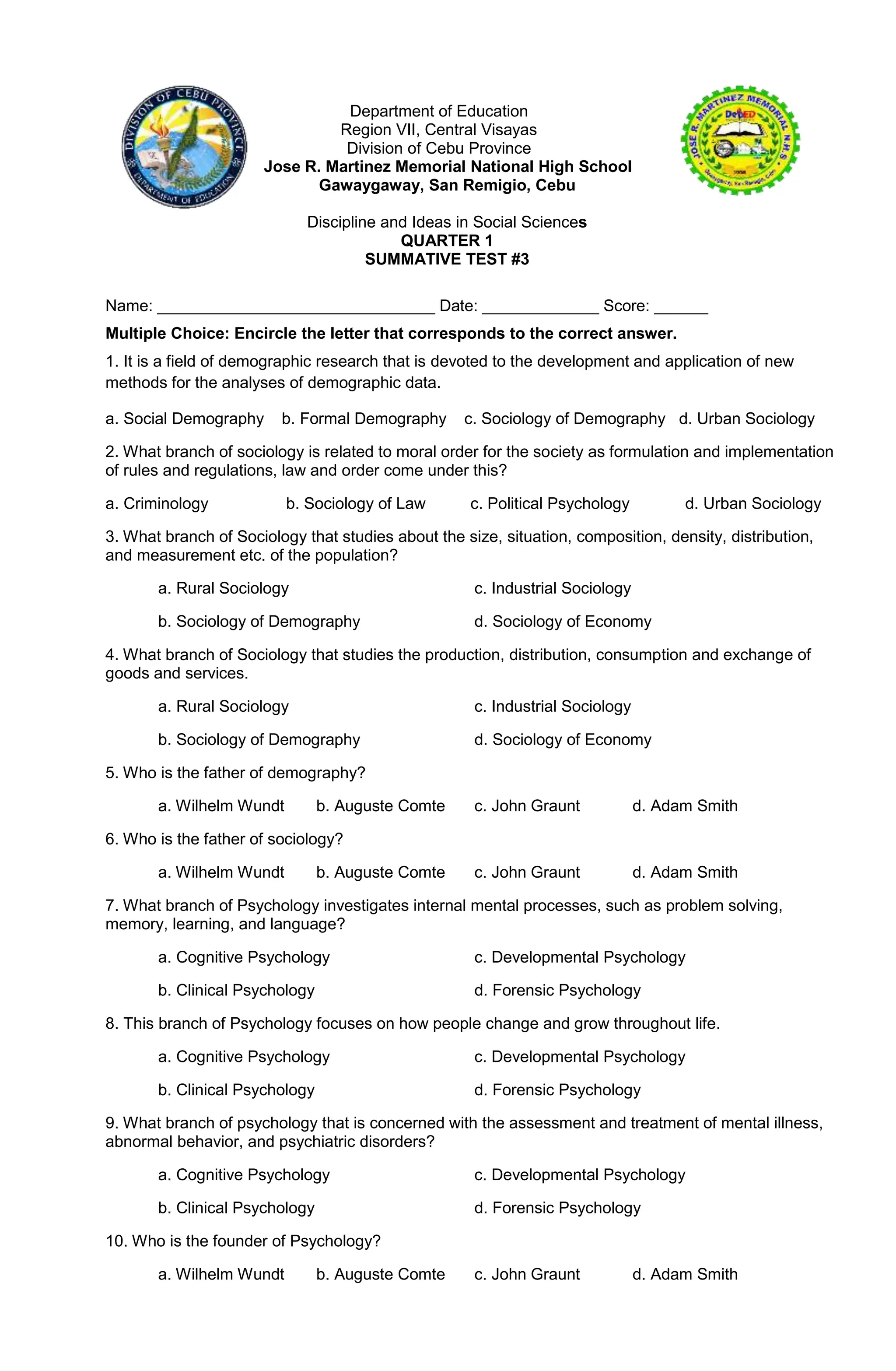
Department of Education
Region VII, Central Visayas
Division of Cebu Province
Jose R. Martinez Memorial National High School
Gawaygaway, San Remigio, Cebu
Discipline and Ideas in Social Sciences
QUARTER 1
SUMMATIVE TEST #3
Name: _______________________________ Date: _____________ Score: ______
Multiple Choice: Encircle the letter that corresponds to the correct answer.
1. It is a field of demographic research that is devoted to the development and application of new
methods for the analyses of demographic data.
a. Social Demography b. Formal Demography c. Sociology of Demography d. Urban Sociology
2. What branch of sociology is related to moral order for the society as formulation and implementation
of rules and regulations, law and order come under this?
a. Criminology b. Sociology of Law c. Political Psychology d. Urban Sociology
3. What branch of Sociology that studies about the size, situation, composition, density, distribution,
and measurement etc. of the population?
a. Rural Sociology c. Industrial Sociology
b. Sociology of Demography d. Sociology of Economy
4. What branch of Sociology that studies the production, distribution, consumption and exchange of
goods and services.
a. Rural Sociology c. Industrial Sociology
b. Sociology of Demography d. Sociology of Economy
5. Who is the father of demography?
a. Wilhelm Wundt b. Auguste Comte c. John Graunt d. Adam Smith
6. Who is the father of sociology?
a. Wilhelm Wundt b. Auguste Comte c. John Graunt d. Adam Smith
7. What branch of Psychology investigates internal mental processes, such as problem solving,
memory, learning, and language?
a. Cognitive Psychology c. Developmental Psychology
b. Clinical Psychology d. Forensic Psychology
8. This branch of Psychology focuses on how people change and grow throughout life.
a. Cognitive Psychology c. Developmental Psychology
b. Clinical Psychology d. Forensic Psychology
9. What branch of psychology that is concerned with the assessment and treatment of mental illness,
abnormal behavior, and psychiatric disorders?
a. Cognitive Psychology c. Developmental Psychology
b. Clinical Psychology d. Forensic Psychology
10. Who is the founder of Psychology?
a. Wilhelm Wundt b. Auguste Comte c. John Graunt d. Adam Smith
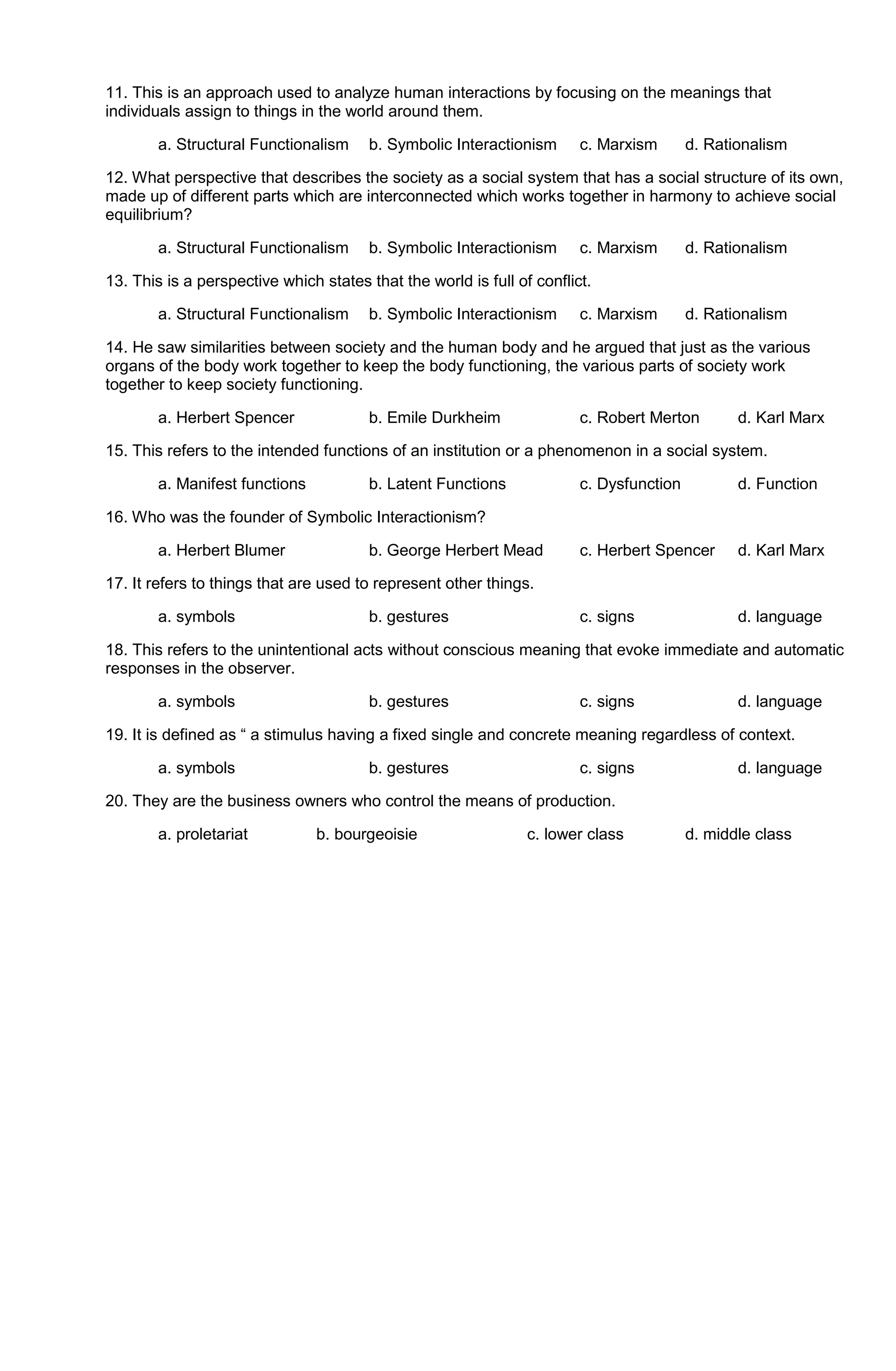
11. This is an approach used to analyze human interactions by focusing on the meanings that
individuals assign to things in the world around them.
a. Structural Functionalism b. Symbolic Interactionism c. Marxism d. Rationalism
12. What perspective that describes the society as a social system that has a social structure of its own,
made up of different parts which are interconnected which works together in harmony to achieve social
equilibrium?
a. Structural Functionalism b. Symbolic Interactionism c. Marxism d. Rationalism
13. This is a perspective which states that the world is full of conflict.
a. Structural Functionalism b. Symbolic Interactionism c. Marxism d. Rationalism
14. He saw similarities between society and the human body and he argued that just as the various
organs of the body work together to keep the body functioning, the various parts of society work
together to keep society functioning.
a. Herbert Spencer b. Emile Durkheim c. Robert Merton d. Karl Marx
15. This refers to the intended functions of an institution or a phenomenon in a social system.
a. Manifest functions b. Latent Functions c. Dysfunction d. Function
16. Who was the founder of Symbolic Interactionism?
a. Herbert Blumer b. George Herbert Mead c. Herbert Spencer d. Karl Marx
17. It refers to things that are used to represent other things.
a. symbols b. gestures c. signs d. language
18. This refers to the unintentional acts without conscious meaning that evoke immediate and automatic
responses in the observer.
a. symbols b. gestures c. signs d. language
19. It is defined as “ a stimulus having a fixed single and concrete meaning regardless of context.
a. symbols b. gestures c. signs d. language
20. They are the business owners who control the means of production.
a. proletariat b. bourgeoisie c. lower class d. middle class

DISS Summative Test no. 3 Q1 for Printing...............docx

  • 1.
    Department of Education RegionVII, Central Visayas Division of Cebu Province Jose R. Martinez Memorial National High School Gawaygaway, San Remigio, Cebu Discipline and Ideas in Social Sciences QUARTER 1 SUMMATIVE TEST #3 Name: _______________________________ Date: _____________ Score: ______ Multiple Choice: Encircle the letter that corresponds to the correct answer. 1. It is a field of demographic research that is devoted to the development and application of new methods for the analyses of demographic data. a. Social Demography b. Formal Demography c. Sociology of Demography d. Urban Sociology 2. What branch of sociology is related to moral order for the society as formulation and implementation of rules and regulations, law and order come under this? a. Criminology b. Sociology of Law c. Political Psychology d. Urban Sociology 3. What branch of Sociology that studies about the size, situation, composition, density, distribution, and measurement etc. of the population? a. Rural Sociology c. Industrial Sociology b. Sociology of Demography d. Sociology of Economy 4. What branch of Sociology that studies the production, distribution, consumption and exchange of goods and services. a. Rural Sociology c. Industrial Sociology b. Sociology of Demography d. Sociology of Economy 5. Who is the father of demography? a. Wilhelm Wundt b. Auguste Comte c. John Graunt d. Adam Smith 6. Who is the father of sociology? a. Wilhelm Wundt b. Auguste Comte c. John Graunt d. Adam Smith 7. What branch of Psychology investigates internal mental processes, such as problem solving, memory, learning, and language? a. Cognitive Psychology c. Developmental Psychology b. Clinical Psychology d. Forensic Psychology 8. This branch of Psychology focuses on how people change and grow throughout life. a. Cognitive Psychology c. Developmental Psychology b. Clinical Psychology d. Forensic Psychology 9. What branch of psychology that is concerned with the assessment and treatment of mental illness, abnormal behavior, and psychiatric disorders? a. Cognitive Psychology c. Developmental Psychology b. Clinical Psychology d. Forensic Psychology 10. Who is the founder of Psychology? a. Wilhelm Wundt b. Auguste Comte c. John Graunt d. Adam Smith
  • 2.
    11. This isan approach used to analyze human interactions by focusing on the meanings that individuals assign to things in the world around them. a. Structural Functionalism b. Symbolic Interactionism c. Marxism d. Rationalism 12. What perspective that describes the society as a social system that has a social structure of its own, made up of different parts which are interconnected which works together in harmony to achieve social equilibrium? a. Structural Functionalism b. Symbolic Interactionism c. Marxism d. Rationalism 13. This is a perspective which states that the world is full of conflict. a. Structural Functionalism b. Symbolic Interactionism c. Marxism d. Rationalism 14. He saw similarities between society and the human body and he argued that just as the various organs of the body work together to keep the body functioning, the various parts of society work together to keep society functioning. a. Herbert Spencer b. Emile Durkheim c. Robert Merton d. Karl Marx 15. This refers to the intended functions of an institution or a phenomenon in a social system. a. Manifest functions b. Latent Functions c. Dysfunction d. Function 16. Who was the founder of Symbolic Interactionism? a. Herbert Blumer b. George Herbert Mead c. Herbert Spencer d. Karl Marx 17. It refers to things that are used to represent other things. a. symbols b. gestures c. signs d. language 18. This refers to the unintentional acts without conscious meaning that evoke immediate and automatic responses in the observer. a. symbols b. gestures c. signs d. language 19. It is defined as “ a stimulus having a fixed single and concrete meaning regardless of context. a. symbols b. gestures c. signs d. language 20. They are the business owners who control the means of production. a. proletariat b. bourgeoisie c. lower class d. middle class