Introduction to Psychology, 7th Edition, Rod Plotnik 
Module 1: Discovering Psychology 
Module 1 
Discovering Psychology
Introduction to Psychology, 7th Edition, Rod Plotnik 
Module 1: Discovering Psychology 
DEFINITION OF PSYCHOLOGY 
• What do psychologists study? 
– Psychology 
– the systematic, scientific study of behaviors and 
mental processes 
– Behaviors 
– refers to observable actions or responses in both 
humans and animals 
– Mental processes 
– not directly observable, refer to a wide range of 
complex mental processes, such as thinking, 
imagining, studying, and dreaming
Introduction to Psychology, 7th Edition, Rod Plotnik 
Module 1: Discovering Psychology 
GOALS OF PSYCHOLOGY 
– Describe 
– Explain 
– Predict 
– Control
Introduction to Psychology, 7th Edition, Rod Plotnik 
Module 1: Discovering Psychology 
GOALS OF PSYCHOLOGY 
• Describe 
– first goal of psychology is to describe the different 
ways that organisms behave 
• Explain 
– second goal of psychology is to explain the cause 
of behavior
Introduction to Psychology, 7th Edition, Rod Plotnik 
Module 1: Discovering Psychology 
GOALS OF PSYCHOLOGY (CONT.) 
• Predict 
– third goal of psychology is to predict how 
organisms will behave in certain situations 
• Control 
– the fourth goal of psychology is to control an 
organism’s behavior
Introduction to Psychology, 7th Edition, Rod Plotnik 
Module 1: Discovering Psychology 
MORE APPROACHES, MORE ANSWERS 
• How do psychologists answer questions? 
– Approaches to understanding behavior include: 
• Biological 
• Cognitive 
• Behavioral 
• Psychoanalytic 
• Humanistic 
• Cross cultural
Introduction to Psychology, 7th Edition, Rod Plotnik 
Module 1: Discovering Psychology 
MORE APPROACHES, MORE ANSWERS (CONT.) 
• Biological approach 
– focuses on how our genes, hormones, and 
nervous system interact with our environments to 
influence learning, personality, memory, 
motivation, emotions, and coping techniques
Introduction to Psychology, 7th Edition, Rod Plotnik 
Module 1: Discovering Psychology 
MORE APPROACHES, MORE ANSWERS (CONT.) 
• Cognitive approach 
– examines how we process, store, and use 
information and how this information influences, 
what we attend to, perceive, learn, remember, 
believe, and feel
Introduction to Psychology, 7th Edition, Rod Plotnik 
Module 1: Discovering Psychology 
MORE APPROACHES, MORE ANSWERS (CONT.) 
• Behavioral approach 
– studies how organisms learn new behaviors or 
modify existing ones, depending on whether 
events in their environments reward or punish 
these behaviors
Introduction to Psychology, 7th Edition, Rod Plotnik 
Module 1: Discovering Psychology 
MORE APPROACHES, MORE ANSWERS (CONT.) 
• Psychoanalytic approach 
– stresses the influence of unconscious fears, 
desires, and motivations on thoughts, behaviors, 
and the development of personality traits and 
psychological problems later in life
Introduction to Psychology, 7th Edition, Rod Plotnik 
Module 1: Discovering Psychology 
MORE APPROACHES, MORE ANSWERS (CONT.) 
• Humanistic approach 
– emphasizes that each individual has great 
freedom in directing his or her future, a large 
capacity for personal growth, a considerable 
amount of intrinsic worth, and enormous potential 
for self-fulfillment
Introduction to Psychology, 7th Edition, Rod Plotnik 
Module 1: Discovering Psychology 
MORE APPROACHES, MORE ANSWERS (CONT.) 
• Cross-cultural approach 
– examines the influence of cultural and ethnic 
similarities and differences on psychological and 
social functioning of a culture’s members
Introduction to Psychology, 7th Edition, Rod Plotnik 
Module 1: Discovering Psychology 
HISTORICAL APPROACHES 
• How did psychology begin? 
– Structuralism: Elements of the Mind 
– Functionalism: Functions of the Mind 
– Gestalt Approach: Sensations versus Perceptions 
– Behaviorism: Observable Behaviors
Introduction to Psychology, 7th Edition, Rod Plotnik 
Module 1: Discovering Psychology 
HISTORICAL APPROACHES 
• Structuralism 
– was the study of the most basic elements, 
primarily sensations and perceptions, that make 
up our conscious mental experiences 
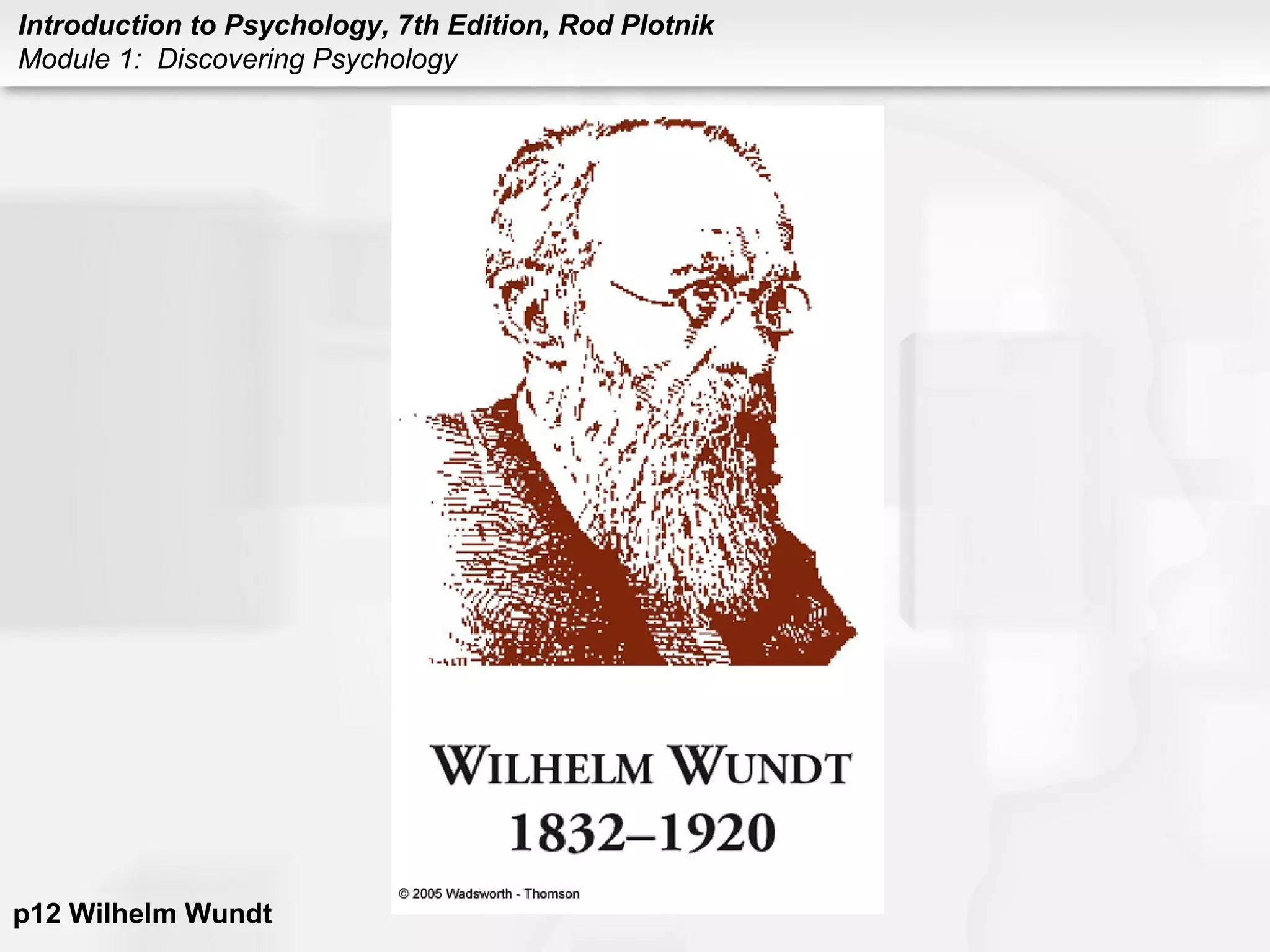
– Wilhelm Wundt
Introduction to Psychology, 7th Edition, Rod Plotnik 
Module 1: Discovering Psychology 
p12 Wilhelm Wundt
Introduction to Psychology, 7th Edition, Rod Plotnik 
Module 1: Discovering Psychology 
HISTORICAL APPROACHES 
• Functionalism 
– which was the study of the function rather than the 
structure of consciousness, was interested in how 
our minds adapt to our changing environment
Introduction to Psychology, 7th Edition, Rod Plotnik 
Module 1: Discovering Psychology 
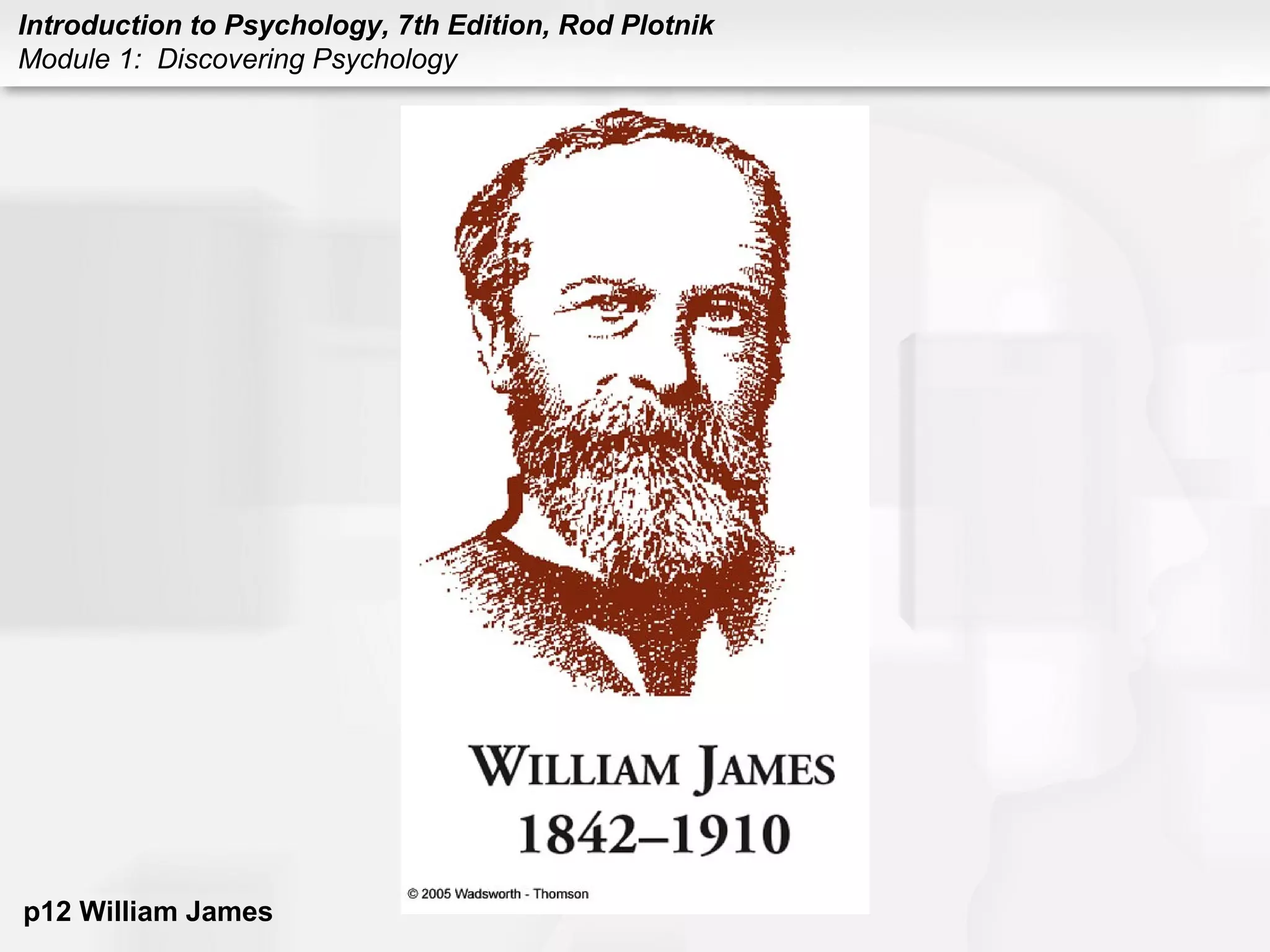
p12 William James
Introduction to Psychology, 7th Edition, Rod Plotnik 
Module 1: Discovering Psychology 
HISTORICAL APPROACHES 
• Gestalt Approach 
– emphasized that perception is more than the sum 
of its parts and studied how sensations are 
assembled into meaningful perceptual 
experiences
Introduction to Psychology, 7th Edition, Rod Plotnik 
Module 1: Discovering Psychology 
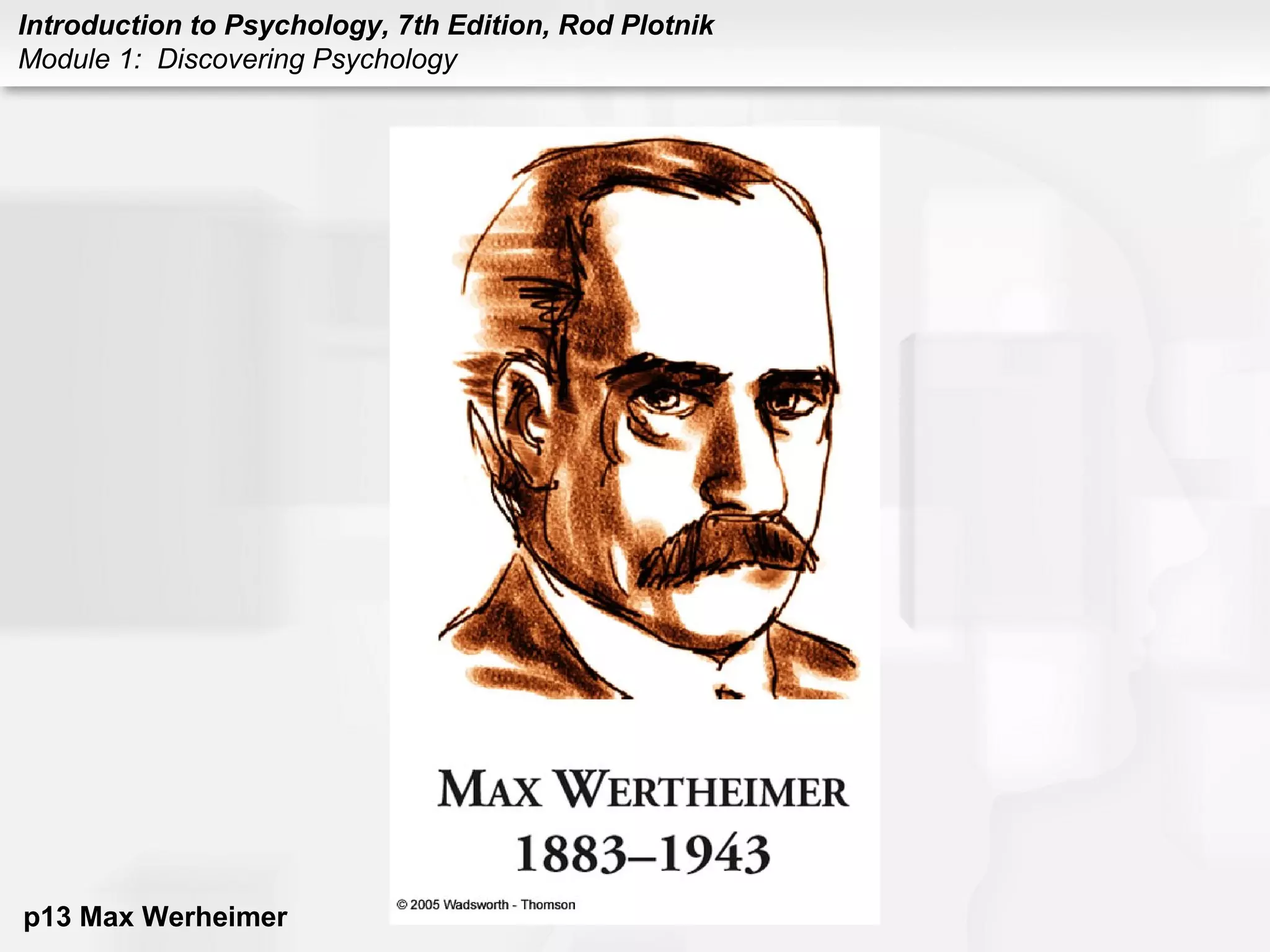
p13 Max Werheimer
Introduction to Psychology, 7th Edition, Rod Plotnik 
Module 1: Discovering Psychology 
HISTORICAL APPROACHES 
• Behaviorism 
– emphasized the objective, scientific analysis of 
observable behaviors
Introduction to Psychology, 7th Edition, Rod Plotnik 
Module 1: Discovering Psychology 
CULTURAL DIVERSITY: EARLY DISCRIMINATION 
• Women in psychology 
– Mary Calkins 
– established a laboratory in psychology at 
Wellesley College in 1891 where she was a faculty 
member 
– completed all requirements for a Ph.D at Harvard 
but was not granted the degree because of being 
a woman 
– not until 1908 that a woman, Margaret Washburn, 
was awarded a Ph.D in psychology
Introduction to Psychology, 7th Edition, Rod Plotnik 
Module 1: Discovering Psychology 
CULTURAL DIVERSITY: EARLY DISCRIMINATION 
(CONT.) 
• Minorities in Psychology 
– Ruth Howard was the first African American 
woman to receive a Ph.D in psychology 
– from the University of Minnesota in 1934. 
– was a successful clinical psychologist and school 
consultant
Introduction to Psychology, 7th Edition, Rod Plotnik 
Module 1: Discovering Psychology 
CULTURAL DIVERSITY: EARLY DISCRIMINATION 
(CONT.) 
• Minorities in Psychology 
– George Sanchez (an Hispanic) conducted 
pioneering work on the cultural bias of intelligence 
tests given to minority students 
– Sanchez showed that intelligence tests contained 
many questions that were biased against 
minorities 
– resulting in lower scores
Introduction to Psychology, 7th Edition, Rod Plotnik 
Module 1: Discovering Psychology 
CAREERS IN PSYCHOLOGY 
• Psychologist versus Psychiatrist 
– psychologists have completed four to five years of 
postgraduate education and have obtained a 
Ph.D., PsyD., or Ed.D in psychology 
– clinical psychologists have a Ph.D., PsyD., or 
Ed.D., have specialized in a clinical subarea, and 
have spent an additional year in a supervised 
therapy setting to gain experience in diagnosing 
and treating a wide range of abnormal behaviors
Introduction to Psychology, 7th Edition, Rod Plotnik 
Module 1: Discovering Psychology 
CAREERS IN PSYCHOLOGY 
• Psychologist versus Psychiatrist 
– counseling psychologists provide many of the 
same services as Clinical Psychologists, but 
usually work with different problems such as those 
involving marriage, family, or career counseling 
– psychiatrists are medical doctors (M.D.s) who 
have spent several years in clinical training, which 
includes diagnosing possible physical and 
neurological causes of abnormal behaviors and 
treating these behaviors, often with prescription 
drugs
Introduction to Psychology, 7th Edition, Rod Plotnik 
Module 1: Discovering Psychology 
CAREERS IN PSYCHOLOGY 
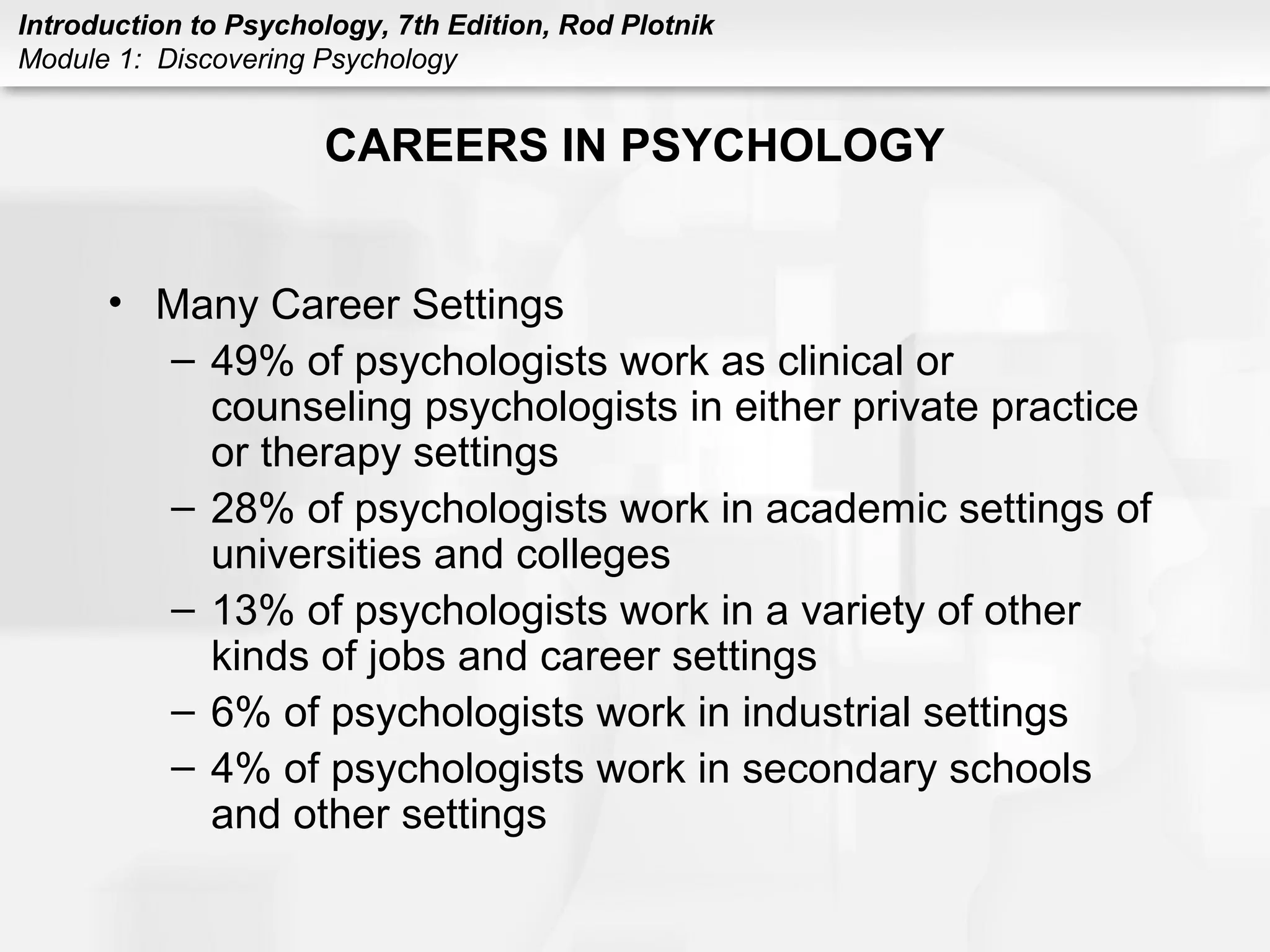
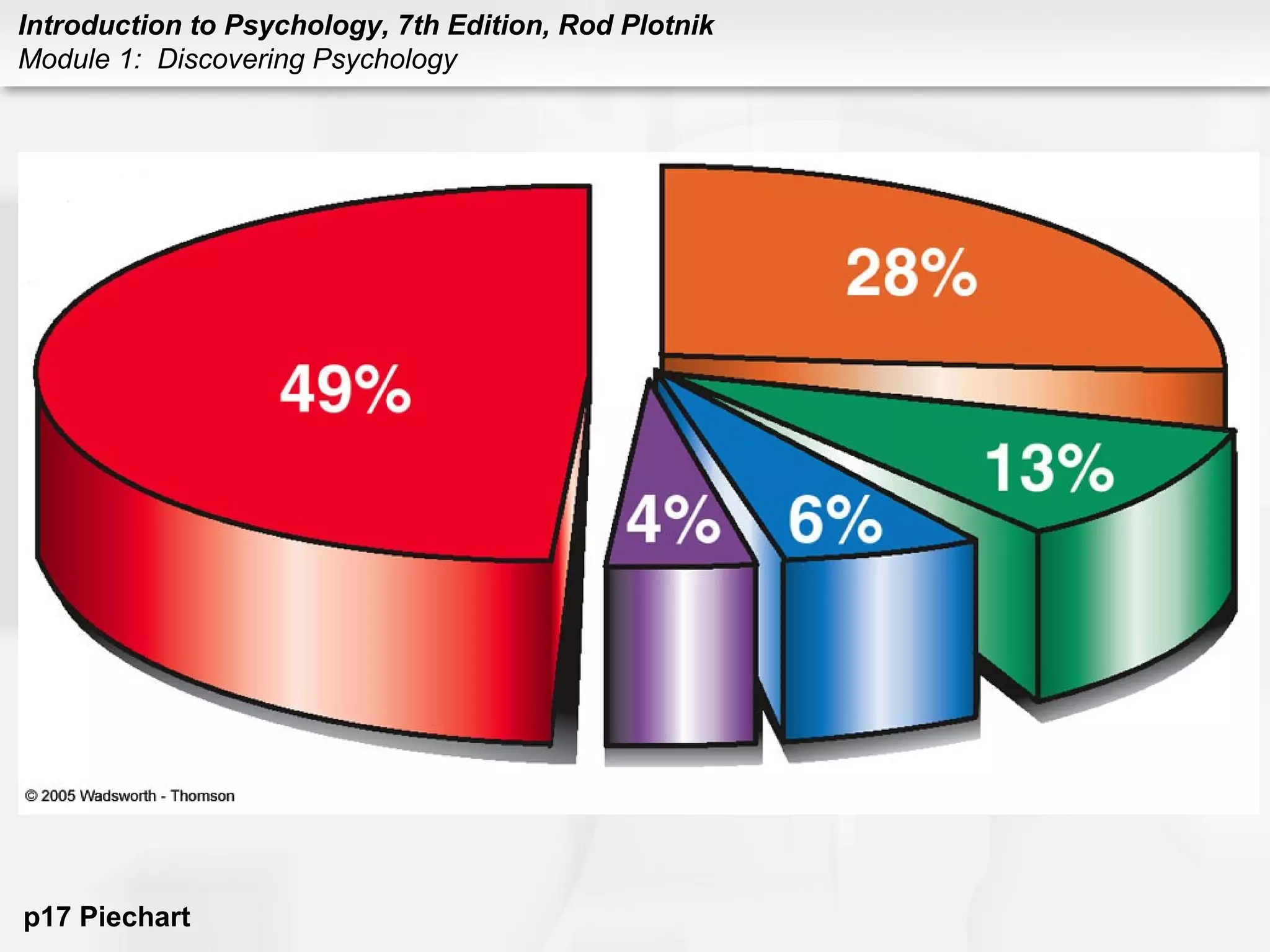
• Many Career Settings 
– 49% of psychologists work as clinical or 
counseling psychologists in either private practice 
or therapy settings 
– 28% of psychologists work in academic settings of 
universities and colleges 
– 13% of psychologists work in a variety of other 
kinds of jobs and career settings 
– 6% of psychologists work in industrial settings 
– 4% of psychologists work in secondary schools 
and other settings
Introduction to Psychology, 7th Edition, Rod Plotnik 
Module 1: Discovering Psychology 
p17 Piechart
Introduction to Psychology, 7th Edition, Rod Plotnik 
Module 1: Discovering Psychology 
RESEARCH AREAS 
• Areas of Specialization 
– Social and Personality 
– Developmental 
– Experimental 
– Biological 
– Cognitive 
– Psychometrics
Introduction to Psychology, 7th Edition, Rod Plotnik 
Module 1: Discovering Psychology 
RESEARCH AREAS (CONT.) 
• Areas of Specialization 
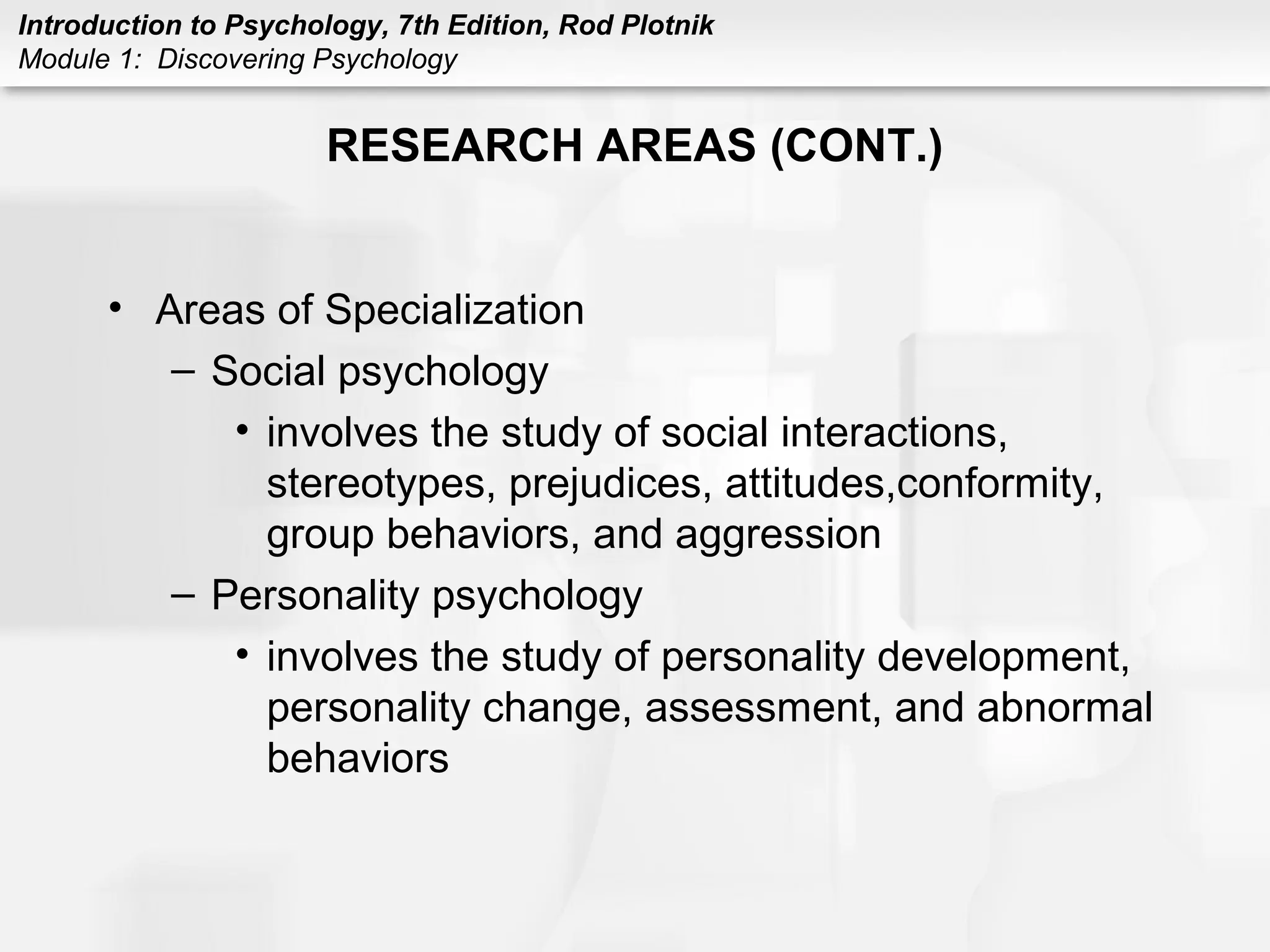
– Social psychology 
• involves the study of social interactions, 
stereotypes, prejudices, attitudes,conformity, 
group behaviors, and aggression 
– Personality psychology 
• involves the study of personality development, 
personality change, assessment, and abnormal 
behaviors
Introduction to Psychology, 7th Edition, Rod Plotnik 
Module 1: Discovering Psychology 
RESEARCH AREAS (CONT.) 
• Areas of Specialization 
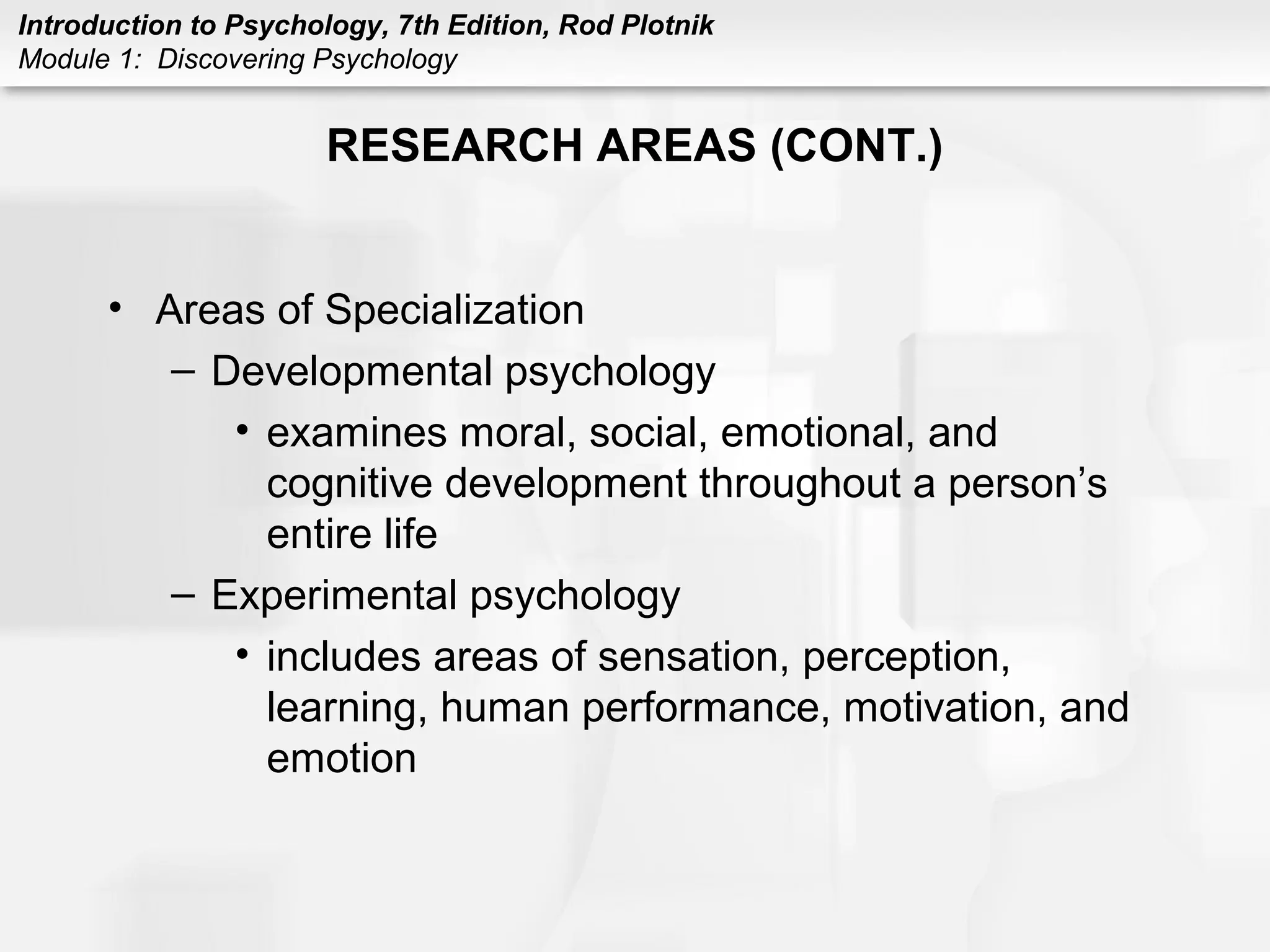
– Developmental psychology 
• examines moral, social, emotional, and 
cognitive development throughout a person’s 
entire life 
– Experimental psychology 
• includes areas of sensation, perception, 
learning, human performance, motivation, and 
emotion
Introduction to Psychology, 7th Edition, Rod Plotnik 
Module 1: Discovering Psychology 
RESEARCH AREAS (CONT.) 
• Areas of Specialization 
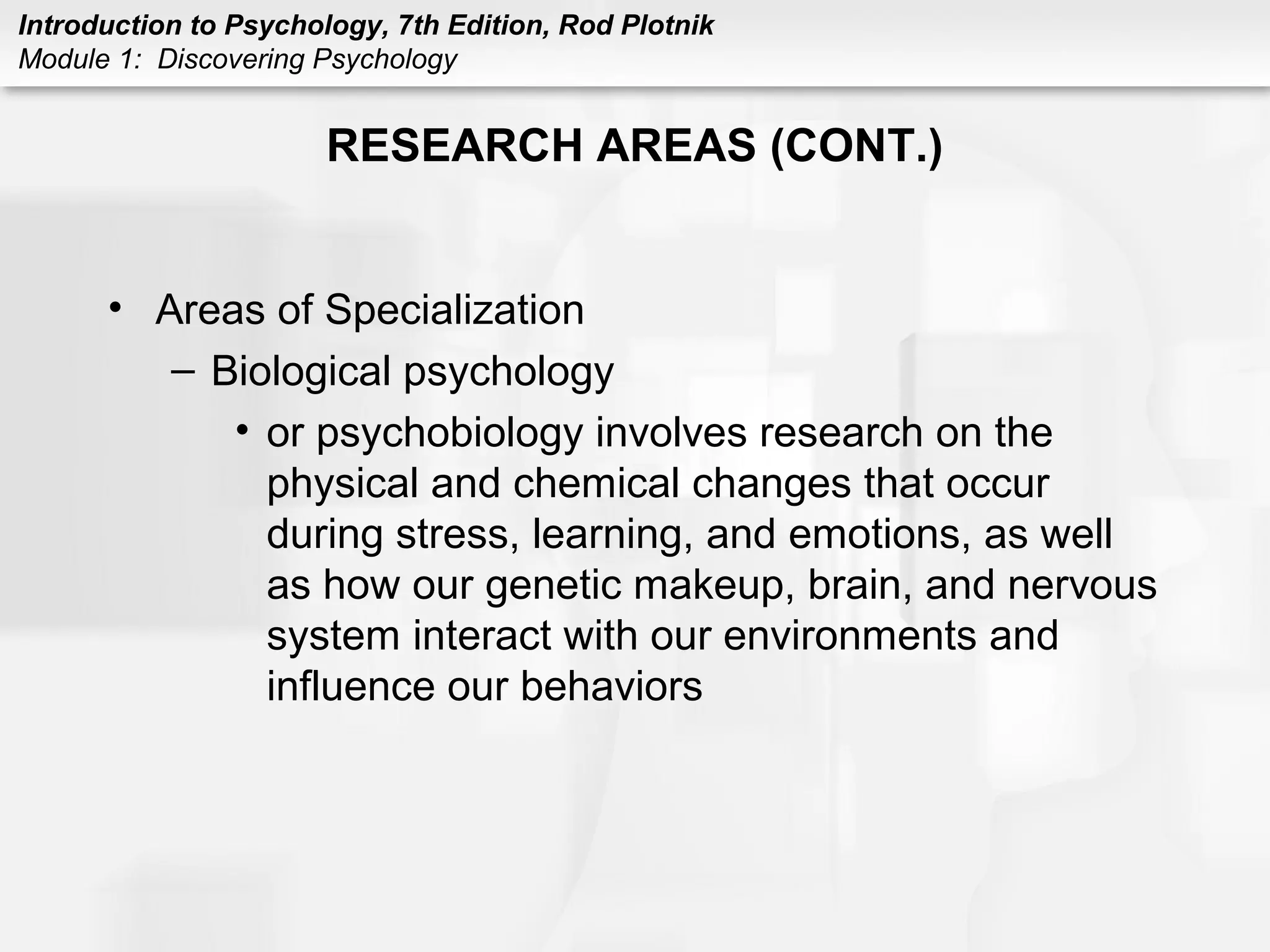
– Biological psychology 
• or psychobiology involves research on the 
physical and chemical changes that occur 
during stress, learning, and emotions, as well 
as how our genetic makeup, brain, and nervous 
system interact with our environments and 
influence our behaviors
Introduction to Psychology, 7th Edition, Rod Plotnik 
Module 1: Discovering Psychology 
RESEARCH AREAS (CONT.) 
• Areas of Specialization 
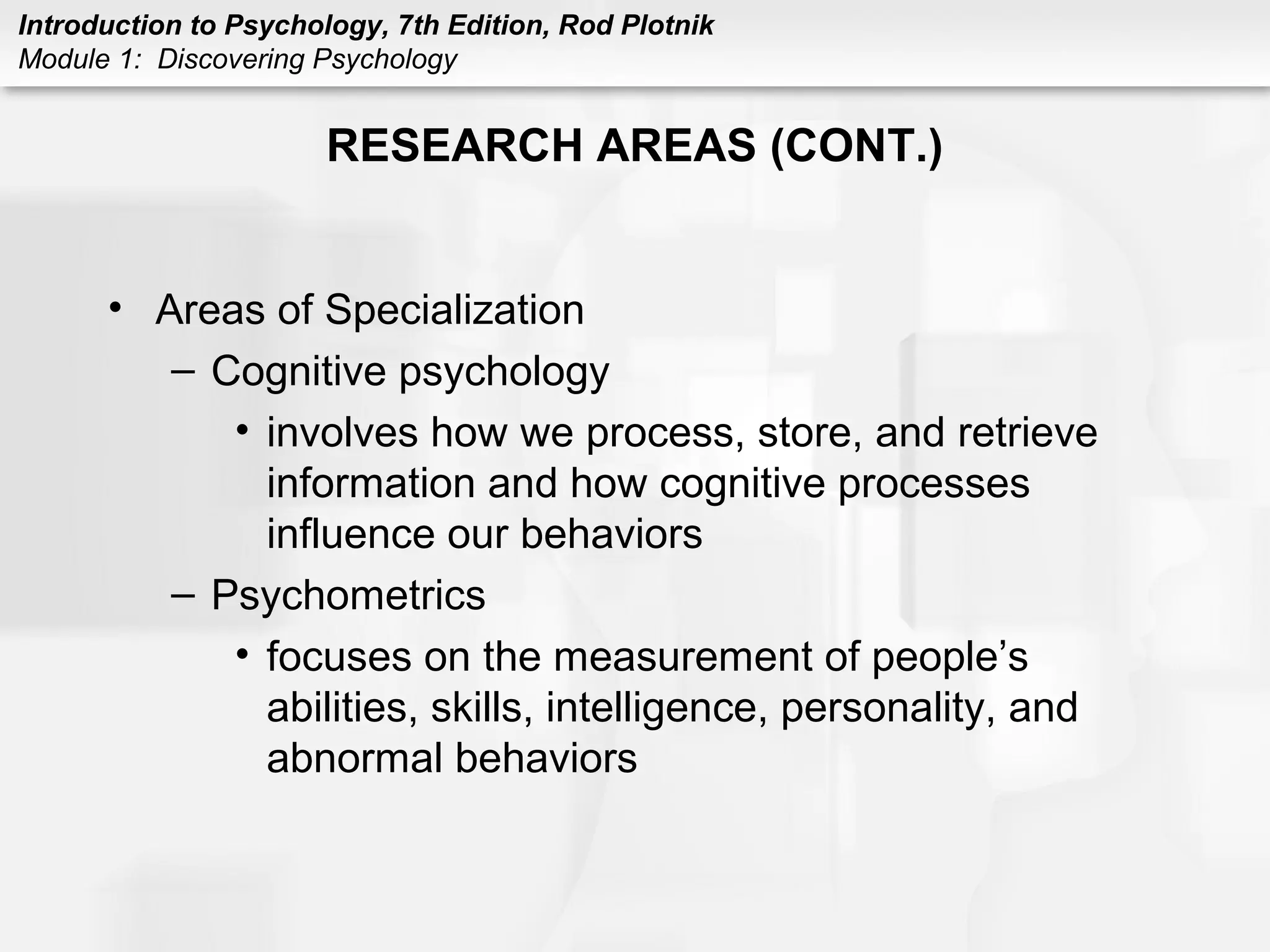
– Cognitive psychology 
• involves how we process, store, and retrieve 
information and how cognitive processes 
influence our behaviors 
– Psychometrics 
• focuses on the measurement of people’s 
abilities, skills, intelligence, personality, and 
abnormal behaviors

discovering psychology

  • 1.
    Introduction to Psychology,7th Edition, Rod Plotnik Module 1: Discovering Psychology Module 1 Discovering Psychology
  • 2.
    Introduction to Psychology,7th Edition, Rod Plotnik Module 1: Discovering Psychology DEFINITION OF PSYCHOLOGY • What do psychologists study? – Psychology – the systematic, scientific study of behaviors and mental processes – Behaviors – refers to observable actions or responses in both humans and animals – Mental processes – not directly observable, refer to a wide range of complex mental processes, such as thinking, imagining, studying, and dreaming
  • 3.
    Introduction to Psychology,7th Edition, Rod Plotnik Module 1: Discovering Psychology GOALS OF PSYCHOLOGY – Describe – Explain – Predict – Control
  • 4.
    Introduction to Psychology,7th Edition, Rod Plotnik Module 1: Discovering Psychology GOALS OF PSYCHOLOGY • Describe – first goal of psychology is to describe the different ways that organisms behave • Explain – second goal of psychology is to explain the cause of behavior
  • 5.
    Introduction to Psychology,7th Edition, Rod Plotnik Module 1: Discovering Psychology GOALS OF PSYCHOLOGY (CONT.) • Predict – third goal of psychology is to predict how organisms will behave in certain situations • Control – the fourth goal of psychology is to control an organism’s behavior
  • 6.
    Introduction to Psychology,7th Edition, Rod Plotnik Module 1: Discovering Psychology MORE APPROACHES, MORE ANSWERS • How do psychologists answer questions? – Approaches to understanding behavior include: • Biological • Cognitive • Behavioral • Psychoanalytic • Humanistic • Cross cultural
  • 7.
    Introduction to Psychology,7th Edition, Rod Plotnik Module 1: Discovering Psychology MORE APPROACHES, MORE ANSWERS (CONT.) • Biological approach – focuses on how our genes, hormones, and nervous system interact with our environments to influence learning, personality, memory, motivation, emotions, and coping techniques
  • 8.
    Introduction to Psychology,7th Edition, Rod Plotnik Module 1: Discovering Psychology MORE APPROACHES, MORE ANSWERS (CONT.) • Cognitive approach – examines how we process, store, and use information and how this information influences, what we attend to, perceive, learn, remember, believe, and feel
  • 9.
    Introduction to Psychology,7th Edition, Rod Plotnik Module 1: Discovering Psychology MORE APPROACHES, MORE ANSWERS (CONT.) • Behavioral approach – studies how organisms learn new behaviors or modify existing ones, depending on whether events in their environments reward or punish these behaviors
  • 10.
    Introduction to Psychology,7th Edition, Rod Plotnik Module 1: Discovering Psychology MORE APPROACHES, MORE ANSWERS (CONT.) • Psychoanalytic approach – stresses the influence of unconscious fears, desires, and motivations on thoughts, behaviors, and the development of personality traits and psychological problems later in life
  • 11.
    Introduction to Psychology,7th Edition, Rod Plotnik Module 1: Discovering Psychology MORE APPROACHES, MORE ANSWERS (CONT.) • Humanistic approach – emphasizes that each individual has great freedom in directing his or her future, a large capacity for personal growth, a considerable amount of intrinsic worth, and enormous potential for self-fulfillment
  • 12.
    Introduction to Psychology,7th Edition, Rod Plotnik Module 1: Discovering Psychology MORE APPROACHES, MORE ANSWERS (CONT.) • Cross-cultural approach – examines the influence of cultural and ethnic similarities and differences on psychological and social functioning of a culture’s members
  • 13.
    Introduction to Psychology,7th Edition, Rod Plotnik Module 1: Discovering Psychology HISTORICAL APPROACHES • How did psychology begin? – Structuralism: Elements of the Mind – Functionalism: Functions of the Mind – Gestalt Approach: Sensations versus Perceptions – Behaviorism: Observable Behaviors
  • 14.
    Introduction to Psychology,7th Edition, Rod Plotnik Module 1: Discovering Psychology HISTORICAL APPROACHES • Structuralism – was the study of the most basic elements, primarily sensations and perceptions, that make up our conscious mental experiences – Wilhelm Wundt
  • 15.
    Introduction to Psychology,7th Edition, Rod Plotnik Module 1: Discovering Psychology p12 Wilhelm Wundt
  • 16.
    Introduction to Psychology,7th Edition, Rod Plotnik Module 1: Discovering Psychology HISTORICAL APPROACHES • Functionalism – which was the study of the function rather than the structure of consciousness, was interested in how our minds adapt to our changing environment
  • 17.
    Introduction to Psychology,7th Edition, Rod Plotnik Module 1: Discovering Psychology p12 William James
  • 18.
    Introduction to Psychology,7th Edition, Rod Plotnik Module 1: Discovering Psychology HISTORICAL APPROACHES • Gestalt Approach – emphasized that perception is more than the sum of its parts and studied how sensations are assembled into meaningful perceptual experiences
  • 19.
    Introduction to Psychology,7th Edition, Rod Plotnik Module 1: Discovering Psychology p13 Max Werheimer
  • 20.
    Introduction to Psychology,7th Edition, Rod Plotnik Module 1: Discovering Psychology HISTORICAL APPROACHES • Behaviorism – emphasized the objective, scientific analysis of observable behaviors
  • 21.
    Introduction to Psychology,7th Edition, Rod Plotnik Module 1: Discovering Psychology CULTURAL DIVERSITY: EARLY DISCRIMINATION • Women in psychology – Mary Calkins – established a laboratory in psychology at Wellesley College in 1891 where she was a faculty member – completed all requirements for a Ph.D at Harvard but was not granted the degree because of being a woman – not until 1908 that a woman, Margaret Washburn, was awarded a Ph.D in psychology
  • 22.
    Introduction to Psychology,7th Edition, Rod Plotnik Module 1: Discovering Psychology CULTURAL DIVERSITY: EARLY DISCRIMINATION (CONT.) • Minorities in Psychology – Ruth Howard was the first African American woman to receive a Ph.D in psychology – from the University of Minnesota in 1934. – was a successful clinical psychologist and school consultant
  • 23.
    Introduction to Psychology,7th Edition, Rod Plotnik Module 1: Discovering Psychology CULTURAL DIVERSITY: EARLY DISCRIMINATION (CONT.) • Minorities in Psychology – George Sanchez (an Hispanic) conducted pioneering work on the cultural bias of intelligence tests given to minority students – Sanchez showed that intelligence tests contained many questions that were biased against minorities – resulting in lower scores
  • 24.
    Introduction to Psychology,7th Edition, Rod Plotnik Module 1: Discovering Psychology CAREERS IN PSYCHOLOGY • Psychologist versus Psychiatrist – psychologists have completed four to five years of postgraduate education and have obtained a Ph.D., PsyD., or Ed.D in psychology – clinical psychologists have a Ph.D., PsyD., or Ed.D., have specialized in a clinical subarea, and have spent an additional year in a supervised therapy setting to gain experience in diagnosing and treating a wide range of abnormal behaviors
  • 25.
    Introduction to Psychology,7th Edition, Rod Plotnik Module 1: Discovering Psychology CAREERS IN PSYCHOLOGY • Psychologist versus Psychiatrist – counseling psychologists provide many of the same services as Clinical Psychologists, but usually work with different problems such as those involving marriage, family, or career counseling – psychiatrists are medical doctors (M.D.s) who have spent several years in clinical training, which includes diagnosing possible physical and neurological causes of abnormal behaviors and treating these behaviors, often with prescription drugs
  • 26.
    Introduction to Psychology,7th Edition, Rod Plotnik Module 1: Discovering Psychology CAREERS IN PSYCHOLOGY • Many Career Settings – 49% of psychologists work as clinical or counseling psychologists in either private practice or therapy settings – 28% of psychologists work in academic settings of universities and colleges – 13% of psychologists work in a variety of other kinds of jobs and career settings – 6% of psychologists work in industrial settings – 4% of psychologists work in secondary schools and other settings
  • 27.
    Introduction to Psychology,7th Edition, Rod Plotnik Module 1: Discovering Psychology p17 Piechart
  • 28.
    Introduction to Psychology,7th Edition, Rod Plotnik Module 1: Discovering Psychology RESEARCH AREAS • Areas of Specialization – Social and Personality – Developmental – Experimental – Biological – Cognitive – Psychometrics
  • 29.
    Introduction to Psychology,7th Edition, Rod Plotnik Module 1: Discovering Psychology RESEARCH AREAS (CONT.) • Areas of Specialization – Social psychology • involves the study of social interactions, stereotypes, prejudices, attitudes,conformity, group behaviors, and aggression – Personality psychology • involves the study of personality development, personality change, assessment, and abnormal behaviors
  • 30.
    Introduction to Psychology,7th Edition, Rod Plotnik Module 1: Discovering Psychology RESEARCH AREAS (CONT.) • Areas of Specialization – Developmental psychology • examines moral, social, emotional, and cognitive development throughout a person’s entire life – Experimental psychology • includes areas of sensation, perception, learning, human performance, motivation, and emotion
  • 31.
    Introduction to Psychology,7th Edition, Rod Plotnik Module 1: Discovering Psychology RESEARCH AREAS (CONT.) • Areas of Specialization – Biological psychology • or psychobiology involves research on the physical and chemical changes that occur during stress, learning, and emotions, as well as how our genetic makeup, brain, and nervous system interact with our environments and influence our behaviors
  • 32.
    Introduction to Psychology,7th Edition, Rod Plotnik Module 1: Discovering Psychology RESEARCH AREAS (CONT.) • Areas of Specialization – Cognitive psychology • involves how we process, store, and retrieve information and how cognitive processes influence our behaviors – Psychometrics • focuses on the measurement of people’s abilities, skills, intelligence, personality, and abnormal behaviors