Blueprint Concepts Case Study -May 2012-

               How to navigate in corporate buildings: a review of directory boards In Sydney


     HOW TO NAVIGATE IN CORPORATE BUILDINGS: A
       REVIEW OF DIRECTORY BOARDS IN SYDNEY


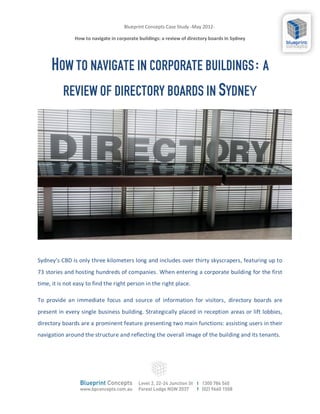
Sydney’s CBD is only three kilometers long and includes over thirty skyscrapers, featuring up to
73 stories and hosting hundreds of companies. When entering a corporate building for the first
time, it is not easy to find the right person in the right place.

To provide an immediate focus and source of information for visitors, directory boards are
present in every single business building. Strategically placed in reception areas or lift lobbies,
directory boards are a prominent feature presenting two main functions: assisting users in their
navigation around the structure and reflecting the overall image of the building and its tenants.
Blueprint Concepts Case Study -May 2012-

               How to navigate in corporate buildings: a review of directory boards In Sydney

When designing directory boards, the challenge is to ensure that they are in line with the
environment’s aesthetics, secured from vandalism, and allow for simple replacement of
individual tenant names while providing clear and legible information about the occupants of a
building. Directory boards can be manufactured using a variety of different shapes and
materials such as: acrylic, stainless steel, aluminum, illuminated panels and many others,
depending on their environment and image of the building.

There is an infinite number of options to choose from when it comes to developing directory
boards. This is why Blueprint Concepts decided to take a closer look at the decisions made by
building managers in Sydney’s CBD. What are the main challenges and current trends for this
type of corporate signage? What shapes, materials, and visual tactics did Sydney building
managers deploy to ensure their directory boards have
an immediate, positive impact on visitors?

To answer these questions we scrutinized directory
boards all over the city. (See map).

In order to complete this study we analysed among
other things, each board dimension, legibility, content,
location, materials, colours used, lighting systems and
use of LCD screens.
Blueprint Concepts Case Study -May 2012-

                How to navigate in corporate buildings: a review of directory boards In Sydney

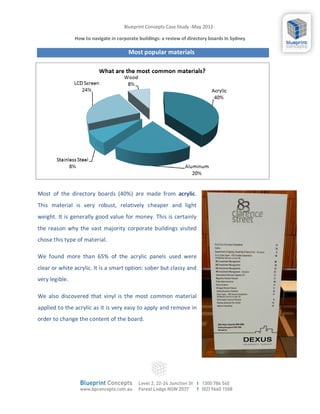
                                        Most popular materials


Most of the directory boards (40%) are made from acrylic.
This material is very robust, relatively cheaper and light
weight. It is generally good value for money. This is certainly
the reason why the vast majority corporate buildings visited
chose this type of material.

We found more than 65% of the acrylic panels used were
clear or white acrylic. It is a smart option: sober but classy and
very legible.

We also discovered that vinyl is the most common material
applied to the acrylic as it is very easy to apply and remove in
order to change the content of the board.
Blueprint Concepts Case Study -May 2012-

                 How to navigate in corporate buildings: a review of directory boards In Sydney


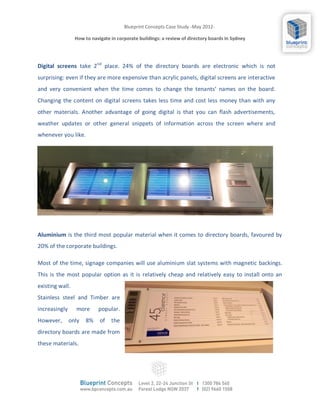
Digital screens take 2nd place. 24% of the directory boards are electronic which is not
surprising: even if they are more expensive than acrylic panels, digital screens are interactive
and very convenient when the time comes to change the tenants’ names on the board.
Changing the content on digital screens takes less time and cost less money than with any
other materials. Another advantage of going digital is that you can flash advertisements,
weather updates or other general snippets of information across the screen where and
whenever you like.


Aluminium is the third most popular material when it comes to directory boards, favoured by
20% of the corporate buildings.

Most of the time, signage companies will use aluminium slat systems with magnetic backings.
This is the most popular option as it is relatively cheap and relatively easy to install onto an
existing wall.
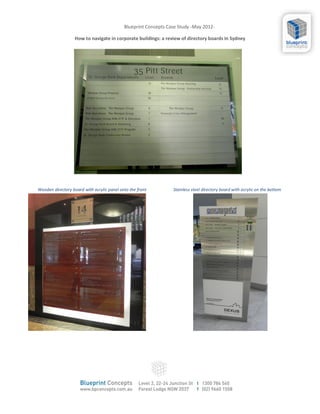
Stainless steel and Timber are
increasingly     more      popular.
However,       only   8%    of   the
directory boards are made from
these materials.
Blueprint Concepts Case Study -May 2012-

                   How to navigate in corporate buildings: a review of directory boards In Sydney


Wooden directory board with acrylic panel onto the front         Stainless steel directory board with acrylic on the bottom
Blueprint Concepts Case Study -May 2012-

              How to navigate in corporate buildings: a review of directory boards In Sydney

                                  Illuminated Directory boards


The vast majority of directory boards (79%) are traditional
directory boards, that is to say they are non-illuminated. This is
not surprising. Even if illuminated directory boards are more
eye-catching, it is not an essential but a premium option. Since
directory boards are located at the entrance of buildings, near
the lifts or at the reception, they are not hard to find so
illuminating the boards is not always a necessity.

Illuminated signs look more professional and make a great
impact on visitors when they first walk into a building but
require additional maintenance costs and their installation can
be more expensive because of the need to run power to the
location.
Blueprint Concepts Case Study -May 2012-

              How to navigate in corporate buildings: a review of directory boards In Sydney

                                 Size and boards configuration

Directory boards can be either freestanding or mounted on a wall, with landscape or portrait
orientation.
Blueprint Concepts Case Study -May 2012-

               How to navigate in corporate buildings: a review of directory boards In Sydney

It seems that the most conventional and popular type of boards are portrait oriented and
mounted to the wall. However, we found some unusual boards, such as this 4-meter-long
slopping board:


The average size for freestanding boards is somewhere between 1.70 and 2 m high by 0.5 to 1m
wide. The tallest one was 3m high. Wall mounted signs are usually smaller, with an average size
of 1.40m high by 0.7m wide.

The majority of directory boards are composed of one directory board but some places have
decided to use a set of two similar boards (Please, see image below.). This is a good way to
improve legibility and to ensure that all the content of the boards are at eye level.
Blueprint Concepts Case Study -May 2012-

               How to navigate in corporate buildings: a review of directory boards In Sydney


Set of two boards                                      Tallest directory board: 3meters high.


It seems that tall narrow directory boards are the most popular. However, this presents certain
challenges in terms of legibility because the information located at the very top or very bottom
of the board is not always easy to spot at first glance. Landscape oriented boards are more
reader-friendly but are surprisingly less popular (32%). This is probably due to the fact that they
take up more space, which can be an inconvenience in small lobby areas.
Blueprint Concepts Case Study -May 2012-

              How to navigate in corporate buildings: a review of directory boards In Sydney

                                        Colours and fonts


   -   Colours:


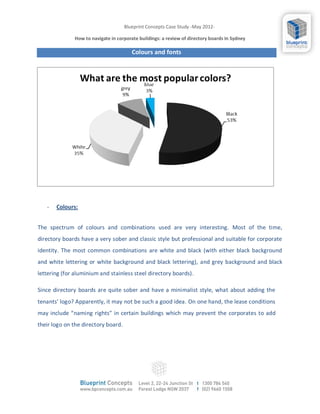
The spectrum of colours and combinations used are very interesting. Most of the time,
directory boards have a very sober and classic style but professional and suitable for corporate
identity. The most common combinations are white and black (with either black background
and white lettering or white background and black lettering), and grey background and black
lettering (for aluminium and stainless steel directory boards).

Since directory boards are quite sober and have a minimalist style, what about adding the
tenants’ logo? Apparently, it may not be such a good idea. On one hand, the lease conditions
may include “naming rights” in certain buildings which may prevent the corporates to add
their logo on the directory board.
Blueprint Concepts Case Study -May 2012-

               How to navigate in corporate buildings: a review of directory boards In Sydney

On the other hand, in terms of design, adding the logo may provide too much information,
which will harm the main purpose of a directory board: being informative and legible.
Including the tenant’s logo can be a good idea, (if we consider there is no “naming rights”
preventing the corporates to do so), but only if there is a few tenants or if the directory
board’s size allows it .The following photos properly illustrate this statement:


   -   Font size

The size of the font is usually small or medium, which is
understandable. The number of tenants in a corporate building can
range from just a few tenants to more than 80.

Therefore, adding the tenants’ logo, as well as the name and the
level where they are located would take up too much space and
would require an oversized directory board, which may not be
feasible from an architectural point of view .
Blueprint Concepts Case Study -May 2012-

              How to navigate in corporate buildings: a review of directory boards In Sydney

                                            CONCLUSION


Most directory boards in Sydney’s CBD are very simple, feature few colours and standard
shapes. We were hoping to see a larger spectrum of colours and definitely more logos. Most
boards chose simplicity and legibility over originality. Acrylic and aluminium portrait boards are
the first choice for most buildings, whilst the popularity of digital screens is growing slowly.
The most professional and minimalistic looking boards seem to be the trendiest ones in Sydney,
with a few exceptions of course:


Blueprint Concepts can assist with the design, manufacture and installation of any type of
directory board throughout Australia. Please phone one of our consultants today on 1300 784
540 to discuss your options and requirements.

Directory boards

  • 1.
    Blueprint Concepts CaseStudy -May 2012- How to navigate in corporate buildings: a review of directory boards In Sydney HOW TO NAVIGATE IN CORPORATE BUILDINGS: A REVIEW OF DIRECTORY BOARDS IN SYDNEY Sydney’s CBD is only three kilometers long and includes over thirty skyscrapers, featuring up to 73 stories and hosting hundreds of companies. When entering a corporate building for the first time, it is not easy to find the right person in the right place. To provide an immediate focus and source of information for visitors, directory boards are present in every single business building. Strategically placed in reception areas or lift lobbies, directory boards are a prominent feature presenting two main functions: assisting users in their navigation around the structure and reflecting the overall image of the building and its tenants.
  • 2.
    Blueprint Concepts CaseStudy -May 2012- How to navigate in corporate buildings: a review of directory boards In Sydney When designing directory boards, the challenge is to ensure that they are in line with the environment’s aesthetics, secured from vandalism, and allow for simple replacement of individual tenant names while providing clear and legible information about the occupants of a building. Directory boards can be manufactured using a variety of different shapes and materials such as: acrylic, stainless steel, aluminum, illuminated panels and many others, depending on their environment and image of the building. There is an infinite number of options to choose from when it comes to developing directory boards. This is why Blueprint Concepts decided to take a closer look at the decisions made by building managers in Sydney’s CBD. What are the main challenges and current trends for this type of corporate signage? What shapes, materials, and visual tactics did Sydney building managers deploy to ensure their directory boards have an immediate, positive impact on visitors? To answer these questions we scrutinized directory boards all over the city. (See map). In order to complete this study we analysed among other things, each board dimension, legibility, content, location, materials, colours used, lighting systems and use of LCD screens.
  • 3.
    Blueprint Concepts CaseStudy -May 2012- How to navigate in corporate buildings: a review of directory boards In Sydney Most popular materials Most of the directory boards (40%) are made from acrylic. This material is very robust, relatively cheaper and light weight. It is generally good value for money. This is certainly the reason why the vast majority corporate buildings visited chose this type of material. We found more than 65% of the acrylic panels used were clear or white acrylic. It is a smart option: sober but classy and very legible. We also discovered that vinyl is the most common material applied to the acrylic as it is very easy to apply and remove in order to change the content of the board.
  • 4.
    Blueprint Concepts CaseStudy -May 2012- How to navigate in corporate buildings: a review of directory boards In Sydney Digital screens take 2nd place. 24% of the directory boards are electronic which is not surprising: even if they are more expensive than acrylic panels, digital screens are interactive and very convenient when the time comes to change the tenants’ names on the board. Changing the content on digital screens takes less time and cost less money than with any other materials. Another advantage of going digital is that you can flash advertisements, weather updates or other general snippets of information across the screen where and whenever you like. Aluminium is the third most popular material when it comes to directory boards, favoured by 20% of the corporate buildings. Most of the time, signage companies will use aluminium slat systems with magnetic backings. This is the most popular option as it is relatively cheap and relatively easy to install onto an existing wall. Stainless steel and Timber are increasingly more popular. However, only 8% of the directory boards are made from these materials.
  • 5.
    Blueprint Concepts CaseStudy -May 2012- How to navigate in corporate buildings: a review of directory boards In Sydney Wooden directory board with acrylic panel onto the front Stainless steel directory board with acrylic on the bottom
  • 6.
    Blueprint Concepts CaseStudy -May 2012- How to navigate in corporate buildings: a review of directory boards In Sydney Illuminated Directory boards The vast majority of directory boards (79%) are traditional directory boards, that is to say they are non-illuminated. This is not surprising. Even if illuminated directory boards are more eye-catching, it is not an essential but a premium option. Since directory boards are located at the entrance of buildings, near the lifts or at the reception, they are not hard to find so illuminating the boards is not always a necessity. Illuminated signs look more professional and make a great impact on visitors when they first walk into a building but require additional maintenance costs and their installation can be more expensive because of the need to run power to the location.
  • 7.
    Blueprint Concepts CaseStudy -May 2012- How to navigate in corporate buildings: a review of directory boards In Sydney Size and boards configuration Directory boards can be either freestanding or mounted on a wall, with landscape or portrait orientation.
  • 8.
    Blueprint Concepts CaseStudy -May 2012- How to navigate in corporate buildings: a review of directory boards In Sydney It seems that the most conventional and popular type of boards are portrait oriented and mounted to the wall. However, we found some unusual boards, such as this 4-meter-long slopping board: The average size for freestanding boards is somewhere between 1.70 and 2 m high by 0.5 to 1m wide. The tallest one was 3m high. Wall mounted signs are usually smaller, with an average size of 1.40m high by 0.7m wide. The majority of directory boards are composed of one directory board but some places have decided to use a set of two similar boards (Please, see image below.). This is a good way to improve legibility and to ensure that all the content of the boards are at eye level.
  • 9.
    Blueprint Concepts CaseStudy -May 2012- How to navigate in corporate buildings: a review of directory boards In Sydney Set of two boards Tallest directory board: 3meters high. It seems that tall narrow directory boards are the most popular. However, this presents certain challenges in terms of legibility because the information located at the very top or very bottom of the board is not always easy to spot at first glance. Landscape oriented boards are more reader-friendly but are surprisingly less popular (32%). This is probably due to the fact that they take up more space, which can be an inconvenience in small lobby areas.
  • 10.
    Blueprint Concepts CaseStudy -May 2012- How to navigate in corporate buildings: a review of directory boards In Sydney Colours and fonts - Colours: The spectrum of colours and combinations used are very interesting. Most of the time, directory boards have a very sober and classic style but professional and suitable for corporate identity. The most common combinations are white and black (with either black background and white lettering or white background and black lettering), and grey background and black lettering (for aluminium and stainless steel directory boards). Since directory boards are quite sober and have a minimalist style, what about adding the tenants’ logo? Apparently, it may not be such a good idea. On one hand, the lease conditions may include “naming rights” in certain buildings which may prevent the corporates to add their logo on the directory board.
  • 11.
    Blueprint Concepts CaseStudy -May 2012- How to navigate in corporate buildings: a review of directory boards In Sydney On the other hand, in terms of design, adding the logo may provide too much information, which will harm the main purpose of a directory board: being informative and legible. Including the tenant’s logo can be a good idea, (if we consider there is no “naming rights” preventing the corporates to do so), but only if there is a few tenants or if the directory board’s size allows it .The following photos properly illustrate this statement: - Font size The size of the font is usually small or medium, which is understandable. The number of tenants in a corporate building can range from just a few tenants to more than 80. Therefore, adding the tenants’ logo, as well as the name and the level where they are located would take up too much space and would require an oversized directory board, which may not be feasible from an architectural point of view .
  • 12.
    Blueprint Concepts CaseStudy -May 2012- How to navigate in corporate buildings: a review of directory boards In Sydney CONCLUSION Most directory boards in Sydney’s CBD are very simple, feature few colours and standard shapes. We were hoping to see a larger spectrum of colours and definitely more logos. Most boards chose simplicity and legibility over originality. Acrylic and aluminium portrait boards are the first choice for most buildings, whilst the popularity of digital screens is growing slowly. The most professional and minimalistic looking boards seem to be the trendiest ones in Sydney, with a few exceptions of course: Blueprint Concepts can assist with the design, manufacture and installation of any type of directory board throughout Australia. Please phone one of our consultants today on 1300 784 540 to discuss your options and requirements.