Direct Method
The Direct Method has one
very basic rule: No
translation is allowed.
Direct Method (Berlitz method)
receives its name from the fact
that meaning is to be connected
directly with the target language,
without going through the
process of translating into the
students' native language.
Principles of the Direct
Method
 Reading in the target language should be taught
from the beginning of language instruction;
however, the reading skill will be developed
through practice with speaking.
 Objects or pictures present in the immediate
classroom environment should be used to help
students understand the meaning.
 The native language should not be used in the
classroom.
 The teacher should demonstrate, not explain or
translate. It is desirable that students make a direct
association between the target language and
meaning.
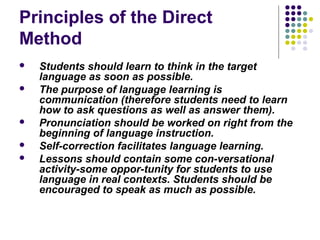
Principles of the Direct
Method
 Students should learn to think in the target
language as soon as possible.
 The purpose of language learning is
communication (therefore students need to learn
how to ask questions as well as answer them).
 Pronunciation should be worked on right from the
beginning of language instruction.
 Self-correction facilitates language learning.
 Lessons should contain some con-versational
activity-some oppor-tunity for students to use
language in real contexts. Students should be
encouraged to speak as much as possible.
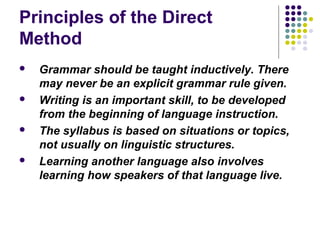
Principles of the Direct
Method
 Grammar should be taught inductively. There
may never be an explicit grammar rule given.
 Writing is an important skill, to be developed
from the beginning of language instruction.
 The syllabus is based on situations or topics,
not usually on linguistic structures.
 Learning another language also involves
learning how speakers of that language live.
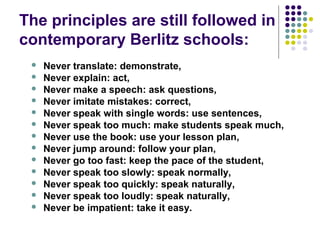
The principles are still followed in
contemporary Berlitz schools:
 Never translate: demonstrate,
 Never explain: act,
 Never make a speech: ask questions,
 Never imitate mistakes: correct,
 Never speak with single words: use sentences,
 Never speak too much: make students speak much,
 Never use the book: use your lesson plan,
 Never jump around: follow your plan,
 Never go too fast: keep the pace of the student,
 Never speak too slowly: speak normally,
 Never speak too quickly: speak naturally,
 Never speak too loudly: speak naturally,
 Never be impatient: take it easy.
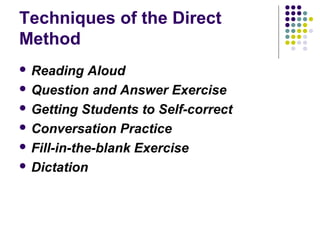
Techniques of the Direct
Method
 Reading Aloud
 Question and Answer Exercise
 Getting Students to Self-correct
 Conversation Practice
 Fill-in-the-blank Exercise
 Dictation
Drawbacks:
 First, it required teachers who were native speakers
or who had native-like fluency in the foreign
language.
 It was largely dependent on the teacher's skill, rather
than on a textbook, and not all teachers were
proficient enough in the foreign language to adhere
to the principles of the method.
 Critics pointed out that strict adherence to Direct
Method principles was often counterproductive,
since teachers were required to go to great lengths
to avoid using the native tongue, when sometimes a
simple brief explanation in the students native
tongue would have been a. more efficient route to
comprehension.

Direct method

  • 1.
    Direct Method The DirectMethod has one very basic rule: No translation is allowed.
  • 2.
    Direct Method (Berlitzmethod) receives its name from the fact that meaning is to be connected directly with the target language, without going through the process of translating into the students' native language.
  • 3.
    Principles of theDirect Method  Reading in the target language should be taught from the beginning of language instruction; however, the reading skill will be developed through practice with speaking.  Objects or pictures present in the immediate classroom environment should be used to help students understand the meaning.  The native language should not be used in the classroom.  The teacher should demonstrate, not explain or translate. It is desirable that students make a direct association between the target language and meaning.
  • 4.
    Principles of theDirect Method  Students should learn to think in the target language as soon as possible.  The purpose of language learning is communication (therefore students need to learn how to ask questions as well as answer them).  Pronunciation should be worked on right from the beginning of language instruction.  Self-correction facilitates language learning.  Lessons should contain some con-versational activity-some oppor-tunity for students to use language in real contexts. Students should be encouraged to speak as much as possible.
  • 5.
    Principles of theDirect Method  Grammar should be taught inductively. There may never be an explicit grammar rule given.  Writing is an important skill, to be developed from the beginning of language instruction.  The syllabus is based on situations or topics, not usually on linguistic structures.  Learning another language also involves learning how speakers of that language live.
  • 6.
    The principles arestill followed in contemporary Berlitz schools:  Never translate: demonstrate,  Never explain: act,  Never make a speech: ask questions,  Never imitate mistakes: correct,  Never speak with single words: use sentences,  Never speak too much: make students speak much,  Never use the book: use your lesson plan,  Never jump around: follow your plan,  Never go too fast: keep the pace of the student,  Never speak too slowly: speak normally,  Never speak too quickly: speak naturally,  Never speak too loudly: speak naturally,  Never be impatient: take it easy.
  • 7.
    Techniques of theDirect Method  Reading Aloud  Question and Answer Exercise  Getting Students to Self-correct  Conversation Practice  Fill-in-the-blank Exercise  Dictation
  • 8.
    Drawbacks:  First, itrequired teachers who were native speakers or who had native-like fluency in the foreign language.  It was largely dependent on the teacher's skill, rather than on a textbook, and not all teachers were proficient enough in the foreign language to adhere to the principles of the method.  Critics pointed out that strict adherence to Direct Method principles was often counterproductive, since teachers were required to go to great lengths to avoid using the native tongue, when sometimes a simple brief explanation in the students native tongue would have been a. more efficient route to comprehension.