Diphtheria.Pertussis.Tetanus
Diphtheria
 Caused by Corynebacterium
diphtheriae
 An aerobic gram-positive bacillus
 Man-to-man transmission
 Incubation period- 2-5 days
 Primarily a disease of children
 75% children immune by 10 years
 Involves respiratory mucous membrane
Clinical manifestation
 Tonsillopharyngeal, laryngeal, nasal &
tracheobronchial involvement
 s/s- fever with systemic toxicity, sore throat,
dysphagia, hoarseness, rhinorrhea, cough, Cxal LNE
 Characteristic pseudomembrane over tonsils, that
bleeds on attempt to remove
 Complication- local or toxin mediated
ļ‚§ Respiratory obstruction
ļ‚§ Myocarditis- arrythmias &/or heart failure
ļ‚§ Polyneuritis- IX/X Cr. n., proximaldistal weakness, distal paresthesias
ļ‚§ Pneumonia
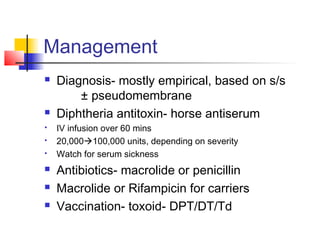
Management
 Diagnosis- mostly empirical, based on s/s
± pseudomembrane
 Diphtheria antitoxin- horse antiserum
ļ‚§ IV infusion over 60 mins
ļ‚§ 20,000100,000 units, depending on severity
ļ‚§ Watch for serum sickness
 Antibiotics- macrolide or penicillin
 Macrolide or Rifampicin for carriers
 Vaccination- toxoid- DPT/DT/Td
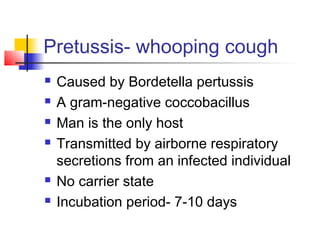
Pretussis- whooping cough
 Caused by Bordetella pertussis
 A gram-negative coccobacillus
 Man is the only host
 Transmitted by airborne respiratory
secretions from an infected individual
 No carrier state
 Incubation period- 7-10 days
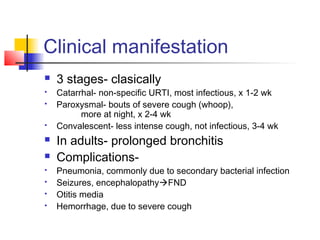
Clinical manifestation
 3 stages- clasically
ļ‚§ Catarrhal- non-specific URTI, most infectious, x 1-2 wk
ļ‚§ Paroxysmal- bouts of severe cough (whoop),
more at night, x 2-4 wk
ļ‚§ Convalescent- less intense cough, not infectious, 3-4 wk
 In adults- prolonged bronchitis
 Complications-
ļ‚§ Pneumonia, commonly due to secondary bacterial infection
ļ‚§ Seizures, encephalopathyFND
ļ‚§ Otitis media
ļ‚§ Hemorrhage, due to severe cough
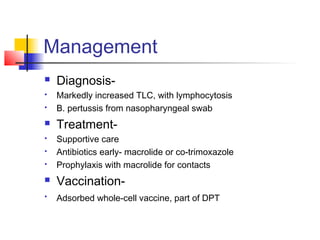
Management
 Diagnosis-
ļ‚§ Markedly increased TLC, with lymphocytosis
ļ‚§ B. pertussis from nasopharyngeal swab
 Treatment-
ļ‚§ Supportive care
ļ‚§ Antibiotics early- macrolide or co-trimoxazole
ļ‚§ Prophylaxis with macrolide for contacts
 Vaccination-
ļ‚§
Adsorbed whole-cell vaccine, part of DPT
Tetanus
 A neurologic disorder, characterised by
increased muscle tone & spasms
 Caused by tetanospasmin, a toxin produced
by Clostridium tetani
 C. tetani- a motile anaerobic gram-positive
bacillus with a terminal spore
 Sporadic disease, caused by contamination
of wound with spores, that germinate under
suitable conditions, to produce neurotoxin
 Infectionsymptom- ~7 days
Clinical manifestation
 Progressive skeletal muscle involvement
ļ‚§ Trismus, dysphagia
ļ‚§ Rigid abdomen, stiff proximal limb muscles (hands/feet- spared)
ļ‚§ Facial grimace
ļ‚§ Arched back- opisthotonus
 Paroxysmal painful generalized spasms
 Complications-
ļ‚§ Sympathetic overactivity
ļ‚§ Pneumonia
ļ‚§ Fractures
ļ‚§ Asphyxia
Management
 Diagnosis- clinical
 Treatment-
ļ‚§ Supportive care
ļ‚§ Wound care
ļ‚§ Antibiotic- Penicillin or Clindamycin
ļ‚§ Antitoxin- Tetanus immunoglobulin
ļ‚§ Diazepam & neuromuscular blockade with mech. vent.
 Course- 4-6 weeks, with complete recovery
 Prognosis- early disease with short course
has poor prognosis
 Vaccine- DPT in children & Td in adults

Diptheria.pertussis.tetanus

  • 1.
  • 2.
    Diphtheria  Caused byCorynebacterium diphtheriae  An aerobic gram-positive bacillus  Man-to-man transmission  Incubation period- 2-5 days  Primarily a disease of children  75% children immune by 10 years  Involves respiratory mucous membrane
  • 3.
    Clinical manifestation  Tonsillopharyngeal,laryngeal, nasal & tracheobronchial involvement  s/s- fever with systemic toxicity, sore throat, dysphagia, hoarseness, rhinorrhea, cough, Cxal LNE  Characteristic pseudomembrane over tonsils, that bleeds on attempt to remove  Complication- local or toxin mediated ļ‚§ Respiratory obstruction ļ‚§ Myocarditis- arrythmias &/or heart failure ļ‚§ Polyneuritis- IX/X Cr. n., proximaldistal weakness, distal paresthesias ļ‚§ Pneumonia
  • 4.
    Management  Diagnosis- mostlyempirical, based on s/s ± pseudomembrane  Diphtheria antitoxin- horse antiserum ļ‚§ IV infusion over 60 mins ļ‚§ 20,000100,000 units, depending on severity ļ‚§ Watch for serum sickness  Antibiotics- macrolide or penicillin  Macrolide or Rifampicin for carriers  Vaccination- toxoid- DPT/DT/Td
  • 5.
    Pretussis- whooping cough Caused by Bordetella pertussis  A gram-negative coccobacillus  Man is the only host  Transmitted by airborne respiratory secretions from an infected individual  No carrier state  Incubation period- 7-10 days
  • 6.
    Clinical manifestation  3stages- clasically ļ‚§ Catarrhal- non-specific URTI, most infectious, x 1-2 wk ļ‚§ Paroxysmal- bouts of severe cough (whoop), more at night, x 2-4 wk ļ‚§ Convalescent- less intense cough, not infectious, 3-4 wk  In adults- prolonged bronchitis  Complications- ļ‚§ Pneumonia, commonly due to secondary bacterial infection ļ‚§ Seizures, encephalopathyFND ļ‚§ Otitis media ļ‚§ Hemorrhage, due to severe cough
  • 7.
    Management  Diagnosis- ļ‚§ Markedlyincreased TLC, with lymphocytosis ļ‚§ B. pertussis from nasopharyngeal swab  Treatment- ļ‚§ Supportive care ļ‚§ Antibiotics early- macrolide or co-trimoxazole ļ‚§ Prophylaxis with macrolide for contacts  Vaccination- ļ‚§ Adsorbed whole-cell vaccine, part of DPT
  • 8.
    Tetanus  A neurologicdisorder, characterised by increased muscle tone & spasms  Caused by tetanospasmin, a toxin produced by Clostridium tetani  C. tetani- a motile anaerobic gram-positive bacillus with a terminal spore  Sporadic disease, caused by contamination of wound with spores, that germinate under suitable conditions, to produce neurotoxin  Infectionsymptom- ~7 days
  • 9.
    Clinical manifestation  Progressiveskeletal muscle involvement ļ‚§ Trismus, dysphagia ļ‚§ Rigid abdomen, stiff proximal limb muscles (hands/feet- spared) ļ‚§ Facial grimace ļ‚§ Arched back- opisthotonus  Paroxysmal painful generalized spasms  Complications- ļ‚§ Sympathetic overactivity ļ‚§ Pneumonia ļ‚§ Fractures ļ‚§ Asphyxia
  • 10.
    Management  Diagnosis- clinical Treatment- ļ‚§ Supportive care ļ‚§ Wound care ļ‚§ Antibiotic- Penicillin or Clindamycin ļ‚§ Antitoxin- Tetanus immunoglobulin ļ‚§ Diazepam & neuromuscular blockade with mech. vent.  Course- 4-6 weeks, with complete recovery  Prognosis- early disease with short course has poor prognosis  Vaccine- DPT in children & Td in adults