




WELCOME
ALL
E. P. I. TARGET
DISEASES
(DPT POLIO HIB MR PCV)
Why immunisation?
 Measles, polio, DPT, Hib, S pneumoniae, rotavirus, TB, etc.
are killers. HBV and rubella are not U-5 killer
 EPI led to 17,000 fewer U-5 death/d in 2012 than in 1990
 Still: 18,000 U-5 death/d or 6.6 million/y (50% in Sub
Saharan Africa; 30% in S Asia) in 2012
 To stop these deaths. S Asia has strong progress: >50%
reduction since 1990; but in SS Africa it is 45%
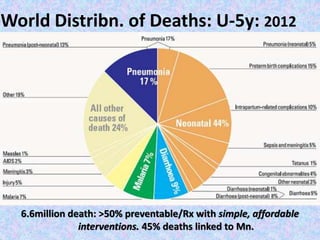
World Distribn. of Deaths: U-5y: 2012
6.6million death: >50% preventable/Rx with simple, affordable
interventions. 45% deaths linked to Mn.
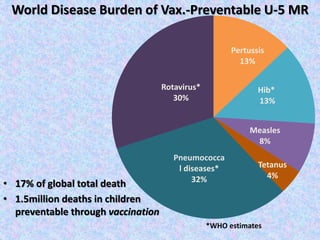
World Disease Burden of Vax.-Preventable U-5 MR
Pertussis
13%
Hib*
13%
Measles
8%
Tetanus
4%
Pneumococca
l diseases*
32%
Rotavirus*
30%
• 17% of global total death
• 1.5million deaths in children
preventable through vaccination
*WHO estimates
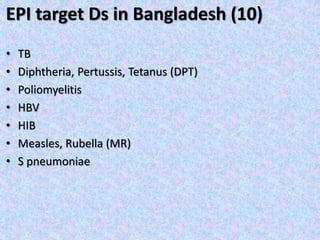
EPI target Ds in Bangladesh (10)
• TB
• Diphtheria, Pertussis, Tetanus (DPT)
• Poliomyelitis
• HBV
• HIB
• Measles, Rubella (MR)
• S pneumoniae
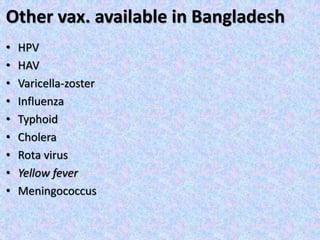
Other vax. available in Bangladesh
• HPV
• HAV
• Varicella-zoster
• Influenza
• Typhoid
• Cholera
• Rota virus
• Yellow fever
• Meningococcus
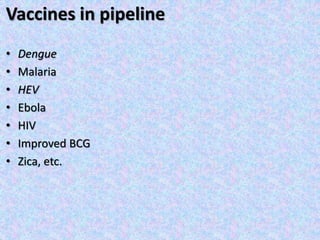
Vaccines in pipeline
• Dengue
• Malaria
• HEV
• Ebola
• HIV
• Improved BCG
• Zica, etc.
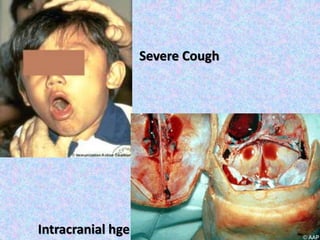
Intracranial hge
Severe Cough
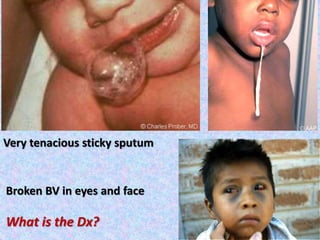
Very tenacious sticky sputum
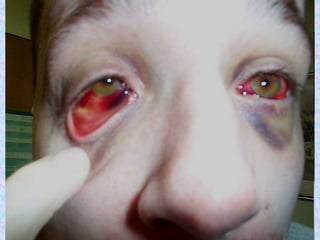
Broken BV in eyes and face
What is the Dx?
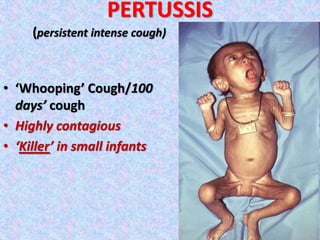
• ‘Whooping’ Cough/100
days’ cough
• Highly contagious
• ‘Killer’ in small infants
PERTUSSIS
(persistent intense cough)
Pertussis: an ARI c/by B. pertussis, and uncommonly
by a few other MOs, characterized by 3 stages:
catarrhal, paroxysmal, convalescence
Aetiology
• B. pertussis (Classical)
• Others:
– B. parapertussis, B. bronchiseptica
– Adenovirus 1, 2, 3, 5
– M pneumoniae, C trachomatis, C pneumoniae
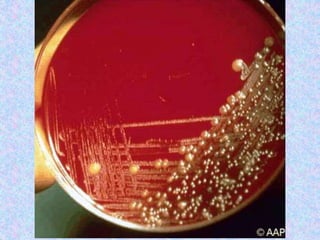
B pertussis
fastidious, Gram-ve, pleomorphic rod
• No growth on ordinary media
(lab to be informed beforehand!)
• Does not survive in environment (P2P spread)
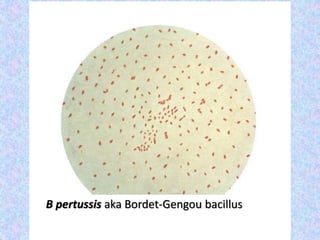
B pertussis aka Bordet-Gengou bacillus
Epidemiology
70% cases in <1y age. Endemic every 3-5y
• Humans only. P2P: contact, droplets
• Mild/atypical in older  source for children
• Highly contagious in stage- 1 (~100%)
• Immunity is incomplete
• I P: 7-10d. PI varies (-2 +6w of cough):
– Infant: 6w after onset; adult: 2w …
• Severity: immune status, previous pertussis, ABT
IP: incubation period. PI: period of infectivity
Pathogenesis
• Basically bronchitis
• Locally invasive; toxin mediated:
– severe inflam.: necrosis, infiltration: debris  sticky
scanty sputum  severe cough
• May cause Br. Pn., bronchiectasis, collapse
• Brain cortical atrophy from IC hge and anoxia
Pertussis toxins: pertactin, lymphocytotic factor, filamentous
hemagglutinin, fimbrial proteins agglutinogens)
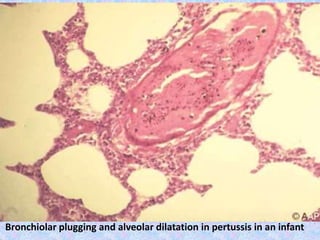
Bronchiolar plugging and alveolar dilatation in pertussis in an infant
Clinical Stages
Catarrhal stage: ~1-2 w. Mimics coryza: LGF, cough, red
watering eyes. Dx usually missed. ABT can abort
Paroxysmal stage: 2-4w/longer
• Forceful cough of  severity; 5-10 bouts /expn.  whoop
and vomiting
• Flushed/cyanosed face, bulging bloody watering eyes
• Protruded tongue, dribbling
• Distended neck veins
• Fever is absent or minimal
CF in Infants (paroxysmal stage)
• Paroxysmal cough 100%
• Post-tussive emesis 80%
• Prolonged dyspnoea (neonate) 80%
• Whoop 70%
• Convulsion 25%
• Mortality <4mo age 40%
Atypical presentation
• <6 mo age: apnea, no whoop. Severest in preterm
• Older children and adults: milder-shorter, prolonged
cough ± paroxysms. No whoop in adults
S/he is apathetic, loses wt. rapidly
Triggers of paroxysms
– eating, drinking, sneezing, yawing, wind
– laughing, playing, smoke
– suggestion
Physical examination
• Generally uninformative; May be no signs
• Diffuse rales, and ronchi may be noted
• Petechiae may be seen
Convalescence stage
• Signs of improvement over weeks-months
• RT can stay irritated for months-years: Paroxysms
may occur with each RTI during this period
Complications
• Respiratory:
• CNS:
• Alimentary system:
• Others:
Complications: Respiratory Sys.
• Pneumonia: primary, secondary
• Reactivation of TB
• Bronchiectasis
• Collapse
• Emphysema
• Pneumothorax
• AOM
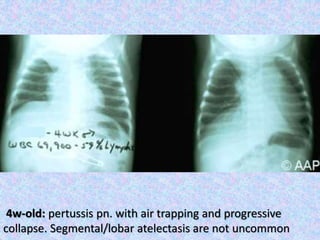
4w-old: pertussis pn. with air trapping and progressive
collapse. Segmental/lobar atelectasis are not uncommon
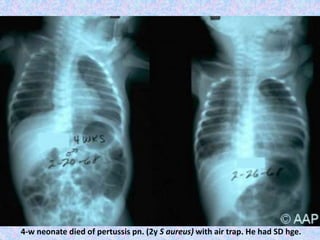
4-w neonate died of pertussis pn. (2y S aureus) with air trap. He had SD hge.
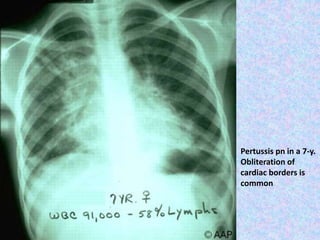
Pertussis pn in a 7-y.
Obliteration of
cardiac borders is
common
Complications: CNS
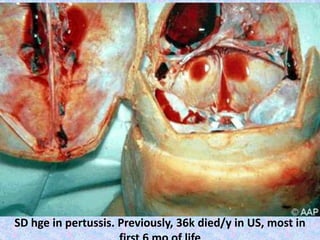
• Hemorrhage, SD hematoma, brain atrophy
• Seizures (Pertussis encephalopathy: hge+atrophy+seizures)
• SIADH
Complications: Alimentary Sys.
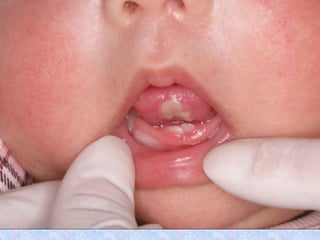
• Frenulum ulceration
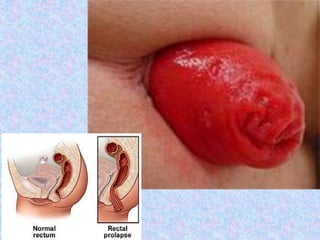
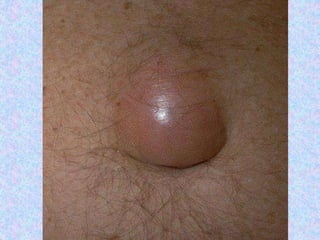
• Rectal prolapse, umbilical/inguinal hernia
• Intussusception, melena
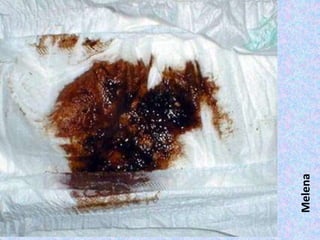
• Malnutrition
SD hge in pertussis. Previously, 36k died/y in US, most in
Melena
Complications: Others
• Over exhaustion
• Dehydration
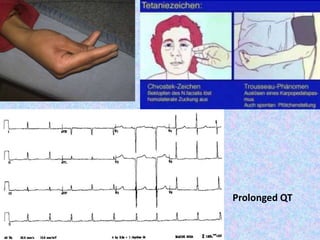
• Tetany
• Hypoglycemia
• Epistaxis, sub-conj. bleeds, purpura
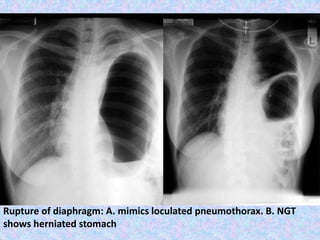
• Diaphragmatic rupture
Rupture of diaphragm: A. mimics loculated pneumothorax. B. NGT
shows herniated stomach
Prolonged QT
Dx: mainly clinical
• High index of suspicion in stage 1: immunity, contact,
neighborhood
• Classical paroxysm is v. suggestive
• Cough >2w with post-tussive emesis is an important clue
Lab.
• CS:
• CBC: absolute lymphocytosis (20-50K) is typical (not in B
parapertussis and immunized). It parallels the severity
• CXR: perihilar infiltrates, Br.Pn., emphysema, etc.
• PCR for rapid Dx
CS: should be done in all cases. Takes 10-14d
Negative: after 4thw of illness, immunized, ABT
• NP secretions (aspiration/Dacron/Ca alginate swab)
• Media: Regan-Lowe (transport) and B.G.
• Inform lab* beforehand
DD:
• Other c/of bronchitis
• Foreign body
• Toxic damage to RT by gases
• Lipoid/chemical pneumonia
*Inform lab as these media are not routinely available
• Erythromycin x14d is DoC
– Aborts paroxysm in Stage 1
– Shortens duration, reduces spread, prevents relapse
– In Stage 2 ABT has no effect
• Azithromycin and clarithromycin are alternative
• Resistance is rare
Penicillins, cephalosporins ineffective
TREATMENT
(Azithro.10–12mg/kg/d, p.o., x5d; max. 600mg/d
Clarithro. 15–20 mg/kg/d, p.o., in 2 dd; max. 1 g/d x7d)
Nursing is v. important
– Avoid triggers, hydration, nutrition
– suction clearance, O2
– Betamethasone, albuterol may  severity
No cough suppressants
Admission: Infants <6 mo
– to manage apnea, hypoxia
– feeding difficulties, dehydration
– other complications
– ICU
IMMUNISATION
• 5 doses: 4th at 15-18mo; 5th (DT) at school entry
• Immunity is not absolute/permanent
• It may not prevent infection. Mild illness may not be
recognized and can spread
Prognosis
• Mortality ~40 % in infants <5mo
Death:
• Anoxia, rapid dehydration
• Malnutrition, hypoglycemia
• Over exhaustion, encephalopathy
Points to Ponder
• Pertussis is fatal in small babies
• Severe damage to RT cilia  RT is reactive for 1y
• Causes innumerable complications
• Immunity is neither complete/permanent
• Cl. Dx is essential
• No growth on ordinary media
• Rx can abort the disease in coryzal stage
• Can reactivate TB
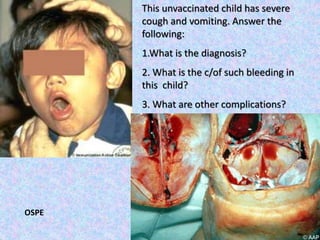
This unvaccinated child has severe
cough and vomiting. Answer the
following:
1.What is the diagnosis?
2. What is the c/of such bleeding in
this child?
3. What are other complications?
OSPE
MCQ
Classical pertussis
• causes neutrophilic leukocytosis
• causes leukemoid reaction
• is complicated by apnea in neonates
• immunization confers excellent protection
• causes death by septicemia
• the bacteria grows in common media
• makes blood culture positive
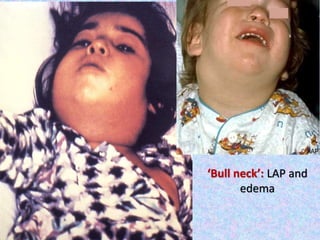
‘Bull neck’: LAP and
edema
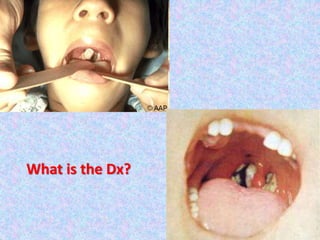
What is the Dx?
DIPHTHERIA
a serious d. c/by C. diphtheriae (only locally invasive):
– fatal local obstructing and
– fatal systemic toxicity
• Spreads P2P. Fate depends on:
– strain (toxic/not), circulation, immunity
• Man only. Both non-/toxigenic cause obstruction
• Only toxigenics cause toxemia
• 50% mortality
• Now rare
Common site: URT
• Also skin, eye, ear, genitalia, wound
• Exotoxin: degeneration/necrosis of heart, nerves (paralysis)
kidneys, adrenals. Interval: myocarditis 2w. neuritis 3-7w
• DPT vax.: requires booster/10y
Characteristic pseudomembrane
• Necrosed tissue+exudate+bacteria
• Tough-fibrinous adherent
• Gray to black (~bleed)
• Attempt to remove it causes bleeding
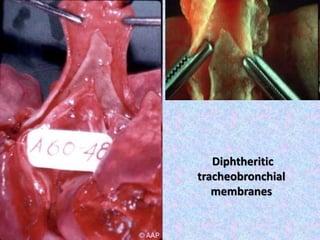
Diphtheritic
tracheobronchial
membranes
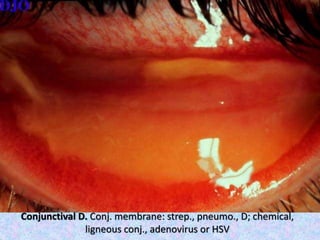
Conjunctival D. Conj. membrane: strep., pneumo., D; chemical,
ligneous conj., adenovirus or HSV
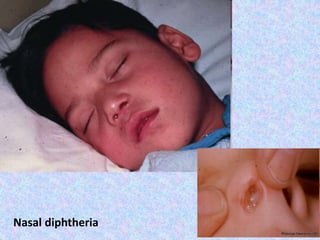
Nasal diphtheria
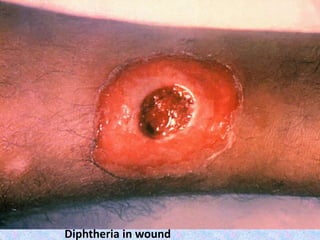
Diphtheria in wound
Tonsilopharyngeal D
Insidious: LGF, disproportionately toxic, malaise, sore throat,
irritable, dysphagia, bull neck, rapid pulse, ± respiratory
and CV collapse. Very distinctive membrane extends from
pharynx to palate. Palatal palsy: nasal voice +/-
regurgitation. May die in 7–10d
Laryngeal D
Usually extension from pharynx
• Croup, severe chest retraction, hoarseness
• Restless, but soon becomes weak, drowsy
• A grave situation! Urgent tracheostomy/intubation
Diagnosis
Clinical Dx is urgent!
• Extended membrane, disproportionately toxic; noisy
breaths, stridor, hoarseness, bull neck, palatal palsy
• Serosanguinous nasal discharge
• Confirmed by CS, FAB staining
• Toxigenicity test by using guinea pigs
IMPORTANT!
• Diphtheria like MO on smear does not establish Dx. CS
essential. But Cl. Dx is enough to start Rx
• Mortality is ~5%. Untreated ~50%
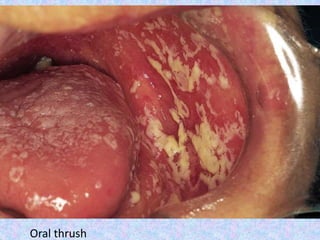
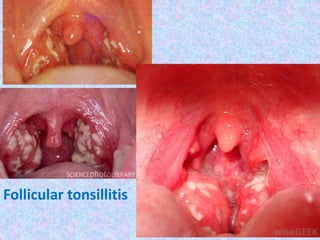
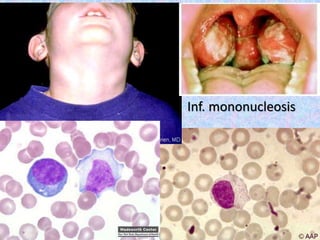
White Patch Over Tonsils
 Follicular tonsillitis
 D i p h t h e r i a
 Inf. Mono.
 Agranucytosis
 Leukemias
 Candidiasis
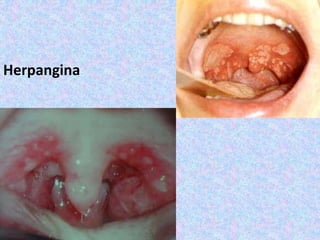
 Herpangina
• Vincent’s angina
• Post tonsillectomy
membrane
• Ac. Toxoplasmosis
• Ac. CMV
Herpangina
Oral thrush
Follicular tonsillitis
Inf. mononucleosis
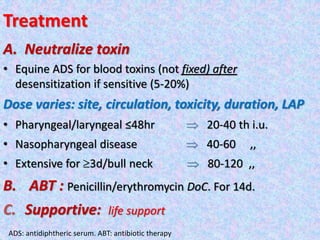
Treatment
A. Neutralize toxin
• Equine ADS for blood toxins (not fixed) after
desensitization if sensitive (5-20%)
Dose varies: site, circulation, toxicity, duration, LAP
• Pharyngeal/laryngeal ≤48hr  20-40 th i.u.
• Nasopharyngeal disease  40-60 ,,
• Extensive for 3d/bull neck  80-120 ,,
B. ABT : Penicillin/erythromycin DoC. For 14d.
C. Supportive: life support
ADS: antidiphtheric serum. ABT: antibiotic therapy
Complications
Obstruction:
• Hypoxia, CV collapse
• Bull neck, dysphagia
• Pn., hemorrhagic pn.
Toxemia:
Neuritis: paralysis of palate,
pharynx, eye, diaphragm,
ciliary B, GBS
Myocarditis
Gastritis
Hepatitis
Nephritis, ATN
MCQ
In diphtheria:
• most strains are toxigenic
• natural infx. does not exclude vaccination
• greatest obstruction occurs with pharyngeal D
• antibiotic alone is curative
• positive Albert Stain is diagnostic
• cardiac failure occurs due to toxic myocarditis
• the pseudomembrane is easily separable
WelcomeAll
WelcomeAll
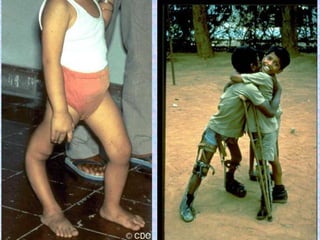
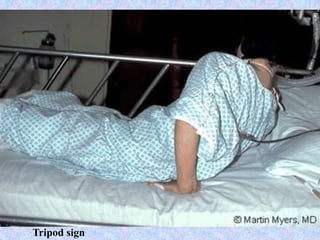
POLIOMYELITIS
• Enterovirus: damage AH cells: partial/full paralysis
• Spreads: P2P, mucus/phlegm, feces
• Enters gut and URT, multiplies in throat and gut, spread to
nerve by blood and lymph
• IP: 5-35d. 3 patterns: subclinical (commonest)
nonparalytic, paralytic (1%)
• Massive vax.: practically eradicated it from most countries
except a few Afro-Asian countries
AH: anterior horn
CF
• Fever, myalgia, HA, abnormal reflexes, back stiffness, stiff
neck, ANS features
• Tests: cultures from throat, stools, or CSF
Rx
• Only supportive:
– moist heat for muscle pain and spasms
– Analgesic (no narcotics)
– Physiotherapy, orthopedic appliances and surgery
• If severe: lifesaving measures
Tripod sign
Complications
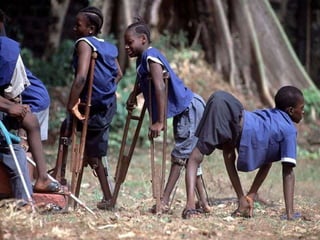
• Paralysis, aspiration pn., pulmonary edema
• Myocarditis, shock
• Paralytic ileus, disability, deformity, urine retention, UTI
Prognosis
• Depends on the clinical type and area affected
• Most cases recover.
• CNS involvement is a medical emergency
• Disability is more common than death
Prevention: OPV (live) and IPV (inactive). No OPV in HIC
• OPV: herd immunity. Pulse dosing in LICs
HIC: high income countries. LIC:
MCQ
• Both OPV and IPV are live vax
• OPV is used globally
• Both polio vax. gives herd immunity
• OPV pulse dosing is used in LICs only
• Most polio cases are subclinical
• Polio paralysis is usually symmetrical
• Bangladesh is polio free
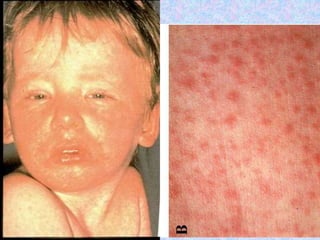
What is the Dx?
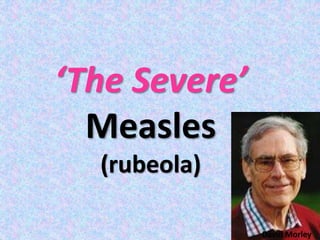
‘The Severe’
Measles
(rubeola)
David Morley
Measles is a killer and
blinding disease
specially for
malnourished children
Measles is a viral ID of man. Spreads P2P
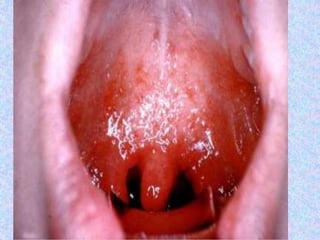
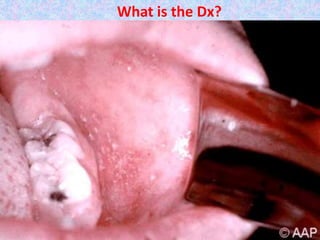
• Main sign: an itchy MPR (exanthem) and tiny white spots in
mouth (enanthem). 3 stages:
catarrhal, eruptive, convalescence
• F, cough, rhinitis, conjunctivitis. Rash on 4th day of F
• Severely ill. Serious complications
• Vax. prevents it
• IP: 7-18d. But SSPE: ~10.8y; not contagious
• PI:- -5 +5 d of rash
MPR: maculopapular rash
Pathology:
• MPR: starts at hair line, behind ears; eyes, RT and GIT
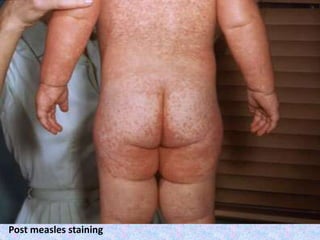
Spreads downwards. Stays 7–10d: post measles staining
• Rash reaches feet: F goes!
• Rash may bleed (black measles)
• Mouth: Koplik spots; devastating ulcers
• Severe depletion of VA
• RT: Pn., bronchiolitis; bronchitis, bronchiectasis, AOM
• CNS: Encephalitis, SSPE
• GIT: D, malabsorption
Pathology …
Immune system
• Immunoparesis (T&B cell)
• Diarrhea
Appendix
• Lymphoid hyperplasia
• Pathognomic Warthin-Finkeldey Giant cell
• Appendicectomy not needed
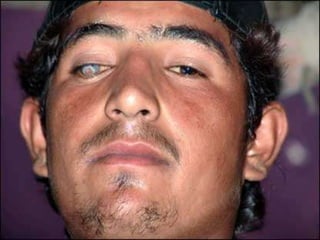
Eyes: VADX, Keratoconjunctivitis, Keratomalacia
Nutrition: VADX, Enteritis
Post measles staining
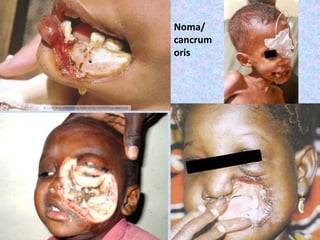
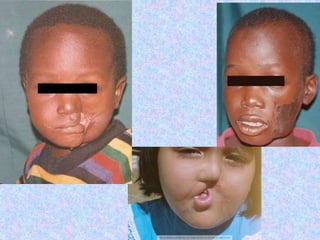
Noma/
cancrum
oris
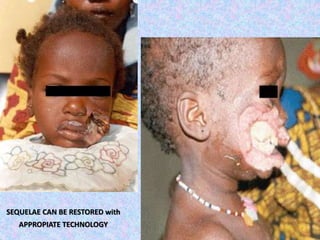
SEQUELAE CAN BE RESTORED with
APPROPIATE TECHNOLOGY
DIAGNOSIS
• Mainly clinical. Giant cells in nasal smear
• Culture of virus (urine, blood, nasopharynx)
• Sp. IgM
Rx: No sp. Rx. Only supportive:
Most important: Vitamin A
– 200,000 i.u. day1, day 4 and day 8. It  MM
• FEB, feeding, oral hygiene
• Rx of complications. ABT only for 2y infx.
• Ig may benefit in severe Mn
• VADX, blindness
• AOM
• Laryngotracheitis
• Bronchitis
• Bronchiectasis
• Bronchiolitis
• Giant Cell Pn.
• PM enteropathy
• Mouth ulcers
• Myocarditis
• Encephalitis
• SSPE (1/1000)
Complications: by virus itself
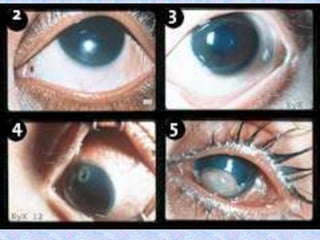
Eye damage (by virus and VADX)
– Conjunctivitis, keratitis, keratomalacia. Was the
commonest nutritional blindness
Secondary infx
• Unmasking of TB
• Bronchitis, bronchiolitis, bronchiectasis
• ALTB (croup), bacterial pneumonia
• AOM, diarrhea
Pneumoniain measles: viral, giant cell (Hecht),
bacterial, tuberculous
Complications: immunoparesis
• Unmasking of TB, depressed CMI (Pseudo-ve MT)
• Low response to vaccines
• Diarrhea, malabsorption, 2y infx. (v. common)
• If fever recurs suspect 2y infx.
Causes of death
• Fulminant course, pn., diarrhea, severe Mn., VADX
• Neurologic complications
Any non-accidental death within 1 mo of measles is
measles related death
Subac. Sclerosing Panencephalitis (SSPE)
• A rare, chr., progressive encephalitis in children and young
adults (?mutation of virus)
• There is restricted expression of envelope proteins: no
infectious particles like the M protein produced: no
immune response. No spread!
Progression
• Stage 1: irritable, altered personality, dementia, MR
• .. 2: fit, ataxia, more MR, speech problems, dysphagia
• .. 3: steady decline in body function, blindness. Pt. is
likely to be mute and/or comatose
No cure. Inosine pranobex, ribavirin, IF alpha/beta
Aka Dawson Disease, Dawson E or measles E
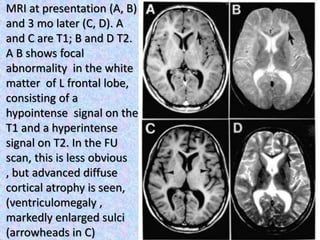
MRI at presentation (A, B)
and 3 mo later (C, D). A
and C are T1; B and D T2.
A B shows focal
abnormality in the white
matter of L frontal lobe,
consisting of a
hypointense signal on the
T1 and a hyperintense
signal on T2. In the FU
scan, this is less obvious
, but advanced diffuse
cortical atrophy is seen,
(ventriculomegaly ,
markedly enlarged sulci
(arrowheads in C)
MCQ
• Measles can deplete VA totally
• MT can be negative after measles
• Vaccines should not be deferred after measles
• Noma is a recognized complication of measles
• 2 doses of measles vaccine are required
• It is the commonest c/of nutritional blindness
• SSPE is a slow virus infection
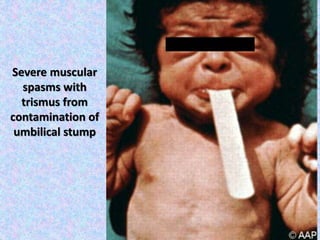
Severe muscular
spasms with
trismus from
contamination of
umbilical stump
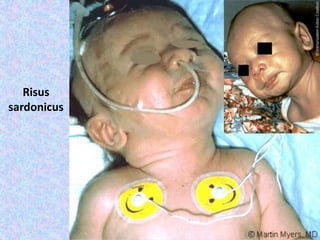
Risus
sardonicus
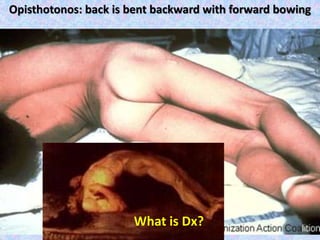
Opisthotonos: back is bent backward with forward bowing
What is Dx?
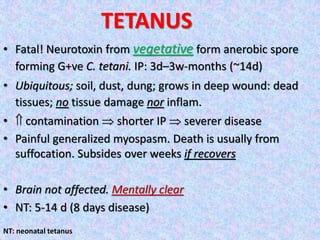
TETANUS
• Fatal! Neurotoxin from vegetative form anerobic spore
forming G+ve C. tetani. IP: 3d–3w-months (~14d)
• Ubiquitous; soil, dust, dung; grows in deep wound: dead
tissues; no tissue damage nor inflam.
•  contamination  shorter IP  severer disease
• Painful generalized myospasm. Death is usually from
suffocation. Subsides over weeks if recovers
• Brain not affected. Mentally clear
• NT: 5-14 d (8 days disease)
NT: neonatal tetanus
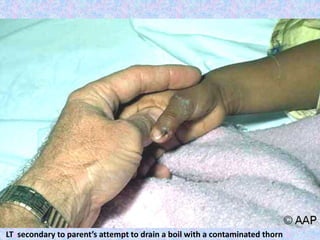
LT secondary to parent’s attempt to drain a boil with a contaminated thorn
TREATMENT
Medical emergency. Must hospitalize
• Supportive: control spasm, FEB, nutrition
• Control of ANS instability if any:
– ventilator SOS:
• Wound management:
Control of spasms is most important
• Anticonvulsant: Best survival is achieved by flaccid
paralysis and mechanical ventilation
• TIG 3000-6000iu im for all. No local infiltration (cannot
neutralize fixed toxin)
• IVIG can be considered
Anticonvulsants
• Diazepam, Midazolam, Chlorpromazine
• Baclofen and other muscle relaxants
ANS instabilities
• Temp. instability, Cardiac arrhythmias
• Unstable BP, Excessive secretions
Temperature instability
HGF in tetanus: Spasms, Sympathetic over-stimulation,
Infection, Dehydration
TETANUS PRONE WOUND
• Containing dirt, feces, soil, or saliva
• Has necrotic or gangrenous tissue
Aggressive care is essential: part of prevention
Aim: eradication of the MO
• Remove dead tissue and FB
• No extensive débridement for punctures
• No wide excision of cord stump
WOUND MANAGEMENT
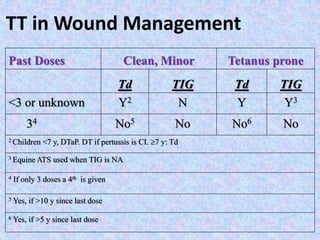
Past Doses Clean, Minor Tetanus prone
Td TIG Td TIG
<3 or unknown Y2 N Y Y3
34 No5 No No6 No
2 Children <7 y, DTaP. DT if pertussis is CI. 7 y: Td
3 Equine ATS used when TIG is NA
4 If only 3 doses a 4th is given
5 Yes, if >10 y since last dose
6 Yes, if >5 y since last dose
TT in Wound Management
ABT
• Metronidazole is the DoC. Pen. G is alternative
• Duration: 10-14d
TIG
• Give TIG in HIV, regardless of h/of TT
• Child 7y: use Td; <7y: DTaP/DTP/DT
• Separate sites for TT and TIG
• TIG does not preclude immunization
• TIG does not impair immunogenesis
PO/IV metronidazole (30 mg/kg/d/6-h. Pen. G (100 000 U/kg/d/4-6h; max. 12 million U/day) IM
COMPLICATIONS
• Aspiration pn.
• Dysphagia
• Dyspnea, apnea
• Secondary infx.
• IC Hge
• Fractures, soft tissue
injury
• Hyperpyrexia
• Hypoglycemia
• Hyperglycemia
CAUSES OF DEATH
•Over-exhaustion, Aspiration pn., Hypoglycemia
• IC Hge, Dehydration
Immunization
• TT is toxoid; better as Td. Very stable: months at room
temp. Very effective. May be given with other vax.
• Given as DTP/DTaP, DT, Td ( diphtheria content)
– TT for pregnant and women of CBA
• Children 6w-7 y: x5 TT and diphtheria toxoid
• 5th before school entry. Then each 10y
• For wilderness expeditions: 1 booster if not taken in 5y
HIB conjugate vx. containing TT (PRP-T) are not substitutes for TT vx
POINTS TO PONDER
• Non-communicable
• Completely preventable
• Non-inflammatory toxic response
• Disease does not confer immunity
• Spasm control is the mainstay of Rx
MCQ
Tetanus
• is commonly focal
• is a communicable disease
• Dx mainly clinically
• The vaccine is highly effective
• is more common in elderly people
• Pt. stays mentally clear
• can cause hyperpyrexia
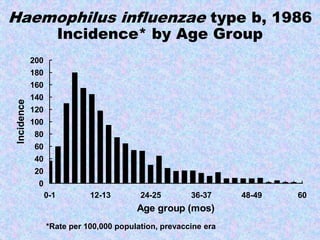
Hemophilus influenzae type b (Hib/HIB)
• Severe sepsis, particularly among infants
• During late 19C was believed to cause flu
• Aerobic Gram-negative, polysaccharide capsule
• 6 different serotypes (a - f)
• 95% of invasive disease is c/by type b (Hib)
• Colonizes nasopharynx: affects local and distant sites
• Antecedent URTI may be a contributing factor
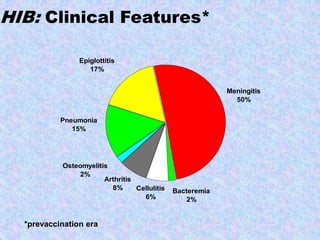
Cellulitis
6%
Arthritis
8% Bacteremia
2%
Meningitis
50%
Epiglottitis
17%
Pneumonia
15%
Osteomyelitis
2%
HIB: Clinical Features*
*prevaccination era
Hib Meningitis
• 50-65% of meningitis in the prevaccine era
• Deafness or neurologic sequelae in 15-30%
• CFR: 2-5% despite of effective ABT
• Hospitalization required
• Rx: 3G cephalosporin, or chloramphenicol plus ampicillin.
Ampicillin-resistance is now common
• Reservoir: human; asymptomatic carriers. Droplets
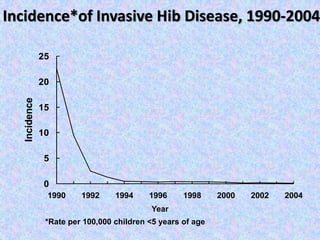
• Incidence has fallen 99% since prevaccine era
CFR: case-fatality rate
0
5
10
15
20
25
1990 1992 1994 1996 1998 2000 2002 2004
Incidence
Incidence*of Invasive Hib Disease, 1990-2004
*Rate per 100,000 children <5 years of age
Year
0
20
40
60
80
100
120
140
160
180
200
0-1 12-13 24-25 36-37 48-49 60
Age group (mos)
IncidenceHaemophilus influenzae type b, 1986
Incidence* by Age Group
*Rate per 100,000 population, prevaccine era
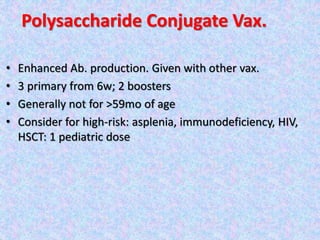
Polysaccharide Conjugate Vax.
• Enhanced Ab. production. Given with other vax.
• 3 primary from 6w; 2 boosters
• Generally not for >59mo of age
• Consider for high-risk: asplenia, immunodeficiency, HIV,
HSCT: 1 pediatric dose
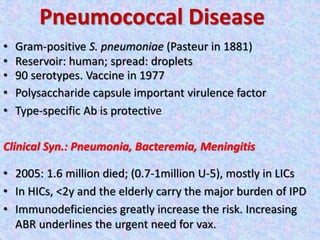
Pneumococcal Disease
• Gram-positive S. pneumoniae (Pasteur in 1881)
• Reservoir: human; spread: droplets
• 90 serotypes. Vaccine in 1977
• Polysaccharide capsule important virulence factor
• Type-specific Ab is protective
Clinical Syn.: Pneumonia, Bacteremia, Meningitis
• 2005: 1.6 million died; (0.7-1million U-5), mostly in LICs
• In HICs, <2y and the elderly carry the major burden of IPD
• Immunodeficiencies greatly increase the risk. Increasing
ABR underlines the urgent need for vax.
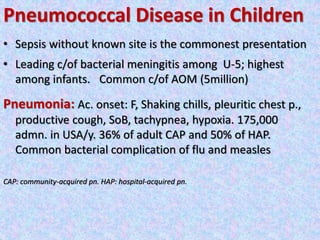
Pneumococcal Disease in Children
• Sepsis without known site is the commonest presentation
• Leading c/of bacterial meningitis among U-5; highest
among infants. Common c/of AOM (5million)
Pneumonia: Ac. onset: F, Shaking chills, pleuritic chest p.,
productive cough, SoB, tachypnea, hypoxia. 175,000
admn. in USA/y. 36% of adult CAP and 50% of HAP.
Common bacterial complication of flu and measles
CAP: community-acquired pn. HAP: hospital-acquired pn.
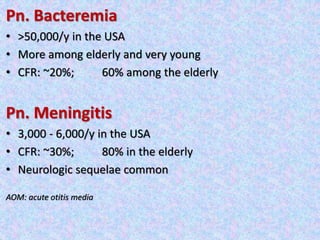
Pn. Bacteremia
• >50,000/y in the USA
• More among elderly and very young
• CFR: ~20%; 60% among the elderly
Pn. Meningitis
• 3,000 - 6,000/y in the USA
• CFR: ~30%; 80% in the elderly
• Neurologic sequelae common
AOM: acute otitis media
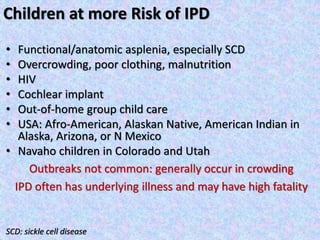
Children at more Risk of IPD
• Functional/anatomic asplenia, especially SCD
• Overcrowding, poor clothing, malnutrition
• HIV
• Cochlear implant
• Out-of-home group child care
• USA: Afro-American, Alaskan Native, American Indian in
Alaska, Arizona, or N Mexico
• Navaho children in Colorado and Utah
Outbreaks not common: generally occur in crowding
IPD often has underlying illness and may have high fatality
SCD: sickle cell disease
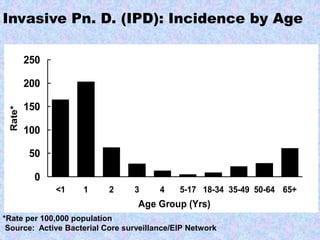
Invasive Pn. D. (IPD): Incidence by Age
0
50
100
150
200
250
<1 1 2 3 4 5-17 18-34 35-49 50-64 65+
Age Group (Yrs)
Rate*
*Rate per 100,000 population
Source: Active Bacterial Core surveillance/EIP Network
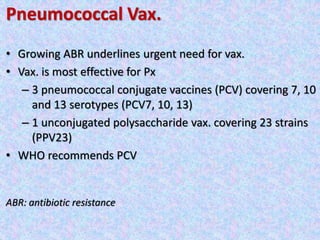
Pneumococcal Vax.
• Growing ABR underlines urgent need for vax.
• Vax. is most effective for Px
– 3 pneumococcal conjugate vaccines (PCV) covering 7, 10
and 13 serotypes (PCV7, 10, 13)
– 1 unconjugated polysaccharide vax. covering 23 strains
(PPV23)
• WHO recommends PCV
ABR: antibiotic resistance
Rubella
• Acute, contagious viral infection that occurs most
often in children and young adults
• Rubella infection in pregnant women may cause fetal
death or congenital defects known as congenital
rubella syndrome (CRS)
• Estimated 110,000 babies are born with CRS annually
• Single dose of vaccine > 95% long-lasting immunity
• Often combined with Measles, Mumps, and/or
Varicella vaccine
Next Lec.:
Childhood
Injury
(ACCIDENTS IN CHILDREN)
THANK YOU

Epi Target Diseases

  • 4.
  • 5.
    E. P. I.TARGET DISEASES (DPT POLIO HIB MR PCV)
  • 6.
    Why immunisation?  Measles,polio, DPT, Hib, S pneumoniae, rotavirus, TB, etc. are killers. HBV and rubella are not U-5 killer  EPI led to 17,000 fewer U-5 death/d in 2012 than in 1990  Still: 18,000 U-5 death/d or 6.6 million/y (50% in Sub Saharan Africa; 30% in S Asia) in 2012  To stop these deaths. S Asia has strong progress: >50% reduction since 1990; but in SS Africa it is 45%
  • 7.
    World Distribn. ofDeaths: U-5y: 2012 6.6million death: >50% preventable/Rx with simple, affordable interventions. 45% deaths linked to Mn.
  • 8.
    World Disease Burdenof Vax.-Preventable U-5 MR Pertussis 13% Hib* 13% Measles 8% Tetanus 4% Pneumococca l diseases* 32% Rotavirus* 30% • 17% of global total death • 1.5million deaths in children preventable through vaccination *WHO estimates
  • 9.
    EPI target Dsin Bangladesh (10) • TB • Diphtheria, Pertussis, Tetanus (DPT) • Poliomyelitis • HBV • HIB • Measles, Rubella (MR) • S pneumoniae
  • 10.
    Other vax. availablein Bangladesh • HPV • HAV • Varicella-zoster • Influenza • Typhoid • Cholera • Rota virus • Yellow fever • Meningococcus
  • 11.
    Vaccines in pipeline •Dengue • Malaria • HEV • Ebola • HIV • Improved BCG • Zica, etc.
  • 12.
  • 13.
    Very tenacious stickysputum Broken BV in eyes and face What is the Dx?
  • 14.
    • ‘Whooping’ Cough/100 days’cough • Highly contagious • ‘Killer’ in small infants PERTUSSIS (persistent intense cough)
  • 15.
    Pertussis: an ARIc/by B. pertussis, and uncommonly by a few other MOs, characterized by 3 stages: catarrhal, paroxysmal, convalescence Aetiology • B. pertussis (Classical) • Others: – B. parapertussis, B. bronchiseptica – Adenovirus 1, 2, 3, 5 – M pneumoniae, C trachomatis, C pneumoniae
  • 16.
    B pertussis fastidious, Gram-ve,pleomorphic rod • No growth on ordinary media (lab to be informed beforehand!) • Does not survive in environment (P2P spread)
  • 18.
    B pertussis akaBordet-Gengou bacillus
  • 19.
    Epidemiology 70% cases in<1y age. Endemic every 3-5y • Humans only. P2P: contact, droplets • Mild/atypical in older  source for children • Highly contagious in stage- 1 (~100%) • Immunity is incomplete • I P: 7-10d. PI varies (-2 +6w of cough): – Infant: 6w after onset; adult: 2w … • Severity: immune status, previous pertussis, ABT IP: incubation period. PI: period of infectivity
  • 20.
    Pathogenesis • Basically bronchitis •Locally invasive; toxin mediated: – severe inflam.: necrosis, infiltration: debris  sticky scanty sputum  severe cough • May cause Br. Pn., bronchiectasis, collapse • Brain cortical atrophy from IC hge and anoxia Pertussis toxins: pertactin, lymphocytotic factor, filamentous hemagglutinin, fimbrial proteins agglutinogens)
  • 21.
    Bronchiolar plugging andalveolar dilatation in pertussis in an infant
  • 22.
    Clinical Stages Catarrhal stage:~1-2 w. Mimics coryza: LGF, cough, red watering eyes. Dx usually missed. ABT can abort Paroxysmal stage: 2-4w/longer • Forceful cough of  severity; 5-10 bouts /expn.  whoop and vomiting • Flushed/cyanosed face, bulging bloody watering eyes • Protruded tongue, dribbling • Distended neck veins • Fever is absent or minimal
  • 23.
    CF in Infants(paroxysmal stage) • Paroxysmal cough 100% • Post-tussive emesis 80% • Prolonged dyspnoea (neonate) 80% • Whoop 70% • Convulsion 25% • Mortality <4mo age 40% Atypical presentation • <6 mo age: apnea, no whoop. Severest in preterm • Older children and adults: milder-shorter, prolonged cough ± paroxysms. No whoop in adults
  • 24.
    S/he is apathetic,loses wt. rapidly Triggers of paroxysms – eating, drinking, sneezing, yawing, wind – laughing, playing, smoke – suggestion Physical examination • Generally uninformative; May be no signs • Diffuse rales, and ronchi may be noted • Petechiae may be seen
  • 26.
    Convalescence stage • Signsof improvement over weeks-months • RT can stay irritated for months-years: Paroxysms may occur with each RTI during this period Complications • Respiratory: • CNS: • Alimentary system: • Others:
  • 27.
    Complications: Respiratory Sys. •Pneumonia: primary, secondary • Reactivation of TB • Bronchiectasis • Collapse • Emphysema • Pneumothorax • AOM
  • 28.
    4w-old: pertussis pn.with air trapping and progressive collapse. Segmental/lobar atelectasis are not uncommon
  • 29.
    4-w neonate diedof pertussis pn. (2y S aureus) with air trap. He had SD hge.
  • 30.
    Pertussis pn ina 7-y. Obliteration of cardiac borders is common
  • 31.
    Complications: CNS • Hemorrhage,SD hematoma, brain atrophy • Seizures (Pertussis encephalopathy: hge+atrophy+seizures) • SIADH Complications: Alimentary Sys. • Frenulum ulceration • Rectal prolapse, umbilical/inguinal hernia • Intussusception, melena • Malnutrition
  • 32.
    SD hge inpertussis. Previously, 36k died/y in US, most in
  • 36.
  • 37.
    Complications: Others • Overexhaustion • Dehydration • Tetany • Hypoglycemia • Epistaxis, sub-conj. bleeds, purpura • Diaphragmatic rupture
  • 38.
    Rupture of diaphragm:A. mimics loculated pneumothorax. B. NGT shows herniated stomach
  • 39.
  • 40.
    Dx: mainly clinical •High index of suspicion in stage 1: immunity, contact, neighborhood • Classical paroxysm is v. suggestive • Cough >2w with post-tussive emesis is an important clue Lab. • CS: • CBC: absolute lymphocytosis (20-50K) is typical (not in B parapertussis and immunized). It parallels the severity • CXR: perihilar infiltrates, Br.Pn., emphysema, etc. • PCR for rapid Dx
  • 41.
    CS: should bedone in all cases. Takes 10-14d Negative: after 4thw of illness, immunized, ABT • NP secretions (aspiration/Dacron/Ca alginate swab) • Media: Regan-Lowe (transport) and B.G. • Inform lab* beforehand DD: • Other c/of bronchitis • Foreign body • Toxic damage to RT by gases • Lipoid/chemical pneumonia *Inform lab as these media are not routinely available
  • 42.
    • Erythromycin x14dis DoC – Aborts paroxysm in Stage 1 – Shortens duration, reduces spread, prevents relapse – In Stage 2 ABT has no effect • Azithromycin and clarithromycin are alternative • Resistance is rare Penicillins, cephalosporins ineffective TREATMENT (Azithro.10–12mg/kg/d, p.o., x5d; max. 600mg/d Clarithro. 15–20 mg/kg/d, p.o., in 2 dd; max. 1 g/d x7d)
  • 43.
    Nursing is v.important – Avoid triggers, hydration, nutrition – suction clearance, O2 – Betamethasone, albuterol may  severity No cough suppressants Admission: Infants <6 mo – to manage apnea, hypoxia – feeding difficulties, dehydration – other complications – ICU
  • 44.
    IMMUNISATION • 5 doses:4th at 15-18mo; 5th (DT) at school entry • Immunity is not absolute/permanent • It may not prevent infection. Mild illness may not be recognized and can spread Prognosis • Mortality ~40 % in infants <5mo Death: • Anoxia, rapid dehydration • Malnutrition, hypoglycemia • Over exhaustion, encephalopathy
  • 45.
    Points to Ponder •Pertussis is fatal in small babies • Severe damage to RT cilia  RT is reactive for 1y • Causes innumerable complications • Immunity is neither complete/permanent • Cl. Dx is essential • No growth on ordinary media • Rx can abort the disease in coryzal stage • Can reactivate TB
  • 46.
    This unvaccinated childhas severe cough and vomiting. Answer the following: 1.What is the diagnosis? 2. What is the c/of such bleeding in this child? 3. What are other complications? OSPE
  • 47.
    MCQ Classical pertussis • causesneutrophilic leukocytosis • causes leukemoid reaction • is complicated by apnea in neonates • immunization confers excellent protection • causes death by septicemia • the bacteria grows in common media • makes blood culture positive
  • 48.
  • 49.
  • 50.
    DIPHTHERIA a serious d.c/by C. diphtheriae (only locally invasive): – fatal local obstructing and – fatal systemic toxicity • Spreads P2P. Fate depends on: – strain (toxic/not), circulation, immunity • Man only. Both non-/toxigenic cause obstruction • Only toxigenics cause toxemia • 50% mortality • Now rare
  • 51.
    Common site: URT •Also skin, eye, ear, genitalia, wound • Exotoxin: degeneration/necrosis of heart, nerves (paralysis) kidneys, adrenals. Interval: myocarditis 2w. neuritis 3-7w • DPT vax.: requires booster/10y Characteristic pseudomembrane • Necrosed tissue+exudate+bacteria • Tough-fibrinous adherent • Gray to black (~bleed) • Attempt to remove it causes bleeding
  • 52.
  • 53.
    Conjunctival D. Conj.membrane: strep., pneumo., D; chemical, ligneous conj., adenovirus or HSV
  • 54.
  • 55.
  • 56.
    Tonsilopharyngeal D Insidious: LGF,disproportionately toxic, malaise, sore throat, irritable, dysphagia, bull neck, rapid pulse, ± respiratory and CV collapse. Very distinctive membrane extends from pharynx to palate. Palatal palsy: nasal voice +/- regurgitation. May die in 7–10d Laryngeal D Usually extension from pharynx • Croup, severe chest retraction, hoarseness • Restless, but soon becomes weak, drowsy • A grave situation! Urgent tracheostomy/intubation
  • 57.
    Diagnosis Clinical Dx isurgent! • Extended membrane, disproportionately toxic; noisy breaths, stridor, hoarseness, bull neck, palatal palsy • Serosanguinous nasal discharge • Confirmed by CS, FAB staining • Toxigenicity test by using guinea pigs IMPORTANT! • Diphtheria like MO on smear does not establish Dx. CS essential. But Cl. Dx is enough to start Rx • Mortality is ~5%. Untreated ~50%
  • 58.
    White Patch OverTonsils  Follicular tonsillitis  D i p h t h e r i a  Inf. Mono.  Agranucytosis  Leukemias  Candidiasis  Herpangina • Vincent’s angina • Post tonsillectomy membrane • Ac. Toxoplasmosis • Ac. CMV
  • 59.
  • 60.
  • 61.
  • 62.
  • 63.
    Treatment A. Neutralize toxin •Equine ADS for blood toxins (not fixed) after desensitization if sensitive (5-20%) Dose varies: site, circulation, toxicity, duration, LAP • Pharyngeal/laryngeal ≤48hr  20-40 th i.u. • Nasopharyngeal disease  40-60 ,, • Extensive for 3d/bull neck  80-120 ,, B. ABT : Penicillin/erythromycin DoC. For 14d. C. Supportive: life support ADS: antidiphtheric serum. ABT: antibiotic therapy
  • 64.
    Complications Obstruction: • Hypoxia, CVcollapse • Bull neck, dysphagia • Pn., hemorrhagic pn. Toxemia: Neuritis: paralysis of palate, pharynx, eye, diaphragm, ciliary B, GBS Myocarditis Gastritis Hepatitis Nephritis, ATN
  • 65.
    MCQ In diphtheria: • moststrains are toxigenic • natural infx. does not exclude vaccination • greatest obstruction occurs with pharyngeal D • antibiotic alone is curative • positive Albert Stain is diagnostic • cardiac failure occurs due to toxic myocarditis • the pseudomembrane is easily separable
  • 66.
  • 72.
    POLIOMYELITIS • Enterovirus: damageAH cells: partial/full paralysis • Spreads: P2P, mucus/phlegm, feces • Enters gut and URT, multiplies in throat and gut, spread to nerve by blood and lymph • IP: 5-35d. 3 patterns: subclinical (commonest) nonparalytic, paralytic (1%) • Massive vax.: practically eradicated it from most countries except a few Afro-Asian countries AH: anterior horn
  • 73.
    CF • Fever, myalgia,HA, abnormal reflexes, back stiffness, stiff neck, ANS features • Tests: cultures from throat, stools, or CSF Rx • Only supportive: – moist heat for muscle pain and spasms – Analgesic (no narcotics) – Physiotherapy, orthopedic appliances and surgery • If severe: lifesaving measures
  • 74.
  • 75.
    Complications • Paralysis, aspirationpn., pulmonary edema • Myocarditis, shock • Paralytic ileus, disability, deformity, urine retention, UTI Prognosis • Depends on the clinical type and area affected • Most cases recover. • CNS involvement is a medical emergency • Disability is more common than death Prevention: OPV (live) and IPV (inactive). No OPV in HIC • OPV: herd immunity. Pulse dosing in LICs HIC: high income countries. LIC:
  • 77.
    MCQ • Both OPVand IPV are live vax • OPV is used globally • Both polio vax. gives herd immunity • OPV pulse dosing is used in LICs only • Most polio cases are subclinical • Polio paralysis is usually symmetrical • Bangladesh is polio free
  • 80.
  • 81.
  • 82.
    Measles is akiller and blinding disease specially for malnourished children
  • 83.
    Measles is aviral ID of man. Spreads P2P • Main sign: an itchy MPR (exanthem) and tiny white spots in mouth (enanthem). 3 stages: catarrhal, eruptive, convalescence • F, cough, rhinitis, conjunctivitis. Rash on 4th day of F • Severely ill. Serious complications • Vax. prevents it • IP: 7-18d. But SSPE: ~10.8y; not contagious • PI:- -5 +5 d of rash MPR: maculopapular rash
  • 84.
    Pathology: • MPR: startsat hair line, behind ears; eyes, RT and GIT Spreads downwards. Stays 7–10d: post measles staining • Rash reaches feet: F goes! • Rash may bleed (black measles) • Mouth: Koplik spots; devastating ulcers • Severe depletion of VA • RT: Pn., bronchiolitis; bronchitis, bronchiectasis, AOM • CNS: Encephalitis, SSPE • GIT: D, malabsorption
  • 85.
    Pathology … Immune system •Immunoparesis (T&B cell) • Diarrhea Appendix • Lymphoid hyperplasia • Pathognomic Warthin-Finkeldey Giant cell • Appendicectomy not needed Eyes: VADX, Keratoconjunctivitis, Keratomalacia Nutrition: VADX, Enteritis
  • 86.
  • 87.
  • 88.
    SEQUELAE CAN BERESTORED with APPROPIATE TECHNOLOGY
  • 90.
    DIAGNOSIS • Mainly clinical.Giant cells in nasal smear • Culture of virus (urine, blood, nasopharynx) • Sp. IgM Rx: No sp. Rx. Only supportive: Most important: Vitamin A – 200,000 i.u. day1, day 4 and day 8. It  MM • FEB, feeding, oral hygiene • Rx of complications. ABT only for 2y infx. • Ig may benefit in severe Mn
  • 91.
    • VADX, blindness •AOM • Laryngotracheitis • Bronchitis • Bronchiectasis • Bronchiolitis • Giant Cell Pn. • PM enteropathy • Mouth ulcers • Myocarditis • Encephalitis • SSPE (1/1000) Complications: by virus itself
  • 92.
    Eye damage (byvirus and VADX) – Conjunctivitis, keratitis, keratomalacia. Was the commonest nutritional blindness Secondary infx • Unmasking of TB • Bronchitis, bronchiolitis, bronchiectasis • ALTB (croup), bacterial pneumonia • AOM, diarrhea Pneumoniain measles: viral, giant cell (Hecht), bacterial, tuberculous
  • 93.
    Complications: immunoparesis • Unmaskingof TB, depressed CMI (Pseudo-ve MT) • Low response to vaccines • Diarrhea, malabsorption, 2y infx. (v. common) • If fever recurs suspect 2y infx. Causes of death • Fulminant course, pn., diarrhea, severe Mn., VADX • Neurologic complications Any non-accidental death within 1 mo of measles is measles related death
  • 94.
    Subac. Sclerosing Panencephalitis(SSPE) • A rare, chr., progressive encephalitis in children and young adults (?mutation of virus) • There is restricted expression of envelope proteins: no infectious particles like the M protein produced: no immune response. No spread! Progression • Stage 1: irritable, altered personality, dementia, MR • .. 2: fit, ataxia, more MR, speech problems, dysphagia • .. 3: steady decline in body function, blindness. Pt. is likely to be mute and/or comatose No cure. Inosine pranobex, ribavirin, IF alpha/beta Aka Dawson Disease, Dawson E or measles E
  • 95.
    MRI at presentation(A, B) and 3 mo later (C, D). A and C are T1; B and D T2. A B shows focal abnormality in the white matter of L frontal lobe, consisting of a hypointense signal on the T1 and a hyperintense signal on T2. In the FU scan, this is less obvious , but advanced diffuse cortical atrophy is seen, (ventriculomegaly , markedly enlarged sulci (arrowheads in C)
  • 98.
    MCQ • Measles candeplete VA totally • MT can be negative after measles • Vaccines should not be deferred after measles • Noma is a recognized complication of measles • 2 doses of measles vaccine are required • It is the commonest c/of nutritional blindness • SSPE is a slow virus infection
  • 99.
    Severe muscular spasms with trismusfrom contamination of umbilical stump
  • 100.
  • 101.
    Opisthotonos: back isbent backward with forward bowing What is Dx?
  • 102.
    TETANUS • Fatal! Neurotoxinfrom vegetative form anerobic spore forming G+ve C. tetani. IP: 3d–3w-months (~14d) • Ubiquitous; soil, dust, dung; grows in deep wound: dead tissues; no tissue damage nor inflam. •  contamination  shorter IP  severer disease • Painful generalized myospasm. Death is usually from suffocation. Subsides over weeks if recovers • Brain not affected. Mentally clear • NT: 5-14 d (8 days disease) NT: neonatal tetanus
  • 103.
    LT secondary toparent’s attempt to drain a boil with a contaminated thorn
  • 104.
    TREATMENT Medical emergency. Musthospitalize • Supportive: control spasm, FEB, nutrition • Control of ANS instability if any: – ventilator SOS: • Wound management: Control of spasms is most important • Anticonvulsant: Best survival is achieved by flaccid paralysis and mechanical ventilation • TIG 3000-6000iu im for all. No local infiltration (cannot neutralize fixed toxin) • IVIG can be considered
  • 105.
    Anticonvulsants • Diazepam, Midazolam,Chlorpromazine • Baclofen and other muscle relaxants ANS instabilities • Temp. instability, Cardiac arrhythmias • Unstable BP, Excessive secretions Temperature instability HGF in tetanus: Spasms, Sympathetic over-stimulation, Infection, Dehydration
  • 106.
    TETANUS PRONE WOUND •Containing dirt, feces, soil, or saliva • Has necrotic or gangrenous tissue Aggressive care is essential: part of prevention Aim: eradication of the MO • Remove dead tissue and FB • No extensive débridement for punctures • No wide excision of cord stump WOUND MANAGEMENT
  • 107.
    Past Doses Clean,Minor Tetanus prone Td TIG Td TIG <3 or unknown Y2 N Y Y3 34 No5 No No6 No 2 Children <7 y, DTaP. DT if pertussis is CI. 7 y: Td 3 Equine ATS used when TIG is NA 4 If only 3 doses a 4th is given 5 Yes, if >10 y since last dose 6 Yes, if >5 y since last dose TT in Wound Management
  • 108.
    ABT • Metronidazole isthe DoC. Pen. G is alternative • Duration: 10-14d TIG • Give TIG in HIV, regardless of h/of TT • Child 7y: use Td; <7y: DTaP/DTP/DT • Separate sites for TT and TIG • TIG does not preclude immunization • TIG does not impair immunogenesis PO/IV metronidazole (30 mg/kg/d/6-h. Pen. G (100 000 U/kg/d/4-6h; max. 12 million U/day) IM
  • 109.
    COMPLICATIONS • Aspiration pn. •Dysphagia • Dyspnea, apnea • Secondary infx. • IC Hge • Fractures, soft tissue injury • Hyperpyrexia • Hypoglycemia • Hyperglycemia CAUSES OF DEATH •Over-exhaustion, Aspiration pn., Hypoglycemia • IC Hge, Dehydration
  • 110.
    Immunization • TT istoxoid; better as Td. Very stable: months at room temp. Very effective. May be given with other vax. • Given as DTP/DTaP, DT, Td ( diphtheria content) – TT for pregnant and women of CBA • Children 6w-7 y: x5 TT and diphtheria toxoid • 5th before school entry. Then each 10y • For wilderness expeditions: 1 booster if not taken in 5y HIB conjugate vx. containing TT (PRP-T) are not substitutes for TT vx
  • 111.
    POINTS TO PONDER •Non-communicable • Completely preventable • Non-inflammatory toxic response • Disease does not confer immunity • Spasm control is the mainstay of Rx
  • 112.
    MCQ Tetanus • is commonlyfocal • is a communicable disease • Dx mainly clinically • The vaccine is highly effective • is more common in elderly people • Pt. stays mentally clear • can cause hyperpyrexia
  • 113.
    Hemophilus influenzae typeb (Hib/HIB) • Severe sepsis, particularly among infants • During late 19C was believed to cause flu • Aerobic Gram-negative, polysaccharide capsule • 6 different serotypes (a - f) • 95% of invasive disease is c/by type b (Hib) • Colonizes nasopharynx: affects local and distant sites • Antecedent URTI may be a contributing factor
  • 114.
  • 115.
    Hib Meningitis • 50-65%of meningitis in the prevaccine era • Deafness or neurologic sequelae in 15-30% • CFR: 2-5% despite of effective ABT • Hospitalization required • Rx: 3G cephalosporin, or chloramphenicol plus ampicillin. Ampicillin-resistance is now common • Reservoir: human; asymptomatic carriers. Droplets • Incidence has fallen 99% since prevaccine era CFR: case-fatality rate
  • 116.
    0 5 10 15 20 25 1990 1992 19941996 1998 2000 2002 2004 Incidence Incidence*of Invasive Hib Disease, 1990-2004 *Rate per 100,000 children <5 years of age Year
  • 117.
    0 20 40 60 80 100 120 140 160 180 200 0-1 12-13 24-2536-37 48-49 60 Age group (mos) IncidenceHaemophilus influenzae type b, 1986 Incidence* by Age Group *Rate per 100,000 population, prevaccine era
  • 118.
    Polysaccharide Conjugate Vax. •Enhanced Ab. production. Given with other vax. • 3 primary from 6w; 2 boosters • Generally not for >59mo of age • Consider for high-risk: asplenia, immunodeficiency, HIV, HSCT: 1 pediatric dose
  • 119.
    Pneumococcal Disease • Gram-positiveS. pneumoniae (Pasteur in 1881) • Reservoir: human; spread: droplets • 90 serotypes. Vaccine in 1977 • Polysaccharide capsule important virulence factor • Type-specific Ab is protective Clinical Syn.: Pneumonia, Bacteremia, Meningitis • 2005: 1.6 million died; (0.7-1million U-5), mostly in LICs • In HICs, <2y and the elderly carry the major burden of IPD • Immunodeficiencies greatly increase the risk. Increasing ABR underlines the urgent need for vax.
  • 120.
    Pneumococcal Disease inChildren • Sepsis without known site is the commonest presentation • Leading c/of bacterial meningitis among U-5; highest among infants. Common c/of AOM (5million) Pneumonia: Ac. onset: F, Shaking chills, pleuritic chest p., productive cough, SoB, tachypnea, hypoxia. 175,000 admn. in USA/y. 36% of adult CAP and 50% of HAP. Common bacterial complication of flu and measles CAP: community-acquired pn. HAP: hospital-acquired pn.
  • 121.
    Pn. Bacteremia • >50,000/yin the USA • More among elderly and very young • CFR: ~20%; 60% among the elderly Pn. Meningitis • 3,000 - 6,000/y in the USA • CFR: ~30%; 80% in the elderly • Neurologic sequelae common AOM: acute otitis media
  • 122.
    Children at moreRisk of IPD • Functional/anatomic asplenia, especially SCD • Overcrowding, poor clothing, malnutrition • HIV • Cochlear implant • Out-of-home group child care • USA: Afro-American, Alaskan Native, American Indian in Alaska, Arizona, or N Mexico • Navaho children in Colorado and Utah Outbreaks not common: generally occur in crowding IPD often has underlying illness and may have high fatality SCD: sickle cell disease
  • 123.
    Invasive Pn. D.(IPD): Incidence by Age 0 50 100 150 200 250 <1 1 2 3 4 5-17 18-34 35-49 50-64 65+ Age Group (Yrs) Rate* *Rate per 100,000 population Source: Active Bacterial Core surveillance/EIP Network
  • 124.
    Pneumococcal Vax. • GrowingABR underlines urgent need for vax. • Vax. is most effective for Px – 3 pneumococcal conjugate vaccines (PCV) covering 7, 10 and 13 serotypes (PCV7, 10, 13) – 1 unconjugated polysaccharide vax. covering 23 strains (PPV23) • WHO recommends PCV ABR: antibiotic resistance
  • 125.
    Rubella • Acute, contagiousviral infection that occurs most often in children and young adults • Rubella infection in pregnant women may cause fetal death or congenital defects known as congenital rubella syndrome (CRS) • Estimated 110,000 babies are born with CRS annually • Single dose of vaccine > 95% long-lasting immunity • Often combined with Measles, Mumps, and/or Varicella vaccine
  • 129.
  • 130.