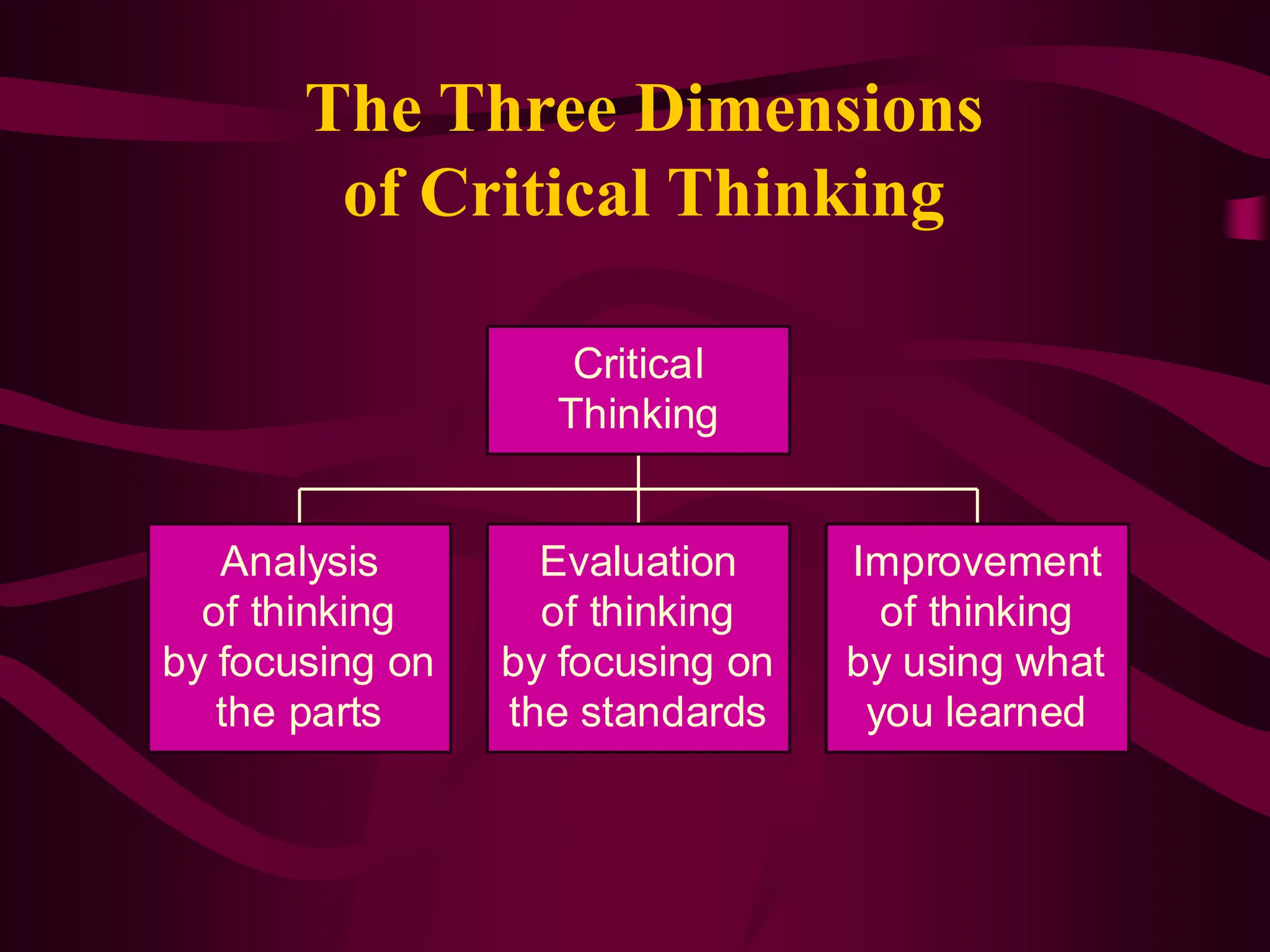
The Three Dimensions
of Critical Thinking
Analysis
of thinking
by focusing on
the parts
Evaluation
of thinking
by focusing on
the standards
Improvement
of thinking
by using what
you learned
Critical
Thinking
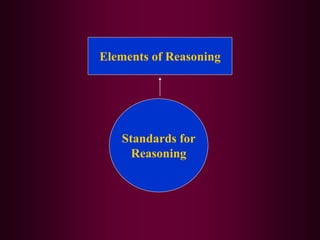
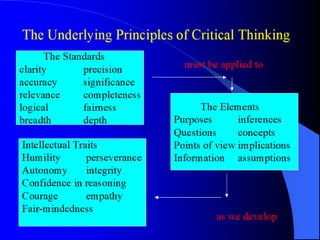
Standards for
Reasoning
Elements of Reasoning
Intellectual Standards:
And questions that can be used to
apply them
Intellectual standards are standards which
must be applied to thinking whenever one is
interested in checking the quality of
reasoning about a problem, issue, or
situation. To think critically entails having
command of these standards.
While there are a number of universal
standards for thought, we tend to begin with
the following standards, when working with
students:
Could you elaborate further on that point?
Could you express that point in
another way?
Could you give me an illustration?
Could you give me an example?
Clarity is a gateway standard. If a statement is unclear, we
cannot determine whether it is accurate or relevant. In
fact, we cannot tell anything about it because we don’t yet
know what it is saying. For example, the question “What
can be done about the education system in America?” is
unclear. In order to adequately address the question, we
would need to have a clearer understanding of what the
person asking the question is considering the “problem”
to be. A clearer question might be “What can educators do
to ensure that students learn the skills and abilities which
help them function successfully on the job and in their
daily decision-making?”
Clarity:
Accuracy:
Is that really true?
How could we check that?
How could we find out if that is true?
A statement can be clear but not accurate, as
in “Most dogs are over 300 pounds in
weight.”
Precision:
Could you give me more details?
Could you be more specific?
A statement can be both clear and accurate,
but not precise, as in “Jack is overweight.”
(We don’t know how overweight Jack is,
one pound or 500 pounds.)
Relevance:
How is that connected to the question?
How does that bear on the issue?
A statement can be clear, accurate, and precise, but
not relevant to the question at issue. For example,
students often think that the amount of effort they
put into a course should be used in raising their
grade in a course. Often, however, “effort” does
not measure the quality of student learning, and
when that is so, effort is irrelevant to their
appropriate grade.
Depth:
How does your answer address the complexities in
the question?
How are you taking into account the problems in the
question?
Is that dealing with the most significant factors?
A statement can be clear, accurate, precise, and relevant, but
superficial (that is, lack depth). For example, the statement
“Just Say No” which is often used to discourage children
and teens from using drugs, is clear, accurate, precise, and
relevant. Nevertheless, it lacks depth because it treats an
extremely complex issue, the pervasive problem of drug
use among young people, superficially. It fails to deal with
the complexities of the issue.
Breadth:
Do we need to consider another point of view?
Is there another way to look at this question?
What would this look like from a conservative
standpoint?
What would this look like from the point of view
of...?
A line of reasoning may be clear, accurate, precise,
relevant, and deep, but lack breadth (as in an
argument from either the conservative or liberal
standpoints which gets deeply into an issue, but
only recognizes the insights of one side of the
question).
Logic:
Does this really make sense?
Does that follow from what you said?
How does that follow?
But before you implied this and now you are saying
that, I don’t see how both can be true.
When we think, we bring a variety of thoughts
together into some order. When the combination
of thoughts are mutually supporting and make
sense in combination, the thinking is “logical.”
When the combination is not mutually supporting,
is contradictory in some sense, or does not “make
sense,” the combination is “not logical.”
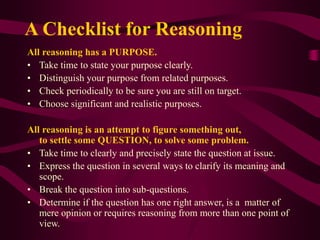
A Checklist for Reasoning
All reasoning has a PURPOSE.
• Take time to state your purpose clearly.
• Distinguish your purpose from related purposes.
• Check periodically to be sure you are still on target.
• Choose significant and realistic purposes.
All reasoning is an attempt to figure something out,
to settle some QUESTION, to solve some problem.
• Take time to clearly and precisely state the question at issue.
• Express the question in several ways to clarify its meaning and
scope.
• Break the question into sub-questions.
• Determine if the question has one right answer, is a matter of
mere opinion or requires reasoning from more than one point of
view.
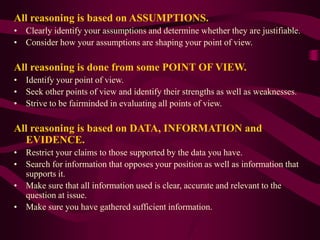
All reasoning is based on ASSUMPTIONS.
• Clearly identify your assumptions and determine whether they are justifiable.
• Consider how your assumptions are shaping your point of view.
All reasoning is done from some POINT OF VIEW.
• Identify your point of view.
• Seek other points of view and identify their strengths as well as weaknesses.
• Strive to be fairminded in evaluating all points of view.
All reasoning is based on DATA, INFORMATION and
EVIDENCE.
• Restrict your claims to those supported by the data you have.
• Search for information that opposes your position as well as information that
supports it.
• Make sure that all information used is clear, accurate and relevant to the
question at issue.
• Make sure you have gathered sufficient information.
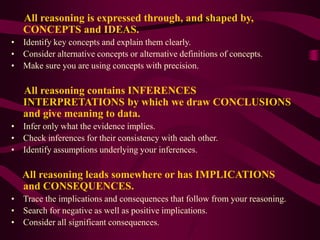
All reasoning is expressed through, and shaped by,
CONCEPTS and IDEAS.
• Identify key concepts and explain them clearly.
• Consider alternative concepts or alternative definitions of concepts.
• Make sure you are using concepts with precision.
All reasoning contains INFERENCES
INTERPRETATIONS by which we draw CONCLUSIONS
and give meaning to data.
• Infer only what the evidence implies.
• Check inferences for their consistency with each other.
• Identify assumptions underlying your inferences.
All reasoning leads somewhere or has IMPLICATIONS
and CONSEQUENCES.
• Trace the implications and consequences that follow from your reasoning.
• Search for negative as well as positive implications.
• Consider all significant consequences.
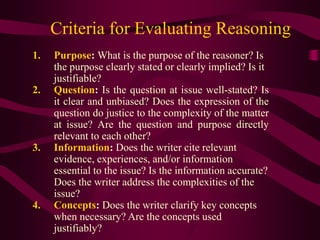
Criteria for Evaluating Reasoning
1. Purpose: What is the purpose of the reasoner? Is
the purpose clearly stated or clearly implied? Is it
justifiable?
2. Question: Is the question at issue well-stated? Is
it clear and unbiased? Does the expression of the
question do justice to the complexity of the matter
at issue? Are the question and purpose directly
relevant to each other?
3. Information: Does the writer cite relevant
evidence, experiences, and/or information
essential to the issue? Is the information accurate?
Does the writer address the complexities of the
issue?
4. Concepts: Does the writer clarify key concepts
when necessary? Are the concepts used
justifiably?
Criteria For Evaluating
Reasoning (cont.)
5. Assumptions: Does the writer show a sensitivity to what
he or she is taking for granted or assuming? (Insofar as
those assumptions might reasonably be questioned?) Does
the writer use questionable assumptions without addressing
problems which might be inherent in those assumptions?
6. Inferences: Does the writer develop a line of reasoning
explaining well how s/he is arriving at her or his main
conclusions?
7. Point of View: Does the writer show a sensitivity to
alternative relevant points of view or lines of reasoning?
Does s/he consider and respond to objections framed from
other relevant points of view?
8. Implications: Does the writer show a sensitivity to the
implications and consequences of the position s/he is
taking?
Evaluating Your Writing
As You Write
To write well, you also need to evaluate our work as
you go. Use intellectual standards as guides for
questioning the quality of your writing
Clarity: Am I clear about what I am writing? Or is my
thinking muddled? For each paragraph, have I stated my
main idea, then elaborated it? Have I provided examples
to make my points clear? Have I illustrated important
ideas? Have I written sentences that can be interpreted in
different ways, or is my intended meaning clear?
Precision: Have I provided adequate details for the reader
to understand precisely what I mean? Do I need more
details?
Logic: Do all the ideas in my paper logically fit together?
Have I used transitional words to make connections
between ideas evident to the reader?
Relevance: In the paper as a whole, have I adhered to the
main issue I am dealing with, or do I wander from idea to
idea? In each paragraph, is everything in the paragraph
relevant to the main idea in the paragraph? Have I
included only that information that is irrelevant to the
issue?
Significance: Are the ideas I am dealing with
important, or is my work superficial? What is the
most significant question to focus on? What are the
most significant concepts? Facts?
Depth: Do I clearly understand what makes the issue
complex? Have I sufficiently detailed those
complexities?
Fairness: Have I been fair to all viewpoints relevant to
the issue? Or have I presented opposing viewpoints
in a “weak” form, in order to dismiss them?
Accuracy: Have I made sure that all the information I
have presented as factual is actually verified? Are
my sources of information credible?

Dimensions of Critical thinking reasoning

  • 1.
    The Three Dimensions ofCritical Thinking Analysis of thinking by focusing on the parts Evaluation of thinking by focusing on the standards Improvement of thinking by using what you learned Critical Thinking
  • 2.
  • 4.
    Intellectual Standards: And questionsthat can be used to apply them Intellectual standards are standards which must be applied to thinking whenever one is interested in checking the quality of reasoning about a problem, issue, or situation. To think critically entails having command of these standards.
  • 5.
    While there area number of universal standards for thought, we tend to begin with the following standards, when working with students:
  • 6.
    Could you elaboratefurther on that point? Could you express that point in another way? Could you give me an illustration? Could you give me an example? Clarity is a gateway standard. If a statement is unclear, we cannot determine whether it is accurate or relevant. In fact, we cannot tell anything about it because we don’t yet know what it is saying. For example, the question “What can be done about the education system in America?” is unclear. In order to adequately address the question, we would need to have a clearer understanding of what the person asking the question is considering the “problem” to be. A clearer question might be “What can educators do to ensure that students learn the skills and abilities which help them function successfully on the job and in their daily decision-making?” Clarity:
  • 7.
    Accuracy: Is that reallytrue? How could we check that? How could we find out if that is true? A statement can be clear but not accurate, as in “Most dogs are over 300 pounds in weight.”
  • 8.
    Precision: Could you giveme more details? Could you be more specific? A statement can be both clear and accurate, but not precise, as in “Jack is overweight.” (We don’t know how overweight Jack is, one pound or 500 pounds.)
  • 9.
    Relevance: How is thatconnected to the question? How does that bear on the issue? A statement can be clear, accurate, and precise, but not relevant to the question at issue. For example, students often think that the amount of effort they put into a course should be used in raising their grade in a course. Often, however, “effort” does not measure the quality of student learning, and when that is so, effort is irrelevant to their appropriate grade.
  • 10.
    Depth: How does youranswer address the complexities in the question? How are you taking into account the problems in the question? Is that dealing with the most significant factors? A statement can be clear, accurate, precise, and relevant, but superficial (that is, lack depth). For example, the statement “Just Say No” which is often used to discourage children and teens from using drugs, is clear, accurate, precise, and relevant. Nevertheless, it lacks depth because it treats an extremely complex issue, the pervasive problem of drug use among young people, superficially. It fails to deal with the complexities of the issue.
  • 11.
    Breadth: Do we needto consider another point of view? Is there another way to look at this question? What would this look like from a conservative standpoint? What would this look like from the point of view of...? A line of reasoning may be clear, accurate, precise, relevant, and deep, but lack breadth (as in an argument from either the conservative or liberal standpoints which gets deeply into an issue, but only recognizes the insights of one side of the question).
  • 12.
    Logic: Does this reallymake sense? Does that follow from what you said? How does that follow? But before you implied this and now you are saying that, I don’t see how both can be true. When we think, we bring a variety of thoughts together into some order. When the combination of thoughts are mutually supporting and make sense in combination, the thinking is “logical.” When the combination is not mutually supporting, is contradictory in some sense, or does not “make sense,” the combination is “not logical.”
  • 13.
    A Checklist forReasoning All reasoning has a PURPOSE. • Take time to state your purpose clearly. • Distinguish your purpose from related purposes. • Check periodically to be sure you are still on target. • Choose significant and realistic purposes. All reasoning is an attempt to figure something out, to settle some QUESTION, to solve some problem. • Take time to clearly and precisely state the question at issue. • Express the question in several ways to clarify its meaning and scope. • Break the question into sub-questions. • Determine if the question has one right answer, is a matter of mere opinion or requires reasoning from more than one point of view.
  • 14.
    All reasoning isbased on ASSUMPTIONS. • Clearly identify your assumptions and determine whether they are justifiable. • Consider how your assumptions are shaping your point of view. All reasoning is done from some POINT OF VIEW. • Identify your point of view. • Seek other points of view and identify their strengths as well as weaknesses. • Strive to be fairminded in evaluating all points of view. All reasoning is based on DATA, INFORMATION and EVIDENCE. • Restrict your claims to those supported by the data you have. • Search for information that opposes your position as well as information that supports it. • Make sure that all information used is clear, accurate and relevant to the question at issue. • Make sure you have gathered sufficient information.
  • 15.
    All reasoning isexpressed through, and shaped by, CONCEPTS and IDEAS. • Identify key concepts and explain them clearly. • Consider alternative concepts or alternative definitions of concepts. • Make sure you are using concepts with precision. All reasoning contains INFERENCES INTERPRETATIONS by which we draw CONCLUSIONS and give meaning to data. • Infer only what the evidence implies. • Check inferences for their consistency with each other. • Identify assumptions underlying your inferences. All reasoning leads somewhere or has IMPLICATIONS and CONSEQUENCES. • Trace the implications and consequences that follow from your reasoning. • Search for negative as well as positive implications. • Consider all significant consequences.
  • 16.
    Criteria for EvaluatingReasoning 1. Purpose: What is the purpose of the reasoner? Is the purpose clearly stated or clearly implied? Is it justifiable? 2. Question: Is the question at issue well-stated? Is it clear and unbiased? Does the expression of the question do justice to the complexity of the matter at issue? Are the question and purpose directly relevant to each other? 3. Information: Does the writer cite relevant evidence, experiences, and/or information essential to the issue? Is the information accurate? Does the writer address the complexities of the issue? 4. Concepts: Does the writer clarify key concepts when necessary? Are the concepts used justifiably?
  • 17.
    Criteria For Evaluating Reasoning(cont.) 5. Assumptions: Does the writer show a sensitivity to what he or she is taking for granted or assuming? (Insofar as those assumptions might reasonably be questioned?) Does the writer use questionable assumptions without addressing problems which might be inherent in those assumptions? 6. Inferences: Does the writer develop a line of reasoning explaining well how s/he is arriving at her or his main conclusions? 7. Point of View: Does the writer show a sensitivity to alternative relevant points of view or lines of reasoning? Does s/he consider and respond to objections framed from other relevant points of view? 8. Implications: Does the writer show a sensitivity to the implications and consequences of the position s/he is taking?
  • 18.
    Evaluating Your Writing AsYou Write To write well, you also need to evaluate our work as you go. Use intellectual standards as guides for questioning the quality of your writing
  • 19.
    Clarity: Am Iclear about what I am writing? Or is my thinking muddled? For each paragraph, have I stated my main idea, then elaborated it? Have I provided examples to make my points clear? Have I illustrated important ideas? Have I written sentences that can be interpreted in different ways, or is my intended meaning clear? Precision: Have I provided adequate details for the reader to understand precisely what I mean? Do I need more details? Logic: Do all the ideas in my paper logically fit together? Have I used transitional words to make connections between ideas evident to the reader? Relevance: In the paper as a whole, have I adhered to the main issue I am dealing with, or do I wander from idea to idea? In each paragraph, is everything in the paragraph relevant to the main idea in the paragraph? Have I included only that information that is irrelevant to the issue?
  • 20.
    Significance: Are theideas I am dealing with important, or is my work superficial? What is the most significant question to focus on? What are the most significant concepts? Facts? Depth: Do I clearly understand what makes the issue complex? Have I sufficiently detailed those complexities? Fairness: Have I been fair to all viewpoints relevant to the issue? Or have I presented opposing viewpoints in a “weak” form, in order to dismiss them? Accuracy: Have I made sure that all the information I have presented as factual is actually verified? Are my sources of information credible?