Digital Marketing
Email Marketing
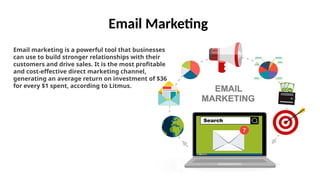
Email marketing is a powerful tool that businesses
can use to build stronger relationships with their
customers and drive sales. It is the most profitable
and cost-effective direct marketing channel,
generating an average return on investment of $36
for every $1 spent, according to Litmus.
Promotional emails
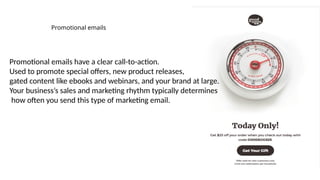
Promotional emails have a clear call-to-action.
Used to promote special offers, new product releases,
gated content like ebooks and webinars, and your brand at large.
Your business’s sales and marketing rhythm typically determines
how often you send this type of marketing email.
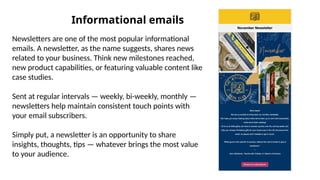
Informational emails
Newsletters are one of the most popular informational
emails. A newsletter, as the name suggests, shares news
related to your business. Think new milestones reached,
new product capabilities, or featuring valuable content like
case studies.
Sent at regular intervals — weekly, bi-weekly, monthly —
newsletters help maintain consistent touch points with
your email subscribers.
Simply put, a newsletter is an opportunity to share
insights, thoughts, tips — whatever brings the most value
to your audience.
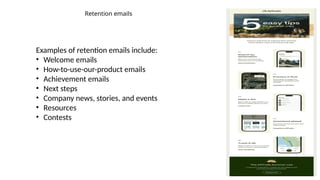
Retention emails
Examples of retention emails include:
• Welcome emails
• How-to-use-our-product emails
• Achievement emails
• Next steps
• Company news, stories, and events
• Resources
• Contests
Transactional emails
These emails are automated
messages triggered as a response
to certain actions taken by your
customers, such as when a
customer buys an item from your
shop.
Examples of transactional emails
include:
•Order confirmations
•Thank yous
•Password resets
•Abandoned cart emails
•Product review requests
The benefits of email marketing
• Conversions (selling your products and services).
• Brand awareness
• Customer loyalty
Forums
Forum marketing focuses on specific subjects so people that
joined the actual forum can get access to more detailed
information.
The participants can have the discussion wherever they're as
long as they need something in common like background,
experience, even culture.
Online forums can be valuable resources in the field of digital
marketing.
They provide a platform for marketers, business owners, and
enthusiasts to discuss strategies, share insights, seek advice,
and stay updated on industry trends.
Social network
Social media marketing is a form of
digital marketing that leverages the
power of popular social media
networks to achieve your marketing
and branding goals.
But it’s not just about creating
business accounts and posting when
you feel like it.
Social network
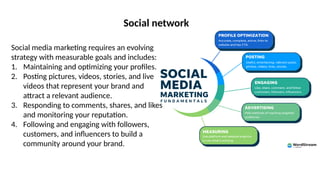
Social media marketing requires an evolving
strategy with measurable goals and includes:
1. Maintaining and optimizing your profiles.
2. Posting pictures, videos, stories, and live
videos that represent your brand and
attract a relevant audience.
3. Responding to comments, shares, and likes
and monitoring your reputation.
4. Following and engaging with followers,
customers, and influencers to build a
community around your brand.
Humanize your business: It turns your business into an active participant in
your market. Your profile, posts, and interactions with users form an
approachable persona that your audience can familiarize and connect with,
and come to trust.
Drive traffic: Between the link in your profile, blog post links in your posts,
and your ads, social media is a top channel for increasing traffic to your
website where you can convert visitors into customers. Plus, social signals are
an indirect SEO factor.
Generate leads and customers: You can also generate leads and conversions
directly on these platforms, through features like Instagram/Facebook shops,
direct messaging, call to action buttons on profiles, and appointment booking
capabilities.
Benefits
Increase brand awareness: The visual nature of social media platforms
allows you to build your visual identity across vast audiences and improve
brand awareness. And better brand awareness means better results with
all your other campaigns.
Build relationships: These platforms open up both direct and indirect lines
of communication with your followers through which you can network,
gather feedback, hold discussions, and connect directly with individuals.
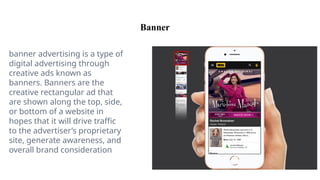
Banner
banner advertising is a type of
digital advertising through
creative ads known as
banners. Banners are the
creative rectangular ad that
are shown along the top, side,
or bottom of a website in
hopes that it will drive traffic
to the advertiser’s proprietary
site, generate awareness, and
overall brand consideration
Banner ads can be static or dynamic ads that are strategically
positioned on a website to capture consumers’ attention.
Through banner advertising, brands can promote their brand as well
as encourage viewers to visit the brand's website.
Banner ads are an impactful way to increase customer traffic, sell a
product, and/or grab a customer’s attention. To determine whether
banner advertising is effective, it is important to look at an ad’s CTR,
or click-through-rate.
How to create banner ads
1. Outlining brand goals and objectives. Brands must think critically around what success looks like within
a banner ad campaign and the desired action viewers should take after seeing the banner ad.
2. Agreeing upon a budget. Before launching a banner ad, it is important to know how much a brand is
willing to invest in order to know how much advertising spend can go against the ad.
3. Identifying the right audience. Who is the ad intended to reach? Ensuring the brand has the
appropriate audience in mind for the banner ad affects the overall success of the ad.
4. Create the right CTA. What do brands want viewers to do? This could range from learning more about
the brand or clicking on the ad to subscribe to their newsletter on their website.
5. What will the ad creative look like? This should be informed by both the brand’s business goals and
creative direction. Banner ad creatives should consider branding logos, high-quality imagery, readable
text, and overall company branding.
For banner ad sizes, the ad specs depend on the banner shape,
ranging from medium to large rectangle, small to medium
square, half page, and more.
The three standard ad formats are
leaderboard (728 X 90),
medium rectangle (300 X 250),
skyscraper (160 X 600).
digitalMarketing.pptx can use it college

digitalMarketing.pptx can use it college

  • 1.
  • 3.
    Email Marketing Email marketingis a powerful tool that businesses can use to build stronger relationships with their customers and drive sales. It is the most profitable and cost-effective direct marketing channel, generating an average return on investment of $36 for every $1 spent, according to Litmus.
  • 5.
    Promotional emails Promotional emailshave a clear call-to-action. Used to promote special offers, new product releases, gated content like ebooks and webinars, and your brand at large. Your business’s sales and marketing rhythm typically determines how often you send this type of marketing email.
  • 6.
    Informational emails Newsletters areone of the most popular informational emails. A newsletter, as the name suggests, shares news related to your business. Think new milestones reached, new product capabilities, or featuring valuable content like case studies. Sent at regular intervals — weekly, bi-weekly, monthly — newsletters help maintain consistent touch points with your email subscribers. Simply put, a newsletter is an opportunity to share insights, thoughts, tips — whatever brings the most value to your audience.
  • 7.
    Retention emails Examples ofretention emails include: • Welcome emails • How-to-use-our-product emails • Achievement emails • Next steps • Company news, stories, and events • Resources • Contests
  • 8.
    Transactional emails These emailsare automated messages triggered as a response to certain actions taken by your customers, such as when a customer buys an item from your shop. Examples of transactional emails include: •Order confirmations •Thank yous •Password resets •Abandoned cart emails •Product review requests
  • 9.
    The benefits ofemail marketing • Conversions (selling your products and services). • Brand awareness • Customer loyalty
  • 10.
    Forums Forum marketing focuseson specific subjects so people that joined the actual forum can get access to more detailed information. The participants can have the discussion wherever they're as long as they need something in common like background, experience, even culture. Online forums can be valuable resources in the field of digital marketing. They provide a platform for marketers, business owners, and enthusiasts to discuss strategies, share insights, seek advice, and stay updated on industry trends.
  • 11.
    Social network Social mediamarketing is a form of digital marketing that leverages the power of popular social media networks to achieve your marketing and branding goals. But it’s not just about creating business accounts and posting when you feel like it.
  • 12.
    Social network Social mediamarketing requires an evolving strategy with measurable goals and includes: 1. Maintaining and optimizing your profiles. 2. Posting pictures, videos, stories, and live videos that represent your brand and attract a relevant audience. 3. Responding to comments, shares, and likes and monitoring your reputation. 4. Following and engaging with followers, customers, and influencers to build a community around your brand.
  • 13.
    Humanize your business:It turns your business into an active participant in your market. Your profile, posts, and interactions with users form an approachable persona that your audience can familiarize and connect with, and come to trust. Drive traffic: Between the link in your profile, blog post links in your posts, and your ads, social media is a top channel for increasing traffic to your website where you can convert visitors into customers. Plus, social signals are an indirect SEO factor. Generate leads and customers: You can also generate leads and conversions directly on these platforms, through features like Instagram/Facebook shops, direct messaging, call to action buttons on profiles, and appointment booking capabilities. Benefits
  • 14.
    Increase brand awareness:The visual nature of social media platforms allows you to build your visual identity across vast audiences and improve brand awareness. And better brand awareness means better results with all your other campaigns. Build relationships: These platforms open up both direct and indirect lines of communication with your followers through which you can network, gather feedback, hold discussions, and connect directly with individuals.
  • 15.
    Banner banner advertising isa type of digital advertising through creative ads known as banners. Banners are the creative rectangular ad that are shown along the top, side, or bottom of a website in hopes that it will drive traffic to the advertiser’s proprietary site, generate awareness, and overall brand consideration
  • 16.
    Banner ads canbe static or dynamic ads that are strategically positioned on a website to capture consumers’ attention. Through banner advertising, brands can promote their brand as well as encourage viewers to visit the brand's website. Banner ads are an impactful way to increase customer traffic, sell a product, and/or grab a customer’s attention. To determine whether banner advertising is effective, it is important to look at an ad’s CTR, or click-through-rate.
  • 17.
    How to createbanner ads 1. Outlining brand goals and objectives. Brands must think critically around what success looks like within a banner ad campaign and the desired action viewers should take after seeing the banner ad. 2. Agreeing upon a budget. Before launching a banner ad, it is important to know how much a brand is willing to invest in order to know how much advertising spend can go against the ad. 3. Identifying the right audience. Who is the ad intended to reach? Ensuring the brand has the appropriate audience in mind for the banner ad affects the overall success of the ad. 4. Create the right CTA. What do brands want viewers to do? This could range from learning more about the brand or clicking on the ad to subscribe to their newsletter on their website. 5. What will the ad creative look like? This should be informed by both the brand’s business goals and creative direction. Banner ad creatives should consider branding logos, high-quality imagery, readable text, and overall company branding.
  • 18.
    For banner adsizes, the ad specs depend on the banner shape, ranging from medium to large rectangle, small to medium square, half page, and more. The three standard ad formats are leaderboard (728 X 90), medium rectangle (300 X 250), skyscraper (160 X 600).