Digital Geometry and Image Processing
Dietmar Saupe
Course Outline
SS 2006
Digital Geometry and Image
Processing (3V+2Ü)
 Geometric methods for digital picture analysis
 Scope: Graduate course
 Information Engineering master and PhD students
 Classes (Vorlesung), D. Saupe
 Tuesdays 8:15h-11h, Z714 (preliminary)
 Problem sessions (Übg.), V. Bondarenko
 Thursdays 14:00h-15:30h, Z714 (preliminary)
Primary course text book
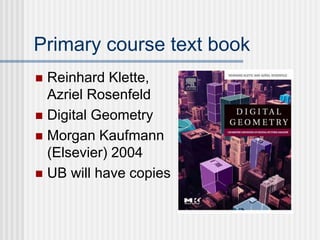
 Reinhard Klette,
Azriel Rosenfeld
 Digital Geometry
 Morgan Kaufmann
(Elsevier) 2004
 UB will have copies
Secondary course text book
 R.C. Gonzales, R.E. Woods
 Digital Image Processing
 Prentice-Hall (2nd Ed.) 2002
 3rd edition
 UB has copies
Digital Geometry
Geometric methods for digital picture analysis
 Focus is on digital image or picture
analysis
 Core of the field
 Related mathematical fundamenals
 It is not
 yet another treatment of a very broad range
of problems, algorithms, heuristics, and
„useful“ technologies
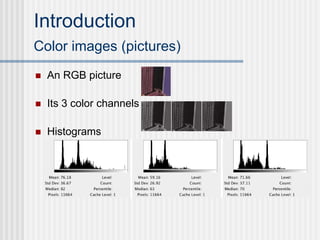
Introduction
Color images (pictures)
 An RGB picture
 Its 3 color channels
 Histograms
Introduction
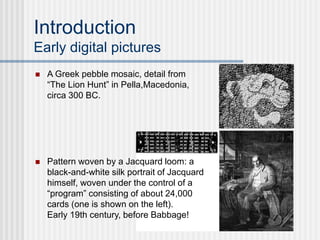
Early digital pictures
 A Greek pebble mosaic, detail from
“The Lion Hunt” in Pella,Macedonia,
circa 300 BC.
 Pattern woven by a Jacquard loom: a
black-and-white silk portrait of Jacquard
himself, woven under the control of a
“program” consisting of about 24,000
cards (one is shown on the left).
Early 19th century, before Babbage!
Introduction
Digital pictures in 2005
 Standard 16 Megapixel CCD cameras evolving
 Specialized cameras in photogrammetry of 100 Megapixels
 3D imaging modalities (CT, MRI, ...)
 3D-laser range scanners
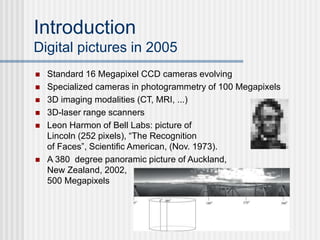
 Leon Harmon of Bell Labs: picture of
Lincoln (252 pixels), “The Recognition
of Faces”, Scientific American, (Nov. 1973).
 A 380 degree panoramic picture of Auckland,
New Zealand, 2002,
500 Megapixels
Introduction
Grid of squares versus grid of points
 Two concepts for pixels (cells)
 Is the value a component of the pixel?
 A picture P is a mapping of a finite
rectangular grid region into the reals
 Generalization to 3D: voxel
Introduction
Adjacency
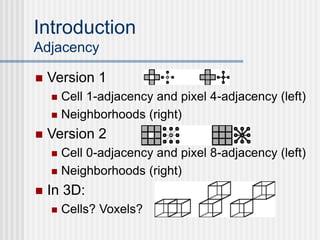
 Version 1
 Cell 1-adjacency and pixel 4-adjacency (left)
 Neighborhoods (right)
 Version 2
 Cell 0-adjacency and pixel 8-adjacency (left)
 Neighborhoods (right)
 In 3D:
 Cells? Voxels?
Introduction
Replace the X´s!
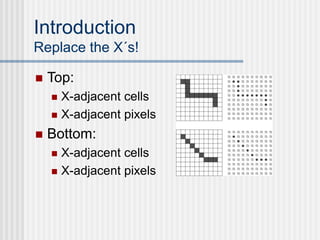
 Top:
 X-adjacent cells
 X-adjacent pixels
 Bottom:
 X-adjacent cells
 X-adjacent pixels
Introduction
Same in 3D!
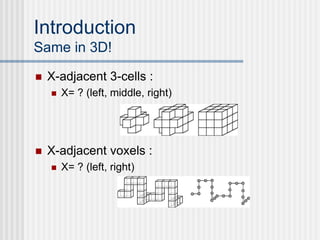
 X-adjacent 3-cells :
 X= ? (left, middle, right)
 X-adjacent voxels :
 X= ? (left, right)
Introduction
Grid point connectivity
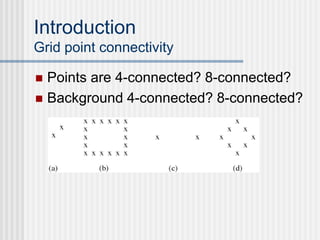
 Points are 4-connected? 8-connected?
 Background 4-connected? 8-connected?
Introduction
Equivalent classes
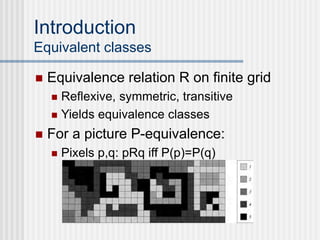
 Equivalence relation R on finite grid
 Reflexive, symmetric, transitive
 Yields equivalence classes
 For a picture P-equivalence:
 Pixels p,q: pRq iff P(p)=P(q)
Introduction
Component labelling
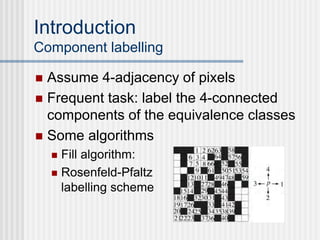
 Assume 4-adjacency of pixels
 Frequent task: label the 4-connected
components of the equivalence classes
 Some algorithms
 Fill algorithm:
 Rosenfeld-Pfaltz
labelling scheme
Introduction
Image scan sequences
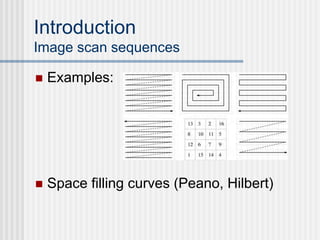
 Examples:
 Space filling curves (Peano, Hilbert)
Topics (Chapters)
Metrics
 Basics: Norms, Minkowski metrics, integer valued
metrics, induced topology, Hausdorff metric
 Grid point metrics, paths, geodesics, intrinsic distances
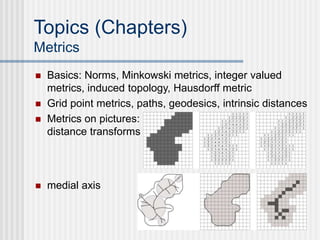
 Metrics on pictures:
distance transforms
 medial axis
Topics (Chapters)
Adjacency graphs
 Graphs and connectedness, basic graph theory, Euler
characteristic and planarity
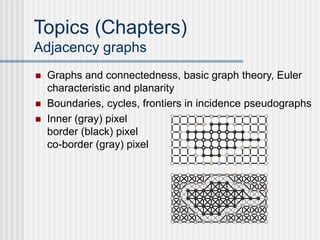
 Boundaries, cycles, frontiers in incidence pseudographs
 Inner (gray) pixel
border (black) pixel
co-border (gray) pixel
Topics (Chapters)
Topology
 Topological spaces, digital topologies
 Concepts homeomorphy, isotopy (top.
equivalence)
 Simplicial complexes, triangulations
Topics (Chapters)
Curves and surfaces: topology, geometry
 Jordan curves, curves in grids
 Surfaces and manifolds, ... in 3D grids
 Arc length, curvature, angles, areas
 Surfaces and solids
 Principal, gaussian, mean curvature
 Tracing surfaces
Topics (Chapters)
Curves and surfaces in grids
 Straightness, 2D and 3D
 Measuring arc length, curvature, corners
 Digital planes
 Measuring surface area, curvature
Selected Topics
 Moments and their estimation
 Other picture properties
 Spatial relations
Selected Topics (not covered)
 Hulls and diagrams (convexity, Voronoi)
 Transformations (t. groups, symmetries,
magnification, ...)
 Morphological operators (dilation, erosion,
simplification, segmentation, ...)
 Deformations (topological-preserving def.,
shrinking, thinning, ...)

DigitalGeometry.ppt

  • 1.
    Digital Geometry andImage Processing Dietmar Saupe Course Outline SS 2006
  • 2.
    Digital Geometry andImage Processing (3V+2Ü)  Geometric methods for digital picture analysis  Scope: Graduate course  Information Engineering master and PhD students  Classes (Vorlesung), D. Saupe  Tuesdays 8:15h-11h, Z714 (preliminary)  Problem sessions (Übg.), V. Bondarenko  Thursdays 14:00h-15:30h, Z714 (preliminary)
  • 3.
    Primary course textbook  Reinhard Klette, Azriel Rosenfeld  Digital Geometry  Morgan Kaufmann (Elsevier) 2004  UB will have copies
  • 4.
    Secondary course textbook  R.C. Gonzales, R.E. Woods  Digital Image Processing  Prentice-Hall (2nd Ed.) 2002  3rd edition  UB has copies
  • 5.
    Digital Geometry Geometric methodsfor digital picture analysis  Focus is on digital image or picture analysis  Core of the field  Related mathematical fundamenals  It is not  yet another treatment of a very broad range of problems, algorithms, heuristics, and „useful“ technologies
  • 6.
    Introduction Color images (pictures) An RGB picture  Its 3 color channels  Histograms
  • 7.
    Introduction Early digital pictures A Greek pebble mosaic, detail from “The Lion Hunt” in Pella,Macedonia, circa 300 BC.  Pattern woven by a Jacquard loom: a black-and-white silk portrait of Jacquard himself, woven under the control of a “program” consisting of about 24,000 cards (one is shown on the left). Early 19th century, before Babbage!
  • 8.
    Introduction Digital pictures in2005  Standard 16 Megapixel CCD cameras evolving  Specialized cameras in photogrammetry of 100 Megapixels  3D imaging modalities (CT, MRI, ...)  3D-laser range scanners  Leon Harmon of Bell Labs: picture of Lincoln (252 pixels), “The Recognition of Faces”, Scientific American, (Nov. 1973).  A 380 degree panoramic picture of Auckland, New Zealand, 2002, 500 Megapixels
  • 9.
    Introduction Grid of squaresversus grid of points  Two concepts for pixels (cells)  Is the value a component of the pixel?  A picture P is a mapping of a finite rectangular grid region into the reals  Generalization to 3D: voxel
  • 10.
    Introduction Adjacency  Version 1 Cell 1-adjacency and pixel 4-adjacency (left)  Neighborhoods (right)  Version 2  Cell 0-adjacency and pixel 8-adjacency (left)  Neighborhoods (right)  In 3D:  Cells? Voxels?
  • 11.
    Introduction Replace the X´s! Top:  X-adjacent cells  X-adjacent pixels  Bottom:  X-adjacent cells  X-adjacent pixels
  • 12.
    Introduction Same in 3D! X-adjacent 3-cells :  X= ? (left, middle, right)  X-adjacent voxels :  X= ? (left, right)
  • 13.
    Introduction Grid point connectivity Points are 4-connected? 8-connected?  Background 4-connected? 8-connected?
  • 14.
    Introduction Equivalent classes  Equivalencerelation R on finite grid  Reflexive, symmetric, transitive  Yields equivalence classes  For a picture P-equivalence:  Pixels p,q: pRq iff P(p)=P(q)
  • 15.
    Introduction Component labelling  Assume4-adjacency of pixels  Frequent task: label the 4-connected components of the equivalence classes  Some algorithms  Fill algorithm:  Rosenfeld-Pfaltz labelling scheme
  • 16.
    Introduction Image scan sequences Examples:  Space filling curves (Peano, Hilbert)
  • 17.
    Topics (Chapters) Metrics  Basics:Norms, Minkowski metrics, integer valued metrics, induced topology, Hausdorff metric  Grid point metrics, paths, geodesics, intrinsic distances  Metrics on pictures: distance transforms  medial axis
  • 18.
    Topics (Chapters) Adjacency graphs Graphs and connectedness, basic graph theory, Euler characteristic and planarity  Boundaries, cycles, frontiers in incidence pseudographs  Inner (gray) pixel border (black) pixel co-border (gray) pixel
  • 19.
    Topics (Chapters) Topology  Topologicalspaces, digital topologies  Concepts homeomorphy, isotopy (top. equivalence)  Simplicial complexes, triangulations
  • 20.
    Topics (Chapters) Curves andsurfaces: topology, geometry  Jordan curves, curves in grids  Surfaces and manifolds, ... in 3D grids  Arc length, curvature, angles, areas  Surfaces and solids  Principal, gaussian, mean curvature  Tracing surfaces
  • 21.
    Topics (Chapters) Curves andsurfaces in grids  Straightness, 2D and 3D  Measuring arc length, curvature, corners  Digital planes  Measuring surface area, curvature
  • 22.
    Selected Topics  Momentsand their estimation  Other picture properties  Spatial relations
  • 23.
    Selected Topics (notcovered)  Hulls and diagrams (convexity, Voronoi)  Transformations (t. groups, symmetries, magnification, ...)  Morphological operators (dilation, erosion, simplification, segmentation, ...)  Deformations (topological-preserving def., shrinking, thinning, ...)