DIGITAL PAYMENTS ROADMAP: TOWARDS INCLUSIVE, ACCESSIBLE, EFFECTIVE AND SUSTAINABLE DIGITAL PAYMENTS IN SOUTH AFRICA
DIGITAL PAYMENTS ROADMAP:
TOWARDS INCLUSIVE, ACCESSIBLE,
EFFECTIVE AND SUSTAINABLE DIGITAL
PAYMENTS IN SOUTH AFRICA
© South African Reserve Bank
All rights reserved. No part of this publication may be reproduced, stored in a retrieval system, or transmitted in any form or by any means, electronic,
mechanical, photocopying, recording or otherwise, without fully acknowledging the Digital Payments Roadmap: Towards inclusive, accessible,
effective and sustainable digital payments in South Africa of the South African Reserve Bank as the source. The contents of this publication are
intended for general information only and are not intended to serve as financial or other advice. While every precaution is taken to ensure the
accuracy of information, the South African Reserve Bank shall not be liable to any person for inaccurate information or opinions contained in this
publication. Unless indicated otherwise, data were supplied by the South African Reserve Bank.
Comments and enquiries relating to this publication are welcomed and should be addressed to:
Head: National Payment System Department
South African Reserve Bank
P O Box 427
Pretoria 0001
Tel. +27 12 313 3424
Email: npsdirectives@resbank.co.za
http://www.resbank.co.za
Produced by the South African Reserve Bank
DIGITAL PAYMENTS ROADMAP: TOWARDS INCLUSIVE, ACCESSIBLE, EFFECTIVE AND SUSTAINABLE DIGITAL PAYMENTS IN SOUTH AFRICA
1. Introduction			 2
2. Purpose, objectives and scope			 4
3. Digital payments landscape in South Africa			 6
4. Obstacles and challenges to achieving inclusive, accessible, effective and 			
sustainable digital payments in South Africa			 12
5. Towards inclusive, accessible, effective and sustainable digital payments 		 22
6. The enabling and catalysing regulator and the innovative payment industry		 35
7. Conclusion 38
Abbreviations			 39
Annexure A: Benefits of digital payments			 40
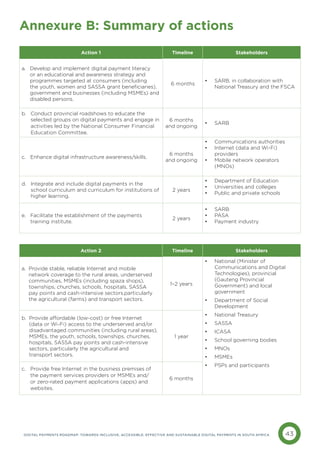
Annexure B: Summary of actions			 43
Contents
DIGITAL PAYMENTS ROADMAP: TOWARDS INCLUSIVE, ACCESSIBLE, EFFECTIVE AND SUSTAINABLE DIGITAL PAYMENTS IN SOUTH AFRICA
2 DIGITAL PAYMENTS ROADMAP: TOWARDS INCLUSIVE, ACCESSIBLE, EFFECTIVE AND SUSTAINABLE DIGITAL PAYMENTS IN SOUTH AFRICA
1
Innovation and technological advancements
are rapidly accelerating the transformation,
modernisation and digitisation of world economies.
According to a report by PricewaterhouseCoopers
titled ‘Payments 2025 and beyond’, global
cashless payment volumes are set to increase by
more than 80% from 2020 to 2025, from about
1 trillion transactions to almost 1.9 trillion, and to
almost triple by 2030.¹
Africa is embracing this transformation as
demonstrated through the African Union’s Digital
Transformation Strategy for Africa (2020–2030),
which states the following as its vision: “An integrated
and inclusive digital society and economy in Africa
that improves the quality of life of Africa’s citizens,
strengthens the existing economic sector, enable[s]
its diversification and development, and ensures
continental ownership with Africa as a producer
and not only a consumer in the global economy.”2
Digital payments are central to this digital economic
transformation, spurring economic activity, driving
digital trade and unlocking new opportunities for the
broader society.
South Africa (SA) has made great strides in embracing
this digital societal and economic transformation.
Digital payments are widely accessible to the broader
society and across all living standards measure (LSM)
market segments. More than 94% of South African
adults are financially included, and approximately
82% of this adult population has access to at least one
bank account. The phasing out of cheques in January
2021 , the launch of the new faster payments system
(PayShap) in March 2023, and the introduction and
use of contactless payments and quick response
(QR) codes, among other things, demonstrate
SA’s major commitment and accomplishments in
digitising payments and expanding the broader SA
digital economy.
Despite these accomplishments, the pace of
adoption of emerging digital payments and the
utilisation of existing digital payments in SA across all
the LSM market segments have been sluggish. Cash
remains king in SA, with individuals and businesses –
particularlythoseintheunderservedcommunities and
in the lower and middle LSMs (1–7) market segments
The PricewaterhouseCoopers report is available at https://www.pwc.
co.za/en/press-room/payments-2025-and-beyond.html
See the African Union’s vision for the Digital Transformation Strategy
for Africa (2020–2030), available at https://au.int/sites/default/files/
documents/38507-doc-dts-english.pdf
INTRODUCTION
1
2
3
DIGITAL PAYMENTS ROADMAP: TOWARDS INCLUSIVE, ACCESSIBLE, EFFECTIVE AND SUSTAINABLE DIGITAL PAYMENTS IN SOUTH AFRICA
– being overly reliant on cash for daily payments.
This over-reliance on cash – coupled with high costs to
consumers and micro, small and medium enterprises
(MSMEs); a lack of interoperability; financial exclusion
of the underserved or disadvantaged communities; a
lack of financial and digital literacy; a lack of or slow
modernisation of legacy systems; a lack of access to
infrastructure, including Internet/Wi-Fi; and lack of
trust in using digital payments – creates barriers or
obstacles to, and lowers the appetite for, an increased
adoption of new innovative digital payment methods
and the frequent use of existing digital payments.
As a result, a focused roadmap is required to identify
and break down the barriers, remove the obstacles,
increase accessibility and usability, and unlock the
potential of digital payments to spur economic activity
and trade, enhance economic growth and uplift the
lives of ordinary South Africans (see Annexure A:
Benefits of digital payments).
This Digital Payments Roadmap (Roadmap), known
as Project Stimela, aims to accelerate the pace of
adoption and use of digital payments in SA through
high-level action plans (see Annexure B: Summary of
the actions), and includes the following:
• the expansion of the accessibility of the national
payment system (NPS) to financial technologies
(fintechs) and non-banks;
• the provision of fast, low-cost innovative payment
products and services such as faster payments,
e-money and mobile money, including increasing
digitalpaymentsliteracyandawarenessinwomen,
the youth, MSMEs, government, government
social grant recipients, schools, and so forth; and
• the modernisation of the payment infrastructure,
including the extension of the reach of safe and
affordable Internet and data networks as well
as access points to the underserved lower and
middle LSMs market segments.
The Roadmap further underscores the importance
of embracing and leveraging new and emerging
payment methods, technologies and platforms such
as mobile money, e-money, central bank digital
currencies (CBDCs), application programming
interfaces (APIs), artificial intelligence, regulatory
technology (regtech) and supervisory technology
(suptech) to promote more inclusive, efficient,
effective, safer and sustainable digital payments
in SA.
The Roadmap is designed to realise the overarching
goals and strategies of the National Payment System
Framework and Strategy: Vision 2025 (Vision 2025).3
These include, among other things, the promotion
of competition and innovation, cost-effectiveness,
interoperability and financial inclusion. These
policy goals are to be achieved through leveraging
technological developments to extend the availability
of digital payments to all sectors of society.
The Roadmap further seeks to support National
Treasury’s draft policy paper titled ‘An inclusive
financial sector for all’ 4
in enhancing and deepening
financial inclusion in the SA financial sector.
The successful delivery of the Roadmap is centred
and dependent on public-public, public-private and
private-private partnerships and collaborations, and
on harnessing the capabilities and resources of the
multiple stakeholders within and beyond the payment
system ecosystem.
The Roadmap consists of the following sections:
• Section 2: Purpose, objectives and scope
• Section 3: Digital payments landscape in SA
• Section 4: Obstacles and challenges to achieving
inclusive, accessible, effective and sustainable
digital payments in SA
• Section 5: Towards inclusive, accessible, effective
and sustainable digital payments
• Section 6: The enabling and catalysing regulator
and the innovative payment industry
• Section 7: Conclusion
3 https://www.resbank.co.za/content/dam/sarb/what-we-do/payments-and-settlements/Vision%202025.pdf
http://www.treasury.gov.za/comm_media/press/2020/Financial%20Inclusion%20Policy%20-%20An%20Inclusive%20
Financial%20Sector%20For%20All.pdf
4
4 DIGITAL PAYMENTS ROADMAP: TOWARDS INCLUSIVE, ACCESSIBLE, EFFECTIVE AND SUSTAINABLE DIGITAL PAYMENTS IN SOUTH AFRICA
2
Purpose
The purpose of this Roadmap is to identify obstacles,
barriers and challenges to the adoption of an
increased and effective usage of digital payments,
and to develop a multi-disciplinary and stakeholder
action plan to unlock the inclusivity, effectiveness
and sustainability of digital payments in SA.
Objectives
The objectives of the Roadmap are to promote
and enable the offering and adoption of alternative
inclusive, cost-effective, sustainable and innovative
digital payments, and to increase the usage of
traditional and emerging digital payments to support
the socio-economic needs of all South Africans.
Scope
This Roadmap focuses on the SA payment ecosystem
and does not extend to cross-border payments.
PURPOSE,
OBJECTIVES AND
SCOPE
5
DIGITAL PAYMENTS ROADMAP: TOWARDS INCLUSIVE, ACCESSIBLE, EFFECTIVE AND SUSTAINABLE DIGITAL PAYMENTS IN SOUTH AFRICA
6 DIGITAL PAYMENTS ROADMAP: TOWARDS INCLUSIVE, ACCESSIBLE, EFFECTIVE AND SUSTAINABLE DIGITAL PAYMENTS IN SOUTH AFRICA
3 SA has an advanced banking and financial services
industry, with a society in digital transition. Digital
payments are widely accessible in SA, and financial
inclusion is high by the standards of developing
economies. The South African Reserve Bank
(SARB), in collaboration with the government (in
particular National Treasury) and the payment
industry, has made great strides in enabling
and enhancing the provision of safer, seamless,
convenient, affordable and faster digital payment
offerings. This section profiles the SA digital
payments landscape to highlight opportunities
that were leveraged to speed up beneficial change.
Retail payments
The SA retail payment services landscape has
developed significantly over the past few years.
The various retail payment methods currently
in use in SA include cards (debit, credit and
fleet), electronic funds transfer (EFT) (credit and
debit), authenticated collections (DebiCheck),
real-time clearing, PayShap (faster payments
system) and automated teller machines (ATMs).
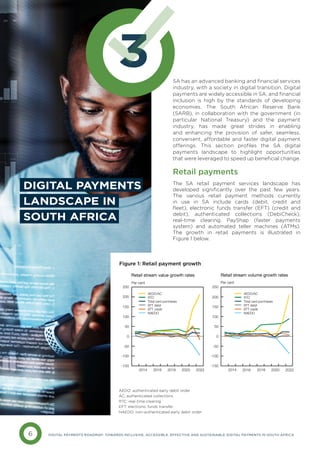
The growth in retail payments is illustrated in
Figure 1 below.
DIGITAL PAYMENTS
LANDSCAPE IN
SOUTH AFRICA
Retail stream value growth rates
Per cent Per cent
AEDO/AC
RTC
Total card purchases
EFT debit
EFT credit
NAEDO
AEDO/AC
RTC
Total card purchases
EFT debit
EFT credit
NAEDO
-150
-100
-50
0
50
100
150
200
250
Retail stream volume growth rates
2014 2016 2020
2018 2022
-150
-100
-50
0
50
100
150
200
250
2014 2016 2018 2020 2022
Figure 1: Retail payment growth
AEDO: authenticated early debit order
AC: authenticated collections
RTC: real-time clearing
EFT: electronic funds transfer
NAEDO: non-authenticated early debit order
7
DIGITAL PAYMENTS ROADMAP: TOWARDS INCLUSIVE, ACCESSIBLE, EFFECTIVE AND SUSTAINABLE DIGITAL PAYMENTS IN SOUTH AFRICA
The retail figures include on-us and off-us
transactions. They are therefore different from
the South African Multiple Option Settlement
(SAMOS) figures. The total value of retail
payments (excluding cash withdrawals) decreased
from R52 trillion in 2021 to R45 trillion in 2022.
The total volume of retail payments (excluding
cash withdrawals) increased from 5.4 billion in
2021 to 6.4 billion in 2022. In 2022, EFT credits
made up a significant portion of total retail
values, contributing 90%, while card purchases
contributed 65% of total retail volumes.5
Cheques
were officially phased out on 31 December
2020. The growth in retail payment transactions
(volumes) indicates increased leveraging of the
benefits of digital payment options by consumers
and businesses.
Contribution to gross domestic
product and economic growth
The International Monetary Fund found that
digital financial inclusion was positively associated
with growth in gross domestic product (GDP)
per capita from 2011 to 2018, suggesting that
digital financial inclusion can accelerate economic
growth.6
The wider adoption and usage of other
forms of digital payments in the economy could
therefore significantly and positively contribute to
economic growth.
Financial inclusion
SA has a high level of financial inclusion, supported
by the well-developed financial services sector,
particularly the banking sector. According to
FinMark Trust's FinScope South Africa Consumer
Survey 2022 (FinScope),7
the formally served
or included in SA increased from 91% in 2021
to 96% in 2022, measured in terms of access to
broader financial services, including insurance,
payments, savings and credit. The banked adult
population increased from 81% in 2021 to 82% in
2022, indicating increased access of the adult
population to tools and instruments that enable
digital payments in SA.
Payment Information Return (PAYIR) system – The National Payment System Department’s data collection system.
International Monetary Fund, ‘Is digital financial inclusion unlocking growth?’, Working Paper No. 2021/167, June 2021.
https://www.imf.org/en/Publications/WP/Issues/2021/06/11/Is-Digital-Financial-Inclusion-Unlocking-Growth-460738
7 The FinScope surveys are provided to the SARB as the SARB is one of the funders of the surveys.
5
6
8 DIGITAL PAYMENTS ROADMAP: TOWARDS INCLUSIVE, ACCESSIBLE, EFFECTIVE AND SUSTAINABLE DIGITAL PAYMENTS IN SOUTH AFRICA
PayShap (faster payments)
In March 2023, SA successfully launched a faster payments service named
PayShap.8
PayShap is a low-value, real-time retail payment platform/
scheme aimed at deepening the financial inclusion of consumers and small
businesses by making digital payments more convenient, thus reducing
the reliance on cash in the economy. Key features launched include instant
payments by enabling the immediate payment of funds from one bank
account to another and using a proxy such as a mobile number to transfer
funds to a recipient. The request-to-pay feature is still in development
and will be launched in 2024. PayShap supports the Vision 2025 goals of
financial inclusion, innovation and competition, and cost-effectiveness.
Nine banks – First National Bank, Absa, Nedbank, Standard Bank, Discovery
Bank, Capitec Bank, Tyme Bank, Investec and Sasfin Bank – participate in
PayShap, with other banks envisioned to join PayShap in 2024. Although the
transaction volumes are fairly low and the pricing by some banks is higher
than expected for a financial inclusion product, the full implementation of
PayShap’s request-to-pay feature, participation by other small to medium
banks and non-banks, and increased consumer awareness are expected
to enhance competition in PayShap, drive down costs and increase the
PayShap uptake for the benefit of all South Africans.
ISO 20022 implementation
In September 2022, the payment industry adopted the International
Organization for Standardization (ISO) 20022 standard and embedded
this standard in all new retail payment system implementations, including
PayShap and authenticated collections (known as DebiCheck), and in the
domestic wholesale real-time gross settlement (RTGS) system. ISO 20022
is a rich, structured and extensible messaging standard that provides richer
and higher-quality payment data in the payment message for possible use
in customer and transaction verification and screening.
The ISO 20022 standard presents more opportunities for greater
interoperability and integration between payment systems and also
improves operational resilience while reducing market fragmentation and
the avoidance of single points of failure. This standard facilitates automation
and straight-through processing to reduce costs, processing time and risks
associated with financial transactions, and enables the transmission of rich
data to enhance the handling of financial crime compliance processes.
Many global open-banking projects use ISO 20022 data components to
assure a high level of reuse throughout the financial services ecosystem.9
8 https://www.payshap.co.za/#/home
9 World Economic Forum, ‘Defining and measuring payment interoperability’, White Paper, April 2022. 		
https://www3.weforum.org/docs/WEF_Defining_and %20Measuring_Interoperability_2022.pdf
9
DIGITAL PAYMENTS ROADMAP: TOWARDS INCLUSIVE, ACCESSIBLE, EFFECTIVE AND SUSTAINABLE DIGITAL PAYMENTS IN SOUTH AFRICA
Contactless payments
The use of contactless payments in SA through a tap-and-
go payment method enabled by near-field communication
technology enables consumers to tap their debit or credit
cards, or virtual cards loaded on a mobile device, over
a point-of-sale (POS) terminal, thereby fully digitising
card payments. Contactless payments are prominent
in the physical payment environment and increased
sharply during the height of the coronavirus disease 2019
(COVID-19) pandemic. According to a Mastercard global
consumer study, 75% of SA respondents expressed that
they use contactless payments due to its safety as well
as for hygiene reasons, which was heightened during
the COVID-19 period.10
Contactless payment instruments
have enhanced the speed and use of digital payments,
and the overall consumer experience.
Government payments
The SA social security grant system programme
assists more than 11 million people and benefits more
than 40% of SA households. Currently, all social grant
recipients receive these benefits through bank accounts,
and the majority of these are held at Postbank.11
As at
the end of December 2021, 63% (7 285 934) of the
11 550 605 South African Social Security Agency (SASSA)
beneficiaries were paid though the South African Post
Office and the remaining 37% (about 4 264 671) were
paid through their personal bank accounts with other
commercial banks.12
Phasing out of cheques
In November 2020, the SARB, in collaboration with the
Financial Sector Conduct Authority (FSCA), Payments
Association of South Africa (PASA) and the Banking
Association South Africa (BASA), phased out cheques as
a payment instrument, effective from 31 December 2020.
The phasing out was driven by the challenges associated
with the use of cheques, particularly lengthy processing
periods, fraud, cheques being an expensive payment
instrument, the restricted acceptance of cheques, and
declining cheque usage. The main objective was to
promote faster, cheaper and convenient digital payments
in SA.
https://www.mastercard.com/news/eemea/en/newsroom/press-releases/press-releases/en/2020/april/mastercard-study-shows-south-african-
consumers-make-the-move-to-contactless-payments-for-everyday-purchases/
https://www.treasury.gov.za/comm_media/press/2020/Financial%20Inclusion%20Policy%20-%20An%20Inclusive%20Financial%20Sector%20
For%20All.pdf
SASSA Annual Performance Plan, 2022-2023; amended figures provided by SASSA.
https://static.pmg.org.za/SASSA_2022-23_Annual_Performance_Plan.pdf
10
11
12
10 DIGITAL PAYMENTS ROADMAP: TOWARDS INCLUSIVE, ACCESSIBLE, EFFECTIVE AND SUSTAINABLE DIGITAL PAYMENTS IN SOUTH AFRICA
Quick response codes
QR codes or scan-to-pay offerings are slowly gaining popularity as a
payment method in SA, although the use of QR codes is substantially
low relative to contactless payments. According to FinScope, only 0.2%
of consumers used QR code payments in 2022. Although QR codes are
readable by modern mobile devices, there are multiple QR providers that
provide different QR codes to initiate a payment, resulting in multiple
displays of QR codes by merchants.
The gradual increase in the number of QR codes prompted the SA payment
industry to develop an interoperable QR code standard. The standard
establishes a single, recognisable QR code useable on any application,
with the ability to process through a number of payment rails which should
be cost-effective, safe to use, and interoperable between networks to pay
any business or person while promoting a consistent user experience.
Defining an SA standard for QR code usage in the payment environment
reduces market fragmentation and allows practical and secure usage by
all players. It also guides consumer and business application developers in
implementing the acceptance of payee/payer credentials via QR codes.
More research and analysis are required to determine the root cause of the
low usage of QR codes.
Fintech, the Intergovernmental Fintech 		
Working Group and the Innovation Hub
The Intergovernmental Fintech Working Group (IFWG), established in
2016, is a collaborative initiative of the IFWG stakeholders which includes
National Treasury, the SARB, the Prudential Authority, the Financial
Intelligence Centre, the FSCA, the National Credit Regulator, the South
African Revenue Service and the Competition Commission. The IFWG was
established as a collaborative structure to gain a better understanding of
the growing role of fintech companies and innovation in the SA financial
sector as well as to explore how regulators may more proactively assess
emerging risks and opportunities in the market. The IFWG established the
following structures to facilitate an enabling regulatory environment for
fintech:
• Regulatory Guidance Unit, which assists innovators to resolve specific
questions regarding the policy landscape and regulatory requirements.
• Regulatory Sandbox, which provides innovators in the financial sector
with an opportunity to test new products and services that push the
boundaries of existing legislation and regulation responsibly, under the
supervision of relevant regulators (in a controlled environment).
• Innovation Accelerator, with the objective of providing a collaborative,
exploratory environment for financial sector regulators to learn from
and work with each other (i.e. the broader financial sector ecosystem)
on emerging innovations in the industry.
15 FinScope South Africa Consumer Survey 2022
11
DIGITAL PAYMENTS ROADMAP: TOWARDS INCLUSIVE, ACCESSIBLE, EFFECTIVE AND SUSTAINABLE DIGITAL PAYMENTS IN SOUTH AFRICA
Fintechs are increasingly exploring and bringing
digital products and services to South Africans.
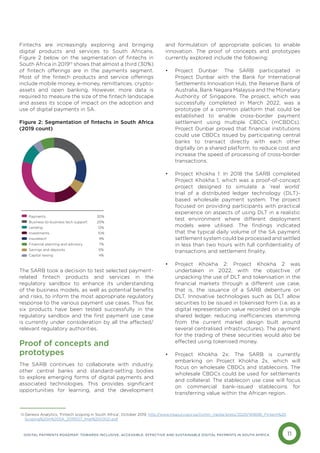
Figure 2 below on the segmentation of fintechs in
South Africa in 201913
shows that almost a third (30%)
of fintech offerings are in the payments segment.
Most of the fintech products and service offerings
include mobile money, e-money, remittances, crypto-
assets and open banking. However, more data is
required to measure the size of the fintech landscape
and assess its scope of impact on the adoption and
use of digital payments in SA.
Figure 2: Segmentation of fintechs in South Africa
(2019 count)
The SARB took a decision to test selected payment-
related fintech products and services in the
regulatory sandbox to enhance its understanding
of the business models, as well as potential benefits
and risks, to inform the most appropriate regulatory
response to the various payment use cases. Thus far,
six products have been tested successfully in the
regulatory sandbox and the first payment use case
is currently under consideration by all the affected/
relevant regulatory authorities.
Proof of concepts and 			
prototypes
The SARB continues to collaborate with industry,
other central banks and standard-setting bodies
to explore emerging forms of digital payments and
associated technologies. This provides significant
opportunities for learning, and the development
and formulation of appropriate policies to enable
innovation. The proof of concepts and prototypes
currently explored include the following:
• Project Dunbar: The SARB participated in
Project Dunbar with the Bank for International
Settlements Innovation Hub, the Reserve Bank of
Australia, Bank Negara Malaysia and the Monetary
Authority of Singapore. The project, which was
successfully completed in March 2022, was a
prototype of a common platform that could be
established to enable cross-border payment
settlement using multiple CBDCs (mCBDCs).
Project Dunbar proved that financial institutions
could use CBDCs issued by participating central
banks to transact directly with each other
digitally on a shared platform, to reduce cost and
increase the speed of processing of cross-border
transactions.
• Project Khokha 1: In 2018 the SARB completed
Project Khokha 1, which was a proof-of-concept
project designed to simulate a ‘real world’
trial of a distributed ledger technology (DLT)-
based wholesale payment system. The project
focused on providing participants with practical
experience on aspects of using DLT in a realistic
test environment where different deployment
models were utilised. The findings indicated
that the typical daily volume of the SA payment
settlement system could be processed and settled
in less than two hours with full confidentiality of
transactions and settlement finality.
• Project Khokha 2: Project Khokha 2 was
undertaken in 2022, with the objective of
unpacking the use of DLT and tokenisation in the
financial markets through a different use case,
that is, the issuance of a SARB debenture on
DLT. Innovative technologies such as DLT allow
securities to be issued in tokenised form (i.e. as a
digital representation value recorded on a single
shared ledger, reducing inefficiencies stemming
from the current market design built around
several centralised infrastructures). The payment
for the trading of these securities would also be
effected using tokenised money.
• Project Khokha 2x: The SARB is currently
embarking on Project Khokha 2x, which will
focus on wholesale CBDCs and stablecoins. The
wholesale CBDCs could be used for settlements
and collateral. The stablecoin use case will focus
on commercial bank-issued stablecoins for
transferring value within the African region.
Genesis Analytics, ‘Fintech scoping in South Africa’, October 2019. http://www.treasury.gov.za/comm_media/press/2020/WB081_Fintech%20
Scoping%20in%20SA_20191127_final%20(002).pdf
Figure 2: Segmentation of fintechs in South Africa (2019 count)
Payments 30%
Business-to-business tech support 20%
Lending 12%
Investments 10%
Insuretech 9%
Financial planning and advisory 7%
Savings and deposits 6%
Capital raising 4%
13
12 DIGITAL PAYMENTS ROADMAP: TOWARDS INCLUSIVE, ACCESSIBLE, EFFECTIVE AND SUSTAINABLE DIGITAL PAYMENTS IN SOUTH AFRICA
4
Despite the prevalence of various digital retail
payments and high levels of financial inclusion in
SA, a significant majority of the population still
lives and works largely on a cash basis, in a country
where inequality is among the highest in the world.
Key challenges and obstacles to achieving inclusive,
accessible, effective and sustainable digital payments
in SA are as follows:
Low bank account usage
As previously stated, SA has a high level of inclusion,
with 96% of the adult population formally included.
The financial sector, particularly the banking sector,
is well developed, with 82% of the adult population
having access to a bank account. However, the
frequent use of bank accounts in SA is low, with
over 70% of the banked population only using their
bank account at least once a month, according to
FinScope, and only 19% using their bank account
weekly. Cash-use preference (28%) and not having
enough money (50%) are the main reasons for not
using bank accounts, while 6% of the banked stated
that using their account/card is too expensive, 6%
said they avoid debit/stop orders, 2% said they do not
trust their banks, and only 0.1% said the places they
shop do not accept card payments.
Almost half (48%) of the adult population in SA
withdraw all their money as soon as it is deposited
into their bank account. Reasons for immediate cash
withdrawal include cash usage preference (38%), the
immediate need for all the money received (50%), the
account/card being expensive (7%), a lack of trust in
banks (5%), and a lack of card/account acceptance by
merchants (2%). Of the total banked adult population,
34% are mailbox users (i.e. use their bank accounts
mainly for the immediate withdrawal of their money),
of which 39% fall within the LSM 5-6 market segments.
This indicates that broader socio-economic and
societal challenges are driving the low usage of bank
accounts, which in turn is decreasing the use of digital
payments in SA.
.
OBSTACLES AND
CHALLENGES TO
ACHIEVING
INCLUSIVE,
ACCESSIBLE,
EFFECTIVE AND
SUSTAINABLE
DIGITAL PAYMENTS
IN SOUTH AFRICA
13
DIGITAL PAYMENTS ROADMAP: TOWARDS INCLUSIVE, ACCESSIBLE, EFFECTIVE AND SUSTAINABLE DIGITAL PAYMENTS IN SOUTH AFRICA
High cash usage
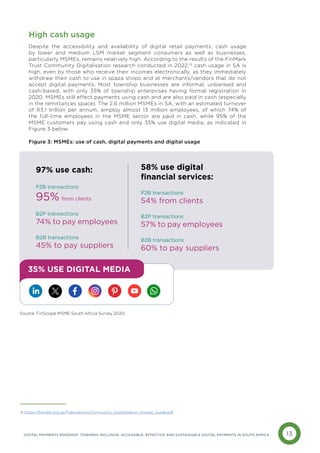
Despite the accessibility and availability of digital retail payments, cash usage
by lower and medium LSM market segment consumers as well as businesses,
particularly MSMEs, remains relatively high. According to the results of the FinMark
Trust Community Digitalisation research conducted in 2022,14
cash usage in SA is
high, even by those who receive their incomes electronically, as they immediately
withdraw their cash to use in spaza shops and at merchants/vendors that do not
accept digital payments. Most township businesses are informal, unbanked and
cash-based, with only 35% of township enterprises having formal registration in
2020. MSMEs still effect payments using cash and are also paid in cash (especially
in the remittances space). The 2.6 million MSMEs in SA, with an estimated turnover
of R3.1 trillion per annum, employ almost 13 million employees, of which 74% of
the full-time employees in the MSME sector are paid in cash, while 95% of the
MSME customers pay using cash and only 35% use digital media, as indicated in
Figure 3 below.
Figure 3: MSMEs: use of cash, digital payments and digital usage
97% use cash:
P2B transactions
95% from clients
B2P transactions
74% to pay employees
B2B transactions
45% to pay suppliers
58% use digital
financial services:
P2B transactions
54% from clients
B2P transactions
57% to pay employees
B2B transactions
60% to pay suppliers
35% USE DIGITAL MEDIA
14 https://finmark.org.za/Publications/Community_Digitalisation_Pocket_Guide.pdf
Source: FinScope MSME South Africa Survey 2020
14 DIGITAL PAYMENTS ROADMAP: TOWARDS INCLUSIVE, ACCESSIBLE, EFFECTIVE AND SUSTAINABLE DIGITAL PAYMENTS IN SOUTH AFRICA
According to FinScope, a total of 98% of adults in SA spend money on food
and groceries; only 34% of adults pay for food and groceries using bank
cards, 2% with banking applications (apps) and 0.2% with QR codes. Of
the 29% of adults that have sent money to someone who does not reside
with them within SA borders, 3% have used an ATM, 4% have used Internet
banking EFT transfers, and 5% have used e-money such as e-wallet, cash
send or send-imali. A total of 88% of adults use cash to buy food and
groceries, despite the higher level of access to bank accounts. Many of the
current remittance products involve cash-in and cash-out elements, with
4.2 million adults in SA having sent money in the past year using Shoprite
Money Market, which includes a cash-in and cash-out facility.
Experiences from the global payment community indicate that high cash
usage is associated with simplicity, reliability, convenience, widespread
accessibility, low cost, and trust and privacy (due to anonymity). Cash
users perceive digital payments as lacking the unique characteristics of
cash, thereby falling short of being the ideal substitutes for cash. These
include cash as an enabler of minor transactions in lower LSM market
segments, better financial control and management, continuous availability
(no technical failures) of cash, minimal costs for users (no hidden costs),
and no access to the Internet (data or Wi-Fi) required for cash. As a result,
the adoption and usage of digital payments remain lower than that of cash.
Costs
Transactional fees: Digital payments attract transactional fees and many
consumers perceive these costs to be high, sporadic, unjustified and
lacking transparency. These include, among other things, monthly account
maintenance or service fees, credit transfer fees, ATM fees, debit order fees,
fees related to payment to another party, statement fees, and unstructured
supplementary service data (USSD) fees. Some of these costs are perceived
to be hidden and too high, leading to mistrust in digital payments and
deterring consumers – particularly low-income earners (those in the lower
LSM market segments) and social grant recipients – from using digital
payment methods, including bank accounts.
Merchant service fees: High merchant service fees contribute to the low
adoption and use of digital payments by merchants. Merchant service
fees, costs of digital payments (e.g. credit and debit cards) and payment
acceptance devices (e.g. POS devices) significantly reduce merchants’ usage
of digital payments. Interchange fees form part of the merchant service
fee that acquirers impose on merchants for accepting card payments. In
SA, card interchange fees range between 0.36% and 2.45%, depending
on the type of transaction and the type of card used, with merchant card
processing fees ranging between 1.5% and 3.5%.15
High interchange and
merchant card processing fees deter smaller merchants from accepting
digital payments, as these fees negatively impact profitability.
https://www.resbank.co.za/content/dam/sarb/what-we-do/payments-and-settlements/regulation-
oversight-and-supervision/ATM%20and%20Card%20Interchange%20rates%20as%20at%2012%20
June%202021.pdf
15
15
DIGITAL PAYMENTS ROADMAP: TOWARDS INCLUSIVE, ACCESSIBLE, EFFECTIVE AND SUSTAINABLE DIGITAL PAYMENTS IN SOUTH AFRICA
Internet/network/data connectivity costs: Most digital payments cannot
be facilitated without affordable Internet connectivity through mobile data
or Wi-Fi. According to the Competition Commission’s Data Services Market
Inquiry final report (published on 2 December 2019), SA ranks among
the more expensive countries for prepaid data prices, with a monthly
data service provided to the poor being inexplicably more expensive per
megabyte than to the wealthy.16
In 2022, South Africans paid up to R85
(US$5) per gigabyte of data compared to US$1.53 per gigabyte in North
Africa and US$2.24 in Western Europe.
High data/Wi-Fi services costs disincentivise the frequent and effective
use of digital payments. This is more pronounced within low-income
groups or disadvantaged communities (lower LSM segments). In some
instances, free banking apps are not necessarily free as updates to the
latest security features or functionalities require regular updates, and data/
Wi-Fi availability is not always affordable. Digital transacting may also not
be possible without using the latest version of the app.
Regulatory compliance costs: There are growing concerns that the cost of
stringent Know Your Customer (KYC) regulations and ongoing customer
due diligence checks – including broader anti-money laundering, countering
the financing of terrorism and countering proliferation regulations - increase
transactional and compliance costs. Higher compliance costs create barriers
to entry for new entrants in the NPS, overburden the existing payment
institutions, and limit the provision of new innovative digital payment
solutions and competition in the NPS.
Infrastructure
Internet (data and Wi-Fi) access and usage in SA
Limited access to, and usage of, technology in SA can also be a barrier
to the adoption and usage of digital payments. Areas with poor Internet
connectivity or limited access to smartphones and computers may not be
able to fully utilise digital payment methods. According to FinScope, 66% of
households in SA have access to the Internet at home, up from 55% in 2021.
Data analysed by the Independent Communications Authority of South
Africa (ICASA) indicates a wider digital divide, showing that access to
Internet at home for South Africans in the big metros is around 17% of
households, while in the rural areas it is 1%.17
The digital divide was attributed
to a lack of affordability and a lack of or poor infrastructure (including
wireless network infrastructure) for broadband Internet connectivity in the
rural areas.
ICASA also highlighted the usage gap where individuals who are covered by
a signal (2G, 3G or 4G) do not use mobile or Internet access due to a lack of
affordability, a lack of necessary skills or a lack of relevant or useful content.
In addition, the gender divide also indicates that women are less likely to
have access to, or make use of, mobile or Internet services. According to
FinScope, of the households with Internet access, 75% claim to connect via
a mobile phone while only 8% connect through a computer (2%) or laptop/
tablet (6%).
16 https://www.compcom.co.za/wp-content/uploads/2019/12/DSMI-Non-Confidential-Report-002.pdf
ICASA, ‘A step closer to achieving a connected South Africa where no one is left behind’, 2023.
https://www.icasa.org.za/news/2023/a-step-closer-to-achieving-a-connected-south-africa-where-no-
one-is-left-behind
17
16 DIGITAL PAYMENTS ROADMAP: TOWARDS INCLUSIVE, ACCESSIBLE, EFFECTIVE AND SUSTAINABLE DIGITAL PAYMENTS IN SOUTH AFRICA
Another major challenge facing digital payments relates to the
under-usage of the Internet for payment purposes by those with Internet
access. According to FinScope, only 11% of adult South Africans with access
to the Internet use the Internet for financial services, including using Internet
banking, a banking app or insurance app, and only 6% use the Internet
for online shopping. Although 57% of the adult population use WhatsApp,
20% indicated that although they are aware of WhatsApp payments, only
4% have used the WhatsApp payments option. Without the necessary
Internet and mobile infrastructure, affordable Internet costs as well as
access and usage in the underserved and urbanised communities will result
in the adoption and usage of digital financial services, particularly digital
payments requiring digital connectivity, remaining low.
Mobile access and mobile payments
FinScope18
indicates that 98% of SA households have at least one mobile
phone. Smartphone usage among adults increased from 59% in 2021 to
66% in 2022, feature phone usage decreased from 4% to 3%, and basic
phone usage decreased from 30% to 28%. According to the 2021 Statista
Global Consumer Survey,19
access to the Internet by 68% of South Africans
provides a favourable opportunity to increase the digitisation of payments
through mobile payments.
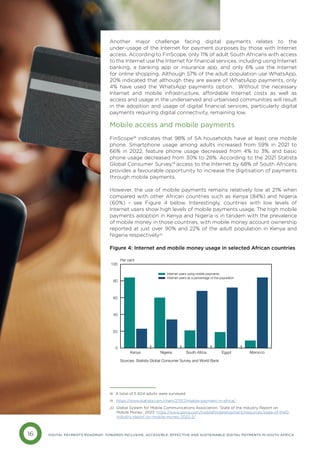
However, the use of mobile payments remains relatively low at 21% when
compared with other African countries such as Kenya (84%) and Nigeria
(60%) – see Figure 4 below. Interestingly, countries with low levels of
Internet users show high levels of mobile payments usage. The high mobile
payments adoption in Kenya and Nigeria is in tandem with the prevalence
of mobile money in those countries, with mobile money account ownership
reported at just over 90% and 22% of the adult population in Kenya and
Nigeria respectively20
Figure 4: Internet and mobile money usage in selected African countries
19 https://www.statista.com/chart/27017/mobile-payment-in-africa/.
Morocco
Egypt
South Africa
Nigeria
Kenya
0
20
40
60
80
100
Figure 4: Percentage of internet users using mobile payments and
internet users as a share of population in selected African countries
Per cent
Sources: Statista Global Consumer Survey and World Bank
Internet users using mobile payments
Internet users as a percentage of the population
20 Global System for Mobile Communications Association, ‘State of the Industry Report on
Mobile Money’, 2023. https://www.gsma.com/mobilefordevelopment/resources/state-of-the0-
industry-report-on-mobile-money-2023-2/
18 A total of 5 604 adults were surveyed.
17
DIGITAL PAYMENTS ROADMAP: TOWARDS INCLUSIVE, ACCESSIBLE, EFFECTIVE AND SUSTAINABLE DIGITAL PAYMENTS IN SOUTH AFRICA
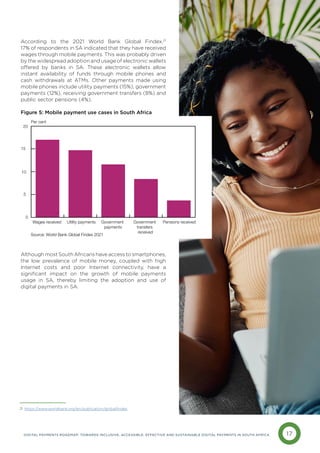
According to the 2021 World Bank Global Findex,21
17% of respondents in SA indicated that they have received
wages through mobile payments. This was probably driven
by the widespread adoption and usage of electronic wallets
offered by banks in SA. These electronic wallets allow
instant availability of funds through mobile phones and
cash withdrawals at ATMs. Other payments made using
mobile phones include utility payments (15%), government
payments (12%), receiving government transfers (8%) and
public sector pensions (4%).
Figure 5: Mobile payment use cases in South Africa
Although most South Africans have access to smartphones,
the low prevalence of mobile money, coupled with high
Internet costs and poor Internet connectivity, have a
significant impact on the growth of mobile payments
usage in SA, thereby limiting the adoption and use of
digital payments in SA.
Pensions received
Government
transfers
received
Government
payments
Utility payments
Wages received
0
5
10
15
20
Figure 5: Mobile payment use cases in South Africa
Per cent
Source: World Bank Global Findex 2021
https://www.worldbank.org/en/publication/globalfindex
21
18 DIGITAL PAYMENTS ROADMAP: TOWARDS INCLUSIVE, ACCESSIBLE, EFFECTIVE AND SUSTAINABLE DIGITAL PAYMENTS IN SOUTH AFRICA
Acquiring infrastructure
The lack or inconsistent availability of acquiring infrastructure (e.g. POS, QR codes
or alternatives) contributes to the slow adoption and use of digital payments. As
depicted in Figure 6, only 8% of MSMEs use speed point (POS) devices, which
limits consumer usage of digital payments (e.g. cards), as over 90% of merchants
do not use POS devices. This is typically experienced when consumers wish to
pay for food, electricity, airtime/data and transport at informal merchants (e.g.
spaza shops, street vendors, taxis and other businesses) in townships, informal
settlements and rural areas.
Figure 6: Facilities utilised by businesses
Persistent electricity cuts
SA has been experiencing persistent electricity supply cuts, which affect
Internet access and the stability of telecommunications network coverage
in certain areas. These frequent power outages disrupt the continued and
seamless provision and processing of digital payments in the NPS, particularly
where backup systems may not be functional or are unavailable. This means that
consumer and business payments could be severely impacted.
In the SARB’s Financial Stability Review, second edition of 2023, the SARB
signalled that rolling power cuts may pose a threat to the country’s financial
stability, stating that “[i]nsufficient and unreliable electricity supply is likely to
threaten the viability of some corporates, especially small and medium-sized
enterprises, for the foreseeable future, with losses potentially spilling over into
the financial sector”. Continuous power cuts will lead to challenges in recharging
batteries for ATMs and Telco network towers, both of which are critical to the
financial system.
Figure 6: Facilities utilised by businesses
Per cent
Source: FinScope South Africa MSME Survey 2020
0 10 20 30 40 50 60
Device to monitor access
Landline
Fax machine
Speed point
Website
Copying machine
Printer
Cash register
Security system
Computer/laptop
Car/minibus
Internet
Generator
Cellphone
19
DIGITAL PAYMENTS ROADMAP: TOWARDS INCLUSIVE, ACCESSIBLE, EFFECTIVE AND SUSTAINABLE DIGITAL PAYMENTS IN SOUTH AFRICA
Legacy systems
Some incumbents, including government departments and banks, are still operating
legacy systems to effect payments or provide digital payment services, and therefore
transitioning to more modernised payment systems may pose complexities and high
cost-related challenges. As a result, these incumbents may be reluctant or lack the
capacity to innovate, resulting in less than desirable adoptions when using digital
payments to meet consumer or beneficiary needs.
Lack of interoperability
Traditional and new payment service providers (PSPs) also offer innovative
closed-loop digital payments which are not interoperable. A typical example is the
provision of digital/electronic wallets and remittance products. Non-interoperable
closed-loop systems lead to a fragmented payment ecosystem, limit customer choice,
and hinder the effective adoption and use of digital payments. Consumers in the closed
loop may only transact (make or receive payments) using a specific PSP’s instruments,
infrastructure, premises or agents, thereby limiting the use and ubiquity of innovative
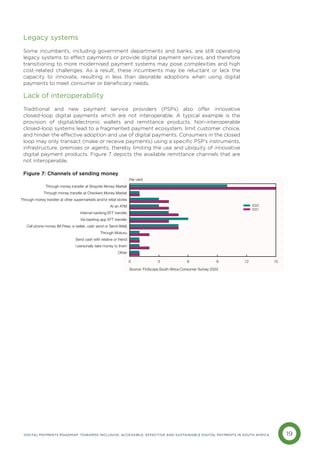
digital payment products. Figure 7 depicts the available remittance channels that are
not interoperable.
Figure 7: Channels of sending money Figure 7: Channels of sending money
Per cent
Source: FinScope South Africa Consumer Survey 2022
0 3 6 9 12 15
Other
I personally take money to them
Send cash with relative or friend
Through Mukuru
Cell phone money (M-Pesa, e-wallet, cash send or Send-iMali)
Via banking app EFT transfer
Internet banking EFT transfer
At an ATM
Through money transfer at other supermarkets and/or retail stores
Through money transfer at Checkers Money Market
Through money transfer at Shoprite Money Market
2022
2021
20 DIGITAL PAYMENTS ROADMAP: TOWARDS INCLUSIVE, ACCESSIBLE, EFFECTIVE AND SUSTAINABLE DIGITAL PAYMENTS IN SOUTH AFRICA
Limited access points
Access points are crucial in extending the reach of digital payments to consumers
and businesses. There are limited access points, including agency models (e.g.
where a bank or large retailer partners with a small merchant to provide remittance
services), for digital payments in the underserved communities. The recent closure
of bank branches and a decrease in the number of POS terminals from about
425 000 in 2020 to approximately 423 000 in 2021 has also contributed to fewer
access points being available to consumers. Although spaza shops and street
vendors are prevalent in the underserved communities and could potentially be
used as access points for digital payments, most of these merchants do not have
access to digital payment devices/methods, and some cannot afford to use digital
payment devices/methods.
Financial and digital illiteracy
The 2019 Deloitte Africa research, which included interviews with 34 payment
experts from 22 different institutions within SA, cited low levels of financial literacy
as one of the key inhibitors to digitising the informal economy.22
The use of digital
payment tools and platforms is associated with higher digital literacy. The rapid
technological advancements, increasing complexity and opaqueness of digital
payments, a lack of bespoke digital payments literacy programmes – particularly
targeted at women, the youth and MSMEs – and high cash usage significantly
contribute to the lack of awareness and the lack of or poor understanding of the
prevalence, opportunities, benefits and risks of digital payments as well as the low
usage of digital payments.
For example, most consumers are not aware that ATMs and banking apps may
be used to make bill payments, and if utilised, would result in them not having to
pay for transportation/travelling costs and stand in queues to make in-store cash
payments. Further, those who are less acquainted with digital infrastructure and
technologies are less likely to adopt and use digital payments, even where digital
infrastructure exists and is accessible.
Government payments
Most SASSA recipients, including those who receive their grants via SASSA or bank
accounts, immediately withdraw all the money from their account from either the
Post Office, ATMs or retailers. The one-off use of these accounts, mainly for the
immediate withdrawal of the money, indicates the use of the accounts as ‘mailboxes’
and deters the use of these accounts for digital payments.
A poor or weak government payment infrastructure, technical glitches, cyber-risks
and fraud - such as those experienced by SASSA in 2022 that led to the suspension
of the withdrawal of funds at ATMs using Postbank-issued SASSA gold cards as well
as the temporary use of retailers, and prevented SASSA recipients from accessing
their grant payments - lower recipients’ confidence and trust in digital payments.
The recent panic caused by the expiry of SASSA gold cards further exacerbated
the negative sentiments over digital payments.
https://www.deloitte.com/content/dam/Deloitte/za/Documents/risk/za-The-future-of-payments-in-
South-Africa%20.pdf
22
21
DIGITAL PAYMENTS ROADMAP: TOWARDS INCLUSIVE, ACCESSIBLE, EFFECTIVE AND SUSTAINABLE DIGITAL PAYMENTS IN SOUTH AFRICA
Security concerns
Individuals are hesitant to use digital payments due to a
fear of fraud, identity theft and loss of money. Cyber-risks
and data privacy issues deter the adoption and use of
digital payments.
Regulatory framework
The current regulatory framework restricts the provision
of payment systems/services involving the pooling of
funds such as mobile money, e-money and remittances
to banks. Non-banks that wish to provide these payment
systems/services are required to partner with banks in
terms of the Banks Act 94 of 1990 and must be designated
for participation in clearing and bank-sponsored in
settlement in accordance with the National Payment
System Act 78 of 1998 (NPS Act). As a result, competition
in the NPS remains low due to the bank model dominating
the NPS; offering alternative digital payments by non-
banks is disincentivised; consumers and businesses have
limited choice; and the costs of digital payments remain
restrictively high.
22 DIGITAL PAYMENTS ROADMAP: TOWARDS INCLUSIVE, ACCESSIBLE, EFFECTIVE AND SUSTAINABLE DIGITAL PAYMENTS IN SOUTH AFRICA
5
TOWARDS
INCLUSIVE,
ACCESSIBLE,
EFFECTIVE AND
SUSTAINABLE
DIGITAL PAYMENTS
The financially and
digitally literate, educated and
skilled user of payments
Financial and digital payments literacy and awareness
are important to address digital and financial illiteracy,
boost the adoption and use of digital payments,
deepen financial inclusion and reduce inequality in
SA. Consumers, government entities and businesses
must have the knowledge and competence to use or
facilitate digital payments and leverage infrastructure
such as the Internet, mobile phones and applications,
as well as have the skills and understanding of the
operations of digital payments and the associated
benefits, opportunities and risks.
Digital payments education, training and awareness
programmes should be developed by the public
and private sector. The strategy and programmes
should be demographically inclusive of women, the
disabled, rural communities, the poor, the youth and
urbanised workers, and include spaza shops, stokvels,
community centres, libraries, schools, hospitals,
SASSA beneficiaries and cash-intensive economic
sectors, such as transport and agriculture, through
mediums such as face-to-face workshops, television,
radio, websites and social media platforms.
A payments training institute should also be
considered to build payment skills and capacity.
The training and educational programmes should
align with the National Consumer Financial Education
Strategy23
and be coordinated through the National
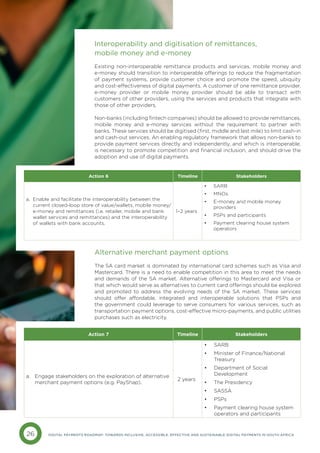
Consumer Financial Education Committee.24
The
table on the next page depicts the actions that were
identified in this regard.
https://www.fscamymoney.co.za/Legislation%20Strategy%20
and%20Policy/National%20consumer%20financial%20education%20
strategy%20(23%20Aug%2020.pdf An updated strategy is being
developed; this process is led by National Treasury.
23
The National Consumer Financial Education Committee was
established to secure active involvement, collaboration and coordination
of various stakeholders in consumer financial education and is chaired
by National Treasury. https://www.treasury.gov.za/comm_media/
press/2022/2022081901%20MEDIA%20RELEASE%20-%20MSWSA%20
LAUNCH.pdf
24
23
DIGITAL PAYMENTS ROADMAP: TOWARDS INCLUSIVE, ACCESSIBLE, EFFECTIVE AND SUSTAINABLE DIGITAL PAYMENTS IN SOUTH AFRICA
The accessible, reliable, cost-effective, resilient and 			
modernised infrastructure
Internet and mobile network/infrastructure
Fast, safe, secure, affordable, stable, reliable and expanded network coverage, and free or affordable Internet
(data and Wi-Fi) is necessary to boost the availability, ubiquity, accessibility, affordability, resilience and usability
of digital payments. Mobile phones, computers, and mobile and Internet broadband coverage should be extended
to the rural areas and other underserved communities to expand the accessibility of digital connectivity.
Public-private partnerships should be established to lower the costs of Internet access, including financing options,
promotions or government subsidies to make Internet access more affordable for different user segments.
Mobile broadband/Internet coverage should be provided by MNOs at a low cost to the underserved communities,
government premises, community centres, libraries, schools, hospitals, SASSA pay points and cash-intensive
economic centres, to support access and usage of digital payments, and to address digital inequality/the digital
divide. Low-cost digital payment services should also be provided to increase the usage of the Internet and
mobiles for digital payments. Currently, WhatsApp and Facebook are the top use cases for Internet in SA.
Digital payment applications/platforms and websites should also be discounted or be accessible free of charge,
and the Internet should be freely accessible at payment services providers’ business premises. This will benefit
MSMEs that use QR codes to effect digital payments.
National, provincial and local government, digital payment providers, and network and Internet mobile data
providers must all contribute to the provision of free Internet/Wi-Fi to needy community segments, to create an
enabling environment for the adoption and use of digital payments. Digital payments literacy and skills should
complement an accessible and affordable digital payments infrastructure.
Action 1 Timeline Stakeholders
a. 
Develop and implement digital payments literacy
or an educational and awareness strategy and
programmes targeted at consumers (including
the youth, women and SASSA grant beneficiaries),
government and businesses (including MSMEs) and
disabled persons.
6 months
• SARB, in collaboration with
National Treasury and the FSCA
b. 
Conduct provincial roadshows to educate the
selected groups on digital payments and engage in
activities led by the National Consumer Financial
Education Committee.
6 months
and ongoing
• SARB
c.  Enhance digital infrastructure awareness/skills.
6 months
and ongoing
• Communications authorities
• Internet (data and Wi-Fi)
providers
• Mobile network operators
(MNOs)
d. 
Integrate and include digital payments in the
school curriculum and curriculum for institutions of
higher learning.
2 years
• Department of Education
• Universities and colleges
• Public and private schools
e. Facilitate the establishment of the payments
training institute.
2 years
• SARB
• PASA
• Payment industry
24 DIGITAL PAYMENTS ROADMAP: TOWARDS INCLUSIVE, ACCESSIBLE, EFFECTIVE AND SUSTAINABLE DIGITAL PAYMENTS IN SOUTH AFRICA
Load-shedding/electricity outages
Uninterrupted electricity supply is critical for the smooth functioning of digital payment systems
and infrastructure, and for the delivery of digital payments. Government should implement
sustainable measures to address the electricity supply crisis in SA. For digital payments to flourish,
certain selected areas and business premises should be exempted from load-shedding or enjoy
shorter load-shedding schedules. Further, alternative sources of energy and off-grid solutions such
as solar, generators, battery-operated payment devices and energy-efficient technologies should
be considered to expand access to electricity and ensure the continued use of digital payments
during outages.
Action 2 Timeline Stakeholders
a. 
Provide stable, reliable Internet and mobile
network coverage to the rural areas, underserved
communities, MSMEs (including spaza shops),
townships, churches, schools, hospitals, SASSA
pay points and cash-intensive sectors, particularly
the agricultural (farms) and
transport sectors.
1–2 years
• National (Minister of
Communications and
Digital Technologies),
provincial (Gauteng
Provincial Government)
and local government
• Department of Social
Development
• National Treasury
• SASSA
• ICASA
• School governing bodies
• MNOs
• MSMEs
• PSPs and participants
b. 
Provide affordable (low-cost) or free Internet
(data or Wi-Fi) access to the underserved and/
or disadvantaged communities (including rural
areas), MSMEs, the youth, schools, townships,
churches, hospitals, SASSA pay points and
cash-intensive sectors, particularly the
agricultural and transport sectors.
1 year
c. 
Provide free Internet in the business premises of
the payment services providers or MSMEs and/
or zero-rated payment applications (apps) and
websites.
6 months
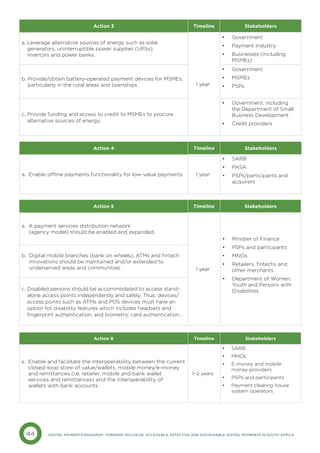
Action 3 Timeline Stakeholders
a. 
Leverage alternative sources of energy such
as solar, generators, uninterruptible power
supplies (UPSs), invertors and power banks.
1 year
• Government
• Payment industry
• Businesses (including
MSMEs)
b. 
Provide/obtain battery-operated payment devices
for MSMEs, particularly in the rural areas and
townships.
• Government
• MSMEs
• PSPs
c. 
Provide funding and access to credit to MSMEs to
procure alternative sources of energy.
• Government, including
the Department of Small
Business Development
• Credit providers
25
DIGITAL PAYMENTS ROADMAP: TOWARDS INCLUSIVE, ACCESSIBLE, EFFECTIVE AND SUSTAINABLE DIGITAL PAYMENTS IN SOUTH AFRICA
Offline payments
An offline digital payment is a transaction that does not require Internet or telecommunications network
connectivity. The Reserve Bank of India (RBI) recently released a framework to enable offline payments.
The RBI’s framework applies to small payments made face-to-face using payment instruments such as
cards, e-wallets and mobile devices. Offline payments should be enabled by implementing a reasonable
limit for contactless and QR code transactions. Enabling digital payments for low-value payments
in an offline mode, with an appropriate risk management framework and practices, can significantly
boost digital payments, particularly in rural areas and during telecommunications network or
electricity outages.
Access points, distribution channels and networks
Access points, distribution channels and networks are crucial for the accessibility of digital payments
in SA and should be extended to the disabled, undeserved and disadvantaged communities. While
bank branches and ATMs are still utilised to access cash by the communities that are digitally excluded
and cash-reliant, digital payment offerings should be enabled and expanded within branches and at
ATMs. Affordable merchant acceptance devices (e.g. POS devices) should also be extended to MSMEs,
particularly spaza shops and smaller merchants. Furthermore, the expansion of the digital payment
services distribution network (e.g. remittances, mobile money and e-money) through agency models
utilising merchants, retailers and services offered by fintechs will further enhance the reach to as many
consumers as possible.
Action 4 Timeline Stakeholders
a. 
Enable offline payments functionality for low-value
payments.
1 year
• SARB
• PASA
• PSPs/participants and
acquirers
Action 5 Timeline Stakeholders
a. 
A payment services distribution network
(agency model) should be enabled and expanded.
1 year
• Minister of Finance
• PSPs and participants
• MNOs
• Retailers, fintechs and
other merchants
• Department of Women,
Youth and Persons with
Disabilities
b. 
Digital mobile branches (bank on wheels), ATMs and
fintech innovations should be maintained and/or
extended to underserved areas and communities.
c. 
Disabled persons should be accommodated to access
standalone access points independently and safely.
Thus, devices/access points such as ATMs and
POS devices must have an option for disability
features which includes headsets and fingerprint
authentication, and biometric card authentication.
26 DIGITAL PAYMENTS ROADMAP: TOWARDS INCLUSIVE, ACCESSIBLE, EFFECTIVE AND SUSTAINABLE DIGITAL PAYMENTS IN SOUTH AFRICA
Interoperability and digitisation of remittances,
mobile money and e-money
Existing non-interoperable remittance products and services, mobile money and
e-money should transition to interoperable offerings to reduce the fragmentation
of payment systems, provide customer choice and promote the speed, ubiquity
and cost-effectiveness of digital payments. A customer of one remittance provider,
e-money provider or mobile money provider should be able to transact with
customers of other providers, using the services and products that integrate with
those of other providers.
Non-banks (including fintech companies) should be allowed to provide remittances,
mobile money and e-money services without the requirement to partner with
banks. These services should be digitised (first, middle and last mile) to limit cash-in
and cash-out services. An enabling regulatory framework that allows non-banks to
provide payment services directly and independently, and which is interoperable,
is necessary to promote competition and financial inclusion, and should drive the
adoption and use of digital payments.
Alternative merchant payment options
The SA card market is dominated by international card schemes such as Visa and
Mastercard. There is a need to enable competition in this area to meet the needs
and demands of the SA market. Alternative offerings to Mastercard and Visa or
that which would serve as alternatives to current card offerings should be explored
and promoted to address the evolving needs of the SA market. These services
should offer affordable, integrated and interoperable solutions that PSPs and
the government could leverage to serve consumers for various services, such as
transportation payment options, cost-effective micro-payments, and public utilities
purchases such as electricity.
Action 6 Timeline Stakeholders
a. 
Enable and facilitate the interoperability between the
current closed-loop store of value/wallets, mobile money/
e-money and remittances (i.e. retailer, mobile and bank
wallet services and remittances) and the interoperability
of wallets with bank accounts.
1–2 years
• SARB
• MNOs
• E-money and mobile money
providers
• PSPs and participants
• Payment clearing house system
operators
Action 7 Timeline Stakeholders
a. 
Engage stakeholders on the exploration of alternative
merchant payment options (e.g. PayShap).
2 years
• SARB
• Minister of Finance/National
Treasury
• Department of Social
Development
• The Presidency
• SASSA
• PSPs
• Payment clearing house system
operators and participants
27
DIGITAL PAYMENTS ROADMAP: TOWARDS INCLUSIVE, ACCESSIBLE, EFFECTIVE AND SUSTAINABLE DIGITAL PAYMENTS IN SOUTH AFRICA
Digital identity
Digital identity refers to a set of electronically
captured and stored attributes (e.g. biometrics) and/
or credentials that uniquely identify a person or an
entity. The benefits of digital identity to the NPS
include increased access, financial inclusion, payment
security (fraud reduction), remote onboarding, and
the reduction of manual errors and compliance costs.
Digital identity has cross-sectoral use cases, and
its development and implementation is dependent
on multiple stakeholders, including government,
regulators, the private sector and consumers. Digital
identity facilitates the consumption of digitised
payment services and may be useful to safely and
efficiently identify and authenticate parties in a digital
payment transaction, thereby lowering compliance
costs for PSPs and, in turn, enhancing the adoption
and use of digital payments.
Although not the leading authority in relation to
identification in SA, the SARB, as a catalyst in the NPS,
is facilitating the assessment of the feasibility and
desirability of establishing a digital financial identity
system to promote the security and efficiency of digital
payments. A consultation paper has been developed
to engage stakeholders on the drivers of digital
identity, policy objectives, possible use cases of digital
identification in the NPS, the governance structure/
framework, the benefits and risks, and the stakeholders
involved. The success of a sustainable digital financial
identity system would depend on the collective effort
and support of government, policymakers, industry
and other relevant stakeholders.
Authentication
As payments become increasingly digitised, a
two-factor authentication for digital payments, similar
to the one adopted in the Netherlands,25
should
be considered and possibly adopted to maintain
the integrity and security of digital payments. A
two-factor authentication requires (i) something you
know (e.g. password/personal identification number
(PIN); (ii) something you have (e.g. cryptographic
identification device or token); or (iii) something
you are (e.g. biometrics). However, a two-factor
authentication requirement may not apply to
low-risk small transactions (e.g. transactions less
than R500) or recurring/debit order payments.
The SARB is therefore considering the development
of a security framework that also addresses
multi-factor authentication, to increase the integrity
and security of digital payments. Secure digital
payments will increase trust and confidence in digital
payments, thereby enhancing the adoption and use of
digital payments.
Secure, identified and
authenticated digital
payments
https://www.dnb.nl/en/sector-news/2021/the-introduction-of-two-factor-
authentication-for-home-shopping-credit-card-purchases-was-completed-
this-spring/
25
28 DIGITAL PAYMENTS ROADMAP: TOWARDS INCLUSIVE, ACCESSIBLE, EFFECTIVE AND SUSTAINABLE DIGITAL PAYMENTS IN SOUTH AFRICA
Electronic Know Your Customer
A centralised Electronic Know Your Customer (E-KYC) registry has gained prominence in
identifying and verifying parties at onboarding. PSPs may use open APIs to develop automated
KYC, reducing personnel costs to shift onboarding from a manual intervention to the automated
monitoring of workflows. Compliance failure and errors can be reduced as API technology
improves reporting and record keeping, and eradicates manual paperwork. E-KYC will promote
the standardisation of information requests, improve customer convenience and reduce
compliance costs, thus making digital payments more attractive.
Cybersecurity and consumer protection
Cybersecurity and cyber-resilience measures should be imposed on participants/PSPs to ensure
early detection and a response to cyber-threats, and to protect against phishing schemes,
ransomware attacks, fraud, identity theft, data breaches and financial losses. The legal and
regulatory consumer protection framework for consumers in the NPS should be implemented
and compliance with the Protection of Personal Information Act 4 of 2013 should be enhanced.
These will promote the safety and integrity of digital payments and increase consumer trust and
confidence in digital payments, thereby enhancing the adoption and use of digital payments.
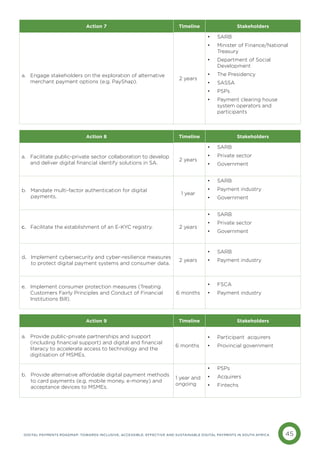
Action 8 Timeline Stakeholders
a. 
Facilitate public-private sector collaboration
to develop and deliver digital financial identify
solutions in SA.
2 years
• SARB
• Private sector
• Government
b. 
Mandate multi-factor authentication for digital
payments.
1 year
• SARB
• Payment industry
• Government
c. 
Facilitate the establishment of an E-KYC registry. 2 years
• SARB
• Private sector
• Government
d. 
Implement cybersecurity and cyber-resilience
measures to protect digital payment systems
and consumer data.
2 years
• SARB
• Payment industry
e. 
Implement consumer protection measures
(Treating Customers Fairly Principles and
Conduct of Financial Institutions Bill).
6 months
• FSCA
• Payment industry
29
DIGITAL PAYMENTS ROADMAP: TOWARDS INCLUSIVE, ACCESSIBLE, EFFECTIVE AND SUSTAINABLE DIGITAL PAYMENTS IN SOUTH AFRICA
MSMEs (spaza shops and 		
cooperatives)
As already stated, businesses, particularly MSMEs,
are still heavily cash-reliant or cash-dominated; lack
or do not use digital infrastructure, including digital
payment acceptance devices; and pay their respective
employees and suppliers in cash. Digitisation
programmes should be adopted by MSMEs, including
the digitisation of internal operations, upskilling and
raising workforce awareness of digital methods,
and leveraging fintechs and the introduction of new
technologies. Further, alternative and affordable
acceptance devices and digital payments such as
e-money, mobile money and the request-to-pay
feature should be availed to smaller merchants
to counter processing fees. Government and/or
public-private partnerships and support as well as
access to finance are required to accelerate the
digitisation of MSMEs. Increased digital proficiency of
MSMEs will accelerate the adoption and use of digital
payments by MSMEs.
Promotion of digitised
payments in cash-intensive
economic sectors
Action 9 Timeline Stakeholders
a. 
Provide public-private partnerships and
support (including financial support) and digital
and financial literacy to accelerate access to
technology and the digitisation of MSMEs.
6 months
• Participant acquirers
• Provincial government
b. 
Provide alternative affordable digital payment
methods to card payments (e.g. mobile money,
e-money) and acceptance devices to MSMEs.
1 year and
ongoing
• PSPs
• Acquirers
• Fintechs
30 DIGITAL PAYMENTS ROADMAP: TOWARDS INCLUSIVE, ACCESSIBLE, EFFECTIVE AND SUSTAINABLE DIGITAL PAYMENTS IN SOUTH AFRICA
Agricultural sector
There are approximately 32 000 commercial farmers in SA, of which between 5 000 and
7 000 produce approximately 80% of the country’s agricultural output.26
Agricultural sector
payments, which are mainly cash-based, include farm workers’ salaries, payments for the
transportation and selling of produce, and the purchasing of seeds, fertiliser and other related
supplies. Payments in the agricultural sector should be digitised throughout the entire agricultural
value chain to make them efficient and cost-effective and to minimise risks. Payments could be
effected through PayShap’s faster payments proxy and request-to-pay feature, or through mobile
money and e-money.
Transport
The taxi industry is a major provider of the mode of transportation in townships, rural areas
and other disadvantaged communities. The taxi industry is a cash-intensive business, which
lacks adequate formal accounting, record keeping, audits and taxation.27
Although some taxi
commuters may have access to digital payments, they are unable to transact digitally due to
the lack of a digital payments acquiring infrastructure deployed by the taxi industry.
The digitisation of taxi industry payments would bring efficiencies for the commuters and
enhance the use of digital payments such as tap and go (contactless cards), QR codes or mobile
payments in taxis. In addition, taxi owners would have enhanced tracking and management of
the financial aspects of their business. Financial inclusion would also be supported, as payments
will be effected via digital payment methods. Taxis undertaking long distance trips could be
prioritised for digitisation as payments are processed upfront for a one-off trip to a specific
destination. Short distance trips could leverage the tap-and-go options for taxi operators who
are keen on digitising taxi fare payments.
Action 10 Timeline Stakeholders
a. 
Facilitate the digitisation of payments such as
farm workers’ salaries, payments for the
transportation and selling of produce, and
the purchasing of seeds, fertiliser and other
related supplies in the agricultural sector.
2 years
• Government
• Farmers
• PSPs
Action 11 Timeline Stakeholders
a. 
Facilitate the digitisation of short and long distance
taxi payments, such as the use of QR codes,
contactless card payments, pay by proxy and
request-to-pay.
1 year
• Government
(National
Treasury, Minister
of Transport)
• Taxi associations
and PSPs
26 https://www.trade.gov/country-commercial-guides/south-africa-agricultural-sector
27 https://irr.org.za/reports/occasional-reports/files/web-irr-south-africas-minibus-taxi-industry-report.pdf
31
DIGITAL PAYMENTS ROADMAP: TOWARDS INCLUSIVE, ACCESSIBLE, EFFECTIVE AND SUSTAINABLE DIGITAL PAYMENTS IN SOUTH AFRICA
Education
Some schools only accept cash payments, and even when schools offer digital paymentoptions,
some parents prefer to pay school fees and other school-related expenses in cash. Most parents
give their children lunch money in cash, and most school tuckshops are still cash-based.
The digitisation of school tuckshops would increase access to digital payments for pupils, and
this could provide opportunities for customised digital payments innovation such as digital
wallets or using fingerprints to authenticate transactions instead of a PIN, and further increase
digital financial literacy in schools. Safe, fast and convenient digital payments should be enabled/
availed in schools to promote the adoption of digital payments and reduce cash usage.
Furthermore, to enhance digital payments skills and training, digital payments literacy should
be included in the school curriculum.
Youth
Almost half (49%) of SA’s population comprises the youth (18 to 35 years of age), and of this,
57% are unemployed. SA’s youth is tech savvy and contributes significantly to the population of
mobile phone ownership.28
While payments by the youth are still mostly cash-based, the youth
are rapidly exploring, experimenting with and embracing digital payments. However, the youth
still face challenges relating to a lack of access to smart phones, the Internet, awareness of
digital payments and digital skills.
To meet the needs of the youth and to entrench the adoption and use of digital payments
by the youth, youth voices should be integrated in digital payments policymaking, youth-
friendly digital payment methods must be promoted and supported,29
and digital and financial
literacy and capability must be promoted. The youth seem to be drawn to solutions for digital
micro-payments and peer-to-peer payments. Mobile platforms and mobile money provide
opportunities to extend digital payments to the youth, particularly those without a bank account.
Action 12 Timeline Stakeholders
a. 
Digitise school service payments, including payments
at tuckshops.
b. 
Develop innovative offerings and apps to enable
parents to pay school fees and send money to pupils
(e.g. lunch money).
2 years
• Department of
Education
• School
governing
bodies
• Fintechs
• PSPs
Action 13 Timeline Stakeholders
a. 
Provide youth-friendly innovative digital payment
methods and services to enable digital
micro-payments and peer-to-peer payments.
Ongoing
• PSPs
• Schools/
universities
• Government
b. 
Integrate youth voices in digital payments
policymaking.
6 months
• National Treasury
• SARB
29 OECD, Advancing the Digital Financial Inclusion of Youth, 2020.
28 By the end of 2020, 495 million people subscribed to mobile services in sub-Saharan Africa, representing 46% of the region’s
population – an increase of almost 20 million since 2019. With more than 40% of the region’s population under the age of 15,
young consumers owning a mobile phone for the first time will remain the primary source of growth for the foreseeable future.
Global System for Mobile Communications Association, ‘The mobile economy: sub-Saharan Africa’. 2021.
https://www.gsma.com/mobileeconomy/wp-content/uploads/2021/09/GSMA_ME_SSA_2021_English_Web_Singles.pdf
32 DIGITAL PAYMENTS ROADMAP: TOWARDS INCLUSIVE, ACCESSIBLE, EFFECTIVE AND SUSTAINABLE DIGITAL PAYMENTS IN SOUTH AFRICA
Women
According to FinScope, 52% of SA’s total population is female, of which 86% are banked.
Increased access of women to bank accounts will assist in building women’s economic power,
thereby contributing to gender equality. However, compared to their male counterparts, women
still face challenges as most of them lack the knowledge or understanding of available digital
payment products, are being offered digital payments that do not meet their needs, have to
travel long distances to payment institutions/PSPs, lack access to the Internet or mobile phones,
and are digitally illiterate. In addition, 42% use their bank account as a mailbox, while 25% use
their bank account less than three times a month. Further, of the 26% of the adult population in
SA that are classified as the rural poor, 61% are female, and despite the higher number of women
who are banked, 63% of unemployed adults are female.30
Digitised government payments
Digitising payments for government services provides benefits to governments, consumers,
businesses and the broader economy. Some of these benefits include providing an efficient,
convenient and transparent revenue collection system, thereby supporting governments to
provide services more efficiently. Although governments still accept cash for the payment of
goods and services, there are initiatives to promote digital payments (e.g. the Department of
Transport only accepts card payments in vehicle licensing stations). These interventions could
be adopted by other government departments and municipalities.
To ensure that government-to-person payments are effective and efficient, government
databases need to become integrated/interoperable and have adequate verification
mechanisms to ensure the accurate identification and validation of payments to qualifying
beneficiaries when using their preferred digital method of payment. For instance, the payment
of social grants or emergency relief grants to incorrect beneficiaries may occur due to the lack
of verification and validation measures. This may lead to major financial losses and reputational
damage to the government. Criminals usually exploit these weaknesses in the system knowing
that the government cannot effectively verify the identity of the recipients. Furthermore, grant
recipients should be offered alternative payment methods that will discourage the withdrawal
of grants to make payments.
Action 14 Timeline Stakeholders
a. 
Develop and target digital payments literacy
programmes for women, particularly rural poor
women.
6 months to
1 year
• SARB
• Payment industry
b. 
Offer digital payments that are suitable,
convenient and affordable for women (e.g.
mobile money, remittances).
Ongoing • Payment industry
30 Global Partnership for Financial Inclusion (GPFI), ‘Advancing Women’s Digital Financial Inclusion’, July 2020.
33
DIGITAL PAYMENTS ROADMAP: TOWARDS INCLUSIVE, ACCESSIBLE, EFFECTIVE AND SUSTAINABLE DIGITAL PAYMENTS IN SOUTH AFRICA
Digitised money
Central bank money/public money
In May 2021, the SARB embarked on a study to investigate the feasibility, desirability and
appropriateness of a CBDC31
as electronic legal tender, for general-purpose retail use,
complementary to cash. The objective of the feasibility study is to consider how the issuance of
a general purpose CBDC will feed into the SARB’s policy position and mandate.
The study is focused on the issuance of a domestic CBDC that can be used by consumers in SA for
general retail purposes. The SARB is continually exploring possible use cases, including whether
a retail CBDC can address gaps that current traditional digital payments do not adequately fulfil,
such as cost-effectiveness and real-time online and offline peer-to-peer digital payment use
cases. At the conclusion of the study, the following action was identified:
Action 15 Timeline Stakeholders
a. 
Digitise person-to-government and government-to-
person payments end to end (first and last mile).
1 year
• Government
(National Treasury;
Department
of Social
Development;
local governments,
including cities
of Johannesburg
and/or Tshwane
and/or Ekurhuleni)
b. 
Government-to-person payments must be
streamlined across government departments to
ensure that government-to-person payments adhere
to specific standards and government departments’
databases leverage off each other.
1 year
• National Treasury
• Government
departments and
municipalities
Action 16 Timeline Stakeholders
a. 
The SARB should further explore the feasibility of
digitising money/cash through the issuance of retail
CBDCs and use cases for a wholesale CBDC.
2 years • SARB
31 The Committee on Payments and Market Infrastructures (CPMI) defines CBDCs
as a digital form of central bank money different from balances in traditional 		
reserve or settlement accounts.
34 DIGITAL PAYMENTS ROADMAP: TOWARDS INCLUSIVE, ACCESSIBLE, EFFECTIVE AND SUSTAINABLE DIGITAL PAYMENTS IN SOUTH AFRICA
Crypto-assets
Crypto-assets are emerging as alternative digital payment methods/assets.
Crypto-assets are based on DLT and smart contracts, with the potential to
promote seamless, fast and cost-efficient digital payments. The SARB has
cautioned consumers about the risks of using crypto-assets for payments,
and is continually assessing the risk to financial stability, monetary policy,
the payment system and to consumers. It has further reiterated that
crypto-assets are not legal tender in SA. Although not legal tender, SA has
not taken a position to ban the use of crypto-assets for payment purposes.
Some merchants and consumers have embraced crypto-assets, with the
likes of Pick n Pay (a retail business in the fast-moving consumer goods
industry) having publicly proclaimed its acceptance of crypto-asset Bitcoin
for the payment of goods in some of its stores. The SARB is exploring the
feasibility of leveraging DLT technology to enhance the settlement system/
infrastructure.
From a policy and regulatory perspective, the SARB is developing its
approach to crypto-assets and leveraging best practices from the Group
of Twenty (G20), Financial Stability Board and Committee on Payments
and Market Infrastructures (CPMI) on appropriate regulatory approaches
to crypto-assets regulation. The SARB is aware that the FSCA has declared
crypto-assets used for payment as financial products under the Financial
Advisory and Intermediary Services Act 37 of 2002 (FAIS Act), and that
providers of crypto-assets will be licensed and regulated under the FAIS
Act. The SARB is collaborating with the FSCA to ensure that the regulation
of crypto-assets is appropriate, taking into account the potential risks and
unintended consequences.
In the interim, the SARB is open to allowing eligible stablecoins used for
domestic payments to be tested in the regulatory sandbox. The sandbox
approach would provide the SARB with an opportunity to understand and
assess payment use cases in the short term as well as their potential for
enhancing the adoption and use of digital payments, which process may
assist in developing a regulatory, supervisory and oversight framework for
crypto-based payments. In this regard, the following action was identified:
Action 17 Timeline Stakeholders
a. 
Accelerate the selection and testing of
stablecoins use cases in the regulatory
sandbox.
2 years • SARB
35
DIGITAL PAYMENTS ROADMAP: TOWARDS INCLUSIVE, ACCESSIBLE, EFFECTIVE AND SUSTAINABLE DIGITAL PAYMENTS IN SOUTH AFRICA
6
THE ENABLING
AND CATALYSING
REGULATOR AND
THE INNOVATIVE
PAYMENT
INDUSTRY
The increased adoption and use of digital payments
require an enabling regulatory framework that will
promote innovation, deepen financial inclusion,
and broaden access and competition in the NPS.
The SARB should, in its catalyst role, nudge all
the stakeholders to ensure delivery of the above-
mentioned actions to unlock the potential of
digital payments and create opportunities that
would benefit South Africans. Payment industry
stakeholders are expected to explore, innovate
and offer safe, affordable, convenient and
suitable digital payment services that leverage
technology to promote the adoption and use of
digital payments across all market segments.
The following are some of the key initiatives or
technologies that the SARB is implementing or
exploring to enhance the adoption and use of
digital payments:
An enabling regulatory framework,
including a review of the NPS Act
National Treasury and the SARB are currently
reviewing the NPS Act and proposing amendments
to provide an enabling regulatory framework that
will, among other things, enhance the safety,
efficiency, innovation, competition and financial
inclusion in the NPS. The proposed amendments
will further broaden access to non-banks for the
NPS service provision, and enable the issuance of
digital payment instruments by banks and non-
banks, including retailers, fintechs and MNOs.
Qualifying non-banks will be allowed to offer a full
suite of digital payments independently without
the requirement to partner with banks. Further,
the revised NPS Act will, through activity-based
regulation, expand the scope of the NPS Act to
include emerging digital payment services.
36 DIGITAL PAYMENTS ROADMAP: TOWARDS INCLUSIVE, ACCESSIBLE, EFFECTIVE AND SUSTAINABLE DIGITAL PAYMENTS IN SOUTH AFRICA
The SARB is also developing a regulatory framework to promote the
interoperability of digital payment methods, instruments and systems
to enhance the ubiquity, convenience and reach of digital payments.
Regulatory frameworks for mobile money, e-money, remittances (including
agency models) and third-party payment providers are also being
developed. The SARB will also embark on roadshows to raise awareness
on digital payments across all the LSM market segments and coordinate
collaborative efforts by all stakeholders involved.
Regtechs, suptechs and artificial intelligence
Since the 2008 global financial crisis, regulatory requirements have been
strengthened, and authorities and regulated institutions alike are dealing
with increased complexity around regulation. This encourages the
establishment and adoption of digitised regulatory compliance and
supervisory tools. Further, advances in technology have propelled increased
cost-efficiency and data processing capability as well as greater computing
power.32
Data analytics tools and artificial intelligence are becoming the
most important technologies in the payment landscape and the skills in
these areas are developing steadily.
The SARB is considering and monitoring the developments and applications
of suptech and regtech tools and methods to streamline and support
regulatory processes and lower compliance costs. These important
outcomeswillpotentiallybringnewentrantsintheNPS,increasecompetition
and enhance the offering, adoption and use of digital payments.
API standards and open banking
Opening banking entails allowing access by regulated third-party providers
to customer data (i.e. transactional account information) with the
customer’s informed consent. Open banking then enables these parties
to offer customers alternative and innovative digital payment mechanisms
and enhance other digital payment offerings that may improve customer
experience. Opening access to consumer data may also benefit banks by
enhancing innovation and customer experience, and improving both the
competitive and the collaborative relationships between banks and fintech
companies.
APIs are being used to share customers’ financial information to support the
provision of innovative digital payment solutions, increase customer reach
and improve customer experience. The payment industry is encouraged
to bilaterally explore partnership arrangements that would enhance open
payments in SA. The SARB is developing a regulatory framework for open
banking to ensure that open-banking services are provided in a controlled
environment with the informed consent of the consumer and under
common API standards. It is envisaged that this will enhance and support
the adoption and use of digital payments by consumers.
32 https://www.fsb.org/wp-content/uploads/P091020.pdf
37
DIGITAL PAYMENTS ROADMAP: TOWARDS INCLUSIVE, ACCESSIBLE, EFFECTIVE AND SUSTAINABLE DIGITAL PAYMENTS IN SOUTH AFRICA
Big data and big techs
Although there is no universal definition of big
data, a simplified definition is that it refers to new
technological tools that are used to collect, manage,
process and analyse large and complex data sets.
In the fast evolving digital payments landscape, big
data could play a major role by generating analytics
to assess changing consumer behaviour, thus allowing
PSPs to offer services that meet customer needs. Big
data relevant for financial services may be obtained
directly from big tech platforms that include: (i)
transactions (sales volumes and average selling
prices); (ii) reputation-related information (claims
ratio, handling time, reviews and complaints); and (iii)
industry-specific characteristics (sales seasonality,
demand trend and macroeconomic sensitivity). This
may also be enriched by using non-traditional data
obtained via social media and other channels.33
The SARB is developing a policy position on big
data which will outline the SARB’s understanding of
big data and its role (including benefits and risks)
in the NPS.
Big tech companies refer to large technology
companies with large and extensive customer
networks, such as Alibaba, Amazon, Google
and Tencent. The use of technology by big tech
companies has increased the efficiency with which
they provide payments. This has also led to the
proliferation of payment services that are cheaper,
more convenient and tailored to users’ needs,
thereby offering opportunities to improve consumer
welfare. The growing role of big tech firms presents
opportunities to provide payment services to
previously underserved segments of the population.
For example, mobile payment platforms offered by
big tech companies may result in the rapid uptake
by many consumers that were previously excluded in
the conventional regulated financial system. However,
these companies may grow too big and may be anti-
competitive, resulting in barriers to entry for small
firms. The SARB is developing a policy position on big
tech which will outline the SARB’s understanding of
big tech companies and their role (including benefits
and risks) in the NPS, and the appropriate policy and
regulatory response.
Digital platforms: super app
A super app may be described as a platform that
integrates various digital solutions such as social,
financial and entertainment platforms in one app.
Super apps gather rich data about consumers and use
this data to offer financial services that improve
customer experience. Super apps may facilitate
cashless and contactless payments as well as mobile
payments. The rise in super apps has been spurred by
the growth in financial data sharing between banks
and non-banks, also known as open banking, which
is enabling super apps to facilitate payment products
and services that improve customer experience. The
social media app WeChat is a good example of a
super app that offers messaging, social networking,
shopping, payments and other services for free in
China. A policy position and regulatory framework
is required on how digital platforms, including digital
wallets, can advance the adoption and use of digital
payments, and how they must be regulated.
Tokenisation
According to the Financial Stability Board,34
tokenisation refers to the creation of a digital
representation of traditional assets on a programmable
platform. In payments, tokenisation has the potential
to increase speed and transparency and lower costs,
especially for cross-border payments.35
The Bank
for International Settlements further states that the
tokenisation of money on a common programmable
platform allows money to be transferred
directly without messaging an intermediary first
(e.g.clearinghousesorcorrespondentbanks),orletting
transactions be executed through smart contracts,
which allows for automation and composability.
The tokenisation of card payment transactions is
a good example, which involves the conversion of
confidential information belonging to a cardholder or
the user of a payment instrument into unique symbols
or tokens to protect it from any data breaches and
invasion. Apple Pay, Samsung Pay and Google Pay are
some of the examples of tokenised card payments.
Despite the potential benefits stated above,
tokenisation faces significant legal challenges, just like
the challenges faced by other innovative technologies.
Existing regulations may not be specific or enabling for
tokenised use cases, which may result in unregulated
or the underregulation of payment activities that
introduce risks in the payment ecosystem. Therefore,
regulatory frameworks need to be enabling,
harmonised and coordinated to prevent unintended
consequences such as regulatory arbitrage, loss of
funds and shadow activities. The SARB is monitoring
the growth, use and innovation of tokenisation as
secure payments are crucial to entrench the trust and
integrity of digital payments.
33 Bank for International Settlements, 'Big tech in finance: opportunities and risks', 2019 is available at https://www.bis.org/publ/arpdf/ar2019e3.pdf
34 https://www.fsb.org/wp-content/uploads/P160223.pdf
35 https://www.bis.org/publ/bisbull72.pdf
38 DIGITAL PAYMENTS ROADMAP: TOWARDS INCLUSIVE, ACCESSIBLE, EFFECTIVE AND SUSTAINABLE DIGITAL PAYMENTS IN SOUTH AFRICA
7
CONCLUSION
Vision 2025 states that a collaborative approach
among industry stakeholders is one of the key
success factors that will act as the foundation for the
development and maintenance of safe and efficient
payment systems. Thus, collaboration is key to
achieving inclusive, effective and sustainable digital
payments in a shift towards a digitised economy that
benefits all South Africans.
The execution of this Roadmap will be broadly
facilitated by the National Payment System
Department of the SARB and supported by
coordination mechanisms to bring together actions
by various stakeholders identified in this Roadmap.
39
DIGITAL PAYMENTS ROADMAP: TOWARDS INCLUSIVE, ACCESSIBLE, EFFECTIVE AND SUSTAINABLE DIGITAL PAYMENTS IN SOUTH AFRICA
Abbreviations
API		 application programming interface
app		application
ATM		 automated teller machine
B2B		 business to business
B2P			 business to person
CBDC		 central bank digital currency
COVID-19		 coronavirus disease 2019
DLT		 distributed ledger technology
EFT 		 electronic funds transfer
e-money		electronic-money
fintech 		 financial technology
FSCA		 Financial Sector Conduct Authority
ICASA		 Independent Communications Authority of South Africa
IFWG		 Intergovernmental Fintech Working Group
ISO		 International Organization for Standardization
KYC		 Know Your Customer
LSM		 living standards measure
MNO		 mobile network operator
MSME 		 micro, small and medium enterprise
NPS		 national payment system
NPS Act		 National Payment System Act 78 of 1998
P2B		 person to business
PIN		 personal identification number
PASA		 Payments Association of South Africa
POS		 point of sale
PSP		 payment service provider
QR 		 quick response
regtech 		 regulatory technology
Roadmap		 Digital Payments Roadmap
SA		 South Africa(n)
SARB		 South African Reserve Bank
SASSA 		 South African Social Security Agency
suptech 		 supervisory technology
Vision 2025		 National Payment System Framework and Strategy: Vision 2025
40 DIGITAL PAYMENTS ROADMAP: TOWARDS INCLUSIVE, ACCESSIBLE, EFFECTIVE AND SUSTAINABLE DIGITAL PAYMENTS IN SOUTH AFRICA
Annexure A: Benefits of
digital payments
Benefit Details
Safety a. 
Eliminate the risks associated with using cash:
Digital payments address the risks of using, keeping, moving
or managing cash that is susceptible to loss, theft, robbery
and cash heists for businesses, merchants, individuals and
government.
b. 
Payment reaches its intended recipient in full:
Digital payments address the challenges and risks of sending
cash to family members using informal and unregulated channels
such as third parties (e.g. taxi drivers) to send money to another
province. Cash payments carry the risk that the money will not
reach the recipient or that the amount will not be received in full.
Convenience a. 
Improved audit trail and financial management: Digital
payments provide an easier audit trail of transactions for the
management of funds. This includes quick access by consumers
to their transactional history – a trail of who was paid, when
and how much – and provides a view of the available funds in
the account, thus enabling better budgeting and the tracking
of spending patterns. It also provides better monitoring of the
business to determine if a profit or loss was made and areas for
improvement. Digital payments improve records management,
resulting in precise figures, traceability and transparency, which
assists with the compilation of better quality financial statements.
b. 
Immediate access to products/services: Digital payments
provide immediate access to products and services (e.g. buying
digital books which can be downloaded immediately after making
payment), meaning that consumers do not have to wait several
days for delivery.
c. 
Flexibility of making payments: Digital payments can be
made any day, anytime and anywhere in the world by using
digital payment options.
d. Avoiding the inconvenience of making in-person purchases
or payments: Digital payments limit the inconvenience of
restrictive trading hours, standing in queues as well as travelling
time and costs.
e. 
Option to choose a preferred payment method: Consumers
have a choice to effect digital payments via different devices (e.g.
cellphone, laptop, tablet) and using various methods of payment
(e.g. electronic funds transfer (EFT) and card). The provision of
a variety of digital payments presents an opportunity for new
market entrants to offer payment solutions that will improve
customer experience and convenience.
f. 
Faster payments: Unlike sending money to another province
using a third party, which may take several hours to several days,
digital payments will reach the recipient quickly. This is important
when the consumer needs to make an emergency payment. The
government can speedily and effectively distribute emergency
disaster relief payments using digital payments, thus benefiting
the government and the grant recipients.
41
DIGITAL PAYMENTS ROADMAP: TOWARDS INCLUSIVE, ACCESSIBLE, EFFECTIVE AND SUSTAINABLE DIGITAL PAYMENTS IN SOUTH AFRICA
Cost-effectiveness a. Cheaper payments: Digital payments are cheaper as the
consumer does not incur travelling costs to access a bank
or ATM to withdraw cash or make payments at a store. Cash
withdrawal fees may be incurred to withdraw money, especially
if the consumer is using another participant’s ATM or has
exceeded the free number of ATM transactions or value for the
month.
b. 
Challenges of ATM proximity to consumers: These
challenges include consumers spending money to travel to
ATMs as well as standing in long queues and worrying about
getting mugged after withdrawing their cash. Digital payments
are expected to address these risks.
c. 
Reduced cash management costs: Deposit-taking
institutions, retailers and businesses have the potential to save
costs that relate to cash management, including distribution,
safekeeping and logistics. Digital payments may reduce the
cost of filling ATMs with cash at month end and during holiday
seasons.
Women
empowerment
a. 
Better control of finances: Generally, women are recipients of
child social grants, and digital payments can empower women by
allowing them to have better control of their finances as they can
have privacy with regard to the management of their finances.
Hence, they will be enabled to make informed financial decisions
for themselves, their children and the rest of their family. Through
digital payments they may also access other financial products
such as savings and investments.
Business opportunities a. 
New products: Digital payments allow incumbents to introduce
new offerings and enhance their current service offerings which
may reach new markets and retain customers.
b. 
Partnerships: Digital payments allow incumbents to create new
partnerships such as agency arrangements with retailers and
fintechs.
c. 
New players: Digital payments allow consumers to benefit from
competitive products and pricing as new players compete with
incumbents.
d. 
e. 
Cross-selling: Digital payments provide an opportunity to sell
other products to the consumer such as savings, loans and
investments.
New incentives: Digital payments allow for the easy introduction
of loyalty programmes, discounts and value-added services to
attract and retain customers.
42 DIGITAL PAYMENTS ROADMAP: TOWARDS INCLUSIVE, ACCESSIBLE, EFFECTIVE AND SUSTAINABLE DIGITAL PAYMENTS IN SOUTH AFRICA
Transparency a. 
Better circulation of money: With digital payments, the
circulation of money is visible to the SARB and regulators to
implement better policies and regulations as well as to have better
oversight to improve financial stability and the safety, efficiency
and integrity of the NPS. Regulatory authorities can monitor
compliance relating to money laundering, terror financing and
proliferation financing as well as tax and the conduct of payment
services providers.
b. 
Eliminate payment anonymity: The sender and receiver of
digital payments are known. This is beneficial as the sender is
certain that the money will reach the intended recipient. The
recipient is also certain of who sent them the money, thus
creating trust and confidence in using digital payments. This
can assist in monitoring fraudulent payments and bribes as the
sender and the receiver of payments are known.
c. 
Monitor the achievement of policy objectives: Digital
payments can assist in monitoring objectives such as efficiency,
competition and financial inclusion.
43
DIGITAL PAYMENTS ROADMAP: TOWARDS INCLUSIVE, ACCESSIBLE, EFFECTIVE AND SUSTAINABLE DIGITAL PAYMENTS IN SOUTH AFRICA
Annexure B: Summary of actions
Action 1 Timeline Stakeholders
a. 
Develop and implement digital payment literacy
or an educational and awareness strategy and
programmes targeted at consumers (including
the youth, women and SASSA grant beneficiaries),
government and businesses (including MSMEs) and
disabled persons.
6 months
• SARB, in collaboration with
National Treasury and the FSCA
b. 
Conduct provincial roadshows to educate the
selected groups on digital payments and engage in
activities led by the National Consumer Financial
Education Committee.
6 months
and ongoing
• SARB
c.  Enhance digital infrastructure awareness/skills.
6 months
and ongoing
• Communications authorities
• Internet (data and Wi-Fi)
providers
• Mobile network operators
(MNOs)
d. 
Integrate and include digital payments in the
school curriculum and curriculum for institutions of
higher learning.
2 years
• Department of Education
• Universities and colleges
• Public and private schools
e. Facilitate the establishment of the payments
training institute.
2 years
• SARB
• PASA
• Payment industry
Action 2 Timeline Stakeholders
a. 
Provide stable, reliable Internet and mobile
network coverage to the rural areas, underserved
communities, MSMEs (including spaza shops),
townships, churches, schools, hospitals, SASSA
pay points and cash-intensive sectors,particularly
the agricultural (farms) and transport sectors.
1–2 years
• National (Minister of
Communications and Digital
Technologies), provincial
(Gauteng Provincial
Government) and local
government
• Department of Social
Development
• National Treasury
• SASSA
• ICASA
• School governing bodies
• MNOs
• MSMEs
• PSPs and participants
b. 
Provide affordable (low-cost) or free Internet
(data or Wi-Fi) access to the underserved and/or
disadvantaged communities (including rural areas),
MSMEs, the youth, schools, townships, churches,
hospitals, SASSA pay points and cash-intensive
sectors, particularly the agricultural and
transport sectors.
1 year
c. 
Provide free Internet in the business premises of
the payment services providers or MSMEs and/
or zero-rated payment applications (apps) and
websites.
6 months
44 DIGITAL PAYMENTS ROADMAP: TOWARDS INCLUSIVE, ACCESSIBLE, EFFECTIVE AND SUSTAINABLE DIGITAL PAYMENTS IN SOUTH AFRICA
Action 3 Timeline Stakeholders
a. 
Leverage alternative sources of energy such as solar,
generators, uninterruptible power supplies (UPSs),
invertors and power banks.
1 year
• Government
• Payment industry
• Businesses (including
MSMEs)
b. 
Provide/obtain battery-operated payment devices for MSMEs,
particularly in the rural areas and townships.
• Government
• MSMEs
• PSPs
c. 
Provide funding and access to credit to MSMEs to procure
alternative sources of energy.
• Government, including
the Department of Small
Business Development
• Credit providers
Action 4 Timeline Stakeholders
a. 
Enable offline payments functionality for low-value payments. 1 year
• SARB
• PASA
• PSPs/participants and
acquirers
Action 5 Timeline Stakeholders
a. 
A payment services distribution network
(agency model) should be enabled and expanded.
1 year
• Minister of Finance
• PSPs and participants
• MNOs
• Retailers, fintechs and
other merchants
• Department of Women,
Youth and Persons with
Disabilities
b. 
Digital mobile branches (bank on wheels), ATMs and fintech
innovations should be maintained and/or extended to
underserved areas and communities.
c. 
Disabled persons should be accommodated to access stand-
alone access points independently and safely. Thus, devices/
access points such as ATMs and POS devices must have an
option for disability features which includes headsets and
fingerprint authentication, and biometric card authentication.
Action 6 Timeline Stakeholders
a. 
Enable and facilitate the interoperability between the current
closed-loop store of value/wallets, mobile money/e-money
and remittances (i.e. retailer, mobile and bank wallet
services and remittances) and the interoperability of
wallets with bank accounts.
1–2 years
• SARB
• MNOs
• E-money and mobile
money providers
• PSPs and participants
• Payment clearing house
system operators
45
DIGITAL PAYMENTS ROADMAP: TOWARDS INCLUSIVE, ACCESSIBLE, EFFECTIVE AND SUSTAINABLE DIGITAL PAYMENTS IN SOUTH AFRICA
Action 8 Timeline Stakeholders
a. 
Facilitate public-private sector collaboration to develop
and deliver digital financial identify solutions in SA.
2 years
• SARB
• Private sector
• Government
b. 
Mandate multi-factor authentication for digital
payments.
1 year
• SARB
• Payment industry
• Government
c. 
Facilitate the establishment of an E-KYC registry. 2 years
• SARB
• Private sector
• Government
d. 
Implement cybersecurity and cyber-resilience measures
to protect digital payment systems and consumer data.
2 years
• SARB
• Payment industry
e. 
Implement consumer protection measures (Treating
Customers Fairly Principles and Conduct of Financial
Institutions Bill).
6 months
• FSCA
• Payment industry
Action 9 Timeline Stakeholders
a. 
Provide public-private partnerships and support
(including financial support) and digital and financial
literacy to accelerate access to technology and the
digitisation of MSMEs.
6 months
• Participant acquirers
• Provincial government
b. 
Provide alternative affordable digital payment methods
to card payments (e.g. mobile money, e-money) and
acceptance devices to MSMEs.
1 year and
ongoing
• PSPs
• Acquirers
• Fintechs
Action 7 Timeline Stakeholders
a. 
Engage stakeholders on the exploration of alternative
merchant payment options (e.g. PayShap).
2 years
• SARB
• Minister of Finance/National
Treasury
• Department of Social
Development
• The Presidency
• SASSA
• PSPs
• Payment clearing house
system operators and
participants
46 DIGITAL PAYMENTS ROADMAP: TOWARDS INCLUSIVE, ACCESSIBLE, EFFECTIVE AND SUSTAINABLE DIGITAL PAYMENTS IN SOUTH AFRICA
Action 10 Timeline Stakeholders
a. 
Facilitate the digitisation of payments such as farm workers’
salaries, payments for the transportation and selling of produce,
and the purchasing of seeds, ertiliser and other related supplies
in the agricultural sector.
2 years
• Government
• Farmers
• PSPs
Action 11 Timeline Stakeholders
a. 
Facilitate the digitisation of short and long distance taxi payments,
such as the use of QR codes, contactless card payments, pay by
proxy and request-to-pay.
1 year
• Government
(National Treasury,
Minister of
Transport)
• Taxi associations
and PSPs
Action 12 Timeline Stakeholders
a. 
Digitise school service payments, including payments
at tuckshops.
b. 
Develop innovative offerings and apps to enable parents to pay
school fees and send money to pupils (e.g. lunch money).
2 years
• Department of
Education
• School governing
bodies
• Fintechs
• PSPs
Action 13 Timeline Stakeholders
a. 
Provide youth-friendly innovative digital payment methods and
services to enable digital micro-payments and peer-to-peer
payments.
Ongoing
• PSPs
• Schools/universities
• Government
b. 
Integrate youth voices in digital payments policymaking. 6 months
• National Treasury
• SARB
Action 14 Timeline Stakeholders
a. 
Develop and target digital payments literacy programmes for
women, particularly rural poor women.
6 months
to 1 year
• SARB
• Payment industry
b. 
Offer digital payments that are suitable, convenient and affordable
for women (e.g. mobile money, remittances).
Ongoing • Payment industry
47
DIGITAL PAYMENTS ROADMAP: TOWARDS INCLUSIVE, ACCESSIBLE, EFFECTIVE AND SUSTAINABLE DIGITAL PAYMENTS IN SOUTH AFRICA
Action 17 Timeline Stakeholders
a. 
Accelerate the selection and testing of stablecoins use cases in
the regulatory sandbox.
2 years • SARB
Action 16 Timeline Stakeholders
a. 
The SARB should further explore the feasibility of digitising
money/cash through the issuance of retail CBDCs and use cases
for a wholesale CBDC.
2 years • SARB
Action 15 Timeline Stakeholders
a. 
Digitise person-to-government and government-to-person
payments end to end (first and last mile).
1 year
• Government (National
Treasury; Department
of Social Development;
local governments,
including cities of
Johannesburg and/
or Tshwane and/or
Ekurhuleni)
b. 
Government-to-person payments must be streamlined across
government departments to ensure that government-to-
person payments adhere to specific standards and government
departments’ databases leverage off each other.
1 year
• National Treasury
• Government
departments and
municipalities
www.resbank.co.za

Digital Payments Roadmap Digital Payments Roadmap

  • 1.
    DIGITAL PAYMENTS ROADMAP:TOWARDS INCLUSIVE, ACCESSIBLE, EFFECTIVE AND SUSTAINABLE DIGITAL PAYMENTS IN SOUTH AFRICA DIGITAL PAYMENTS ROADMAP: TOWARDS INCLUSIVE, ACCESSIBLE, EFFECTIVE AND SUSTAINABLE DIGITAL PAYMENTS IN SOUTH AFRICA
  • 2.
    © South AfricanReserve Bank All rights reserved. No part of this publication may be reproduced, stored in a retrieval system, or transmitted in any form or by any means, electronic, mechanical, photocopying, recording or otherwise, without fully acknowledging the Digital Payments Roadmap: Towards inclusive, accessible, effective and sustainable digital payments in South Africa of the South African Reserve Bank as the source. The contents of this publication are intended for general information only and are not intended to serve as financial or other advice. While every precaution is taken to ensure the accuracy of information, the South African Reserve Bank shall not be liable to any person for inaccurate information or opinions contained in this publication. Unless indicated otherwise, data were supplied by the South African Reserve Bank. Comments and enquiries relating to this publication are welcomed and should be addressed to: Head: National Payment System Department South African Reserve Bank P O Box 427 Pretoria 0001 Tel. +27 12 313 3424 Email: npsdirectives@resbank.co.za http://www.resbank.co.za Produced by the South African Reserve Bank DIGITAL PAYMENTS ROADMAP: TOWARDS INCLUSIVE, ACCESSIBLE, EFFECTIVE AND SUSTAINABLE DIGITAL PAYMENTS IN SOUTH AFRICA
  • 3.
    DIGITAL PAYMENTS ROADMAP:TOWARDS INCLUSIVE, ACCESSIBLE, EFFECTIVE AND SUSTAINABLE DIGITAL PAYMENTS IN SOUTH AFRICA 1. Introduction 2 2. Purpose, objectives and scope 4 3. Digital payments landscape in South Africa 6 4. Obstacles and challenges to achieving inclusive, accessible, effective and sustainable digital payments in South Africa 12 5. Towards inclusive, accessible, effective and sustainable digital payments 22 6. The enabling and catalysing regulator and the innovative payment industry 35 7. Conclusion 38 Abbreviations 39 Annexure A: Benefits of digital payments 40 Annexure B: Summary of actions 43 Contents DIGITAL PAYMENTS ROADMAP: TOWARDS INCLUSIVE, ACCESSIBLE, EFFECTIVE AND SUSTAINABLE DIGITAL PAYMENTS IN SOUTH AFRICA
  • 4.
    2 DIGITAL PAYMENTSROADMAP: TOWARDS INCLUSIVE, ACCESSIBLE, EFFECTIVE AND SUSTAINABLE DIGITAL PAYMENTS IN SOUTH AFRICA 1 Innovation and technological advancements are rapidly accelerating the transformation, modernisation and digitisation of world economies. According to a report by PricewaterhouseCoopers titled ‘Payments 2025 and beyond’, global cashless payment volumes are set to increase by more than 80% from 2020 to 2025, from about 1 trillion transactions to almost 1.9 trillion, and to almost triple by 2030.¹ Africa is embracing this transformation as demonstrated through the African Union’s Digital Transformation Strategy for Africa (2020–2030), which states the following as its vision: “An integrated and inclusive digital society and economy in Africa that improves the quality of life of Africa’s citizens, strengthens the existing economic sector, enable[s] its diversification and development, and ensures continental ownership with Africa as a producer and not only a consumer in the global economy.”2 Digital payments are central to this digital economic transformation, spurring economic activity, driving digital trade and unlocking new opportunities for the broader society. South Africa (SA) has made great strides in embracing this digital societal and economic transformation. Digital payments are widely accessible to the broader society and across all living standards measure (LSM) market segments. More than 94% of South African adults are financially included, and approximately 82% of this adult population has access to at least one bank account. The phasing out of cheques in January 2021 , the launch of the new faster payments system (PayShap) in March 2023, and the introduction and use of contactless payments and quick response (QR) codes, among other things, demonstrate SA’s major commitment and accomplishments in digitising payments and expanding the broader SA digital economy. Despite these accomplishments, the pace of adoption of emerging digital payments and the utilisation of existing digital payments in SA across all the LSM market segments have been sluggish. Cash remains king in SA, with individuals and businesses – particularlythoseintheunderservedcommunities and in the lower and middle LSMs (1–7) market segments The PricewaterhouseCoopers report is available at https://www.pwc. co.za/en/press-room/payments-2025-and-beyond.html See the African Union’s vision for the Digital Transformation Strategy for Africa (2020–2030), available at https://au.int/sites/default/files/ documents/38507-doc-dts-english.pdf INTRODUCTION 1 2
  • 5.
    3 DIGITAL PAYMENTS ROADMAP:TOWARDS INCLUSIVE, ACCESSIBLE, EFFECTIVE AND SUSTAINABLE DIGITAL PAYMENTS IN SOUTH AFRICA – being overly reliant on cash for daily payments. This over-reliance on cash – coupled with high costs to consumers and micro, small and medium enterprises (MSMEs); a lack of interoperability; financial exclusion of the underserved or disadvantaged communities; a lack of financial and digital literacy; a lack of or slow modernisation of legacy systems; a lack of access to infrastructure, including Internet/Wi-Fi; and lack of trust in using digital payments – creates barriers or obstacles to, and lowers the appetite for, an increased adoption of new innovative digital payment methods and the frequent use of existing digital payments. As a result, a focused roadmap is required to identify and break down the barriers, remove the obstacles, increase accessibility and usability, and unlock the potential of digital payments to spur economic activity and trade, enhance economic growth and uplift the lives of ordinary South Africans (see Annexure A: Benefits of digital payments). This Digital Payments Roadmap (Roadmap), known as Project Stimela, aims to accelerate the pace of adoption and use of digital payments in SA through high-level action plans (see Annexure B: Summary of the actions), and includes the following: • the expansion of the accessibility of the national payment system (NPS) to financial technologies (fintechs) and non-banks; • the provision of fast, low-cost innovative payment products and services such as faster payments, e-money and mobile money, including increasing digitalpaymentsliteracyandawarenessinwomen, the youth, MSMEs, government, government social grant recipients, schools, and so forth; and • the modernisation of the payment infrastructure, including the extension of the reach of safe and affordable Internet and data networks as well as access points to the underserved lower and middle LSMs market segments. The Roadmap further underscores the importance of embracing and leveraging new and emerging payment methods, technologies and platforms such as mobile money, e-money, central bank digital currencies (CBDCs), application programming interfaces (APIs), artificial intelligence, regulatory technology (regtech) and supervisory technology (suptech) to promote more inclusive, efficient, effective, safer and sustainable digital payments in SA. The Roadmap is designed to realise the overarching goals and strategies of the National Payment System Framework and Strategy: Vision 2025 (Vision 2025).3 These include, among other things, the promotion of competition and innovation, cost-effectiveness, interoperability and financial inclusion. These policy goals are to be achieved through leveraging technological developments to extend the availability of digital payments to all sectors of society. The Roadmap further seeks to support National Treasury’s draft policy paper titled ‘An inclusive financial sector for all’ 4 in enhancing and deepening financial inclusion in the SA financial sector. The successful delivery of the Roadmap is centred and dependent on public-public, public-private and private-private partnerships and collaborations, and on harnessing the capabilities and resources of the multiple stakeholders within and beyond the payment system ecosystem. The Roadmap consists of the following sections: • Section 2: Purpose, objectives and scope • Section 3: Digital payments landscape in SA • Section 4: Obstacles and challenges to achieving inclusive, accessible, effective and sustainable digital payments in SA • Section 5: Towards inclusive, accessible, effective and sustainable digital payments • Section 6: The enabling and catalysing regulator and the innovative payment industry • Section 7: Conclusion 3 https://www.resbank.co.za/content/dam/sarb/what-we-do/payments-and-settlements/Vision%202025.pdf http://www.treasury.gov.za/comm_media/press/2020/Financial%20Inclusion%20Policy%20-%20An%20Inclusive%20 Financial%20Sector%20For%20All.pdf 4
  • 6.
    4 DIGITAL PAYMENTSROADMAP: TOWARDS INCLUSIVE, ACCESSIBLE, EFFECTIVE AND SUSTAINABLE DIGITAL PAYMENTS IN SOUTH AFRICA 2 Purpose The purpose of this Roadmap is to identify obstacles, barriers and challenges to the adoption of an increased and effective usage of digital payments, and to develop a multi-disciplinary and stakeholder action plan to unlock the inclusivity, effectiveness and sustainability of digital payments in SA. Objectives The objectives of the Roadmap are to promote and enable the offering and adoption of alternative inclusive, cost-effective, sustainable and innovative digital payments, and to increase the usage of traditional and emerging digital payments to support the socio-economic needs of all South Africans. Scope This Roadmap focuses on the SA payment ecosystem and does not extend to cross-border payments. PURPOSE, OBJECTIVES AND SCOPE
  • 7.
    5 DIGITAL PAYMENTS ROADMAP:TOWARDS INCLUSIVE, ACCESSIBLE, EFFECTIVE AND SUSTAINABLE DIGITAL PAYMENTS IN SOUTH AFRICA
  • 8.
    6 DIGITAL PAYMENTSROADMAP: TOWARDS INCLUSIVE, ACCESSIBLE, EFFECTIVE AND SUSTAINABLE DIGITAL PAYMENTS IN SOUTH AFRICA 3 SA has an advanced banking and financial services industry, with a society in digital transition. Digital payments are widely accessible in SA, and financial inclusion is high by the standards of developing economies. The South African Reserve Bank (SARB), in collaboration with the government (in particular National Treasury) and the payment industry, has made great strides in enabling and enhancing the provision of safer, seamless, convenient, affordable and faster digital payment offerings. This section profiles the SA digital payments landscape to highlight opportunities that were leveraged to speed up beneficial change. Retail payments The SA retail payment services landscape has developed significantly over the past few years. The various retail payment methods currently in use in SA include cards (debit, credit and fleet), electronic funds transfer (EFT) (credit and debit), authenticated collections (DebiCheck), real-time clearing, PayShap (faster payments system) and automated teller machines (ATMs). The growth in retail payments is illustrated in Figure 1 below. DIGITAL PAYMENTS LANDSCAPE IN SOUTH AFRICA Retail stream value growth rates Per cent Per cent AEDO/AC RTC Total card purchases EFT debit EFT credit NAEDO AEDO/AC RTC Total card purchases EFT debit EFT credit NAEDO -150 -100 -50 0 50 100 150 200 250 Retail stream volume growth rates 2014 2016 2020 2018 2022 -150 -100 -50 0 50 100 150 200 250 2014 2016 2018 2020 2022 Figure 1: Retail payment growth AEDO: authenticated early debit order AC: authenticated collections RTC: real-time clearing EFT: electronic funds transfer NAEDO: non-authenticated early debit order
  • 9.
    7 DIGITAL PAYMENTS ROADMAP:TOWARDS INCLUSIVE, ACCESSIBLE, EFFECTIVE AND SUSTAINABLE DIGITAL PAYMENTS IN SOUTH AFRICA The retail figures include on-us and off-us transactions. They are therefore different from the South African Multiple Option Settlement (SAMOS) figures. The total value of retail payments (excluding cash withdrawals) decreased from R52 trillion in 2021 to R45 trillion in 2022. The total volume of retail payments (excluding cash withdrawals) increased from 5.4 billion in 2021 to 6.4 billion in 2022. In 2022, EFT credits made up a significant portion of total retail values, contributing 90%, while card purchases contributed 65% of total retail volumes.5 Cheques were officially phased out on 31 December 2020. The growth in retail payment transactions (volumes) indicates increased leveraging of the benefits of digital payment options by consumers and businesses. Contribution to gross domestic product and economic growth The International Monetary Fund found that digital financial inclusion was positively associated with growth in gross domestic product (GDP) per capita from 2011 to 2018, suggesting that digital financial inclusion can accelerate economic growth.6 The wider adoption and usage of other forms of digital payments in the economy could therefore significantly and positively contribute to economic growth. Financial inclusion SA has a high level of financial inclusion, supported by the well-developed financial services sector, particularly the banking sector. According to FinMark Trust's FinScope South Africa Consumer Survey 2022 (FinScope),7 the formally served or included in SA increased from 91% in 2021 to 96% in 2022, measured in terms of access to broader financial services, including insurance, payments, savings and credit. The banked adult population increased from 81% in 2021 to 82% in 2022, indicating increased access of the adult population to tools and instruments that enable digital payments in SA. Payment Information Return (PAYIR) system – The National Payment System Department’s data collection system. International Monetary Fund, ‘Is digital financial inclusion unlocking growth?’, Working Paper No. 2021/167, June 2021. https://www.imf.org/en/Publications/WP/Issues/2021/06/11/Is-Digital-Financial-Inclusion-Unlocking-Growth-460738 7 The FinScope surveys are provided to the SARB as the SARB is one of the funders of the surveys. 5 6
  • 10.
    8 DIGITAL PAYMENTSROADMAP: TOWARDS INCLUSIVE, ACCESSIBLE, EFFECTIVE AND SUSTAINABLE DIGITAL PAYMENTS IN SOUTH AFRICA PayShap (faster payments) In March 2023, SA successfully launched a faster payments service named PayShap.8 PayShap is a low-value, real-time retail payment platform/ scheme aimed at deepening the financial inclusion of consumers and small businesses by making digital payments more convenient, thus reducing the reliance on cash in the economy. Key features launched include instant payments by enabling the immediate payment of funds from one bank account to another and using a proxy such as a mobile number to transfer funds to a recipient. The request-to-pay feature is still in development and will be launched in 2024. PayShap supports the Vision 2025 goals of financial inclusion, innovation and competition, and cost-effectiveness. Nine banks – First National Bank, Absa, Nedbank, Standard Bank, Discovery Bank, Capitec Bank, Tyme Bank, Investec and Sasfin Bank – participate in PayShap, with other banks envisioned to join PayShap in 2024. Although the transaction volumes are fairly low and the pricing by some banks is higher than expected for a financial inclusion product, the full implementation of PayShap’s request-to-pay feature, participation by other small to medium banks and non-banks, and increased consumer awareness are expected to enhance competition in PayShap, drive down costs and increase the PayShap uptake for the benefit of all South Africans. ISO 20022 implementation In September 2022, the payment industry adopted the International Organization for Standardization (ISO) 20022 standard and embedded this standard in all new retail payment system implementations, including PayShap and authenticated collections (known as DebiCheck), and in the domestic wholesale real-time gross settlement (RTGS) system. ISO 20022 is a rich, structured and extensible messaging standard that provides richer and higher-quality payment data in the payment message for possible use in customer and transaction verification and screening. The ISO 20022 standard presents more opportunities for greater interoperability and integration between payment systems and also improves operational resilience while reducing market fragmentation and the avoidance of single points of failure. This standard facilitates automation and straight-through processing to reduce costs, processing time and risks associated with financial transactions, and enables the transmission of rich data to enhance the handling of financial crime compliance processes. Many global open-banking projects use ISO 20022 data components to assure a high level of reuse throughout the financial services ecosystem.9 8 https://www.payshap.co.za/#/home 9 World Economic Forum, ‘Defining and measuring payment interoperability’, White Paper, April 2022. https://www3.weforum.org/docs/WEF_Defining_and %20Measuring_Interoperability_2022.pdf
  • 11.
    9 DIGITAL PAYMENTS ROADMAP:TOWARDS INCLUSIVE, ACCESSIBLE, EFFECTIVE AND SUSTAINABLE DIGITAL PAYMENTS IN SOUTH AFRICA Contactless payments The use of contactless payments in SA through a tap-and- go payment method enabled by near-field communication technology enables consumers to tap their debit or credit cards, or virtual cards loaded on a mobile device, over a point-of-sale (POS) terminal, thereby fully digitising card payments. Contactless payments are prominent in the physical payment environment and increased sharply during the height of the coronavirus disease 2019 (COVID-19) pandemic. According to a Mastercard global consumer study, 75% of SA respondents expressed that they use contactless payments due to its safety as well as for hygiene reasons, which was heightened during the COVID-19 period.10 Contactless payment instruments have enhanced the speed and use of digital payments, and the overall consumer experience. Government payments The SA social security grant system programme assists more than 11 million people and benefits more than 40% of SA households. Currently, all social grant recipients receive these benefits through bank accounts, and the majority of these are held at Postbank.11 As at the end of December 2021, 63% (7 285 934) of the 11 550 605 South African Social Security Agency (SASSA) beneficiaries were paid though the South African Post Office and the remaining 37% (about 4 264 671) were paid through their personal bank accounts with other commercial banks.12 Phasing out of cheques In November 2020, the SARB, in collaboration with the Financial Sector Conduct Authority (FSCA), Payments Association of South Africa (PASA) and the Banking Association South Africa (BASA), phased out cheques as a payment instrument, effective from 31 December 2020. The phasing out was driven by the challenges associated with the use of cheques, particularly lengthy processing periods, fraud, cheques being an expensive payment instrument, the restricted acceptance of cheques, and declining cheque usage. The main objective was to promote faster, cheaper and convenient digital payments in SA. https://www.mastercard.com/news/eemea/en/newsroom/press-releases/press-releases/en/2020/april/mastercard-study-shows-south-african- consumers-make-the-move-to-contactless-payments-for-everyday-purchases/ https://www.treasury.gov.za/comm_media/press/2020/Financial%20Inclusion%20Policy%20-%20An%20Inclusive%20Financial%20Sector%20 For%20All.pdf SASSA Annual Performance Plan, 2022-2023; amended figures provided by SASSA. https://static.pmg.org.za/SASSA_2022-23_Annual_Performance_Plan.pdf 10 11 12
  • 12.
    10 DIGITAL PAYMENTSROADMAP: TOWARDS INCLUSIVE, ACCESSIBLE, EFFECTIVE AND SUSTAINABLE DIGITAL PAYMENTS IN SOUTH AFRICA Quick response codes QR codes or scan-to-pay offerings are slowly gaining popularity as a payment method in SA, although the use of QR codes is substantially low relative to contactless payments. According to FinScope, only 0.2% of consumers used QR code payments in 2022. Although QR codes are readable by modern mobile devices, there are multiple QR providers that provide different QR codes to initiate a payment, resulting in multiple displays of QR codes by merchants. The gradual increase in the number of QR codes prompted the SA payment industry to develop an interoperable QR code standard. The standard establishes a single, recognisable QR code useable on any application, with the ability to process through a number of payment rails which should be cost-effective, safe to use, and interoperable between networks to pay any business or person while promoting a consistent user experience. Defining an SA standard for QR code usage in the payment environment reduces market fragmentation and allows practical and secure usage by all players. It also guides consumer and business application developers in implementing the acceptance of payee/payer credentials via QR codes. More research and analysis are required to determine the root cause of the low usage of QR codes. Fintech, the Intergovernmental Fintech Working Group and the Innovation Hub The Intergovernmental Fintech Working Group (IFWG), established in 2016, is a collaborative initiative of the IFWG stakeholders which includes National Treasury, the SARB, the Prudential Authority, the Financial Intelligence Centre, the FSCA, the National Credit Regulator, the South African Revenue Service and the Competition Commission. The IFWG was established as a collaborative structure to gain a better understanding of the growing role of fintech companies and innovation in the SA financial sector as well as to explore how regulators may more proactively assess emerging risks and opportunities in the market. The IFWG established the following structures to facilitate an enabling regulatory environment for fintech: • Regulatory Guidance Unit, which assists innovators to resolve specific questions regarding the policy landscape and regulatory requirements. • Regulatory Sandbox, which provides innovators in the financial sector with an opportunity to test new products and services that push the boundaries of existing legislation and regulation responsibly, under the supervision of relevant regulators (in a controlled environment). • Innovation Accelerator, with the objective of providing a collaborative, exploratory environment for financial sector regulators to learn from and work with each other (i.e. the broader financial sector ecosystem) on emerging innovations in the industry. 15 FinScope South Africa Consumer Survey 2022
  • 13.
    11 DIGITAL PAYMENTS ROADMAP:TOWARDS INCLUSIVE, ACCESSIBLE, EFFECTIVE AND SUSTAINABLE DIGITAL PAYMENTS IN SOUTH AFRICA Fintechs are increasingly exploring and bringing digital products and services to South Africans. Figure 2 below on the segmentation of fintechs in South Africa in 201913 shows that almost a third (30%) of fintech offerings are in the payments segment. Most of the fintech products and service offerings include mobile money, e-money, remittances, crypto- assets and open banking. However, more data is required to measure the size of the fintech landscape and assess its scope of impact on the adoption and use of digital payments in SA. Figure 2: Segmentation of fintechs in South Africa (2019 count) The SARB took a decision to test selected payment- related fintech products and services in the regulatory sandbox to enhance its understanding of the business models, as well as potential benefits and risks, to inform the most appropriate regulatory response to the various payment use cases. Thus far, six products have been tested successfully in the regulatory sandbox and the first payment use case is currently under consideration by all the affected/ relevant regulatory authorities. Proof of concepts and prototypes The SARB continues to collaborate with industry, other central banks and standard-setting bodies to explore emerging forms of digital payments and associated technologies. This provides significant opportunities for learning, and the development and formulation of appropriate policies to enable innovation. The proof of concepts and prototypes currently explored include the following: • Project Dunbar: The SARB participated in Project Dunbar with the Bank for International Settlements Innovation Hub, the Reserve Bank of Australia, Bank Negara Malaysia and the Monetary Authority of Singapore. The project, which was successfully completed in March 2022, was a prototype of a common platform that could be established to enable cross-border payment settlement using multiple CBDCs (mCBDCs). Project Dunbar proved that financial institutions could use CBDCs issued by participating central banks to transact directly with each other digitally on a shared platform, to reduce cost and increase the speed of processing of cross-border transactions. • Project Khokha 1: In 2018 the SARB completed Project Khokha 1, which was a proof-of-concept project designed to simulate a ‘real world’ trial of a distributed ledger technology (DLT)- based wholesale payment system. The project focused on providing participants with practical experience on aspects of using DLT in a realistic test environment where different deployment models were utilised. The findings indicated that the typical daily volume of the SA payment settlement system could be processed and settled in less than two hours with full confidentiality of transactions and settlement finality. • Project Khokha 2: Project Khokha 2 was undertaken in 2022, with the objective of unpacking the use of DLT and tokenisation in the financial markets through a different use case, that is, the issuance of a SARB debenture on DLT. Innovative technologies such as DLT allow securities to be issued in tokenised form (i.e. as a digital representation value recorded on a single shared ledger, reducing inefficiencies stemming from the current market design built around several centralised infrastructures). The payment for the trading of these securities would also be effected using tokenised money. • Project Khokha 2x: The SARB is currently embarking on Project Khokha 2x, which will focus on wholesale CBDCs and stablecoins. The wholesale CBDCs could be used for settlements and collateral. The stablecoin use case will focus on commercial bank-issued stablecoins for transferring value within the African region. Genesis Analytics, ‘Fintech scoping in South Africa’, October 2019. http://www.treasury.gov.za/comm_media/press/2020/WB081_Fintech%20 Scoping%20in%20SA_20191127_final%20(002).pdf Figure 2: Segmentation of fintechs in South Africa (2019 count) Payments 30% Business-to-business tech support 20% Lending 12% Investments 10% Insuretech 9% Financial planning and advisory 7% Savings and deposits 6% Capital raising 4% 13
  • 14.
    12 DIGITAL PAYMENTSROADMAP: TOWARDS INCLUSIVE, ACCESSIBLE, EFFECTIVE AND SUSTAINABLE DIGITAL PAYMENTS IN SOUTH AFRICA 4 Despite the prevalence of various digital retail payments and high levels of financial inclusion in SA, a significant majority of the population still lives and works largely on a cash basis, in a country where inequality is among the highest in the world. Key challenges and obstacles to achieving inclusive, accessible, effective and sustainable digital payments in SA are as follows: Low bank account usage As previously stated, SA has a high level of inclusion, with 96% of the adult population formally included. The financial sector, particularly the banking sector, is well developed, with 82% of the adult population having access to a bank account. However, the frequent use of bank accounts in SA is low, with over 70% of the banked population only using their bank account at least once a month, according to FinScope, and only 19% using their bank account weekly. Cash-use preference (28%) and not having enough money (50%) are the main reasons for not using bank accounts, while 6% of the banked stated that using their account/card is too expensive, 6% said they avoid debit/stop orders, 2% said they do not trust their banks, and only 0.1% said the places they shop do not accept card payments. Almost half (48%) of the adult population in SA withdraw all their money as soon as it is deposited into their bank account. Reasons for immediate cash withdrawal include cash usage preference (38%), the immediate need for all the money received (50%), the account/card being expensive (7%), a lack of trust in banks (5%), and a lack of card/account acceptance by merchants (2%). Of the total banked adult population, 34% are mailbox users (i.e. use their bank accounts mainly for the immediate withdrawal of their money), of which 39% fall within the LSM 5-6 market segments. This indicates that broader socio-economic and societal challenges are driving the low usage of bank accounts, which in turn is decreasing the use of digital payments in SA. . OBSTACLES AND CHALLENGES TO ACHIEVING INCLUSIVE, ACCESSIBLE, EFFECTIVE AND SUSTAINABLE DIGITAL PAYMENTS IN SOUTH AFRICA
  • 15.
    13 DIGITAL PAYMENTS ROADMAP:TOWARDS INCLUSIVE, ACCESSIBLE, EFFECTIVE AND SUSTAINABLE DIGITAL PAYMENTS IN SOUTH AFRICA High cash usage Despite the accessibility and availability of digital retail payments, cash usage by lower and medium LSM market segment consumers as well as businesses, particularly MSMEs, remains relatively high. According to the results of the FinMark Trust Community Digitalisation research conducted in 2022,14 cash usage in SA is high, even by those who receive their incomes electronically, as they immediately withdraw their cash to use in spaza shops and at merchants/vendors that do not accept digital payments. Most township businesses are informal, unbanked and cash-based, with only 35% of township enterprises having formal registration in 2020. MSMEs still effect payments using cash and are also paid in cash (especially in the remittances space). The 2.6 million MSMEs in SA, with an estimated turnover of R3.1 trillion per annum, employ almost 13 million employees, of which 74% of the full-time employees in the MSME sector are paid in cash, while 95% of the MSME customers pay using cash and only 35% use digital media, as indicated in Figure 3 below. Figure 3: MSMEs: use of cash, digital payments and digital usage 97% use cash: P2B transactions 95% from clients B2P transactions 74% to pay employees B2B transactions 45% to pay suppliers 58% use digital financial services: P2B transactions 54% from clients B2P transactions 57% to pay employees B2B transactions 60% to pay suppliers 35% USE DIGITAL MEDIA 14 https://finmark.org.za/Publications/Community_Digitalisation_Pocket_Guide.pdf Source: FinScope MSME South Africa Survey 2020
  • 16.
    14 DIGITAL PAYMENTSROADMAP: TOWARDS INCLUSIVE, ACCESSIBLE, EFFECTIVE AND SUSTAINABLE DIGITAL PAYMENTS IN SOUTH AFRICA According to FinScope, a total of 98% of adults in SA spend money on food and groceries; only 34% of adults pay for food and groceries using bank cards, 2% with banking applications (apps) and 0.2% with QR codes. Of the 29% of adults that have sent money to someone who does not reside with them within SA borders, 3% have used an ATM, 4% have used Internet banking EFT transfers, and 5% have used e-money such as e-wallet, cash send or send-imali. A total of 88% of adults use cash to buy food and groceries, despite the higher level of access to bank accounts. Many of the current remittance products involve cash-in and cash-out elements, with 4.2 million adults in SA having sent money in the past year using Shoprite Money Market, which includes a cash-in and cash-out facility. Experiences from the global payment community indicate that high cash usage is associated with simplicity, reliability, convenience, widespread accessibility, low cost, and trust and privacy (due to anonymity). Cash users perceive digital payments as lacking the unique characteristics of cash, thereby falling short of being the ideal substitutes for cash. These include cash as an enabler of minor transactions in lower LSM market segments, better financial control and management, continuous availability (no technical failures) of cash, minimal costs for users (no hidden costs), and no access to the Internet (data or Wi-Fi) required for cash. As a result, the adoption and usage of digital payments remain lower than that of cash. Costs Transactional fees: Digital payments attract transactional fees and many consumers perceive these costs to be high, sporadic, unjustified and lacking transparency. These include, among other things, monthly account maintenance or service fees, credit transfer fees, ATM fees, debit order fees, fees related to payment to another party, statement fees, and unstructured supplementary service data (USSD) fees. Some of these costs are perceived to be hidden and too high, leading to mistrust in digital payments and deterring consumers – particularly low-income earners (those in the lower LSM market segments) and social grant recipients – from using digital payment methods, including bank accounts. Merchant service fees: High merchant service fees contribute to the low adoption and use of digital payments by merchants. Merchant service fees, costs of digital payments (e.g. credit and debit cards) and payment acceptance devices (e.g. POS devices) significantly reduce merchants’ usage of digital payments. Interchange fees form part of the merchant service fee that acquirers impose on merchants for accepting card payments. In SA, card interchange fees range between 0.36% and 2.45%, depending on the type of transaction and the type of card used, with merchant card processing fees ranging between 1.5% and 3.5%.15 High interchange and merchant card processing fees deter smaller merchants from accepting digital payments, as these fees negatively impact profitability. https://www.resbank.co.za/content/dam/sarb/what-we-do/payments-and-settlements/regulation- oversight-and-supervision/ATM%20and%20Card%20Interchange%20rates%20as%20at%2012%20 June%202021.pdf 15
  • 17.
    15 DIGITAL PAYMENTS ROADMAP:TOWARDS INCLUSIVE, ACCESSIBLE, EFFECTIVE AND SUSTAINABLE DIGITAL PAYMENTS IN SOUTH AFRICA Internet/network/data connectivity costs: Most digital payments cannot be facilitated without affordable Internet connectivity through mobile data or Wi-Fi. According to the Competition Commission’s Data Services Market Inquiry final report (published on 2 December 2019), SA ranks among the more expensive countries for prepaid data prices, with a monthly data service provided to the poor being inexplicably more expensive per megabyte than to the wealthy.16 In 2022, South Africans paid up to R85 (US$5) per gigabyte of data compared to US$1.53 per gigabyte in North Africa and US$2.24 in Western Europe. High data/Wi-Fi services costs disincentivise the frequent and effective use of digital payments. This is more pronounced within low-income groups or disadvantaged communities (lower LSM segments). In some instances, free banking apps are not necessarily free as updates to the latest security features or functionalities require regular updates, and data/ Wi-Fi availability is not always affordable. Digital transacting may also not be possible without using the latest version of the app. Regulatory compliance costs: There are growing concerns that the cost of stringent Know Your Customer (KYC) regulations and ongoing customer due diligence checks – including broader anti-money laundering, countering the financing of terrorism and countering proliferation regulations - increase transactional and compliance costs. Higher compliance costs create barriers to entry for new entrants in the NPS, overburden the existing payment institutions, and limit the provision of new innovative digital payment solutions and competition in the NPS. Infrastructure Internet (data and Wi-Fi) access and usage in SA Limited access to, and usage of, technology in SA can also be a barrier to the adoption and usage of digital payments. Areas with poor Internet connectivity or limited access to smartphones and computers may not be able to fully utilise digital payment methods. According to FinScope, 66% of households in SA have access to the Internet at home, up from 55% in 2021. Data analysed by the Independent Communications Authority of South Africa (ICASA) indicates a wider digital divide, showing that access to Internet at home for South Africans in the big metros is around 17% of households, while in the rural areas it is 1%.17 The digital divide was attributed to a lack of affordability and a lack of or poor infrastructure (including wireless network infrastructure) for broadband Internet connectivity in the rural areas. ICASA also highlighted the usage gap where individuals who are covered by a signal (2G, 3G or 4G) do not use mobile or Internet access due to a lack of affordability, a lack of necessary skills or a lack of relevant or useful content. In addition, the gender divide also indicates that women are less likely to have access to, or make use of, mobile or Internet services. According to FinScope, of the households with Internet access, 75% claim to connect via a mobile phone while only 8% connect through a computer (2%) or laptop/ tablet (6%). 16 https://www.compcom.co.za/wp-content/uploads/2019/12/DSMI-Non-Confidential-Report-002.pdf ICASA, ‘A step closer to achieving a connected South Africa where no one is left behind’, 2023. https://www.icasa.org.za/news/2023/a-step-closer-to-achieving-a-connected-south-africa-where-no- one-is-left-behind 17
  • 18.
    16 DIGITAL PAYMENTSROADMAP: TOWARDS INCLUSIVE, ACCESSIBLE, EFFECTIVE AND SUSTAINABLE DIGITAL PAYMENTS IN SOUTH AFRICA Another major challenge facing digital payments relates to the under-usage of the Internet for payment purposes by those with Internet access. According to FinScope, only 11% of adult South Africans with access to the Internet use the Internet for financial services, including using Internet banking, a banking app or insurance app, and only 6% use the Internet for online shopping. Although 57% of the adult population use WhatsApp, 20% indicated that although they are aware of WhatsApp payments, only 4% have used the WhatsApp payments option. Without the necessary Internet and mobile infrastructure, affordable Internet costs as well as access and usage in the underserved and urbanised communities will result in the adoption and usage of digital financial services, particularly digital payments requiring digital connectivity, remaining low. Mobile access and mobile payments FinScope18 indicates that 98% of SA households have at least one mobile phone. Smartphone usage among adults increased from 59% in 2021 to 66% in 2022, feature phone usage decreased from 4% to 3%, and basic phone usage decreased from 30% to 28%. According to the 2021 Statista Global Consumer Survey,19 access to the Internet by 68% of South Africans provides a favourable opportunity to increase the digitisation of payments through mobile payments. However, the use of mobile payments remains relatively low at 21% when compared with other African countries such as Kenya (84%) and Nigeria (60%) – see Figure 4 below. Interestingly, countries with low levels of Internet users show high levels of mobile payments usage. The high mobile payments adoption in Kenya and Nigeria is in tandem with the prevalence of mobile money in those countries, with mobile money account ownership reported at just over 90% and 22% of the adult population in Kenya and Nigeria respectively20 Figure 4: Internet and mobile money usage in selected African countries 19 https://www.statista.com/chart/27017/mobile-payment-in-africa/. Morocco Egypt South Africa Nigeria Kenya 0 20 40 60 80 100 Figure 4: Percentage of internet users using mobile payments and internet users as a share of population in selected African countries Per cent Sources: Statista Global Consumer Survey and World Bank Internet users using mobile payments Internet users as a percentage of the population 20 Global System for Mobile Communications Association, ‘State of the Industry Report on Mobile Money’, 2023. https://www.gsma.com/mobilefordevelopment/resources/state-of-the0- industry-report-on-mobile-money-2023-2/ 18 A total of 5 604 adults were surveyed.
  • 19.
    17 DIGITAL PAYMENTS ROADMAP:TOWARDS INCLUSIVE, ACCESSIBLE, EFFECTIVE AND SUSTAINABLE DIGITAL PAYMENTS IN SOUTH AFRICA According to the 2021 World Bank Global Findex,21 17% of respondents in SA indicated that they have received wages through mobile payments. This was probably driven by the widespread adoption and usage of electronic wallets offered by banks in SA. These electronic wallets allow instant availability of funds through mobile phones and cash withdrawals at ATMs. Other payments made using mobile phones include utility payments (15%), government payments (12%), receiving government transfers (8%) and public sector pensions (4%). Figure 5: Mobile payment use cases in South Africa Although most South Africans have access to smartphones, the low prevalence of mobile money, coupled with high Internet costs and poor Internet connectivity, have a significant impact on the growth of mobile payments usage in SA, thereby limiting the adoption and use of digital payments in SA. Pensions received Government transfers received Government payments Utility payments Wages received 0 5 10 15 20 Figure 5: Mobile payment use cases in South Africa Per cent Source: World Bank Global Findex 2021 https://www.worldbank.org/en/publication/globalfindex 21
  • 20.
    18 DIGITAL PAYMENTSROADMAP: TOWARDS INCLUSIVE, ACCESSIBLE, EFFECTIVE AND SUSTAINABLE DIGITAL PAYMENTS IN SOUTH AFRICA Acquiring infrastructure The lack or inconsistent availability of acquiring infrastructure (e.g. POS, QR codes or alternatives) contributes to the slow adoption and use of digital payments. As depicted in Figure 6, only 8% of MSMEs use speed point (POS) devices, which limits consumer usage of digital payments (e.g. cards), as over 90% of merchants do not use POS devices. This is typically experienced when consumers wish to pay for food, electricity, airtime/data and transport at informal merchants (e.g. spaza shops, street vendors, taxis and other businesses) in townships, informal settlements and rural areas. Figure 6: Facilities utilised by businesses Persistent electricity cuts SA has been experiencing persistent electricity supply cuts, which affect Internet access and the stability of telecommunications network coverage in certain areas. These frequent power outages disrupt the continued and seamless provision and processing of digital payments in the NPS, particularly where backup systems may not be functional or are unavailable. This means that consumer and business payments could be severely impacted. In the SARB’s Financial Stability Review, second edition of 2023, the SARB signalled that rolling power cuts may pose a threat to the country’s financial stability, stating that “[i]nsufficient and unreliable electricity supply is likely to threaten the viability of some corporates, especially small and medium-sized enterprises, for the foreseeable future, with losses potentially spilling over into the financial sector”. Continuous power cuts will lead to challenges in recharging batteries for ATMs and Telco network towers, both of which are critical to the financial system. Figure 6: Facilities utilised by businesses Per cent Source: FinScope South Africa MSME Survey 2020 0 10 20 30 40 50 60 Device to monitor access Landline Fax machine Speed point Website Copying machine Printer Cash register Security system Computer/laptop Car/minibus Internet Generator Cellphone
  • 21.
    19 DIGITAL PAYMENTS ROADMAP:TOWARDS INCLUSIVE, ACCESSIBLE, EFFECTIVE AND SUSTAINABLE DIGITAL PAYMENTS IN SOUTH AFRICA Legacy systems Some incumbents, including government departments and banks, are still operating legacy systems to effect payments or provide digital payment services, and therefore transitioning to more modernised payment systems may pose complexities and high cost-related challenges. As a result, these incumbents may be reluctant or lack the capacity to innovate, resulting in less than desirable adoptions when using digital payments to meet consumer or beneficiary needs. Lack of interoperability Traditional and new payment service providers (PSPs) also offer innovative closed-loop digital payments which are not interoperable. A typical example is the provision of digital/electronic wallets and remittance products. Non-interoperable closed-loop systems lead to a fragmented payment ecosystem, limit customer choice, and hinder the effective adoption and use of digital payments. Consumers in the closed loop may only transact (make or receive payments) using a specific PSP’s instruments, infrastructure, premises or agents, thereby limiting the use and ubiquity of innovative digital payment products. Figure 7 depicts the available remittance channels that are not interoperable. Figure 7: Channels of sending money Figure 7: Channels of sending money Per cent Source: FinScope South Africa Consumer Survey 2022 0 3 6 9 12 15 Other I personally take money to them Send cash with relative or friend Through Mukuru Cell phone money (M-Pesa, e-wallet, cash send or Send-iMali) Via banking app EFT transfer Internet banking EFT transfer At an ATM Through money transfer at other supermarkets and/or retail stores Through money transfer at Checkers Money Market Through money transfer at Shoprite Money Market 2022 2021
  • 22.
    20 DIGITAL PAYMENTSROADMAP: TOWARDS INCLUSIVE, ACCESSIBLE, EFFECTIVE AND SUSTAINABLE DIGITAL PAYMENTS IN SOUTH AFRICA Limited access points Access points are crucial in extending the reach of digital payments to consumers and businesses. There are limited access points, including agency models (e.g. where a bank or large retailer partners with a small merchant to provide remittance services), for digital payments in the underserved communities. The recent closure of bank branches and a decrease in the number of POS terminals from about 425 000 in 2020 to approximately 423 000 in 2021 has also contributed to fewer access points being available to consumers. Although spaza shops and street vendors are prevalent in the underserved communities and could potentially be used as access points for digital payments, most of these merchants do not have access to digital payment devices/methods, and some cannot afford to use digital payment devices/methods. Financial and digital illiteracy The 2019 Deloitte Africa research, which included interviews with 34 payment experts from 22 different institutions within SA, cited low levels of financial literacy as one of the key inhibitors to digitising the informal economy.22 The use of digital payment tools and platforms is associated with higher digital literacy. The rapid technological advancements, increasing complexity and opaqueness of digital payments, a lack of bespoke digital payments literacy programmes – particularly targeted at women, the youth and MSMEs – and high cash usage significantly contribute to the lack of awareness and the lack of or poor understanding of the prevalence, opportunities, benefits and risks of digital payments as well as the low usage of digital payments. For example, most consumers are not aware that ATMs and banking apps may be used to make bill payments, and if utilised, would result in them not having to pay for transportation/travelling costs and stand in queues to make in-store cash payments. Further, those who are less acquainted with digital infrastructure and technologies are less likely to adopt and use digital payments, even where digital infrastructure exists and is accessible. Government payments Most SASSA recipients, including those who receive their grants via SASSA or bank accounts, immediately withdraw all the money from their account from either the Post Office, ATMs or retailers. The one-off use of these accounts, mainly for the immediate withdrawal of the money, indicates the use of the accounts as ‘mailboxes’ and deters the use of these accounts for digital payments. A poor or weak government payment infrastructure, technical glitches, cyber-risks and fraud - such as those experienced by SASSA in 2022 that led to the suspension of the withdrawal of funds at ATMs using Postbank-issued SASSA gold cards as well as the temporary use of retailers, and prevented SASSA recipients from accessing their grant payments - lower recipients’ confidence and trust in digital payments. The recent panic caused by the expiry of SASSA gold cards further exacerbated the negative sentiments over digital payments. https://www.deloitte.com/content/dam/Deloitte/za/Documents/risk/za-The-future-of-payments-in- South-Africa%20.pdf 22
  • 23.
    21 DIGITAL PAYMENTS ROADMAP:TOWARDS INCLUSIVE, ACCESSIBLE, EFFECTIVE AND SUSTAINABLE DIGITAL PAYMENTS IN SOUTH AFRICA Security concerns Individuals are hesitant to use digital payments due to a fear of fraud, identity theft and loss of money. Cyber-risks and data privacy issues deter the adoption and use of digital payments. Regulatory framework The current regulatory framework restricts the provision of payment systems/services involving the pooling of funds such as mobile money, e-money and remittances to banks. Non-banks that wish to provide these payment systems/services are required to partner with banks in terms of the Banks Act 94 of 1990 and must be designated for participation in clearing and bank-sponsored in settlement in accordance with the National Payment System Act 78 of 1998 (NPS Act). As a result, competition in the NPS remains low due to the bank model dominating the NPS; offering alternative digital payments by non- banks is disincentivised; consumers and businesses have limited choice; and the costs of digital payments remain restrictively high.
  • 24.
    22 DIGITAL PAYMENTSROADMAP: TOWARDS INCLUSIVE, ACCESSIBLE, EFFECTIVE AND SUSTAINABLE DIGITAL PAYMENTS IN SOUTH AFRICA 5 TOWARDS INCLUSIVE, ACCESSIBLE, EFFECTIVE AND SUSTAINABLE DIGITAL PAYMENTS The financially and digitally literate, educated and skilled user of payments Financial and digital payments literacy and awareness are important to address digital and financial illiteracy, boost the adoption and use of digital payments, deepen financial inclusion and reduce inequality in SA. Consumers, government entities and businesses must have the knowledge and competence to use or facilitate digital payments and leverage infrastructure such as the Internet, mobile phones and applications, as well as have the skills and understanding of the operations of digital payments and the associated benefits, opportunities and risks. Digital payments education, training and awareness programmes should be developed by the public and private sector. The strategy and programmes should be demographically inclusive of women, the disabled, rural communities, the poor, the youth and urbanised workers, and include spaza shops, stokvels, community centres, libraries, schools, hospitals, SASSA beneficiaries and cash-intensive economic sectors, such as transport and agriculture, through mediums such as face-to-face workshops, television, radio, websites and social media platforms. A payments training institute should also be considered to build payment skills and capacity. The training and educational programmes should align with the National Consumer Financial Education Strategy23 and be coordinated through the National Consumer Financial Education Committee.24 The table on the next page depicts the actions that were identified in this regard. https://www.fscamymoney.co.za/Legislation%20Strategy%20 and%20Policy/National%20consumer%20financial%20education%20 strategy%20(23%20Aug%2020.pdf An updated strategy is being developed; this process is led by National Treasury. 23 The National Consumer Financial Education Committee was established to secure active involvement, collaboration and coordination of various stakeholders in consumer financial education and is chaired by National Treasury. https://www.treasury.gov.za/comm_media/ press/2022/2022081901%20MEDIA%20RELEASE%20-%20MSWSA%20 LAUNCH.pdf 24
  • 25.
    23 DIGITAL PAYMENTS ROADMAP:TOWARDS INCLUSIVE, ACCESSIBLE, EFFECTIVE AND SUSTAINABLE DIGITAL PAYMENTS IN SOUTH AFRICA The accessible, reliable, cost-effective, resilient and modernised infrastructure Internet and mobile network/infrastructure Fast, safe, secure, affordable, stable, reliable and expanded network coverage, and free or affordable Internet (data and Wi-Fi) is necessary to boost the availability, ubiquity, accessibility, affordability, resilience and usability of digital payments. Mobile phones, computers, and mobile and Internet broadband coverage should be extended to the rural areas and other underserved communities to expand the accessibility of digital connectivity. Public-private partnerships should be established to lower the costs of Internet access, including financing options, promotions or government subsidies to make Internet access more affordable for different user segments. Mobile broadband/Internet coverage should be provided by MNOs at a low cost to the underserved communities, government premises, community centres, libraries, schools, hospitals, SASSA pay points and cash-intensive economic centres, to support access and usage of digital payments, and to address digital inequality/the digital divide. Low-cost digital payment services should also be provided to increase the usage of the Internet and mobiles for digital payments. Currently, WhatsApp and Facebook are the top use cases for Internet in SA. Digital payment applications/platforms and websites should also be discounted or be accessible free of charge, and the Internet should be freely accessible at payment services providers’ business premises. This will benefit MSMEs that use QR codes to effect digital payments. National, provincial and local government, digital payment providers, and network and Internet mobile data providers must all contribute to the provision of free Internet/Wi-Fi to needy community segments, to create an enabling environment for the adoption and use of digital payments. Digital payments literacy and skills should complement an accessible and affordable digital payments infrastructure. Action 1 Timeline Stakeholders a. Develop and implement digital payments literacy or an educational and awareness strategy and programmes targeted at consumers (including the youth, women and SASSA grant beneficiaries), government and businesses (including MSMEs) and disabled persons. 6 months • SARB, in collaboration with National Treasury and the FSCA b. Conduct provincial roadshows to educate the selected groups on digital payments and engage in activities led by the National Consumer Financial Education Committee. 6 months and ongoing • SARB c. Enhance digital infrastructure awareness/skills. 6 months and ongoing • Communications authorities • Internet (data and Wi-Fi) providers • Mobile network operators (MNOs) d. Integrate and include digital payments in the school curriculum and curriculum for institutions of higher learning. 2 years • Department of Education • Universities and colleges • Public and private schools e. Facilitate the establishment of the payments training institute. 2 years • SARB • PASA • Payment industry
  • 26.
    24 DIGITAL PAYMENTSROADMAP: TOWARDS INCLUSIVE, ACCESSIBLE, EFFECTIVE AND SUSTAINABLE DIGITAL PAYMENTS IN SOUTH AFRICA Load-shedding/electricity outages Uninterrupted electricity supply is critical for the smooth functioning of digital payment systems and infrastructure, and for the delivery of digital payments. Government should implement sustainable measures to address the electricity supply crisis in SA. For digital payments to flourish, certain selected areas and business premises should be exempted from load-shedding or enjoy shorter load-shedding schedules. Further, alternative sources of energy and off-grid solutions such as solar, generators, battery-operated payment devices and energy-efficient technologies should be considered to expand access to electricity and ensure the continued use of digital payments during outages. Action 2 Timeline Stakeholders a. Provide stable, reliable Internet and mobile network coverage to the rural areas, underserved communities, MSMEs (including spaza shops), townships, churches, schools, hospitals, SASSA pay points and cash-intensive sectors, particularly the agricultural (farms) and transport sectors. 1–2 years • National (Minister of Communications and Digital Technologies), provincial (Gauteng Provincial Government) and local government • Department of Social Development • National Treasury • SASSA • ICASA • School governing bodies • MNOs • MSMEs • PSPs and participants b. Provide affordable (low-cost) or free Internet (data or Wi-Fi) access to the underserved and/ or disadvantaged communities (including rural areas), MSMEs, the youth, schools, townships, churches, hospitals, SASSA pay points and cash-intensive sectors, particularly the agricultural and transport sectors. 1 year c. Provide free Internet in the business premises of the payment services providers or MSMEs and/ or zero-rated payment applications (apps) and websites. 6 months Action 3 Timeline Stakeholders a. Leverage alternative sources of energy such as solar, generators, uninterruptible power supplies (UPSs), invertors and power banks. 1 year • Government • Payment industry • Businesses (including MSMEs) b. Provide/obtain battery-operated payment devices for MSMEs, particularly in the rural areas and townships. • Government • MSMEs • PSPs c. Provide funding and access to credit to MSMEs to procure alternative sources of energy. • Government, including the Department of Small Business Development • Credit providers
  • 27.
    25 DIGITAL PAYMENTS ROADMAP:TOWARDS INCLUSIVE, ACCESSIBLE, EFFECTIVE AND SUSTAINABLE DIGITAL PAYMENTS IN SOUTH AFRICA Offline payments An offline digital payment is a transaction that does not require Internet or telecommunications network connectivity. The Reserve Bank of India (RBI) recently released a framework to enable offline payments. The RBI’s framework applies to small payments made face-to-face using payment instruments such as cards, e-wallets and mobile devices. Offline payments should be enabled by implementing a reasonable limit for contactless and QR code transactions. Enabling digital payments for low-value payments in an offline mode, with an appropriate risk management framework and practices, can significantly boost digital payments, particularly in rural areas and during telecommunications network or electricity outages. Access points, distribution channels and networks Access points, distribution channels and networks are crucial for the accessibility of digital payments in SA and should be extended to the disabled, undeserved and disadvantaged communities. While bank branches and ATMs are still utilised to access cash by the communities that are digitally excluded and cash-reliant, digital payment offerings should be enabled and expanded within branches and at ATMs. Affordable merchant acceptance devices (e.g. POS devices) should also be extended to MSMEs, particularly spaza shops and smaller merchants. Furthermore, the expansion of the digital payment services distribution network (e.g. remittances, mobile money and e-money) through agency models utilising merchants, retailers and services offered by fintechs will further enhance the reach to as many consumers as possible. Action 4 Timeline Stakeholders a. Enable offline payments functionality for low-value payments. 1 year • SARB • PASA • PSPs/participants and acquirers Action 5 Timeline Stakeholders a. A payment services distribution network (agency model) should be enabled and expanded. 1 year • Minister of Finance • PSPs and participants • MNOs • Retailers, fintechs and other merchants • Department of Women, Youth and Persons with Disabilities b. Digital mobile branches (bank on wheels), ATMs and fintech innovations should be maintained and/or extended to underserved areas and communities. c. Disabled persons should be accommodated to access standalone access points independently and safely. Thus, devices/access points such as ATMs and POS devices must have an option for disability features which includes headsets and fingerprint authentication, and biometric card authentication.
  • 28.
    26 DIGITAL PAYMENTSROADMAP: TOWARDS INCLUSIVE, ACCESSIBLE, EFFECTIVE AND SUSTAINABLE DIGITAL PAYMENTS IN SOUTH AFRICA Interoperability and digitisation of remittances, mobile money and e-money Existing non-interoperable remittance products and services, mobile money and e-money should transition to interoperable offerings to reduce the fragmentation of payment systems, provide customer choice and promote the speed, ubiquity and cost-effectiveness of digital payments. A customer of one remittance provider, e-money provider or mobile money provider should be able to transact with customers of other providers, using the services and products that integrate with those of other providers. Non-banks (including fintech companies) should be allowed to provide remittances, mobile money and e-money services without the requirement to partner with banks. These services should be digitised (first, middle and last mile) to limit cash-in and cash-out services. An enabling regulatory framework that allows non-banks to provide payment services directly and independently, and which is interoperable, is necessary to promote competition and financial inclusion, and should drive the adoption and use of digital payments. Alternative merchant payment options The SA card market is dominated by international card schemes such as Visa and Mastercard. There is a need to enable competition in this area to meet the needs and demands of the SA market. Alternative offerings to Mastercard and Visa or that which would serve as alternatives to current card offerings should be explored and promoted to address the evolving needs of the SA market. These services should offer affordable, integrated and interoperable solutions that PSPs and the government could leverage to serve consumers for various services, such as transportation payment options, cost-effective micro-payments, and public utilities purchases such as electricity. Action 6 Timeline Stakeholders a. Enable and facilitate the interoperability between the current closed-loop store of value/wallets, mobile money/ e-money and remittances (i.e. retailer, mobile and bank wallet services and remittances) and the interoperability of wallets with bank accounts. 1–2 years • SARB • MNOs • E-money and mobile money providers • PSPs and participants • Payment clearing house system operators Action 7 Timeline Stakeholders a. Engage stakeholders on the exploration of alternative merchant payment options (e.g. PayShap). 2 years • SARB • Minister of Finance/National Treasury • Department of Social Development • The Presidency • SASSA • PSPs • Payment clearing house system operators and participants
  • 29.
    27 DIGITAL PAYMENTS ROADMAP:TOWARDS INCLUSIVE, ACCESSIBLE, EFFECTIVE AND SUSTAINABLE DIGITAL PAYMENTS IN SOUTH AFRICA Digital identity Digital identity refers to a set of electronically captured and stored attributes (e.g. biometrics) and/ or credentials that uniquely identify a person or an entity. The benefits of digital identity to the NPS include increased access, financial inclusion, payment security (fraud reduction), remote onboarding, and the reduction of manual errors and compliance costs. Digital identity has cross-sectoral use cases, and its development and implementation is dependent on multiple stakeholders, including government, regulators, the private sector and consumers. Digital identity facilitates the consumption of digitised payment services and may be useful to safely and efficiently identify and authenticate parties in a digital payment transaction, thereby lowering compliance costs for PSPs and, in turn, enhancing the adoption and use of digital payments. Although not the leading authority in relation to identification in SA, the SARB, as a catalyst in the NPS, is facilitating the assessment of the feasibility and desirability of establishing a digital financial identity system to promote the security and efficiency of digital payments. A consultation paper has been developed to engage stakeholders on the drivers of digital identity, policy objectives, possible use cases of digital identification in the NPS, the governance structure/ framework, the benefits and risks, and the stakeholders involved. The success of a sustainable digital financial identity system would depend on the collective effort and support of government, policymakers, industry and other relevant stakeholders. Authentication As payments become increasingly digitised, a two-factor authentication for digital payments, similar to the one adopted in the Netherlands,25 should be considered and possibly adopted to maintain the integrity and security of digital payments. A two-factor authentication requires (i) something you know (e.g. password/personal identification number (PIN); (ii) something you have (e.g. cryptographic identification device or token); or (iii) something you are (e.g. biometrics). However, a two-factor authentication requirement may not apply to low-risk small transactions (e.g. transactions less than R500) or recurring/debit order payments. The SARB is therefore considering the development of a security framework that also addresses multi-factor authentication, to increase the integrity and security of digital payments. Secure digital payments will increase trust and confidence in digital payments, thereby enhancing the adoption and use of digital payments. Secure, identified and authenticated digital payments https://www.dnb.nl/en/sector-news/2021/the-introduction-of-two-factor- authentication-for-home-shopping-credit-card-purchases-was-completed- this-spring/ 25
  • 30.
    28 DIGITAL PAYMENTSROADMAP: TOWARDS INCLUSIVE, ACCESSIBLE, EFFECTIVE AND SUSTAINABLE DIGITAL PAYMENTS IN SOUTH AFRICA Electronic Know Your Customer A centralised Electronic Know Your Customer (E-KYC) registry has gained prominence in identifying and verifying parties at onboarding. PSPs may use open APIs to develop automated KYC, reducing personnel costs to shift onboarding from a manual intervention to the automated monitoring of workflows. Compliance failure and errors can be reduced as API technology improves reporting and record keeping, and eradicates manual paperwork. E-KYC will promote the standardisation of information requests, improve customer convenience and reduce compliance costs, thus making digital payments more attractive. Cybersecurity and consumer protection Cybersecurity and cyber-resilience measures should be imposed on participants/PSPs to ensure early detection and a response to cyber-threats, and to protect against phishing schemes, ransomware attacks, fraud, identity theft, data breaches and financial losses. The legal and regulatory consumer protection framework for consumers in the NPS should be implemented and compliance with the Protection of Personal Information Act 4 of 2013 should be enhanced. These will promote the safety and integrity of digital payments and increase consumer trust and confidence in digital payments, thereby enhancing the adoption and use of digital payments. Action 8 Timeline Stakeholders a. Facilitate public-private sector collaboration to develop and deliver digital financial identify solutions in SA. 2 years • SARB • Private sector • Government b. Mandate multi-factor authentication for digital payments. 1 year • SARB • Payment industry • Government c. Facilitate the establishment of an E-KYC registry. 2 years • SARB • Private sector • Government d. Implement cybersecurity and cyber-resilience measures to protect digital payment systems and consumer data. 2 years • SARB • Payment industry e. Implement consumer protection measures (Treating Customers Fairly Principles and Conduct of Financial Institutions Bill). 6 months • FSCA • Payment industry
  • 31.
    29 DIGITAL PAYMENTS ROADMAP:TOWARDS INCLUSIVE, ACCESSIBLE, EFFECTIVE AND SUSTAINABLE DIGITAL PAYMENTS IN SOUTH AFRICA MSMEs (spaza shops and cooperatives) As already stated, businesses, particularly MSMEs, are still heavily cash-reliant or cash-dominated; lack or do not use digital infrastructure, including digital payment acceptance devices; and pay their respective employees and suppliers in cash. Digitisation programmes should be adopted by MSMEs, including the digitisation of internal operations, upskilling and raising workforce awareness of digital methods, and leveraging fintechs and the introduction of new technologies. Further, alternative and affordable acceptance devices and digital payments such as e-money, mobile money and the request-to-pay feature should be availed to smaller merchants to counter processing fees. Government and/or public-private partnerships and support as well as access to finance are required to accelerate the digitisation of MSMEs. Increased digital proficiency of MSMEs will accelerate the adoption and use of digital payments by MSMEs. Promotion of digitised payments in cash-intensive economic sectors Action 9 Timeline Stakeholders a. Provide public-private partnerships and support (including financial support) and digital and financial literacy to accelerate access to technology and the digitisation of MSMEs. 6 months • Participant acquirers • Provincial government b. Provide alternative affordable digital payment methods to card payments (e.g. mobile money, e-money) and acceptance devices to MSMEs. 1 year and ongoing • PSPs • Acquirers • Fintechs
  • 32.
    30 DIGITAL PAYMENTSROADMAP: TOWARDS INCLUSIVE, ACCESSIBLE, EFFECTIVE AND SUSTAINABLE DIGITAL PAYMENTS IN SOUTH AFRICA Agricultural sector There are approximately 32 000 commercial farmers in SA, of which between 5 000 and 7 000 produce approximately 80% of the country’s agricultural output.26 Agricultural sector payments, which are mainly cash-based, include farm workers’ salaries, payments for the transportation and selling of produce, and the purchasing of seeds, fertiliser and other related supplies. Payments in the agricultural sector should be digitised throughout the entire agricultural value chain to make them efficient and cost-effective and to minimise risks. Payments could be effected through PayShap’s faster payments proxy and request-to-pay feature, or through mobile money and e-money. Transport The taxi industry is a major provider of the mode of transportation in townships, rural areas and other disadvantaged communities. The taxi industry is a cash-intensive business, which lacks adequate formal accounting, record keeping, audits and taxation.27 Although some taxi commuters may have access to digital payments, they are unable to transact digitally due to the lack of a digital payments acquiring infrastructure deployed by the taxi industry. The digitisation of taxi industry payments would bring efficiencies for the commuters and enhance the use of digital payments such as tap and go (contactless cards), QR codes or mobile payments in taxis. In addition, taxi owners would have enhanced tracking and management of the financial aspects of their business. Financial inclusion would also be supported, as payments will be effected via digital payment methods. Taxis undertaking long distance trips could be prioritised for digitisation as payments are processed upfront for a one-off trip to a specific destination. Short distance trips could leverage the tap-and-go options for taxi operators who are keen on digitising taxi fare payments. Action 10 Timeline Stakeholders a. Facilitate the digitisation of payments such as farm workers’ salaries, payments for the transportation and selling of produce, and the purchasing of seeds, fertiliser and other related supplies in the agricultural sector. 2 years • Government • Farmers • PSPs Action 11 Timeline Stakeholders a. Facilitate the digitisation of short and long distance taxi payments, such as the use of QR codes, contactless card payments, pay by proxy and request-to-pay. 1 year • Government (National Treasury, Minister of Transport) • Taxi associations and PSPs 26 https://www.trade.gov/country-commercial-guides/south-africa-agricultural-sector 27 https://irr.org.za/reports/occasional-reports/files/web-irr-south-africas-minibus-taxi-industry-report.pdf
  • 33.
    31 DIGITAL PAYMENTS ROADMAP:TOWARDS INCLUSIVE, ACCESSIBLE, EFFECTIVE AND SUSTAINABLE DIGITAL PAYMENTS IN SOUTH AFRICA Education Some schools only accept cash payments, and even when schools offer digital paymentoptions, some parents prefer to pay school fees and other school-related expenses in cash. Most parents give their children lunch money in cash, and most school tuckshops are still cash-based. The digitisation of school tuckshops would increase access to digital payments for pupils, and this could provide opportunities for customised digital payments innovation such as digital wallets or using fingerprints to authenticate transactions instead of a PIN, and further increase digital financial literacy in schools. Safe, fast and convenient digital payments should be enabled/ availed in schools to promote the adoption of digital payments and reduce cash usage. Furthermore, to enhance digital payments skills and training, digital payments literacy should be included in the school curriculum. Youth Almost half (49%) of SA’s population comprises the youth (18 to 35 years of age), and of this, 57% are unemployed. SA’s youth is tech savvy and contributes significantly to the population of mobile phone ownership.28 While payments by the youth are still mostly cash-based, the youth are rapidly exploring, experimenting with and embracing digital payments. However, the youth still face challenges relating to a lack of access to smart phones, the Internet, awareness of digital payments and digital skills. To meet the needs of the youth and to entrench the adoption and use of digital payments by the youth, youth voices should be integrated in digital payments policymaking, youth- friendly digital payment methods must be promoted and supported,29 and digital and financial literacy and capability must be promoted. The youth seem to be drawn to solutions for digital micro-payments and peer-to-peer payments. Mobile platforms and mobile money provide opportunities to extend digital payments to the youth, particularly those without a bank account. Action 12 Timeline Stakeholders a. Digitise school service payments, including payments at tuckshops. b. Develop innovative offerings and apps to enable parents to pay school fees and send money to pupils (e.g. lunch money). 2 years • Department of Education • School governing bodies • Fintechs • PSPs Action 13 Timeline Stakeholders a. Provide youth-friendly innovative digital payment methods and services to enable digital micro-payments and peer-to-peer payments. Ongoing • PSPs • Schools/ universities • Government b. Integrate youth voices in digital payments policymaking. 6 months • National Treasury • SARB 29 OECD, Advancing the Digital Financial Inclusion of Youth, 2020. 28 By the end of 2020, 495 million people subscribed to mobile services in sub-Saharan Africa, representing 46% of the region’s population – an increase of almost 20 million since 2019. With more than 40% of the region’s population under the age of 15, young consumers owning a mobile phone for the first time will remain the primary source of growth for the foreseeable future. Global System for Mobile Communications Association, ‘The mobile economy: sub-Saharan Africa’. 2021. https://www.gsma.com/mobileeconomy/wp-content/uploads/2021/09/GSMA_ME_SSA_2021_English_Web_Singles.pdf
  • 34.
    32 DIGITAL PAYMENTSROADMAP: TOWARDS INCLUSIVE, ACCESSIBLE, EFFECTIVE AND SUSTAINABLE DIGITAL PAYMENTS IN SOUTH AFRICA Women According to FinScope, 52% of SA’s total population is female, of which 86% are banked. Increased access of women to bank accounts will assist in building women’s economic power, thereby contributing to gender equality. However, compared to their male counterparts, women still face challenges as most of them lack the knowledge or understanding of available digital payment products, are being offered digital payments that do not meet their needs, have to travel long distances to payment institutions/PSPs, lack access to the Internet or mobile phones, and are digitally illiterate. In addition, 42% use their bank account as a mailbox, while 25% use their bank account less than three times a month. Further, of the 26% of the adult population in SA that are classified as the rural poor, 61% are female, and despite the higher number of women who are banked, 63% of unemployed adults are female.30 Digitised government payments Digitising payments for government services provides benefits to governments, consumers, businesses and the broader economy. Some of these benefits include providing an efficient, convenient and transparent revenue collection system, thereby supporting governments to provide services more efficiently. Although governments still accept cash for the payment of goods and services, there are initiatives to promote digital payments (e.g. the Department of Transport only accepts card payments in vehicle licensing stations). These interventions could be adopted by other government departments and municipalities. To ensure that government-to-person payments are effective and efficient, government databases need to become integrated/interoperable and have adequate verification mechanisms to ensure the accurate identification and validation of payments to qualifying beneficiaries when using their preferred digital method of payment. For instance, the payment of social grants or emergency relief grants to incorrect beneficiaries may occur due to the lack of verification and validation measures. This may lead to major financial losses and reputational damage to the government. Criminals usually exploit these weaknesses in the system knowing that the government cannot effectively verify the identity of the recipients. Furthermore, grant recipients should be offered alternative payment methods that will discourage the withdrawal of grants to make payments. Action 14 Timeline Stakeholders a. Develop and target digital payments literacy programmes for women, particularly rural poor women. 6 months to 1 year • SARB • Payment industry b. Offer digital payments that are suitable, convenient and affordable for women (e.g. mobile money, remittances). Ongoing • Payment industry 30 Global Partnership for Financial Inclusion (GPFI), ‘Advancing Women’s Digital Financial Inclusion’, July 2020.
  • 35.
    33 DIGITAL PAYMENTS ROADMAP:TOWARDS INCLUSIVE, ACCESSIBLE, EFFECTIVE AND SUSTAINABLE DIGITAL PAYMENTS IN SOUTH AFRICA Digitised money Central bank money/public money In May 2021, the SARB embarked on a study to investigate the feasibility, desirability and appropriateness of a CBDC31 as electronic legal tender, for general-purpose retail use, complementary to cash. The objective of the feasibility study is to consider how the issuance of a general purpose CBDC will feed into the SARB’s policy position and mandate. The study is focused on the issuance of a domestic CBDC that can be used by consumers in SA for general retail purposes. The SARB is continually exploring possible use cases, including whether a retail CBDC can address gaps that current traditional digital payments do not adequately fulfil, such as cost-effectiveness and real-time online and offline peer-to-peer digital payment use cases. At the conclusion of the study, the following action was identified: Action 15 Timeline Stakeholders a. Digitise person-to-government and government-to- person payments end to end (first and last mile). 1 year • Government (National Treasury; Department of Social Development; local governments, including cities of Johannesburg and/or Tshwane and/or Ekurhuleni) b. Government-to-person payments must be streamlined across government departments to ensure that government-to-person payments adhere to specific standards and government departments’ databases leverage off each other. 1 year • National Treasury • Government departments and municipalities Action 16 Timeline Stakeholders a. The SARB should further explore the feasibility of digitising money/cash through the issuance of retail CBDCs and use cases for a wholesale CBDC. 2 years • SARB 31 The Committee on Payments and Market Infrastructures (CPMI) defines CBDCs as a digital form of central bank money different from balances in traditional reserve or settlement accounts.
  • 36.
    34 DIGITAL PAYMENTSROADMAP: TOWARDS INCLUSIVE, ACCESSIBLE, EFFECTIVE AND SUSTAINABLE DIGITAL PAYMENTS IN SOUTH AFRICA Crypto-assets Crypto-assets are emerging as alternative digital payment methods/assets. Crypto-assets are based on DLT and smart contracts, with the potential to promote seamless, fast and cost-efficient digital payments. The SARB has cautioned consumers about the risks of using crypto-assets for payments, and is continually assessing the risk to financial stability, monetary policy, the payment system and to consumers. It has further reiterated that crypto-assets are not legal tender in SA. Although not legal tender, SA has not taken a position to ban the use of crypto-assets for payment purposes. Some merchants and consumers have embraced crypto-assets, with the likes of Pick n Pay (a retail business in the fast-moving consumer goods industry) having publicly proclaimed its acceptance of crypto-asset Bitcoin for the payment of goods in some of its stores. The SARB is exploring the feasibility of leveraging DLT technology to enhance the settlement system/ infrastructure. From a policy and regulatory perspective, the SARB is developing its approach to crypto-assets and leveraging best practices from the Group of Twenty (G20), Financial Stability Board and Committee on Payments and Market Infrastructures (CPMI) on appropriate regulatory approaches to crypto-assets regulation. The SARB is aware that the FSCA has declared crypto-assets used for payment as financial products under the Financial Advisory and Intermediary Services Act 37 of 2002 (FAIS Act), and that providers of crypto-assets will be licensed and regulated under the FAIS Act. The SARB is collaborating with the FSCA to ensure that the regulation of crypto-assets is appropriate, taking into account the potential risks and unintended consequences. In the interim, the SARB is open to allowing eligible stablecoins used for domestic payments to be tested in the regulatory sandbox. The sandbox approach would provide the SARB with an opportunity to understand and assess payment use cases in the short term as well as their potential for enhancing the adoption and use of digital payments, which process may assist in developing a regulatory, supervisory and oversight framework for crypto-based payments. In this regard, the following action was identified: Action 17 Timeline Stakeholders a. Accelerate the selection and testing of stablecoins use cases in the regulatory sandbox. 2 years • SARB
  • 37.
    35 DIGITAL PAYMENTS ROADMAP:TOWARDS INCLUSIVE, ACCESSIBLE, EFFECTIVE AND SUSTAINABLE DIGITAL PAYMENTS IN SOUTH AFRICA 6 THE ENABLING AND CATALYSING REGULATOR AND THE INNOVATIVE PAYMENT INDUSTRY The increased adoption and use of digital payments require an enabling regulatory framework that will promote innovation, deepen financial inclusion, and broaden access and competition in the NPS. The SARB should, in its catalyst role, nudge all the stakeholders to ensure delivery of the above- mentioned actions to unlock the potential of digital payments and create opportunities that would benefit South Africans. Payment industry stakeholders are expected to explore, innovate and offer safe, affordable, convenient and suitable digital payment services that leverage technology to promote the adoption and use of digital payments across all market segments. The following are some of the key initiatives or technologies that the SARB is implementing or exploring to enhance the adoption and use of digital payments: An enabling regulatory framework, including a review of the NPS Act National Treasury and the SARB are currently reviewing the NPS Act and proposing amendments to provide an enabling regulatory framework that will, among other things, enhance the safety, efficiency, innovation, competition and financial inclusion in the NPS. The proposed amendments will further broaden access to non-banks for the NPS service provision, and enable the issuance of digital payment instruments by banks and non- banks, including retailers, fintechs and MNOs. Qualifying non-banks will be allowed to offer a full suite of digital payments independently without the requirement to partner with banks. Further, the revised NPS Act will, through activity-based regulation, expand the scope of the NPS Act to include emerging digital payment services.
  • 38.
    36 DIGITAL PAYMENTSROADMAP: TOWARDS INCLUSIVE, ACCESSIBLE, EFFECTIVE AND SUSTAINABLE DIGITAL PAYMENTS IN SOUTH AFRICA The SARB is also developing a regulatory framework to promote the interoperability of digital payment methods, instruments and systems to enhance the ubiquity, convenience and reach of digital payments. Regulatory frameworks for mobile money, e-money, remittances (including agency models) and third-party payment providers are also being developed. The SARB will also embark on roadshows to raise awareness on digital payments across all the LSM market segments and coordinate collaborative efforts by all stakeholders involved. Regtechs, suptechs and artificial intelligence Since the 2008 global financial crisis, regulatory requirements have been strengthened, and authorities and regulated institutions alike are dealing with increased complexity around regulation. This encourages the establishment and adoption of digitised regulatory compliance and supervisory tools. Further, advances in technology have propelled increased cost-efficiency and data processing capability as well as greater computing power.32 Data analytics tools and artificial intelligence are becoming the most important technologies in the payment landscape and the skills in these areas are developing steadily. The SARB is considering and monitoring the developments and applications of suptech and regtech tools and methods to streamline and support regulatory processes and lower compliance costs. These important outcomeswillpotentiallybringnewentrantsintheNPS,increasecompetition and enhance the offering, adoption and use of digital payments. API standards and open banking Opening banking entails allowing access by regulated third-party providers to customer data (i.e. transactional account information) with the customer’s informed consent. Open banking then enables these parties to offer customers alternative and innovative digital payment mechanisms and enhance other digital payment offerings that may improve customer experience. Opening access to consumer data may also benefit banks by enhancing innovation and customer experience, and improving both the competitive and the collaborative relationships between banks and fintech companies. APIs are being used to share customers’ financial information to support the provision of innovative digital payment solutions, increase customer reach and improve customer experience. The payment industry is encouraged to bilaterally explore partnership arrangements that would enhance open payments in SA. The SARB is developing a regulatory framework for open banking to ensure that open-banking services are provided in a controlled environment with the informed consent of the consumer and under common API standards. It is envisaged that this will enhance and support the adoption and use of digital payments by consumers. 32 https://www.fsb.org/wp-content/uploads/P091020.pdf
  • 39.
    37 DIGITAL PAYMENTS ROADMAP:TOWARDS INCLUSIVE, ACCESSIBLE, EFFECTIVE AND SUSTAINABLE DIGITAL PAYMENTS IN SOUTH AFRICA Big data and big techs Although there is no universal definition of big data, a simplified definition is that it refers to new technological tools that are used to collect, manage, process and analyse large and complex data sets. In the fast evolving digital payments landscape, big data could play a major role by generating analytics to assess changing consumer behaviour, thus allowing PSPs to offer services that meet customer needs. Big data relevant for financial services may be obtained directly from big tech platforms that include: (i) transactions (sales volumes and average selling prices); (ii) reputation-related information (claims ratio, handling time, reviews and complaints); and (iii) industry-specific characteristics (sales seasonality, demand trend and macroeconomic sensitivity). This may also be enriched by using non-traditional data obtained via social media and other channels.33 The SARB is developing a policy position on big data which will outline the SARB’s understanding of big data and its role (including benefits and risks) in the NPS. Big tech companies refer to large technology companies with large and extensive customer networks, such as Alibaba, Amazon, Google and Tencent. The use of technology by big tech companies has increased the efficiency with which they provide payments. This has also led to the proliferation of payment services that are cheaper, more convenient and tailored to users’ needs, thereby offering opportunities to improve consumer welfare. The growing role of big tech firms presents opportunities to provide payment services to previously underserved segments of the population. For example, mobile payment platforms offered by big tech companies may result in the rapid uptake by many consumers that were previously excluded in the conventional regulated financial system. However, these companies may grow too big and may be anti- competitive, resulting in barriers to entry for small firms. The SARB is developing a policy position on big tech which will outline the SARB’s understanding of big tech companies and their role (including benefits and risks) in the NPS, and the appropriate policy and regulatory response. Digital platforms: super app A super app may be described as a platform that integrates various digital solutions such as social, financial and entertainment platforms in one app. Super apps gather rich data about consumers and use this data to offer financial services that improve customer experience. Super apps may facilitate cashless and contactless payments as well as mobile payments. The rise in super apps has been spurred by the growth in financial data sharing between banks and non-banks, also known as open banking, which is enabling super apps to facilitate payment products and services that improve customer experience. The social media app WeChat is a good example of a super app that offers messaging, social networking, shopping, payments and other services for free in China. A policy position and regulatory framework is required on how digital platforms, including digital wallets, can advance the adoption and use of digital payments, and how they must be regulated. Tokenisation According to the Financial Stability Board,34 tokenisation refers to the creation of a digital representation of traditional assets on a programmable platform. In payments, tokenisation has the potential to increase speed and transparency and lower costs, especially for cross-border payments.35 The Bank for International Settlements further states that the tokenisation of money on a common programmable platform allows money to be transferred directly without messaging an intermediary first (e.g.clearinghousesorcorrespondentbanks),orletting transactions be executed through smart contracts, which allows for automation and composability. The tokenisation of card payment transactions is a good example, which involves the conversion of confidential information belonging to a cardholder or the user of a payment instrument into unique symbols or tokens to protect it from any data breaches and invasion. Apple Pay, Samsung Pay and Google Pay are some of the examples of tokenised card payments. Despite the potential benefits stated above, tokenisation faces significant legal challenges, just like the challenges faced by other innovative technologies. Existing regulations may not be specific or enabling for tokenised use cases, which may result in unregulated or the underregulation of payment activities that introduce risks in the payment ecosystem. Therefore, regulatory frameworks need to be enabling, harmonised and coordinated to prevent unintended consequences such as regulatory arbitrage, loss of funds and shadow activities. The SARB is monitoring the growth, use and innovation of tokenisation as secure payments are crucial to entrench the trust and integrity of digital payments. 33 Bank for International Settlements, 'Big tech in finance: opportunities and risks', 2019 is available at https://www.bis.org/publ/arpdf/ar2019e3.pdf 34 https://www.fsb.org/wp-content/uploads/P160223.pdf 35 https://www.bis.org/publ/bisbull72.pdf
  • 40.
    38 DIGITAL PAYMENTSROADMAP: TOWARDS INCLUSIVE, ACCESSIBLE, EFFECTIVE AND SUSTAINABLE DIGITAL PAYMENTS IN SOUTH AFRICA 7 CONCLUSION Vision 2025 states that a collaborative approach among industry stakeholders is one of the key success factors that will act as the foundation for the development and maintenance of safe and efficient payment systems. Thus, collaboration is key to achieving inclusive, effective and sustainable digital payments in a shift towards a digitised economy that benefits all South Africans. The execution of this Roadmap will be broadly facilitated by the National Payment System Department of the SARB and supported by coordination mechanisms to bring together actions by various stakeholders identified in this Roadmap.
  • 41.
    39 DIGITAL PAYMENTS ROADMAP:TOWARDS INCLUSIVE, ACCESSIBLE, EFFECTIVE AND SUSTAINABLE DIGITAL PAYMENTS IN SOUTH AFRICA Abbreviations API application programming interface app application ATM automated teller machine B2B business to business B2P business to person CBDC central bank digital currency COVID-19 coronavirus disease 2019 DLT distributed ledger technology EFT electronic funds transfer e-money electronic-money fintech financial technology FSCA Financial Sector Conduct Authority ICASA Independent Communications Authority of South Africa IFWG Intergovernmental Fintech Working Group ISO International Organization for Standardization KYC Know Your Customer LSM living standards measure MNO mobile network operator MSME micro, small and medium enterprise NPS national payment system NPS Act National Payment System Act 78 of 1998 P2B person to business PIN personal identification number PASA Payments Association of South Africa POS point of sale PSP payment service provider QR quick response regtech regulatory technology Roadmap Digital Payments Roadmap SA South Africa(n) SARB South African Reserve Bank SASSA South African Social Security Agency suptech supervisory technology Vision 2025 National Payment System Framework and Strategy: Vision 2025
  • 42.
    40 DIGITAL PAYMENTSROADMAP: TOWARDS INCLUSIVE, ACCESSIBLE, EFFECTIVE AND SUSTAINABLE DIGITAL PAYMENTS IN SOUTH AFRICA Annexure A: Benefits of digital payments Benefit Details Safety a. Eliminate the risks associated with using cash: Digital payments address the risks of using, keeping, moving or managing cash that is susceptible to loss, theft, robbery and cash heists for businesses, merchants, individuals and government. b. Payment reaches its intended recipient in full: Digital payments address the challenges and risks of sending cash to family members using informal and unregulated channels such as third parties (e.g. taxi drivers) to send money to another province. Cash payments carry the risk that the money will not reach the recipient or that the amount will not be received in full. Convenience a. Improved audit trail and financial management: Digital payments provide an easier audit trail of transactions for the management of funds. This includes quick access by consumers to their transactional history – a trail of who was paid, when and how much – and provides a view of the available funds in the account, thus enabling better budgeting and the tracking of spending patterns. It also provides better monitoring of the business to determine if a profit or loss was made and areas for improvement. Digital payments improve records management, resulting in precise figures, traceability and transparency, which assists with the compilation of better quality financial statements. b. Immediate access to products/services: Digital payments provide immediate access to products and services (e.g. buying digital books which can be downloaded immediately after making payment), meaning that consumers do not have to wait several days for delivery. c. Flexibility of making payments: Digital payments can be made any day, anytime and anywhere in the world by using digital payment options. d. Avoiding the inconvenience of making in-person purchases or payments: Digital payments limit the inconvenience of restrictive trading hours, standing in queues as well as travelling time and costs. e. Option to choose a preferred payment method: Consumers have a choice to effect digital payments via different devices (e.g. cellphone, laptop, tablet) and using various methods of payment (e.g. electronic funds transfer (EFT) and card). The provision of a variety of digital payments presents an opportunity for new market entrants to offer payment solutions that will improve customer experience and convenience. f. Faster payments: Unlike sending money to another province using a third party, which may take several hours to several days, digital payments will reach the recipient quickly. This is important when the consumer needs to make an emergency payment. The government can speedily and effectively distribute emergency disaster relief payments using digital payments, thus benefiting the government and the grant recipients.
  • 43.
    41 DIGITAL PAYMENTS ROADMAP:TOWARDS INCLUSIVE, ACCESSIBLE, EFFECTIVE AND SUSTAINABLE DIGITAL PAYMENTS IN SOUTH AFRICA Cost-effectiveness a. Cheaper payments: Digital payments are cheaper as the consumer does not incur travelling costs to access a bank or ATM to withdraw cash or make payments at a store. Cash withdrawal fees may be incurred to withdraw money, especially if the consumer is using another participant’s ATM or has exceeded the free number of ATM transactions or value for the month. b. Challenges of ATM proximity to consumers: These challenges include consumers spending money to travel to ATMs as well as standing in long queues and worrying about getting mugged after withdrawing their cash. Digital payments are expected to address these risks. c. Reduced cash management costs: Deposit-taking institutions, retailers and businesses have the potential to save costs that relate to cash management, including distribution, safekeeping and logistics. Digital payments may reduce the cost of filling ATMs with cash at month end and during holiday seasons. Women empowerment a. Better control of finances: Generally, women are recipients of child social grants, and digital payments can empower women by allowing them to have better control of their finances as they can have privacy with regard to the management of their finances. Hence, they will be enabled to make informed financial decisions for themselves, their children and the rest of their family. Through digital payments they may also access other financial products such as savings and investments. Business opportunities a. New products: Digital payments allow incumbents to introduce new offerings and enhance their current service offerings which may reach new markets and retain customers. b. Partnerships: Digital payments allow incumbents to create new partnerships such as agency arrangements with retailers and fintechs. c. New players: Digital payments allow consumers to benefit from competitive products and pricing as new players compete with incumbents. d. e. Cross-selling: Digital payments provide an opportunity to sell other products to the consumer such as savings, loans and investments. New incentives: Digital payments allow for the easy introduction of loyalty programmes, discounts and value-added services to attract and retain customers.
  • 44.
    42 DIGITAL PAYMENTSROADMAP: TOWARDS INCLUSIVE, ACCESSIBLE, EFFECTIVE AND SUSTAINABLE DIGITAL PAYMENTS IN SOUTH AFRICA Transparency a. Better circulation of money: With digital payments, the circulation of money is visible to the SARB and regulators to implement better policies and regulations as well as to have better oversight to improve financial stability and the safety, efficiency and integrity of the NPS. Regulatory authorities can monitor compliance relating to money laundering, terror financing and proliferation financing as well as tax and the conduct of payment services providers. b. Eliminate payment anonymity: The sender and receiver of digital payments are known. This is beneficial as the sender is certain that the money will reach the intended recipient. The recipient is also certain of who sent them the money, thus creating trust and confidence in using digital payments. This can assist in monitoring fraudulent payments and bribes as the sender and the receiver of payments are known. c. Monitor the achievement of policy objectives: Digital payments can assist in monitoring objectives such as efficiency, competition and financial inclusion.
  • 45.
    43 DIGITAL PAYMENTS ROADMAP:TOWARDS INCLUSIVE, ACCESSIBLE, EFFECTIVE AND SUSTAINABLE DIGITAL PAYMENTS IN SOUTH AFRICA Annexure B: Summary of actions Action 1 Timeline Stakeholders a. Develop and implement digital payment literacy or an educational and awareness strategy and programmes targeted at consumers (including the youth, women and SASSA grant beneficiaries), government and businesses (including MSMEs) and disabled persons. 6 months • SARB, in collaboration with National Treasury and the FSCA b. Conduct provincial roadshows to educate the selected groups on digital payments and engage in activities led by the National Consumer Financial Education Committee. 6 months and ongoing • SARB c. Enhance digital infrastructure awareness/skills. 6 months and ongoing • Communications authorities • Internet (data and Wi-Fi) providers • Mobile network operators (MNOs) d. Integrate and include digital payments in the school curriculum and curriculum for institutions of higher learning. 2 years • Department of Education • Universities and colleges • Public and private schools e. Facilitate the establishment of the payments training institute. 2 years • SARB • PASA • Payment industry Action 2 Timeline Stakeholders a. Provide stable, reliable Internet and mobile network coverage to the rural areas, underserved communities, MSMEs (including spaza shops), townships, churches, schools, hospitals, SASSA pay points and cash-intensive sectors,particularly the agricultural (farms) and transport sectors. 1–2 years • National (Minister of Communications and Digital Technologies), provincial (Gauteng Provincial Government) and local government • Department of Social Development • National Treasury • SASSA • ICASA • School governing bodies • MNOs • MSMEs • PSPs and participants b. Provide affordable (low-cost) or free Internet (data or Wi-Fi) access to the underserved and/or disadvantaged communities (including rural areas), MSMEs, the youth, schools, townships, churches, hospitals, SASSA pay points and cash-intensive sectors, particularly the agricultural and transport sectors. 1 year c. Provide free Internet in the business premises of the payment services providers or MSMEs and/ or zero-rated payment applications (apps) and websites. 6 months
  • 46.
    44 DIGITAL PAYMENTSROADMAP: TOWARDS INCLUSIVE, ACCESSIBLE, EFFECTIVE AND SUSTAINABLE DIGITAL PAYMENTS IN SOUTH AFRICA Action 3 Timeline Stakeholders a. Leverage alternative sources of energy such as solar, generators, uninterruptible power supplies (UPSs), invertors and power banks. 1 year • Government • Payment industry • Businesses (including MSMEs) b. Provide/obtain battery-operated payment devices for MSMEs, particularly in the rural areas and townships. • Government • MSMEs • PSPs c. Provide funding and access to credit to MSMEs to procure alternative sources of energy. • Government, including the Department of Small Business Development • Credit providers Action 4 Timeline Stakeholders a. Enable offline payments functionality for low-value payments. 1 year • SARB • PASA • PSPs/participants and acquirers Action 5 Timeline Stakeholders a. A payment services distribution network (agency model) should be enabled and expanded. 1 year • Minister of Finance • PSPs and participants • MNOs • Retailers, fintechs and other merchants • Department of Women, Youth and Persons with Disabilities b. Digital mobile branches (bank on wheels), ATMs and fintech innovations should be maintained and/or extended to underserved areas and communities. c. Disabled persons should be accommodated to access stand- alone access points independently and safely. Thus, devices/ access points such as ATMs and POS devices must have an option for disability features which includes headsets and fingerprint authentication, and biometric card authentication. Action 6 Timeline Stakeholders a. Enable and facilitate the interoperability between the current closed-loop store of value/wallets, mobile money/e-money and remittances (i.e. retailer, mobile and bank wallet services and remittances) and the interoperability of wallets with bank accounts. 1–2 years • SARB • MNOs • E-money and mobile money providers • PSPs and participants • Payment clearing house system operators
  • 47.
    45 DIGITAL PAYMENTS ROADMAP:TOWARDS INCLUSIVE, ACCESSIBLE, EFFECTIVE AND SUSTAINABLE DIGITAL PAYMENTS IN SOUTH AFRICA Action 8 Timeline Stakeholders a. Facilitate public-private sector collaboration to develop and deliver digital financial identify solutions in SA. 2 years • SARB • Private sector • Government b. Mandate multi-factor authentication for digital payments. 1 year • SARB • Payment industry • Government c. Facilitate the establishment of an E-KYC registry. 2 years • SARB • Private sector • Government d. Implement cybersecurity and cyber-resilience measures to protect digital payment systems and consumer data. 2 years • SARB • Payment industry e. Implement consumer protection measures (Treating Customers Fairly Principles and Conduct of Financial Institutions Bill). 6 months • FSCA • Payment industry Action 9 Timeline Stakeholders a. Provide public-private partnerships and support (including financial support) and digital and financial literacy to accelerate access to technology and the digitisation of MSMEs. 6 months • Participant acquirers • Provincial government b. Provide alternative affordable digital payment methods to card payments (e.g. mobile money, e-money) and acceptance devices to MSMEs. 1 year and ongoing • PSPs • Acquirers • Fintechs Action 7 Timeline Stakeholders a. Engage stakeholders on the exploration of alternative merchant payment options (e.g. PayShap). 2 years • SARB • Minister of Finance/National Treasury • Department of Social Development • The Presidency • SASSA • PSPs • Payment clearing house system operators and participants
  • 48.
    46 DIGITAL PAYMENTSROADMAP: TOWARDS INCLUSIVE, ACCESSIBLE, EFFECTIVE AND SUSTAINABLE DIGITAL PAYMENTS IN SOUTH AFRICA Action 10 Timeline Stakeholders a. Facilitate the digitisation of payments such as farm workers’ salaries, payments for the transportation and selling of produce, and the purchasing of seeds, ertiliser and other related supplies in the agricultural sector. 2 years • Government • Farmers • PSPs Action 11 Timeline Stakeholders a. Facilitate the digitisation of short and long distance taxi payments, such as the use of QR codes, contactless card payments, pay by proxy and request-to-pay. 1 year • Government (National Treasury, Minister of Transport) • Taxi associations and PSPs Action 12 Timeline Stakeholders a. Digitise school service payments, including payments at tuckshops. b. Develop innovative offerings and apps to enable parents to pay school fees and send money to pupils (e.g. lunch money). 2 years • Department of Education • School governing bodies • Fintechs • PSPs Action 13 Timeline Stakeholders a. Provide youth-friendly innovative digital payment methods and services to enable digital micro-payments and peer-to-peer payments. Ongoing • PSPs • Schools/universities • Government b. Integrate youth voices in digital payments policymaking. 6 months • National Treasury • SARB Action 14 Timeline Stakeholders a. Develop and target digital payments literacy programmes for women, particularly rural poor women. 6 months to 1 year • SARB • Payment industry b. Offer digital payments that are suitable, convenient and affordable for women (e.g. mobile money, remittances). Ongoing • Payment industry
  • 49.
    47 DIGITAL PAYMENTS ROADMAP:TOWARDS INCLUSIVE, ACCESSIBLE, EFFECTIVE AND SUSTAINABLE DIGITAL PAYMENTS IN SOUTH AFRICA Action 17 Timeline Stakeholders a. Accelerate the selection and testing of stablecoins use cases in the regulatory sandbox. 2 years • SARB Action 16 Timeline Stakeholders a. The SARB should further explore the feasibility of digitising money/cash through the issuance of retail CBDCs and use cases for a wholesale CBDC. 2 years • SARB Action 15 Timeline Stakeholders a. Digitise person-to-government and government-to-person payments end to end (first and last mile). 1 year • Government (National Treasury; Department of Social Development; local governments, including cities of Johannesburg and/ or Tshwane and/or Ekurhuleni) b. Government-to-person payments must be streamlined across government departments to ensure that government-to- person payments adhere to specific standards and government departments’ databases leverage off each other. 1 year • National Treasury • Government departments and municipalities
  • 51.