12/11/2025 DIFFUSION AND DISSOLUTION 1
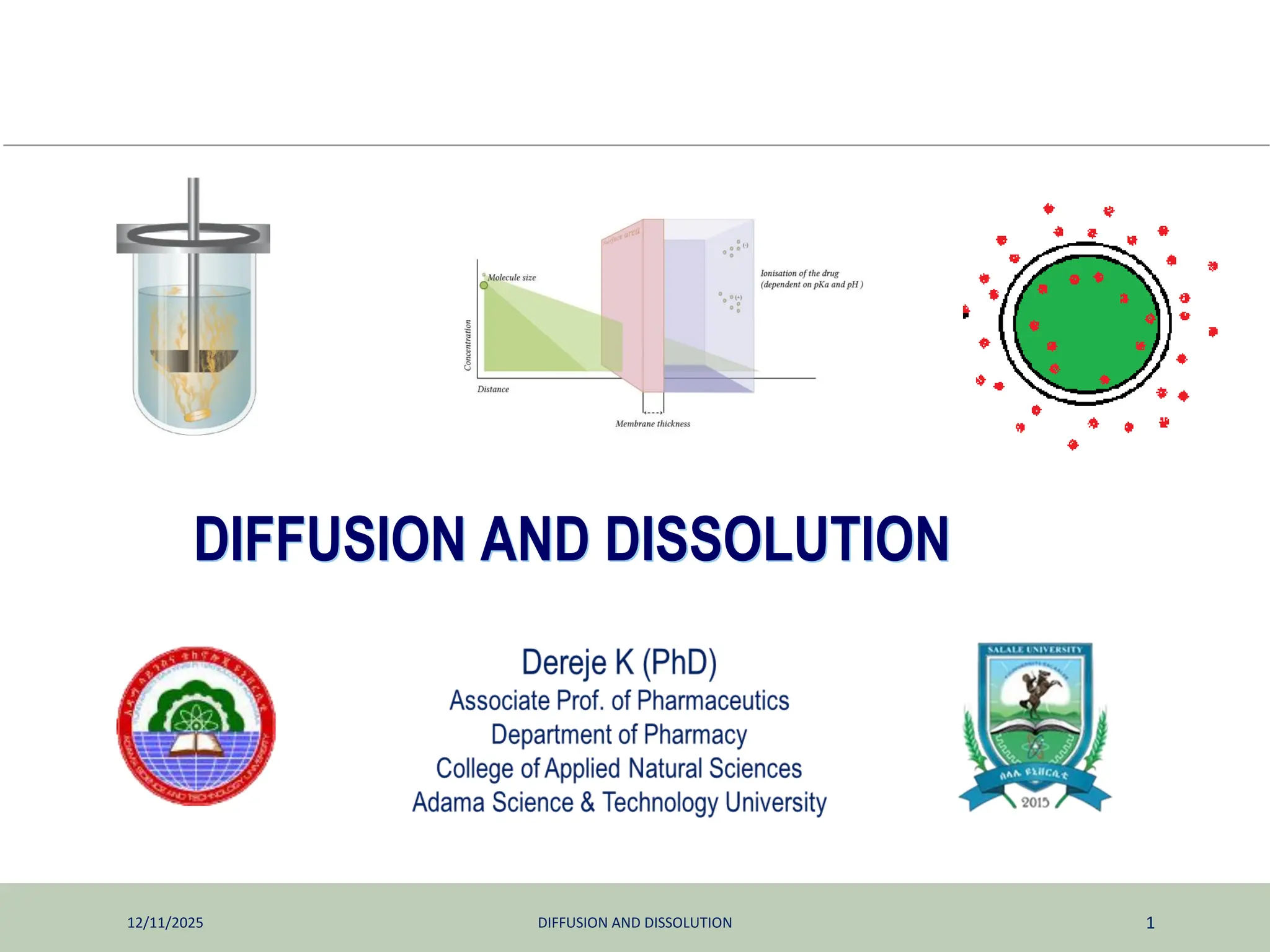
DIFFUSION AND DISSOLUTION
12/11/2025 DIFFUSION AND DISSOLUTION 2
Learning Objectives
 After finishing this chapter the student will have thorough knowledge
of:
Definition of diffusion, osmosis, dialysis, ultrafiltration
Fick’s law of diffusion (steady state, diffusion through a membrane)
Applications of diffusion in pharmaceutical sciences
Dissolution of particles (Noyes-whetney equation, factors affecting
dissolution)
Intrinsic dissolution rate
Sink conditions, Lag time and burst effects
12/11/2025 DIFFUSION AND DISSOLUTION 3
Introduction
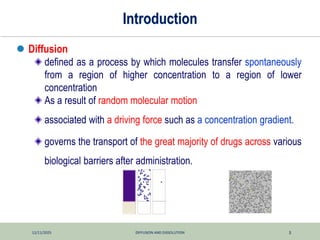
 Diffusion
defined as a process by which molecules transfer spontaneously
from a region of higher concentration to a region of lower
concentration
As a result of random molecular motion
associated with a driving force such as a concentration gradient.
governs the transport of the great majority of drugs across various
biological barriers after administration.
12/11/2025 DIFFUSION AND DISSOLUTION 4
Introduction…
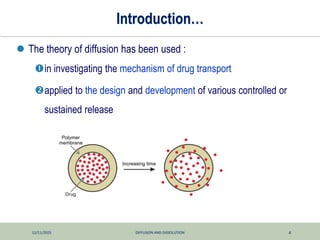
 The theory of diffusion has been used :
in investigating the mechanism of drug transport
applied to the design and development of various controlled or
sustained release
12/11/2025 DIFFUSION AND DISSOLUTION 5
Introduction…
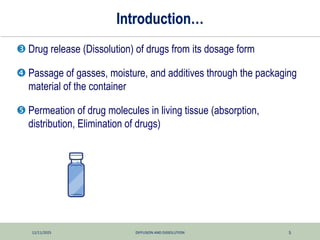
 Drug release (Dissolution) of drugs from its dosage form
 Passage of gasses, moisture, and additives through the packaging
material of the container
 Permeation of drug molecules in living tissue (absorption,
distribution, Elimination of drugs)
12/11/2025 DIFFUSION AND DISSOLUTION 6
Introduction…
12/11/2025 DIFFUSION AND DISSOLUTION 7
Introduction…
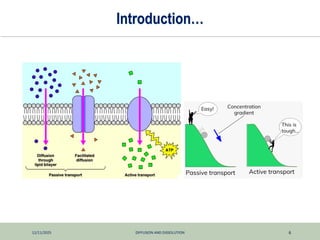
 The molecules that migrate from one location to another are termed
as diffusants, permeants or penetrants
 The medium in which the diffusant migrates is called the diffusional
barrier.
 The concentration gradient is the concentration profile of the
diffusant in the diffusional barrier.
 The concentration gradient is the driving force for diffusion
12/11/2025 DIFFUSION AND DISSOLUTION 8
Introduction…
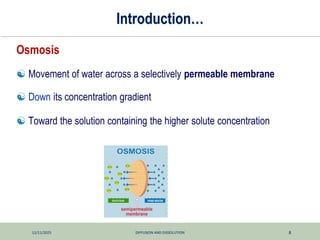
Osmosis
 Movement of water across a selectively permeable membrane
 Down its concentration gradient
 Toward the solution containing the higher solute concentration
12/11/2025 DIFFUSION AND DISSOLUTION 9
Introduction…
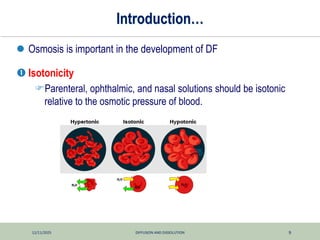
 Osmosis is important in the development of DF
 Isotonicity
Parenteral, ophthalmic, and nasal solutions should be isotonic
relative to the osmotic pressure of blood.
12/11/2025 DIFFUSION AND DISSOLUTION 10
Introduction…
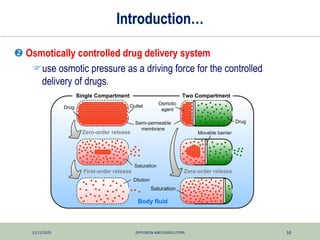
 Osmotically controlled drug delivery system
use osmotic pressure as a driving force for the controlled
delivery of drugs.
12/11/2025 DIFFUSION AND DISSOLUTION 11
Introduction…
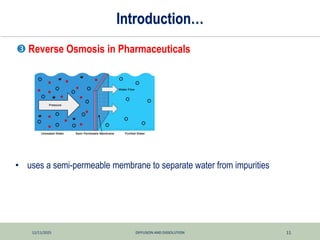
 Reverse Osmosis in Pharmaceuticals
• uses a semi-permeable membrane to separate water from impurities
12/11/2025 DIFFUSION AND DISSOLUTION 12
Introduction…
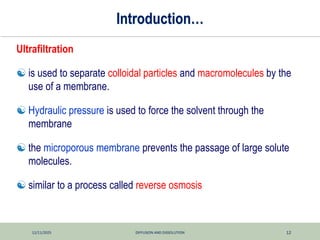
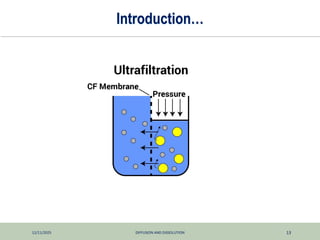
Ultrafiltration
 is used to separate colloidal particles and macromolecules by the
use of a membrane.
 Hydraulic pressure is used to force the solvent through the
membrane
 the microporous membrane prevents the passage of large solute
molecules.
 similar to a process called reverse osmosis
12/11/2025 DIFFUSION AND DISSOLUTION 13
Introduction…
12/11/2025 DIFFUSION AND DISSOLUTION 14
Introduction…
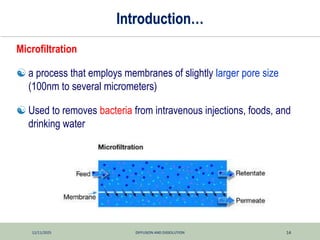
Microfiltration
 a process that employs membranes of slightly larger pore size
(100nm to several micrometers)
 Used to removes bacteria from intravenous injections, foods, and
drinking water
12/11/2025 DIFFUSION AND DISSOLUTION 15
Introduction…
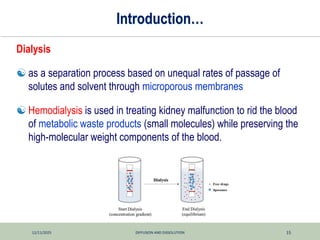
Dialysis
 as a separation process based on unequal rates of passage of
solutes and solvent through microporous membranes
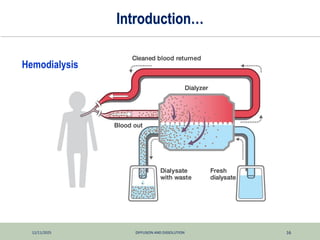
 Hemodialysis is used in treating kidney malfunction to rid the blood
of metabolic waste products (small molecules) while preserving the
high-molecular weight components of the blood.
12/11/2025 DIFFUSION AND DISSOLUTION 16
Introduction…
Hemodialysis
12/11/2025 DIFFUSION AND DISSOLUTION 17
Fick’s law of diffusion
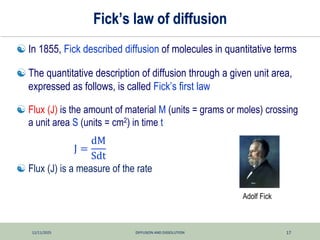
 In 1855, Fick described diffusion of molecules in quantitative terms
 The quantitative description of diffusion through a given unit area,
expressed as follows, is called Fick’s first law
 Flux (J) is the amount of material M (units = grams or moles) crossing
a unit area S (units = cm2) in time t
 Flux (J) is a measure of the rate
J =
dM
Sdt
Adolf Fick
12/11/2025 DIFFUSION AND DISSOLUTION 18
Fick’s law of diffusion….
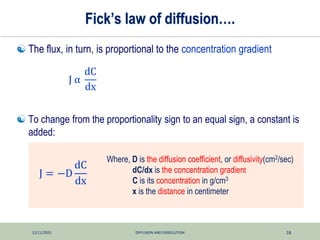
 The flux, in turn, is proportional to the concentration gradient
 To change from the proportionality sign to an equal sign, a constant is
added:
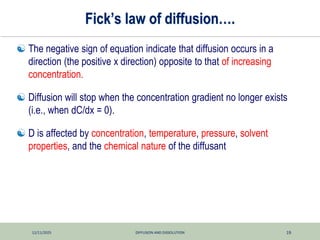
Where, D is the diffusion coefficient, or diffusivity(cm2/sec)
dC/dx is the concentration gradient
C is its concentration in g/cm3
x is the distance in centimeter
J α
dC
dx
J = −D
dC
dx
12/11/2025 DIFFUSION AND DISSOLUTION 19
Fick’s law of diffusion….
 The negative sign of equation indicate that diffusion occurs in a
direction (the positive x direction) opposite to that of increasing
concentration.
 Diffusion will stop when the concentration gradient no longer exists
(i.e., when dC/dx = 0).
 D is affected by concentration, temperature, pressure, solvent
properties, and the chemical nature of the diffusant
12/11/2025 DIFFUSION AND DISSOLUTION 20
Fick’s law of diffusion…
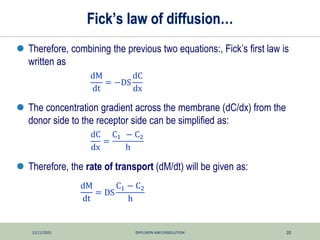
 Therefore, combining the previous two equations:, Fick’s first law is
written as
 The concentration gradient across the membrane (dC/dx) from the
donor side to the receptor side can be simplified as:
 Therefore, the rate of transport (dM/dt) will be given as:
dM
dt
= −DS
dC
dx
dC
dx
=
C1 − C2
h
dM
dt
= DS
C1 − C2
h
12/11/2025 DIFFUSION AND DISSOLUTION 21
Fick’s law of diffusion…
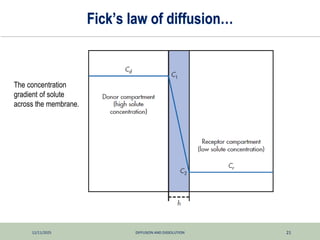
The concentration
gradient of solute
across the membrane.
12/11/2025 DIFFUSION AND DISSOLUTION 22
Steady state diffusion
 When the amounts of diffusant enter and leave the given space at the
same rate, the concentration of the diffusant in the given volume is a
constant.
 The diffusion process that meets this condition is considered a steady
state diffusion
 The concentration in the given space is independent of time.
12/11/2025 DIFFUSION AND DISSOLUTION 23
Non-steady state diffusion
 A diffusion process in which the concentration of diffusant in a given
space is a function of time
 the concentration of diffusant in the diffusional barrier varies with time
 In this case, the Fick’s second law to study the diffusion process.
12/11/2025 DIFFUSION AND DISSOLUTION 24
Distribution or partition coefficient
 Distribution or partition coefficient is a measure of the ability of a
compound to distribute in two immiscible phases.
 The partition phenomenon is of paramount importance for the
diffusion across skin and other epithelia.
 Many pharmaceutical processes based on the partition principles
absorption from the gastrointestinal tract after oral administration
 drug distribution following entry into systemic circulation
12/11/2025 DIFFUSION AND DISSOLUTION 25
Distribution or partition coefficient…
extraction and isolation of pure drugs after synthetic
manufacturing or from crude plant sources
formulation of a stable dosage form (emulsion, etc.),
assay of plasma concentrations,
 These all are based on the partition principles
12/11/2025 DIFFUSION AND DISSOLUTION 26
Distribution or partition coefficient…
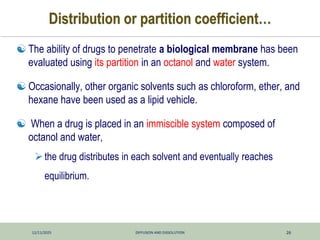
 The ability of drugs to penetrate a biological membrane has been
evaluated using its partition in an octanol and water system.
 Occasionally, other organic solvents such as chloroform, ether, and
hexane have been used as a lipid vehicle.
 When a drug is placed in an immiscible system composed of
octanol and water,
the drug distributes in each solvent and eventually reaches
equilibrium.
12/11/2025 DIFFUSION AND DISSOLUTION 27
Distribution or partition coefficient…
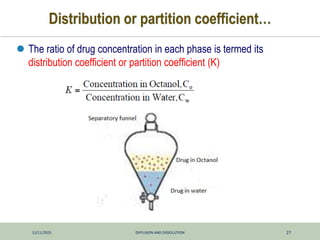
 The ratio of drug concentration in each phase is termed its
distribution coefficient or partition coefficient (K)
12/11/2025 DIFFUSION AND DISSOLUTION 28
Distribution or partition coefficient…
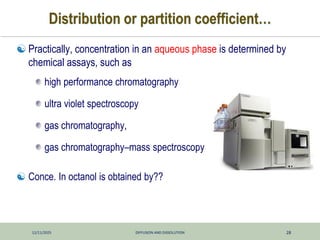
 Practically, concentration in an aqueous phase is determined by
chemical assays, such as
high performance chromatography
ultra violet spectroscopy
gas chromatography,
gas chromatography–mass spectroscopy
 Conce. In octanol is obtained by??
12/11/2025 DIFFUSION AND DISSOLUTION 29
Distribution or partition coefficient…
Example:
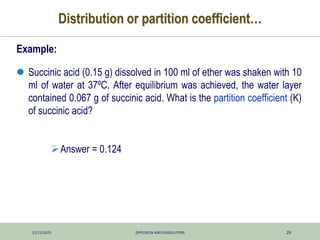
 Succinic acid (0.15 g) dissolved in 100 ml of ether was shaken with 10
ml of water at 37ºC. After equilibrium was achieved, the water layer
contained 0.067 g of succinic acid. What is the partition coefficient (K)
of succinic acid?
Answer = 0.124
12/11/2025 DIFFUSION AND DISSOLUTION 30
Diffusion coefficient & permeability coefficient
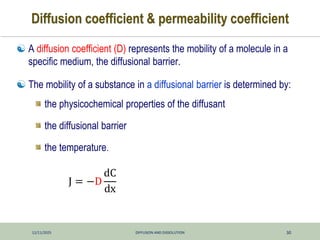
 A diffusion coefficient (D) represents the mobility of a molecule in a
specific medium, the diffusional barrier.
 The mobility of a substance in a diffusional barrier is determined by:
the physicochemical properties of the diffusant
the diffusional barrier
the temperature.
J = −D
dC
dx
12/11/2025 DIFFUSION AND DISSOLUTION 31
Diffusion coefficient & permeability coefficient…
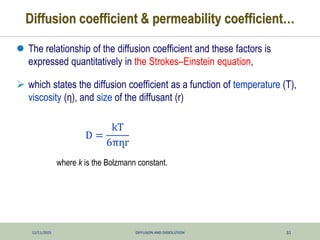
 The relationship of the diffusion coefficient and these factors is
expressed quantitatively in the Strokes–Einstein equation,
 which states the diffusion coefficient as a function of temperature (T),
viscosity (η), and size of the diffusant (r)
where k is the Bolzmann constant.
D =
kT
6πղr
12/11/2025 DIFFUSION AND DISSOLUTION 32
Diffusion coefficient & permeability coefficient…
12/11/2025 DIFFUSION AND DISSOLUTION 33
12/11/2025 DIFFUSION AND DISSOLUTION 34
Diffusion coefficient & permeability coefficient…
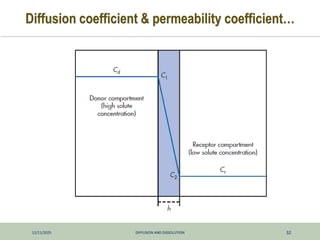
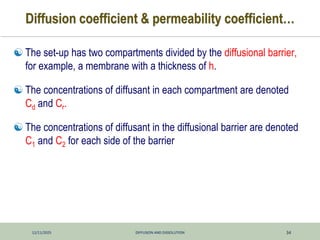
 The set-up has two compartments divided by the diffusional barrier,
for example, a membrane with a thickness of h.
 The concentrations of diffusant in each compartment are denoted
Cd and Cr.
 The concentrations of diffusant in the diffusional barrier are denoted
C1 and C2 for each side of the barrier
12/11/2025 DIFFUSION AND DISSOLUTION 35
Diffusion coefficient & permeability coefficient…
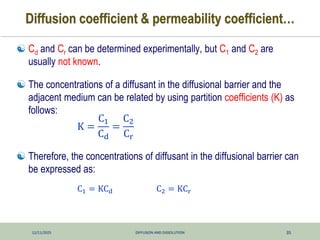
 Cd and Cr can be determined experimentally, but C1 and C2 are
usually not known.
 The concentrations of a diffusant in the diffusional barrier and the
adjacent medium can be related by using partition coefficients (K) as
follows:
 Therefore, the concentrations of diffusant in the diffusional barrier can
be expressed as:
K =
C1
Cd
=
C2
Cr
C1 = KCd C2 = KCr
12/11/2025 DIFFUSION AND DISSOLUTION 36
Diffusion coefficient & permeability coefficient…
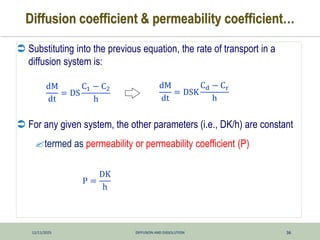
 Substituting into the previous equation, the rate of transport in a
diffusion system is:
 For any given system, the other parameters (i.e., DK/h) are constant
termed as permeability or permeability coefficient (P)
dM
dt
= DSK
Cd − Cr
h
dM
dt
= DS
C1 − C2
h
P =
DK
h
12/11/2025 DIFFUSION AND DISSOLUTION 37
Sink Condition Approximation
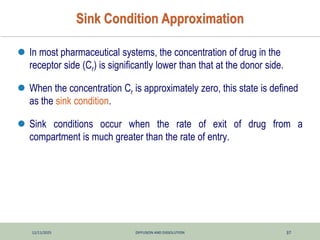
 In most pharmaceutical systems, the concentration of drug in the
receptor side (Cr) is significantly lower than that at the donor side.
 When the concentration Cr is approximately zero, this state is defined
as the sink condition.
 Sink conditions occur when the rate of exit of drug from a
compartment is much greater than the rate of entry.
12/11/2025 DIFFUSION AND DISSOLUTION 38
Sink Condition Approximation…
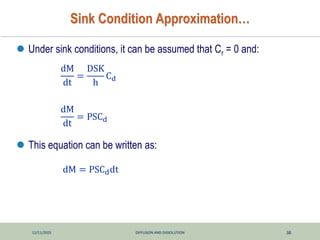
 Under sink conditions, it can be assumed that Cr = 0 and:
 This equation can be written as:
dM
dt
=
DSK
h
Cd
dM
dt
= PSCd
dM = PSCddt
12/11/2025 DIFFUSION AND DISSOLUTION 39
Sink Condition Approximation…
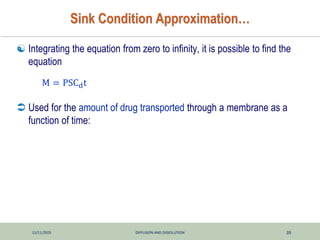
 Integrating the equation from zero to infinity, it is possible to find the
equation
 Used for the amount of drug transported through a membrane as a
function of time:
M = PSCdt
12/11/2025 DIFFUSION AND DISSOLUTION 40
Example 1
A drug passing through a 1-mm-thick membrane has a diffusion
coefficient of 4.23 × 10− 7 cm2/s and an oil–water partition coefficient of
2.03. The radius of the area exposed to the solution is 2 cm, and the
concentration of the drug in the donor compartment is 0.5 mg/mL.
Calculate the permeability (P) and the diffusion rate of the drug.
Solution
h =1mm=0.1cm
D= 4.23 × 10− 7 cm2/s
K= 2.03
r = 2cm, S = πr2 =12.57cm2
Cd =0.5mg/mL
P=DK/h = [(4.23 × 10− 7 cm2/s)(2.03)]/0.1cm = 8.59 x 10⁻⁵ cm/s
dM/dt = PSCd = 0.19 mg/h
12/11/2025 DIFFUSION AND DISSOLUTION 41
Example 2
To study the oral absorption of paclitaxel from an oil-in-water emulsion
formulation, an inverted closed-loop intestinal model was used. The drug was
instilled in the intestine, and the system was maintained at 37°C (98.6°F) in an
oxygen-rich buffer medium. The surface area available for diffusion was 28.4
cm2, and the concentration of paclitaxel in the intestine was 1.50 mg/mL.
Calculate the amount of paclitaxel that will permeate the intestine in 6 h of study
if the permeability coefficient was 4.25 × 10⁻⁶ cm/s. Assume zero-order
transport under sink conditions.
Solution
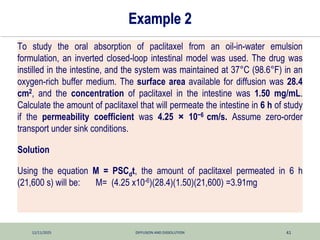
Using the equation M = PSCdt, the amount of paclitaxel permeated in 6 h
(21,600 s) will be: M= (4.25 x10⁻⁶)(28.4)(1.50)(21,600) =3.91mg
12/11/2025 DIFFUSION AND DISSOLUTION 42
Experimental methods
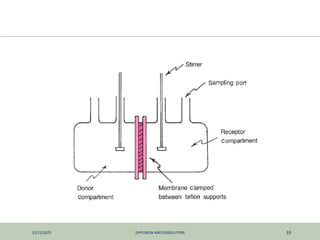
 The diffusion process can be studied by using various methods
 The most commonly used method in pharmaceutical research is the
permeation method using simple diffusion cell.
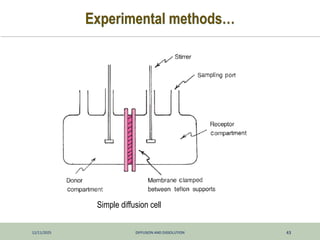
 The experimental set-up for this method consists of two chambers
separated by a diffusional barrier.
 The donor chamber is filled with drug solution
12/11/2025 DIFFUSION AND DISSOLUTION 43
Experimental methods…
Simple diffusion cell
12/11/2025 DIFFUSION AND DISSOLUTION 44
Experimental methods….
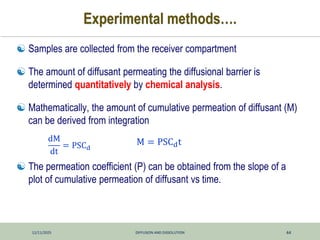
 Samples are collected from the receiver compartment
 The amount of diffusant permeating the diffusional barrier is
determined quantitatively by chemical analysis.
 Mathematically, the amount of cumulative permeation of diffusant (M)
can be derived from integration
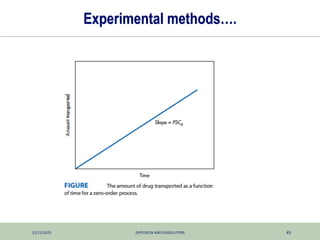
 The permeation coefficient (P) can be obtained from the slope of a
plot of cumulative permeation of diffusant vs time.
dM
dt
= PSCd
M = PSCdt
12/11/2025 DIFFUSION AND DISSOLUTION 45
Experimental methods….
12/11/2025 DIFFUSION AND DISSOLUTION 46
Lag-Time and Burst Effects
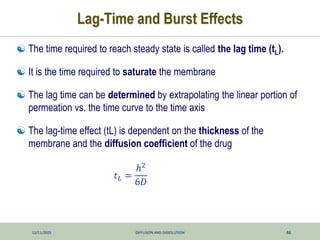
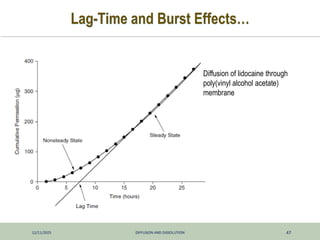
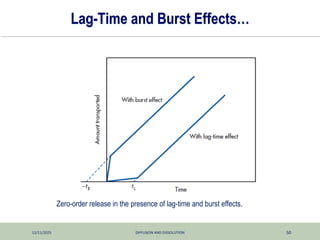
 The time required to reach steady state is called the lag time (tL).
 It is the time required to saturate the membrane
 The lag time can be determined by extrapolating the linear portion of
permeation vs. the time curve to the time axis
 The lag-time effect (tL) is dependent on the thickness of the
membrane and the diffusion coefficient of the drug
𝑡𝐿 =
ℎ2
6𝐷
12/11/2025 DIFFUSION AND DISSOLUTION 47
Lag-Time and Burst Effects…
Diffusion of lidocaine through
poly(vinyl alcohol acetate)
membrane
12/11/2025 DIFFUSION AND DISSOLUTION 48
Lag-Time and Burst Effects…
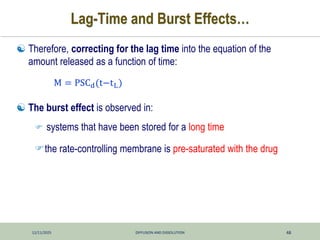
 Therefore, correcting for the lag time into the equation of the
amount released as a function of time:
 The burst effect is observed in:
 systems that have been stored for a long time
the rate-controlling membrane is pre-saturated with the drug
M = PSCd(t−tL)
12/11/2025 DIFFUSION AND DISSOLUTION 49
Lag-Time and Burst Effects…
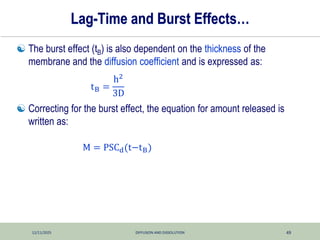
 The burst effect (tB) is also dependent on the thickness of the
membrane and the diffusion coefficient and is expressed as:
 Correcting for the burst effect, the equation for amount released is
written as:
tB =
h2
3D
M = PSCd(t−tB)
12/11/2025 DIFFUSION AND DISSOLUTION 50
Lag-Time and Burst Effects…
Zero-order release in the presence of lag-time and burst effects.
12/11/2025 DIFFUSION AND DISSOLUTION 51
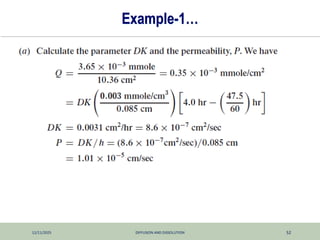
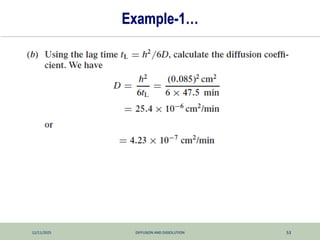
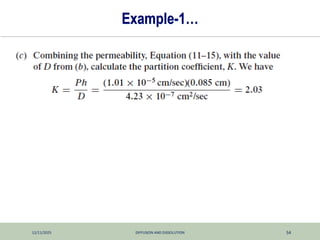
Example-1
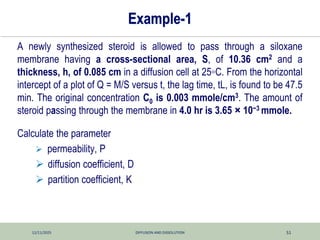
A newly synthesized steroid is allowed to pass through a siloxane
membrane having a cross-sectional area, S, of 10.36 cm2 and a
thickness, h, of 0.085 cm in a diffusion cell at 25◦C. From the horizontal
intercept of a plot of Q = M/S versus t, the lag time, tL, is found to be 47.5
min. The original concentration C0 is 0.003 mmole/cm3. The amount of
steroid passing through the membrane in 4.0 hr is 3.65 × 10⁻³ mmole.
Calculate the parameter
 permeability, P
 diffusion coefficient, D
 partition coefficient, K
12/11/2025 DIFFUSION AND DISSOLUTION 52
Example-1…
12/11/2025 DIFFUSION AND DISSOLUTION 53
Example-1…
12/11/2025 DIFFUSION AND DISSOLUTION 54
Example-1…
12/11/2025 DIFFUSION AND DISSOLUTION 55
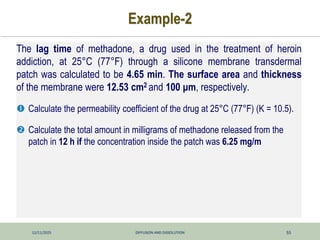
Example-2
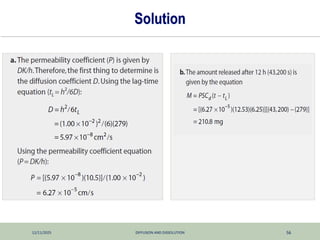
The lag time of methadone, a drug used in the treatment of heroin
addiction, at 25°C (77°F) through a silicone membrane transdermal
patch was calculated to be 4.65 min. The surface area and thickness
of the membrane were 12.53 cm2 and 100 μm, respectively.
 Calculate the permeability coefficient of the drug at 25°C (77°F) (K = 10.5).
 Calculate the total amount in milligrams of methadone released from the
patch in 12 h if the concentration inside the patch was 6.25 mg/m
12/11/2025 DIFFUSION AND DISSOLUTION 56
Solution
12/11/2025 DIFFUSION AND DISSOLUTION 57
Dissolution
 Dissolution is a process in which a solid substance solubilizes in a
given solvent
i.e. mass transfer from the solid surface to the liquid phase.
 Rate of dissolution
 is the amount of drug substance that goes in solution per unit time
under standardized conditions of temperature and solvent
composition.
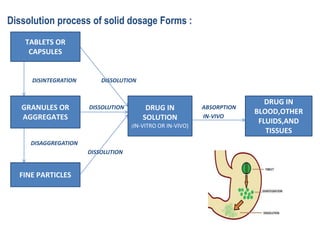
Dissolution process of solid dosage Forms :
DISINTEGRATION DISSOLUTION
DISSOLUTION ABSORPTION
IN-VIVO
IN-VIVO
DISAGGREGATION
DISSOLUTION
TABLETS OR
CAPSULES
GRANULES OR
AGGREGATES
FINE PARTICLES
DRUG IN
SOLUTION
(IN-VITRO OR IN-VIVO)
DRUG IN
BLOOD,OTHER
FLUIDS,AND
TISSUES
12/11/2025 DIFFUSION AND DISSOLUTION 59
12/11/2025 DIFFUSION AND DISSOLUTION 60
Dissolution mechanism
 The mechanism of dissolution could be explained by two models:
 diffusion-limited model
 Reaction limited model
12/11/2025 DIFFUSION AND DISSOLUTION 61
Dissolution mechanism….
The reaction-limited dissolution can be explained by
 the interfacial barrier model
 the Danckwert model.
12/11/2025 DIFFUSION AND DISSOLUTION 62
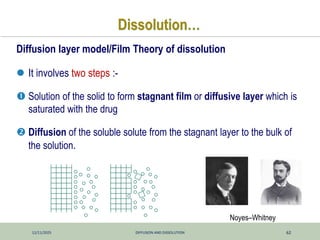
Dissolution…
Diffusion layer model/Film Theory of dissolution
 It involves two steps :-
 Solution of the solid to form stagnant film or diffusive layer which is
saturated with the drug
 Diffusion of the soluble solute from the stagnant layer to the bulk of
the solution.
Noyes–Whitney
12/11/2025 DIFFUSION AND DISSOLUTION 63
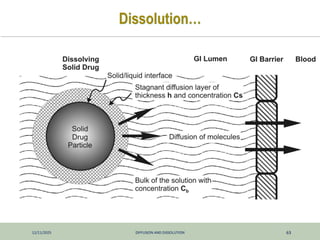
Dissolution…
12/11/2025 DIFFUSION AND DISSOLUTION 64
Dissolution…
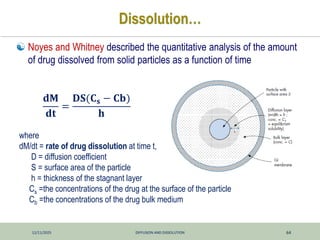
 Noyes and Whitney described the quantitative analysis of the amount
of drug dissolved from solid particles as a function of time
𝐝𝐌
𝐝𝐭
=
𝐃𝐒(𝐂𝐬 − 𝐂𝐛)
𝐡
where
dM/dt = rate of drug dissolution at time t,
D = diffusion coefficient
S = surface area of the particle
h = thickness of the stagnant layer
Cs =the concentrations of the drug at the surface of the particle
Cb =the concentrations of the drug bulk medium
12/11/2025 DIFFUSION AND DISSOLUTION 65
Dissolution…
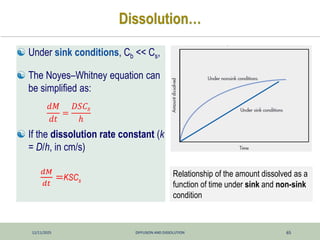
 Under sink conditions, Cb << Cs,
 The Noyes–Whitney equation can
be simplified as:
 If the dissolution rate constant (k
= D/h, in cm/s)
𝑑𝑀
𝑑𝑡
=
𝐷𝑆𝐶𝑠
ℎ
𝑑𝑀
𝑑𝑡
=KSCs
Relationship of the amount dissolved as a
function of time under sink and non-sink
condition
12/11/2025 DIFFUSION AND DISSOLUTION 66
Dissolution…
12/11/2025 DIFFUSION AND DISSOLUTION 67
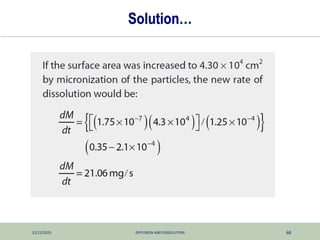
Solution
12/11/2025 DIFFUSION AND DISSOLUTION 68
Solution…
12/11/2025 DIFFUSION AND DISSOLUTION 69
Hixson-Crowell Cube-Root Relationship
 Major assumption in the Noyes-Whitney relationship is that the
surface area (S) term in the equation remains constant throughout the
dissolution process
 However, the size of drug particles from tablets, capsules, and
suspensions will decrease as the drug dissolves
 To take into account the changing surface area, Hixson and Crowell
modified the Noyes-Whitney equation
12/11/2025 DIFFUSION AND DISSOLUTION 70
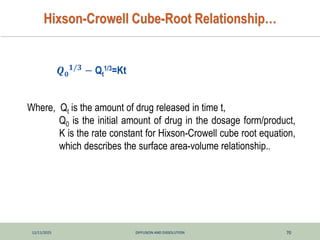
Hixson-Crowell Cube-Root Relationship…
Where, Qt is the amount of drug released in time t,
Q0 is the initial amount of drug in the dosage form/product,
K is the rate constant for Hixson-Crowell cube root equation,
which describes the surface area-volume relationship..
𝑸𝟎
𝟏/𝟑 − Qt
1/3=Kt
12/11/2025 DIFFUSION AND DISSOLUTION 71
Factors affecting Drug Dissolution
1. Factors relating to the physicochemical properties of drug
Solubility
Particle size and effective surface area of the drug
Polymorphism and amorphism
Salt form of the drug
Hydrates/solvates
12/11/2025 DIFFUSION AND DISSOLUTION 72
Factors affecting Drug Dissolution
2. Factors relating to the dosage forms.
A) Pharmaceutical excipients
Vehicle
Diluents
Lubricants
Binders
Surfactants
Colorants
12/11/2025 DIFFUSION AND DISSOLUTION 73
Factors affecting Drug Dissolution…
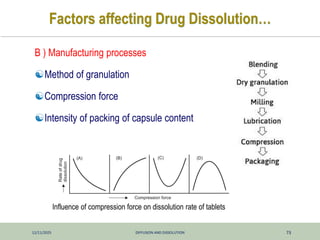
B ) Manufacturing processes
Method of granulation
Compression force
Intensity of packing of capsule content
Influence of compression force on dissolution rate of tablets
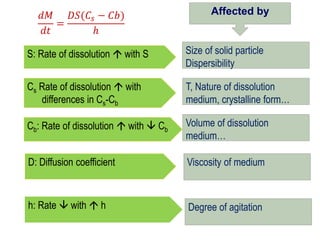
𝑑𝑀
𝑑𝑡
=
𝐷𝑆(𝐶𝑠 − 𝐶𝑏)
ℎ
S: Rate of dissolution  with S
Cs Rate of dissolution  with
differences in Cs-Cb
Cb: Rate of dissolution  with  Cb
D: Diffusion coefficient
h: Rate  with  h
Affected by
Size of solid particle
Dispersibility
T, Nature of dissolution
medium, crystalline form…
Volume of dissolution
medium…
Viscosity of medium
Degree of agitation
12/11/2025 DIFFUSION AND DISSOLUTION 75
Intrinsic dissolution rate (IDR)
 IDR is the rate of dissolution of a pure pharmaceutical active
ingredient when the surface area, stirring speed, pH and ionic
strength of the dissolution medium is kept constant
 is a prime indicator of the bioavailability of a drug candidate
12/11/2025 DIFFUSION AND DISSOLUTION 76
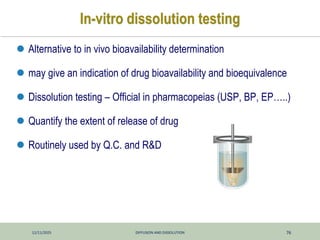
In-vitro dissolution testing
 Alternative to in vivo bioavailability determination
 may give an indication of drug bioavailability and bioequivalence
 Dissolution testing – Official in pharmacopeias (USP, BP, EP…..)
 Quantify the extent of release of drug
 Routinely used by Q.C. and R&D
12/11/2025 DIFFUSION AND DISSOLUTION 77
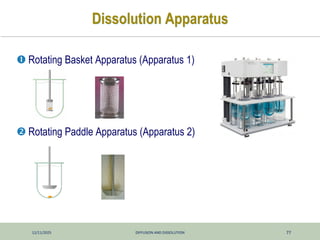
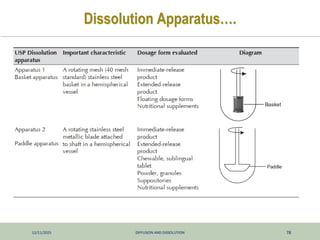
Dissolution Apparatus
 Rotating Basket Apparatus (Apparatus 1)
 Rotating Paddle Apparatus (Apparatus 2)
12/11/2025 DIFFUSION AND DISSOLUTION 78
Dissolution Apparatus….
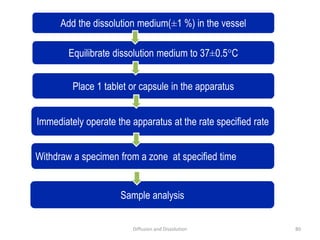
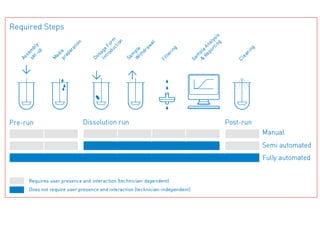
Add the dissolution medium(±1 %) in the vessel
Equilibrate dissolution medium to 37±0.5°C
Place 1 tablet or capsule in the apparatus
Immediately operate the apparatus at the rate specified rate
Withdraw a specimen from a zone at specified time
Sample analysis
Diffusion and Dissolution 80
12/11/2025 DIFFUSION AND DISSOLUTION 81
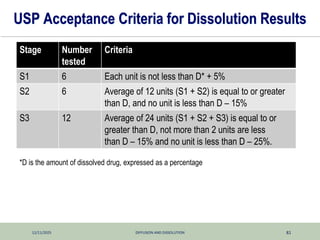
USP Acceptance Criteria for Dissolution Results
Stage Number
tested
Criteria
S1 6 Each unit is not less than D* + 5%
S2 6 Average of 12 units (S1 + S2) is equal to or greater
than D, and no unit is less than D – 15%
S3 12 Average of 24 units (S1 + S2 + S3) is equal to or
greater than D, not more than 2 units are less
than D – 15% and no unit is less than D – 25%.
*D is the amount of dissolved drug, expressed as a percentage
12/11/2025 DIFFUSION AND DISSOLUTION 82
Summary
 Diffusion, Osmosis, Dialysis, Ultrafiltration
 Fick’s law of diffusion
 Types of diffusion
 Distribution or partition coefficient
 Factors affecting rate of diffusion
 Sink condition
 Dissolution theories
 Factors affecting dissolution rate
12/11/2025 DIFFUSION AND DISSOLUTION 83
Quiz-2
 A pharmaceutical company is developing a new oral tablet
formulation for a poorly soluble drug. During preliminary testing,
they observe that the dissolution rate of the drug is significantly
lower than expected.
 Questions:
 Discuss potential physicochemical factors that could be influencing
the dissolution rate of the drug.
 Based on the Noyes-Whitney equation, how might the company
modify the formulation to enhance the dissolution rate?

4. IPPP-II (Diffusion and Dissolution) pdf.pdf

  • 1.
    12/11/2025 DIFFUSION ANDDISSOLUTION 1 DIFFUSION AND DISSOLUTION
  • 2.
    12/11/2025 DIFFUSION ANDDISSOLUTION 2 Learning Objectives  After finishing this chapter the student will have thorough knowledge of: Definition of diffusion, osmosis, dialysis, ultrafiltration Fick’s law of diffusion (steady state, diffusion through a membrane) Applications of diffusion in pharmaceutical sciences Dissolution of particles (Noyes-whetney equation, factors affecting dissolution) Intrinsic dissolution rate Sink conditions, Lag time and burst effects
  • 3.
    12/11/2025 DIFFUSION ANDDISSOLUTION 3 Introduction  Diffusion defined as a process by which molecules transfer spontaneously from a region of higher concentration to a region of lower concentration As a result of random molecular motion associated with a driving force such as a concentration gradient. governs the transport of the great majority of drugs across various biological barriers after administration.
  • 4.
    12/11/2025 DIFFUSION ANDDISSOLUTION 4 Introduction…  The theory of diffusion has been used : in investigating the mechanism of drug transport applied to the design and development of various controlled or sustained release
  • 5.
    12/11/2025 DIFFUSION ANDDISSOLUTION 5 Introduction…  Drug release (Dissolution) of drugs from its dosage form  Passage of gasses, moisture, and additives through the packaging material of the container  Permeation of drug molecules in living tissue (absorption, distribution, Elimination of drugs)
  • 6.
    12/11/2025 DIFFUSION ANDDISSOLUTION 6 Introduction…
  • 7.
    12/11/2025 DIFFUSION ANDDISSOLUTION 7 Introduction…  The molecules that migrate from one location to another are termed as diffusants, permeants or penetrants  The medium in which the diffusant migrates is called the diffusional barrier.  The concentration gradient is the concentration profile of the diffusant in the diffusional barrier.  The concentration gradient is the driving force for diffusion
  • 8.
    12/11/2025 DIFFUSION ANDDISSOLUTION 8 Introduction… Osmosis  Movement of water across a selectively permeable membrane  Down its concentration gradient  Toward the solution containing the higher solute concentration
  • 9.
    12/11/2025 DIFFUSION ANDDISSOLUTION 9 Introduction…  Osmosis is important in the development of DF  Isotonicity Parenteral, ophthalmic, and nasal solutions should be isotonic relative to the osmotic pressure of blood.
  • 10.
    12/11/2025 DIFFUSION ANDDISSOLUTION 10 Introduction…  Osmotically controlled drug delivery system use osmotic pressure as a driving force for the controlled delivery of drugs.
  • 11.
    12/11/2025 DIFFUSION ANDDISSOLUTION 11 Introduction…  Reverse Osmosis in Pharmaceuticals • uses a semi-permeable membrane to separate water from impurities
  • 12.
    12/11/2025 DIFFUSION ANDDISSOLUTION 12 Introduction… Ultrafiltration  is used to separate colloidal particles and macromolecules by the use of a membrane.  Hydraulic pressure is used to force the solvent through the membrane  the microporous membrane prevents the passage of large solute molecules.  similar to a process called reverse osmosis
  • 13.
    12/11/2025 DIFFUSION ANDDISSOLUTION 13 Introduction…
  • 14.
    12/11/2025 DIFFUSION ANDDISSOLUTION 14 Introduction… Microfiltration  a process that employs membranes of slightly larger pore size (100nm to several micrometers)  Used to removes bacteria from intravenous injections, foods, and drinking water
  • 15.
    12/11/2025 DIFFUSION ANDDISSOLUTION 15 Introduction… Dialysis  as a separation process based on unequal rates of passage of solutes and solvent through microporous membranes  Hemodialysis is used in treating kidney malfunction to rid the blood of metabolic waste products (small molecules) while preserving the high-molecular weight components of the blood.
  • 16.
    12/11/2025 DIFFUSION ANDDISSOLUTION 16 Introduction… Hemodialysis
  • 17.
    12/11/2025 DIFFUSION ANDDISSOLUTION 17 Fick’s law of diffusion  In 1855, Fick described diffusion of molecules in quantitative terms  The quantitative description of diffusion through a given unit area, expressed as follows, is called Fick’s first law  Flux (J) is the amount of material M (units = grams or moles) crossing a unit area S (units = cm2) in time t  Flux (J) is a measure of the rate J = dM Sdt Adolf Fick
  • 18.
    12/11/2025 DIFFUSION ANDDISSOLUTION 18 Fick’s law of diffusion….  The flux, in turn, is proportional to the concentration gradient  To change from the proportionality sign to an equal sign, a constant is added: Where, D is the diffusion coefficient, or diffusivity(cm2/sec) dC/dx is the concentration gradient C is its concentration in g/cm3 x is the distance in centimeter J α dC dx J = −D dC dx
  • 19.
    12/11/2025 DIFFUSION ANDDISSOLUTION 19 Fick’s law of diffusion….  The negative sign of equation indicate that diffusion occurs in a direction (the positive x direction) opposite to that of increasing concentration.  Diffusion will stop when the concentration gradient no longer exists (i.e., when dC/dx = 0).  D is affected by concentration, temperature, pressure, solvent properties, and the chemical nature of the diffusant
  • 20.
    12/11/2025 DIFFUSION ANDDISSOLUTION 20 Fick’s law of diffusion…  Therefore, combining the previous two equations:, Fick’s first law is written as  The concentration gradient across the membrane (dC/dx) from the donor side to the receptor side can be simplified as:  Therefore, the rate of transport (dM/dt) will be given as: dM dt = −DS dC dx dC dx = C1 − C2 h dM dt = DS C1 − C2 h
  • 21.
    12/11/2025 DIFFUSION ANDDISSOLUTION 21 Fick’s law of diffusion… The concentration gradient of solute across the membrane.
  • 22.
    12/11/2025 DIFFUSION ANDDISSOLUTION 22 Steady state diffusion  When the amounts of diffusant enter and leave the given space at the same rate, the concentration of the diffusant in the given volume is a constant.  The diffusion process that meets this condition is considered a steady state diffusion  The concentration in the given space is independent of time.
  • 23.
    12/11/2025 DIFFUSION ANDDISSOLUTION 23 Non-steady state diffusion  A diffusion process in which the concentration of diffusant in a given space is a function of time  the concentration of diffusant in the diffusional barrier varies with time  In this case, the Fick’s second law to study the diffusion process.
  • 24.
    12/11/2025 DIFFUSION ANDDISSOLUTION 24 Distribution or partition coefficient  Distribution or partition coefficient is a measure of the ability of a compound to distribute in two immiscible phases.  The partition phenomenon is of paramount importance for the diffusion across skin and other epithelia.  Many pharmaceutical processes based on the partition principles absorption from the gastrointestinal tract after oral administration  drug distribution following entry into systemic circulation
  • 25.
    12/11/2025 DIFFUSION ANDDISSOLUTION 25 Distribution or partition coefficient… extraction and isolation of pure drugs after synthetic manufacturing or from crude plant sources formulation of a stable dosage form (emulsion, etc.), assay of plasma concentrations,  These all are based on the partition principles
  • 26.
    12/11/2025 DIFFUSION ANDDISSOLUTION 26 Distribution or partition coefficient…  The ability of drugs to penetrate a biological membrane has been evaluated using its partition in an octanol and water system.  Occasionally, other organic solvents such as chloroform, ether, and hexane have been used as a lipid vehicle.  When a drug is placed in an immiscible system composed of octanol and water, the drug distributes in each solvent and eventually reaches equilibrium.
  • 27.
    12/11/2025 DIFFUSION ANDDISSOLUTION 27 Distribution or partition coefficient…  The ratio of drug concentration in each phase is termed its distribution coefficient or partition coefficient (K)
  • 28.
    12/11/2025 DIFFUSION ANDDISSOLUTION 28 Distribution or partition coefficient…  Practically, concentration in an aqueous phase is determined by chemical assays, such as high performance chromatography ultra violet spectroscopy gas chromatography, gas chromatography–mass spectroscopy  Conce. In octanol is obtained by??
  • 29.
    12/11/2025 DIFFUSION ANDDISSOLUTION 29 Distribution or partition coefficient… Example:  Succinic acid (0.15 g) dissolved in 100 ml of ether was shaken with 10 ml of water at 37ºC. After equilibrium was achieved, the water layer contained 0.067 g of succinic acid. What is the partition coefficient (K) of succinic acid? Answer = 0.124
  • 30.
    12/11/2025 DIFFUSION ANDDISSOLUTION 30 Diffusion coefficient & permeability coefficient  A diffusion coefficient (D) represents the mobility of a molecule in a specific medium, the diffusional barrier.  The mobility of a substance in a diffusional barrier is determined by: the physicochemical properties of the diffusant the diffusional barrier the temperature. J = −D dC dx
  • 31.
    12/11/2025 DIFFUSION ANDDISSOLUTION 31 Diffusion coefficient & permeability coefficient…  The relationship of the diffusion coefficient and these factors is expressed quantitatively in the Strokes–Einstein equation,  which states the diffusion coefficient as a function of temperature (T), viscosity (η), and size of the diffusant (r) where k is the Bolzmann constant. D = kT 6πղr
  • 32.
    12/11/2025 DIFFUSION ANDDISSOLUTION 32 Diffusion coefficient & permeability coefficient…
  • 33.
  • 34.
    12/11/2025 DIFFUSION ANDDISSOLUTION 34 Diffusion coefficient & permeability coefficient…  The set-up has two compartments divided by the diffusional barrier, for example, a membrane with a thickness of h.  The concentrations of diffusant in each compartment are denoted Cd and Cr.  The concentrations of diffusant in the diffusional barrier are denoted C1 and C2 for each side of the barrier
  • 35.
    12/11/2025 DIFFUSION ANDDISSOLUTION 35 Diffusion coefficient & permeability coefficient…  Cd and Cr can be determined experimentally, but C1 and C2 are usually not known.  The concentrations of a diffusant in the diffusional barrier and the adjacent medium can be related by using partition coefficients (K) as follows:  Therefore, the concentrations of diffusant in the diffusional barrier can be expressed as: K = C1 Cd = C2 Cr C1 = KCd C2 = KCr
  • 36.
    12/11/2025 DIFFUSION ANDDISSOLUTION 36 Diffusion coefficient & permeability coefficient…  Substituting into the previous equation, the rate of transport in a diffusion system is:  For any given system, the other parameters (i.e., DK/h) are constant termed as permeability or permeability coefficient (P) dM dt = DSK Cd − Cr h dM dt = DS C1 − C2 h P = DK h
  • 37.
    12/11/2025 DIFFUSION ANDDISSOLUTION 37 Sink Condition Approximation  In most pharmaceutical systems, the concentration of drug in the receptor side (Cr) is significantly lower than that at the donor side.  When the concentration Cr is approximately zero, this state is defined as the sink condition.  Sink conditions occur when the rate of exit of drug from a compartment is much greater than the rate of entry.
  • 38.
    12/11/2025 DIFFUSION ANDDISSOLUTION 38 Sink Condition Approximation…  Under sink conditions, it can be assumed that Cr = 0 and:  This equation can be written as: dM dt = DSK h Cd dM dt = PSCd dM = PSCddt
  • 39.
    12/11/2025 DIFFUSION ANDDISSOLUTION 39 Sink Condition Approximation…  Integrating the equation from zero to infinity, it is possible to find the equation  Used for the amount of drug transported through a membrane as a function of time: M = PSCdt
  • 40.
    12/11/2025 DIFFUSION ANDDISSOLUTION 40 Example 1 A drug passing through a 1-mm-thick membrane has a diffusion coefficient of 4.23 × 10− 7 cm2/s and an oil–water partition coefficient of 2.03. The radius of the area exposed to the solution is 2 cm, and the concentration of the drug in the donor compartment is 0.5 mg/mL. Calculate the permeability (P) and the diffusion rate of the drug. Solution h =1mm=0.1cm D= 4.23 × 10− 7 cm2/s K= 2.03 r = 2cm, S = πr2 =12.57cm2 Cd =0.5mg/mL P=DK/h = [(4.23 × 10− 7 cm2/s)(2.03)]/0.1cm = 8.59 x 10⁻⁵ cm/s dM/dt = PSCd = 0.19 mg/h
  • 41.
    12/11/2025 DIFFUSION ANDDISSOLUTION 41 Example 2 To study the oral absorption of paclitaxel from an oil-in-water emulsion formulation, an inverted closed-loop intestinal model was used. The drug was instilled in the intestine, and the system was maintained at 37°C (98.6°F) in an oxygen-rich buffer medium. The surface area available for diffusion was 28.4 cm2, and the concentration of paclitaxel in the intestine was 1.50 mg/mL. Calculate the amount of paclitaxel that will permeate the intestine in 6 h of study if the permeability coefficient was 4.25 × 10⁻⁶ cm/s. Assume zero-order transport under sink conditions. Solution Using the equation M = PSCdt, the amount of paclitaxel permeated in 6 h (21,600 s) will be: M= (4.25 x10⁻⁶)(28.4)(1.50)(21,600) =3.91mg
  • 42.
    12/11/2025 DIFFUSION ANDDISSOLUTION 42 Experimental methods  The diffusion process can be studied by using various methods  The most commonly used method in pharmaceutical research is the permeation method using simple diffusion cell.  The experimental set-up for this method consists of two chambers separated by a diffusional barrier.  The donor chamber is filled with drug solution
  • 43.
    12/11/2025 DIFFUSION ANDDISSOLUTION 43 Experimental methods… Simple diffusion cell
  • 44.
    12/11/2025 DIFFUSION ANDDISSOLUTION 44 Experimental methods….  Samples are collected from the receiver compartment  The amount of diffusant permeating the diffusional barrier is determined quantitatively by chemical analysis.  Mathematically, the amount of cumulative permeation of diffusant (M) can be derived from integration  The permeation coefficient (P) can be obtained from the slope of a plot of cumulative permeation of diffusant vs time. dM dt = PSCd M = PSCdt
  • 45.
    12/11/2025 DIFFUSION ANDDISSOLUTION 45 Experimental methods….
  • 46.
    12/11/2025 DIFFUSION ANDDISSOLUTION 46 Lag-Time and Burst Effects  The time required to reach steady state is called the lag time (tL).  It is the time required to saturate the membrane  The lag time can be determined by extrapolating the linear portion of permeation vs. the time curve to the time axis  The lag-time effect (tL) is dependent on the thickness of the membrane and the diffusion coefficient of the drug 𝑡𝐿 = ℎ2 6𝐷
  • 47.
    12/11/2025 DIFFUSION ANDDISSOLUTION 47 Lag-Time and Burst Effects… Diffusion of lidocaine through poly(vinyl alcohol acetate) membrane
  • 48.
    12/11/2025 DIFFUSION ANDDISSOLUTION 48 Lag-Time and Burst Effects…  Therefore, correcting for the lag time into the equation of the amount released as a function of time:  The burst effect is observed in:  systems that have been stored for a long time the rate-controlling membrane is pre-saturated with the drug M = PSCd(t−tL)
  • 49.
    12/11/2025 DIFFUSION ANDDISSOLUTION 49 Lag-Time and Burst Effects…  The burst effect (tB) is also dependent on the thickness of the membrane and the diffusion coefficient and is expressed as:  Correcting for the burst effect, the equation for amount released is written as: tB = h2 3D M = PSCd(t−tB)
  • 50.
    12/11/2025 DIFFUSION ANDDISSOLUTION 50 Lag-Time and Burst Effects… Zero-order release in the presence of lag-time and burst effects.
  • 51.
    12/11/2025 DIFFUSION ANDDISSOLUTION 51 Example-1 A newly synthesized steroid is allowed to pass through a siloxane membrane having a cross-sectional area, S, of 10.36 cm2 and a thickness, h, of 0.085 cm in a diffusion cell at 25◦C. From the horizontal intercept of a plot of Q = M/S versus t, the lag time, tL, is found to be 47.5 min. The original concentration C0 is 0.003 mmole/cm3. The amount of steroid passing through the membrane in 4.0 hr is 3.65 × 10⁻³ mmole. Calculate the parameter  permeability, P  diffusion coefficient, D  partition coefficient, K
  • 52.
    12/11/2025 DIFFUSION ANDDISSOLUTION 52 Example-1…
  • 53.
    12/11/2025 DIFFUSION ANDDISSOLUTION 53 Example-1…
  • 54.
    12/11/2025 DIFFUSION ANDDISSOLUTION 54 Example-1…
  • 55.
    12/11/2025 DIFFUSION ANDDISSOLUTION 55 Example-2 The lag time of methadone, a drug used in the treatment of heroin addiction, at 25°C (77°F) through a silicone membrane transdermal patch was calculated to be 4.65 min. The surface area and thickness of the membrane were 12.53 cm2 and 100 μm, respectively.  Calculate the permeability coefficient of the drug at 25°C (77°F) (K = 10.5).  Calculate the total amount in milligrams of methadone released from the patch in 12 h if the concentration inside the patch was 6.25 mg/m
  • 56.
    12/11/2025 DIFFUSION ANDDISSOLUTION 56 Solution
  • 57.
    12/11/2025 DIFFUSION ANDDISSOLUTION 57 Dissolution  Dissolution is a process in which a solid substance solubilizes in a given solvent i.e. mass transfer from the solid surface to the liquid phase.  Rate of dissolution  is the amount of drug substance that goes in solution per unit time under standardized conditions of temperature and solvent composition.
  • 58.
    Dissolution process ofsolid dosage Forms : DISINTEGRATION DISSOLUTION DISSOLUTION ABSORPTION IN-VIVO IN-VIVO DISAGGREGATION DISSOLUTION TABLETS OR CAPSULES GRANULES OR AGGREGATES FINE PARTICLES DRUG IN SOLUTION (IN-VITRO OR IN-VIVO) DRUG IN BLOOD,OTHER FLUIDS,AND TISSUES
  • 59.
  • 60.
    12/11/2025 DIFFUSION ANDDISSOLUTION 60 Dissolution mechanism  The mechanism of dissolution could be explained by two models:  diffusion-limited model  Reaction limited model
  • 61.
    12/11/2025 DIFFUSION ANDDISSOLUTION 61 Dissolution mechanism…. The reaction-limited dissolution can be explained by  the interfacial barrier model  the Danckwert model.
  • 62.
    12/11/2025 DIFFUSION ANDDISSOLUTION 62 Dissolution… Diffusion layer model/Film Theory of dissolution  It involves two steps :-  Solution of the solid to form stagnant film or diffusive layer which is saturated with the drug  Diffusion of the soluble solute from the stagnant layer to the bulk of the solution. Noyes–Whitney
  • 63.
    12/11/2025 DIFFUSION ANDDISSOLUTION 63 Dissolution…
  • 64.
    12/11/2025 DIFFUSION ANDDISSOLUTION 64 Dissolution…  Noyes and Whitney described the quantitative analysis of the amount of drug dissolved from solid particles as a function of time 𝐝𝐌 𝐝𝐭 = 𝐃𝐒(𝐂𝐬 − 𝐂𝐛) 𝐡 where dM/dt = rate of drug dissolution at time t, D = diffusion coefficient S = surface area of the particle h = thickness of the stagnant layer Cs =the concentrations of the drug at the surface of the particle Cb =the concentrations of the drug bulk medium
  • 65.
    12/11/2025 DIFFUSION ANDDISSOLUTION 65 Dissolution…  Under sink conditions, Cb << Cs,  The Noyes–Whitney equation can be simplified as:  If the dissolution rate constant (k = D/h, in cm/s) 𝑑𝑀 𝑑𝑡 = 𝐷𝑆𝐶𝑠 ℎ 𝑑𝑀 𝑑𝑡 =KSCs Relationship of the amount dissolved as a function of time under sink and non-sink condition
  • 66.
    12/11/2025 DIFFUSION ANDDISSOLUTION 66 Dissolution…
  • 67.
    12/11/2025 DIFFUSION ANDDISSOLUTION 67 Solution
  • 68.
    12/11/2025 DIFFUSION ANDDISSOLUTION 68 Solution…
  • 69.
    12/11/2025 DIFFUSION ANDDISSOLUTION 69 Hixson-Crowell Cube-Root Relationship  Major assumption in the Noyes-Whitney relationship is that the surface area (S) term in the equation remains constant throughout the dissolution process  However, the size of drug particles from tablets, capsules, and suspensions will decrease as the drug dissolves  To take into account the changing surface area, Hixson and Crowell modified the Noyes-Whitney equation
  • 70.
    12/11/2025 DIFFUSION ANDDISSOLUTION 70 Hixson-Crowell Cube-Root Relationship… Where, Qt is the amount of drug released in time t, Q0 is the initial amount of drug in the dosage form/product, K is the rate constant for Hixson-Crowell cube root equation, which describes the surface area-volume relationship.. 𝑸𝟎 𝟏/𝟑 − Qt 1/3=Kt
  • 71.
    12/11/2025 DIFFUSION ANDDISSOLUTION 71 Factors affecting Drug Dissolution 1. Factors relating to the physicochemical properties of drug Solubility Particle size and effective surface area of the drug Polymorphism and amorphism Salt form of the drug Hydrates/solvates
  • 72.
    12/11/2025 DIFFUSION ANDDISSOLUTION 72 Factors affecting Drug Dissolution 2. Factors relating to the dosage forms. A) Pharmaceutical excipients Vehicle Diluents Lubricants Binders Surfactants Colorants
  • 73.
    12/11/2025 DIFFUSION ANDDISSOLUTION 73 Factors affecting Drug Dissolution… B ) Manufacturing processes Method of granulation Compression force Intensity of packing of capsule content Influence of compression force on dissolution rate of tablets
  • 74.
    𝑑𝑀 𝑑𝑡 = 𝐷𝑆(𝐶𝑠 − 𝐶𝑏) ℎ S:Rate of dissolution  with S Cs Rate of dissolution  with differences in Cs-Cb Cb: Rate of dissolution  with  Cb D: Diffusion coefficient h: Rate  with  h Affected by Size of solid particle Dispersibility T, Nature of dissolution medium, crystalline form… Volume of dissolution medium… Viscosity of medium Degree of agitation
  • 75.
    12/11/2025 DIFFUSION ANDDISSOLUTION 75 Intrinsic dissolution rate (IDR)  IDR is the rate of dissolution of a pure pharmaceutical active ingredient when the surface area, stirring speed, pH and ionic strength of the dissolution medium is kept constant  is a prime indicator of the bioavailability of a drug candidate
  • 76.
    12/11/2025 DIFFUSION ANDDISSOLUTION 76 In-vitro dissolution testing  Alternative to in vivo bioavailability determination  may give an indication of drug bioavailability and bioequivalence  Dissolution testing – Official in pharmacopeias (USP, BP, EP…..)  Quantify the extent of release of drug  Routinely used by Q.C. and R&D
  • 77.
    12/11/2025 DIFFUSION ANDDISSOLUTION 77 Dissolution Apparatus  Rotating Basket Apparatus (Apparatus 1)  Rotating Paddle Apparatus (Apparatus 2)
  • 78.
    12/11/2025 DIFFUSION ANDDISSOLUTION 78 Dissolution Apparatus….
  • 80.
    Add the dissolutionmedium(±1 %) in the vessel Equilibrate dissolution medium to 37±0.5°C Place 1 tablet or capsule in the apparatus Immediately operate the apparatus at the rate specified rate Withdraw a specimen from a zone at specified time Sample analysis Diffusion and Dissolution 80
  • 81.
    12/11/2025 DIFFUSION ANDDISSOLUTION 81 USP Acceptance Criteria for Dissolution Results Stage Number tested Criteria S1 6 Each unit is not less than D* + 5% S2 6 Average of 12 units (S1 + S2) is equal to or greater than D, and no unit is less than D – 15% S3 12 Average of 24 units (S1 + S2 + S3) is equal to or greater than D, not more than 2 units are less than D – 15% and no unit is less than D – 25%. *D is the amount of dissolved drug, expressed as a percentage
  • 82.
    12/11/2025 DIFFUSION ANDDISSOLUTION 82 Summary  Diffusion, Osmosis, Dialysis, Ultrafiltration  Fick’s law of diffusion  Types of diffusion  Distribution or partition coefficient  Factors affecting rate of diffusion  Sink condition  Dissolution theories  Factors affecting dissolution rate
  • 83.
    12/11/2025 DIFFUSION ANDDISSOLUTION 83 Quiz-2  A pharmaceutical company is developing a new oral tablet formulation for a poorly soluble drug. During preliminary testing, they observe that the dissolution rate of the drug is significantly lower than expected.  Questions:  Discuss potential physicochemical factors that could be influencing the dissolution rate of the drug.  Based on the Noyes-Whitney equation, how might the company modify the formulation to enhance the dissolution rate?