Diffuse Axonal Injury and
Concussion
Dr Amit Agrawal, MCh
∗ Due to stretching forces placed on individual nerve cells
∗ Pathology distributed throughout brain
∗ Types
∗ Concussion
∗ Diffuse Axonal Injury (Moderate to Severe)
Diffuse Brain Injury
∗ Accidental Falls
∗ Vehicular accidents
∗ Child Abuse
∗ Assaults
∗ Gunshots
∗ Violent shaking of a child
∗ Sports related injuries
Causes
∗ Diffuse axonal injury (DAI) is the predominant
mechanism of injury in 40% to 50% of traumatic brain
injuries (TBIs) requiring hospital admission in the United
States.
∗ A component of DAI is believed to be present in all motor
vehicle crashes (MVCs) where the patient has lost
consciousness
∗ Widespread axonal damage occurring after a mild,
moderate, or severe TBI
∗ Process takes approximately 12-24 hours
∗ One of the major causes of unconsciousness and
persistent vegetative state after head trauma
Diffuse Axonal Injury
∗ Due to acceleration/deceleration to whtie matter +
hypoxia
∗ Significant mechanical disruption of nerve cells
∗ Cerebral hemispheres and brainstem
∗ High mortality rate
Diffuse Axonal Injury
∗ Mostly microscopic damage, and it is often not visible on
imaging studies
∗ The main mechanical force that causes DAI is rotational
acceleration of the brain, resulting in unrestricted head
movement
∗ Rotational acceleration produces shearing and tensile
forces, and axons can be pulled apart at the microscopic
level
∗ Microscopic evaluation of the brain tissue often shows
numerous swollen and disconnected axons
∗ Rapid stretching of axons is thought to damage the
axonal cytoskeleton and, therefore, disrupt normal
neuron function
Diffuse Axonal Injury:Pathological
feature
∗ Varies from mild to profound
∗ May be permanent or temporary
∗ Symptoms may appear immediately or over weeks,
months, years
∗ Diffuse axonal injury (DAI)
∗ Clinical signs:
∗ ↓ LOC
∗ ↑ ICP
∗ Decerebration or decortication
∗ Global cerebral edema
Diffuse Axonal Injury: Clinical
features
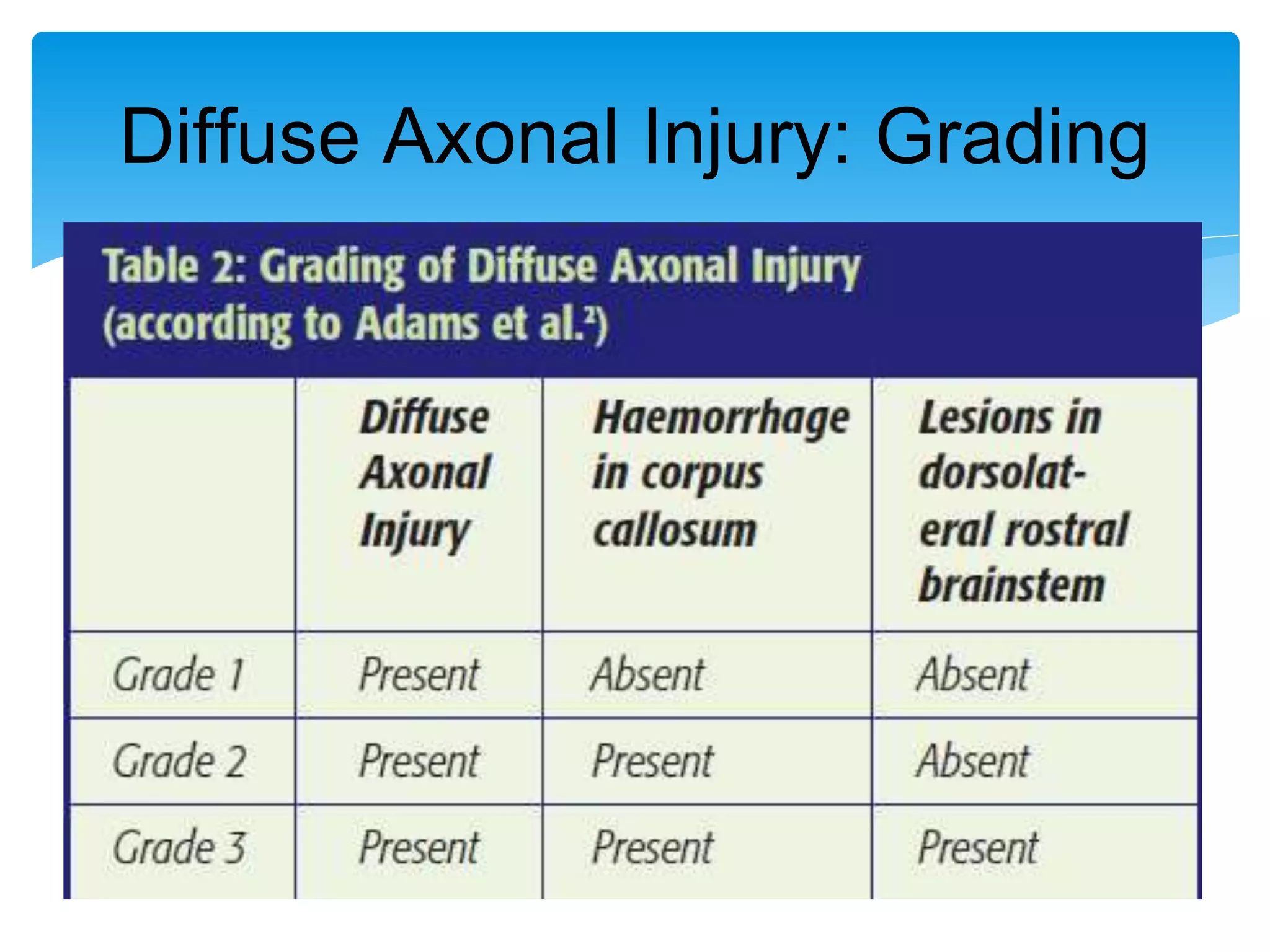
Diffuse Axonal Injury: Grading
∗ Defined as the result of the forceful motion of the head
causing a brief change in mental status for less than 30
minutes.
Concussion
∗ Concussion may be caused either by a direct blow to the
head, face, neck or elsewhere on the body with an ‘‘impulsive’’
force transmitted to the head.
∗ Concussion typically results in the rapid onset of short- lived
impairment of neurologic function that resolves spontaneously.
However in some cases symptoms and signs may evolve over
a number of minutes to hours.
∗ Concussion may result in neuropathological changes but the
acute clinical symptoms largely reflect a functional disturbance
rather than a structural injury and as such, no abnormality is
seen on standard structural neuroimaging studies.
∗ Concussion results in a graded set of clinical symptoms that
may or may not involve loss of consciousness. Resolution of
the clinical and cognitive symptoms typically follows a
sequential course. However it is important to note that in
some cases, post-concussive symptoms may be prolonged.
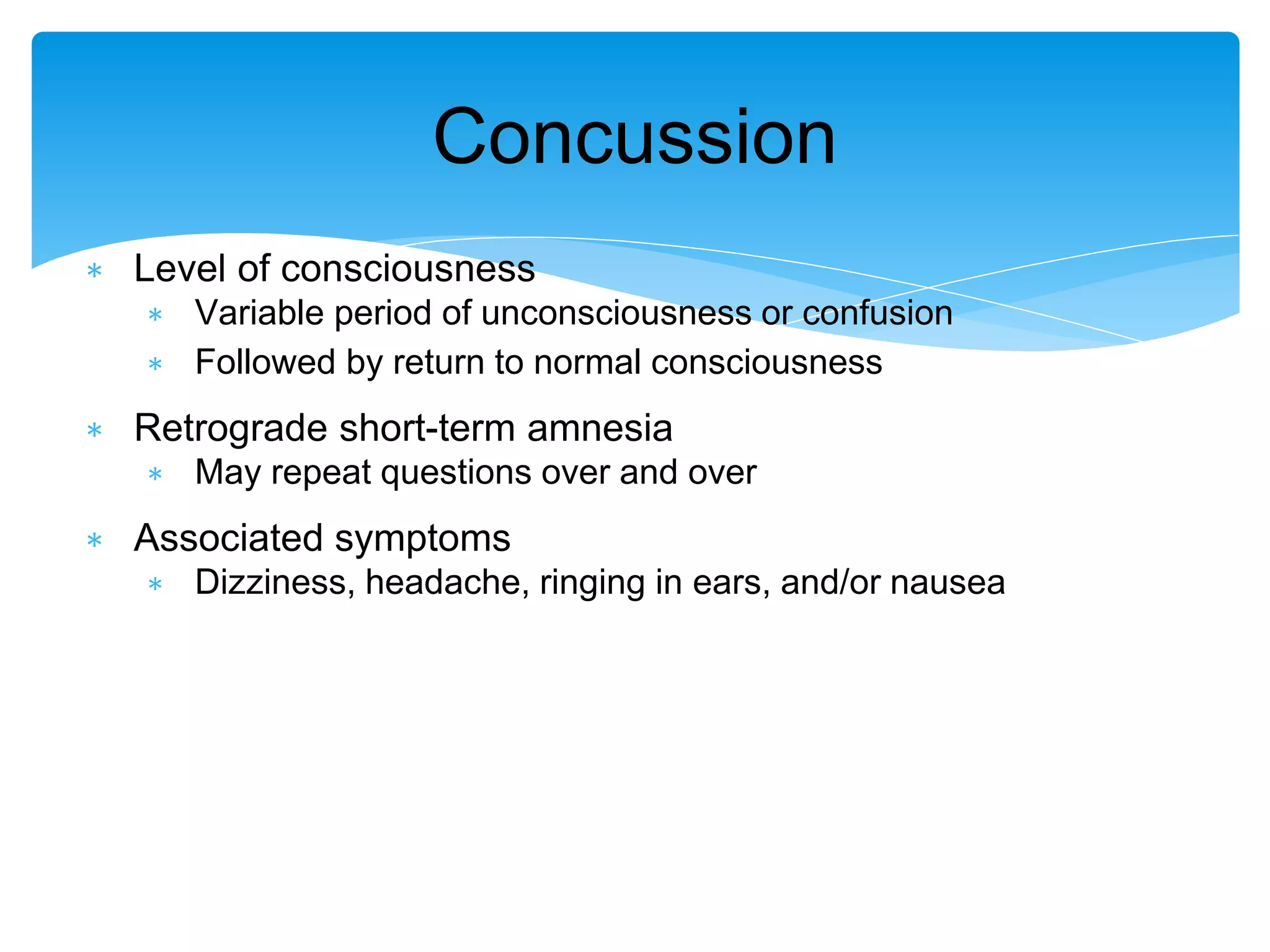
Concussion
∗ Level of consciousness
∗ Variable period of unconsciousness or confusion
∗ Followed by return to normal consciousness
∗ Retrograde short-term amnesia
∗ May repeat questions over and over
∗ Associated symptoms
∗ Dizziness, headache, ringing in ears, and/or nausea
Concussion
Head Trauma -
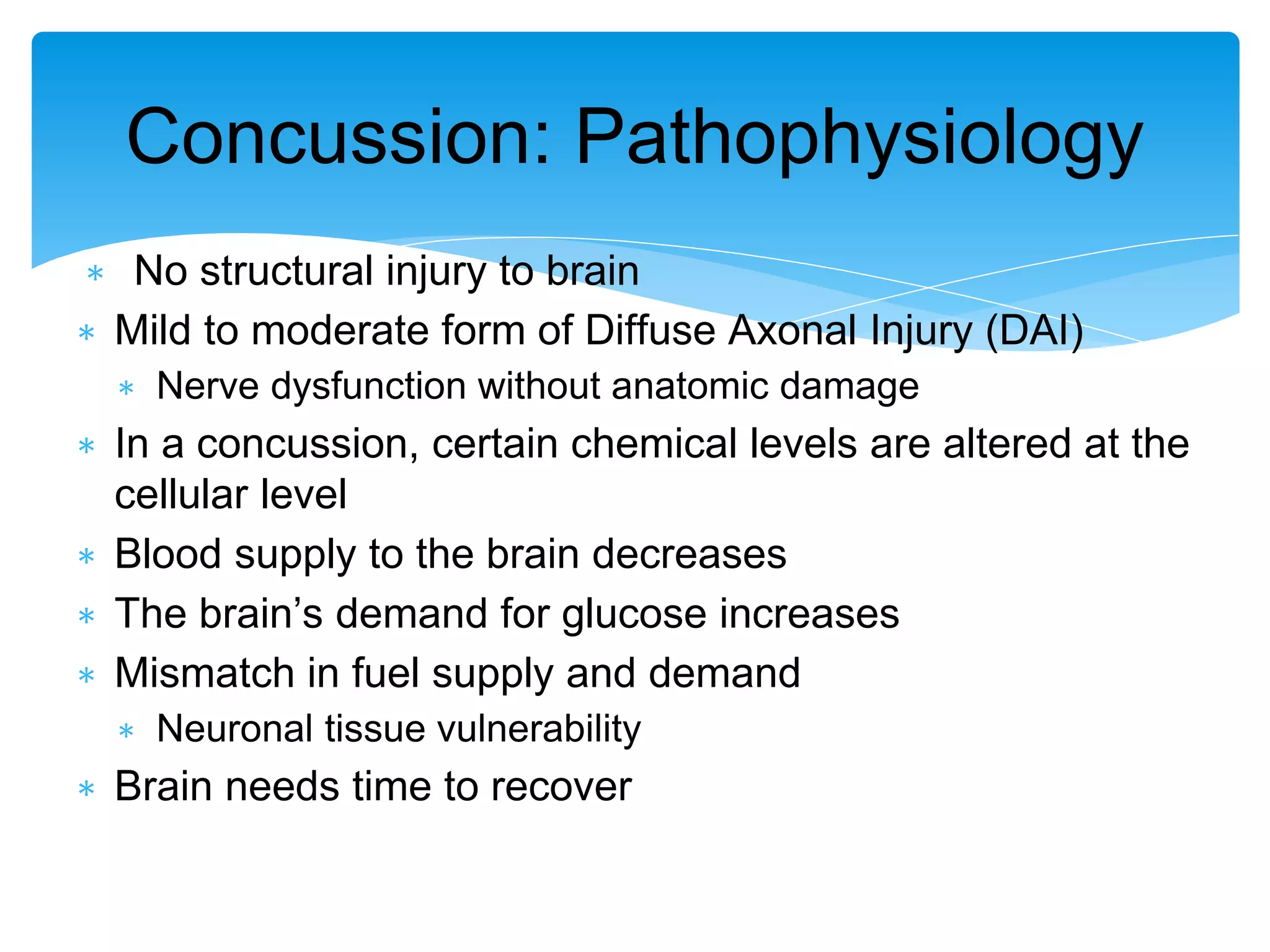
∗ No structural injury to brain
∗ Mild to moderate form of Diffuse Axonal Injury (DAI)
∗ Nerve dysfunction without anatomic damage
∗ In a concussion, certain chemical levels are altered at the
cellular level
∗ Blood supply to the brain decreases
∗ The brain’s demand for glucose increases
∗ Mismatch in fuel supply and demand
∗ Neuronal tissue vulnerability
∗ Brain needs time to recover
Concussion: Pathophysiology
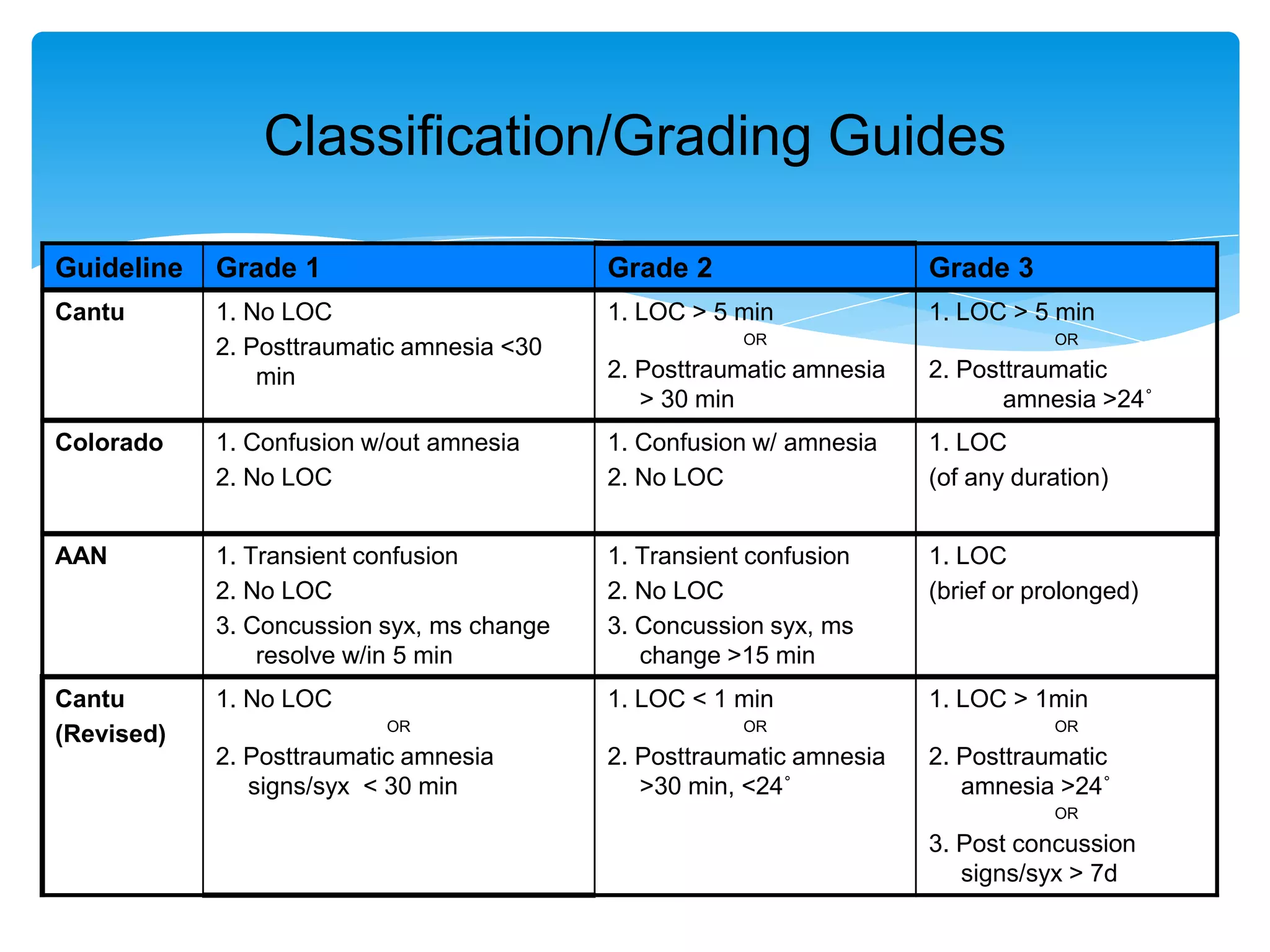
Classification/Grading Guides
Guideline Grade 1 Grade 2 Grade 3
Cantu 1. No LOC
2. Posttraumatic amnesia <30
min
1. LOC > 5 min
OR
2. Posttraumatic amnesia
> 30 min
1. LOC > 5 min
OR
2. Posttraumatic
amnesia >24˚
Colorado 1. Confusion w/out amnesia
2. No LOC
1. Confusion w/ amnesia
2. No LOC
1. LOC
(of any duration)
AAN 1. Transient confusion
2. No LOC
3. Concussion syx, ms change
resolve w/in 5 min
1. Transient confusion
2. No LOC
3. Concussion syx, ms
change >15 min
1. LOC
(brief or prolonged)
Cantu
(Revised)
1. No LOC
OR
2. Posttraumatic amnesia
signs/syx < 30 min
1. LOC < 1 min
OR
2. Posttraumatic amnesia
>30 min, <24˚
1. LOC > 1min
OR
2. Posttraumatic
amnesia >24˚
OR
3. Post concussion
signs/syx > 7d
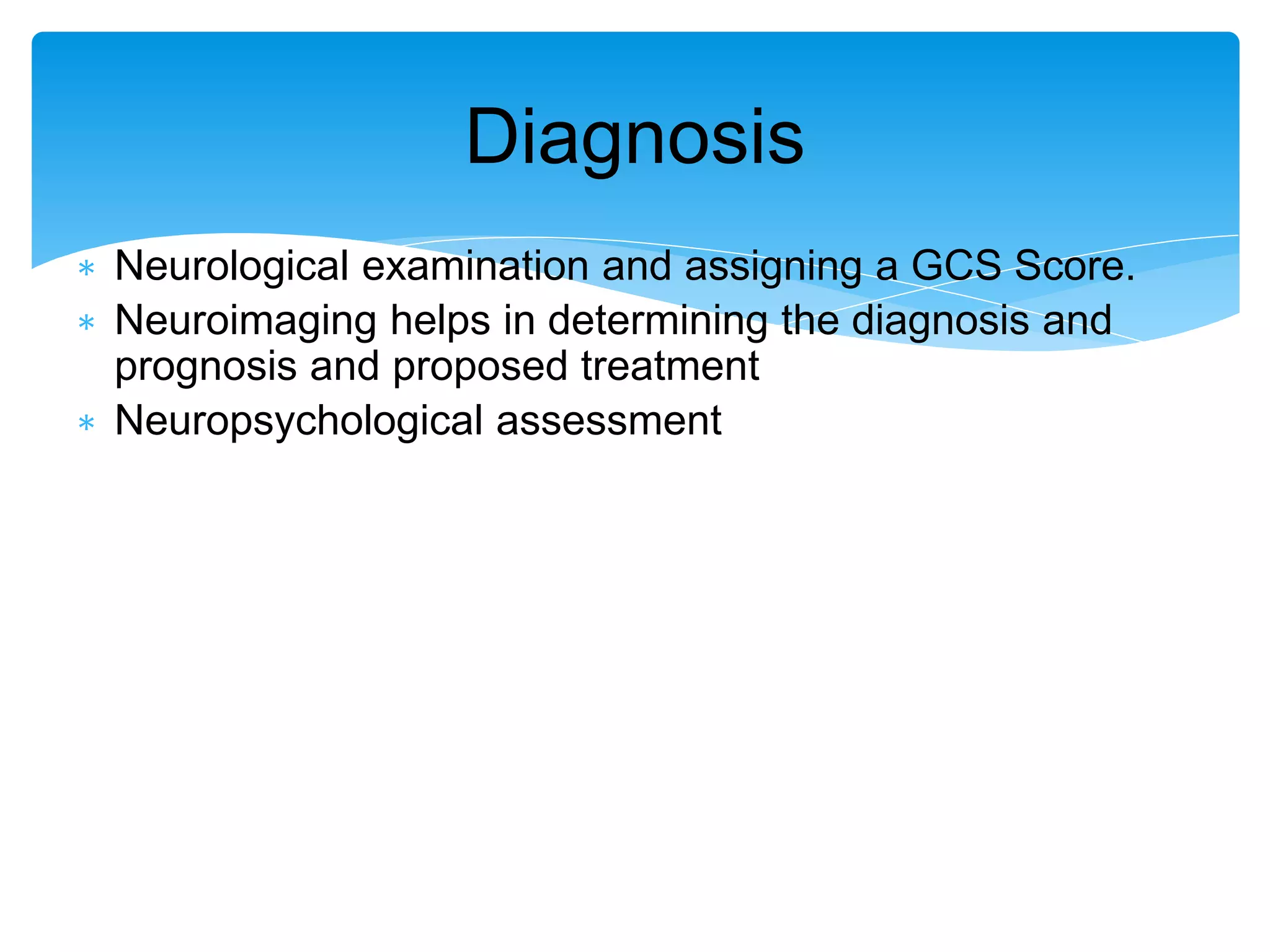
∗ Neurological examination and assigning a GCS Score.
∗ Neuroimaging helps in determining the diagnosis and
prognosis and proposed treatment
∗ Neuropsychological assessment
Diagnosis
∗ Computed tomography (CT)
∗ Rarely detected on CT ( 20% of DAI lesions are
hemorrhagic)
∗ Magnetic resonance imaging (MRI)
∗ Can show more details than CT as detecting injury
characteristics such as diffuse axonal injury
∗ However, MRI is not used in the emergency setting
∗ X-rays:
∗ Not much role
∗ Angiography:
∗ May be used to detect blood vessel pathology.
∗ Electroencephalography and transcranial doppler may
also be used.
Investigations
∗ ABCD
∗ Pharmacotherapy
● Prolonged symptoms (sleep disturbance, anxiety)
● Modify underlying pathophysiology
∗ Upon return to play should not be on medication that
could mask symptoms
● Antidepressants?
● Physical Rest
● No training, playing, exercise, weights
● Beware of exertion with activities of daily living
● Cognitive Rest
● No television, extensive reading, video games?
● Caution re: daytime sleep
Management
∗ Mild cases: Gradual resolution within 7-10 days
∗ Gradual return to work and social activities that does
not result in significant exacerbation of symptoms
Management
∗ Intracranial Hemorrhage
∗ Skull Fracture
∗ Epidural Hemorrhage
∗ Subdural Hemorrhage
∗ Intracerebral Hemorrhage
∗ Cerebral Hyperemia
∗ Cerebral Edema
∗ Seizures
∗ Migraine Headaches
Associated Secondary Conditions
∗ Majority (80-90%) resolve in short (7-10 day) period
∗ May take longer in children and adolescents
Recovery
∗ Alzheimer's Disease: recent research suggests correlation
between head injury in early adulthood and AD later in life
∗ Parkinson's Disease: rare, but may occur
∗ Dementia Pugilistica: also known as chronic traumatic
encephalopathy, usually acquired from repetitive blows to the
head (boxers)
∗ Post-traumatic Dementia: long term memory problems,
caused by single, severe traumatic brain injury resulting in a
coma
Long Term Effects
• In the car...
o Wear seatbelt
o Head rest in proper position
o Children under the age of 13 should ride in the back seat
• Activities
o Wear a helmet
• Sports
o Wear protective gear
Prevention
∗ Traumatic injuries affect more patients than all other
neurological conditions COMBINED
∗ At present, the best treatment is PREVENTION
Conclusion
1.6 to 2.3 million sports concussions per year
Center for Disease Control 2006

Diffuse Axonal Injury and Concussion

  • 1.
    Diffuse Axonal Injuryand Concussion Dr Amit Agrawal, MCh
  • 2.
    ∗ Due tostretching forces placed on individual nerve cells ∗ Pathology distributed throughout brain ∗ Types ∗ Concussion ∗ Diffuse Axonal Injury (Moderate to Severe) Diffuse Brain Injury
  • 3.
    ∗ Accidental Falls ∗Vehicular accidents ∗ Child Abuse ∗ Assaults ∗ Gunshots ∗ Violent shaking of a child ∗ Sports related injuries Causes
  • 4.
    ∗ Diffuse axonalinjury (DAI) is the predominant mechanism of injury in 40% to 50% of traumatic brain injuries (TBIs) requiring hospital admission in the United States. ∗ A component of DAI is believed to be present in all motor vehicle crashes (MVCs) where the patient has lost consciousness ∗ Widespread axonal damage occurring after a mild, moderate, or severe TBI ∗ Process takes approximately 12-24 hours ∗ One of the major causes of unconsciousness and persistent vegetative state after head trauma Diffuse Axonal Injury
  • 5.
    ∗ Due toacceleration/deceleration to whtie matter + hypoxia ∗ Significant mechanical disruption of nerve cells ∗ Cerebral hemispheres and brainstem ∗ High mortality rate Diffuse Axonal Injury
  • 6.
    ∗ Mostly microscopicdamage, and it is often not visible on imaging studies ∗ The main mechanical force that causes DAI is rotational acceleration of the brain, resulting in unrestricted head movement ∗ Rotational acceleration produces shearing and tensile forces, and axons can be pulled apart at the microscopic level ∗ Microscopic evaluation of the brain tissue often shows numerous swollen and disconnected axons ∗ Rapid stretching of axons is thought to damage the axonal cytoskeleton and, therefore, disrupt normal neuron function Diffuse Axonal Injury:Pathological feature
  • 7.
    ∗ Varies frommild to profound ∗ May be permanent or temporary ∗ Symptoms may appear immediately or over weeks, months, years ∗ Diffuse axonal injury (DAI) ∗ Clinical signs: ∗ ↓ LOC ∗ ↑ ICP ∗ Decerebration or decortication ∗ Global cerebral edema Diffuse Axonal Injury: Clinical features
  • 8.
  • 9.
    ∗ Defined asthe result of the forceful motion of the head causing a brief change in mental status for less than 30 minutes. Concussion
  • 10.
    ∗ Concussion maybe caused either by a direct blow to the head, face, neck or elsewhere on the body with an ‘‘impulsive’’ force transmitted to the head. ∗ Concussion typically results in the rapid onset of short- lived impairment of neurologic function that resolves spontaneously. However in some cases symptoms and signs may evolve over a number of minutes to hours. ∗ Concussion may result in neuropathological changes but the acute clinical symptoms largely reflect a functional disturbance rather than a structural injury and as such, no abnormality is seen on standard structural neuroimaging studies. ∗ Concussion results in a graded set of clinical symptoms that may or may not involve loss of consciousness. Resolution of the clinical and cognitive symptoms typically follows a sequential course. However it is important to note that in some cases, post-concussive symptoms may be prolonged. Concussion
  • 11.
    ∗ Level ofconsciousness ∗ Variable period of unconsciousness or confusion ∗ Followed by return to normal consciousness ∗ Retrograde short-term amnesia ∗ May repeat questions over and over ∗ Associated symptoms ∗ Dizziness, headache, ringing in ears, and/or nausea Concussion Head Trauma -
  • 12.
    ∗ No structuralinjury to brain ∗ Mild to moderate form of Diffuse Axonal Injury (DAI) ∗ Nerve dysfunction without anatomic damage ∗ In a concussion, certain chemical levels are altered at the cellular level ∗ Blood supply to the brain decreases ∗ The brain’s demand for glucose increases ∗ Mismatch in fuel supply and demand ∗ Neuronal tissue vulnerability ∗ Brain needs time to recover Concussion: Pathophysiology
  • 13.
    Classification/Grading Guides Guideline Grade1 Grade 2 Grade 3 Cantu 1. No LOC 2. Posttraumatic amnesia <30 min 1. LOC > 5 min OR 2. Posttraumatic amnesia > 30 min 1. LOC > 5 min OR 2. Posttraumatic amnesia >24˚ Colorado 1. Confusion w/out amnesia 2. No LOC 1. Confusion w/ amnesia 2. No LOC 1. LOC (of any duration) AAN 1. Transient confusion 2. No LOC 3. Concussion syx, ms change resolve w/in 5 min 1. Transient confusion 2. No LOC 3. Concussion syx, ms change >15 min 1. LOC (brief or prolonged) Cantu (Revised) 1. No LOC OR 2. Posttraumatic amnesia signs/syx < 30 min 1. LOC < 1 min OR 2. Posttraumatic amnesia >30 min, <24˚ 1. LOC > 1min OR 2. Posttraumatic amnesia >24˚ OR 3. Post concussion signs/syx > 7d
  • 14.
    ∗ Neurological examinationand assigning a GCS Score. ∗ Neuroimaging helps in determining the diagnosis and prognosis and proposed treatment ∗ Neuropsychological assessment Diagnosis
  • 15.
    ∗ Computed tomography(CT) ∗ Rarely detected on CT ( 20% of DAI lesions are hemorrhagic) ∗ Magnetic resonance imaging (MRI) ∗ Can show more details than CT as detecting injury characteristics such as diffuse axonal injury ∗ However, MRI is not used in the emergency setting ∗ X-rays: ∗ Not much role ∗ Angiography: ∗ May be used to detect blood vessel pathology. ∗ Electroencephalography and transcranial doppler may also be used. Investigations
  • 16.
    ∗ ABCD ∗ Pharmacotherapy ●Prolonged symptoms (sleep disturbance, anxiety) ● Modify underlying pathophysiology ∗ Upon return to play should not be on medication that could mask symptoms ● Antidepressants? ● Physical Rest ● No training, playing, exercise, weights ● Beware of exertion with activities of daily living ● Cognitive Rest ● No television, extensive reading, video games? ● Caution re: daytime sleep Management
  • 17.
    ∗ Mild cases:Gradual resolution within 7-10 days ∗ Gradual return to work and social activities that does not result in significant exacerbation of symptoms Management
  • 18.
    ∗ Intracranial Hemorrhage ∗Skull Fracture ∗ Epidural Hemorrhage ∗ Subdural Hemorrhage ∗ Intracerebral Hemorrhage ∗ Cerebral Hyperemia ∗ Cerebral Edema ∗ Seizures ∗ Migraine Headaches Associated Secondary Conditions
  • 19.
    ∗ Majority (80-90%)resolve in short (7-10 day) period ∗ May take longer in children and adolescents Recovery
  • 20.
    ∗ Alzheimer's Disease:recent research suggests correlation between head injury in early adulthood and AD later in life ∗ Parkinson's Disease: rare, but may occur ∗ Dementia Pugilistica: also known as chronic traumatic encephalopathy, usually acquired from repetitive blows to the head (boxers) ∗ Post-traumatic Dementia: long term memory problems, caused by single, severe traumatic brain injury resulting in a coma Long Term Effects
  • 21.
    • In thecar... o Wear seatbelt o Head rest in proper position o Children under the age of 13 should ride in the back seat • Activities o Wear a helmet • Sports o Wear protective gear Prevention
  • 22.
    ∗ Traumatic injuriesaffect more patients than all other neurological conditions COMBINED ∗ At present, the best treatment is PREVENTION Conclusion
  • 23.
    1.6 to 2.3million sports concussions per year Center for Disease Control 2006