Different
Approaches to UX
Research
In any industry, the customer is very important for the
brand’s success. UX Research should be done in order to
know the user experience about the product or the
service.
UX research helps in the development of analytical techniques used to know the user experienceregarding the
product. The research should be conducted in such a way keeping in mind who the user is, in what context they
use a product and what they need from a product or service. The business owners need to be clear of their
resources and constraints before beginning a UX research. Once they are clear, they can start the research.

Duration of research
The duration of research and what a particular
business wants to achieve decides either to
choose Longitudinal Research or Cross-sectional
research.
Longitudinal Research
Longitudinal research mainly focuses on repeated observation of a group of users over time,
at regular intervals. This research is done in order to observe user perceptions, attitudes, and
behaviours. The main advantage of longitudinal research is that it extends beyond a single
time frame. Because of this, the events can occur in a proper sequence. The longitudinal
study can be done in many ways like diaries, participant observation, and repeated
interviews/ surveys.
Longitudinal Research
Cross-Sectional Research
Cross-Sectional Research is a study where the
feedback is collected from a group of people at a
single point of time. Here the users are
categorized into different groups named cohorts.
It mainly involves assessing customers with one
key factor, at a specified time. For this, the
business owners invite users and categorize them
Cross-Sectional Research
Nature of data
Here, business owners should decide if they
require statistical or opinions and other subjective
data. Based on this, the quantitative and
qualitative research can be done.
Nature of data
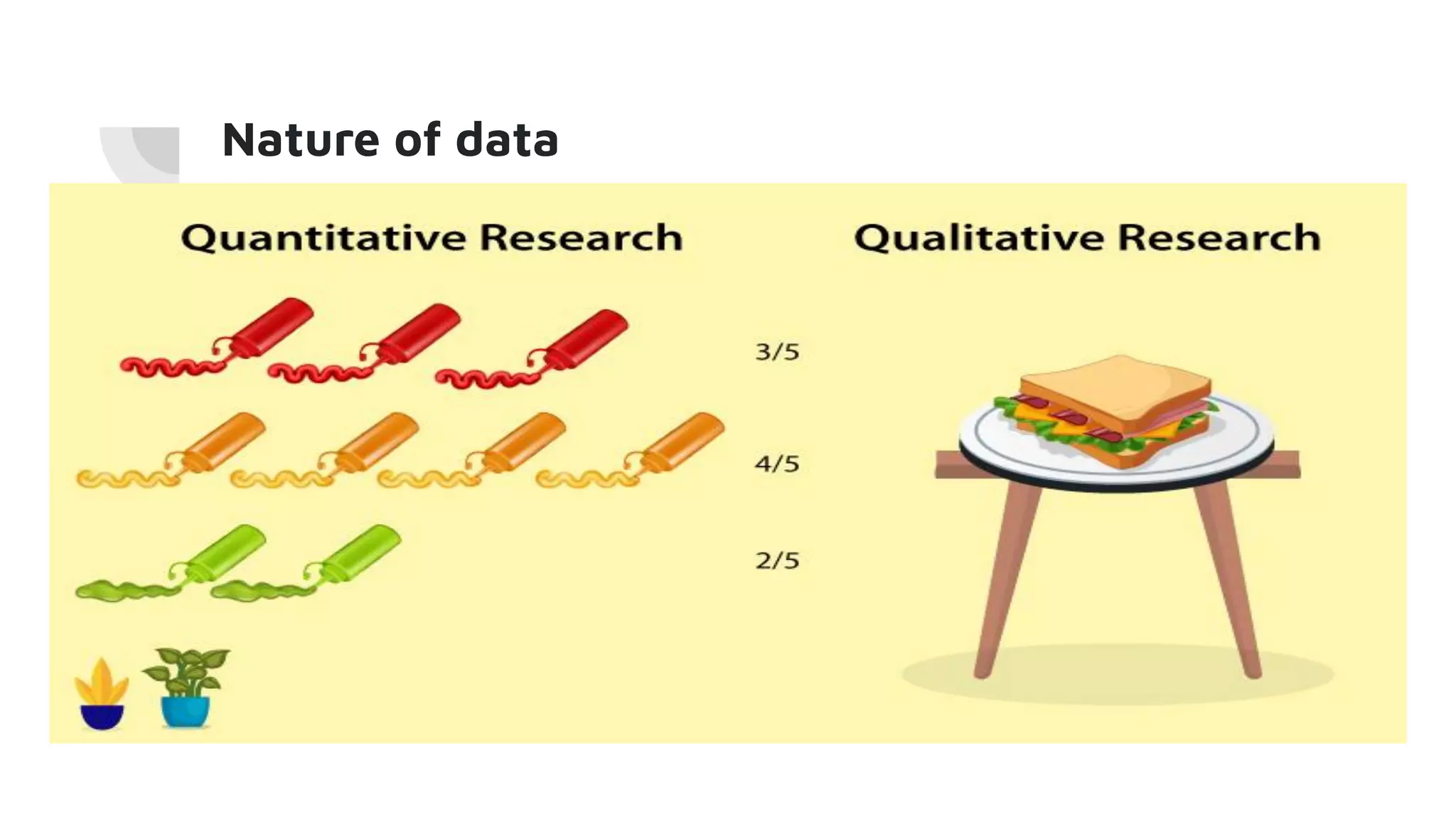
Quantitative Research
Quantitative research includes anything that you
can count: time on page, time to complete a task,
user flow, page view. The quantitative study in UX
is more often used in market research as it
involves large data sets. Here, the research will be
done keeping in mind the customer preferences.
Qualitative Research
Qualitative research in UX involves mainly the
behaviours, feelings, and attitudes of users.
Qualitative research is done in order to
understand the factors that influence the
customer's decision to buy a product, experience
in using that product and the impact it creates by
taking the customer's feedback.
Source of data
The data can be collected in two ways: through
Primary and Secondary research.
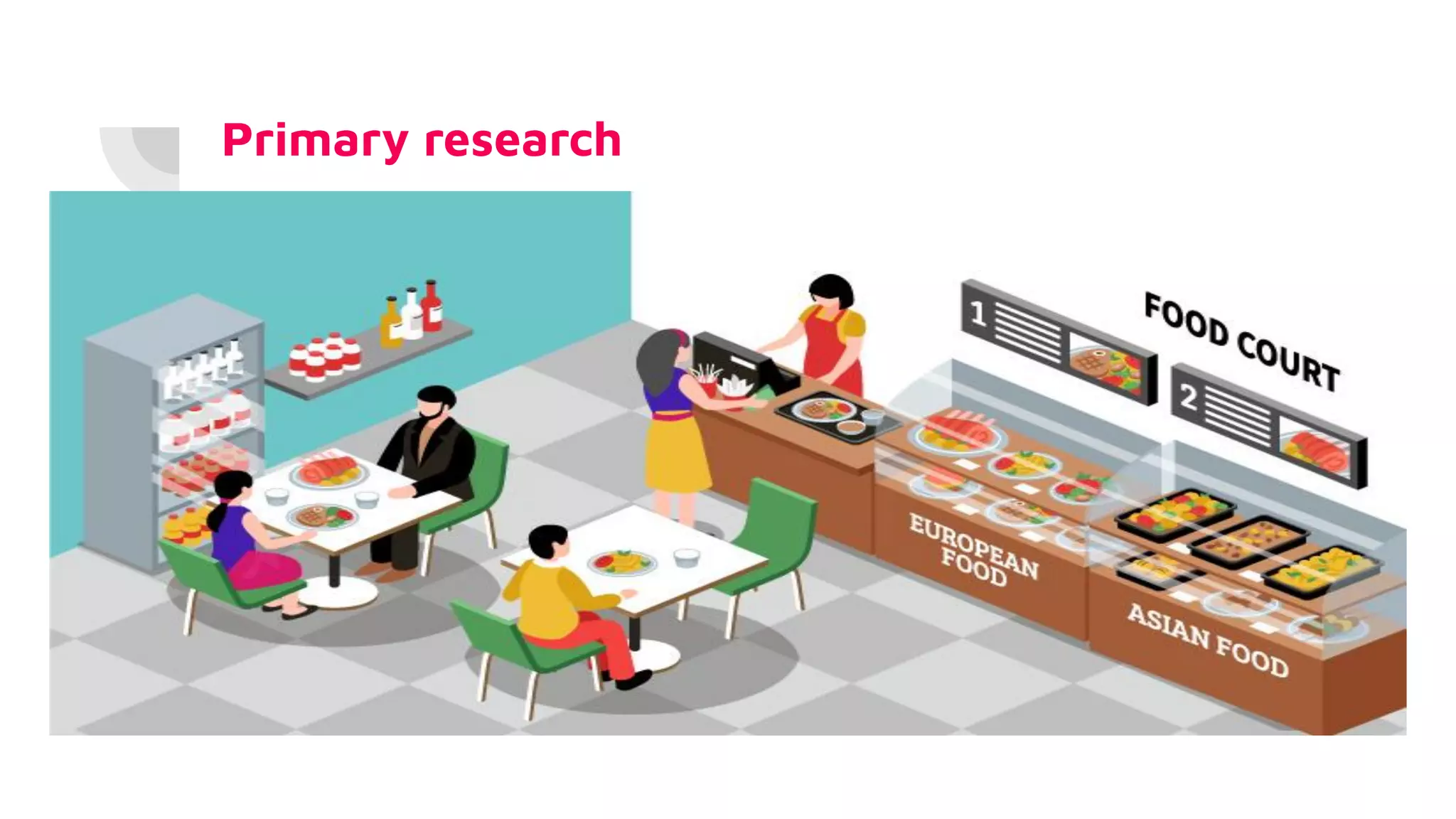
Primary research
Primary research is done through interviews,
experiments or conducting questionnaires to
acquire data. The fresh data is collected rather
than the data from the published sources.
Primary research is both time and
resource-consuming as it requires direct
interaction with the customers.
Primary research
Secondary Research
Secondary research focuses on analyzing already
existing sources like research papers, journals,
articles. For those who are having less time and
limited resources, Secondary research will be an
added advantage as it takes relatively less time.
Secondary Research
The objective of the Research
The objective of the research is to investigate the
problem and trying to fix the problem in the most
efficient way. This can be done through
Exploratory research, Descriptive research and
Evaluative research.
Generative or Exploratory research
Exploratory research is done in order to
investigate the problem at the preliminary stage.
This research thus involves conducting
interviews, group discussions with the customers
as per the requirement and identify the problem
regarding the product.
Generative or Exploratory research
Descriptive and Informative research
In descriptive research, the problem statement is
already given and is used to gain a detailed
understanding of the problem. This research
helps in providing the complete solution to the
problem after a detailed analysis of the problem.
Descriptive and Informative research
Evaluative Research
Evaluative research is done by approaching the
users and try to find out whether the solution
which you got in the Descriptive research works
out or not. The main aim of this research is to see
if the problem got completely fixed or not.
Evaluative Research
The outcome of the Research
Pure Research
Pure research is basic research in order to identify
the relationship between variables. Pure research
is done completely out of curiosity and interest
and is more exploratory in nature
Pure Research
Applied Research
Applied research is based on basic or pure
research. This is done in order to solve the
problem identified in the pure research phase.
The outcome of this research is mainly used for
the present use, not for the future.
Applied Research
Different Approaches to UX Research
It is also essential to choose the correct research approach
for a product at the correct time. The Nextbrain Studio uses
these kinds of approaches for UX researches for better
customer satisfaction.
Let’s Talk with Us
Nextbrain - UI / UX Design Studio
#44, 2nd floor, 1st cross, 2nd Main Rd
Prasanth Extension, Whitefield,
Bengaluru, Karnataka 560066
Call 91 9952493995
Mail ux@nextbrain.studio
Different approaches to ux research

Different approaches to ux research

  • 1.
  • 2.
    In any industry,the customer is very important for the brand’s success. UX Research should be done in order to know the user experience about the product or the service. UX research helps in the development of analytical techniques used to know the user experienceregarding the product. The research should be conducted in such a way keeping in mind who the user is, in what context they use a product and what they need from a product or service. The business owners need to be clear of their resources and constraints before beginning a UX research. Once they are clear, they can start the research.
  • 3.
    Duration of research Theduration of research and what a particular business wants to achieve decides either to choose Longitudinal Research or Cross-sectional research.
  • 4.
    Longitudinal Research Longitudinal researchmainly focuses on repeated observation of a group of users over time, at regular intervals. This research is done in order to observe user perceptions, attitudes, and behaviours. The main advantage of longitudinal research is that it extends beyond a single time frame. Because of this, the events can occur in a proper sequence. The longitudinal study can be done in many ways like diaries, participant observation, and repeated interviews/ surveys.
  • 5.
  • 6.
    Cross-Sectional Research Cross-Sectional Researchis a study where the feedback is collected from a group of people at a single point of time. Here the users are categorized into different groups named cohorts. It mainly involves assessing customers with one key factor, at a specified time. For this, the business owners invite users and categorize them
  • 7.
  • 8.
    Nature of data Here,business owners should decide if they require statistical or opinions and other subjective data. Based on this, the quantitative and qualitative research can be done.
  • 9.
  • 10.
    Quantitative Research Quantitative researchincludes anything that you can count: time on page, time to complete a task, user flow, page view. The quantitative study in UX is more often used in market research as it involves large data sets. Here, the research will be done keeping in mind the customer preferences.
  • 11.
    Qualitative Research Qualitative researchin UX involves mainly the behaviours, feelings, and attitudes of users. Qualitative research is done in order to understand the factors that influence the customer's decision to buy a product, experience in using that product and the impact it creates by taking the customer's feedback.
  • 12.
    Source of data Thedata can be collected in two ways: through Primary and Secondary research.
  • 13.
    Primary research Primary researchis done through interviews, experiments or conducting questionnaires to acquire data. The fresh data is collected rather than the data from the published sources. Primary research is both time and resource-consuming as it requires direct interaction with the customers.
  • 14.
  • 15.
    Secondary Research Secondary researchfocuses on analyzing already existing sources like research papers, journals, articles. For those who are having less time and limited resources, Secondary research will be an added advantage as it takes relatively less time.
  • 16.
  • 17.
    The objective ofthe Research The objective of the research is to investigate the problem and trying to fix the problem in the most efficient way. This can be done through Exploratory research, Descriptive research and Evaluative research.
  • 18.
    Generative or Exploratoryresearch Exploratory research is done in order to investigate the problem at the preliminary stage. This research thus involves conducting interviews, group discussions with the customers as per the requirement and identify the problem regarding the product.
  • 19.
  • 20.
    Descriptive and Informativeresearch In descriptive research, the problem statement is already given and is used to gain a detailed understanding of the problem. This research helps in providing the complete solution to the problem after a detailed analysis of the problem.
  • 21.
  • 22.
    Evaluative Research Evaluative researchis done by approaching the users and try to find out whether the solution which you got in the Descriptive research works out or not. The main aim of this research is to see if the problem got completely fixed or not.
  • 23.
  • 24.
    The outcome ofthe Research Pure Research Pure research is basic research in order to identify the relationship between variables. Pure research is done completely out of curiosity and interest and is more exploratory in nature
  • 25.
  • 26.
    Applied Research Applied researchis based on basic or pure research. This is done in order to solve the problem identified in the pure research phase. The outcome of this research is mainly used for the present use, not for the future.
  • 27.
  • 28.
    Different Approaches toUX Research It is also essential to choose the correct research approach for a product at the correct time. The Nextbrain Studio uses these kinds of approaches for UX researches for better customer satisfaction.
  • 29.
    Let’s Talk withUs Nextbrain - UI / UX Design Studio #44, 2nd floor, 1st cross, 2nd Main Rd Prasanth Extension, Whitefield, Bengaluru, Karnataka 560066 Call 91 9952493995 Mail ux@nextbrain.studio