“Home(r) is where the heart is”

    In 1982, Connecticut had a
breakthrough in medical
technology. Dr. Robert K.
Jarvik introduced to the
world, the first artificial heart .


                                    Photograph by Debjani Das and Matthew Hersey Photographs
“Knock, knock”
                                                           “Who’s there?”
                                                           “Orange”
                                                           “Orange, who?”
                                                           “Orange you glad Pez moved to
                                                           Connecticut?”

                                                           That’s right folks! One of America’s most
                                                           beloved candy’s, Pez, claimed Orange,
                                                           Conn., as its new home in 1974.


Photograph by Debjani Das and Matthew Hersey Photographs
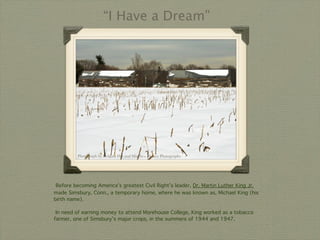
“I Have a Dream”


         Photograph by Debjani Das and Matthew Hersey Photographs


 Before becoming America’s greatest Civil Right’s leader, Dr. Martin Luther King Jr.
made Simsbury, Conn., a temporary home, where he was known as, Michael King (his
birth name).

 In need of earning money to attend Morehouse College, King worked as a tobacco
farmer, one of Simsbury’s major crops, in the summers of 1944 and 1947.
“they may take our wine, but they’ll
never take our freedom!”
...Or so Connecticut hoped.

  The 18th Amendment was introduced in
 1917, banning the production and
 consumption of alcohol in the U.S;
 better known as The National Prohibition
 Act.

  However, Connecticut held on strong by
 not ratifying the amendment until two
 years later, finally giving in May of
 1919.

  Rhode Island continued the fight and
 never ratified.


                                            Photograph by Debjani Das and Matthew Hersey Photographs
That’s right! Another great invention
comes from this great state of ours.
The collapsible toothpaste tube.

 Created in 1892 by Dr. Washington
Sheffield, a dental surgeon and New
London native, Washington rocked the
world with the bendable tube once
referred to as “creme dentifrice.”


                                        Photograph by Debjani Das and Matthew Hersey Photographs
Before being known as “Yankees,”
                                                           New Englanders, specifically
                                                           those from New Haven, Conn., were
                                                           referred to as “Pumpkin-Heads.”

                                                            Known for perfectly rounded haircuts,
                                                           colonial barbers used half-cut pumpkins
                                                           as a model to ensure what we would
                                                           recognize as the “bowl cut.”

                                                           Quite the trendsetters!


Photograph by Debjani Das and Matthew Hersey Photographs
Old New Gate Prison
        and


        Text
        Text

                  Matthew Hersey Photographs


Copper Mine Museum
      1773-1827
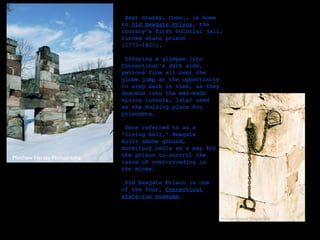
East Granby, Conn., is home
                             to Old Newgate Prison, the
                             country’s first colonial jail,
                             turned state prison
                             (1773-1827).

                              Offering a glimpse into
                             Connecticut’s dark side,
                             patrons from all over the
                             globe jump at the opportunity
                             to step back in time, as they
                             descend into the man-made
                             mining tunnels, later used
                             as the holding place for
                             prisoners.

                              Once referred to as a
                             “living hell,” Newgate
                             built above ground,
                             dormitory cells as a way for
Matthew Hersey Photographs   the prison to control the
                             issue of over-crowding in
                             the mines.

                              Old Newgate Prison is one
                             of the four, Connecticut
                             state-run museums.


                                                             Matthew Hersey Photographs
Hysteria In Connecticut
  Forty-five years before Salem, Mass., began
its cleansing process of removing the village’s
“evil-doers,” Hartford, Conn., started the fear-
driven hunt by hanging Alyse Young, the first
victim to be accused of witchcraft in the
colonies.

 Connecticut’s Old State House marks the site
where this unfortunate woman met her fate in
1647.

 Ten years after Young’s death, several other
men and women would be accused and
executed. This time in history is known as the
Hartford Witch Trials.                             Photograph by Debjani Das and Matthew Hersey Photographs

Did You Know...

  • 1.
    “Home(r) is wherethe heart is” In 1982, Connecticut had a breakthrough in medical technology. Dr. Robert K. Jarvik introduced to the world, the first artificial heart . Photograph by Debjani Das and Matthew Hersey Photographs
  • 2.
    “Knock, knock” “Who’s there?” “Orange” “Orange, who?” “Orange you glad Pez moved to Connecticut?” That’s right folks! One of America’s most beloved candy’s, Pez, claimed Orange, Conn., as its new home in 1974. Photograph by Debjani Das and Matthew Hersey Photographs
  • 3.
    “I Have aDream” Photograph by Debjani Das and Matthew Hersey Photographs Before becoming America’s greatest Civil Right’s leader, Dr. Martin Luther King Jr. made Simsbury, Conn., a temporary home, where he was known as, Michael King (his birth name). In need of earning money to attend Morehouse College, King worked as a tobacco farmer, one of Simsbury’s major crops, in the summers of 1944 and 1947.
  • 4.
    “they may takeour wine, but they’ll never take our freedom!” ...Or so Connecticut hoped. The 18th Amendment was introduced in 1917, banning the production and consumption of alcohol in the U.S; better known as The National Prohibition Act. However, Connecticut held on strong by not ratifying the amendment until two years later, finally giving in May of 1919. Rhode Island continued the fight and never ratified. Photograph by Debjani Das and Matthew Hersey Photographs
  • 5.
    That’s right! Anothergreat invention comes from this great state of ours. The collapsible toothpaste tube. Created in 1892 by Dr. Washington Sheffield, a dental surgeon and New London native, Washington rocked the world with the bendable tube once referred to as “creme dentifrice.” Photograph by Debjani Das and Matthew Hersey Photographs
  • 6.
    Before being knownas “Yankees,” New Englanders, specifically those from New Haven, Conn., were referred to as “Pumpkin-Heads.” Known for perfectly rounded haircuts, colonial barbers used half-cut pumpkins as a model to ensure what we would recognize as the “bowl cut.” Quite the trendsetters! Photograph by Debjani Das and Matthew Hersey Photographs
  • 7.
    Old New GatePrison and Text Text Matthew Hersey Photographs Copper Mine Museum 1773-1827
  • 8.
    East Granby, Conn.,is home to Old Newgate Prison, the country’s first colonial jail, turned state prison (1773-1827). Offering a glimpse into Connecticut’s dark side, patrons from all over the globe jump at the opportunity to step back in time, as they descend into the man-made mining tunnels, later used as the holding place for prisoners. Once referred to as a “living hell,” Newgate built above ground, dormitory cells as a way for Matthew Hersey Photographs the prison to control the issue of over-crowding in the mines. Old Newgate Prison is one of the four, Connecticut state-run museums. Matthew Hersey Photographs
  • 9.
    Hysteria In Connecticut Forty-five years before Salem, Mass., began its cleansing process of removing the village’s “evil-doers,” Hartford, Conn., started the fear- driven hunt by hanging Alyse Young, the first victim to be accused of witchcraft in the colonies. Connecticut’s Old State House marks the site where this unfortunate woman met her fate in 1647. Ten years after Young’s death, several other men and women would be accused and executed. This time in history is known as the Hartford Witch Trials. Photograph by Debjani Das and Matthew Hersey Photographs

Editor's Notes