CHAPTER 16
DICTIONARIES
Unit 2:
Computational Thinking and Programming
XI
Computer Science (083)
Board : CBSE
Courtesy CBSE
Unit II
Computational Thinking and Programming
(60 Theory periods + 45 Practical Periods)
DCSc & Engg, PGDCA,ADCA,MCA.MSc(IT),Mtech(IT),MPhil (Comp. Sci)
Department of Computer Science, Sainik School Amaravathinagar
Cell No: 9431453730
Praveen M Jigajinni
Prepared by
Courtesy CBSE
LEARNING OUTCOMES
After studying this lesson, students
will be able to:
 Understand the need of dictionaries;
Solve problems by using dictionaries;
Get clear idea about dictionaries functions;
and
 Understand the difference between list and
dictionary.
LEARNING OUTCOMES
WHAT IS DICTIONARY?
A dictionary is like a list, but more in
general. In a list, index value is an integer, while
in a dictionary index value can be any other data
type and are called keys. The key will be used as
a string as it is easy to recall. A dictionary is an
extremely useful data storage construct for
storing and retrieving all key value pairs, where
each element is accessed (or indexed) by a
unique key. However, dictionary keys are not in
sequences and hence maintain no left-to right
order.
WHAT IS DICTIONARY?
We can refer to a dictionary as a
mapping between a set of indices (which
are called keys) and a set of values. Each
key maps a value. The association of a key
and a value is called a key-value pair.
Syntax:
my_dict = {'key1': 'value1','key2':
'value2','key3': 'value3'…'keyn': 'valuen'}
KEY VALYE PAIR
Curley brackets are used to represent a
dictionary.
Each pair in the dictionary is represented
by a key and value separated by a colon.
Multiple pairs are separated by vcomas
DICTIONARIES
A dictionary is an un­
ordered collection of key­
value pairs.
A dictionary has a length, specifically the numb
er of key­
value pairs.
A dictionary provides fast look up by key.
The keys must be immutable object types.
DICTIONARIES
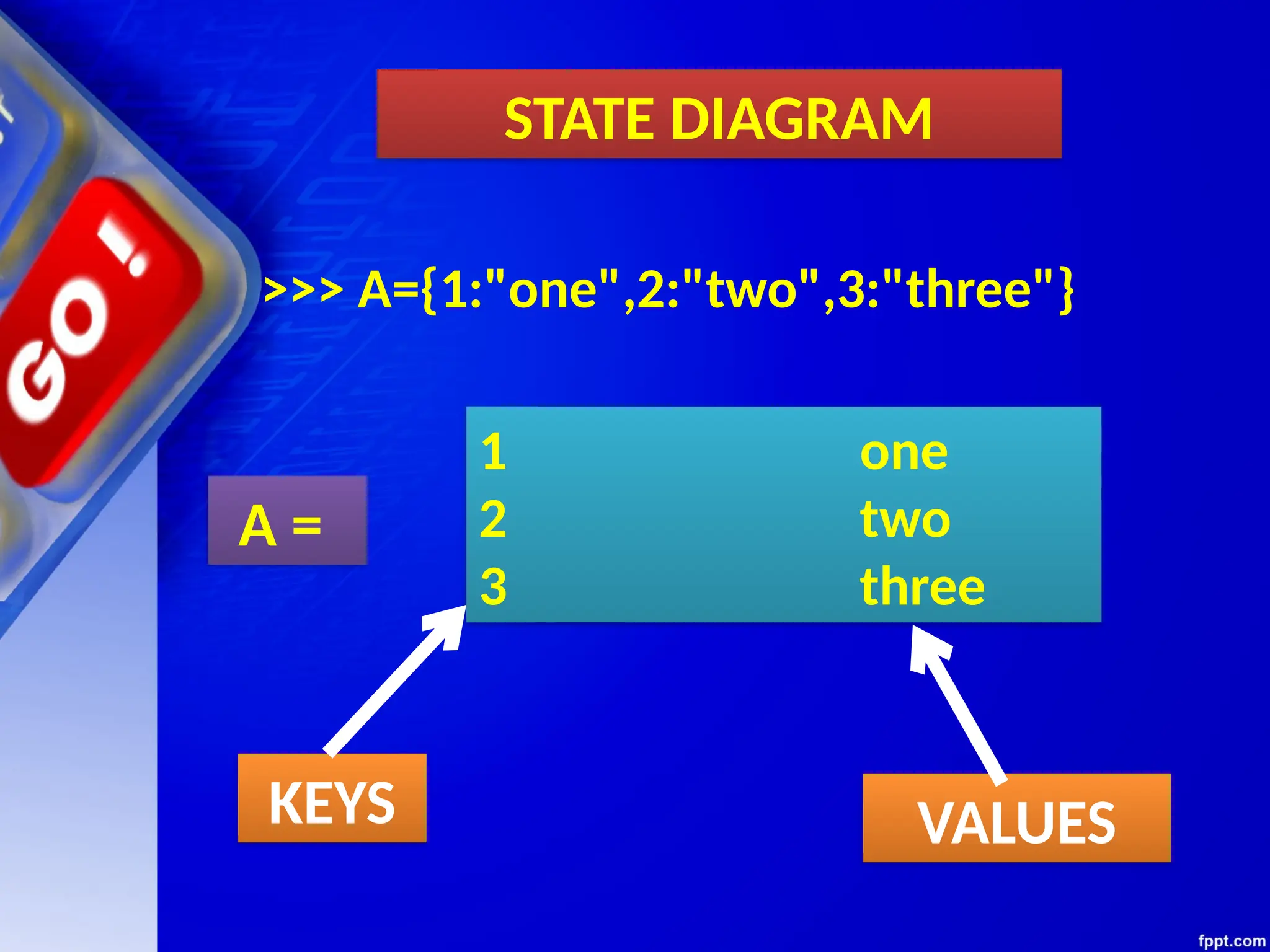
>>> A={1:"one",2:"two",3:"three"}
STATE DIAGRAM
A =
1 one
2 two
3 three
KEYS VALUES
CREATING A DICTIONARY – dict()
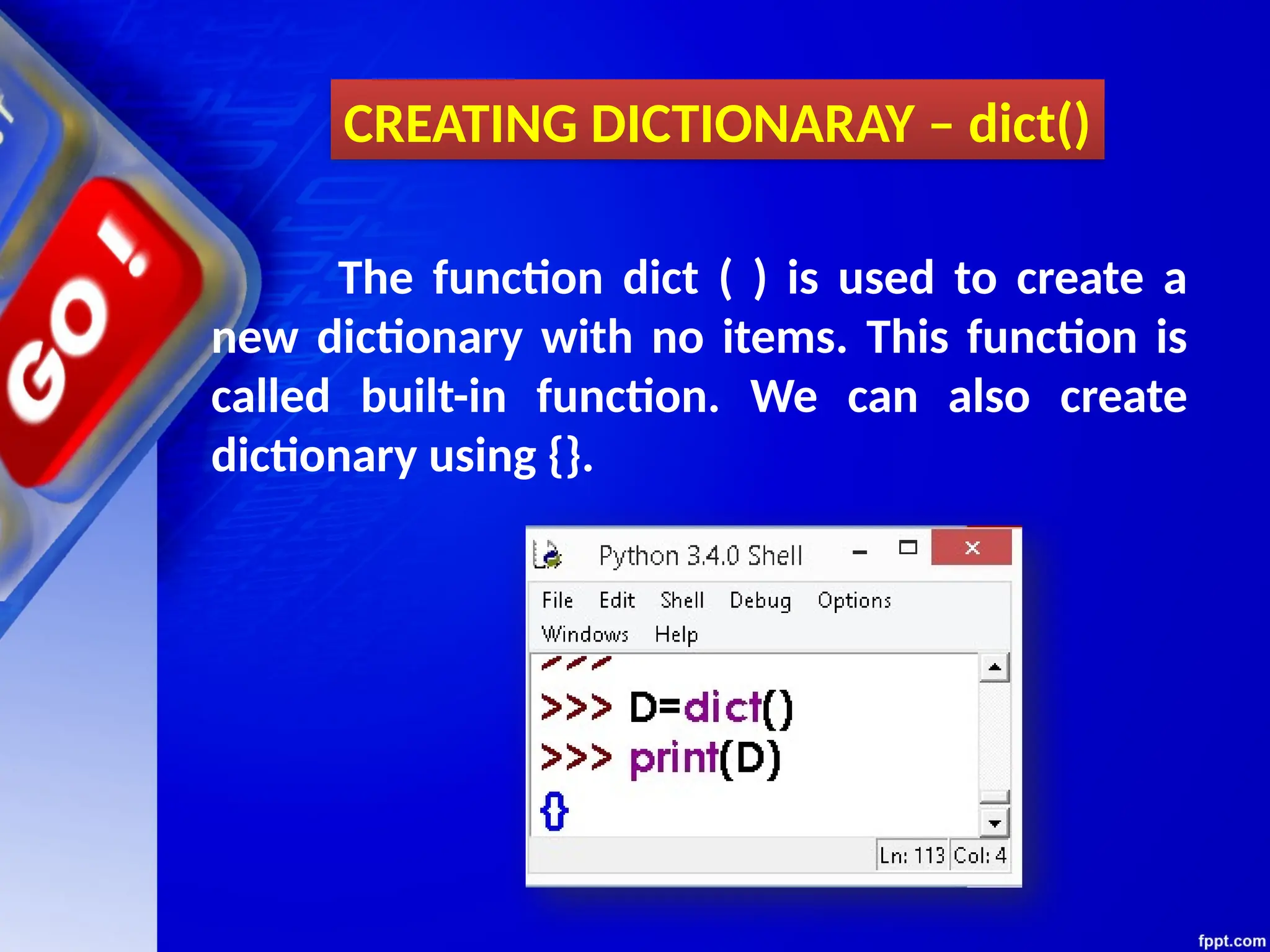
CREATING DICTIONARAY – dict()
The function dict ( ) is used to create a
new dictionary with no items. This function is
called built-in function. We can also create
dictionary using {}.
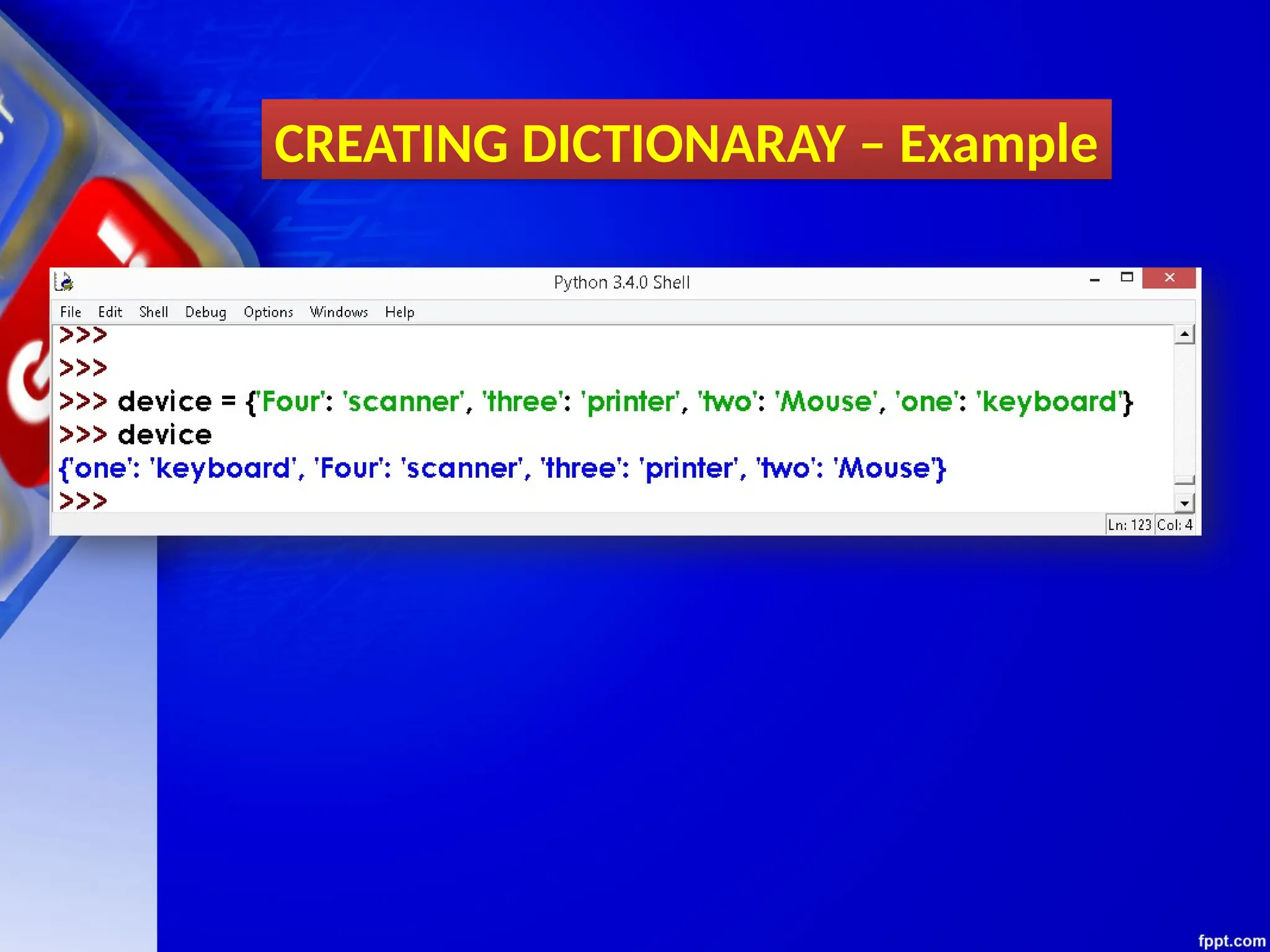
CREATING DICTIONARAY – Example
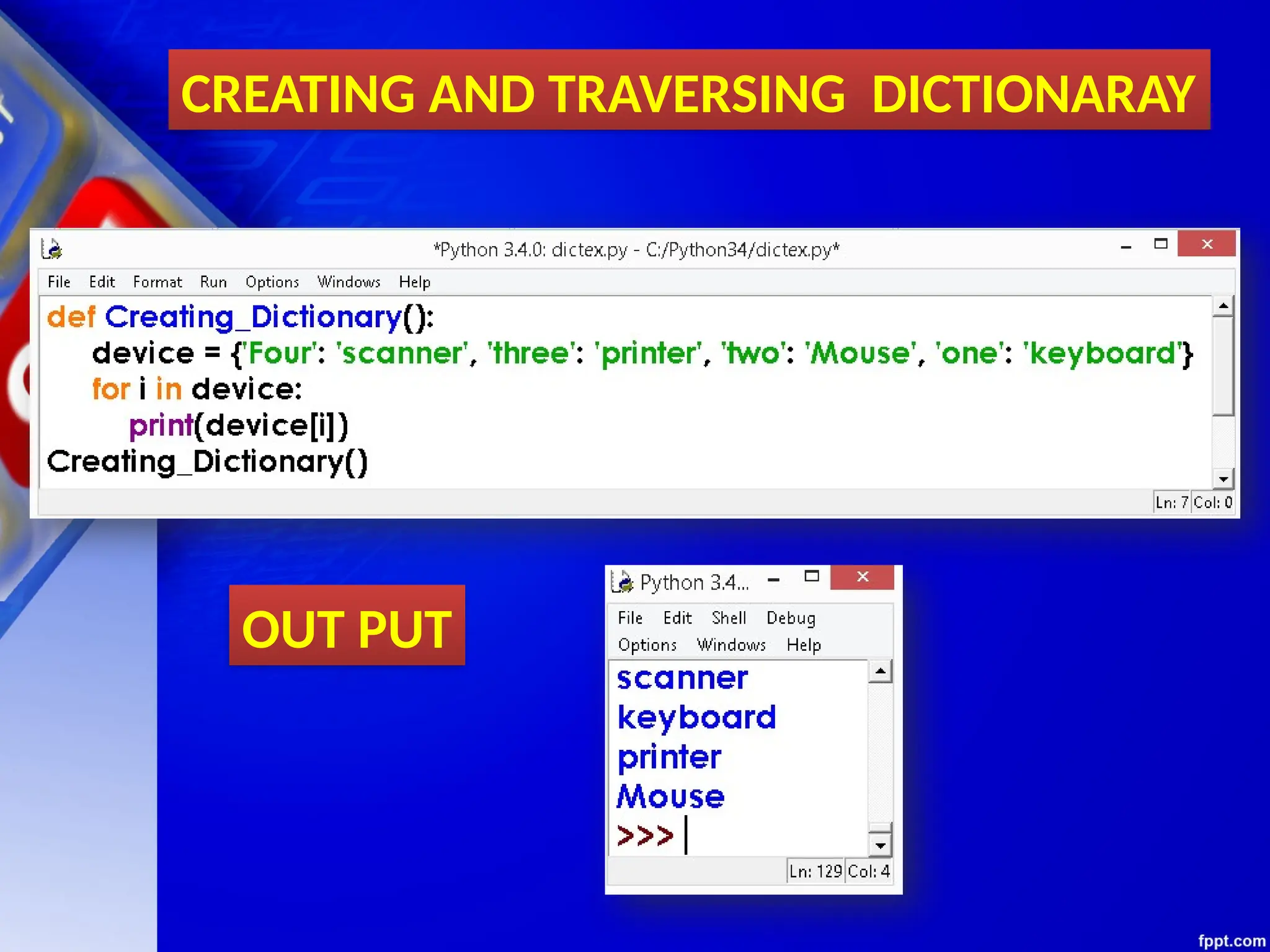
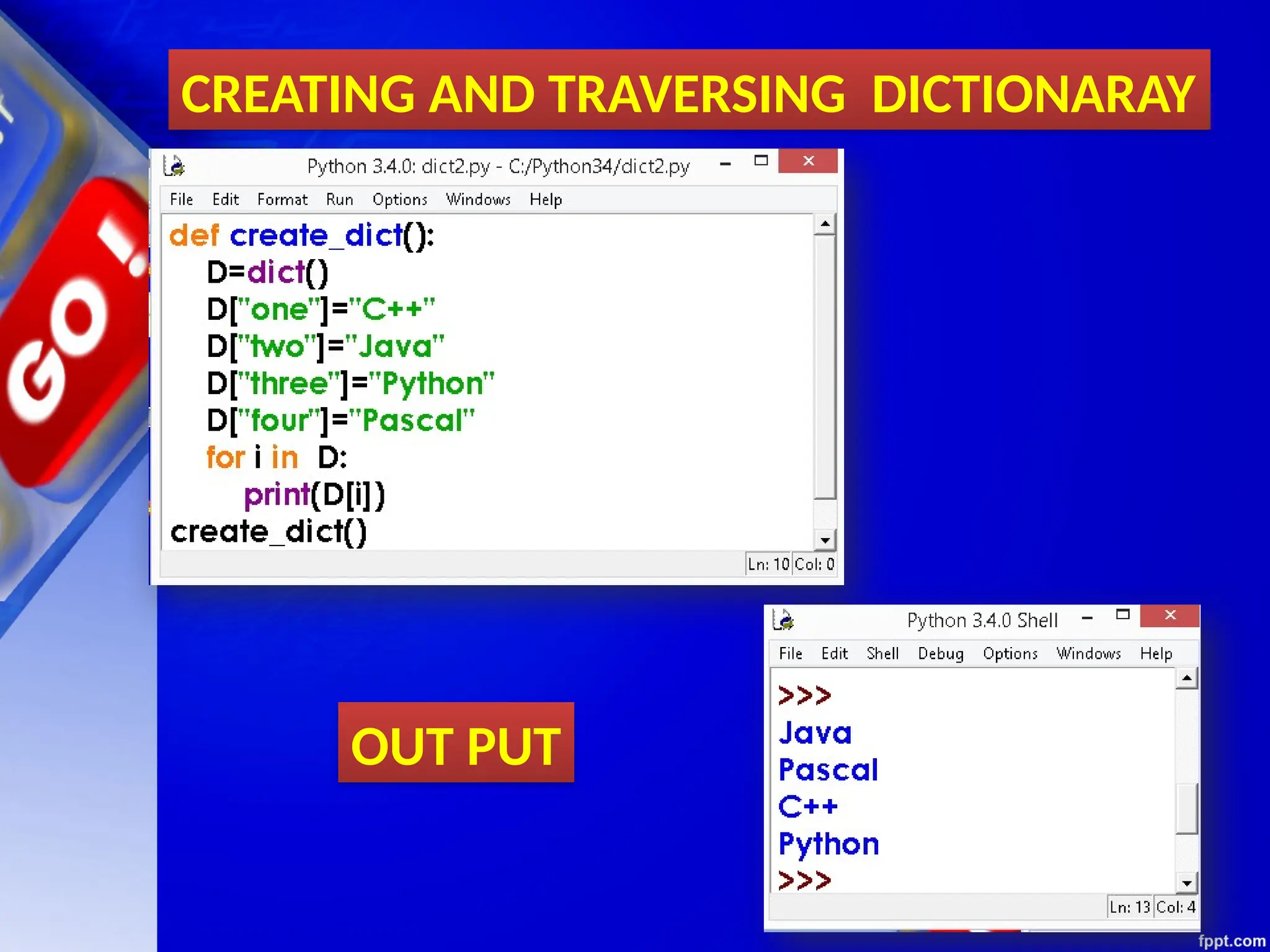
CREATING AND TRAVERSING DICTIONARAY
OUT PUT
CREATING AND TRAVERSING DICTIONARAY
OUT PUT
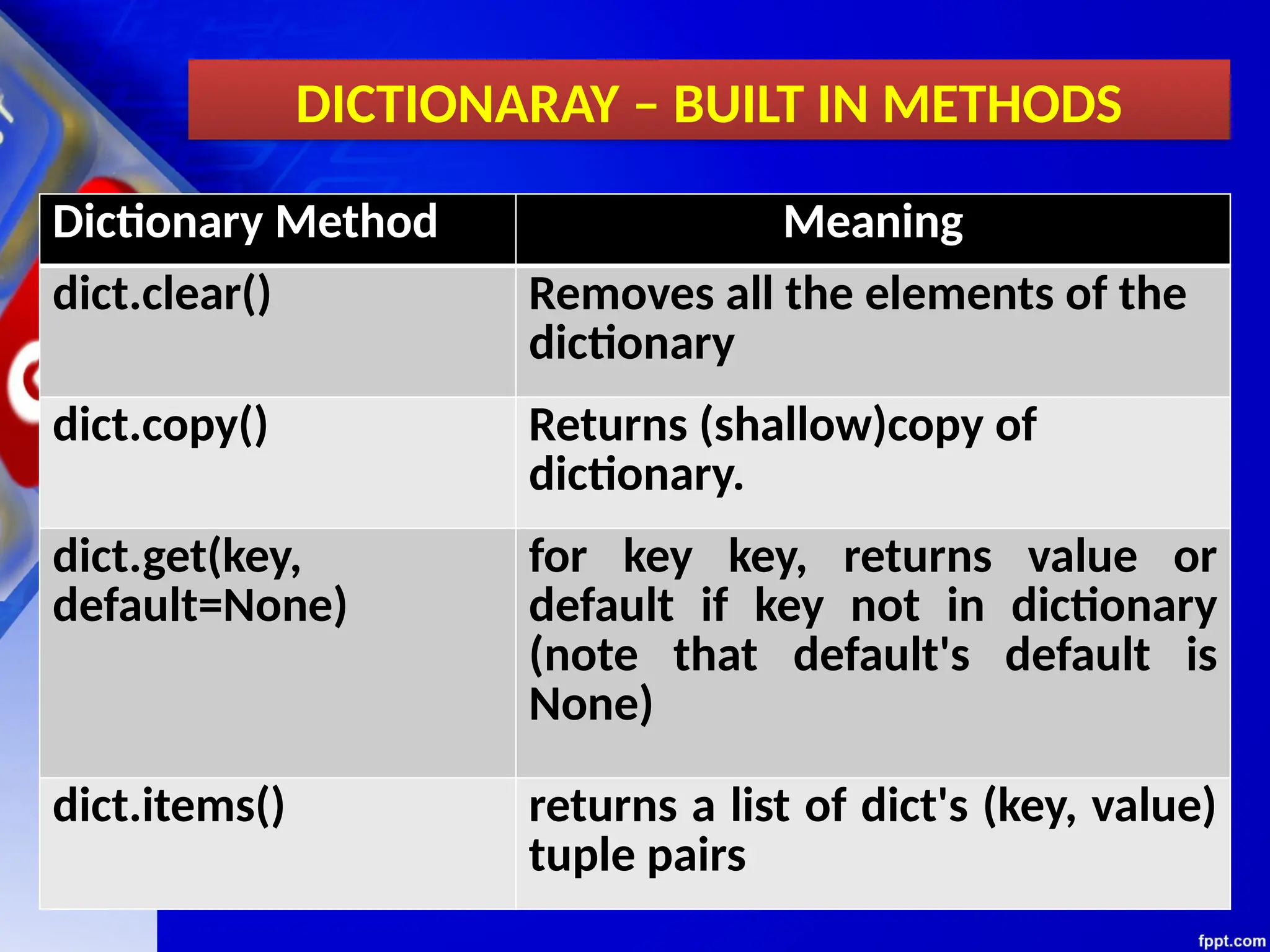
DICTIONARAY – BUILT IN METHODS
Dictionary Method Meaning
dict.clear() Removes all the elements of the
dictionary
dict.copy() Returns (shallow)copy of
dictionary.
dict.get(key,
default=None)
for key key, returns value or
default if key not in dictionary
(note that default's default is
None)
dict.items() returns a list of dict's (key, value)
tuple pairs
Dictionary Method Meaning
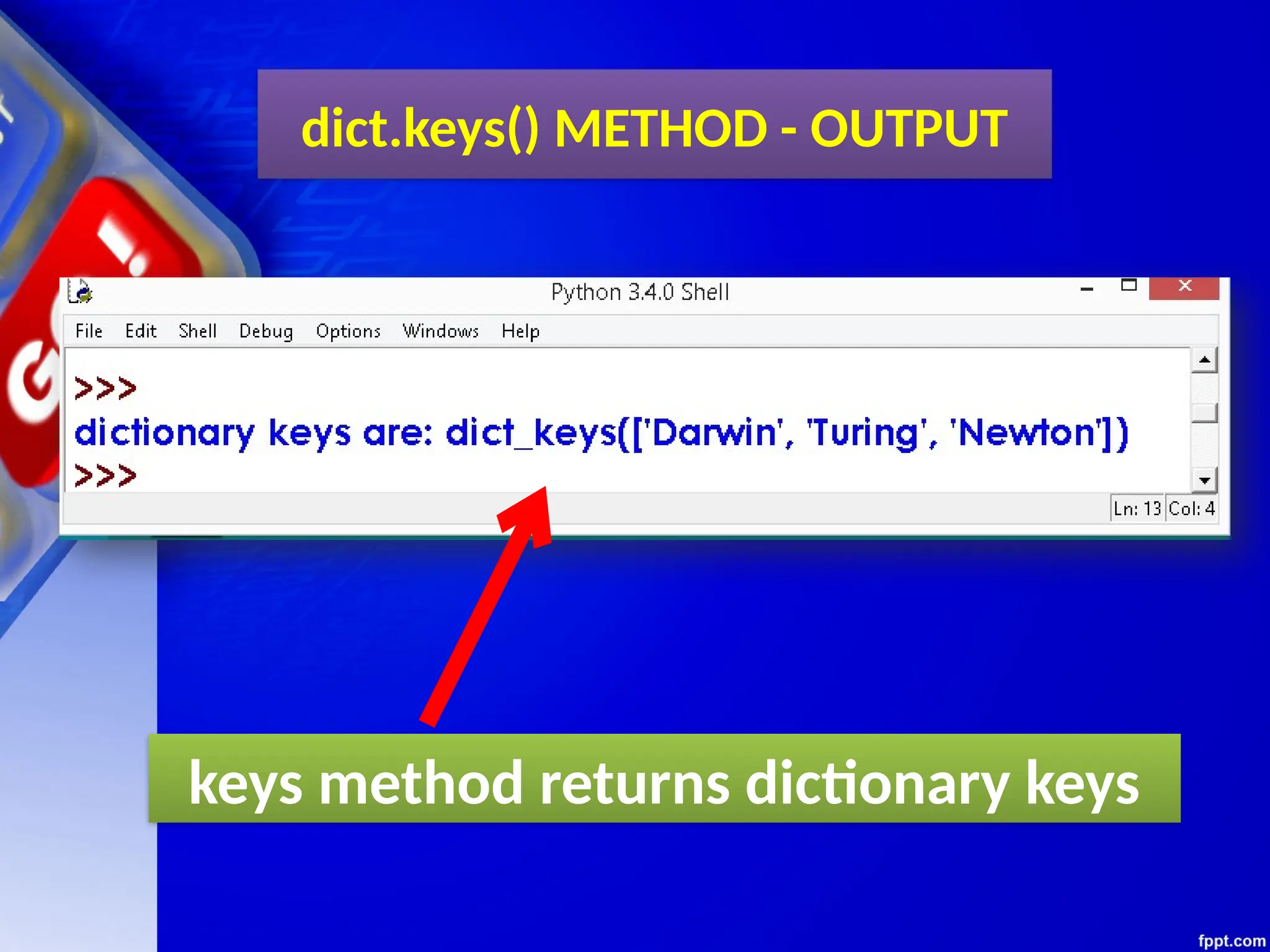
dict.keys() returns list of dictionary dict's
keys
dict.setdefault key,
default=None
similar to get(), but will set
dict[key]=default if key is not
already in dict
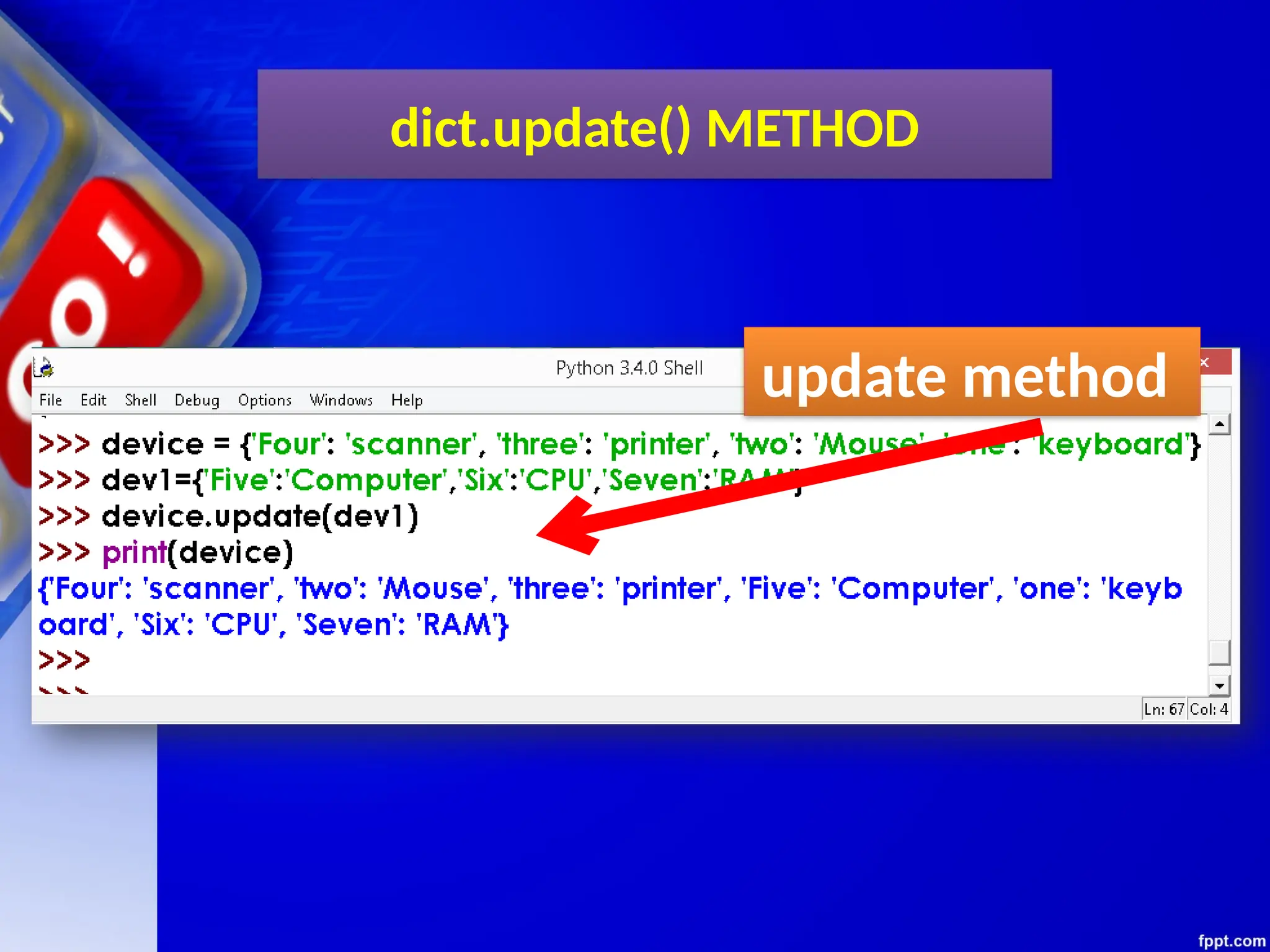
dict.update(dict2) adds dictionary dict2's key-values
pairs to dict
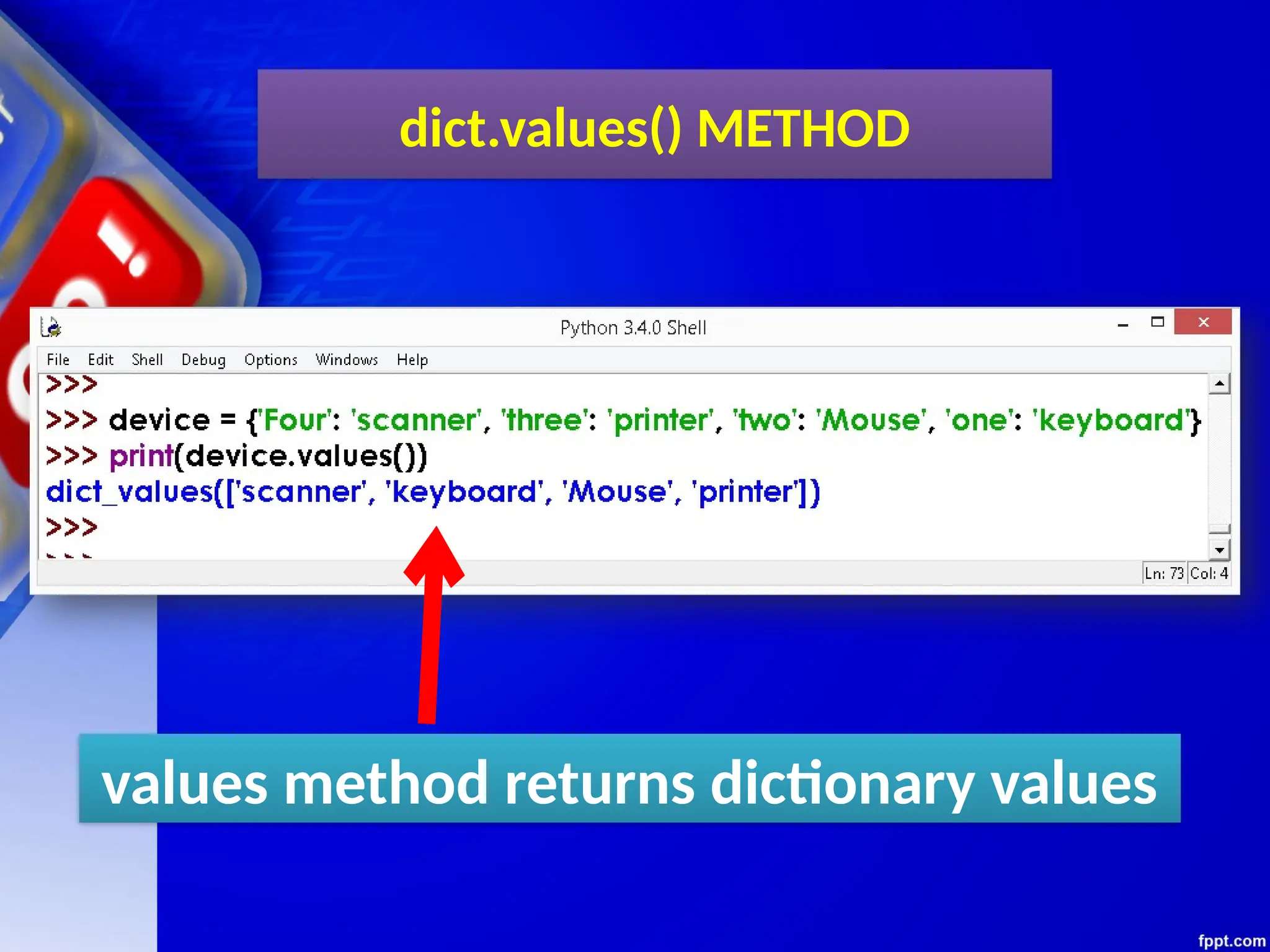
dict.values() returns list of dictionary dict's
values
DICTIONARAY – BUILT IN METHODS
Dictionary Method Meaning
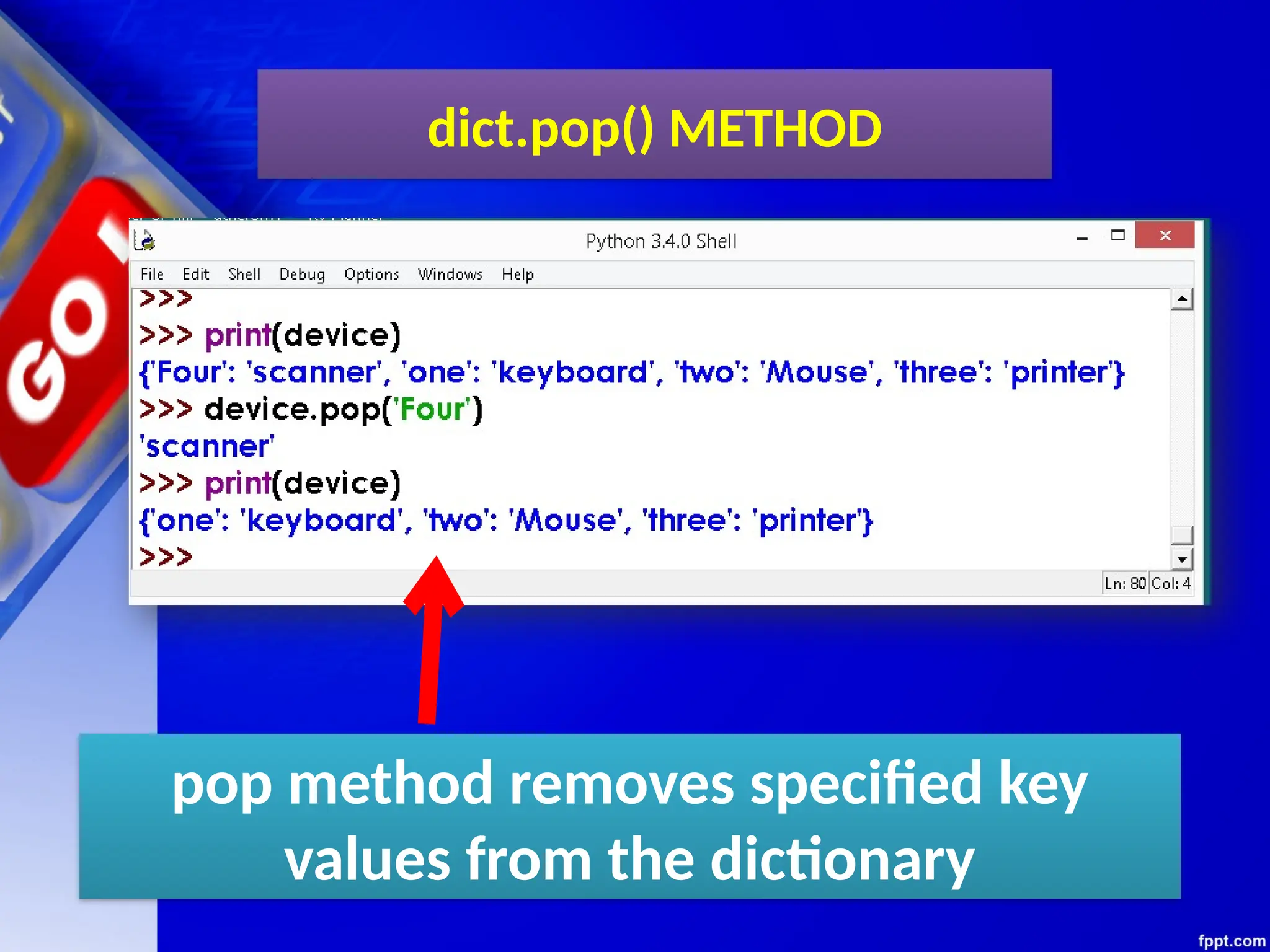
dict.pop() returns list of dictionary dict's
keys
dict.popitem() similar to get(), but will set
dict[key]=default if key is not
already in dict
DICTIONARAY – BUILT IN METHODS
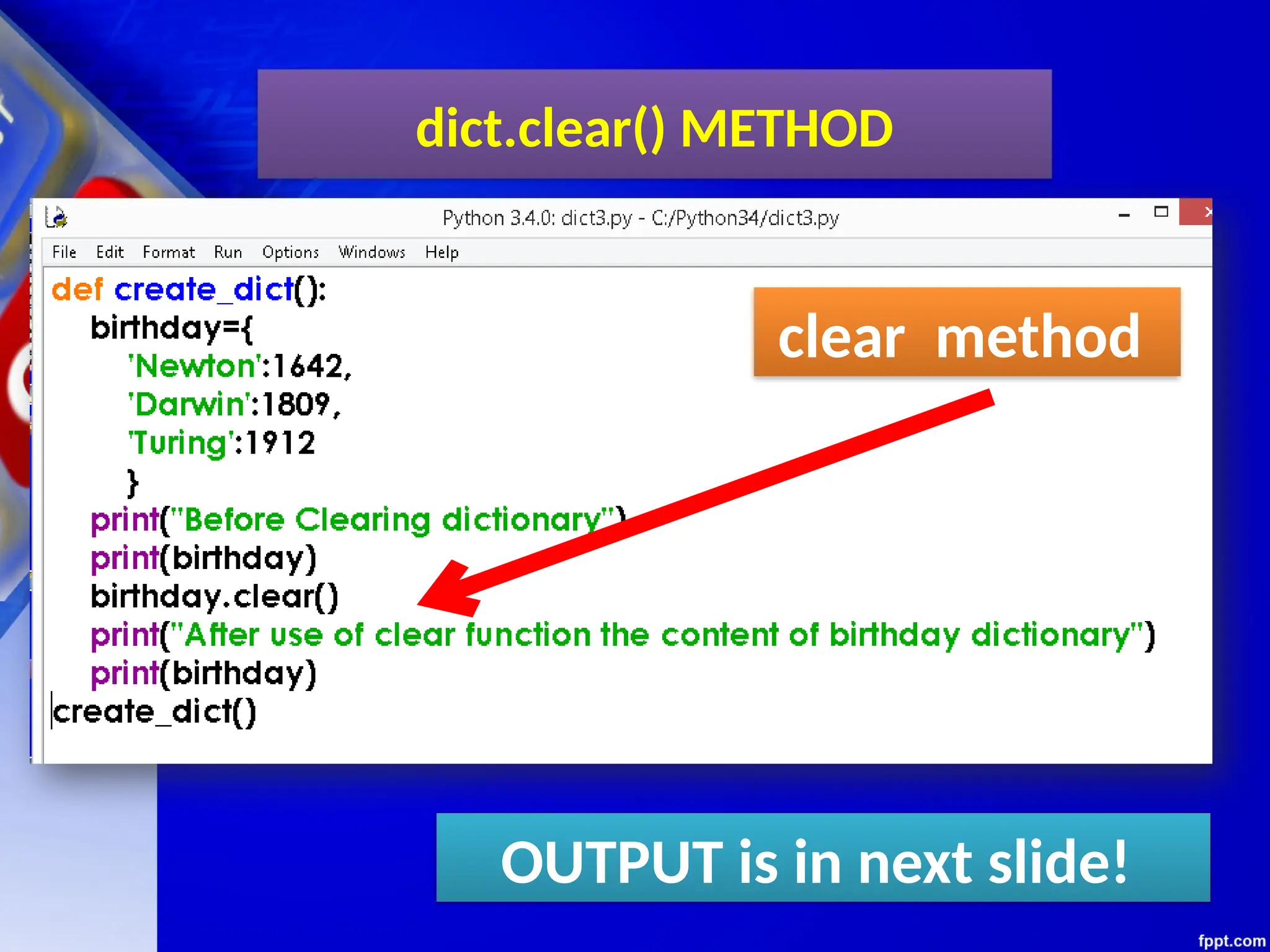
dict.clear() METHOD
clear method
OUTPUT is in next slide!
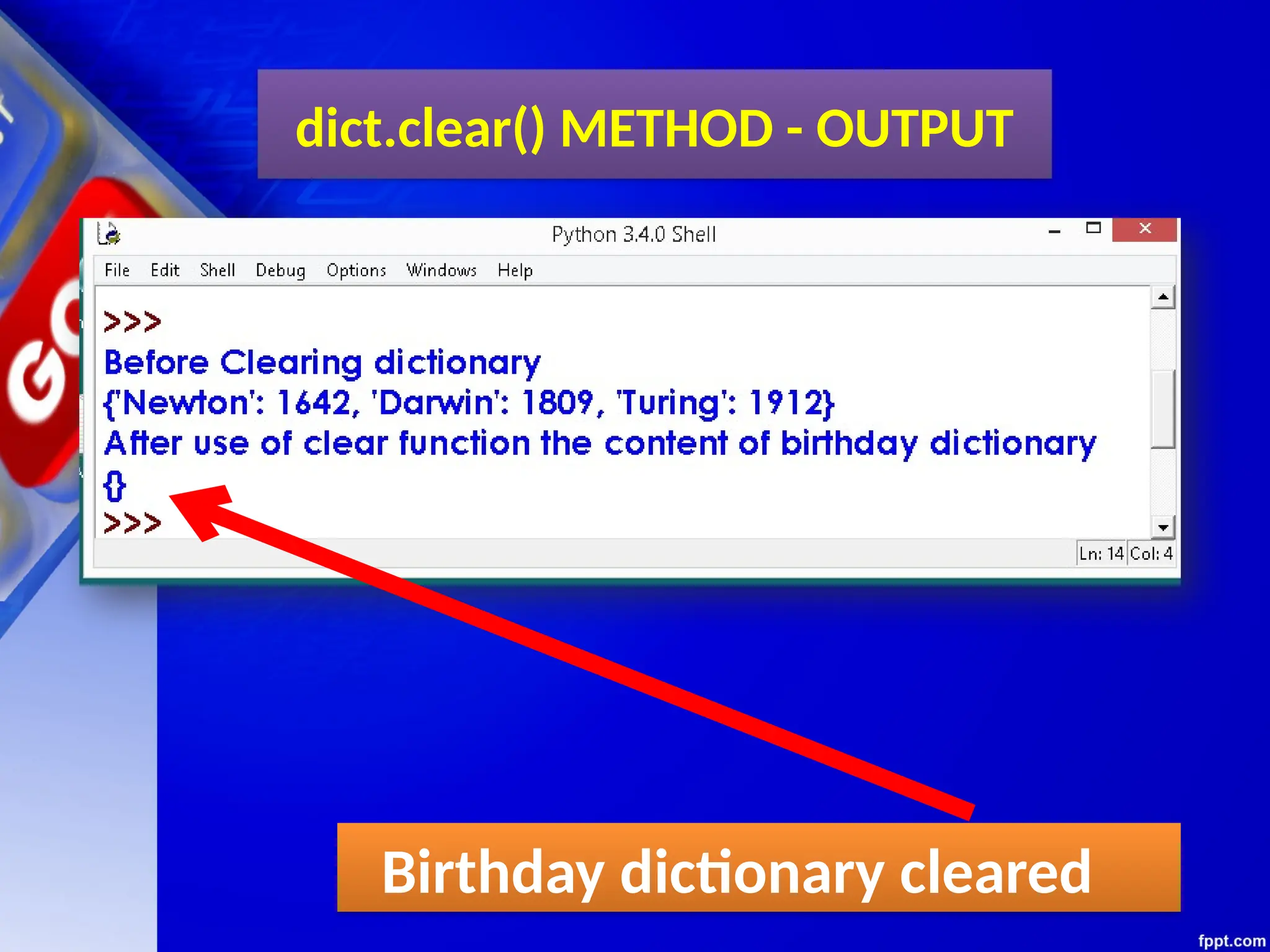
dict.clear() METHOD - OUTPUT
Birthday dictionary cleared
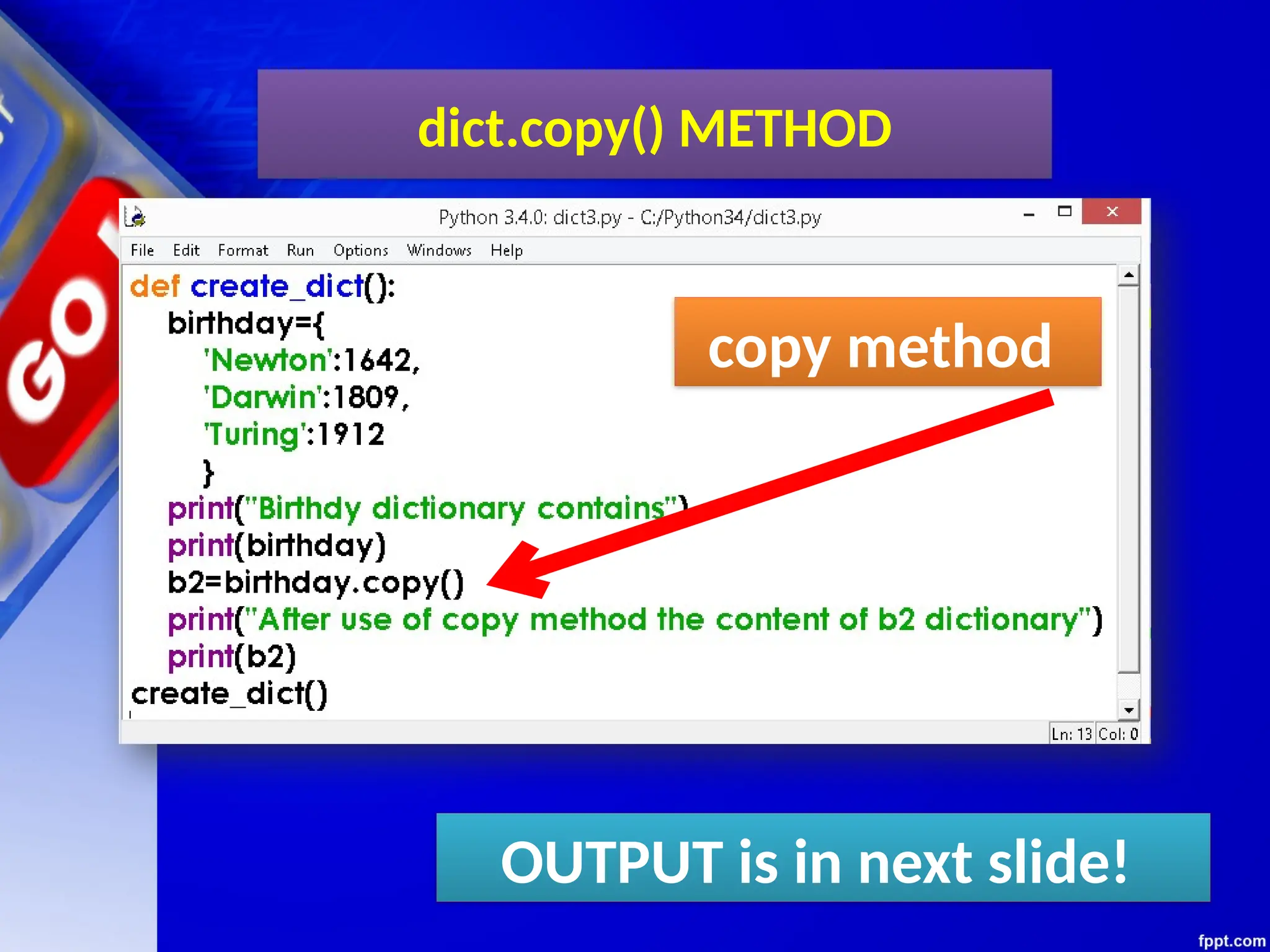
dict.copy() METHOD
copy method
OUTPUT is in next slide!
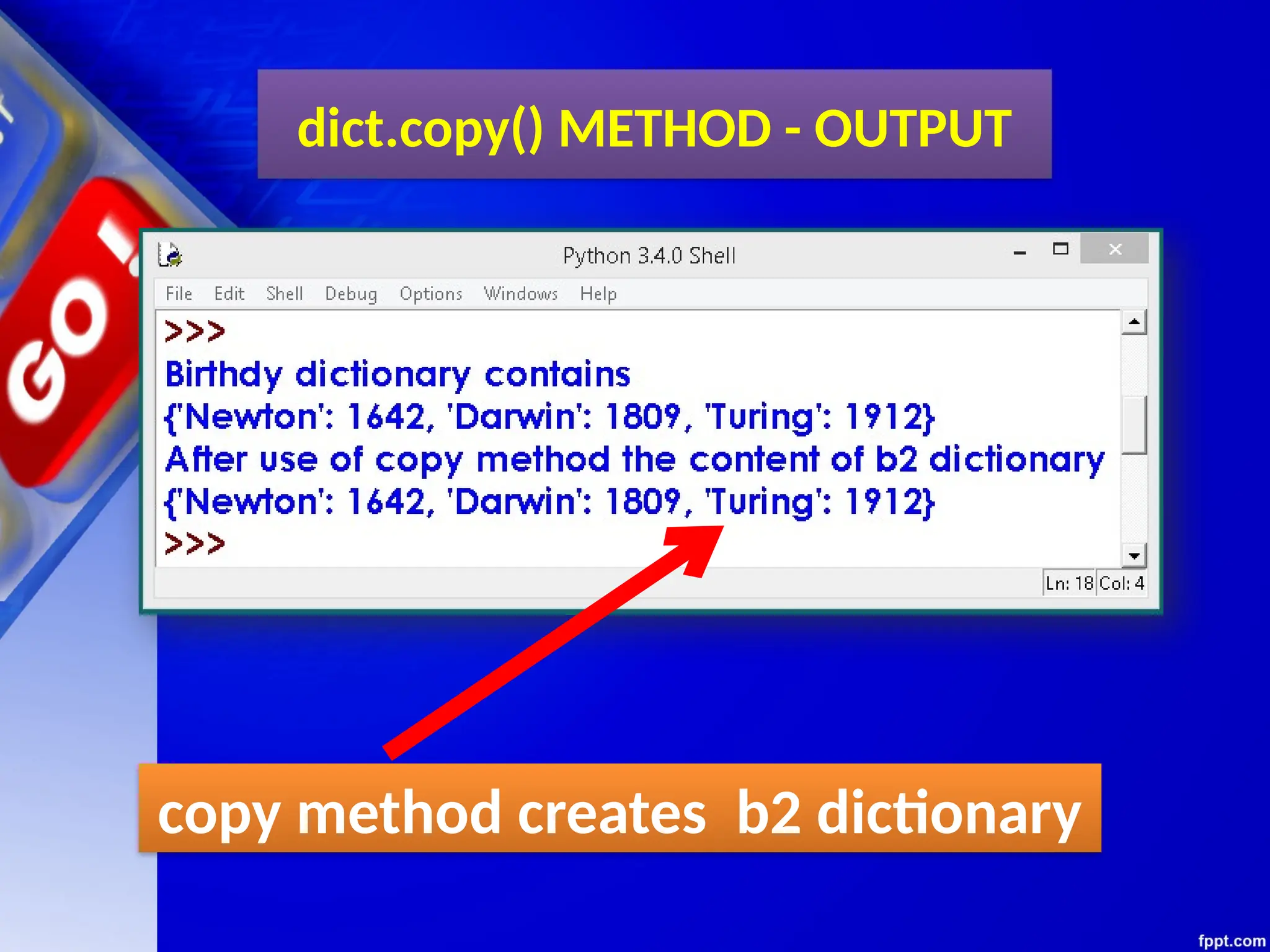
dict.copy() METHOD - OUTPUT
copy method creates b2 dictionary
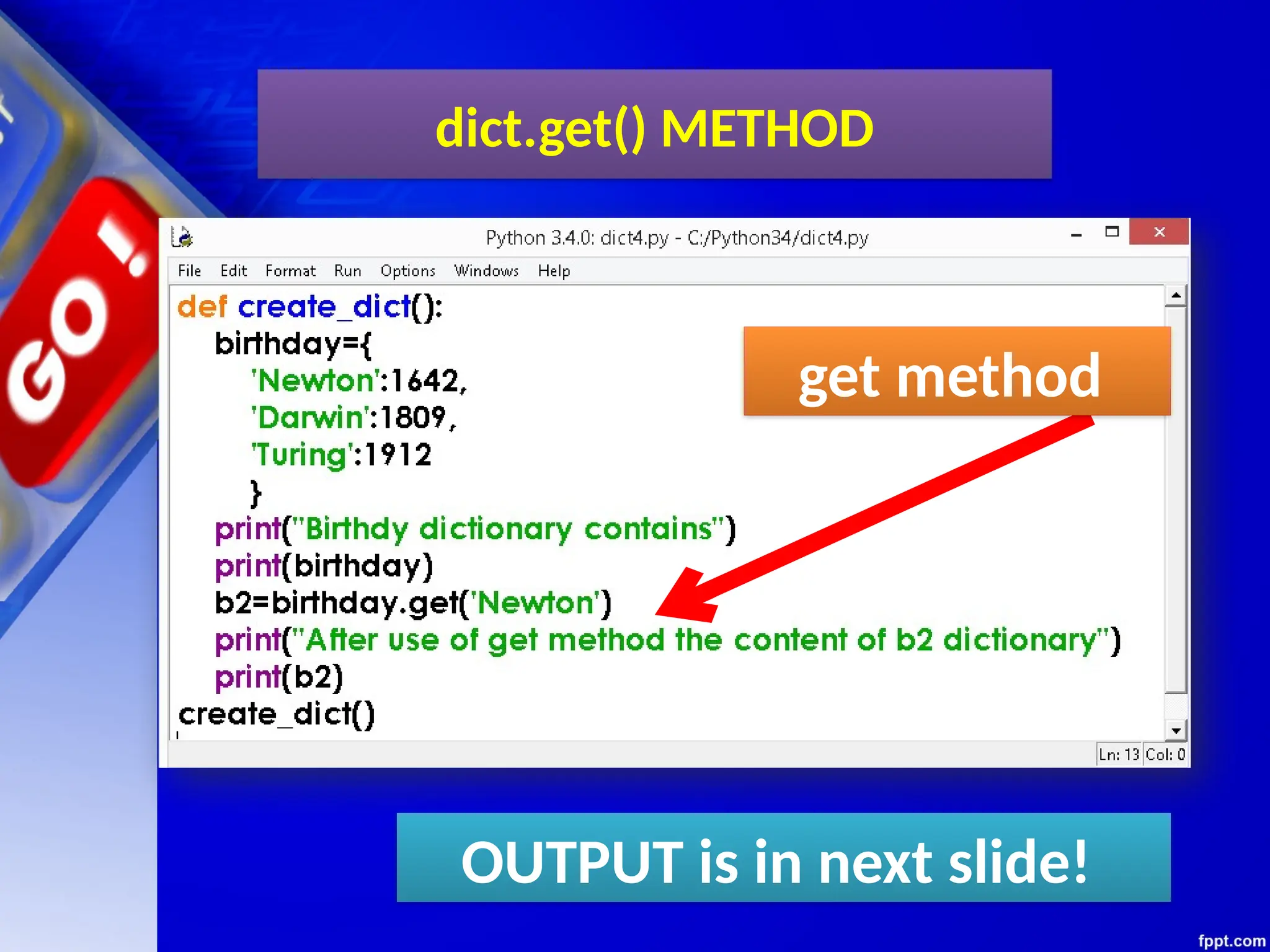
dict.get() METHOD
OUTPUT is in next slide!
get method
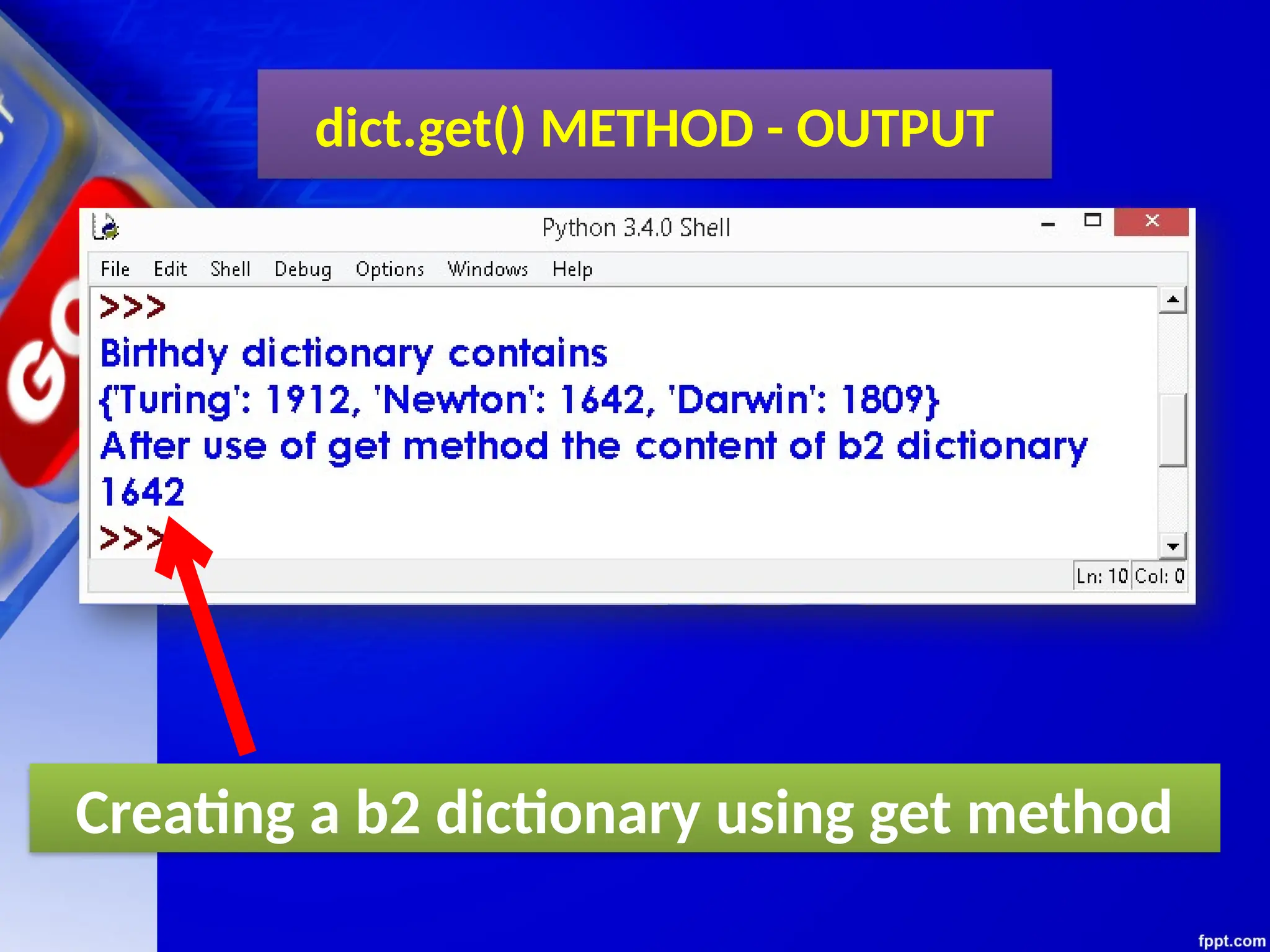
dict.get() METHOD - OUTPUT
Creating a b2 dictionary using get method
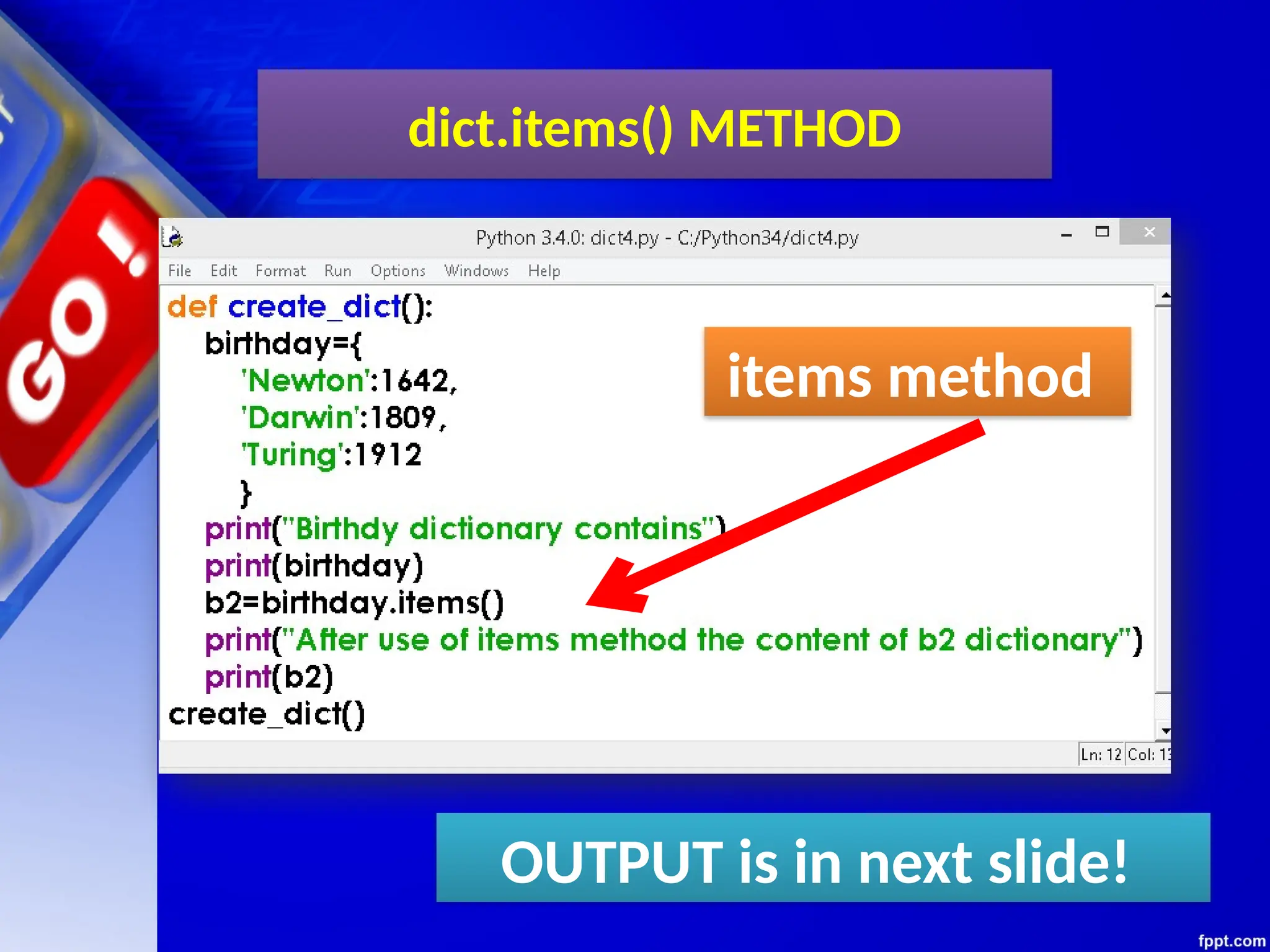
dict.items() METHOD
OUTPUT is in next slide!
items method
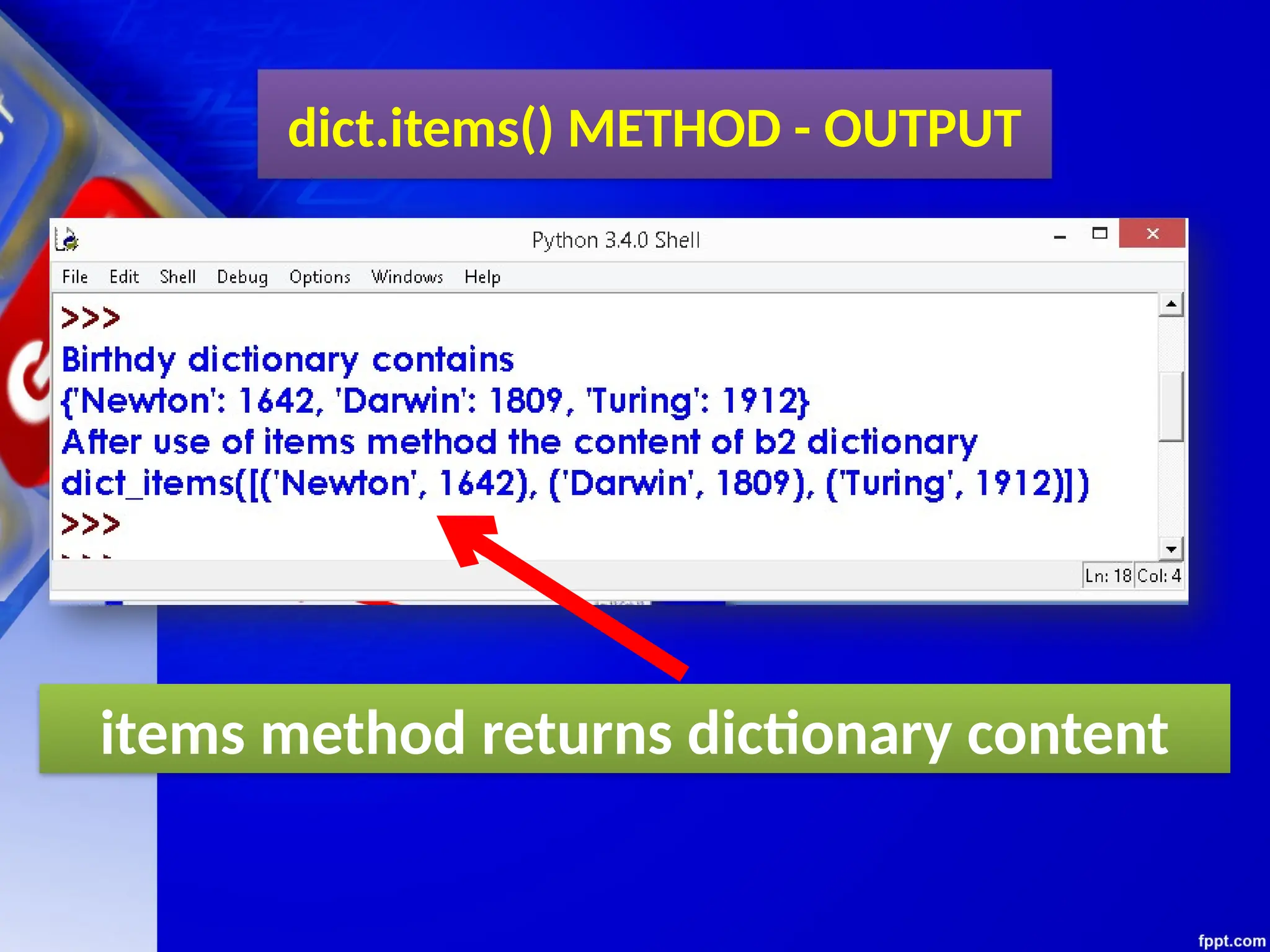
dict.items() METHOD - OUTPUT
items method returns dictionary content
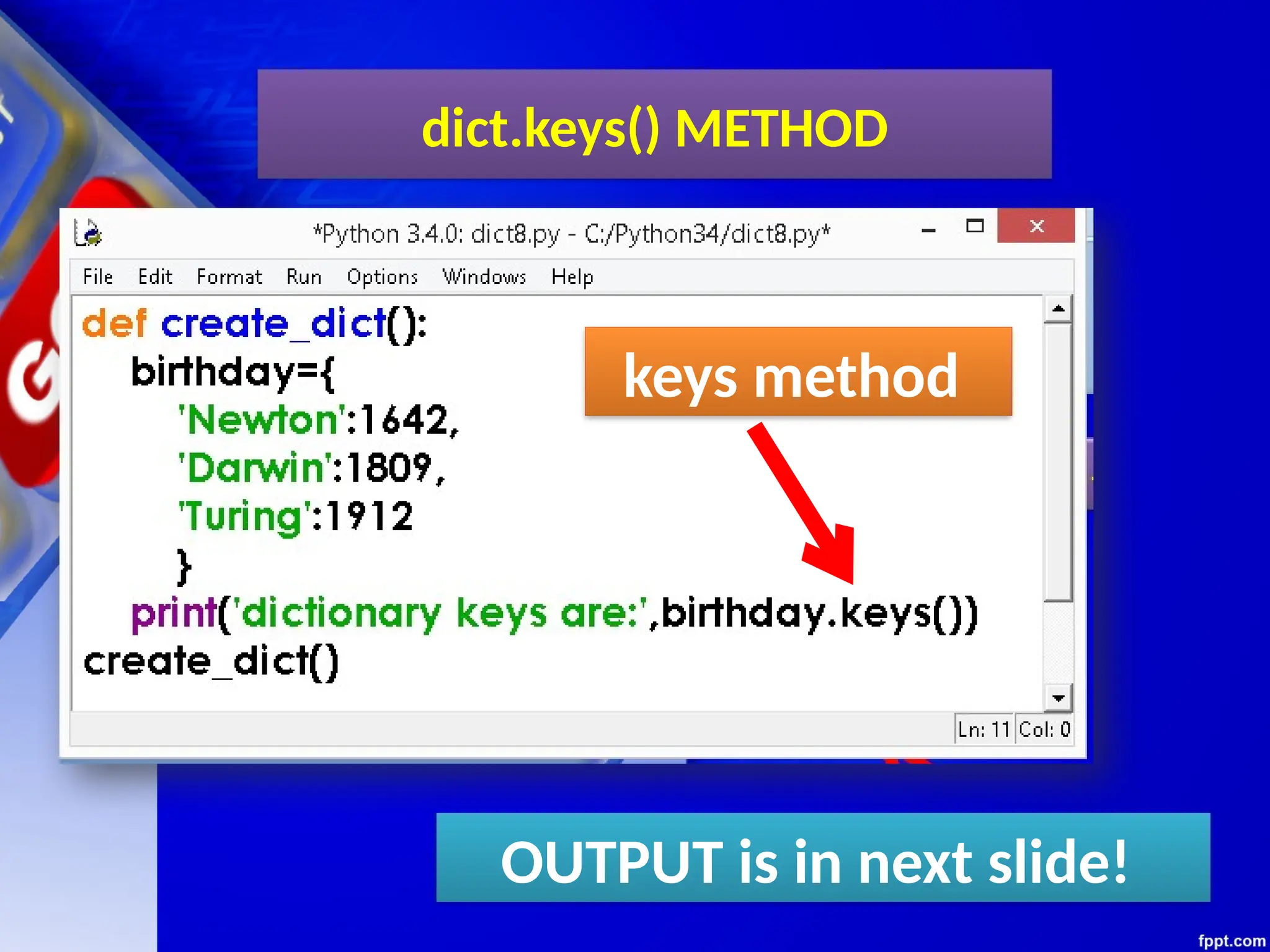
dict.keys() METHOD
OUTPUT is in next slide!
keys method
dict.keys() METHOD - OUTPUT
keys method returns dictionary keys
dict.update() METHOD
update method
dict.values() METHOD
values method returns dictionary values
dict.pop() METHOD
pop method removes specified key
values from the dictionary
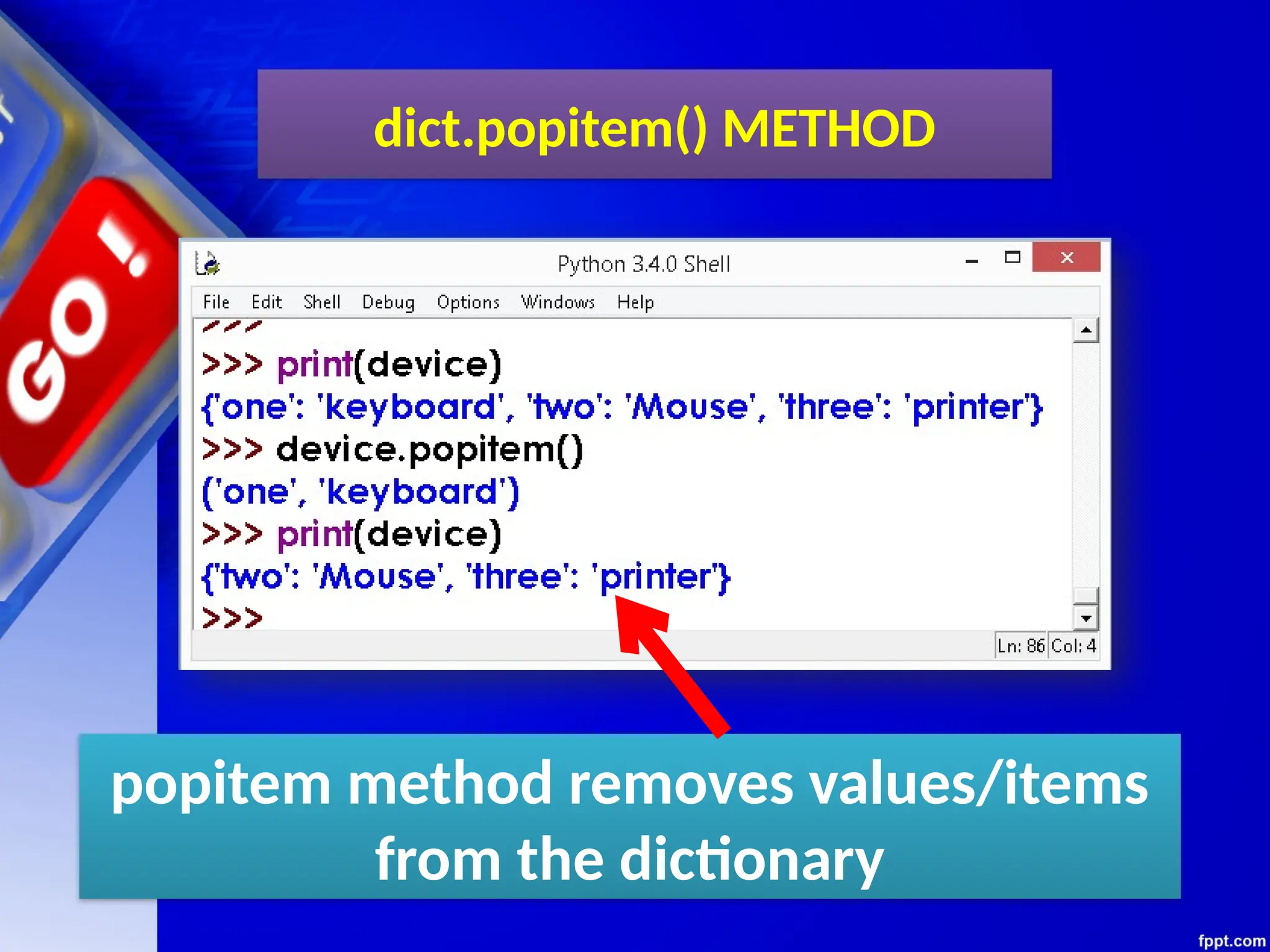
dict.popitem() METHOD
popitem method removes values/items
from the dictionary
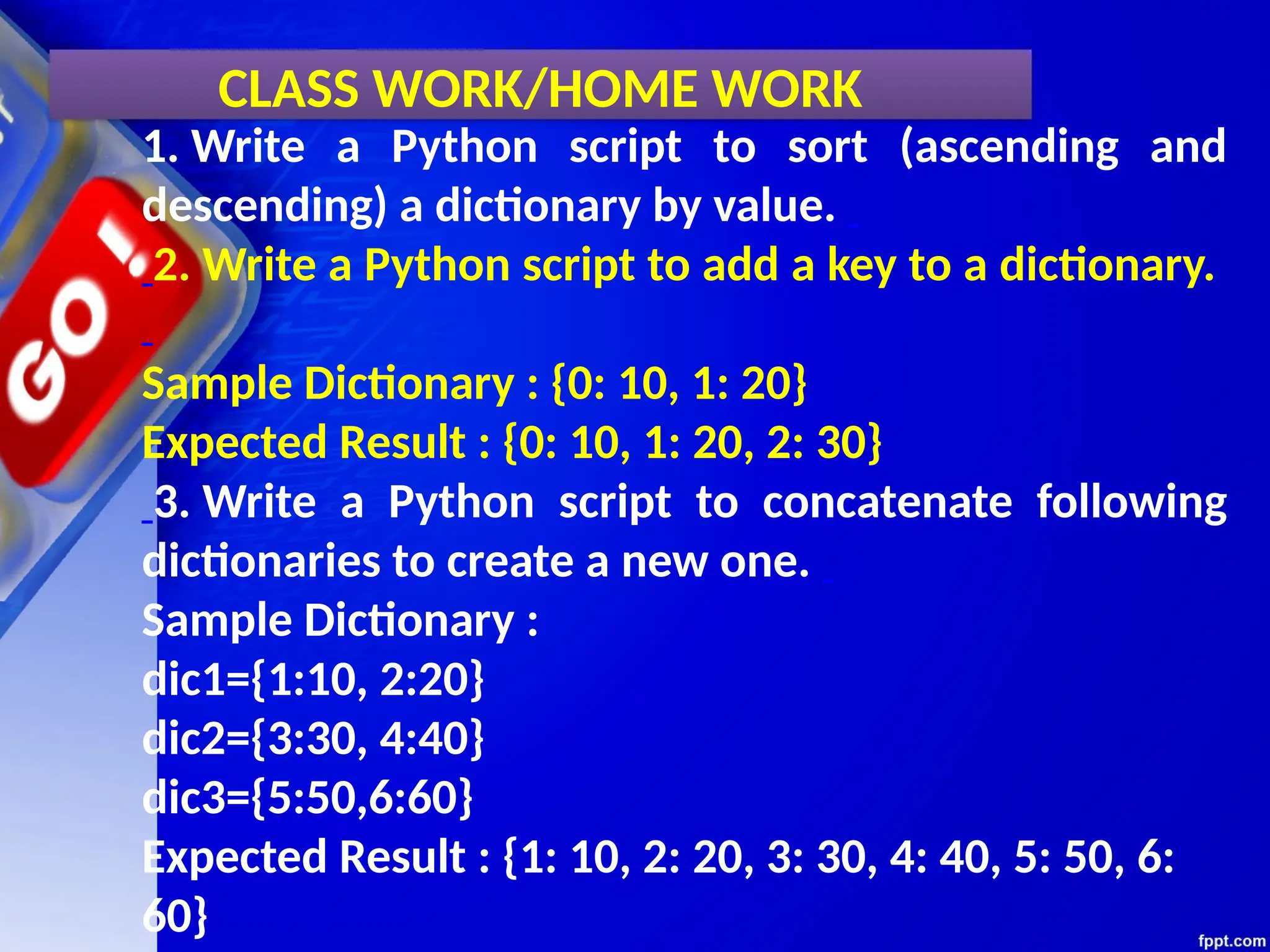
CLASS WORK/HOME WORK
1. Write a Python script to sort (ascending and
descending) a dictionary by value.
2. Write a Python script to add a key to a dictionary.
Sample Dictionary : {0: 10, 1: 20}
Expected Result : {0: 10, 1: 20, 2: 30}
3. Write a Python script to concatenate following
dictionaries to create a new one.
Sample Dictionary :
dic1={1:10, 2:20}
dic2={3:30, 4:40}
dic3={5:50,6:60}
Expected Result : {1: 10, 2: 20, 3: 30, 4: 40, 5: 50, 6:
60}
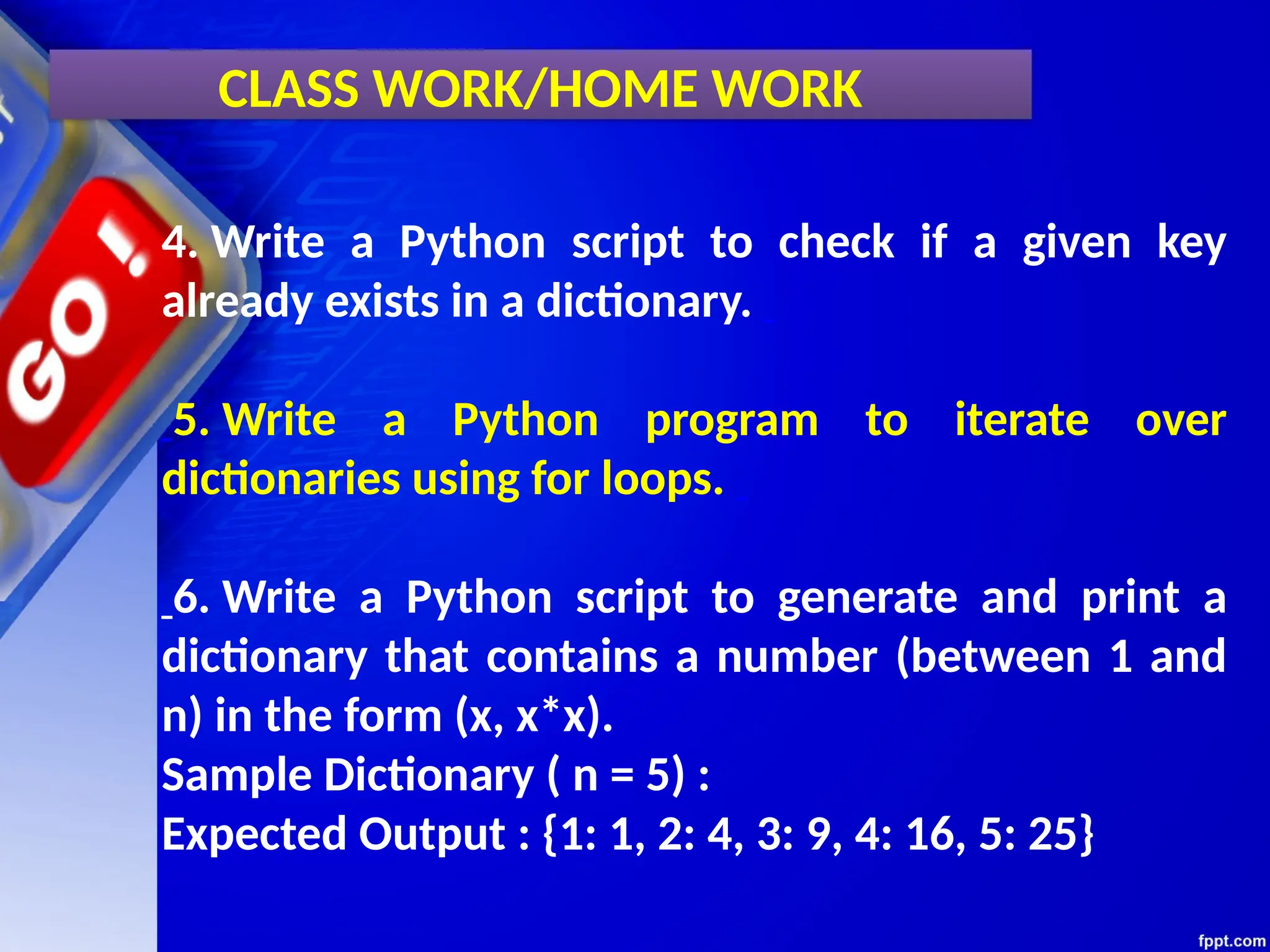
CLASS WORK/HOME WORK
4. Write a Python script to check if a given key
already exists in a dictionary.
5. Write a Python program to iterate over
dictionaries using for loops.
6. Write a Python script to generate and print a
dictionary that contains a number (between 1 and
n) in the form (x, x*x).
Sample Dictionary ( n = 5) :
Expected Output : {1: 1, 2: 4, 3: 9, 4: 16, 5: 25}
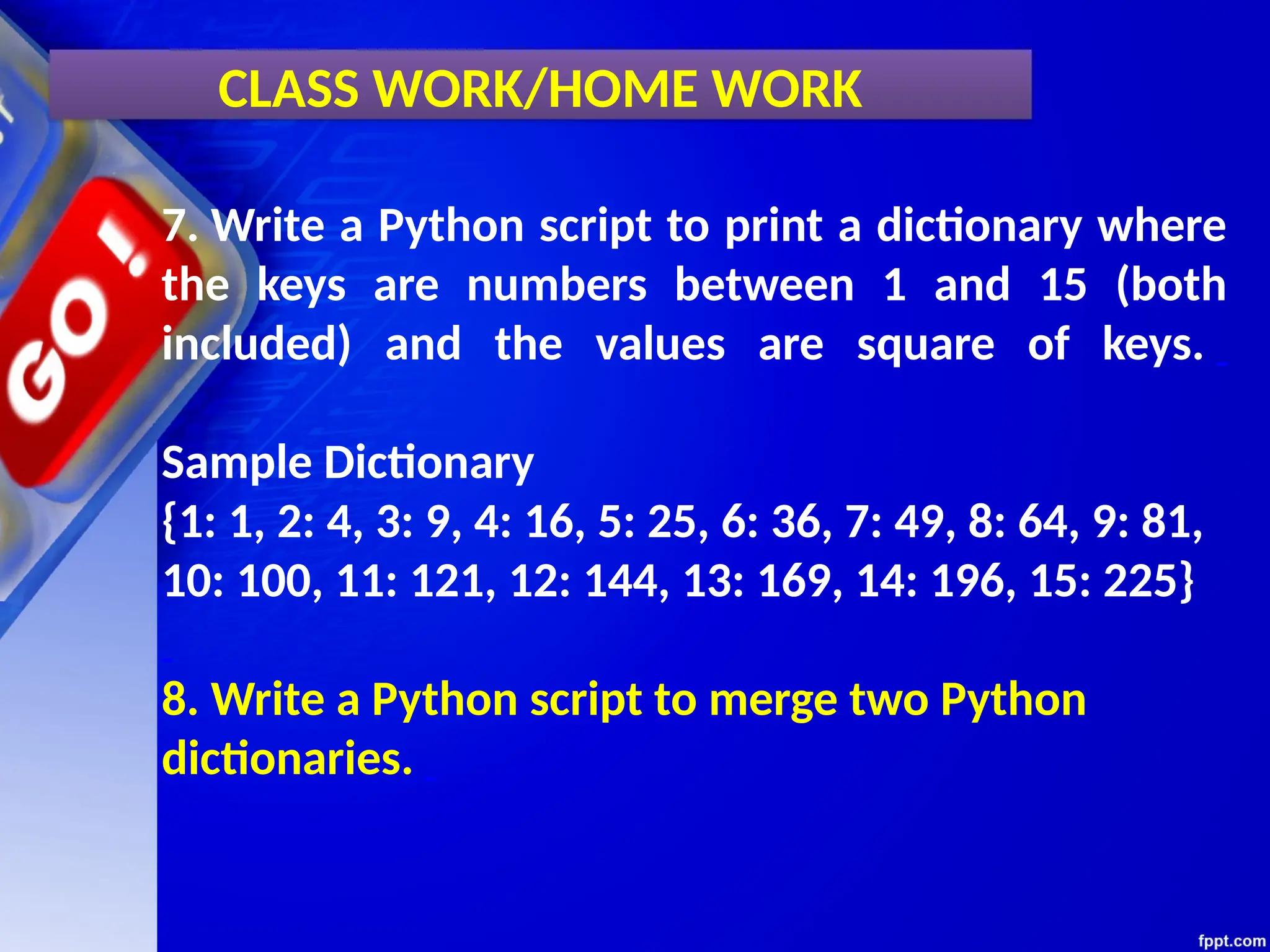
CLASS WORK/HOME WORK
7. Write a Python script to print a dictionary where
the keys are numbers between 1 and 15 (both
included) and the values are square of keys.
Sample Dictionary
{1: 1, 2: 4, 3: 9, 4: 16, 5: 25, 6: 36, 7: 49, 8: 64, 9: 81,
10: 100, 11: 121, 12: 144, 13: 169, 14: 196, 15: 225}
8. Write a Python script to merge two Python
dictionaries.
CLASS WORK/HOME WORK
9. Write a Python program to iterate over
dictionaries using for loops.
10. Write a Python program to sum all the items in
a dictionary.
Class Test
Class Test
Time: 40 Min Max Marks: 20
1. What is dictionary? give example 02
2. Write a python script to traverse a
dictionary 05
3. Explain 5 list built in methods of
dictionary 10
4. What is key value pair? Explain 05
Thank You

DICTIONARIES TUTORIALS FOR ADVANCED LEARNING OF YTHON PROGRAMMING

  • 1.
  • 2.
    Unit 2: Computational Thinkingand Programming XI Computer Science (083) Board : CBSE Courtesy CBSE
  • 3.
    Unit II Computational Thinkingand Programming (60 Theory periods + 45 Practical Periods) DCSc & Engg, PGDCA,ADCA,MCA.MSc(IT),Mtech(IT),MPhil (Comp. Sci) Department of Computer Science, Sainik School Amaravathinagar Cell No: 9431453730 Praveen M Jigajinni Prepared by Courtesy CBSE
  • 4.
  • 5.
    After studying thislesson, students will be able to:  Understand the need of dictionaries; Solve problems by using dictionaries; Get clear idea about dictionaries functions; and  Understand the difference between list and dictionary. LEARNING OUTCOMES
  • 6.
  • 7.
    A dictionary islike a list, but more in general. In a list, index value is an integer, while in a dictionary index value can be any other data type and are called keys. The key will be used as a string as it is easy to recall. A dictionary is an extremely useful data storage construct for storing and retrieving all key value pairs, where each element is accessed (or indexed) by a unique key. However, dictionary keys are not in sequences and hence maintain no left-to right order. WHAT IS DICTIONARY?
  • 8.
    We can referto a dictionary as a mapping between a set of indices (which are called keys) and a set of values. Each key maps a value. The association of a key and a value is called a key-value pair. Syntax: my_dict = {'key1': 'value1','key2': 'value2','key3': 'value3'…'keyn': 'valuen'} KEY VALYE PAIR
  • 9.
    Curley brackets areused to represent a dictionary. Each pair in the dictionary is represented by a key and value separated by a colon. Multiple pairs are separated by vcomas DICTIONARIES
  • 10.
    A dictionary isan un­ ordered collection of key­ value pairs. A dictionary has a length, specifically the numb er of key­ value pairs. A dictionary provides fast look up by key. The keys must be immutable object types. DICTIONARIES
  • 11.
    >>> A={1:"one",2:"two",3:"three"} STATE DIAGRAM A= 1 one 2 two 3 three KEYS VALUES
  • 12.
  • 13.
    CREATING DICTIONARAY –dict() The function dict ( ) is used to create a new dictionary with no items. This function is called built-in function. We can also create dictionary using {}.
  • 14.
  • 15.
  • 16.
    CREATING AND TRAVERSINGDICTIONARAY OUT PUT
  • 17.
    CREATING AND TRAVERSINGDICTIONARAY OUT PUT
  • 18.
  • 19.
    DICTIONARAY – BUILTIN METHODS Dictionary Method Meaning dict.clear() Removes all the elements of the dictionary dict.copy() Returns (shallow)copy of dictionary. dict.get(key, default=None) for key key, returns value or default if key not in dictionary (note that default's default is None) dict.items() returns a list of dict's (key, value) tuple pairs
  • 20.
    Dictionary Method Meaning dict.keys()returns list of dictionary dict's keys dict.setdefault key, default=None similar to get(), but will set dict[key]=default if key is not already in dict dict.update(dict2) adds dictionary dict2's key-values pairs to dict dict.values() returns list of dictionary dict's values DICTIONARAY – BUILT IN METHODS
  • 21.
    Dictionary Method Meaning dict.pop()returns list of dictionary dict's keys dict.popitem() similar to get(), but will set dict[key]=default if key is not already in dict DICTIONARAY – BUILT IN METHODS
  • 22.
  • 23.
    dict.clear() METHOD -OUTPUT Birthday dictionary cleared
  • 24.
  • 25.
    dict.copy() METHOD -OUTPUT copy method creates b2 dictionary
  • 26.
    dict.get() METHOD OUTPUT isin next slide! get method
  • 27.
    dict.get() METHOD -OUTPUT Creating a b2 dictionary using get method
  • 28.
    dict.items() METHOD OUTPUT isin next slide! items method
  • 29.
    dict.items() METHOD -OUTPUT items method returns dictionary content
  • 30.
    dict.keys() METHOD OUTPUT isin next slide! keys method
  • 31.
    dict.keys() METHOD -OUTPUT keys method returns dictionary keys
  • 32.
  • 33.
    dict.values() METHOD values methodreturns dictionary values
  • 34.
    dict.pop() METHOD pop methodremoves specified key values from the dictionary
  • 35.
    dict.popitem() METHOD popitem methodremoves values/items from the dictionary
  • 36.
  • 37.
    CLASS WORK/HOME WORK 1.Write a Python script to sort (ascending and descending) a dictionary by value. 2. Write a Python script to add a key to a dictionary. Sample Dictionary : {0: 10, 1: 20} Expected Result : {0: 10, 1: 20, 2: 30} 3. Write a Python script to concatenate following dictionaries to create a new one. Sample Dictionary : dic1={1:10, 2:20} dic2={3:30, 4:40} dic3={5:50,6:60} Expected Result : {1: 10, 2: 20, 3: 30, 4: 40, 5: 50, 6: 60}
  • 38.
    CLASS WORK/HOME WORK 4.Write a Python script to check if a given key already exists in a dictionary. 5. Write a Python program to iterate over dictionaries using for loops. 6. Write a Python script to generate and print a dictionary that contains a number (between 1 and n) in the form (x, x*x). Sample Dictionary ( n = 5) : Expected Output : {1: 1, 2: 4, 3: 9, 4: 16, 5: 25}
  • 39.
    CLASS WORK/HOME WORK 7.Write a Python script to print a dictionary where the keys are numbers between 1 and 15 (both included) and the values are square of keys. Sample Dictionary {1: 1, 2: 4, 3: 9, 4: 16, 5: 25, 6: 36, 7: 49, 8: 64, 9: 81, 10: 100, 11: 121, 12: 144, 13: 169, 14: 196, 15: 225} 8. Write a Python script to merge two Python dictionaries.
  • 40.
    CLASS WORK/HOME WORK 9.Write a Python program to iterate over dictionaries using for loops. 10. Write a Python program to sum all the items in a dictionary.
  • 41.
  • 42.
    Class Test Time: 40Min Max Marks: 20 1. What is dictionary? give example 02 2. Write a python script to traverse a dictionary 05 3. Explain 5 list built in methods of dictionary 10 4. What is key value pair? Explain 05
  • 43.