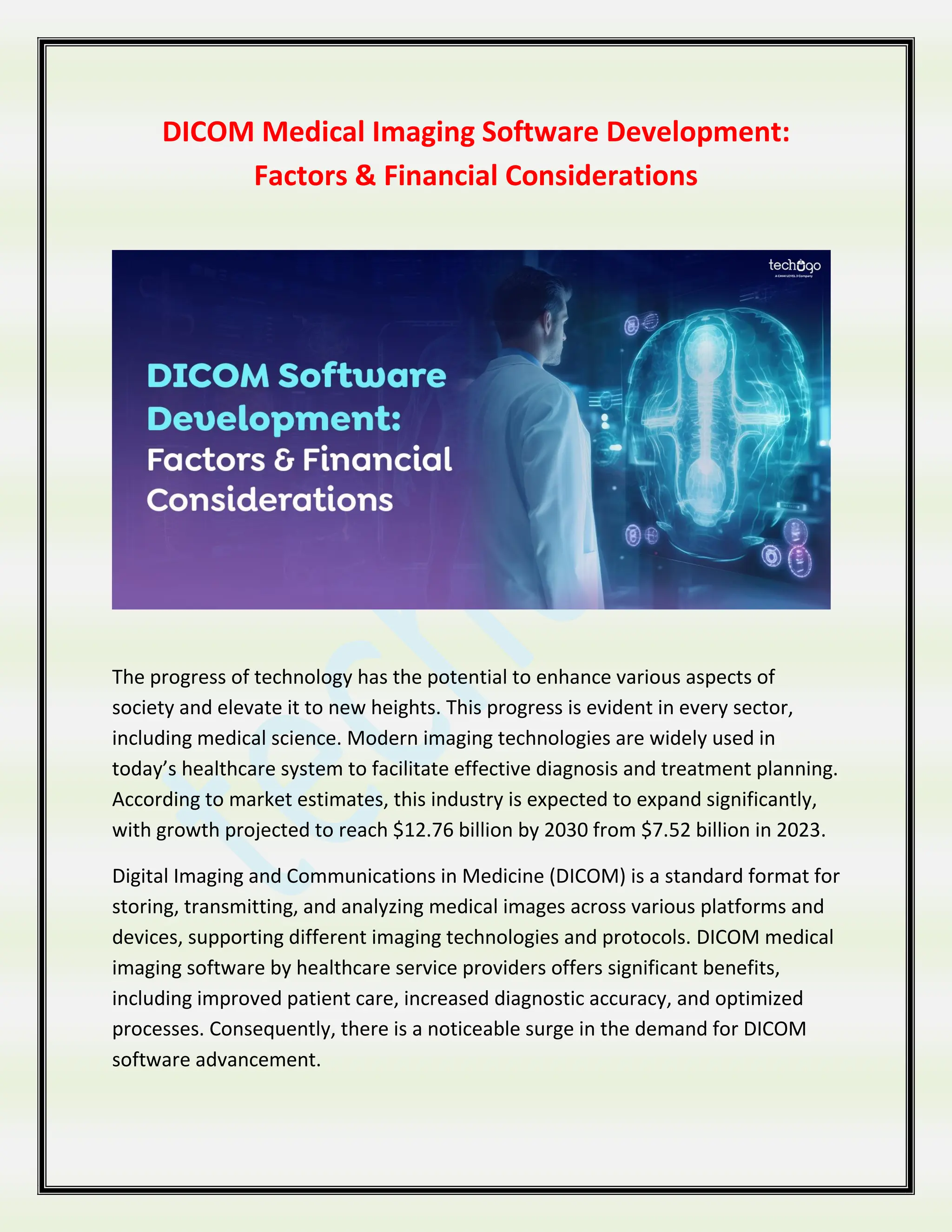
DICOM Medical Imaging Software Development:
Factors & Financial Considerations
The progress of technology has the potential to enhance various aspects of
society and elevate it to new heights. This progress is evident in every sector,
including medical science. Modern imaging technologies are widely used in
today’s healthcare system to facilitate effective diagnosis and treatment planning.
According to market estimates, this industry is expected to expand significantly,
with growth projected to reach $12.76 billion by 2030 from $7.52 billion in 2023.
Digital Imaging and Communications in Medicine (DICOM) is a standard format for
storing, transmitting, and analyzing medical images across various platforms and
devices, supporting different imaging technologies and protocols. DICOM medical
imaging software by healthcare service providers offers significant benefits,
including improved patient care, increased diagnostic accuracy, and optimized
processes. Consequently, there is a noticeable surge in the demand for DICOM
software advancement.
This blog delves into the nuanced considerations surrounding the financial facets
of DICOM software evolution. Furthermore, we investigate the numerous factors
impacting expenditures, indispensable features, and more, presenting insights to
aid a medicine delivery app development company in forming knowledgeable
choices regarding their DICOM software investments.
Collaborate with us to harness AI, ML and IOT into the burgeoning medical
imaging software.
Also Read : How AI And Machine Learning Are Helping App Development Field?
Comprehending the Expense of Crafting DICOM Medical Imaging Software
Digital imaging applications in medicine are crucial in modern healthcare with AI
and ML, enabling the conservation, transmission, and examination of medical
images. It adheres to the DICOM standard, guaranteeing adaptability across
imaging devices and platforms. This application supports adept diagnosis,
treatment planning, and patient care, accommodating diverse imaging
methodologies such as X-ray, MRI, CT scan, and ultrasound.
As previously noted, the average cost for formulating DICOM medical imaging
software can vary based on multiple factors influencing the overall development
expense, including the complexity of the software, the timetable for software
delivery, the location of the contracted mobile app development
company, adherence to regulatory standards like HIPAA, and the level of
expertise demanded from the medicine delivery app development company,
among other considerations.
In more straightforward language, highly intricate medical imaging software will
require a more significant investment, ranging from a few thousand to several
hundred thousand dollars. At the same time, less complex solutions may be
produced at a reduced cost. Nevertheless, regardless of complexity, investing in
top-notch DICOM medical imaging software is crucial for delivering effective
healthcare services.
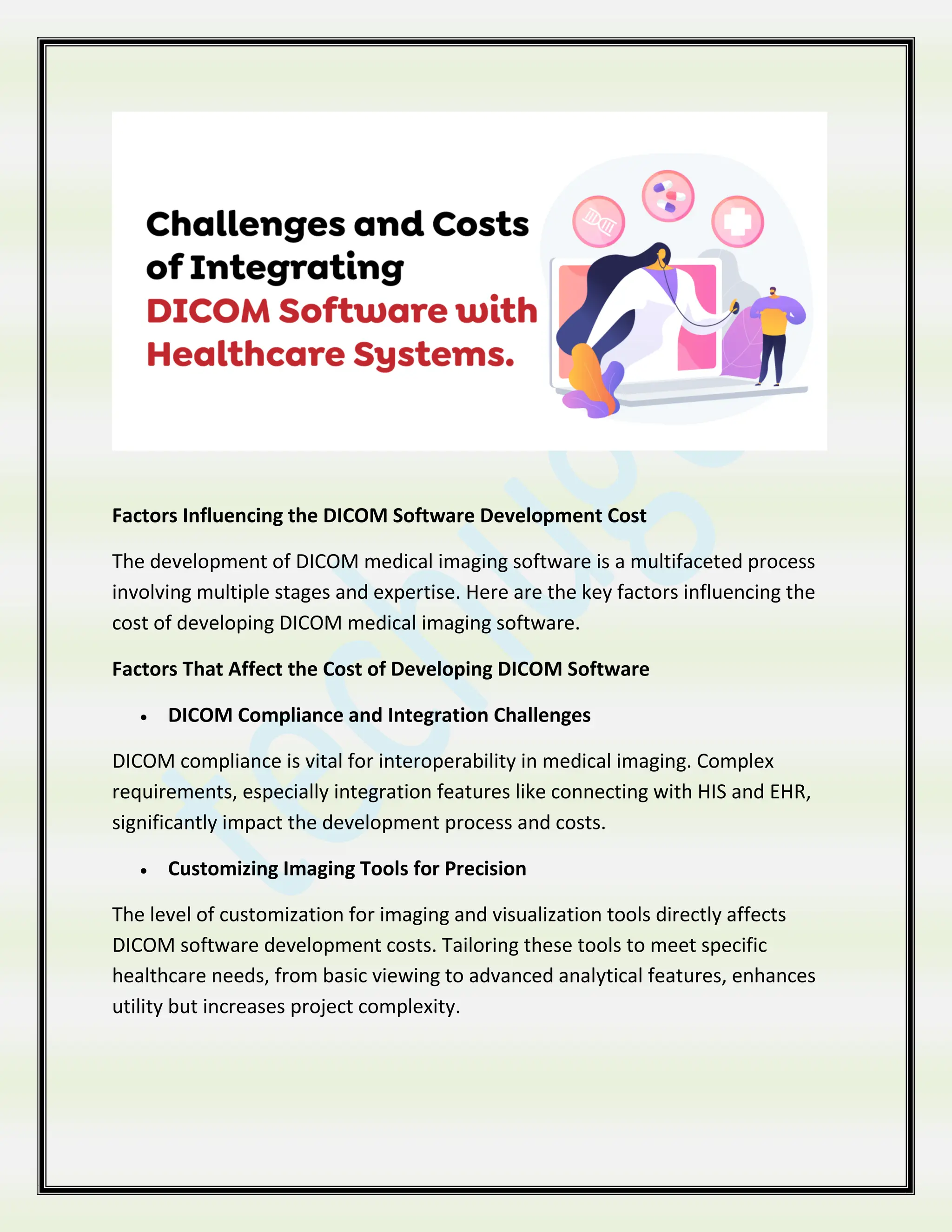
Factors Influencing the DICOM Software Development Cost
The development of DICOM medical imaging software is a multifaceted process
involving multiple stages and expertise. Here are the key factors influencing the
cost of developing DICOM medical imaging software.
Factors That Affect the Cost of Developing DICOM Software
 DICOM Compliance and Integration Challenges
DICOM compliance is vital for interoperability in medical imaging. Complex
requirements, especially integration features like connecting with HIS and EHR,
significantly impact the development process and costs.
 Customizing Imaging Tools for Precision
The level of customization for imaging and visualization tools directly affects
DICOM software development costs. Tailoring these tools to meet specific
healthcare needs, from basic viewing to advanced analytical features, enhances
utility but increases project complexity.
 Ensuring Patient Data Security
Formidable protective measures are imperative for developing DICOM software,
guaranteeing the safeguarding of patient data and adherence to healthcare
regulations. The intricacy of security attributes impacts development expenses,
balancing the necessity for secure data transmission and ease of access.
 Considerations Regarding Expandability and Infrastructure
The requisites for expandability and infrastructure wield substantial influence
over the expenses incurred in constructing DICOM medical imaging software.
Devising plans for software scalability and resilient infrastructure is indispensable
to managing escalating data volumes and simultaneous users without incurring
considerable supplementary costs.
 Incorporation with Healthcare Systems
Integrating DICOM software with prevailing healthcare systems poses a complex
and expensive undertaking. Tailored development, interim solutions, and
exhaustive testing are imperative to ensure seamless compatibility with Hospital
Information Systems (HIS), Electronic Health Records (EHR), and other clinical
applications, contributing to the overall development expenditure.
 Support for Multiple Modalities and Standards
Ensuring DICOM software supports multiple imaging modalities is essential for
comprehensive care. This versatility allows for integrating CT, MRI, X-ray, and
ultrasound images. Moreover, the software should also be able to support IoT
devices, as medical IoT devices are gaining popularity. The medical imaging
software development cost significantly increases with the complexity of
supporting diverse modalities and standards. Tailoring the software to
accommodate DICOM in radiology ensures compatibility with global healthcare
protocols.
This capability facilitates seamless communication and image exchange between
different systems and devices. As the software becomes more adaptable to
various modalities, it becomes a more valuable tool in diagnosing and treating
patients, reflecting the investment in its development.
Here’s why a medicine delivery app development company should be a top
consideration for your healthcare app development in India:
Development Team’s Expertise
The development team’s expertise of a healthcare app development company is
crucial to the cost to develop a healthcare app. While skilled and experienced
developers command higher salaries, on the one hand, the right development
team also includes other resources, including a project manager, tech leads,
a DevOps engineer, a business analyst, a UI/UX engineer, cloud
computing engineer and a QA expert, on the other hand.Ultimately, choosing the
right team should be a balance between cost, quality, and collaboration
efficiency, all of which directly impact the overall investment in DICOM software
development.
Essential Features for Building Efficient DICOM Software
Creating efficient DICOM software requires careful consideration of its
capabilities. It’s vital to incorporate features that meet the demands of modern
healthcare. Here are the essential features of custom medical image analysis
software.
Multiple DICOM Software Features
 DICOM Image Viewing and Manipulation
DICOM image viewing and manipulation are critical for diagnosing and treating
patients accurately. These functionalities allow healthcare professionals to quickly
access, view, and analyze medical images. The ability to adjust brightness,
contrast, and zoom enhances the clarity and detail of images. This is particularly
important in complex cases where precision is critical.
 Medical image viewing
Integrating these features supports the growing role of DICOM in the healthcare
industry, enabling seamless collaboration and decision-making among medical
teams. Efficient image manipulation tools are essential for timely and effective
patient care, highlighting their importance in medical software development.
 Patient Information Management
Patient information management is a cornerstone of DICOM software, ensuring
data is organized and easily accessible. This feature streamlines the workflow for
healthcare providers, allowing quick retrieval of patient records and images. It’s
essential for enhancing patient care and operational efficiency within medical
facilities. Secure storage and access mechanisms are also crucial, safeguarding
patient confidentiality and adhering to health data regulations.
 Secure Image Storage and Archiving
Secure image storage and archiving are vital for maintaining the integrity of
medical data. This ensures that healthcare providers can rely on a consistent and
accessible database of patient images over time. Implementing robust encryption
and data protection techniques is crucial to prevent unauthorized access and
breaches. These security measures are fundamental to medical imaging software
development, safeguarding patient confidentiality and compliance with
regulatory standards.
 Multi-Modality Support
Multi-modality support is essential for DICOM software to accommodate various
medical imaging techniques. This functionality empowers the program to analyze
and showcase images from CT scans, MRIs, X-rays, and ultrasounds on a unified
platform. It improves the diagnostic procedure by offering an all-encompassing
perspective of patient data across diverse imaging modalities.
How are mobile apps transforming the healthcare industry?
Observance of the Health Insurance Portability and Accountability Act (HIPAA)
Ensuring conformity with the Health Insurance Portability and Accountability Act
(HIPAA) is indispensable for DICOM software. This adherence upholds patient
confidentiality and fortifies medical information, a fundamental element of
reliance in healthcare. Abiding by HIPAA standards demands stringent data
safeguarding measures, encompassing encryption, access controls, and secure
data transmission protocols.
The cost to develop a healthcare app, DICOM medical imaging software mirrors
the intricacy of amalgamating these protective measures. It is pivotal to
forestalling data breaches and ensuring the secrecy of patient information.
Adherence shields patients and healthcare providers from legal and financial
consequences, accentuating its significance in the development procedure
followed by a medicine delivery app development company.
These features form the backbone of effective DICOM software. They ensure the
software meets the diverse needs of healthcare professionals and patients alike.
Also Read : Transforming Healthcare in the Skies With Air Ambulance in Dubai
Difficulties in constructing a DICOM software
 Constructing DICOM software introduces distinct hurdles in the healthcare
and IOT technology scene. It demands a subtle comprehension of medical
imaging necessities and regulatory criteria.
 One of the fundamental obstacles of medical imaging software is ensuring
compatibility across diverse imaging apparatus and systems. This
interoperability is crucial for smooth healthcare workflows.
 Adhering to data security and privacy regulations increases intricacy,
making compliance a noteworthy impediment.
 The importance of DICOM lies in its ability to standardize and streamline
the sharing of medical images, which poses its unique challenges.
 Adaptability is another crucial concern, as software needs to adjust to
increasing data volumes without sacrificing performance.
Step-By-Step DICOM Software Development Process
 Requirement Analysis: The initial stage in the DICOM software
development procedure includes collecting and scrutinizing the
requirements of healthcare experts. This stage is crucial for comprehending
the distinct functionalities that the software must uphold, like image
examination, retention, and distribution. It guarantees the ultimate product
corresponds to the anticipations of its ultimate users.
 Design and Prototyping: After defining the requirements, the next step is
designing the software architecture and user interface. This stage includes
creating wireframes and prototypes and visually representing the software.
It’s essential for ensuring usability and addressing the specific needs of
medical imaging.
 Development: The core phase of the medical imaging software
development process begins with coding. Developers use programming
languages suitable for healthcare applications to build the software’s
functionality. This step requires integrating DICOM standards for medical
image processing and ensuring compatibility with various imaging devices.
 Compliance and Security: Ensuring compliance with healthcare regulations,
such as HIPAA, is crucial. The medical imaging software development
process includes implementing robust security measures to protect patient
data and ensure privacy. This phase is essential for earning confidence and
fulfilling legal obligations.
 Incorporation and Testing: Following the conclusion of the development
stage, the software undergoes comprehensive scrutiny for flaws, errors,
and compatibility issues. Incorporation testing ensures the software
operates seamlessly with existing healthcare systems and EHRs. This step is
vital for affirming the reliability and efficiency of the software in real-world
scenarios.
 Implementation and Upkeep: The ultimate stage encompasses introducing
the software in an active environment and delivering continual
maintenance. This includes updates for new features, bug fixes, and
adjustments based on user feedback. Continuous support ensures the
software remains effective and secure over time.
Also Read : The Ultimate Guide to Energy Management Software Development:
Mastering Energy Efficiency!
Developing DICOM software by a healthcare app development company requires
a detailed and phased approach, from initial analysis to deployment and
maintenance. To create a dependable, compliant, and user-friendly software
application while meeting the healthcare business’s complicated objectives, each
stage is crucial. Addressing these factors can significantly enhance patient care
and operational effectiveness while improving the delivery of medical imaging
services.
Techugo: Your Trusted Partner for DICOM Software Development
We at Techugo are proud to be setting the standard for DICOM medical imaging
software development. Each project benefits from our professional team’s vast
experience and inventiveness, which guarantees the implementation of solutions
that meet industry standards and specifically address our client’s unique needs.
Also Read : Improving Healthcare App Development: Reasons Why You Should
Invest in it!
As a proficient medicine delivery app development company, our dedication lies
in delivering secure, practical, and user-friendly DICOM applications. We
comprehend the intricacies of developing medical imaging software, merging
state-of-the-art technology with a profound understanding of the healthcare
sector. This positions us as your optimal collaborator in enhancing medical
imaging capabilities. In addition, our experts safely transfer PACS/DICOM data
using HL7 standards, guaranteeing PHI security and upholding data integrity,
protection, privacy, and authenticity.
Contact Us
Address :- A-26, Sector - 63, Noida, U.P, 201301
Mobile No. :- +91 966-71 3-4400, +91 870-008-4279
Mail Id :- sales@techugo.com
Website :- https://www.techugo.com/
***Thankyou***

DICOM Medical Imaging Software Development: Factors & Financial Considerations

  • 1.
    DICOM Medical ImagingSoftware Development: Factors & Financial Considerations The progress of technology has the potential to enhance various aspects of society and elevate it to new heights. This progress is evident in every sector, including medical science. Modern imaging technologies are widely used in today’s healthcare system to facilitate effective diagnosis and treatment planning. According to market estimates, this industry is expected to expand significantly, with growth projected to reach $12.76 billion by 2030 from $7.52 billion in 2023. Digital Imaging and Communications in Medicine (DICOM) is a standard format for storing, transmitting, and analyzing medical images across various platforms and devices, supporting different imaging technologies and protocols. DICOM medical imaging software by healthcare service providers offers significant benefits, including improved patient care, increased diagnostic accuracy, and optimized processes. Consequently, there is a noticeable surge in the demand for DICOM software advancement.
  • 2.
    This blog delvesinto the nuanced considerations surrounding the financial facets of DICOM software evolution. Furthermore, we investigate the numerous factors impacting expenditures, indispensable features, and more, presenting insights to aid a medicine delivery app development company in forming knowledgeable choices regarding their DICOM software investments. Collaborate with us to harness AI, ML and IOT into the burgeoning medical imaging software. Also Read : How AI And Machine Learning Are Helping App Development Field? Comprehending the Expense of Crafting DICOM Medical Imaging Software Digital imaging applications in medicine are crucial in modern healthcare with AI and ML, enabling the conservation, transmission, and examination of medical images. It adheres to the DICOM standard, guaranteeing adaptability across imaging devices and platforms. This application supports adept diagnosis, treatment planning, and patient care, accommodating diverse imaging methodologies such as X-ray, MRI, CT scan, and ultrasound. As previously noted, the average cost for formulating DICOM medical imaging software can vary based on multiple factors influencing the overall development expense, including the complexity of the software, the timetable for software delivery, the location of the contracted mobile app development company, adherence to regulatory standards like HIPAA, and the level of expertise demanded from the medicine delivery app development company, among other considerations. In more straightforward language, highly intricate medical imaging software will require a more significant investment, ranging from a few thousand to several hundred thousand dollars. At the same time, less complex solutions may be produced at a reduced cost. Nevertheless, regardless of complexity, investing in top-notch DICOM medical imaging software is crucial for delivering effective healthcare services.
  • 3.
    Factors Influencing theDICOM Software Development Cost The development of DICOM medical imaging software is a multifaceted process involving multiple stages and expertise. Here are the key factors influencing the cost of developing DICOM medical imaging software. Factors That Affect the Cost of Developing DICOM Software  DICOM Compliance and Integration Challenges DICOM compliance is vital for interoperability in medical imaging. Complex requirements, especially integration features like connecting with HIS and EHR, significantly impact the development process and costs.  Customizing Imaging Tools for Precision The level of customization for imaging and visualization tools directly affects DICOM software development costs. Tailoring these tools to meet specific healthcare needs, from basic viewing to advanced analytical features, enhances utility but increases project complexity.
  • 4.
     Ensuring PatientData Security Formidable protective measures are imperative for developing DICOM software, guaranteeing the safeguarding of patient data and adherence to healthcare regulations. The intricacy of security attributes impacts development expenses, balancing the necessity for secure data transmission and ease of access.  Considerations Regarding Expandability and Infrastructure The requisites for expandability and infrastructure wield substantial influence over the expenses incurred in constructing DICOM medical imaging software. Devising plans for software scalability and resilient infrastructure is indispensable to managing escalating data volumes and simultaneous users without incurring considerable supplementary costs.  Incorporation with Healthcare Systems Integrating DICOM software with prevailing healthcare systems poses a complex and expensive undertaking. Tailored development, interim solutions, and exhaustive testing are imperative to ensure seamless compatibility with Hospital Information Systems (HIS), Electronic Health Records (EHR), and other clinical applications, contributing to the overall development expenditure.  Support for Multiple Modalities and Standards Ensuring DICOM software supports multiple imaging modalities is essential for comprehensive care. This versatility allows for integrating CT, MRI, X-ray, and ultrasound images. Moreover, the software should also be able to support IoT devices, as medical IoT devices are gaining popularity. The medical imaging software development cost significantly increases with the complexity of supporting diverse modalities and standards. Tailoring the software to accommodate DICOM in radiology ensures compatibility with global healthcare protocols. This capability facilitates seamless communication and image exchange between different systems and devices. As the software becomes more adaptable to
  • 5.
    various modalities, itbecomes a more valuable tool in diagnosing and treating patients, reflecting the investment in its development. Here’s why a medicine delivery app development company should be a top consideration for your healthcare app development in India: Development Team’s Expertise The development team’s expertise of a healthcare app development company is crucial to the cost to develop a healthcare app. While skilled and experienced developers command higher salaries, on the one hand, the right development team also includes other resources, including a project manager, tech leads, a DevOps engineer, a business analyst, a UI/UX engineer, cloud computing engineer and a QA expert, on the other hand.Ultimately, choosing the right team should be a balance between cost, quality, and collaboration efficiency, all of which directly impact the overall investment in DICOM software development.
  • 6.
    Essential Features forBuilding Efficient DICOM Software Creating efficient DICOM software requires careful consideration of its capabilities. It’s vital to incorporate features that meet the demands of modern healthcare. Here are the essential features of custom medical image analysis software. Multiple DICOM Software Features  DICOM Image Viewing and Manipulation DICOM image viewing and manipulation are critical for diagnosing and treating patients accurately. These functionalities allow healthcare professionals to quickly access, view, and analyze medical images. The ability to adjust brightness, contrast, and zoom enhances the clarity and detail of images. This is particularly important in complex cases where precision is critical.  Medical image viewing Integrating these features supports the growing role of DICOM in the healthcare industry, enabling seamless collaboration and decision-making among medical teams. Efficient image manipulation tools are essential for timely and effective patient care, highlighting their importance in medical software development.  Patient Information Management Patient information management is a cornerstone of DICOM software, ensuring data is organized and easily accessible. This feature streamlines the workflow for healthcare providers, allowing quick retrieval of patient records and images. It’s essential for enhancing patient care and operational efficiency within medical facilities. Secure storage and access mechanisms are also crucial, safeguarding patient confidentiality and adhering to health data regulations.  Secure Image Storage and Archiving Secure image storage and archiving are vital for maintaining the integrity of medical data. This ensures that healthcare providers can rely on a consistent and accessible database of patient images over time. Implementing robust encryption
  • 7.
    and data protectiontechniques is crucial to prevent unauthorized access and breaches. These security measures are fundamental to medical imaging software development, safeguarding patient confidentiality and compliance with regulatory standards.  Multi-Modality Support Multi-modality support is essential for DICOM software to accommodate various medical imaging techniques. This functionality empowers the program to analyze and showcase images from CT scans, MRIs, X-rays, and ultrasounds on a unified platform. It improves the diagnostic procedure by offering an all-encompassing perspective of patient data across diverse imaging modalities. How are mobile apps transforming the healthcare industry? Observance of the Health Insurance Portability and Accountability Act (HIPAA) Ensuring conformity with the Health Insurance Portability and Accountability Act (HIPAA) is indispensable for DICOM software. This adherence upholds patient confidentiality and fortifies medical information, a fundamental element of reliance in healthcare. Abiding by HIPAA standards demands stringent data safeguarding measures, encompassing encryption, access controls, and secure data transmission protocols. The cost to develop a healthcare app, DICOM medical imaging software mirrors the intricacy of amalgamating these protective measures. It is pivotal to forestalling data breaches and ensuring the secrecy of patient information. Adherence shields patients and healthcare providers from legal and financial consequences, accentuating its significance in the development procedure followed by a medicine delivery app development company. These features form the backbone of effective DICOM software. They ensure the software meets the diverse needs of healthcare professionals and patients alike. Also Read : Transforming Healthcare in the Skies With Air Ambulance in Dubai
  • 8.
    Difficulties in constructinga DICOM software  Constructing DICOM software introduces distinct hurdles in the healthcare and IOT technology scene. It demands a subtle comprehension of medical imaging necessities and regulatory criteria.  One of the fundamental obstacles of medical imaging software is ensuring compatibility across diverse imaging apparatus and systems. This interoperability is crucial for smooth healthcare workflows.  Adhering to data security and privacy regulations increases intricacy, making compliance a noteworthy impediment.  The importance of DICOM lies in its ability to standardize and streamline the sharing of medical images, which poses its unique challenges.  Adaptability is another crucial concern, as software needs to adjust to increasing data volumes without sacrificing performance. Step-By-Step DICOM Software Development Process  Requirement Analysis: The initial stage in the DICOM software development procedure includes collecting and scrutinizing the
  • 9.
    requirements of healthcareexperts. This stage is crucial for comprehending the distinct functionalities that the software must uphold, like image examination, retention, and distribution. It guarantees the ultimate product corresponds to the anticipations of its ultimate users.  Design and Prototyping: After defining the requirements, the next step is designing the software architecture and user interface. This stage includes creating wireframes and prototypes and visually representing the software. It’s essential for ensuring usability and addressing the specific needs of medical imaging.  Development: The core phase of the medical imaging software development process begins with coding. Developers use programming languages suitable for healthcare applications to build the software’s functionality. This step requires integrating DICOM standards for medical image processing and ensuring compatibility with various imaging devices.  Compliance and Security: Ensuring compliance with healthcare regulations, such as HIPAA, is crucial. The medical imaging software development process includes implementing robust security measures to protect patient data and ensure privacy. This phase is essential for earning confidence and fulfilling legal obligations.  Incorporation and Testing: Following the conclusion of the development stage, the software undergoes comprehensive scrutiny for flaws, errors, and compatibility issues. Incorporation testing ensures the software operates seamlessly with existing healthcare systems and EHRs. This step is vital for affirming the reliability and efficiency of the software in real-world scenarios.  Implementation and Upkeep: The ultimate stage encompasses introducing the software in an active environment and delivering continual maintenance. This includes updates for new features, bug fixes, and adjustments based on user feedback. Continuous support ensures the software remains effective and secure over time.
  • 10.
    Also Read :The Ultimate Guide to Energy Management Software Development: Mastering Energy Efficiency! Developing DICOM software by a healthcare app development company requires a detailed and phased approach, from initial analysis to deployment and maintenance. To create a dependable, compliant, and user-friendly software application while meeting the healthcare business’s complicated objectives, each stage is crucial. Addressing these factors can significantly enhance patient care and operational effectiveness while improving the delivery of medical imaging services. Techugo: Your Trusted Partner for DICOM Software Development We at Techugo are proud to be setting the standard for DICOM medical imaging software development. Each project benefits from our professional team’s vast experience and inventiveness, which guarantees the implementation of solutions that meet industry standards and specifically address our client’s unique needs. Also Read : Improving Healthcare App Development: Reasons Why You Should Invest in it!
  • 11.
    As a proficientmedicine delivery app development company, our dedication lies in delivering secure, practical, and user-friendly DICOM applications. We comprehend the intricacies of developing medical imaging software, merging state-of-the-art technology with a profound understanding of the healthcare sector. This positions us as your optimal collaborator in enhancing medical imaging capabilities. In addition, our experts safely transfer PACS/DICOM data using HL7 standards, guaranteeing PHI security and upholding data integrity, protection, privacy, and authenticity.
  • 12.
    Contact Us Address :-A-26, Sector - 63, Noida, U.P, 201301 Mobile No. :- +91 966-71 3-4400, +91 870-008-4279 Mail Id :- sales@techugo.com Website :- https://www.techugo.com/ ***Thankyou***