So You Need to Find a Journal @
Briggs Library:
Understanding the Dewey Decimal System
Journals @ Briggs Library
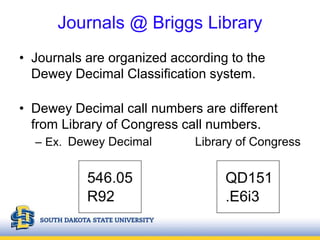
• Journals are organized according to the
Dewey Decimal Classification system.
• Dewey Decimal call numbers are different
from Library of Congress call numbers.
– Ex.
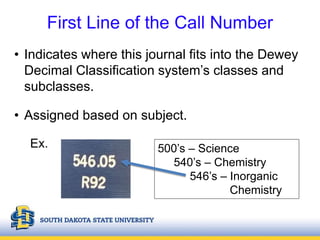
First Line of the Call Number
• Indicates where this journal fits into the Dewey
Decimal Classification system’s classes and
subclasses.
• Assigned based on subject.
Ex. 500’s – Science
540’s – Chemistry
546’s – Inorganic
Chemistry
Main Classes of Dewey Decimal
000 Computer science, information & general works
100 Philosophy & psychology
200 Religion
300 Social sciences
400 Language
500 Science
600 Technology
700 Arts & recreation
800 Literature
900 History & geography
Online Computer Library Center. Introduction to the Dewey
Decimal Classification [PDF document]. Retrieved from
http://www.oclc.org/content/dam/oclc/dewey/versions/
print/intro.pdf
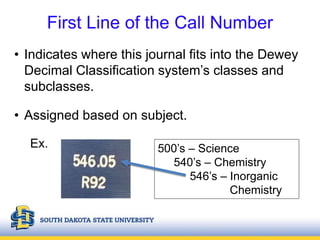
First Line of the Call Number
• Indicates where this journal fits into the Dewey
Decimal Classification system’s classes and
subclasses.
• Assigned based on subject.
Ex. 500’s – Science
540’s – Chemistry
546’s – Inorganic
Chemistry
More About the First Line of the
Call Number
• Each of the Main Classes in Dewey Decimal
has multiple subclasses, as seen in the
previous example.
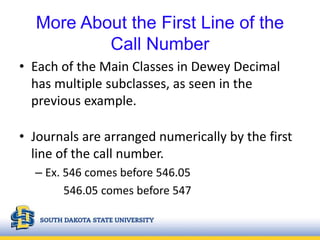
• Journals are arranged numerically by the first
line of the call number.
– Ex. 546 comes before 546.05
546.05 comes before 547
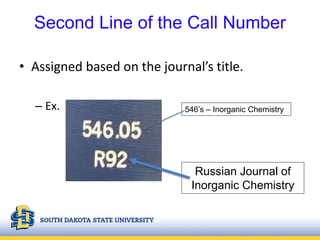
Second Line of the Call Number
• Assigned based on the journal’s title.
– Ex. 546’s – Inorganic Chemistry
Russian Journal of
Inorganic Chemistry
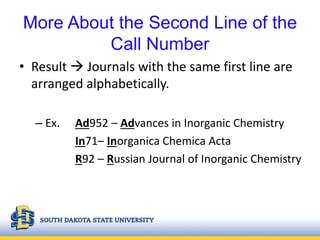
More About the Second Line of the
Call Number
• Result  Journals with the same first line are
arranged alphabetically.
– Ex. Ad952 – Advances in Inorganic Chemistry
In71– Inorganica Chemica Acta
R92 – Russian Journal of Inorganic Chemistry
More About the Second Line of the
Call Number
• Journals with the same first line are organized
by the second line.
1. Alphabetically by letter(s)
2. By the remaining numbers
– Ex. Advances in Inorganic Chemistry (546.05 Ad952) comes
before Inorganica Chemica Acta (546.05 In71).
Both come before the Russian Journal of Inorganic
Chemistry (546.05 R92).
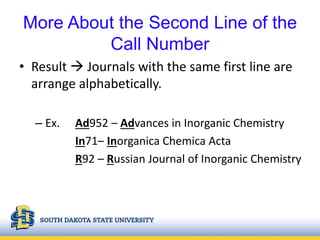
More About the Second Line of the
Call Number
• Result  Journals with the same first line are
arrange alphabetically.
– Ex. Ad952 – Advances in Inorganic Chemistry
In71– Inorganica Chemica Acta
R92 – Russian Journal of Inorganic Chemistry
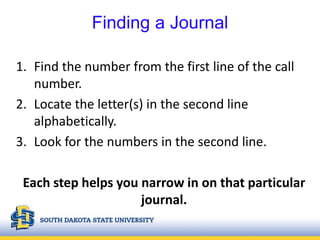
Finding a Journal
1. Find the number from the first line of the call
number.
2. Locate the letter(s) in the second line
alphabetically.
3. Look for the numbers in the second line.
Each step helps you narrow in on that particular
journal.
Finding a Specific Article in a Journal
• What you need
– Journal’s call number.
– Volume/Year the article was published.
– Issue in which the article was published.
– Page numbers for the article.
• All volumes of a journal will have the same call
number.
• Once you find the journal, locate the correct
volume/year, issue, and pages.
Finding a Specific Article in a Journal
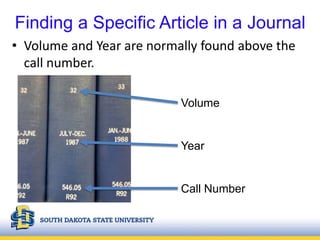
• Volume and Year are normally found above the
call number.
Call Number
Year
Volume
Finding a Specific Article in a Journal
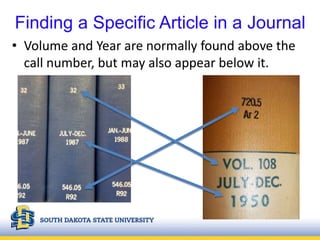
• Volume and Year are normally found above the
call number, but may also appear below it.
Questions? Ask a Librarian!
http://sdstate.edu/hilton-m-briggs-library/ask-briggs

Dewey Decimal Call Numbers at Briggs Library

  • 1.
    So You Needto Find a Journal @ Briggs Library: Understanding the Dewey Decimal System
  • 2.
    Journals @ BriggsLibrary • Journals are organized according to the Dewey Decimal Classification system. • Dewey Decimal call numbers are different from Library of Congress call numbers. – Ex.
  • 3.
    First Line ofthe Call Number • Indicates where this journal fits into the Dewey Decimal Classification system’s classes and subclasses. • Assigned based on subject. Ex. 500’s – Science 540’s – Chemistry 546’s – Inorganic Chemistry
  • 4.
    Main Classes ofDewey Decimal 000 Computer science, information & general works 100 Philosophy & psychology 200 Religion 300 Social sciences 400 Language 500 Science 600 Technology 700 Arts & recreation 800 Literature 900 History & geography Online Computer Library Center. Introduction to the Dewey Decimal Classification [PDF document]. Retrieved from http://www.oclc.org/content/dam/oclc/dewey/versions/ print/intro.pdf
  • 5.
    First Line ofthe Call Number • Indicates where this journal fits into the Dewey Decimal Classification system’s classes and subclasses. • Assigned based on subject. Ex. 500’s – Science 540’s – Chemistry 546’s – Inorganic Chemistry
  • 6.
    More About theFirst Line of the Call Number • Each of the Main Classes in Dewey Decimal has multiple subclasses, as seen in the previous example. • Journals are arranged numerically by the first line of the call number. – Ex. 546 comes before 546.05 546.05 comes before 547
  • 7.
    Second Line ofthe Call Number • Assigned based on the journal’s title. – Ex. 546’s – Inorganic Chemistry Russian Journal of Inorganic Chemistry
  • 8.
    More About theSecond Line of the Call Number • Result  Journals with the same first line are arranged alphabetically. – Ex. Ad952 – Advances in Inorganic Chemistry In71– Inorganica Chemica Acta R92 – Russian Journal of Inorganic Chemistry
  • 9.
    More About theSecond Line of the Call Number • Journals with the same first line are organized by the second line. 1. Alphabetically by letter(s) 2. By the remaining numbers – Ex. Advances in Inorganic Chemistry (546.05 Ad952) comes before Inorganica Chemica Acta (546.05 In71). Both come before the Russian Journal of Inorganic Chemistry (546.05 R92).
  • 10.
    More About theSecond Line of the Call Number • Result  Journals with the same first line are arrange alphabetically. – Ex. Ad952 – Advances in Inorganic Chemistry In71– Inorganica Chemica Acta R92 – Russian Journal of Inorganic Chemistry
  • 11.
    Finding a Journal 1.Find the number from the first line of the call number. 2. Locate the letter(s) in the second line alphabetically. 3. Look for the numbers in the second line. Each step helps you narrow in on that particular journal.
  • 12.
    Finding a SpecificArticle in a Journal • What you need – Journal’s call number. – Volume/Year the article was published. – Issue in which the article was published. – Page numbers for the article. • All volumes of a journal will have the same call number. • Once you find the journal, locate the correct volume/year, issue, and pages.
  • 13.
    Finding a SpecificArticle in a Journal • Volume and Year are normally found above the call number. Call Number Year Volume
  • 14.
    Finding a SpecificArticle in a Journal • Volume and Year are normally found above the call number, but may also appear below it.
  • 15.
    Questions? Ask aLibrarian! http://sdstate.edu/hilton-m-briggs-library/ask-briggs