











LET’S PLAY
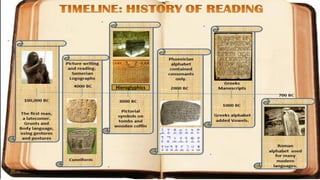
History of
Reading
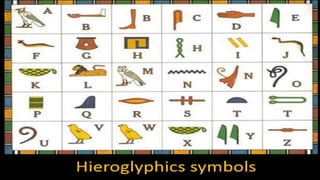
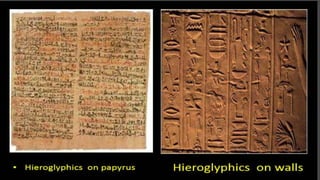
Hieroglyphics
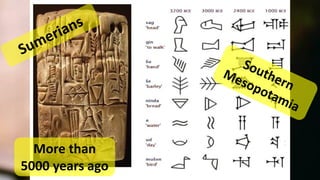
More than
5000 years ago
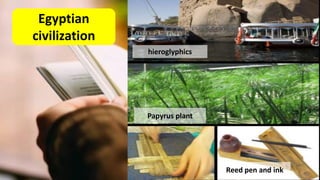
Egyptian
civilization
hieroglyphics
Papyrus plant
Reed pen and ink
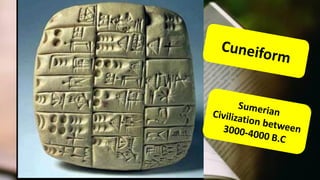
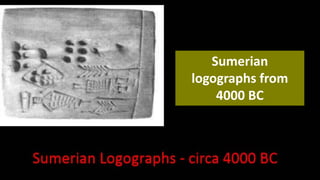
Sumerian
logographs from
4000 BC
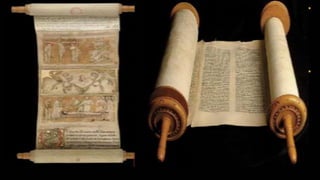
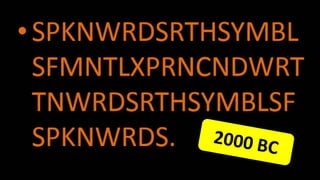
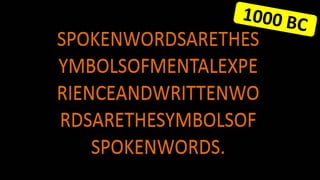
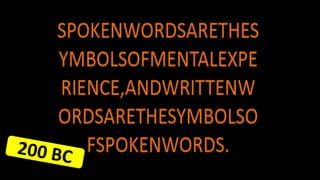
Another 1000 years passed Medieval Scribes
Reading is a general term used to
refer to the processes of deriving
meaning from abstraction or
symbolic representation.
Reading is a process undertaken
to reduce uncertainty about
meanings a text conveys.
Reading is the process that
results from a negotiation of
meaning between the text and the
reader.
Reading is the knowledge,
expectations, and strategies a
reader uses to uncover textual
meaning all play decisive roles
way the reader negotiates with
the text’s meaning.
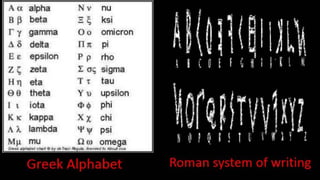
• requires deriving meaning from 26 symbols
(i.e., the alphabet)
• presented in seemingly infinite combinations
(e.g., sentences and paragraphs)
• organized with 14 other print symbols (i.e.,
punctuation marks) and several text
conventions (e.g., space between words and
paragraph indents
Reading English text
writing as the antithesis of
reading
Fischer (2003)
• Writing is a skill; reading is
a faculty.
Fischer (2003)
• Writing is expression;
reading is impression.
Fischer (2003)
• Writing is public; reading is
personal.
Fischer (2003)
“Writing was originally elaborated and
thereafter deliberately adapted; reading
has evolved in tandem with humanity’s
deeper understanding of the written
word’s latent capabilities”
Fischer (2003)
Group Activity
Group 1
“Reading is to the
mind what exercise
is to the body.”
–Richard Sleete
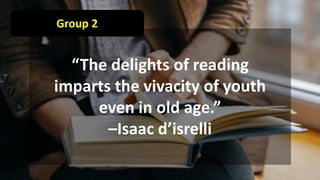
Group 2
“The delights of reading
imparts the vivacity of youth
even in old age.”
–Isaac d’isrelli
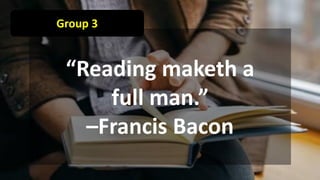
Group 3
“Reading maketh a
full man.”
–Francis Bacon
Group 4
“The greatest gift is a passion for
reading. It is cheap, it consoles, it
excites, it gives you knowledge of the
world and experience of a wide kind.
It is moral illumination.”
–Elizabeth Hardwick
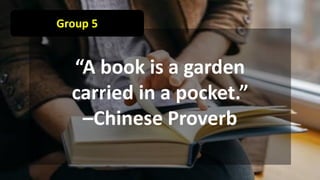
Group 5
“A book is a garden
carried in a pocket.”
–Chinese Proverb
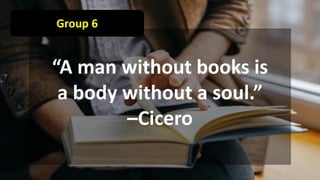
Group 6
“A man without books is
a body without a soul.”
–Cicero
Group 7
“The book is man’s best
invention so far.”
–Carolina Maria de Jesus
Group 8
“I have sought rest
everywhere, and only
found it in corners, and
books.”
–Thomas a Kempis
Group 9
“You don’t have to burn
books to destroy a culture.
Just get people to stop
reading them.”
–Ray Bradbury
Group 10
“Books are treasured wealth
of the world and the fit
inheritance of generations.”
–Henry David Thoreau
Group 11
“Books we must have
though we lack bread.”
–Alice Williams
Brotherston
Group 12
“Books we must have
though we lack bread.”
–Alice Williams
Brotherston
• Reading in an academic context is
different from everyday reading.
• Academic reading requires a more
active, probing, and recursive strategy
than does recreational reading.
• It is an essential skill for completing a
written assignment.
Academic Reading
REFLECTION TIME
1. Reading is a burden in work and life.
2. Personally, it has not been useful in my studies.
3. For men and women of great minds, they are avoided
and set aside.
4. People do not find books as sources of rest and
enjoyment.
5. The library is not a wholesome place to stay and spend
time in.
• Skimming
• Scanning
• Intensive
• Extensive
Reading Techniques
Skimming
1. Read the title.
2. Read the 1st paragraph very quickly.
3. Read and underline the 1st two lines of each
paragraph.
4. Give attention to sub-headings and subtitles.
5. Read and underline the last two lines of each
paragraph.
6. Read the last paragraph of the tet quickly.
7. Underline key words.
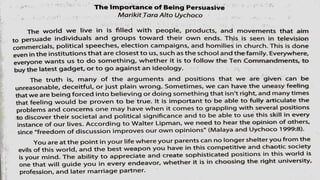
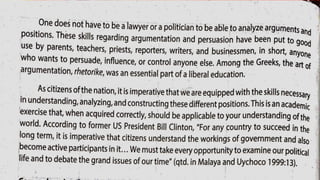
ANSWER THE FOLLOWING
QUESTIONS IN YOUR NOTEBOOK:
1. Do you agree with the essay? Why or why not?
2. What are the instances when you felt you were doing or
believing something wrong, but was not able to fully
explain or say why you felt that way?
3. What issues do you think are important in your life? Why
is it important to analyze them?
4. Why is it important for citizens of the nation to be able to
analyze an argument?
5. Do you think you should analyze the positions or
arguments that come from one’s parents, teachers, or
religion? Why or why not?
Scanning
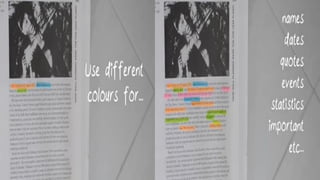
Underline…
“the most”, “the best”
Places, nationalities, names
Terminology, scientific terms, medical
terms, etc.
Numbers, dates, percentage, etc.
Countries, continents, etc.
Intensive Reading
• Have your aims clear in mind.
• Remember this is going to be far more
time consuming than scanning and
skimming.
• Do this if you need to list the chronology
of events in a long passage.
Extensive Reading
• Involves reading for pleasure
• Requires a fluid decoding
and assimilation of the text
and content
Strategies for improving reading rate and
comprehension
“SQ3R METHOD FOR THOROUGH STUDY”
Reading Techniques
SQ3R
Step 1: Survey
Step 2: Questions
Step 3: Read
Step 4: Recall
Step 5: Review
Adapted from F.P. Robinson. Effective Study. New York: Harper and Bros. 1948.
MONTHLY REQUIREMENT
• BOOK REVIEW
➢ Synthesis
➢ Analysis
➢ Learning insights
➢ Policy recommendations
MONTHLY REQUIREMENT
• BOOK REVIEW
➢ Arial
➢ 12
➢ Double space
➢ Justify
➢ Maximum of three pages only
➢ Maybe typed or handwritten
➢ Short bond paper
Reading Tips/Habits
Do you take notes?
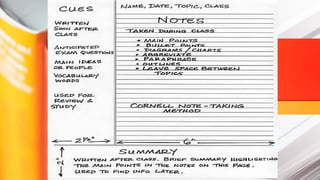
Note-taking Methods
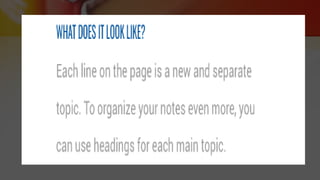
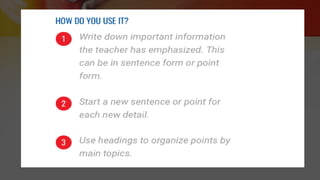
1.Use white space to separate major ideas.
2.Try to limit your notes to one concept or
section per page.
3.Use abbreviations and/or symbols where
possible to avoid long sentences.
4.Write down the information in your own
words.
4 General Ideas to Improve Note-Taking
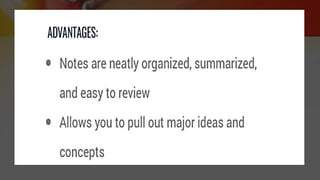
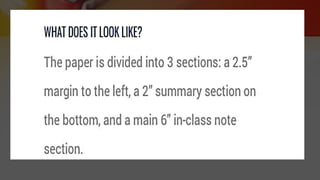
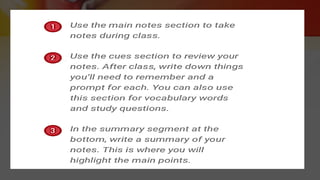
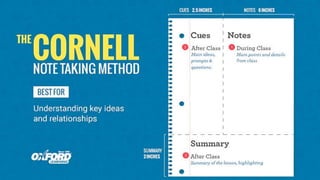
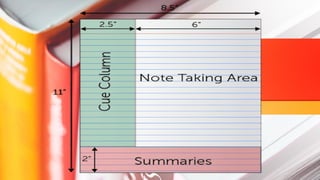
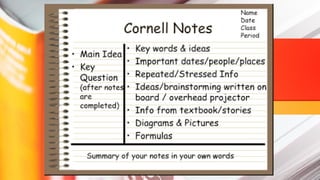
The Cornell Method
The Cornell Method
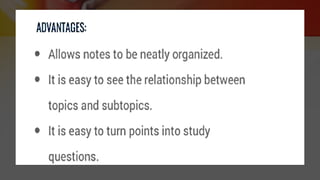
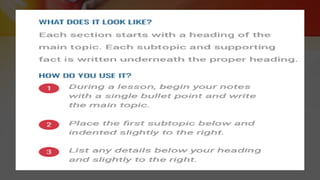
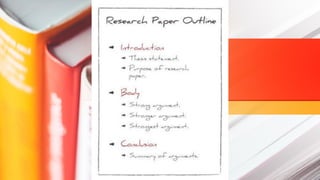
The Outlining Method
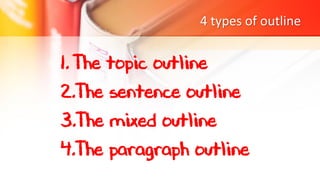
4 types of outline
1. The topic outline
2.The sentence outline
3.The mixed outline
4.The paragraph outline
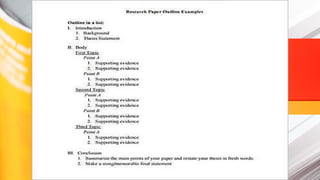
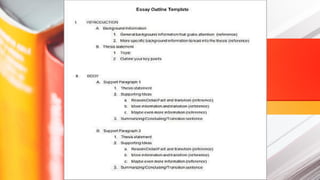
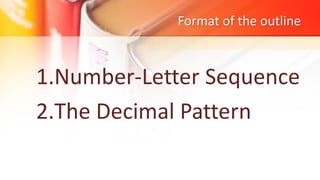
Format of the outline
1.Number-Letter Sequence
2.The Decimal Pattern
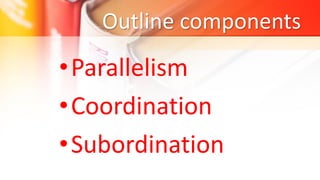
Outline components
•Parallelism
•Coordination
•Subordination
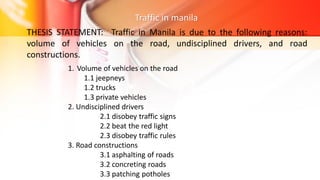
Traffic in manila
THESIS STATEMENT: Traffic in Manila is due to the following reasons:
volume of vehicles on the road, undisciplined drivers, and road
constructions.
1. Volume of vehicles on the road
1.1 jeepneys
1.2 trucks
1.3 private vehicles
2. Undisciplined drivers
2.1 disobey traffic signs
2.2 beat the red light
2.3 disobey traffic rules
3. Road constructions
3.1 asphalting of roads
3.2 concreting roads
3.3 patching potholes
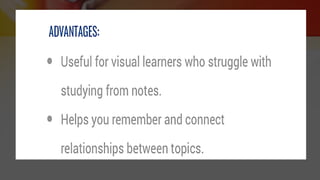
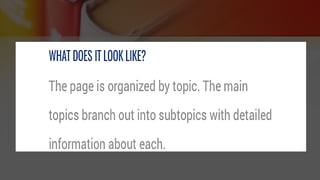
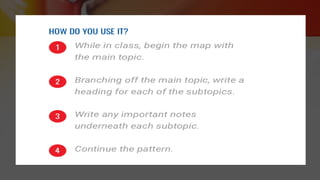
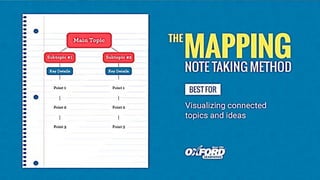
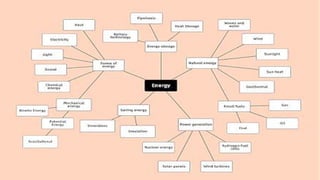
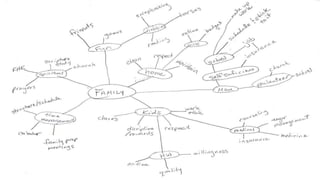
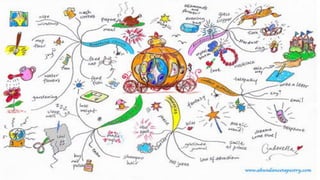
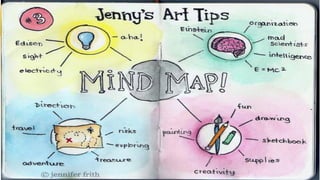
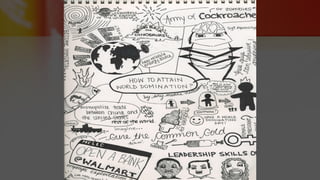
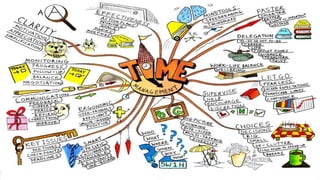
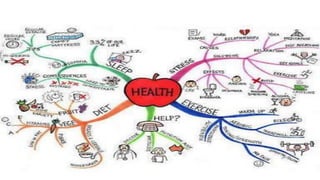
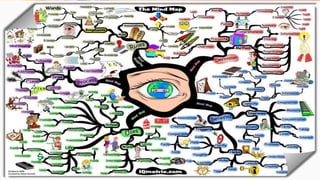
Mind Mapping
• Don’t spend too much time on your maps
• Use colors and images when appropriate
• Follow the mind mapping rules but let
them help you not restrict you
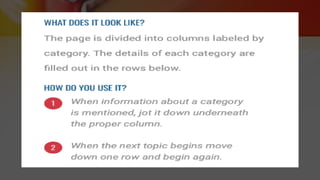
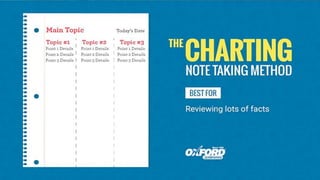
The Charting Method
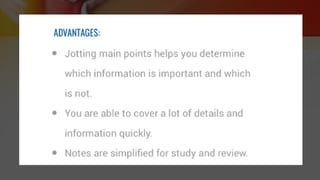
The Sentence Method
Better grades start with
better notes.
TO GOD BE THE GLORY!
ROMANS 11:36

Developmental Reading Lessons 1&2

  • 1.
  • 14.
  • 15.
  • 20.
  • 22.
  • 27.
  • 31.
    Another 1000 yearspassed Medieval Scribes
  • 34.
    Reading is ageneral term used to refer to the processes of deriving meaning from abstraction or symbolic representation.
  • 35.
    Reading is aprocess undertaken to reduce uncertainty about meanings a text conveys.
  • 36.
    Reading is theprocess that results from a negotiation of meaning between the text and the reader.
  • 37.
    Reading is theknowledge, expectations, and strategies a reader uses to uncover textual meaning all play decisive roles way the reader negotiates with the text’s meaning.
  • 38.
    • requires derivingmeaning from 26 symbols (i.e., the alphabet) • presented in seemingly infinite combinations (e.g., sentences and paragraphs) • organized with 14 other print symbols (i.e., punctuation marks) and several text conventions (e.g., space between words and paragraph indents Reading English text
  • 39.
    writing as theantithesis of reading Fischer (2003)
  • 40.
    • Writing isa skill; reading is a faculty. Fischer (2003)
  • 41.
    • Writing isexpression; reading is impression. Fischer (2003)
  • 42.
    • Writing ispublic; reading is personal. Fischer (2003)
  • 43.
    “Writing was originallyelaborated and thereafter deliberately adapted; reading has evolved in tandem with humanity’s deeper understanding of the written word’s latent capabilities” Fischer (2003)
  • 44.
  • 45.
    Group 1 “Reading isto the mind what exercise is to the body.” –Richard Sleete
  • 46.
    Group 2 “The delightsof reading imparts the vivacity of youth even in old age.” –Isaac d’isrelli
  • 47.
    Group 3 “Reading maketha full man.” –Francis Bacon
  • 48.
    Group 4 “The greatestgift is a passion for reading. It is cheap, it consoles, it excites, it gives you knowledge of the world and experience of a wide kind. It is moral illumination.” –Elizabeth Hardwick
  • 49.
    Group 5 “A bookis a garden carried in a pocket.” –Chinese Proverb
  • 50.
    Group 6 “A manwithout books is a body without a soul.” –Cicero
  • 51.
    Group 7 “The bookis man’s best invention so far.” –Carolina Maria de Jesus
  • 52.
    Group 8 “I havesought rest everywhere, and only found it in corners, and books.” –Thomas a Kempis
  • 53.
    Group 9 “You don’thave to burn books to destroy a culture. Just get people to stop reading them.” –Ray Bradbury
  • 54.
    Group 10 “Books aretreasured wealth of the world and the fit inheritance of generations.” –Henry David Thoreau
  • 55.
    Group 11 “Books wemust have though we lack bread.” –Alice Williams Brotherston
  • 56.
    Group 12 “Books wemust have though we lack bread.” –Alice Williams Brotherston
  • 57.
    • Reading inan academic context is different from everyday reading. • Academic reading requires a more active, probing, and recursive strategy than does recreational reading. • It is an essential skill for completing a written assignment. Academic Reading
  • 58.
    REFLECTION TIME 1. Readingis a burden in work and life. 2. Personally, it has not been useful in my studies. 3. For men and women of great minds, they are avoided and set aside. 4. People do not find books as sources of rest and enjoyment. 5. The library is not a wholesome place to stay and spend time in.
  • 59.
    • Skimming • Scanning •Intensive • Extensive Reading Techniques
  • 60.
    Skimming 1. Read thetitle. 2. Read the 1st paragraph very quickly. 3. Read and underline the 1st two lines of each paragraph. 4. Give attention to sub-headings and subtitles. 5. Read and underline the last two lines of each paragraph. 6. Read the last paragraph of the tet quickly. 7. Underline key words.
  • 63.
    ANSWER THE FOLLOWING QUESTIONSIN YOUR NOTEBOOK: 1. Do you agree with the essay? Why or why not? 2. What are the instances when you felt you were doing or believing something wrong, but was not able to fully explain or say why you felt that way? 3. What issues do you think are important in your life? Why is it important to analyze them? 4. Why is it important for citizens of the nation to be able to analyze an argument? 5. Do you think you should analyze the positions or arguments that come from one’s parents, teachers, or religion? Why or why not?
  • 64.
    Scanning Underline… “the most”, “thebest” Places, nationalities, names Terminology, scientific terms, medical terms, etc. Numbers, dates, percentage, etc. Countries, continents, etc.
  • 65.
    Intensive Reading • Haveyour aims clear in mind. • Remember this is going to be far more time consuming than scanning and skimming. • Do this if you need to list the chronology of events in a long passage.
  • 66.
    Extensive Reading • Involvesreading for pleasure • Requires a fluid decoding and assimilation of the text and content
  • 67.
    Strategies for improvingreading rate and comprehension “SQ3R METHOD FOR THOROUGH STUDY” Reading Techniques
  • 68.
    SQ3R Step 1: Survey Step2: Questions Step 3: Read Step 4: Recall Step 5: Review Adapted from F.P. Robinson. Effective Study. New York: Harper and Bros. 1948.
  • 69.
    MONTHLY REQUIREMENT • BOOKREVIEW ➢ Synthesis ➢ Analysis ➢ Learning insights ➢ Policy recommendations
  • 70.
    MONTHLY REQUIREMENT • BOOKREVIEW ➢ Arial ➢ 12 ➢ Double space ➢ Justify ➢ Maximum of three pages only ➢ Maybe typed or handwritten ➢ Short bond paper
  • 71.
  • 85.
  • 86.
  • 87.
    1.Use white spaceto separate major ideas. 2.Try to limit your notes to one concept or section per page. 3.Use abbreviations and/or symbols where possible to avoid long sentences. 4.Write down the information in your own words. 4 General Ideas to Improve Note-Taking
  • 88.
  • 92.
  • 96.
  • 102.
    4 types ofoutline 1. The topic outline 2.The sentence outline 3.The mixed outline 4.The paragraph outline
  • 103.
    Format of theoutline 1.Number-Letter Sequence 2.The Decimal Pattern
  • 104.
  • 105.
    Traffic in manila THESISSTATEMENT: Traffic in Manila is due to the following reasons: volume of vehicles on the road, undisciplined drivers, and road constructions. 1. Volume of vehicles on the road 1.1 jeepneys 1.2 trucks 1.3 private vehicles 2. Undisciplined drivers 2.1 disobey traffic signs 2.2 beat the red light 2.3 disobey traffic rules 3. Road constructions 3.1 asphalting of roads 3.2 concreting roads 3.3 patching potholes
  • 106.
  • 120.
    • Don’t spendtoo much time on your maps • Use colors and images when appropriate • Follow the mind mapping rules but let them help you not restrict you
  • 121.
  • 125.
  • 129.
    Better grades startwith better notes.
  • 130.
    TO GOD BETHE GLORY! ROMANS 11:36