International Journal of Evaluation and Research in Education (IJERE)
Vol. 12, No. 3, September 2023, pp. 1364~1374
ISSN: 2252-8822, DOI: 10.11591/ijere.v12i3.25687  1364
Journal homepage: http://ijere.iaescore.com
Development of learning models for inculcating Pancasila
values
Taat Wulandari1
, Anik Widiastuti1
, Nasiwan1
, Johan Setiawan2
, Muhammad Rijal Fadli2
,
Hadisaputra3
1
Faculty of Social, Law and Political Sciences, Universitas Negeri Yogyakarta, Yogyakarta, Indonesia
2
Faculty of Teaching and Education, Muhammadiyah Metro University, Metro, Indonesia
3
Faculty of Teaching and Education, Muhammadiyah University Makassar, Makassar, Indonesia
Article Info ABSTRACT
Article history:
Received Oct 12, 2022
Revised May 14, 2023
Accepted Jun 13, 2023
The values contained in Pancasila have not been implemented in the life of
the Indonesian people properly. This study aims to produce a product in the
form of a model of planting Pancasila values. This research is a research and
development, using a research and development model from Borg and Gall
which is modified into seven development steps. Product validation of the
Pancasila values inculcation model by learning technology experts and
Pancasila education experts. Techniques data analysis used descriptive
statistical analysis. This research resulted in a model named my real action
plan for Pancasila (MRAPP). MRAPP is a learning model that can be used
to inculcate Pancasila values. The steps of the MRAPP model are as: i) field
observations; ii) determining one of the precepts of Pancasila; iii) designing
real action; iv) making a schedule of activities and presentation of proposals;
v) monitoring the implementation of real action; vi) reporting the process
and results of real action; and vii) doing reflection. The results of the
validation of the feasibility of the learning model from the validation of
learning experts and the validation of Pancasila education experts, namely
the MRAPP learning model declared “eligible” to be used as a learning
model for inculcating Pancasila values.
Keywords:
Learning model
My real action plan for
Pancasila
Values
This is an open access article under the CC BY-SA license.
Corresponding Author:
Taat Wulandari
Faculty of Social, Law and Political Sciences, Universitas Negeri Yogyakarta
Caturtunggal, Depok, Sleman, Yogyakarta, Indonesia
Email: taat_wulandari@uny.ac.id
1. INTRODUCTION
Every nation and country have a different history, principle, or ideology in all corners of the world.
Likewise, Indonesia is a nation that is one of the countries consisting of various ethnicities, religions, and
races. Based on the 2010 population census, Indonesia is inhabited by 237 million people, has 1.86 million
km2
of land, 3.2 million km2
of ocean, and 17,604 islands. Based on this, it places Indonesia as one of the
largest countries in the world by looking at its population and area. So that it is impossible for Indonesian
citizens who live to be able to stand alone without the help of others. This can foster awareness that
everything that is achieved in essence requires the help of others [1]. So that it gives birth to the awareness
that every human being can be called to his heart to behave well for others and the environment. It takes the
ability to control oneself in all interests to live in harmony and balance in society. Social relations that are
harmonious and balanced in the view of Pancasila in society are not neutral but are imbued with the values
contained in the precepts of Pancasila as a unit [2]. Humans must live and be able to work together with other
humans in society.
Int J Eval & Res Educ ISSN: 2252-8822 
Development of learning models for inculcating Pancasila values (Taat Wulandari)
1365
Based on this, in unifying, an ideology that can bind citizens is needed. The Indonesian nation has
Pancasila which is used as an ideology consisting of values derived from the original Indonesian personality.
Pancasila has an important function and position in the Indonesian state, namely as the identity of the
Indonesian nation, as the ideology of the Indonesian nation and state, as the basis of state philosophy, and as
the principle of the Indonesian unity [3]–[5]. Pancasila as the basis of the state has values: i) Divine values
(religious); ii) Human values (humanism); and iii) Societal values (nationalism and social justice) [6], [7].
Pancasila is the foundation of the Indonesian state. When it becomes the basis of the state, the
values contained in Pancasila should be the basis for people's lives, ways of thinking, and acting. Each item
in Pancasila contains noble values that should be a guideline for the Indonesian people to be implemented in
real everyday life [8]. Based on this, Pancasila is a guideline and reference that can be used by citizens to
behave to create good citizens. So far, especially during the three-decade reign, the institutionalization of
Pancasila values has only been limited to rhetoric. The Indonesian people still exhibit some behaviors that are
inversely proportional to those mandated by Pancasila. The current state of Indonesia still does not directly
reflect the practice of Pancasila values. There are still conflicts stemming from violent incidents and the
intolerance of minority groups or groups with different views [9].
Based on The National Commission on Human Rights (Komnas HAM) 2015 annual report 2016,
there was an increase in reports of cases of freedom of belief and religion from 74 complaints in 2014 to 87
complaints, for each complaint covering more than one action. In addition, according to the 2015 Wahid
Institute report, there was an increase in reports of cases of freedom of belief and religion in 2015 reaching
190 incidents in 249 actions [10]. The report noted an increase of 23% from 2014 with 158 incidents with
187 violations. In early 2017, conflicts in the name of religion tended to increase, this was indicated in areas
in Depok, West Java. On February 23, 2017, the Al-Hidayah mosque belonging to the Sawangan Ahmadiyah
congregation was sealed by the Depok City Municipal Police [11].
There are all the divisions and conflicts that occur that do not reflect the identity of the nation.
Lately, the culture and direction of politics in Indonesia have been colored by issues of conflict, ethnicity,
and the threat of disintegration of Indonesian territory. Pancasila is also the philosophy of the Indonesian
nation. At the philosophical level, the values contained therein should be reduced to things that are
implementable in aspects of national and state life in the current industrial 4.0 era [12]. The current era of
communication and technology is developing rapidly, especially electronic media and social media which
can influence the attitudes and actions of the younger generation which tend to be inconsistent with the
personality of the Indonesian nation [13]–[15].
The emergence of phenomena that can threaten the ideology of the State is now visible, such as the
installation of The Communist Party of Indonesia (PKI) attributes (pictures of hammer and sickle) in the
form of logos, strikers, and flags found in one of the student boarding rooms which is considered a source of
unrest and threatens the nation's ideology [16]. In addition, the life of the state is currently threatened by
massive corruption. According to the 2016 Association of Certified Fraud Examiners (ACFE) Indonesia
survey, the most common fraud in Indonesia is corruption. Corruption is seen as the most detrimental type of
fraud in Indonesia [17]. Corruption is the cause of the misallocation of resources and is the responsibility of
the nation's future generations. Therefore, corruption is not a light problem but must be eliminated from the
life of the state and society [18]–[20].
Corruption is an act that violates the law and is a criminal act. The younger generation not only
needs to be trained to think critically but must be able to act. Learning must also be able to train critical
thinking skills [21]. From Pancasila, corruption is very contrary to the fifth precept, namely justice for all
Indonesian people. Therefore, Pancasila can be a source for eradicating corruption, and a source of anti-
corruption values [22]. Indications that the implementation of Pancasila values has fallen into deviations are
shown by the many cases of corruption in Indonesia. Eradication of corruption must be comprehensive and
can be done through a cultural approach. Planting Pancasila in the life of the nation and state is not easy. The
spirit of Pancasila values reflects the nationalism of its people [23]. Meanwhile, Indonesian society shows a
decline in nationalism and it is time for the implementation of Pancasila values to be revitalized as the basis
of the state along with religious norms [24].
It is the formulation of Pancasila in Indonesian positive law that is juridically-constitutionally valid,
valid, and binding on all state institutions, community institutions, and every citizen, without exception. This
Pancasila reality is referred to as an objective reality, namely that the reality exists in Pancasila itself apart
from anything else or apart from people's knowledge [25]. The objective reality that exists and is attached to
Pancasila, so that Pancasila as a system is unique and different from other philosophical systems. This is
scientifically referred to as objective philosophy.
The values in the five precepts of Pancasila are [25]–[29]: First, belief in one supreme God. The
values contained in this first precept are as: humans who were created must carry out God's commands and
stay away from His prohibitions; Indonesian people have the right to embrace their respective religions and
beliefs; are obliged to carry out what is instructed in the law. Their respective religions and stay away from
 ISSN: 2252-8822
Int J Eval & Res Educ, Vol. 12, No. 3, September 2023: 1364-1374
1366
what is forbidden. Second, just and civilized humanity, so this second precept explains that fellow human
beings have the same degree before the law. In addition, citizens in their social life have an attitude of respect
for others, mutual respect for dignity, and dignity in the fulfillment of human rights so that civilized citizens
are reflected. So that every citizen has a human spirit that can be used as a source of state unity in life
together. Third, Unity of Indonesia, the meaning of this third precept is that unity is essentially one, which
means that it is not divided. As citizens, it is better to know that this country is factually made up of various
cultures so that we hope to have a sense of unity that can be realized through cooperation that Indonesia can
be proud of. Fourth, Democracy led by wisdom of Wisdom in deliberation/representation, this fourth precept
describes democracy, the existence of togetherness in making decisions and handling them, and mutual
honesty. The deliberation mechanism for consensus can be implemented by being led with an attitude of
wisdom in making every decision. Fifth, social justice for all Indonesian people, the meaning in this fifth
precept is the existence of equitable prosperity for all people, all wealth and so on are used for mutual
happiness and protecting the weak. So that citizens, especially students, are expected to have an attitude of
solidarity.
Based on this, the Pancasila values contained in the first to the fifth precepts are the ideals, hopes,
and dreams of the Indonesian people that can be realized together. It is understood that these values are
expected to be implemented in various aspects of social, national, and state life [30]. The implementation of
Pancasila has the same responsibility as citizens, state officials, and government officials who are guided by
the basic philosophy of the State, namely Pancasila. Likewise, educational institutions and universities should
be able to translate the values of Pancasila so that there are efforts to realize and implement them in a real
way by all students in a university [31].
Students as agents of change in this current era are required to play a role in guarding government
performance such as controlling and providing input to determine policies that favor the people. Apart from
that, students are a generation that is prepared seriously to be able to serve and continue the current
government ladder [32]. There is great hope for students to be able to continue the leadership milestones in
the future to be able to accommodate all the aspirations of the community. As a student who has a
responsibility to himself, but also has a responsibility to the nation, he is expected to have intellectual,
spiritual, and emotional intelligence. So that this nation will have prospective leaders who in thinking and
acting will not deviate from the norms, laws, and state principles of Pancasila [33].
Pancasila has a strategic position in the life of the nation and state, and for that Pancasila should
have a place to be maintained and preserved through community, national, and state life activities by
revitalizing and actualizing it. Therefore, it is the concern and responsibility of all parties, especially
educators, in the education process, it is necessary to instill the values of Pancasila [34]. The changes that
occur in social, economic, and political life above reflect the shifting of Pancasila values, including in the
world of education [35]. The values contained in Pancasila need to be taught from one generation to the next
through education about Pancasila in the realm of higher education [36]. Therefore, this study develops a
model for inculcating the values of Pancasila as the philosophy and foundation of the Indonesian state. The
number of corruption cases in Indonesia shows that the values of Pancasila are not well embedded in
Indonesian society [37], [38]. The inculcation of Pancasila values can be carried out in learning activities
which are used as an important basis for the survival of this nation's life [39]–[41].
The studies that have been carried out discuss Pancasila as being part of the four pillars of
nationality. The use of the term “four pillars” according to research that has been carried out refers to the use
of the term since it was produced by political elites through public education programs that have degraded
and legitimized the meaning of Pancasila, the 1945 Constitution, Unitary State of the Republic of Indonesia
(Negara Kesatuan Republik Indonesia/NKRI), and Bhinneka Tunggal Ika [42], [43]. Philosophically, the use
of the term four pillars for public education to introduce national insights carried out by the people's
consultative assembly of the republic of Indonesia has distorted the meaning and shifted the meaning of
Pancasila, the 1945 constitution, NKRI, and Bhinneka Tunggal Ika. The term “four pillars” is also not known
in this history or by the public [44].
Various studies related to Pancasila have been discussed, but the discourse on developing a learning
model that can be applied to instill Pancasila values is still not much debated [45], [46]. This shows that the
trend of previous researches is still struggling with the debate on the meaning of Pancasila as the basis of the
state. So, as a result, the development of thinking about learning models in instilling Pancasila has not
changed much. Therefore, it is very important and urgent to develop a learning model that can be applied to
instill Pancasila values. Thus, this study aims to produce a product in the form of a model of planting
Pancasila values.
Int J Eval & Res Educ ISSN: 2252-8822 
Development of learning models for inculcating Pancasila values (Taat Wulandari)
1367
2. RESEARCH METHOD
2.1. Research design
This research is a research and development (research and development). Development research is a
research method that is directed to produce a particular product as well as to test the effectiveness of the
product [47]. This development research uses the Borg and Gall development model which is modified
according to the ability of the researcher and is into seven development steps [48], [49].
2.2. Research subject
Develop a model for inculcating Pancasila values in anti-corruption education courses in the social
science education study program, faculty of social sciences, Yogyakarta State University. The trial subject of
the product design validation of the Pancasila values inculcation model by learning experts and Pancasila
Education experts. At the validation stage, it was carried out by five validators, consisting of three learning
experts and two Pancasila education experts.
2.3. Techniques and instruments of data collection
Data collection techniques used a questionnaire. The instrument used in this study was made by the
researcher himself and then validated by an expert known as expert judgment to obtain a valid and reliable
data collection tool. The data obtained through the trial activities are classified into two, namely qualitative
data and quantitative data. Qualitative data in the form of criticisms and suggestions put forward by learning
experts and Pancasila education experts were collected and abstracted to obtain a model product of
inculcating Pancasila values. The data obtained from the questionnaire in the form of quantitative data is
processed by quantitative data analysis techniques. Quantitative data processing in this study uses descriptive
statistics. The research instrument uses a questionnaire with a rating scale of 1 to 5. The data collection
instrument grid can be seen Table 1.
Table 1. Data collection instrument grid
Aspect Indicator Item number Number of items
Aspect hint Availability of instructions 1.2 2
Language aspect Language compatibility 3.4.5 3
Aspect substance The suitability of the steps of the learning model 6.7.8.9 4
Learning aspect Centrality 10.11 2
Focusing on the question/driving question 12 1
Constructive/constructive investigation 13.14 2
Investigation 15 1
Independence/autonomy 16 1
Realism 17.18 2
Total 18
2.4. Data analysis technique
Analysis of product development research data using descriptive statistical analysis with qualitative
and quantitative approaches. Qualitative data comes from data from interviews with lecturers in an
unstructured manner. Quantitative data were processed using quantitative data analysis with the help of the
SPSS statistics 26 program. Product development research was analyzed according to the characteristics of
each product to determine whether the product met the eligibility criteria.
The determination of instrument’s feasibility category is determined based on expert and practitioner
reviews with the criteria for determining the practicality category using a scale of 5. The instrument is
declared eligible if the results of the calculation obtain a score in the “good” category. Table 2 shows the
practicality criteria used.
Table 2. Practical criteria
Average score interval Category
(M + 1.5s) < X Very good
(M + 0.5s) < X ≤ (M + 1.5s) Good
(M – 0.5s) < X ≤ (M + 0.5s) Good enough
(M – 1.5s) < X ≤ (M – 0.5s) Not good
X ≤ (M – 1.5s) Very not good
 ISSN: 2252-8822
Int J Eval & Res Educ, Vol. 12, No. 3, September 2023: 1364-1374
1368
3. RESULTS
3.1. Product development process
The product developed in this study is a learning model for inculcating the values of Pancasila,
which is named my real action plan for Pancasila (MRAPP). MARPP is prepared with learning activity steps
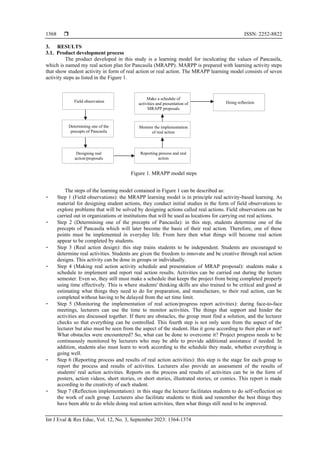
that show student activity in form of real action or real action. The MRAPP learning model consists of seven
activity steps as listed in the Figure 1.
Figure 1. MRAPP model steps
The steps of the learning model contained in Figure 1 can be described as:
- Step 1 (Field observations): the MRAPP learning model is in principle real activity-based learning. As
material for designing student actions, they conduct initial studies in the form of field observations to
explore problems that will be solved by designing actions called real actions. Field observations can be
carried out in organizations or institutions that will be used as locations for carrying out real actions.
- Step 2 (Determining one of the precepts of Pancasila): in this step, students determine one of the
precepts of Pancasila which will later become the basis of their real action. Therefore, one of these
points must be implemented in everyday life. From here then what things will become real action
appear to be completed by students.
- Step 3 (Real action design): this step trains students to be independent. Students are encouraged to
determine real activities. Students are given the freedom to innovate and be creative through real action
designs. This activity can be done in groups or individually.
- Step 4 (Making real action activity schedule and presentation of MRAP proposal): students make a
schedule to implement and report real action results. Activities can be carried out during the lecture
semester. Even so, they still must make a schedule that keeps the project from being completed properly
using time effectively. This is where students' thinking skills are also trained to be critical and good at
estimating what things they need to do for preparation, and manufacture, to their real action, can be
completed without having to be delayed from the set time limit.
- Step 5 (Monitoring the implementation of real action/progress report activities): during face-to-face
meetings, lecturers can use the time to monitor activities. The things that support and hinder the
activities are discussed together. If there are obstacles, the group must find a solution, and the lecturer
checks so that everything can be controlled. This fourth step is not only seen from the aspect of the
lecturer but also must be seen from the aspect of the student. Has it gone according to their plan or not?
What obstacles were encountered? So, what can be done to overcome it? Project progress needs to be
continuously monitored by lecturers who may be able to provide additional assistance if needed. In
addition, students also must learn to work according to the schedule they made, whether everything is
going well.
- Step 6 (Reporting process and results of real action activities): this step is the stage for each group to
report the process and results of activities. Lecturers also provide an assessment of the results of
students' real action activities. Reports on the process and results of activities can be in the form of
posters, action videos, short stories, or short stories, illustrated stories, or comics. This report is made
according to the creativity of each student.
- Step 7 (Reflection implementation): in this stage the lecturer facilitates students to do self-reflection on
the work of each group. Lecturers also facilitate students to think and remember the best things they
have been able to do while doing real action activities, then what things still need to be improved.
Field observation
Designing real
action/proposals
Determining one of the
precepts of Pancasila
Reporting process and real
action
Monitor the implementation
of real action
Make a schedule of
activities and presentation of
MRAPP proposals
Doing reflection
Int J Eval & Res Educ ISSN: 2252-8822 
Development of learning models for inculcating Pancasila values (Taat Wulandari)
1369
3.2. Product validation and development results
MRAPP as a learning model for inculcating Pancasila values was developed was validated by
experts, namely lecturers from the department of learning technology, faculty of education, Yogyakarta State
University and lecturers from the department of Pancasila education, faculty of social sciences, Yogyakarta
State university. At the validation stage, in addition to assessing the material experts, they were also asked to
provide suggestions and comments on the learning model developed. Expert suggestions and comments are
used as a reference for researchers to revise the learning model product.
Identification of the tendency of high and low expert validation scores and use tests are determined
based on ideal criteria. The highest score (ST) is 5 and the lowest score (SR) is 1. To determine the ideal
mean (M) and ideal standard deviation (S) the following criteria were calculated. With the prices of M and S,
the trend of scores can be categorized, using the guidelines for selecting category scores in Table 3. The table
can be used as a reference to determine the score criteria for the validation results. The learning model
developed is declared feasible if it gets a score in the “good enough” category, with a score ranging from
2.665 to 3.335.
Table 3. Guidelines for determining scoring categories
Average score interval Category
4.005 < X Very good
3.335 < X ≤ 4.005 Good
2.665 < X ≤ 3.335 Good enough
1.995 < X ≤ 2.665 Not good
X ≤ 1.995 Very not good
The results of the research total score from the validation of learning experts obtained a total score
of 191, and the overall average was 3.597. The score indicates that the learning model developed is declared
eligible with a “good” score category. The highest score for each indicator is on the independence or
autonomy indicator with a score of 4 included in the “good” category, while the lowest score is on the
centrality indicator with a score of 3 included in the “good enough” category.
The results of the validation of learning experts obtained a total score of 137, and the overall
average was 3.838. The score indicates that the learning model developed is declared eligible with a “good”
score category. The highest score for each indicator is on the independence or autonomy indicator with a
score of 4.5 including in the “very good” category, while the lowest score is on the indicator focusing on
questions/driving questions with a score of 3 included in the “good enough” category. To facilitate the
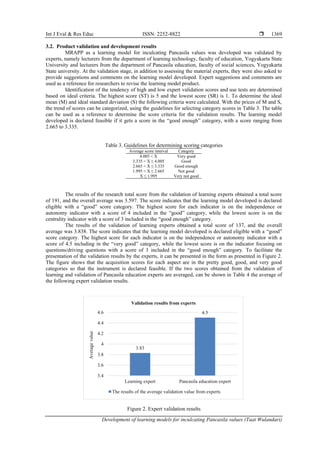
presentation of the validation results by the experts, it can be presented in the form as presented in Figure 2.
The figure shows that the acquisition scores for each aspect are in the pretty good, good, and very good
categories so that the instrument is declared feasible. If the two scores obtained from the validation of
learning and validation of Pancasila education experts are averaged, can be shown in Table 4 the average of
the following expert validation results.
Figure 2. Expert validation results
3.83
4.5
3.4
3.6
3.8
4
4.2
4.4
4.6
Learning expert Pancasila education expert
Average
value
Validation results from experts
The results of the average validation value from experts
 ISSN: 2252-8822
Int J Eval & Res Educ, Vol. 12, No. 3, September 2023: 1364-1374
1370
Table 4. Average expert validation results
Validator Score
Learning expert 3.597
Pancasila education expert 3.838
Average 3.717
Table 4 shows that the average score of expert validation results is 3.717 and is included in the
“good” category. The results of the study were carried out by processing the results of the validation of
learning media experts and Pancasila Education experts. For the results of expert validation, the average
score for all aspects is calculated, which is then known as the comparison between each expert. The results
obtained indicate that the developed model is “feasible” because the validation results have a mean score of
3.717 and are included in the “good” category. As for the details of the score validation results, the validation
of learning experts obtained an average score of 3.597 and the validation of Pancasila education experts
obtained a score of 3.838 where both were included in the “good” category.
The score for each indicator, for learning experts, the highest indicator is the independence or
autonomy indicator, while the indicator that gets the lowest score is the centrality indicator. This shows that
the learning model developed can provide student independence because the activities carried out require a
lot of thinking and real action by the students themselves. The score for each indicator, for Pancasila
Education experts, the highest indicator is on the realism or realism indicator, while the indicator that gets the
lowest score is on the indicator focusing on questions or driving questions. This shows that the learning
model developed has high realism because it is in the form of real action or what is called real action to apply
Pancasila values in a planned action, which can be in the form of individual action or group action.
4. DISCUSSION
Development of a model for inculcating Pancasila values. The development of a model for
inculcating Pancasila values by following the steps of Borg and Gall’s development which were simplified
into seven stages has resulted in a learning model for inculcating Pancasila values. The stages of
development are carried out through various processes and revisions to obtain a model of planting Pancasila
values that are appropriate and suitable for use. Pancasila, whose values have begun to be poorly understood
and not applied in learning, is expected to be re-instilled because the values of Pancasila contain
characteristics that are by the goals of national education. MRAPP is a learning model that can be applied to
inculcate Pancasila values. At the expert validation stage, several suggestions were obtained for improving
the model for inculcating Pancasila values which had been successfully developed in the form of a learning
model called MRAPP. After getting advice from experts, the researcher revised the developed learning model
and completed the syntax to make it clearer and more complete in its use. The results obtained indicate that
the model developed is feasible to be used as a model for inculcating Pancasila values in the learning process.
The feasibility of the model for inculcating Pancasila values and the results of the study were carried
out by processing the validation results of learning media experts and Pancasila education experts. For the
results of expert validation, the average score for all aspects is calculated, which is then known as the
comparison between each expert. The results obtained indicate that the developed model is “feasible”
because the validation results have a mean score of 3.717 and are included in the “good” category. As for the
details of the score validation results, the validation of learning experts obtained an average score of 3.597
and the validation of Pancasila Education experts obtained a score of 3.838 where both were included in the
“good” category.
Obtaining a score for each indicator, for learning experts, the highest indicator is the independence
or autonomy indicator. While the indicator that gets the lowest score is the centrality indicator. This shows
that the learning model developed can provide student independence because the activities carried out require
a lot of thinking and real action by the students themselves. The score for each indicator, for Pancasila
Education experts, the highest indicator is on the realism or realism indicator, while the indicator that gets the
lowest score is on the indicator focusing on questions or driving questions. This shows that the learning
model developed has high realism because it is in the form of real action or what is called real action to apply
Pancasila values in a planned action, which can be in the form of individual action or group action.
Pancasila, which is very rich in the values of the virtues of life, should be able to prosper the
Indonesian people. The definition of prosperity here is free from anarchic actions, free from problems of
religious fundamentality, ethnic radicalism, minority-majority dualism, and an economy that is socially just
for the people of Indonesia [50]. This is in line with the opinion of Subaidi [31] who states that against
conservatism and its conflicts: our Indonesian challenges are in the form of conservativism,
Int J Eval & Res Educ ISSN: 2252-8822 
Development of learning models for inculcating Pancasila values (Taat Wulandari)
1371
exclusivism/fundamentalism, intolerance, radicalism, and terrorism. It can be done with Pancasila. With
Pancasila, we imagine that conservativism can develop into progressive, inclusive, tolerant, democratic, and
social inclusion [51], [52].
Previous research [53], [54] explained that the internalization of Pancasila values was continuously
carried out as a form of grounding the state ideology (Pancasila). The understanding of Pancasila values is
divided into three, namely low, medium, and medium. Low understanding is limited to the ability to mention
concepts, medium ability is the ability to understand concepts and understanding and high ability is the
ability to connect the previous parts with several events. Internalization of Pancasila values through many
ways in the learning process by its function in realizing smart and good citizens (smart and good citizenship)
[55]. This is a form of effort in the habituation of Pancasila values in everyday life and society [56].
The learning model for inculcating Pancasila values is important because so far, the model is only
theoretical without looking at the action and conditions in the learning process. Carrying out revitalization
requires the role and involvement of the community through concrete actions [57]. The meaning
revitalization is essentially an effort to revive vitality or an effort to restore its position to be important [58].
In addition, revitalization aims to review the shortcomings of what has been implemented and then adapted to
the dynamic conditions of the times to provide benefits for life [59].
The actualization of Pancasila values in learning in universities is an important milestone for
teaching students the values contained in Pancasila. The values of Pancasila are to be a light and guide to the
achievement of the country's goals [60]. Moreover, with the changes that occur in society, it will return to its
identity as a large and diverse nation with an ideology that covers all ethnic groups, religions, races, groups,
and diverse cultures [61]. In addition, the existence of Pancasila is a picture of the character of the Indonesian
people with stable understanding (moral knowing), appreciation (moral feeling), and consistent
implementation (moral action) of the noble values of Pancasila [62], [63]. So, with the learning model
developed, it can make a real contribution, but so far there are still shortcomings. The MRAPP model is one
of the media to instill the values of Pancasila which is still not considered important for students. The
MRAPP model, is certainly very helpful for the development of learning designs so that what the nation
aspires to can be absorbed by the nation's generation.
5. CONCLUSION
The learning model for inculcating Pancasila values can be done in several steps, including seeing
the potential and problems that exist in the field, collecting data followed by the analysis of the needs of the
learning model, product design, validation, revision, and the final product in the form of a model for
inculcating values. Pancasila values called my real action plan for Pancasila with seven learning steps
consisting of: i) field observations; ii) determination of one of the principles of Pancasila; iii) real
action/proposal design; iv) making the schedule of real action activities and presentation of proposals;
v) monitoring the implementation of real action/progress reports; vi) reporting on real action processes and
results; vii) implementation of reflection. Based on the data obtained from the validation of learning experts
and validation of Pancasila Education experts, the MRAPP learning model has an average score of 3.717.
The details of each expert are as: the results of the feasibility analysis according to the validation of learning
experts get a score of 3.597 and the results of the validation of the Pancasila Education experts get a score of
3.838 where both are included in the "Good" category. The score is included in the “good” category, so the
MRAPP is “appropriate” to be used as a model for inculcating Pancasila values.
REFERENCES
[1] E. D. Ainsyiyah and A. M. Ginting, “Pancasila and Civic Education Learning by Non Pancasila and Civic Education Program
Graduate,” Budapest International Research and Critics Institute (BIRCI-Journal): Humanities and Social Sciences, vol. 3, no. 3,
pp. 1650–1659, 2020, doi: 10.33258/birci.v3i3.1097.
[2] L. Sumardi, “Pancasila: The educational philosophy alternative from Indonesia for the world,” Journal of Education and Practice,
vol. 11, no. 11, pp. 88–98, 2020, doi: 10.7176/jep/11-12-11.
[3] B. P. Wibowo, T. Wulandari, and J. Setiawan, “Relationship between the understanding of Indonesian history and the nationalism
attitude of state senior high school students,” International Journal of Education and Social Science Research, vol. 03, no. 01,
pp. 158–172, 2020, doi: 10.37500/ijessr.2020.3014.
[4] T. Endaryati, A. Aman, and J. Setiawan, “The implementation of national values insights in the learning process of Indonesian
history to form student’s solidarity attitudes,” International Journal of Learning and Development, vol. 10, no. 2, p. 10, 2020, doi:
10.5296/ijld.v10i2.17125.
[5] W. D. Anggraeni, A. Aman, and J. Setiawan, “Character education values of Radin Inten II’s against the Dutch colonization for
learning local history,” AL-ISHLAH: Jurnal Pendidikan, vol. 14, no. 3, pp. 4267–4278, 2022, doi: 10.35445/alishlah.v14i3.2095.
[6] S. Hamzah, M. H. B. Yussof, and A. A. Enriquez, “Togetherness in the diversity of the pancasila ideology frame,” Journal of
Social Work and Science Education, vol. 1, no. 1, pp. 8–12, 2020, doi: 10.52690/jswse.v1i1.5.
[7] N. Fadilah, “Challenges and strengthening of Pancasila ideology in facing the era of the industrial revolution 4.0,” Journal of
Digital Education, Communication, and Arts (DECA), vol. 2, no. 02, pp. 66–78, 2019, doi: 10.30871/deca.v2i02.1546.
 ISSN: 2252-8822
Int J Eval & Res Educ, Vol. 12, No. 3, September 2023: 1364-1374
1372
[8] S. A. Mukaromah, A. Gusmawan, and J. Munandar, “The lunge of global ideologies: The challenges of Pancasila ideology
education in the middle of global existence in the era of globalization,” Jurnal Panjar: Pengabdian Bidang Pembelajaran, vol. 4,
no. 1, pp. 1–30, 2022, doi: 10.15294/panjar.v4i1.55017.
[9] I. G. N. Santika, Exploring and finding the spirit of Pancasila contextually. Klaten: Penerbit Lakeisha (in Indonesian), 2020.
[10] Bunari, M. R. Fadli, A. Fikri, J. Setiawan, A. Fahri, and I. M. Izzati, “Understanding history, historical thinking, and historical
consciousness, in learning history: An ex post-facto correlation,” International Journal of Evaluation and Research in Education
(IJERE), vol. 12, no. 1, pp. 260–267, 2023, doi: 10.11591/ijere.v12i1.23633.
[11] R. S. Situru, “Pancasila and today’s challenges,” (in Indonesian), Elementary Journal, vol. 2, no. 1, pp. 1–14, 2019, doi:
10.47178/elementary.v2i1.611.
[12] H. I. Hendri and K. B. Firdaus, “Pancasila resilience in the era of disruption: the dilemma of social media in responding to the
challenges of the issue of intolerance,” (in Indonesian), Jurnal Paris Langkis, vol. 1, no. 2, pp. 36–47, 2021, doi:
10.37304/paris.v1i2.2509.
[13] L. Suryadinata, “Pancasila and the Challenge of Political Islam: Past and Present,” in Pancasila and the Challenge of Political
Islam, Singapore: ISEAS Publishing, 2019, doi: 10.1355/9789814818681-003.
[14] J. Setiawan, Aman, and T. Wulandari, “Understanding Indonesian history, interest in learning history and national insight with
nationalism attitude,” International Journal of Evaluation and Research in Education (IJERE), vol. 9, no. 2, pp. 364–373, 2020,
doi: 10.11591/ijere.v9i2.20474.
[15] J. Setiawan, A. Sudrajat, Aman, and D. Kumalasari, “Development of higher order thinking skill assessment instruments in
learning Indonesian history,” International Journal of Evaluation and Research in Education (IJERE), vol. 10, no. 2, pp. 545–
552, 2021, doi: 10.11591/ijere.v10i2.20796.
[16] G. N. Santika, G. Sujana, and M. A. Winaya, “Building the integrative awareness of the Indonesian nation through reflection on
the historical journey of Pancasila in the perspective of ideological conflicts,” (in Indonesian), Jurnal Etika Demokrasi (JED),
vol. 4, no. 2, pp. 39–49, 2019, doi: 10.26618/jed.v4i2.2391.
[17] D. Maharani and D. A. Dewi, “Implementation of Pancasila in overcoming corruption in Indonesia,” (in Indonesian), Jurnal
Pendidikan Tambusai, vol. 5, no. 1, pp. 920–931, 2021, doi: 10.31004/jptam.v5i1.1045.
[18] A. Salsabila, “The role of Pancasila to eradicate the crime of corruption,” Journal of Creativity Students, vol. 4, no. 1, pp. 90–100,
2019, doi: 10.15294/jcs.v4i1.36039.
[19] M. Basri, J. Setiawan, M. Insani, M. R. Fadli, K. Amboro, and K. Kuswono, “The correlation of the understanding of Indonesian
history, multiculturalism, and historical awareness to students’ nationalistic attitudes,” International Journal of Evaluation and
Research in Education (IJERE), vol. 11, no. 1, pp. 369–376, 2022, doi: 10.11591/ijere.v11i1.22075.
[20] S. Surandi, S. Supardi, and J. Setiawan, “The Implementation of Radin Inten II’s Nationalism Resistance Values Within Local
History Learning,” Ta’dib, vol. 23, no. 2, p. 145, 2020, doi: 10.31958/jt.v23i2.1721.
[21] D. P. Duarsa and Dauri, “Revitalization of Pancasila values against the imposition of substitution money as an additional criminal
in corruption crimes,” in Proceedings of the Universitas Lampung International Conference on Social Sciences (ULICoSS 2021),
2022, vol. 628, pp. 271–279, doi: 10.2991/assehr.k.220102.033.
[22] L. Retnasari, “Actualization of Pancasila values with strengthening anti-corruption education in school,” in Proceedings of the 1st
International Conference Of Education, Social And Humanities (INCESH 2021), vol. 581, pp. 378–383, 2021, doi:
https://doi.org/10.2991/assehr.k.211028.147.
[23] A. Harefa and S. Daliwu, The theory of Pancasila education which is integrated with Anti-Corruption education. Banyumas:
Penerbit Lutfi Gilang (in Indonesian), 2020.
[24] R. Agustina, A. Sudrajat, J. Setiawan, and N. Sudarwati, “Development of mind mapping based prezi multimedia to improve
history learning outcomes,” Ta’dib, vol. 25, no. 2, p. 129, 2022, doi: 10.31958/jt.v25i2.6852.
[25] A. Riyadi, Pancasila in the fight against corruption. Kepanjen: Ae Publishing (in Indonesian), 2021.
[26] Ishaq, Pancasila education. Yogyakarta: Prenada Media (in Indonesian), 2021.
[27] Ronto, Pancasila as the ideology and basis of the state. Jakarta: Balai Pustaka (in Indonesian), 2017.
[28] E. Kusdarini, S. Sunarso, and I. Arpannudin, “The implementation of Pancasila education through field work learning model,”
Cakrawala Pendidikan, vol. 39, no. 2, pp. 359–369, 2020, doi: 10.21831/cp.v39i2.31412.
[29] R. Tomalili, Pancasila and civic education. Yogyakarta: Deepublish (in Indonesian), 2019.
[30] J. Setiawan, “Character values of independence Hadratussyekh K.H. M. Hasyim Asy’ari,” HISTORIA: Jurnal Program Studi
Pendidikan Sejarah Volume, vol. 11, no. 1, pp. 17–28, 2023, doi: 10.24127/hj.v11i1.6469.
[31] Subaidi, “Strengthening character education in Indonesia: Implementing values from moderate Islam and the Pancasila,” Journal
of Social Studies Education Research, vol. 11, no. 2, pp. 120–132, 2020.
[32] M. Ma’arif, Z. Nuryana, and I. A. Saidi, “Character education in the new paradigm of Pancasila citizenship education,” Universal
Journal of Educational Research, vol. 8, no. 12, pp. 6893–6901, 2020, doi: 10.13189/ujer.2020.081255.
[33] J. A. Dewantara, I. F. Suhendar, R. Rosyid, and T. S. Atmaja, “Pancasila as ideology and characteristics civic education in
indonesia,” International Journal for Educational and Vocational Studies, vol. 1, no. 5, pp. 398–410, 2019, doi:
10.29103/ijevs.v1i5.1617.
[34] Y. Nugraha, Sapriya, E. Danial, and Rahmat, “Curriculum of Pancasila and citizenship education department in the industrial
revolution era 4.0,” Journal of Positive School Psychology, vol. 6, no. 5, pp. 1029–1037, 2022, [Online]. Available:
https://journalppw.com/index.php/jpsp/article/view/8202/5352.
[35] N. T. Martoredjo, “Building character through Pancasila values to sovereign nation,” Humaniora, vol. 7, no. 1, p. 116, 2016, doi:
10.21512/humaniora.v7i1.3494.
[36] A. Edison, A. Ananda, Z. M. Effendi, and M. Montessori, “The effectiveness of the pancasila learning model in improving
Pancasila learning activities in higher universities,” Specialusis Ugdymas, vol. 1, no. 43, pp. 329–341, 2022, [Online]. Available:
https://www.sumc.lt/index.php/se/article/view/1318.
[37] B. Nor, E. T. Djatmika, S. U. M. Widjaja, and H. Wahyono, “Development of economic learning model based on Pancasila
values,” International Journal of Instruction, vol. 15, no. 1, pp. 259–276, 2022, doi: 10.29333/iji.2022.15115a.
[38] T. Taniredja, M. Afandi, and E. M. Faridli, “The appropriate Pancasila education contents to implant lofty values for Indonesian
students,” International Journal For Education Studies, vol. 5, no. 1, pp. 107–116, 2012, doi: 10.2121/edu-ijes.v5i1.269.
[39] A. Istianah, S. Mazid, S. Hakim, and R. Susanti, “Integration of Pancasila values to build the character of Pancasila students in the
campus environment,” (in Indonesian), Jurnal Gatranusantara, vol. 19, no. 1, pp. 68–79, 2021, [Online]. Available:
http://publikasi.undana.ac.id/index.php/JG/article/view/g674.
[40] R. Fitriya, “Integration of Pancasila values through religious activities in the zero hour program,” (in Indonesian), Jurnal
Manajemen, Kepemimpinan, dan Supervisi Pendidikan (JMKSP), vol. 2, no. 2, pp. 89–99, 2017, doi: 10.31851/jmksp.v2i2.1467.
Int J Eval & Res Educ ISSN: 2252-8822 
Development of learning models for inculcating Pancasila values (Taat Wulandari)
1373
[41] N. R. Erinawati, “Instilling the values of Pancasila through life skill learning during the covid-19 pandemic period,” Ideguru:
Jurnal Karya Ilmiah Guru, vol. 7, no. 1, pp. 7–12, 2022, doi: 10.51169/ideguru.v7i1.232.
[42] D. Sallamah and D. A. Dewi, “The role and implementation of Pancasila values in living in the era of globalization,”
Antropocene: Jurnal Penelitian Ilmu Humaniora, vol. 1, no. 8, pp. 123–134, 2021, doi: 10.56393/antropocene.v1i8.242.
[43] A. Arifin, “Internalization of Pancasila values and nationalism in high schools through citizenship education,” AL-ISHLAH:
Jurnal Pendidikan, vol. 13, no. 3, pp. 1899–1908, 2021, doi: 10.35445/alishlah.v13i3.1238.
[44] B. Sumardjoko and M. Musyiam, “Model of civic education learning based on the local wisdom for revitalizing values of
Pancasila,” Cakrawala Pendidikan, vol. 37, no. 2, pp. 201–211, 2018, doi: 10.21831/cp.v37i2.18037.
[45] J. A. Dewantara and T. H. Nurgiansah, “Strengthening Pancasila values during the Covid-19 pandemic,” Edukatif: Jurnal Ilmu
Pendidikan, vol. 3, no. 4, pp. 2411–2417, 2021, doi: 10.31004/edukatif.v3i4.443.
[46] E. Elihami, “E-learning in Islamic education and Pancasila on during Covid-19 pandemic,” Academy of Education Journal,
vol. 12, no. 2, pp. 303–310, 2021, doi: 10.47200/aoej.v12i2.746.
[47] Sugiyono, Qualitative, quantitative, and R&D research methods. Bandung: Alfabeta (in Indonesian), 2020.
[48] W. R. Borg and M. D. Gall, Educational research: An introduction. New York: Longman Publishing, 2010.
[49] S. Gustiani, “Research and development (R&D) method as a model design in educational research and its alternatives,” Holistics
Journal, vol. 11, no. 2, pp. 12–22, 2019, [Online]. Available: https://jurnal.polsri.ac.id/index.php/holistic/article/view/1849.
[50] T. S. Manik, M. Murdiono, and M. Andhika, “Islam and Pancasila: Perspective of Indonesian Moslem postgraduate students,”
Sospol: Jurnal Sosial Politik, vol. 7, no. 1, pp. 18–28, 2021, doi: 10.22219/sospol.v7i1.13511.
[51] V. E. D. N. Veronica Eka Desi Natalia, “Implementation of Pancasila values in character education,” Social Science Studies,
vol. 1, no. 1, pp. 023–031, 2021, doi: 10.47153/sss11.1732021.
[52] F. Jannah and R. Fahlevi, “Strengthening the Pancasila character values in forming the character of Pancasilais generation,” in
Proceedings of the 1st International Conference on Creativity, Innovation and Technology in Education (IC-CITE 2018), 2018,
vol. 274, pp. 77–79, doi: 10.2991/iccite-18.2018.18.
[53] B. MS, S. Rahmawati, and S. Wardani, “The development of a learning media for visualizing the Pancasila values based on
information and communication technology,” Cakrawala Pendidikan, vol. 3, no. 1, pp. 502–521, 2017, doi:
10.21831/cp.v36i3.12748.
[54] M. Murdiono, Miftahuddin, and P. W. Kuncorowati, “The education of the national character of Pancasila in secondary school
based on pesantren,” Cakrawala Pendidikan, vol. 36, no. 3, pp. 423–434, 2017, doi: 10.21831/cp.v36i3.15399.
[55] R. M. Saputri, “the influence of learning media as an efforts to improve understanding of Pancasila values through online
learning,” Jurnal Penelitian Ilmu Pendidikan, vol. 15, no. 1, pp. 436–451, 2022, doi: 10.21831/jpipfip.v15i1.42199.
[56] R. Al Hamid, “Reinterpretation of understanding Pancasila and the value of diversity post-reform era,” Empirisma, vol. 31, no. 1,
pp. 16–29, 2022, doi: 10.30762/empirisma.v31i1.3629.
[57] S. Fitriasari, I. S. Masyitoh, and Baeihaqi, “The role of Pancasila education teachers and citizenship in strengthening character
education based on Pancasila values,” in Proceedings of the 2nd Annual Civic Education Conference, 2020, vol. 418, pp. 534–
539, doi: 10.2991/assehr.k.200320.101.
[58] M. R. Fadli, S. Rochmat, A. Sudrajat, Aman, A. Rohman, and Kuswono, “Flipped classroom in history learning to improve
students’ critical thinking,” International Journal of Evaluation and Research in Education (IJERE), vol. 11, no. 3, pp. 1416–
1423, 2022, doi: 10.11591/ijere.v11i3.22785.
[59] A. B. Solissa, “The reactualization of the Pancasila values in the light of perennial philosophy,” ESENSIA: Jurnal Ilmu-Ilmu
Ushuluddin, vol. 21, no. 1, pp. 49–70, 2020, doi: 10.14421/esensia.v21i1.2172.
[60] A. Eddison, A. Ananda, Z. M. Effendi, and M. Montessori, “The validity of the Pancasila learning model in the effort to develop
nationalism in universities,” Journal of Positive School Psychology, vol. 6, no. 4, pp. 4079–4087, 2022.
[61] D. T. Suarno, Y. Suryono, Zamroni, J. Irmansyah, and F. Yasin, “The meaning and experience on nationalism among Indonesian
migrant workers’ children in border area,” International Journal of Evaluation and Research in Education (IJERE), vol. 11, no. 3,
pp. 1595–1606, 2022, doi: 10.11591/ijere.v11i3.21729.
[62] M. Kusmayanti, K. Komalasari, and T. Saputra, “Students’ perception towards Pancasila and civic education learning based on
living values education,” in Proceedings of the Annual Civic Education Conference (ACEC 2021), 2022, vol. 636, pp. 237–241,
doi: 10.2991/assehr.k.220108.043.
[63] R. Erliyana and S. Huda, “Actualization of Pancasila values (Indonesian Ideology) in Majelis Taklim Organization,” AL-HAYAT:
Journal of Islamic Education, vol. 3, no. 1, p. 68, 2019, doi: 10.35723/ajie.v3i1.46.
BIOGRAPHIES OF AUTHORS
Taat Wulandari is a Lecturer, Department of Social Science Education, Faculty
of Social Science, Law, and Political Sciences, Yogyakarta State University, Yogyakarta
55281, Indonesia. Her researches focus on multicultural education, social studies education,
historical, social, cultural, character and culture education. She can be contacted at email:
taat_wulandari@uny.ac.id.
 ISSN: 2252-8822
Int J Eval & Res Educ, Vol. 12, No. 3, September 2023: 1364-1374
1374
Anik Widiastuti is a Lecturer, Department of Social Science Education, Faculty
of Social Science, Law, and Political Sciences, Yogyakarta State University, Yogyakarta
55281, Indonesia. Her researches focus on social studies education, entrepreneurship
education, integrated education, social and culture. She can be contacted at email:
anikwidiastuti@uny.ac.id.
Nasiwan is a Lecturer Department of Social Science Education, Faculty of Social
Science, Law, and Political Sciences, Yogyakarta State University, Yogyakarta 55281,
Indonesia. His research focuses on social studies education, political science, Islamic
movements, political education, political parties, and socio-culture. He can be contacted at
email: nasiwan@uny.ac.id.
Johan Setiawan is a Doctoral (Dr) & Lecturer, Department of History
Education, Faculty of Education and Teacher Training, Universitas Muhammadiyah Metro,
Indonesia. His research focuses on history education, character education, and Indonesian
history. He can be contacted at email: johansetiawan767@gmail.com.
Muhammad Rijal Fadli is a Lecturer Department of History Education, Faculty
of Education and Teacher Training, Universitas Muhammadiyah Metro, Indonesia. He
completed the master doctoral program (Dr.) at Graduate School, Universitas Negeri
Yogyakarta, which focused on history and social studies education. His research focuses on
history education, history, and Islamic studies. He can be contacted at email:
muhammadrijalfadli@ummetro.ac.id; rijalfadli.co@gmail.com.
Hadisaputra is a Lecturer Universitas Muhammadiyah Makassar. His research
focuses on social studies education, political science, political education, political parties,
sociology, religion, history, and socio-culture. He can be contacted at email:
hadisaputra@unismuh.ac.id.

Development of learning models for inculcating Pancasila values

  • 1.
    International Journal ofEvaluation and Research in Education (IJERE) Vol. 12, No. 3, September 2023, pp. 1364~1374 ISSN: 2252-8822, DOI: 10.11591/ijere.v12i3.25687  1364 Journal homepage: http://ijere.iaescore.com Development of learning models for inculcating Pancasila values Taat Wulandari1 , Anik Widiastuti1 , Nasiwan1 , Johan Setiawan2 , Muhammad Rijal Fadli2 , Hadisaputra3 1 Faculty of Social, Law and Political Sciences, Universitas Negeri Yogyakarta, Yogyakarta, Indonesia 2 Faculty of Teaching and Education, Muhammadiyah Metro University, Metro, Indonesia 3 Faculty of Teaching and Education, Muhammadiyah University Makassar, Makassar, Indonesia Article Info ABSTRACT Article history: Received Oct 12, 2022 Revised May 14, 2023 Accepted Jun 13, 2023 The values contained in Pancasila have not been implemented in the life of the Indonesian people properly. This study aims to produce a product in the form of a model of planting Pancasila values. This research is a research and development, using a research and development model from Borg and Gall which is modified into seven development steps. Product validation of the Pancasila values inculcation model by learning technology experts and Pancasila education experts. Techniques data analysis used descriptive statistical analysis. This research resulted in a model named my real action plan for Pancasila (MRAPP). MRAPP is a learning model that can be used to inculcate Pancasila values. The steps of the MRAPP model are as: i) field observations; ii) determining one of the precepts of Pancasila; iii) designing real action; iv) making a schedule of activities and presentation of proposals; v) monitoring the implementation of real action; vi) reporting the process and results of real action; and vii) doing reflection. The results of the validation of the feasibility of the learning model from the validation of learning experts and the validation of Pancasila education experts, namely the MRAPP learning model declared “eligible” to be used as a learning model for inculcating Pancasila values. Keywords: Learning model My real action plan for Pancasila Values This is an open access article under the CC BY-SA license. Corresponding Author: Taat Wulandari Faculty of Social, Law and Political Sciences, Universitas Negeri Yogyakarta Caturtunggal, Depok, Sleman, Yogyakarta, Indonesia Email: taat_wulandari@uny.ac.id 1. INTRODUCTION Every nation and country have a different history, principle, or ideology in all corners of the world. Likewise, Indonesia is a nation that is one of the countries consisting of various ethnicities, religions, and races. Based on the 2010 population census, Indonesia is inhabited by 237 million people, has 1.86 million km2 of land, 3.2 million km2 of ocean, and 17,604 islands. Based on this, it places Indonesia as one of the largest countries in the world by looking at its population and area. So that it is impossible for Indonesian citizens who live to be able to stand alone without the help of others. This can foster awareness that everything that is achieved in essence requires the help of others [1]. So that it gives birth to the awareness that every human being can be called to his heart to behave well for others and the environment. It takes the ability to control oneself in all interests to live in harmony and balance in society. Social relations that are harmonious and balanced in the view of Pancasila in society are not neutral but are imbued with the values contained in the precepts of Pancasila as a unit [2]. Humans must live and be able to work together with other humans in society.
  • 2.
    Int J Eval& Res Educ ISSN: 2252-8822  Development of learning models for inculcating Pancasila values (Taat Wulandari) 1365 Based on this, in unifying, an ideology that can bind citizens is needed. The Indonesian nation has Pancasila which is used as an ideology consisting of values derived from the original Indonesian personality. Pancasila has an important function and position in the Indonesian state, namely as the identity of the Indonesian nation, as the ideology of the Indonesian nation and state, as the basis of state philosophy, and as the principle of the Indonesian unity [3]–[5]. Pancasila as the basis of the state has values: i) Divine values (religious); ii) Human values (humanism); and iii) Societal values (nationalism and social justice) [6], [7]. Pancasila is the foundation of the Indonesian state. When it becomes the basis of the state, the values contained in Pancasila should be the basis for people's lives, ways of thinking, and acting. Each item in Pancasila contains noble values that should be a guideline for the Indonesian people to be implemented in real everyday life [8]. Based on this, Pancasila is a guideline and reference that can be used by citizens to behave to create good citizens. So far, especially during the three-decade reign, the institutionalization of Pancasila values has only been limited to rhetoric. The Indonesian people still exhibit some behaviors that are inversely proportional to those mandated by Pancasila. The current state of Indonesia still does not directly reflect the practice of Pancasila values. There are still conflicts stemming from violent incidents and the intolerance of minority groups or groups with different views [9]. Based on The National Commission on Human Rights (Komnas HAM) 2015 annual report 2016, there was an increase in reports of cases of freedom of belief and religion from 74 complaints in 2014 to 87 complaints, for each complaint covering more than one action. In addition, according to the 2015 Wahid Institute report, there was an increase in reports of cases of freedom of belief and religion in 2015 reaching 190 incidents in 249 actions [10]. The report noted an increase of 23% from 2014 with 158 incidents with 187 violations. In early 2017, conflicts in the name of religion tended to increase, this was indicated in areas in Depok, West Java. On February 23, 2017, the Al-Hidayah mosque belonging to the Sawangan Ahmadiyah congregation was sealed by the Depok City Municipal Police [11]. There are all the divisions and conflicts that occur that do not reflect the identity of the nation. Lately, the culture and direction of politics in Indonesia have been colored by issues of conflict, ethnicity, and the threat of disintegration of Indonesian territory. Pancasila is also the philosophy of the Indonesian nation. At the philosophical level, the values contained therein should be reduced to things that are implementable in aspects of national and state life in the current industrial 4.0 era [12]. The current era of communication and technology is developing rapidly, especially electronic media and social media which can influence the attitudes and actions of the younger generation which tend to be inconsistent with the personality of the Indonesian nation [13]–[15]. The emergence of phenomena that can threaten the ideology of the State is now visible, such as the installation of The Communist Party of Indonesia (PKI) attributes (pictures of hammer and sickle) in the form of logos, strikers, and flags found in one of the student boarding rooms which is considered a source of unrest and threatens the nation's ideology [16]. In addition, the life of the state is currently threatened by massive corruption. According to the 2016 Association of Certified Fraud Examiners (ACFE) Indonesia survey, the most common fraud in Indonesia is corruption. Corruption is seen as the most detrimental type of fraud in Indonesia [17]. Corruption is the cause of the misallocation of resources and is the responsibility of the nation's future generations. Therefore, corruption is not a light problem but must be eliminated from the life of the state and society [18]–[20]. Corruption is an act that violates the law and is a criminal act. The younger generation not only needs to be trained to think critically but must be able to act. Learning must also be able to train critical thinking skills [21]. From Pancasila, corruption is very contrary to the fifth precept, namely justice for all Indonesian people. Therefore, Pancasila can be a source for eradicating corruption, and a source of anti- corruption values [22]. Indications that the implementation of Pancasila values has fallen into deviations are shown by the many cases of corruption in Indonesia. Eradication of corruption must be comprehensive and can be done through a cultural approach. Planting Pancasila in the life of the nation and state is not easy. The spirit of Pancasila values reflects the nationalism of its people [23]. Meanwhile, Indonesian society shows a decline in nationalism and it is time for the implementation of Pancasila values to be revitalized as the basis of the state along with religious norms [24]. It is the formulation of Pancasila in Indonesian positive law that is juridically-constitutionally valid, valid, and binding on all state institutions, community institutions, and every citizen, without exception. This Pancasila reality is referred to as an objective reality, namely that the reality exists in Pancasila itself apart from anything else or apart from people's knowledge [25]. The objective reality that exists and is attached to Pancasila, so that Pancasila as a system is unique and different from other philosophical systems. This is scientifically referred to as objective philosophy. The values in the five precepts of Pancasila are [25]–[29]: First, belief in one supreme God. The values contained in this first precept are as: humans who were created must carry out God's commands and stay away from His prohibitions; Indonesian people have the right to embrace their respective religions and beliefs; are obliged to carry out what is instructed in the law. Their respective religions and stay away from
  • 3.
     ISSN: 2252-8822 IntJ Eval & Res Educ, Vol. 12, No. 3, September 2023: 1364-1374 1366 what is forbidden. Second, just and civilized humanity, so this second precept explains that fellow human beings have the same degree before the law. In addition, citizens in their social life have an attitude of respect for others, mutual respect for dignity, and dignity in the fulfillment of human rights so that civilized citizens are reflected. So that every citizen has a human spirit that can be used as a source of state unity in life together. Third, Unity of Indonesia, the meaning of this third precept is that unity is essentially one, which means that it is not divided. As citizens, it is better to know that this country is factually made up of various cultures so that we hope to have a sense of unity that can be realized through cooperation that Indonesia can be proud of. Fourth, Democracy led by wisdom of Wisdom in deliberation/representation, this fourth precept describes democracy, the existence of togetherness in making decisions and handling them, and mutual honesty. The deliberation mechanism for consensus can be implemented by being led with an attitude of wisdom in making every decision. Fifth, social justice for all Indonesian people, the meaning in this fifth precept is the existence of equitable prosperity for all people, all wealth and so on are used for mutual happiness and protecting the weak. So that citizens, especially students, are expected to have an attitude of solidarity. Based on this, the Pancasila values contained in the first to the fifth precepts are the ideals, hopes, and dreams of the Indonesian people that can be realized together. It is understood that these values are expected to be implemented in various aspects of social, national, and state life [30]. The implementation of Pancasila has the same responsibility as citizens, state officials, and government officials who are guided by the basic philosophy of the State, namely Pancasila. Likewise, educational institutions and universities should be able to translate the values of Pancasila so that there are efforts to realize and implement them in a real way by all students in a university [31]. Students as agents of change in this current era are required to play a role in guarding government performance such as controlling and providing input to determine policies that favor the people. Apart from that, students are a generation that is prepared seriously to be able to serve and continue the current government ladder [32]. There is great hope for students to be able to continue the leadership milestones in the future to be able to accommodate all the aspirations of the community. As a student who has a responsibility to himself, but also has a responsibility to the nation, he is expected to have intellectual, spiritual, and emotional intelligence. So that this nation will have prospective leaders who in thinking and acting will not deviate from the norms, laws, and state principles of Pancasila [33]. Pancasila has a strategic position in the life of the nation and state, and for that Pancasila should have a place to be maintained and preserved through community, national, and state life activities by revitalizing and actualizing it. Therefore, it is the concern and responsibility of all parties, especially educators, in the education process, it is necessary to instill the values of Pancasila [34]. The changes that occur in social, economic, and political life above reflect the shifting of Pancasila values, including in the world of education [35]. The values contained in Pancasila need to be taught from one generation to the next through education about Pancasila in the realm of higher education [36]. Therefore, this study develops a model for inculcating the values of Pancasila as the philosophy and foundation of the Indonesian state. The number of corruption cases in Indonesia shows that the values of Pancasila are not well embedded in Indonesian society [37], [38]. The inculcation of Pancasila values can be carried out in learning activities which are used as an important basis for the survival of this nation's life [39]–[41]. The studies that have been carried out discuss Pancasila as being part of the four pillars of nationality. The use of the term “four pillars” according to research that has been carried out refers to the use of the term since it was produced by political elites through public education programs that have degraded and legitimized the meaning of Pancasila, the 1945 Constitution, Unitary State of the Republic of Indonesia (Negara Kesatuan Republik Indonesia/NKRI), and Bhinneka Tunggal Ika [42], [43]. Philosophically, the use of the term four pillars for public education to introduce national insights carried out by the people's consultative assembly of the republic of Indonesia has distorted the meaning and shifted the meaning of Pancasila, the 1945 constitution, NKRI, and Bhinneka Tunggal Ika. The term “four pillars” is also not known in this history or by the public [44]. Various studies related to Pancasila have been discussed, but the discourse on developing a learning model that can be applied to instill Pancasila values is still not much debated [45], [46]. This shows that the trend of previous researches is still struggling with the debate on the meaning of Pancasila as the basis of the state. So, as a result, the development of thinking about learning models in instilling Pancasila has not changed much. Therefore, it is very important and urgent to develop a learning model that can be applied to instill Pancasila values. Thus, this study aims to produce a product in the form of a model of planting Pancasila values.
  • 4.
    Int J Eval& Res Educ ISSN: 2252-8822  Development of learning models for inculcating Pancasila values (Taat Wulandari) 1367 2. RESEARCH METHOD 2.1. Research design This research is a research and development (research and development). Development research is a research method that is directed to produce a particular product as well as to test the effectiveness of the product [47]. This development research uses the Borg and Gall development model which is modified according to the ability of the researcher and is into seven development steps [48], [49]. 2.2. Research subject Develop a model for inculcating Pancasila values in anti-corruption education courses in the social science education study program, faculty of social sciences, Yogyakarta State University. The trial subject of the product design validation of the Pancasila values inculcation model by learning experts and Pancasila Education experts. At the validation stage, it was carried out by five validators, consisting of three learning experts and two Pancasila education experts. 2.3. Techniques and instruments of data collection Data collection techniques used a questionnaire. The instrument used in this study was made by the researcher himself and then validated by an expert known as expert judgment to obtain a valid and reliable data collection tool. The data obtained through the trial activities are classified into two, namely qualitative data and quantitative data. Qualitative data in the form of criticisms and suggestions put forward by learning experts and Pancasila education experts were collected and abstracted to obtain a model product of inculcating Pancasila values. The data obtained from the questionnaire in the form of quantitative data is processed by quantitative data analysis techniques. Quantitative data processing in this study uses descriptive statistics. The research instrument uses a questionnaire with a rating scale of 1 to 5. The data collection instrument grid can be seen Table 1. Table 1. Data collection instrument grid Aspect Indicator Item number Number of items Aspect hint Availability of instructions 1.2 2 Language aspect Language compatibility 3.4.5 3 Aspect substance The suitability of the steps of the learning model 6.7.8.9 4 Learning aspect Centrality 10.11 2 Focusing on the question/driving question 12 1 Constructive/constructive investigation 13.14 2 Investigation 15 1 Independence/autonomy 16 1 Realism 17.18 2 Total 18 2.4. Data analysis technique Analysis of product development research data using descriptive statistical analysis with qualitative and quantitative approaches. Qualitative data comes from data from interviews with lecturers in an unstructured manner. Quantitative data were processed using quantitative data analysis with the help of the SPSS statistics 26 program. Product development research was analyzed according to the characteristics of each product to determine whether the product met the eligibility criteria. The determination of instrument’s feasibility category is determined based on expert and practitioner reviews with the criteria for determining the practicality category using a scale of 5. The instrument is declared eligible if the results of the calculation obtain a score in the “good” category. Table 2 shows the practicality criteria used. Table 2. Practical criteria Average score interval Category (M + 1.5s) < X Very good (M + 0.5s) < X ≤ (M + 1.5s) Good (M – 0.5s) < X ≤ (M + 0.5s) Good enough (M – 1.5s) < X ≤ (M – 0.5s) Not good X ≤ (M – 1.5s) Very not good
  • 5.
     ISSN: 2252-8822 IntJ Eval & Res Educ, Vol. 12, No. 3, September 2023: 1364-1374 1368 3. RESULTS 3.1. Product development process The product developed in this study is a learning model for inculcating the values of Pancasila, which is named my real action plan for Pancasila (MRAPP). MARPP is prepared with learning activity steps that show student activity in form of real action or real action. The MRAPP learning model consists of seven activity steps as listed in the Figure 1. Figure 1. MRAPP model steps The steps of the learning model contained in Figure 1 can be described as: - Step 1 (Field observations): the MRAPP learning model is in principle real activity-based learning. As material for designing student actions, they conduct initial studies in the form of field observations to explore problems that will be solved by designing actions called real actions. Field observations can be carried out in organizations or institutions that will be used as locations for carrying out real actions. - Step 2 (Determining one of the precepts of Pancasila): in this step, students determine one of the precepts of Pancasila which will later become the basis of their real action. Therefore, one of these points must be implemented in everyday life. From here then what things will become real action appear to be completed by students. - Step 3 (Real action design): this step trains students to be independent. Students are encouraged to determine real activities. Students are given the freedom to innovate and be creative through real action designs. This activity can be done in groups or individually. - Step 4 (Making real action activity schedule and presentation of MRAP proposal): students make a schedule to implement and report real action results. Activities can be carried out during the lecture semester. Even so, they still must make a schedule that keeps the project from being completed properly using time effectively. This is where students' thinking skills are also trained to be critical and good at estimating what things they need to do for preparation, and manufacture, to their real action, can be completed without having to be delayed from the set time limit. - Step 5 (Monitoring the implementation of real action/progress report activities): during face-to-face meetings, lecturers can use the time to monitor activities. The things that support and hinder the activities are discussed together. If there are obstacles, the group must find a solution, and the lecturer checks so that everything can be controlled. This fourth step is not only seen from the aspect of the lecturer but also must be seen from the aspect of the student. Has it gone according to their plan or not? What obstacles were encountered? So, what can be done to overcome it? Project progress needs to be continuously monitored by lecturers who may be able to provide additional assistance if needed. In addition, students also must learn to work according to the schedule they made, whether everything is going well. - Step 6 (Reporting process and results of real action activities): this step is the stage for each group to report the process and results of activities. Lecturers also provide an assessment of the results of students' real action activities. Reports on the process and results of activities can be in the form of posters, action videos, short stories, or short stories, illustrated stories, or comics. This report is made according to the creativity of each student. - Step 7 (Reflection implementation): in this stage the lecturer facilitates students to do self-reflection on the work of each group. Lecturers also facilitate students to think and remember the best things they have been able to do while doing real action activities, then what things still need to be improved. Field observation Designing real action/proposals Determining one of the precepts of Pancasila Reporting process and real action Monitor the implementation of real action Make a schedule of activities and presentation of MRAPP proposals Doing reflection
  • 6.
    Int J Eval& Res Educ ISSN: 2252-8822  Development of learning models for inculcating Pancasila values (Taat Wulandari) 1369 3.2. Product validation and development results MRAPP as a learning model for inculcating Pancasila values was developed was validated by experts, namely lecturers from the department of learning technology, faculty of education, Yogyakarta State University and lecturers from the department of Pancasila education, faculty of social sciences, Yogyakarta State university. At the validation stage, in addition to assessing the material experts, they were also asked to provide suggestions and comments on the learning model developed. Expert suggestions and comments are used as a reference for researchers to revise the learning model product. Identification of the tendency of high and low expert validation scores and use tests are determined based on ideal criteria. The highest score (ST) is 5 and the lowest score (SR) is 1. To determine the ideal mean (M) and ideal standard deviation (S) the following criteria were calculated. With the prices of M and S, the trend of scores can be categorized, using the guidelines for selecting category scores in Table 3. The table can be used as a reference to determine the score criteria for the validation results. The learning model developed is declared feasible if it gets a score in the “good enough” category, with a score ranging from 2.665 to 3.335. Table 3. Guidelines for determining scoring categories Average score interval Category 4.005 < X Very good 3.335 < X ≤ 4.005 Good 2.665 < X ≤ 3.335 Good enough 1.995 < X ≤ 2.665 Not good X ≤ 1.995 Very not good The results of the research total score from the validation of learning experts obtained a total score of 191, and the overall average was 3.597. The score indicates that the learning model developed is declared eligible with a “good” score category. The highest score for each indicator is on the independence or autonomy indicator with a score of 4 included in the “good” category, while the lowest score is on the centrality indicator with a score of 3 included in the “good enough” category. The results of the validation of learning experts obtained a total score of 137, and the overall average was 3.838. The score indicates that the learning model developed is declared eligible with a “good” score category. The highest score for each indicator is on the independence or autonomy indicator with a score of 4.5 including in the “very good” category, while the lowest score is on the indicator focusing on questions/driving questions with a score of 3 included in the “good enough” category. To facilitate the presentation of the validation results by the experts, it can be presented in the form as presented in Figure 2. The figure shows that the acquisition scores for each aspect are in the pretty good, good, and very good categories so that the instrument is declared feasible. If the two scores obtained from the validation of learning and validation of Pancasila education experts are averaged, can be shown in Table 4 the average of the following expert validation results. Figure 2. Expert validation results 3.83 4.5 3.4 3.6 3.8 4 4.2 4.4 4.6 Learning expert Pancasila education expert Average value Validation results from experts The results of the average validation value from experts
  • 7.
     ISSN: 2252-8822 IntJ Eval & Res Educ, Vol. 12, No. 3, September 2023: 1364-1374 1370 Table 4. Average expert validation results Validator Score Learning expert 3.597 Pancasila education expert 3.838 Average 3.717 Table 4 shows that the average score of expert validation results is 3.717 and is included in the “good” category. The results of the study were carried out by processing the results of the validation of learning media experts and Pancasila Education experts. For the results of expert validation, the average score for all aspects is calculated, which is then known as the comparison between each expert. The results obtained indicate that the developed model is “feasible” because the validation results have a mean score of 3.717 and are included in the “good” category. As for the details of the score validation results, the validation of learning experts obtained an average score of 3.597 and the validation of Pancasila education experts obtained a score of 3.838 where both were included in the “good” category. The score for each indicator, for learning experts, the highest indicator is the independence or autonomy indicator, while the indicator that gets the lowest score is the centrality indicator. This shows that the learning model developed can provide student independence because the activities carried out require a lot of thinking and real action by the students themselves. The score for each indicator, for Pancasila Education experts, the highest indicator is on the realism or realism indicator, while the indicator that gets the lowest score is on the indicator focusing on questions or driving questions. This shows that the learning model developed has high realism because it is in the form of real action or what is called real action to apply Pancasila values in a planned action, which can be in the form of individual action or group action. 4. DISCUSSION Development of a model for inculcating Pancasila values. The development of a model for inculcating Pancasila values by following the steps of Borg and Gall’s development which were simplified into seven stages has resulted in a learning model for inculcating Pancasila values. The stages of development are carried out through various processes and revisions to obtain a model of planting Pancasila values that are appropriate and suitable for use. Pancasila, whose values have begun to be poorly understood and not applied in learning, is expected to be re-instilled because the values of Pancasila contain characteristics that are by the goals of national education. MRAPP is a learning model that can be applied to inculcate Pancasila values. At the expert validation stage, several suggestions were obtained for improving the model for inculcating Pancasila values which had been successfully developed in the form of a learning model called MRAPP. After getting advice from experts, the researcher revised the developed learning model and completed the syntax to make it clearer and more complete in its use. The results obtained indicate that the model developed is feasible to be used as a model for inculcating Pancasila values in the learning process. The feasibility of the model for inculcating Pancasila values and the results of the study were carried out by processing the validation results of learning media experts and Pancasila education experts. For the results of expert validation, the average score for all aspects is calculated, which is then known as the comparison between each expert. The results obtained indicate that the developed model is “feasible” because the validation results have a mean score of 3.717 and are included in the “good” category. As for the details of the score validation results, the validation of learning experts obtained an average score of 3.597 and the validation of Pancasila Education experts obtained a score of 3.838 where both were included in the “good” category. Obtaining a score for each indicator, for learning experts, the highest indicator is the independence or autonomy indicator. While the indicator that gets the lowest score is the centrality indicator. This shows that the learning model developed can provide student independence because the activities carried out require a lot of thinking and real action by the students themselves. The score for each indicator, for Pancasila Education experts, the highest indicator is on the realism or realism indicator, while the indicator that gets the lowest score is on the indicator focusing on questions or driving questions. This shows that the learning model developed has high realism because it is in the form of real action or what is called real action to apply Pancasila values in a planned action, which can be in the form of individual action or group action. Pancasila, which is very rich in the values of the virtues of life, should be able to prosper the Indonesian people. The definition of prosperity here is free from anarchic actions, free from problems of religious fundamentality, ethnic radicalism, minority-majority dualism, and an economy that is socially just for the people of Indonesia [50]. This is in line with the opinion of Subaidi [31] who states that against conservatism and its conflicts: our Indonesian challenges are in the form of conservativism,
  • 8.
    Int J Eval& Res Educ ISSN: 2252-8822  Development of learning models for inculcating Pancasila values (Taat Wulandari) 1371 exclusivism/fundamentalism, intolerance, radicalism, and terrorism. It can be done with Pancasila. With Pancasila, we imagine that conservativism can develop into progressive, inclusive, tolerant, democratic, and social inclusion [51], [52]. Previous research [53], [54] explained that the internalization of Pancasila values was continuously carried out as a form of grounding the state ideology (Pancasila). The understanding of Pancasila values is divided into three, namely low, medium, and medium. Low understanding is limited to the ability to mention concepts, medium ability is the ability to understand concepts and understanding and high ability is the ability to connect the previous parts with several events. Internalization of Pancasila values through many ways in the learning process by its function in realizing smart and good citizens (smart and good citizenship) [55]. This is a form of effort in the habituation of Pancasila values in everyday life and society [56]. The learning model for inculcating Pancasila values is important because so far, the model is only theoretical without looking at the action and conditions in the learning process. Carrying out revitalization requires the role and involvement of the community through concrete actions [57]. The meaning revitalization is essentially an effort to revive vitality or an effort to restore its position to be important [58]. In addition, revitalization aims to review the shortcomings of what has been implemented and then adapted to the dynamic conditions of the times to provide benefits for life [59]. The actualization of Pancasila values in learning in universities is an important milestone for teaching students the values contained in Pancasila. The values of Pancasila are to be a light and guide to the achievement of the country's goals [60]. Moreover, with the changes that occur in society, it will return to its identity as a large and diverse nation with an ideology that covers all ethnic groups, religions, races, groups, and diverse cultures [61]. In addition, the existence of Pancasila is a picture of the character of the Indonesian people with stable understanding (moral knowing), appreciation (moral feeling), and consistent implementation (moral action) of the noble values of Pancasila [62], [63]. So, with the learning model developed, it can make a real contribution, but so far there are still shortcomings. The MRAPP model is one of the media to instill the values of Pancasila which is still not considered important for students. The MRAPP model, is certainly very helpful for the development of learning designs so that what the nation aspires to can be absorbed by the nation's generation. 5. CONCLUSION The learning model for inculcating Pancasila values can be done in several steps, including seeing the potential and problems that exist in the field, collecting data followed by the analysis of the needs of the learning model, product design, validation, revision, and the final product in the form of a model for inculcating values. Pancasila values called my real action plan for Pancasila with seven learning steps consisting of: i) field observations; ii) determination of one of the principles of Pancasila; iii) real action/proposal design; iv) making the schedule of real action activities and presentation of proposals; v) monitoring the implementation of real action/progress reports; vi) reporting on real action processes and results; vii) implementation of reflection. Based on the data obtained from the validation of learning experts and validation of Pancasila Education experts, the MRAPP learning model has an average score of 3.717. The details of each expert are as: the results of the feasibility analysis according to the validation of learning experts get a score of 3.597 and the results of the validation of the Pancasila Education experts get a score of 3.838 where both are included in the "Good" category. The score is included in the “good” category, so the MRAPP is “appropriate” to be used as a model for inculcating Pancasila values. REFERENCES [1] E. D. Ainsyiyah and A. M. Ginting, “Pancasila and Civic Education Learning by Non Pancasila and Civic Education Program Graduate,” Budapest International Research and Critics Institute (BIRCI-Journal): Humanities and Social Sciences, vol. 3, no. 3, pp. 1650–1659, 2020, doi: 10.33258/birci.v3i3.1097. [2] L. Sumardi, “Pancasila: The educational philosophy alternative from Indonesia for the world,” Journal of Education and Practice, vol. 11, no. 11, pp. 88–98, 2020, doi: 10.7176/jep/11-12-11. [3] B. P. Wibowo, T. Wulandari, and J. Setiawan, “Relationship between the understanding of Indonesian history and the nationalism attitude of state senior high school students,” International Journal of Education and Social Science Research, vol. 03, no. 01, pp. 158–172, 2020, doi: 10.37500/ijessr.2020.3014. [4] T. Endaryati, A. Aman, and J. Setiawan, “The implementation of national values insights in the learning process of Indonesian history to form student’s solidarity attitudes,” International Journal of Learning and Development, vol. 10, no. 2, p. 10, 2020, doi: 10.5296/ijld.v10i2.17125. [5] W. D. Anggraeni, A. Aman, and J. Setiawan, “Character education values of Radin Inten II’s against the Dutch colonization for learning local history,” AL-ISHLAH: Jurnal Pendidikan, vol. 14, no. 3, pp. 4267–4278, 2022, doi: 10.35445/alishlah.v14i3.2095. [6] S. Hamzah, M. H. B. Yussof, and A. A. Enriquez, “Togetherness in the diversity of the pancasila ideology frame,” Journal of Social Work and Science Education, vol. 1, no. 1, pp. 8–12, 2020, doi: 10.52690/jswse.v1i1.5. [7] N. Fadilah, “Challenges and strengthening of Pancasila ideology in facing the era of the industrial revolution 4.0,” Journal of Digital Education, Communication, and Arts (DECA), vol. 2, no. 02, pp. 66–78, 2019, doi: 10.30871/deca.v2i02.1546.
  • 9.
     ISSN: 2252-8822 IntJ Eval & Res Educ, Vol. 12, No. 3, September 2023: 1364-1374 1372 [8] S. A. Mukaromah, A. Gusmawan, and J. Munandar, “The lunge of global ideologies: The challenges of Pancasila ideology education in the middle of global existence in the era of globalization,” Jurnal Panjar: Pengabdian Bidang Pembelajaran, vol. 4, no. 1, pp. 1–30, 2022, doi: 10.15294/panjar.v4i1.55017. [9] I. G. N. Santika, Exploring and finding the spirit of Pancasila contextually. Klaten: Penerbit Lakeisha (in Indonesian), 2020. [10] Bunari, M. R. Fadli, A. Fikri, J. Setiawan, A. Fahri, and I. M. Izzati, “Understanding history, historical thinking, and historical consciousness, in learning history: An ex post-facto correlation,” International Journal of Evaluation and Research in Education (IJERE), vol. 12, no. 1, pp. 260–267, 2023, doi: 10.11591/ijere.v12i1.23633. [11] R. S. Situru, “Pancasila and today’s challenges,” (in Indonesian), Elementary Journal, vol. 2, no. 1, pp. 1–14, 2019, doi: 10.47178/elementary.v2i1.611. [12] H. I. Hendri and K. B. Firdaus, “Pancasila resilience in the era of disruption: the dilemma of social media in responding to the challenges of the issue of intolerance,” (in Indonesian), Jurnal Paris Langkis, vol. 1, no. 2, pp. 36–47, 2021, doi: 10.37304/paris.v1i2.2509. [13] L. Suryadinata, “Pancasila and the Challenge of Political Islam: Past and Present,” in Pancasila and the Challenge of Political Islam, Singapore: ISEAS Publishing, 2019, doi: 10.1355/9789814818681-003. [14] J. Setiawan, Aman, and T. Wulandari, “Understanding Indonesian history, interest in learning history and national insight with nationalism attitude,” International Journal of Evaluation and Research in Education (IJERE), vol. 9, no. 2, pp. 364–373, 2020, doi: 10.11591/ijere.v9i2.20474. [15] J. Setiawan, A. Sudrajat, Aman, and D. Kumalasari, “Development of higher order thinking skill assessment instruments in learning Indonesian history,” International Journal of Evaluation and Research in Education (IJERE), vol. 10, no. 2, pp. 545– 552, 2021, doi: 10.11591/ijere.v10i2.20796. [16] G. N. Santika, G. Sujana, and M. A. Winaya, “Building the integrative awareness of the Indonesian nation through reflection on the historical journey of Pancasila in the perspective of ideological conflicts,” (in Indonesian), Jurnal Etika Demokrasi (JED), vol. 4, no. 2, pp. 39–49, 2019, doi: 10.26618/jed.v4i2.2391. [17] D. Maharani and D. A. Dewi, “Implementation of Pancasila in overcoming corruption in Indonesia,” (in Indonesian), Jurnal Pendidikan Tambusai, vol. 5, no. 1, pp. 920–931, 2021, doi: 10.31004/jptam.v5i1.1045. [18] A. Salsabila, “The role of Pancasila to eradicate the crime of corruption,” Journal of Creativity Students, vol. 4, no. 1, pp. 90–100, 2019, doi: 10.15294/jcs.v4i1.36039. [19] M. Basri, J. Setiawan, M. Insani, M. R. Fadli, K. Amboro, and K. Kuswono, “The correlation of the understanding of Indonesian history, multiculturalism, and historical awareness to students’ nationalistic attitudes,” International Journal of Evaluation and Research in Education (IJERE), vol. 11, no. 1, pp. 369–376, 2022, doi: 10.11591/ijere.v11i1.22075. [20] S. Surandi, S. Supardi, and J. Setiawan, “The Implementation of Radin Inten II’s Nationalism Resistance Values Within Local History Learning,” Ta’dib, vol. 23, no. 2, p. 145, 2020, doi: 10.31958/jt.v23i2.1721. [21] D. P. Duarsa and Dauri, “Revitalization of Pancasila values against the imposition of substitution money as an additional criminal in corruption crimes,” in Proceedings of the Universitas Lampung International Conference on Social Sciences (ULICoSS 2021), 2022, vol. 628, pp. 271–279, doi: 10.2991/assehr.k.220102.033. [22] L. Retnasari, “Actualization of Pancasila values with strengthening anti-corruption education in school,” in Proceedings of the 1st International Conference Of Education, Social And Humanities (INCESH 2021), vol. 581, pp. 378–383, 2021, doi: https://doi.org/10.2991/assehr.k.211028.147. [23] A. Harefa and S. Daliwu, The theory of Pancasila education which is integrated with Anti-Corruption education. Banyumas: Penerbit Lutfi Gilang (in Indonesian), 2020. [24] R. Agustina, A. Sudrajat, J. Setiawan, and N. Sudarwati, “Development of mind mapping based prezi multimedia to improve history learning outcomes,” Ta’dib, vol. 25, no. 2, p. 129, 2022, doi: 10.31958/jt.v25i2.6852. [25] A. Riyadi, Pancasila in the fight against corruption. Kepanjen: Ae Publishing (in Indonesian), 2021. [26] Ishaq, Pancasila education. Yogyakarta: Prenada Media (in Indonesian), 2021. [27] Ronto, Pancasila as the ideology and basis of the state. Jakarta: Balai Pustaka (in Indonesian), 2017. [28] E. Kusdarini, S. Sunarso, and I. Arpannudin, “The implementation of Pancasila education through field work learning model,” Cakrawala Pendidikan, vol. 39, no. 2, pp. 359–369, 2020, doi: 10.21831/cp.v39i2.31412. [29] R. Tomalili, Pancasila and civic education. Yogyakarta: Deepublish (in Indonesian), 2019. [30] J. Setiawan, “Character values of independence Hadratussyekh K.H. M. Hasyim Asy’ari,” HISTORIA: Jurnal Program Studi Pendidikan Sejarah Volume, vol. 11, no. 1, pp. 17–28, 2023, doi: 10.24127/hj.v11i1.6469. [31] Subaidi, “Strengthening character education in Indonesia: Implementing values from moderate Islam and the Pancasila,” Journal of Social Studies Education Research, vol. 11, no. 2, pp. 120–132, 2020. [32] M. Ma’arif, Z. Nuryana, and I. A. Saidi, “Character education in the new paradigm of Pancasila citizenship education,” Universal Journal of Educational Research, vol. 8, no. 12, pp. 6893–6901, 2020, doi: 10.13189/ujer.2020.081255. [33] J. A. Dewantara, I. F. Suhendar, R. Rosyid, and T. S. Atmaja, “Pancasila as ideology and characteristics civic education in indonesia,” International Journal for Educational and Vocational Studies, vol. 1, no. 5, pp. 398–410, 2019, doi: 10.29103/ijevs.v1i5.1617. [34] Y. Nugraha, Sapriya, E. Danial, and Rahmat, “Curriculum of Pancasila and citizenship education department in the industrial revolution era 4.0,” Journal of Positive School Psychology, vol. 6, no. 5, pp. 1029–1037, 2022, [Online]. Available: https://journalppw.com/index.php/jpsp/article/view/8202/5352. [35] N. T. Martoredjo, “Building character through Pancasila values to sovereign nation,” Humaniora, vol. 7, no. 1, p. 116, 2016, doi: 10.21512/humaniora.v7i1.3494. [36] A. Edison, A. Ananda, Z. M. Effendi, and M. Montessori, “The effectiveness of the pancasila learning model in improving Pancasila learning activities in higher universities,” Specialusis Ugdymas, vol. 1, no. 43, pp. 329–341, 2022, [Online]. Available: https://www.sumc.lt/index.php/se/article/view/1318. [37] B. Nor, E. T. Djatmika, S. U. M. Widjaja, and H. Wahyono, “Development of economic learning model based on Pancasila values,” International Journal of Instruction, vol. 15, no. 1, pp. 259–276, 2022, doi: 10.29333/iji.2022.15115a. [38] T. Taniredja, M. Afandi, and E. M. Faridli, “The appropriate Pancasila education contents to implant lofty values for Indonesian students,” International Journal For Education Studies, vol. 5, no. 1, pp. 107–116, 2012, doi: 10.2121/edu-ijes.v5i1.269. [39] A. Istianah, S. Mazid, S. Hakim, and R. Susanti, “Integration of Pancasila values to build the character of Pancasila students in the campus environment,” (in Indonesian), Jurnal Gatranusantara, vol. 19, no. 1, pp. 68–79, 2021, [Online]. Available: http://publikasi.undana.ac.id/index.php/JG/article/view/g674. [40] R. Fitriya, “Integration of Pancasila values through religious activities in the zero hour program,” (in Indonesian), Jurnal Manajemen, Kepemimpinan, dan Supervisi Pendidikan (JMKSP), vol. 2, no. 2, pp. 89–99, 2017, doi: 10.31851/jmksp.v2i2.1467.
  • 10.
    Int J Eval& Res Educ ISSN: 2252-8822  Development of learning models for inculcating Pancasila values (Taat Wulandari) 1373 [41] N. R. Erinawati, “Instilling the values of Pancasila through life skill learning during the covid-19 pandemic period,” Ideguru: Jurnal Karya Ilmiah Guru, vol. 7, no. 1, pp. 7–12, 2022, doi: 10.51169/ideguru.v7i1.232. [42] D. Sallamah and D. A. Dewi, “The role and implementation of Pancasila values in living in the era of globalization,” Antropocene: Jurnal Penelitian Ilmu Humaniora, vol. 1, no. 8, pp. 123–134, 2021, doi: 10.56393/antropocene.v1i8.242. [43] A. Arifin, “Internalization of Pancasila values and nationalism in high schools through citizenship education,” AL-ISHLAH: Jurnal Pendidikan, vol. 13, no. 3, pp. 1899–1908, 2021, doi: 10.35445/alishlah.v13i3.1238. [44] B. Sumardjoko and M. Musyiam, “Model of civic education learning based on the local wisdom for revitalizing values of Pancasila,” Cakrawala Pendidikan, vol. 37, no. 2, pp. 201–211, 2018, doi: 10.21831/cp.v37i2.18037. [45] J. A. Dewantara and T. H. Nurgiansah, “Strengthening Pancasila values during the Covid-19 pandemic,” Edukatif: Jurnal Ilmu Pendidikan, vol. 3, no. 4, pp. 2411–2417, 2021, doi: 10.31004/edukatif.v3i4.443. [46] E. Elihami, “E-learning in Islamic education and Pancasila on during Covid-19 pandemic,” Academy of Education Journal, vol. 12, no. 2, pp. 303–310, 2021, doi: 10.47200/aoej.v12i2.746. [47] Sugiyono, Qualitative, quantitative, and R&D research methods. Bandung: Alfabeta (in Indonesian), 2020. [48] W. R. Borg and M. D. Gall, Educational research: An introduction. New York: Longman Publishing, 2010. [49] S. Gustiani, “Research and development (R&D) method as a model design in educational research and its alternatives,” Holistics Journal, vol. 11, no. 2, pp. 12–22, 2019, [Online]. Available: https://jurnal.polsri.ac.id/index.php/holistic/article/view/1849. [50] T. S. Manik, M. Murdiono, and M. Andhika, “Islam and Pancasila: Perspective of Indonesian Moslem postgraduate students,” Sospol: Jurnal Sosial Politik, vol. 7, no. 1, pp. 18–28, 2021, doi: 10.22219/sospol.v7i1.13511. [51] V. E. D. N. Veronica Eka Desi Natalia, “Implementation of Pancasila values in character education,” Social Science Studies, vol. 1, no. 1, pp. 023–031, 2021, doi: 10.47153/sss11.1732021. [52] F. Jannah and R. Fahlevi, “Strengthening the Pancasila character values in forming the character of Pancasilais generation,” in Proceedings of the 1st International Conference on Creativity, Innovation and Technology in Education (IC-CITE 2018), 2018, vol. 274, pp. 77–79, doi: 10.2991/iccite-18.2018.18. [53] B. MS, S. Rahmawati, and S. Wardani, “The development of a learning media for visualizing the Pancasila values based on information and communication technology,” Cakrawala Pendidikan, vol. 3, no. 1, pp. 502–521, 2017, doi: 10.21831/cp.v36i3.12748. [54] M. Murdiono, Miftahuddin, and P. W. Kuncorowati, “The education of the national character of Pancasila in secondary school based on pesantren,” Cakrawala Pendidikan, vol. 36, no. 3, pp. 423–434, 2017, doi: 10.21831/cp.v36i3.15399. [55] R. M. Saputri, “the influence of learning media as an efforts to improve understanding of Pancasila values through online learning,” Jurnal Penelitian Ilmu Pendidikan, vol. 15, no. 1, pp. 436–451, 2022, doi: 10.21831/jpipfip.v15i1.42199. [56] R. Al Hamid, “Reinterpretation of understanding Pancasila and the value of diversity post-reform era,” Empirisma, vol. 31, no. 1, pp. 16–29, 2022, doi: 10.30762/empirisma.v31i1.3629. [57] S. Fitriasari, I. S. Masyitoh, and Baeihaqi, “The role of Pancasila education teachers and citizenship in strengthening character education based on Pancasila values,” in Proceedings of the 2nd Annual Civic Education Conference, 2020, vol. 418, pp. 534– 539, doi: 10.2991/assehr.k.200320.101. [58] M. R. Fadli, S. Rochmat, A. Sudrajat, Aman, A. Rohman, and Kuswono, “Flipped classroom in history learning to improve students’ critical thinking,” International Journal of Evaluation and Research in Education (IJERE), vol. 11, no. 3, pp. 1416– 1423, 2022, doi: 10.11591/ijere.v11i3.22785. [59] A. B. Solissa, “The reactualization of the Pancasila values in the light of perennial philosophy,” ESENSIA: Jurnal Ilmu-Ilmu Ushuluddin, vol. 21, no. 1, pp. 49–70, 2020, doi: 10.14421/esensia.v21i1.2172. [60] A. Eddison, A. Ananda, Z. M. Effendi, and M. Montessori, “The validity of the Pancasila learning model in the effort to develop nationalism in universities,” Journal of Positive School Psychology, vol. 6, no. 4, pp. 4079–4087, 2022. [61] D. T. Suarno, Y. Suryono, Zamroni, J. Irmansyah, and F. Yasin, “The meaning and experience on nationalism among Indonesian migrant workers’ children in border area,” International Journal of Evaluation and Research in Education (IJERE), vol. 11, no. 3, pp. 1595–1606, 2022, doi: 10.11591/ijere.v11i3.21729. [62] M. Kusmayanti, K. Komalasari, and T. Saputra, “Students’ perception towards Pancasila and civic education learning based on living values education,” in Proceedings of the Annual Civic Education Conference (ACEC 2021), 2022, vol. 636, pp. 237–241, doi: 10.2991/assehr.k.220108.043. [63] R. Erliyana and S. Huda, “Actualization of Pancasila values (Indonesian Ideology) in Majelis Taklim Organization,” AL-HAYAT: Journal of Islamic Education, vol. 3, no. 1, p. 68, 2019, doi: 10.35723/ajie.v3i1.46. BIOGRAPHIES OF AUTHORS Taat Wulandari is a Lecturer, Department of Social Science Education, Faculty of Social Science, Law, and Political Sciences, Yogyakarta State University, Yogyakarta 55281, Indonesia. Her researches focus on multicultural education, social studies education, historical, social, cultural, character and culture education. She can be contacted at email: taat_wulandari@uny.ac.id.
  • 11.
     ISSN: 2252-8822 IntJ Eval & Res Educ, Vol. 12, No. 3, September 2023: 1364-1374 1374 Anik Widiastuti is a Lecturer, Department of Social Science Education, Faculty of Social Science, Law, and Political Sciences, Yogyakarta State University, Yogyakarta 55281, Indonesia. Her researches focus on social studies education, entrepreneurship education, integrated education, social and culture. She can be contacted at email: anikwidiastuti@uny.ac.id. Nasiwan is a Lecturer Department of Social Science Education, Faculty of Social Science, Law, and Political Sciences, Yogyakarta State University, Yogyakarta 55281, Indonesia. His research focuses on social studies education, political science, Islamic movements, political education, political parties, and socio-culture. He can be contacted at email: nasiwan@uny.ac.id. Johan Setiawan is a Doctoral (Dr) & Lecturer, Department of History Education, Faculty of Education and Teacher Training, Universitas Muhammadiyah Metro, Indonesia. His research focuses on history education, character education, and Indonesian history. He can be contacted at email: johansetiawan767@gmail.com. Muhammad Rijal Fadli is a Lecturer Department of History Education, Faculty of Education and Teacher Training, Universitas Muhammadiyah Metro, Indonesia. He completed the master doctoral program (Dr.) at Graduate School, Universitas Negeri Yogyakarta, which focused on history and social studies education. His research focuses on history education, history, and Islamic studies. He can be contacted at email: muhammadrijalfadli@ummetro.ac.id; rijalfadli.co@gmail.com. Hadisaputra is a Lecturer Universitas Muhammadiyah Makassar. His research focuses on social studies education, political science, political education, political parties, sociology, religion, history, and socio-culture. He can be contacted at email: hadisaputra@unismuh.ac.id.