Development Administration- Examples from Kerala
HOW TO ADMINISTRATE
DEVELOPMENT???
ANUPAMA PRADEEPAN
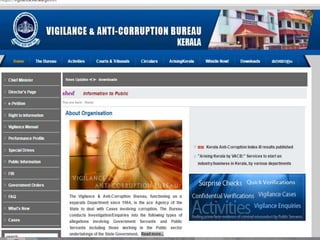
KERALA ANTI CORRUPTION INDEX
Major Functions of the Department
(i) Criminal misconduct of Public Servants as
defined in PC Act 1988.
(ii) Dishonest or improper conduct or abuse of
power by Public Servants.
(iii) Gross dereliction of duty or negligence.
(iv) Misappropriation of public funds involving
more than Rs. 5,00,000/-
(v) Amassment of wealth disproportionate to
the known sources of income.
(vi) Misuse of Public money or property.
(vii) Preventive vigilance actions and activities.
KERALA ANTI CORRUPTION INDEX
• to measure the level of corruption on a monthly basis in
this state.
• KAI is a group of 20 to 25 simple, composite indicators or
parameters upon which people feel or access corruption
that their see, hear or experience in everyday life.
• first of its kind in the country
• government's policy of 'zero tolerance to corruption'.
• to measure the level of corruption on a monthly basis in
the state.
• Then VACB director and DGP Jacob Thomas
• the objective is to evolve a "durable and sustainable"
mechanism to check corruption, which is possible only by
sensitising and empowering general public.
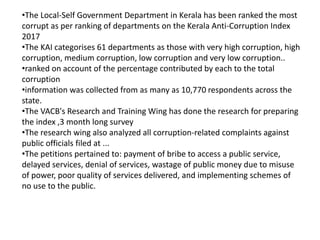
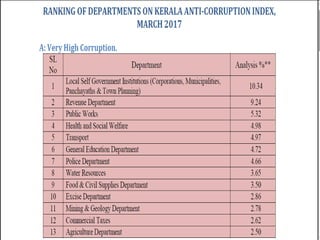
•The Local-Self Government Department in Kerala has been ranked the most
corrupt as per ranking of departments on the Kerala Anti-Corruption Index
2017
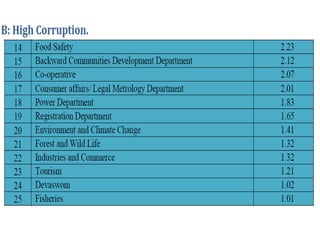
•The KAI categorises 61 departments as those with very high corruption, high
corruption, medium corruption, low corruption and very low corruption..
•ranked on account of the percentage contributed by each to the total
corruption
•information was collected from as many as 10,770 respondents across the
state.
•The VACB's Research and Training Wing has done the research for preparing
the index ,3 month long survey
•The research wing also analyzed all corruption-related complaints against
public officials filed at ...
•The petitions pertained to: payment of bribe to access a public service,
delayed services, denial of services, wastage of public money due to misuse
of power, poor quality of services delivered, and implementing schemes of
no use to the public.
Based on the survey results, the VACB has
recommended a host of measures to combat corruption.
They include:
• maximum utilization of the e-governance facility in
departments that interact directly with the general
public
• impart anti-corruption training to new recruits in the
departments that topped the list
• initiatives to ensure transparency in administration
and accountability in all the departments, etc.
INITIATIVES
•Mobile app:
whistle kerala,Arising Kerala
•Good governance audit
•Viginet
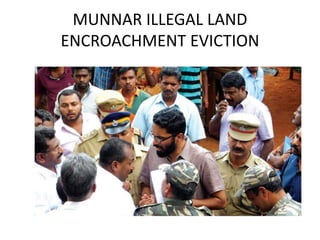
MUNNAR ILLEGAL LAND
ENCROACHMENT EVICTION
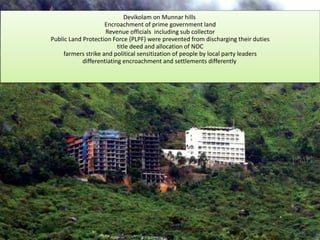
Devikolam on Munnar hills
Encroachment of prime government land
Revenue officials including sub collector
Public Land Protection Force (PLPF) were prevented from discharging their duties
title deed and allocation of NOC
farmers strike and political sensitization of people by local party leaders
differentiating encroachment and settlements differently
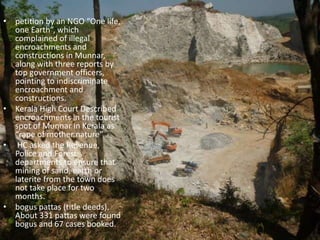
• petition by an NGO “One life,
one Earth”, which
complained of illegal
encroachments and
constructions in Munnar,
along with three reports by
top government officers,
pointing to indiscriminate
encroachment and
constructions.
• Kerala High Court Described
encroachments in the tourist
spot of Munnar in Kerala as
“rape of mother nature”
• HC asked the Revenue,
Police and Forest
departments to ensure that
mining of sand, earth or
laterite from the town does
not take place for two
months.
• bogus pattas (title deeds).
About 331 pattas were found
bogus and 67 cases booked.
• Land revenue Commissioner Report
• Want on destruction of environment
• land assigned under the Land Assignment Rules, 1964, cannot be
used for the construction of commercial buildings.
• Acquiring an NOC from the Revenue Department was held as a pre-
requisite for carrying out any construction in Munnar.
• Many of the places mentioned in the report belong to the category
of forest land although the ownership of them is with the revenue
authorities or private individuals.
• “The Supreme Court verdict clearly stipulates that forest land
cannot be used for non-forest purposes without prior permission
from the Ministry of Environment, Forests and Climate.
• The commercial building boom in the region is also posing grave
challenge to wild-life habitat in the region
• The unchecked construction disrupting the natural forest paths of
wild animals hitting their movement
• intensification of man-animal conflicts.
Story before:
• The first enquiry report was submitted by Additional Director
General of Police (Intelligence) Rajan K. Madhekar on April 1, 2004.
Following that P.C. Sanal Kumar, who was Secretary, Kerala Land Use
Board, and Principal Secretary (Revenue) Nivedita P. Haran
conducted enquiries into the encroachments.
• However, the government failed to evict most of the encroachers
and stem the wave of encroachments at Munnar due to high
political pressure( LDF Gov. 2005)
• The appointment of the fourth enquiry team comes in the wake of
stringent remarks by the Kerala High Court against the
government’s failure to check the encroachments and directive to
initiate action against the encroachers.
What gov. says…??
• Government would not treat those who had settled years ago in the district as
'encroachers‘.
• ban imposed on felling trees in farm land should be withdrawn.
• "What is required is a environmentally friendly building plan," .
Opposition says:
• Separate development authority required
• rules generally applicable to the State were not suitable to Munnar’s environment
and topography. It is important to have a separate development authority for
Munnar.
• A committee led by experts of the development authority should be entrusted
with the task of preparing a long-term plan for Munnar. Several high-rises were
under construction. At Pallivasal, KDH village and Chinnakkanal, 108 buildings
were constructed even after stop memos were issued, .
Scarce resource
Surprise checks
Punish guilty officials
Stern action needed
Distracting the public
Implement legislation
Reform politicians
THE REAL HERO:
• While the top bureaucracy remains reluctant to
handle the land encroachment-related issues, a
sub collector has raised the cudgels of law
against the land mafia and its encroachments in
Munnar.
• Devikulam sub collector V. Sriram refuses to be
cowed down by the threats of a minister, an MLA
and the local CPM leadership.
• Revenue Department has unearthed gross
violations in quarries in the area as well as other
parts of the district.
• In his report submitted to District Collector G
Gokul on March 20, Venkitaraman
recommended imposing a fine of Rs 5 to Rs 15
crore on quarry owners for evading government
royalty--Rs 50 for a tonne of rock.
• Quarry owners have been baying for
Venkitaraman’s blood after he took action
against violators by seizing 45 vehicles. They are
exerting pressure on the government and
political leaders to transfer him. They fear if he is
not checked, many quarries in Cardamom Hill
Reserve and patta lands will be closed for ever.
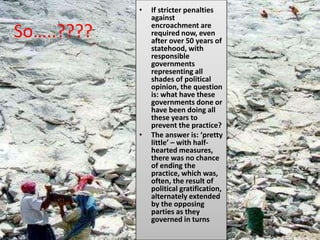
So…..????
• If stricter penalties
against
encroachment are
required now, even
after over 50 years of
statehood, with
responsible
governments
representing all
shades of political
opinion, the question
is: what have these
governments done or
have been doing all
these years to
prevent the practice?
• The answer is: ‘pretty
little’ – with half-
hearted measures,
there was no chance
of ending the
practice, which was,
often, the result of
political gratification,
alternately extended
by the opposing
parties as they
governed in turns

DEVELOPMENT ADMINISTRATION

  • 1.
    Development Administration- Examplesfrom Kerala HOW TO ADMINISTRATE DEVELOPMENT??? ANUPAMA PRADEEPAN
  • 3.
  • 5.
    Major Functions ofthe Department (i) Criminal misconduct of Public Servants as defined in PC Act 1988. (ii) Dishonest or improper conduct or abuse of power by Public Servants. (iii) Gross dereliction of duty or negligence. (iv) Misappropriation of public funds involving more than Rs. 5,00,000/- (v) Amassment of wealth disproportionate to the known sources of income. (vi) Misuse of Public money or property. (vii) Preventive vigilance actions and activities.
  • 6.
    KERALA ANTI CORRUPTIONINDEX • to measure the level of corruption on a monthly basis in this state. • KAI is a group of 20 to 25 simple, composite indicators or parameters upon which people feel or access corruption that their see, hear or experience in everyday life. • first of its kind in the country • government's policy of 'zero tolerance to corruption'. • to measure the level of corruption on a monthly basis in the state. • Then VACB director and DGP Jacob Thomas • the objective is to evolve a "durable and sustainable" mechanism to check corruption, which is possible only by sensitising and empowering general public.
  • 7.
    •The Local-Self GovernmentDepartment in Kerala has been ranked the most corrupt as per ranking of departments on the Kerala Anti-Corruption Index 2017 •The KAI categorises 61 departments as those with very high corruption, high corruption, medium corruption, low corruption and very low corruption.. •ranked on account of the percentage contributed by each to the total corruption •information was collected from as many as 10,770 respondents across the state. •The VACB's Research and Training Wing has done the research for preparing the index ,3 month long survey •The research wing also analyzed all corruption-related complaints against public officials filed at ... •The petitions pertained to: payment of bribe to access a public service, delayed services, denial of services, wastage of public money due to misuse of power, poor quality of services delivered, and implementing schemes of no use to the public.
  • 13.
    Based on thesurvey results, the VACB has recommended a host of measures to combat corruption. They include: • maximum utilization of the e-governance facility in departments that interact directly with the general public • impart anti-corruption training to new recruits in the departments that topped the list • initiatives to ensure transparency in administration and accountability in all the departments, etc.
  • 14.
    INITIATIVES •Mobile app: whistle kerala,ArisingKerala •Good governance audit •Viginet
  • 15.
  • 16.
    Devikolam on Munnarhills Encroachment of prime government land Revenue officials including sub collector Public Land Protection Force (PLPF) were prevented from discharging their duties title deed and allocation of NOC farmers strike and political sensitization of people by local party leaders differentiating encroachment and settlements differently
  • 17.
    • petition byan NGO “One life, one Earth”, which complained of illegal encroachments and constructions in Munnar, along with three reports by top government officers, pointing to indiscriminate encroachment and constructions. • Kerala High Court Described encroachments in the tourist spot of Munnar in Kerala as “rape of mother nature” • HC asked the Revenue, Police and Forest departments to ensure that mining of sand, earth or laterite from the town does not take place for two months. • bogus pattas (title deeds). About 331 pattas were found bogus and 67 cases booked.
  • 18.
    • Land revenueCommissioner Report • Want on destruction of environment • land assigned under the Land Assignment Rules, 1964, cannot be used for the construction of commercial buildings. • Acquiring an NOC from the Revenue Department was held as a pre- requisite for carrying out any construction in Munnar. • Many of the places mentioned in the report belong to the category of forest land although the ownership of them is with the revenue authorities or private individuals. • “The Supreme Court verdict clearly stipulates that forest land cannot be used for non-forest purposes without prior permission from the Ministry of Environment, Forests and Climate. • The commercial building boom in the region is also posing grave challenge to wild-life habitat in the region • The unchecked construction disrupting the natural forest paths of wild animals hitting their movement • intensification of man-animal conflicts.
  • 19.
    Story before: • Thefirst enquiry report was submitted by Additional Director General of Police (Intelligence) Rajan K. Madhekar on April 1, 2004. Following that P.C. Sanal Kumar, who was Secretary, Kerala Land Use Board, and Principal Secretary (Revenue) Nivedita P. Haran conducted enquiries into the encroachments. • However, the government failed to evict most of the encroachers and stem the wave of encroachments at Munnar due to high political pressure( LDF Gov. 2005) • The appointment of the fourth enquiry team comes in the wake of stringent remarks by the Kerala High Court against the government’s failure to check the encroachments and directive to initiate action against the encroachers.
  • 21.
    What gov. says…?? •Government would not treat those who had settled years ago in the district as 'encroachers‘. • ban imposed on felling trees in farm land should be withdrawn. • "What is required is a environmentally friendly building plan," . Opposition says: • Separate development authority required • rules generally applicable to the State were not suitable to Munnar’s environment and topography. It is important to have a separate development authority for Munnar. • A committee led by experts of the development authority should be entrusted with the task of preparing a long-term plan for Munnar. Several high-rises were under construction. At Pallivasal, KDH village and Chinnakkanal, 108 buildings were constructed even after stop memos were issued, .
  • 22.
    Scarce resource Surprise checks Punishguilty officials Stern action needed Distracting the public Implement legislation Reform politicians
  • 23.
    THE REAL HERO: •While the top bureaucracy remains reluctant to handle the land encroachment-related issues, a sub collector has raised the cudgels of law against the land mafia and its encroachments in Munnar. • Devikulam sub collector V. Sriram refuses to be cowed down by the threats of a minister, an MLA and the local CPM leadership. • Revenue Department has unearthed gross violations in quarries in the area as well as other parts of the district. • In his report submitted to District Collector G Gokul on March 20, Venkitaraman recommended imposing a fine of Rs 5 to Rs 15 crore on quarry owners for evading government royalty--Rs 50 for a tonne of rock. • Quarry owners have been baying for Venkitaraman’s blood after he took action against violators by seizing 45 vehicles. They are exerting pressure on the government and political leaders to transfer him. They fear if he is not checked, many quarries in Cardamom Hill Reserve and patta lands will be closed for ever.
  • 24.
    So…..???? • If stricterpenalties against encroachment are required now, even after over 50 years of statehood, with responsible governments representing all shades of political opinion, the question is: what have these governments done or have been doing all these years to prevent the practice? • The answer is: ‘pretty little’ – with half- hearted measures, there was no chance of ending the practice, which was, often, the result of political gratification, alternately extended by the opposing parties as they governed in turns

Editor's Notes