Desmurgy is a branch of surgery which is
related to dressings and bandages, techniques
of making
Bandages are an integral part of the First Aid
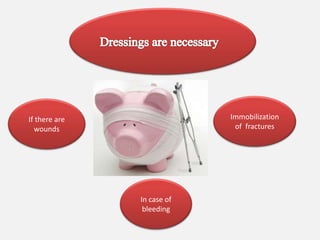
If there are
wounds
In case of
bleeding
Immobilization
of fractures
Antiseptic
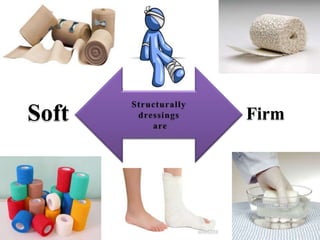
Soft Firm
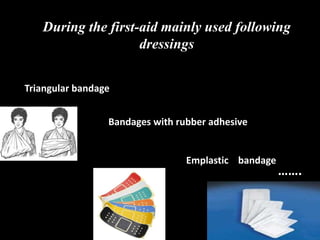
During the first-aid mainly used following
dressings
Triangular bandage
Bandages with rubber adhesive
Emplastic bandage


.
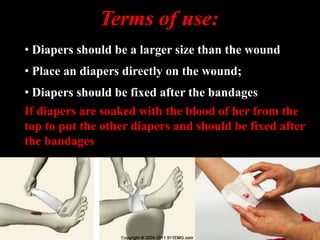
Terms of use:
‱ Diapers should be a larger size than the wound
‱ Place an diapers directly on the wound;
‱ Diapers should be fixed after the bandages
If diapers are soaked with the blood of her from the
top to put the other diapers and should be fixed after
the bandages
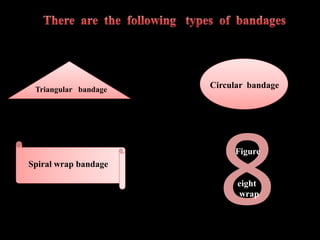
Triangular bandage
Circular bandage
Spiral wrap bandage
Figure
eight
wrap
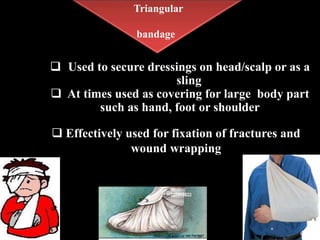
Triangular
bandage
 Used to secure dressings on head/scalp or as a
sling
 At times used as covering for large body part
such as hand, foot or shoulder
 Effectively used for fixation of fractures and
wound wrapping
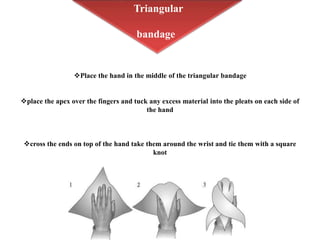
Place the hand in the middle of the triangular bandage
place the apex over the fingers and tuck any excess material into the pleats on each side of
the hand
cross the ends on top of the hand take them around the wrist and tie them with a square
knot
Triangular
bandage
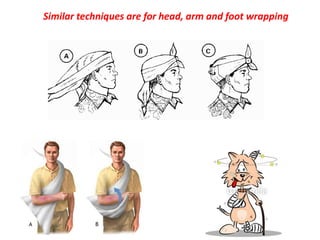
Similar techniques are for head, arm and foot wrapping
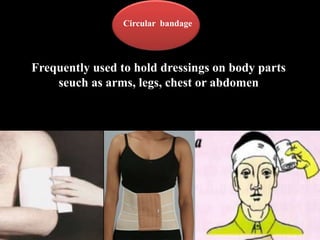
Circular bandage
Frequently used to hold dressings on body parts
seuch as arms, legs, chest or abdomen
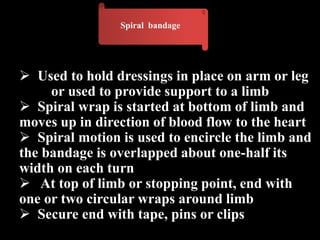
Spiral bandage
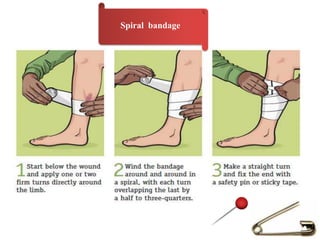
 Used to hold dressings in place on arm or leg
or used to provide support to a limb
 Spiral wrap is started at bottom of limb and
moves up in direction of blood flow to the heart
 Spiral motion is used to encircle the limb and
the bandage is overlapped about one-half its
width on each turn
 At top of limb or stopping point, end with
one or two circular wraps around limb
 Secure end with tape, pins or clips
Spiral bandage
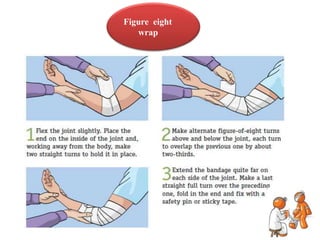
Figure eight
wrap
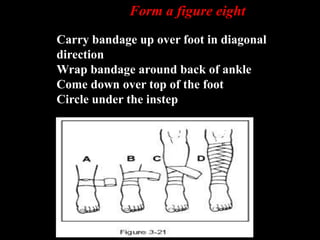
Form a figure eight
Carry bandage up over foot in diagonal
direction
Wrap bandage around back of ankle
Come down over top of the foot
Circle under the instep
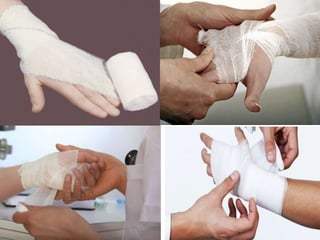
Recurrent wrap to finger
o Used to hold dressing or splint on finger
o Fold bandage backward and forward over finger three to
four times to form a recurrent wrap
o Start at bottom of finger and use spiral wrap up and down
the finger to hold recurrent wraps in position
o Use a figure eight around the wrist to hold bandage in place
o End with one or two circular wraps around the wrist
Tie, tape or pin bandage at the wrist
Bandages on the head
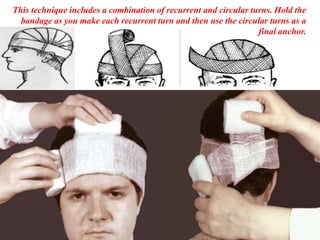
This technique includes a combination of recurrent and circular turns. Hold the
bandage as you make each recurrent turn and then use the circular turns as a
final anchor.
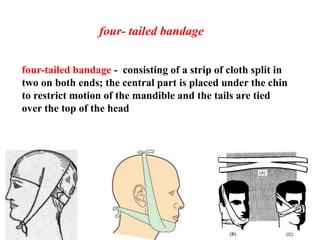
four- tailed bandage
four-tailed bandage - consisting of a strip of cloth split in
two on both ends; the central part is placed under the chin
to restrict motion of the mandible and the tails are tied
over the top of the head
And finally Check the circulation
 Important to check circulation after bandage
applied to make sure bandage
is not too tight
 Signs of poor or impaired circulation
1. Swelling or edema
2. Pale or cyanotic color
3. Coldness to touch
4. Numbness or tingling
5. Poor or slow return to pink color after nailbeds are
blanched
 Loosen bandages immediately if any signs of
impaired circulation are noted
Thank you for your
attention!

Desmurgy

  • 2.
    Desmurgy is abranch of surgery which is related to dressings and bandages, techniques of making Bandages are an integral part of the First Aid
  • 3.
    If there are wounds Incase of bleeding Immobilization of fractures
  • 4.
  • 5.
  • 6.
    During the first-aidmainly used following dressings Triangular bandage Bandages with rubber adhesive Emplastic bandage 

.
  • 7.
    Terms of use: ‱Diapers should be a larger size than the wound ‱ Place an diapers directly on the wound; ‱ Diapers should be fixed after the bandages If diapers are soaked with the blood of her from the top to put the other diapers and should be fixed after the bandages
  • 8.
    Triangular bandage Circular bandage Spiralwrap bandage Figure eight wrap
  • 9.
    Triangular bandage  Used tosecure dressings on head/scalp or as a sling  At times used as covering for large body part such as hand, foot or shoulder  Effectively used for fixation of fractures and wound wrapping
  • 10.
    Place the handin the middle of the triangular bandage place the apex over the fingers and tuck any excess material into the pleats on each side of the hand cross the ends on top of the hand take them around the wrist and tie them with a square knot Triangular bandage
  • 11.
    Similar techniques arefor head, arm and foot wrapping
  • 12.
    Circular bandage Frequently usedto hold dressings on body parts seuch as arms, legs, chest or abdomen
  • 13.
    Spiral bandage  Usedto hold dressings in place on arm or leg or used to provide support to a limb  Spiral wrap is started at bottom of limb and moves up in direction of blood flow to the heart  Spiral motion is used to encircle the limb and the bandage is overlapped about one-half its width on each turn  At top of limb or stopping point, end with one or two circular wraps around limb  Secure end with tape, pins or clips
  • 14.
  • 15.
  • 16.
    Form a figureeight Carry bandage up over foot in diagonal direction Wrap bandage around back of ankle Come down over top of the foot Circle under the instep
  • 17.
    Recurrent wrap tofinger o Used to hold dressing or splint on finger o Fold bandage backward and forward over finger three to four times to form a recurrent wrap o Start at bottom of finger and use spiral wrap up and down the finger to hold recurrent wraps in position o Use a figure eight around the wrist to hold bandage in place o End with one or two circular wraps around the wrist Tie, tape or pin bandage at the wrist
  • 19.
  • 20.
    This technique includesa combination of recurrent and circular turns. Hold the bandage as you make each recurrent turn and then use the circular turns as a final anchor.
  • 21.
    four- tailed bandage four-tailedbandage - consisting of a strip of cloth split in two on both ends; the central part is placed under the chin to restrict motion of the mandible and the tails are tied over the top of the head
  • 22.
    And finally Checkthe circulation  Important to check circulation after bandage applied to make sure bandage is not too tight  Signs of poor or impaired circulation 1. Swelling or edema 2. Pale or cyanotic color 3. Coldness to touch 4. Numbness or tingling 5. Poor or slow return to pink color after nailbeds are blanched  Loosen bandages immediately if any signs of impaired circulation are noted
  • 23.
    Thank you foryour attention!