CNCFT
Key concepts incomputer science include algorithms,
which serve as the fundamental building blocks of
computational tasks. Algorithms are essential for solving
problems efficiently and play a crucial role in various
applications, from search engines to cryptography. Data
structures refer to the methods of organizing and storing
data to facilitate access and modification. Examples
include arrays, linked lists, trees, and graphs. Artificial
intelligence (AI) involves the development of systems
capable of performing tasks that typically require human
intelligence, such as learning, reasoning, problem-
solving, perception, and language understanding.
Présentation de l’entreprise d’accueil
2.
Etude de
l’existant
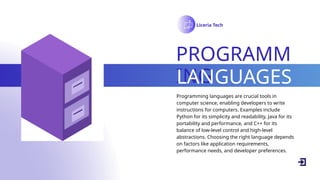
Programming languagesare crucial tools in
computer science, enabling developers to write
instructions for computers. Examples include
Python for its simplicity and readability, Java for its
portability and performance, and C++ for its
balance of low-level control and high-level
abstractions. Choosing the right language depends
on factors like application requirements,
performance needs, and developer preferences.
Analyse de l’existant
3.
Programming languages arecrucial tools in
computer science, enabling developers to write
instructions for computers. Examples include
Python for its simplicity and readability, Java for its
portability and performance, and C++ for its
balance of low-level control and high-level
abstractions. Choosing the right language depends
on factors like application requirements,
performance needs, and developer preferences.
Programming languages are crucial tools in
computer science, enabling developers to write
instructions for computers. Examples include
Python for its simplicity and readability, Java for its
portability and performance, and C++ for its
balance of low-level control and high-level
abstractions. Choosing the right language depends
on factors like application requirements,
performance needs, and developer preferences.
4.
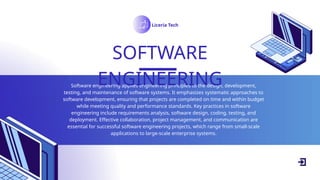
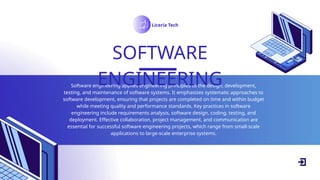
Software engineering appliesengineering principles to the design, development,
testing, and maintenance of software systems. It emphasizes systematic approaches to
software development, ensuring that projects are completed on time and within budget
while meeting quality and performance standards. Key practices in software
engineering include requirements analysis, software design, coding, testing, and
deployment. Effective collaboration, project management, and communication are
essential for successful software engineering projects, which range from small-scale
applications to large-scale enterprise systems.
SOFTWARE
ENGINEERING
Liceria Tech
5.
DATA
SCIENCE
Liceria Tech
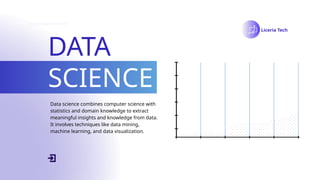
Data sciencecombines computer science with
statistics and domain knowledge to extract
meaningful insights and knowledge from data.
It involves techniques like data mining,
machine learning, and data visualization.
6.
CYBERSECURITY
Liceria Tech
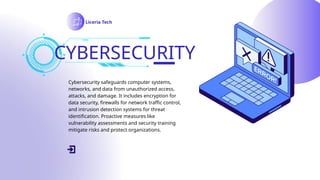
Cybersecurity safeguardscomputer systems,
networks, and data from unauthorized access,
attacks, and damage. It includes encryption for
data security, firewalls for network traffic control,
and intrusion detection systems for threat
identification. Proactive measures like
vulnerability assessments and security training
mitigate risks and protect organizations.
7.
Liceria Tech
ARTIFICIAL
INTELLIGEN
CE
Artificial Intelligence(AI) enables machines to
perform tasks requiring human-like intelligence,
such as learning from data, problem-solving, and
understanding natural language. AI technologies
include machine learning algorithms, neural
networks, and expert systems. Applications span
industries like healthcare, finance, transportation,
and entertainment, revolutionizing how tasks are
automated and decisions are made.
8.
FUTURE TRENDS
Liceria Tech
Thefuture of computer science is shaped by emerging technologies and evolving
trends that promise to transform industries and society. Quantum computing
represents a paradigm shift in computational power, enabling calculations that are
beyond the capabilities of classical computers. The Internet of Things (IoT) connects
everyday objects to the internet, creating vast networks of interconnected devices
that can share data and automate processes. Augmented reality (AR) and virtual
reality (VR) enhance user experiences by overlaying digital information onto the
physical world or creating immersive virtual environments. Biocomputing explores
the intersection of biology and computer science, using biological materials and
processes to develop new computing paradigms and technologies.
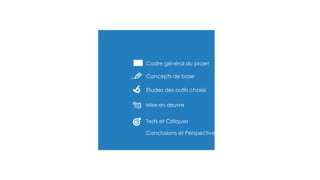
Cadre général duprojet
Concepts de base
Etudes des outils choisis
Mise en œuvre
Tests et Critiques
Conclusions et Perspectives
11.
Liceria Tech
PROGRAMM
ING
LANGUAGES
Programming languagesare crucial tools in
computer science, enabling developers to write
instructions for computers. Examples include
Python for its simplicity and readability, Java for its
portability and performance, and C++ for its
balance of low-level control and high-level
abstractions. Choosing the right language depends
on factors like application requirements,
performance needs, and developer preferences.
12.
Software engineering appliesengineering principles to the design, development,
testing, and maintenance of software systems. It emphasizes systematic approaches to
software development, ensuring that projects are completed on time and within budget
while meeting quality and performance standards. Key practices in software
engineering include requirements analysis, software design, coding, testing, and
deployment. Effective collaboration, project management, and communication are
essential for successful software engineering projects, which range from small-scale
applications to large-scale enterprise systems.
SOFTWARE
ENGINEERING
Liceria Tech
13.
DATA
SCIENCE
Liceria Tech
Data sciencecombines computer science with
statistics and domain knowledge to extract
meaningful insights and knowledge from data.
It involves techniques like data mining,
machine learning, and data visualization.
14.
CYBERSECURITY
Liceria Tech
Cybersecurity safeguardscomputer systems,
networks, and data from unauthorized access,
attacks, and damage. It includes encryption for
data security, firewalls for network traffic control,
and intrusion detection systems for threat
identification. Proactive measures like
vulnerability assessments and security training
mitigate risks and protect organizations.
15.
Liceria Tech
ARTIFICIAL
INTELLIGEN
CE
Artificial Intelligence(AI) enables machines to
perform tasks requiring human-like intelligence,
such as learning from data, problem-solving, and
understanding natural language. AI technologies
include machine learning algorithms, neural
networks, and expert systems. Applications span
industries like healthcare, finance, transportation,
and entertainment, revolutionizing how tasks are
automated and decisions are made.
16.
FUTURE TRENDS
Liceria Tech
Thefuture of computer science is shaped by emerging technologies and evolving
trends that promise to transform industries and society. Quantum computing
represents a paradigm shift in computational power, enabling calculations that are
beyond the capabilities of classical computers. The Internet of Things (IoT) connects
everyday objects to the internet, creating vast networks of interconnected devices
that can share data and automate processes. Augmented reality (AR) and virtual
reality (VR) enhance user experiences by overlaying digital information onto the
physical world or creating immersive virtual environments. Biocomputing explores
the intersection of biology and computer science, using biological materials and
processes to develop new computing paradigms and technologies.