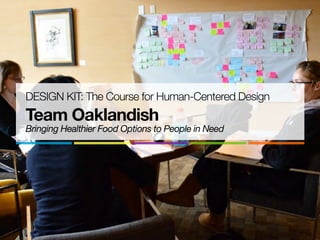
DESIGN KIT: The Course for Human-Centered Design
Team Oaklandish
Bringing Healthier Food Options to People in Need
The Process
2
The Challenge Inspiration Our Insights Our Solution
3 6 14 29 34
DESIGN KIT: The Course for Human-Centered Design
The Process
3
The Human-Centered Design Process
Pioneered by IDEO, the HCD process asks its practitioners to approach
developing design solutions to social challenges by focusing on the needs of
its end users, channeling deep empathy and gathering constant feedback
while continually generating and iterating on ideas in a convergent and
divergent manner.
4
Inspiration Ideation Implementation
The Human-Centered Design Process
Our Team:
Team Oaklandish
Alex Krzyzosiak
Cindy Bayley
Celeste Layne
Radha Seshagiri
Tammy Chung
5
DESIGN KIT: The Course for Human-Centered Design
The Challenge
6
How Might We Provide Healthier
Food Options for People in Need?
7
How Might We
Provide Healthier
Food Options for
People in Need?
As part of this design
challenge, the team
considered existing barriers to
getting healthier food options
to low-income residents of
West Oakland including
infrastructure, distribution,
storage, education, access,
and capital
8
With consideration to our
end-users, we have defined
“healthier” to mean:
Primarily:
Balanced Meal
Unprocessed / Fresh
Vegetables & Fruits (shelf stable)
Secondarily:
Low Salt / Low Sugar
Home-cooked
Organic
But what do
we mean by
“healthier”?
9
Source: City Slicker Farms http://www.cityslickerfarms.org/west-oakland;
https://oaklandnorth.net/few-food-choices/
“It is easier to stay drunk
than it is to eat”
- Oakland resident Gregory Higgins
West Oakland is a food desert where
there is an average of only one
supermarket per 93,126 residents
Why West
Oakland?
10
In contrast, there are over 40 liquor
stores selling tobacco, alcohol, and
little to no fresh foods
Access to healthy food is further
restricted due to economic reasons:
the average household has three
people and an income of only
$21,124 per year—32% of the
21,000 residents live below the
poverty level
Source: City Slicker Farms http://www.cityslickerfarms.org/west-oakland;
https://oaklandnorth.net/few-food-choices/
11
We tested our own knowledge...
What do we know?
Food is cultural
Produce markets are a short bus
ride away
There are existing organizations
dedicated to relieving food access
issues in West Oakland
What are our assumptions?
Food waste (from produce markets,
farms) in the area is an issue
Healthy food is expensive
Healthy food is boring
12
... And determined our gaps
What don’t we know? What do we have to find out?
Why is there a disconnect between availability in nearby Chinatown and
people in need in other parts of Oakland?
How do people choose what they eat?
What current infrastructure for food access is in place and available?
What are people’s perceptions about food, healthy vs. unhealthy?
13
DESIGN KIT: The Course for Human-Centered Design
Inspiration
14
Seeking Inspiration
In light of our information gaps, the team identified several key people
and organizations to immerse ourselves into West Oakland’s challenge:
• Families located in West
Oakland’s food deserts
• Children attending public schools
in the region
• Food distributors
• Nutritionists
• Food suppliers
• City Slicker Farms (local urban farming
organization)
• Social worker and child behavioralist
People to Learn From: Experts to Speak to:
15
Seeking Inspiration
Our learning could be grouped into three distinct themes:
1. Knowledge
2. Resources
3. Motivation
16
Knowledge
There are varying degrees to how much
knowledge residents have regarding
how to cook and eat healthfully. Further,
there is varying opinion as to which
foods qualify as “healthy”
17
“You have to consider their
economic status and what they
can afford to eat. It would be
unfair to say you have to buy
everything fresh. It’s important to
find a good balance.”
- Andrea Robles,
Nutrition Researcher at Stanford University
18
“The vegetables at
school aren’t salty
enough - they need to
have ‘zang’ [ to taste
good ]!”
- Destiny, 10 years old,
student at KIPP Bridge
19
“Many people have trouble
understanding food labels”
- Andrea Robles,
Nutrition Researcher at Stanford University
20
Resources
Residents lack time to reach
supermarkets where they may find
healthier food and lack access to
infrastructure for which to cook
more healthfully
21
22
“I would buy milk and bread for
my son at the liquor store.”
- Jennifer Dhillon,
West Oakland resident
“People in the neighborhood can cook food here
on the spot [if they don’t have access to
kitchens]... If time is tight, they can make a juice.”
- Larry Davis, People’s Grocery
23
Motivation
Eating is emotional—there is a need to
stay sensitive to existing cultural norms
around eating and communicating
about food
24
“Even though these programs
exist, many low income families
in need are too embarrassed to
actually use them”
- Maddy Conboy, Social Worker /
Child Behavioralist
25
“Culturally appropriate
food is sometimes in
conflict with what’s
considered healthy”
- Joseph Davis,
City Slicker Farms
26
“We need to be intentional about outreach”
- Andrionna, Mandela Food Cooperative
27
“Word of mouth is
the primary way
people hear about
City Slicker Farms.”
- Joseph Davis,
City Slicker Farms
28
DESIGN KIT: The Course for Human-Centered Design
Our Insights
29
Insights Into Opportunities
Our research provided insights and the framework for opportunity areas
for which to design against:
1. Existing Behaviors
2. Food Waste & Food Surplus
3. Grassroots Communication
30
INSIGHT 1
Existing
Behaviors
INSIGHT
People often have engrained
existing behaviors around
food that can act as a barrier
to eating balanced and
healthfully
How might we enable more
balanced (healthy) eating
over time by understanding
and leveraging people's
existing behaviors around
food?
HMW Q
31
INSIGHT 2
Food Waste &
Food Surplus
INSIGHT
There is often limited access
to food, but at the same time,
some organizations often
have a surplus of food
How might we bridge the
gap between lack of access
to food and existing surplus
of food?
32
HMW Q
INSIGHT 3
Grassroots
Communication
INSIGHT
Organizers find grassroots
methods of communication
most effective
How might we leverage
grassroots means to bring
awareness to healthy eating
options and behaviors?
33
HMW Q
DESIGN KIT: The Course for Human-Centered Design
Our Solution
34
Insights Into Ideas
35
Given our three ‘how might we’ questions, the
team ideated around potential design solutions,
rapidly generating a large volume of ideas to
capture the gamut of opportunities and to build off
of one another’s ideas
Our Solution:
A Liquor Store Redesign
36
A Liquor Store
Redesign
How Might We Provide
Healthier Food Options for
People in Need?
With the insight that there is
and excess of liquor stores in
West Oakland where residents
often visit to re-stock on staple
food products, we identified
an opportunity to leverage
people’s existing behaviors
in order to implement
incremental change.
37
A Liquor Store
Redesign
OUR IDEA
A Healthy Oakland,
A Healthy You:
A partnership amongst West
Oakland corner stores bringing
healthy foods within reach
An effort to redesign the
liquor store to better
promote healthy and
balanced eating, meeting
people where they buy
their food today
38
39
A Healthy Oakland,
A Healthy You
Our team ideated realistic
solutions for corner store
owners that were low-cost
and easy to implement.
Further, to take into
account each customers’
varying circumstances, we
incorporated a dual-level
pricing system.
Branded signage
to draw recognition
amongst the
network of partners
40
Low-cost, versatile, mobile
cart unit that is easily
collapsable (for storage) and
adaptable for a variety of
store layouts
Tiered pricing based on
an ‘honor system.’
Customers decide
whether they can afford
the full price or need to
purchase food at a
reduced rate
A Healthy Oakland,
A Healthy You
PROTOTYPE A
A cart outside displays
healthy, fresh food. This
food is surplus food
collected from local
organizations and is sold at
a heavily discounted price.
41
SIGNAGE:
Our Mission
To provide accessible, healthy food
for West Oakland residents, taking
into account each of our customers’
different circumstances.
Pick a Pricing Level:
Level A – Reduced Price
For when money is tight and income
is intermittent.
Level B – Regular Price
For those who have greater access
to cash, pay a little more to help a
neighbor!
Branded signage and a
mission statement with
information about the
dual pricing model
42
A Healthy Oakland,
A Healthy You
PROTOTYPE B
An indoor cart/unit, clearly
displays healthy, shelf-stable
options below the register
where customers are
making their purchases.
Hearing About the Store
Jennifer hears from a
neighbor about how the
corner store down the block
is now selling an expanded
offering of fresh groceries
and shelf stable vegetables
and fruit.
Discovery
Jennifer has decided to make
chicken, rice, beans and collard
greens for dinner. While the kids
are at school, she goes to the
corner store to check out the
assortment. She realizes that
there’s now a new produce cart
outside the store
Meet Jennifer
37, Nurse’s Aid
(night shift)
Resident of West
Oakland with two kids
(10, 13 yo), and a single
parent
43
The Experience
The Experience
Checking-Out
She sees the pricing sign near
the shelf and learns about the
dual-level pricing system. A
reduced rate is available for
those who aren’t able to
afford the full price. She pays
the reduced rate, as money is
currently tight for her family.
Healthy Meals at Home
Jennifer cooks her family’s
favorite meal and is happy
that she had time to
prepare it before she had
to leave for work. She’s
especially glad that her kids
are happy and full.
Initial Purchase
Jennifer picks up collard
greens from the cart outside
and continues to enter the
corner store. Immediately,
she sees there’s a new
dedicated section to shelf
stable vegetables.
44
The Experience
Spreading the Word
Jennifer runs into her friend
Paul, who asks to borrow milk
and eggs. She tells him how
easy it is now to pick up fresh
groceries at the corner store
down the street. Paul had no
idea about the change to the
store, and goes the next day.
Full Adoption
Next time, Jennifer takes her
kids to the corner store, which
now comes to mind first when
she thinks about buying
groceries for dinner. She tells
her kids that they can come
by to purchase groceries
when she’s unable to.
45
Testing Our
Prototype
46
To test our prototype, we
leveraged our diagrams to
gather feedback from those
outside of our process, role
playing with them to discover
the concept’s strengths and
areas for improvement.
^ Prototype A
Prototype B >
Feedback: Strengths to Leverage
47
• Cart: A mobile, versatile, and approachable way to introduce healthier
foods into the corner store setting
• Branded Element: Brings credibility, imbues Oakland pride, and is a
recognizable element (e.g., badge, signage, colors); consider using badge
to brand produce
Feedback: Potential Barriers to Consider
48
• Pricing Ambiguity: May need further guidance to customers on how to
determine their level; honor system may cause an awkward disposition for
customers; the proposition may not be relevant to level B customers (thus,
potentially no need for different levels)
• Corner Store Owners’ POV: May not have capacity (shelf space, floor
space) or resources to upkeep; may not be incentivized to house the cart
within their stores
Feedback: Ideas to Build Upon
49
• Identify the Source: Leverage signage or other materials to indicate where
the fresh produce is sourced from (e.g., local farms, nearby city farms)
• Share Inspiration: Display and distribute 10-minute recipe cards,
pamphlets with tips on cooking more healthfully, and suggest alternatives to
foods and beverages
• Educational Materials: Leverage space to provide information on serving
suggestions and other nutritional benefits
What’s Next?
The Design Kit: The Course for Human Centered Design course concludes at
the Implementation phase, whereby the team identifies key next steps to bring
A Healthy Oakland, A Healthy You to life:
• Continued prototyping and iteration incorporating feedback received
• Identification of key roles necessary to staff to execute on our plan, including:
operations, inventory management, community outreach, development, and
design & engineering
• Preparation for sell-in, including a pitch for funders
50
West Oakland is classified as a food
desert—for every 93,000 residents,
there is only one supermarket. A
Healthy Oakland, A Healthy You is a
partnership among West Oakland
corner stores aiming to address this
issue and bring healthy food within
reach. By designing a new approach
to leverage surplus food for people in
need, the corner store will become a
convenient resource for local
residents to buy healthier food
options right in their neighborhood.
THEPITCH
Thank You!
Team Oaklandish wishes to thank the folks at IDEO.org and +ACUMEN for
introducing us to a new way of thinking, and our fellow classmates for their
feedback and inspiration.
- Alex, Celeste, Cindy, Radha & Tammy
51
DESIGN KIT: The Course for Human-Centered Design
Team Oaklandish
Bringing Healthier Food Options to People in Need
52

Design Kit: Human-Centered Design - Team Oaklandish

  • 1.
    DESIGN KIT: TheCourse for Human-Centered Design Team Oaklandish Bringing Healthier Food Options to People in Need
  • 2.
    The Process 2 The ChallengeInspiration Our Insights Our Solution 3 6 14 29 34
  • 3.
    DESIGN KIT: TheCourse for Human-Centered Design The Process 3
  • 4.
    The Human-Centered DesignProcess Pioneered by IDEO, the HCD process asks its practitioners to approach developing design solutions to social challenges by focusing on the needs of its end users, channeling deep empathy and gathering constant feedback while continually generating and iterating on ideas in a convergent and divergent manner. 4 Inspiration Ideation Implementation
  • 5.
    The Human-Centered DesignProcess Our Team: Team Oaklandish Alex Krzyzosiak Cindy Bayley Celeste Layne Radha Seshagiri Tammy Chung 5
  • 6.
    DESIGN KIT: TheCourse for Human-Centered Design The Challenge 6
  • 7.
    How Might WeProvide Healthier Food Options for People in Need? 7
  • 8.
    How Might We ProvideHealthier Food Options for People in Need? As part of this design challenge, the team considered existing barriers to getting healthier food options to low-income residents of West Oakland including infrastructure, distribution, storage, education, access, and capital 8
  • 9.
    With consideration toour end-users, we have defined “healthier” to mean: Primarily: Balanced Meal Unprocessed / Fresh Vegetables & Fruits (shelf stable) Secondarily: Low Salt / Low Sugar Home-cooked Organic But what do we mean by “healthier”? 9
  • 10.
    Source: City SlickerFarms http://www.cityslickerfarms.org/west-oakland; https://oaklandnorth.net/few-food-choices/ “It is easier to stay drunk than it is to eat” - Oakland resident Gregory Higgins West Oakland is a food desert where there is an average of only one supermarket per 93,126 residents Why West Oakland? 10
  • 11.
    In contrast, thereare over 40 liquor stores selling tobacco, alcohol, and little to no fresh foods Access to healthy food is further restricted due to economic reasons: the average household has three people and an income of only $21,124 per year—32% of the 21,000 residents live below the poverty level Source: City Slicker Farms http://www.cityslickerfarms.org/west-oakland; https://oaklandnorth.net/few-food-choices/ 11
  • 12.
    We tested ourown knowledge... What do we know? Food is cultural Produce markets are a short bus ride away There are existing organizations dedicated to relieving food access issues in West Oakland What are our assumptions? Food waste (from produce markets, farms) in the area is an issue Healthy food is expensive Healthy food is boring 12
  • 13.
    ... And determinedour gaps What don’t we know? What do we have to find out? Why is there a disconnect between availability in nearby Chinatown and people in need in other parts of Oakland? How do people choose what they eat? What current infrastructure for food access is in place and available? What are people’s perceptions about food, healthy vs. unhealthy? 13
  • 14.
    DESIGN KIT: TheCourse for Human-Centered Design Inspiration 14
  • 15.
    Seeking Inspiration In lightof our information gaps, the team identified several key people and organizations to immerse ourselves into West Oakland’s challenge: • Families located in West Oakland’s food deserts • Children attending public schools in the region • Food distributors • Nutritionists • Food suppliers • City Slicker Farms (local urban farming organization) • Social worker and child behavioralist People to Learn From: Experts to Speak to: 15
  • 16.
    Seeking Inspiration Our learningcould be grouped into three distinct themes: 1. Knowledge 2. Resources 3. Motivation 16
  • 17.
    Knowledge There are varyingdegrees to how much knowledge residents have regarding how to cook and eat healthfully. Further, there is varying opinion as to which foods qualify as “healthy” 17
  • 18.
    “You have toconsider their economic status and what they can afford to eat. It would be unfair to say you have to buy everything fresh. It’s important to find a good balance.” - Andrea Robles, Nutrition Researcher at Stanford University 18
  • 19.
    “The vegetables at schoolaren’t salty enough - they need to have ‘zang’ [ to taste good ]!” - Destiny, 10 years old, student at KIPP Bridge 19
  • 20.
    “Many people havetrouble understanding food labels” - Andrea Robles, Nutrition Researcher at Stanford University 20
  • 21.
    Resources Residents lack timeto reach supermarkets where they may find healthier food and lack access to infrastructure for which to cook more healthfully 21
  • 22.
    22 “I would buymilk and bread for my son at the liquor store.” - Jennifer Dhillon, West Oakland resident
  • 23.
    “People in theneighborhood can cook food here on the spot [if they don’t have access to kitchens]... If time is tight, they can make a juice.” - Larry Davis, People’s Grocery 23
  • 24.
    Motivation Eating is emotional—thereis a need to stay sensitive to existing cultural norms around eating and communicating about food 24
  • 25.
    “Even though theseprograms exist, many low income families in need are too embarrassed to actually use them” - Maddy Conboy, Social Worker / Child Behavioralist 25
  • 26.
    “Culturally appropriate food issometimes in conflict with what’s considered healthy” - Joseph Davis, City Slicker Farms 26
  • 27.
    “We need tobe intentional about outreach” - Andrionna, Mandela Food Cooperative 27
  • 28.
    “Word of mouthis the primary way people hear about City Slicker Farms.” - Joseph Davis, City Slicker Farms 28
  • 29.
    DESIGN KIT: TheCourse for Human-Centered Design Our Insights 29
  • 30.
    Insights Into Opportunities Ourresearch provided insights and the framework for opportunity areas for which to design against: 1. Existing Behaviors 2. Food Waste & Food Surplus 3. Grassroots Communication 30
  • 31.
    INSIGHT 1 Existing Behaviors INSIGHT People oftenhave engrained existing behaviors around food that can act as a barrier to eating balanced and healthfully How might we enable more balanced (healthy) eating over time by understanding and leveraging people's existing behaviors around food? HMW Q 31
  • 32.
    INSIGHT 2 Food Waste& Food Surplus INSIGHT There is often limited access to food, but at the same time, some organizations often have a surplus of food How might we bridge the gap between lack of access to food and existing surplus of food? 32 HMW Q
  • 33.
    INSIGHT 3 Grassroots Communication INSIGHT Organizers findgrassroots methods of communication most effective How might we leverage grassroots means to bring awareness to healthy eating options and behaviors? 33 HMW Q
  • 34.
    DESIGN KIT: TheCourse for Human-Centered Design Our Solution 34
  • 35.
    Insights Into Ideas 35 Givenour three ‘how might we’ questions, the team ideated around potential design solutions, rapidly generating a large volume of ideas to capture the gamut of opportunities and to build off of one another’s ideas
  • 36.
    Our Solution: A LiquorStore Redesign 36
  • 37.
    A Liquor Store Redesign HowMight We Provide Healthier Food Options for People in Need? With the insight that there is and excess of liquor stores in West Oakland where residents often visit to re-stock on staple food products, we identified an opportunity to leverage people’s existing behaviors in order to implement incremental change. 37
  • 38.
    A Liquor Store Redesign OURIDEA A Healthy Oakland, A Healthy You: A partnership amongst West Oakland corner stores bringing healthy foods within reach An effort to redesign the liquor store to better promote healthy and balanced eating, meeting people where they buy their food today 38
  • 39.
    39 A Healthy Oakland, AHealthy You Our team ideated realistic solutions for corner store owners that were low-cost and easy to implement. Further, to take into account each customers’ varying circumstances, we incorporated a dual-level pricing system.
  • 40.
    Branded signage to drawrecognition amongst the network of partners 40 Low-cost, versatile, mobile cart unit that is easily collapsable (for storage) and adaptable for a variety of store layouts Tiered pricing based on an ‘honor system.’ Customers decide whether they can afford the full price or need to purchase food at a reduced rate A Healthy Oakland, A Healthy You PROTOTYPE A A cart outside displays healthy, fresh food. This food is surplus food collected from local organizations and is sold at a heavily discounted price.
  • 41.
    41 SIGNAGE: Our Mission To provideaccessible, healthy food for West Oakland residents, taking into account each of our customers’ different circumstances. Pick a Pricing Level: Level A – Reduced Price For when money is tight and income is intermittent. Level B – Regular Price For those who have greater access to cash, pay a little more to help a neighbor!
  • 42.
    Branded signage anda mission statement with information about the dual pricing model 42 A Healthy Oakland, A Healthy You PROTOTYPE B An indoor cart/unit, clearly displays healthy, shelf-stable options below the register where customers are making their purchases.
  • 43.
    Hearing About theStore Jennifer hears from a neighbor about how the corner store down the block is now selling an expanded offering of fresh groceries and shelf stable vegetables and fruit. Discovery Jennifer has decided to make chicken, rice, beans and collard greens for dinner. While the kids are at school, she goes to the corner store to check out the assortment. She realizes that there’s now a new produce cart outside the store Meet Jennifer 37, Nurse’s Aid (night shift) Resident of West Oakland with two kids (10, 13 yo), and a single parent 43 The Experience
  • 44.
    The Experience Checking-Out She seesthe pricing sign near the shelf and learns about the dual-level pricing system. A reduced rate is available for those who aren’t able to afford the full price. She pays the reduced rate, as money is currently tight for her family. Healthy Meals at Home Jennifer cooks her family’s favorite meal and is happy that she had time to prepare it before she had to leave for work. She’s especially glad that her kids are happy and full. Initial Purchase Jennifer picks up collard greens from the cart outside and continues to enter the corner store. Immediately, she sees there’s a new dedicated section to shelf stable vegetables. 44
  • 45.
    The Experience Spreading theWord Jennifer runs into her friend Paul, who asks to borrow milk and eggs. She tells him how easy it is now to pick up fresh groceries at the corner store down the street. Paul had no idea about the change to the store, and goes the next day. Full Adoption Next time, Jennifer takes her kids to the corner store, which now comes to mind first when she thinks about buying groceries for dinner. She tells her kids that they can come by to purchase groceries when she’s unable to. 45
  • 46.
    Testing Our Prototype 46 To testour prototype, we leveraged our diagrams to gather feedback from those outside of our process, role playing with them to discover the concept’s strengths and areas for improvement. ^ Prototype A Prototype B >
  • 47.
    Feedback: Strengths toLeverage 47 • Cart: A mobile, versatile, and approachable way to introduce healthier foods into the corner store setting • Branded Element: Brings credibility, imbues Oakland pride, and is a recognizable element (e.g., badge, signage, colors); consider using badge to brand produce
  • 48.
    Feedback: Potential Barriersto Consider 48 • Pricing Ambiguity: May need further guidance to customers on how to determine their level; honor system may cause an awkward disposition for customers; the proposition may not be relevant to level B customers (thus, potentially no need for different levels) • Corner Store Owners’ POV: May not have capacity (shelf space, floor space) or resources to upkeep; may not be incentivized to house the cart within their stores
  • 49.
    Feedback: Ideas toBuild Upon 49 • Identify the Source: Leverage signage or other materials to indicate where the fresh produce is sourced from (e.g., local farms, nearby city farms) • Share Inspiration: Display and distribute 10-minute recipe cards, pamphlets with tips on cooking more healthfully, and suggest alternatives to foods and beverages • Educational Materials: Leverage space to provide information on serving suggestions and other nutritional benefits
  • 50.
    What’s Next? The DesignKit: The Course for Human Centered Design course concludes at the Implementation phase, whereby the team identifies key next steps to bring A Healthy Oakland, A Healthy You to life: • Continued prototyping and iteration incorporating feedback received • Identification of key roles necessary to staff to execute on our plan, including: operations, inventory management, community outreach, development, and design & engineering • Preparation for sell-in, including a pitch for funders 50 West Oakland is classified as a food desert—for every 93,000 residents, there is only one supermarket. A Healthy Oakland, A Healthy You is a partnership among West Oakland corner stores aiming to address this issue and bring healthy food within reach. By designing a new approach to leverage surplus food for people in need, the corner store will become a convenient resource for local residents to buy healthier food options right in their neighborhood. THEPITCH
  • 51.
    Thank You! Team Oaklandishwishes to thank the folks at IDEO.org and +ACUMEN for introducing us to a new way of thinking, and our fellow classmates for their feedback and inspiration. - Alex, Celeste, Cindy, Radha & Tammy 51
  • 52.
    DESIGN KIT: TheCourse for Human-Centered Design Team Oaklandish Bringing Healthier Food Options to People in Need 52