Nuclear Magnetic
Resonance
DEPT
Submitted to:
Dr.Sara Musaddaq
Submitted by:
Maria Arshad MP-CHM-03
Sidra MP-CHM-04
Organic Chemistry
1st Semester
2020-2022
The Women University Multan.
Content:
1. Introduction ro DEPT
2. Off-Resonance Decoupled method
3. Difference of INEPT and DEPT
4. Term Distortionless
5. DEPT Experiment
6. Examples of DEPT
7. Reference
1.DEPT
DEPT stands for Distortionless Enhancement by
Polarization Transfer method. The method used to
determine the multiplicities of carbon-13 atoms.
This method use the phenomenon polarization
transfer.
2.Off- Resonance decoupling method:
• Before this method, a classical method for recording off- resonance C-13 spectra.
• In this classical method (Off-Resonance method) the observed pattern of
multiplets are consistent with n+1 rule. In this technique, the coupling between
directly attached carbon and hydrogen to it are observed.
• Its results in simple spectrum. But this method to give wide information about all
neighboring protons.
So the new method DEPT( Distortionless Enhancement by Polarization method)
was introduced that gives the information about all the neighboring hydrogen
that are bound to each carbon.
3.Difference of INEPT and DEPT:
The polarization transfer from H-1 to C-13 is the advantage to increase sensitivity over the
normal C-13 spectra. Polarization transfer meant for that they use population difference between
nuclei having high magnetogyric ratio and then transfer to low magnetogyric ratio..
DEPT experiment involve polarization transfer like INEPT.
In DEPT there is no need of exact setting of delays between pulses like in INEPT.
INEPT pulse angle is dependent on chemical shift but DEPT is not like this, its pulses
depends on the protons that to carbon atom.
4.Term distortionless:
• In DEPT , D stands for Distortionless which describes as:
A distortionless signal has no frequency and no delay distortion so it is better
than INEPT.
• There is no alteration of signal from the original spectrum signal.
5.DEPT Experiment
DEPT PULSES:
• In DEPT experiment three types of spectra were obtained by setting pulse at
different angles.
• Intensity of resonances depends on the pulse angle.
45⁰ pulse
90⁰ pulse
135⁰ pulse
DEPT-45: all protonated carbons are shown in this proton pulse angle.
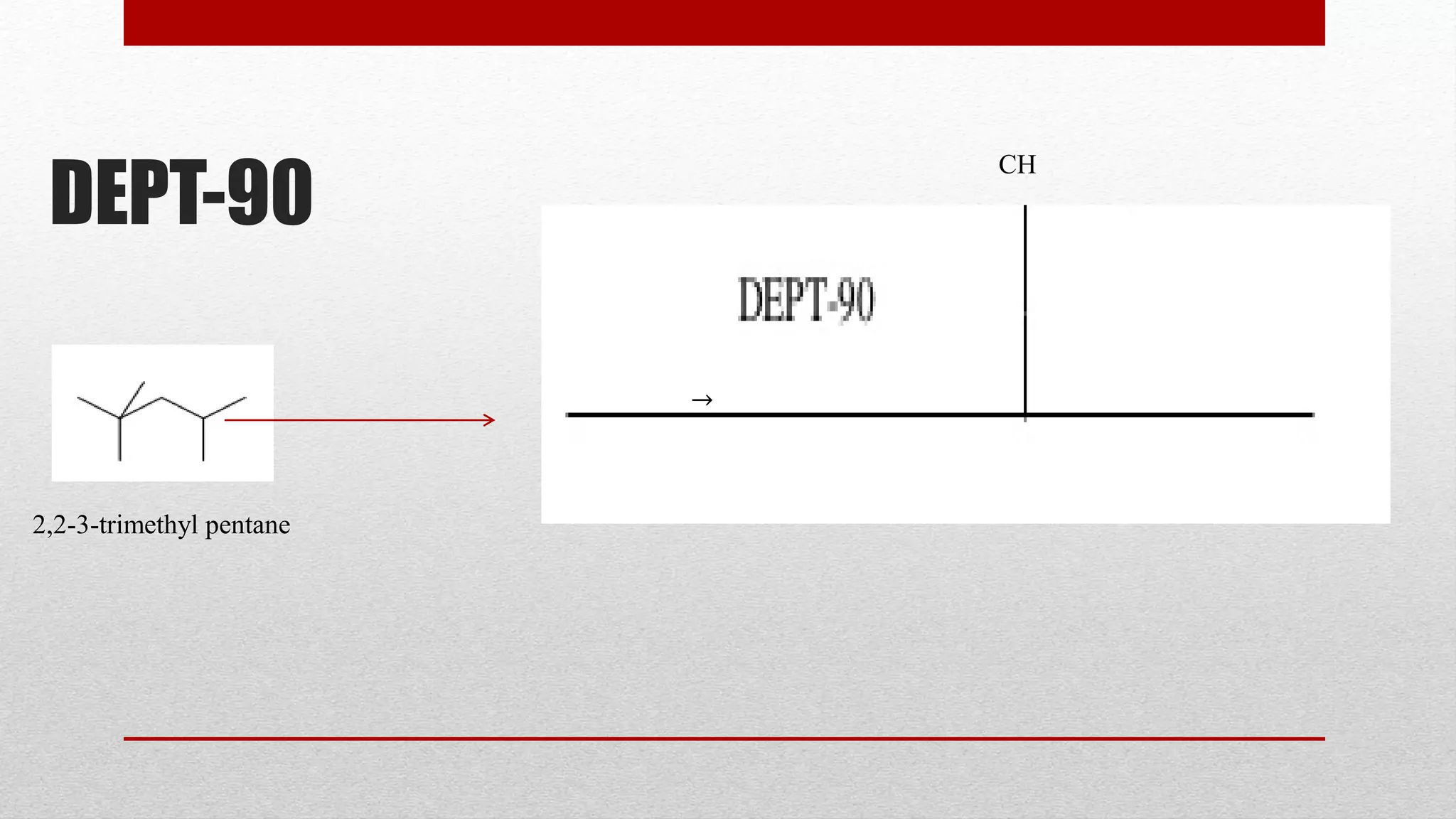
DEPT-90: only CH shown in this pulse angle.
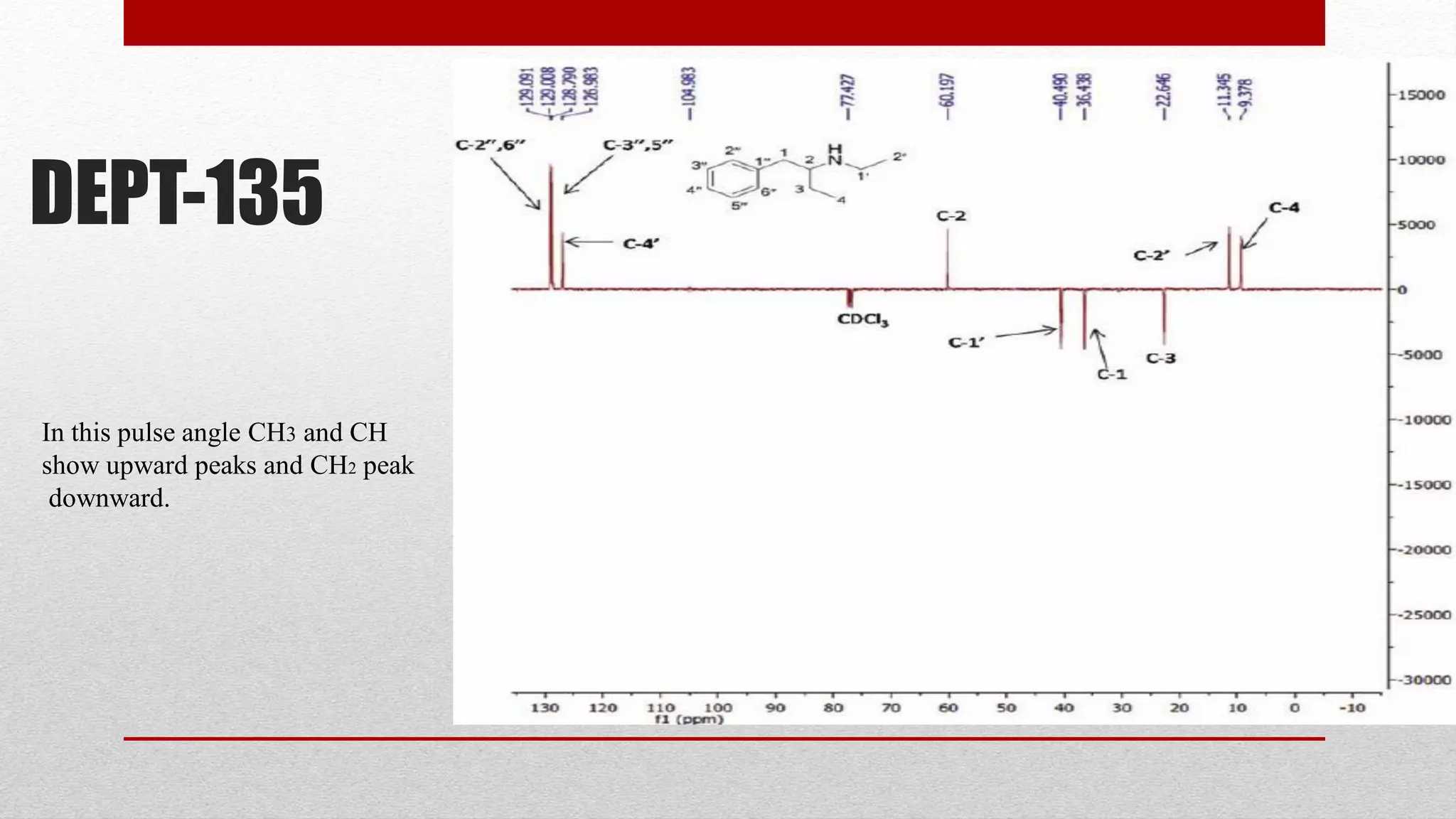
DEPT-135: the peaks of CH2 show downward and peaks of CH3 and CH are shown upward on s
on DEPT experiment.
The peak of quaternary carbon is not shown in distortionless enhancement by polarization transfer
method.
+ For upward peak
- For downward peak
DEPT-45
All protonated carbons show here
DEPT-90
2,2-3-trimethyl pentane
→
CH
DEPT-135
In this pulse angle CH3 and CH
show upward peaks and CH2 peak
downward.
6.Examples of DEPT
Isoamylacetate spectrum
Diethyl phthalate spectrum
Quaternary carbon shown in C-13
NMR but not in DEPT experiment
7. Reference:
• Soling problem with NMR Spectroscopy (2nd Edition), page 133-190
• Chem.libertext.org (McMurry)
• www.nanalysis.com
• www.chem.ucalgary.ca
• www.chemicalforums.com
• www.oxfordsynthesiscd
• www.lasalle.edu
Thank You!
P r e p a r e d b y : P r o f e s s o r N a m e

Dept nmr

  • 1.
  • 2.
    Submitted to: Dr.Sara Musaddaq Submittedby: Maria Arshad MP-CHM-03 Sidra MP-CHM-04 Organic Chemistry 1st Semester 2020-2022 The Women University Multan.
  • 3.
    Content: 1. Introduction roDEPT 2. Off-Resonance Decoupled method 3. Difference of INEPT and DEPT 4. Term Distortionless 5. DEPT Experiment 6. Examples of DEPT 7. Reference
  • 4.
    1.DEPT DEPT stands forDistortionless Enhancement by Polarization Transfer method. The method used to determine the multiplicities of carbon-13 atoms. This method use the phenomenon polarization transfer.
  • 5.
    2.Off- Resonance decouplingmethod: • Before this method, a classical method for recording off- resonance C-13 spectra. • In this classical method (Off-Resonance method) the observed pattern of multiplets are consistent with n+1 rule. In this technique, the coupling between directly attached carbon and hydrogen to it are observed. • Its results in simple spectrum. But this method to give wide information about all neighboring protons. So the new method DEPT( Distortionless Enhancement by Polarization method) was introduced that gives the information about all the neighboring hydrogen that are bound to each carbon.
  • 6.
    3.Difference of INEPTand DEPT: The polarization transfer from H-1 to C-13 is the advantage to increase sensitivity over the normal C-13 spectra. Polarization transfer meant for that they use population difference between nuclei having high magnetogyric ratio and then transfer to low magnetogyric ratio.. DEPT experiment involve polarization transfer like INEPT. In DEPT there is no need of exact setting of delays between pulses like in INEPT. INEPT pulse angle is dependent on chemical shift but DEPT is not like this, its pulses depends on the protons that to carbon atom.
  • 7.
    4.Term distortionless: • InDEPT , D stands for Distortionless which describes as: A distortionless signal has no frequency and no delay distortion so it is better than INEPT. • There is no alteration of signal from the original spectrum signal.
  • 8.
  • 9.
    DEPT PULSES: • InDEPT experiment three types of spectra were obtained by setting pulse at different angles. • Intensity of resonances depends on the pulse angle. 45⁰ pulse 90⁰ pulse 135⁰ pulse
  • 11.
    DEPT-45: all protonatedcarbons are shown in this proton pulse angle. DEPT-90: only CH shown in this pulse angle. DEPT-135: the peaks of CH2 show downward and peaks of CH3 and CH are shown upward on s on DEPT experiment. The peak of quaternary carbon is not shown in distortionless enhancement by polarization transfer method. + For upward peak - For downward peak
  • 12.
  • 13.
  • 14.
    DEPT-135 In this pulseangle CH3 and CH show upward peaks and CH2 peak downward.
  • 15.
  • 18.
  • 19.
    Diethyl phthalate spectrum Quaternarycarbon shown in C-13 NMR but not in DEPT experiment
  • 20.
    7. Reference: • Solingproblem with NMR Spectroscopy (2nd Edition), page 133-190 • Chem.libertext.org (McMurry) • www.nanalysis.com • www.chem.ucalgary.ca • www.chemicalforums.com • www.oxfordsynthesiscd • www.lasalle.edu
  • 21.
    Thank You! P re p a r e d b y : P r o f e s s o r N a m e