Two-Dimensional NMR(2D-NMR)
Spectroscopy
02/19/18 Kalam Sirisha 2D NMR
By
Dr. Kalam Sirisha,
Associate Professor & Head,
Department of Pharmaceutical Chemistry,
Vaagdevi College of Pharmacy, Ramnagar,
Warangal, Telangana
E-mail: ragisirisha@yahoo.com
2
Introduction
•2D NMR is a set of NMR methods which gives data plotted in a space defined by
two frequency axes rather than one.
•Basis of 2D NMR: Interaction of nuclear spins (1
H with 1
H, 1
H with 13
C, etc.) plotted in two
dimensions
•Applications:
Obtain structural information not accessible by one-dimensional NMR methods
Simplifies analysis of more complex or ambiguous cases such as proteins.
02/19/18 Kalam Sirisha 2D NMR
2D NMR Spectrum
02/19/18 3Kalam Sirisha 2D NMR
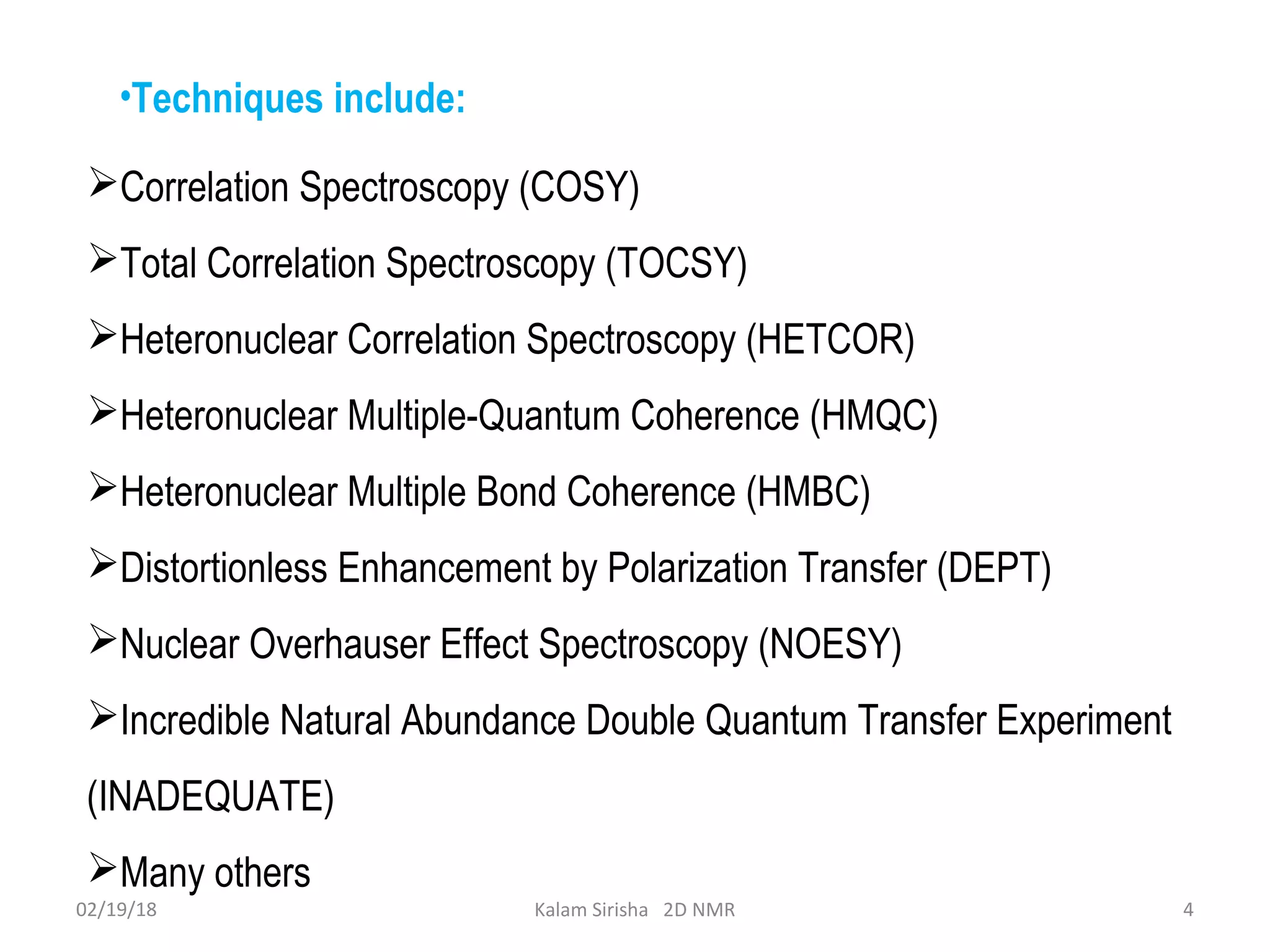
Correlation Spectroscopy (COSY)
Total Correlation Spectroscopy (TOCSY)
Heteronuclear Correlation Spectroscopy (HETCOR)
Heteronuclear Multiple-Quantum Coherence (HMQC)
Heteronuclear Multiple Bond Coherence (HMBC)
Distortionless Enhancement by Polarization Transfer (DEPT)
Nuclear Overhauser Effect Spectroscopy (NOESY)
Incredible Natural Abundance Double Quantum Transfer Experiment
(INADEQUATE)
Many others
02/19/18 4Kalam Sirisha 2D NMR
•Techniques include:
COSY and HETCOR 2-D Spectra
In one-dimensional (1-D) NMR spectra, the signals appear along the x-axis. In two-dimensional (2-
D) NMR spectra, a 1-D spectrum appears along one axis (x-axis) and a second 1-D spectrum
appears along the other axis (y-axis).
In COSY, the (1-D) proton spectrum is presented along both the x-axis and the y-axis. Signals in
this case rise above the xy plane and are usually shown as a contour plot. Signals will appear where
one set of protons couples with another set of protons. Thus, this type of spectrum indicates which
protons are coupled in a molecule in a fairly unambiguous way.
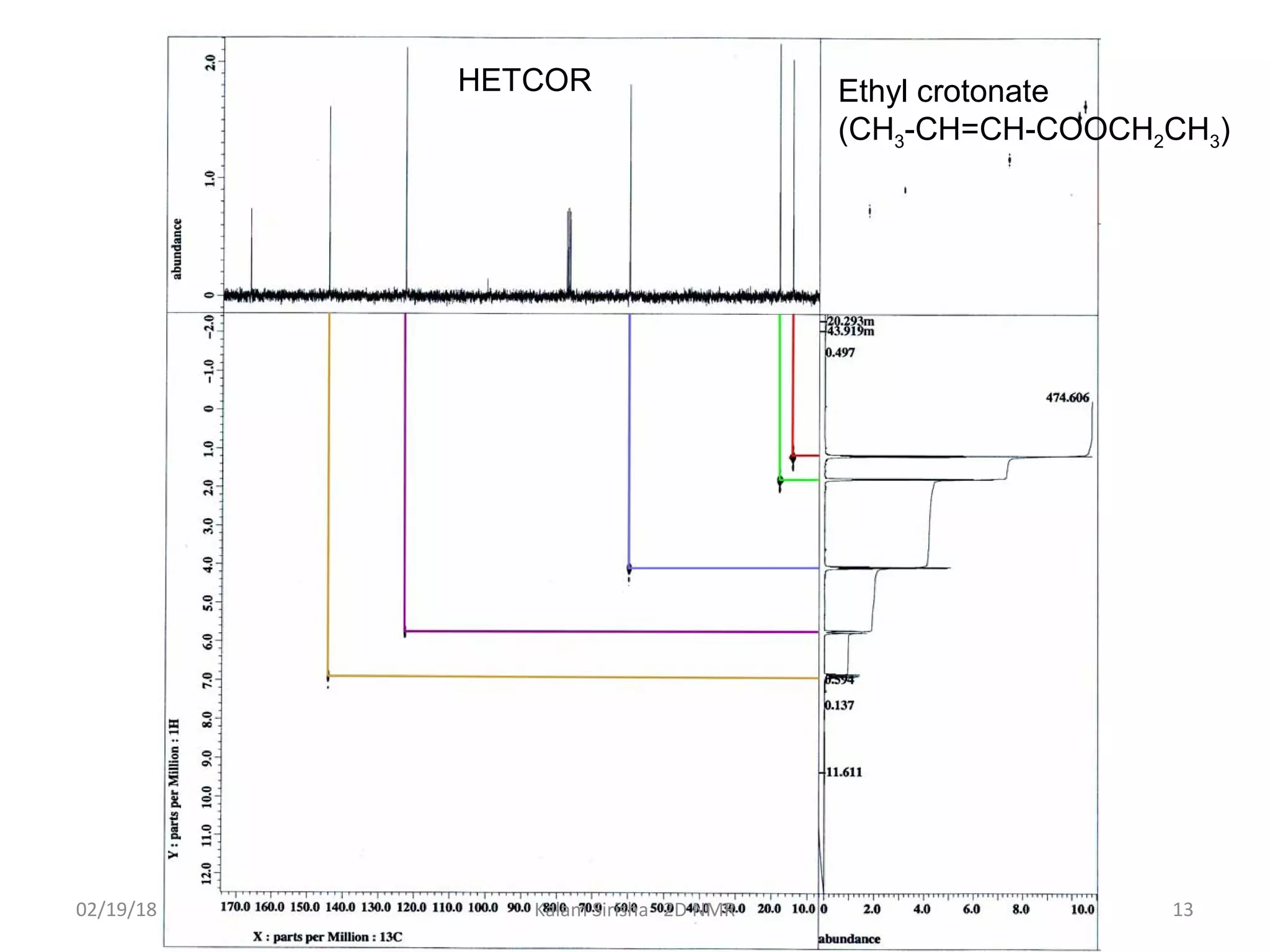
HETCOR is similar to COSY, except that the x-axis is the C-13 spectrum and the y-axis is the
proton spectrum. Signals result in the xy plane showing which protons are coupled (attached) to
which carbon atoms.
02/19/18 5Kalam Sirisha 2D NMR
COSY: Correlation of 1
H-1
H coupling
HETCOR: Correlation of 1
H-13
C coupling
6
O
O
H
CH2OH
O
H
CH2OH
HO
H
OH
H
H
HO
HO
HO
H
H
CH2
H
OH
1
2
3
4
5
6
7
8
9
10
11
12
•Dots = correlations
•Ignore dots on diagonal
Sucrose 1
H-NMR
Sucrose1
H-NMR
Examples
•H6 and H5 are coupled
•Identify H9 by its coupling with H10
H10
02/19/18 Kalam Sirisha 2D NMR
COSY Spectrum of
Sucrose
02/19/18 Kalam Sirisha 2D NMR 7
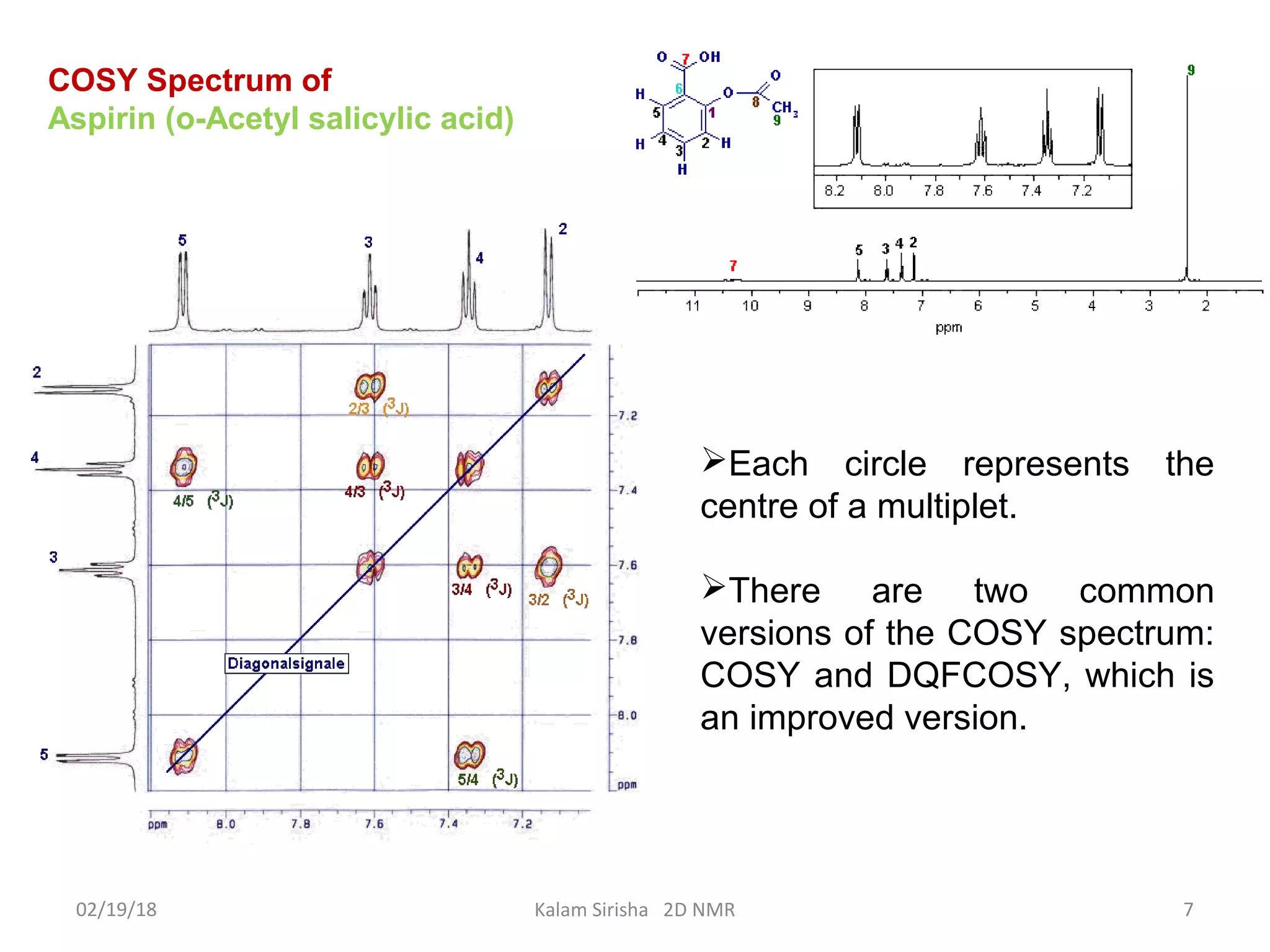
COSY Spectrum of
Aspirin (o-Acetyl salicylic acid)
Each circle represents the
centre of a multiplet.
There are two common
versions of the COSY spectrum:
COSY and DQFCOSY, which is
an improved version.
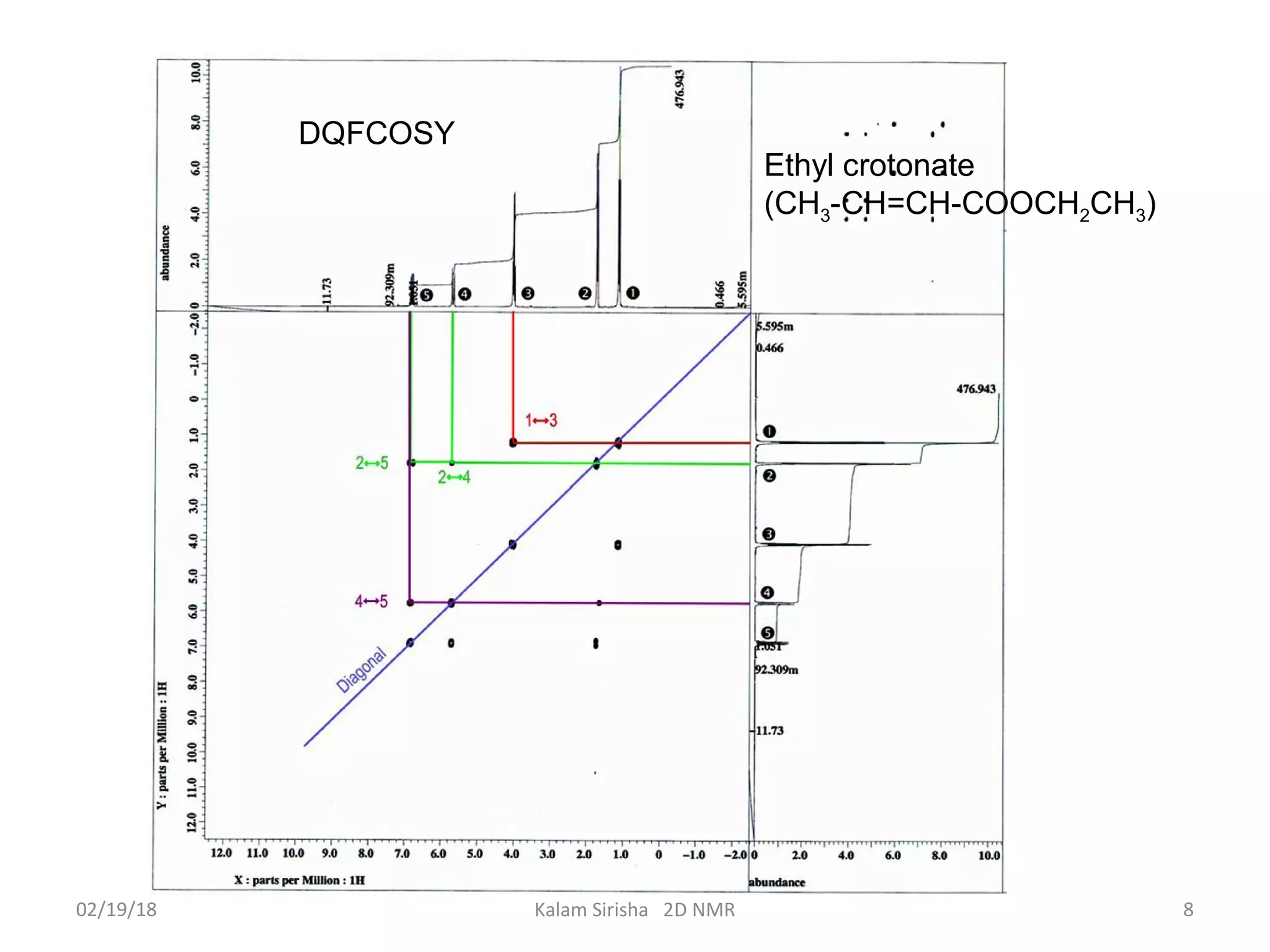
DQFCOSY
Ethyl crotonate
(CH3-CH=CH-COOCH2CH3)
02/19/18 8Kalam Sirisha 2D NMR
The spectrum is mirror-imaged about the diagonal, so we can work
on either side of the diagonal.
We can see that methyl protons 1 are coupled to methylene
protons 3 (the ethyl group). Methyl protons 2 are coupled to vinyl
protons 4 and 5. Vinylic proton 4 is coupled to vinylic proton 5.
In the case of a more complex spectrum it is likely that 2D
spectrum would provide information could not be obtained from the
1-D proton spectrum.
02/19/18 9Kalam Sirisha 2D NMR
02/19/18 Kalam Sirisha 2D NMR 10
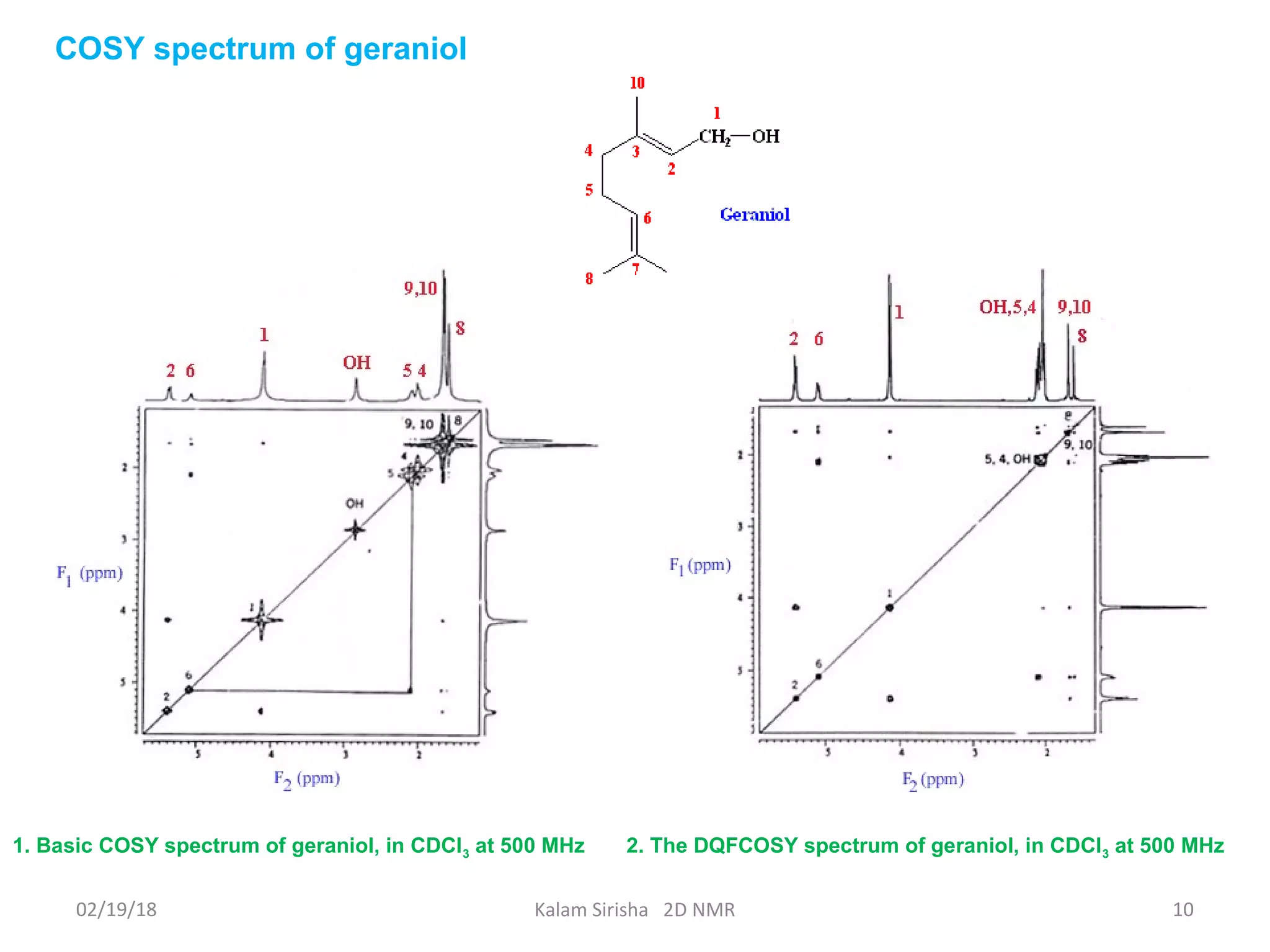
1. Basic COSY spectrum of geraniol, in CDCl3 at 500 MHz 2. The DQFCOSY spectrum of geraniol, in CDCl3 at 500 MHz
COSY spectrum of geraniol
02/19/18 Kalam Sirisha 2D NMR 11
HETCOR
02/19/18 Kalam Sirisha 2D NMR 12
HETCOR Spectrum of Ethyl Butenoate
HETCOR Ethyl crotonate
(CH3-CH=CH-COOCH2CH3)
02/19/18 13Kalam Sirisha 2D NMR
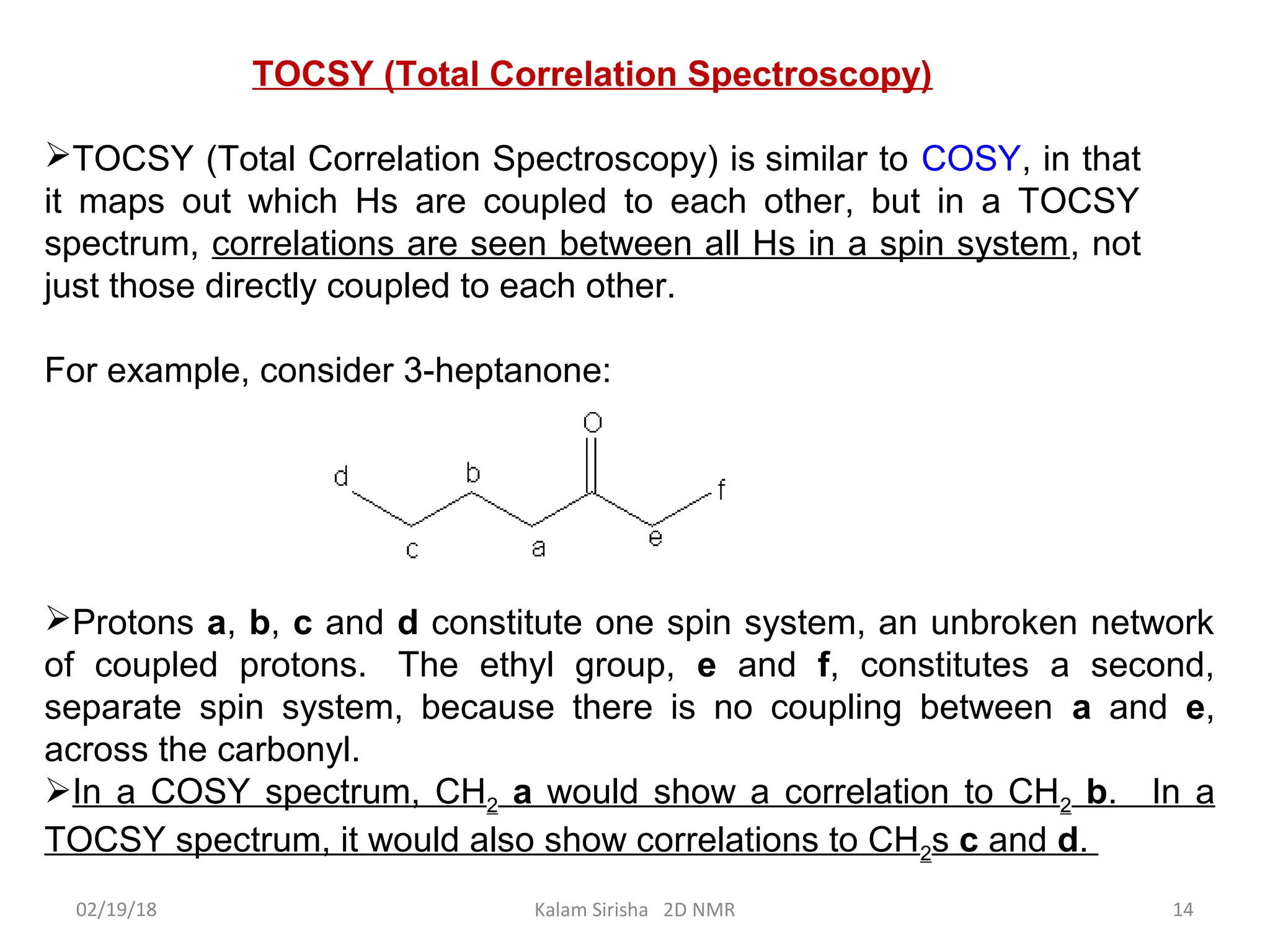
TOCSY (Total Correlation Spectroscopy)
TOCSY (Total Correlation Spectroscopy) is similar to COSY, in that
it maps out which Hs are coupled to each other, but in a TOCSY
spectrum, correlations are seen between all Hs in a spin system, not
just those directly coupled to each other.
For example, consider 3-heptanone:
Protons a, b, c and d constitute one spin system, an unbroken network
of coupled protons. The ethyl group, e and f, constitutes a second,
separate spin system, because there is no coupling between a and e,
across the carbonyl.
In a COSY spectrum, CH2 a would show a correlation to CH2 b. In a
TOCSY spectrum, it would also show correlations to CH2s c and d.
02/19/18 14Kalam Sirisha 2D NMR
TOCSY spectrum of codeine
02/19/18 15Kalam Sirisha 2D NMR
The cross-peaks marked with red and green circles are longer-range correlations,
not observed in the COSY spectrum.
Table of TOCSY peaks:
8 --> 7
3 --> 5, 9, 10, 16
5 --> 9, 10, 11, 16
9 --> 10, 16, OH, H2O
10 --> 16, OH, H2O
11 --> 16, 18, 18'
18 --> 16, 18'
16 --> 18'
13 --> 13', 17, 17'
13' --> 17, 17'
17 --> 17'
02/19/18 16Kalam Sirisha 2D NMR
HMQC & HMBC
HMQC (Heteronuclear Multiple Quantum Coherence) and HMBC
(Heteronuclear Multiple Bond Coherence) are 2D inverse correlation
techniques that allow for the determination of connectivity between
two different nuclear species. HMQC is selective for direct coupling
and HMBC gives longer range couplings (2-4 bond coupling).
HMBC
02/19/18 17Kalam Sirisha 2D NMR
18
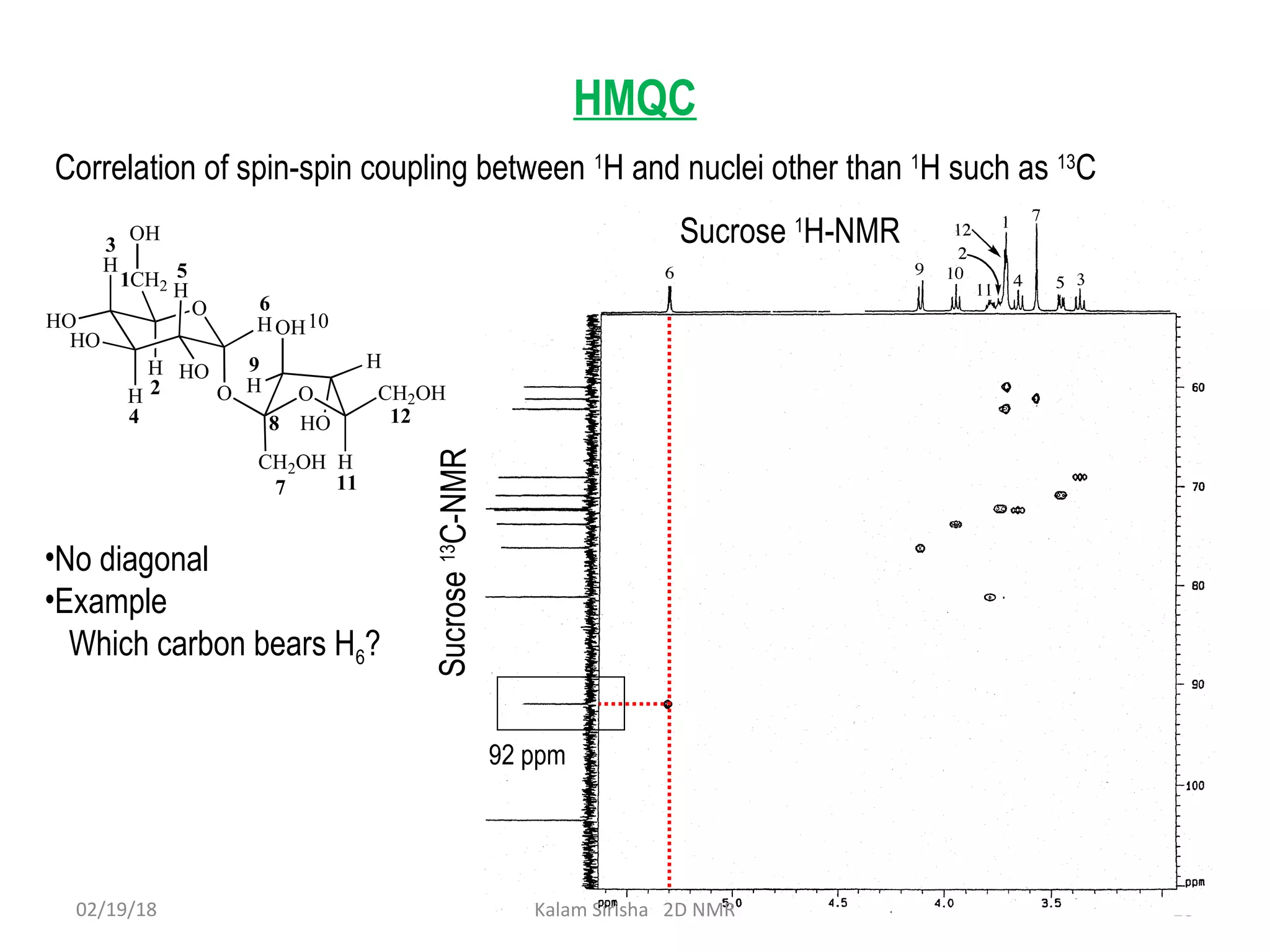
HMQC
Correlation of spin-spin coupling between 1
H and nuclei other than 1
H such as 13
C
O
O
H
CH2OH
O
H
CH2OH
HO
H
OH
H
H
HO
HO
HO
H
H
CH2
H
OH
1
2
3
4
5
6
7
8
9
10
11
12
Sucrose13
C-NMR
Sucrose 1
H-NMR
•No diagonal
•Example
Which carbon bears H6?
92 ppm
02/19/18 Kalam Sirisha 2D NMR
This experiment yields the same information as the older
"HETCOR" experiment, but is more sensitive, so can be done in less
time and/or with less material. This is possible because in the HMQC
experiment, the signal is detected by observing protons, rather than
carbons, which is inherently more sensitive, and the relaxation time is
shorter.
This so-called "inverse detection" experiment is technically more
difficult and is possible only on newer model spectrometers. Acorn
NMR's new JEOL Eclipse+
400 is equipped to perform inverse
experiments, and uses Z-gradients for improved spectral quality.
The time required for an HMQC depends on the amount of material,
but can be done in 1/2 hour or less, compared to several hours for a
HETCOR spectrum.
02/19/18 19Kalam Sirisha 2D NMR
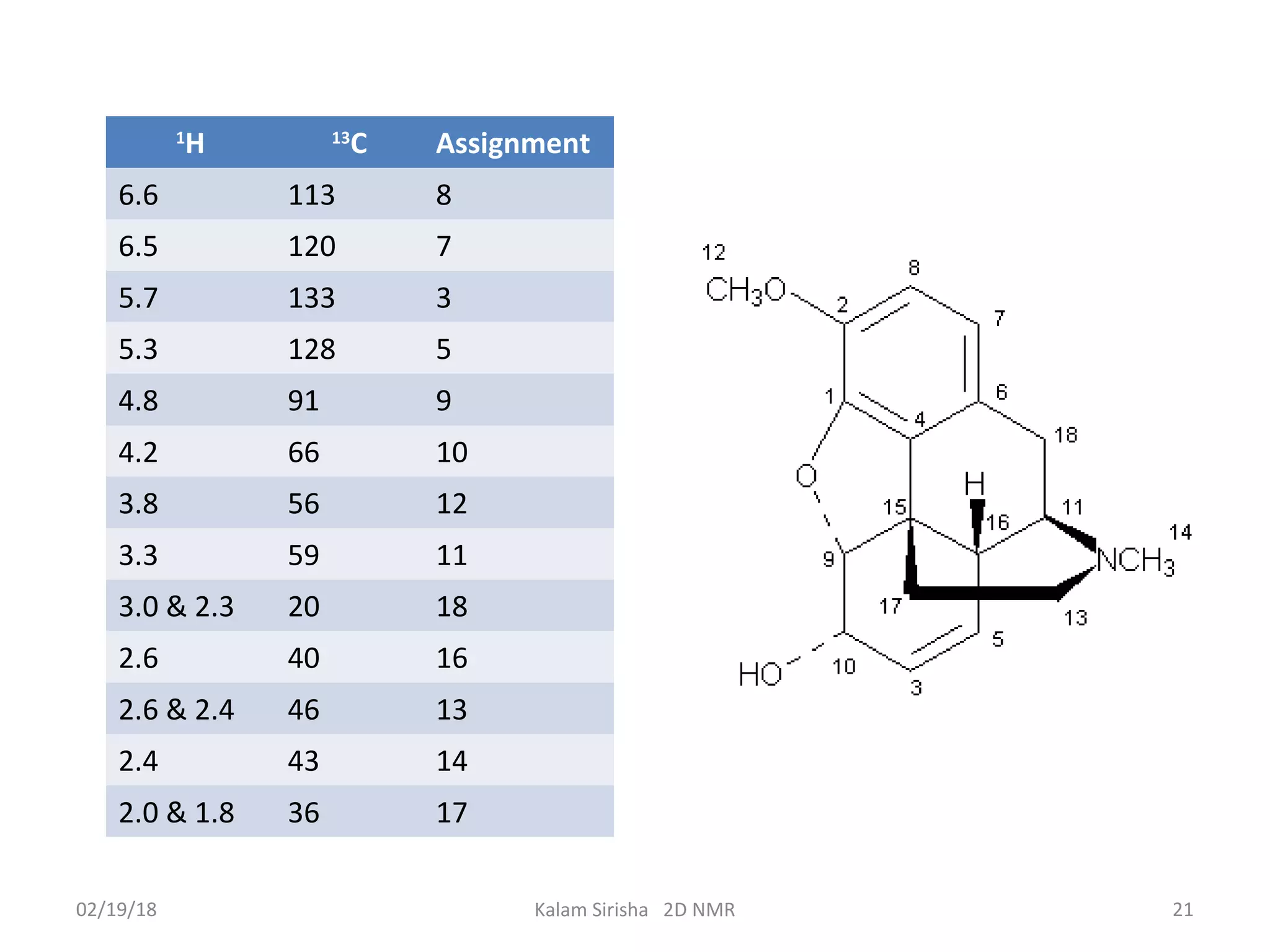
HMQC OF CODEINE
02/19/18 20Kalam Sirisha 2D NMR
1
H 13
C Assignment
6.6 113 8
6.5 120 7
5.7 133 3
5.3 128 5
4.8 91 9
4.2 66 10
3.8 56 12
3.3 59 11
3.0 & 2.3 20 18
2.6 40 16
2.6 & 2.4 46 13
2.4 43 14
2.0 & 1.8 36 17
02/19/18 21Kalam Sirisha 2D NMR
02/19/18 22Kalam Sirisha 2D NMR
02/19/18 Kalam Sirisha 2D NMR 23
HMBC of Ethyl trans cinnamate
DEPT
Distortionless Enhancement by Polarization Transfer
02/19/18 24Kalam Sirisha 2D NMR
Introduction
While modern NMR spectrometers make recording 13
C-NMR spectra
a matter of routine, the fact remains that it is more difficult to obtain
a 13
C-NMR spectrum than a 1
H-NMR spectrum. The difficulty stems
from two sources:
1.the natural abundance of 13
C is low, so there are fewer NMR-
active nuclei per mole of compound to absorb energy.
2.the inherent signal intensity per nucleus is less for 13
C than for
1
H. For equal numbers of 1
H and 13
C nuclei, the signal intensity for 13
C
is roughly 1/4 that of 1
H. When combined with the fact that the natural
abundance of 13
C is roughly 1% of that of 1
H, this means that the
signal intensity of 1
H is over 400 times greater than that of 13
C.
Consequently NMR spectroscopists have sought ways to increase
the signal intensity of carbon. All of the methods they have developed
involve a phenomenon known as polarization transfer. One such
polarization transfer technique is called Distortionless Enhancement
by Polarization Transfer, DEPT.
02/19/18 25Kalam Sirisha 2D NMR
DEPT Spectroscopy
The word polarization is used to describe the
differences in populations of various spin states that
are produced when a sample is subjected to an
external magnetic field.
In the absence of Bo, the magnetic moments of the
individual nuclei are randomly oriented and that they all
have essentially the same energy. Application of a strong
external magnetic field removes the randomness, forcing
the nuclei to align with or against the direction of Bo. This
change from a random state to an ordered state is called
polarization.
02/19/18 26Kalam Sirisha 2D NMR
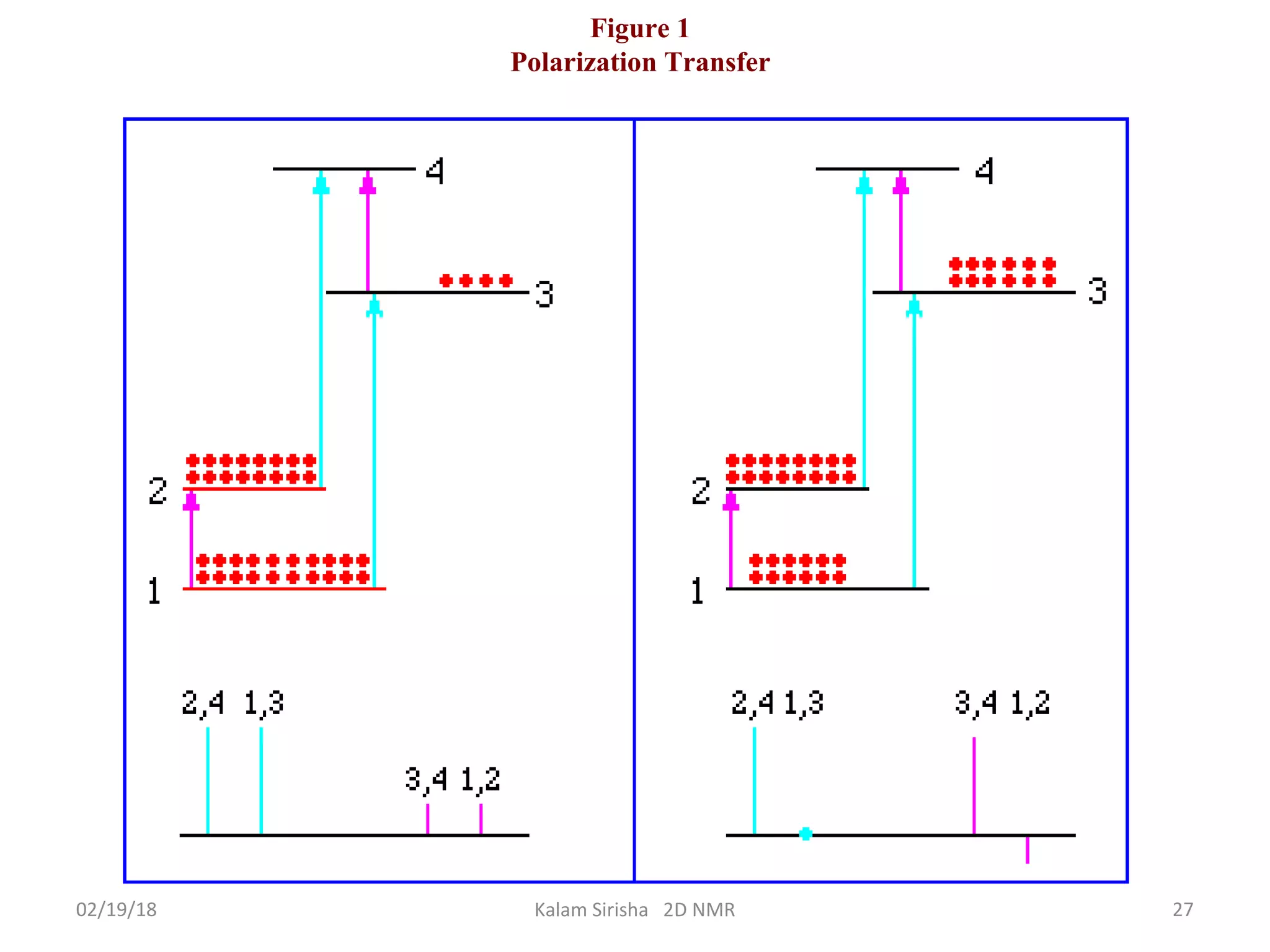
Figure 1
Polarization Transfer
02/19/18 27Kalam Sirisha 2D NMR
The diagram at the top of the left hand panel of Figure 1
shows the polarization of the 13
C and 1
H nuclei in a
sample of chloroform, CHCl3. The spin states labeled 1-
4 are produced by spin-spin coupling of the C and the H
atoms. The red dots represent the population differences
between the various spin states. The population
difference between state 1 and state 2 is 4 units, the
same as that between state 3 and state 4. By the same
token, the population difference between states 2 and 4
is 16 units, which is the same as the difference between
states 1 and 3. The transitions associated with 13
C nuclei
are colored magenta, while those of the 1
H nuclei are
shown in cyan. The diagram at the bottom of the left
hand panel represents the corresponding spectrum.
Note that the 1
H signal is approximately 4 times the
intensity of the 13
C signal.
02/19/18 28Kalam Sirisha 2D NMR
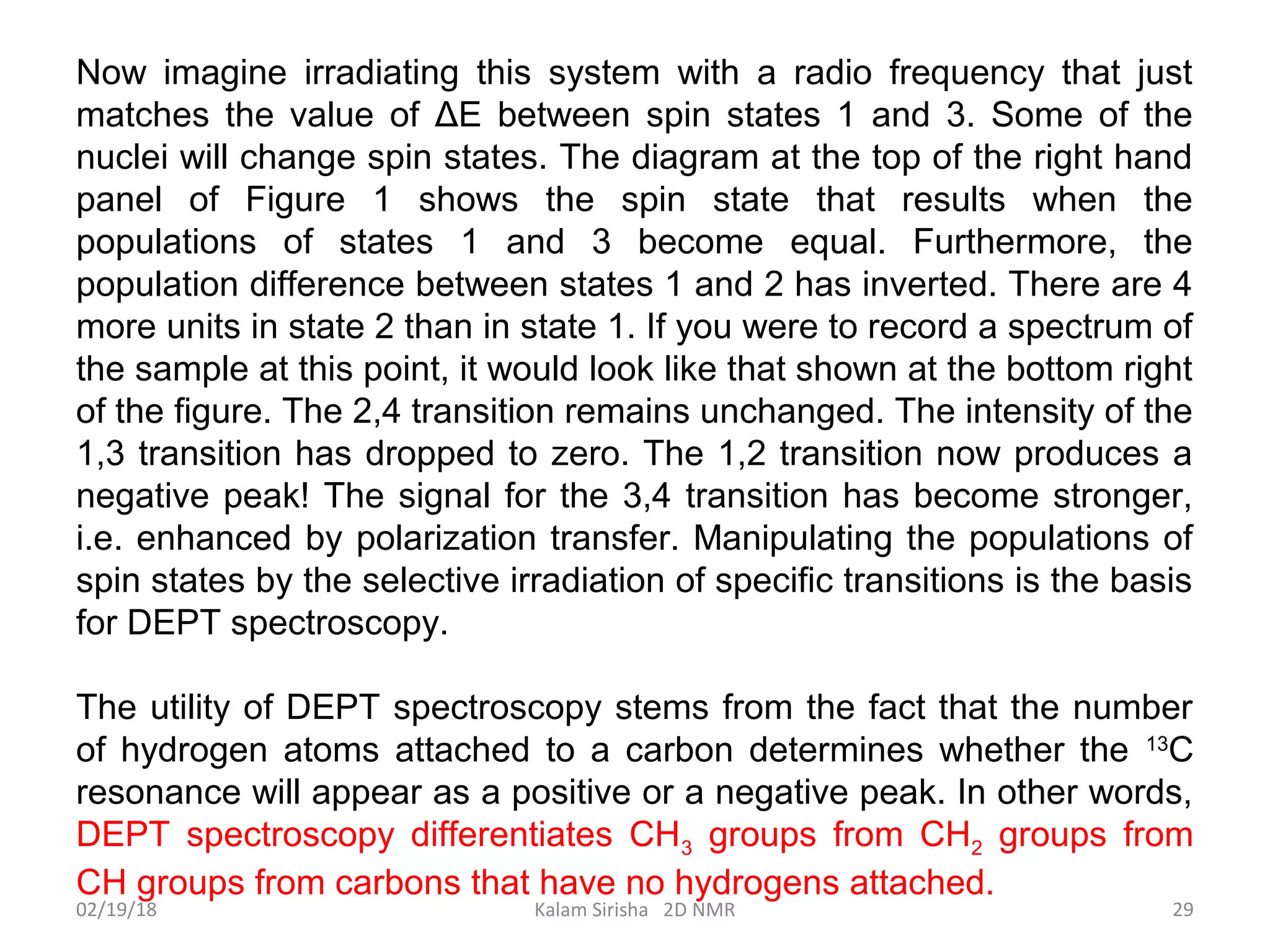
Now imagine irradiating this system with a radio frequency that just
matches the value of ΔE between spin states 1 and 3. Some of the
nuclei will change spin states. The diagram at the top of the right hand
panel of Figure 1 shows the spin state that results when the
populations of states 1 and 3 become equal. Furthermore, the
population difference between states 1 and 2 has inverted. There are 4
more units in state 2 than in state 1. If you were to record a spectrum of
the sample at this point, it would look like that shown at the bottom right
of the figure. The 2,4 transition remains unchanged. The intensity of the
1,3 transition has dropped to zero. The 1,2 transition now produces a
negative peak! The signal for the 3,4 transition has become stronger,
i.e. enhanced by polarization transfer. Manipulating the populations of
spin states by the selective irradiation of specific transitions is the basis
for DEPT spectroscopy.
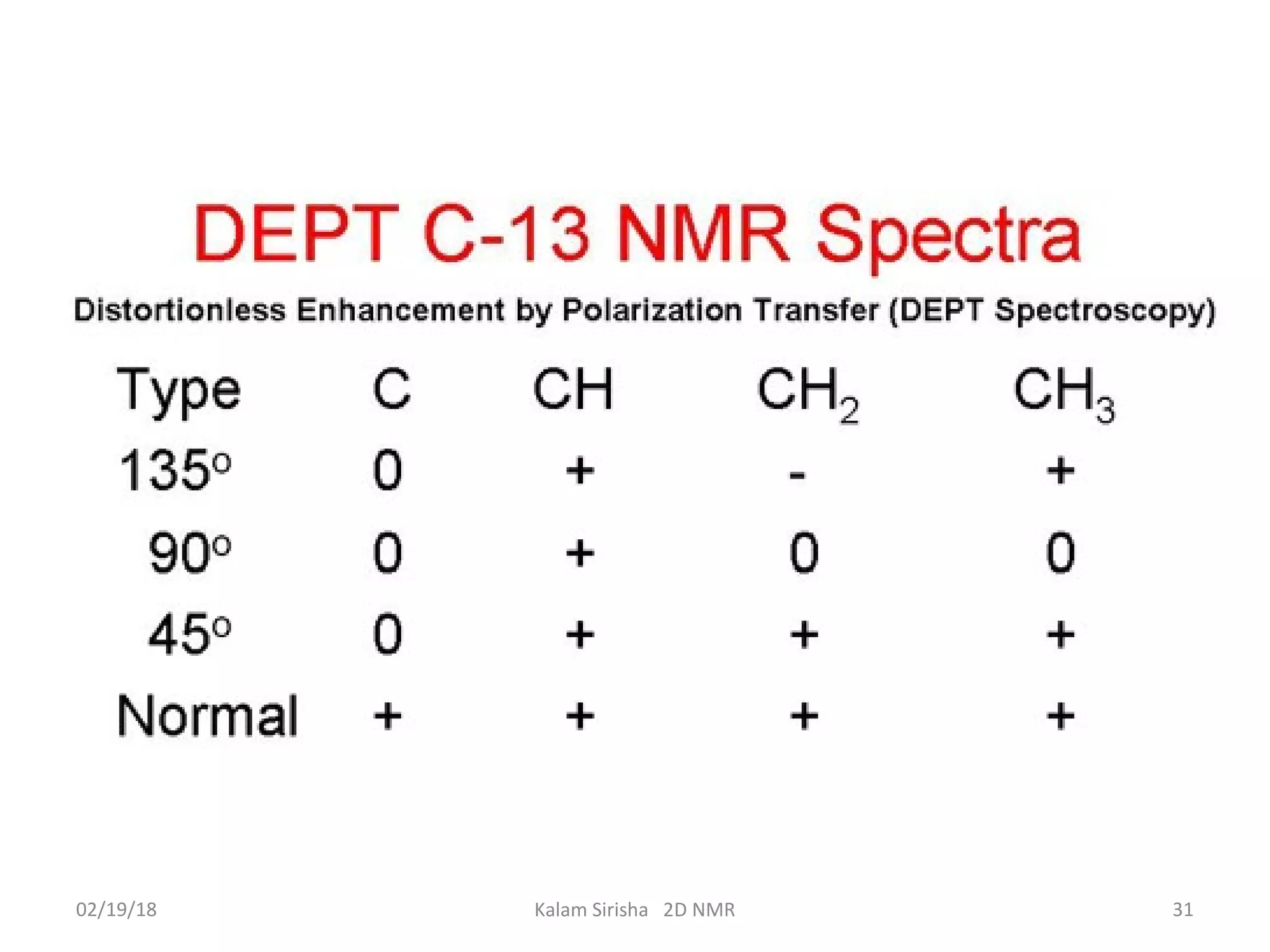
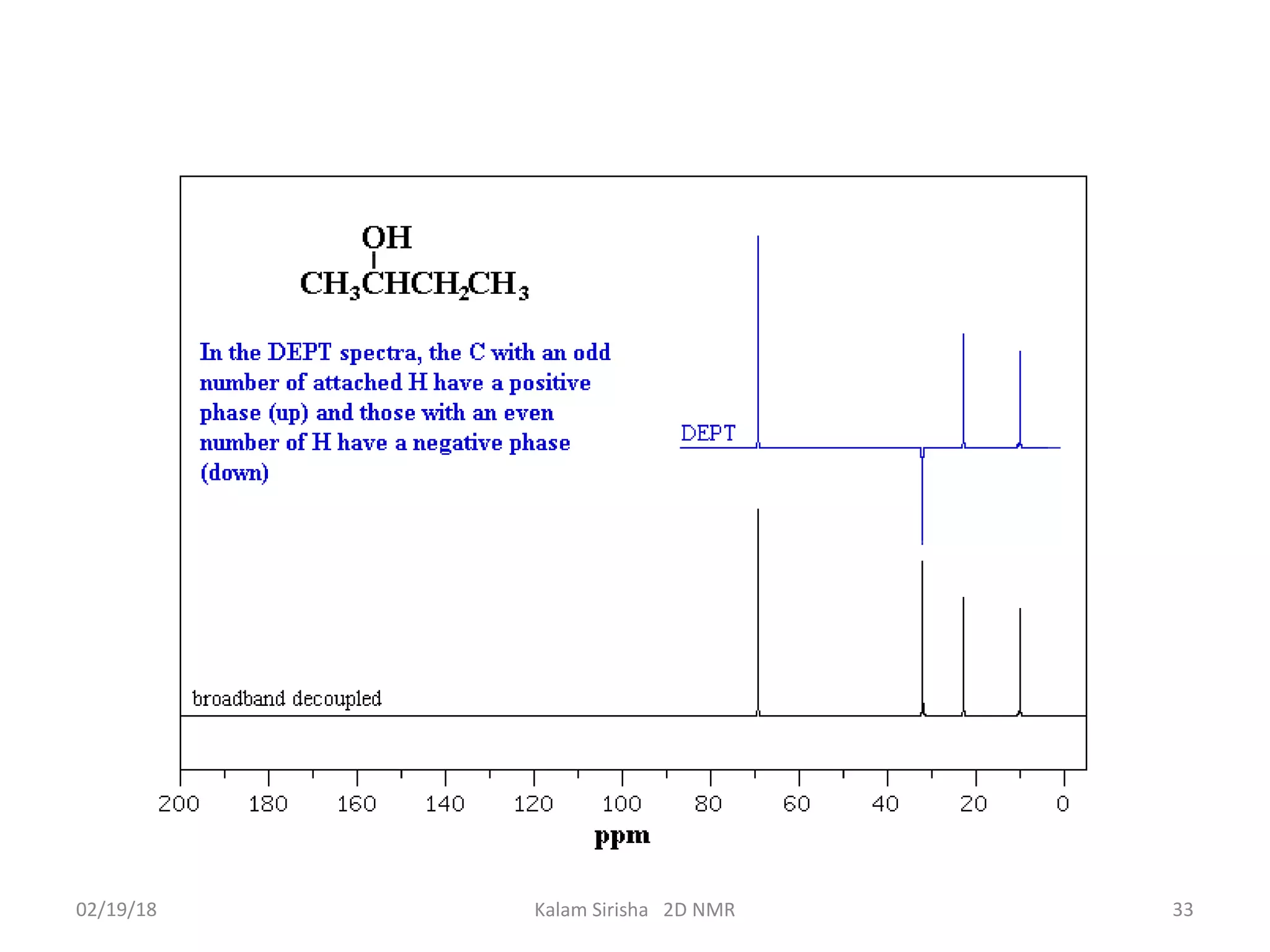
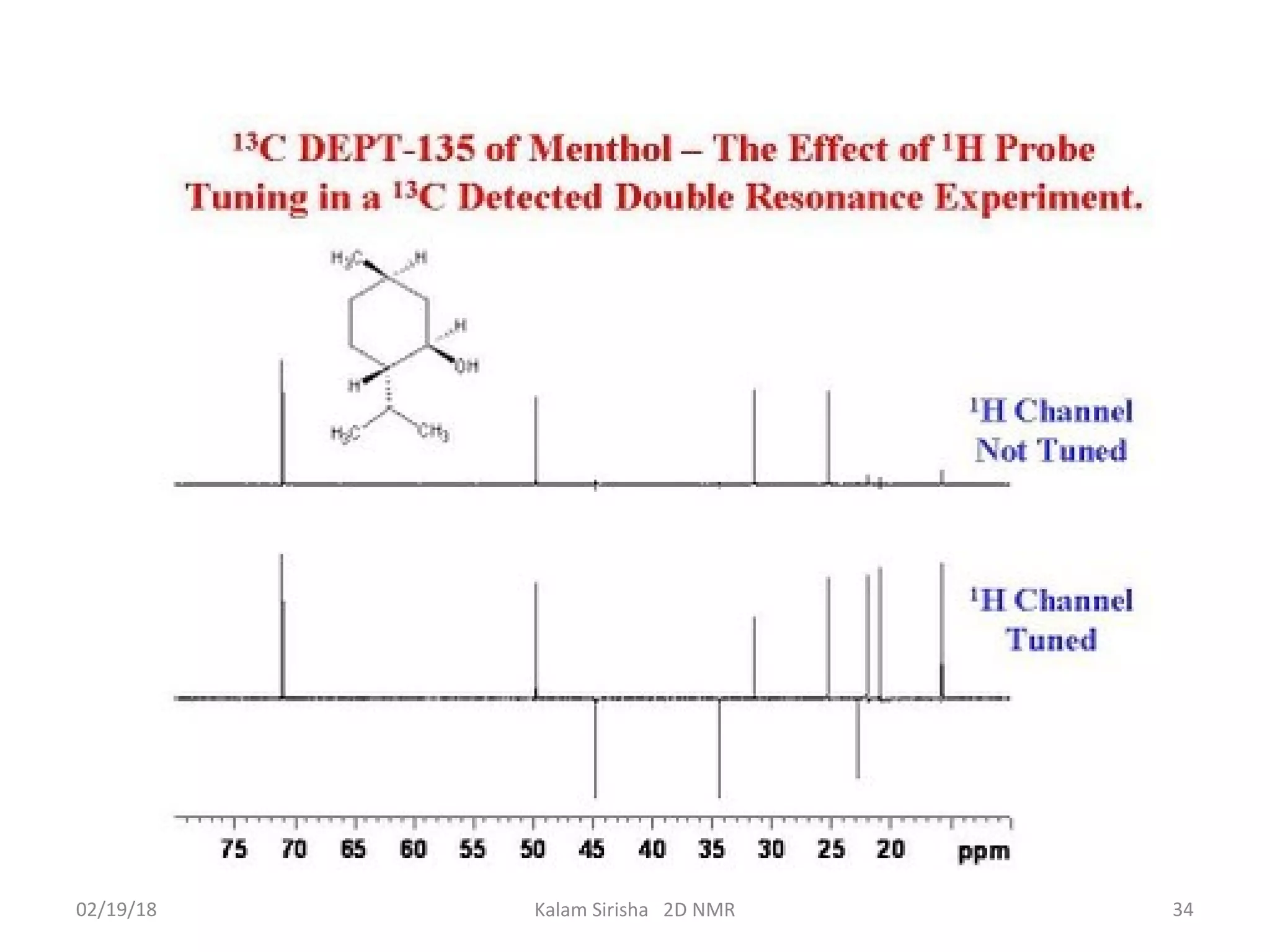
The utility of DEPT spectroscopy stems from the fact that the number
of hydrogen atoms attached to a carbon determines whether the 13
C
resonance will appear as a positive or a negative peak. In other words,
DEPT spectroscopy differentiates CH3 groups from CH2 groups from
CH groups from carbons that have no hydrogens attached.
02/19/18 29Kalam Sirisha 2D NMR
Figure 2
Interpreting DEPT Spectra
02/19/18 30Kalam Sirisha 2D NMR
02/19/18 31Kalam Sirisha 2D NMR
02/19/18 32Kalam Sirisha 2D NMR
02/19/18 33Kalam Sirisha 2D NMR
02/19/18 34Kalam Sirisha 2D NMR
02/19/18 35Kalam Sirisha 2D NMR
02/19/18 Kalam Sirisha 2D NMR 36
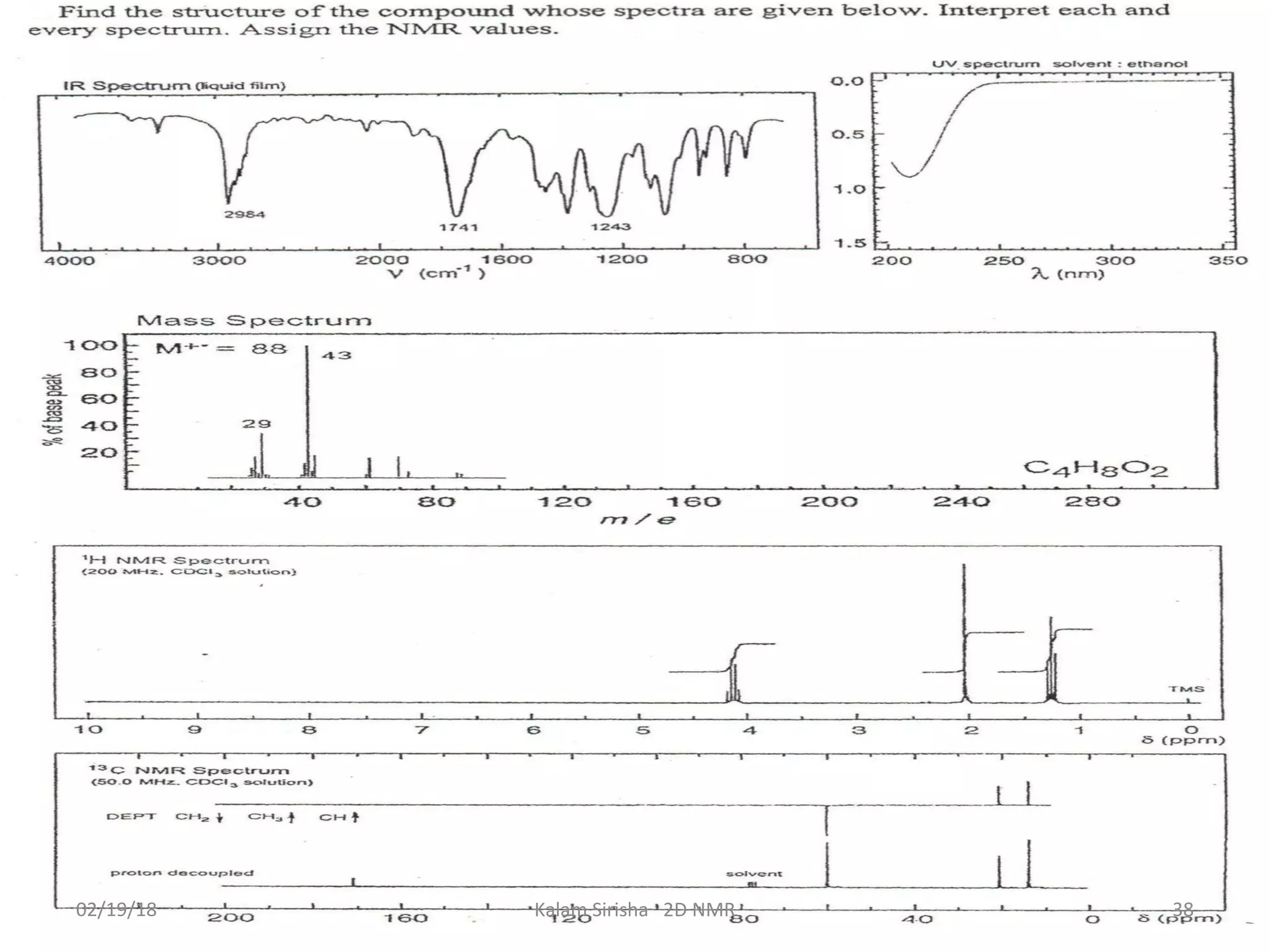
2D NMR PROBLEMS
02/19/18 Kalam Sirisha 2D NMR 37
02/19/18 Kalam Sirisha 2D NMR 38
02/19/18 Kalam Sirisha 2D NMR 39
02/19/18 Kalam Sirisha 2D NMR 40
Interpret the given HETCOR spectrum of Ibuprofen after predicting its PMR (Y-axis)
and CMR (X-axis) spectra. Indicate the various 1
H-13
C couplings seen in Ibuprofen.
02/19/18 Kalam Sirisha 2D NMR 41
A compound with molecular formula C6H4Cl2O displays the following IR, 1
H NMR
and 13
C NMR spectra. Propose a structure for this compound.
02/19/18 Kalam Sirisha 2D NMR 42
Interpret the HETCOR spectrum of propyl benzoate using its 1
H NMR and 13
C NMR
given below:
02/19/18 Kalam Sirisha 2D NMR 43

2D NMR & PROBLEMS BASED ON IT

  • 1.
    Two-Dimensional NMR(2D-NMR) Spectroscopy 02/19/18 KalamSirisha 2D NMR By Dr. Kalam Sirisha, Associate Professor & Head, Department of Pharmaceutical Chemistry, Vaagdevi College of Pharmacy, Ramnagar, Warangal, Telangana E-mail: ragisirisha@yahoo.com
  • 2.
    2 Introduction •2D NMR isa set of NMR methods which gives data plotted in a space defined by two frequency axes rather than one. •Basis of 2D NMR: Interaction of nuclear spins (1 H with 1 H, 1 H with 13 C, etc.) plotted in two dimensions •Applications: Obtain structural information not accessible by one-dimensional NMR methods Simplifies analysis of more complex or ambiguous cases such as proteins. 02/19/18 Kalam Sirisha 2D NMR
  • 3.
    2D NMR Spectrum 02/19/183Kalam Sirisha 2D NMR
  • 4.
    Correlation Spectroscopy (COSY) TotalCorrelation Spectroscopy (TOCSY) Heteronuclear Correlation Spectroscopy (HETCOR) Heteronuclear Multiple-Quantum Coherence (HMQC) Heteronuclear Multiple Bond Coherence (HMBC) Distortionless Enhancement by Polarization Transfer (DEPT) Nuclear Overhauser Effect Spectroscopy (NOESY) Incredible Natural Abundance Double Quantum Transfer Experiment (INADEQUATE) Many others 02/19/18 4Kalam Sirisha 2D NMR •Techniques include:
  • 5.
    COSY and HETCOR2-D Spectra In one-dimensional (1-D) NMR spectra, the signals appear along the x-axis. In two-dimensional (2- D) NMR spectra, a 1-D spectrum appears along one axis (x-axis) and a second 1-D spectrum appears along the other axis (y-axis). In COSY, the (1-D) proton spectrum is presented along both the x-axis and the y-axis. Signals in this case rise above the xy plane and are usually shown as a contour plot. Signals will appear where one set of protons couples with another set of protons. Thus, this type of spectrum indicates which protons are coupled in a molecule in a fairly unambiguous way. HETCOR is similar to COSY, except that the x-axis is the C-13 spectrum and the y-axis is the proton spectrum. Signals result in the xy plane showing which protons are coupled (attached) to which carbon atoms. 02/19/18 5Kalam Sirisha 2D NMR COSY: Correlation of 1 H-1 H coupling HETCOR: Correlation of 1 H-13 C coupling
  • 6.
    6 O O H CH2OH O H CH2OH HO H OH H H HO HO HO H H CH2 H OH 1 2 3 4 5 6 7 8 9 10 11 12 •Dots = correlations •Ignoredots on diagonal Sucrose 1 H-NMR Sucrose1 H-NMR Examples •H6 and H5 are coupled •Identify H9 by its coupling with H10 H10 02/19/18 Kalam Sirisha 2D NMR COSY Spectrum of Sucrose
  • 7.
    02/19/18 Kalam Sirisha2D NMR 7 COSY Spectrum of Aspirin (o-Acetyl salicylic acid) Each circle represents the centre of a multiplet. There are two common versions of the COSY spectrum: COSY and DQFCOSY, which is an improved version.
  • 8.
  • 9.
    The spectrum ismirror-imaged about the diagonal, so we can work on either side of the diagonal. We can see that methyl protons 1 are coupled to methylene protons 3 (the ethyl group). Methyl protons 2 are coupled to vinyl protons 4 and 5. Vinylic proton 4 is coupled to vinylic proton 5. In the case of a more complex spectrum it is likely that 2D spectrum would provide information could not be obtained from the 1-D proton spectrum. 02/19/18 9Kalam Sirisha 2D NMR
  • 10.
    02/19/18 Kalam Sirisha2D NMR 10 1. Basic COSY spectrum of geraniol, in CDCl3 at 500 MHz 2. The DQFCOSY spectrum of geraniol, in CDCl3 at 500 MHz COSY spectrum of geraniol
  • 11.
    02/19/18 Kalam Sirisha2D NMR 11 HETCOR
  • 12.
    02/19/18 Kalam Sirisha2D NMR 12 HETCOR Spectrum of Ethyl Butenoate
  • 13.
  • 14.
    TOCSY (Total CorrelationSpectroscopy) TOCSY (Total Correlation Spectroscopy) is similar to COSY, in that it maps out which Hs are coupled to each other, but in a TOCSY spectrum, correlations are seen between all Hs in a spin system, not just those directly coupled to each other. For example, consider 3-heptanone: Protons a, b, c and d constitute one spin system, an unbroken network of coupled protons. The ethyl group, e and f, constitutes a second, separate spin system, because there is no coupling between a and e, across the carbonyl. In a COSY spectrum, CH2 a would show a correlation to CH2 b. In a TOCSY spectrum, it would also show correlations to CH2s c and d. 02/19/18 14Kalam Sirisha 2D NMR
  • 15.
    TOCSY spectrum ofcodeine 02/19/18 15Kalam Sirisha 2D NMR The cross-peaks marked with red and green circles are longer-range correlations, not observed in the COSY spectrum. Table of TOCSY peaks: 8 --> 7 3 --> 5, 9, 10, 16 5 --> 9, 10, 11, 16 9 --> 10, 16, OH, H2O 10 --> 16, OH, H2O 11 --> 16, 18, 18' 18 --> 16, 18' 16 --> 18' 13 --> 13', 17, 17' 13' --> 17, 17' 17 --> 17'
  • 16.
  • 17.
    HMQC & HMBC HMQC(Heteronuclear Multiple Quantum Coherence) and HMBC (Heteronuclear Multiple Bond Coherence) are 2D inverse correlation techniques that allow for the determination of connectivity between two different nuclear species. HMQC is selective for direct coupling and HMBC gives longer range couplings (2-4 bond coupling). HMBC 02/19/18 17Kalam Sirisha 2D NMR
  • 18.
    18 HMQC Correlation of spin-spincoupling between 1 H and nuclei other than 1 H such as 13 C O O H CH2OH O H CH2OH HO H OH H H HO HO HO H H CH2 H OH 1 2 3 4 5 6 7 8 9 10 11 12 Sucrose13 C-NMR Sucrose 1 H-NMR •No diagonal •Example Which carbon bears H6? 92 ppm 02/19/18 Kalam Sirisha 2D NMR
  • 19.
    This experiment yieldsthe same information as the older "HETCOR" experiment, but is more sensitive, so can be done in less time and/or with less material. This is possible because in the HMQC experiment, the signal is detected by observing protons, rather than carbons, which is inherently more sensitive, and the relaxation time is shorter. This so-called "inverse detection" experiment is technically more difficult and is possible only on newer model spectrometers. Acorn NMR's new JEOL Eclipse+ 400 is equipped to perform inverse experiments, and uses Z-gradients for improved spectral quality. The time required for an HMQC depends on the amount of material, but can be done in 1/2 hour or less, compared to several hours for a HETCOR spectrum. 02/19/18 19Kalam Sirisha 2D NMR
  • 20.
    HMQC OF CODEINE 02/19/1820Kalam Sirisha 2D NMR
  • 21.
    1 H 13 C Assignment 6.6113 8 6.5 120 7 5.7 133 3 5.3 128 5 4.8 91 9 4.2 66 10 3.8 56 12 3.3 59 11 3.0 & 2.3 20 18 2.6 40 16 2.6 & 2.4 46 13 2.4 43 14 2.0 & 1.8 36 17 02/19/18 21Kalam Sirisha 2D NMR
  • 22.
  • 23.
    02/19/18 Kalam Sirisha2D NMR 23 HMBC of Ethyl trans cinnamate
  • 24.
    DEPT Distortionless Enhancement byPolarization Transfer 02/19/18 24Kalam Sirisha 2D NMR
  • 25.
    Introduction While modern NMRspectrometers make recording 13 C-NMR spectra a matter of routine, the fact remains that it is more difficult to obtain a 13 C-NMR spectrum than a 1 H-NMR spectrum. The difficulty stems from two sources: 1.the natural abundance of 13 C is low, so there are fewer NMR- active nuclei per mole of compound to absorb energy. 2.the inherent signal intensity per nucleus is less for 13 C than for 1 H. For equal numbers of 1 H and 13 C nuclei, the signal intensity for 13 C is roughly 1/4 that of 1 H. When combined with the fact that the natural abundance of 13 C is roughly 1% of that of 1 H, this means that the signal intensity of 1 H is over 400 times greater than that of 13 C. Consequently NMR spectroscopists have sought ways to increase the signal intensity of carbon. All of the methods they have developed involve a phenomenon known as polarization transfer. One such polarization transfer technique is called Distortionless Enhancement by Polarization Transfer, DEPT. 02/19/18 25Kalam Sirisha 2D NMR
  • 26.
    DEPT Spectroscopy The wordpolarization is used to describe the differences in populations of various spin states that are produced when a sample is subjected to an external magnetic field. In the absence of Bo, the magnetic moments of the individual nuclei are randomly oriented and that they all have essentially the same energy. Application of a strong external magnetic field removes the randomness, forcing the nuclei to align with or against the direction of Bo. This change from a random state to an ordered state is called polarization. 02/19/18 26Kalam Sirisha 2D NMR
  • 27.
  • 28.
    The diagram atthe top of the left hand panel of Figure 1 shows the polarization of the 13 C and 1 H nuclei in a sample of chloroform, CHCl3. The spin states labeled 1- 4 are produced by spin-spin coupling of the C and the H atoms. The red dots represent the population differences between the various spin states. The population difference between state 1 and state 2 is 4 units, the same as that between state 3 and state 4. By the same token, the population difference between states 2 and 4 is 16 units, which is the same as the difference between states 1 and 3. The transitions associated with 13 C nuclei are colored magenta, while those of the 1 H nuclei are shown in cyan. The diagram at the bottom of the left hand panel represents the corresponding spectrum. Note that the 1 H signal is approximately 4 times the intensity of the 13 C signal. 02/19/18 28Kalam Sirisha 2D NMR
  • 29.
    Now imagine irradiatingthis system with a radio frequency that just matches the value of ΔE between spin states 1 and 3. Some of the nuclei will change spin states. The diagram at the top of the right hand panel of Figure 1 shows the spin state that results when the populations of states 1 and 3 become equal. Furthermore, the population difference between states 1 and 2 has inverted. There are 4 more units in state 2 than in state 1. If you were to record a spectrum of the sample at this point, it would look like that shown at the bottom right of the figure. The 2,4 transition remains unchanged. The intensity of the 1,3 transition has dropped to zero. The 1,2 transition now produces a negative peak! The signal for the 3,4 transition has become stronger, i.e. enhanced by polarization transfer. Manipulating the populations of spin states by the selective irradiation of specific transitions is the basis for DEPT spectroscopy. The utility of DEPT spectroscopy stems from the fact that the number of hydrogen atoms attached to a carbon determines whether the 13 C resonance will appear as a positive or a negative peak. In other words, DEPT spectroscopy differentiates CH3 groups from CH2 groups from CH groups from carbons that have no hydrogens attached. 02/19/18 29Kalam Sirisha 2D NMR
  • 30.
    Figure 2 Interpreting DEPTSpectra 02/19/18 30Kalam Sirisha 2D NMR
  • 31.
  • 32.
  • 33.
  • 34.
  • 35.
  • 36.
    02/19/18 Kalam Sirisha2D NMR 36 2D NMR PROBLEMS
  • 37.
  • 38.
  • 39.
  • 40.
    02/19/18 Kalam Sirisha2D NMR 40 Interpret the given HETCOR spectrum of Ibuprofen after predicting its PMR (Y-axis) and CMR (X-axis) spectra. Indicate the various 1 H-13 C couplings seen in Ibuprofen.
  • 41.
    02/19/18 Kalam Sirisha2D NMR 41 A compound with molecular formula C6H4Cl2O displays the following IR, 1 H NMR and 13 C NMR spectra. Propose a structure for this compound.
  • 42.
    02/19/18 Kalam Sirisha2D NMR 42 Interpret the HETCOR spectrum of propyl benzoate using its 1 H NMR and 13 C NMR given below:
  • 43.