DEPED-DOH JMC #1, S. 2021
OPERATIONAL GUIDELINES
ON THE IMPLEMENTATION
OF LIMITED F2F LEARNING
MODALITY
SEPTEMBER 27, 2021
SALIENT POINTS
BACKGROUND
Public health crisis
Nationwide closure of all learning institutions
 massive implementation of alternative learning
methods thru distance learning modalities
Challenges in the teaching and learning process
FRAMEWORK FOR REOPENING SCHOOLS
(UNESCO, UNICEF, WB, WFP, UNHCR)
Impact on child’s ability to learn due to disruptions of instructional time
Marginalized children are less likely to return to school
Children from poorest households are already 5x likely to be out of primary school
Increase the risk of child trafficking, online & offline sex abuse and exploitation of
children
Teenage pregnancies
Child marriages
Violence
Other threats
Disrupt essential school-based services (immunization, school feeding, mental health
& psychosocial support
Aggravate stress and anxiety due to loss of peer interaction & disrupted routines
FROM UNESCO…
Remote learning is particularly challenging to elementary school students
Devastating for working parents and guardians, particularly mothers
Women will be forced to leave their job causing possible delay for
economic recovery
Other parents feel forced to leave their young children in unsafe situations
No one-size-fits-all strategy for determining optimal model for remote
learning
Students suffer from their remote environment
Hence, in areas where transmission is under control & administrators can
resume physical classes, resources must be focused on learners.
SCOPE
Provide guidance on the mechanisms and standards on the resumption of F2F
classes
Cover the roles and responsibilities of stakeholders across governance levels to
ensure effective, efficient, and safe implementation.
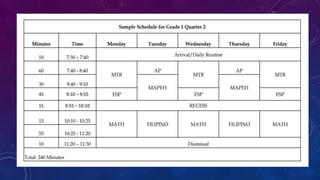
Initial implementation of F2F classes in minimal-risk areas on the DOH risk
classification
Phases of Implementation:
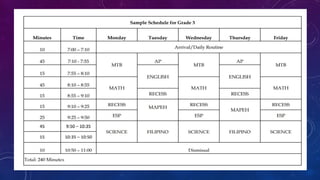
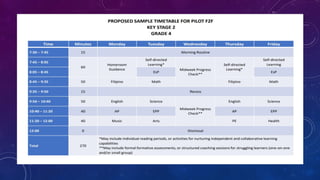
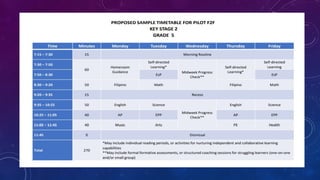
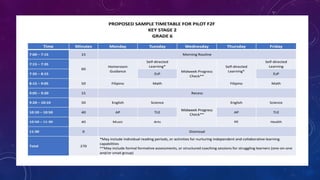
 Pilot (ONLY LEARNERS IN THE KEY STAGE K-to-3 & SELECTED SECONDARY LEARNERS FROM
SHS)
 Expanded
 Full implementation in the new normal
POLICY STATEMENT
• deliver quality basic education in a safe learning
environment to learners in low- to minimal-risk areas;
• address the teaching and learning gaps encountered in
the distance learning modalities; and
• strengthen the school-community health and safety
support system for all children.
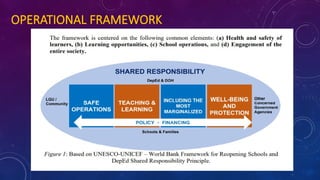
OPERATIONAL FRAMEWORK
ELIGIBILITY OF PARTICIPATION- SCHOOLS
1.Located in minimal-risk area
2.Shall pass the SSAT
3.SSAT result must be validated by the SDO Composite Team
(DRRMC, SDO Health Personnel, PO, SDO Engineer, CID Rep)
4.Supported by the LGU (resolution or letter of support)
5.Secure expressed support and consent of parents
6.Set of requirement were listed for private schools
ELIGIBILITY OF PARTICIPATION – TEACHERS &
EMPLOYEES
• All 65 y/o and below & with NO diagnosed co-
morbidities shall be eligible to provide services,
also PWDs, pregnant & lactating (CSC MC # 18, s.
2020)
• Covid-19 vaccination shall remain an essential
strategy,
ELIGIBILITY OF PARTICIPATION – LEARNERS
• Voluntary
• Learners from within the city/municipality
• Can walk or with regulated transportation, or with available private transport
• Without existing comorbidities
• Updated routine immunizations
• Priority
• no direct parent/guardian, Key stage 1 learners (K-3)
• Struggling learners
• SHS in the TVL Track
• With mental health concerns (referral process)
GUIDELINES ON SAFE OPENING
• Preparations
• Set up WASH,
• PPEs,
• health & safety protocols,
• LMs,
• Class programs, and
• HR requirements (DOH AO #2021-0043)
• Involvement of the community
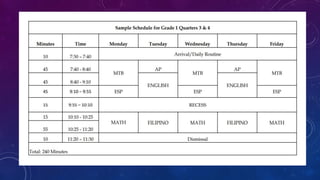
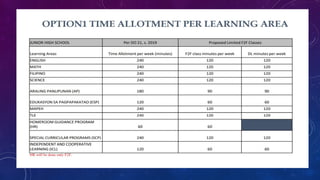
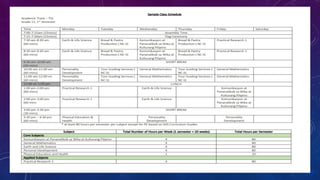
• Class program adjusted according to AWA
• School shall orient learners, parents, guardians, teaching & non-teaching personnel, external stakeholders, & LGU of the
eligibility of participation, existing protocols, mechanisms,, and procedures needed in conducting F2F classes
• School shall screen the vaccination records (routine immunizations) of children
• School shall conduct simulation activities
• All persons shall wear well-fitted face masks and face shields
GUIDELINES ON SAFE OPENING
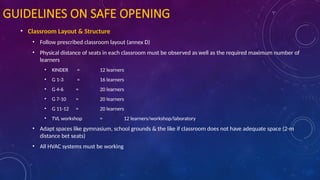
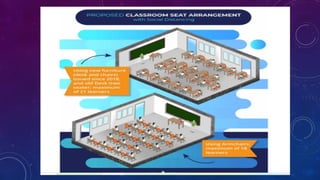
• Classroom Layout & Structure
• Follow prescribed classroom layout (annex D)
• Physical distance of seats in each classroom must be observed as well as the required maximum number of
learners
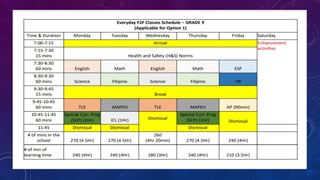
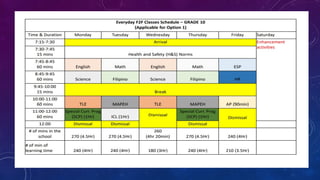
• KINDER = 12 learners
• G 1-3 = 16 learners
• G 4-6 = 20 learners
• G 7-10 = 20 learners
• G 11-12 = 20 learners
• TVL workshop = 12 learners/workshop/laboratory
• Adapt spaces like gymnasium, school grounds & the like if classroom does not have adequate space (2-m
distance bet seats)
• All HVAC systems must be working
GUIDELINES ON SAFE OPENING
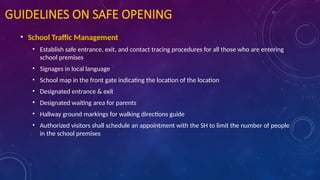
• School Traffic Management
• Establish safe entrance, exit, and contact tracing procedures for all those who are entering
school premises
• Signages in local language
• School map in the front gate indicating the location of the location
• Designated entrance & exit
• Designated waiting area for parents
• Hallway ground markings for walking directions guide
• Authorized visitors shall schedule an appointment with the SH to limit the number of people
in the school premises
GUIDELINES ON SAFE OPENING
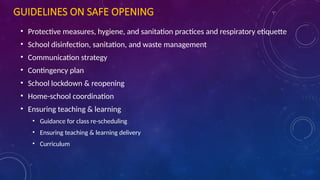
• Protective measures, hygiene, and sanitation practices and respiratory etiquette
• School disinfection, sanitation, and waste management
• Communication strategy
• Contingency plan
• School lockdown & reopening
• Home-school coordination
• Ensuring teaching & learning
• Guidance for class re-scheduling
• Ensuring teaching & learning delivery
• Curriculum
GUIDELINES ON SAFE OPENING
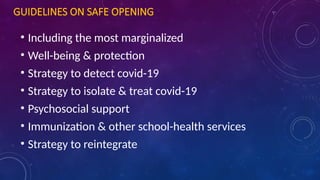
• Including the most marginalized
• Well-being & protection
• Strategy to detect covid-19
• Strategy to isolate & treat covid-19
• Psychosocial support
• Immunization & other school-health services
• Strategy to reintegrate
ROLES & RESPONSIBILITIES
• SDO
• Prepare the implementation Plan
• Monitor & evaluate the implementation
• Provide TA to schools
• Mobilize resources & support from community stakeholders of the health &
safety protocols
• Orient SDO key officials on the standards & processes of pilot implementation
• Orient SHs, LGUs on the standards of pilot implementation
• Validate SSAT results for public & private schools
• Submit to RO the validated list of participating schools
ROLES & RESPONSIBILITIES
• PARTICIPATING SCHOOLS
• Ensure strict implementation of health & safety protocols
• Submit SSAT results
• Orient parents, community, barangay officials, CSO, and other partners
• Secure written support from the LGU
• Secure consent from parents/legal guardian
• Develop contingency plan
• Mobilize resources and support from community stakeholders
• Establish coordination mechanisms with BHERT ang LGU
• Establish psychosocial support mechanisms to learners & school personnel
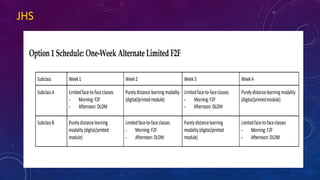
JHS
THANK YOU…!

DEPED-DOH JMC 1 IMPLEMENTATIONF2FLEARNINGMODALITY

  • 1.
    DEPED-DOH JMC #1,S. 2021 OPERATIONAL GUIDELINES ON THE IMPLEMENTATION OF LIMITED F2F LEARNING MODALITY SEPTEMBER 27, 2021 SALIENT POINTS
  • 2.
    BACKGROUND Public health crisis Nationwideclosure of all learning institutions  massive implementation of alternative learning methods thru distance learning modalities Challenges in the teaching and learning process
  • 3.
    FRAMEWORK FOR REOPENINGSCHOOLS (UNESCO, UNICEF, WB, WFP, UNHCR) Impact on child’s ability to learn due to disruptions of instructional time Marginalized children are less likely to return to school Children from poorest households are already 5x likely to be out of primary school Increase the risk of child trafficking, online & offline sex abuse and exploitation of children Teenage pregnancies Child marriages Violence Other threats Disrupt essential school-based services (immunization, school feeding, mental health & psychosocial support Aggravate stress and anxiety due to loss of peer interaction & disrupted routines
  • 4.
    FROM UNESCO… Remote learningis particularly challenging to elementary school students Devastating for working parents and guardians, particularly mothers Women will be forced to leave their job causing possible delay for economic recovery Other parents feel forced to leave their young children in unsafe situations No one-size-fits-all strategy for determining optimal model for remote learning Students suffer from their remote environment Hence, in areas where transmission is under control & administrators can resume physical classes, resources must be focused on learners.
  • 5.
    SCOPE Provide guidance onthe mechanisms and standards on the resumption of F2F classes Cover the roles and responsibilities of stakeholders across governance levels to ensure effective, efficient, and safe implementation. Initial implementation of F2F classes in minimal-risk areas on the DOH risk classification Phases of Implementation:  Pilot (ONLY LEARNERS IN THE KEY STAGE K-to-3 & SELECTED SECONDARY LEARNERS FROM SHS)  Expanded  Full implementation in the new normal
  • 6.
    POLICY STATEMENT • deliverquality basic education in a safe learning environment to learners in low- to minimal-risk areas; • address the teaching and learning gaps encountered in the distance learning modalities; and • strengthen the school-community health and safety support system for all children.
  • 7.
  • 8.
    ELIGIBILITY OF PARTICIPATION-SCHOOLS 1.Located in minimal-risk area 2.Shall pass the SSAT 3.SSAT result must be validated by the SDO Composite Team (DRRMC, SDO Health Personnel, PO, SDO Engineer, CID Rep) 4.Supported by the LGU (resolution or letter of support) 5.Secure expressed support and consent of parents 6.Set of requirement were listed for private schools
  • 9.
    ELIGIBILITY OF PARTICIPATION– TEACHERS & EMPLOYEES • All 65 y/o and below & with NO diagnosed co- morbidities shall be eligible to provide services, also PWDs, pregnant & lactating (CSC MC # 18, s. 2020) • Covid-19 vaccination shall remain an essential strategy,
  • 10.
    ELIGIBILITY OF PARTICIPATION– LEARNERS • Voluntary • Learners from within the city/municipality • Can walk or with regulated transportation, or with available private transport • Without existing comorbidities • Updated routine immunizations • Priority • no direct parent/guardian, Key stage 1 learners (K-3) • Struggling learners • SHS in the TVL Track • With mental health concerns (referral process)
  • 11.
    GUIDELINES ON SAFEOPENING • Preparations • Set up WASH, • PPEs, • health & safety protocols, • LMs, • Class programs, and • HR requirements (DOH AO #2021-0043) • Involvement of the community • Class program adjusted according to AWA • School shall orient learners, parents, guardians, teaching & non-teaching personnel, external stakeholders, & LGU of the eligibility of participation, existing protocols, mechanisms,, and procedures needed in conducting F2F classes • School shall screen the vaccination records (routine immunizations) of children • School shall conduct simulation activities • All persons shall wear well-fitted face masks and face shields
  • 12.
    GUIDELINES ON SAFEOPENING • Classroom Layout & Structure • Follow prescribed classroom layout (annex D) • Physical distance of seats in each classroom must be observed as well as the required maximum number of learners • KINDER = 12 learners • G 1-3 = 16 learners • G 4-6 = 20 learners • G 7-10 = 20 learners • G 11-12 = 20 learners • TVL workshop = 12 learners/workshop/laboratory • Adapt spaces like gymnasium, school grounds & the like if classroom does not have adequate space (2-m distance bet seats) • All HVAC systems must be working
  • 13.
    GUIDELINES ON SAFEOPENING • School Traffic Management • Establish safe entrance, exit, and contact tracing procedures for all those who are entering school premises • Signages in local language • School map in the front gate indicating the location of the location • Designated entrance & exit • Designated waiting area for parents • Hallway ground markings for walking directions guide • Authorized visitors shall schedule an appointment with the SH to limit the number of people in the school premises
  • 14.
    GUIDELINES ON SAFEOPENING • Protective measures, hygiene, and sanitation practices and respiratory etiquette • School disinfection, sanitation, and waste management • Communication strategy • Contingency plan • School lockdown & reopening • Home-school coordination • Ensuring teaching & learning • Guidance for class re-scheduling • Ensuring teaching & learning delivery • Curriculum
  • 15.
    GUIDELINES ON SAFEOPENING • Including the most marginalized • Well-being & protection • Strategy to detect covid-19 • Strategy to isolate & treat covid-19 • Psychosocial support • Immunization & other school-health services • Strategy to reintegrate
  • 16.
    ROLES & RESPONSIBILITIES •SDO • Prepare the implementation Plan • Monitor & evaluate the implementation • Provide TA to schools • Mobilize resources & support from community stakeholders of the health & safety protocols • Orient SDO key officials on the standards & processes of pilot implementation • Orient SHs, LGUs on the standards of pilot implementation • Validate SSAT results for public & private schools • Submit to RO the validated list of participating schools
  • 17.
    ROLES & RESPONSIBILITIES •PARTICIPATING SCHOOLS • Ensure strict implementation of health & safety protocols • Submit SSAT results • Orient parents, community, barangay officials, CSO, and other partners • Secure written support from the LGU • Secure consent from parents/legal guardian • Develop contingency plan • Mobilize resources and support from community stakeholders • Establish coordination mechanisms with BHERT ang LGU • Establish psychosocial support mechanisms to learners & school personnel
  • 31.
  • 47.