Introduction
Supply and demandare essential in the market economy. Supply and demand
imfluenced each other and does imoact the prices of consumer goods and services within
an economy.
Demand refers to the quantity of a product that consumers are willing and able
to buy at various price levels, while supply refers to the quantity that producers are
willing and able to sell.
The relationship between supply and demand helps explain why prices rise or fall.
When demand increases and supply remains constant, prices tend to rise. On the other
hand, when supply increases and demand remains the same, prices typically fall. The point
at which supply and demand are equal is called the equilibrium, where the market is most
efficient
4.
To understand howsupply and demand interact
in a market to determine prices and quantities
of goods and services.
Explain the basic concepts of supply and
demand
Identify the factors that influence both
supply and demand
Analyze how changes in supply or demand
affect market equilibrium
.
Goals of
the lesson:
Supply and
Demand
5.
NON-PRICE DETERMINANTS OFDEMAND
Trends, advertising, and personal preferences play a major role in shaping what
consumers want to buy.
Trends (e.g., viral products, fashion fads) can increase demand rapidly.
Advertising can influence consumer choices by creating awareness or desire.
Personal preferences differ by age, culture, lifestyle, etc., affecting what people are willing to
purchase.
📌Example: A popular celebrity endorses a brand of shoes — demand for that brand may
suddenly increase!
1.TASTES AND PREFERENCES
Taste of the product affecst the demand that the buyer is willing to pay at a certain price.
6.
NON-PRICE DETERMINANTS OFDEMAND
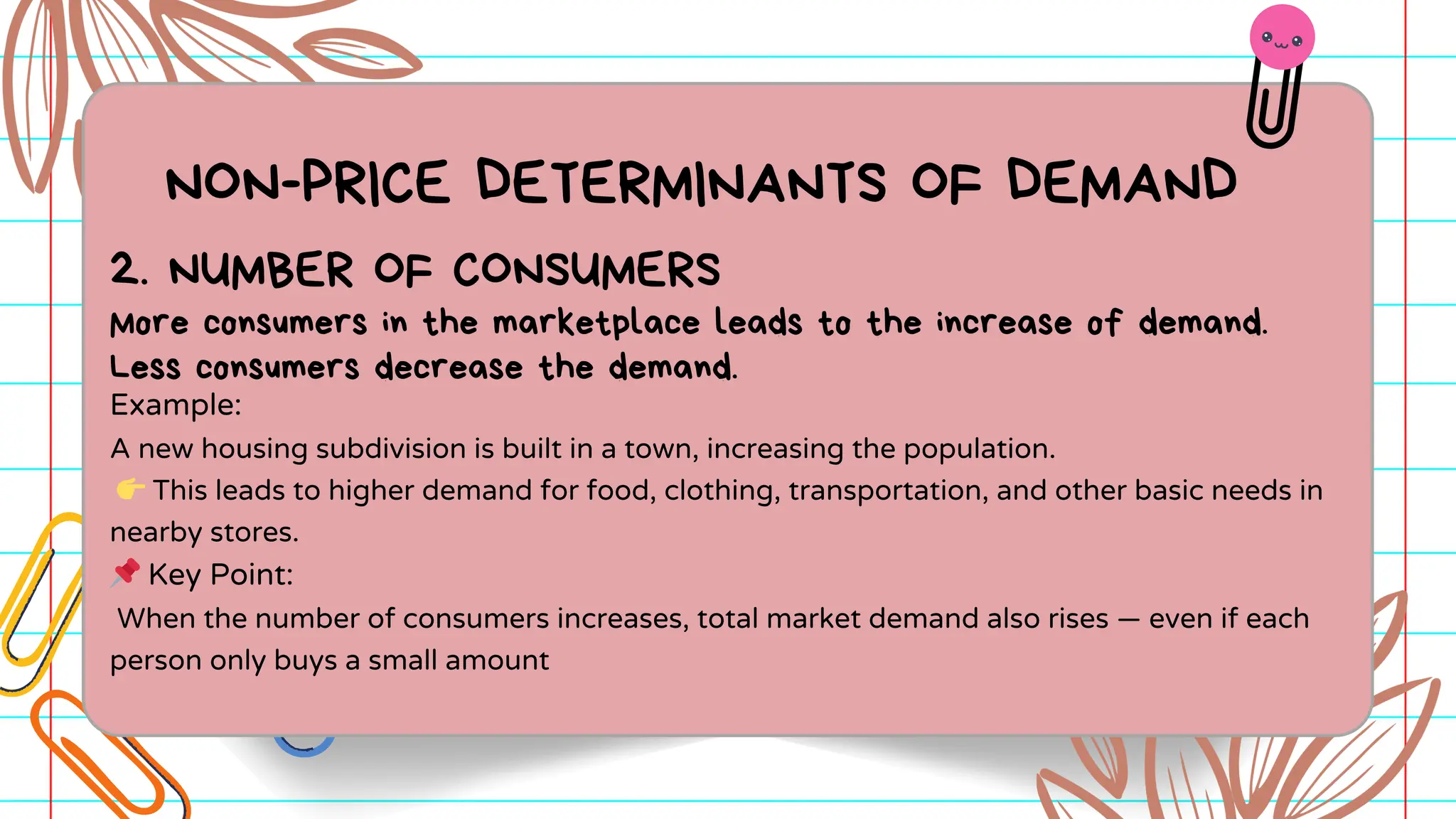
Example:
A new housing subdivision is built in a town, increasing the population.
👉This leads to higher demand for food, clothing, transportation, and other basic needs in
nearby stores.
📌Key Point:
When the number of consumers increases, total market demand also rises — even if each
person only buys a small amount
2. NUMBER OF CONSUMERS
More consumers in the marketplace leads to the increase of demand.
Less consumers decrease the demand.
7.
NON-PRICE DETERMINANTS OFDEMAND
📝Example:
A worker receives a salary increase.
👉They start dining out more often and buy a new phone.
This reflects increased demand due to higher income.
📌Note: Some goods (called inferior goods) may see less demand as income
rises (e.g., instant noodles).
3. INCOME The income of the consumers affects their capacity to
buy a certain product.
Higher income = higher demand
Lower income = lower demand
8.
NON-PRICE DETERMINANTS OFDEMAND
4. PRICES OF RELATED GOODS
An increase or decrease of the demand on the price of goods is classified as
substitute or a complement product
SUBSTITUTE GOODS
Goods that can replace each other.
📈 If the price of one rises, demand for the other increases.
COMPLEMENTARY GOODS
Example:
If the price of Coke increases, people may buy Pepsi instead → demand for Pepsi increases.
Example:
Printers and Ink Cartridges
👉 If printer prices drop, more people buy printers.
👉 As a result, demand for ink cartridges increases.
UNRELATED GOODS
📝 Example:
Shoes and Bananas
👉 If the price of shoes increases, it does not change how much people buy bananas.
9.
NON-PRICE DETERMINANTS OFDEMAND
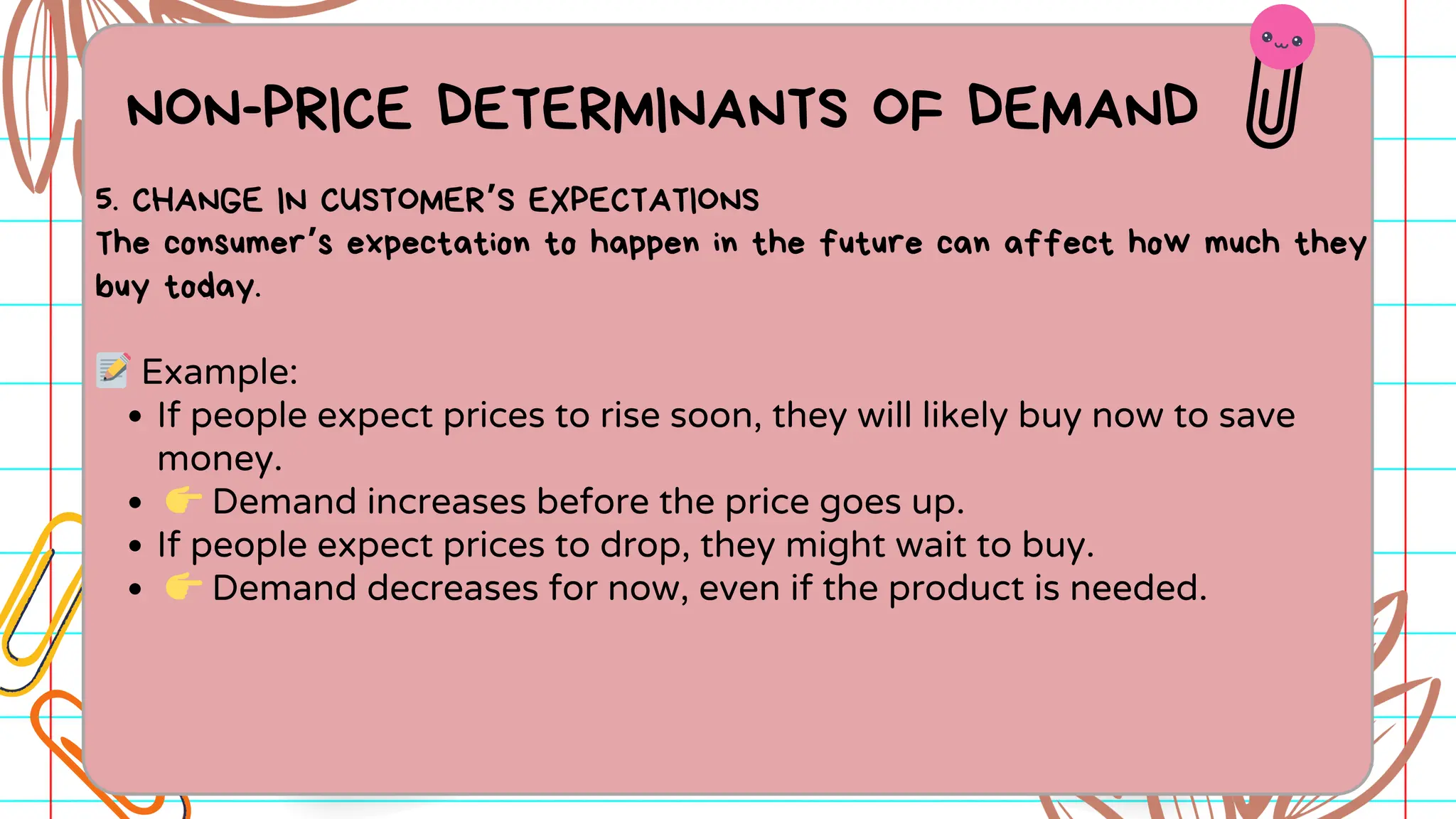
5. CHANGE IN CUSTOMER’S EXPECTATIONS
The consumer’s expectation to happen in the future can affect how much they
buy today.
📝Example:
If people expect prices to rise soon, they will likely buy now to save
money.
👉Demand increases before the price goes up.
If people expect prices to drop, they might wait to buy.
👉Demand decreases for now, even if the product is needed.
10.
NON-PRICE DETERMINANTS OFSUPPLY
1. PRICE RESOURCES
The cost of raw materials, labor, and other inputs directly affects how much
a producer is willing to supply.
📝Explanation:
When the price of resources increases
👉It becomes more expensive to produce goods
👉Supply decreases
When the price of resources decreases
👉Production becomes cheaper
👉Supply increases
📍Example:
If the cost of flour rises, a bakery might reduce bread production because of higher expenses.
👉This leads to less bread supply in the market.
📌Key Point:
Resource prices impact profit margins, which influence how much producers are willing to produce and
sell.
11.
NON-PRICE DETERMINANTS OFSUPPLY
2. TECHNOLOGY
Improvements in technology make production faster, cheaper, and more
efficient — leading to an increase in supply.
📝Explanation:
Advanced tools or machines allow producers to create more output using the same or
fewer resources.
As production becomes more efficient, businesses can supply more at the same cost.
📍Example:
A new baking machine allows a bakery to produce twice as many loaves of bread in the
same time.
👉The bakery’s supply increases without raising prices.
📌Key Point:
Better technology = higher productivity = more supply in the market.
Would you like me to prepare the next slide on Government Policies
12.
NON-PRICE DETERMINANTS OFSUPPLY
3. TAXES AND SUBSIDIES
Government actions like taxes and subsidies can affect the cost of production, which
in turn affects supply.
🧾Taxes
Increase production costs
Producers may reduce supply to avoid losses
Example:
If a government imposes a new sugar tax, a candy manufacturer might cut back production due to higher
costs.
🎁Subsidies
Financial aid from the government to producers
Reduces production costs and increases supply
Example:
Farmers receiving subsidies for rice production can produce more rice, increasing supply in the market.
📌Key Point:
Taxes = 🛑Lower supply
Subsidies = ✅Higher supply
13.
NON-PRICE DETERMINANTS OFSUPPLY
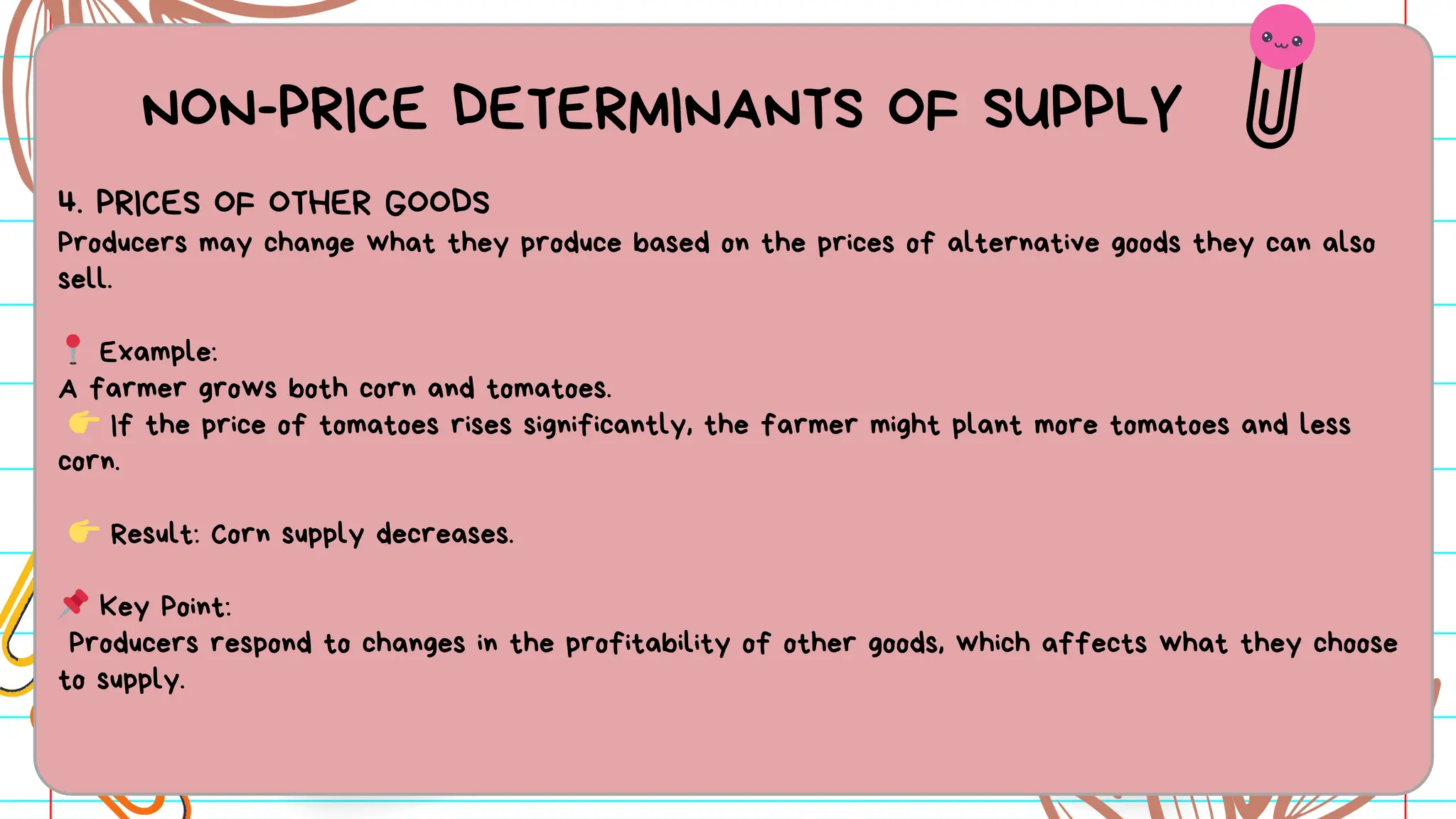
4. PRICES OF OTHER GOODS
Producers may change what they produce based on the prices of alternative goods they can also
sell.
📍 Example:
A farmer grows both corn and tomatoes.
👉 If the price of tomatoes rises significantly, the farmer might plant more tomatoes and less
corn.
👉 Result: Corn supply decreases.
📌 Key Point:
Producers respond to changes in the profitability of other goods, which affects what they choose
to supply.
14.
NON-PRICE DETERMINANTS OFSUPPLY
5. PRICE EXPECTATIONS
A producer’s expectation of future prices can influence how much they supply now.
Explanation:
If producers expect prices to rise in the future, they may withhold supply now to sell later
at a higher price.
👉Current supply decreases
If they expect prices to fall, they may try to sell more now before prices drop.
👉Current supply increases
📍Example:
Oil producers expect prices to rise next month.
👉They may limit current production to take advantage of future high prices.
👉Current oil supply decreases.
📌Key Point:
Future price expectations directly influence the amount supplied today.
15.
NON-PRICE DETERMINANTS OFSUPPLY
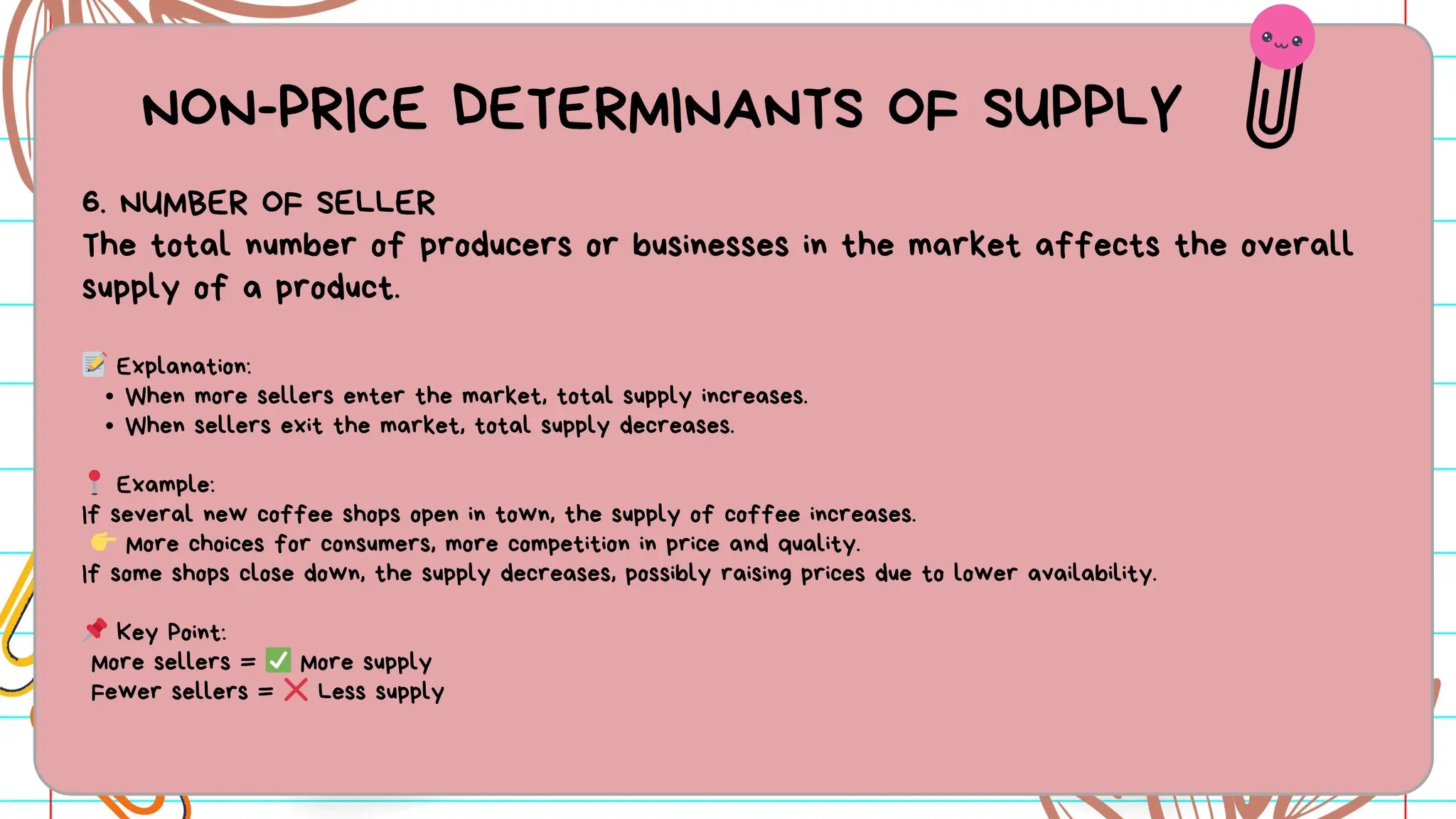
6. NUMBER OF SELLER
The total number of producers or businesses in the market affects the overall
supply of a product.
📝 Explanation:
When more sellers enter the market, total supply increases.
When sellers exit the market, total supply decreases.
📍 Example:
If several new coffee shops open in town, the supply of coffee increases.
👉 More choices for consumers, more competition in price and quality.
If some shops close down, the supply decreases, possibly raising prices due to lower availability.
📌 Key Point:
More sellers = ✅ More supply
Fewer sellers = ❌ Less supply
16.
Exercises:
Direction: Clarify anddetermine whether the given word is a factors
affecting demand. Write S for factors affecting supply and write D for
factors affecting demand.
____________________Number os sellers __________Number of consumers
____________________Income _________________Taxes and subsidies
____________________Price of Related goods ______Taste
____________________Price of Resources __________Income
____________________Technology _______________Price Expectations
17.
Directions: Provide aconcise and a brief statement to support your
answer.
1.An increase in the price of inputs leads to a decrease in
supply.
2.If there are more producers in the market, there will be a
large supply of products/services.
3.The increase in the level of production technology will
incfrease supply.
4.Substitute goods are typically consumed together.
5.When income rises, the demand for the product will
increase, when income falls, the demand for the product
will decrease.
18.
WHAT I HAVELEARNED?
Directions: Provide your own ideas regarding the following statement.
1.What have ypou learned from the discussion? How can you
apply these learning in your real-life activities?
2. Cite specific real-life scenario as to where you can use your
learnings about the factors of demand?
3. Cite specific real-life scenario as to where you can use your
learnings about the factors of Supply?
19.
ADDITIONAL ACTIVITES:
Identify thenon-price determinants of supply from the following statements and choose the
correct answer from the given words below.
________________1. An expectation of a substantial rise in future log prices decreases the
supply of the logs today.
________________2. An increase in the price of cucumbers decreases in the supply of water
melon.
________________3. An increase in the number of tattoo parlors increases the supply of
tattoos, the formation of women’s professional basketball leagues increases the supply of
women’s professional basketball games
change in expectations
change in the price of related goods
change in income
change in number of buyers
change in buyer’s taste
20.
ADDITIONAL ACTIVITES:
Identify thenon-price determinants of demand from the following statements and choose the
correct answer from the given words below.
________________1. Physical fitness rises in popularity. increasing the demand for
jogging shoes and bicycle patriotism rises, increasing the demands for flags.
________________2. A decline in the birthrate reduces the demands for children’s
toys.
________________3. A rise in income increases the demand for normal goods such
as donuts, sports, tickets and necklaces while reducing the demand for interior goods
such as used clothes, squash and an expensive wine.
change in expectations
change in the price of related goods
change in income
change in number of buyers
change in buyer’s taste