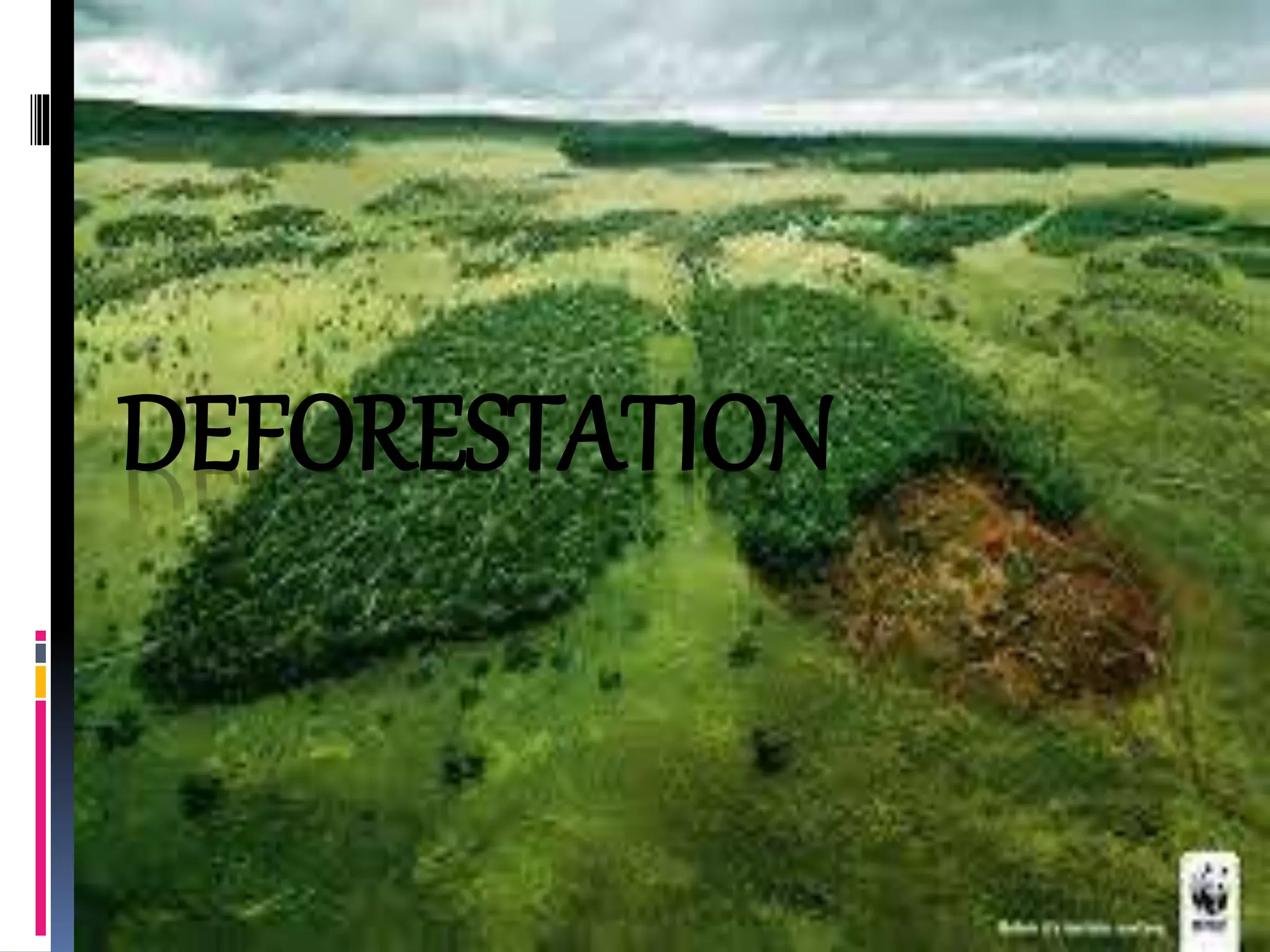
DEFORESTATION
CONTENTS OF PRESENTATION
DEFORESTATION
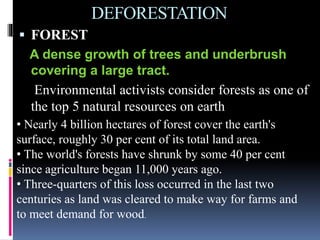
 FOREST
A dense growth of trees and underbrush
covering a large tract.
Environmental activists consider forests as one of
the top 5 natural resources on earth
• Nearly 4 billion hectares of forest cover the earth's
surface, roughly 30 per cent of its total land area.
• The world's forests have shrunk by some 40 per cent
since agriculture began 11,000 years ago.
• Three-quarters of this loss occurred in the last two
centuries as land was cleared to make way for farms and
to meet demand for wood.
IMPORTANCE OF FOREST
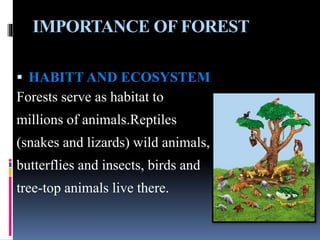
 HABITT AND ECOSYSTEM
Forests serve as habitat to
millions of animals.Reptiles
(snakes and lizards) wild animals,
butterflies and insects, birds and
tree-top animals live there.
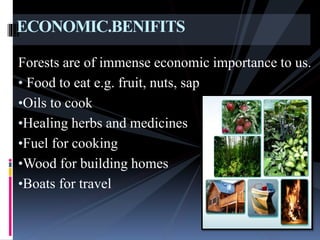
Forests are of immense economic importance to us.
• Food to eat e.g. fruit, nuts, sap
•Oils to cook
•Healing herbs and medicines
•Fuel for cooking
•Wood for building homes
•Boats for travel
ECONOMIC.BENIFITS
•Control temperatures.(e.g. TRFs cool
air in the tropics)
•Absorb rainfall and store water in their leaves,
trunk, and roots
•Filter dust and pollution
•Protect the soil from exposure to soil erosion
•Maintain atmospheric balance by absorbing large
quantities of carbon dioxide and then
releasing oxygen back into the air
•Maintain a constant humidity level.
CLIMATE CONTROL
Makes its possible for drinking and supporting life
As the water flows seeps into the ground, soil particles trap
impurities and filters the water
ENJOYMENT VALUE
The natural beauty and peace of the forest offer a special
source of enjoyment. In the United States, Canada, and
many other countries, huge forestlands have been set aside
for people's enjoyment.
MAINTAINING WATER QUALITY
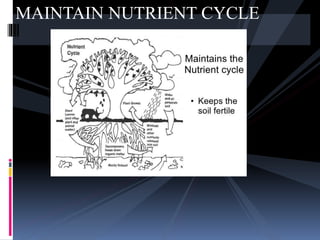
MAINTAIN NUTRIENT CYCLE
DEFINITION
 Deforestation is the conversion of forested areas to non-
forested land
Deforestation is the full or large scale removal of forest or
area of tress in order to clear land for human development
“Clearing of virgin forests, or intentional destruction or
removal of trees and other vegetation for agricultural
,commercial, housing, or firewood use without replanting
(reforesting) and without allowing time for the forest to
regenerate itself ”.
DEFORESTATION
Some 4000 years ago, evidences of man
made plant and animal extinction actions have
been seen.
 Fire was one of the popular methods of
balding a forest to be turned into an
agricultural area.
 Grazing animals also became a lead to
major deforestation in area locales.
 No significant effects of deforestation at
that time is because of the less population
PRE HISTORICAL DEFORESTATION
THE INDUSTRIALTIMES OFDEFORESTATION
In 19th century with advent of industrialization
deforestation even rose to bigger numbers.
None at that time was able to see the probable
effects that we are experiencing right now.
Timber was in great popularity among
shipbuilders; thus, the business of logging grew in
astounding counts.
Introduction of steamboats in the United States
was the cause of deforestation of banks of major
rivers such as the Mississippi River
a slash and burn method for creating short term
goals.
slash-and-burn deforestation releases 180 metric tons
of carbon into the atmosphere
Over 200 million people are using this technique all
over the world; and perhaps it is the main reason why
gigantic land areas have been totally exhausted and
eroded.
Such lands are of no use for any form of cultivation
at the present time.
Demand of growing businesses have endangered the
forests
Deforestation rate is higher than reforestation
PRESENT DEFORESTATION TRENDS
CAUSE OF DEFORESTATION DUE TO
HUMANS
1. TIMBER
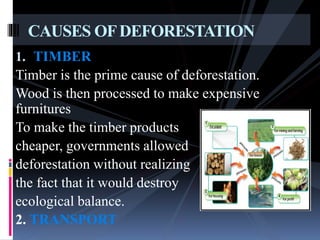
Timber is the prime cause of deforestation.
Wood is then processed to make expensive
furnitures
To make the timber products
cheaper, governments allowed
deforestation without realizing
the fact that it would destroy
ecological balance.
2. TRANSPORT
CAUSES OFDEFORESTATION
CONSTRUCTION OF ROADS AND RAILWAYS
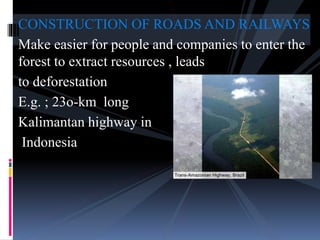
Make easier for people and companies to enter the
forest to extract resources , leads
to deforestation
E.g. ; 23o-km long
Kalimantan highway in
Indonesia
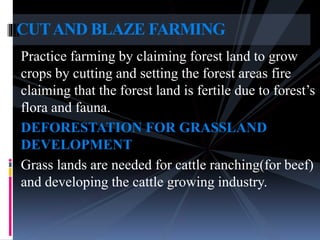
Practice farming by claiming forest land to grow
crops by cutting and setting the forest areas fire
claiming that the forest land is fertile due to forest’s
flora and fauna.
DEFORESTATION FOR GRASSLAND
DEVELOPMENT
Grass lands are needed for cattle ranching(for beef)
and developing the cattle growing industry.
CUTAND BLAZE FARMING
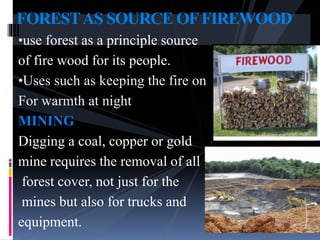
•use forest as a principle source
of fire wood for its people.
•Uses such as keeping the fire on
For warmth at night
MINING
Digging a coal, copper or gold
mine requires the removal of all
forest cover, not just for the
mines but also for trucks and
equipment.
FORESTAS SOURCE OFFIREWOOD
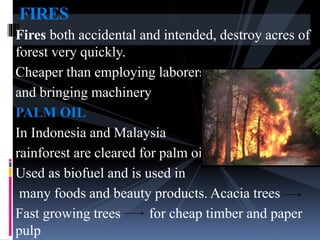
Fires both accidental and intended, destroy acres of
forest very quickly.
Cheaper than employing laborers
and bringing machinery
PALM OIL
In Indonesia and Malaysia
rainforest are cleared for palm oil
Used as biofuel and is used in
many foods and beauty products. Acacia trees
Fast growing trees for cheap timber and paper
pulp
FIRES
Factories are a source of pollution.
When factories let out smoke it forms clouds.
When it rains from those clouds, it can become acid
rain or polluted water drops.
The trees absorb the polluted water, it makes them
sick or can even kill the trees.
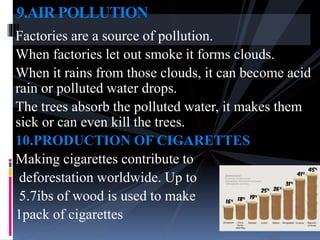
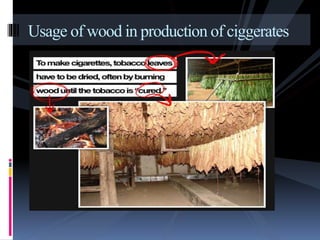
10.PRODUCTION OF CIGARETTES
Making cigarettes contribute to
deforestation worldwide. Up to
5.7ibs of wood is used to make
1pack of cigarettes
9.AIR POLLUTION
Usage of wood in production of ciggerates
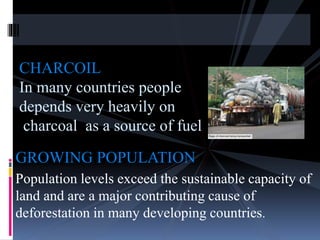
GROWING POPULATION
Population levels exceed the sustainable capacity of
land and are a major contributing cause of
deforestation in many developing countries.
CHARCOIL
In many countries people
depends very heavily on
charcoal as a source of fuel
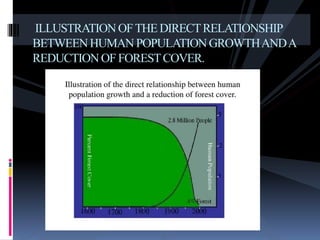
ILLUSTRATIONOFTHEDIRECTRELATIONSHIP
BETWEENHUMAN POPULATIONGROWTHANDA
REDUCTIONOFFORESTCOVER.
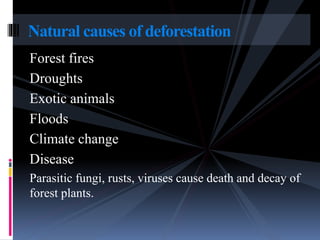
Forest fires
Droughts
Exotic animals
Floods
Climate change
Disease
Parasitic fungi, rusts, viruses cause death and decay of
forest plants.
Natural causes of deforestation
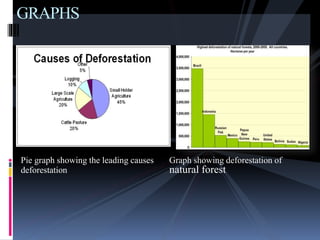
Pie graph showing the leading causes Graph showing deforestation of
deforestation natural forest
GRAPHS
POSITIVE CONSEQUENCES OF DEFORESTATION
Forests make way
for residential houses
Office buildings and factories.
Governments are able to build roads to make trade and
transport easier and therefore more convenient to residents.
NEGATIVE CONSEQUENCES OFDEFORESTATION
CONSEQUENCES OF DEFORESTATION
Deforestation is the major contributor. to global
warming
Deforestation influences trees to release carbon
stores.
As the concentration of carbon dioxide increases, a
layer forms in the atmosphere that traps sun
radiation.
This radiation gets converted to heat and causes
global warming
Scientists say that almost 1.5 billion tons of carbon
is released each year by tropical deforestation.
ATMOSPHERIC–OXYGENIMBALANCEAND CLIMATE
CHANGE:
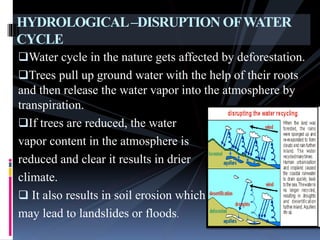
Water cycle in the nature gets affected by deforestation.
Trees pull up ground water with the help of their roots
and then release the water vapor into the atmosphere by
transpiration.
If trees are reduced, the water
vapor content in the atmosphere is
reduced and clear it results in drier
climate.
 It also results in soil erosion which
may lead to landslides or floods.
HYDROLOGICAL–DISRUPTION OFWATER
CYCLE
Forests which are clear felled (cut down) result in the soil
being exposed to the sun.
The soil becomes dry and volatile and nutrients such as
nitrogen are lost.
Leaf litter, which is the main source of nutrients for trees,
is not produced when the trees are removed.
The tree canopy protects the soil from the heavy rainfall
SOIL– INFERTILITYAND SOILEROSION
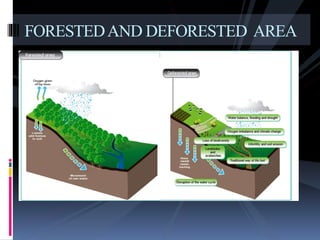
FORESTEDAND DEFORESTED AREA
Deforestation results in the decline in biodiversity
and many species of living organisms are becoming
extinct. Forests support wildlife habitat and the
tropical rainforests contribute to 80%of the
biodiversity
It is estimated that almost 90 percent of predicted
extinctions will take place within next forty years.
DESERTIFICATION
Deforestation is one of the causes behind the
conversion of many fertile tracts of land to deserts.
This phenomenon is known as desertification .
BIODIVERSITY– LOSS OFBIODIVERSITY:
Average temperature of the earth has risen in
the last century.
If this phenomenon continues then the
increased temperatures would lead to melting
of glaciers.
This would lead to a massive rise in the sea
levels leading to submersion of coastal areas.
DANGER OFSUBMERSION OF
COASTALAREASAND GLACIERS:
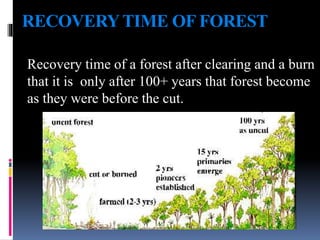
RECOVERYTIME OF FOREST
Recovery time of a forest after clearing and a burn
that it is only after 100+ years that forest become
as they were before the cut.
a) USE RECYCLED ITEMS:
Use recycled item including
notebook paper, books, toilet paper,
and shopping bags.
b) TREE CARE:
Must remove a tree for a legitimate
reason
Make sure that for every tree lost
another is planted in its place.
HOWTO PREVENT DEFORESTATION
Farmers should make use of environment savvy techniques
like crop rotation.
Crop rotation involves using the same piece of land to grow
two different kinds of crops, instead of growing the same in
two different pieces of land.
d) CUT BACK ON PALM OIL:
In Malaysia and Indonesia, an increasing amount of trees
are cut down in order to generate the palm oil used in the
production of some breads, chocolates, and shampoos.
h)FOLLOW CROP ROTATION:
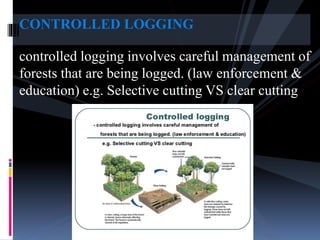
CONTROLLED LOGGING
controlled logging involves careful management of
forests that are being logged. (law enforcement &
education) e.g. Selective cutting VS clear cutting
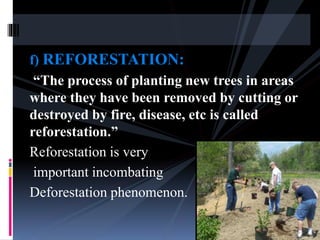
f) REFORESTATION:
“The process of planting new trees in areas
where they have been removed by cutting or
destroyed by fire, disease, etc is called
reforestation.”
Reforestation is very
important incombating
Deforestation phenomenon.
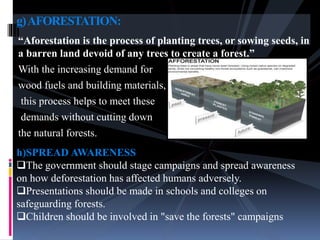
“Aforestation is the process of planting trees, or sowing seeds, in
a barren land devoid of any trees to create a forest.”
With the increasing demand for
wood fuels and building materials,
this process helps to meet these
demands without cutting down
the natural forests.
g)AFORESTATION:
h)SPREAD AWARENESS
The government should stage campaigns and spread awareness
on how deforestation has affected humans adversely.
Presentations should be made in schools and colleges on
safeguarding forests.
Children should be involved in "save the forests" campaigns
Lend your support through donations of your time, money,
or actions to organizations that run programs concentrating
on the preservation of forest habitats, such as
•Greenpeace,
•World Wide Fund for Nature,
•Community Forestry International, and
•Conservation International.
SUPPORTCONSERVATION ORGANIZATIONS:
•The Ministry of Forestry(MOF) - MOF issues
licenses to timber companies and monitor their
activities.
Four Main Policies of MOF •
Afforestation
Reforestation
Controlled logging
Conservation
Controlling forest fires
WORKING ORGANIZATION
Developing countries should urgently adopt
effective policies to rapidly slowing down the
current high rates of population growth
Our Role in Forest Conservation
•Simple actions such as making use of both sides of
a piece of paper can help to reduce wastage of
forest resources.
• To help reduce deforestation in other countries, we
can buy furniture made of timber from sustainably
managed forests.
NEEDTO CONTROLPOPULATION GROWTH
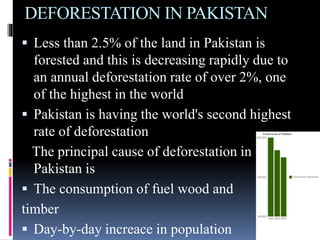
DEFORESTATION IN PAKISTAN
 Less than 2.5% of the land in Pakistan is
forested and this is decreasing rapidly due to
an annual deforestation rate of over 2%, one
of the highest in the world
 Pakistan is having the world's second highest
rate of deforestation
The principal cause of deforestation in
Pakistan is
 The consumption of fuel wood and
timber
 Day-by-day increace in population

Deforestation

  • 1.
  • 2.
  • 3.
    DEFORESTATION  FOREST A densegrowth of trees and underbrush covering a large tract. Environmental activists consider forests as one of the top 5 natural resources on earth • Nearly 4 billion hectares of forest cover the earth's surface, roughly 30 per cent of its total land area. • The world's forests have shrunk by some 40 per cent since agriculture began 11,000 years ago. • Three-quarters of this loss occurred in the last two centuries as land was cleared to make way for farms and to meet demand for wood.
  • 4.
    IMPORTANCE OF FOREST HABITT AND ECOSYSTEM Forests serve as habitat to millions of animals.Reptiles (snakes and lizards) wild animals, butterflies and insects, birds and tree-top animals live there.
  • 5.
    Forests are ofimmense economic importance to us. • Food to eat e.g. fruit, nuts, sap •Oils to cook •Healing herbs and medicines •Fuel for cooking •Wood for building homes •Boats for travel ECONOMIC.BENIFITS
  • 6.
    •Control temperatures.(e.g. TRFscool air in the tropics) •Absorb rainfall and store water in their leaves, trunk, and roots •Filter dust and pollution •Protect the soil from exposure to soil erosion •Maintain atmospheric balance by absorbing large quantities of carbon dioxide and then releasing oxygen back into the air •Maintain a constant humidity level. CLIMATE CONTROL
  • 7.
    Makes its possiblefor drinking and supporting life As the water flows seeps into the ground, soil particles trap impurities and filters the water ENJOYMENT VALUE The natural beauty and peace of the forest offer a special source of enjoyment. In the United States, Canada, and many other countries, huge forestlands have been set aside for people's enjoyment. MAINTAINING WATER QUALITY
  • 8.
  • 9.
    DEFINITION  Deforestation isthe conversion of forested areas to non- forested land Deforestation is the full or large scale removal of forest or area of tress in order to clear land for human development “Clearing of virgin forests, or intentional destruction or removal of trees and other vegetation for agricultural ,commercial, housing, or firewood use without replanting (reforesting) and without allowing time for the forest to regenerate itself ”. DEFORESTATION
  • 10.
    Some 4000 yearsago, evidences of man made plant and animal extinction actions have been seen.  Fire was one of the popular methods of balding a forest to be turned into an agricultural area.  Grazing animals also became a lead to major deforestation in area locales.  No significant effects of deforestation at that time is because of the less population PRE HISTORICAL DEFORESTATION
  • 11.
    THE INDUSTRIALTIMES OFDEFORESTATION In19th century with advent of industrialization deforestation even rose to bigger numbers. None at that time was able to see the probable effects that we are experiencing right now. Timber was in great popularity among shipbuilders; thus, the business of logging grew in astounding counts. Introduction of steamboats in the United States was the cause of deforestation of banks of major rivers such as the Mississippi River
  • 12.
    a slash andburn method for creating short term goals. slash-and-burn deforestation releases 180 metric tons of carbon into the atmosphere Over 200 million people are using this technique all over the world; and perhaps it is the main reason why gigantic land areas have been totally exhausted and eroded. Such lands are of no use for any form of cultivation at the present time. Demand of growing businesses have endangered the forests Deforestation rate is higher than reforestation PRESENT DEFORESTATION TRENDS
  • 13.
  • 14.
    1. TIMBER Timber isthe prime cause of deforestation. Wood is then processed to make expensive furnitures To make the timber products cheaper, governments allowed deforestation without realizing the fact that it would destroy ecological balance. 2. TRANSPORT CAUSES OFDEFORESTATION
  • 15.
    CONSTRUCTION OF ROADSAND RAILWAYS Make easier for people and companies to enter the forest to extract resources , leads to deforestation E.g. ; 23o-km long Kalimantan highway in Indonesia
  • 16.
    Practice farming byclaiming forest land to grow crops by cutting and setting the forest areas fire claiming that the forest land is fertile due to forest’s flora and fauna. DEFORESTATION FOR GRASSLAND DEVELOPMENT Grass lands are needed for cattle ranching(for beef) and developing the cattle growing industry. CUTAND BLAZE FARMING
  • 17.
    •use forest asa principle source of fire wood for its people. •Uses such as keeping the fire on For warmth at night MINING Digging a coal, copper or gold mine requires the removal of all forest cover, not just for the mines but also for trucks and equipment. FORESTAS SOURCE OFFIREWOOD
  • 18.
    Fires both accidentaland intended, destroy acres of forest very quickly. Cheaper than employing laborers and bringing machinery PALM OIL In Indonesia and Malaysia rainforest are cleared for palm oil Used as biofuel and is used in many foods and beauty products. Acacia trees Fast growing trees for cheap timber and paper pulp FIRES
  • 19.
    Factories are asource of pollution. When factories let out smoke it forms clouds. When it rains from those clouds, it can become acid rain or polluted water drops. The trees absorb the polluted water, it makes them sick or can even kill the trees. 10.PRODUCTION OF CIGARETTES Making cigarettes contribute to deforestation worldwide. Up to 5.7ibs of wood is used to make 1pack of cigarettes 9.AIR POLLUTION
  • 20.
    Usage of woodin production of ciggerates
  • 21.
    GROWING POPULATION Population levelsexceed the sustainable capacity of land and are a major contributing cause of deforestation in many developing countries. CHARCOIL In many countries people depends very heavily on charcoal as a source of fuel
  • 22.
  • 23.
    Forest fires Droughts Exotic animals Floods Climatechange Disease Parasitic fungi, rusts, viruses cause death and decay of forest plants. Natural causes of deforestation
  • 24.
    Pie graph showingthe leading causes Graph showing deforestation of deforestation natural forest GRAPHS
  • 25.
    POSITIVE CONSEQUENCES OFDEFORESTATION Forests make way for residential houses Office buildings and factories. Governments are able to build roads to make trade and transport easier and therefore more convenient to residents. NEGATIVE CONSEQUENCES OFDEFORESTATION CONSEQUENCES OF DEFORESTATION
  • 26.
    Deforestation is themajor contributor. to global warming Deforestation influences trees to release carbon stores. As the concentration of carbon dioxide increases, a layer forms in the atmosphere that traps sun radiation. This radiation gets converted to heat and causes global warming Scientists say that almost 1.5 billion tons of carbon is released each year by tropical deforestation. ATMOSPHERIC–OXYGENIMBALANCEAND CLIMATE CHANGE:
  • 27.
    Water cycle inthe nature gets affected by deforestation. Trees pull up ground water with the help of their roots and then release the water vapor into the atmosphere by transpiration. If trees are reduced, the water vapor content in the atmosphere is reduced and clear it results in drier climate.  It also results in soil erosion which may lead to landslides or floods. HYDROLOGICAL–DISRUPTION OFWATER CYCLE
  • 28.
    Forests which areclear felled (cut down) result in the soil being exposed to the sun. The soil becomes dry and volatile and nutrients such as nitrogen are lost. Leaf litter, which is the main source of nutrients for trees, is not produced when the trees are removed. The tree canopy protects the soil from the heavy rainfall SOIL– INFERTILITYAND SOILEROSION
  • 29.
  • 30.
    Deforestation results inthe decline in biodiversity and many species of living organisms are becoming extinct. Forests support wildlife habitat and the tropical rainforests contribute to 80%of the biodiversity It is estimated that almost 90 percent of predicted extinctions will take place within next forty years. DESERTIFICATION Deforestation is one of the causes behind the conversion of many fertile tracts of land to deserts. This phenomenon is known as desertification . BIODIVERSITY– LOSS OFBIODIVERSITY:
  • 31.
    Average temperature ofthe earth has risen in the last century. If this phenomenon continues then the increased temperatures would lead to melting of glaciers. This would lead to a massive rise in the sea levels leading to submersion of coastal areas. DANGER OFSUBMERSION OF COASTALAREASAND GLACIERS:
  • 32.
    RECOVERYTIME OF FOREST Recoverytime of a forest after clearing and a burn that it is only after 100+ years that forest become as they were before the cut.
  • 33.
    a) USE RECYCLEDITEMS: Use recycled item including notebook paper, books, toilet paper, and shopping bags. b) TREE CARE: Must remove a tree for a legitimate reason Make sure that for every tree lost another is planted in its place. HOWTO PREVENT DEFORESTATION
  • 34.
    Farmers should makeuse of environment savvy techniques like crop rotation. Crop rotation involves using the same piece of land to grow two different kinds of crops, instead of growing the same in two different pieces of land. d) CUT BACK ON PALM OIL: In Malaysia and Indonesia, an increasing amount of trees are cut down in order to generate the palm oil used in the production of some breads, chocolates, and shampoos. h)FOLLOW CROP ROTATION:
  • 35.
    CONTROLLED LOGGING controlled logginginvolves careful management of forests that are being logged. (law enforcement & education) e.g. Selective cutting VS clear cutting
  • 36.
    f) REFORESTATION: “The processof planting new trees in areas where they have been removed by cutting or destroyed by fire, disease, etc is called reforestation.” Reforestation is very important incombating Deforestation phenomenon.
  • 37.
    “Aforestation is theprocess of planting trees, or sowing seeds, in a barren land devoid of any trees to create a forest.” With the increasing demand for wood fuels and building materials, this process helps to meet these demands without cutting down the natural forests. g)AFORESTATION: h)SPREAD AWARENESS The government should stage campaigns and spread awareness on how deforestation has affected humans adversely. Presentations should be made in schools and colleges on safeguarding forests. Children should be involved in "save the forests" campaigns
  • 38.
    Lend your supportthrough donations of your time, money, or actions to organizations that run programs concentrating on the preservation of forest habitats, such as •Greenpeace, •World Wide Fund for Nature, •Community Forestry International, and •Conservation International. SUPPORTCONSERVATION ORGANIZATIONS:
  • 39.
    •The Ministry ofForestry(MOF) - MOF issues licenses to timber companies and monitor their activities. Four Main Policies of MOF • Afforestation Reforestation Controlled logging Conservation Controlling forest fires WORKING ORGANIZATION
  • 40.
    Developing countries shouldurgently adopt effective policies to rapidly slowing down the current high rates of population growth Our Role in Forest Conservation •Simple actions such as making use of both sides of a piece of paper can help to reduce wastage of forest resources. • To help reduce deforestation in other countries, we can buy furniture made of timber from sustainably managed forests. NEEDTO CONTROLPOPULATION GROWTH
  • 41.
    DEFORESTATION IN PAKISTAN Less than 2.5% of the land in Pakistan is forested and this is decreasing rapidly due to an annual deforestation rate of over 2%, one of the highest in the world  Pakistan is having the world's second highest rate of deforestation The principal cause of deforestation in Pakistan is  The consumption of fuel wood and timber  Day-by-day increace in population