Definitions of Tort
Prof Govind Prasad Goyal, IMS Law College, Noida
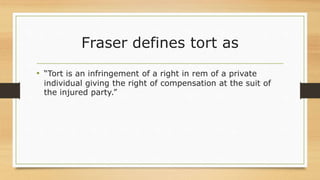
Fraser defines tort as
• “Tort is an infringement of a right in rem of a private
individual giving the right of compensation at the suit of
the injured party.”
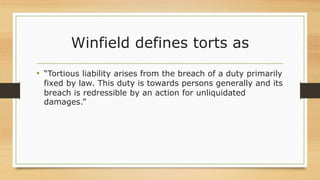
Winfield defines torts as
• “Tortious liability arises from the breach of a duty primarily
fixed by law. This duty is towards persons generally and its
breach is redressible by an action for unliquidated
damages.”
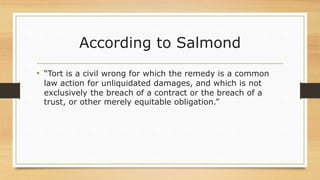
According to Salmond
• “Tort is a civil wrong for which the remedy is a common
law action for unliquidated damages, and which is not
exclusively the breach of a contract or the breach of a
trust, or other merely equitable obligation.”
Pollock’s contribution to the
definition is
• “Tort is an act or omission (not merely the breach of a
duty arising out of personal relations, or undertaken by a
contract which is related to harm suffered by a
determinate person, giving rise to a civil remedy which is
not an action of contract”
Section 2(m) Limitation Act of
1963 defines torts as
• “Tort means a civil wrong which is not exclusively a breach
of contract or trust”.
In M.C. Mehta v. Union of India, Justice
Bhagwati observed-
• “We have to evolve new principles and lay down new norms which
will adequately deal with new problems which arise in a highly
industrialized economy. We cannot allow our judicial thinking to be
constructed by reference to the law as it prevails in England or for
the matter of that in any foreign country. We are certainly prepared
to receive light from whatever source it comes but we have to build
our own jurisprudence.”
SCI in Rajkot Municipal Corporation vs
Manjulben Jayantilal Nakum & Ors on 17 January, 1997
• In the absence of statutory law or established principles of law laid by this
Court (read Supreme Court of India) or High Courts consistent with Indian
conditions and circumstances, this Court selectedly applied the common
law principles evolved by the courts in England on grounds of justice,
equity and good conscience (vide Ramanbhai Prabhatbhai's case).
Common law principles of tort evolved by the courts in England may be
applied in India to the extent of suitability and applicability to the Indian
conditions.
The Supreme Court of Canada in the
case of Hall v Herbert,
• “It is difficult to define the nature of tort.” Indeed, one of
the greatest writers in the field, W.L. Prosser has
expressed the opinion that it should not be defined.
This Photo by Unknown Author is licensed under CC BY-NC

Definitions of tort

  • 1.
    Definitions of Tort ProfGovind Prasad Goyal, IMS Law College, Noida
  • 2.
    Fraser defines tortas • “Tort is an infringement of a right in rem of a private individual giving the right of compensation at the suit of the injured party.”
  • 3.
    Winfield defines tortsas • “Tortious liability arises from the breach of a duty primarily fixed by law. This duty is towards persons generally and its breach is redressible by an action for unliquidated damages.”
  • 4.
    According to Salmond •“Tort is a civil wrong for which the remedy is a common law action for unliquidated damages, and which is not exclusively the breach of a contract or the breach of a trust, or other merely equitable obligation.”
  • 5.
    Pollock’s contribution tothe definition is • “Tort is an act or omission (not merely the breach of a duty arising out of personal relations, or undertaken by a contract which is related to harm suffered by a determinate person, giving rise to a civil remedy which is not an action of contract”
  • 6.
    Section 2(m) LimitationAct of 1963 defines torts as • “Tort means a civil wrong which is not exclusively a breach of contract or trust”.
  • 7.
    In M.C. Mehtav. Union of India, Justice Bhagwati observed- • “We have to evolve new principles and lay down new norms which will adequately deal with new problems which arise in a highly industrialized economy. We cannot allow our judicial thinking to be constructed by reference to the law as it prevails in England or for the matter of that in any foreign country. We are certainly prepared to receive light from whatever source it comes but we have to build our own jurisprudence.”
  • 8.
    SCI in RajkotMunicipal Corporation vs Manjulben Jayantilal Nakum & Ors on 17 January, 1997 • In the absence of statutory law or established principles of law laid by this Court (read Supreme Court of India) or High Courts consistent with Indian conditions and circumstances, this Court selectedly applied the common law principles evolved by the courts in England on grounds of justice, equity and good conscience (vide Ramanbhai Prabhatbhai's case). Common law principles of tort evolved by the courts in England may be applied in India to the extent of suitability and applicability to the Indian conditions.
  • 9.
    The Supreme Courtof Canada in the case of Hall v Herbert, • “It is difficult to define the nature of tort.” Indeed, one of the greatest writers in the field, W.L. Prosser has expressed the opinion that it should not be defined.
  • 10.
    This Photo byUnknown Author is licensed under CC BY-NC