PERSPECTIVE
1194
Defining the Epidemiology of Covid-19
n engl j med 382;13  nejm.org  March 26, 2020
Defining the Epidemiology of Covid-19
Defining the Epidemiology of Covid-19 — Studies Needed
Marc Lipsitch, D.Phil., David L. Swerdlow, M.D., and Lyn Finelli, Dr.P.H.​​
The epidemic of 2019 novel
coronavirus (now called SARS-
CoV-2, causing the disease Covid-
19) has expanded from Wuhan
throughout China and is being
exported to a growing number of
countries, some of which have
seen onward transmission. Early
efforts have focused on describ-
ing the clinical course, counting
severe cases, and treating the
sick. Experience with the Middle
East respiratory syndrome (MERS),
pandemic influenza, and other
outbreaks has shown that as an
epidemic evolves, we face an ur-
gent need to expand public health
activities in order to elucidate the
epidemiology of the novel virus
and characterize its potential im-
pact. The impact of an epidemic
depends on the number of per-
sons infected, the infection’s trans-
missibility, and the spectrum of
clinical severity.
Thus, several questions are es-
pecially critical. First, what is the
full spectrum of disease severity
(which can range from asymp-
tomatic, to symptomatic-but-mild,
to severe, to requiring hospital-
ization, to fatal)?
Second, how transmissible is
the virus?
Third, who are the infectors
— how do the infected person’s
age, the severity of illness, and
other characteristics of a case af-
fect the risk of transmitting the
infection to others? Of vital in-
terest is the role that asymptom-
atic or presymptomatic infected
persons play in transmission.
When and for how long is the
virus present in respiratory secre-
tions?
And fourth, what are the risk
factors for severe illness or death?
And how can we identify groups
most likely to have poor out-
comes so that we can focus pre-
vention and treatment efforts?
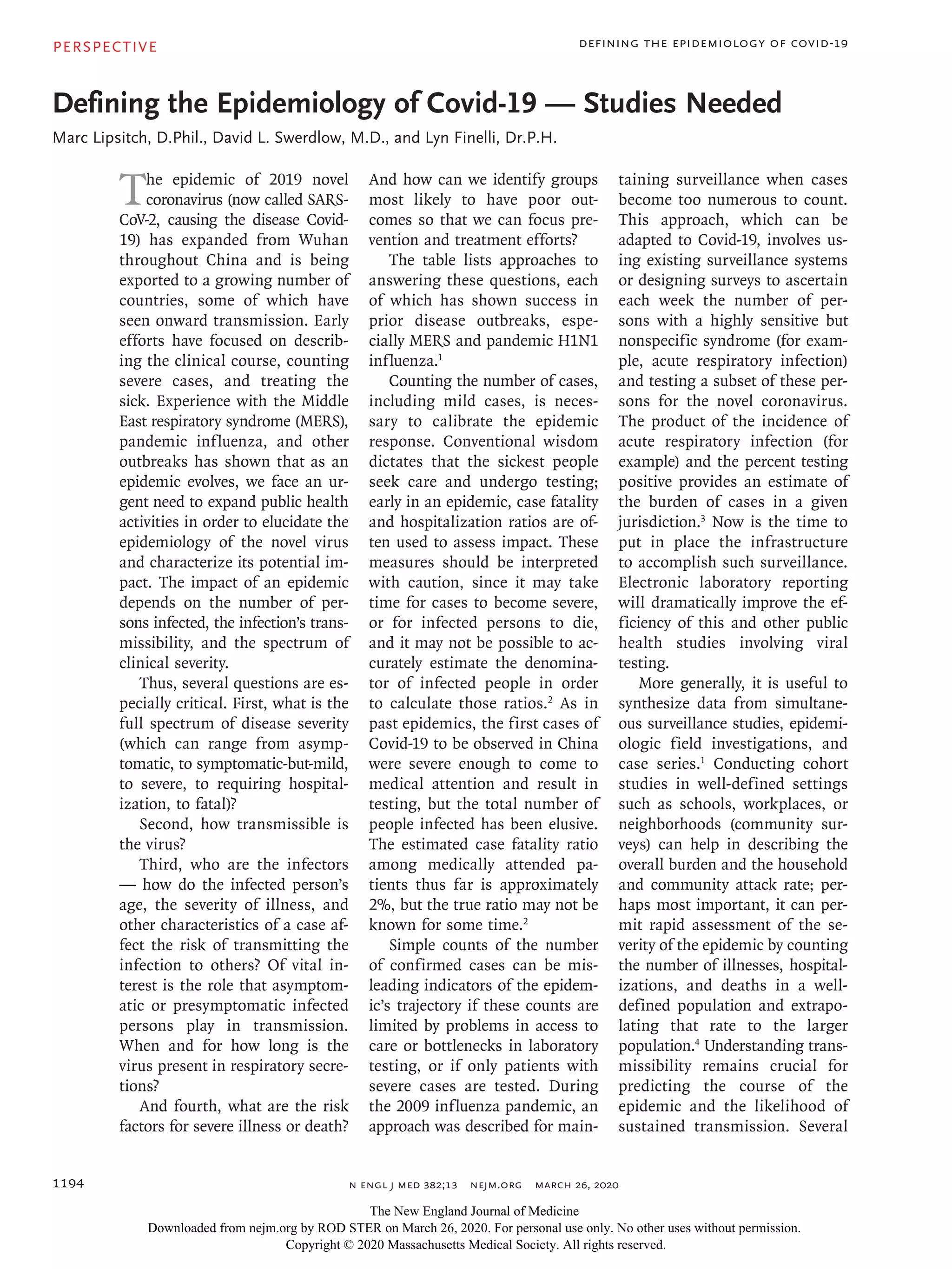
The table lists approaches to
answering these questions, each
of which has shown success in
prior disease outbreaks, espe-
cially MERS and pandemic H1N1
influenza.1
Counting the number of cases,
including mild cases, is neces-
sary to calibrate the epidemic
response. Conventional wisdom
dictates that the sickest people
seek care and undergo testing;
early in an epidemic, case fatality
and hospitalization ratios are of-
ten used to assess impact. These
measures should be interpreted
with caution, since it may take
time for cases to become severe,
or for infected persons to die,
and it may not be possible to ac-
curately estimate the denomina-
tor of infected people in order
to calculate those ratios.2
As in
past epidemics, the first cases of
Covid-19 to be observed in China
were severe enough to come to
medical attention and result in
testing, but the total number of
people infected has been elusive.
The estimated case fatality ratio
among medically attended pa-
tients thus far is approximately
2%, but the true ratio may not be
known for some time.2
Simple counts of the number
of confirmed cases can be mis-
leading indicators of the epidem-
ic’s trajectory if these counts are
limited by problems in access to
care or bottlenecks in laboratory
testing, or if only patients with
severe cases are tested. During
the 2009 influenza pandemic, an
approach was described for main-
taining surveillance when cases
become too numerous to count.
This approach, which can be
adapted to Covid-19, involves us-
ing existing surveillance systems
or designing surveys to ascertain
each week the number of per-
sons with a highly sensitive but
nonspecific syndrome (for exam-
ple, acute respiratory infection)
and testing a subset of these per-
sons for the novel coronavirus.
The product of the incidence of
acute respiratory infection (for
example) and the percent testing
positive provides an estimate of
the burden of cases in a given
jurisdiction.3
Now is the time to
put in place the infrastructure
to accomplish such surveillance.
Electronic laboratory reporting
will dramatically improve the ef-
ficiency of this and other public
health studies involving viral
testing.
More generally, it is useful to
synthesize data from simultane-
ous surveillance studies, epidemi-
ologic field investigations, and
case series.1
Conducting cohort
studies in well-defined settings
such as schools, workplaces, or
neighborhoods (community sur-
veys) can help in describing the
overall burden and the household
and community attack rate; per-
haps most important, it can per-
mit rapid assessment of the se-
verity of the epidemic by counting
the number of illnesses, hospital-
izations, and deaths in a well-
defined population and extrapo-
lating that rate to the larger
population.4
Understanding trans-
missibility remains crucial for
predicting the course of the
­epidemic and the likelihood of
sustained transmission. Several
The New England Journal of Medicine
Downloaded from nejm.org by ROD STER on March 26, 2020. For personal use only. No other uses without permission.
Copyright © 2020 Massachusetts Medical Society. All rights reserved.
PERSPECTIVE
1195
Defining the Epidemiology of Covid-19
n engl j med 382;13  nejm.org  March 26, 2020
groups have estimated the basic
reproductive number R0 of SARS-
CoV-2 using epidemic curves, but
household studies can be superior
sources of data on the timing and
probability of transmission and
may be useful in estimation of R0.5
Household studies can also
help define the role that subclin-
ical, asymptomatic, and mild in-
fections play in transmission to
inform evidence-based decisions
about prioritization of control
measures; measures that depend
on identification and isolation of
symptomatic persons will be far
more effective if those persons
have the primary role in trans-
mission. On the other hand, if
persons without symptoms can
transmit the virus, more empha-
sis should be placed on measures
for social distancing, such as clos-
ing schools and avoiding mass
gatherings. To evaluate whether
the risks that school closure poses
to children’s well-being and edu-
cation — and to productivity if
working parents are needed for
child care — are justified, we
must learn whether children are
an important source of transmis-
sion. Household studies can also
be used to conduct viral shed-
ding studies that can help deter-
mine when patients are most in-
fectious and for how long they
should be isolated.
A key point of these recom-
mendations is that viral testing
should not be used only for clini-
cal care. A proportion of testing
capacity must be reserved to sup-
port public health efforts to char-
acterize the trajectory and sever-
ity of the disease. Although this
approach may result in many neg-
ative test results and therefore
appear “wasteful,” such set-aside
capacity will permit a far clearer
understanding of the spread of
the epidemic and wiser use of re-
sources to combat it. Testing in
unexplained clusters or severe
cases of acute respiratory infec-
tions, regardless of a patient’s
travel history, may be a sensitive
way to screen for chains of trans-
mission that may have been
missed. Such findings are rele-
vant particularly in light of evi-
dence that even Singapore, with
one of the world’s best public
health systems, has found cases
that have so far not been linked
to known cases or to Chinese
travel. If such undetected intro-
ductions are happening in Singa-
pore, it is prudent to expect they
are happening elsewhere as well.
Early investments in charac-
terizing SARS-CoV-2 will pay off
handsomely in improving the
epidemic response. If sustained
transmission takes off outside
China, as many experts expect,
the urgency of the epidemic will
necessitate choices about which
interventions to employ, under
which circumstances, and for how
long. Starting these epidemio-
logic and surveillance activities
promptly will enable us to choose
the most efficient ways of con-
trolling the epidemic and help
us avoid interventions that may be
unnecessarily costly or unduly re-
strictive of normal activity.
Many urban centers in China
are or will soon be overwhelmed
with the treatment of severe cases.
It may be difficult for many of
them to perform the kinds of
studies described here. One ex-
ception is systematic surveys of
persons who are not suspected to
have Covid-19 or who have mild
respiratory illness, to assess
whether they are currently sub-
clinically infected (viral testing),
have been infected previously (se-
rologic testing), or both. These
studies, which will inform esti-
mates of the severity spectrum,
will be most informative in the
settings that have the most cases.
Fortunately, the numbers of
detected cases outside China re-
main manageable for public health
authorities — and too small for
the conduct of such studies. But
it is vital for jurisdictions outside
mainland China to prepare to
perform these studies as case
numbers grow.
Disclosure forms provided by the authors
are available at NEJM.org.
From the Center for Communicable Dis-
ease Dynamics, Department of Epidemiol-
ogy, Harvard T.H. Chan School of Public
Health, Boston (M.L.); Medical Develop-
ment and Scientific/Clinical Affairs, Pfizer
Vaccines, Collegeville, PA (D.L.S.); and the
Center for Observational and Real-World
Evidence, Merck, Kenilworth, NJ (L.F.).
This article was published on February 19,
2020, at NEJM.org.
1.	 Lipsitch M, Finelli L, Heffernan RT,
Leung GM, Redd SC. Improving the evi-
Types of Evidence Needed for Controlling an Epidemic.
Evidence Needed Study Type
No. of cases, including milder ones Syndromic surveillance plus targeted
viral testing
Risk factors and timing of transmission Household studies
Severity and attack rate Community studies
Severity “pyramid” Integration of multiple sources and
data types
Risk factors for infection and severe
outcomes, including death
Case–control studies
Infectiousness timing and intensity Viral shedding studies
The New England Journal of Medicine
Downloaded from nejm.org by ROD STER on March 26, 2020. For personal use only. No other uses without permission.
Copyright © 2020 Massachusetts Medical Society. All rights reserved.
PERSPECTIVE
1196
Defining the Epidemiology of Covid-19
n engl j med 382;13  nejm.org  March 26, 2020
dence base for decision making during a
pandemic: the example of 2009 influenza A/
H1N1. Biosecur Bioterror 2011;​9:​89-115.
2.	 Lipsitch M, Donnelly CA, Fraser C, et al.
Potential Biases in Estimating Absolute and
Relative Case-Fatality Risks during Outbreaks.
PLoS Negl Trop Dis 2015;​9(7):​e0003846.
3.	 Lipsitch M, Hayden FG, Cowling BJ,
Leung GM. How to maintain surveillance
for novel influenza A H1N1 when there are
too many cases to count. Lancet 2009;​374:​
1209-11.
4.	 Janusz KB, Cortes JE, Serdarevic F, et al.
Influenza-like illness in a community sur-
rounding a school-based outbreak of 2009
pandemic influenza A (H1N1) virus — Chi-
cago, Illinois, 2009. Clin Infect Dis 2011;​52:​
Suppl 1:​S94-S101.
5.	 Cauchemez S, Donnelly CA, Reed C, et al.
Household transmission of 2009 pandemic
influenza A (H1N1) virus in the United
States. N Engl J Med 2009;​361:​2619-27.
DOI: 10.1056/NEJMp2002125
Copyright © 2020 Massachusetts Medical Society.Defining the Epidemiology of Covid-19
Suicide — Rewriting My Story
Justin L. Bullock, M.D., M.P.H.​​
Intern year is a marathon. It’s
an analogy I’ve heard often,
and one that resonates with the
runner in me. Both intern year
and marathons have a way of re-
vealing vulnerabilities and break-
ing even the strongest among us.
Overwhelmed by sick patients,
night shifts, goals-of-care meet-
ings, medical hierarchy, micro-
aggressions, and feelings of in-
adequacy, even the most solid
interns can falter. As an intern
with a mental illness, I approached
the starting line knowing that at
some point my vulnerabilities
would be exposed and that hit-
ting the wall was inevitable. I
didn’t know when, but if my his-
tory of mental illness was any in-
dicator, my crash would be bad.
My year started off perfectly.
I matched at my first-choice pro-
gram, loved my intern class, and
had a paper published, and my
mentor and I were asked to give
departmental grand rounds. Yet
the bipolar mind is fickle, and
happiness and accomplishment
can quickly fade into pain and
suffering.
For me, it was the night shifts.
Rather than making me tired,
nights activated me; instead of
sleeping during the day, I worked.
I happily clicked “submit” on an-
other paper and excitedly began
three new projects. But such an
explosion of productivity portends
a precipitous decline. As I worked
harder, a fire set my mind ablaze.
I’m just sad about this relationship
ending, I’m not depressed, I told my-
self. Another resident whom I’d
fallen for would soon move
across the country. In reality, our
relationship had already ended,
in part because he was still re-
covering from the end of another
relationship during intern year
— a frighteningly common oc-
currence. It wasn’t even a relation-
ship, you loser. I didn’t notice de-
pression surreptitiously assaulting
my mind, until it was too late.
The elements of SIGECAPS, a
mnemonic for the diagnostic cri-
teria for depression — loss of
Sleep, loss of Interest, Guilt, loss
of Energy, loss of Concentration,
loss of Appetite, Psychomotor re-
tardation, and Suicidality — feel
miserable at best and may be le-
thal at worst. It’s the second “S”
that gets me. Jump. I knew the
first time it drifted through my
mind that my suicide would be
by jumping. I would bike to the
Golden Gate Bridge and put a
“free” sign on my bike. The jump
would have to be quick; I would
not want anyone to talk me
down. I planned what to do with
my money and belongings.
“I’m starting to get depressed,”
I told my sister emotionlessly.
She began to cry, probably flash-
ing back to the last time I was
severely depressed, attempted
suicide, and ended up in the ICU.
I told her I was sad that my
2-year-old niece wouldn’t remem-
ber me. “Do you think I would
ever let her forget you?” she re-
sponded. We both cried. She
knows my depressions well: her
unconventional response brought
me back to reality.
Despite my fear, I frequently
speak out about my mental ill-
ness. I am not afraid of others
knowing that I have bipolar dis-
order; I fear instead that I may
encourage others to get help but
will ultimately kill myself. As I
get sicker, depression’s seductive
voice begins to sound rational.
Justin, you aren’t strong enough to take
another depression, just kill yourself
now before it gets worse. I titrated
my medications, hoping to cor-
rect my brain chemistry.
I told a senior resident that I
was struggling; he told me about
his own experience with burnout
and depression as an intern and
let me know that some of my
cointerns were depressed as well.
He didn’t understand the depth
of my darkness, but he did ask if
I thought about hurting myself.
“I don’t have a plan,” I lied.
Looking at me with suspicious
eyes, he contemplated placing me
The New England Journal of Medicine
Downloaded from nejm.org by ROD STER on March 26, 2020. For personal use only. No other uses without permission.
Copyright © 2020 Massachusetts Medical Society. All rights reserved.

Defing the Epidemiologic of Covid-19

  • 1.
    PERSPECTIVE 1194 Defining the Epidemiologyof Covid-19 n engl j med 382;13  nejm.org  March 26, 2020 Defining the Epidemiology of Covid-19 Defining the Epidemiology of Covid-19 — Studies Needed Marc Lipsitch, D.Phil., David L. Swerdlow, M.D., and Lyn Finelli, Dr.P.H.​​ The epidemic of 2019 novel coronavirus (now called SARS- CoV-2, causing the disease Covid- 19) has expanded from Wuhan throughout China and is being exported to a growing number of countries, some of which have seen onward transmission. Early efforts have focused on describ- ing the clinical course, counting severe cases, and treating the sick. Experience with the Middle East respiratory syndrome (MERS), pandemic influenza, and other outbreaks has shown that as an epidemic evolves, we face an ur- gent need to expand public health activities in order to elucidate the epidemiology of the novel virus and characterize its potential im- pact. The impact of an epidemic depends on the number of per- sons infected, the infection’s trans- missibility, and the spectrum of clinical severity. Thus, several questions are es- pecially critical. First, what is the full spectrum of disease severity (which can range from asymp- tomatic, to symptomatic-but-mild, to severe, to requiring hospital- ization, to fatal)? Second, how transmissible is the virus? Third, who are the infectors — how do the infected person’s age, the severity of illness, and other characteristics of a case af- fect the risk of transmitting the infection to others? Of vital in- terest is the role that asymptom- atic or presymptomatic infected persons play in transmission. When and for how long is the virus present in respiratory secre- tions? And fourth, what are the risk factors for severe illness or death? And how can we identify groups most likely to have poor out- comes so that we can focus pre- vention and treatment efforts? The table lists approaches to answering these questions, each of which has shown success in prior disease outbreaks, espe- cially MERS and pandemic H1N1 influenza.1 Counting the number of cases, including mild cases, is neces- sary to calibrate the epidemic response. Conventional wisdom dictates that the sickest people seek care and undergo testing; early in an epidemic, case fatality and hospitalization ratios are of- ten used to assess impact. These measures should be interpreted with caution, since it may take time for cases to become severe, or for infected persons to die, and it may not be possible to ac- curately estimate the denomina- tor of infected people in order to calculate those ratios.2 As in past epidemics, the first cases of Covid-19 to be observed in China were severe enough to come to medical attention and result in testing, but the total number of people infected has been elusive. The estimated case fatality ratio among medically attended pa- tients thus far is approximately 2%, but the true ratio may not be known for some time.2 Simple counts of the number of confirmed cases can be mis- leading indicators of the epidem- ic’s trajectory if these counts are limited by problems in access to care or bottlenecks in laboratory testing, or if only patients with severe cases are tested. During the 2009 influenza pandemic, an approach was described for main- taining surveillance when cases become too numerous to count. This approach, which can be adapted to Covid-19, involves us- ing existing surveillance systems or designing surveys to ascertain each week the number of per- sons with a highly sensitive but nonspecific syndrome (for exam- ple, acute respiratory infection) and testing a subset of these per- sons for the novel coronavirus. The product of the incidence of acute respiratory infection (for example) and the percent testing positive provides an estimate of the burden of cases in a given jurisdiction.3 Now is the time to put in place the infrastructure to accomplish such surveillance. Electronic laboratory reporting will dramatically improve the ef- ficiency of this and other public health studies involving viral testing. More generally, it is useful to synthesize data from simultane- ous surveillance studies, epidemi- ologic field investigations, and case series.1 Conducting cohort studies in well-defined settings such as schools, workplaces, or neighborhoods (community sur- veys) can help in describing the overall burden and the household and community attack rate; per- haps most important, it can per- mit rapid assessment of the se- verity of the epidemic by counting the number of illnesses, hospital- izations, and deaths in a well- defined population and extrapo- lating that rate to the larger population.4 Understanding trans- missibility remains crucial for predicting the course of the ­epidemic and the likelihood of sustained transmission. Several The New England Journal of Medicine Downloaded from nejm.org by ROD STER on March 26, 2020. For personal use only. No other uses without permission. Copyright © 2020 Massachusetts Medical Society. All rights reserved.
  • 2.
    PERSPECTIVE 1195 Defining the Epidemiologyof Covid-19 n engl j med 382;13  nejm.org  March 26, 2020 groups have estimated the basic reproductive number R0 of SARS- CoV-2 using epidemic curves, but household studies can be superior sources of data on the timing and probability of transmission and may be useful in estimation of R0.5 Household studies can also help define the role that subclin- ical, asymptomatic, and mild in- fections play in transmission to inform evidence-based decisions about prioritization of control measures; measures that depend on identification and isolation of symptomatic persons will be far more effective if those persons have the primary role in trans- mission. On the other hand, if persons without symptoms can transmit the virus, more empha- sis should be placed on measures for social distancing, such as clos- ing schools and avoiding mass gatherings. To evaluate whether the risks that school closure poses to children’s well-being and edu- cation — and to productivity if working parents are needed for child care — are justified, we must learn whether children are an important source of transmis- sion. Household studies can also be used to conduct viral shed- ding studies that can help deter- mine when patients are most in- fectious and for how long they should be isolated. A key point of these recom- mendations is that viral testing should not be used only for clini- cal care. A proportion of testing capacity must be reserved to sup- port public health efforts to char- acterize the trajectory and sever- ity of the disease. Although this approach may result in many neg- ative test results and therefore appear “wasteful,” such set-aside capacity will permit a far clearer understanding of the spread of the epidemic and wiser use of re- sources to combat it. Testing in unexplained clusters or severe cases of acute respiratory infec- tions, regardless of a patient’s travel history, may be a sensitive way to screen for chains of trans- mission that may have been missed. Such findings are rele- vant particularly in light of evi- dence that even Singapore, with one of the world’s best public health systems, has found cases that have so far not been linked to known cases or to Chinese travel. If such undetected intro- ductions are happening in Singa- pore, it is prudent to expect they are happening elsewhere as well. Early investments in charac- terizing SARS-CoV-2 will pay off handsomely in improving the epidemic response. If sustained transmission takes off outside China, as many experts expect, the urgency of the epidemic will necessitate choices about which interventions to employ, under which circumstances, and for how long. Starting these epidemio- logic and surveillance activities promptly will enable us to choose the most efficient ways of con- trolling the epidemic and help us avoid interventions that may be unnecessarily costly or unduly re- strictive of normal activity. Many urban centers in China are or will soon be overwhelmed with the treatment of severe cases. It may be difficult for many of them to perform the kinds of studies described here. One ex- ception is systematic surveys of persons who are not suspected to have Covid-19 or who have mild respiratory illness, to assess whether they are currently sub- clinically infected (viral testing), have been infected previously (se- rologic testing), or both. These studies, which will inform esti- mates of the severity spectrum, will be most informative in the settings that have the most cases. Fortunately, the numbers of detected cases outside China re- main manageable for public health authorities — and too small for the conduct of such studies. But it is vital for jurisdictions outside mainland China to prepare to perform these studies as case numbers grow. Disclosure forms provided by the authors are available at NEJM.org. From the Center for Communicable Dis- ease Dynamics, Department of Epidemiol- ogy, Harvard T.H. Chan School of Public Health, Boston (M.L.); Medical Develop- ment and Scientific/Clinical Affairs, Pfizer Vaccines, Collegeville, PA (D.L.S.); and the Center for Observational and Real-World Evidence, Merck, Kenilworth, NJ (L.F.). This article was published on February 19, 2020, at NEJM.org. 1. Lipsitch M, Finelli L, Heffernan RT, Leung GM, Redd SC. Improving the evi- Types of Evidence Needed for Controlling an Epidemic. Evidence Needed Study Type No. of cases, including milder ones Syndromic surveillance plus targeted viral testing Risk factors and timing of transmission Household studies Severity and attack rate Community studies Severity “pyramid” Integration of multiple sources and data types Risk factors for infection and severe outcomes, including death Case–control studies Infectiousness timing and intensity Viral shedding studies The New England Journal of Medicine Downloaded from nejm.org by ROD STER on March 26, 2020. For personal use only. No other uses without permission. Copyright © 2020 Massachusetts Medical Society. All rights reserved.
  • 3.
    PERSPECTIVE 1196 Defining the Epidemiologyof Covid-19 n engl j med 382;13  nejm.org  March 26, 2020 dence base for decision making during a pandemic: the example of 2009 influenza A/ H1N1. Biosecur Bioterror 2011;​9:​89-115. 2. Lipsitch M, Donnelly CA, Fraser C, et al. Potential Biases in Estimating Absolute and Relative Case-Fatality Risks during Outbreaks. PLoS Negl Trop Dis 2015;​9(7):​e0003846. 3. Lipsitch M, Hayden FG, Cowling BJ, Leung GM. How to maintain surveillance for novel influenza A H1N1 when there are too many cases to count. Lancet 2009;​374:​ 1209-11. 4. Janusz KB, Cortes JE, Serdarevic F, et al. Influenza-like illness in a community sur- rounding a school-based outbreak of 2009 pandemic influenza A (H1N1) virus — Chi- cago, Illinois, 2009. Clin Infect Dis 2011;​52:​ Suppl 1:​S94-S101. 5. Cauchemez S, Donnelly CA, Reed C, et al. Household transmission of 2009 pandemic influenza A (H1N1) virus in the United States. N Engl J Med 2009;​361:​2619-27. DOI: 10.1056/NEJMp2002125 Copyright © 2020 Massachusetts Medical Society.Defining the Epidemiology of Covid-19 Suicide — Rewriting My Story Suicide — Rewriting My Story Justin L. Bullock, M.D., M.P.H.​​ Intern year is a marathon. It’s an analogy I’ve heard often, and one that resonates with the runner in me. Both intern year and marathons have a way of re- vealing vulnerabilities and break- ing even the strongest among us. Overwhelmed by sick patients, night shifts, goals-of-care meet- ings, medical hierarchy, micro- aggressions, and feelings of in- adequacy, even the most solid interns can falter. As an intern with a mental illness, I approached the starting line knowing that at some point my vulnerabilities would be exposed and that hit- ting the wall was inevitable. I didn’t know when, but if my his- tory of mental illness was any in- dicator, my crash would be bad. My year started off perfectly. I matched at my first-choice pro- gram, loved my intern class, and had a paper published, and my mentor and I were asked to give departmental grand rounds. Yet the bipolar mind is fickle, and happiness and accomplishment can quickly fade into pain and suffering. For me, it was the night shifts. Rather than making me tired, nights activated me; instead of sleeping during the day, I worked. I happily clicked “submit” on an- other paper and excitedly began three new projects. But such an explosion of productivity portends a precipitous decline. As I worked harder, a fire set my mind ablaze. I’m just sad about this relationship ending, I’m not depressed, I told my- self. Another resident whom I’d fallen for would soon move across the country. In reality, our relationship had already ended, in part because he was still re- covering from the end of another relationship during intern year — a frighteningly common oc- currence. It wasn’t even a relation- ship, you loser. I didn’t notice de- pression surreptitiously assaulting my mind, until it was too late. The elements of SIGECAPS, a mnemonic for the diagnostic cri- teria for depression — loss of Sleep, loss of Interest, Guilt, loss of Energy, loss of Concentration, loss of Appetite, Psychomotor re- tardation, and Suicidality — feel miserable at best and may be le- thal at worst. It’s the second “S” that gets me. Jump. I knew the first time it drifted through my mind that my suicide would be by jumping. I would bike to the Golden Gate Bridge and put a “free” sign on my bike. The jump would have to be quick; I would not want anyone to talk me down. I planned what to do with my money and belongings. “I’m starting to get depressed,” I told my sister emotionlessly. She began to cry, probably flash- ing back to the last time I was severely depressed, attempted suicide, and ended up in the ICU. I told her I was sad that my 2-year-old niece wouldn’t remem- ber me. “Do you think I would ever let her forget you?” she re- sponded. We both cried. She knows my depressions well: her unconventional response brought me back to reality. Despite my fear, I frequently speak out about my mental ill- ness. I am not afraid of others knowing that I have bipolar dis- order; I fear instead that I may encourage others to get help but will ultimately kill myself. As I get sicker, depression’s seductive voice begins to sound rational. Justin, you aren’t strong enough to take another depression, just kill yourself now before it gets worse. I titrated my medications, hoping to cor- rect my brain chemistry. I told a senior resident that I was struggling; he told me about his own experience with burnout and depression as an intern and let me know that some of my cointerns were depressed as well. He didn’t understand the depth of my darkness, but he did ask if I thought about hurting myself. “I don’t have a plan,” I lied. Looking at me with suspicious eyes, he contemplated placing me The New England Journal of Medicine Downloaded from nejm.org by ROD STER on March 26, 2020. For personal use only. No other uses without permission. Copyright © 2020 Massachusetts Medical Society. All rights reserved.