Comment
www.thelancet.com Published online March 16, 2020 https://doi.org/10.1016/S0140-6736(20)30673-5	 1
COVID-19:towards controlling of a pandemic
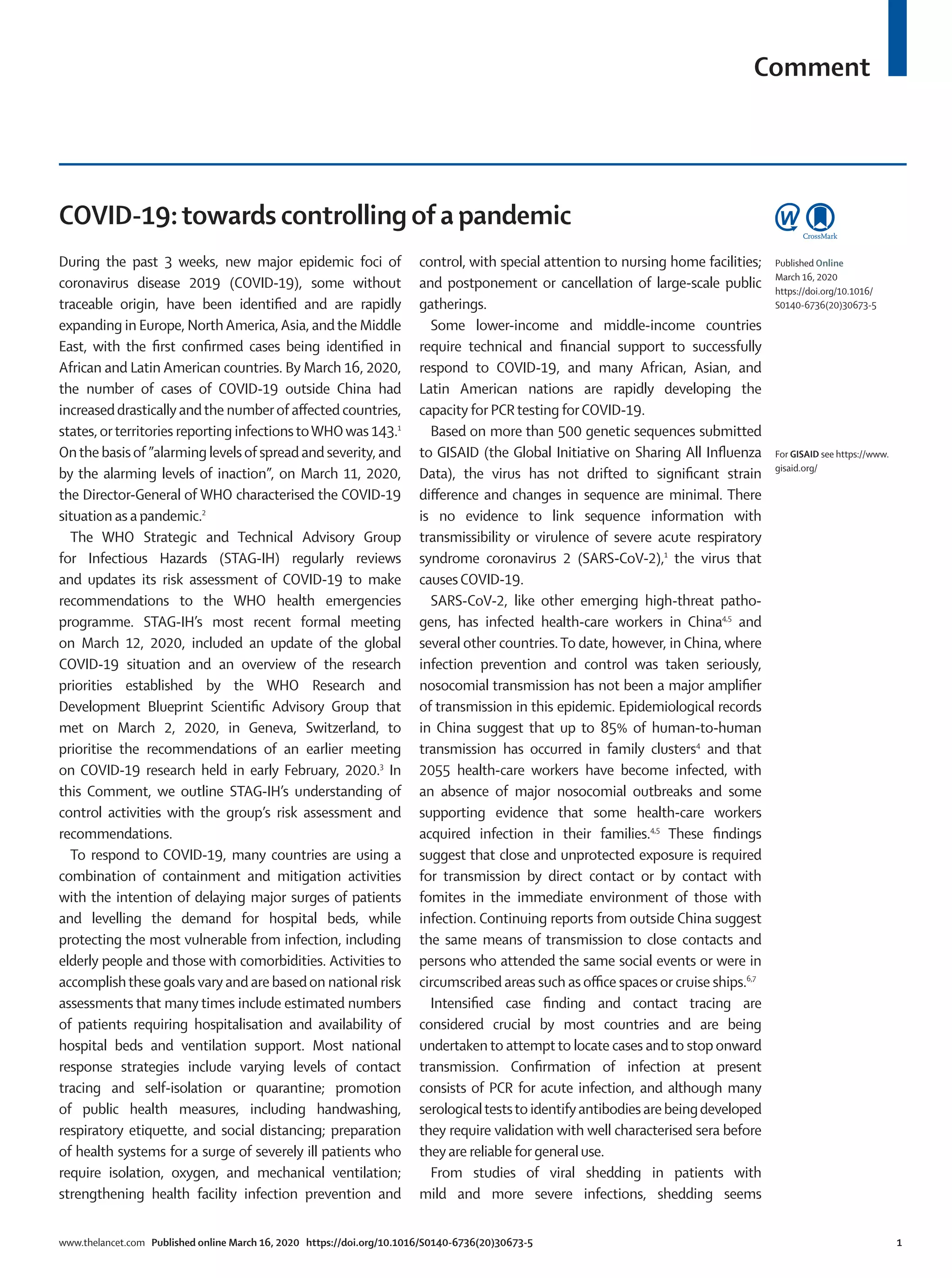
During the past 3 weeks, new major epidemic foci of
coronavirus disease 2019 (COVID-19), some without
traceable origin, have been identified and are rapidly
expanding in Europe, NorthAmerica,Asia, andthe Middle
East, with the first confirmed cases being identified in
African and Latin American countries. By March 16, 2020,
the number of cases of COVID-19 outside China had
increaseddrastically andthe numberof affected countries,
states,orterritories reporting infectionstoWHOwas 143.1
Onthe basisof ”alarming levelsof spread and severity, and
by the alarming levels of inaction”, on March 11, 2020,
the Director-General of WHO characterised the COVID-19
situation as a pandemic.2
The WHO Strategic and Technical Advisory Group
for Infectious Hazards (STAG-IH) regularly reviews
and updates its risk assessment of COVID-19 to make
recommendations to the WHO health emergencies
programme. STAG-IH’s most recent formal meeting
on March 12, 2020, included an update of the global
COVID-19 situation and an overview of the research
priorities established by the WHO Research and
Development Blueprint Scientific Advisory Group that
met on March 2, 2020, in Geneva, Switzerland, to
prioritise the recommendations of an earlier meeting
on COVID-19 research held in early February, 2020.3
In
this Comment, we outline STAG-IH’s understanding of
control activities with the group’s risk assessment and
recommendations.
To respond to COVID-19, many countries are using a
combination of containment and mitigation activities
with the intention of delaying major surges of patients
and levelling the demand for hospital beds, while
protecting the most vulnerable from infection, including
elderly people and those with comorbidities. Activities to
accomplishthese goals vary and are basedon national risk
assessments that many times include estimated numbers
of patients requiring hospitalisation and availability of
hospital beds and ventilation support. Most national
response strategies include varying levels of contact
tracing and self-isolation or quarantine; promotion
of public health measures, including handwashing,
respiratory etiquette, and social distancing; preparation
of health systems for a surge of severely ill patients who
require isolation, oxygen, and mechanical ventilation;
strengthening health facility infection prevention and
control, with special attention to nursing home facilities;
and postponement or cancellation of large-scale public
gatherings.
Some lower-income and middle-income countries
require technical and financial support to successfully
respond to COVID-19, and many African, Asian, and
Latin American nations are rapidly developing the
capacity for PCRtesting forCOVID-19.
Based on more than 500 genetic sequences submitted
to GISAID (the Global Initiative on Sharing All Influenza
Data), the virus has not drifted to significant strain
difference and changes in sequence are minimal. There
is no evidence to link sequence information with
transmissibility or virulence of severe acute respiratory
syndrome coronavirus 2 (SARS-CoV-2),1
the virus that
causesCOVID-19.
SARS-CoV-2, like other emerging high-threat patho­
gens, has infected health-care workers in China4,5
and
several other countries.To date, however, in China, where
infection prevention and control was taken seriously,
nosocomial transmission has not been a major amplifier
of transmission in this epidemic. Epidemiological records
in China suggest that up to 85% of human-to-human
transmission has occurred in family clusters4
and that
2055 health-care workers have become infected, with
an absence of major nosocomial outbreaks and some
supporting evidence that some health-care workers
acquired infection in their families.4,5
These findings
suggest that close and unprotected exposure is required
for transmission by direct contact or by contact with
fomites in the immediate environment of those with
infection. Continuing reports from outside China suggest
the same means of transmission to close contacts and
persons who attended the same social events or were in
circumscribed areas such as office spaces or cruise ships.6,7
Intensified case finding and contact tracing are
considered crucial by most countries and are being
undertakento attemptto locate cases andto stop onward
transmission. Confirmation of infection at present
consists of PCR for acute infection, and although many
serologicalteststo identify antibodies are beingdeveloped
they require validation with well characterised sera before
they are reliable for generaluse.
From studies of viral shedding in patients with
mild and more severe infections, shedding seems
Published Online
March 16, 2020
https://doi.org/10.1016/
S0140-6736(20)30673-5
For GISAID see https://www.
gisaid.org/
Comment
2	 www.thelancet.com Published online March 16, 2020 https://doi.org/10.1016/S0140-6736(20)30673-5
to be greatest during the early phase of disease
(Myoung-don Oh and Gabriel Leung, WHO Collaborating
Centre for Infectious Disease Epidemiology and
Control, School of Public Health, LKS Faculty of
Medicine, The University of Hong Kong, Hong Kong,
Special Administrative Region, China, personal
communication).8,9
The role, if any, of asymptomatic
carriers in transmitting infection is not yet completely
understood.4
Presymptomatic infec­tiousness is a
concern (Myoung-don Oh and Gabriel Leung, personal
communication)8,9
and many countries are now using
1–2 days of symptom onset as the start day for contact
identification.
A comprehensive report published by the Chinese
Center for Disease Control and Prevention on the
epidemiological characteristics of 72 314 patients with
COVID-19 confirmed previous understanding that most
known infections cause mild disease, with a case fatality
ratio that ranged from 2·9% in Hubei province to 0·4% in
the other Chinese provinces.5
This report also suggested
that elderly people, particularly those older than 80 years,
and people with comorbidities, such as cardiac disease,
respiratory disease, and diabetes, are at greatest risk of
serious disease and death. The case definition used in
China changed several times as COVID-19 progressed,
making it difficult to completely characterise the natural
history of infection, including the mortality ratio.4
Information on mortality and contributing factors
from outbreak sites in other countries varies greatly,
and seems to be influenced by such factors as age
of patients, associated comorbidities, availability of
isolation facilities for acute care for patients who need
respiratory support, and surge capacity of the health-
care system. Indi­vi­duals in care facilities for older people
are at particular risk of serious disease as shown in the
report of a series of deaths in an elderly care facility in
the USA.10
The pandemic of COVID-19 has clearly entered a new
stage with rapid spread in countries outside China and
all members of society must understand and practise
measures for self-protection and for prevention of
transmission of infection to others. STAG-IH makes the
following recommendations.
First, countries need to rapidly and robustly increase
their preparedness, readiness, and response actions
based on their national risk assessment and the four
WHO transmission scenarios11
for countries with
no cases, first cases, first clusters, and community
transmission and spread (4Cs).
Second, all countries should consider a combination
of response measures: case and contact finding;
containment or other measures that aim to delay the
onsetof patient surgeswhere feasible; and measures such
as public awareness, promotion of personal protective
hygiene, preparation of health systems for a surge of
severely ill patients, stronger infection prevention and
control in health facilities, nursing homes, and long-term
care facilities, and postponement or cancellation of large-
scale public gatherings.
Third, countries with no or a few first cases of
COVID-19 should consider active surveillance for timely
case finding; isolate, test, and trace every contact in
containment; practise social distancing; and ready
their health-care systems and populations for spread of
infection.
Fourth, lower-income and middle-income countries
that request support fromWHO should be fully supported
technically and financially. Financial support should be
sought by countries and by WHO, including from the
World Bank Pandemic Emergency Financing Facility and
other mechanisms.12
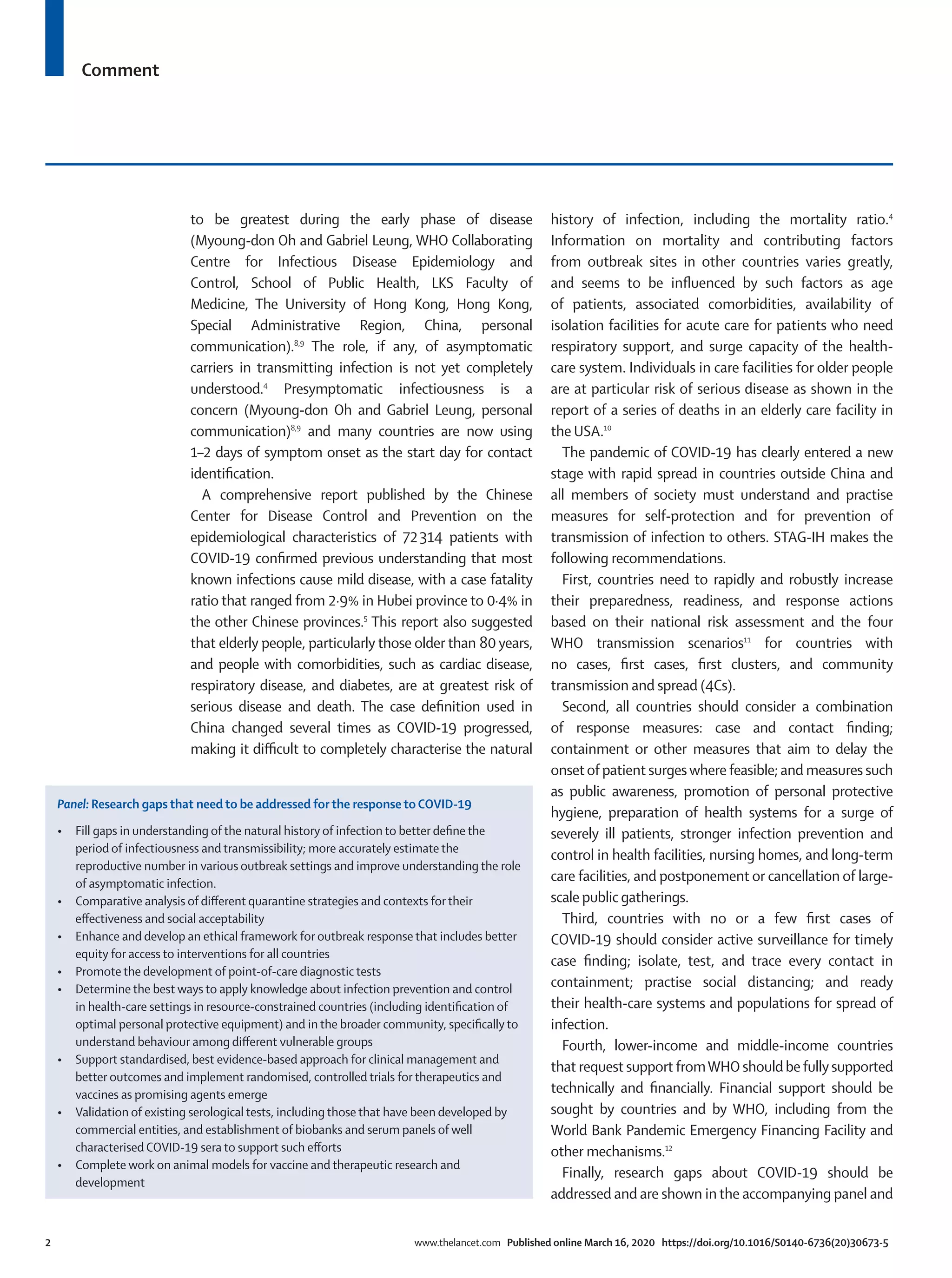
Finally, research gaps about COVID-19 should be
addressed and are shown in the accompanying panel and
Panel: Research gaps that need to be addressed for the response to COVID-19
•	 Fill gaps in understanding of the natural history of infection to better define the
period of infectiousness and transmissibility; more accurately estimate the
reproductive number in various outbreak settings and improve understanding the role
of asymptomatic infection.
•	 Comparative analysis of different quarantine strategies and contexts for their
effectiveness and social acceptability
•	 Enhance and develop an ethical framework for outbreak response that includes better
equity for access to interventions for all countries
•	 Promote the development of point-of-care diagnostic tests
•	 Determine the best ways to apply knowledge about infection prevention and control
in health-care settings in resource-constrained countries (including identification of
optimal personal protective equipment) and in the broader community, specifically to
understand behaviour among different vulnerable groups
•	 Support standardised, best evidence-based approach for clinical management and
better outcomes and implement randomised, controlled trials for therapeutics and
vaccines as promising agents emerge
•	 Validation of existing serological tests, including those that have been developed by
commercial entities, and establishment of biobanks and serum panels of well
characterised COVID-19 sera to support such efforts
•	 Complete work on animal models for vaccine and therapeutic research and
development
Comment
www.thelancet.com Published online March 16, 2020 https://doi.org/10.1016/S0140-6736(20)30673-5	 3
include some identified by the global community and
by the Research and Development Blueprint Scientific
Advisory Group.
The STAG-IH emphasises the importance of the
continued rapid sharing of data of public health
importance in medical journals that provide rapid peer
review and online publication without a paywall. It is
sharing of information in this way, as well as technical
collaboration among clinicians, epidemiologists, and
virologists, that has provided the world with its current
understanding of COVID-19.
We are all members oftheWHO Strategic andTechnicalAdvisoryGroup for
Infectious Hazards and declare no competing interests.
JulietBedford,DeliaEnria,JohanGiesecke,*DavidLHeymann,
ChikweIhekweazu,GaryKobinger,HCliffordLane,
ZiadMemish,Myoung-donOh,AmadouAlphaSall,
AnneSchuchat,KumnuanUngchusak,LotharHWieler,for
theWHOStrategicandTechnicalAdvisoryGroupfor
InfectiousHazards
david.heymann@lshtm.ac.uk
Anthrologica,Oxfordshire,UK (JB); Instituto Nacionalde EnfermedadesVirales
Humanas (INEVH) ”Julio Maiztegui” andCCWHO-OPSonViral Haemorrhagic
Fevers andArboviruses, BuenosAires,Argentina (DE); Karolinska Institute,
Stockholm, Sweden (JG); Infectious Disease Epidemiology, London Schoolof
Hygiene &Tropical Medicine, LondonWC1E 7HT,UK (DLH); NigeriaCentre for
DiseaseControl,Abuja, Nigeria (CI); Infectious Disease ResearchCentre,Université
Laval, Facultyof Medicine,QuébecCity,Canada (GK); National InstituteofAllergy
and Infectious Diseases, Bethesda, MD,USA (HCL); Research and InnovationCenter,
King Saud MedicalCity, Ministryof Health, Riyadh, SaudiArabia (ZM); JW Lee
Center forGlobal Medicine, SNUCollegeof Medicine, Departmentof Internal
Medicine, Seoul NationalUniversity Hospital, Seoul, South Korea (M-dO); Institut
Pasteurde Dakar, Dakar, Senegal (AAS);Centers for DiseaseControl and Prevention,
Atlanta,GA,USA (AS); Ministryof Health, Departmentof DiseasesControl,
Bangkok,Thailand (KU); and Robert Koch Institute, Berlin,Germany (LHW)
1	 WHO. Coronavirus disease (COVID-2019) situation reports. Situation
report—55. March 15, 2020. https://www.who.int/docs/default-source/
coronaviruse/situation-reports/20200315-sitrep-55-covid-19.
pdf?sfvrsn=33daa5cb_6 (accessed March 16, 2020).
2	 WHO.WHOVirtual press conference on COVID-19. March 11, 2020.
https://www.who.int/docs/default-source/coronaviruse/transcripts/
who-audio-emergencies-coronavirus-press-conference-full-and-final-
11mar2020.pdf?sfvrsn=cb432bb3_2 (accessed March 16, 2020).
3	 WHO. A coordinated global research roadmap. 2020. https://www.who.int/
blueprint/priority-diseases/key-action/Roadmap-version-FINAL-for-WEB.
pdf?ua=1 (accessed March 16, 2020).
4	 WHO. Report of theWHO-China Joint Mission on Coronavirus Disease 2019
(COVID-19). February, 2020. https://www.who.int/docs/default-source/
coronaviruse/who-china-joint-mission-on-covid-19-final-report.pdf
(accessed March 13, 2020).
5	 Wu Z, McGoogan JM. Characteristics of and important lessons from the
coronavirus disease 2019 (COVID-19) outbreak in China: summary of a
report of 72 314 cases from the Chinese Center for Disease Control and
Prevention. JAMA 2020; published online Feb 24. DOI:10.1001/
jama.2020.2648.
6	 Rothe C, Schunk M, Sothmann P, et al.Transmission of 2019-nCoV
infection from an asymptomatic contact in Germany. N Engl J Med 2020;
382: 970–71.
7	 The National Institute of Infectious Diseases, Japan. Field briefing:
Diamond Princess COVID-19 cases. Feb 19, 2020. https://www.niid.go.jp/
niid/en/2019-ncov-e/9407-covid-dp-fe-01.html (accessed
March 16, 2020).
8	 Zou L, Ruan F, Huang M, et al. SARS-CoV-2 viral load in upper respiratory
specimens of infected patients. New Engl J Med 2020; published online
Feb 19. DOI:10.1056/NEJMc2001737.
9	 Kim JY, Ko JH, KimY, et al.Viral load kinetics of SARS-CoV-2 infection in
first two patients in Korea. J Korean Med Sci 2020; 35: e86.
10	 Public Health King County, Seattle. Update: increasing King County
COVID-19 case numbers for March 10, 2020 point to importance of social
distancing. March 10, 2020. https://www.kingcounty.gov/depts/health/
news/2020/March/10-covid-case-updates.aspx (accessed March 13, 2020).
11	 WHO. Critical preparedness, readiness and response actions for COVID-19.
March 7, 2020. https://www.who.int/publications-detail/critical-
preparedness-readiness-and-response-actions-for-covid-19
(accessed March 13, 2020).
12	 WHO. 2019 Novel Coronavirus (2019‑nCoV): strategic preparedness and
response plan. February, 2020. https://www.who.int/docs/default-source/
coronaviruse/srp-04022020.pdf (accessed March 16, 2020).

COVID-19: towards controlling of a pandemic

  • 1.
    Comment www.thelancet.com Published onlineMarch 16, 2020 https://doi.org/10.1016/S0140-6736(20)30673-5 1 COVID-19:towards controlling of a pandemic During the past 3 weeks, new major epidemic foci of coronavirus disease 2019 (COVID-19), some without traceable origin, have been identified and are rapidly expanding in Europe, NorthAmerica,Asia, andthe Middle East, with the first confirmed cases being identified in African and Latin American countries. By March 16, 2020, the number of cases of COVID-19 outside China had increaseddrastically andthe numberof affected countries, states,orterritories reporting infectionstoWHOwas 143.1 Onthe basisof ”alarming levelsof spread and severity, and by the alarming levels of inaction”, on March 11, 2020, the Director-General of WHO characterised the COVID-19 situation as a pandemic.2 The WHO Strategic and Technical Advisory Group for Infectious Hazards (STAG-IH) regularly reviews and updates its risk assessment of COVID-19 to make recommendations to the WHO health emergencies programme. STAG-IH’s most recent formal meeting on March 12, 2020, included an update of the global COVID-19 situation and an overview of the research priorities established by the WHO Research and Development Blueprint Scientific Advisory Group that met on March 2, 2020, in Geneva, Switzerland, to prioritise the recommendations of an earlier meeting on COVID-19 research held in early February, 2020.3 In this Comment, we outline STAG-IH’s understanding of control activities with the group’s risk assessment and recommendations. To respond to COVID-19, many countries are using a combination of containment and mitigation activities with the intention of delaying major surges of patients and levelling the demand for hospital beds, while protecting the most vulnerable from infection, including elderly people and those with comorbidities. Activities to accomplishthese goals vary and are basedon national risk assessments that many times include estimated numbers of patients requiring hospitalisation and availability of hospital beds and ventilation support. Most national response strategies include varying levels of contact tracing and self-isolation or quarantine; promotion of public health measures, including handwashing, respiratory etiquette, and social distancing; preparation of health systems for a surge of severely ill patients who require isolation, oxygen, and mechanical ventilation; strengthening health facility infection prevention and control, with special attention to nursing home facilities; and postponement or cancellation of large-scale public gatherings. Some lower-income and middle-income countries require technical and financial support to successfully respond to COVID-19, and many African, Asian, and Latin American nations are rapidly developing the capacity for PCRtesting forCOVID-19. Based on more than 500 genetic sequences submitted to GISAID (the Global Initiative on Sharing All Influenza Data), the virus has not drifted to significant strain difference and changes in sequence are minimal. There is no evidence to link sequence information with transmissibility or virulence of severe acute respiratory syndrome coronavirus 2 (SARS-CoV-2),1 the virus that causesCOVID-19. SARS-CoV-2, like other emerging high-threat patho­ gens, has infected health-care workers in China4,5 and several other countries.To date, however, in China, where infection prevention and control was taken seriously, nosocomial transmission has not been a major amplifier of transmission in this epidemic. Epidemiological records in China suggest that up to 85% of human-to-human transmission has occurred in family clusters4 and that 2055 health-care workers have become infected, with an absence of major nosocomial outbreaks and some supporting evidence that some health-care workers acquired infection in their families.4,5 These findings suggest that close and unprotected exposure is required for transmission by direct contact or by contact with fomites in the immediate environment of those with infection. Continuing reports from outside China suggest the same means of transmission to close contacts and persons who attended the same social events or were in circumscribed areas such as office spaces or cruise ships.6,7 Intensified case finding and contact tracing are considered crucial by most countries and are being undertakento attemptto locate cases andto stop onward transmission. Confirmation of infection at present consists of PCR for acute infection, and although many serologicalteststo identify antibodies are beingdeveloped they require validation with well characterised sera before they are reliable for generaluse. From studies of viral shedding in patients with mild and more severe infections, shedding seems Published Online March 16, 2020 https://doi.org/10.1016/ S0140-6736(20)30673-5 For GISAID see https://www. gisaid.org/
  • 2.
    Comment 2 www.thelancet.com Publishedonline March 16, 2020 https://doi.org/10.1016/S0140-6736(20)30673-5 to be greatest during the early phase of disease (Myoung-don Oh and Gabriel Leung, WHO Collaborating Centre for Infectious Disease Epidemiology and Control, School of Public Health, LKS Faculty of Medicine, The University of Hong Kong, Hong Kong, Special Administrative Region, China, personal communication).8,9 The role, if any, of asymptomatic carriers in transmitting infection is not yet completely understood.4 Presymptomatic infec­tiousness is a concern (Myoung-don Oh and Gabriel Leung, personal communication)8,9 and many countries are now using 1–2 days of symptom onset as the start day for contact identification. A comprehensive report published by the Chinese Center for Disease Control and Prevention on the epidemiological characteristics of 72 314 patients with COVID-19 confirmed previous understanding that most known infections cause mild disease, with a case fatality ratio that ranged from 2·9% in Hubei province to 0·4% in the other Chinese provinces.5 This report also suggested that elderly people, particularly those older than 80 years, and people with comorbidities, such as cardiac disease, respiratory disease, and diabetes, are at greatest risk of serious disease and death. The case definition used in China changed several times as COVID-19 progressed, making it difficult to completely characterise the natural history of infection, including the mortality ratio.4 Information on mortality and contributing factors from outbreak sites in other countries varies greatly, and seems to be influenced by such factors as age of patients, associated comorbidities, availability of isolation facilities for acute care for patients who need respiratory support, and surge capacity of the health- care system. Indi­vi­duals in care facilities for older people are at particular risk of serious disease as shown in the report of a series of deaths in an elderly care facility in the USA.10 The pandemic of COVID-19 has clearly entered a new stage with rapid spread in countries outside China and all members of society must understand and practise measures for self-protection and for prevention of transmission of infection to others. STAG-IH makes the following recommendations. First, countries need to rapidly and robustly increase their preparedness, readiness, and response actions based on their national risk assessment and the four WHO transmission scenarios11 for countries with no cases, first cases, first clusters, and community transmission and spread (4Cs). Second, all countries should consider a combination of response measures: case and contact finding; containment or other measures that aim to delay the onsetof patient surgeswhere feasible; and measures such as public awareness, promotion of personal protective hygiene, preparation of health systems for a surge of severely ill patients, stronger infection prevention and control in health facilities, nursing homes, and long-term care facilities, and postponement or cancellation of large- scale public gatherings. Third, countries with no or a few first cases of COVID-19 should consider active surveillance for timely case finding; isolate, test, and trace every contact in containment; practise social distancing; and ready their health-care systems and populations for spread of infection. Fourth, lower-income and middle-income countries that request support fromWHO should be fully supported technically and financially. Financial support should be sought by countries and by WHO, including from the World Bank Pandemic Emergency Financing Facility and other mechanisms.12 Finally, research gaps about COVID-19 should be addressed and are shown in the accompanying panel and Panel: Research gaps that need to be addressed for the response to COVID-19 • Fill gaps in understanding of the natural history of infection to better define the period of infectiousness and transmissibility; more accurately estimate the reproductive number in various outbreak settings and improve understanding the role of asymptomatic infection. • Comparative analysis of different quarantine strategies and contexts for their effectiveness and social acceptability • Enhance and develop an ethical framework for outbreak response that includes better equity for access to interventions for all countries • Promote the development of point-of-care diagnostic tests • Determine the best ways to apply knowledge about infection prevention and control in health-care settings in resource-constrained countries (including identification of optimal personal protective equipment) and in the broader community, specifically to understand behaviour among different vulnerable groups • Support standardised, best evidence-based approach for clinical management and better outcomes and implement randomised, controlled trials for therapeutics and vaccines as promising agents emerge • Validation of existing serological tests, including those that have been developed by commercial entities, and establishment of biobanks and serum panels of well characterised COVID-19 sera to support such efforts • Complete work on animal models for vaccine and therapeutic research and development
  • 3.
    Comment www.thelancet.com Published onlineMarch 16, 2020 https://doi.org/10.1016/S0140-6736(20)30673-5 3 include some identified by the global community and by the Research and Development Blueprint Scientific Advisory Group. The STAG-IH emphasises the importance of the continued rapid sharing of data of public health importance in medical journals that provide rapid peer review and online publication without a paywall. It is sharing of information in this way, as well as technical collaboration among clinicians, epidemiologists, and virologists, that has provided the world with its current understanding of COVID-19. We are all members oftheWHO Strategic andTechnicalAdvisoryGroup for Infectious Hazards and declare no competing interests. JulietBedford,DeliaEnria,JohanGiesecke,*DavidLHeymann, ChikweIhekweazu,GaryKobinger,HCliffordLane, ZiadMemish,Myoung-donOh,AmadouAlphaSall, AnneSchuchat,KumnuanUngchusak,LotharHWieler,for theWHOStrategicandTechnicalAdvisoryGroupfor InfectiousHazards david.heymann@lshtm.ac.uk Anthrologica,Oxfordshire,UK (JB); Instituto Nacionalde EnfermedadesVirales Humanas (INEVH) ”Julio Maiztegui” andCCWHO-OPSonViral Haemorrhagic Fevers andArboviruses, BuenosAires,Argentina (DE); Karolinska Institute, Stockholm, Sweden (JG); Infectious Disease Epidemiology, London Schoolof Hygiene &Tropical Medicine, LondonWC1E 7HT,UK (DLH); NigeriaCentre for DiseaseControl,Abuja, Nigeria (CI); Infectious Disease ResearchCentre,Université Laval, Facultyof Medicine,QuébecCity,Canada (GK); National InstituteofAllergy and Infectious Diseases, Bethesda, MD,USA (HCL); Research and InnovationCenter, King Saud MedicalCity, Ministryof Health, Riyadh, SaudiArabia (ZM); JW Lee Center forGlobal Medicine, SNUCollegeof Medicine, Departmentof Internal Medicine, Seoul NationalUniversity Hospital, Seoul, South Korea (M-dO); Institut Pasteurde Dakar, Dakar, Senegal (AAS);Centers for DiseaseControl and Prevention, Atlanta,GA,USA (AS); Ministryof Health, Departmentof DiseasesControl, Bangkok,Thailand (KU); and Robert Koch Institute, Berlin,Germany (LHW) 1 WHO. Coronavirus disease (COVID-2019) situation reports. Situation report—55. March 15, 2020. https://www.who.int/docs/default-source/ coronaviruse/situation-reports/20200315-sitrep-55-covid-19. pdf?sfvrsn=33daa5cb_6 (accessed March 16, 2020). 2 WHO.WHOVirtual press conference on COVID-19. March 11, 2020. https://www.who.int/docs/default-source/coronaviruse/transcripts/ who-audio-emergencies-coronavirus-press-conference-full-and-final- 11mar2020.pdf?sfvrsn=cb432bb3_2 (accessed March 16, 2020). 3 WHO. A coordinated global research roadmap. 2020. https://www.who.int/ blueprint/priority-diseases/key-action/Roadmap-version-FINAL-for-WEB. pdf?ua=1 (accessed March 16, 2020). 4 WHO. Report of theWHO-China Joint Mission on Coronavirus Disease 2019 (COVID-19). February, 2020. https://www.who.int/docs/default-source/ coronaviruse/who-china-joint-mission-on-covid-19-final-report.pdf (accessed March 13, 2020). 5 Wu Z, McGoogan JM. Characteristics of and important lessons from the coronavirus disease 2019 (COVID-19) outbreak in China: summary of a report of 72 314 cases from the Chinese Center for Disease Control and Prevention. JAMA 2020; published online Feb 24. DOI:10.1001/ jama.2020.2648. 6 Rothe C, Schunk M, Sothmann P, et al.Transmission of 2019-nCoV infection from an asymptomatic contact in Germany. N Engl J Med 2020; 382: 970–71. 7 The National Institute of Infectious Diseases, Japan. Field briefing: Diamond Princess COVID-19 cases. Feb 19, 2020. https://www.niid.go.jp/ niid/en/2019-ncov-e/9407-covid-dp-fe-01.html (accessed March 16, 2020). 8 Zou L, Ruan F, Huang M, et al. SARS-CoV-2 viral load in upper respiratory specimens of infected patients. New Engl J Med 2020; published online Feb 19. DOI:10.1056/NEJMc2001737. 9 Kim JY, Ko JH, KimY, et al.Viral load kinetics of SARS-CoV-2 infection in first two patients in Korea. J Korean Med Sci 2020; 35: e86. 10 Public Health King County, Seattle. Update: increasing King County COVID-19 case numbers for March 10, 2020 point to importance of social distancing. March 10, 2020. https://www.kingcounty.gov/depts/health/ news/2020/March/10-covid-case-updates.aspx (accessed March 13, 2020). 11 WHO. Critical preparedness, readiness and response actions for COVID-19. March 7, 2020. https://www.who.int/publications-detail/critical- preparedness-readiness-and-response-actions-for-covid-19 (accessed March 13, 2020). 12 WHO. 2019 Novel Coronavirus (2019‑nCoV): strategic preparedness and response plan. February, 2020. https://www.who.int/docs/default-source/ coronaviruse/srp-04022020.pdf (accessed March 16, 2020).