Visit https://ebookmass.com to download the full version and
browse more ebooks or textbooks
Deepwater drilling : well planning, design,
engineering, operations, and technology
application Peter Aird
_____ Press the link below to begin your download _____
https://ebookmass.com/product/deepwater-drilling-well-
planning-design-engineering-operations-and-technology-
application-peter-aird/
Access ebookmass.com now to download high-quality
ebooks or textbooks
We have selected some products that you may be interested in
Click the link to download now or visit ebookmass.com
for more options!.
Smart Cities and Artificial Intelligence: Convergent
Systems for Planning, Design, and Operations 1st Edition
Christopher Grant Kirwan
https://ebookmass.com/product/smart-cities-and-artificial-
intelligence-convergent-systems-for-planning-design-and-
operations-1st-edition-christopher-grant-kirwan/
Feedstock Technology for Reactive Metal Injection Molding:
Process, Design, and Application 1st Edition Peng Cao
https://ebookmass.com/product/feedstock-technology-for-reactive-metal-
injection-molding-process-design-and-application-1st-edition-peng-cao/
Engineering Practice with Oilfield and Drilling
Applications 1st Edition Scott D. Sudhoff
https://ebookmass.com/product/engineering-practice-with-oilfield-and-
drilling-applications-1st-edition-scott-d-sudhoff/
Applying Language Technology in Humanities Research:
Design, Application, and the Underlying Logic 1st ed.
Edition Barbara Mcgillivray
https://ebookmass.com/product/applying-language-technology-in-
humanities-research-design-application-and-the-underlying-logic-1st-
ed-edition-barbara-mcgillivray/
Hole-making and Drilling Technology for Composites:
Advantages, Limitations and Potential 1st Edition Ahmad
Abdullah
https://ebookmass.com/product/hole-making-and-drilling-technology-for-
composites-advantages-limitations-and-potential-1st-edition-ahmad-
abdullah/
Thermal Food Engineering Operations 1st Edition Nitin
Kumar
https://ebookmass.com/product/thermal-food-engineering-operations-1st-
edition-nitin-kumar/
Ethics, Technology, and Engineering: An Introduction 1st
Edition
https://ebookmass.com/product/ethics-technology-and-engineering-an-
introduction-1st-edition/
Planning and Urban Design Standards 2nd Edition
https://ebookmass.com/product/planning-and-urban-design-standards-2nd-
edition/
Civil Engineering Materials 1st Edition Peter A. Claisse
https://ebookmass.com/product/civil-engineering-materials-1st-edition-
peter-a-claisse/
DEEPWATER DRILLING
DEEPWATER
DRILLING
Well Planning, Design,
Engineering, Operations, and
Technology Application
Peter Aird
Gulf Professional Publishing is an imprint of Elsevier
50 Hampshire Street, 5th Floor, Cambridge, MA 02139, United States
The Boulevard, Langford Lane, Kidlington, Oxford, OX5 1GB, United Kingdom
© 2019 Elsevier Ltd. All rights reserved.
No part of this publication may be reproduced or transmitted in any form or by any means, electronic or
mechanical, including photocopying, recording, or any information storage and retrieval system, without
permission in writing from the publisher. Details on how to seek permission, further information about the
Publisher’s permissions policies and our arrangements with organizations such as the Copyright Clearance Center
and the Copyright Licensing Agency, can be found at our website: www.elsevier.com/permissions.
This book and the individual contributions contained in it are protected under copyright by the Publisher (other
than as may be noted herein).
Notices
Knowledge and best practice in this field are constantly changing. As new research and experience broaden our
understanding, changes in research methods, professional practices, or medical treatment may become necessary.
Practitioners and researchers must always rely on their own experience and knowledge in evaluating and using
any information, methods, compounds, or experiments described herein. In using such information or methods
they should be mindful of their own safety and the safety of others, including parties for whom they have a
professional responsibility.
To the fullest extent of the law, neither the Publisher nor the authors, contributors, or editors, assume any liability
for any injury and/or damage to persons or property as a matter of products liability, negligence or otherwise, or
from any use or operation of any methods, products, instructions, or ideas contained in the material herein.
Library of Congress Cataloging-in-Publication Data
A catalog record for this book is available from the Library of Congress
British Library Cataloguing-in-Publication Data
A catalogue record for this book is available from the British Library
ISBN: 978-0-08-102282-5
For information on all Gulf Professional publications
visit our website at https://www.elsevier.com/books-and-journals
Publisher: Brian Romer
Senior Acquisition Editor: Katie Hammon
Editorial Project Manager: Ana Claudia A. Garcia
Production Project Manager: Anitha Sivaraj
Cover Designer: Greg Harris
Typeset by SPi Global, India
I am honored to write the foreword to
this Deepwater Drilling Guide as it brings
together a vast body of knowledge and ex-
perience that is not found elsewhere. This
business is like no other on the globe, where
harsh conditions challenge the operator, con-
tractor, and service providers to extend their
limits. As marine drilling operations seek to
operate in higher-pressure environments,
deeper waters, and harsher conditions and
in remote areas of the globe, the limits of
technology must evolve and change to meet
these needs. Technology often advances in
the oil and gas industry faster than it can be
documented. This text is Peter Aird’s con-
tribution to bringing current methods and
thinking to the reader.
The processes required to penetrate deep-
water objectives have undergone dramatic
revision and change in only a few short
years. What was once thought to be “deeper”
has become routine and common, and ul-
tra depths thought to be unobtainable have
been reached in recent history. Therefore,
this comprehensive text on the subject brings
together recent technologies and innovations
made in deepwater drilling operations. This
text does that and more.
I have known the author, Peter Aird, for
more than 15 years and have worked with
him professionally on politically visible,
HTHP high-risk and deepwater projects in
very harsh environments. These projects were
completed successfully in part by the skill and
dedication of the drilling team of which Aird
was the team lead. From this work experience,
I have grown to respect and hold Peter in high
regard for his engineering abilities and strong
work ethic. Peter is a professional engineer,
trainer, lecturer, and a world-class drilling
man. However, he did not start his working
career with this goal in mind.
After a basic education in Scotland, he
chose to utilize his mechanical skills in the
engine room on a blue water merchant ship.
After a short time, he realized his advance-
ment and more importantly his life experi-
ence would be limited and the challenges of
the engine room would never satisfy his curi-
osity to expand his knowledge and the phys-
ical workings of science surrounding him. To
advance himself, he took a training position
on a major oil operator’s contracted drilling
rigs and quickly moved through the ranks,
where this working environment embraced
all the disciplines outside the mechanical
workings of the rig into drilling engineering.
At this point, Peter realized he should not
only learn as much as the company program
offered but return to school and pursue a
distance learning university engineering de-
gree so that he could understand why things
worked the way they do. In my knowledge,
it is a rare person who after starting down
one career path in the trades can reroute that
path toward higher learning in the school of
engineering. Peter did this while starting a
family, earning a living, and self-­
financing
this higher learning, sacrificing much of
his “free” time to advance himself and his
knowledge. I have found that the person
who takes this path in industry has a well-
rounded and practical knowledge that is rare
in the business.
In these deepwater work collaborations,
Peter and I have discussed that ­
deepwater
Foreword
vii
viii FOREWORD
industry publications concerning drill-
ing operations generally lag far behind the
advances in practice and technology and
moreover lack the benefit of knowledge,
experience, and innovations made by the
industry. Peter has a curiosity in all things
related to his profession of drilling wells and
delivering the best project possible and is
constantly searching for new and better solu-
tions and results to the task of drilling wells
in deepwater.
Peter took this to heart and has produced
a deepwater drilling guide that describes the
present technology. I do hope that the be-
holder of this text benefits and has use for the
knowledge that is presented.
L. William Abel
Abel Engineering Inc., Houston,
TX, United States
ix
Author’s Preface
My drilling work began in 1980 when,
as a former Merchant Navy marine engi-
neering officer, I became a trainee for Shell
International, working through a drilling su-
pervisors development program that I then
served for both Shell and BP Internationally
from 1986 to 1993. Thereafter, as a consultant,
I was employed in the same role globally for
various recognized companies, drilling fron-
tier leading edge wells, many of which were
in deepwater. In 1998, I was approached and
reluctantly agreed to develop industry first
training materials for deepwater drilling and
well engineering, confessing a lack of train-
ing skills, knowledge, and experience, but
convinced a need for this training was and is
today sorely needed. Through the decades, I
have since shared knowledge and experience
gained by facilitating and delivering deep-
water and other complex well design, drilling
engineering, and operations training courses.
I felt similarly unprepared to write this
book, even with the deepwater opportunities
and experiences gained within drilling, well
engineering, and operations specialist posi-
tions held, conducting leadership and con-
sultancy support roles in multiple deepwater
projects in recent years. Despite having pro-
duced numerous technical and operational
documents, I had absolutely no writing skills.
But again I saw the great need for a guide
since, as the deepwater industry, technology,
principles, and practices grow and change, so
does the need for more discussion, sharing
and distribution of knowledge from lessons
learned and from things that go wrong.
The reason for this book is twofold.
Foremost was this opportunity to con-
tinue one’s self-education and development
journey in all deepwater subject matters.
That, through this process, has uncovered
and raised multiple aspects to what we as
an industry know, don’t know, and require
more focus on, to assure deepwater pro-
grams, projects, technologies and best prac-
tices succeed, remain competitive, learn
from the past, and deliver the SEE (Safe,
Effective, and Efficient) outcomes and benefits
desired.
Secondly, this is a first edition (and a
time-constrained mission) to serve as a
training, learning, and development vehicle
for myself and others to collaborate, share,
discuss, develop, and educate the next tech-
nological and digitized deepwater genera-
tion with the far wider skill set, knowledge,
and experience demanded for field and proj-
ect use.
To the many people through the decades
who have evidently contributed to this deep-
water drilling guide, we thank you deeply.
In particular more sincere thanks go to the
sterling work of my editor, Carolyn Barta
(without whom this book would never
have resulted), illustrator Dianne Cook
(of One Giant Leap), my well control guru
and friend Bill Abel (Abel Engineering),
Alexander Edwards (Ikon Geoscience), and
Deiter Wijning (Huisman), and to my pub-
lisher, Elsevier, whose flexibility and ex-
tended deadlines have made this publication
possible.
x AUTHOR’S PREFACE
Finally, thanks to my dearest beloved wife
Joyce, and our two grandsons who can all
shout “hurrah” that this mammoth task is
done (for now) and that they shall now be
afforded the attention and availability they
have so patiently been waiting for.
Enjoy,
Peter Aird (The “Kingdom of Fife,”
Scotland, Driller.)
Deepwater Drilling 3 © 2019 Elsevier Ltd. All rights reserved.
https://doi.org/10.1016/B978-0-08-102282-5.00001-6
C H A P T E R
1
Mission, Mission Statement
MISSION
The mission of this book is to provide a usable comprehensive, practical, and understand-
able “Guide to Deepwater Drilling” for people at all levels who already understand basic
drilling principles, standards, and practices. Readers can use and apply the guide in their
respective workplaces, to further self-educate, enhance, and develop the skill sets to meet
specific deepwater project requirements.
Due to the relative infancy and untapped nature of deepwater, this book serves as a guide.
When regional or local knowledge, experience, understanding, and physical, people and pa-
per evidence exists, these factors shall take precedence to assure safe, effective, and efficient
deepwater project delivery. With time, this guide shall be developed further.
A GUIDE TO DEEPWATER DRILLING
General Introduction
The world's accessible offshore hydrocarbon has been produced in abundance from the
1960s. Easy offshore hydrocarbons today are more difficult to find, yet deepwater explora-
tion remains where potential “big oil” exists. Deepwater is a continuance of accumulated
best-practiced drilling knowledge and experience to manage, control, and change in more
challenging operating environments. If big oil discoveries continue to result in deepwater,
more wells will need to be drilled and business will continue to grow. Operating companies
are therefore not only searching and exploring into more distant seas and oceans but also
in more remote, harsh, and inhospitable locations and environments for big oil in a rapidly
changing and uncertain world of energy needs, supply, and demand.
Economic Factors of Deepwater Exploration
The commonly accepted economic objectives to explore successfully in deepwater envi-
ronments are viewed as:
1. thick, continuous reservoirs that exhibit high flow rates with large drainage radius;
2. recoverable reserves of at least five to several hundred million barrels or more;
4 1. Mission, Mission Statement
I. DEEPWATER GENERAL
3. geologically and seismically well defined and relatively simple reservoirs in nature,
down to and including the producing horizons, so that highly accurate petroleum,
reservoir, and production modeling can result to reduce risks and uncertainties.
The Purpose of Drilling in Deepwater
The purpose of deepwater drilling projects is essentially no different from other drilling, i.e.,
to discover commercial hydrocarbons safely, effectively, and efficiently at the lowest cost. When
discovery results, the key decision trigger is how much capital investment is needed to sanction
appraisal drilling, to assure, and acquire must- have vs. nice-to-have data, then process and
interpret the data to meet the complexity of multidiscipline issues to be resolved.
The challenge then is to manage the project development according to controls that assure
doing the right things and getting things done right the first time, at the lowest capital and
operating costs, avoiding damage, loss or harm to the people, businesses and environment as
low as practicable, as illustrated in Fig. 1.1.
As offshore deepwater basins remain relatively unexplored when compared to onshore or
shallow offshore, the greater the water depths should present a greater likelihood of discov-
ering big oil, especially in the 2000–3500m (6562–11,583ft) water depths.
The promise of discoveries can offset the significantly higher costs, risks and uncertainties
that come with increased water depth, and offer the economic viability to explore in these
environments.
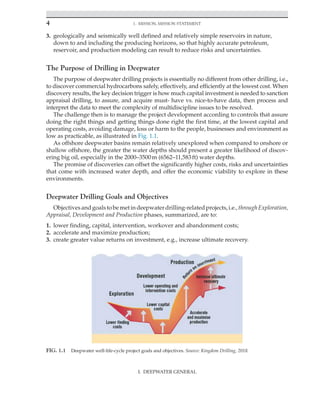
Deepwater Drilling Goals and Objectives
Objectivesandgoalstobemetindeepwaterdrilling-relatedprojects,i.e.,throughExploration,
Appraisal, Development and Production phases, summarized, are to:
1. lower finding, capital, intervention, workover and abandonment costs;
2. accelerate and maximize production;
3. create greater value returns on investment, e.g., increase ultimate recovery.
FIG. 1.1 Deepwater well-life-cycle project goals and objectives. Source: Kingdom Drilling, 2018.
A Guide to Deepwater Drilling 5
I. DEEPWATER GENERAL
To counter these challenges, multiple offshore technological and adaptive advancements
would have to be met during the project life period. Example: the building and construc-
tion of a more fit-for-purpose, multi-functional, next-generation deep and ultradeepwater
operating fleet is perhaps demanded to step change the advancements and technological
solutions required. Where this investment is going to come from is a key factor. A new fleet
would however offer far more optimism that deepwater can survive in such turbulent,
challenging, and changing times.
A Guide to Deepwater Drilling Projects
As the continuous search for deepwater discovery precipitates drilling projects into un-
tapped and progressively more remote, harsh, deep, and ultradeep environments—where
more complex geology, geoscience, petroleum, reservoir, drilling, subsea, technical, and
technology operational challenges arise—this guide can identify and evaluate how and why
deepwater drilling can evolve from more singular frontier activities into a far safer, more in-
trinsic, and strategic element of an operator’s offshore portfolio.
This guide also focuses primarily on deepwater exploration and appraisal drilling
that may lead into development, intervention, and abandonment activities required. All
such specialist areas require separate guides. Content is targeted at an intermediate-to-­
advanced drilling level, for those with a good working understanding and knowledge of
offshore drilling; well safety and management systems; and well delivery using a mul-
tidisciplinary, project-managed approach and a belief that ordinary people can make a
difference.
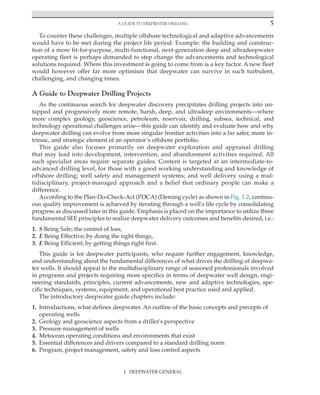
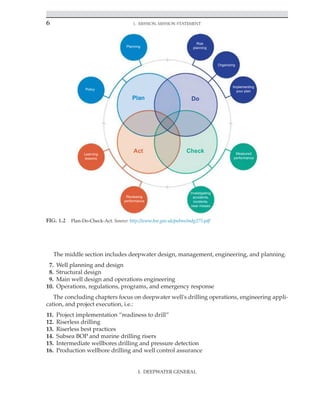
According to the Plan-Do-Check-Act (PDCA) (Deming cycle) as shown in Fig. 1.2, continu-
ous quality improvement is achieved by iterating through a well's life cycle by consolidating
progress as discussed later in this guide. Emphasis is placed on the importance to utilize three
fundamental SEE principles to realize deepwater delivery outcomes and benefits desired, i.e.:
1. S Being Safe; the control of loss,
2. E Being Effective; by doing the right things,
3. E Being Efficient; by getting things right first.
This guide is for deepwater participants, who require further engagement, knowledge,
and understanding about the fundamental differences of what drives the drilling of deepwa-
ter wells. It should appeal to the multidisciplinary range of seasoned professionals involved
in programs and projects requiring more specifics in terms of deepwater well design, engi-
neering standards, principles, current advancements, new and adaptive technologies, spe-
cific techniques, systems, equipment, and operational best practice used and applied.
The introductory deepwater guide chapters include:
1. Introductions, what defines deepwater. An outline of the basic concepts and precepts of
operating wells
2. Geology and geoscience aspects from a driller's perspective
3. Pressure management of wells
4. Metocean operating conditions and environments that exist
5. Essential differences and drivers compared to a standard drilling norm
6. Program, project management, safety and loss control aspects
6 1. Mission, Mission Statement
I. DEEPWATER GENERAL
The middle section includes deepwater design, management, engineering, and planning.
7. Well planning and design
8. Structural design
9. Main well design and operations engineering
10. Operations, regulations, programs, and emergency response
The concluding chapters focus on deepwater well's drilling operations, engineering appli-
cation, and project execution, i.e.:
11. Project implementation “readiness to drill”
12. Riserless drilling
13. Riserless best practices
14. Subsea BOP and marine drilling risers
15. Intermediate wellbores drilling and pressure detection
16. Production wellbore drilling and well control assurance
Planning
Policy
Learning
lessons
Reviewing
performance
Investigating
accidents,
incidents,
near misses
Measured
performance
Implementing
your plan
Organizing
Risk
planning
Plan Do
Act Check
FIG. 1.2 Plan-Do-Check-Act. Source: http://www.hse.gov.uk/pubns/indg275.pdf
A Guide to Deepwater Drilling 7
I. DEEPWATER GENERAL
Deepwater Drilling Defined
Deepwater drilling environments and definitions have changed through the decades as oil
and gas capabilities and technology have transformed. In the 1970s, 100–200m (328–656ft) was
considered as deepwater. In the 1980s 450–600m (1476–1969ft), in the 1990s deep progressed to
1000–1500m (3281–4921ft), and with seismic technology advancements this opened up other
deeper basins to greater than 3000m (9843ft) water depths as drilled today. The technical limit is
+/-4267m (14,000ft) water depth. Definitions, it should be noted, vary from operating regions
and settings and according to environments/conditions that exist. So first and foremost, there
are no hard or fixed rules. Deepwater and ultradeepwater can be whatever you want it to be.
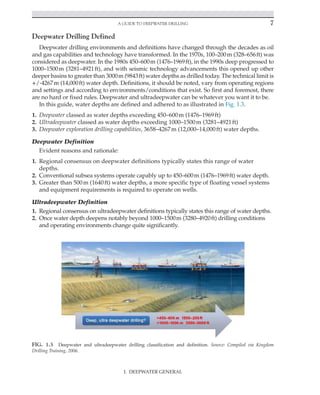
In this guide, water depths are defined and adhered to as illustrated in Fig. 1.3.
1. Deepwater classed as water depths exceeding 450–600m (1476–1969ft)
2. Ultradeepwater classed as water depths exceeding 1000–1500m (3281–4921ft)
3. Deepwater exploration drilling capabilities, 3658–4267m (12,000–14,000ft) water depths.
Deepwater Definition
Evident reasons and rationale:
1. Regional consensus on deepwater definitions typically states this range of water
depths.
2. Conventional subsea systems operate capably up to 450–600m (1476–1969ft) water depth.
3. Greater than 500m (1640ft) water depths, a more specific type of floating vessel systems
and equipment requirements is required to operate on wells.
Ultradeepwater Definition
1. Regional consensus on ultradeepwater definitions typically states this range of water depths.
2. Once water depth deepens notably beyond 1000–1500m (3280–4920ft) drilling conditions
and operating environments change quite significantly.
FIG. 1.3 Deepwater and ultradeepwater drilling classification and definition. Source: Compiled via Kingdom
Drilling Training, 2006.
8 1. Mission, Mission Statement
I. DEEPWATER GENERAL
3. Below 1000–1500m (3280–4920ft), a more specific class of floating vessel, systems, tools,
and equipment is often required to more safely, effectively, and efficiently operate these
wells.
DEEPWATER DRILLING AND OPERATING ENVIRONMENTS
General Introduction
We can draw further conclusions from Fig. 1.3 about deep and ultradeepwater projects
conducted worldwide today in our seas and oceans, including operating conditions and en-
vironments as illustrated in Figs. 1.4 and 1.5.
FIG. 1.4 Continental margins, deepwater settings and environments. From Kingdom Drilling training construct.
Continent+
Continental shelf
Continental slope
Continental rise
Mid-ocean ridge
Sea level
Abyssal plain
Abyssal hill
island arc
Guyot
Continental margin
+ Magma
Seamount
Trench
+ Volcanic island
Submarine canyon
FIG. 1.5 Further deepwater specific operating conditions and environments. Source: http://www.visualdictionaryon-
line.com/images/earth/geology/ocean-floor.jpg
Deepwater Drilling and Operating Environments 9
I. DEEPWATER GENERAL
What immediately sets deep and ultradeepwater apart from conventional offshore pro-
grams and projects is that operations have to be conducted at far greater supply, logistic, and
operating distances from shore. This makes the supply chain and conducting of operations
far more challenging.
Additionally below the deep and ultra-deepwater depths, the continental margins that
exist have variant conditions, settings, and environment as illustrated through a regional
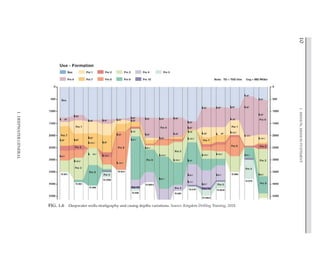
example of deepwater exploration and appraisal wells in Fig. 1.6. Here, it can be viewed how
variant well designs differ across this region.
It is further evident in Fig. 1.6 that the deepwater sedimentary stratigraphy that exists on
each well is far from the same. Wells are exposed to different sets of operating conditions that
can be more or less problematical from a drilling operational standpoint.
At this early stage, it is important to begin to comprehend why geological risks and uncer-
tainties essentially can drive the deepwater well design, construction, and the drilling chal-
lenges that arise, and why these issues reside high on the project hazard and risk register until
wells are safely drilled, data gathered, and more can be learned and translated into added
project value.
One can conclude again the variant geological and drilling conditions and environments
must be safely managed through a deepwater well's life cycle within such fields. With lower
oil prices that may exist well into the future, more competitive means, effective and efficient
methods shall have to result to assure that developing and producing these prospective re-
gions remains commercially sustainable delivering even greater outcomes and benefits.
Brazil Presalt Petroleum Systems
The presalt system occurs beneath a layer of evaporate sediments, i.e., salt anhydrite and
other minerals formed by an ancient, massive evaporation of basin waters. Salt evidently results
more or less continuously across much of the Atlantic margin of both Brazil and West Africa
sides, but is not present on the northern equatorial margin of Brazil or Africa.
The organic-rich sediments that exist and the thermally mature physics of the source rocks,
and the primary and secondary migration into the reservoir rocks and seals within the rift ba-
sin, resulted as the tectonic forces pulled Africa and South America apart to create the South
Atlantic Ocean during Cretaceous and younger times—beginning 145 million years ago. The
subsalt reservoirs that capture the petroleum then divided into two groups:
1. Clastic sediments, formed of both sandstone and conglomerates that were eroded from
the mountains that flank the rift basin, and,
2. Carbonate sediments (rock consisting mostly of calcium carbonate). This porous
limestone and some dolostone reservoirs were deposited in shallow marine water along
the edges and crest of the mountains as they were eventually flooded and then buried by
older sandstone and associated sediments.
Above the reservoirs, the salt formed the top seal that trapped the petroleum accumulations.
Brazilian Postsalt Petroleum System
The postsalt petroleum system in the Atlantic margins lies above the regional salt layer and
was deposited on the western margins of the growing South Atlantic Ocean under conditions
of normal marine shelves and deepwater slopes. The postsalt system is divided also into two
main units:
10
1.
Mission,
Mission
Statement
I.
DEEPWATER
GENERAL
FIG. 1.6 Deepwater wells stratigraphy and casing depths variations. Source: Kingdom Drilling Training, 2018.
Deepwater Drilling and Operating Environments 11
I. DEEPWATER GENERAL
1. Shallow water carbonates, largely grainstones resting on top of the salt layer, and
2. A younger clastic system section, with local sandstone reservoir in a variety of oil and gas
traps.
Grainstones=A kind of limestone comprised of grains with cement called spar.
Salt intrusion in the subsurface creates the diapirs and windows from a deeper strati-
graphic horizon to provide migration routes within the post-salt sections, with younger
sediments providing the classic source rock reservoir and traps demanded for a commercial
prospect to exist.
Structural traps are associated with the salt diapirs and roll over structures created by
faulting. In addition, further stratigraphic traps are formed coinciding with the edges and
pinch outs of these fields typically within sandstone either along the flanks or the up dip
edges of the reservoir body.
Limestone in the postsalt system was deposited under normal marine conditions resulting
from the opening of the South Atlantic Ocean during the cretaceous period. These deposits
can be clean and well sorted to provide ideal reservoir rocks. Note: Deposits of similar age
and environments are also found in deepwater on the West African side of the South Atlantic
Ocean, for example, the Cabinda limestones, offshore Angola.
Above the Brazilian postsalt carbonates lie the younger units comprised of alternating
layers of sandstone reservoirs and claystone by seaward and landward migrations of deltaic,
debrite, and turbidite deposits that will be discussed in more detail in this chapter. Major
seaward migrations (regressions) of the shore line delivered considerable sand to the basin in
the form of a series of deltas at the shelf edges.
Sand is transported into the deepwater slope and basin areas as a variety of channelized
and sheet-like turbidite sequences. At other times, rapid landward migration of the shore-
line (transgressions) results in more widespread deposition of fine grained mudstone and
clay over broad areas of the shelf and deepwater as water depths rapidly increase. The clay
sequence of deposits formed multiple seal layers for the sand sequences. Some of Brazil’s
largest fields are found in sealed turbidites accounting for a large majority of oil and gas be-
ing produced since the Namorado field was discovered in 1975, followed by Albacora (1984),
Marlim (1985), Albacora Leste (1986), Marlim Sul, Leste (1987), and Roncador in 1986.
Deepwater West Africa
Africa commenced exploring in water depths greater than 300m (984ft), to discover deep-
water success in comparison to Brazil. Deepwater successes in West Africa followed those in
Brazil and the Gulf of Mexico, benefitting from technology advancements/adaptations and
the building of fourth, fifth and ultimately sixth generation drilling vessels.
The discoveries in West Africa defined the significance of two major deepwater petroleum
systems of the Niger Delta and the Congo basin, both areas of prolific hydrocarbon genera-
tion from Tertiary marine source rocks.
WEST AFRICAN GEOLOGY
As the continents separated and extended the African Plate form South America, this
stretched and thinned the continental crust remaining to the point of rupture and the be-
ginning of the South Atlantic Ocean. The first marine waters laden with salt entered this
depression from the South, across a shallow shelf called the Walvis Ridge. The climate this
12 1. Mission, Mission Statement
I. DEEPWATER GENERAL
period up to 125 million years ago ultimately resulted in the rapid deposition of the thick salt
deposit now present below some of the oil-producing regions in Brazil and West Africa. With
time and because these thick salts sequences behaved like plastic when loaded by overlying
sediments, the movement of the salt deformed the sedimentary layers into the structural
features that contain the oil and gas that exists today.
The sea floor separated the continents further apart dividing the salt basin in two areas
characterized by narrow shelves beyond which water depth rapidly increased across broad
slopes to water depths of 3300m (10,827ft) since the end of the early Cretaceous period. The
great Niger and Congo rivers of Africa then dumped layers of clay, sand, and organic-rich
mudstones into these deep marine waters to form the source, structure, seals, and reservoir
rocks to generate and trap oil and gas in typically sands and sandstone deposited in the
Oligocene and Miocene periods of the Tertiary era, i.e., 35 to 5 million years ago.
Unlike classic models used to describe deepwater reservoirs such as Gulf of Mexico, sub-
marine fan systems typically depict concentric sediments being deposited in belts radiating
away from the mouth of a submarine fan canyon.
However, early West Africa models suggested gradual down fan decreases in reservoir
and sand thicknesses. Thankfully, modern 3D seismic now being used and many cores that
have been taken from West African reservoirs have characterized and provided us with the
big takeaway that these systems have very different mode of deposition with far more com-
plex reservoirs and sealing architectures as was first predicted.
Many African deepwater reservoirs for example exhibit geometries like filled-in rivers or
streams formed by turbidity currents, i.e., deep currents laden with sediments pulled essentially
by gravity. These currents therefore cut channels, build levees, create meandering channel
patterns like rivers.
In summary, because of the complex distribution of reservoir sands and muds associated
with channelized deepwater reservoirs systems common in West Africa, successful develop-
ment is highly dependent on high-quality seismic data, so geoscientists can develop more
accurate models and locate wells to assure maximum oil recovery, thereby reducing the
number of wells required and increasing production per well to deliver greater returns on
­
investment—all critical factors in deepwater.
Deepwater Salt Challenges
Salt challenges and difficulties in deepwater are not exclusive to Gulf of Mexico, Brazil,
and West Africa as illustrated in Fig. 1.7. Common elements of salt are:
1. All salts are not the same.
a. Simple salts, e.g., halite, remain relatively stable during drilling.
b. Complex salts, e.g., carnallite, tachyhydrite, can creep more rapidly.
2. Wellbore conditions impact creep.
a. Temperature. The higher the temperature, the more salt can move.
b. Pressure differential. The higher the differential between mud weight and formation
pressure, the more salt can move.
Challenges presented in salt are often before entry and at the exit of the systems as high-
lighted in Figs. 1.8 and 1.9.
Deepwater Drilling and Operating Environments 13
I. DEEPWATER GENERAL
FIG. 1.7 Worldwide deepwater salt regions. Source: Perez, M.A., Clyde, R., D’Ambrosio, P., Israel, R., Leavitt, T., Nutt,
L., Johnson, C., Williamson, D., 2008. Meeting the subsalt challenge. Oilfield Rev. 20 (3), 32–45.
FIG. 1.8 Deepwater potential hazards in and around salt. Source: Perez, M.A., Clyde, R., D’Ambrosio, P., Israel, R.,
Leavitt, T., Nutt, L., Johnson, C., Williamson, D., 2008. Meeting the subsalt challenge. Oilfield Rev. 20 (3), 32–45.
14 1. Mission, Mission Statement
I. DEEPWATER GENERAL
The opportunities to experience operational problems to, through and out of salt are many
and are derived from salt tendency to move. Industry limited ability to image salt can lead
to mistaking base of salt depths and unexpected encounters with abnormal or subnormal
pressure zones beneath the salt.
Combating the effects of nonuniform loading caused by salt creep requires full cement
returns to top of salt. In Fig. 1.9 (left), a liner is set inside a cemented casing in to reduce ra-
dial pipe deformation. Salt movement (right) continues to load casing/liner strings that may
result in failure over time.
In the case of mobile “plastic” salt operating loss that can ultimately result are:
1. wellbore drilling difficulties, loss of quality, and operational delays
2. stuck pipe
3. casing deformation
4. wellbore instability
5. drilling troublesome rubble and/or fractured zones vs. avoidance.
Mitigating measures include:
1. higher mud weight
2. design cement to minimize point loading (high tensile strength, flexible)
FIG. 1.9 Cementing across mobile salt. Source: Perez, M.A., Clyde, R., D’Ambrosio, P., Israel, R., Leavitt, T., Nutt, L.,
Johnson, C., Williamson, D., 2008. Meeting the subsalt challenge. Oilfield Rev. 20 (3), 32–45.
Deepwater Drilling and Operating Environments 15
I. DEEPWATER GENERAL
3. thicker walled (higher strength) casing
4. more casing
5. specialized tool procedures and guidelines
6. people developed with a wider skill set to fully understand these problems.
In much deeper and older stratigraphy in deepwater, a further issue below the salt in
certain specific operating conditions and environments is where tar exists, e.g., the Gulf of
Mexico. Key points are:
1. Mobile tar (bitumen) appears in pockets below salt, along faults.
2. Mobility can range from none to very active.
3. Presence is impossible to predict, does not appear in seismic data.
This is a common problem that is well reported and documented in journal papers high-
lighting specific Gulf of Mexico well challenges/problems that can result, such as:
1. packoffs behind BHA (lost returns)
2. swabbing
3. BHA damage from shock and vibration
4. stuck logging tools
5. stuck casing
6. excessive trips to clean tar in casing and riser
7. surface handling problems
Unfortunately mitigation choices are limited.
Either avoid it or fight it.
References
Joyes, R., 2001. South Atlantic Geology: deciphering turbidites on seismic key to understanding basins off Africa,
Brazil. Oil Gas J. 99, 38–43.
Leffler, W.L., Pattarozzi, R., Sterling, G., 2011. Deepwater Petroleum Exploration and Production: A Non-Technical
Guide, second ed. PennWell, Tulsa, OK.
Perez, M.A., Clyde, R., D’Ambrosio, P., Israel, R., Leavitt, T., Nutt, L., Johnson, C., Williamson, D., 2008. Meeting the
subsalt challenge. Oilfield Rev. 20 (3), 32–45.
Press, F., Siever, R., 1998. Understanding Earth, second ed. W.H. Freeman and Co, New York, Basingstoke.
Deepwater Drilling 17 © 2019 Elsevier Ltd. All rights reserved.
https://doi.org/10.1016/B978-0-08-102282-5.00002-8
C H A P T E R
2
Deepwater Geology  Geoscience
DEEPWATER GEOLOGY  GEOSCIENCE
General Introduction
Seventy percent of the earth's surface is covered by sea, of which a large part is defined as
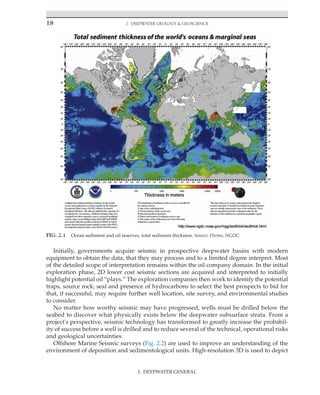
deepwater. The constraints of deepwater petroleum systems as shown in Fig. 2.1 dictate that
only relatively restricted sedimentary surface areas and depths underlain by the continental
plates are considered as commercially prospective for hydrocarbons.
Although analogous fields have been discovered in deepwater, the evident influences
within these environments provide perhaps less reason to expect better quality or larger vol-
ume reservoir accumulations than in shallow water. However, considerable unexplored areas
of deepwater have the potential to contain entrapped hydrocarbons and through the applica-
tion of more modern exploration tools (seismic, logging while drilling, seismic while drilling)
make deepwater a better place today than in earlier offshore years.
A deepwater petroleum system must contain the Geology and Geoscience (GG) ingredi-
ents required for commercial hydrocarbon success. That system, among other factors, must
contain the static and dynamic elements such as reservoir, trap, source rock, cap rock, pri-
mary and secondary migration, and all required interconnections. All elements must be pres-
ent and correctly linked in time and space. Most of the elements are affected by the context
in which they find themselves and certain features in deepwater environments also affect the
eventual nature and volumes of the hydrocarbons trapped.
An introductory examination of deep water geology and geoscience is presented in this
chapter covering seismic, shallow hazards, deepwater geology and geoscience, character-
istics, reservoir sedimentology, trapping, geometry, source rock maturation, and migration
essentials.
Deepwater Seismic Interpretation
At the beginning of deepwater projects, seismic data are generally all that is present.
Advances in 3D and 4D seismic techniques today provide geologists and geophysicists with
greater analysis and interpretation potential to manage and predict deepwater shallow haz-
ards, predict and detect pressure regimes, hydrocarbon petroleum, and reservoir aspects.
Continuous improvement in these fields explains why the industry is capable of exploring in
deeper offshore frontier such as subsalt, etc. that was certainly not previously possible.
18 2. Deepwater Geology  Geoscience
Initially, governments acquire seismic in prospective deepwater basins with modern
equipment to obtain the data, that they may process and to a limited degree interpret. Most
of the detailed scope of interpretation remains within the oil company domain. In the initial
exploration phase, 2D lower cost seismic sections are acquired and interpreted to initially
highlight potential oil “plays.” The exploration companies then work to identify the potential
traps, source rock, seal and presence of hydrocarbons to select the best prospects to bid for
that, if successful, may require further well location, site survey, and environmental studies
to consider.
No matter how worthy seismic may have progressed, wells must be drilled below the
seabed to discover what physically exists below the deepwater subsurface strata. From a
project's perspective, seismic technology has transformed to greatly increase the probabil-
ity of success before a well is drilled and to reduce several of the technical, operational risks
and geological uncertainties.
Offshore Marine Seismic surveys (Fig. 2.2) are used to improve an understanding of the
environment of deposition and sedimentological units. High-resolution 3D is used to depict
FIG. 2.1 Ocean sediment and oil reserves, total sediment thickness. Source: Divins, NGDC.
I. DEEPWATER GENERAL
Deepwater Geology  Geoscience 19
more intense images of the sea bottom and subsurface features and attributes to assure safe
well operations result.
Seismic data are used to identify geohazard occurrences, using both conventional and repro-
cessed 3D seismic, 2D and 3D high-resolution seismic, seismic velocity data, analogue site sur-
veys, and core samples. In exploration plays with limited well data, seismic velocity data are used
and viewed as important to evaluate deepwater subsurface structures where:
1. Hazards and uncertainties may exist,
2. Pressure regimes are predicted,
3. Hydrocarbons may be trapped.
Seafloor debris hazards are recognized and analyzed using side-scan sonar, while slumps
and faults are identified and presented as breaks in seismic reflections using 2D and 3D seis-
mic sections and time slices.
Overpressurized (water flow/gas) pockets can be predicted through seismic data and
attribute analysis that may produce anomalous high amplitudes and reflection time sags.
Indications of hydrates are also predicted via similar seismic data attributes and velocity
analysis. Mud volcanoes and pockmarks, on the other hand, are represented through 3D sea-
floor visualizations and seismic sections.
Marine Seismic Surveys
Fig. 2.2 outlines the seismic essentials to know in that all cases, marine seismic vessels
involve a source (S) and some kind of array of receiver sensors (individual receiver packages
are indicated by the black dots).
Fig. 2.2 illustrates:
1. Towed streamer geometry,
2. On bottom geometry,
3. A buried seafloor array (note that multiple parallel receiver cables are subtly deployed),
4. VSP (vertical seismic profile), where the receivers are positioned in a well.
FIG. 2.2 Offshore marine seismic survey. Source: IOGP shallow hazard guidelines.
I. DEEPWATER GENERAL
20 2. Deepwater Geology  Geoscience
Oil companies generally outsource the seismic acquisition, initial processing and display,
with the final processing then conducted by service companies or specialist individuals.
Some companies will do their own processing and display for most of their own prospects.
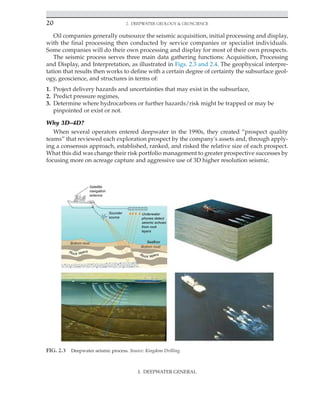
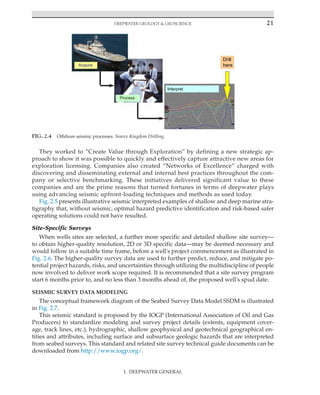
The seismic process serves three main data gathering functions: Acquisition, Processing
and Display, and Interpretation, as illustrated in Figs. 2.3 and 2.4. The geophysical interpre-
tation that results then works to define with a certain degree of certainty the subsurface geol-
ogy, geoscience, and structures in terms of:
1. Project delivery hazards and uncertainties that may exist in the subsurface,
2. Predict pressure regimes,
3. Determine where hydrocarbons or further hazards/risk might be trapped or may be
pinpointed or exist or not.
Why 3D–4D?
When several operators entered deepwater in the 1990s, they created “prospect quality
teams” that reviewed each exploration prospect by the company's assets and, through apply-
ing a consensus approach, established, ranked, and risked the relative size of each prospect.
What this did was change their risk portfolio management to greater prospective successes by
focusing more on acreage capture and aggressive use of 3D higher resolution seismic.
Bottom mud
Bottom mud
Rock layers
Rock layers
Sounder
source
Satellite
navigation
antenna
Underwater
phones detect
seismic echoes
from rock
layers
Seafloor
FIG. 2.3 Deepwater seismic process. Source: Kingdom Drilling.
I. DEEPWATER GENERAL
Deepwater Geology  Geoscience 21
They worked to “Create Value through Exploration” by defining a new strategic ap-
proach to show it was possible to quickly and effectively capture attractive new areas for
exploration licensing. Companies also created “Networks of Excellence” charged with
discovering and disseminating external and internal best practices throughout the com-
pany or selective benchmarking. These initiatives delivered significant value to these
companies and are the prime reasons that turned fortunes in terms of deepwater plays
using advancing seismic upfront-loading techniques and methods as used today.
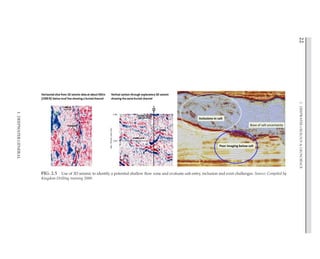
Fig. 2.5 presents illustrative seismic interpreted examples of shallow and deep marine stra-
tigraphy that, without seismic, optimal hazard predictive identification and risk-based safer
operating solutions could not have resulted.
Site-Specific Surveys
When wells sites are selected, a further more specific and detailed shallow site survey—
to obtain higher-quality resolution, 2D or 3D specific data—may be deemed necessary and
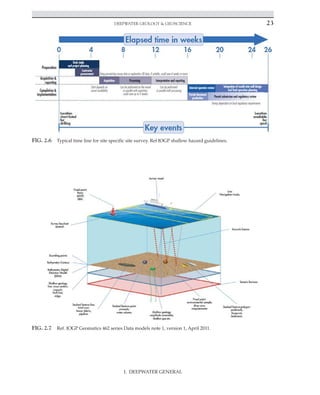
would follow in a suitable time frame, before a well's project commencement as illustrated in
Fig. 2.6. The higher-quality survey data are used to further predict, reduce, and mitigate po-
tential project hazards, risks, and uncertainties through utilizing the multidiscipline of people
now involved to deliver work scope required. It is recommended that a site survey program
start 6 months prior to, and no less than 3 months ahead of, the proposed well's spud date.
SEISMIC SURVEY DATA MODELING
The conceptual framework diagram of the Seabed Survey Data Model SSDM is illustrated
in Fig. 2.7.
This seismic standard is proposed by the IOGP (International Association of Oil and Gas
Producers) to standardize modeling and survey project details (extents, equipment cover-
age, track lines, etc.), hydrographic, shallow geophysical and geotechnical geographical en-
tities and attributes, including surface and subsurface geologic hazards that are interpreted
from seabed surveys. This standard and related site survey technical guide documents can be
downloaded from http://www.iogp.org/.
Acquire
Process
Interpret
Drill
here
FIG. 2.4 Offshore seismic processes. Source Kingdom Drilling.
I. DEEPWATER GENERAL
22
2.
Deepwater
Geology

Geoscience
FIG. 2.5 Use of 3D seismic to identify a potential shallow flow zone and evaluate salt entry, inclusion and exist challenges. Source: Compiled by
Kingdom Drilling training 2009.
I.
DEEPWATER
GENERAL
Deepwater Geology  Geoscience 23
FIG. 2.6 Typical time line for site specific site survey. Ref IOGP shallow hazard guidelines.
FIG. 2.7 Ref. IOGP Geomatics 462 series Data models note 1, version 1, April 2011.
I. DEEPWATER GENERAL
24 2. Deepwater Geology  Geoscience
Shallow Seismic Systems and Methods for Deepwater
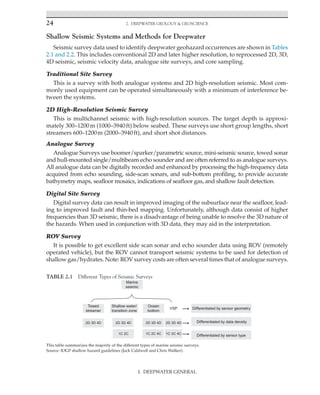
Seismic survey data used to identify deepwater geohazard occurrences are shown in Tables
2.1 and 2.2. This includes conventional 2D and later higher resolution, to reprocessed 2D, 3D,
4D seismic, seismic velocity data, analogue site surveys, and core sampling.
Traditional Site Survey
This is a survey with both analogue systems and 2D high-resolution seismic. Most com-
monly used equipment can be operated simultaneously with a minimum of interference be-
tween the systems.
2D High-Resolution Seismic Survey
This is multichannel seismic with high-resolution sources. The target depth is approxi-
mately 300–1200m (1000–3940ft) below seabed. These surveys use short group lengths, short
streamers 600–1200m (2000–3940ft), and short shot distances.
Analogue Survey
Analogue Surveys use boomer/sparker/parametric source, mini-seismic source, towed sonar
and hull-mounted single/multibeam echo sounder and are often referred to as analogue surveys.
All analogue data can be digitally recorded and enhanced by processing the high-frequency data
acquired from echo sounding, side-scan sonars, and sub-bottom profiling, to provide accurate
bathymetry maps, seafloor mosaics, indications of seafloor gas, and shallow fault detection.
Digital Site Survey
Digital survey data can result in improved imaging of the subsurface near the seafloor, lead-
ing to improved fault and thin-bed mapping. Unfortunately, although data consist of higher
frequencies than 3D seismic, there is a disadvantage of being unable to resolve the 3D nature of
the hazards. When used in conjunction with 3D data, they may aid in the interpretation.
ROV Survey
It is possible to get excellent side scan sonar and echo sounder data using ROV (remotely
operated vehicle), but the ROV cannot transport seismic systems to be used for detection of
shallow gas/hydrates. Note: ROV survey costs are often several times that of analogue surveys.
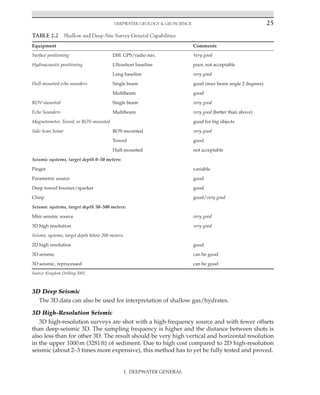
TABLE 2.1 Different Types of Seismic Surveys
Marine
seismic
Towed
streamer
2D 3D 4D 2D 3D 4D 2D 3D 4D 2D 3D 4D
1C 2C 1C 2C 4C 1C 3C 4C
Ocean
bottom
VSP Differentiated by sensor geometry
Differentiated by data density
Differentiated by sensor type
Shallow water/
transition zone
This table summarizes the majority of the different types of marine seismic surveys.
Source: IOGP shallow hazard guidelines (Jack Caldwell and Chris Walker).
I. DEEPWATER GENERAL
Deepwater Geology  Geoscience 25
3D Deep Seismic
The 3D data can also be used for interpretation of shallow gas/hydrates.
3D High-Resolution Seismic
3D high-resolution surveys are shot with a high-frequency source and with fewer offsets
than deep-seismic 3D. The sampling frequency is higher and the distance between shots is
also less than for other 3D. The result should be very high vertical and horizontal resolution
in the upper 1000m (3281ft) of sediment. Due to high cost compared to 2D high-resolution
seismic (about 2–3 times more expensive), this method has to yet be fully tested and proved.
TABLE 2.2 Shallow and Deep-Site Survey General Capabilities
Equipment Comments
Surface positioning Diff. GPS/radio nav. Very good
Hydroacoustic positioning Ultrashort baseline poor, not acceptable
Long baseline very good
Hull-mounted echo sounders Single beam good (max beam angle 2 degrees)
Multibeam good
ROV-mounted Single beam very good
Echo Sounders Multibeam very good (better than above)
Magnetometer, Towed, or ROV-mounted good for big objects
Side-Scan Sonar ROV-mounted very good
Towed good
Hull-mounted not acceptable
Seismic systems, target depth 0–50 meters:
Pinger variable
Parametric source good
Deep towed boomer/sparker good
Chirp good/very good
Seismic systems, target depth 50–500 meters:
Mini seismic source very good
3D high resolution very good
Seismic systems, target depth below 200 meters:
2D high resolution good
3D seismic can be good
3D seismic, reprocessed can be good
Source: Kingdom Drilling 2002.
I. DEEPWATER GENERAL
26 2. Deepwater Geology  Geoscience
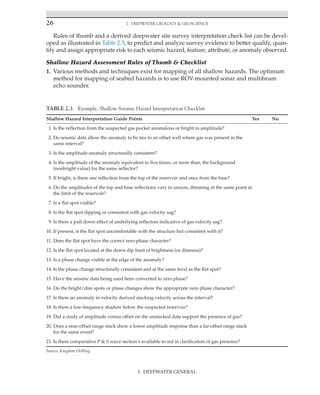
Rules of thumb and a derived deepwater site survey interpretation check list can be devel-
oped as illustrated in Table 2.3, to predict and analyze survey evidence to better qualify, quan-
tify and assign appropriate risk to each seismic hazard, feature, attribute, or anomaly observed.
Shallow Hazard Assessment Rules of Thumb  Checklist
1. Various methods and techniques exist for mapping of all shallow hazards. The optimum
method for mapping of seabed hazards is to use ROV-mounted sonar and multibeam
echo sounder.
TABLE 2.3 Example, Shallow Seismic Hazard Interpretation Checklist
Shallow Hazard Interpretation Guide Points Yes No
1. Is the reflection from the suspected gas pocket anomalous or bright in amplitude?
2. Do seismic data allow the anomaly to be ties to an offset well where gas was present in the
same interval?
3. Is the amplitude anomaly structurally consistent?
4. Is the amplitude of the anomaly equivalent to five times, or more than, the background
(nonbright value) for the same reflector?
5. If bright, is there one reflection from the top of the reservoir and once from the base?
6. Do the amplitudes of the top and base reflections vary in unison, dimming at the same point at
the limit of the reservoir?
7. Is a flat spot visible?
8. Is the flat spot dipping or consistent with gas velocity sag?
9. Is there a pull down effect of underlying reflectors indicative of gas velocity sag?
10. If present, is the flat spot uncomfortable with the structure but consistent with it?
11. Does the flat spot have the correct zero-phase character?
12. Is the flat spot located at the down dip limit of brightness (or dimness)?
13. Is a phase change visible at the edge of the anomaly?
14. Is the phase change structurally consistent and at the same level as the flat spot?
15. Have the seismic data being used been converted to zero phase?
16. Do the bright/dim spots or phase changes show the appropriate zero phase character?
17. Is there an anomaly in velocity derived stacking velocity across the interval?
18. Is there a low-frequency shadow below the suspected reservoir?
19. Did a study of amplitude versus offset on the unstacked data support the presence of gas?
20. Does a near-offset range stack show a lower amplitude response than a far-offset range stack
for the same event?
21. Is there comparative P  S wave section’s available to aid in clarification of gas presence?
Source: Kingdom Drilling.
I. DEEPWATER GENERAL
Deepwater Geology  Geoscience 27
2. The upper tens of metres can best be mapped with a hull-mounted parametric source or
a Chirp system. If ROV is used for mapping of the seabed hazards, the seismic system
should be mounted on the ROV.
3. Shallow water flow and gas reservoirs from 50–1000m (164–3281ft) below seabed are
best mapped with high-resolution 3D seismic. The second best choice is a combination
of seismic data from mini air gun or mini water gun and either high-resolution 2D
or possible conventional 3D seismic, if this shows good resolution in the interval not
covered by the mini-seismic system.
4. Typical line spacing for the 3D seismic surveys is 25m (82 ft). For 2D surveys, it is 250m
(820 ft) in one direction and 500m (1640 ft) in the other. For 2D surveys, it is common to
make a denser pattern around the well location applying 100m (328 ft) spacing in both
directions. Typically, a time frame of 4 weeks should be expected from when the field
work is finished to presentation of final results.
5. It is recommended to avoid drilling at identified shallow hazards. The location of
exploration wells should be moved away from:
• Areas where faulting to shallow depths may be expected
• Shallow depth structural closures, or a closure of the BSR (base of hydrates)
• Shallow gas accumulation
• Shallow reservoirs.
6. If it is impossible to move away from shallow hazards, the well should be designed to
minimize the risks.
• If practically possible, a weighted mud system should be used rather than sea water
when a possible shallow gas zone has to be penetrated.
• The well should be placed as far down flank on a mapped structure as possible.
• Procedures and methods for risk reduction as described under the chapter covering
Shallow Gas should be implemented.
7. Soft seabed may cause anchoring problems. Possible solutions to the problem would be
to use specially designed mud or vertical lift-assisted (VLA) anchors or suction anchors.
Use of piggyback anchors or increased number of anchor lines from 8 to 12 or more can
also be considered.
8. The soft formation's support to the wellhead may not be sufficient for use of standard
equipment. Depending on the results of the seabed strength analysis, larger than
standard OD conductor may be required (36 in (914 mm)), higher grade (X52 or X56), or
thicker wall (1.5in or 1.75in (38.1‒44.5 mm)). The use of a conductor anchor node as used
in more recent deepwater applications ‘CAN’ also be evaluated.
9. Small operating margins between pore pressure and fracture pressure shall exist when
drilling the shallower riserless wellbore sections.
Soil Sampling
Shallow soil sampling may be acquired to obtain and measure geotechnical properties
below the seabed. A common method is to use gravity-based coring devices that can pro-
duce a continuous core of the upper 0–6m (0–20ft) below the seabed. The unit is simple
and reliable and can operate well in water depths 1000m (3281ft). The gravity corer can-
not however function when the seabed consists of sand, gravel, or other hard soils. Under
such circumstances, more comprehensive geotechnical equipment must be used; where more
I. DEEPWATER GENERAL
28 2. Deepwater Geology  Geoscience
­
autonomous and expensive solutions are available to meet required deep water depth capa-
bilities and all subsurface soil conditions, i.e., 3500m (11,400ft).
Possible solutions for extraction of shallow sediments are push samplers or CPTs. Both are
mounted on a weight platform, e.g., 7 tons, size 5×5m (16×16ft). Surface supplied hydrau-
lics is one method used to force a test pipe into the shallow seabed soils.
Shallow Hazard and Risk Assessment Guidelines
Project site survey shallow hazard assessment can be split into two categories, Seabed
Hazards and Subseabed hazards.
1. Seabed Hazards consist of:
a. Topography, slump, and scours feature
b. Slumps or faults extending up to the seabed
c. Manmade objects
d. Wrecks, mines, etc.
e. Poor anchoring conditions
f. Very soft clay, mud slides, cemented sand.
2. Subseabed Hazards Figs. 2.8 and 2.9 consist of:
a. Shallow gas, shallow water flow
b. Gas hydrates and molds
c. Faulting and glide planes to shallow depths
d. Mud volcanoes
e. Incompetent sediments
f. Abnormally pressures zones
g. Layers of boulders
h. Low fracture pressures
i. Shallow prospects.
Notes: The term “shallow” is not definitive and as a general guide refers to depths 1000–
1250m (3280–4100ft) below the seabed. Shallow hazards in the context of deepwater seismic
risk assessment are defined in this guide as:
a. High: An anomaly showing ALL seismic characteristics of a shallow hazard that ties to an
offset well, or is located at a known regional shallow hazard horizon.
FIG. 2.8 Key shallow hazards to predict and assess prior to project implementation. Source: Kingdom Drilling 2018.
I. DEEPWATER GENERAL
Deepwater Geology  Geoscience 29
b. Moderate: An anomaly showing MOST of the seismic characteristics of a shallow
hazard, but which could be interpreted not to be a hazard or reasonable doubt exist for
the presence of such hazards.
c. Low: An anomaly showing SOME of the seismic characteristics of a shallow hazard
interpreted as a low risk although some doubt exists.
d. Negligible: Either there is NO ANOMALY PRESENT at the location or anomaly is
clearly due to nonhazardous, causes.
Note: Any one indication can be spurious. Shallow hazard interpretation on seismic data
involves accumulation of evidence, competent, highly skilled judgment, and a well to be
drilled.
Shallow hazards are mapped with combinations of data from echo sounder, side scan so-
nar, very high-resolution seismic, and further assessed via geotechnical and environmental
samples from the upper few m of the seabed to as deep as is practicable.
Shallow hazards data are acquired, processed, interpreted, and mapped with various seis-
mic equipment systems, techniques, and methods.
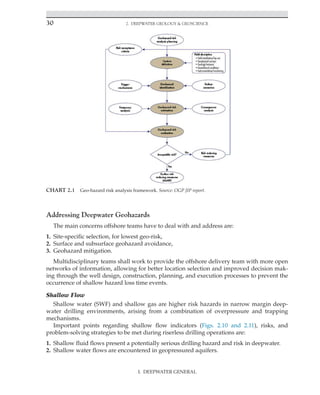
The more interpretive points answered yes or no as illustrated in Table 2.3, the more or
less likely shallow hazard risks are present. A typical risk analysis flowchart framework is
illustrated in Chart 2.1.
FIG. 2.9 Reconstructed in 2018 by Kingdom Drilling, from a widely used summary of deepwater geohazards.
I. DEEPWATER GENERAL
30 2. Deepwater Geology  Geoscience
Addressing Deepwater Geohazards
The main concerns offshore teams have to deal with and address are:
1. Site-specific selection, for lowest geo-risk,
2. Surface and subsurface geohazard avoidance,
3. Geohazard mitigation.
Multidisciplinary teams shall work to provide the offshore delivery team with more open
networks of information, allowing for better location selection and improved decision mak-
ing through the well design, construction, planning, and execution processes to prevent the
occurrence of shallow hazard loss time events.
Shallow Flow
Shallow water (SWF) and shallow gas are higher risk hazards in narrow margin deep-
water drilling environments, arising from a combination of overpressure and trapping
mechanisms.
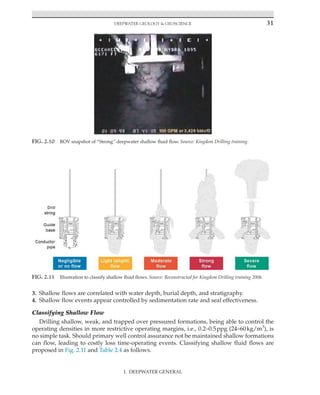
Important points regarding shallow flow indicators (Figs. 2.10 and 2.11), risks, and
­
problem-solving strategies to be met during riserless drilling operations are:
1. Shallow fluid flows present a potentially serious drilling hazard and risk in deepwater.
2. Shallow water flows are encountered in geopressured aquifers.
CHART 2.1 Geo-hazard risk analysis framework. Source: OGP JIP report.
I. DEEPWATER GENERAL
Deepwater Geology  Geoscience 31
3. Shallow flows are correlated with water depth, burial depth, and stratigraphy.
4. Shallow flow events appear controlled by sedimentation rate and seal effectiveness.
Classifying Shallow Flow
Drilling shallow, weak, and trapped over pressured formations, being able to control the
operating densities in more restrictive operating margins, i.e., 0.2–0.5ppg (24–60kg/m3
), is
no simple task. Should primary well control assurance not be maintained shallow formations
can flow, leading to costly loss time-operating events. Classifying shallow fluid flows are
proposed in Fig. 2.11 and Table 2.4 as follows.
FIG. 2.10 ROV snapshot of “Strong” deepwater shallow fluid flow. Source: Kingdom Drilling training.
FIG. 2.11 Illustration to classify shallow fluid flows. Source: Reconstructed for Kingdom Drilling training 2006.
I. DEEPWATER GENERAL
32 2. Deepwater Geology  Geoscience
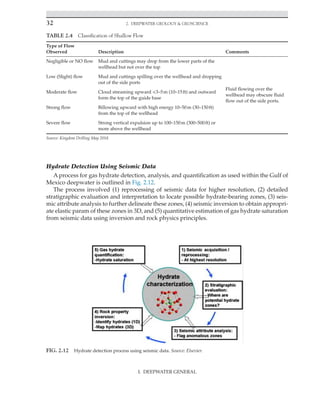
Hydrate Detection Using Seismic Data
A process for gas hydrate detection, analysis, and quantification as used within the Gulf of
Mexico deepwater is outlined in Fig. 2.12.
The process involved (1) reprocessing of seismic data for higher resolution, (2) detailed
stratigraphic evaluation and interpretation to locate possible hydrate-bearing zones, (3) seis-
mic attribute analysis to further delineate these zones, (4) seismic inversion to obtain appropri-
ate elastic param of these zones in 3D, and (5) quantitative estimation of gas hydrate saturation
from seismic data using inversion and rock physics principles.
TABLE 2.4 Classification of Shallow Flow
Type of Flow
Observed Description Comments
Negligible or NO flow Mud and cuttings may drop from the lower parts of the
wellhead but not over the top
Fluid flowing over the
wellhead may obscure fluid
flow out of the side ports.
Low (Slight) flow Mud and cuttings spilling over the wellhead and dropping
out of the side ports
Moderate flow Cloud streaming upward 3–5m (10–15ft) and outward
form the top of the guide base
Strong flow Billowing upward with high energy 10–50m (30–150ft)
from the top of the wellhead
Severe flow Strong vertical expulsion up to 100–150m (300–500ft) or
more above the wellhead
Source: Kingdom Drilling May 2018.
FIG. 2.12 Hydrate detection process using seismic data. Source: Elsevier.
I. DEEPWATER GENERAL
Deepwater Geology  Geoscience 33
BASE OF GAS HYDRATE STABILITY
The outcomes, and benefits of the process are the base of gas hydrate stability (BGHS) can
be confidently inferred from the seismic data processed, displayed, and interpreted from a
hydrate perspective.
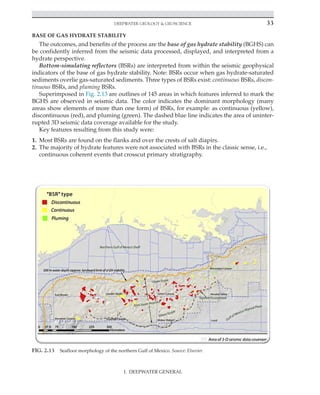
Bottom-simulating reflectors (BSRs) are interpreted from within the seismic geophysical
indicators of the base of gas hydrate stability. Note: BSRs occur when gas hydrate-saturated
sediments overlie gas-saturated sediments. Three types of BSRs exist: continuous BSRs, discon-
tinuous BSRs, and pluming BSRs.
Superimposed in Fig. 2.13 are outlines of 145 areas in which features inferred to mark the
BGHS are observed in seismic data. The color indicates the dominant morphology (many
areas show elements of more than one form) of BSRs, for example: as continuous (yellow),
discontinuous (red), and pluming (green). The dashed blue line indicates the area of uninter-
rupted 3D seismic data coverage available for the study.
Key features resulting from this study were:
1. Most BSRs are found on the flanks and over the crests of salt diapirs.
2. The majority of hydrate features were not associated with BSRs in the classic sense, i.e.,
continuous coherent events that crosscut primary stratigraphy.
FIG. 2.13 Seafloor morphology of the northern Gulf of Mexico. Source: Elsevier.
I. DEEPWATER GENERAL
34 2. Deepwater Geology  Geoscience
DEEPWATER GEOLOGY PRINCIPLES
Essential Principles
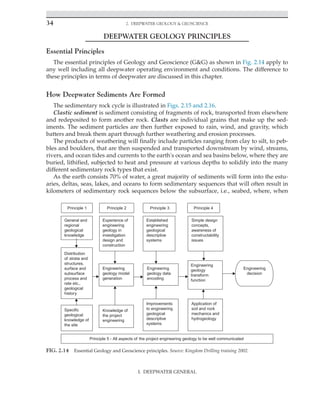
The essential principles of Geology and Geoscience (GG) as shown in Fig. 2.14 apply to
any well including all deepwater operating environment and conditions. The difference to
these principles in terms of deepwater are discussed in this chapter.
How Deepwater Sediments Are Formed
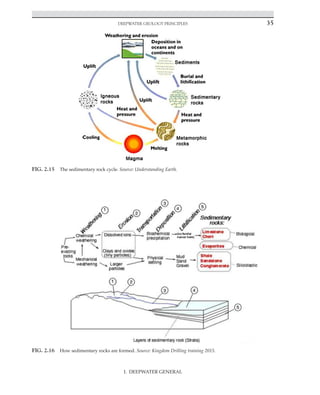
The sedimentary rock cycle is illustrated in Figs. 2.15 and 2.16.
Clastic sediment is sediment consisting of fragments of rock, transported from elsewhere
and redeposited to form another rock. Clasts are individual grains that make up the sed-
iments. The sediment particles are then further exposed to rain, wind, and gravity, which
batters and break them apart through further weathering and erosion processes.
The products of weathering will finally include particles ranging from clay to silt, to peb-
bles and boulders, that are then suspended and transported downstream by wind, streams,
rivers, and ocean tides and currents to the earth's ocean and sea basins below, where they are
buried, lithified, subjected to heat and pressure at various depths to solidify into the many
different sedimentary rock types that exist.
As the earth consists 70% of water, a great majority of sediments will form into the estu-
aries, deltas, seas, lakes, and oceans to form sedimentary sequences that will often result in
kilometers of sedimentary rock sequences below the subsurface, i.e., seabed, where, when
Principle 1
General and
regional
geological
knowledge
Distribution
of strata and
structures,
surface and
subsurface
process and
rate etc.,
geological
history
Experience of
engineering
geology in
investigation
design and
construction
Engineering
geology model
generation
Knowledge of
the project
engineering
Specific
geological
knowledge of
the site
Improvements
to engineering
geological
descriptive
systems
Engineering
geology data
encoding
Engineering
geology
transform
function
Application of
soil and rock
mechanics and
hydrogeology
Principle 5 - All aspects of the project engineering geology to be well communicated
Engineering
decision
Established
engineering
geological
descriptive
systems
Simple design
concepts,
awareness of
constructability
issues
Principle 2 Principle 3 Principle 4
FIG. 2.14 Essential Geology and Geoscience principles. Source: Kingdom Drilling training 2002.
I. DEEPWATER GENERAL
Deepwater Geology Principles 35
FIG. 2.15 The sedimentary rock cycle. Source: Understanding Earth.
FIG. 2.16 How sedimentary rocks are formed. Source: Kingdom Drilling training 2015.
I. DEEPWATER GENERAL
36 2. Deepwater Geology  Geoscience
deep enough, further pressure, heat, and temperature changes further cook and change the
sedimentary rock.
Above the metamorphic bedrocks within the earth basins, sediment thicknesses overlying
the majority of the world’s oceans, seas, and margins have been mapped, interpreted, and can
be readily obtained to conclude deepwater sedimentary basin sequences and rock thickness
where hydrocarbons exist are not all the same.
Ocean sediments are products of weathering, erosion, and transportation through layered
streams of sand, silt, mud (clay), and other materials (carbonates) further precipitate from
solution. These materials then are deposited on the continental ocean and sea floors as tectonic
plates converge, diverge, rise, or subside to form ocean ridges or other unique seabed features
to form the world's deepwater sedimentary ocean floors and drilling basins that exist today.
Deepwater Sedimentary Environments
General
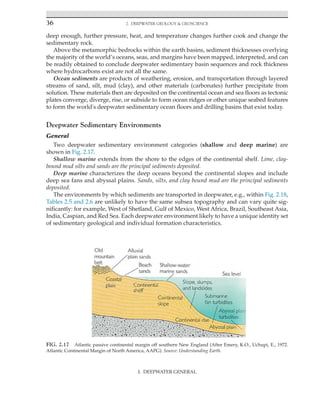
Two deepwater sedimentary environment categories (shallow and deep marine) are
shown in Fig. 2.17.
Shallow marine extends from the shore to the edges of the continental shelf. Lime, clay-
bound mud silts and sands are the principal sediments deposited.
Deep marine characterizes the deep oceans beyond the continental slopes and include
deep sea fans and abyssal plains. Sands, silts, and clay bound mud are the principal sediments
deposited.
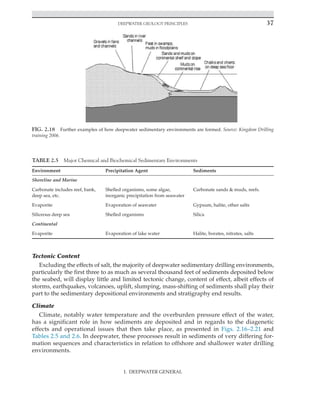
The environments by which sediments are transported in deepwater, e.g., within Fig. 2.18,
Tables 2.5 and 2.6 are unlikely to have the same subsea topography and can vary quite sig-
nificantly: for example, West of Shetland, Gulf of Mexico, West Africa, Brazil, Southeast Asia,
India, Caspian, and Red Sea. Each deepwater environment likely to have a unique identity set
of sedimentary geological and individual formation characteristics.
FIG. 2.17 Atlantic passive continental margin off southern New England (After Emery, K.O., Uchupi, E., 1972.
Atlantic Continental Margin of North America, AAPG). Source: Understanding Earth.
I. DEEPWATER GENERAL
Deepwater Geology Principles 37
Tectonic Content
Excluding the effects of salt, the majority of deepwater sedimentary drilling environments,
particularly the first three to as much as several thousand feet of sediments deposited below
the seabed, will display little and limited tectonic change, content of effect, albeit effects of
storms, earthquakes, volcanoes, uplift, slumping, mass-shifting of sediments shall play their
part to the sedimentary depositional environments and stratigraphy end results.
Climate
Climate, notably water temperature and the overburden pressure effect of the water,
has a significant role in how sediments are deposited and in regards to the diagenetic
effects and operational issues that then take place, as presented in Figs. 2.16–2.21 and
Tables 2.5 and 2.6. In deepwater, these processes result in sediments of very differing for-
mation sequences and characteristics in relation to offshore and shallower water drilling
environments.
TABLE 2.5 Major Chemical and Biochemical Sedimentary Environments
Environment Precipitation Agent Sediments
Shoreline and Marine
Carbonate includes reef, bank,
deep sea, etc.
Shelled organisms, some algae,
inorganic precipitation from seawater
Carbonate sands  muds, reefs.
Evaporite Evaporation of seawater Gypsum, halite, other salts
Siliceous deep sea Shelled organisms Silica
Continental
Evaporite Evaporation of lake water Halite, borates, nitrates, salts
FIG. 2.18 Further examples of how deepwater sedimentary environments are formed. Source: Kingdom Drilling
training 2006.
I. DEEPWATER GENERAL
38 2. Deepwater Geology  Geoscience
Depositional Processes
Deepwater offshore sedimentary environments exist through the mechanisms of:
1. Weathering and Erosion cause sediments to form, that are then
2. Transported and Deposited within the onshore systems and into the offshore drilling
environments over tens of millions of years.
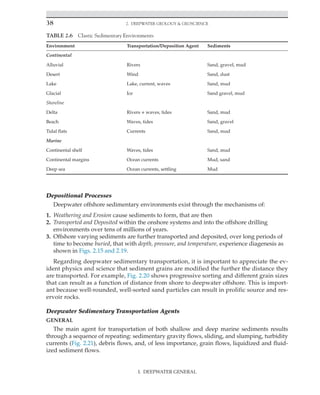
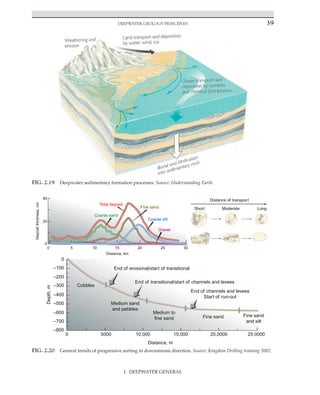
3. Offshore varying sediments are further transported and deposited, over long periods of
time to become buried, that with depth, pressure, and temperature, experience diagenesis as
shown in Figs. 2.15 and 2.19.
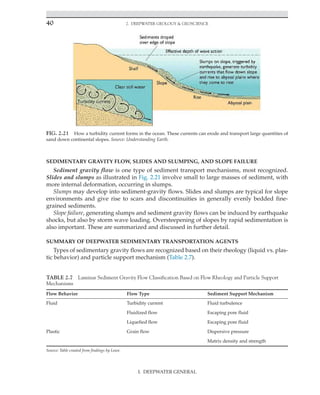
Regarding deepwater sedimentary transportation, it is important to appreciate the ev-
ident physics and science that sediment grains are modified the further the distance they
are transported. For example, Fig. 2.20 shows progressive sorting and different grain sizes
that can result as a function of distance from shore to deepwater offshore. This is import-
ant because well-rounded, well-sorted sand particles can result in prolific source and res-
ervoir rocks.
Deepwater Sedimentary Transportation Agents
GENERAL
The main agent for transportation of both shallow and deep marine sediments results
through a sequence of repeating: sedimentary gravity flows, sliding, and slumping, turbidity
currents (Fig. 2.21), debris flows, and, of less importance, grain flows, liquidized and fluid-
ized sediment flows.
TABLE 2.6 Clastic Sedimentary Environments
Environment Transportation/Deposition Agent Sediments
Continental
Alluvial Rivers Sand, gravel, mud
Desert Wind Sand, dust
Lake Lake, current, waves Sand, mud
Glacial Ice Sand gravel, mud
Shoreline
Delta Rivers + waves, tides Sand, mud
Beach Waves, tides Sand, gravel
Tidal flats Currents Sand, mud
Marine
Continental shelf Waves, tides Sand, mud
Continental margins Ocean currents Mud, sand
Deep sea Ocean currents, settling Mud
I. DEEPWATER GENERAL
Deepwater Geology Principles 39
FIG. 2.19 Deepwater sedimentary formation processes. Source: Understanding Earth.
0
Coarse sand
Total deposit
0
0
20
Deposit
thickness,
cm
40
5 10 15 20
Distance, km
Distance of transport
25 30
0 5000
Depth,
m
10,000 15,000
Distance, m
20,0000 25,0000
–100
–200
–300
–400
–500
–600
–700
–800
Cobbles
Medium sand
and pebbles
Medium to
fine sand Fine sand
End of channels and levees
Start of run-out
End of transitional/start of channels and levees
End of erosional/start of transitional
Fine sand
and silt
Fine sand
Coarse silt
Gravel
Moderate
Short Long
FIG. 2.20 General trends of progressive sorting in downstream direction. Source: Kingdom Drilling training 2002.
I. DEEPWATER GENERAL
40 2. Deepwater Geology  Geoscience
TABLE 2.7 Laminar Sediment Gravity Flow Classification Based on Flow Rheology and Particle Support
Mechanisms
Flow Behavior Flow Type Sediment Support Mechanism
Fluid Turbidity current Fluid turbulence
Fluidized flow Escaping pore fluid
Liquefied flow Escaping pore fluid
Plastic Grain flow Dispersive pressure
Matrix density and strength
Source: Table created from findings by Lowe.
SEDIMENTARY GRAVITY FLOW, SLIDES AND SLUMPING, AND SLOPE FAILURE
Sediment gravity flow is one type of sediment transport mechanisms, most recognized.
Slides and slumps as illustrated in Fig. 2.21 involve small to large masses of sediment, with
more internal deformation, occurring in slumps.
Slumps may develop into sediment-gravity flows. Slides and slumps are typical for slope
environments and give rise to scars and discontinuities in generally evenly bedded fine-
grained sediments.
Slope failure, generating slumps and sediment gravity flows can be induced by earthquake
shocks, but also by storm wave loading. Oversteepening of slopes by rapid sedimentation is
also important. These are summarized and discussed in further detail.
SUMMARY OF DEEPWATER SEDIMENTARY TRANSPORTATION AGENTS
Types of sedimentary gravity flows are recognized based on their rheology (liquid vs. plas-
tic behavior) and particle support mechanism (Table 2.7).
FIG. 2.21 How a turbidity current forms in the ocean. These currents can erode and transport large quantities of
sand down continental slopes. Source: Understanding Earth.
I. DEEPWATER GENERAL
Other documents randomly have
different content
“Nick isn’t a fair sample,” Stan said quickly. “Before you get out of
China, you’ll meet a lot of fellows who are right good men.”
They walked across the grounds to headquarters and turned in.
Wing Commander Beakin was seated at his desk. In spite of the
heat, he was dressed in full uniform. He frowned heavily as he
looked at them.
“Deserters?” he asked in clipped tones.
“No, sir, just recruits,” Allison answered.
“China, eh?” The commander did not wait for an answer. “Well,
boys, you can serve up there better than down here right now. We
all know trouble is on the way. Japan is about ready to strike. The
stronger China is, the safer we are down here. We have to keep
supplies moving in over the Burma Road just as long as it can be
kept open.”
“Yes, sor,” O’Malley broke in. “That’s just the way we had it figured
out. Once we get up there that road will be safe.”
Commander Beakin’s leathery face cracked into a smile. “Aren’t
you the pilot who brought in a new model German gun and laid it on
the desk of my friend, Wing Commander Farrell?”
O’Malley squirmed uncomfortably. Allison spoke up. “The same
man, sir. He herded a Jerry right down on our landing field.”
Stan laughed. “We shall try to uphold the traditions of the service,
sir,” he said.
Commander Beakin cleared his throat. He pulled a sheaf of papers
toward him and glanced at them. Then he shoved them across the
desk.
“Lieutenant Wilson can take you to the Chinese general who will
give you your credentials. These papers will release you and they
will entitle you to return to this service without prejudice. I
understand you are to report at once.” His face had returned to its
flinty hardness, but his eyes showed the pride he had in his men.
The three fliers gathered up their papers and about-faced.
O’Malley seemed to have forgotten the heat. He set a brisk pace.
Allison slowed him down.
“What’s your rush? China will be still there when we get to
Rangoon,” he drawled.
They walked across town to the waterfront where the harbor was
crowded with craft from every nation of the world. A mass of frail
vessels marked the Chinese boat colony where several thousand
Chinese, some of whom had never set foot on land, used boats for
homes and as a means of livelihood. The waterfront was swarming
with a motley crowd of races and colors, all jabbering and shouting
and talking. Few white men were to be seen.
“Our man lives in a little shack down a few blocks,” Stan
explained. “He has his office in one half of a single room and he lives
in the other half. But he has plenty of authority and Uncle Sam is
backing him.”
They hurried on through the colorful throng, hardly paying any
attention to what went on around them. They were eager to be on
their way to China and the skies over the Burma Road.
CHAPTER II
CHINA WINGS
Stan Wilson led his pals to a small shack on the waterfront and
halted before a flimsy door of matting. Over the door and along the
wall were Chinese characters painted in red. Below the characters
was a faded poster showing a slender American girl in a riding habit
and wearing a cocky little hat. The girl was holding high a glass of
Coca Cola. Stan pointed to the familiar advertisement.
“Looks like home,” he said.
“It sure does,” Allison agreed. “Those confounded soft drink ads
are plastered all over the world.”
“Here is where you sign up. I was down yesterday,” Stan said.
“Still want to head for China?”
O’Malley eyed the dilapidated building, then his eyes moved up
and down the street crowded with similar shacks.
“Sure, an’ I’m struck dumb with admiration by the elegance o’
their headquarters, but if they have planes and petrol I’m joinin’ up.”
“They have both,” Stan assured him.
“Suppose we have a look inside,” Allison suggested.
Stan tapped on the wall beside the door. After a brief wait the
matting swung aside and a brown face appeared. Two glittering,
black eyes regarded them. The doorman was a Malay, smaller than
the average. His lips were stained red from chewing betel nut and
his skin was a rich red-brown.
“Come,” he beckoned softly.
Stan shoved O’Malley forward and Allison dropped in behind. They
entered a small room lighted by yellow rays which filtered in through
a screen covering a high window. The room was divided into two
parts by a long grass curtain decorated with painted cherry trees
and mountains. Against this backdrop sat a gaunt Chinese at a small
desk. He wore a white jacket and a pair of billowing pants. His deep-
set eyes peered out at the three fliers from unmoving lids. Slowly he
lifted a bony hand to his chin and fingered its carved outline.
“Welcome,” he said in a soft voice. “Welcome and please sit
down.”
The only place to sit was on a bench before the desk or upon one
of the many cushions scattered about on the floor. The boys seated
themselves on the bench.
“General, I have brought two men who hope to join the China Air
Force. They are the men Commander Beakin reported upon, and the
same men I told you about,” Stan explained.
“I am grateful. China is grateful. To have three aces from the
Royal Air Corps is indeed a great gift.” The general’s voice was
smooth and controlled, but his eyes were searching and watchful.
“There was to be another man. He should be here,” Stan said.
The thin, yellow lips parted in a smile. “Mr. Munson asked to come
one hour later. He informed me he had an engagement.”
“Sure, an’ I’m thinkin’ this Nick Munson is a bad one,” O’Malley
broke in.
The general beamed upon O’Malley. “It is good to be of a
suspicious nature. However, we have checked the credentials Mr.
Munson presented and find them eminently satisfactory. He boasts
overmuch, perhaps, but China has great need of instructors and
pilots.”
“We’ll handle the spalpeen, General. We’ll break his neck if he gets
funny,” O’Malley assured the officer.
“He may well break his own neck if he does the things he tells us
are easy for him,” the general said without smiling.
“We are prepared to be watchful, that is what Lieutenant O’Malley
means,” Allison explained.
“I believe as much, and so we will get on with the few details
which must be settled. First, I must warn you that efforts are being
made to prevent recruited pilots from reaching China.” He smiled
and went on with hardly a pause. “You will be paid one thousand
dollars a month in American money for your services. You will be
under the orders of our renowned general, Chiang Kai-shek, as
regular officers of the China Air Force. I have made out the papers
you will need to present at the air base from which you will fly. Once
you have reported you will not carry these papers on your person.
Should you be forced down behind enemy lines or be in danger of
capture, you will divest yourself of your uniform under which you will
wear Chinese clothing. This is for your personal safety.”
“So the Japs won’t shoot us on sight?” O’Malley asked.
“They seldom shoot prisoners. They use them for bayonet drill,
lashed to a post.” The general’s eyes were hard and clear.
O’Malley straightened aggressively and started to say something
uncomplimentary about the Japs. Stan broke in.
“Thanks, General.”
O’Malley got to his feet and thrust out a huge hand. The general
took it and gripped it.
“Don’t you worry, sor. ’Tis no Japs will be botherin’ yer supplies
once we get up north,” O’Malley said gravely.
The general laughed. “You are most wonderful boys. I wish you
good luck, and, as they say, happy landings.”
Stan hesitated, then faced the general. “Where did you learn to
speak English, sir? Many of your phrases sound very familiar.”
“I come from San Francisco, where I was born. Like yourselves I
am a foreigner helping a great people resist an aggressor. When the
liberty of China is secure I shall return to San Francisco and my law
practice.” There was a twinkle in the eyes of the general.
March Allison laughed his old, cynical laugh. “A Yank,” he said and
snapped a smart salute which the general returned.
Out on the street a minute later he turned to Stan. “What is his
name?”
“Tom Miller,” Stan replied.
O’Malley stopped and looked at Stan. “What sort of a country have
you got over there?” he demanded. “By the shades o’ St. Patrick, if
that general is Tom Miller, I’m Chiang himself.”
“We have Irish policemen, Chinese lawyers and Hindu doctors,”
Stan said without a smile.
“I’m going over there after the war,” O’Malley declared. “Just to
have a good look.”
At that moment the Malay boy who had admitted them to the
presence of General Miller appeared.
“Come, please,” he said.
They followed him toward the waterfront. At a small fruit stand
they met a short Chinese youth dressed in white duck pants and
wearing a flat, straw hat. Their Malay guide bobbed his head and
spoke in Chinese to the youth. The youth smiled at the three fliers,
revealing two rows of even white teeth.
“Welcome to the China Air Arm. I am Tom Koo, flight officer.”
“I am Stan Wilson. This is Bill O’Malley and March Allison,” Stan
said. “Allison will command our flight.”
O’Malley was looking closely at the soldier. Tom Koo was dressed
the same as a thousand other Chinese they had passed on the
waterfront. Suddenly he asked, “You come from San Francisco?”
“Yes,” Tom Koo answered, “but how did you know?”
“I’m an expert,” O’Malley answered. “Anyway, no man could fail to
recognize a Yank.” O’Malley grinned broadly and Tom Koo looked
greatly pleased. He turned to Stan.
“You, too, are an American?”
“I sure am, and we’ll show up the Irish and the British, Tom,” Stan
said very seriously.
The Chinese flier laughed softly. “That will be a very difficult thing
to do. You see, I am informed of the records of Majors Allison and
O’Malley.”
“It’s action we crave, Spitfires and Japs,” O’Malley broke in.
“Japs you shall have in large numbers,” Tom said. “And spies and
crooks and saboteurs to add to the excitement.” The smile faded
from his face and he looked grim. “But first you have a boat ride
which will take you to an island where we have a flying field. It is
best that you do not return to your barracks. Your bags will be
forwarded to you.”
The three walked beside Tom Koo. About them milled shouting
and laughing Tamil and Hindu traders, expounding the value of their
wares. In the midst of such a group stood a fat Chinese. His shrill
voice rose above the tumult and the shouting. Tom shoved his way
toward the fat boatman.
The boatman did not seem to see them, but others turned to look.
The fliers wore street clothing and were taken for tourists who would
have money to spend.
“I will go on. You will speak to the boatman. Say you wish to take
a boat ride.” Tom Koo moved away after giving these instructions in
a low voice.
Stan was closest to the burly Chinese. “We want to see things.
Have you a boat for hire?”
The boatman turned and his black eyes fixed upon the three fliers.
His round, fat stomach bulged above the sash he had knotted
around it. His head was shaven and smooth and his face was
wrinkled into a mass of genial furrows. He was almost an exact copy
of the little statues of the god of happiness they had seen displayed
in the shop windows. He bowed stiffly and placed a huge straw hat
on his head.
“You payee—big?” he asked.
“Sure,” Allison said. “American silver dollars.”
The fat man looked around, then headed toward a junk moored at
the wharf. The boat was high-pooped, square-sterned, made of
carved wood, and staring popeyes were painted on the bows. On its
deck was mounted a gun of a model which had been in use a
hundred years before. Stepping on board, the three fliers found deck
chairs under a canvass awning.
Seating themselves, they watched the Chinese boatman maneuver
his craft into the bay by using a long pole. The junk slowly
proceeded away from the wharf, clearing the hundreds of odd-
looking craft moored there.
A breeze fanned lazily over them and the boatman hoisted a huge
sail. The junk lumbered slowly out across the oily waters. Stan
noticed that the man kept watching the shore. He wondered what
the fat boatman was looking for. Junks and other craft were coming
in or putting out, and a motorboat darted out from among the
moored vessels. The boatman grunted and shrugged his shoulders
as he gave his attention to his sail.
After that nothing happened in the bay, so Stan gave his attention
to the shore line falling away astern and to wondering if the
American instructor would get out to the island.
A number of small islands loomed ahead. The junk skirted the
green patches so closely that they could see the natives going about
their daily lives. The details of their tiny, palm-leaf shacks, standing
on stilts over the water, could be seen clearly.
The day was hot and steamy and the tide was running low. The
receding waters left vast, flat banks of slimy, stinking mud, alive with
crawling creatures chased by long-legged birds. Along the bank
myriad mangrove trees hugged the shore, their naked, crooked roots
exposed.
“Reminds me of a basket o’ slimy, wrigglin’ snakes,” O’Malley
observed sourly.
“It all smells very rare,” Allison said with a grin.
Stan was not watching the shore ahead, he was looking at a
motorboat which had appeared off one of the small islands. It was
the same boat that had put out into the bay at Singapore. It was
cutting toward them, sending a white wedge of water foaming back
from its prow. The Chinese boatman saw it and burst into a high-
pitched chatter.
“Looks like we might have our first taste of the stuff Tom Koo
spoke about,” Stan said.
O’Malley watched the oncoming boat with interest. “Sure, an’ we
might have a bit of excitement,” he said eagerly.
“We may have to make a detour to Rangoon,” Allison said softly.
“Our boatman is scared stiff,” Stan observed.
“If we had our service pistols we might have some fun,” Allison
said. “But all we have are our fists.”
O’Malley grinned wolfishly. He had gotten up and was leaning over
the rail. The motorboat circled the junk and came alongside. It was
filled with little brown men armed with long poles. A chunky fellow
stood in the prow. He shouted up to the boatman.
“Yer delayin’ the parade!” O’Malley shouted down at the man in
the prow. “Get that raft out of our way!”
The leader of the crew looked up at O’Malley, then turned and
began chattering to his crew. At that moment a white man appeared
from a little cabin in the rear of the motorboat. Stan and Allison got
up quickly. The man was Nick Munson. He stood looking up at
O’Malley.
“I missed the junk and set out to overtake you. I’ll be aboard in a
minute,” he called to them. Ducking back into the cabin he came out
with a bag.
“Well, jest imagine that,” O’Malley drawled.
Stan looked over at O’Malley and suddenly his eyes narrowed.
O’Malley was sliding a service pistol into the ample pocket of his
trousers. He moved close to the Irishman.
“How come you filched a gun?” he asked. “We were to turn them
in before we left London.”
“I’m that absent-minded,” O’Malley said with a grin. “I got so used
to the feel o’ Nora snugglin’ in me pocket that I jest couldn’t part
with her.”
Allison looked at Stan and there was a glint in his eyes.
“Sometimes that Irisher shows a glimmer of brilliance,” he said.
Nick Munson clambered aboard the junk. Dropping his bag, he
wiped his forehead and sank into a chair. He spoke two words to the
boatman in Chinese.
“I reckon you learned to speak Chinese in a United States plane
factory,” Stan said, and his eyes locked with Munson’s.
“I picked up a few words along the waterfront in Frisco,” Nick
answered.
The motorboat roared away and the junk moved on its slow
course around a small island beyond which they could see a larger
expanse of land. Stan sat back and watched Nick Munson who was
giving O’Malley a big line about dive bombers. O’Malley was taking it
all in and grinning amiably at Munson.
Presently they sighted low buildings on the island, then the gray
and silver forms of several transport and bomber planes rose into
view. As the junk moved closer they saw that the island was
humming with activity. Malays and Chinese ran about and many
white men mingled with them.
“Hudsons and P–40’s,” Stan said.
“Fine stuff,” O’Malley chimed in. “They got full armament.”
“China, here we come!” Stan shouted.
Allison leaned back and there was a sardonic look on his face. He
puffed out his cheeks as he watched.
“Not bad, old man, not bad at all.”
Nick Munson stood up, his eyes moving swiftly over the scene,
taking in all the details. His lips curved into a smile.
“Ideal spot for an attack, no cover, nothing.” He spoke slowly as
though pleased with the idea.
CHAPTER III
CHINA
The air base on the island was temporary and would be
abandoned within a few weeks. It had been laid out to shorten the
trip of bombers delivered to China by way of Australia and Rangoon
from the west coast of the United States. Stan and his pals hurried
to a flimsy headquarters building where they were met by a number
of officials. Nick Munson went along, though O’Malley made a
number of discouraging remarks.
They presented their credentials and signed for uniforms and
equipment. Tom Koo put in an appearance as the navigator who was
to take them on the first leg of their journey, the hop to Rangoon.
He did not say anything about the details of the flight, or the course,
beyond running a finger across the map to show where they would
fly across the Malay Peninsula.
O’Malley was in high spirits and even offered to share half a stale
pie with Nick Munson. He had discovered the pie in a small canteen
attached to headquarters. Munson refused, so O’Malley devoured all
of it.
Stan walked around the grounds while they were waiting for their
call to go out. He made a circle of the field and came back past
headquarters. As he passed the door he heard Nick Munson’s voice.
It sounded irritated. Munson was arguing hotly with someone. Stan
halted just beyond the door and listened.
“I want a single-seat bomber, one of those dive bombers out
there. That was the agreement when I came over here. I’m an
expert and an instructor. I fly alone.”
A smooth but firm voice answered, “I am sorry, Mr. Munson. I
have orders to assign you to Tom Koo’s bomber crew under
command of Major Allison. If you wish return transportation to
Singapore, that will be arranged. If you wish to go on to China, you
will follow instructions.”
“You’ll hear about this,” Munson growled.
Stan hurried away. He did not want Nick to see him at the door.
When he arrived at the Hudson they were to fly, he found Tom Koo
explaining flight details. Nick Munson sauntered up a few minutes
later and stood listening.
“It is not unusual to be attacked by Jap fliers over the Gulf of
Siam,” Tom Koo said. “They do not recognize neutral waters or soil.
But you all know the Hudson can fly as fast as most pursuit ships
and that she is well armed. Our only danger comes from spies
flashing word of our take-off to the enemy. In that case we may be
ambushed by a swarm of fighter planes.” He smiled at the fliers. “If
you sight ten or twenty enemy planes, you duck and run for it.”
“What if we sight half a dozen?” Stan asked.
“We shoot them down,” Tom Koo said modestly.
“Very encouraging,” Allison drawled.
“Jest you furnish me a fighter to ride herd on the bombers and
we’ll show the spalpeens,” O’Malley exclaimed.
“The distance is too great for a fighter plane,” Tom Koo explained.
“We just fight our way through.”
Stan smiled. The Chinese were used to fighting with the odds
against them. They had been meeting the Japanese that way for
years.
“We’ll take the Hudson through,” Stan said. “And if you hang a few
eggs underneath, we’ll drop them on Saïgon just by way of a little
token.”
Tom beamed. “A very good idea. But we have no bombs here to
take along. At our China bases we will find bombs—American made
bombs and very good ones.”
Tom looked at Nick Munson who was bending over the map
spread on a box. Nick looked up. “Do you have two-way radio?” he
asked.
“Yes,” Tom answered. “But the radio will be used only by Major
Wilson. One-man communication. The ship will be under command
of Major Allison.” He turned to Stan. “I will give you the code and
the wave length used at Rangoon.”
“What if something happens to Wilson?” Nick asked.
“In that case I will take over,” Tom answered.
They checked the charts carefully. Accustomed as they were to
complete weather reports and detailed instructions, this flight
preparation seemed woefully lacking. Stan shoved the code book
into his pocket. Allison gathered up his flying orders and O’Malley
strapped on his helmet.
“We’re all ready,” Allison announced.
“I’ll clear you,” Tom said.
They climbed into the Hudson. Her motors were idling smoothly as
she stood at the cab rank. A number of American mechanics smiled
and waved to them. One of the boys called up to Stan:
“We’ll see you in China in a week.”
Stan lifted a hand and grinned at the boy. He moved back to the
radio compartment. O’Malley manned the forward gun. Nick was
placed in the rear gun turret forward of the twin tail assembly. Tom
was at the navigator’s post.
The field officer flagged them and Stan felt the big ship tremble
under full throttle. She slid forward, gathering speed, her engines
roaring and flaming. The afternoon sun gleamed on the oily, tropic
sea and many birds were winging back and forth in the hot,
burnished sky. The Hudson lifted and bored away and upward. Stan
connected his headset and gave his attention to the code sheets
spread before him. He had a feeling this would be a routine flight
such as he had made many times in the United States.
Everything about the ship was familiar and gave him a snug
feeling. The instrument panel, the arching ribs, the cable lines, all
were familiar to him. He could see the top of Tom Koo’s head, and
he could hear Nick Munson muttering to himself as he lifted the
intercommunication phone to his ears. Nick evidently had the
mouthpiece hanging close to his head.
Stan leaned forward and replaced his earphones. He dialed the
wave length indicated on his code sheet. For a time he listened to
routine orders coming out of the Rangoon base. But he did not cut
in with any messages of his own. That would be taking unnecessary
chances. An enemy radio might be listening. The time passed slowly.
He heard his phone sputtering and slipped off his headset. Nick was
calling him.
“Get in touch with Rangoon?”
“Cleared through O.K.,” Stan called back.
Nick grunted and lapsed into silence. Stan went back to his radio.
The hum of the twin motors beat into his senses and the radio
messages clicked off and on. He eased back and closed his eyes. It
was very restful, flying up above the layer of hot air close to the
ground. He nodded and drowsed off into a nap. There was nothing
to keep him awake.
Suddenly Stan opened his eyes again. The first sense to register
was his ears. He knew, too, from the sickening lurch of the ship that
she was in a tight reversement, knifing over and going down at a
terrific rate. But it was his ears that told him the Hudson was being
attacked.
There was the familiar scream of lead ripping through the dural
surfaces of the bomber. Looking out Stan saw two Karigane fighters
dropping down out of the sky. Above and behind him he could hear
Nick Munson’s guns blasting away, while up ahead he heard
O’Malley’s guns pumping lead. Stan pulled off his headset and
caught up the intercommunication phone.
The next instant the Hudson was looping back, flap guides
screaming, as she faded into a vertical turn gauged to a split second.
Allison was tossing her about like a light fighter plane and the
Hudson was responding nobly. In the swirling patch of sky and
clouds that whirled past, Stan saw at least a dozen of the Karigane
fighters circling and diving, eager to get at the bomber.
“Somebody must have tipped them off,” Stan muttered.
Then he saw that fire was licking at the forward tanks. He pawed
an extinguisher from its clamp and worked his way toward the
leaking tank. The spray from his pump blanketed the blue flame
forking up from the hole. The flame wavered, then went out.
Stan went back and cut in his radio. He got Rangoon and heard a
cool voice talking to a bomber flight. Stan broke in:
“Hudson, Flight Three out of Singapore attacked by flight of
Karigane fighters. Hudson, Flight Three calling. Do you hear me?”
The cool voice came right back at him. “Hudson, Flight Three, I
hear you loud and clear. Give your location.”
Stan looked out and down. He had no idea where they were. He
did not know how long he had slept. Below spread a placid sea, but
he did not know whether it was the Gulf of Siam or the Bay of
Bengal.
“I will check location and call back,” he said.
“Better fight it out and then come in. We have no planes to send,”
the cool voice said.
Now the Hudson was going up, hammering toward a layer of
clouds. The Karigane fighters did not want the bomber to reach
those clouds. Three of them came screaming in from a head-on
position. Stan heard O’Malley open up. One of the fighters sheared
off, turned over and went down in flames, its silver belly gleaming.
Stan realized that it was not dark yet, though the sun had set. He
wondered how long the light would hang on. Then he forgot to
worry about the light as a stream of bullets ripped across the port
wing, causing the Hudson to swerve and stagger. But she went on
up.
Stan shouted into the intercommunication phone to Allison. “How
is it up there? This is Stan.”
“Where have you been all this time?” Allison’s drawl was cool and
unruffled. “Get up here. Tom’s been hit and is down. I need help.”
Stan made his way forward. Tom Koo was slumped over with his
head rolling forward and his neck twisted around. Stan got hold of
him and dragged him back, then slid into his seat. Allison glanced
across at him.
“I dropped off to sleep,” Stan said grimly.
“Nice time for a nap, sorry we had to wake you up,” Allison
answered.
“Got another yellow rat!” The voice of O’Malley roared in over the
phone. “’Tis a Spitfire I’d like to be flyin’ this minnit!”
“I just sawed off a wing! Nice hunting,” came the voice of Nick
Munson.
Stan scowled and looked into the rear mirror. He saw a fighter
swirling and tumbling, black smoke pouring out of its cowling. He
could not be sure it was not the Jap O’Malley had potted. Still, it was
back on the tail where Nick could have hit it.
The Hudson knifed into the clouds just as four Kariganes roared
down for the kill. Allison leaned back and relaxed.
“They do a very nice job,” he said. “Slow but fast on the turn.”
“They come right in,” Stan admitted. “I’d better have a look at
Tom and see if I can fix him up. We’re safe now.”
Tom was hit in the shoulder and had a bad gash. He had struck
his head when he fell and the blow had knocked him out. Stan
bound his shoulder wound and stopped the flow of blood. He
regained consciousness and sat up blinking weakly.
“Can you take the ship in?” he asked. “Every ship is badly
needed.”
“Sure we’ll take her in,” Stan assured him, “but she’ll be laid up for
repairs for a while.”
“You take over the radio. I’ll go back and pilot the Major in,” Tom
said.
Stan helped him up to the seat beside Allison, then he went back
to the radio. After a few minutes he picked up Rangoon. Allison and
Tom got their bearings and they headed in, still keeping to the cloud
layer.
Over Rangoon they broke out of the clouds and began drifting in.
They saw below a calm sea and a green jungle. A beacon began to
flash and Stan contacted the field. They slid in over blue markers
and down on a long runway. As they bumped to a halt, it seemed as
if they had landed at one of the airfields in England. Only the ground
men who rushed forward were American mechanics, not British.
They climbed down, Nick Munson getting out last. He stood
looking at the Hudson, his eyes moving over the damage done by
the encounter with the Japs. Without a word he turned away.
“That bird tried to get a ship of his own for the trip up here,” Stan
said. “I figure the Japs were tipped off and that Munson didn’t care
to be riding with us.”
“Don’t go off half-cocked,” Allison warned.
They arrived at the flight office in time to see a United States
Army major warmly shaking Nick Munson’s hand.
“Well, well, Nick, old man. We’re glad to have you up here as an
instructor,” the major was saying.
“Glad to be here,” Nick answered. “I guess some of your men can
learn a few new tricks.”
“And you’re the man who can teach them,” the major said as he
slapped Nick across the shoulders.
Stan stood in the doorway watching. Apparently Nick Munson was
favorably known to some of the army men from the States. Allison
stepped forward. O’Malley was hungry and, when he was hungry,
other details could wait.
“Where’s the mess?” he demanded.
The major looked at him and smiled. O’Malley’s uniform and
shoulder markings placed him as a flier, but the officer seemed in
doubt.
“Across the street,” he said gruffly.
“Flight Three out of Singapore reporting in, sir,” Allison said.
“Well, well.” The major suddenly showed some interest. The fame
of these three aces had arrived ahead of them. “Glad to have you.”
He looked again at O’Malley. “So you’re the famous O’Malley.” He
held out his hand.
“I’m not so famous as I am hungry,” O’Malley said as he shook
hands.
“I’ll check you right in and show you the mess,” the major said.
CHAPTER IV
FLYING TIGERS
The air was hot and humid. Great cumulus clouds were piled
against the sky. Out on the landing field, which was actually a
converted rice paddy, sat a flight of six Curtiss P–40 planes. The
Tomahawks, as they are called in the R.A.F., gleamed in the sun as
their propellers turned over idly.
Stan Wilson stood between O’Malley and March Allison, listening.
Above the muttering of the six Tomahawks rose the distant roar of
bomber planes coming in.
“Sounds like business,” Allison said.
A captain of the Flying Tigers appeared from a shack. He ran
across the field with three pilots after him. The three newly arrived
pilots saluted.
“Up and at ’em, boys,” the captain snapped. “And remember
you’re not in the R.A.F. now. Make every burst count and snap it off
short. Ammunition supplies are limited.”
O’Malley was away before his pals could move. He had crabbed
some about flying a P–40 until he had taken one up. Now he was
bragging about the ship. Stan and Allison raced to their planes and
climbed in.
A Chinese corporal waved to them, shouting a string of words they
could not understand, then grinned broadly and ended up with:
“Give ’em the works!”
“That must be the signal to take off,” Stan muttered as he pinched
one wheel brake and blasted his tail up, snapping the P–40 around
in a tight circle.
The six Tomahawks bumped across the rice paddy, noses into the
wind, and were off. Stan lifted his ship off the ground and sent it
surging up into the sky. It was like old times when he was a test
pilot back in the United States. The instruments and controls were
familiar and he eased back against the shock pad.
Up spiraled the P–40’s above the high-piled clouds. They bored
along in close formation. Allison had charge of three planes, and an
American from Texas had charge of the other three.
“Japs on the left,” Allison’s voice cracked in over the air, “beyond
the white cloud. Take two thousand feet more air under you, Flight
Five.”
“O.K.,” Stan called back.
“Don’t be after wastin’ me time,” O’Malley grumbled. “I see a Jap
down under.”
“Take two thousand, O’Malley,” Allison drawled. “Fighter planes,
upstairs.”
They went on up, looped over a huge cloud and burst out above a
flight of twenty bombers with red circles on their wings.
“Peel off and go down,” Allison ordered. There was a happy,
reckless note in his voice. This was action again, a fling at bullet-
filled skies.
O’Malley peeled off and went roaring down the chute. Allison
followed, and Stan eased over and opened up. The P–40’s engine
hammered a smooth tune as the air rushed past the hatch cover.
Stan grinned. He was glad to be back at it again.
The bombers below were very slow. They did not break formation
until the P–40’s were on their backs. Stan drove down on a big killer
and opened his guns. He cut his burst short and knifed past. As he
went down and over in a tight, twisting dive, he saw the bomber
burst into flames. Up he went at the belly of another bomber. His
Brownings rattled a hail of lead and sheared away the bomber’s
wing.
As Stan went up, he saw, coming down the chute, a flight of Jap
fighter planes. They were roaring in to save the bombers from
destruction. Stan made a quick guess and decided there must be at
least thirty of them.
“Air superiority,” he muttered. “So this is the way they get it.”
He laid over and sprayed another bomber. It dived and circled,
heading back the way it had come. A glance showed that the
bomber attack had been riddled and put to flight. But there was still
the flock of fighters darting in on the P–40’s.
Stan went up and over and around. He held the P–40 wide open
and shot under the diving Japs. He was remembering what the
captain had said when he gave them instructions. “Go through them
and on up. You can outfly them and be back for a kill before they
can get at you.”
As he went up and over in a screaming loop, he saw that O’Malley
had forgotten his instructions. The Irishman was in the middle of the
enemy formation of fighters and he was stunting like a madman, his
guns spitting flame and death. One Jap plane went down and then
another, but O’Malley was in a tight spot. Smoke was trailing out
behind him, not exhaust smoke but black smoke telling of fire inside
the P–40.
Stan came over and went down. He ripped through the formation,
darting around O’Malley. As he went, he saw, on his right, another
P–40 shuttling across the sky. He clipped a wing off a fighter that
tried to intercept him by diving at him. He saw his companion take
another one out. Then he heard Allison’s clipped words.
“O’Malley! Get moving. Shuttle across. Use your speed.”
“I’m havin’ some fun stayin’ right here,” O’Malley called back.
“You’re on fire,” Stan warned.
“I’m just learnin’ to smoke,” O’Malley called back.
As Stan went across and up, he saw the advantage the P–40 had
over the Jap fighters. They darted after him, but he slipped away on
them. As he went over and down, he saw that his pals were doing
the same thing. That is, all but O’Malley, who was battling it out with
a dozen Japanese around him.
The five Flying Tigers came back across and their roaring charge
was too much for the Japs. They dived and scattered, but, in getting
clear, they lost three more planes.
“No use trying to keep a tally!” Stan shouted.
He looked down and saw that O’Malley’s plane had burst into
flame. He watched the Irishman heave back his hatch cover and
tumble out. For a moment, he held his breath. Had O’Malley
forgotten everything he had been told? It seemed he had slept
through the instruction period. His parachute was billowing out and
he was sailing through the air. But that was not the worst of it. Two
Japs were diving at him from out of the blue.
Stan went over and down with his motor wide open. As he roared
toward the earth, a plane shot over his hatch cover and he had a
glimpse of Allison bending forward as though to push his plane
faster.
“He grabbed the fastest crate,” Stan growled as he eased over and
chased Allison down the chute.
Before they could reach O’Malley, one of the Japanese had
zoomed past the dangling pilot and had opened up on him. Stan
gritted his teeth and pulled the P–40 up. He intended to get that
fellow for the dirty trick he had pulled. Furiously he twisted the gun
button as the Jap came into his windscreen.
His Brownings rattled a short burst and the Jap wobbled
sickeningly. His ship laid over and seemed to explode. Stan eased off
and looped. As he came down again, he saw that Allison was circling
a parachute that was settling into a field. Watching, he saw the
parachute fold up. He laid over and throttled down waiting for
O’Malley to get up.
O’Malley did not move. He lay sprawled where he had hit. Stan
gritted his teeth and went up again, looking for more Japs. The sky
was clear. Not an enemy ship was in sight, except for a number of
wrecks on the ground.
“Flight Five, come in. Flight Five, come in,” headquarters began
calling.
“Flight Five, coming in. Allison speaking.” Stan waited. “One plane
lost. One pilot lost. Flight Five, coming in.”
They made rendezvous with Flight Four which was all intact and
the five P–40’s went in. They eased down and landed, sliding down
the field with rumbling motors.
Stan faced Allison as they climbed to the ground. Allison scowled
bleakly, then he drawled.
“The next time that wild Irisher will listen to instructions.”
“There won’t be any next time for him,” a pilot said. “You can’t
make that kind of flying stick out here. It might work against the
Jerries, but not in a ten-to-one fight with the Japs.”
“You might be right in your tactics,” Allison said with a sardonic
smile. “But you don’t know O’Malley.”
“I’m going to beat some sense into his head when he comes in,”
Stan growled.
He knew both he and Allison were just talking. He remembered
clearly the limp form lying in the rice paddy.
They stamped into the briefing shack and the captain looked them
over, frowning.
“You fellows lost a plane. Planes are valuable in this man’s
country. From now on, you’ll be one short in formation.” Then he
grinned. “Anybody have any idea how many were shot down?”
The boy from Texas spoke up, “I believe about twenty, sir.”
“We’ll make it twelve to be sure. If the ground boys pick up any
more wrecks than that, we’ll take credit.” The captain turned away.
Stan didn’t feel very good. He looked at Allison. “I’d like to see if
we can pick him up,” he said.
The captain turned on him. “You are under combat orders from
daylight until dark,” he snapped. “If you want to go poking out into
the rice fields after dark, that’s your business. The Brownies may
come over again at any moment.”
“Yes, sir,” Stan said.
Allison lowered his voice. “I’m afraid it wouldn’t do any good,” he
said. “I saw him land.”
“So did I,” Stan answered.
The captain spoke sharply and all of the pilots turned to face him.
“We have ten new planes and a new group of pilots coming in.
The whole flight will be under a new flight instructor. He will give
you instructions from now on. I’ll see you men over in the mess as
soon as you are relieved this afternoon.” He turned on his heel and
walked away.
Having a new instructor meant nothing to Stan and Allison. They
had not been with the Flying Tigers long enough to know the man
who was to be relieved. They went out into the sunshine and seated
themselves under a tree to wait for action.
The Japs did not come back. Apparently their smashing defeat had
slowed their attacks. Stan kept watching the flat fields stretching
away from their base, hoping to see a lank figure coming in through
the ground haze.
An hour before sundown they were relieved and went to their
barracks to change to light uniforms. When they had changed, they
walked over to the mess.
A group of some fifty men milled around the room. They were
laughing and talking in small groups. Stan noticed at once that the
men were not acquainted with each other, except for small squads
gathered together. He and Allison stood watching. Suddenly Allison
nudged Stan and said:
“There’s Nick Munson.”
Stan looked and saw Nick Munson in a uniform resplendent with
braid. On his shoulders was the insignia of a colonel.
“He sure got himself a rating in a hurry,” Stan said.
“And a good one. I say, old man, you don’t suppose he has a
special drag around here?” Allison’s lips curled into a smile.
At that moment Munson stepped to the front of the room and
faced the fliers.
“Men!” he shouted. “Give me your attention. Snap into it!”
The men faced him and silence filled the room. “I’m sorry Colonel
Fuller can’t be here. I’ll just have to introduce myself. I’m Nick
Munson, test pilot from the U.S.A. And I’m your new instructor.” He
let his eye rove over the men. His gaze flecked over Stan and
Allison, seemed to pause a moment, then it moved on.
“What do you think of that?” Stan muttered.
“I’m not saying,” Allison answered.
“Just keep your lips buttoned up and listen to me.” Nick glared
directly at Stan and Allison, though he could not have heard what
they said.
The men moved in closer and frowns creased many faces. The
Flying Tigers were easy-going, loose on discipline, deadly in the air.
Many of them were veterans of the China Army. They didn’t like this
new colonel’s attitude.
“I see some of you need a bit of military training,” Nick snapped.
“I’m here to kick some action out of you birds. And I’ll do it or hand
in my papers.”
The men stared at him, but no one said a word.
“I don’t want any more exhibitions like we had this afternoon. One
famous R.A.F. pilot who thought he knew all about flying had a plane
burned from under him and got himself shot up. You birds play this
game my way or you’ll stay on the ground.”
Welcome to our website – the perfect destination for book lovers and
knowledge seekers. We believe that every book holds a new world,
offering opportunities for learning, discovery, and personal growth.
That’s why we are dedicated to bringing you a diverse collection of
books, ranging from classic literature and specialized publications to
self-development guides and children's books.
More than just a book-buying platform, we strive to be a bridge
connecting you with timeless cultural and intellectual values. With an
elegant, user-friendly interface and a smart search system, you can
quickly find the books that best suit your interests. Additionally,
our special promotions and home delivery services help you save time
and fully enjoy the joy of reading.
Join us on a journey of knowledge exploration, passion nurturing, and
personal growth every day!
ebookmasss.com

Deepwater drilling : well planning, design, engineering, operations, and technology application Peter Aird


  • 1.
    Visit https://ebookmass.com todownload the full version and browse more ebooks or textbooks Deepwater drilling : well planning, design, engineering, operations, and technology application Peter Aird _____ Press the link below to begin your download _____ https://ebookmass.com/product/deepwater-drilling-well- planning-design-engineering-operations-and-technology- application-peter-aird/ Access ebookmass.com now to download high-quality ebooks or textbooks

  • 2.
    We have selectedsome products that you may be interested in Click the link to download now or visit ebookmass.com for more options!. Smart Cities and Artificial Intelligence: Convergent Systems for Planning, Design, and Operations 1st Edition Christopher Grant Kirwan https://ebookmass.com/product/smart-cities-and-artificial- intelligence-convergent-systems-for-planning-design-and- operations-1st-edition-christopher-grant-kirwan/ Feedstock Technology for Reactive Metal Injection Molding: Process, Design, and Application 1st Edition Peng Cao https://ebookmass.com/product/feedstock-technology-for-reactive-metal- injection-molding-process-design-and-application-1st-edition-peng-cao/ Engineering Practice with Oilfield and Drilling Applications 1st Edition Scott D. Sudhoff https://ebookmass.com/product/engineering-practice-with-oilfield-and- drilling-applications-1st-edition-scott-d-sudhoff/ Applying Language Technology in Humanities Research: Design, Application, and the Underlying Logic 1st ed. Edition Barbara Mcgillivray https://ebookmass.com/product/applying-language-technology-in- humanities-research-design-application-and-the-underlying-logic-1st- ed-edition-barbara-mcgillivray/
  • 3.
    Hole-making and DrillingTechnology for Composites: Advantages, Limitations and Potential 1st Edition Ahmad Abdullah https://ebookmass.com/product/hole-making-and-drilling-technology-for- composites-advantages-limitations-and-potential-1st-edition-ahmad- abdullah/ Thermal Food Engineering Operations 1st Edition Nitin Kumar https://ebookmass.com/product/thermal-food-engineering-operations-1st- edition-nitin-kumar/ Ethics, Technology, and Engineering: An Introduction 1st Edition https://ebookmass.com/product/ethics-technology-and-engineering-an- introduction-1st-edition/ Planning and Urban Design Standards 2nd Edition https://ebookmass.com/product/planning-and-urban-design-standards-2nd- edition/ Civil Engineering Materials 1st Edition Peter A. Claisse https://ebookmass.com/product/civil-engineering-materials-1st-edition- peter-a-claisse/
  • 6.
  • 7.
    DEEPWATER DRILLING Well Planning, Design, Engineering,Operations, and Technology Application Peter Aird
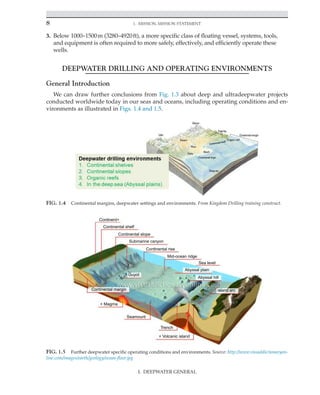
  • 8.
    Gulf Professional Publishingis an imprint of Elsevier 50 Hampshire Street, 5th Floor, Cambridge, MA 02139, United States The Boulevard, Langford Lane, Kidlington, Oxford, OX5 1GB, United Kingdom © 2019 Elsevier Ltd. All rights reserved. No part of this publication may be reproduced or transmitted in any form or by any means, electronic or mechanical, including photocopying, recording, or any information storage and retrieval system, without permission in writing from the publisher. Details on how to seek permission, further information about the Publisher’s permissions policies and our arrangements with organizations such as the Copyright Clearance Center and the Copyright Licensing Agency, can be found at our website: www.elsevier.com/permissions. This book and the individual contributions contained in it are protected under copyright by the Publisher (other than as may be noted herein). Notices Knowledge and best practice in this field are constantly changing. As new research and experience broaden our understanding, changes in research methods, professional practices, or medical treatment may become necessary. Practitioners and researchers must always rely on their own experience and knowledge in evaluating and using any information, methods, compounds, or experiments described herein. In using such information or methods they should be mindful of their own safety and the safety of others, including parties for whom they have a professional responsibility. To the fullest extent of the law, neither the Publisher nor the authors, contributors, or editors, assume any liability for any injury and/or damage to persons or property as a matter of products liability, negligence or otherwise, or from any use or operation of any methods, products, instructions, or ideas contained in the material herein. Library of Congress Cataloging-in-Publication Data A catalog record for this book is available from the Library of Congress British Library Cataloguing-in-Publication Data A catalogue record for this book is available from the British Library ISBN: 978-0-08-102282-5 For information on all Gulf Professional publications visit our website at https://www.elsevier.com/books-and-journals Publisher: Brian Romer Senior Acquisition Editor: Katie Hammon Editorial Project Manager: Ana Claudia A. Garcia Production Project Manager: Anitha Sivaraj Cover Designer: Greg Harris Typeset by SPi Global, India
  • 9.
    I am honoredto write the foreword to this Deepwater Drilling Guide as it brings together a vast body of knowledge and ex- perience that is not found elsewhere. This business is like no other on the globe, where harsh conditions challenge the operator, con- tractor, and service providers to extend their limits. As marine drilling operations seek to operate in higher-pressure environments, deeper waters, and harsher conditions and in remote areas of the globe, the limits of technology must evolve and change to meet these needs. Technology often advances in the oil and gas industry faster than it can be documented. This text is Peter Aird’s con- tribution to bringing current methods and thinking to the reader. The processes required to penetrate deep- water objectives have undergone dramatic revision and change in only a few short years. What was once thought to be “deeper” has become routine and common, and ul- tra depths thought to be unobtainable have been reached in recent history. Therefore, this comprehensive text on the subject brings together recent technologies and innovations made in deepwater drilling operations. This text does that and more. I have known the author, Peter Aird, for more than 15 years and have worked with him professionally on politically visible, HTHP high-risk and deepwater projects in very harsh environments. These projects were completed successfully in part by the skill and dedication of the drilling team of which Aird was the team lead. From this work experience, I have grown to respect and hold Peter in high regard for his engineering abilities and strong work ethic. Peter is a professional engineer, trainer, lecturer, and a world-class drilling man. However, he did not start his working career with this goal in mind. After a basic education in Scotland, he chose to utilize his mechanical skills in the engine room on a blue water merchant ship. After a short time, he realized his advance- ment and more importantly his life experi- ence would be limited and the challenges of the engine room would never satisfy his curi- osity to expand his knowledge and the phys- ical workings of science surrounding him. To advance himself, he took a training position on a major oil operator’s contracted drilling rigs and quickly moved through the ranks, where this working environment embraced all the disciplines outside the mechanical workings of the rig into drilling engineering. At this point, Peter realized he should not only learn as much as the company program offered but return to school and pursue a distance learning university engineering de- gree so that he could understand why things worked the way they do. In my knowledge, it is a rare person who after starting down one career path in the trades can reroute that path toward higher learning in the school of engineering. Peter did this while starting a family, earning a living, and self-­ financing this higher learning, sacrificing much of his “free” time to advance himself and his knowledge. I have found that the person who takes this path in industry has a well- rounded and practical knowledge that is rare in the business. In these deepwater work collaborations, Peter and I have discussed that ­ deepwater Foreword vii
  • 10.
    viii FOREWORD industry publicationsconcerning drill- ing operations generally lag far behind the advances in practice and technology and moreover lack the benefit of knowledge, experience, and innovations made by the industry. Peter has a curiosity in all things related to his profession of drilling wells and delivering the best project possible and is constantly searching for new and better solu- tions and results to the task of drilling wells in deepwater. Peter took this to heart and has produced a deepwater drilling guide that describes the present technology. I do hope that the be- holder of this text benefits and has use for the knowledge that is presented. L. William Abel Abel Engineering Inc., Houston, TX, United States
  • 11.
    ix Author’s Preface My drillingwork began in 1980 when, as a former Merchant Navy marine engi- neering officer, I became a trainee for Shell International, working through a drilling su- pervisors development program that I then served for both Shell and BP Internationally from 1986 to 1993. Thereafter, as a consultant, I was employed in the same role globally for various recognized companies, drilling fron- tier leading edge wells, many of which were in deepwater. In 1998, I was approached and reluctantly agreed to develop industry first training materials for deepwater drilling and well engineering, confessing a lack of train- ing skills, knowledge, and experience, but convinced a need for this training was and is today sorely needed. Through the decades, I have since shared knowledge and experience gained by facilitating and delivering deep- water and other complex well design, drilling engineering, and operations training courses. I felt similarly unprepared to write this book, even with the deepwater opportunities and experiences gained within drilling, well engineering, and operations specialist posi- tions held, conducting leadership and con- sultancy support roles in multiple deepwater projects in recent years. Despite having pro- duced numerous technical and operational documents, I had absolutely no writing skills. But again I saw the great need for a guide since, as the deepwater industry, technology, principles, and practices grow and change, so does the need for more discussion, sharing and distribution of knowledge from lessons learned and from things that go wrong. The reason for this book is twofold. Foremost was this opportunity to con- tinue one’s self-education and development journey in all deepwater subject matters. That, through this process, has uncovered and raised multiple aspects to what we as an industry know, don’t know, and require more focus on, to assure deepwater pro- grams, projects, technologies and best prac- tices succeed, remain competitive, learn from the past, and deliver the SEE (Safe, Effective, and Efficient) outcomes and benefits desired. Secondly, this is a first edition (and a time-constrained mission) to serve as a training, learning, and development vehicle for myself and others to collaborate, share, discuss, develop, and educate the next tech- nological and digitized deepwater genera- tion with the far wider skill set, knowledge, and experience demanded for field and proj- ect use. To the many people through the decades who have evidently contributed to this deep- water drilling guide, we thank you deeply. In particular more sincere thanks go to the sterling work of my editor, Carolyn Barta (without whom this book would never have resulted), illustrator Dianne Cook (of One Giant Leap), my well control guru and friend Bill Abel (Abel Engineering), Alexander Edwards (Ikon Geoscience), and Deiter Wijning (Huisman), and to my pub- lisher, Elsevier, whose flexibility and ex- tended deadlines have made this publication possible.
  • 12.
    x AUTHOR’S PREFACE Finally,thanks to my dearest beloved wife Joyce, and our two grandsons who can all shout “hurrah” that this mammoth task is done (for now) and that they shall now be afforded the attention and availability they have so patiently been waiting for. Enjoy, Peter Aird (The “Kingdom of Fife,” Scotland, Driller.)
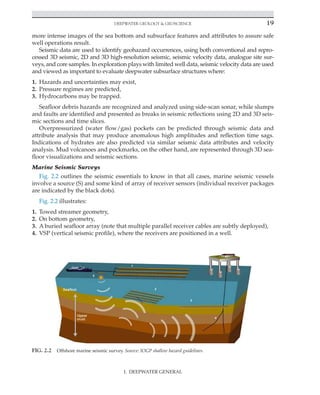
  • 13.
    Deepwater Drilling 3© 2019 Elsevier Ltd. All rights reserved. https://doi.org/10.1016/B978-0-08-102282-5.00001-6 C H A P T E R 1 Mission, Mission Statement MISSION The mission of this book is to provide a usable comprehensive, practical, and understand- able “Guide to Deepwater Drilling” for people at all levels who already understand basic drilling principles, standards, and practices. Readers can use and apply the guide in their respective workplaces, to further self-educate, enhance, and develop the skill sets to meet specific deepwater project requirements. Due to the relative infancy and untapped nature of deepwater, this book serves as a guide. When regional or local knowledge, experience, understanding, and physical, people and pa- per evidence exists, these factors shall take precedence to assure safe, effective, and efficient deepwater project delivery. With time, this guide shall be developed further. A GUIDE TO DEEPWATER DRILLING General Introduction The world's accessible offshore hydrocarbon has been produced in abundance from the 1960s. Easy offshore hydrocarbons today are more difficult to find, yet deepwater explora- tion remains where potential “big oil” exists. Deepwater is a continuance of accumulated best-practiced drilling knowledge and experience to manage, control, and change in more challenging operating environments. If big oil discoveries continue to result in deepwater, more wells will need to be drilled and business will continue to grow. Operating companies are therefore not only searching and exploring into more distant seas and oceans but also in more remote, harsh, and inhospitable locations and environments for big oil in a rapidly changing and uncertain world of energy needs, supply, and demand. Economic Factors of Deepwater Exploration The commonly accepted economic objectives to explore successfully in deepwater envi- ronments are viewed as: 1. thick, continuous reservoirs that exhibit high flow rates with large drainage radius; 2. recoverable reserves of at least five to several hundred million barrels or more;
  • 14.
    4 1. Mission,Mission Statement I. DEEPWATER GENERAL 3. geologically and seismically well defined and relatively simple reservoirs in nature, down to and including the producing horizons, so that highly accurate petroleum, reservoir, and production modeling can result to reduce risks and uncertainties. The Purpose of Drilling in Deepwater The purpose of deepwater drilling projects is essentially no different from other drilling, i.e., to discover commercial hydrocarbons safely, effectively, and efficiently at the lowest cost. When discovery results, the key decision trigger is how much capital investment is needed to sanction appraisal drilling, to assure, and acquire must- have vs. nice-to-have data, then process and interpret the data to meet the complexity of multidiscipline issues to be resolved. The challenge then is to manage the project development according to controls that assure doing the right things and getting things done right the first time, at the lowest capital and operating costs, avoiding damage, loss or harm to the people, businesses and environment as low as practicable, as illustrated in Fig. 1.1. As offshore deepwater basins remain relatively unexplored when compared to onshore or shallow offshore, the greater the water depths should present a greater likelihood of discov- ering big oil, especially in the 2000–3500m (6562–11,583ft) water depths. The promise of discoveries can offset the significantly higher costs, risks and uncertainties that come with increased water depth, and offer the economic viability to explore in these environments. Deepwater Drilling Goals and Objectives Objectivesandgoalstobemetindeepwaterdrilling-relatedprojects,i.e.,throughExploration, Appraisal, Development and Production phases, summarized, are to: 1. lower finding, capital, intervention, workover and abandonment costs; 2. accelerate and maximize production; 3. create greater value returns on investment, e.g., increase ultimate recovery. FIG. 1.1 Deepwater well-life-cycle project goals and objectives. Source: Kingdom Drilling, 2018.
  • 15.
    A Guide toDeepwater Drilling 5 I. DEEPWATER GENERAL To counter these challenges, multiple offshore technological and adaptive advancements would have to be met during the project life period. Example: the building and construc- tion of a more fit-for-purpose, multi-functional, next-generation deep and ultradeepwater operating fleet is perhaps demanded to step change the advancements and technological solutions required. Where this investment is going to come from is a key factor. A new fleet would however offer far more optimism that deepwater can survive in such turbulent, challenging, and changing times. A Guide to Deepwater Drilling Projects As the continuous search for deepwater discovery precipitates drilling projects into un- tapped and progressively more remote, harsh, deep, and ultradeep environments—where more complex geology, geoscience, petroleum, reservoir, drilling, subsea, technical, and technology operational challenges arise—this guide can identify and evaluate how and why deepwater drilling can evolve from more singular frontier activities into a far safer, more in- trinsic, and strategic element of an operator’s offshore portfolio. This guide also focuses primarily on deepwater exploration and appraisal drilling that may lead into development, intervention, and abandonment activities required. All such specialist areas require separate guides. Content is targeted at an intermediate-to-­ advanced drilling level, for those with a good working understanding and knowledge of offshore drilling; well safety and management systems; and well delivery using a mul- tidisciplinary, project-managed approach and a belief that ordinary people can make a difference. According to the Plan-Do-Check-Act (PDCA) (Deming cycle) as shown in Fig. 1.2, continu- ous quality improvement is achieved by iterating through a well's life cycle by consolidating progress as discussed later in this guide. Emphasis is placed on the importance to utilize three fundamental SEE principles to realize deepwater delivery outcomes and benefits desired, i.e.: 1. S Being Safe; the control of loss, 2. E Being Effective; by doing the right things, 3. E Being Efficient; by getting things right first. This guide is for deepwater participants, who require further engagement, knowledge, and understanding about the fundamental differences of what drives the drilling of deepwa- ter wells. It should appeal to the multidisciplinary range of seasoned professionals involved in programs and projects requiring more specifics in terms of deepwater well design, engi- neering standards, principles, current advancements, new and adaptive technologies, spe- cific techniques, systems, equipment, and operational best practice used and applied. The introductory deepwater guide chapters include: 1. Introductions, what defines deepwater. An outline of the basic concepts and precepts of operating wells 2. Geology and geoscience aspects from a driller's perspective 3. Pressure management of wells 4. Metocean operating conditions and environments that exist 5. Essential differences and drivers compared to a standard drilling norm 6. Program, project management, safety and loss control aspects
  • 16.
    6 1. Mission,Mission Statement I. DEEPWATER GENERAL The middle section includes deepwater design, management, engineering, and planning. 7. Well planning and design 8. Structural design 9. Main well design and operations engineering 10. Operations, regulations, programs, and emergency response The concluding chapters focus on deepwater well's drilling operations, engineering appli- cation, and project execution, i.e.: 11. Project implementation “readiness to drill” 12. Riserless drilling 13. Riserless best practices 14. Subsea BOP and marine drilling risers 15. Intermediate wellbores drilling and pressure detection 16. Production wellbore drilling and well control assurance Planning Policy Learning lessons Reviewing performance Investigating accidents, incidents, near misses Measured performance Implementing your plan Organizing Risk planning Plan Do Act Check FIG. 1.2 Plan-Do-Check-Act. Source: http://www.hse.gov.uk/pubns/indg275.pdf
  • 17.
    A Guide toDeepwater Drilling 7 I. DEEPWATER GENERAL Deepwater Drilling Defined Deepwater drilling environments and definitions have changed through the decades as oil and gas capabilities and technology have transformed. In the 1970s, 100–200m (328–656ft) was considered as deepwater. In the 1980s 450–600m (1476–1969ft), in the 1990s deep progressed to 1000–1500m (3281–4921ft), and with seismic technology advancements this opened up other deeper basins to greater than 3000m (9843ft) water depths as drilled today. The technical limit is +/-4267m (14,000ft) water depth. Definitions, it should be noted, vary from operating regions and settings and according to environments/conditions that exist. So first and foremost, there are no hard or fixed rules. Deepwater and ultradeepwater can be whatever you want it to be. In this guide, water depths are defined and adhered to as illustrated in Fig. 1.3. 1. Deepwater classed as water depths exceeding 450–600m (1476–1969ft) 2. Ultradeepwater classed as water depths exceeding 1000–1500m (3281–4921ft) 3. Deepwater exploration drilling capabilities, 3658–4267m (12,000–14,000ft) water depths. Deepwater Definition Evident reasons and rationale: 1. Regional consensus on deepwater definitions typically states this range of water depths. 2. Conventional subsea systems operate capably up to 450–600m (1476–1969ft) water depth. 3. Greater than 500m (1640ft) water depths, a more specific type of floating vessel systems and equipment requirements is required to operate on wells. Ultradeepwater Definition 1. Regional consensus on ultradeepwater definitions typically states this range of water depths. 2. Once water depth deepens notably beyond 1000–1500m (3280–4920ft) drilling conditions and operating environments change quite significantly. FIG. 1.3 Deepwater and ultradeepwater drilling classification and definition. Source: Compiled via Kingdom Drilling Training, 2006.
  • 18.
    8 1. Mission,Mission Statement I. DEEPWATER GENERAL 3. Below 1000–1500m (3280–4920ft), a more specific class of floating vessel, systems, tools, and equipment is often required to more safely, effectively, and efficiently operate these wells. DEEPWATER DRILLING AND OPERATING ENVIRONMENTS General Introduction We can draw further conclusions from Fig. 1.3 about deep and ultradeepwater projects conducted worldwide today in our seas and oceans, including operating conditions and en- vironments as illustrated in Figs. 1.4 and 1.5. FIG. 1.4 Continental margins, deepwater settings and environments. From Kingdom Drilling training construct. Continent+ Continental shelf Continental slope Continental rise Mid-ocean ridge Sea level Abyssal plain Abyssal hill island arc Guyot Continental margin + Magma Seamount Trench + Volcanic island Submarine canyon FIG. 1.5 Further deepwater specific operating conditions and environments. Source: http://www.visualdictionaryon- line.com/images/earth/geology/ocean-floor.jpg
  • 19.
    Deepwater Drilling andOperating Environments 9 I. DEEPWATER GENERAL What immediately sets deep and ultradeepwater apart from conventional offshore pro- grams and projects is that operations have to be conducted at far greater supply, logistic, and operating distances from shore. This makes the supply chain and conducting of operations far more challenging. Additionally below the deep and ultra-deepwater depths, the continental margins that exist have variant conditions, settings, and environment as illustrated through a regional example of deepwater exploration and appraisal wells in Fig. 1.6. Here, it can be viewed how variant well designs differ across this region. It is further evident in Fig. 1.6 that the deepwater sedimentary stratigraphy that exists on each well is far from the same. Wells are exposed to different sets of operating conditions that can be more or less problematical from a drilling operational standpoint. At this early stage, it is important to begin to comprehend why geological risks and uncer- tainties essentially can drive the deepwater well design, construction, and the drilling chal- lenges that arise, and why these issues reside high on the project hazard and risk register until wells are safely drilled, data gathered, and more can be learned and translated into added project value. One can conclude again the variant geological and drilling conditions and environments must be safely managed through a deepwater well's life cycle within such fields. With lower oil prices that may exist well into the future, more competitive means, effective and efficient methods shall have to result to assure that developing and producing these prospective re- gions remains commercially sustainable delivering even greater outcomes and benefits. Brazil Presalt Petroleum Systems The presalt system occurs beneath a layer of evaporate sediments, i.e., salt anhydrite and other minerals formed by an ancient, massive evaporation of basin waters. Salt evidently results more or less continuously across much of the Atlantic margin of both Brazil and West Africa sides, but is not present on the northern equatorial margin of Brazil or Africa. The organic-rich sediments that exist and the thermally mature physics of the source rocks, and the primary and secondary migration into the reservoir rocks and seals within the rift ba- sin, resulted as the tectonic forces pulled Africa and South America apart to create the South Atlantic Ocean during Cretaceous and younger times—beginning 145 million years ago. The subsalt reservoirs that capture the petroleum then divided into two groups: 1. Clastic sediments, formed of both sandstone and conglomerates that were eroded from the mountains that flank the rift basin, and, 2. Carbonate sediments (rock consisting mostly of calcium carbonate). This porous limestone and some dolostone reservoirs were deposited in shallow marine water along the edges and crest of the mountains as they were eventually flooded and then buried by older sandstone and associated sediments. Above the reservoirs, the salt formed the top seal that trapped the petroleum accumulations. Brazilian Postsalt Petroleum System The postsalt petroleum system in the Atlantic margins lies above the regional salt layer and was deposited on the western margins of the growing South Atlantic Ocean under conditions of normal marine shelves and deepwater slopes. The postsalt system is divided also into two main units:
  • 20.
    10 1. Mission, Mission Statement I. DEEPWATER GENERAL FIG. 1.6 Deepwaterwells stratigraphy and casing depths variations. Source: Kingdom Drilling Training, 2018.
  • 21.
    Deepwater Drilling andOperating Environments 11 I. DEEPWATER GENERAL 1. Shallow water carbonates, largely grainstones resting on top of the salt layer, and 2. A younger clastic system section, with local sandstone reservoir in a variety of oil and gas traps. Grainstones=A kind of limestone comprised of grains with cement called spar. Salt intrusion in the subsurface creates the diapirs and windows from a deeper strati- graphic horizon to provide migration routes within the post-salt sections, with younger sediments providing the classic source rock reservoir and traps demanded for a commercial prospect to exist. Structural traps are associated with the salt diapirs and roll over structures created by faulting. In addition, further stratigraphic traps are formed coinciding with the edges and pinch outs of these fields typically within sandstone either along the flanks or the up dip edges of the reservoir body. Limestone in the postsalt system was deposited under normal marine conditions resulting from the opening of the South Atlantic Ocean during the cretaceous period. These deposits can be clean and well sorted to provide ideal reservoir rocks. Note: Deposits of similar age and environments are also found in deepwater on the West African side of the South Atlantic Ocean, for example, the Cabinda limestones, offshore Angola. Above the Brazilian postsalt carbonates lie the younger units comprised of alternating layers of sandstone reservoirs and claystone by seaward and landward migrations of deltaic, debrite, and turbidite deposits that will be discussed in more detail in this chapter. Major seaward migrations (regressions) of the shore line delivered considerable sand to the basin in the form of a series of deltas at the shelf edges. Sand is transported into the deepwater slope and basin areas as a variety of channelized and sheet-like turbidite sequences. At other times, rapid landward migration of the shore- line (transgressions) results in more widespread deposition of fine grained mudstone and clay over broad areas of the shelf and deepwater as water depths rapidly increase. The clay sequence of deposits formed multiple seal layers for the sand sequences. Some of Brazil’s largest fields are found in sealed turbidites accounting for a large majority of oil and gas be- ing produced since the Namorado field was discovered in 1975, followed by Albacora (1984), Marlim (1985), Albacora Leste (1986), Marlim Sul, Leste (1987), and Roncador in 1986. Deepwater West Africa Africa commenced exploring in water depths greater than 300m (984ft), to discover deep- water success in comparison to Brazil. Deepwater successes in West Africa followed those in Brazil and the Gulf of Mexico, benefitting from technology advancements/adaptations and the building of fourth, fifth and ultimately sixth generation drilling vessels. The discoveries in West Africa defined the significance of two major deepwater petroleum systems of the Niger Delta and the Congo basin, both areas of prolific hydrocarbon genera- tion from Tertiary marine source rocks. WEST AFRICAN GEOLOGY As the continents separated and extended the African Plate form South America, this stretched and thinned the continental crust remaining to the point of rupture and the be- ginning of the South Atlantic Ocean. The first marine waters laden with salt entered this depression from the South, across a shallow shelf called the Walvis Ridge. The climate this
  • 22.
    12 1. Mission,Mission Statement I. DEEPWATER GENERAL period up to 125 million years ago ultimately resulted in the rapid deposition of the thick salt deposit now present below some of the oil-producing regions in Brazil and West Africa. With time and because these thick salts sequences behaved like plastic when loaded by overlying sediments, the movement of the salt deformed the sedimentary layers into the structural features that contain the oil and gas that exists today. The sea floor separated the continents further apart dividing the salt basin in two areas characterized by narrow shelves beyond which water depth rapidly increased across broad slopes to water depths of 3300m (10,827ft) since the end of the early Cretaceous period. The great Niger and Congo rivers of Africa then dumped layers of clay, sand, and organic-rich mudstones into these deep marine waters to form the source, structure, seals, and reservoir rocks to generate and trap oil and gas in typically sands and sandstone deposited in the Oligocene and Miocene periods of the Tertiary era, i.e., 35 to 5 million years ago. Unlike classic models used to describe deepwater reservoirs such as Gulf of Mexico, sub- marine fan systems typically depict concentric sediments being deposited in belts radiating away from the mouth of a submarine fan canyon. However, early West Africa models suggested gradual down fan decreases in reservoir and sand thicknesses. Thankfully, modern 3D seismic now being used and many cores that have been taken from West African reservoirs have characterized and provided us with the big takeaway that these systems have very different mode of deposition with far more com- plex reservoirs and sealing architectures as was first predicted. Many African deepwater reservoirs for example exhibit geometries like filled-in rivers or streams formed by turbidity currents, i.e., deep currents laden with sediments pulled essentially by gravity. These currents therefore cut channels, build levees, create meandering channel patterns like rivers. In summary, because of the complex distribution of reservoir sands and muds associated with channelized deepwater reservoirs systems common in West Africa, successful develop- ment is highly dependent on high-quality seismic data, so geoscientists can develop more accurate models and locate wells to assure maximum oil recovery, thereby reducing the number of wells required and increasing production per well to deliver greater returns on ­ investment—all critical factors in deepwater. Deepwater Salt Challenges Salt challenges and difficulties in deepwater are not exclusive to Gulf of Mexico, Brazil, and West Africa as illustrated in Fig. 1.7. Common elements of salt are: 1. All salts are not the same. a. Simple salts, e.g., halite, remain relatively stable during drilling. b. Complex salts, e.g., carnallite, tachyhydrite, can creep more rapidly. 2. Wellbore conditions impact creep. a. Temperature. The higher the temperature, the more salt can move. b. Pressure differential. The higher the differential between mud weight and formation pressure, the more salt can move. Challenges presented in salt are often before entry and at the exit of the systems as high- lighted in Figs. 1.8 and 1.9.
  • 23.
    Deepwater Drilling andOperating Environments 13 I. DEEPWATER GENERAL FIG. 1.7 Worldwide deepwater salt regions. Source: Perez, M.A., Clyde, R., D’Ambrosio, P., Israel, R., Leavitt, T., Nutt, L., Johnson, C., Williamson, D., 2008. Meeting the subsalt challenge. Oilfield Rev. 20 (3), 32–45. FIG. 1.8 Deepwater potential hazards in and around salt. Source: Perez, M.A., Clyde, R., D’Ambrosio, P., Israel, R., Leavitt, T., Nutt, L., Johnson, C., Williamson, D., 2008. Meeting the subsalt challenge. Oilfield Rev. 20 (3), 32–45.
  • 24.
    14 1. Mission,Mission Statement I. DEEPWATER GENERAL The opportunities to experience operational problems to, through and out of salt are many and are derived from salt tendency to move. Industry limited ability to image salt can lead to mistaking base of salt depths and unexpected encounters with abnormal or subnormal pressure zones beneath the salt. Combating the effects of nonuniform loading caused by salt creep requires full cement returns to top of salt. In Fig. 1.9 (left), a liner is set inside a cemented casing in to reduce ra- dial pipe deformation. Salt movement (right) continues to load casing/liner strings that may result in failure over time. In the case of mobile “plastic” salt operating loss that can ultimately result are: 1. wellbore drilling difficulties, loss of quality, and operational delays 2. stuck pipe 3. casing deformation 4. wellbore instability 5. drilling troublesome rubble and/or fractured zones vs. avoidance. Mitigating measures include: 1. higher mud weight 2. design cement to minimize point loading (high tensile strength, flexible) FIG. 1.9 Cementing across mobile salt. Source: Perez, M.A., Clyde, R., D’Ambrosio, P., Israel, R., Leavitt, T., Nutt, L., Johnson, C., Williamson, D., 2008. Meeting the subsalt challenge. Oilfield Rev. 20 (3), 32–45.
  • 25.
    Deepwater Drilling andOperating Environments 15 I. DEEPWATER GENERAL 3. thicker walled (higher strength) casing 4. more casing 5. specialized tool procedures and guidelines 6. people developed with a wider skill set to fully understand these problems. In much deeper and older stratigraphy in deepwater, a further issue below the salt in certain specific operating conditions and environments is where tar exists, e.g., the Gulf of Mexico. Key points are: 1. Mobile tar (bitumen) appears in pockets below salt, along faults. 2. Mobility can range from none to very active. 3. Presence is impossible to predict, does not appear in seismic data. This is a common problem that is well reported and documented in journal papers high- lighting specific Gulf of Mexico well challenges/problems that can result, such as: 1. packoffs behind BHA (lost returns) 2. swabbing 3. BHA damage from shock and vibration 4. stuck logging tools 5. stuck casing 6. excessive trips to clean tar in casing and riser 7. surface handling problems Unfortunately mitigation choices are limited. Either avoid it or fight it. References Joyes, R., 2001. South Atlantic Geology: deciphering turbidites on seismic key to understanding basins off Africa, Brazil. Oil Gas J. 99, 38–43. Leffler, W.L., Pattarozzi, R., Sterling, G., 2011. Deepwater Petroleum Exploration and Production: A Non-Technical Guide, second ed. PennWell, Tulsa, OK. Perez, M.A., Clyde, R., D’Ambrosio, P., Israel, R., Leavitt, T., Nutt, L., Johnson, C., Williamson, D., 2008. Meeting the subsalt challenge. Oilfield Rev. 20 (3), 32–45. Press, F., Siever, R., 1998. Understanding Earth, second ed. W.H. Freeman and Co, New York, Basingstoke.
  • 26.
    Deepwater Drilling 17© 2019 Elsevier Ltd. All rights reserved. https://doi.org/10.1016/B978-0-08-102282-5.00002-8 C H A P T E R 2 Deepwater Geology Geoscience DEEPWATER GEOLOGY GEOSCIENCE General Introduction Seventy percent of the earth's surface is covered by sea, of which a large part is defined as deepwater. The constraints of deepwater petroleum systems as shown in Fig. 2.1 dictate that only relatively restricted sedimentary surface areas and depths underlain by the continental plates are considered as commercially prospective for hydrocarbons. Although analogous fields have been discovered in deepwater, the evident influences within these environments provide perhaps less reason to expect better quality or larger vol- ume reservoir accumulations than in shallow water. However, considerable unexplored areas of deepwater have the potential to contain entrapped hydrocarbons and through the applica- tion of more modern exploration tools (seismic, logging while drilling, seismic while drilling) make deepwater a better place today than in earlier offshore years. A deepwater petroleum system must contain the Geology and Geoscience (GG) ingredi- ents required for commercial hydrocarbon success. That system, among other factors, must contain the static and dynamic elements such as reservoir, trap, source rock, cap rock, pri- mary and secondary migration, and all required interconnections. All elements must be pres- ent and correctly linked in time and space. Most of the elements are affected by the context in which they find themselves and certain features in deepwater environments also affect the eventual nature and volumes of the hydrocarbons trapped. An introductory examination of deep water geology and geoscience is presented in this chapter covering seismic, shallow hazards, deepwater geology and geoscience, character- istics, reservoir sedimentology, trapping, geometry, source rock maturation, and migration essentials. Deepwater Seismic Interpretation At the beginning of deepwater projects, seismic data are generally all that is present. Advances in 3D and 4D seismic techniques today provide geologists and geophysicists with greater analysis and interpretation potential to manage and predict deepwater shallow haz- ards, predict and detect pressure regimes, hydrocarbon petroleum, and reservoir aspects. Continuous improvement in these fields explains why the industry is capable of exploring in deeper offshore frontier such as subsalt, etc. that was certainly not previously possible.
  • 27.
    18 2. DeepwaterGeology Geoscience Initially, governments acquire seismic in prospective deepwater basins with modern equipment to obtain the data, that they may process and to a limited degree interpret. Most of the detailed scope of interpretation remains within the oil company domain. In the initial exploration phase, 2D lower cost seismic sections are acquired and interpreted to initially highlight potential oil “plays.” The exploration companies then work to identify the potential traps, source rock, seal and presence of hydrocarbons to select the best prospects to bid for that, if successful, may require further well location, site survey, and environmental studies to consider. No matter how worthy seismic may have progressed, wells must be drilled below the seabed to discover what physically exists below the deepwater subsurface strata. From a project's perspective, seismic technology has transformed to greatly increase the probabil- ity of success before a well is drilled and to reduce several of the technical, operational risks and geological uncertainties. Offshore Marine Seismic surveys (Fig. 2.2) are used to improve an understanding of the environment of deposition and sedimentological units. High-resolution 3D is used to depict FIG. 2.1 Ocean sediment and oil reserves, total sediment thickness. Source: Divins, NGDC. I. DEEPWATER GENERAL
  • 28.
    Deepwater Geology Geoscience 19 more intense images of the sea bottom and subsurface features and attributes to assure safe well operations result. Seismic data are used to identify geohazard occurrences, using both conventional and repro- cessed 3D seismic, 2D and 3D high-resolution seismic, seismic velocity data, analogue site sur- veys, and core samples. In exploration plays with limited well data, seismic velocity data are used and viewed as important to evaluate deepwater subsurface structures where: 1. Hazards and uncertainties may exist, 2. Pressure regimes are predicted, 3. Hydrocarbons may be trapped. Seafloor debris hazards are recognized and analyzed using side-scan sonar, while slumps and faults are identified and presented as breaks in seismic reflections using 2D and 3D seis- mic sections and time slices. Overpressurized (water flow/gas) pockets can be predicted through seismic data and attribute analysis that may produce anomalous high amplitudes and reflection time sags. Indications of hydrates are also predicted via similar seismic data attributes and velocity analysis. Mud volcanoes and pockmarks, on the other hand, are represented through 3D sea- floor visualizations and seismic sections. Marine Seismic Surveys Fig. 2.2 outlines the seismic essentials to know in that all cases, marine seismic vessels involve a source (S) and some kind of array of receiver sensors (individual receiver packages are indicated by the black dots). Fig. 2.2 illustrates: 1. Towed streamer geometry, 2. On bottom geometry, 3. A buried seafloor array (note that multiple parallel receiver cables are subtly deployed), 4. VSP (vertical seismic profile), where the receivers are positioned in a well. FIG. 2.2 Offshore marine seismic survey. Source: IOGP shallow hazard guidelines. I. DEEPWATER GENERAL
  • 29.
    20 2. DeepwaterGeology Geoscience Oil companies generally outsource the seismic acquisition, initial processing and display, with the final processing then conducted by service companies or specialist individuals. Some companies will do their own processing and display for most of their own prospects. The seismic process serves three main data gathering functions: Acquisition, Processing and Display, and Interpretation, as illustrated in Figs. 2.3 and 2.4. The geophysical interpre- tation that results then works to define with a certain degree of certainty the subsurface geol- ogy, geoscience, and structures in terms of: 1. Project delivery hazards and uncertainties that may exist in the subsurface, 2. Predict pressure regimes, 3. Determine where hydrocarbons or further hazards/risk might be trapped or may be pinpointed or exist or not. Why 3D–4D? When several operators entered deepwater in the 1990s, they created “prospect quality teams” that reviewed each exploration prospect by the company's assets and, through apply- ing a consensus approach, established, ranked, and risked the relative size of each prospect. What this did was change their risk portfolio management to greater prospective successes by focusing more on acreage capture and aggressive use of 3D higher resolution seismic. Bottom mud Bottom mud Rock layers Rock layers Sounder source Satellite navigation antenna Underwater phones detect seismic echoes from rock layers Seafloor FIG. 2.3 Deepwater seismic process. Source: Kingdom Drilling. I. DEEPWATER GENERAL
  • 30.
    Deepwater Geology Geoscience 21 They worked to “Create Value through Exploration” by defining a new strategic ap- proach to show it was possible to quickly and effectively capture attractive new areas for exploration licensing. Companies also created “Networks of Excellence” charged with discovering and disseminating external and internal best practices throughout the com- pany or selective benchmarking. These initiatives delivered significant value to these companies and are the prime reasons that turned fortunes in terms of deepwater plays using advancing seismic upfront-loading techniques and methods as used today. Fig. 2.5 presents illustrative seismic interpreted examples of shallow and deep marine stra- tigraphy that, without seismic, optimal hazard predictive identification and risk-based safer operating solutions could not have resulted. Site-Specific Surveys When wells sites are selected, a further more specific and detailed shallow site survey— to obtain higher-quality resolution, 2D or 3D specific data—may be deemed necessary and would follow in a suitable time frame, before a well's project commencement as illustrated in Fig. 2.6. The higher-quality survey data are used to further predict, reduce, and mitigate po- tential project hazards, risks, and uncertainties through utilizing the multidiscipline of people now involved to deliver work scope required. It is recommended that a site survey program start 6 months prior to, and no less than 3 months ahead of, the proposed well's spud date. SEISMIC SURVEY DATA MODELING The conceptual framework diagram of the Seabed Survey Data Model SSDM is illustrated in Fig. 2.7. This seismic standard is proposed by the IOGP (International Association of Oil and Gas Producers) to standardize modeling and survey project details (extents, equipment cover- age, track lines, etc.), hydrographic, shallow geophysical and geotechnical geographical en- tities and attributes, including surface and subsurface geologic hazards that are interpreted from seabed surveys. This standard and related site survey technical guide documents can be downloaded from http://www.iogp.org/. Acquire Process Interpret Drill here FIG. 2.4 Offshore seismic processes. Source Kingdom Drilling. I. DEEPWATER GENERAL
  • 31.
    22 2. Deepwater Geology Geoscience FIG. 2.5 Useof 3D seismic to identify a potential shallow flow zone and evaluate salt entry, inclusion and exist challenges. Source: Compiled by Kingdom Drilling training 2009. I. DEEPWATER GENERAL
  • 32.
    Deepwater Geology Geoscience 23 FIG. 2.6 Typical time line for site specific site survey. Ref IOGP shallow hazard guidelines. FIG. 2.7 Ref. IOGP Geomatics 462 series Data models note 1, version 1, April 2011. I. DEEPWATER GENERAL
  • 33.
    24 2. DeepwaterGeology Geoscience Shallow Seismic Systems and Methods for Deepwater Seismic survey data used to identify deepwater geohazard occurrences are shown in Tables 2.1 and 2.2. This includes conventional 2D and later higher resolution, to reprocessed 2D, 3D, 4D seismic, seismic velocity data, analogue site surveys, and core sampling. Traditional Site Survey This is a survey with both analogue systems and 2D high-resolution seismic. Most com- monly used equipment can be operated simultaneously with a minimum of interference be- tween the systems. 2D High-Resolution Seismic Survey This is multichannel seismic with high-resolution sources. The target depth is approxi- mately 300–1200m (1000–3940ft) below seabed. These surveys use short group lengths, short streamers 600–1200m (2000–3940ft), and short shot distances. Analogue Survey Analogue Surveys use boomer/sparker/parametric source, mini-seismic source, towed sonar and hull-mounted single/multibeam echo sounder and are often referred to as analogue surveys. All analogue data can be digitally recorded and enhanced by processing the high-frequency data acquired from echo sounding, side-scan sonars, and sub-bottom profiling, to provide accurate bathymetry maps, seafloor mosaics, indications of seafloor gas, and shallow fault detection. Digital Site Survey Digital survey data can result in improved imaging of the subsurface near the seafloor, lead- ing to improved fault and thin-bed mapping. Unfortunately, although data consist of higher frequencies than 3D seismic, there is a disadvantage of being unable to resolve the 3D nature of the hazards. When used in conjunction with 3D data, they may aid in the interpretation. ROV Survey It is possible to get excellent side scan sonar and echo sounder data using ROV (remotely operated vehicle), but the ROV cannot transport seismic systems to be used for detection of shallow gas/hydrates. Note: ROV survey costs are often several times that of analogue surveys. TABLE 2.1 Different Types of Seismic Surveys Marine seismic Towed streamer 2D 3D 4D 2D 3D 4D 2D 3D 4D 2D 3D 4D 1C 2C 1C 2C 4C 1C 3C 4C Ocean bottom VSP Differentiated by sensor geometry Differentiated by data density Differentiated by sensor type Shallow water/ transition zone This table summarizes the majority of the different types of marine seismic surveys. Source: IOGP shallow hazard guidelines (Jack Caldwell and Chris Walker). I. DEEPWATER GENERAL
  • 34.
    Deepwater Geology Geoscience 25 3D Deep Seismic The 3D data can also be used for interpretation of shallow gas/hydrates. 3D High-Resolution Seismic 3D high-resolution surveys are shot with a high-frequency source and with fewer offsets than deep-seismic 3D. The sampling frequency is higher and the distance between shots is also less than for other 3D. The result should be very high vertical and horizontal resolution in the upper 1000m (3281ft) of sediment. Due to high cost compared to 2D high-resolution seismic (about 2–3 times more expensive), this method has to yet be fully tested and proved. TABLE 2.2 Shallow and Deep-Site Survey General Capabilities Equipment Comments Surface positioning Diff. GPS/radio nav. Very good Hydroacoustic positioning Ultrashort baseline poor, not acceptable Long baseline very good Hull-mounted echo sounders Single beam good (max beam angle 2 degrees) Multibeam good ROV-mounted Single beam very good Echo Sounders Multibeam very good (better than above) Magnetometer, Towed, or ROV-mounted good for big objects Side-Scan Sonar ROV-mounted very good Towed good Hull-mounted not acceptable Seismic systems, target depth 0–50 meters: Pinger variable Parametric source good Deep towed boomer/sparker good Chirp good/very good Seismic systems, target depth 50–500 meters: Mini seismic source very good 3D high resolution very good Seismic systems, target depth below 200 meters: 2D high resolution good 3D seismic can be good 3D seismic, reprocessed can be good Source: Kingdom Drilling 2002. I. DEEPWATER GENERAL
  • 35.
    26 2. DeepwaterGeology Geoscience Rules of thumb and a derived deepwater site survey interpretation check list can be devel- oped as illustrated in Table 2.3, to predict and analyze survey evidence to better qualify, quan- tify and assign appropriate risk to each seismic hazard, feature, attribute, or anomaly observed. Shallow Hazard Assessment Rules of Thumb Checklist 1. Various methods and techniques exist for mapping of all shallow hazards. The optimum method for mapping of seabed hazards is to use ROV-mounted sonar and multibeam echo sounder. TABLE 2.3 Example, Shallow Seismic Hazard Interpretation Checklist Shallow Hazard Interpretation Guide Points Yes No 1. Is the reflection from the suspected gas pocket anomalous or bright in amplitude? 2. Do seismic data allow the anomaly to be ties to an offset well where gas was present in the same interval? 3. Is the amplitude anomaly structurally consistent? 4. Is the amplitude of the anomaly equivalent to five times, or more than, the background (nonbright value) for the same reflector? 5. If bright, is there one reflection from the top of the reservoir and once from the base? 6. Do the amplitudes of the top and base reflections vary in unison, dimming at the same point at the limit of the reservoir? 7. Is a flat spot visible? 8. Is the flat spot dipping or consistent with gas velocity sag? 9. Is there a pull down effect of underlying reflectors indicative of gas velocity sag? 10. If present, is the flat spot uncomfortable with the structure but consistent with it? 11. Does the flat spot have the correct zero-phase character? 12. Is the flat spot located at the down dip limit of brightness (or dimness)? 13. Is a phase change visible at the edge of the anomaly? 14. Is the phase change structurally consistent and at the same level as the flat spot? 15. Have the seismic data being used been converted to zero phase? 16. Do the bright/dim spots or phase changes show the appropriate zero phase character? 17. Is there an anomaly in velocity derived stacking velocity across the interval? 18. Is there a low-frequency shadow below the suspected reservoir? 19. Did a study of amplitude versus offset on the unstacked data support the presence of gas? 20. Does a near-offset range stack show a lower amplitude response than a far-offset range stack for the same event? 21. Is there comparative P S wave section’s available to aid in clarification of gas presence? Source: Kingdom Drilling. I. DEEPWATER GENERAL
  • 36.
    Deepwater Geology Geoscience 27 2. The upper tens of metres can best be mapped with a hull-mounted parametric source or a Chirp system. If ROV is used for mapping of the seabed hazards, the seismic system should be mounted on the ROV. 3. Shallow water flow and gas reservoirs from 50–1000m (164–3281ft) below seabed are best mapped with high-resolution 3D seismic. The second best choice is a combination of seismic data from mini air gun or mini water gun and either high-resolution 2D or possible conventional 3D seismic, if this shows good resolution in the interval not covered by the mini-seismic system. 4. Typical line spacing for the 3D seismic surveys is 25m (82 ft). For 2D surveys, it is 250m (820 ft) in one direction and 500m (1640 ft) in the other. For 2D surveys, it is common to make a denser pattern around the well location applying 100m (328 ft) spacing in both directions. Typically, a time frame of 4 weeks should be expected from when the field work is finished to presentation of final results. 5. It is recommended to avoid drilling at identified shallow hazards. The location of exploration wells should be moved away from: • Areas where faulting to shallow depths may be expected • Shallow depth structural closures, or a closure of the BSR (base of hydrates) • Shallow gas accumulation • Shallow reservoirs. 6. If it is impossible to move away from shallow hazards, the well should be designed to minimize the risks. • If practically possible, a weighted mud system should be used rather than sea water when a possible shallow gas zone has to be penetrated. • The well should be placed as far down flank on a mapped structure as possible. • Procedures and methods for risk reduction as described under the chapter covering Shallow Gas should be implemented. 7. Soft seabed may cause anchoring problems. Possible solutions to the problem would be to use specially designed mud or vertical lift-assisted (VLA) anchors or suction anchors. Use of piggyback anchors or increased number of anchor lines from 8 to 12 or more can also be considered. 8. The soft formation's support to the wellhead may not be sufficient for use of standard equipment. Depending on the results of the seabed strength analysis, larger than standard OD conductor may be required (36 in (914 mm)), higher grade (X52 or X56), or thicker wall (1.5in or 1.75in (38.1‒44.5 mm)). The use of a conductor anchor node as used in more recent deepwater applications ‘CAN’ also be evaluated. 9. Small operating margins between pore pressure and fracture pressure shall exist when drilling the shallower riserless wellbore sections. Soil Sampling Shallow soil sampling may be acquired to obtain and measure geotechnical properties below the seabed. A common method is to use gravity-based coring devices that can pro- duce a continuous core of the upper 0–6m (0–20ft) below the seabed. The unit is simple and reliable and can operate well in water depths 1000m (3281ft). The gravity corer can- not however function when the seabed consists of sand, gravel, or other hard soils. Under such circumstances, more comprehensive geotechnical equipment must be used; where more I. DEEPWATER GENERAL
  • 37.
    28 2. DeepwaterGeology Geoscience ­ autonomous and expensive solutions are available to meet required deep water depth capa- bilities and all subsurface soil conditions, i.e., 3500m (11,400ft). Possible solutions for extraction of shallow sediments are push samplers or CPTs. Both are mounted on a weight platform, e.g., 7 tons, size 5×5m (16×16ft). Surface supplied hydrau- lics is one method used to force a test pipe into the shallow seabed soils. Shallow Hazard and Risk Assessment Guidelines Project site survey shallow hazard assessment can be split into two categories, Seabed Hazards and Subseabed hazards. 1. Seabed Hazards consist of: a. Topography, slump, and scours feature b. Slumps or faults extending up to the seabed c. Manmade objects d. Wrecks, mines, etc. e. Poor anchoring conditions f. Very soft clay, mud slides, cemented sand. 2. Subseabed Hazards Figs. 2.8 and 2.9 consist of: a. Shallow gas, shallow water flow b. Gas hydrates and molds c. Faulting and glide planes to shallow depths d. Mud volcanoes e. Incompetent sediments f. Abnormally pressures zones g. Layers of boulders h. Low fracture pressures i. Shallow prospects. Notes: The term “shallow” is not definitive and as a general guide refers to depths 1000– 1250m (3280–4100ft) below the seabed. Shallow hazards in the context of deepwater seismic risk assessment are defined in this guide as: a. High: An anomaly showing ALL seismic characteristics of a shallow hazard that ties to an offset well, or is located at a known regional shallow hazard horizon. FIG. 2.8 Key shallow hazards to predict and assess prior to project implementation. Source: Kingdom Drilling 2018. I. DEEPWATER GENERAL
  • 38.
    Deepwater Geology Geoscience 29 b. Moderate: An anomaly showing MOST of the seismic characteristics of a shallow hazard, but which could be interpreted not to be a hazard or reasonable doubt exist for the presence of such hazards. c. Low: An anomaly showing SOME of the seismic characteristics of a shallow hazard interpreted as a low risk although some doubt exists. d. Negligible: Either there is NO ANOMALY PRESENT at the location or anomaly is clearly due to nonhazardous, causes. Note: Any one indication can be spurious. Shallow hazard interpretation on seismic data involves accumulation of evidence, competent, highly skilled judgment, and a well to be drilled. Shallow hazards are mapped with combinations of data from echo sounder, side scan so- nar, very high-resolution seismic, and further assessed via geotechnical and environmental samples from the upper few m of the seabed to as deep as is practicable. Shallow hazards data are acquired, processed, interpreted, and mapped with various seis- mic equipment systems, techniques, and methods. The more interpretive points answered yes or no as illustrated in Table 2.3, the more or less likely shallow hazard risks are present. A typical risk analysis flowchart framework is illustrated in Chart 2.1. FIG. 2.9 Reconstructed in 2018 by Kingdom Drilling, from a widely used summary of deepwater geohazards. I. DEEPWATER GENERAL
  • 39.
    30 2. DeepwaterGeology Geoscience Addressing Deepwater Geohazards The main concerns offshore teams have to deal with and address are: 1. Site-specific selection, for lowest geo-risk, 2. Surface and subsurface geohazard avoidance, 3. Geohazard mitigation. Multidisciplinary teams shall work to provide the offshore delivery team with more open networks of information, allowing for better location selection and improved decision mak- ing through the well design, construction, planning, and execution processes to prevent the occurrence of shallow hazard loss time events. Shallow Flow Shallow water (SWF) and shallow gas are higher risk hazards in narrow margin deep- water drilling environments, arising from a combination of overpressure and trapping mechanisms. Important points regarding shallow flow indicators (Figs. 2.10 and 2.11), risks, and ­ problem-solving strategies to be met during riserless drilling operations are: 1. Shallow fluid flows present a potentially serious drilling hazard and risk in deepwater. 2. Shallow water flows are encountered in geopressured aquifers. CHART 2.1 Geo-hazard risk analysis framework. Source: OGP JIP report. I. DEEPWATER GENERAL
  • 40.
    Deepwater Geology Geoscience 31 3. Shallow flows are correlated with water depth, burial depth, and stratigraphy. 4. Shallow flow events appear controlled by sedimentation rate and seal effectiveness. Classifying Shallow Flow Drilling shallow, weak, and trapped over pressured formations, being able to control the operating densities in more restrictive operating margins, i.e., 0.2–0.5ppg (24–60kg/m3 ), is no simple task. Should primary well control assurance not be maintained shallow formations can flow, leading to costly loss time-operating events. Classifying shallow fluid flows are proposed in Fig. 2.11 and Table 2.4 as follows. FIG. 2.10 ROV snapshot of “Strong” deepwater shallow fluid flow. Source: Kingdom Drilling training. FIG. 2.11 Illustration to classify shallow fluid flows. Source: Reconstructed for Kingdom Drilling training 2006. I. DEEPWATER GENERAL
  • 41.
    32 2. DeepwaterGeology Geoscience Hydrate Detection Using Seismic Data A process for gas hydrate detection, analysis, and quantification as used within the Gulf of Mexico deepwater is outlined in Fig. 2.12. The process involved (1) reprocessing of seismic data for higher resolution, (2) detailed stratigraphic evaluation and interpretation to locate possible hydrate-bearing zones, (3) seis- mic attribute analysis to further delineate these zones, (4) seismic inversion to obtain appropri- ate elastic param of these zones in 3D, and (5) quantitative estimation of gas hydrate saturation from seismic data using inversion and rock physics principles. TABLE 2.4 Classification of Shallow Flow Type of Flow Observed Description Comments Negligible or NO flow Mud and cuttings may drop from the lower parts of the wellhead but not over the top Fluid flowing over the wellhead may obscure fluid flow out of the side ports. Low (Slight) flow Mud and cuttings spilling over the wellhead and dropping out of the side ports Moderate flow Cloud streaming upward 3–5m (10–15ft) and outward form the top of the guide base Strong flow Billowing upward with high energy 10–50m (30–150ft) from the top of the wellhead Severe flow Strong vertical expulsion up to 100–150m (300–500ft) or more above the wellhead Source: Kingdom Drilling May 2018. FIG. 2.12 Hydrate detection process using seismic data. Source: Elsevier. I. DEEPWATER GENERAL
  • 42.
    Deepwater Geology Geoscience 33 BASE OF GAS HYDRATE STABILITY The outcomes, and benefits of the process are the base of gas hydrate stability (BGHS) can be confidently inferred from the seismic data processed, displayed, and interpreted from a hydrate perspective. Bottom-simulating reflectors (BSRs) are interpreted from within the seismic geophysical indicators of the base of gas hydrate stability. Note: BSRs occur when gas hydrate-saturated sediments overlie gas-saturated sediments. Three types of BSRs exist: continuous BSRs, discon- tinuous BSRs, and pluming BSRs. Superimposed in Fig. 2.13 are outlines of 145 areas in which features inferred to mark the BGHS are observed in seismic data. The color indicates the dominant morphology (many areas show elements of more than one form) of BSRs, for example: as continuous (yellow), discontinuous (red), and pluming (green). The dashed blue line indicates the area of uninter- rupted 3D seismic data coverage available for the study. Key features resulting from this study were: 1. Most BSRs are found on the flanks and over the crests of salt diapirs. 2. The majority of hydrate features were not associated with BSRs in the classic sense, i.e., continuous coherent events that crosscut primary stratigraphy. FIG. 2.13 Seafloor morphology of the northern Gulf of Mexico. Source: Elsevier. I. DEEPWATER GENERAL
  • 43.
    34 2. DeepwaterGeology Geoscience DEEPWATER GEOLOGY PRINCIPLES Essential Principles The essential principles of Geology and Geoscience (GG) as shown in Fig. 2.14 apply to any well including all deepwater operating environment and conditions. The difference to these principles in terms of deepwater are discussed in this chapter. How Deepwater Sediments Are Formed The sedimentary rock cycle is illustrated in Figs. 2.15 and 2.16. Clastic sediment is sediment consisting of fragments of rock, transported from elsewhere and redeposited to form another rock. Clasts are individual grains that make up the sed- iments. The sediment particles are then further exposed to rain, wind, and gravity, which batters and break them apart through further weathering and erosion processes. The products of weathering will finally include particles ranging from clay to silt, to peb- bles and boulders, that are then suspended and transported downstream by wind, streams, rivers, and ocean tides and currents to the earth's ocean and sea basins below, where they are buried, lithified, subjected to heat and pressure at various depths to solidify into the many different sedimentary rock types that exist. As the earth consists 70% of water, a great majority of sediments will form into the estu- aries, deltas, seas, lakes, and oceans to form sedimentary sequences that will often result in kilometers of sedimentary rock sequences below the subsurface, i.e., seabed, where, when Principle 1 General and regional geological knowledge Distribution of strata and structures, surface and subsurface process and rate etc., geological history Experience of engineering geology in investigation design and construction Engineering geology model generation Knowledge of the project engineering Specific geological knowledge of the site Improvements to engineering geological descriptive systems Engineering geology data encoding Engineering geology transform function Application of soil and rock mechanics and hydrogeology Principle 5 - All aspects of the project engineering geology to be well communicated Engineering decision Established engineering geological descriptive systems Simple design concepts, awareness of constructability issues Principle 2 Principle 3 Principle 4 FIG. 2.14 Essential Geology and Geoscience principles. Source: Kingdom Drilling training 2002. I. DEEPWATER GENERAL
  • 44.
    Deepwater Geology Principles35 FIG. 2.15 The sedimentary rock cycle. Source: Understanding Earth. FIG. 2.16 How sedimentary rocks are formed. Source: Kingdom Drilling training 2015. I. DEEPWATER GENERAL
  • 45.
    36 2. DeepwaterGeology Geoscience deep enough, further pressure, heat, and temperature changes further cook and change the sedimentary rock. Above the metamorphic bedrocks within the earth basins, sediment thicknesses overlying the majority of the world’s oceans, seas, and margins have been mapped, interpreted, and can be readily obtained to conclude deepwater sedimentary basin sequences and rock thickness where hydrocarbons exist are not all the same. Ocean sediments are products of weathering, erosion, and transportation through layered streams of sand, silt, mud (clay), and other materials (carbonates) further precipitate from solution. These materials then are deposited on the continental ocean and sea floors as tectonic plates converge, diverge, rise, or subside to form ocean ridges or other unique seabed features to form the world's deepwater sedimentary ocean floors and drilling basins that exist today. Deepwater Sedimentary Environments General Two deepwater sedimentary environment categories (shallow and deep marine) are shown in Fig. 2.17. Shallow marine extends from the shore to the edges of the continental shelf. Lime, clay- bound mud silts and sands are the principal sediments deposited. Deep marine characterizes the deep oceans beyond the continental slopes and include deep sea fans and abyssal plains. Sands, silts, and clay bound mud are the principal sediments deposited. The environments by which sediments are transported in deepwater, e.g., within Fig. 2.18, Tables 2.5 and 2.6 are unlikely to have the same subsea topography and can vary quite sig- nificantly: for example, West of Shetland, Gulf of Mexico, West Africa, Brazil, Southeast Asia, India, Caspian, and Red Sea. Each deepwater environment likely to have a unique identity set of sedimentary geological and individual formation characteristics. FIG. 2.17 Atlantic passive continental margin off southern New England (After Emery, K.O., Uchupi, E., 1972. Atlantic Continental Margin of North America, AAPG). Source: Understanding Earth. I. DEEPWATER GENERAL
  • 46.
    Deepwater Geology Principles37 Tectonic Content Excluding the effects of salt, the majority of deepwater sedimentary drilling environments, particularly the first three to as much as several thousand feet of sediments deposited below the seabed, will display little and limited tectonic change, content of effect, albeit effects of storms, earthquakes, volcanoes, uplift, slumping, mass-shifting of sediments shall play their part to the sedimentary depositional environments and stratigraphy end results. Climate Climate, notably water temperature and the overburden pressure effect of the water, has a significant role in how sediments are deposited and in regards to the diagenetic effects and operational issues that then take place, as presented in Figs. 2.16–2.21 and Tables 2.5 and 2.6. In deepwater, these processes result in sediments of very differing for- mation sequences and characteristics in relation to offshore and shallower water drilling environments. TABLE 2.5 Major Chemical and Biochemical Sedimentary Environments Environment Precipitation Agent Sediments Shoreline and Marine Carbonate includes reef, bank, deep sea, etc. Shelled organisms, some algae, inorganic precipitation from seawater Carbonate sands muds, reefs. Evaporite Evaporation of seawater Gypsum, halite, other salts Siliceous deep sea Shelled organisms Silica Continental Evaporite Evaporation of lake water Halite, borates, nitrates, salts FIG. 2.18 Further examples of how deepwater sedimentary environments are formed. Source: Kingdom Drilling training 2006. I. DEEPWATER GENERAL
  • 47.
    38 2. DeepwaterGeology Geoscience Depositional Processes Deepwater offshore sedimentary environments exist through the mechanisms of: 1. Weathering and Erosion cause sediments to form, that are then 2. Transported and Deposited within the onshore systems and into the offshore drilling environments over tens of millions of years. 3. Offshore varying sediments are further transported and deposited, over long periods of time to become buried, that with depth, pressure, and temperature, experience diagenesis as shown in Figs. 2.15 and 2.19. Regarding deepwater sedimentary transportation, it is important to appreciate the ev- ident physics and science that sediment grains are modified the further the distance they are transported. For example, Fig. 2.20 shows progressive sorting and different grain sizes that can result as a function of distance from shore to deepwater offshore. This is import- ant because well-rounded, well-sorted sand particles can result in prolific source and res- ervoir rocks. Deepwater Sedimentary Transportation Agents GENERAL The main agent for transportation of both shallow and deep marine sediments results through a sequence of repeating: sedimentary gravity flows, sliding, and slumping, turbidity currents (Fig. 2.21), debris flows, and, of less importance, grain flows, liquidized and fluid- ized sediment flows. TABLE 2.6 Clastic Sedimentary Environments Environment Transportation/Deposition Agent Sediments Continental Alluvial Rivers Sand, gravel, mud Desert Wind Sand, dust Lake Lake, current, waves Sand, mud Glacial Ice Sand gravel, mud Shoreline Delta Rivers + waves, tides Sand, mud Beach Waves, tides Sand, gravel Tidal flats Currents Sand, mud Marine Continental shelf Waves, tides Sand, mud Continental margins Ocean currents Mud, sand Deep sea Ocean currents, settling Mud I. DEEPWATER GENERAL
  • 48.
    Deepwater Geology Principles39 FIG. 2.19 Deepwater sedimentary formation processes. Source: Understanding Earth. 0 Coarse sand Total deposit 0 0 20 Deposit thickness, cm 40 5 10 15 20 Distance, km Distance of transport 25 30 0 5000 Depth, m 10,000 15,000 Distance, m 20,0000 25,0000 –100 –200 –300 –400 –500 –600 –700 –800 Cobbles Medium sand and pebbles Medium to fine sand Fine sand End of channels and levees Start of run-out End of transitional/start of channels and levees End of erosional/start of transitional Fine sand and silt Fine sand Coarse silt Gravel Moderate Short Long FIG. 2.20 General trends of progressive sorting in downstream direction. Source: Kingdom Drilling training 2002. I. DEEPWATER GENERAL
  • 49.
    40 2. DeepwaterGeology Geoscience TABLE 2.7 Laminar Sediment Gravity Flow Classification Based on Flow Rheology and Particle Support Mechanisms Flow Behavior Flow Type Sediment Support Mechanism Fluid Turbidity current Fluid turbulence Fluidized flow Escaping pore fluid Liquefied flow Escaping pore fluid Plastic Grain flow Dispersive pressure Matrix density and strength Source: Table created from findings by Lowe. SEDIMENTARY GRAVITY FLOW, SLIDES AND SLUMPING, AND SLOPE FAILURE Sediment gravity flow is one type of sediment transport mechanisms, most recognized. Slides and slumps as illustrated in Fig. 2.21 involve small to large masses of sediment, with more internal deformation, occurring in slumps. Slumps may develop into sediment-gravity flows. Slides and slumps are typical for slope environments and give rise to scars and discontinuities in generally evenly bedded fine- grained sediments. Slope failure, generating slumps and sediment gravity flows can be induced by earthquake shocks, but also by storm wave loading. Oversteepening of slopes by rapid sedimentation is also important. These are summarized and discussed in further detail. SUMMARY OF DEEPWATER SEDIMENTARY TRANSPORTATION AGENTS Types of sedimentary gravity flows are recognized based on their rheology (liquid vs. plas- tic behavior) and particle support mechanism (Table 2.7). FIG. 2.21 How a turbidity current forms in the ocean. These currents can erode and transport large quantities of sand down continental slopes. Source: Understanding Earth. I. DEEPWATER GENERAL
  • 50.
    Other documents randomlyhave different content
  • 51.
    “Nick isn’t afair sample,” Stan said quickly. “Before you get out of China, you’ll meet a lot of fellows who are right good men.” They walked across the grounds to headquarters and turned in. Wing Commander Beakin was seated at his desk. In spite of the heat, he was dressed in full uniform. He frowned heavily as he looked at them. “Deserters?” he asked in clipped tones. “No, sir, just recruits,” Allison answered. “China, eh?” The commander did not wait for an answer. “Well, boys, you can serve up there better than down here right now. We all know trouble is on the way. Japan is about ready to strike. The stronger China is, the safer we are down here. We have to keep supplies moving in over the Burma Road just as long as it can be kept open.” “Yes, sor,” O’Malley broke in. “That’s just the way we had it figured out. Once we get up there that road will be safe.” Commander Beakin’s leathery face cracked into a smile. “Aren’t you the pilot who brought in a new model German gun and laid it on the desk of my friend, Wing Commander Farrell?” O’Malley squirmed uncomfortably. Allison spoke up. “The same man, sir. He herded a Jerry right down on our landing field.” Stan laughed. “We shall try to uphold the traditions of the service, sir,” he said. Commander Beakin cleared his throat. He pulled a sheaf of papers toward him and glanced at them. Then he shoved them across the desk.
  • 52.
    “Lieutenant Wilson cantake you to the Chinese general who will give you your credentials. These papers will release you and they will entitle you to return to this service without prejudice. I understand you are to report at once.” His face had returned to its flinty hardness, but his eyes showed the pride he had in his men. The three fliers gathered up their papers and about-faced. O’Malley seemed to have forgotten the heat. He set a brisk pace. Allison slowed him down. “What’s your rush? China will be still there when we get to Rangoon,” he drawled. They walked across town to the waterfront where the harbor was crowded with craft from every nation of the world. A mass of frail vessels marked the Chinese boat colony where several thousand Chinese, some of whom had never set foot on land, used boats for homes and as a means of livelihood. The waterfront was swarming with a motley crowd of races and colors, all jabbering and shouting and talking. Few white men were to be seen. “Our man lives in a little shack down a few blocks,” Stan explained. “He has his office in one half of a single room and he lives in the other half. But he has plenty of authority and Uncle Sam is backing him.” They hurried on through the colorful throng, hardly paying any attention to what went on around them. They were eager to be on their way to China and the skies over the Burma Road.
  • 54.
    CHAPTER II CHINA WINGS StanWilson led his pals to a small shack on the waterfront and halted before a flimsy door of matting. Over the door and along the wall were Chinese characters painted in red. Below the characters was a faded poster showing a slender American girl in a riding habit and wearing a cocky little hat. The girl was holding high a glass of Coca Cola. Stan pointed to the familiar advertisement. “Looks like home,” he said. “It sure does,” Allison agreed. “Those confounded soft drink ads are plastered all over the world.” “Here is where you sign up. I was down yesterday,” Stan said. “Still want to head for China?” O’Malley eyed the dilapidated building, then his eyes moved up and down the street crowded with similar shacks. “Sure, an’ I’m struck dumb with admiration by the elegance o’ their headquarters, but if they have planes and petrol I’m joinin’ up.” “They have both,” Stan assured him. “Suppose we have a look inside,” Allison suggested. Stan tapped on the wall beside the door. After a brief wait the matting swung aside and a brown face appeared. Two glittering, black eyes regarded them. The doorman was a Malay, smaller than the average. His lips were stained red from chewing betel nut and his skin was a rich red-brown.
  • 55.
    “Come,” he beckonedsoftly. Stan shoved O’Malley forward and Allison dropped in behind. They entered a small room lighted by yellow rays which filtered in through a screen covering a high window. The room was divided into two parts by a long grass curtain decorated with painted cherry trees and mountains. Against this backdrop sat a gaunt Chinese at a small desk. He wore a white jacket and a pair of billowing pants. His deep- set eyes peered out at the three fliers from unmoving lids. Slowly he lifted a bony hand to his chin and fingered its carved outline. “Welcome,” he said in a soft voice. “Welcome and please sit down.” The only place to sit was on a bench before the desk or upon one of the many cushions scattered about on the floor. The boys seated themselves on the bench. “General, I have brought two men who hope to join the China Air Force. They are the men Commander Beakin reported upon, and the same men I told you about,” Stan explained. “I am grateful. China is grateful. To have three aces from the Royal Air Corps is indeed a great gift.” The general’s voice was smooth and controlled, but his eyes were searching and watchful. “There was to be another man. He should be here,” Stan said. The thin, yellow lips parted in a smile. “Mr. Munson asked to come one hour later. He informed me he had an engagement.” “Sure, an’ I’m thinkin’ this Nick Munson is a bad one,” O’Malley broke in. The general beamed upon O’Malley. “It is good to be of a suspicious nature. However, we have checked the credentials Mr. Munson presented and find them eminently satisfactory. He boasts
  • 56.
    overmuch, perhaps, butChina has great need of instructors and pilots.” “We’ll handle the spalpeen, General. We’ll break his neck if he gets funny,” O’Malley assured the officer. “He may well break his own neck if he does the things he tells us are easy for him,” the general said without smiling. “We are prepared to be watchful, that is what Lieutenant O’Malley means,” Allison explained. “I believe as much, and so we will get on with the few details which must be settled. First, I must warn you that efforts are being made to prevent recruited pilots from reaching China.” He smiled and went on with hardly a pause. “You will be paid one thousand dollars a month in American money for your services. You will be under the orders of our renowned general, Chiang Kai-shek, as regular officers of the China Air Force. I have made out the papers you will need to present at the air base from which you will fly. Once you have reported you will not carry these papers on your person. Should you be forced down behind enemy lines or be in danger of capture, you will divest yourself of your uniform under which you will wear Chinese clothing. This is for your personal safety.” “So the Japs won’t shoot us on sight?” O’Malley asked. “They seldom shoot prisoners. They use them for bayonet drill, lashed to a post.” The general’s eyes were hard and clear. O’Malley straightened aggressively and started to say something uncomplimentary about the Japs. Stan broke in. “Thanks, General.” O’Malley got to his feet and thrust out a huge hand. The general took it and gripped it.
  • 57.
    “Don’t you worry,sor. ’Tis no Japs will be botherin’ yer supplies once we get up north,” O’Malley said gravely. The general laughed. “You are most wonderful boys. I wish you good luck, and, as they say, happy landings.” Stan hesitated, then faced the general. “Where did you learn to speak English, sir? Many of your phrases sound very familiar.” “I come from San Francisco, where I was born. Like yourselves I am a foreigner helping a great people resist an aggressor. When the liberty of China is secure I shall return to San Francisco and my law practice.” There was a twinkle in the eyes of the general. March Allison laughed his old, cynical laugh. “A Yank,” he said and snapped a smart salute which the general returned. Out on the street a minute later he turned to Stan. “What is his name?” “Tom Miller,” Stan replied. O’Malley stopped and looked at Stan. “What sort of a country have you got over there?” he demanded. “By the shades o’ St. Patrick, if that general is Tom Miller, I’m Chiang himself.” “We have Irish policemen, Chinese lawyers and Hindu doctors,” Stan said without a smile. “I’m going over there after the war,” O’Malley declared. “Just to have a good look.” At that moment the Malay boy who had admitted them to the presence of General Miller appeared. “Come, please,” he said.
  • 58.
    They followed himtoward the waterfront. At a small fruit stand they met a short Chinese youth dressed in white duck pants and wearing a flat, straw hat. Their Malay guide bobbed his head and spoke in Chinese to the youth. The youth smiled at the three fliers, revealing two rows of even white teeth. “Welcome to the China Air Arm. I am Tom Koo, flight officer.” “I am Stan Wilson. This is Bill O’Malley and March Allison,” Stan said. “Allison will command our flight.” O’Malley was looking closely at the soldier. Tom Koo was dressed the same as a thousand other Chinese they had passed on the waterfront. Suddenly he asked, “You come from San Francisco?” “Yes,” Tom Koo answered, “but how did you know?” “I’m an expert,” O’Malley answered. “Anyway, no man could fail to recognize a Yank.” O’Malley grinned broadly and Tom Koo looked greatly pleased. He turned to Stan. “You, too, are an American?” “I sure am, and we’ll show up the Irish and the British, Tom,” Stan said very seriously. The Chinese flier laughed softly. “That will be a very difficult thing to do. You see, I am informed of the records of Majors Allison and O’Malley.” “It’s action we crave, Spitfires and Japs,” O’Malley broke in. “Japs you shall have in large numbers,” Tom said. “And spies and crooks and saboteurs to add to the excitement.” The smile faded from his face and he looked grim. “But first you have a boat ride which will take you to an island where we have a flying field. It is
  • 59.
    best that youdo not return to your barracks. Your bags will be forwarded to you.” The three walked beside Tom Koo. About them milled shouting and laughing Tamil and Hindu traders, expounding the value of their wares. In the midst of such a group stood a fat Chinese. His shrill voice rose above the tumult and the shouting. Tom shoved his way toward the fat boatman. The boatman did not seem to see them, but others turned to look. The fliers wore street clothing and were taken for tourists who would have money to spend. “I will go on. You will speak to the boatman. Say you wish to take a boat ride.” Tom Koo moved away after giving these instructions in a low voice. Stan was closest to the burly Chinese. “We want to see things. Have you a boat for hire?” The boatman turned and his black eyes fixed upon the three fliers. His round, fat stomach bulged above the sash he had knotted around it. His head was shaven and smooth and his face was wrinkled into a mass of genial furrows. He was almost an exact copy of the little statues of the god of happiness they had seen displayed in the shop windows. He bowed stiffly and placed a huge straw hat on his head. “You payee—big?” he asked. “Sure,” Allison said. “American silver dollars.” The fat man looked around, then headed toward a junk moored at the wharf. The boat was high-pooped, square-sterned, made of carved wood, and staring popeyes were painted on the bows. On its deck was mounted a gun of a model which had been in use a
  • 60.
    hundred years before.Stepping on board, the three fliers found deck chairs under a canvass awning. Seating themselves, they watched the Chinese boatman maneuver his craft into the bay by using a long pole. The junk slowly proceeded away from the wharf, clearing the hundreds of odd- looking craft moored there. A breeze fanned lazily over them and the boatman hoisted a huge sail. The junk lumbered slowly out across the oily waters. Stan noticed that the man kept watching the shore. He wondered what the fat boatman was looking for. Junks and other craft were coming in or putting out, and a motorboat darted out from among the moored vessels. The boatman grunted and shrugged his shoulders as he gave his attention to his sail. After that nothing happened in the bay, so Stan gave his attention to the shore line falling away astern and to wondering if the American instructor would get out to the island. A number of small islands loomed ahead. The junk skirted the green patches so closely that they could see the natives going about their daily lives. The details of their tiny, palm-leaf shacks, standing on stilts over the water, could be seen clearly. The day was hot and steamy and the tide was running low. The receding waters left vast, flat banks of slimy, stinking mud, alive with crawling creatures chased by long-legged birds. Along the bank myriad mangrove trees hugged the shore, their naked, crooked roots exposed. “Reminds me of a basket o’ slimy, wrigglin’ snakes,” O’Malley observed sourly. “It all smells very rare,” Allison said with a grin.
  • 61.
    Stan was notwatching the shore ahead, he was looking at a motorboat which had appeared off one of the small islands. It was the same boat that had put out into the bay at Singapore. It was cutting toward them, sending a white wedge of water foaming back from its prow. The Chinese boatman saw it and burst into a high- pitched chatter. “Looks like we might have our first taste of the stuff Tom Koo spoke about,” Stan said. O’Malley watched the oncoming boat with interest. “Sure, an’ we might have a bit of excitement,” he said eagerly. “We may have to make a detour to Rangoon,” Allison said softly. “Our boatman is scared stiff,” Stan observed. “If we had our service pistols we might have some fun,” Allison said. “But all we have are our fists.” O’Malley grinned wolfishly. He had gotten up and was leaning over the rail. The motorboat circled the junk and came alongside. It was filled with little brown men armed with long poles. A chunky fellow stood in the prow. He shouted up to the boatman. “Yer delayin’ the parade!” O’Malley shouted down at the man in the prow. “Get that raft out of our way!” The leader of the crew looked up at O’Malley, then turned and began chattering to his crew. At that moment a white man appeared from a little cabin in the rear of the motorboat. Stan and Allison got up quickly. The man was Nick Munson. He stood looking up at O’Malley. “I missed the junk and set out to overtake you. I’ll be aboard in a minute,” he called to them. Ducking back into the cabin he came out with a bag.
  • 62.
    “Well, jest imaginethat,” O’Malley drawled. Stan looked over at O’Malley and suddenly his eyes narrowed. O’Malley was sliding a service pistol into the ample pocket of his trousers. He moved close to the Irishman. “How come you filched a gun?” he asked. “We were to turn them in before we left London.” “I’m that absent-minded,” O’Malley said with a grin. “I got so used to the feel o’ Nora snugglin’ in me pocket that I jest couldn’t part with her.” Allison looked at Stan and there was a glint in his eyes. “Sometimes that Irisher shows a glimmer of brilliance,” he said. Nick Munson clambered aboard the junk. Dropping his bag, he wiped his forehead and sank into a chair. He spoke two words to the boatman in Chinese. “I reckon you learned to speak Chinese in a United States plane factory,” Stan said, and his eyes locked with Munson’s. “I picked up a few words along the waterfront in Frisco,” Nick answered. The motorboat roared away and the junk moved on its slow course around a small island beyond which they could see a larger expanse of land. Stan sat back and watched Nick Munson who was giving O’Malley a big line about dive bombers. O’Malley was taking it all in and grinning amiably at Munson. Presently they sighted low buildings on the island, then the gray and silver forms of several transport and bomber planes rose into view. As the junk moved closer they saw that the island was humming with activity. Malays and Chinese ran about and many white men mingled with them.
  • 63.
    “Hudsons and P–40’s,”Stan said. “Fine stuff,” O’Malley chimed in. “They got full armament.” “China, here we come!” Stan shouted. Allison leaned back and there was a sardonic look on his face. He puffed out his cheeks as he watched. “Not bad, old man, not bad at all.” Nick Munson stood up, his eyes moving swiftly over the scene, taking in all the details. His lips curved into a smile. “Ideal spot for an attack, no cover, nothing.” He spoke slowly as though pleased with the idea.
  • 65.
    CHAPTER III CHINA The airbase on the island was temporary and would be abandoned within a few weeks. It had been laid out to shorten the trip of bombers delivered to China by way of Australia and Rangoon from the west coast of the United States. Stan and his pals hurried to a flimsy headquarters building where they were met by a number of officials. Nick Munson went along, though O’Malley made a number of discouraging remarks. They presented their credentials and signed for uniforms and equipment. Tom Koo put in an appearance as the navigator who was to take them on the first leg of their journey, the hop to Rangoon. He did not say anything about the details of the flight, or the course, beyond running a finger across the map to show where they would fly across the Malay Peninsula. O’Malley was in high spirits and even offered to share half a stale pie with Nick Munson. He had discovered the pie in a small canteen attached to headquarters. Munson refused, so O’Malley devoured all of it. Stan walked around the grounds while they were waiting for their call to go out. He made a circle of the field and came back past headquarters. As he passed the door he heard Nick Munson’s voice. It sounded irritated. Munson was arguing hotly with someone. Stan halted just beyond the door and listened. “I want a single-seat bomber, one of those dive bombers out there. That was the agreement when I came over here. I’m an expert and an instructor. I fly alone.”
  • 66.
    A smooth butfirm voice answered, “I am sorry, Mr. Munson. I have orders to assign you to Tom Koo’s bomber crew under command of Major Allison. If you wish return transportation to Singapore, that will be arranged. If you wish to go on to China, you will follow instructions.” “You’ll hear about this,” Munson growled. Stan hurried away. He did not want Nick to see him at the door. When he arrived at the Hudson they were to fly, he found Tom Koo explaining flight details. Nick Munson sauntered up a few minutes later and stood listening. “It is not unusual to be attacked by Jap fliers over the Gulf of Siam,” Tom Koo said. “They do not recognize neutral waters or soil. But you all know the Hudson can fly as fast as most pursuit ships and that she is well armed. Our only danger comes from spies flashing word of our take-off to the enemy. In that case we may be ambushed by a swarm of fighter planes.” He smiled at the fliers. “If you sight ten or twenty enemy planes, you duck and run for it.” “What if we sight half a dozen?” Stan asked. “We shoot them down,” Tom Koo said modestly. “Very encouraging,” Allison drawled. “Jest you furnish me a fighter to ride herd on the bombers and we’ll show the spalpeens,” O’Malley exclaimed. “The distance is too great for a fighter plane,” Tom Koo explained. “We just fight our way through.” Stan smiled. The Chinese were used to fighting with the odds against them. They had been meeting the Japanese that way for years.
  • 67.
    “We’ll take theHudson through,” Stan said. “And if you hang a few eggs underneath, we’ll drop them on Saïgon just by way of a little token.” Tom beamed. “A very good idea. But we have no bombs here to take along. At our China bases we will find bombs—American made bombs and very good ones.” Tom looked at Nick Munson who was bending over the map spread on a box. Nick looked up. “Do you have two-way radio?” he asked. “Yes,” Tom answered. “But the radio will be used only by Major Wilson. One-man communication. The ship will be under command of Major Allison.” He turned to Stan. “I will give you the code and the wave length used at Rangoon.” “What if something happens to Wilson?” Nick asked. “In that case I will take over,” Tom answered. They checked the charts carefully. Accustomed as they were to complete weather reports and detailed instructions, this flight preparation seemed woefully lacking. Stan shoved the code book into his pocket. Allison gathered up his flying orders and O’Malley strapped on his helmet. “We’re all ready,” Allison announced. “I’ll clear you,” Tom said. They climbed into the Hudson. Her motors were idling smoothly as she stood at the cab rank. A number of American mechanics smiled and waved to them. One of the boys called up to Stan: “We’ll see you in China in a week.”
  • 68.
    Stan lifted ahand and grinned at the boy. He moved back to the radio compartment. O’Malley manned the forward gun. Nick was placed in the rear gun turret forward of the twin tail assembly. Tom was at the navigator’s post. The field officer flagged them and Stan felt the big ship tremble under full throttle. She slid forward, gathering speed, her engines roaring and flaming. The afternoon sun gleamed on the oily, tropic sea and many birds were winging back and forth in the hot, burnished sky. The Hudson lifted and bored away and upward. Stan connected his headset and gave his attention to the code sheets spread before him. He had a feeling this would be a routine flight such as he had made many times in the United States. Everything about the ship was familiar and gave him a snug feeling. The instrument panel, the arching ribs, the cable lines, all were familiar to him. He could see the top of Tom Koo’s head, and he could hear Nick Munson muttering to himself as he lifted the intercommunication phone to his ears. Nick evidently had the mouthpiece hanging close to his head. Stan leaned forward and replaced his earphones. He dialed the wave length indicated on his code sheet. For a time he listened to routine orders coming out of the Rangoon base. But he did not cut in with any messages of his own. That would be taking unnecessary chances. An enemy radio might be listening. The time passed slowly. He heard his phone sputtering and slipped off his headset. Nick was calling him. “Get in touch with Rangoon?” “Cleared through O.K.,” Stan called back. Nick grunted and lapsed into silence. Stan went back to his radio. The hum of the twin motors beat into his senses and the radio messages clicked off and on. He eased back and closed his eyes. It was very restful, flying up above the layer of hot air close to the
  • 69.
    ground. He noddedand drowsed off into a nap. There was nothing to keep him awake. Suddenly Stan opened his eyes again. The first sense to register was his ears. He knew, too, from the sickening lurch of the ship that she was in a tight reversement, knifing over and going down at a terrific rate. But it was his ears that told him the Hudson was being attacked. There was the familiar scream of lead ripping through the dural surfaces of the bomber. Looking out Stan saw two Karigane fighters dropping down out of the sky. Above and behind him he could hear Nick Munson’s guns blasting away, while up ahead he heard O’Malley’s guns pumping lead. Stan pulled off his headset and caught up the intercommunication phone. The next instant the Hudson was looping back, flap guides screaming, as she faded into a vertical turn gauged to a split second. Allison was tossing her about like a light fighter plane and the Hudson was responding nobly. In the swirling patch of sky and clouds that whirled past, Stan saw at least a dozen of the Karigane fighters circling and diving, eager to get at the bomber. “Somebody must have tipped them off,” Stan muttered. Then he saw that fire was licking at the forward tanks. He pawed an extinguisher from its clamp and worked his way toward the leaking tank. The spray from his pump blanketed the blue flame forking up from the hole. The flame wavered, then went out. Stan went back and cut in his radio. He got Rangoon and heard a cool voice talking to a bomber flight. Stan broke in: “Hudson, Flight Three out of Singapore attacked by flight of Karigane fighters. Hudson, Flight Three calling. Do you hear me?”
  • 70.
    The cool voicecame right back at him. “Hudson, Flight Three, I hear you loud and clear. Give your location.” Stan looked out and down. He had no idea where they were. He did not know how long he had slept. Below spread a placid sea, but he did not know whether it was the Gulf of Siam or the Bay of Bengal. “I will check location and call back,” he said. “Better fight it out and then come in. We have no planes to send,” the cool voice said. Now the Hudson was going up, hammering toward a layer of clouds. The Karigane fighters did not want the bomber to reach those clouds. Three of them came screaming in from a head-on position. Stan heard O’Malley open up. One of the fighters sheared off, turned over and went down in flames, its silver belly gleaming. Stan realized that it was not dark yet, though the sun had set. He wondered how long the light would hang on. Then he forgot to worry about the light as a stream of bullets ripped across the port wing, causing the Hudson to swerve and stagger. But she went on up. Stan shouted into the intercommunication phone to Allison. “How is it up there? This is Stan.” “Where have you been all this time?” Allison’s drawl was cool and unruffled. “Get up here. Tom’s been hit and is down. I need help.” Stan made his way forward. Tom Koo was slumped over with his head rolling forward and his neck twisted around. Stan got hold of him and dragged him back, then slid into his seat. Allison glanced across at him. “I dropped off to sleep,” Stan said grimly.
  • 71.
    “Nice time fora nap, sorry we had to wake you up,” Allison answered. “Got another yellow rat!” The voice of O’Malley roared in over the phone. “’Tis a Spitfire I’d like to be flyin’ this minnit!” “I just sawed off a wing! Nice hunting,” came the voice of Nick Munson. Stan scowled and looked into the rear mirror. He saw a fighter swirling and tumbling, black smoke pouring out of its cowling. He could not be sure it was not the Jap O’Malley had potted. Still, it was back on the tail where Nick could have hit it. The Hudson knifed into the clouds just as four Kariganes roared down for the kill. Allison leaned back and relaxed. “They do a very nice job,” he said. “Slow but fast on the turn.” “They come right in,” Stan admitted. “I’d better have a look at Tom and see if I can fix him up. We’re safe now.” Tom was hit in the shoulder and had a bad gash. He had struck his head when he fell and the blow had knocked him out. Stan bound his shoulder wound and stopped the flow of blood. He regained consciousness and sat up blinking weakly. “Can you take the ship in?” he asked. “Every ship is badly needed.” “Sure we’ll take her in,” Stan assured him, “but she’ll be laid up for repairs for a while.” “You take over the radio. I’ll go back and pilot the Major in,” Tom said.
  • 72.
    Stan helped himup to the seat beside Allison, then he went back to the radio. After a few minutes he picked up Rangoon. Allison and Tom got their bearings and they headed in, still keeping to the cloud layer. Over Rangoon they broke out of the clouds and began drifting in. They saw below a calm sea and a green jungle. A beacon began to flash and Stan contacted the field. They slid in over blue markers and down on a long runway. As they bumped to a halt, it seemed as if they had landed at one of the airfields in England. Only the ground men who rushed forward were American mechanics, not British. They climbed down, Nick Munson getting out last. He stood looking at the Hudson, his eyes moving over the damage done by the encounter with the Japs. Without a word he turned away. “That bird tried to get a ship of his own for the trip up here,” Stan said. “I figure the Japs were tipped off and that Munson didn’t care to be riding with us.” “Don’t go off half-cocked,” Allison warned. They arrived at the flight office in time to see a United States Army major warmly shaking Nick Munson’s hand. “Well, well, Nick, old man. We’re glad to have you up here as an instructor,” the major was saying. “Glad to be here,” Nick answered. “I guess some of your men can learn a few new tricks.” “And you’re the man who can teach them,” the major said as he slapped Nick across the shoulders. Stan stood in the doorway watching. Apparently Nick Munson was favorably known to some of the army men from the States. Allison
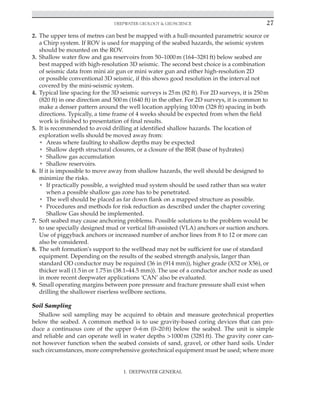
  • 73.
    stepped forward. O’Malleywas hungry and, when he was hungry, other details could wait. “Where’s the mess?” he demanded. The major looked at him and smiled. O’Malley’s uniform and shoulder markings placed him as a flier, but the officer seemed in doubt. “Across the street,” he said gruffly. “Flight Three out of Singapore reporting in, sir,” Allison said. “Well, well.” The major suddenly showed some interest. The fame of these three aces had arrived ahead of them. “Glad to have you.” He looked again at O’Malley. “So you’re the famous O’Malley.” He held out his hand. “I’m not so famous as I am hungry,” O’Malley said as he shook hands. “I’ll check you right in and show you the mess,” the major said.
  • 75.
    CHAPTER IV FLYING TIGERS Theair was hot and humid. Great cumulus clouds were piled against the sky. Out on the landing field, which was actually a converted rice paddy, sat a flight of six Curtiss P–40 planes. The Tomahawks, as they are called in the R.A.F., gleamed in the sun as their propellers turned over idly. Stan Wilson stood between O’Malley and March Allison, listening. Above the muttering of the six Tomahawks rose the distant roar of bomber planes coming in. “Sounds like business,” Allison said. A captain of the Flying Tigers appeared from a shack. He ran across the field with three pilots after him. The three newly arrived pilots saluted. “Up and at ’em, boys,” the captain snapped. “And remember you’re not in the R.A.F. now. Make every burst count and snap it off short. Ammunition supplies are limited.” O’Malley was away before his pals could move. He had crabbed some about flying a P–40 until he had taken one up. Now he was bragging about the ship. Stan and Allison raced to their planes and climbed in. A Chinese corporal waved to them, shouting a string of words they could not understand, then grinned broadly and ended up with: “Give ’em the works!”
  • 76.
    “That must bethe signal to take off,” Stan muttered as he pinched one wheel brake and blasted his tail up, snapping the P–40 around in a tight circle. The six Tomahawks bumped across the rice paddy, noses into the wind, and were off. Stan lifted his ship off the ground and sent it surging up into the sky. It was like old times when he was a test pilot back in the United States. The instruments and controls were familiar and he eased back against the shock pad. Up spiraled the P–40’s above the high-piled clouds. They bored along in close formation. Allison had charge of three planes, and an American from Texas had charge of the other three. “Japs on the left,” Allison’s voice cracked in over the air, “beyond the white cloud. Take two thousand feet more air under you, Flight Five.” “O.K.,” Stan called back. “Don’t be after wastin’ me time,” O’Malley grumbled. “I see a Jap down under.” “Take two thousand, O’Malley,” Allison drawled. “Fighter planes, upstairs.” They went on up, looped over a huge cloud and burst out above a flight of twenty bombers with red circles on their wings. “Peel off and go down,” Allison ordered. There was a happy, reckless note in his voice. This was action again, a fling at bullet- filled skies. O’Malley peeled off and went roaring down the chute. Allison followed, and Stan eased over and opened up. The P–40’s engine hammered a smooth tune as the air rushed past the hatch cover. Stan grinned. He was glad to be back at it again.
  • 77.
    The bombers belowwere very slow. They did not break formation until the P–40’s were on their backs. Stan drove down on a big killer and opened his guns. He cut his burst short and knifed past. As he went down and over in a tight, twisting dive, he saw the bomber burst into flames. Up he went at the belly of another bomber. His Brownings rattled a hail of lead and sheared away the bomber’s wing. As Stan went up, he saw, coming down the chute, a flight of Jap fighter planes. They were roaring in to save the bombers from destruction. Stan made a quick guess and decided there must be at least thirty of them. “Air superiority,” he muttered. “So this is the way they get it.” He laid over and sprayed another bomber. It dived and circled, heading back the way it had come. A glance showed that the bomber attack had been riddled and put to flight. But there was still the flock of fighters darting in on the P–40’s. Stan went up and over and around. He held the P–40 wide open and shot under the diving Japs. He was remembering what the captain had said when he gave them instructions. “Go through them and on up. You can outfly them and be back for a kill before they can get at you.” As he went up and over in a screaming loop, he saw that O’Malley had forgotten his instructions. The Irishman was in the middle of the enemy formation of fighters and he was stunting like a madman, his guns spitting flame and death. One Jap plane went down and then another, but O’Malley was in a tight spot. Smoke was trailing out behind him, not exhaust smoke but black smoke telling of fire inside the P–40. Stan came over and went down. He ripped through the formation, darting around O’Malley. As he went, he saw, on his right, another P–40 shuttling across the sky. He clipped a wing off a fighter that
  • 78.
    tried to intercepthim by diving at him. He saw his companion take another one out. Then he heard Allison’s clipped words. “O’Malley! Get moving. Shuttle across. Use your speed.” “I’m havin’ some fun stayin’ right here,” O’Malley called back. “You’re on fire,” Stan warned. “I’m just learnin’ to smoke,” O’Malley called back. As Stan went across and up, he saw the advantage the P–40 had over the Jap fighters. They darted after him, but he slipped away on them. As he went over and down, he saw that his pals were doing the same thing. That is, all but O’Malley, who was battling it out with a dozen Japanese around him. The five Flying Tigers came back across and their roaring charge was too much for the Japs. They dived and scattered, but, in getting clear, they lost three more planes. “No use trying to keep a tally!” Stan shouted. He looked down and saw that O’Malley’s plane had burst into flame. He watched the Irishman heave back his hatch cover and tumble out. For a moment, he held his breath. Had O’Malley forgotten everything he had been told? It seemed he had slept through the instruction period. His parachute was billowing out and he was sailing through the air. But that was not the worst of it. Two Japs were diving at him from out of the blue. Stan went over and down with his motor wide open. As he roared toward the earth, a plane shot over his hatch cover and he had a glimpse of Allison bending forward as though to push his plane faster.
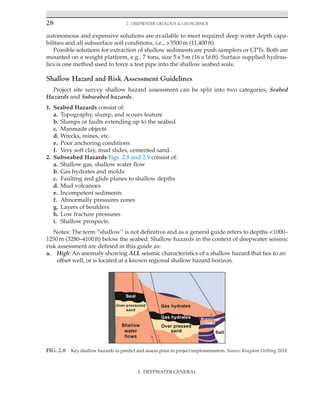
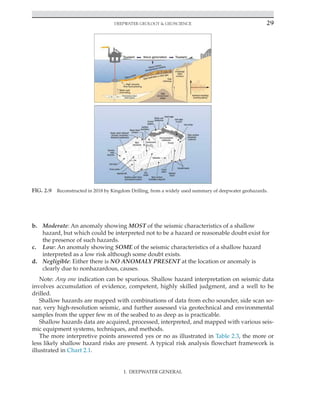
  • 79.
    “He grabbed thefastest crate,” Stan growled as he eased over and chased Allison down the chute. Before they could reach O’Malley, one of the Japanese had zoomed past the dangling pilot and had opened up on him. Stan gritted his teeth and pulled the P–40 up. He intended to get that fellow for the dirty trick he had pulled. Furiously he twisted the gun button as the Jap came into his windscreen. His Brownings rattled a short burst and the Jap wobbled sickeningly. His ship laid over and seemed to explode. Stan eased off and looped. As he came down again, he saw that Allison was circling a parachute that was settling into a field. Watching, he saw the parachute fold up. He laid over and throttled down waiting for O’Malley to get up. O’Malley did not move. He lay sprawled where he had hit. Stan gritted his teeth and went up again, looking for more Japs. The sky was clear. Not an enemy ship was in sight, except for a number of wrecks on the ground. “Flight Five, come in. Flight Five, come in,” headquarters began calling. “Flight Five, coming in. Allison speaking.” Stan waited. “One plane lost. One pilot lost. Flight Five, coming in.” They made rendezvous with Flight Four which was all intact and the five P–40’s went in. They eased down and landed, sliding down the field with rumbling motors. Stan faced Allison as they climbed to the ground. Allison scowled bleakly, then he drawled. “The next time that wild Irisher will listen to instructions.”
  • 80.
    “There won’t beany next time for him,” a pilot said. “You can’t make that kind of flying stick out here. It might work against the Jerries, but not in a ten-to-one fight with the Japs.” “You might be right in your tactics,” Allison said with a sardonic smile. “But you don’t know O’Malley.” “I’m going to beat some sense into his head when he comes in,” Stan growled. He knew both he and Allison were just talking. He remembered clearly the limp form lying in the rice paddy. They stamped into the briefing shack and the captain looked them over, frowning. “You fellows lost a plane. Planes are valuable in this man’s country. From now on, you’ll be one short in formation.” Then he grinned. “Anybody have any idea how many were shot down?” The boy from Texas spoke up, “I believe about twenty, sir.” “We’ll make it twelve to be sure. If the ground boys pick up any more wrecks than that, we’ll take credit.” The captain turned away. Stan didn’t feel very good. He looked at Allison. “I’d like to see if we can pick him up,” he said. The captain turned on him. “You are under combat orders from daylight until dark,” he snapped. “If you want to go poking out into the rice fields after dark, that’s your business. The Brownies may come over again at any moment.” “Yes, sir,” Stan said. Allison lowered his voice. “I’m afraid it wouldn’t do any good,” he said. “I saw him land.”
  • 81.
    “So did I,”Stan answered. The captain spoke sharply and all of the pilots turned to face him. “We have ten new planes and a new group of pilots coming in. The whole flight will be under a new flight instructor. He will give you instructions from now on. I’ll see you men over in the mess as soon as you are relieved this afternoon.” He turned on his heel and walked away. Having a new instructor meant nothing to Stan and Allison. They had not been with the Flying Tigers long enough to know the man who was to be relieved. They went out into the sunshine and seated themselves under a tree to wait for action. The Japs did not come back. Apparently their smashing defeat had slowed their attacks. Stan kept watching the flat fields stretching away from their base, hoping to see a lank figure coming in through the ground haze. An hour before sundown they were relieved and went to their barracks to change to light uniforms. When they had changed, they walked over to the mess. A group of some fifty men milled around the room. They were laughing and talking in small groups. Stan noticed at once that the men were not acquainted with each other, except for small squads gathered together. He and Allison stood watching. Suddenly Allison nudged Stan and said: “There’s Nick Munson.” Stan looked and saw Nick Munson in a uniform resplendent with braid. On his shoulders was the insignia of a colonel. “He sure got himself a rating in a hurry,” Stan said.
  • 82.
    “And a goodone. I say, old man, you don’t suppose he has a special drag around here?” Allison’s lips curled into a smile. At that moment Munson stepped to the front of the room and faced the fliers. “Men!” he shouted. “Give me your attention. Snap into it!” The men faced him and silence filled the room. “I’m sorry Colonel Fuller can’t be here. I’ll just have to introduce myself. I’m Nick Munson, test pilot from the U.S.A. And I’m your new instructor.” He let his eye rove over the men. His gaze flecked over Stan and Allison, seemed to pause a moment, then it moved on. “What do you think of that?” Stan muttered. “I’m not saying,” Allison answered. “Just keep your lips buttoned up and listen to me.” Nick glared directly at Stan and Allison, though he could not have heard what they said. The men moved in closer and frowns creased many faces. The Flying Tigers were easy-going, loose on discipline, deadly in the air. Many of them were veterans of the China Army. They didn’t like this new colonel’s attitude. “I see some of you need a bit of military training,” Nick snapped. “I’m here to kick some action out of you birds. And I’ll do it or hand in my papers.” The men stared at him, but no one said a word. “I don’t want any more exhibitions like we had this afternoon. One famous R.A.F. pilot who thought he knew all about flying had a plane burned from under him and got himself shot up. You birds play this game my way or you’ll stay on the ground.”
  • 83.
    Welcome to ourwebsite – the perfect destination for book lovers and knowledge seekers. We believe that every book holds a new world, offering opportunities for learning, discovery, and personal growth. That’s why we are dedicated to bringing you a diverse collection of books, ranging from classic literature and specialized publications to self-development guides and children's books. More than just a book-buying platform, we strive to be a bridge connecting you with timeless cultural and intellectual values. With an elegant, user-friendly interface and a smart search system, you can quickly find the books that best suit your interests. Additionally, our special promotions and home delivery services help you save time and fully enjoy the joy of reading. Join us on a journey of knowledge exploration, passion nurturing, and personal growth every day! ebookmasss.com