© 2021 IBM Corporation
IBM Data and AI
IBM ILOG CPLEX Optimization Studio
(COS)
© 2021 IBM Corporation
IBM Data and AI
Why Prescriptive Analytics?
© 2021 IBM Corporation
3
IBM Data and AI
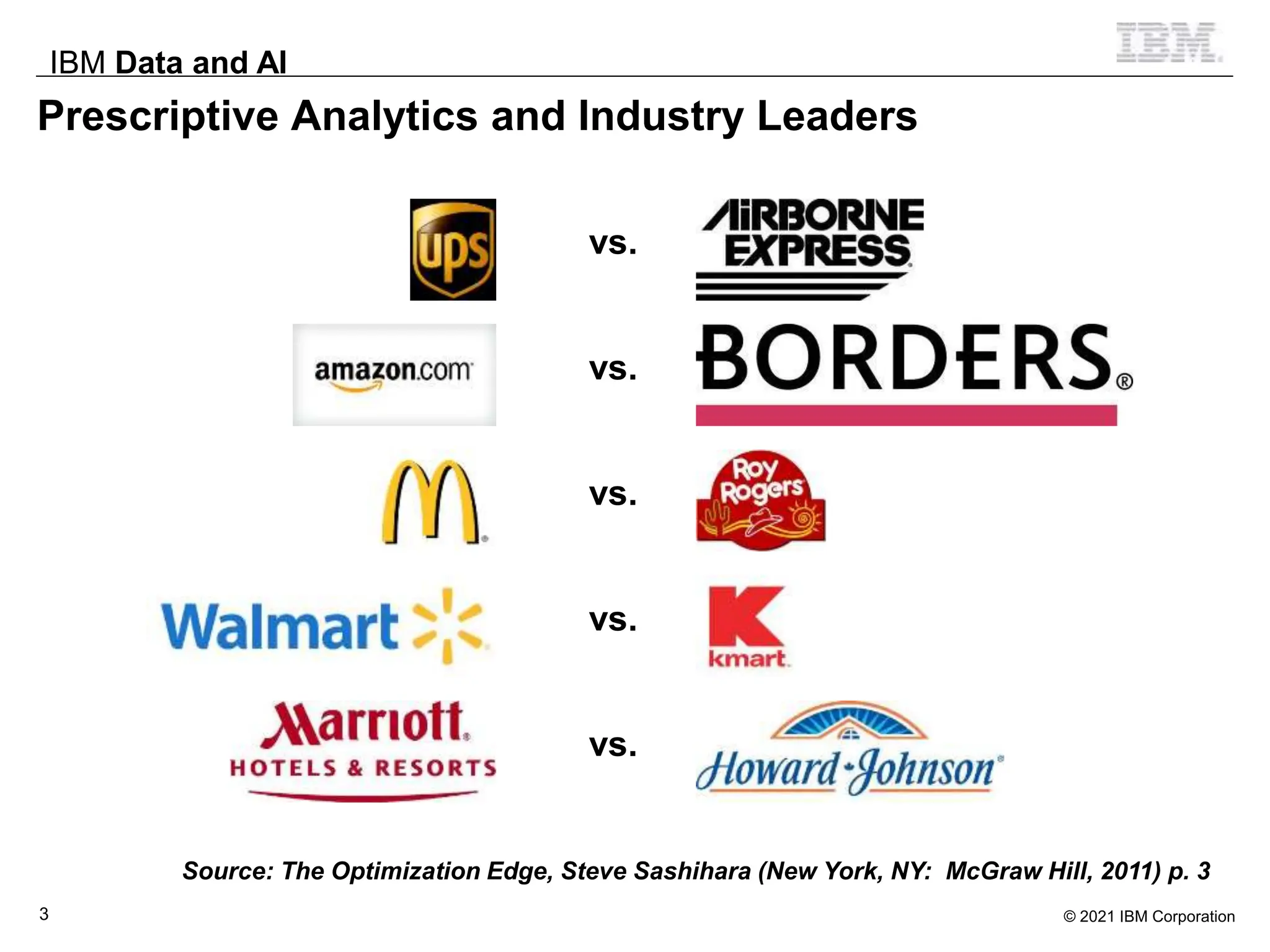
Prescriptive Analytics and Industry Leaders
vs.
vs.
vs.
vs.
vs.
Source: The Optimization Edge, Steve Sashihara (New York, NY: McGraw Hill, 2011) p. 3
© 2021 IBM Corporation
4
IBM Data and AI
Prescriptive Analytics Solutions – Documented Results
2 Chilean Forestry firms Timber Harvesting $20M/yr + 30% fewer trucks
UPS Air Network Design $40M/yr + 10% fewer planes
South African Defence Force/Equip Planning $1.1B/yr
Motorola Procurement Management $100M-150M/yr
Samsung Electronics
Semiconductor
Manufacturing
50% reduction in cycle times
SNCF (French Railroad) Scheduling & Pricing $16M/yr rev + 2% lower op ex
Continental Airlines Crew Re-scheduling $40M/yr
AT&T Network Recovery 35% reduction spare capacity
Grantham Mayo van Otterloo Portfolio Optimization $4M/yr
Source: Edelman Finalists, http://www.informs.org or http://www.scienceofbetter.org
© 2021 IBM Corporation
5
IBM Data and AI
Prescriptive Analytics within the Analytics Portfolio
COGNITIVE
Have you
considered?
Understand
Reason
Learn
What is
happening in
my business
today?
DESCRIPTIVE
Discover
Report
Analyze
What will
happen in
the future?
PREDICTIVE
Forecast
Correlate
Anticipate
What should I
do about it?
PRESCRIPTIVE
Recommend
Decide
Assign
Technology
Need
Outcome
© 2021 IBM Corporation
6
IBM Data and AI
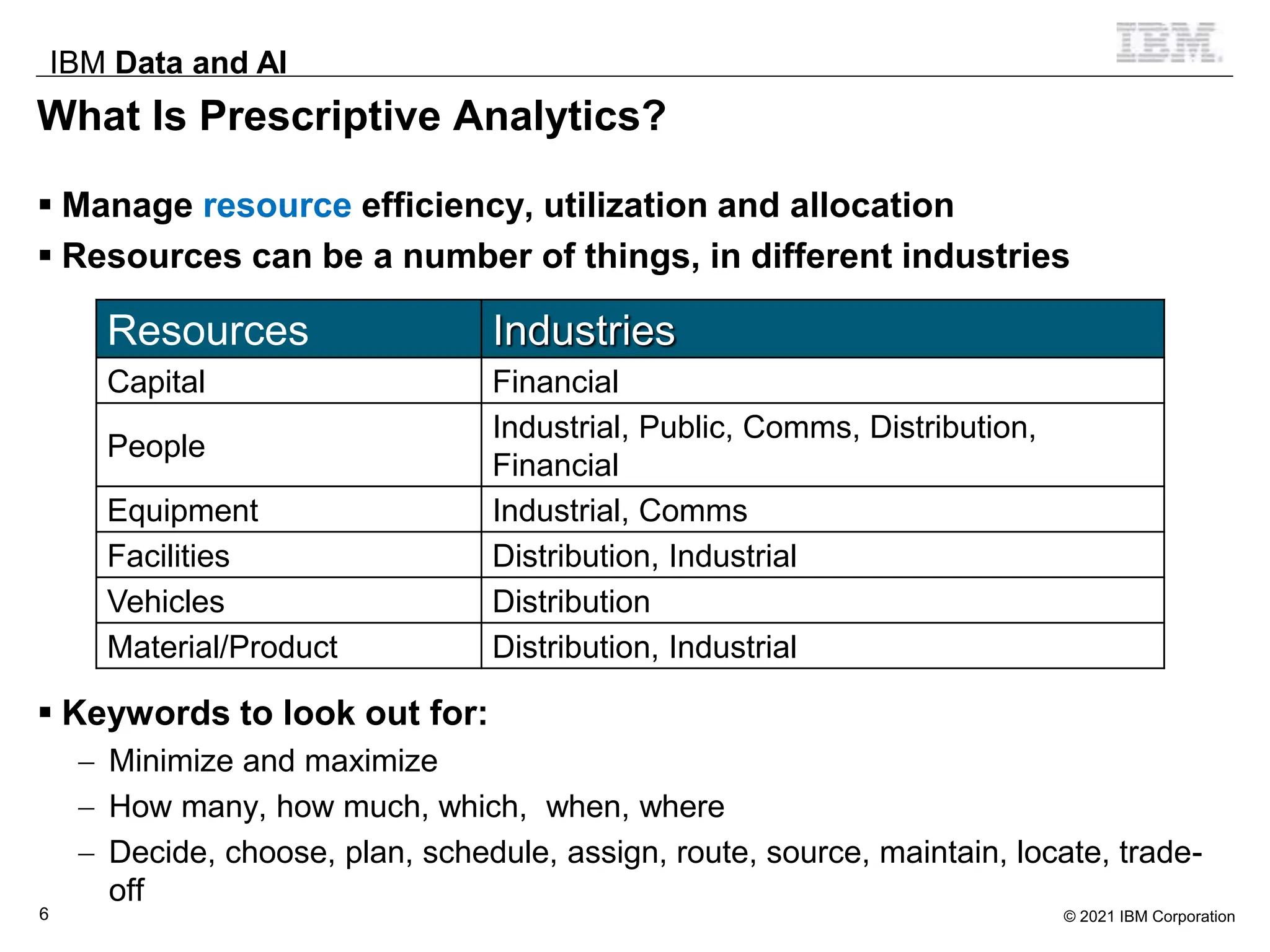
What Is Prescriptive Analytics?
 Manage resource efficiency, utilization and allocation
 Resources can be a number of things, in different industries
 Keywords to look out for:
 Minimize and maximize
 How many, how much, which, when, where
 Decide, choose, plan, schedule, assign, route, source, maintain, locate, trade-
off
Resources Industries
Capital Financial
People
Industrial, Public, Comms, Distribution,
Financial
Equipment Industrial, Comms
Facilities Distribution, Industrial
Vehicles Distribution
Material/Product Distribution, Industrial
© 2021 IBM Corporation
IBM Data and AI
Quick Product Review
© 2021 IBM Corporation
8
IBM Data and AI
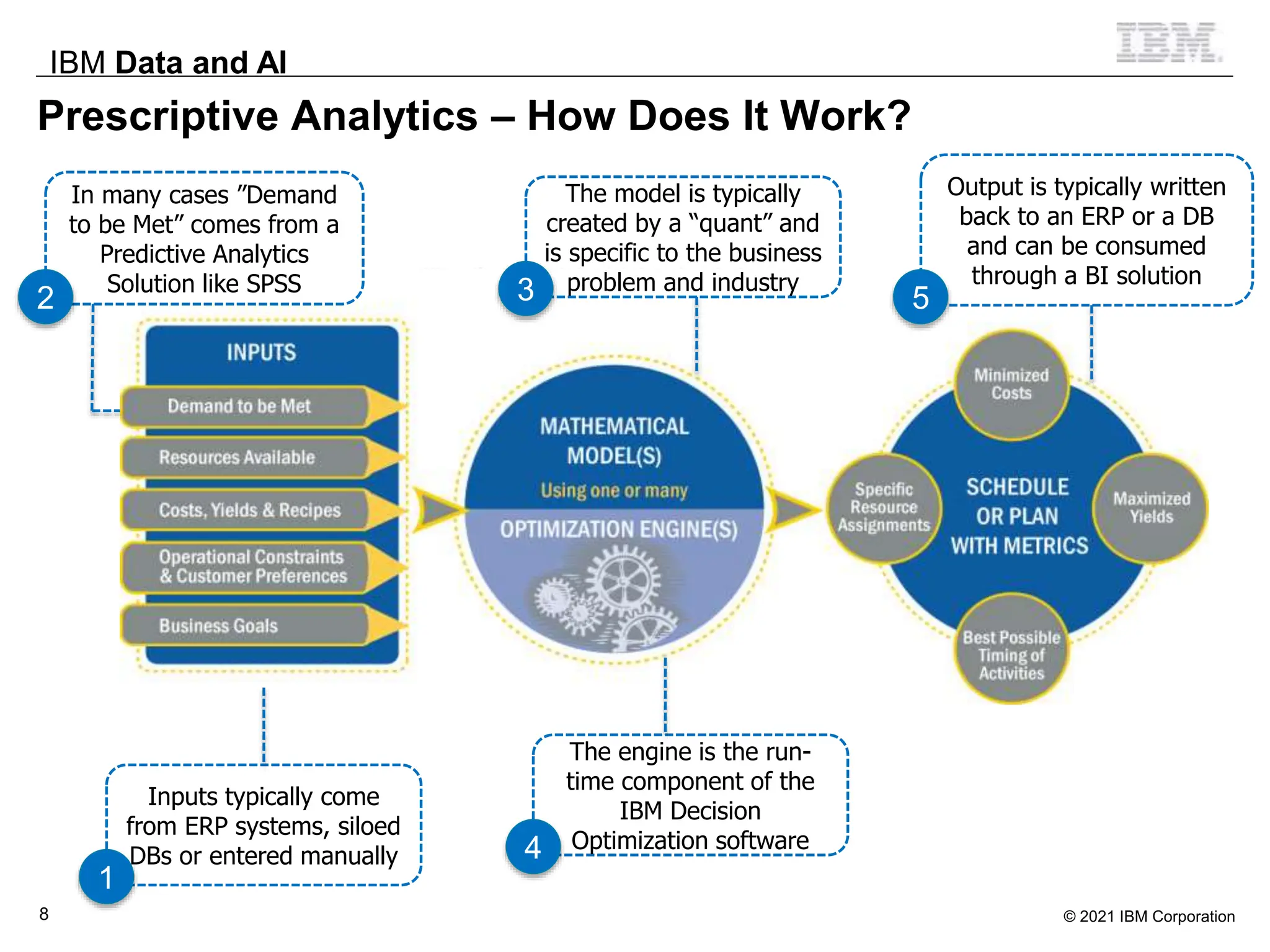
Prescriptive Analytics – How Does It Work?
Inputs typically come
from ERP systems, siloed
DBs or entered manually
1
In many cases ”Demand
to be Met” comes from a
Predictive Analytics
Solution like SPSS
2
The model is typically
created by a “quant” and
is specific to the business
problem and industry
3
The engine is the run-
time component of the
IBM Decision
Optimization software
4
Output is typically written
back to an ERP or a DB
and can be consumed
through a BI solution
5
© 2021 IBM Corporation
9
IBM Data and AI
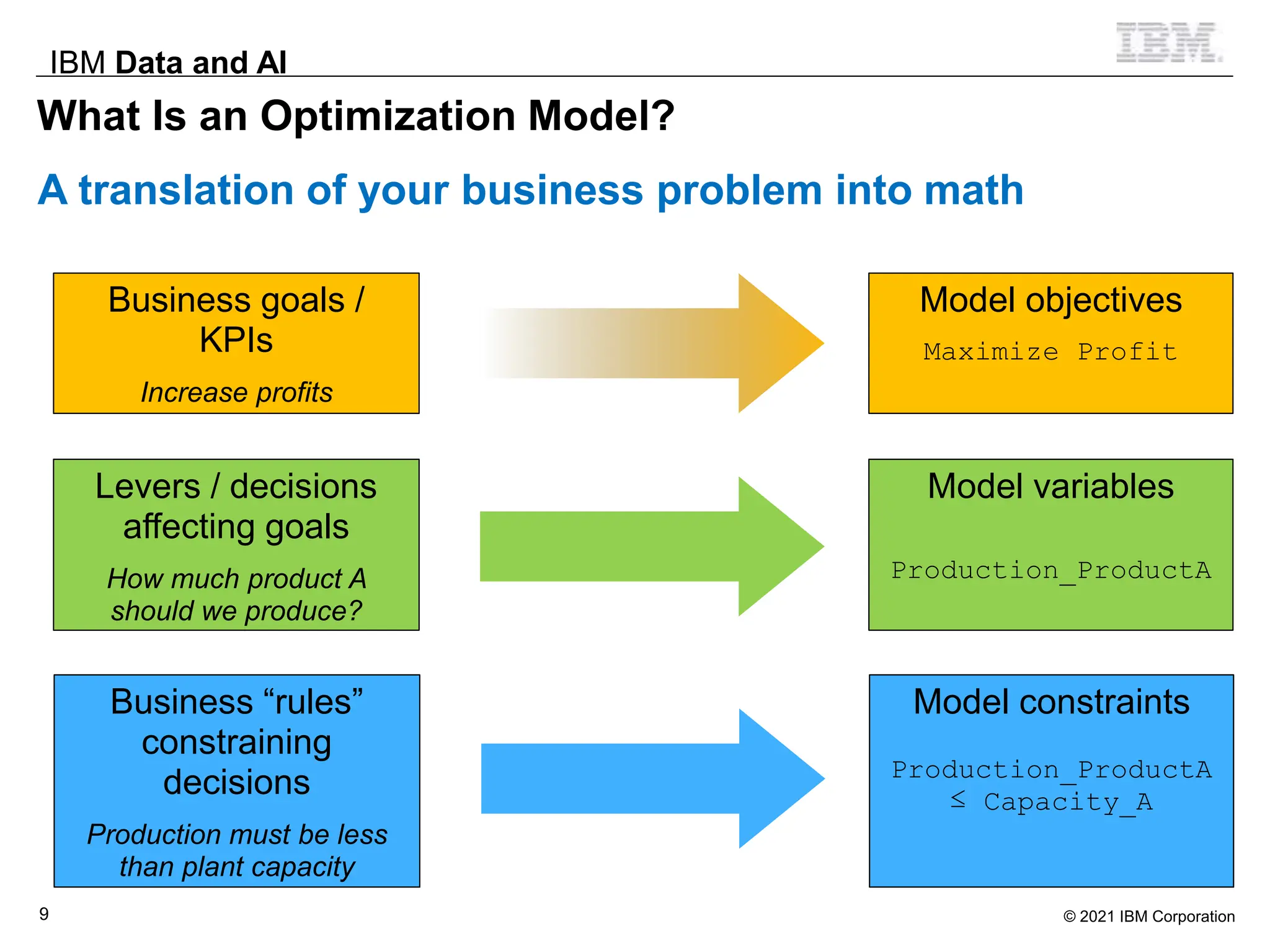
What Is an Optimization Model?
A translation of your business problem into math
Business goals /
KPIs
Increase profits
Model objectives
Maximize Profit
Levers / decisions
affecting goals
How much product A
should we produce?
Model variables
Production_ProductA
Business “rules”
constraining
decisions
Production must be less
than plant capacity
Model constraints
Production_ProductA
≤ Capacity_A
© 2021 IBM Corporation
IBM Data and AI
Product Details of
IBM ILOG CPLEX Optimization Studio
(COS)
© 2021 IBM Corporation
11
IBM Data and AI
COS – Target Audience
 Operations Research (or Data Scientist) Professional:
 Typically math degree in Operations Research, Applied Mathematics, Industrial
Engineering etc.
 Primarily interested in creating the mathematical-optimization model to solve a
business problem
 Wants to work either with a modeling environment or with engine APIs
 Expects appropriate data (demand, resources, business rules) to be available for
use
 Expects IT to integrate incoming data, with the execution of the optimization model
and for writing results back into appropriate IT systems (e.g., ERP)
 IT Professional (as long as they are embedding the models what the OR
professional has created):
 Typical system integration and sysadmin skills as well as some DB API
programming skills
 Wants make appropriate data sources available for optimization model
 Wants to run optimization engine (i.e., COS) in a stable architecture
 Wants to write results back to appropriate IT system
© 2021 IBM Corporation
12
IBM Data and AI
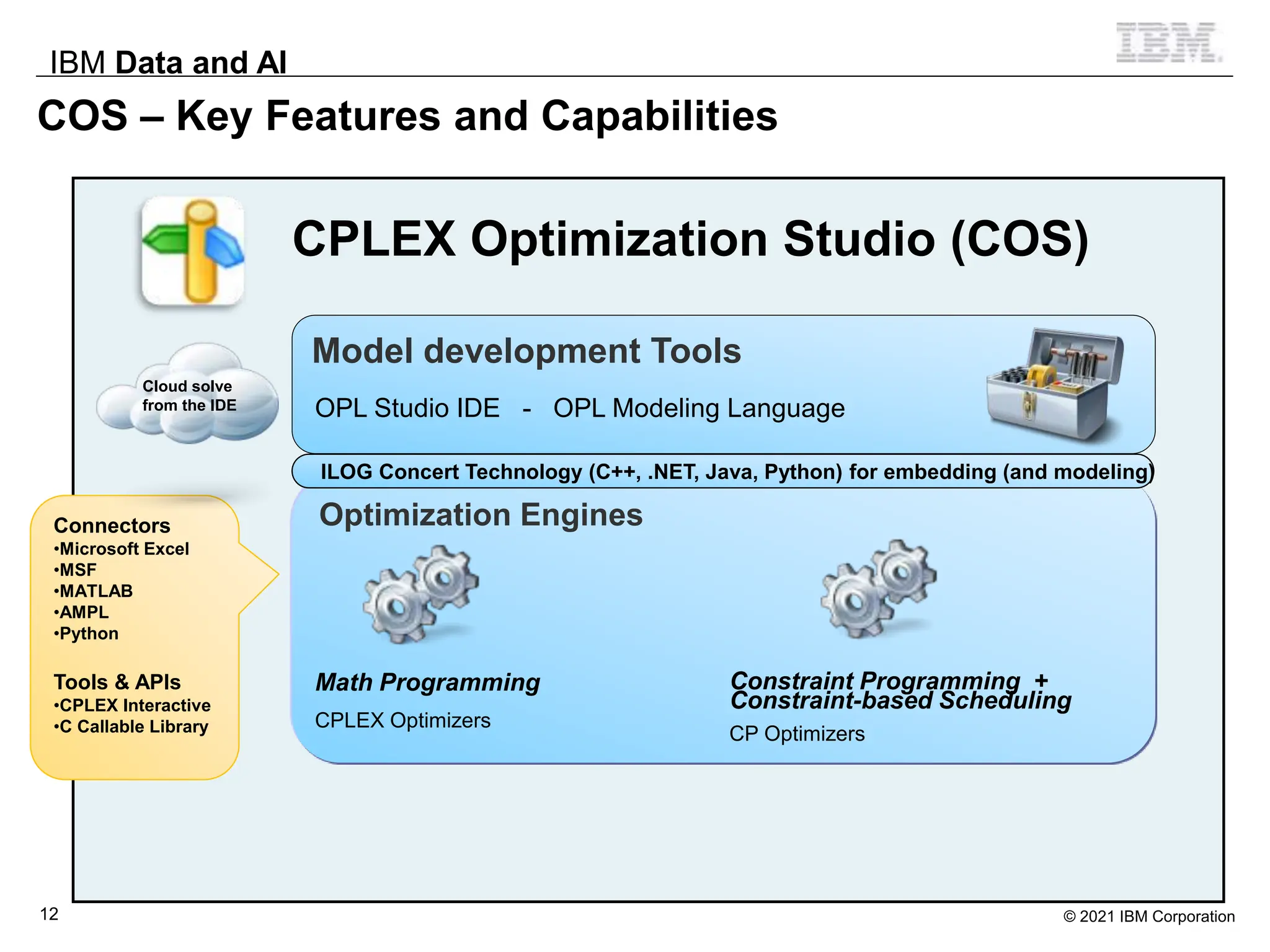
COS – Key Features and Capabilities
Model development Tools
Optimization Engines
Math Programming
CPLEX Optimizers
Constraint Programming +
Constraint-based Scheduling
CP Optimizers
OPL Studio IDE - OPL Modeling Language
ILOG Concert Technology (C++, .NET, Java, Python) for embedding (and modeling)
Connectors
•Microsoft Excel
•MSF
•MATLAB
•AMPL
•Python
Tools & APIs
•CPLEX Interactive
•C Callable Library
CPLEX Optimization Studio (COS)
Cloud solve
from the IDE
© 2021 IBM Corporation
13
IBM Data and AI
1
2
3
4
5
6
0
50
100
150
200
250
300
350
12.4
(2011)
12.5.0
(2012)
12.6.0
(2013)
12.6.1
(2014)
12.6.3
(2015)
12.7.0
(2016)
12.8.0
(2017)
12.9.0
(2018)
12.10.0
(2019)
20.1.0
(2020)
total
speedup
number
of
timeouts
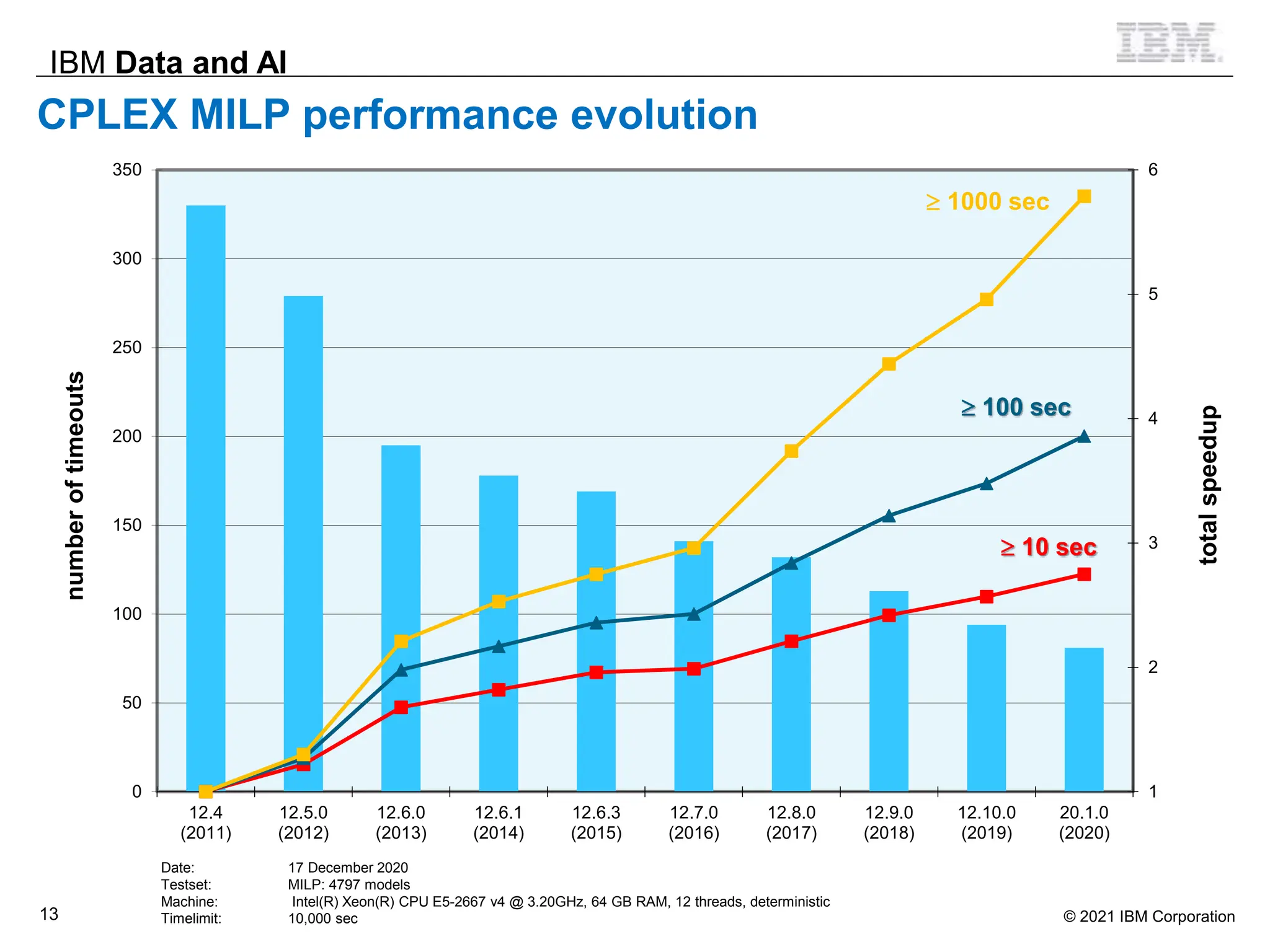
CPLEX MILP performance evolution
 10 sec
 100 sec
 1000 sec
Date: 17 December 2020
Testset: MILP: 4797 models
Machine: Intel(R) Xeon(R) CPU E5-2667 v4 @ 3.20GHz, 64 GB RAM, 12 threads, deterministic
Timelimit: 10,000 sec
© 2021 IBM Corporation
14
IBM Data and AI
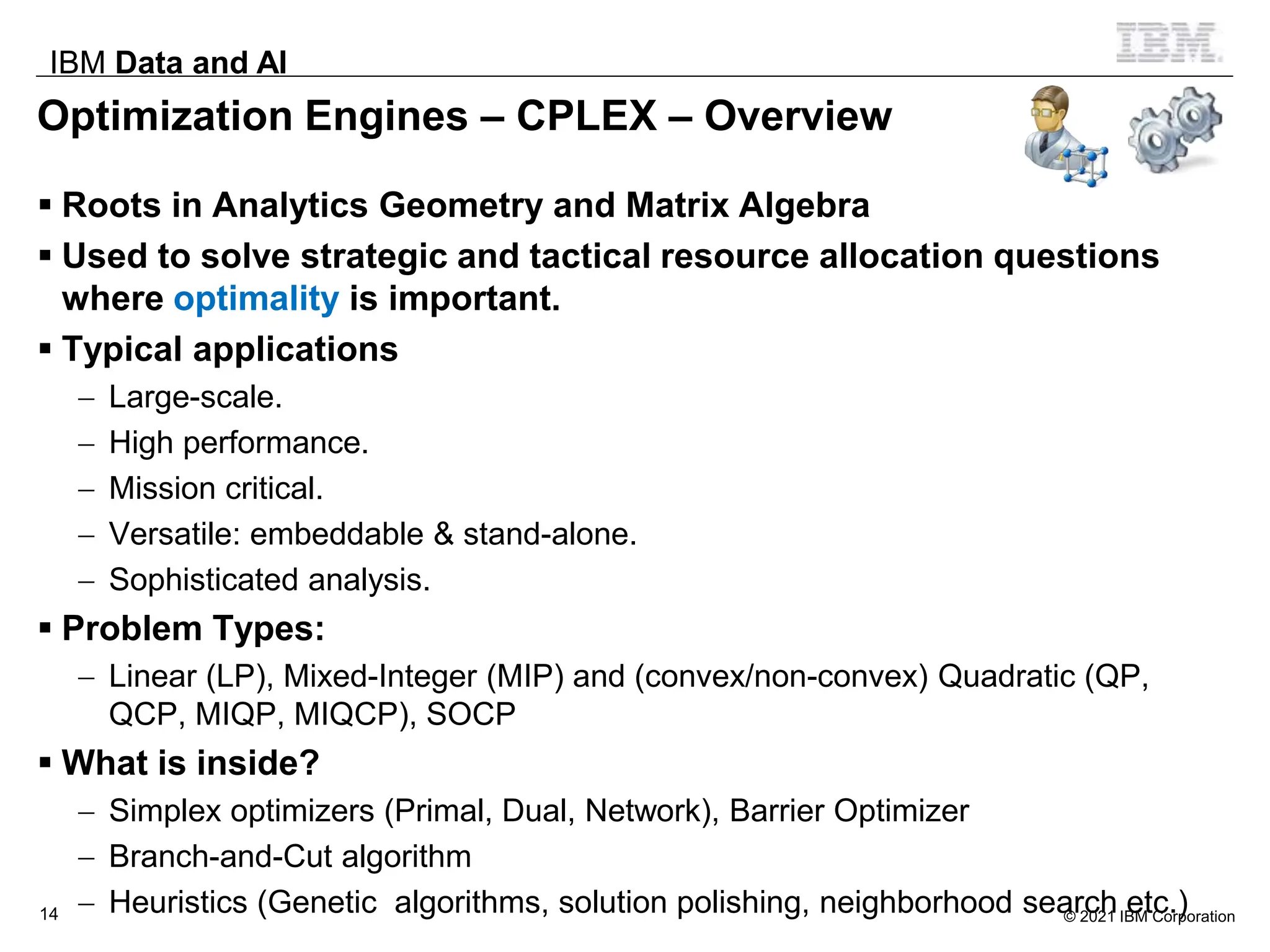
Optimization Engines – CPLEX – Overview
 Roots in Analytics Geometry and Matrix Algebra
 Used to solve strategic and tactical resource allocation questions
where optimality is important.
 Typical applications
 Large-scale.
 High performance.
 Mission critical.
 Versatile: embeddable & stand-alone.
 Sophisticated analysis.
 Problem Types:
 Linear (LP), Mixed-Integer (MIP) and (convex/non-convex) Quadratic (QP,
QCP, MIQP, MIQCP), SOCP
 What is inside?
 Simplex optimizers (Primal, Dual, Network), Barrier Optimizer
 Branch-and-Cut algorithm
 Heuristics (Genetic algorithms, solution polishing, neighborhood search etc.)
© 2021 IBM Corporation
15
IBM Data and AI
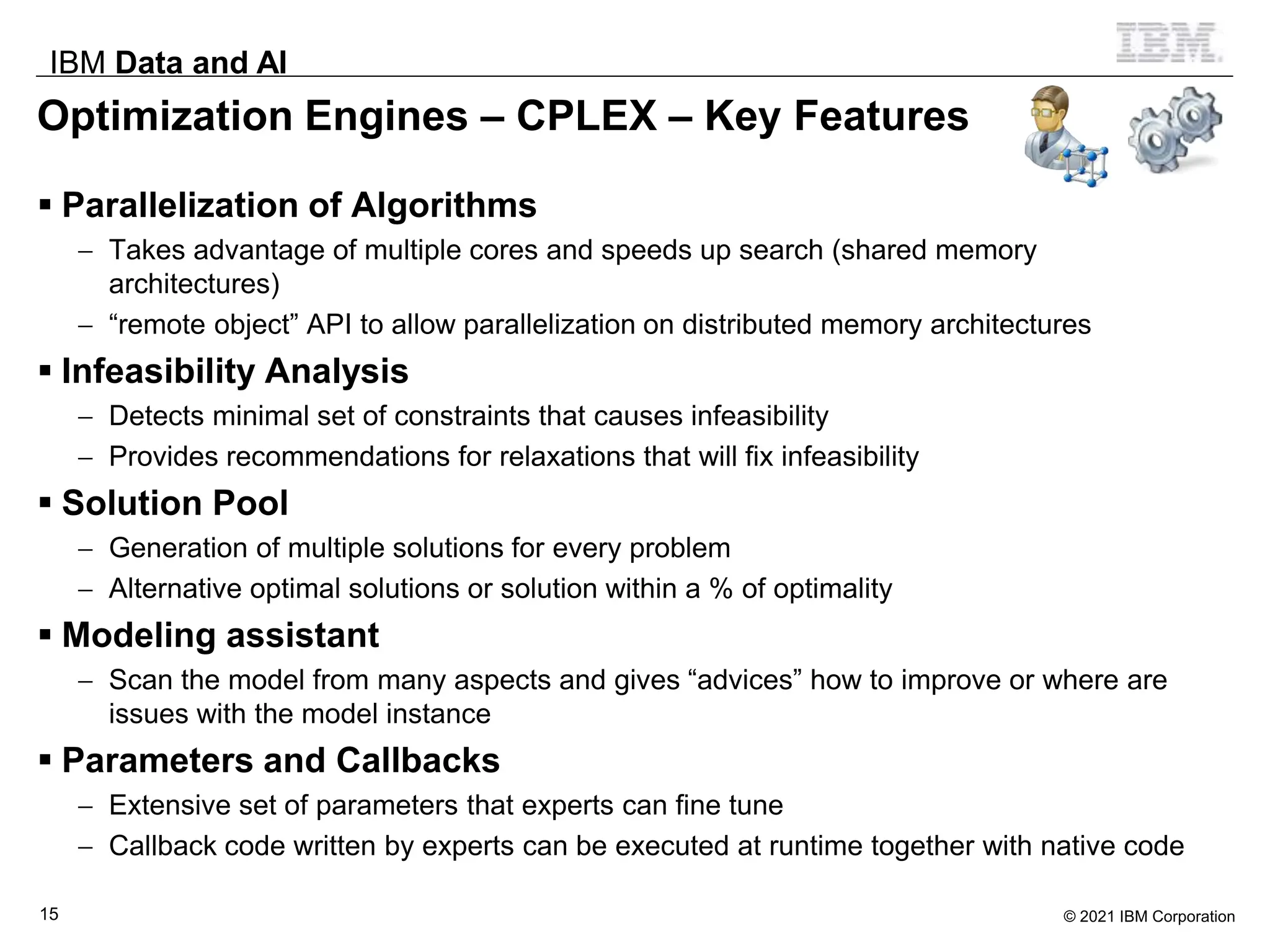
Optimization Engines – CPLEX – Key Features
 Parallelization of Algorithms
 Takes advantage of multiple cores and speeds up search (shared memory
architectures)
 “remote object” API to allow parallelization on distributed memory architectures
 Infeasibility Analysis
 Detects minimal set of constraints that causes infeasibility
 Provides recommendations for relaxations that will fix infeasibility
 Solution Pool
 Generation of multiple solutions for every problem
 Alternative optimal solutions or solution within a % of optimality
 Modeling assistant
 Scan the model from many aspects and gives “advices” how to improve or where are
issues with the model instance
 Parameters and Callbacks
 Extensive set of parameters that experts can fine tune
 Callback code written by experts can be executed at runtime together with native code
© 2021 IBM Corporation
16
IBM Data and AI
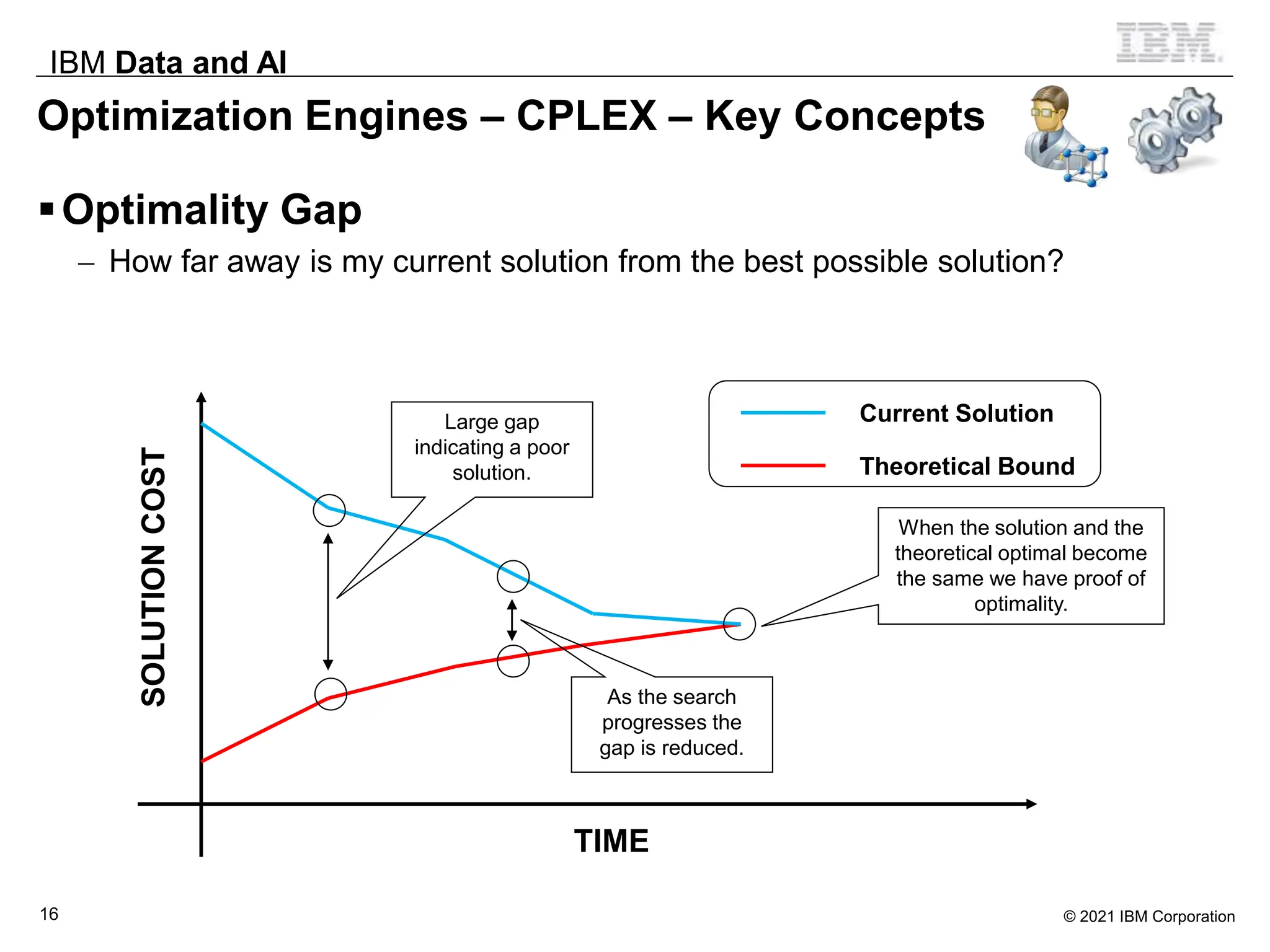
Optimization Engines – CPLEX – Key Concepts
Optimality Gap
 How far away is my current solution from the best possible solution?
TIME
SOLUTION
COST
Current Solution
Theoretical Bound
Large gap
indicating a poor
solution.
As the search
progresses the
gap is reduced.
When the solution and the
theoretical optimal become
the same we have proof of
optimality.
© 2021 IBM Corporation
17
IBM Data and AI
Optimization Engines – CP Optimizer – Overview
 Typical Applications:
 Complex feasibility problems and detailed scheduling problems.
 Problem Types:
 Almost no restrictions except discrete decision variables (i.e., 1,2,3 as
opposed to ranges [1-3])
 Key Features:
 Scheduling-specific modeling constructs
 Powerful default search for a model-and-solve approach
 Custom search capability can complement default search.
 Parallelization - takes advantage of multiple cores and speeds up search
© 2021 IBM Corporation
18
IBM Data and AI
OPL Studio IDE – Model Development Tools
Inspector/output tabs
Model/script code editor for
CPLEX and CP Optimizer models
Problem outline
Problem browsers
Project navigator
© 2021 IBM Corporation
19
IBM Data and AI
An Example of a CPLEX (MIP) Model
Data initialization
Decision Variables
Objective Function
Post-processing
Constraints
© 2021 IBM Corporation
20
IBM Data and AI
An Example of a CP Optimizer (scheduling) Model
Data initialization
Decision Variables
Objective Function
Constraints
© 2021 IBM Corporation
21
IBM Data and AI
Accessing the Engine – Alternatives
 Important IBM Connectors:
 SPSS Modeler dev connector (Introduction, Additional Video 1, Additional
Video 2)
 Planning analytics connector
 Other Connectors:
 Microsoft Excel (deprecated)
 JDBC connector in the IDE
 Microsoft Solver Foundation
 MATLAB – Modeling IDE for several math function and engines
 CPLEX Interactive – Executable that runs in console
 APIs:
 Java, C++, .NET,
 Python
 C Callable Library
 OPL has embedding API’s in Java, C#, C++ and DOOPL (Python)
© 2021 IBM Corporation
22
IBM Data and AI
Deployment of Optimization Solutions
 Through CPLEX/CPO/OPL (embedding) APIs:
 IT can use the native language of the overall solution (C, Java, C++, .NET,
Python) to call the code (or model) created by the OR professional
 All that is required by IT is to link the appropriate library with the COS native
code during compilation
 No other deployment restrictions exist - COS can practically run anywhere!
 IBM Decision Optimization Center (DOC)*:
 DOC has server technology out of the box
 Servers are built on dockerized images
 DOC provides Angular-based LOB-facing web-GUI tool builder
 For modeling DOC includes CPLEX Optimization Studio
*: separately purchased, i.e. DOC includes COS, but COS doesn’t include any component of DOC (like server, web-GUI building tool, etc)
© 2021 IBM Corporation
IBM Data and AI
Thank you!
© 2021 IBM Corporation
24
IBM Data and AI
Legal Disclaimer
• © IBM Corporation 2017. All Rights Reserved.
• The information contained in this publication is provided for informational purposes only. While efforts were made to verify the completeness and accuracy of the information contained
in this publication, it is provided AS IS without warranty of any kind, express or implied. In addition, this information is based on IBM’s current product plans and strategy, which are
subject to change by IBM without notice. IBM shall not be responsible for any damages arising out of the use of, or otherwise related to, this publication or any other materials. Nothing
contained in this publication is intended to, nor shall have the effect of, creating any warranties or representations from IBM or its suppliers or licensors, or altering the terms and
conditions of the applicable license agreement governing the use of IBM software.
• References in this presentation to IBM products, programs, or services do not imply that they will be available in all countries in which IBM operates. Product release dates and/or
capabilities referenced in this presentation may change at any time at IBM’s sole discretion based on market opportunities or other factors, and are not intended to be a commitment
to future product or feature availability in any way. Nothing contained in these materials is intended to, nor shall have the effect of, stating or implying that any activities undertaken by
you will result in any specific sales, revenue growth or other results.
• If the text contains performance statistics or references to benchmarks, insert the following language; otherwise delete:
Performance is based on measurements and projections using standard IBM benchmarks in a controlled environment. The actual throughput or performance that any user will
experience will vary depending upon many factors, including considerations such as the amount of multiprogramming in the user's job stream, the I/O configuration, the storage
configuration, and the workload processed. Therefore, no assurance can be given that an individual user will achieve results similar to those stated here.
• If the text includes any customer examples, please confirm we have prior written approval from such customer and insert the following language; otherwise delete:
All customer examples described are presented as illustrations of how those customers have used IBM products and the results they may have achieved. Actual environmental costs
and performance characteristics may vary by customer.
• Please review text for proper trademark attribution of IBM products. At first use, each product name must be the full name and include appropriate trademark symbols (e.g., IBM
Lotus® Sametime® Unyte™). Subsequent references can drop “IBM” but should include the proper branding (e.g., Lotus Sametime Gateway, or WebSphere Application Server).
Please refer to http://www.ibm.com/legal/copytrade.shtml for guidance on which trademarks require the ® or ™ symbol. Do not use abbreviations for IBM product names in your
presentation. All product names must be used as adjectives rather than nouns. Please list all of the trademarks that you use in your presentation as follows; delete any not included in
your presentation. IBM, the IBM logo, Lotus, Lotus Notes, Notes, Domino, Quickr, Sametime, WebSphere, UC2, PartnerWorld and Lotusphere are trademarks of International
Business Machines Corporation in the United States, other countries, or both. Unyte is a trademark of WebDialogs, Inc., in the United States, other countries, or both.
• If you reference Adobe® in the text, please mark the first use and include the following; otherwise delete:
Adobe, the Adobe logo, PostScript, and the PostScript logo are either registered trademarks or trademarks of Adobe Systems Incorporated in the United States, and/or other
countries.
• If you reference Java™ in the text, please mark the first use and include the following; otherwise delete:
Java and all Java-based trademarks and logos are trademarks or registered trademarks of Oracle and/or its affiliates.
• If you reference Microsoft® and/or Windows® in the text, please mark the first use and include the following, as applicable; otherwise delete:
Microsoft and Windows are trademarks of Microsoft Corporation in the United States, other countries, or both.
• If you reference Intel® and/or any of the following Intel products in the text, please mark the first use and include those that you use as follows; otherwise delete:
Intel, Intel Centrino, Celeron, Intel Xeon, Intel SpeedStep, Itanium, and Pentium are trademarks or registered trademarks of Intel Corporation or its subsidiaries in the United States
and other countries.
• If you reference UNIX® in the text, please mark the first use and include the following; otherwise delete:
UNIX is a registered trademark of The Open Group in the United States and other countries.
• If you reference Linux® in your presentation, please mark the first use and include the following; otherwise delete:
Linux is a registered trademark of Linus Torvalds in the United States, other countries, or both. Other company, product, or service names may be trademarks or service marks of
others.
• If the text/graphics include screenshots, no actual IBM employee names may be used (even your own), if your screenshots include fictitious company names (e.g., Renovations, Zeta
Bank, Acme) please update and insert the following; otherwise delete: All references to [insert fictitious company name] refer to a fictitious company and are used for illustration
purposes only.

Decision Optimization - CPLEX Optimization Studio - Product Overview(2).PPTX

  • 1.
    © 2021 IBMCorporation IBM Data and AI IBM ILOG CPLEX Optimization Studio (COS)
  • 2.
    © 2021 IBMCorporation IBM Data and AI Why Prescriptive Analytics?
  • 3.
    © 2021 IBMCorporation 3 IBM Data and AI Prescriptive Analytics and Industry Leaders vs. vs. vs. vs. vs. Source: The Optimization Edge, Steve Sashihara (New York, NY: McGraw Hill, 2011) p. 3
  • 4.
    © 2021 IBMCorporation 4 IBM Data and AI Prescriptive Analytics Solutions – Documented Results 2 Chilean Forestry firms Timber Harvesting $20M/yr + 30% fewer trucks UPS Air Network Design $40M/yr + 10% fewer planes South African Defence Force/Equip Planning $1.1B/yr Motorola Procurement Management $100M-150M/yr Samsung Electronics Semiconductor Manufacturing 50% reduction in cycle times SNCF (French Railroad) Scheduling & Pricing $16M/yr rev + 2% lower op ex Continental Airlines Crew Re-scheduling $40M/yr AT&T Network Recovery 35% reduction spare capacity Grantham Mayo van Otterloo Portfolio Optimization $4M/yr Source: Edelman Finalists, http://www.informs.org or http://www.scienceofbetter.org
  • 5.
    © 2021 IBMCorporation 5 IBM Data and AI Prescriptive Analytics within the Analytics Portfolio COGNITIVE Have you considered? Understand Reason Learn What is happening in my business today? DESCRIPTIVE Discover Report Analyze What will happen in the future? PREDICTIVE Forecast Correlate Anticipate What should I do about it? PRESCRIPTIVE Recommend Decide Assign Technology Need Outcome
  • 6.
    © 2021 IBMCorporation 6 IBM Data and AI What Is Prescriptive Analytics?  Manage resource efficiency, utilization and allocation  Resources can be a number of things, in different industries  Keywords to look out for:  Minimize and maximize  How many, how much, which, when, where  Decide, choose, plan, schedule, assign, route, source, maintain, locate, trade- off Resources Industries Capital Financial People Industrial, Public, Comms, Distribution, Financial Equipment Industrial, Comms Facilities Distribution, Industrial Vehicles Distribution Material/Product Distribution, Industrial
  • 7.
    © 2021 IBMCorporation IBM Data and AI Quick Product Review
  • 8.
    © 2021 IBMCorporation 8 IBM Data and AI Prescriptive Analytics – How Does It Work? Inputs typically come from ERP systems, siloed DBs or entered manually 1 In many cases ”Demand to be Met” comes from a Predictive Analytics Solution like SPSS 2 The model is typically created by a “quant” and is specific to the business problem and industry 3 The engine is the run- time component of the IBM Decision Optimization software 4 Output is typically written back to an ERP or a DB and can be consumed through a BI solution 5
  • 9.
    © 2021 IBMCorporation 9 IBM Data and AI What Is an Optimization Model? A translation of your business problem into math Business goals / KPIs Increase profits Model objectives Maximize Profit Levers / decisions affecting goals How much product A should we produce? Model variables Production_ProductA Business “rules” constraining decisions Production must be less than plant capacity Model constraints Production_ProductA ≤ Capacity_A
  • 10.
    © 2021 IBMCorporation IBM Data and AI Product Details of IBM ILOG CPLEX Optimization Studio (COS)
  • 11.
    © 2021 IBMCorporation 11 IBM Data and AI COS – Target Audience  Operations Research (or Data Scientist) Professional:  Typically math degree in Operations Research, Applied Mathematics, Industrial Engineering etc.  Primarily interested in creating the mathematical-optimization model to solve a business problem  Wants to work either with a modeling environment or with engine APIs  Expects appropriate data (demand, resources, business rules) to be available for use  Expects IT to integrate incoming data, with the execution of the optimization model and for writing results back into appropriate IT systems (e.g., ERP)  IT Professional (as long as they are embedding the models what the OR professional has created):  Typical system integration and sysadmin skills as well as some DB API programming skills  Wants make appropriate data sources available for optimization model  Wants to run optimization engine (i.e., COS) in a stable architecture  Wants to write results back to appropriate IT system
  • 12.
    © 2021 IBMCorporation 12 IBM Data and AI COS – Key Features and Capabilities Model development Tools Optimization Engines Math Programming CPLEX Optimizers Constraint Programming + Constraint-based Scheduling CP Optimizers OPL Studio IDE - OPL Modeling Language ILOG Concert Technology (C++, .NET, Java, Python) for embedding (and modeling) Connectors •Microsoft Excel •MSF •MATLAB •AMPL •Python Tools & APIs •CPLEX Interactive •C Callable Library CPLEX Optimization Studio (COS) Cloud solve from the IDE
  • 13.
    © 2021 IBMCorporation 13 IBM Data and AI 1 2 3 4 5 6 0 50 100 150 200 250 300 350 12.4 (2011) 12.5.0 (2012) 12.6.0 (2013) 12.6.1 (2014) 12.6.3 (2015) 12.7.0 (2016) 12.8.0 (2017) 12.9.0 (2018) 12.10.0 (2019) 20.1.0 (2020) total speedup number of timeouts CPLEX MILP performance evolution  10 sec  100 sec  1000 sec Date: 17 December 2020 Testset: MILP: 4797 models Machine: Intel(R) Xeon(R) CPU E5-2667 v4 @ 3.20GHz, 64 GB RAM, 12 threads, deterministic Timelimit: 10,000 sec
  • 14.
    © 2021 IBMCorporation 14 IBM Data and AI Optimization Engines – CPLEX – Overview  Roots in Analytics Geometry and Matrix Algebra  Used to solve strategic and tactical resource allocation questions where optimality is important.  Typical applications  Large-scale.  High performance.  Mission critical.  Versatile: embeddable & stand-alone.  Sophisticated analysis.  Problem Types:  Linear (LP), Mixed-Integer (MIP) and (convex/non-convex) Quadratic (QP, QCP, MIQP, MIQCP), SOCP  What is inside?  Simplex optimizers (Primal, Dual, Network), Barrier Optimizer  Branch-and-Cut algorithm  Heuristics (Genetic algorithms, solution polishing, neighborhood search etc.)
  • 15.
    © 2021 IBMCorporation 15 IBM Data and AI Optimization Engines – CPLEX – Key Features  Parallelization of Algorithms  Takes advantage of multiple cores and speeds up search (shared memory architectures)  “remote object” API to allow parallelization on distributed memory architectures  Infeasibility Analysis  Detects minimal set of constraints that causes infeasibility  Provides recommendations for relaxations that will fix infeasibility  Solution Pool  Generation of multiple solutions for every problem  Alternative optimal solutions or solution within a % of optimality  Modeling assistant  Scan the model from many aspects and gives “advices” how to improve or where are issues with the model instance  Parameters and Callbacks  Extensive set of parameters that experts can fine tune  Callback code written by experts can be executed at runtime together with native code
  • 16.
    © 2021 IBMCorporation 16 IBM Data and AI Optimization Engines – CPLEX – Key Concepts Optimality Gap  How far away is my current solution from the best possible solution? TIME SOLUTION COST Current Solution Theoretical Bound Large gap indicating a poor solution. As the search progresses the gap is reduced. When the solution and the theoretical optimal become the same we have proof of optimality.
  • 17.
    © 2021 IBMCorporation 17 IBM Data and AI Optimization Engines – CP Optimizer – Overview  Typical Applications:  Complex feasibility problems and detailed scheduling problems.  Problem Types:  Almost no restrictions except discrete decision variables (i.e., 1,2,3 as opposed to ranges [1-3])  Key Features:  Scheduling-specific modeling constructs  Powerful default search for a model-and-solve approach  Custom search capability can complement default search.  Parallelization - takes advantage of multiple cores and speeds up search
  • 18.
    © 2021 IBMCorporation 18 IBM Data and AI OPL Studio IDE – Model Development Tools Inspector/output tabs Model/script code editor for CPLEX and CP Optimizer models Problem outline Problem browsers Project navigator
  • 19.
    © 2021 IBMCorporation 19 IBM Data and AI An Example of a CPLEX (MIP) Model Data initialization Decision Variables Objective Function Post-processing Constraints
  • 20.
    © 2021 IBMCorporation 20 IBM Data and AI An Example of a CP Optimizer (scheduling) Model Data initialization Decision Variables Objective Function Constraints
  • 21.
    © 2021 IBMCorporation 21 IBM Data and AI Accessing the Engine – Alternatives  Important IBM Connectors:  SPSS Modeler dev connector (Introduction, Additional Video 1, Additional Video 2)  Planning analytics connector  Other Connectors:  Microsoft Excel (deprecated)  JDBC connector in the IDE  Microsoft Solver Foundation  MATLAB – Modeling IDE for several math function and engines  CPLEX Interactive – Executable that runs in console  APIs:  Java, C++, .NET,  Python  C Callable Library  OPL has embedding API’s in Java, C#, C++ and DOOPL (Python)
  • 22.
    © 2021 IBMCorporation 22 IBM Data and AI Deployment of Optimization Solutions  Through CPLEX/CPO/OPL (embedding) APIs:  IT can use the native language of the overall solution (C, Java, C++, .NET, Python) to call the code (or model) created by the OR professional  All that is required by IT is to link the appropriate library with the COS native code during compilation  No other deployment restrictions exist - COS can practically run anywhere!  IBM Decision Optimization Center (DOC)*:  DOC has server technology out of the box  Servers are built on dockerized images  DOC provides Angular-based LOB-facing web-GUI tool builder  For modeling DOC includes CPLEX Optimization Studio *: separately purchased, i.e. DOC includes COS, but COS doesn’t include any component of DOC (like server, web-GUI building tool, etc)
  • 23.
    © 2021 IBMCorporation IBM Data and AI Thank you!
  • 24.
    © 2021 IBMCorporation 24 IBM Data and AI Legal Disclaimer • © IBM Corporation 2017. All Rights Reserved. • The information contained in this publication is provided for informational purposes only. While efforts were made to verify the completeness and accuracy of the information contained in this publication, it is provided AS IS without warranty of any kind, express or implied. In addition, this information is based on IBM’s current product plans and strategy, which are subject to change by IBM without notice. IBM shall not be responsible for any damages arising out of the use of, or otherwise related to, this publication or any other materials. Nothing contained in this publication is intended to, nor shall have the effect of, creating any warranties or representations from IBM or its suppliers or licensors, or altering the terms and conditions of the applicable license agreement governing the use of IBM software. • References in this presentation to IBM products, programs, or services do not imply that they will be available in all countries in which IBM operates. Product release dates and/or capabilities referenced in this presentation may change at any time at IBM’s sole discretion based on market opportunities or other factors, and are not intended to be a commitment to future product or feature availability in any way. Nothing contained in these materials is intended to, nor shall have the effect of, stating or implying that any activities undertaken by you will result in any specific sales, revenue growth or other results. • If the text contains performance statistics or references to benchmarks, insert the following language; otherwise delete: Performance is based on measurements and projections using standard IBM benchmarks in a controlled environment. The actual throughput or performance that any user will experience will vary depending upon many factors, including considerations such as the amount of multiprogramming in the user's job stream, the I/O configuration, the storage configuration, and the workload processed. Therefore, no assurance can be given that an individual user will achieve results similar to those stated here. • If the text includes any customer examples, please confirm we have prior written approval from such customer and insert the following language; otherwise delete: All customer examples described are presented as illustrations of how those customers have used IBM products and the results they may have achieved. Actual environmental costs and performance characteristics may vary by customer. • Please review text for proper trademark attribution of IBM products. At first use, each product name must be the full name and include appropriate trademark symbols (e.g., IBM Lotus® Sametime® Unyte™). Subsequent references can drop “IBM” but should include the proper branding (e.g., Lotus Sametime Gateway, or WebSphere Application Server). Please refer to http://www.ibm.com/legal/copytrade.shtml for guidance on which trademarks require the ® or ™ symbol. Do not use abbreviations for IBM product names in your presentation. All product names must be used as adjectives rather than nouns. Please list all of the trademarks that you use in your presentation as follows; delete any not included in your presentation. IBM, the IBM logo, Lotus, Lotus Notes, Notes, Domino, Quickr, Sametime, WebSphere, UC2, PartnerWorld and Lotusphere are trademarks of International Business Machines Corporation in the United States, other countries, or both. Unyte is a trademark of WebDialogs, Inc., in the United States, other countries, or both. • If you reference Adobe® in the text, please mark the first use and include the following; otherwise delete: Adobe, the Adobe logo, PostScript, and the PostScript logo are either registered trademarks or trademarks of Adobe Systems Incorporated in the United States, and/or other countries. • If you reference Java™ in the text, please mark the first use and include the following; otherwise delete: Java and all Java-based trademarks and logos are trademarks or registered trademarks of Oracle and/or its affiliates. • If you reference Microsoft® and/or Windows® in the text, please mark the first use and include the following, as applicable; otherwise delete: Microsoft and Windows are trademarks of Microsoft Corporation in the United States, other countries, or both. • If you reference Intel® and/or any of the following Intel products in the text, please mark the first use and include those that you use as follows; otherwise delete: Intel, Intel Centrino, Celeron, Intel Xeon, Intel SpeedStep, Itanium, and Pentium are trademarks or registered trademarks of Intel Corporation or its subsidiaries in the United States and other countries. • If you reference UNIX® in the text, please mark the first use and include the following; otherwise delete: UNIX is a registered trademark of The Open Group in the United States and other countries. • If you reference Linux® in your presentation, please mark the first use and include the following; otherwise delete: Linux is a registered trademark of Linus Torvalds in the United States, other countries, or both. Other company, product, or service names may be trademarks or service marks of others. • If the text/graphics include screenshots, no actual IBM employee names may be used (even your own), if your screenshots include fictitious company names (e.g., Renovations, Zeta Bank, Acme) please update and insert the following; otherwise delete: All references to [insert fictitious company name] refer to a fictitious company and are used for illustration purposes only.