Debt to Equity Ratio Explained – Meaning, Formula & Importance
1.
Understanding the
Debt-to-Equity Ratio
Thedebt to equity ratio measures a company's financial leverage. It
compares total liabilities to shareholder equity. This ratio is a key metric in
financial analysis and risk assessment.
by Amit Pandey
2.
Calculating the Debt-to-EquityRatio
Step 1
Locate Total Liabilities on
the balance sheet.
Step 2
Find Shareholder Equity on
the balance sheet.
Step 3
Divide liabilities by equity to
get the ratio.
Example
Liabilities = $5M, Equity =
$10M, Ratio = 0.5
3.
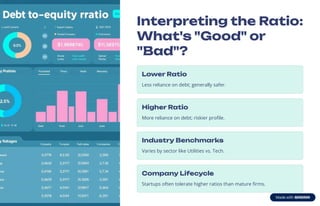
Interpreting the Ratio:
What's"Good" or
"Bad"?
Lower Ratio
Less reliance on debt; generally safer.
Higher Ratio
More reliance on debt; riskier profile.
Industry Benchmarks
Varies by sector like Utilities vs. Tech.
Company Lifecycle
Startups often tolerate higher ratios than mature firms.
4.
High Debt-to-Equity:
Risks and
Implications
FinancialRisk
Difficulty meeting debt obligations in tough times.
Higher Interest Expenses
Reduced profitability due to debt servicing costs.
Bankruptcy Potential
Severe downturns can lead to insolvency.
Example
Lehman Brothers' collapse triggered by excessive leverage.
5.
Low Debt-to-Equity: Advantagesand
Drawbacks
Advantages
Greater financial stability
Attractive to conservative investors
Resilient to economic shocks
Drawbacks
May miss growth opportunities
Less leverage for expansion
Potentially lower returns
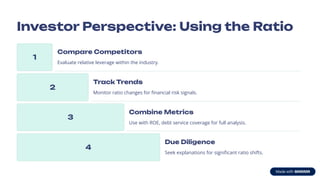
Investor Perspective: Usingthe Ratio
1
Compare Competitors
Evaluate relative leverage within the industry.
2
Track Trends
Monitor ratio changes for financial risk signals.
3
Combine Metrics
Use with ROE, debt service coverage for full analysis.
4
Due Diligence
Seek explanations for significant ratio shifts.
8.
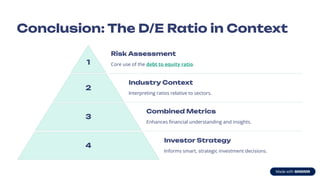
Conclusion: The D/ERatio in Context
1
Risk Assessment
Core use of the debt to equity ratio.
2
Industry Context
Interpreting ratios relative to sectors.
3
Combined Metrics
Enhances financial understanding and insights.
4
Investor Strategy
Informs smart, strategic investment decisions.