Dr. Babasaheb Ambedkar Technological University, Lonere
(Established as a University of Technology in the State of Maharashtra)
(Under Maharashtra Act No. XXIX of 2014)
P.O. Lonere, Dist. Raigad, Pin 402 103, Maharashtra
Telephone and Fax.: 02140 - 275142
www.dbatu.ac.in
Draft Copy of Curriculum for Undergraduate Degree
Programme
B. Tech. in Civil Engineering
With effect from (Fourth Year) AY 2023-24
Dr. Babasaheb Ambedkar Technological University
B.Tech. Civil Engineering
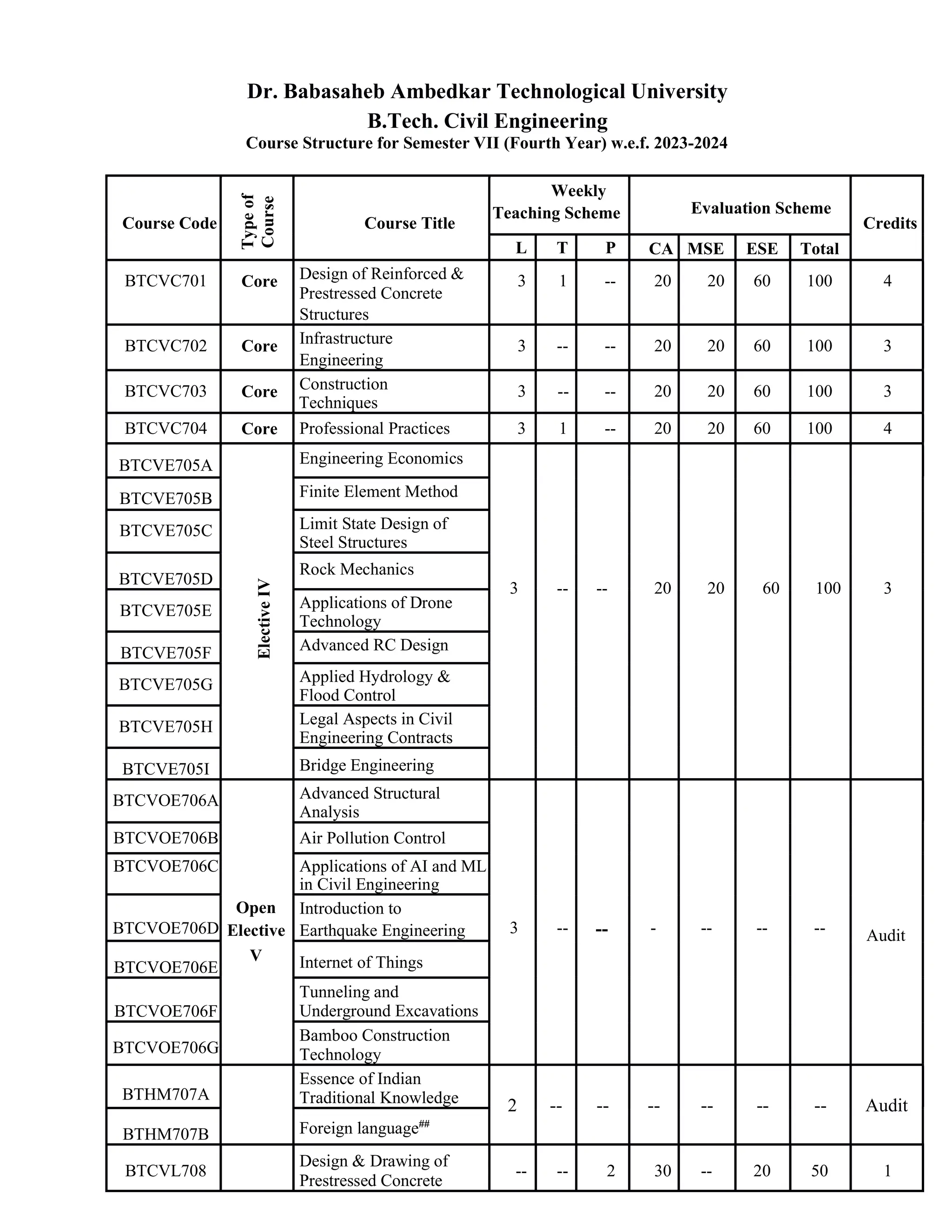
Course Structure for Semester VII (Fourth Year) w.e.f. 2023-2024
Course Code
Type
of
Course
Course Title
Weekly
Teaching Scheme Evaluation Scheme
Credits
L T P CA MSE ESE Total
BTCVC701 Core Design of Reinforced &
Prestressed Concrete
Structures
3 1 -- 20 20 60 100 4
BTCVC702 Core Infrastructure
Engineering
3 -- -- 20 20 60 100 3
BTCVC703 Core Construction
Techniques
3 -- -- 20 20 60 100 3
BTCVC704 Core Professional Practices 3 1 -- 20 20 60 100 4
BTCVE705A
Elective
IV
Engineering Economics
3 -- -- 20 20 60 100 3
BTCVE705B Finite Element Method
BTCVE705C Limit State Design of
Steel Structures
BTCVE705D
Rock Mechanics
BTCVE705E Applications of Drone
Technology
BTCVE705F Advanced RC Design
BTCVE705G Applied Hydrology &
Flood Control
BTCVE705H Legal Aspects in Civil
Engineering Contracts
BTCVE705I Bridge Engineering
BTCVOE706A
Open
Elective
V
Advanced Structural
Analysis
3 -- -- - -- -- -- Audit
BTCVOE706B Air Pollution Control
BTCVOE706C Applications of AI and ML
in Civil Engineering
BTCVOE706D
Introduction to
Earthquake Engineering
BTCVOE706E Internet of Things
BTCVOE706F
Tunneling and
Underground Excavations
BTCVOE706G
Bamboo Construction
Technology
BTHM707A
Essence of Indian
Traditional Knowledge 2 -- -- -- -- -- -- Audit
BTHM707B Foreign language##
BTCVL708
Design & Drawing of
Prestressed Concrete
-- -- 2 30 -- 20 50 1
Lab. Structures
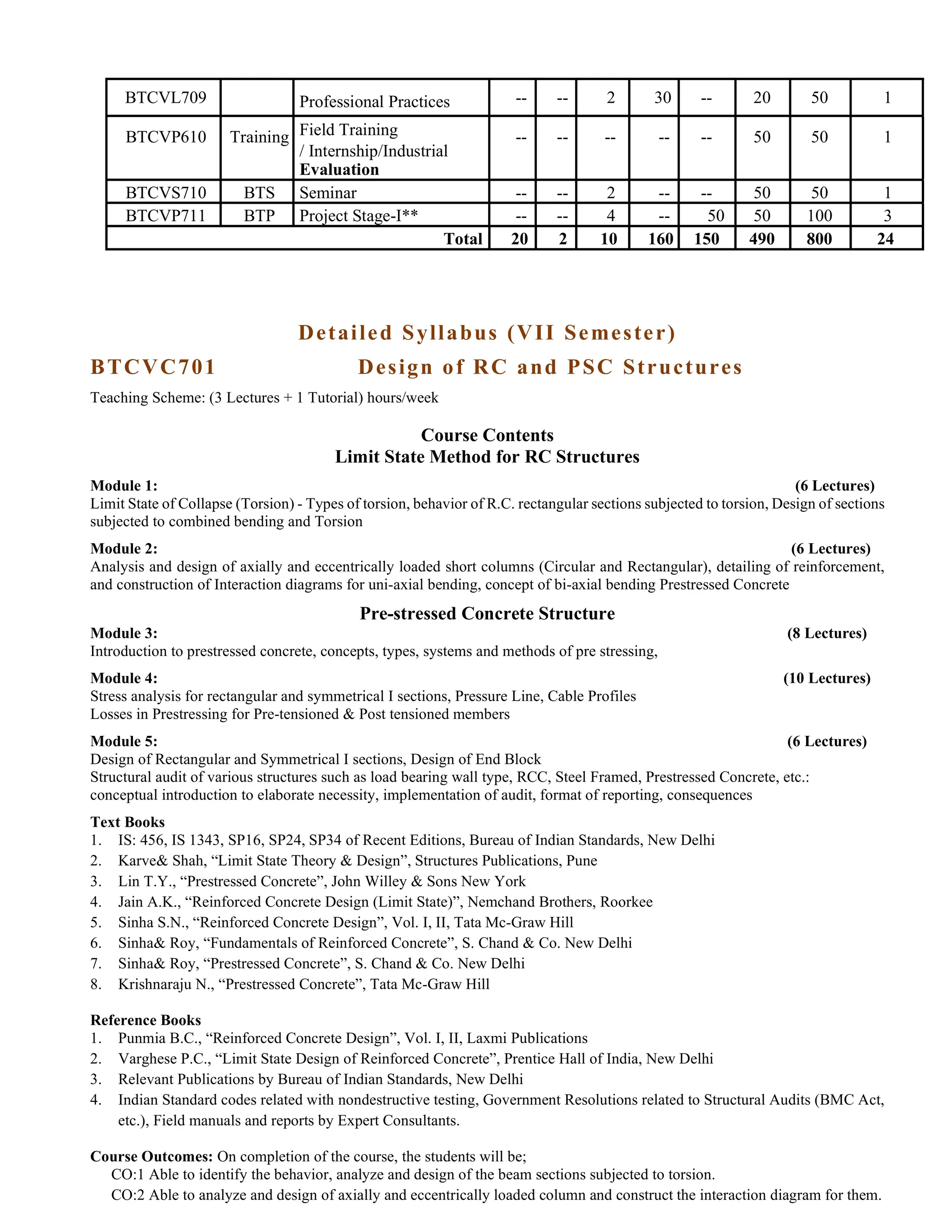
BTCVL709 Professional Practices -- -- 2 30 -- 20 50 1
BTCVP610 Training Field Training
/ Internship/Industrial
Evaluation
-- -- -- -- -- 50 50 1
BTCVS710 BTS Seminar -- -- 2 -- -- 50 50 1
BTCVP711 BTP Project Stage-I** -- -- 4 -- 50 50 100 3
Total 20 2 10 160 150 490 800 24
B.Tech. Civil Engineering
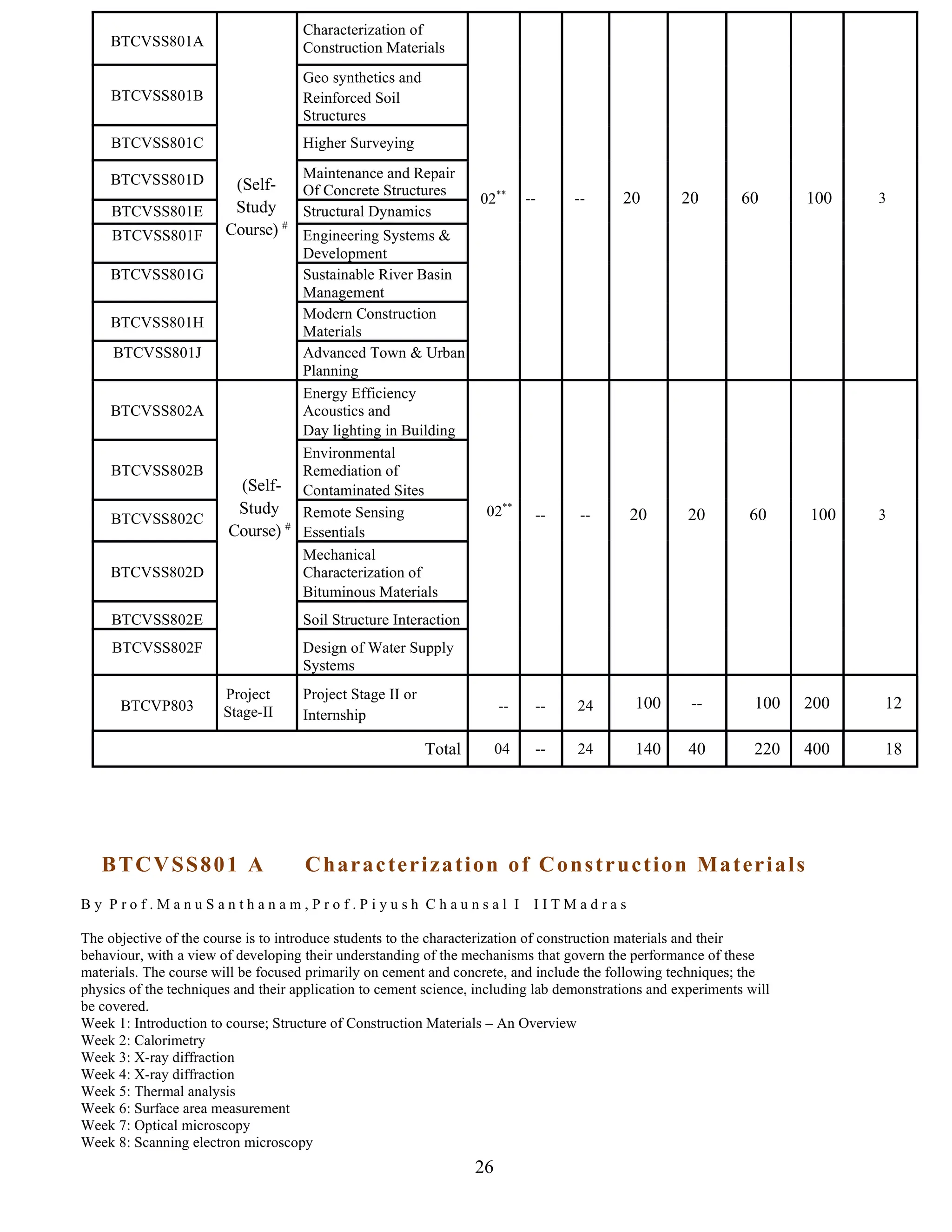
Course Structure for Semester VIII [Fourth Year] w.e.f. 2023-2024
Course Code
Type of
Course Course Title
Weekly Teaching
Scheme
Evaluation Scheme$
Credits
L T P CA MSE ESE Total
BTCVSS801A
(Self-
Study
Course) #
Characterization of
Construction Materials
02**
-- -- 20 20 60 100 3
BTCVSS801B
Geo synthetics and
Reinforced Soil
Structures
BTCVSS801C Higher Surveying
BTCVSS801D Maintenance and Repair
Of Concrete Structures
BTCVSS801E Structural Dynamics
BTCVSS801F Engineering Systems &
Development
BTCVSS801G Sustainable River Basin
Management
BTCVSS801H
Modern Construction
Materials
BTCVSS801J Advanced Town & Urban
Planning
BTCVSS802A
(Self-
Study
Course) #
Energy Efficiency
Acoustics and
Day lighting in Building
02**
-- -- 20 20 60 100 3
BTCVSS802B
Environmental
Remediation of
Contaminated Sites
BTCVSS802C Remote Sensing
Essentials
BTCVSS802D
Mechanical
Characterization of
Bituminous Materials
BTCVSS802E Soil Structure Interaction
BTCVSS802F Design of Water Supply
Systems
BTCVP803
Project
Stage-II
Project Stage II or
Internship
-- -- 24 100 -- 100 200 12
Total 04 -- 24 140 40 220 400 18
## Student may take foreign language course from online platform NPTEL/SWAYAM/any other
approved foreign language course run by university
#The subjects are to be studied on self-study mode using SWAYAM/NPTEL/any other online
source approved by the University.
**
If required Coordinator may be appointed for each Self-study course and an administrative
load of 02 hours per week may be considered for monitoring and assisting the students, and to
conduct examination (if required), evaluation and preparation of result.
$If the examination schedule for the online Self study course chosen by student do not match
with the University’s Academic Schedule, University/Institute have to conduct exam for such
courses.
* Internship of One Semester as per BTCEP803: One Faculty guide from the Institute side and
one Mentor from the Industry should be identified to monitor the progress of work. During the
period of Internship, a review of work should be taken followed by a final presentation at the
end.
Dr. Babasaheb Ambedkar Technological University, Lonere
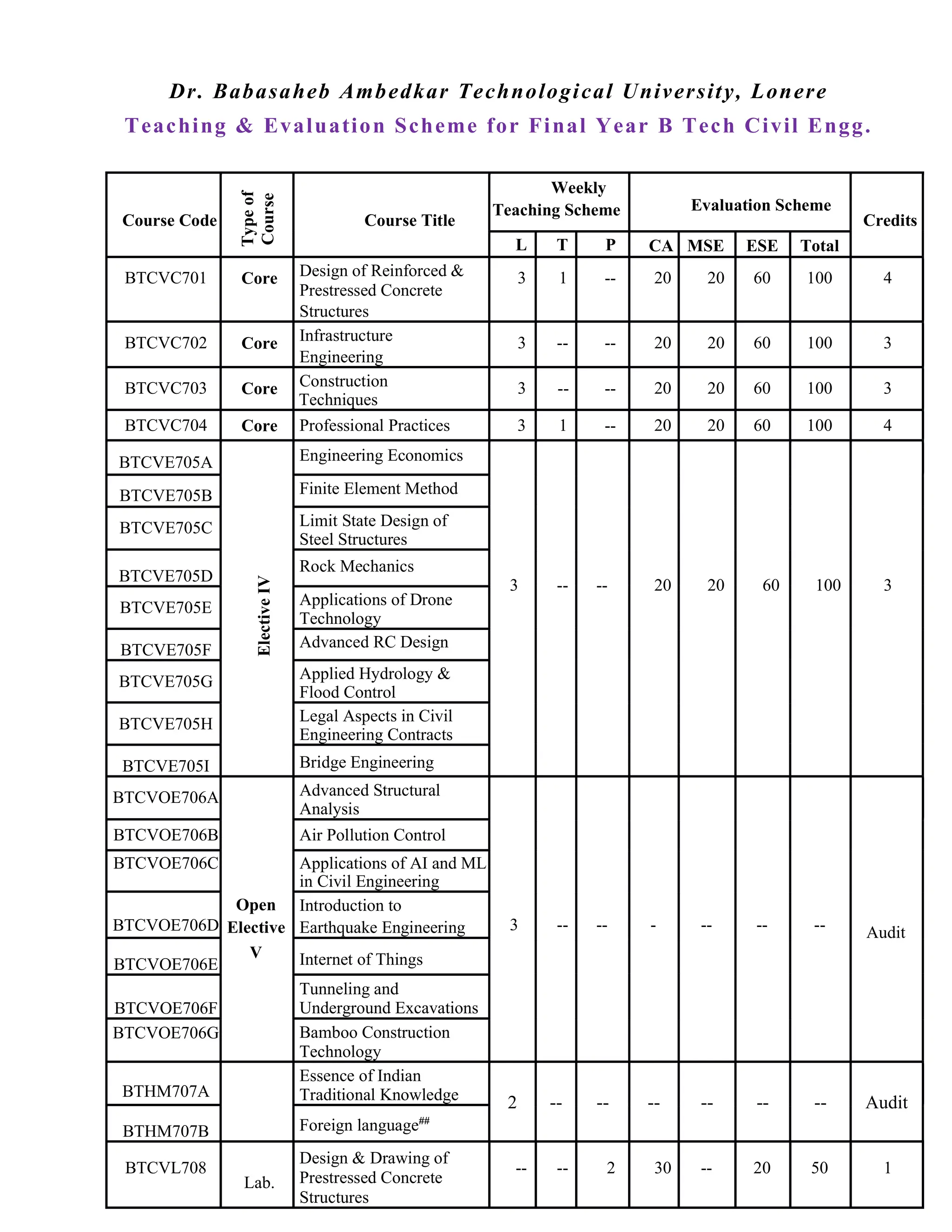
Teaching & Evaluation Scheme for Final Year B Tech Civil Engg.
Course Code
Type
of
Course
Course Title
Weekly
Teaching Scheme Evaluation Scheme
Credits
L T P CA MSE ESE Total
BTCVC701 Core Design of Reinforced &
Prestressed Concrete
Structures
3 1 -- 20 20 60 100 4
BTCVC702 Core Infrastructure
Engineering
3 -- -- 20 20 60 100 3
BTCVC703 Core Construction
Techniques
3 -- -- 20 20 60 100 3
BTCVC704 Core Professional Practices 3 1 -- 20 20 60 100 4
BTCVE705A
Elective
IV
Engineering Economics
3 -- -- 20 20 60 100 3
BTCVE705B Finite Element Method
BTCVE705C Limit State Design of
Steel Structures
BTCVE705D
Rock Mechanics
BTCVE705E Applications of Drone
Technology
BTCVE705F Advanced RC Design
BTCVE705G Applied Hydrology &
Flood Control
BTCVE705H Legal Aspects in Civil
Engineering Contracts
BTCVE705I Bridge Engineering
BTCVOE706A
Open
Elective
V
Advanced Structural
Analysis
3 -- -- - -- -- -- Audit
BTCVOE706B Air Pollution Control
BTCVOE706C Applications of AI and ML
in Civil Engineering
BTCVOE706D
Introduction to
Earthquake Engineering
BTCVOE706E Internet of Things
BTCVOE706F
Tunneling and
Underground Excavations
BTCVOE706G Bamboo Construction
Technology
BTHM707A
Essence of Indian
Traditional Knowledge 2 -- -- -- -- -- -- Audit
BTHM707B Foreign language##
BTCVL708
Lab.
Design & Drawing of
Prestressed Concrete
Structures
-- -- 2 30 -- 20 50 1
BTCVL709 Professional Practices -- -- 2 30 -- 20 50 1
BTCVP610 Training Field Training
/ Internship/Industrial
Evaluation
-- -- -- -- -- 50 50 1
BTCVS710 BTS Seminar -- -- 2 -- -- 50 50 1
BTCVP711 BTP Project Stage-I** -- -- 4 -- 50 50 100 3
Total 20 2 10 160 150 490 800 24
Detailed Syllabus (VII Semester)
BTCVC701 Design of RC and PSC Structures
Teaching Scheme: (3 Lectures + 1 Tutorial) hours/week
Course Contents
Limit State Method for RC Structures
Module 1: (6 Lectures)
Limit State of Collapse (Torsion) - Types of torsion, behavior of R.C. rectangular sections subjected to torsion, Design of sections
subjected to combined bending and Torsion
Module 2: (6 Lectures)
Analysis and design of axially and eccentrically loaded short columns (Circular and Rectangular), detailing of reinforcement,
and construction of Interaction diagrams for uni-axial bending, concept of bi-axial bending Prestressed Concrete
Pre-stressed Concrete Structure
Module 3: (8 Lectures)
Introduction to prestressed concrete, concepts, types, systems and methods of pre stressing,
Module 4: (10 Lectures)
Stress analysis for rectangular and symmetrical I sections, Pressure Line, Cable Profiles
Losses in Prestressing for Pre-tensioned & Post tensioned members
Module 5: (6 Lectures)
Design of Rectangular and Symmetrical I sections, Design of End Block
Structural audit of various structures such as load bearing wall type, RCC, Steel Framed, Prestressed Concrete, etc.:
conceptual introduction to elaborate necessity, implementation of audit, format of reporting, consequences
Text Books
1. IS: 456, IS 1343, SP16, SP24, SP34 of Recent Editions, Bureau of Indian Standards, New Delhi
2. Karve& Shah, “Limit State Theory & Design”, Structures Publications, Pune
3. Lin T.Y., “Prestressed Concrete”, John Willey & Sons New York
4. Jain A.K., “Reinforced Concrete Design (Limit State)”, Nemchand Brothers, Roorkee
5. Sinha S.N., “Reinforced Concrete Design”, Vol. I, II, Tata Mc-Graw Hill
6. Sinha& Roy, “Fundamentals of Reinforced Concrete”, S. Chand & Co. New Delhi
7. Sinha& Roy, “Prestressed Concrete”, S. Chand & Co. New Delhi
8. Krishnaraju N., “Prestressed Concrete”, Tata Mc-Graw Hill
Reference Books
1. Punmia B.C., “Reinforced Concrete Design”, Vol. I, II, Laxmi Publications
2. Varghese P.C., “Limit State Design of Reinforced Concrete”, Prentice Hall of India, New Delhi
3. Relevant Publications by Bureau of Indian Standards, New Delhi
4. Indian Standard codes related with nondestructive testing, Government Resolutions related to Structural Audits (BMC Act,
etc.), Field manuals and reports by Expert Consultants.
Course Outcomes: On completion of the course, the students will be;
CO:1 Able to identify the behavior, analyze and design of the beam sections subjected to torsion.
CO:2 Able to analyze and design of axially and eccentrically loaded column and construct the interaction diagram for them.
CO:3 Understand various concepts, systems and losses in pre-stressing.
CO:4 Able to analyze and design the rectangular and symmetrical I-section pre-stressed beam/girders.

BTCVC702 Infrastructure Engineering
Teaching Scheme: (3 Lectures) hours/week
Course Contents
Module 1 (8 Lectures)
Railway Engineering: Permanent Way, gauges, rails, sleepers, ballast, sub grade formation, fixtures and fastenings, Geometric
Design of tracks- Horizontal Alignment, Vertical Alignment
Module 2 (8 Lectures)
Points and Crossings: Standard types, Design of simple turnout, various types of Junctions, Stations and Yards: Purpose,
Location, Site selection, general layouts of Terminus and Junction, Signaling and Interlocking, Construction and Maintenance
of Track, Modern trends in Railways
Metro Rail: Introduction to mass rapid transit system in India, Options of Mass Rapid Transit Systems(MRTS), Choice of Metro
Rail as a Mode of Mass Transit, Advantages and disadvantages, Planning and Implementation of Metro Rail Projects, Private
participation and public private partnership (PPP), Financing options of metro rail project in India, Alignment and track structure
requirement, Track components- Rail, Rail to sleeper Fastenings, Base slab
Module 3: (6 Lectures)
Dock and Harbor Engineering: Inland Water Transport in India, Tides, Winds and Waves Erosion, Transport of Sediments,
Beach Drift, Littoral Drift, Sand Bars, Coast Protection, Classification of Ports and Harbors, Site Selection, Features of Break
Waters, Jetties, Wharves, Piers, Facilities required, Dry Docks, Wet Docks, Lift Docks, Floating Docks, Spillways, Navigational
Aids, Lighthouses, Terminal Buildings, and Dredging- Special Equipment.
Module 4: (6 Lectures)
Airport Engineering: Planning, Airport Surveys, Site Selection, Zoning Laws, Runways, Geometric Design, Airport Capacity,
Terminal Buildings, Parking Systems, Taxiways, Hangers, Airport Drainage, Air Traffic Control, Airport Lighting
Module 5: (8 Lectures)
Tunnel Engineering: Shape and Size of Tunnel Shafts, Pilot Tunnels, Tunneling in Hard Rock, Tunneling in Soft Materials,
Drilling-Patterns, Blasting, Timbering, Mucking, Tunnel Lining, Advances In Tunneling Methods, Safety Measures, Ventilation,
Lighting and Drainage of Tunnels
Text Books
1. Saxena S. C. and Arora S. (2003) “A Course in Railway Engineering,” Dhanpat Rai & Sons, Delhi
2. Arora N. L. (1995) “Transportation Engineering”, IPH New Delhi
3. Bindra S. P. “Bridge Tunnel and Railway Engineering”, Dhanpatrai and Sons, New Delhi
4. Hariharan K. V. (2002) “Multimodal Transport & Infrastructure Development in India”, Shroff Publishers, Mumbai
5. Quinn A. D. “Planning and Construction of Docks and Harbours”, Tata McGraw Hill, New Delhi
6. Oza H. P. and Oza G. H. (2012) “Dock and Harbour Engineering”, Chartor Publishing House, Anand
7. Shrinivasan R. (2016) “Dock, Harbour and Tunnel Engineering”, Chartor Publishing House, Anand
8. Khanna S. K. and Arora N. L. (1999), “Airport Engineering” Nemchand& Bros., Roorkee
9. Rangawala S. C. (2012) “Airport Engineering”, Charotar Publishing House Pvt. Limited, Anand
References
1. Publications of Bureau of Indian Standards, New Delhi, Relevant To the Syl Laboratories
2. Cormick H. F. (1975) “Dock and Harbour Engineering” Giffin Publishers
3. Horonjeff R. (2012) “Planning and Design of Airports”, Tata McGraw Hill, New Delhi
Course Outcomes: On completion of the course, the students will be able to:
CO:1 Know about the basics and design of various components of railway engineering
CO:2 Understand the types and functions of tracks, junctions and railway stations.
CO:3 Able to understand Airport engineering.
CO:4 Able to understand Docks and Harbours.
CO:5 Know about the aircraft characteristics, planning and components of airport
CO:6 Understand the types and components of docks and harbors

BTCVC703 Construction Techniques
Teaching Scheme: (3 Lectures) hours/week
Course Contents
Module 1: (8 Lectures)
Introduction, planning of a new project, site access and services, mechanical and manual construction, excavation in earth:
Understanding basics and functions of equipment, earthmoving equipment - Tractors, Bulldozers, Scrappers, Power shovel,
Hoes, simple numerical problems based on cycle time and production rates, drag line, Clamshell, Trenchers, Compactors- types
and performance, operating efficiencies, lifting capacities
Module 2: (6 Lectures)
Excavation in hard rock, Rippers, jack hammers, drills, compressors and pneumatic equipment, blasting explosives, detonators,
fuses, drainage in excavation – necessity and methods of dewatering
Module 3: (6Lectures)
RMC Plant, layout and production capacity, type of concrete mixers, machinery for vertical and horizontal transportation of
concrete, grouting, Shotcreting, under water concreting, Type of formwork, Slip formwork, equipment for placing of concrete in
normal and difficult situations
Module 4: (6 Lectures)
Prefabricated construction: Relative economy, steel construction: planning and field operations, erection equipment, cranes of
various types such as tower, crawler, luffing jib tower crane, floating and dredging equipment
Module 5: (8 Lectures)
Road construction aspects, asphalt mixing and batching plant (Hot Mix Plant), sensor paver for rigid roads, crushing plants belt
conveyers, cableway, construction of a new railway track, aspects of bridge construction
Diaphragm walls: purpose and construction methods, safety measures in construction, prevention of accidents and introduction
to disaster management
Text Books
1. Peurifoy R.L. (2010). Construction, Planning, Equipment & Methods, McGraw hill Book Co. N. Delhi
2. Verma Mahesh, (1975). Construction Equipment, Metropolitan book Co., New York
3. Singh J., (2006). Heavy Construction - Planning, Equipment & Methods, Oxford & IBH Pub., N. Delhi
Reference Books
1. Quin A. (1961), Planning and Construction of Docks and Harbors, Mc-Graw Hill Company, New York.
2. Stubbs F. W., (1971). Hand Book of Heavy Construction, Mc-Graw Hill Inc, US 2nd edition.
3. Boyes R.G.H, (1975). Structural & cut off Diaphragm Walls, Applied Science Publishers Ltd. London.
4. Ataev S. S., (1999). Construction Technology, Mir Publishers, Mascow.
Course Outcomes: On completion of the course, the students will be able to:
CO:1 Understand the planning of new project with site accessibility and services required.
CO:2 Comprehend the various civil construction equipment's.
CO:3 Familiar with layout of RMC plant, production, capacity and operation process.
CO:4 Recognize various aspect of road construction, construction of diaphragm walls, railway track construction etc.

BTCVC704 Professional Practices
Teaching Scheme :(3 Lectures + 1 Tutorial) hours/week
Course Contents
Module 1: Introduction of Estimate (8 Lectures)
Introduction to estimating, purpose, types, items of inclusion, modes of measurement for different works, administrative approval
and technical sanction to estimates; Quantity Surveying: Specifications: purpose general and detailed specifications for various
items of work, prime cost, provisional sums and provisional quantities, taking out quantity, P.W.D. method, recording of
measurements
Module 2: Costing (8 Lectures)
Analysis of rates for various items of construction of civil engineering works, standard schedule of rate, price escalation, detailed
and approximate estimates for buildings, R.C.C works, culverts, earthwork for canals, roads including hill roads and other
civil engineering works
Module 3: Tendering (8 Lectures)
Types, preparation of tender papers, conditions of contracts, competitive bidding, types of bids, invitation of tenders, scrutiny
and acceptance of tenders, award of jobs, introduction to B.O.T. and similar other basis of execution,
Module 4: Contracts (6 Lectures)
Essentials of legally valid contract, types and forms of contract between various agencies, organizational set up of P.W.D.
classification of works, method of carrying out work in P.W.D. mode of payment, bill forms, introduction to arbitration
Module 5: Valuation (6 Lectures)
Principles, types, price and cost, attributes of value, valuer and his duties, factors affecting the valuation of properties, methods
of valuation, different types of lease
Valuation from yield and from life, gross yield and net yield, sinking fund, depreciation, different methods of calculating
depreciation, depreciated cost, obsolescence
Text Books
1. Dutta B. N. (2012) “Estimating and Costing”, UBS Publishers Distributors, New Delhi
2. Namavati R. H. (2016) “Professional Practice Estimating and Valuation”, Lakhani book Depot, Mumbai
3. Patil B. S. (2015) “Civil Engineering Contracts and Estimates”, Universities Press, Hyderabad
4. Bhasin P. L. (1987) “Quantity Surveying”, S. Chand & Co. Ltd., Mumbai
5. Rangwala S. C. (1990), “Elements of Estimating and Costing”, Charotar Publication, Anand
6. Birdi G. S. (2014) “Estimating and Costing”, DhanpatRai& Sons, N. Delhi
7. Chakroborty M. (2010) “Estimating, Costing & Specification in Civil Engineering”, M.Chakraborty Publication, Nepal
8. Rangwala S. C. (2011) “Valuation of real Properties”, Charotar Publication, Anand
References
1. Govt. of Maharashtra P.W. and Housing Department Publication edition 1979 and 1981
2. P. W. D. Maharashtra, “Standard Specifications”, Volumes I & II
3. C.P.W.D. Specifications
4. C.P.W.D. Schedule of Rates
5. P.W.D. Maharashtra Schedule of Rates
6. Publications of Bureau of Indian Standards: IS 1200 all parts, and other relevant
Course Outcomes: On completion of the course, the students will be able to:
CO1: Understand the importance of preparing the types of estimates under different conditions for various structures.
CO2: Know about the rate analysis and bill preparations and to study about the specification writing.
CO3: Know the various types of contract, accounts in PWD, methods for initiating the works in PWD and tendering.
CO4: Understand the valuation of land and buildings, various methods and factors affecting valuation.

BTCVE705A Engineering Economics
Teaching Scheme: (3 Lectures) hours/week
Course Contents
Module 1 (06 Lectures)
Introduction to engineering economics, importance, demand and supply, types of costs, types of interests, value of money – time
and equivalence, tangible and intangible factors, introduction to inflation,
Module 2 (06 Lectures)
Cash Flow diagram, Nominal and effective interest – continuous interest, Single Payment Compound Amount Factor, Uniform
series of Payments, comparing alternatives, Present worth Analysis, Annual worth Analysis, Future worth Analysis, Rate of
Return Analysis, Break Even Analysis, Benefit/Cost Analysis
Module 3 (06 Lectures)
Economics of Project Parameters, Equipment Economics, Operating Costs, Buy, Rent and Lease Options, |Replacement
Analysis, Cost Estimates, Type of Estimates, Parametric Estimate, Management Accounting, Financial accounting principles,
basic concepts, Financial statements, accounting ratios
Module 4 (08 Lectures)
Investment Evaluation and Financing Projects, Taxation, Depreciation, switching between different depreciation methods,
Inflation, Sources of finance, equity, debit, securities, borrowings, debentures, Working capital requirement, financial institutes
Module 5 (08 Lectures)
Financial Management, Introduction, Charts of Accounts, Balance Sheet, Financial Ratios, Working Capital Management,
Budgeting and budgetary control, Performance budgeting. Profit & Loss, statement, Ratio analysis, Appraisal through financial
statements, International finance forward
Text Books
1. Blank, L.T., and Tarquin, A. J., (1988). Engineering Economy, Mc-Graw Hill Book Co.
2. Collier C. and GlaGola C. (1998). Engineering Economics & Cost Analysis, Addison Wesley Education
Publishers,
3. Patel, B. M., (2000). Project management- strategic Financial Planning, Evaluation and Control,Vikas
Publishing House Pvt. Ltd. New Delhi,
4. Shrivastava, U. K., (2000). Construction Planning and Management, Galgotia Publications Pvt. Ltd. New Delhi.
References
1. Van Horne, J.C. (1990). Financial Management and Policy, Prentice-Hall of India Ltd.
2. Taylor, G.A. (1968). Managerial and Engineering Economy. East-West Edition.
3. Thuesen, H.G. (1959). Engineering Economy, Prentice-Hall, Inc.
4. Brigham, E.F. (1978). Fundamentals of Financial Management, the Dryden Press, Hinsdale, Illinios,
5. Kolb, R.W. and Rodriguez, R.J. (1992). Financial Management, D.C. Heath & Co.
6. Walker, E.W. (1974). Essentials of Financial Management, Prentice Hall of India Private Limited, New Delhi.
Course Outcomes: On completion of the course, the students will be able to:
CO1: Adopt as per principles of economics and financing
CO2: Analyze available alternatives and propose best suitable among them
CO3: Apply various models of financial management and accounting

BTCVE705B Finite Element Method
Teaching Scheme: (3Lectures) hours/week
Course Contents
Module 1: Introduction to FEM & Approximate Methods (06 Lectures)
Introduction, Overview of Various Methods to Solve Integral & Differential Equations (Point Collocation Method, Method of
Least Square, Weighted Residual Method, Galerkin’s Method), Variational Calculus (Hamilton’s Variational Principle,
Minimum Potential Energy Principle, Euler Lagrange Equation), Partial FEM (Kentorvich Method/ Finite Strip Method/ Semi-
Analytical Method), Local & Global Finite Element Methods (Rayleigh-Ritz Method), Stepwise Procedure.
Module 2: One Dimensional FE Analysis (06 Lectures)
Application of FEM to Solve various 1-D problems (Shape Functions for 1-D Elements, Properties of Shape Functions, Lagrange
Interpolating Polynomials), C0 Continuity, 1-D FE Analysis (Discretization, Selection of Shape Function, Defining Gradients of
Primary Unknowns & Constitutive Equations, Derivation of Element Equations, Assembly & Application of Boundary
Conditions, Computation of Primary and Secondary Unknowns), Direct Approach for Assembly, Boundary Conditions
(Geometric, Natural), Concept of Sub-Structuring (Static Condensation), Stiffness Matrix for Basic Bar & Beam Element,
Representation of Distributed Loading, The Assembly Process within the PMPE Approach, Element Stresses)
Module 3: FE Analysis by Direct Approach (06 Lectures)
C1 Continuity, Formulation of 1-D Beam Element, Classical Beam Theory, Element Equation Formulation (Galerkin’s
Approach, Rayleigh-Ritz Approach), Derivation of Scalar Functional from Differential Equation and Vice Versa, Simple
applications to Beams.
Module 4: Two Dimensional FE Analysis (06 Lectures)
Conditions of Symmetry & Anti Symmetry (Applications), 2-D FE Analysis, Review of Theory of Elasticity, CST Element (3-
Node Triangular Element), Pascal’s Triangle and Pyramid, Area Co-ordinate, Stepwise Formulation, Equivalent Load Vector,
Plane Stress Problems using CST Elements, 2-D Stress Analysis using 4-noded Rectangular Element, Stepwise Formulation,
Effect of Aspect Ratio, Explicit & Implicit Iso-parametric Formulation, Iso-parametric Elements for Plane Problems
Module 5: Three Dimensional FE Analysis (04 Lectures)
3-D Stress Analysis using FEM, Iso-parametric Formulation, 3-D Brick Element, FEA of Axi-symmetric Solids Subjected to
Axi-symmetric and Asymmetric Loads (all contents at introductory level)
Computer Implementation of FEM, Application of FEM to Time Dependent Problems, Partial FEM, h-version of FEM, p-version
of FEM, Adaptive Meshing, Exposure to Hybrid FEM (Mixed/ Hybrid Formulation, Unidirectional Composites), Introduction
to software’s, elementary problem-solving using freeware
References:
1. Mukhopdhyay, M., (1984). Concept and Application of Finite Element Analysis, Oxford and IBH Publishing Co. Pvt. Ltd.
2. Zienkiewicz, O.C and Taylor R.L., (2000). The Finite Element Method, Vol 1 & 2; 5th Ed, Butterworth- Heinemann,
3. Reddy J. N. (2005). An Introduction to Finite Element Method, McGraw Hill , 3rd Ed,
4. Cook R.D., Malcus D.S. and Plesha, (1997). Concepts and Applications of Finite Element Analysis,4th Ed, Wiley.
5. Hutton D.V., (2004). Fundamentals of Finite Element Analysis, Tata McGraw Hill Pub.
6. Desai C. S. & Abel J. F., (1974). Introduction to the Finite Element Method, CBS Pub.
7. Krishnamoorthy C. S, (1994). Programming in the Finite Element Method, Tata McGraw Hill.
8. Chandrupatla T. R. and Belegundu,(2002). Introduction to the Finite Element in Engineering, Pearson Education.
9. Bathe K.J., (1996). Finite Element Procedures, PHI learning pvt.ltd
10. Desai Y.M., and Eldho T.I, (2011). Finite Element Method with application in Engineering, Pearson, Delhi
11. Bhavikatti S. S. (2015). Finite Element Analysis, New Age International Publication.
Course Outcomes: Upon completion of the course the students will be able to:
CO1: Understand the different energy methods in structural analysis and basic concepts of finite element method.
CO2: Analyze 1-D problems related to structural analysis like Bars, Trusses, Beams and Frames using finite element approach.
CO3: Find solution to problems using direct approach methods like Rayleigh – Ritz or Galerkin’s Method.
CO4: Solve 2-D problems using knowledge of theory of elasticity.
CO5: Students will be able to implement the knowledge of numerical methods in FEM to find the solution to the various problems
in statics and dynamics.

BTCVE705C Limit State Design of Steel Structures
Teaching Scheme: (3Lectures) hours/week
Course Contents
Module 1: Introduction (4 Lectures)
Introduction, advantages & disadvantages of steel structures, permissible stresses, factor of safety, methods of design, types of
connections, various types of standard rolled sections, types of loads and load combinations
Module 2: Connections (4 Lectures)
Types: Riveted, Bolted, Welded; Analysis of axially & eccentrically loaded connections (subjected to bending & torsion),
Permissible Stresses, Design of connections, failure of joints
Module 3: Axially Loaded Members (6 Lectures)
Tension members: Common sections, net effective area, load capacity, connection using weld / bolts, design of tension splice
Compression members: Common sections used, effective length and slenderness ratio, permissible stresses, load carrying
capacity, connection using weld / bolt
Module 4: Beams (6 Lectures)
Laterally supported & unsupported beams, design of simple beams, built up beams using flange plates, curtailment of flange
plates, web buckling & web crippling, secondary and main beam arrangement, beam to beam connections
Module 5: Industrial Roofing (6 Lectures)
Gantry girder: Forces acting on a gantry girder, commonly used sections, introduction to design of gantry girder as laterally
unsupported beam, connection details
Roof trusses: Components of an industrial shed, types of trusses, load calculations and combinations, design of purlins, design
of truss members, design of hinge & roller supports
Note: Contents in Module 1 to part of 5 shall be taught with help of relevant text or reference books based on elastic
design concept and shall be taught with reference to IS 800 2007
Use of IS 800: 1984 and 2007, IS 875 (All Parts), IS: Handbook No.1 for Steel Section and Steel Table is permitted for
theory examination.
Text Books
1.Duggal S. K. (2017) “Design of Steel Structures”, Tata McGraw Hill Pub. Co. Ltd., New Delhi
2.Gambhir M. L. (2017) “Fundamentals of Structural Steel Design”, Tata McGraw Hill Pub. Co. Ltd., New Delhi
3.Negi L. S. (2017) “Design of Steel Structures”, Tata McGraw Hill Pub. Co. Ltd., New Delhi
4.Chandra Ram (2016) “Design of Steel Structures”, Vol. I & Vol. II, Standard Book House, New Delhi
5.Subramanian N. (2010) “Steel Structures: Design and Practice” Oxford Univ. Press, Delhi
6.Sai Ram K. S. (2015) “Design of Steel Structures”, Pearson Education, Delhi
Reference Books
1.Arya A. S. and Ajamani J.L. (2014) “Design of Steel Structures”, Nemchand and Brothers, Roorkee
2.Vazirani V.N. and Ratwani M.M. (1988) “Design of Steel Structures”, Standard Book House, New Delhi
3.Publications of Bureau of Indian Standards, New Delhi, IS 800:1984, 2007, IS 875 (Part I to V)
4.Gaylord E.H. and Gaylord C.N. (1991) “Design of Steel Structures” McGraw Hill, New York
5.Salmon C. G. and Johnson J. E. (2008) “Steel Structures: Design and Behaviour”, Harper and Row, New York
6.Steel Designers Manual.
Course Outcomes: On completion of the course, the students will be able to:
CO1: Identify and compute the design loads and the stresses developed in the steel member.
CO2: Analyze and design the various connections and identify the potential failure modes.
CO3: Analyze and design various tension, compression and flexural members.
CO4: Understand provisions in relevant BIS Codes.

BTCVE705D Rock Mechanics
Teaching Scheme: (3Lectures) hours/week
Course Contents
Module 1: Introduction (Lectures 08)
Introduction, Development, Objective, and Scope of Rock Mechanics, Applications of Rock Mechanics: Slopes, Underground
Excavations, Foundations, and Rock Support Systems. Physical and Mechanical Properties of Rocks, Factors Affecting the
Strength and Deformation of Rocks, Lineaments, Discontinuities in Rocks, and Associated Problems.
Module 2: Rock Testing (Lectures 08)
Introduction; Rock Sampling, Laboratory Testing, and In-Situ Determination of Strength of Rock Samples and identifying its
Properties like Density, Porosity, and Water Absorption, Using Methods like Uniaxial Compressive Strength, Tri-Axial
Compressive Test, Tensile Strength, Shear Strength, Flexural Strength, Swelling and Slake Durability, Permeability, and Point
Load Strength.
Module 3: Engineering Classification Rock Mass (Lectures 08)
Concept of Rock Mass, Geological Strength Index, Rock Quality Designation, Classification systems, Rock Mass Rating, Rock
Structure Rating, Deere and Miller classification, Geo-mechanics and NGI Classification Systems, and Applications in Civil
Engineering Projects.
Module 4: Rock Mass Behavior at Slope (Lectures 06)
Stability of Rock Slopes, Modes of Failure, Methods of Analysis, Prevention, and Control of Rock Slope Failure, and Slope
Monitoring Techniques.
Module 5: Strength Criteria and Improvement Techniques of Rock Mass (Lectures 06)
Mohr-Coulomb criterion, Hoek and Brown criterion, Barton’s Theory of Rock Mass Stability, Methods of Improving Rock
Properties, Rock Reinforcement & Rock Bolting: Rock Bolts, Rock Anchors, Steel Mats, Precast Concrete Segments, Shotcrete,
and Grouting, etc.
Text Books
1. Ramamurthy, T (2007). “Engineering in Rocks for Slopes, Foundation, and Tunnels.” N. Delhi, PHI Pvt. Ltd.
2. Singh, B and Goel RK (2011). “Engineering Rock Mass Classification” Oxford, UK, Elsevier Inc.
3. Sivakugan, N, Shukla, SK and Das, BM (2013). “Rock Mechanics: an introduction”. Boca Raton, FL, CRC Press.
Reference Book
1. Goodman R. E., “Introduction to Rock Mechanics”, John Wiley and Sons, India
2. Obert and Duvall, “Rock Mechanics and Hydraulic Structures”, John Wiley and Sons, India
3. Winterkorn and Fang, “Foundation Engineering Hand Book” Springer, Boston, MA.
4. Relevant Indian Standards.
Course Outcomes: On completion of the course, the students will be able to:
CO1: Understand about rock mechanics and its applications.
CO2: Able to determine the engineering properties of rocks and sub-surface conditions.
CO3: Identify various causes of slope failure and suggest some preventive measures for them.
CO4: Categorize rock mass into various classes for recognizing overall rock mass quality.

BTCVPE705E Applications of Drone Technology
Teaching Scheme: (3Lectures) hours/week
Course Contents
Module 1: Introduction to Drone Technology (6 Lectures)
Overview of drone technology and its versatility, Importance of drones in civil engineering projects,, Understanding the role of
data in drone applications, Examples of successful drone applications in civil engineering, Introduction to different types of
drones and their capabilities, Brief introduction to relevant drone regulations and certifications
Module 2: Drone Data Acquisition (8 Lectures)
Comparison of drones with traditional surveying and inspection methods.Flight planning fundamentals for civil engineering
projects, Understanding the importance of mission objectives and data requirements, Factors influencing drone flight, such as
weather conditions and airspace restrictions,, Introduction to LiDAR (Light Detection and Ranging) technology and its
applications, Data acquisition for various civil engineering projects, including surveying, construction, Water Management and
infrastructure inspection, Safety precautions and emergency procedures during drone operations.
Module 3: Drone Application in Civil Engineering (8 Lectures)
Overview of drone applications in civil engineering disciplines, including surveying, construction, inspection, and environmental
monitoring, Importance of drones in enhancing efficiency and accuracy in civil engineering projects, Benefits and limitations of
using drones in civil engineering projects, Construction site management using drones: Progress monitoring, material tracking,
and site safety assessment.
Module 4: Drone Data Processing and Analysis (6 Lectures)
Data processing software and tools, 3D modeling and point cloud analysis, GIS integration and mapping, Data interpretation and
visualization, Emerging trends in drone technology, Discussion on drone payload options for various data collection needs, Case
studies illustrating the economic and environmental advantages of using drones in civil engineering projects
Module 5: Advanced Topics in Drone Technology (8 Lectures)
Drones in transportation engineering: Road and highway planning and monitoring, Surveying and mapping with drones:
Topographic mapping and contour generation, Infrastructure inspection and monitoring with drones: Bridges, buildings, dams,
and roads, Drones in water resources engineering: Flood modeling and hydrological monitoring, Drones in flood mapping, forest
monitoring and post-disaster damage assessment.
Text Books
1. Randal W. Beard and Timothy W. McLain: Small Unmanned Aircraft
2. Theory and Practice, Princeton University Press, 2012
3. Kimon P. Valavanis: Advances in Unmanned Aerial Vehicles: State of the Art and the Road to Autonomy, Springer, 2007
Reference Books
1. Drone Technology in Architecture, Engineering, and Construction: A Strategic Guide to Unmanned Aerial Vehicle
Operation and Implementation by Daniel Tal and Jon Altschuld, 2021
2. Drones: Technology and Business Plan for Civil Engineering by Thiago Prudêncio and Gleydson Carlos Almeida, 2023
3. Small Unmanned Aircraft Systems Guide: Exploring Designs, Operations, Regulations, and Economics by Brent
Terwilliger, 2017
Course Outcomes: On completion of the course, the students will be able to:
CO1: Understand about drone technology and its applications.
CO2: Able to understand drone data acquisition techniques.
CO3: Able to understand application of drone in Civil Engineering Project.
CO4: To analyze different drone data processing software and tools.
CO5: To understand different advanced methods used in drone technology.
.

BTCVPE705F Advanced RC Design
Teaching scheme: (3 Lectures) hour/week
Course Contents
Module 1: Circular Slabs (10 Lectures)
Introduction, Slabs freely supported at edges and carrying UDL, Slabs fixed at edges and carrying UDL, , Slabs simply supported
at the edges with load UDL w Uniformly distributed along the circumference of a concentric circle, Slab simply supported at
edges with UDL inside a concentric circle, Slab simply supported at edges with a central hole and carrying UDL Slab simply
supported at edges with a central hole and carrying w Uniformly distributed along the circumference of a concentric circle.
Module 2: Flat Slabs (10 Lectures)
Introduction, Components of Flat Slab Construction, IS Code Recommendations (IS: 456-2000), Direct Design Method,
Equivalent Frame Method, Shear in Flat Slab, Slab Reinforcement, Openings in Flat Slab.
Module 3: Domes (5 Lectures)
Introduction, Nature of Stresses in Spherical Domes, Analysis of Spherical Domes, Stresses due to Wind load, Design of RC
Domes, Conical Domes.
Module 4: Bunkers and Silos (5 Lectures)
Introduction, Janssen’s theory, Airy’s theory,Bunkers, Hopper Bottom, Indian Standard on Design of Bins(IS :4995-1968)
Module 5: Chimneys (6Lectures)
Introduction, wind pressure, stresses in chimney shaft due to self weight and wind, stresses in horizontal reinforcement due to
wind shear, stresses due to Temperature difference ,combined effect of self load ,wind and temperature, temperature stresses in
horizontal reinforcement, Design of RC Chimneys.
Text Books
1. IS: 456, IS 1343, SP16, SP24, SP34 of Recent Editions, Bureau of Indian Standards, New Delhi
2. Karve & Shah, “Limit State Theory & Design”, Structures Publications, Pune
3. Lin T.Y., “Prestressed Concrete”, John Willey & Sons New York
4. Jain A.K., “Reinforced Concrete Design (Limit State)”, Nemchand Brothers, Roorkee.
5. Sinha S.N., “Reinforced Concrete Design”, Vol. I, II, Tata Mc-Graw Hill
6. Sinha& Roy, “Fundamentals of Reinforced Concrete”, S. Chand & Co. New Delhi
7. Sinha& Roy, “Prestressed Concrete”, S. Chand & Co. New Delhi
8. Krishnaraju N., “Prestressed Concrete”, Tata Mc-Graw Hill
Reference Books:
1. Punmia B.C., “Reinforced Concrete Design”, Vol. I, II, Laxmi Publications
2. Varghese P.C., “Limit State Design of Reinforced Concrete”, Prentice Hall of India, New Delhi
3. Relevant Publications by Bureau of Indian Standards, New Delhi
4. Indian Standard codes related with nondestructive testing, Government Resolutions related to Structural Audits (BMC Act,
etc.), Field manuals and reports by Expert Consultants.
Course Outcomes: On completion of the course, the students will be;
1. Able to identify the behavior, analyze and design of circular slabs, flat slab.
2. Able to analyze design domes, bunkers and silos and Chimneys.

BTCVPE705G Applied Hydrology and Flood Control
Teaching scheme: (3 Lectures) hour/week
Course Contents
Module 1: (6 Lectures)
Precipitation: Types of precipitation, measurement, Presentation of rainfall data mass rainfall curves, Hyetograph, Concepts of
depth area duration analysis, Frequency analysis frequency of point rainfall and plotting position, Intensity duration curves,
Maximum Intensity duration frequency analysis.
Module 2: (6 Lectures)
Runoff, Introduction, Factors affecting runoff, Rainfall Runoff relationships, Empirical Techniques to determine runoff,
Runoff hydrograph Introduction, Factors affecting Flood Hydrograph, Components of Hydrograph, Base flow separation,
Effective rainfall, Unit hydrograph theory, S curve hydrograph, uses and limitations of Unit Hydrograph
Module 3: (6 Lectures)
Floods: Types of floods, Estimation of peak flow, Rational formula and other methods, Flood frequency analysis, Gumbel’s
method, Design floods.
Module 4: (6 Lectures)
Flood Estimation and Routing: Estimation of design flood, SPF/MPF empirical methods, Statistical methods, Frequency
analysis, Unit hydrograph method, Flood estimation in small watersheds and mountainous region, Estimation by lumped,
distributed model, Routing, Lumped, Distributed, Hydraulic and hydrological routing.
Module 5: (6 Lectures)
Flood Control and Management: Flood routing, Hydrological channel routing by Muskingham method, Hydrologic reservoir
routing. Flood control methods, Structural and non-structural measures Flood plain Zoning, Flood disaster monitoring and
mitigation procedure, Methods of forecasting, Data analysis and warning, Flood fighting Remote Sensing for flood
management.
Text books:
1. Das G., Hydrology and Soil Conservation Engineering 2nd Edition. Prentice Hall of India Pvt. Ltd. New Delhi. 2009.
2. Subramanya K., Engineering Hydrology, Tata McGraw-Hill Book Co., New Delhi. 1984.
3. Chow V.T., Maidment D.R., and Mays L.W., Applied Hydrology, McGraw Hill, 1998.
4. Applied Hydrology by K.N. Mutreja, Tata Mc-Graw Hill Book Co., New Delhi. 1985.
Course Outcomes: On completion of the course, the students will be able to:
CO1: Understand the hydrologic extremes of floods.
CO2: Estimate severity and extent of damages and mitigation measures to combat them.
CO3: Understand the climate system, being aware of the impact of climate change on society.
CO4: Understand role of hydrological cycle precipitation and runoff in civil engineering systems.

BTCVPE705H Legal Aspects in Civil Engineering Contracts
Teaching scheme: (3 Lectures) hour/week
Course Contents
Module 1: (08 Lectures)
Professional Practice and Administration Contracts: The standard form of building contracts, Indian contract Act, The right of
building owner, Right of Contractor, Types of Civil Engineering contracts, RERA
Module 2: (08 Lectures)
Bailment: Nature of Transactions, Delivery of Bailee, care to be taken, Bailee’s Responsibility, Termination, Bailment of
pledges. Injunction: Types Temporary, Perpetual, Mandatory when referred, Indemnity and Guarantee: Difference between
the two, The Contract of Guarantee and Indemnity,
Module 3: (06 Lectures)
Industrial Acts and Labour Laws: Indian factories Act, Industrial Dispute Act, Payment of Wages Act, Work Compensation Act,
Trade Union Act, The Building and Other Constructions Workers’ (Regulation of Employment and Conditions of Service) Act,
1996
Module 4: (06 Lectures)
Arbitration and Award: Indian Arbitration Act, Arbitration Agreement, Conduct of Arbitration, Power and Duties of Arbitration,
Rules of Evidence, E- Tendering, Preparation and publication of ward, Methods of Enforcement impending and Awards.
Module 5: (08 Lectures)
Safety Engineering: Sources, Classification, Cost of Accident and Injury Workmen’s Compensation Act, Safety Programme,
Safety Organization. Employers Liability Act, Employers Insurance Act, Safety and Health Standards Occupations Hazards,
personal Protective equipments, preventive measures Factory Act, Fatal accidents
Course Outcome (CO):
CO1: Students will learn Indian contract act, Arbitration act and contract administration
CO1: Student will gain knowledge about bailment and FIDIC
CO1: Students will understand the labour laws
CO1: Students will be exposed to safety engineering and relevant act
Text Books
1. Indian arbitration Act by B. S. Patil
2. Indian Contract Act.
3. Safety Engineering, Govt. of India Publication
4. Professional Practice, Roshan Namavati.
5. Legal Aspects of building and Engineering Contracts by B. S. Patil
Reference Books
1. Indian Contract Act Avatar singh
2. Indian contract Act Jhamb

BTCVPE705I Bridge Engineering
Teaching Scheme: (3 Lectures) hours/week
Course Contents
Module 1: Introduction (6 Lectures)
History of bridges, components and definitions, classification of road bridges, span length, classicalexamples of each type, people
involved in the total process, history of analysis
Module 2: Selection of site and initial decision process (8 Lectures)
Survey and alignment, geotechnical investigations and interpretations River Bridge: Selection of bridge
site and planning, collection of bridge design data, hydrological calculation, waterway calculation, scour calculation, depth of
foundation, freeboard. Road Bridge: Selection of bridge site and planning, collection of bridge design data, vertical clearance.
Module 3: Standard loading for bridge design as per different codes (6 Lectures)
Road Bridges: IRC, BS code, AASHTO code. dead load, live load, impact factor, centrifugal force, windloads, hydraulic forces,
longitudinal forces, seismic forces, earth pressure, buoyancy, lane concept,equivalent loads, traffic load, width of roadway and
footway, use of influence lines for maximum forces in members, transverse distribution of live loads among deck longitudinal,
load combinations for different working state and limit state designs.
Railway Bridges: Loadings for railway bridges, rail road data, pre-design considerations, rail road v/shighway bridges.
Module 4: Superstructures (8 Lectures)
Selection of main bridge parameters, design methodologies, choices of superstructure types:orthotropic plate theory, load
distribution techniques, grillage analysis, finite element analysis(Preferable), different types of superstructures (RCC and PSC),
Longitudinal analysis of bridge, slab bridge and voided slab bridge, beam-slab bridge, box girder bridge
Different types of bridge bearings and expansion joints, Design of bearings and joints.
Parapets for highway bridges: Definitions, classification of bridge parapets, various details
Module 5: Substructure (6 Lectures)
Pier, abutment, wing walls, importance of soil structure interaction
Foundations: open foundation, pile foundation, well foundation, examples - simply supported bridge,continuous bridge.
Text/Reference Books
1. Victor D. J., Essentials of Bridge Engineering, Oxford & IBH.
2. Raju N. K., Design of Bridges, Oxford & IBH.
3. Ponnuswamy S., Bridge Engineering, Tata McGraw Hill
4. Raina V K, “Handbook for Concrete Bridges” Vol. 1 and 2, Shroff Publishers, Mumbai
5. Raina V. K., Concrete Bridge Practice, (Analysis, Design Economics), 4th Edition, Shroff Publishers, Mumbai
6. Raina V. K., Concrete Bridge Practice, (Construction, Maintenance, Rehabilitation), 2nd Ed., Shroff Publishers, Mumbai.
7. Raina V. K., Field Manual for Highway and Bridge Engineers”, 3rd Edition, Shroff Publishers, Mumbai
8. Raina V. K., “World of Bridges”, Shroff Publishers, Mumbai
Course Outcomes: On completion of the course, the students will be able to:
1. Understand components of bridges and its various types.
2. Understand site selection criteria and comprehend various forces acting on bridges.
3. Analyze bridge structures using different analysis techniques.
4. Understand the importance of different types of bridge bearings.

BTCVOE706A Advanced Structural Analysis
Teaching Scheme: (3 Lectures) hours/week
Course Contents
Module 1: Review of basic concepts in structural analysis (06 Lectures)
Type of structure, loads, response, statically determinate structures, principle of virtual work and displacement-based and
force-based energy principles deriving stiffness and flexibility coefficients, Force method, Displacement Methods
Module 2: Matrix concepts and Matrix analysis of structures (06 Lectures)
Matrix; vector; basic matrix operations; rank; solution of linear simultaneous equations; eigenvalues andeigen vectors.
Introduction; coordinate systems; displacement and force transformation matrices; Contra-gradient principle; element and
structure stiffness matrices; Element and structure flexibility matrices; equivalent joint loads; stiffness and flexibility
approaches
Module 3: Matrix analysis of structures with axial elements: (08 Lectures)
Introduction: Axial stiffness and flexibility; stiffness matrices for an axial element (two dof), plane truss element (four dof)
and space truss element (six dof);One-dimensional axial structures: Analysis by conventional stiffness method (two dof per
element) and reduced element stiffness method(single dof); Analysis by flexibility method;
Plane trusses: Analysis by conventional stiffness, method (four dof per element) and reduced element stiffness method
(single dof); Analysis by flexibility method;
Space trusses: Analysis by conventional stiffness method (six dof per element) and reduced element stiffness method
(single dof).
Module 4: Matrix analysis of beams and grids (10 Lectures)
Conventional stiffness method for beams: Beam element stiffness (four dof); generation of stiffness matrix for continuous
beam; dealing with internal hinges, hinged and guided-fixed end supports; accounting for shear deformations;
Reduced stiffness method for beams: Beam element stiffness (two dof); dealing with moment releases, hinged and guided-
fixed end supports;
Flexibility method for fixed and continuous beams: Force transformation matrix; element flexibility matrix; solution procedure
(including support movements); Stiffness method for grids: Introduction; torsional stiffness of grid element and advantage of
torsion release; analysis by conventional stiffness method using grid element with six dof; analysis by reduced stiffness method
(three dof per element);
Module 5: Matrix analysis of plane frames: (06 Lectures)
Conventional stiffness method for plane frames: Element stiffness (six dof); generation of structure stiffness matrix and
solution procedure; dealing with internal hinges and various end conditions;
Reduced stiffness method for plane frames: Element stiffness (three dof); ignoring axial deformations; dealing with moment
releases, hinged and guided fixed end supports;
Flexibility method for plane frames: Force transformation matrix; element flexibility matrix; solution procedure(including
support movements);Ignoring axial deformations;
References
1. Devdas Menon, "Advanced Structural Analysis", Narosa Publishing House, 2009.
2. Asslam Kassimali, "Matrix Analysis of Structures", Brooks/Cole Publishing Co., USA, 1999.
3. Amin Ghali, Adam M Neville and Tom G Brown, "Structural Analysis: A Unified Classical and Matrix
Approach", Sixth Edition, 2007, Chapman & Hall.
4. DevdasMenon, "Structural Analysis", Narosa Publishing House, 2008
Course Outcomes: On successful completion of this course the students will be able
CO1: To analyse the indeterminate structures by force and displacement methods of analysis.
CO2: To understand the fundamental concepts of the matrix for analysis of structures.
CO3: To analyse the one-dimensional axial structures by matrix approach.
CO4: To analyse the beams and grid structures by matrix approach.
CO5: To analyse the plane frames by matrix approach

BTCVOE706B Air Pollution Control
Teaching Scheme: (3 Lectures) hours/week
Course Contents
Module 1: Introduction to Air Pollution (06 Lectures)
The Structure of the atmosphere, Composition of dry ambient air and properties of air. BIS Definition and scope of Air
Pollution, Scales of air pollution, Types of exposures. Air Pollutants,
Module 1: Classification (08 Lectures)
Classifications, Natural and Artificial, Primary and Secondary, point and Non-Point, Line and Area Sources of air pollution.
Stationary and mobile sources, composition of particulate& gaseous pollutant, units of measurement. Effect of different air
pollutants on man, animals, vegetation, property, aesthetic value and visibility, air pollution episodes. Global effects of air
pollution- global warming, ozone depletion, acid rain and heat island effect.
Module3: Meteorology and Air pollution (08 Lectures)
Solar radiation, wind circulation, factors affecting dispersion of pollutants, Lapse rate, stability conditions, wind velocity
profile, Maximum mixing depth (MMD), visibility, Wind rose diagram, General characteristics of stack plume (Plume
behaviour). Gaussion diffusion model for finding ground level concentration. Plume rise. Formulae for stack height and
determination of minimum stack height.
Module4: Air Sampling and Analysis (06 Lectures)
Air pollution survey, basis and statistical considerations of sampling sites. Devices and methods used for sampling gases and
particulates. Stack emission monitoring, isokinetic sampling. Analysis of air samples chemical and instrumental methods.
Ambient air quality monitoring.
Module5: Photochemical Smog, Odour Pollution & Indoor Pollution (08 Lectures)
Chemistry of air pollution, Chain reactions of hydrocarbons, nitrogen oxide, Sulphuric oxides and intermediates,
photochemical smog formation, air pollution indices -aerosols, fog, smog index. Odour pollution: Theory, sources,
measurement and methods of control of odour pollution. Indoor air pollution: Causes of air pollution, sources and effects of
indoor air pollutants, changes in indoor air quality, control of indoor air pollutants and air cleaning systems.
Text Books
1. Wark K. and Warner C. F. (1997) “Air pollution: Its Origin and Control” Pearson Education, Delhi
2. Rao M. and Rao H. V. N. (2017) “Air Pollution” Tata McGraw Hill Pub. Co. Ltd., New Delhi
3. Peavy S. H. and Rowe D. R. (2017) “Environmental Engineering” Tata McGraw Hill Pub. Co. Ltd., New Delhi
4. Muralio Krishna K. V. S. G. (2017) “Air Pollution and Control” Jain Brothers, Mumbai
Reference Books
1. Crawford M. (1984) “Air pollution Control Theory” McGraw Hill, New York
2. Anjaneyulu Y. (2002) “Air Pollution and Control Technologies” Allied Publishers, Mumbai
3. Raju B. S. N. (2018) “Fundamentals of Air Pollution” CBS Publishers and Distributors Pvt. Ltd., N. Delhi
Course Outcomes: On successful completion of this course the students will be able to
1. Identify the sources of air pollutants and their effect on human, plants and materials.
2. Apply knowledge of meteorology for controlling air pollution
3. Design air pollution controlling equipment.
4. Apply knowledge of legislation for prevention and control of air pollution.

BTCVOE706C Applications of AI and ML in Civil Engineering
Teaching Scheme: (3 Lectures) hours/week
Course Contents
Module 1: Introduction to AI and ML in civil Engineering (5 Lectures)
Understanding the fundamentals of AI and ML, Overview of AI techniques and Algorithms, AI and ML applications in Civil
Engineering, Modeling concept
Module 2: AI and ML Techniques (8 Lectures)
Artificial Neural Networks, Machine Learning Algorithm, Neural Language Processing, Concurrent Neural Networks, Linear
regression, Descriptive statics- Data exploration (histograms, scatter Plot etc), measure of central tendency, positions, dispersion
and other measures, statistical analysis- measure of distribution (Skewness and Kurtosis), relation between attributes and other
statistical graphs, data management- data acquisition, data pre processing and preparation, data quality and transformation.
Module 3: AI and ML in Transportation Engineering and Construction Planning (6 Lectures)
AI applications in Traffic flow optimization and analysis, intelligent transportation systems and traffic control, real time traffic
prediction using ML Algorithms
Resource allocation and optimization in construction projects, Implementing AI based construction planning tools
Module 4: AI and ML in Water Resource Engineering and Environment Engineering (7 Lectures)
Model application in Water Resource Engineering- Classification, prediction and forecasting: time series data, Fuzzy model
application in Water Resources Engineering: Runoff Hydrograph Simulation, Hydrograph Simulation at watershed scale, Peak
discharge prediction
Predictive models for Air pollution levels, Water availability, climate change impacts, Waste management data analysis,
Module 5: AI and ML in Structural design and structural health monitoring (7 Lectures)
Implementing AI and ML in Structural Design task, AI and ML for structural analysis and simulation, Structural design
optimization, Importance of predictive maintenance in civil infrastructure, Models for structural health assessment
Text Books
1. Gebrail Bekdas (2019), “Artificial Intelligence and Machine Learning applications in Civil, Mechanical and Industrial
Engineering” IGI Global Publication
2. G. Tyfure (2012), “Soft Computing in Water Resources Engineering”, WIT Press, Southampton, UK
3. N. K. Bose and P. Liang (1996), “Neural Networks Fundamentals with Graphs, Algorithms, and applications” Tata McGraw-
Hill Publication.
Reference Books
1. B. Kosko (1993), “Neural Networks and Fuzzy Systems: A Dynamical Approach to Machine Intelligence”, Prentice- Hall.
2. Publications in peer reviewed international unpaid journals.
Course Outcomes: On completion of the course, the students will be able to:
CO1: Understand the fundamental concepts of artificial intelligence and machine learning and their relevance to civil
engineering applications.
CO2: Analyze real-time traffic data and apply machine learning models to optimize traffic flow and control in transportation
systems.
CO3: Implement AI-based approaches to optimize water resource management and predict water demand, air quality model,
climate change in civil engineering projects.

BTCVOE706D Introduction to Earthquake Engineering
Teaching Scheme: (3 Lectures) hours/week
Course Contents
Module 1 (6
Lectures)
Elements of seismology: Terminology, structure of the earth, causes of an earthquake, seismic waves, magnitude and intensity,
seismograph, strong motion earthquakes, Accelerogram, prominent earthquakes of India.
Module 2 (6 Lectures)
Structural dynamics: Free and forced vibrations of single degree of freedom systems, un-damped and viscously damped
vibrations, equations of motion, Duhamel integral.
Module 3: (6 Lectures)
Response Spectrum Theory: construction of Design Response Spectrum, effect of foundation and structural damping on design
spectrum, design spectrum of IS 1893, evaluation of lateral loads.
Module 4 (6 Lectures)
Principles of Earthquake Resistant Design (EQRD), planning aspects, resistance of structural elements and structures for dynamic
load, design criteria, ductile detailing of RCC members, energy absorption, provisions of IS 13920.
Module 5 (10 Lectures)
Construction aspects of masonry and timber structures, retrofitting and strengthening techniques of low cost and low-rise
buildings, provisions of IS 4326.
Dynamic properties of soils, field and Laboratory tests, site evaluation, behavior under dynamic loads, effect on bearing capacity,
settlement, liquefaction.
Text Books
1. IS 456, IS 1498, IS 1893, IS 1905, IS 2131, IS 13920, IS 4326 of recent editions, Bureau of IS,New Delhi.
2. Chopra A.K. (2001). Dynamics of Structures, 2nd Edi, Pearson Education Pvt. Ltd., India, ISBN 81-7808-472-4.
3. Mario Paz, (1985). Structural Dynamics, CBS Publication.
4. Arya A.S., (1987). Elements of Earthquake Engineering, South Asian Pub., New Delhi.
Reference Books
1. Clough R.W. and Penzien J.(1993), Dynamics of Structures, McGraw Hill New York
2. Humar J. L., (2002). Dynamics of Structures, 2nd Edition Swets and Zeitlinger, Netherlands.
3. Farzad Naiem, (2001). The Seismic Design Handbook, Kluwer Academic Pub. Massachusetts, ISBN: 0-7923- 7301-4.
4. Dowrick D. J., (1977). Earthquake Resistant Design for Engineers & Architects, John Wiley and Sons Ltd.
5. Pauley T. and Priestley M.J.N., (1992). Seismic Design of Reinforced Concrete and Masonry Buildings, John Wiley &
Sons Inc., USA, ISBN 0-471-54915-0.
6. Nayak N. V., (1985). Foundation Design Manual, Dhanpat rai and Sons, Delhi.
7. Housner G.W. & Hudson D. E., (1950). Applied Mechanics- Dynamics, East-West Edition, N. Delhi.
8. Kramer S. L., (2003). Geotechnical Earthquake Engineering, Pearson Education.
Course Outcomes: On completion of the course, the students will be able to:
CO1 Capture complexities in earthquake resistant design of structures
CO2 Grasp Nature of earthquake vibration and associated forces on structures
CO3 Understand importance of designing the building to targeted seismic performance.

BTCVOE706E Internet of Things
Teaching Scheme: (3 Lectures) hours/week
Course Contents
Module 1: (7 Lectures)
Introduction to IoT Defining IoT, Characteristics of IoT, Physical design of IoT, Logical design of IoT, Functional blocks of
IoT, Communication models & APIs, Machine to Machine, Difference between IoT and M2M, Software define Network
Module 2: (5 Lectures)
Network & Communication aspects, Wireless medium access issues, MAC protocol survey, Survey routing protocols, Sensor
deployment & Node discovery, Data aggregation & dissemination
Module 3: (6 Lectures)
Challenges in IoT Design challenges, Development challenges, Security challenges, Other challenges.
Module 4: (7 Lectures)
Domain specific applications of IoT, Home automation, Industry applications, Surveillance applications, Other IoT
applications
Module 5: (7 Lectures)
Developing IoTs Introduction to Python, Introduction to different IoT tools, developing applications through IoT tools,
developing sensor-based application through embedded system platform, Implementing IoT, concepts with python.
Text Books:
1. Pethuru Raj and Anupama C. Raman “The Internet of Things: Enabling Technologies, Platforms, and Use Cases”,
by (CRC Press).
2. Samuel Greengard “The Internet of Things” MA: MIT Press, 2015.
Reference Books
1. Vijay Madisetti, Arshdeep Bahga, “Internet of Things: A Hands-On Approach”
2. Waltenegus Dargie,Christian Poellabauer, “Fundamentals of Wireless Sensor Networks: Theory and Practice
Course Outcomes: On completion of the course, the students will be able to:
CO1: Understand the concepts of Internet of Things
CO2: Analyze basic protocols in wireless sensor network
CO3: Design IoT applications in different domain and be able to analyze their performance
CO4: Implement basic IoT applications on embedded platform

BTCVOE706F Tunnelling and Underground Excavation
Teaching Scheme: (3 Lectures) hours/week
Course Contents
Module 1 Tunneling Methods (06 Lectures)
Types and purpose of tunnels; factors affecting choice of excavation technique; Methods - soft ground tunneling, hard rock
tunneling, shallow tunneling, deep tunneling; Shallow tunnels – cut and cover, cover and cut, pipe jacking, jacked box excavation
techniques, methods of muck disposal, supporting, problems encountered and remedial measures.
Module 2 Tunneling by Drilling and Blasting: (08 Lectures)
Unit operations in conventional tunneling; Drilling – drilling principles, drilling equipment, drilling tools, drill selection, specific
drilling; Blasting - explosives, initiators, blasting mechanics, blast holes nomenclature; types of cuts- fan, wedge and others;
blast design, tunnel blast performance - powder factor, parameters influencing, models for prediction; mucking and transportation
equipment selection.
Module 3 Tunneling by Road headers and Impact Hammers (08 Lectures)
Cutting principles, method of excavation, selection, performance, limitations and problems. Tunneling by Tunnel Boring
Machines: Boring principles, method of excavation, selection, performance, limitations and problems; TBM applications.
Module 4 Excavation of large and deep tunnels Introduction (06 Lectures)
Purpose and use of large and deep tunnels; excavation issues governing large and deep tunnels; excavation methods of large and
deep tunnels - unit operations, different equipment, types of rock
pressure and methods to deal, roof and wall supports, case studies from hydel, road and rail tunnels.
Module 5 Shield Tunneling (08 Lectures)
Introduction; advantages of shield tunneling; classification; different types of shield tunneling techniques – open shield, close
shield, half shield; conventional shields, special features in shield tunneling; factors affecting selection of a shield; slurry shield,
earth pressure balance shield, slime shields, other shield development methods, problems encountered with possible remedies.
Text Books:
1. Srinivasan R., (2016). Harbour, Docks and Tunnel Engineering, Charotar Pub. House.
2. Saxena S. C. (2015). Tunnel Engineering, DhanpatRai Publications.
3. Tatiya R. R., (2013), Surface and Underground Excavation, CRC Press.
References:
1. Stack, B. (1982). Handbook of Mining and Tunnelling Machinery, Wiley, New York.
2. Chugh, C.P., (1977). Drilling Technology Handbook, Oxford & IBH Publication.
3. Bickel J.O. and. Kuesel T.R, (2018). Tunnel Engineering Handbook, CBS Publishers and Distributors Pvt. Ltd.
4. Brebbia C.A., Kaliampakos D., Prochazka P., (2008). Underground Spaces Design, Engineering and
Environmental Aspects, WIT Press,
Web links:
1. https://www.isrm.net
2. www.nirm.in
3. http://umich.edu/~gs265/tunnel.html
4. http://se.sze.hu/images/ngm_se108_1/Tunnels_2015-03-20_Toth_1-Excavation.pdf
5. https://www.usbr.gov/ssle/safety/RSHS/sec23.pdf
6. https://www.osha.gov/Publications/osha3115.html
Course Outcomes: On completion of the course, the students will be able to:
CO1: Understand types of tunnels and tunneling methods conforming to site conditionsCO2: Investigate
various tunneling operations and relevant machinery required
CO3: Understand methods and operations of excavating large and deep tunnels
CO4: Propose suitable tunneling and excavations methods to optimize the same
23

BTCVOE706G Bamboo Construction Technology
Teaching Scheme: (3 Lectures) hours/week
Course Contents
Module – 1: Understanding bamboo plant ( lecture 6 )
Understanding Bamboo anatomy, Bamboo species in India & worldwide, Traditional use of bamboo in India & worldwide, Field
visit to understand bamboo plant
Module – 2: Environmental impact ( lecture 6 )
Understanding environmental issues, Carbon Foot print of various building materials, Energy analysis, Response to Climate
Change, environmental benefit of bamboo house
Module – 3: Bamboo as a construction material ( lecture 6 )
Various properties of bamboo, comparative analysis with steel, timber etc. structural properties of various bamboo species, Bamboo
preservation techniques, Field visit to understand preservation of bamboo
Module – 4: Understanding bamboo ( lecture 6 )
Various joints in bamboo, Preparation of drawing for bamboo structures, structural analysis of bamboo structure, Various
components in bamboo e.g. door, window, sky light, trusses etc. , Case study, Field visit to understand Bamboo house
Module – 5: Bamboo economy ( lecture 6 )
Estimation of bamboo structure, pre fabrication in bamboo construction, income generation from bamboo plantation, Case study –
well known bamboo structure
Text books
1. David Farrelly, “The book of Bamboo “, Sep 2002, University of California press
2. Vinu Kale, “ (Venu Bharati) ʼʼ, CAPART publication , New Delhi
3. Jain A.K., “The Idea of Green Building” Khanna Publishers, N. Dehli, ISBN No. 978-81-7409-256-4
Reference books
1. SP 7- National Building Code Group 1 to 5- B.I.S. New Delhi (Part 6 – section 3)
2. IS 9096 (2006) Preservation of Bamboo
Course Outcomes: On completion of the course, the students will be able to:
CO1: Understand need of Bamboo in construction.
CO2: Understand bamboo as a construction material.
CO3: Develop construction techniques in bamboo

BTCVHM707A Essence of Indian Traditional Knowledge
Teaching Scheme: 1 Lecture / week
Course Contents
Module I (04 Lectures)
Ancient Education System in India, History of Indian Knowledge System, Sources of knowledge transmission and preservation,
Indian Artistic Tradition: Chitrakala, Moorthikala, Vasthukala, Sthapthya, Sangeetha, Nruthya, Sahithya
Module II (04 Lectures)
Indian Linguistic Tradition (Phonology, morphology, syntax & semantics), Yoga & Holistic Health care
Module III (04 Lectures)
Philosophical Traditions in ancient India, Relevance in today’s life
Module IV (04 Lectures)
Glimpses of ancient Indian science and technology, Ancient structures in India, Traditional materials, Construction styles and
Techniques, Developments in construction materials, living styles and habitation, Town Planning, Case Studies
24
Module V (06 Lectures)
Developments in water supply, sanitation, irrigation and agriculture, Case Studies
Developments in transportation and communication, Case Studies
Text / Reference Books
1. V. Sivaramakrishna, “Cultural Heritage of India”, Course Material, Bharatiya Vidya Bhavan, Mumbai, 5th Edi., 2014
2. Swami Jitatmanand, “Modern Physics and Vedant”, Bharatiya Vidya Bhavan
3. Fritz of Capra, “Tao of Physics”
4. Fritz of Capra, “The wave of Life”
5. 5Jha V. N. (English Trans,), “Tarkasangraha of Annam Bhatta”, Inernational Chinmay Foundation, Velliarnad, Arnakulam
6. “Yoga Sutra of Patanjali”, Ramakrishna Mission, Kolkatta
7. Jha GN (English Trans.), R N Jha, “Yoga-darshanam with Vyasa Bhashya”, Vidyanidhi Prakasham, Delhi, 2016
8. Jha RN, “Science of Consciousness Psychotherapy and Yoga Practices”, Vidyanidhi Prakasham, Delhi, 2016
9. P R Sharma (English translation), “Shodashang Hridayam”
10. Indian Journal of Traditional Knowledge
11. https://www.niscair.res.in/sciencecommunication/researchjournals/rejour/ijtk/ijtk0.asp
12. Swayam Course by Prof. D. P. Mishra, IIT Kanpur: https://swayam.gov.in/nd1_noc19_ae07/preview

BTCVHM707B Foreign Language
Student may take foreign language course from online platform NPTEL/SWAYAM/any other approved
foreign language course by University such as;
German I https://onlinecourses.nptel.ac.in/noc19_hs51/preview
Spanish https://onlinecourses.swayam2.ac.in/cec19_lg03/preview
French https://onlinecourses.swayam2.ac.in/cec19_lg04/preview
Japanese https://onlinecourses.nptel.ac.in/noc19_hs52/preview

BTCVL708 Design and Drawing of Prestressed Concrete Structures Lab
Practical:2 Hours / Week Term Work: 50 Marks
Term work shall be based on the syllabus of BTCVC701. It consists of
1. Assignment on prestress Loss calculation
2. Assignment on stress calculation
3. Assignment on resistance of PSC members against shear and torsion.
4. Design, detailing and drawing of prestressed slab
5. Design, detailing and drawing of prestressed girder
6. Two site visit reports of R.C.C. and P.S.C structure.
There should be separate design data for a group size of maximum four students.

25
BTCVL709 Professional Practices Lab
Practical:2 Hours / Week
Term work include detailed study and working of following set of assignments
1) Detailed estimate for a two storied RCC or load bearing wall building
2) Preparing detailed estimate for any four of the following:
a) A small culvert
b) A stretch of a road about 1 Km. long including earthwork
c) A reach of canal about 1 Km. long
d) A percolation tank
e) A factory shed of steel frame
f) Water supply scheme
g) Drainage scheme
h) Water Treatment plants.
3) Valuation report including valuation certificate for any one of the following:
a) A building for residential purpose or commercial purpose
b) A hotel
c) A theatre
d) Any one construction machine.
4) Drafting of Detailed specification for any five civil engineering items. This shall include at least one item each
from Roads, Irrigation works, Water Supply, Sanitation and buildings
Assignment (1) and (2) shall include Rate Analysis of at least two items.

BTCVP 610
Field Training /Internship /Industrial Training (Evaluation)
Students are expected to undergo industrial training for at least four weeks at factory / construction site / design offices or in combination of
these. Training session shall be guided and certified by qualified engineer / architect / contractor in civil engineering. A neat detailed report on
activities carried out during training is expected. Students should undergo training for minimum 4 weeks which can be completed partially in V
Semester and VI Semester or in at one time after VI Semester. Evaluation will be done in VII Semester.

BTCVS710 Seminar III
Teaching Scheme: 2 hours per week
Student shall visit to ongoing construction sites in field to witness and collect information from works of execution of roads. It is
desirable to collect basic information on components of roads, construction machinery, etc. Intention of the work is to introduce
the student to the sequential order of execution of road works, preparation of road alignment and various surveys

BTCVM711 Project Stage I
Term work shall consist of detailed report for chosen topic and output of final working proposed. Report shall summarise the
literature survey, spell out the scope of work, methodology and results. Viva-voce Examination shall be based on work carried
out by the student.

Semester VIII
Course Code
Type of
Course Course Title
Weekly Teaching
Scheme
Evaluation Scheme$
Credits
L T P CA MSE ESE Total
26
BTCVSS801A
(Self-
Study
Course) #
Characterization of
Construction Materials
02**
-- -- 20 20 60 100 3
BTCVSS801B
Geo synthetics and
Reinforced Soil
Structures
BTCVSS801C Higher Surveying
BTCVSS801D Maintenance and Repair
Of Concrete Structures
BTCVSS801E Structural Dynamics
BTCVSS801F Engineering Systems &
Development
BTCVSS801G Sustainable River Basin
Management
BTCVSS801H
Modern Construction
Materials
BTCVSS801J Advanced Town & Urban
Planning
BTCVSS802A
(Self-
Study
Course) #
Energy Efficiency
Acoustics and
Day lighting in Building
02**
-- -- 20 20 60 100 3
BTCVSS802B
Environmental
Remediation of
Contaminated Sites
BTCVSS802C Remote Sensing
Essentials
BTCVSS802D
Mechanical
Characterization of
Bituminous Materials
BTCVSS802E Soil Structure Interaction
BTCVSS802F Design of Water Supply
Systems
BTCVP803
Project
Stage-II
Project Stage II or
Internship
-- -- 24 100 -- 100 200 12
Total 04 -- 24 140 40 220 400 18
BTCVSS801 A Characterization of Construction Materials
B y P r o f . M a n u S a n t h a n a m , P r o f . P i y u s h C h a u n s a l I I I T M a d r a s
The objective of the course is to introduce students to the characterization of construction materials and their
behaviour, with a view of developing their understanding of the mechanisms that govern the performance of these
materials. The course will be focused primarily on cement and concrete, and include the following techniques; the
physics of the techniques and their application to cement science, including lab demonstrations and experiments will
be covered.UTC
Week 1: Introduction to course; Structure of Construction Materials – An Overview
Week 2: Calorimetry
Week 3: X-ray diffraction
Week 4: X-ray diffraction
Week 5: Thermal analysis
Week 6: Surface area measurement
Week 7: Optical microscopy
Week 8: Scanning electron microscopy
27
Week 9: Image analysis
Week 10: Spectroscopic techniques
Week 11: Mercury intrusion porosimetry
Week 12: Impedance analysis and ultrasonic methods
https://archive.nptel.ac.in/content/syllabus_pdf/105106200.pdf

BTCVSS801 B Geo-synthetics and Reinforced Soil Structures
https://archive.nptel.ac.in/content/syllabus_pdf/105106052.pdf

BTCVSS801 C Higher Surveying
https://archive.nptel.ac.in/content/syllabus_pdf/105103176.pdf

BTCVSS801 D Maintenance and Repair of Concrete Structures
https://archive.nptel.ac.in/content/syllabus_pdf/105106202.pdf

BTCVSS801 E Structural Dynamics
https://archive.nptel.ac.in/content/syllabus_pdf/105106151.pdf

BTCVSS801 F Engineering systems and development
https://archive.nptel.ac.in/content/syllabus_pdf/110104074.pdf

BTCVSS801 G Sustainable River Basin Management
https://nptel.ac.in/content/syllabus_pdf/105106145.pdf
https://onlinecourses-archive.nptel.ac.in/noc15_ce03/preview

28
BTCVSS801 H Modern Construction Materials
https://archive.nptel.ac.in/content/syllabus_pdf/105106053.pdf

BTCVSS802 A
Energy Efficiency Acoustics and Daylighting in Building
https://archive.nptel.ac.in/content/syllabus_pdf/105102175.pdf

BTCVSS802 B Environmental Remediation of Contaminated
Sites
https://archive.nptel.ac.in/content/syllabus_pdf/105107181.pdf

BTCVSS802 C Remote Sensing Essentials
https://archive.nptel.ac.in/content/syllabus_pdf/105107201.pdf

BTCVSS802 D Mechanical Characterization of Bituminous
Materials
https://archive.nptel.ac.in/content/syllabus_pdf/105106203.pdf

BTCVSS803 E Soil Structure Interaction
https://archive.nptel.ac.in/content/syllabus_pdf/105105200.pdf

29
BTCVP803 Project Stage II or internship
Term work shall consist of detailed report for chosen topic and output of final working proposed. Report shall summarise the
literature survey, spell out the scope of work, methodology and results. Viva-voce Examination shall be based on work carried out
by the student in Industry based project or In-house project or Internship.


DBATU Civil Engineering Syllabus 2023-24

  • 1.
    Dr. Babasaheb AmbedkarTechnological University, Lonere (Established as a University of Technology in the State of Maharashtra) (Under Maharashtra Act No. XXIX of 2014) P.O. Lonere, Dist. Raigad, Pin 402 103, Maharashtra Telephone and Fax.: 02140 - 275142 www.dbatu.ac.in Draft Copy of Curriculum for Undergraduate Degree Programme B. Tech. in Civil Engineering With effect from (Fourth Year) AY 2023-24
  • 2.
    Dr. Babasaheb AmbedkarTechnological University B.Tech. Civil Engineering Course Structure for Semester VII (Fourth Year) w.e.f. 2023-2024 Course Code Type of Course Course Title Weekly Teaching Scheme Evaluation Scheme Credits L T P CA MSE ESE Total BTCVC701 Core Design of Reinforced & Prestressed Concrete Structures 3 1 -- 20 20 60 100 4 BTCVC702 Core Infrastructure Engineering 3 -- -- 20 20 60 100 3 BTCVC703 Core Construction Techniques 3 -- -- 20 20 60 100 3 BTCVC704 Core Professional Practices 3 1 -- 20 20 60 100 4 BTCVE705A Elective IV Engineering Economics 3 -- -- 20 20 60 100 3 BTCVE705B Finite Element Method BTCVE705C Limit State Design of Steel Structures BTCVE705D Rock Mechanics BTCVE705E Applications of Drone Technology BTCVE705F Advanced RC Design BTCVE705G Applied Hydrology & Flood Control BTCVE705H Legal Aspects in Civil Engineering Contracts BTCVE705I Bridge Engineering BTCVOE706A Open Elective V Advanced Structural Analysis 3 -- -- - -- -- -- Audit BTCVOE706B Air Pollution Control BTCVOE706C Applications of AI and ML in Civil Engineering BTCVOE706D Introduction to Earthquake Engineering BTCVOE706E Internet of Things BTCVOE706F Tunneling and Underground Excavations BTCVOE706G Bamboo Construction Technology BTHM707A Essence of Indian Traditional Knowledge 2 -- -- -- -- -- -- Audit BTHM707B Foreign language## BTCVL708 Design & Drawing of Prestressed Concrete -- -- 2 30 -- 20 50 1
  • 3.
    Lab. Structures BTCVL709 ProfessionalPractices -- -- 2 30 -- 20 50 1 BTCVP610 Training Field Training / Internship/Industrial Evaluation -- -- -- -- -- 50 50 1 BTCVS710 BTS Seminar -- -- 2 -- -- 50 50 1 BTCVP711 BTP Project Stage-I** -- -- 4 -- 50 50 100 3 Total 20 2 10 160 150 490 800 24 B.Tech. Civil Engineering Course Structure for Semester VIII [Fourth Year] w.e.f. 2023-2024 Course Code Type of Course Course Title Weekly Teaching Scheme Evaluation Scheme$ Credits L T P CA MSE ESE Total BTCVSS801A (Self- Study Course) # Characterization of Construction Materials 02** -- -- 20 20 60 100 3 BTCVSS801B Geo synthetics and Reinforced Soil Structures BTCVSS801C Higher Surveying BTCVSS801D Maintenance and Repair Of Concrete Structures BTCVSS801E Structural Dynamics BTCVSS801F Engineering Systems & Development BTCVSS801G Sustainable River Basin Management BTCVSS801H Modern Construction Materials BTCVSS801J Advanced Town & Urban Planning BTCVSS802A (Self- Study Course) # Energy Efficiency Acoustics and Day lighting in Building 02** -- -- 20 20 60 100 3 BTCVSS802B Environmental Remediation of Contaminated Sites BTCVSS802C Remote Sensing Essentials BTCVSS802D Mechanical Characterization of Bituminous Materials BTCVSS802E Soil Structure Interaction BTCVSS802F Design of Water Supply Systems BTCVP803 Project Stage-II Project Stage II or Internship -- -- 24 100 -- 100 200 12 Total 04 -- 24 140 40 220 400 18
  • 4.
    ## Student maytake foreign language course from online platform NPTEL/SWAYAM/any other approved foreign language course run by university #The subjects are to be studied on self-study mode using SWAYAM/NPTEL/any other online source approved by the University. ** If required Coordinator may be appointed for each Self-study course and an administrative load of 02 hours per week may be considered for monitoring and assisting the students, and to conduct examination (if required), evaluation and preparation of result. $If the examination schedule for the online Self study course chosen by student do not match with the University’s Academic Schedule, University/Institute have to conduct exam for such courses. * Internship of One Semester as per BTCEP803: One Faculty guide from the Institute side and one Mentor from the Industry should be identified to monitor the progress of work. During the period of Internship, a review of work should be taken followed by a final presentation at the end.
  • 5.
    Dr. Babasaheb AmbedkarTechnological University, Lonere Teaching & Evaluation Scheme for Final Year B Tech Civil Engg. Course Code Type of Course Course Title Weekly Teaching Scheme Evaluation Scheme Credits L T P CA MSE ESE Total BTCVC701 Core Design of Reinforced & Prestressed Concrete Structures 3 1 -- 20 20 60 100 4 BTCVC702 Core Infrastructure Engineering 3 -- -- 20 20 60 100 3 BTCVC703 Core Construction Techniques 3 -- -- 20 20 60 100 3 BTCVC704 Core Professional Practices 3 1 -- 20 20 60 100 4 BTCVE705A Elective IV Engineering Economics 3 -- -- 20 20 60 100 3 BTCVE705B Finite Element Method BTCVE705C Limit State Design of Steel Structures BTCVE705D Rock Mechanics BTCVE705E Applications of Drone Technology BTCVE705F Advanced RC Design BTCVE705G Applied Hydrology & Flood Control BTCVE705H Legal Aspects in Civil Engineering Contracts BTCVE705I Bridge Engineering BTCVOE706A Open Elective V Advanced Structural Analysis 3 -- -- - -- -- -- Audit BTCVOE706B Air Pollution Control BTCVOE706C Applications of AI and ML in Civil Engineering BTCVOE706D Introduction to Earthquake Engineering BTCVOE706E Internet of Things BTCVOE706F Tunneling and Underground Excavations BTCVOE706G Bamboo Construction Technology BTHM707A Essence of Indian Traditional Knowledge 2 -- -- -- -- -- -- Audit BTHM707B Foreign language## BTCVL708 Lab. Design & Drawing of Prestressed Concrete Structures -- -- 2 30 -- 20 50 1
  • 6.
    BTCVL709 Professional Practices-- -- 2 30 -- 20 50 1 BTCVP610 Training Field Training / Internship/Industrial Evaluation -- -- -- -- -- 50 50 1 BTCVS710 BTS Seminar -- -- 2 -- -- 50 50 1 BTCVP711 BTP Project Stage-I** -- -- 4 -- 50 50 100 3 Total 20 2 10 160 150 490 800 24 Detailed Syllabus (VII Semester) BTCVC701 Design of RC and PSC Structures Teaching Scheme: (3 Lectures + 1 Tutorial) hours/week Course Contents Limit State Method for RC Structures Module 1: (6 Lectures) Limit State of Collapse (Torsion) - Types of torsion, behavior of R.C. rectangular sections subjected to torsion, Design of sections subjected to combined bending and Torsion Module 2: (6 Lectures) Analysis and design of axially and eccentrically loaded short columns (Circular and Rectangular), detailing of reinforcement, and construction of Interaction diagrams for uni-axial bending, concept of bi-axial bending Prestressed Concrete Pre-stressed Concrete Structure Module 3: (8 Lectures) Introduction to prestressed concrete, concepts, types, systems and methods of pre stressing, Module 4: (10 Lectures) Stress analysis for rectangular and symmetrical I sections, Pressure Line, Cable Profiles Losses in Prestressing for Pre-tensioned & Post tensioned members Module 5: (6 Lectures) Design of Rectangular and Symmetrical I sections, Design of End Block Structural audit of various structures such as load bearing wall type, RCC, Steel Framed, Prestressed Concrete, etc.: conceptual introduction to elaborate necessity, implementation of audit, format of reporting, consequences Text Books 1. IS: 456, IS 1343, SP16, SP24, SP34 of Recent Editions, Bureau of Indian Standards, New Delhi 2. Karve& Shah, “Limit State Theory & Design”, Structures Publications, Pune 3. Lin T.Y., “Prestressed Concrete”, John Willey & Sons New York 4. Jain A.K., “Reinforced Concrete Design (Limit State)”, Nemchand Brothers, Roorkee 5. Sinha S.N., “Reinforced Concrete Design”, Vol. I, II, Tata Mc-Graw Hill 6. Sinha& Roy, “Fundamentals of Reinforced Concrete”, S. Chand & Co. New Delhi 7. Sinha& Roy, “Prestressed Concrete”, S. Chand & Co. New Delhi 8. Krishnaraju N., “Prestressed Concrete”, Tata Mc-Graw Hill Reference Books 1. Punmia B.C., “Reinforced Concrete Design”, Vol. I, II, Laxmi Publications 2. Varghese P.C., “Limit State Design of Reinforced Concrete”, Prentice Hall of India, New Delhi 3. Relevant Publications by Bureau of Indian Standards, New Delhi 4. Indian Standard codes related with nondestructive testing, Government Resolutions related to Structural Audits (BMC Act, etc.), Field manuals and reports by Expert Consultants. Course Outcomes: On completion of the course, the students will be; CO:1 Able to identify the behavior, analyze and design of the beam sections subjected to torsion. CO:2 Able to analyze and design of axially and eccentrically loaded column and construct the interaction diagram for them.
  • 7.
    CO:3 Understand variousconcepts, systems and losses in pre-stressing. CO:4 Able to analyze and design the rectangular and symmetrical I-section pre-stressed beam/girders.  BTCVC702 Infrastructure Engineering Teaching Scheme: (3 Lectures) hours/week Course Contents Module 1 (8 Lectures) Railway Engineering: Permanent Way, gauges, rails, sleepers, ballast, sub grade formation, fixtures and fastenings, Geometric Design of tracks- Horizontal Alignment, Vertical Alignment Module 2 (8 Lectures) Points and Crossings: Standard types, Design of simple turnout, various types of Junctions, Stations and Yards: Purpose, Location, Site selection, general layouts of Terminus and Junction, Signaling and Interlocking, Construction and Maintenance of Track, Modern trends in Railways Metro Rail: Introduction to mass rapid transit system in India, Options of Mass Rapid Transit Systems(MRTS), Choice of Metro Rail as a Mode of Mass Transit, Advantages and disadvantages, Planning and Implementation of Metro Rail Projects, Private participation and public private partnership (PPP), Financing options of metro rail project in India, Alignment and track structure requirement, Track components- Rail, Rail to sleeper Fastenings, Base slab Module 3: (6 Lectures) Dock and Harbor Engineering: Inland Water Transport in India, Tides, Winds and Waves Erosion, Transport of Sediments, Beach Drift, Littoral Drift, Sand Bars, Coast Protection, Classification of Ports and Harbors, Site Selection, Features of Break Waters, Jetties, Wharves, Piers, Facilities required, Dry Docks, Wet Docks, Lift Docks, Floating Docks, Spillways, Navigational Aids, Lighthouses, Terminal Buildings, and Dredging- Special Equipment. Module 4: (6 Lectures) Airport Engineering: Planning, Airport Surveys, Site Selection, Zoning Laws, Runways, Geometric Design, Airport Capacity, Terminal Buildings, Parking Systems, Taxiways, Hangers, Airport Drainage, Air Traffic Control, Airport Lighting Module 5: (8 Lectures) Tunnel Engineering: Shape and Size of Tunnel Shafts, Pilot Tunnels, Tunneling in Hard Rock, Tunneling in Soft Materials, Drilling-Patterns, Blasting, Timbering, Mucking, Tunnel Lining, Advances In Tunneling Methods, Safety Measures, Ventilation, Lighting and Drainage of Tunnels Text Books 1. Saxena S. C. and Arora S. (2003) “A Course in Railway Engineering,” Dhanpat Rai & Sons, Delhi 2. Arora N. L. (1995) “Transportation Engineering”, IPH New Delhi 3. Bindra S. P. “Bridge Tunnel and Railway Engineering”, Dhanpatrai and Sons, New Delhi 4. Hariharan K. V. (2002) “Multimodal Transport & Infrastructure Development in India”, Shroff Publishers, Mumbai 5. Quinn A. D. “Planning and Construction of Docks and Harbours”, Tata McGraw Hill, New Delhi 6. Oza H. P. and Oza G. H. (2012) “Dock and Harbour Engineering”, Chartor Publishing House, Anand 7. Shrinivasan R. (2016) “Dock, Harbour and Tunnel Engineering”, Chartor Publishing House, Anand 8. Khanna S. K. and Arora N. L. (1999), “Airport Engineering” Nemchand& Bros., Roorkee 9. Rangawala S. C. (2012) “Airport Engineering”, Charotar Publishing House Pvt. Limited, Anand References 1. Publications of Bureau of Indian Standards, New Delhi, Relevant To the Syl Laboratories 2. Cormick H. F. (1975) “Dock and Harbour Engineering” Giffin Publishers 3. Horonjeff R. (2012) “Planning and Design of Airports”, Tata McGraw Hill, New Delhi Course Outcomes: On completion of the course, the students will be able to: CO:1 Know about the basics and design of various components of railway engineering CO:2 Understand the types and functions of tracks, junctions and railway stations. CO:3 Able to understand Airport engineering. CO:4 Able to understand Docks and Harbours. CO:5 Know about the aircraft characteristics, planning and components of airport CO:6 Understand the types and components of docks and harbors
  • 8.
     BTCVC703 Construction Techniques TeachingScheme: (3 Lectures) hours/week Course Contents Module 1: (8 Lectures) Introduction, planning of a new project, site access and services, mechanical and manual construction, excavation in earth: Understanding basics and functions of equipment, earthmoving equipment - Tractors, Bulldozers, Scrappers, Power shovel, Hoes, simple numerical problems based on cycle time and production rates, drag line, Clamshell, Trenchers, Compactors- types and performance, operating efficiencies, lifting capacities Module 2: (6 Lectures) Excavation in hard rock, Rippers, jack hammers, drills, compressors and pneumatic equipment, blasting explosives, detonators, fuses, drainage in excavation – necessity and methods of dewatering Module 3: (6Lectures) RMC Plant, layout and production capacity, type of concrete mixers, machinery for vertical and horizontal transportation of concrete, grouting, Shotcreting, under water concreting, Type of formwork, Slip formwork, equipment for placing of concrete in normal and difficult situations Module 4: (6 Lectures) Prefabricated construction: Relative economy, steel construction: planning and field operations, erection equipment, cranes of various types such as tower, crawler, luffing jib tower crane, floating and dredging equipment Module 5: (8 Lectures) Road construction aspects, asphalt mixing and batching plant (Hot Mix Plant), sensor paver for rigid roads, crushing plants belt conveyers, cableway, construction of a new railway track, aspects of bridge construction Diaphragm walls: purpose and construction methods, safety measures in construction, prevention of accidents and introduction to disaster management Text Books 1. Peurifoy R.L. (2010). Construction, Planning, Equipment & Methods, McGraw hill Book Co. N. Delhi 2. Verma Mahesh, (1975). Construction Equipment, Metropolitan book Co., New York 3. Singh J., (2006). Heavy Construction - Planning, Equipment & Methods, Oxford & IBH Pub., N. Delhi Reference Books 1. Quin A. (1961), Planning and Construction of Docks and Harbors, Mc-Graw Hill Company, New York. 2. Stubbs F. W., (1971). Hand Book of Heavy Construction, Mc-Graw Hill Inc, US 2nd edition. 3. Boyes R.G.H, (1975). Structural & cut off Diaphragm Walls, Applied Science Publishers Ltd. London. 4. Ataev S. S., (1999). Construction Technology, Mir Publishers, Mascow. Course Outcomes: On completion of the course, the students will be able to: CO:1 Understand the planning of new project with site accessibility and services required. CO:2 Comprehend the various civil construction equipment's. CO:3 Familiar with layout of RMC plant, production, capacity and operation process. CO:4 Recognize various aspect of road construction, construction of diaphragm walls, railway track construction etc.  BTCVC704 Professional Practices Teaching Scheme :(3 Lectures + 1 Tutorial) hours/week Course Contents Module 1: Introduction of Estimate (8 Lectures) Introduction to estimating, purpose, types, items of inclusion, modes of measurement for different works, administrative approval and technical sanction to estimates; Quantity Surveying: Specifications: purpose general and detailed specifications for various
  • 9.
    items of work,prime cost, provisional sums and provisional quantities, taking out quantity, P.W.D. method, recording of measurements Module 2: Costing (8 Lectures) Analysis of rates for various items of construction of civil engineering works, standard schedule of rate, price escalation, detailed and approximate estimates for buildings, R.C.C works, culverts, earthwork for canals, roads including hill roads and other civil engineering works Module 3: Tendering (8 Lectures) Types, preparation of tender papers, conditions of contracts, competitive bidding, types of bids, invitation of tenders, scrutiny and acceptance of tenders, award of jobs, introduction to B.O.T. and similar other basis of execution, Module 4: Contracts (6 Lectures) Essentials of legally valid contract, types and forms of contract between various agencies, organizational set up of P.W.D. classification of works, method of carrying out work in P.W.D. mode of payment, bill forms, introduction to arbitration Module 5: Valuation (6 Lectures) Principles, types, price and cost, attributes of value, valuer and his duties, factors affecting the valuation of properties, methods of valuation, different types of lease Valuation from yield and from life, gross yield and net yield, sinking fund, depreciation, different methods of calculating depreciation, depreciated cost, obsolescence Text Books 1. Dutta B. N. (2012) “Estimating and Costing”, UBS Publishers Distributors, New Delhi 2. Namavati R. H. (2016) “Professional Practice Estimating and Valuation”, Lakhani book Depot, Mumbai 3. Patil B. S. (2015) “Civil Engineering Contracts and Estimates”, Universities Press, Hyderabad 4. Bhasin P. L. (1987) “Quantity Surveying”, S. Chand & Co. Ltd., Mumbai 5. Rangwala S. C. (1990), “Elements of Estimating and Costing”, Charotar Publication, Anand 6. Birdi G. S. (2014) “Estimating and Costing”, DhanpatRai& Sons, N. Delhi 7. Chakroborty M. (2010) “Estimating, Costing & Specification in Civil Engineering”, M.Chakraborty Publication, Nepal 8. Rangwala S. C. (2011) “Valuation of real Properties”, Charotar Publication, Anand References 1. Govt. of Maharashtra P.W. and Housing Department Publication edition 1979 and 1981 2. P. W. D. Maharashtra, “Standard Specifications”, Volumes I & II 3. C.P.W.D. Specifications 4. C.P.W.D. Schedule of Rates 5. P.W.D. Maharashtra Schedule of Rates 6. Publications of Bureau of Indian Standards: IS 1200 all parts, and other relevant Course Outcomes: On completion of the course, the students will be able to: CO1: Understand the importance of preparing the types of estimates under different conditions for various structures. CO2: Know about the rate analysis and bill preparations and to study about the specification writing. CO3: Know the various types of contract, accounts in PWD, methods for initiating the works in PWD and tendering. CO4: Understand the valuation of land and buildings, various methods and factors affecting valuation.  BTCVE705A Engineering Economics Teaching Scheme: (3 Lectures) hours/week Course Contents Module 1 (06 Lectures) Introduction to engineering economics, importance, demand and supply, types of costs, types of interests, value of money – time and equivalence, tangible and intangible factors, introduction to inflation, Module 2 (06 Lectures) Cash Flow diagram, Nominal and effective interest – continuous interest, Single Payment Compound Amount Factor, Uniform series of Payments, comparing alternatives, Present worth Analysis, Annual worth Analysis, Future worth Analysis, Rate of Return Analysis, Break Even Analysis, Benefit/Cost Analysis Module 3 (06 Lectures) Economics of Project Parameters, Equipment Economics, Operating Costs, Buy, Rent and Lease Options, |Replacement Analysis, Cost Estimates, Type of Estimates, Parametric Estimate, Management Accounting, Financial accounting principles, basic concepts, Financial statements, accounting ratios
  • 10.
    Module 4 (08Lectures) Investment Evaluation and Financing Projects, Taxation, Depreciation, switching between different depreciation methods, Inflation, Sources of finance, equity, debit, securities, borrowings, debentures, Working capital requirement, financial institutes Module 5 (08 Lectures) Financial Management, Introduction, Charts of Accounts, Balance Sheet, Financial Ratios, Working Capital Management, Budgeting and budgetary control, Performance budgeting. Profit & Loss, statement, Ratio analysis, Appraisal through financial statements, International finance forward Text Books 1. Blank, L.T., and Tarquin, A. J., (1988). Engineering Economy, Mc-Graw Hill Book Co. 2. Collier C. and GlaGola C. (1998). Engineering Economics & Cost Analysis, Addison Wesley Education Publishers, 3. Patel, B. M., (2000). Project management- strategic Financial Planning, Evaluation and Control,Vikas Publishing House Pvt. Ltd. New Delhi, 4. Shrivastava, U. K., (2000). Construction Planning and Management, Galgotia Publications Pvt. Ltd. New Delhi. References 1. Van Horne, J.C. (1990). Financial Management and Policy, Prentice-Hall of India Ltd. 2. Taylor, G.A. (1968). Managerial and Engineering Economy. East-West Edition. 3. Thuesen, H.G. (1959). Engineering Economy, Prentice-Hall, Inc. 4. Brigham, E.F. (1978). Fundamentals of Financial Management, the Dryden Press, Hinsdale, Illinios, 5. Kolb, R.W. and Rodriguez, R.J. (1992). Financial Management, D.C. Heath & Co. 6. Walker, E.W. (1974). Essentials of Financial Management, Prentice Hall of India Private Limited, New Delhi. Course Outcomes: On completion of the course, the students will be able to: CO1: Adopt as per principles of economics and financing CO2: Analyze available alternatives and propose best suitable among them CO3: Apply various models of financial management and accounting  BTCVE705B Finite Element Method Teaching Scheme: (3Lectures) hours/week Course Contents Module 1: Introduction to FEM & Approximate Methods (06 Lectures) Introduction, Overview of Various Methods to Solve Integral & Differential Equations (Point Collocation Method, Method of Least Square, Weighted Residual Method, Galerkin’s Method), Variational Calculus (Hamilton’s Variational Principle, Minimum Potential Energy Principle, Euler Lagrange Equation), Partial FEM (Kentorvich Method/ Finite Strip Method/ Semi- Analytical Method), Local & Global Finite Element Methods (Rayleigh-Ritz Method), Stepwise Procedure. Module 2: One Dimensional FE Analysis (06 Lectures) Application of FEM to Solve various 1-D problems (Shape Functions for 1-D Elements, Properties of Shape Functions, Lagrange Interpolating Polynomials), C0 Continuity, 1-D FE Analysis (Discretization, Selection of Shape Function, Defining Gradients of Primary Unknowns & Constitutive Equations, Derivation of Element Equations, Assembly & Application of Boundary Conditions, Computation of Primary and Secondary Unknowns), Direct Approach for Assembly, Boundary Conditions (Geometric, Natural), Concept of Sub-Structuring (Static Condensation), Stiffness Matrix for Basic Bar & Beam Element, Representation of Distributed Loading, The Assembly Process within the PMPE Approach, Element Stresses) Module 3: FE Analysis by Direct Approach (06 Lectures) C1 Continuity, Formulation of 1-D Beam Element, Classical Beam Theory, Element Equation Formulation (Galerkin’s Approach, Rayleigh-Ritz Approach), Derivation of Scalar Functional from Differential Equation and Vice Versa, Simple applications to Beams. Module 4: Two Dimensional FE Analysis (06 Lectures) Conditions of Symmetry & Anti Symmetry (Applications), 2-D FE Analysis, Review of Theory of Elasticity, CST Element (3- Node Triangular Element), Pascal’s Triangle and Pyramid, Area Co-ordinate, Stepwise Formulation, Equivalent Load Vector, Plane Stress Problems using CST Elements, 2-D Stress Analysis using 4-noded Rectangular Element, Stepwise Formulation, Effect of Aspect Ratio, Explicit & Implicit Iso-parametric Formulation, Iso-parametric Elements for Plane Problems Module 5: Three Dimensional FE Analysis (04 Lectures)
  • 11.
    3-D Stress Analysisusing FEM, Iso-parametric Formulation, 3-D Brick Element, FEA of Axi-symmetric Solids Subjected to Axi-symmetric and Asymmetric Loads (all contents at introductory level) Computer Implementation of FEM, Application of FEM to Time Dependent Problems, Partial FEM, h-version of FEM, p-version of FEM, Adaptive Meshing, Exposure to Hybrid FEM (Mixed/ Hybrid Formulation, Unidirectional Composites), Introduction to software’s, elementary problem-solving using freeware References: 1. Mukhopdhyay, M., (1984). Concept and Application of Finite Element Analysis, Oxford and IBH Publishing Co. Pvt. Ltd. 2. Zienkiewicz, O.C and Taylor R.L., (2000). The Finite Element Method, Vol 1 & 2; 5th Ed, Butterworth- Heinemann, 3. Reddy J. N. (2005). An Introduction to Finite Element Method, McGraw Hill , 3rd Ed, 4. Cook R.D., Malcus D.S. and Plesha, (1997). Concepts and Applications of Finite Element Analysis,4th Ed, Wiley. 5. Hutton D.V., (2004). Fundamentals of Finite Element Analysis, Tata McGraw Hill Pub. 6. Desai C. S. & Abel J. F., (1974). Introduction to the Finite Element Method, CBS Pub. 7. Krishnamoorthy C. S, (1994). Programming in the Finite Element Method, Tata McGraw Hill. 8. Chandrupatla T. R. and Belegundu,(2002). Introduction to the Finite Element in Engineering, Pearson Education. 9. Bathe K.J., (1996). Finite Element Procedures, PHI learning pvt.ltd 10. Desai Y.M., and Eldho T.I, (2011). Finite Element Method with application in Engineering, Pearson, Delhi 11. Bhavikatti S. S. (2015). Finite Element Analysis, New Age International Publication. Course Outcomes: Upon completion of the course the students will be able to: CO1: Understand the different energy methods in structural analysis and basic concepts of finite element method. CO2: Analyze 1-D problems related to structural analysis like Bars, Trusses, Beams and Frames using finite element approach. CO3: Find solution to problems using direct approach methods like Rayleigh – Ritz or Galerkin’s Method. CO4: Solve 2-D problems using knowledge of theory of elasticity. CO5: Students will be able to implement the knowledge of numerical methods in FEM to find the solution to the various problems in statics and dynamics.  BTCVE705C Limit State Design of Steel Structures Teaching Scheme: (3Lectures) hours/week Course Contents Module 1: Introduction (4 Lectures) Introduction, advantages & disadvantages of steel structures, permissible stresses, factor of safety, methods of design, types of connections, various types of standard rolled sections, types of loads and load combinations Module 2: Connections (4 Lectures) Types: Riveted, Bolted, Welded; Analysis of axially & eccentrically loaded connections (subjected to bending & torsion), Permissible Stresses, Design of connections, failure of joints Module 3: Axially Loaded Members (6 Lectures) Tension members: Common sections, net effective area, load capacity, connection using weld / bolts, design of tension splice Compression members: Common sections used, effective length and slenderness ratio, permissible stresses, load carrying capacity, connection using weld / bolt Module 4: Beams (6 Lectures) Laterally supported & unsupported beams, design of simple beams, built up beams using flange plates, curtailment of flange plates, web buckling & web crippling, secondary and main beam arrangement, beam to beam connections Module 5: Industrial Roofing (6 Lectures) Gantry girder: Forces acting on a gantry girder, commonly used sections, introduction to design of gantry girder as laterally unsupported beam, connection details Roof trusses: Components of an industrial shed, types of trusses, load calculations and combinations, design of purlins, design of truss members, design of hinge & roller supports
  • 12.
    Note: Contents inModule 1 to part of 5 shall be taught with help of relevant text or reference books based on elastic design concept and shall be taught with reference to IS 800 2007 Use of IS 800: 1984 and 2007, IS 875 (All Parts), IS: Handbook No.1 for Steel Section and Steel Table is permitted for theory examination. Text Books 1.Duggal S. K. (2017) “Design of Steel Structures”, Tata McGraw Hill Pub. Co. Ltd., New Delhi 2.Gambhir M. L. (2017) “Fundamentals of Structural Steel Design”, Tata McGraw Hill Pub. Co. Ltd., New Delhi 3.Negi L. S. (2017) “Design of Steel Structures”, Tata McGraw Hill Pub. Co. Ltd., New Delhi 4.Chandra Ram (2016) “Design of Steel Structures”, Vol. I & Vol. II, Standard Book House, New Delhi 5.Subramanian N. (2010) “Steel Structures: Design and Practice” Oxford Univ. Press, Delhi 6.Sai Ram K. S. (2015) “Design of Steel Structures”, Pearson Education, Delhi Reference Books 1.Arya A. S. and Ajamani J.L. (2014) “Design of Steel Structures”, Nemchand and Brothers, Roorkee 2.Vazirani V.N. and Ratwani M.M. (1988) “Design of Steel Structures”, Standard Book House, New Delhi 3.Publications of Bureau of Indian Standards, New Delhi, IS 800:1984, 2007, IS 875 (Part I to V) 4.Gaylord E.H. and Gaylord C.N. (1991) “Design of Steel Structures” McGraw Hill, New York 5.Salmon C. G. and Johnson J. E. (2008) “Steel Structures: Design and Behaviour”, Harper and Row, New York 6.Steel Designers Manual. Course Outcomes: On completion of the course, the students will be able to: CO1: Identify and compute the design loads and the stresses developed in the steel member. CO2: Analyze and design the various connections and identify the potential failure modes. CO3: Analyze and design various tension, compression and flexural members. CO4: Understand provisions in relevant BIS Codes.  BTCVE705D Rock Mechanics Teaching Scheme: (3Lectures) hours/week Course Contents Module 1: Introduction (Lectures 08) Introduction, Development, Objective, and Scope of Rock Mechanics, Applications of Rock Mechanics: Slopes, Underground Excavations, Foundations, and Rock Support Systems. Physical and Mechanical Properties of Rocks, Factors Affecting the Strength and Deformation of Rocks, Lineaments, Discontinuities in Rocks, and Associated Problems. Module 2: Rock Testing (Lectures 08) Introduction; Rock Sampling, Laboratory Testing, and In-Situ Determination of Strength of Rock Samples and identifying its Properties like Density, Porosity, and Water Absorption, Using Methods like Uniaxial Compressive Strength, Tri-Axial Compressive Test, Tensile Strength, Shear Strength, Flexural Strength, Swelling and Slake Durability, Permeability, and Point Load Strength. Module 3: Engineering Classification Rock Mass (Lectures 08) Concept of Rock Mass, Geological Strength Index, Rock Quality Designation, Classification systems, Rock Mass Rating, Rock Structure Rating, Deere and Miller classification, Geo-mechanics and NGI Classification Systems, and Applications in Civil Engineering Projects. Module 4: Rock Mass Behavior at Slope (Lectures 06) Stability of Rock Slopes, Modes of Failure, Methods of Analysis, Prevention, and Control of Rock Slope Failure, and Slope Monitoring Techniques. Module 5: Strength Criteria and Improvement Techniques of Rock Mass (Lectures 06) Mohr-Coulomb criterion, Hoek and Brown criterion, Barton’s Theory of Rock Mass Stability, Methods of Improving Rock Properties, Rock Reinforcement & Rock Bolting: Rock Bolts, Rock Anchors, Steel Mats, Precast Concrete Segments, Shotcrete, and Grouting, etc.
  • 13.
    Text Books 1. Ramamurthy,T (2007). “Engineering in Rocks for Slopes, Foundation, and Tunnels.” N. Delhi, PHI Pvt. Ltd. 2. Singh, B and Goel RK (2011). “Engineering Rock Mass Classification” Oxford, UK, Elsevier Inc. 3. Sivakugan, N, Shukla, SK and Das, BM (2013). “Rock Mechanics: an introduction”. Boca Raton, FL, CRC Press. Reference Book 1. Goodman R. E., “Introduction to Rock Mechanics”, John Wiley and Sons, India 2. Obert and Duvall, “Rock Mechanics and Hydraulic Structures”, John Wiley and Sons, India 3. Winterkorn and Fang, “Foundation Engineering Hand Book” Springer, Boston, MA. 4. Relevant Indian Standards. Course Outcomes: On completion of the course, the students will be able to: CO1: Understand about rock mechanics and its applications. CO2: Able to determine the engineering properties of rocks and sub-surface conditions. CO3: Identify various causes of slope failure and suggest some preventive measures for them. CO4: Categorize rock mass into various classes for recognizing overall rock mass quality.  BTCVPE705E Applications of Drone Technology Teaching Scheme: (3Lectures) hours/week Course Contents Module 1: Introduction to Drone Technology (6 Lectures) Overview of drone technology and its versatility, Importance of drones in civil engineering projects,, Understanding the role of data in drone applications, Examples of successful drone applications in civil engineering, Introduction to different types of drones and their capabilities, Brief introduction to relevant drone regulations and certifications Module 2: Drone Data Acquisition (8 Lectures) Comparison of drones with traditional surveying and inspection methods.Flight planning fundamentals for civil engineering projects, Understanding the importance of mission objectives and data requirements, Factors influencing drone flight, such as weather conditions and airspace restrictions,, Introduction to LiDAR (Light Detection and Ranging) technology and its applications, Data acquisition for various civil engineering projects, including surveying, construction, Water Management and infrastructure inspection, Safety precautions and emergency procedures during drone operations. Module 3: Drone Application in Civil Engineering (8 Lectures) Overview of drone applications in civil engineering disciplines, including surveying, construction, inspection, and environmental monitoring, Importance of drones in enhancing efficiency and accuracy in civil engineering projects, Benefits and limitations of using drones in civil engineering projects, Construction site management using drones: Progress monitoring, material tracking, and site safety assessment. Module 4: Drone Data Processing and Analysis (6 Lectures) Data processing software and tools, 3D modeling and point cloud analysis, GIS integration and mapping, Data interpretation and visualization, Emerging trends in drone technology, Discussion on drone payload options for various data collection needs, Case studies illustrating the economic and environmental advantages of using drones in civil engineering projects Module 5: Advanced Topics in Drone Technology (8 Lectures) Drones in transportation engineering: Road and highway planning and monitoring, Surveying and mapping with drones: Topographic mapping and contour generation, Infrastructure inspection and monitoring with drones: Bridges, buildings, dams, and roads, Drones in water resources engineering: Flood modeling and hydrological monitoring, Drones in flood mapping, forest monitoring and post-disaster damage assessment. Text Books 1. Randal W. Beard and Timothy W. McLain: Small Unmanned Aircraft 2. Theory and Practice, Princeton University Press, 2012 3. Kimon P. Valavanis: Advances in Unmanned Aerial Vehicles: State of the Art and the Road to Autonomy, Springer, 2007
  • 14.
    Reference Books 1. DroneTechnology in Architecture, Engineering, and Construction: A Strategic Guide to Unmanned Aerial Vehicle Operation and Implementation by Daniel Tal and Jon Altschuld, 2021 2. Drones: Technology and Business Plan for Civil Engineering by Thiago Prudêncio and Gleydson Carlos Almeida, 2023 3. Small Unmanned Aircraft Systems Guide: Exploring Designs, Operations, Regulations, and Economics by Brent Terwilliger, 2017 Course Outcomes: On completion of the course, the students will be able to: CO1: Understand about drone technology and its applications. CO2: Able to understand drone data acquisition techniques. CO3: Able to understand application of drone in Civil Engineering Project. CO4: To analyze different drone data processing software and tools. CO5: To understand different advanced methods used in drone technology. .  BTCVPE705F Advanced RC Design Teaching scheme: (3 Lectures) hour/week Course Contents Module 1: Circular Slabs (10 Lectures) Introduction, Slabs freely supported at edges and carrying UDL, Slabs fixed at edges and carrying UDL, , Slabs simply supported at the edges with load UDL w Uniformly distributed along the circumference of a concentric circle, Slab simply supported at edges with UDL inside a concentric circle, Slab simply supported at edges with a central hole and carrying UDL Slab simply supported at edges with a central hole and carrying w Uniformly distributed along the circumference of a concentric circle. Module 2: Flat Slabs (10 Lectures) Introduction, Components of Flat Slab Construction, IS Code Recommendations (IS: 456-2000), Direct Design Method, Equivalent Frame Method, Shear in Flat Slab, Slab Reinforcement, Openings in Flat Slab. Module 3: Domes (5 Lectures) Introduction, Nature of Stresses in Spherical Domes, Analysis of Spherical Domes, Stresses due to Wind load, Design of RC Domes, Conical Domes. Module 4: Bunkers and Silos (5 Lectures) Introduction, Janssen’s theory, Airy’s theory,Bunkers, Hopper Bottom, Indian Standard on Design of Bins(IS :4995-1968) Module 5: Chimneys (6Lectures) Introduction, wind pressure, stresses in chimney shaft due to self weight and wind, stresses in horizontal reinforcement due to wind shear, stresses due to Temperature difference ,combined effect of self load ,wind and temperature, temperature stresses in horizontal reinforcement, Design of RC Chimneys. Text Books 1. IS: 456, IS 1343, SP16, SP24, SP34 of Recent Editions, Bureau of Indian Standards, New Delhi 2. Karve & Shah, “Limit State Theory & Design”, Structures Publications, Pune 3. Lin T.Y., “Prestressed Concrete”, John Willey & Sons New York 4. Jain A.K., “Reinforced Concrete Design (Limit State)”, Nemchand Brothers, Roorkee. 5. Sinha S.N., “Reinforced Concrete Design”, Vol. I, II, Tata Mc-Graw Hill 6. Sinha& Roy, “Fundamentals of Reinforced Concrete”, S. Chand & Co. New Delhi 7. Sinha& Roy, “Prestressed Concrete”, S. Chand & Co. New Delhi 8. Krishnaraju N., “Prestressed Concrete”, Tata Mc-Graw Hill
  • 15.
    Reference Books: 1. PunmiaB.C., “Reinforced Concrete Design”, Vol. I, II, Laxmi Publications 2. Varghese P.C., “Limit State Design of Reinforced Concrete”, Prentice Hall of India, New Delhi 3. Relevant Publications by Bureau of Indian Standards, New Delhi 4. Indian Standard codes related with nondestructive testing, Government Resolutions related to Structural Audits (BMC Act, etc.), Field manuals and reports by Expert Consultants. Course Outcomes: On completion of the course, the students will be; 1. Able to identify the behavior, analyze and design of circular slabs, flat slab. 2. Able to analyze design domes, bunkers and silos and Chimneys.  BTCVPE705G Applied Hydrology and Flood Control Teaching scheme: (3 Lectures) hour/week Course Contents Module 1: (6 Lectures) Precipitation: Types of precipitation, measurement, Presentation of rainfall data mass rainfall curves, Hyetograph, Concepts of depth area duration analysis, Frequency analysis frequency of point rainfall and plotting position, Intensity duration curves, Maximum Intensity duration frequency analysis. Module 2: (6 Lectures) Runoff, Introduction, Factors affecting runoff, Rainfall Runoff relationships, Empirical Techniques to determine runoff, Runoff hydrograph Introduction, Factors affecting Flood Hydrograph, Components of Hydrograph, Base flow separation, Effective rainfall, Unit hydrograph theory, S curve hydrograph, uses and limitations of Unit Hydrograph Module 3: (6 Lectures) Floods: Types of floods, Estimation of peak flow, Rational formula and other methods, Flood frequency analysis, Gumbel’s method, Design floods. Module 4: (6 Lectures) Flood Estimation and Routing: Estimation of design flood, SPF/MPF empirical methods, Statistical methods, Frequency analysis, Unit hydrograph method, Flood estimation in small watersheds and mountainous region, Estimation by lumped, distributed model, Routing, Lumped, Distributed, Hydraulic and hydrological routing. Module 5: (6 Lectures) Flood Control and Management: Flood routing, Hydrological channel routing by Muskingham method, Hydrologic reservoir routing. Flood control methods, Structural and non-structural measures Flood plain Zoning, Flood disaster monitoring and mitigation procedure, Methods of forecasting, Data analysis and warning, Flood fighting Remote Sensing for flood management. Text books: 1. Das G., Hydrology and Soil Conservation Engineering 2nd Edition. Prentice Hall of India Pvt. Ltd. New Delhi. 2009. 2. Subramanya K., Engineering Hydrology, Tata McGraw-Hill Book Co., New Delhi. 1984. 3. Chow V.T., Maidment D.R., and Mays L.W., Applied Hydrology, McGraw Hill, 1998. 4. Applied Hydrology by K.N. Mutreja, Tata Mc-Graw Hill Book Co., New Delhi. 1985. Course Outcomes: On completion of the course, the students will be able to: CO1: Understand the hydrologic extremes of floods. CO2: Estimate severity and extent of damages and mitigation measures to combat them. CO3: Understand the climate system, being aware of the impact of climate change on society. CO4: Understand role of hydrological cycle precipitation and runoff in civil engineering systems. 
  • 16.
    BTCVPE705H Legal Aspectsin Civil Engineering Contracts Teaching scheme: (3 Lectures) hour/week Course Contents Module 1: (08 Lectures) Professional Practice and Administration Contracts: The standard form of building contracts, Indian contract Act, The right of building owner, Right of Contractor, Types of Civil Engineering contracts, RERA Module 2: (08 Lectures) Bailment: Nature of Transactions, Delivery of Bailee, care to be taken, Bailee’s Responsibility, Termination, Bailment of pledges. Injunction: Types Temporary, Perpetual, Mandatory when referred, Indemnity and Guarantee: Difference between the two, The Contract of Guarantee and Indemnity, Module 3: (06 Lectures) Industrial Acts and Labour Laws: Indian factories Act, Industrial Dispute Act, Payment of Wages Act, Work Compensation Act, Trade Union Act, The Building and Other Constructions Workers’ (Regulation of Employment and Conditions of Service) Act, 1996 Module 4: (06 Lectures) Arbitration and Award: Indian Arbitration Act, Arbitration Agreement, Conduct of Arbitration, Power and Duties of Arbitration, Rules of Evidence, E- Tendering, Preparation and publication of ward, Methods of Enforcement impending and Awards. Module 5: (08 Lectures) Safety Engineering: Sources, Classification, Cost of Accident and Injury Workmen’s Compensation Act, Safety Programme, Safety Organization. Employers Liability Act, Employers Insurance Act, Safety and Health Standards Occupations Hazards, personal Protective equipments, preventive measures Factory Act, Fatal accidents Course Outcome (CO): CO1: Students will learn Indian contract act, Arbitration act and contract administration CO1: Student will gain knowledge about bailment and FIDIC CO1: Students will understand the labour laws CO1: Students will be exposed to safety engineering and relevant act Text Books 1. Indian arbitration Act by B. S. Patil 2. Indian Contract Act. 3. Safety Engineering, Govt. of India Publication 4. Professional Practice, Roshan Namavati. 5. Legal Aspects of building and Engineering Contracts by B. S. Patil Reference Books 1. Indian Contract Act Avatar singh 2. Indian contract Act Jhamb  BTCVPE705I Bridge Engineering Teaching Scheme: (3 Lectures) hours/week Course Contents Module 1: Introduction (6 Lectures) History of bridges, components and definitions, classification of road bridges, span length, classicalexamples of each type, people involved in the total process, history of analysis Module 2: Selection of site and initial decision process (8 Lectures) Survey and alignment, geotechnical investigations and interpretations River Bridge: Selection of bridge site and planning, collection of bridge design data, hydrological calculation, waterway calculation, scour calculation, depth of foundation, freeboard. Road Bridge: Selection of bridge site and planning, collection of bridge design data, vertical clearance. Module 3: Standard loading for bridge design as per different codes (6 Lectures)
  • 17.
    Road Bridges: IRC,BS code, AASHTO code. dead load, live load, impact factor, centrifugal force, windloads, hydraulic forces, longitudinal forces, seismic forces, earth pressure, buoyancy, lane concept,equivalent loads, traffic load, width of roadway and footway, use of influence lines for maximum forces in members, transverse distribution of live loads among deck longitudinal, load combinations for different working state and limit state designs. Railway Bridges: Loadings for railway bridges, rail road data, pre-design considerations, rail road v/shighway bridges. Module 4: Superstructures (8 Lectures) Selection of main bridge parameters, design methodologies, choices of superstructure types:orthotropic plate theory, load distribution techniques, grillage analysis, finite element analysis(Preferable), different types of superstructures (RCC and PSC), Longitudinal analysis of bridge, slab bridge and voided slab bridge, beam-slab bridge, box girder bridge Different types of bridge bearings and expansion joints, Design of bearings and joints. Parapets for highway bridges: Definitions, classification of bridge parapets, various details Module 5: Substructure (6 Lectures) Pier, abutment, wing walls, importance of soil structure interaction Foundations: open foundation, pile foundation, well foundation, examples - simply supported bridge,continuous bridge. Text/Reference Books 1. Victor D. J., Essentials of Bridge Engineering, Oxford & IBH. 2. Raju N. K., Design of Bridges, Oxford & IBH. 3. Ponnuswamy S., Bridge Engineering, Tata McGraw Hill 4. Raina V K, “Handbook for Concrete Bridges” Vol. 1 and 2, Shroff Publishers, Mumbai 5. Raina V. K., Concrete Bridge Practice, (Analysis, Design Economics), 4th Edition, Shroff Publishers, Mumbai 6. Raina V. K., Concrete Bridge Practice, (Construction, Maintenance, Rehabilitation), 2nd Ed., Shroff Publishers, Mumbai. 7. Raina V. K., Field Manual for Highway and Bridge Engineers”, 3rd Edition, Shroff Publishers, Mumbai 8. Raina V. K., “World of Bridges”, Shroff Publishers, Mumbai Course Outcomes: On completion of the course, the students will be able to: 1. Understand components of bridges and its various types. 2. Understand site selection criteria and comprehend various forces acting on bridges. 3. Analyze bridge structures using different analysis techniques. 4. Understand the importance of different types of bridge bearings.  BTCVOE706A Advanced Structural Analysis Teaching Scheme: (3 Lectures) hours/week Course Contents Module 1: Review of basic concepts in structural analysis (06 Lectures) Type of structure, loads, response, statically determinate structures, principle of virtual work and displacement-based and force-based energy principles deriving stiffness and flexibility coefficients, Force method, Displacement Methods Module 2: Matrix concepts and Matrix analysis of structures (06 Lectures) Matrix; vector; basic matrix operations; rank; solution of linear simultaneous equations; eigenvalues andeigen vectors. Introduction; coordinate systems; displacement and force transformation matrices; Contra-gradient principle; element and structure stiffness matrices; Element and structure flexibility matrices; equivalent joint loads; stiffness and flexibility approaches Module 3: Matrix analysis of structures with axial elements: (08 Lectures) Introduction: Axial stiffness and flexibility; stiffness matrices for an axial element (two dof), plane truss element (four dof) and space truss element (six dof);One-dimensional axial structures: Analysis by conventional stiffness method (two dof per element) and reduced element stiffness method(single dof); Analysis by flexibility method; Plane trusses: Analysis by conventional stiffness, method (four dof per element) and reduced element stiffness method (single dof); Analysis by flexibility method;
  • 18.
    Space trusses: Analysisby conventional stiffness method (six dof per element) and reduced element stiffness method (single dof). Module 4: Matrix analysis of beams and grids (10 Lectures) Conventional stiffness method for beams: Beam element stiffness (four dof); generation of stiffness matrix for continuous beam; dealing with internal hinges, hinged and guided-fixed end supports; accounting for shear deformations; Reduced stiffness method for beams: Beam element stiffness (two dof); dealing with moment releases, hinged and guided- fixed end supports; Flexibility method for fixed and continuous beams: Force transformation matrix; element flexibility matrix; solution procedure (including support movements); Stiffness method for grids: Introduction; torsional stiffness of grid element and advantage of torsion release; analysis by conventional stiffness method using grid element with six dof; analysis by reduced stiffness method (three dof per element); Module 5: Matrix analysis of plane frames: (06 Lectures) Conventional stiffness method for plane frames: Element stiffness (six dof); generation of structure stiffness matrix and solution procedure; dealing with internal hinges and various end conditions; Reduced stiffness method for plane frames: Element stiffness (three dof); ignoring axial deformations; dealing with moment releases, hinged and guided fixed end supports; Flexibility method for plane frames: Force transformation matrix; element flexibility matrix; solution procedure(including support movements);Ignoring axial deformations; References 1. Devdas Menon, "Advanced Structural Analysis", Narosa Publishing House, 2009. 2. Asslam Kassimali, "Matrix Analysis of Structures", Brooks/Cole Publishing Co., USA, 1999. 3. Amin Ghali, Adam M Neville and Tom G Brown, "Structural Analysis: A Unified Classical and Matrix Approach", Sixth Edition, 2007, Chapman & Hall. 4. DevdasMenon, "Structural Analysis", Narosa Publishing House, 2008 Course Outcomes: On successful completion of this course the students will be able CO1: To analyse the indeterminate structures by force and displacement methods of analysis. CO2: To understand the fundamental concepts of the matrix for analysis of structures. CO3: To analyse the one-dimensional axial structures by matrix approach. CO4: To analyse the beams and grid structures by matrix approach. CO5: To analyse the plane frames by matrix approach  BTCVOE706B Air Pollution Control Teaching Scheme: (3 Lectures) hours/week Course Contents Module 1: Introduction to Air Pollution (06 Lectures) The Structure of the atmosphere, Composition of dry ambient air and properties of air. BIS Definition and scope of Air Pollution, Scales of air pollution, Types of exposures. Air Pollutants, Module 1: Classification (08 Lectures) Classifications, Natural and Artificial, Primary and Secondary, point and Non-Point, Line and Area Sources of air pollution. Stationary and mobile sources, composition of particulate& gaseous pollutant, units of measurement. Effect of different air pollutants on man, animals, vegetation, property, aesthetic value and visibility, air pollution episodes. Global effects of air pollution- global warming, ozone depletion, acid rain and heat island effect. Module3: Meteorology and Air pollution (08 Lectures)
  • 19.
    Solar radiation, windcirculation, factors affecting dispersion of pollutants, Lapse rate, stability conditions, wind velocity profile, Maximum mixing depth (MMD), visibility, Wind rose diagram, General characteristics of stack plume (Plume behaviour). Gaussion diffusion model for finding ground level concentration. Plume rise. Formulae for stack height and determination of minimum stack height. Module4: Air Sampling and Analysis (06 Lectures) Air pollution survey, basis and statistical considerations of sampling sites. Devices and methods used for sampling gases and particulates. Stack emission monitoring, isokinetic sampling. Analysis of air samples chemical and instrumental methods. Ambient air quality monitoring. Module5: Photochemical Smog, Odour Pollution & Indoor Pollution (08 Lectures) Chemistry of air pollution, Chain reactions of hydrocarbons, nitrogen oxide, Sulphuric oxides and intermediates, photochemical smog formation, air pollution indices -aerosols, fog, smog index. Odour pollution: Theory, sources, measurement and methods of control of odour pollution. Indoor air pollution: Causes of air pollution, sources and effects of indoor air pollutants, changes in indoor air quality, control of indoor air pollutants and air cleaning systems. Text Books 1. Wark K. and Warner C. F. (1997) “Air pollution: Its Origin and Control” Pearson Education, Delhi 2. Rao M. and Rao H. V. N. (2017) “Air Pollution” Tata McGraw Hill Pub. Co. Ltd., New Delhi 3. Peavy S. H. and Rowe D. R. (2017) “Environmental Engineering” Tata McGraw Hill Pub. Co. Ltd., New Delhi 4. Muralio Krishna K. V. S. G. (2017) “Air Pollution and Control” Jain Brothers, Mumbai Reference Books 1. Crawford M. (1984) “Air pollution Control Theory” McGraw Hill, New York 2. Anjaneyulu Y. (2002) “Air Pollution and Control Technologies” Allied Publishers, Mumbai 3. Raju B. S. N. (2018) “Fundamentals of Air Pollution” CBS Publishers and Distributors Pvt. Ltd., N. Delhi Course Outcomes: On successful completion of this course the students will be able to 1. Identify the sources of air pollutants and their effect on human, plants and materials. 2. Apply knowledge of meteorology for controlling air pollution 3. Design air pollution controlling equipment. 4. Apply knowledge of legislation for prevention and control of air pollution.  BTCVOE706C Applications of AI and ML in Civil Engineering Teaching Scheme: (3 Lectures) hours/week Course Contents Module 1: Introduction to AI and ML in civil Engineering (5 Lectures) Understanding the fundamentals of AI and ML, Overview of AI techniques and Algorithms, AI and ML applications in Civil Engineering, Modeling concept Module 2: AI and ML Techniques (8 Lectures) Artificial Neural Networks, Machine Learning Algorithm, Neural Language Processing, Concurrent Neural Networks, Linear regression, Descriptive statics- Data exploration (histograms, scatter Plot etc), measure of central tendency, positions, dispersion and other measures, statistical analysis- measure of distribution (Skewness and Kurtosis), relation between attributes and other statistical graphs, data management- data acquisition, data pre processing and preparation, data quality and transformation. Module 3: AI and ML in Transportation Engineering and Construction Planning (6 Lectures) AI applications in Traffic flow optimization and analysis, intelligent transportation systems and traffic control, real time traffic prediction using ML Algorithms Resource allocation and optimization in construction projects, Implementing AI based construction planning tools Module 4: AI and ML in Water Resource Engineering and Environment Engineering (7 Lectures) Model application in Water Resource Engineering- Classification, prediction and forecasting: time series data, Fuzzy model application in Water Resources Engineering: Runoff Hydrograph Simulation, Hydrograph Simulation at watershed scale, Peak discharge prediction
  • 20.
    Predictive models forAir pollution levels, Water availability, climate change impacts, Waste management data analysis, Module 5: AI and ML in Structural design and structural health monitoring (7 Lectures) Implementing AI and ML in Structural Design task, AI and ML for structural analysis and simulation, Structural design optimization, Importance of predictive maintenance in civil infrastructure, Models for structural health assessment Text Books 1. Gebrail Bekdas (2019), “Artificial Intelligence and Machine Learning applications in Civil, Mechanical and Industrial Engineering” IGI Global Publication 2. G. Tyfure (2012), “Soft Computing in Water Resources Engineering”, WIT Press, Southampton, UK 3. N. K. Bose and P. Liang (1996), “Neural Networks Fundamentals with Graphs, Algorithms, and applications” Tata McGraw- Hill Publication. Reference Books 1. B. Kosko (1993), “Neural Networks and Fuzzy Systems: A Dynamical Approach to Machine Intelligence”, Prentice- Hall. 2. Publications in peer reviewed international unpaid journals. Course Outcomes: On completion of the course, the students will be able to: CO1: Understand the fundamental concepts of artificial intelligence and machine learning and their relevance to civil engineering applications. CO2: Analyze real-time traffic data and apply machine learning models to optimize traffic flow and control in transportation systems. CO3: Implement AI-based approaches to optimize water resource management and predict water demand, air quality model, climate change in civil engineering projects.  BTCVOE706D Introduction to Earthquake Engineering Teaching Scheme: (3 Lectures) hours/week Course Contents Module 1 (6 Lectures) Elements of seismology: Terminology, structure of the earth, causes of an earthquake, seismic waves, magnitude and intensity, seismograph, strong motion earthquakes, Accelerogram, prominent earthquakes of India. Module 2 (6 Lectures) Structural dynamics: Free and forced vibrations of single degree of freedom systems, un-damped and viscously damped vibrations, equations of motion, Duhamel integral. Module 3: (6 Lectures) Response Spectrum Theory: construction of Design Response Spectrum, effect of foundation and structural damping on design spectrum, design spectrum of IS 1893, evaluation of lateral loads. Module 4 (6 Lectures) Principles of Earthquake Resistant Design (EQRD), planning aspects, resistance of structural elements and structures for dynamic load, design criteria, ductile detailing of RCC members, energy absorption, provisions of IS 13920. Module 5 (10 Lectures) Construction aspects of masonry and timber structures, retrofitting and strengthening techniques of low cost and low-rise buildings, provisions of IS 4326. Dynamic properties of soils, field and Laboratory tests, site evaluation, behavior under dynamic loads, effect on bearing capacity, settlement, liquefaction. Text Books 1. IS 456, IS 1498, IS 1893, IS 1905, IS 2131, IS 13920, IS 4326 of recent editions, Bureau of IS,New Delhi. 2. Chopra A.K. (2001). Dynamics of Structures, 2nd Edi, Pearson Education Pvt. Ltd., India, ISBN 81-7808-472-4.
  • 21.
    3. Mario Paz,(1985). Structural Dynamics, CBS Publication. 4. Arya A.S., (1987). Elements of Earthquake Engineering, South Asian Pub., New Delhi. Reference Books 1. Clough R.W. and Penzien J.(1993), Dynamics of Structures, McGraw Hill New York 2. Humar J. L., (2002). Dynamics of Structures, 2nd Edition Swets and Zeitlinger, Netherlands. 3. Farzad Naiem, (2001). The Seismic Design Handbook, Kluwer Academic Pub. Massachusetts, ISBN: 0-7923- 7301-4. 4. Dowrick D. J., (1977). Earthquake Resistant Design for Engineers & Architects, John Wiley and Sons Ltd. 5. Pauley T. and Priestley M.J.N., (1992). Seismic Design of Reinforced Concrete and Masonry Buildings, John Wiley & Sons Inc., USA, ISBN 0-471-54915-0. 6. Nayak N. V., (1985). Foundation Design Manual, Dhanpat rai and Sons, Delhi. 7. Housner G.W. & Hudson D. E., (1950). Applied Mechanics- Dynamics, East-West Edition, N. Delhi. 8. Kramer S. L., (2003). Geotechnical Earthquake Engineering, Pearson Education. Course Outcomes: On completion of the course, the students will be able to: CO1 Capture complexities in earthquake resistant design of structures CO2 Grasp Nature of earthquake vibration and associated forces on structures CO3 Understand importance of designing the building to targeted seismic performance.  BTCVOE706E Internet of Things Teaching Scheme: (3 Lectures) hours/week Course Contents Module 1: (7 Lectures) Introduction to IoT Defining IoT, Characteristics of IoT, Physical design of IoT, Logical design of IoT, Functional blocks of IoT, Communication models & APIs, Machine to Machine, Difference between IoT and M2M, Software define Network Module 2: (5 Lectures) Network & Communication aspects, Wireless medium access issues, MAC protocol survey, Survey routing protocols, Sensor deployment & Node discovery, Data aggregation & dissemination Module 3: (6 Lectures) Challenges in IoT Design challenges, Development challenges, Security challenges, Other challenges. Module 4: (7 Lectures) Domain specific applications of IoT, Home automation, Industry applications, Surveillance applications, Other IoT applications Module 5: (7 Lectures) Developing IoTs Introduction to Python, Introduction to different IoT tools, developing applications through IoT tools, developing sensor-based application through embedded system platform, Implementing IoT, concepts with python. Text Books: 1. Pethuru Raj and Anupama C. Raman “The Internet of Things: Enabling Technologies, Platforms, and Use Cases”, by (CRC Press). 2. Samuel Greengard “The Internet of Things” MA: MIT Press, 2015. Reference Books 1. Vijay Madisetti, Arshdeep Bahga, “Internet of Things: A Hands-On Approach” 2. Waltenegus Dargie,Christian Poellabauer, “Fundamentals of Wireless Sensor Networks: Theory and Practice Course Outcomes: On completion of the course, the students will be able to: CO1: Understand the concepts of Internet of Things CO2: Analyze basic protocols in wireless sensor network CO3: Design IoT applications in different domain and be able to analyze their performance CO4: Implement basic IoT applications on embedded platform
  • 22.
     BTCVOE706F Tunnelling andUnderground Excavation Teaching Scheme: (3 Lectures) hours/week Course Contents Module 1 Tunneling Methods (06 Lectures) Types and purpose of tunnels; factors affecting choice of excavation technique; Methods - soft ground tunneling, hard rock tunneling, shallow tunneling, deep tunneling; Shallow tunnels – cut and cover, cover and cut, pipe jacking, jacked box excavation techniques, methods of muck disposal, supporting, problems encountered and remedial measures. Module 2 Tunneling by Drilling and Blasting: (08 Lectures) Unit operations in conventional tunneling; Drilling – drilling principles, drilling equipment, drilling tools, drill selection, specific drilling; Blasting - explosives, initiators, blasting mechanics, blast holes nomenclature; types of cuts- fan, wedge and others; blast design, tunnel blast performance - powder factor, parameters influencing, models for prediction; mucking and transportation equipment selection. Module 3 Tunneling by Road headers and Impact Hammers (08 Lectures) Cutting principles, method of excavation, selection, performance, limitations and problems. Tunneling by Tunnel Boring Machines: Boring principles, method of excavation, selection, performance, limitations and problems; TBM applications. Module 4 Excavation of large and deep tunnels Introduction (06 Lectures) Purpose and use of large and deep tunnels; excavation issues governing large and deep tunnels; excavation methods of large and deep tunnels - unit operations, different equipment, types of rock pressure and methods to deal, roof and wall supports, case studies from hydel, road and rail tunnels. Module 5 Shield Tunneling (08 Lectures) Introduction; advantages of shield tunneling; classification; different types of shield tunneling techniques – open shield, close shield, half shield; conventional shields, special features in shield tunneling; factors affecting selection of a shield; slurry shield, earth pressure balance shield, slime shields, other shield development methods, problems encountered with possible remedies. Text Books: 1. Srinivasan R., (2016). Harbour, Docks and Tunnel Engineering, Charotar Pub. House. 2. Saxena S. C. (2015). Tunnel Engineering, DhanpatRai Publications. 3. Tatiya R. R., (2013), Surface and Underground Excavation, CRC Press. References: 1. Stack, B. (1982). Handbook of Mining and Tunnelling Machinery, Wiley, New York. 2. Chugh, C.P., (1977). Drilling Technology Handbook, Oxford & IBH Publication. 3. Bickel J.O. and. Kuesel T.R, (2018). Tunnel Engineering Handbook, CBS Publishers and Distributors Pvt. Ltd. 4. Brebbia C.A., Kaliampakos D., Prochazka P., (2008). Underground Spaces Design, Engineering and Environmental Aspects, WIT Press, Web links: 1. https://www.isrm.net 2. www.nirm.in 3. http://umich.edu/~gs265/tunnel.html 4. http://se.sze.hu/images/ngm_se108_1/Tunnels_2015-03-20_Toth_1-Excavation.pdf 5. https://www.usbr.gov/ssle/safety/RSHS/sec23.pdf 6. https://www.osha.gov/Publications/osha3115.html Course Outcomes: On completion of the course, the students will be able to: CO1: Understand types of tunnels and tunneling methods conforming to site conditionsCO2: Investigate various tunneling operations and relevant machinery required CO3: Understand methods and operations of excavating large and deep tunnels CO4: Propose suitable tunneling and excavations methods to optimize the same
  • 23.
    23  BTCVOE706G Bamboo ConstructionTechnology Teaching Scheme: (3 Lectures) hours/week Course Contents Module – 1: Understanding bamboo plant ( lecture 6 ) Understanding Bamboo anatomy, Bamboo species in India & worldwide, Traditional use of bamboo in India & worldwide, Field visit to understand bamboo plant Module – 2: Environmental impact ( lecture 6 ) Understanding environmental issues, Carbon Foot print of various building materials, Energy analysis, Response to Climate Change, environmental benefit of bamboo house Module – 3: Bamboo as a construction material ( lecture 6 ) Various properties of bamboo, comparative analysis with steel, timber etc. structural properties of various bamboo species, Bamboo preservation techniques, Field visit to understand preservation of bamboo Module – 4: Understanding bamboo ( lecture 6 ) Various joints in bamboo, Preparation of drawing for bamboo structures, structural analysis of bamboo structure, Various components in bamboo e.g. door, window, sky light, trusses etc. , Case study, Field visit to understand Bamboo house Module – 5: Bamboo economy ( lecture 6 ) Estimation of bamboo structure, pre fabrication in bamboo construction, income generation from bamboo plantation, Case study – well known bamboo structure Text books 1. David Farrelly, “The book of Bamboo “, Sep 2002, University of California press 2. Vinu Kale, “ (Venu Bharati) ʼʼ, CAPART publication , New Delhi 3. Jain A.K., “The Idea of Green Building” Khanna Publishers, N. Dehli, ISBN No. 978-81-7409-256-4 Reference books 1. SP 7- National Building Code Group 1 to 5- B.I.S. New Delhi (Part 6 – section 3) 2. IS 9096 (2006) Preservation of Bamboo Course Outcomes: On completion of the course, the students will be able to: CO1: Understand need of Bamboo in construction. CO2: Understand bamboo as a construction material. CO3: Develop construction techniques in bamboo  BTCVHM707A Essence of Indian Traditional Knowledge Teaching Scheme: 1 Lecture / week Course Contents Module I (04 Lectures) Ancient Education System in India, History of Indian Knowledge System, Sources of knowledge transmission and preservation, Indian Artistic Tradition: Chitrakala, Moorthikala, Vasthukala, Sthapthya, Sangeetha, Nruthya, Sahithya Module II (04 Lectures) Indian Linguistic Tradition (Phonology, morphology, syntax & semantics), Yoga & Holistic Health care Module III (04 Lectures) Philosophical Traditions in ancient India, Relevance in today’s life Module IV (04 Lectures) Glimpses of ancient Indian science and technology, Ancient structures in India, Traditional materials, Construction styles and Techniques, Developments in construction materials, living styles and habitation, Town Planning, Case Studies
  • 24.
    24 Module V (06Lectures) Developments in water supply, sanitation, irrigation and agriculture, Case Studies Developments in transportation and communication, Case Studies Text / Reference Books 1. V. Sivaramakrishna, “Cultural Heritage of India”, Course Material, Bharatiya Vidya Bhavan, Mumbai, 5th Edi., 2014 2. Swami Jitatmanand, “Modern Physics and Vedant”, Bharatiya Vidya Bhavan 3. Fritz of Capra, “Tao of Physics” 4. Fritz of Capra, “The wave of Life” 5. 5Jha V. N. (English Trans,), “Tarkasangraha of Annam Bhatta”, Inernational Chinmay Foundation, Velliarnad, Arnakulam 6. “Yoga Sutra of Patanjali”, Ramakrishna Mission, Kolkatta 7. Jha GN (English Trans.), R N Jha, “Yoga-darshanam with Vyasa Bhashya”, Vidyanidhi Prakasham, Delhi, 2016 8. Jha RN, “Science of Consciousness Psychotherapy and Yoga Practices”, Vidyanidhi Prakasham, Delhi, 2016 9. P R Sharma (English translation), “Shodashang Hridayam” 10. Indian Journal of Traditional Knowledge 11. https://www.niscair.res.in/sciencecommunication/researchjournals/rejour/ijtk/ijtk0.asp 12. Swayam Course by Prof. D. P. Mishra, IIT Kanpur: https://swayam.gov.in/nd1_noc19_ae07/preview  BTCVHM707B Foreign Language Student may take foreign language course from online platform NPTEL/SWAYAM/any other approved foreign language course by University such as; German I https://onlinecourses.nptel.ac.in/noc19_hs51/preview Spanish https://onlinecourses.swayam2.ac.in/cec19_lg03/preview French https://onlinecourses.swayam2.ac.in/cec19_lg04/preview Japanese https://onlinecourses.nptel.ac.in/noc19_hs52/preview  BTCVL708 Design and Drawing of Prestressed Concrete Structures Lab Practical:2 Hours / Week Term Work: 50 Marks Term work shall be based on the syllabus of BTCVC701. It consists of 1. Assignment on prestress Loss calculation 2. Assignment on stress calculation 3. Assignment on resistance of PSC members against shear and torsion. 4. Design, detailing and drawing of prestressed slab 5. Design, detailing and drawing of prestressed girder 6. Two site visit reports of R.C.C. and P.S.C structure. There should be separate design data for a group size of maximum four students. 
  • 25.
    25 BTCVL709 Professional PracticesLab Practical:2 Hours / Week Term work include detailed study and working of following set of assignments 1) Detailed estimate for a two storied RCC or load bearing wall building 2) Preparing detailed estimate for any four of the following: a) A small culvert b) A stretch of a road about 1 Km. long including earthwork c) A reach of canal about 1 Km. long d) A percolation tank e) A factory shed of steel frame f) Water supply scheme g) Drainage scheme h) Water Treatment plants. 3) Valuation report including valuation certificate for any one of the following: a) A building for residential purpose or commercial purpose b) A hotel c) A theatre d) Any one construction machine. 4) Drafting of Detailed specification for any five civil engineering items. This shall include at least one item each from Roads, Irrigation works, Water Supply, Sanitation and buildings Assignment (1) and (2) shall include Rate Analysis of at least two items.  BTCVP 610 Field Training /Internship /Industrial Training (Evaluation) Students are expected to undergo industrial training for at least four weeks at factory / construction site / design offices or in combination of these. Training session shall be guided and certified by qualified engineer / architect / contractor in civil engineering. A neat detailed report on activities carried out during training is expected. Students should undergo training for minimum 4 weeks which can be completed partially in V Semester and VI Semester or in at one time after VI Semester. Evaluation will be done in VII Semester.  BTCVS710 Seminar III Teaching Scheme: 2 hours per week Student shall visit to ongoing construction sites in field to witness and collect information from works of execution of roads. It is desirable to collect basic information on components of roads, construction machinery, etc. Intention of the work is to introduce the student to the sequential order of execution of road works, preparation of road alignment and various surveys  BTCVM711 Project Stage I Term work shall consist of detailed report for chosen topic and output of final working proposed. Report shall summarise the literature survey, spell out the scope of work, methodology and results. Viva-voce Examination shall be based on work carried out by the student.  Semester VIII Course Code Type of Course Course Title Weekly Teaching Scheme Evaluation Scheme$ Credits L T P CA MSE ESE Total
  • 26.
    26 BTCVSS801A (Self- Study Course) # Characterization of ConstructionMaterials 02** -- -- 20 20 60 100 3 BTCVSS801B Geo synthetics and Reinforced Soil Structures BTCVSS801C Higher Surveying BTCVSS801D Maintenance and Repair Of Concrete Structures BTCVSS801E Structural Dynamics BTCVSS801F Engineering Systems & Development BTCVSS801G Sustainable River Basin Management BTCVSS801H Modern Construction Materials BTCVSS801J Advanced Town & Urban Planning BTCVSS802A (Self- Study Course) # Energy Efficiency Acoustics and Day lighting in Building 02** -- -- 20 20 60 100 3 BTCVSS802B Environmental Remediation of Contaminated Sites BTCVSS802C Remote Sensing Essentials BTCVSS802D Mechanical Characterization of Bituminous Materials BTCVSS802E Soil Structure Interaction BTCVSS802F Design of Water Supply Systems BTCVP803 Project Stage-II Project Stage II or Internship -- -- 24 100 -- 100 200 12 Total 04 -- 24 140 40 220 400 18 BTCVSS801 A Characterization of Construction Materials B y P r o f . M a n u S a n t h a n a m , P r o f . P i y u s h C h a u n s a l I I I T M a d r a s The objective of the course is to introduce students to the characterization of construction materials and their behaviour, with a view of developing their understanding of the mechanisms that govern the performance of these materials. The course will be focused primarily on cement and concrete, and include the following techniques; the physics of the techniques and their application to cement science, including lab demonstrations and experiments will be covered.UTC Week 1: Introduction to course; Structure of Construction Materials – An Overview Week 2: Calorimetry Week 3: X-ray diffraction Week 4: X-ray diffraction Week 5: Thermal analysis Week 6: Surface area measurement Week 7: Optical microscopy Week 8: Scanning electron microscopy
  • 27.
    27 Week 9: Imageanalysis Week 10: Spectroscopic techniques Week 11: Mercury intrusion porosimetry Week 12: Impedance analysis and ultrasonic methods https://archive.nptel.ac.in/content/syllabus_pdf/105106200.pdf  BTCVSS801 B Geo-synthetics and Reinforced Soil Structures https://archive.nptel.ac.in/content/syllabus_pdf/105106052.pdf  BTCVSS801 C Higher Surveying https://archive.nptel.ac.in/content/syllabus_pdf/105103176.pdf  BTCVSS801 D Maintenance and Repair of Concrete Structures https://archive.nptel.ac.in/content/syllabus_pdf/105106202.pdf  BTCVSS801 E Structural Dynamics https://archive.nptel.ac.in/content/syllabus_pdf/105106151.pdf  BTCVSS801 F Engineering systems and development https://archive.nptel.ac.in/content/syllabus_pdf/110104074.pdf  BTCVSS801 G Sustainable River Basin Management https://nptel.ac.in/content/syllabus_pdf/105106145.pdf https://onlinecourses-archive.nptel.ac.in/noc15_ce03/preview 
  • 28.
    28 BTCVSS801 H ModernConstruction Materials https://archive.nptel.ac.in/content/syllabus_pdf/105106053.pdf  BTCVSS802 A Energy Efficiency Acoustics and Daylighting in Building https://archive.nptel.ac.in/content/syllabus_pdf/105102175.pdf  BTCVSS802 B Environmental Remediation of Contaminated Sites https://archive.nptel.ac.in/content/syllabus_pdf/105107181.pdf  BTCVSS802 C Remote Sensing Essentials https://archive.nptel.ac.in/content/syllabus_pdf/105107201.pdf  BTCVSS802 D Mechanical Characterization of Bituminous Materials https://archive.nptel.ac.in/content/syllabus_pdf/105106203.pdf  BTCVSS803 E Soil Structure Interaction https://archive.nptel.ac.in/content/syllabus_pdf/105105200.pdf 
  • 29.
    29 BTCVP803 Project StageII or internship Term work shall consist of detailed report for chosen topic and output of final working proposed. Report shall summarise the literature survey, spell out the scope of work, methodology and results. Viva-voce Examination shall be based on work carried out by the student in Industry based project or In-house project or Internship. 