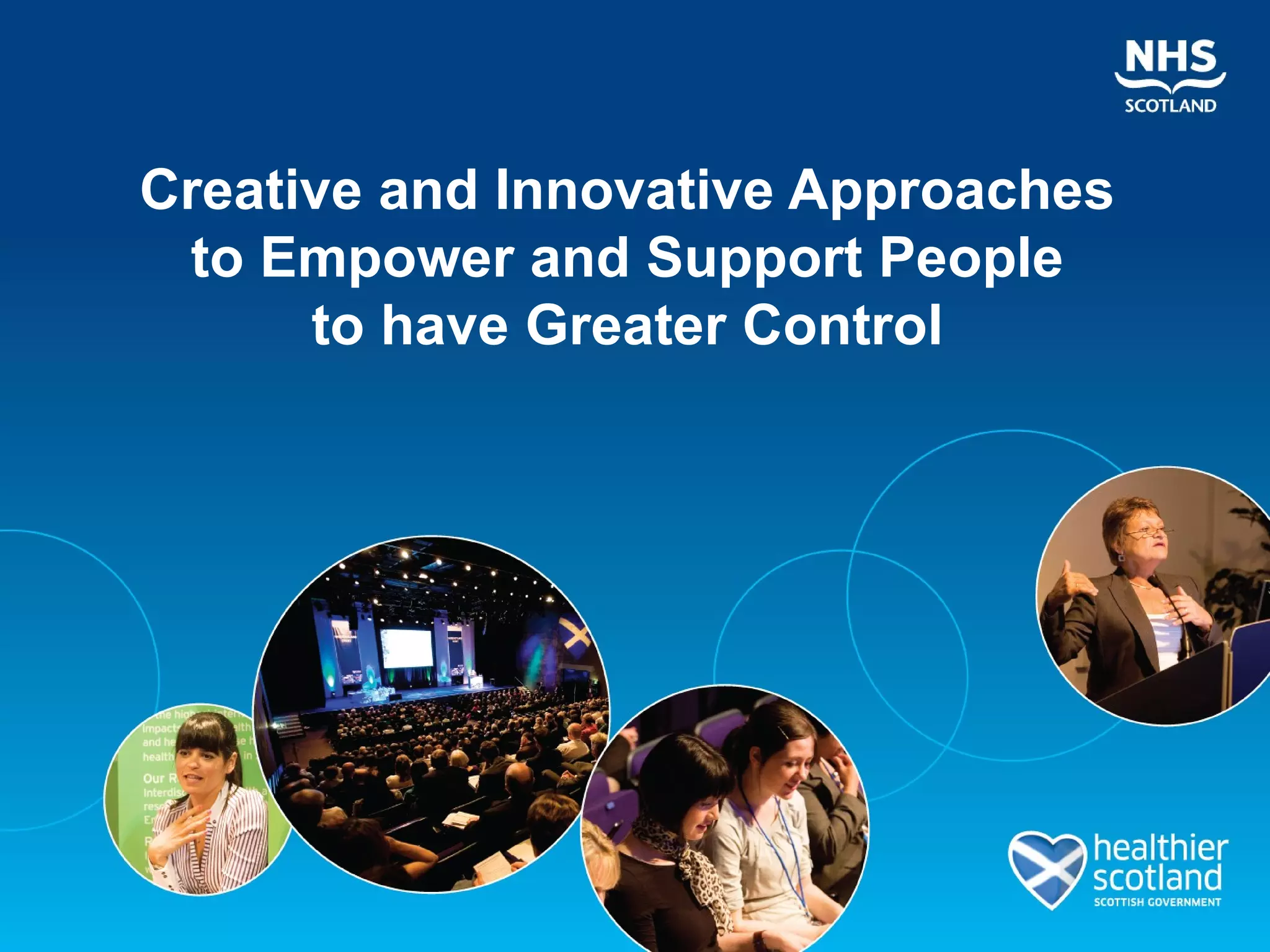
Creative and Innovative Approaches
 to Empower and Support People
      to have Greater Control
Assets, Outcomes and Risk Enablement

                   • NHS Quality Strategy

                   • Person-centred

                   • Effective

                   • Safe
Long Term Conditions Alliance Scotland

                   • Background

                   • Membership

                   • Shared agenda

                   • Policy
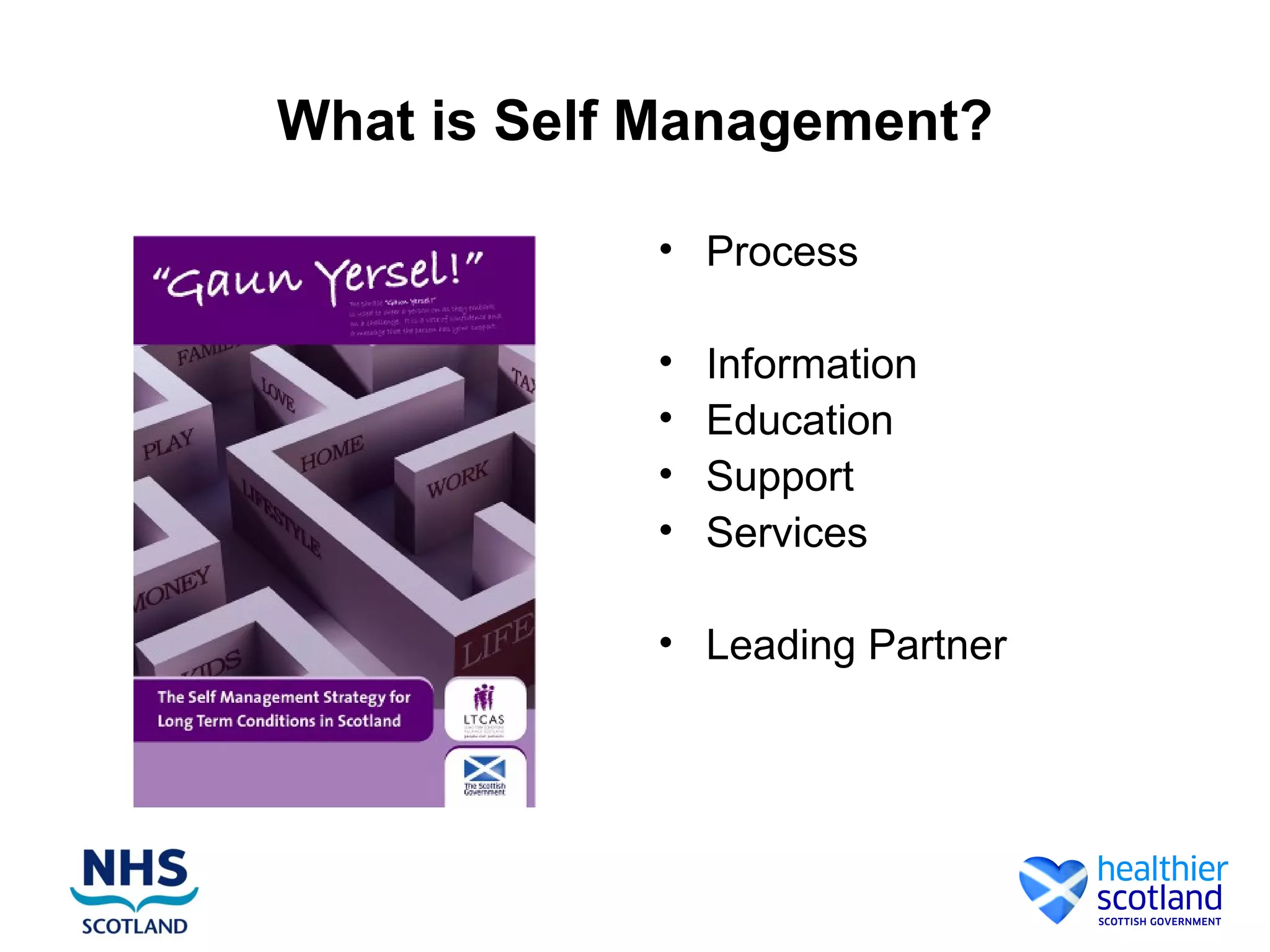
What is Self Management?

            • Process

            •   Information
            •   Education
            •   Support
            •   Services

            • Leading Partner
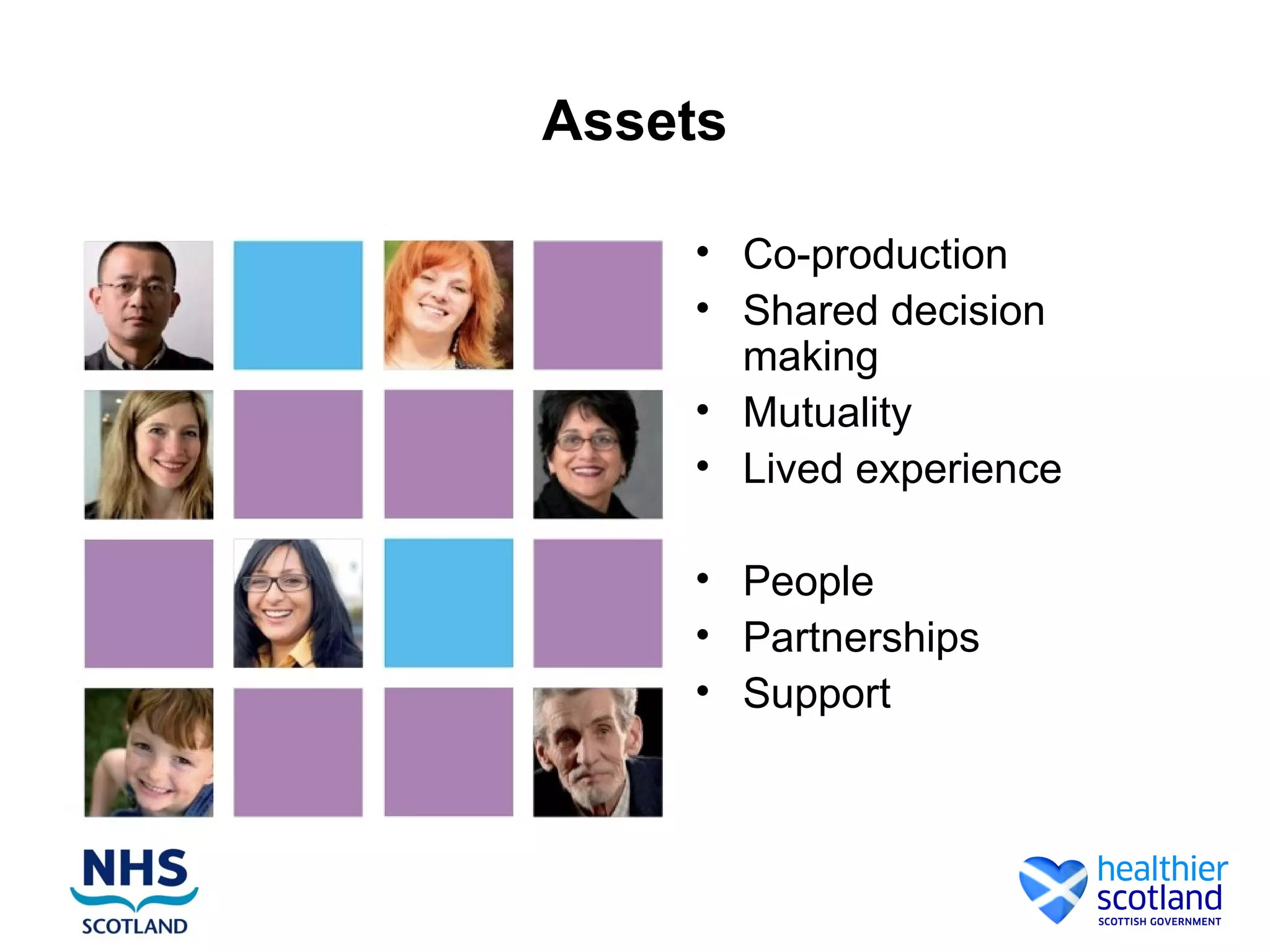
Assets

    • Co-production
    • Shared decision
      making
    • Mutuality
    • Lived experience

    • People
    • Partnerships
    • Support
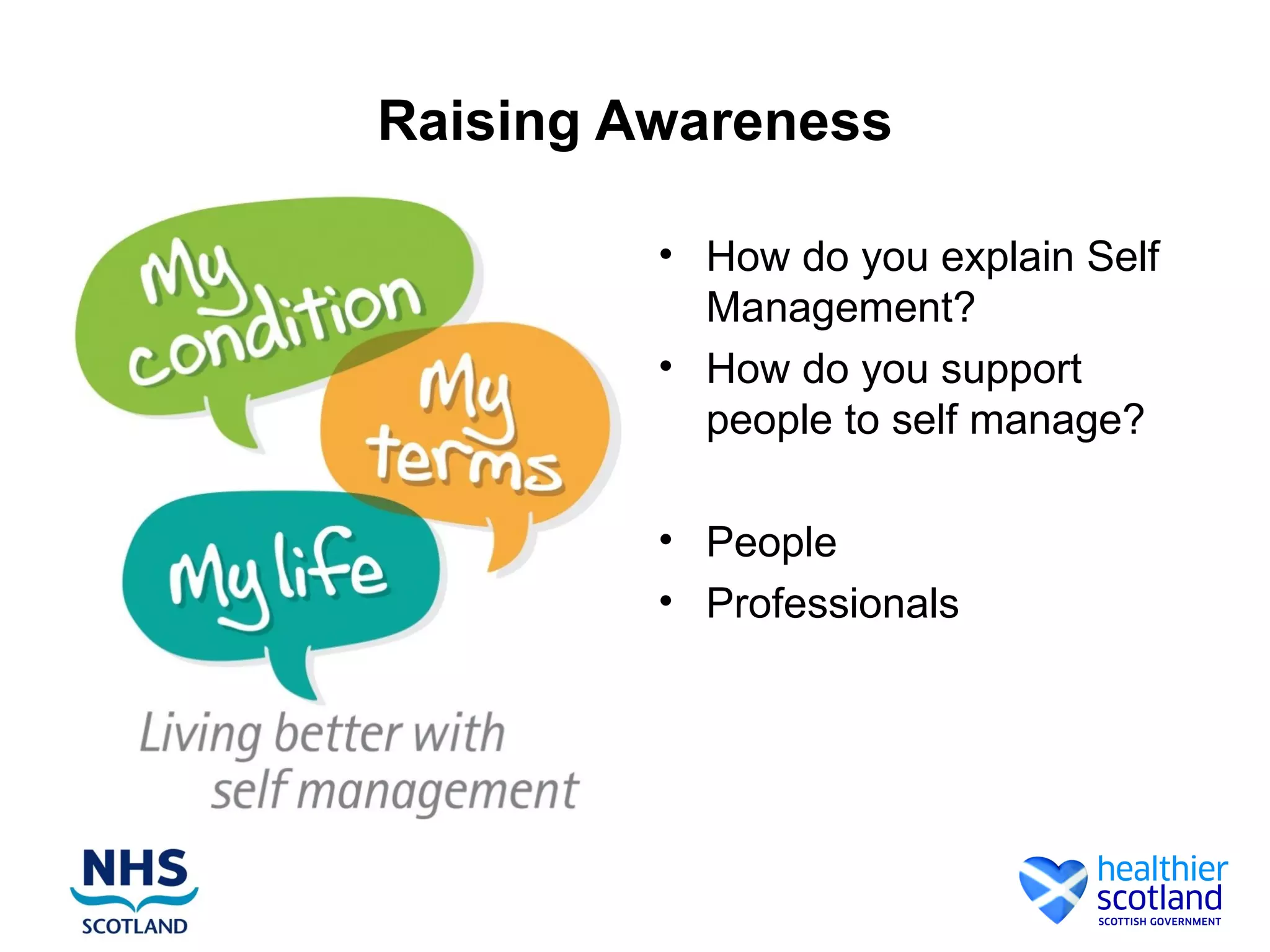
Raising Awareness

         • How do you explain Self
           Management?
         • How do you support
           people to self manage?

         • People
         • Professionals
Conversations that Matter –
Becoming Facilitators not Fixers

         Ross Grieve
Conversations which Support Self
         Management at Thistle
• Relationship based care –person as lead partner
• Focus on –
    – working toward personal outcomes
    – Identifying and building on assets
    – ( person’s own resources, self management
      strategies, social networks, community supports)
    – Small changes
    – Relapse management and enabling positive risk
      taking
• Peer support
• ,
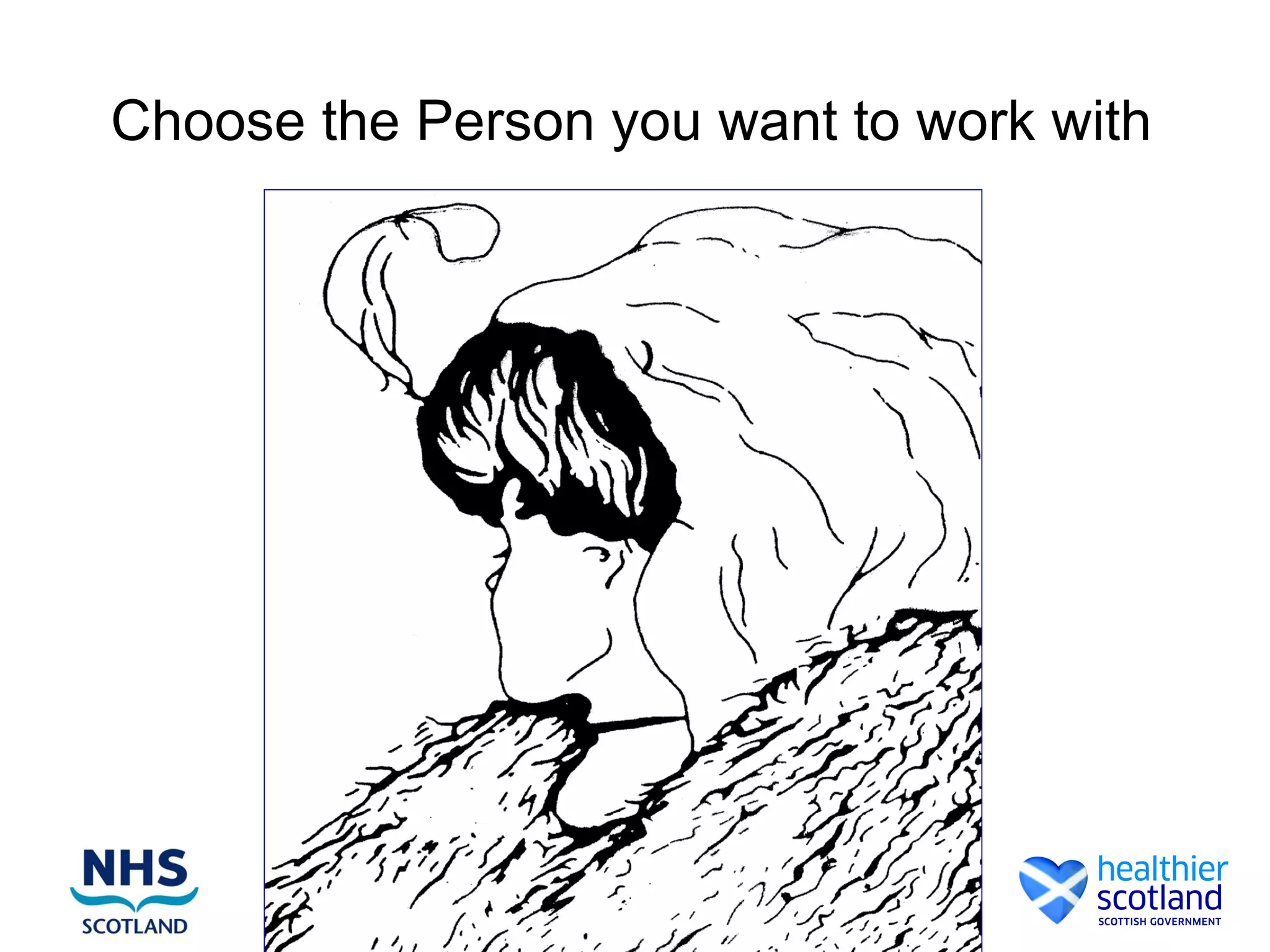
Choose the Person you want to work with
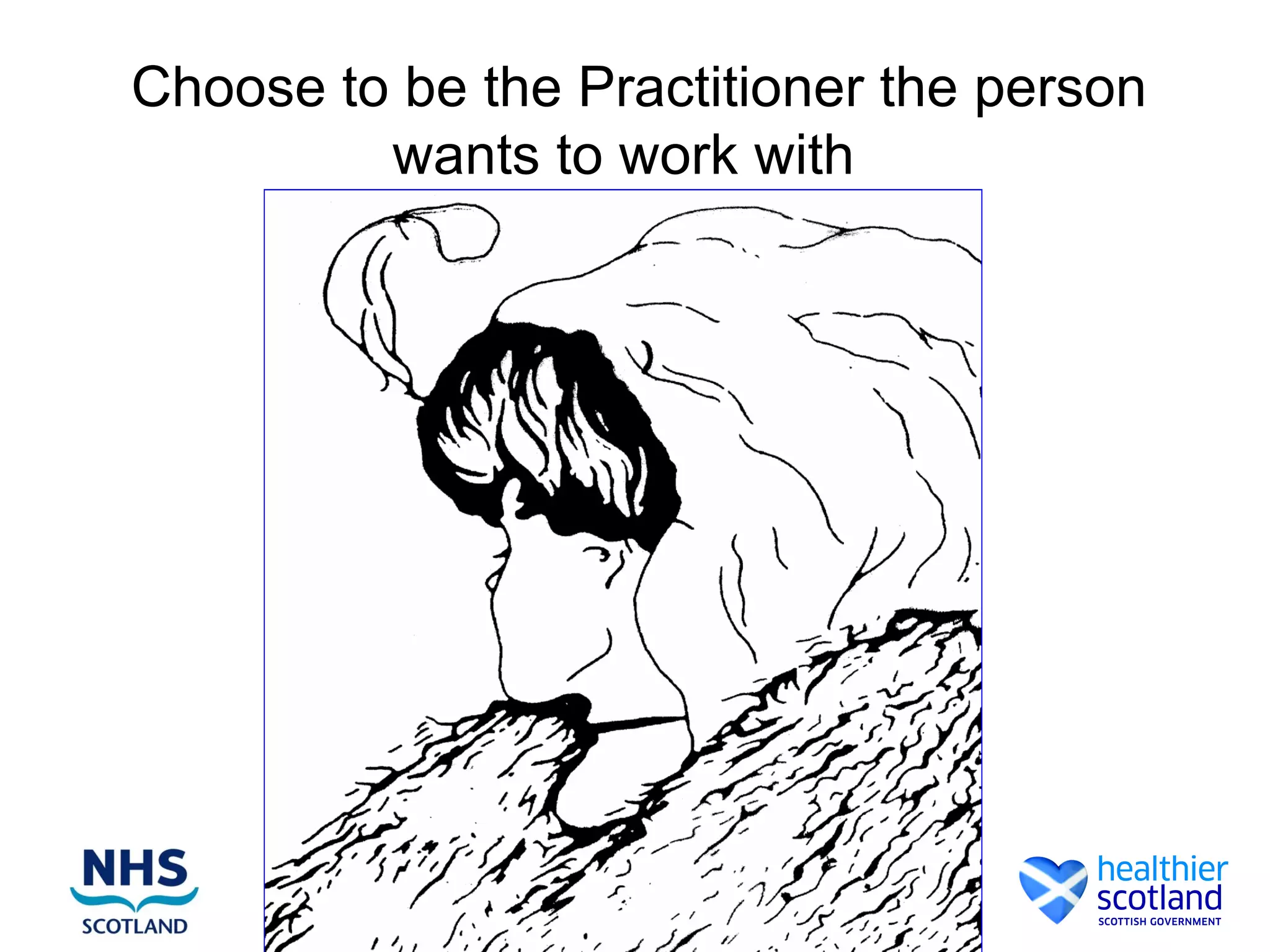
Choose to be the Practitioner the person
         wants to work with
The Non- Expert Stance

• Person as expert and authority in their life
• Practitioner as expert in facilitating change


• What are the characteristics of a facilitative approach ?
Considerations

• Motivation
• “ Everyone is motivated for something…..”
• Find and work with that motivation
• Non – compliance
• “ Simply, two people working toward different goals -
• but, the person in power gets to call the other non
  compliant”
• Resistance
• “There is no resistance - just a person’s unique way of
  co-operating”
Meeting the Person


• What do I know about this person that tells me they
  are likely to realise their hopes ?
How to help a person define what they
                  want?
• Many people know what they don’t want

• John, what are you hoping to get from us working
  together ?
• “I don’t know….I’ve been so low. I’m anxious most of the
  time”
• So, if our work proves to be useful for you , what would
  you hope to be experiencing instead?
• “ I don’t know , a bit of hope maybe…. calmness ?”
• Ok, so a bit of hope, calmness…. what else ?
How to help a person define what they
                  want?
• What would people say if they are asked

• “ what was helpful about the practitioner asking you
  what you wanted to get from the work? “
Negotiate Change into Being….now !
• Many concerns (and therefore hopes) can start to
  change through the process of conversation

•   Emotional states
•   “I’ve no confidence, I feel so low , I don’t have control”
•   Identity
•   I used to be the main contributor
•   I just want to be my old self again
•   Strategy ( self management skills)
•    I don’t know how to cope with the way my energy
    changes
Why does a focus on the future rekindle
             lost hope ?
• The importance of detailed description of the “outcome”
  people are aspiring toward.
• Grounds the description in day to day life
• Helps people self correct if hopes appear “unrealistic”
• People start to experience the physiological states
  associated with the future description
• People notice times they are already experiencing
  aspects of the future they want ….
Identifying and building on existing
  personal resources, self management
      strategies , renewed identities
• Have there been any times recently when you have
  noticed this ( “this” meaning the description of the
  future) happening already, even in a small way ?
• and strategic questions
• How did you manage to do that ?
• and perhaps identity questions
• What does that say about you , the fact that you
  managed that, give all that’s been going on for you ?
Micro - analysis

• Co-creating change through conversation
• One utterance at a time
• What influences what the practitioner says or does
  next ?
• Eg. Traditional role - the need to fix, to do to people
• What are we trained to listen out for?
• Eg. Information we require for assessment purposes
Micro - analysis

• What happens in conversation when we are trained to
  listen out for signs of:
• coping, resilience , survival
• what people want and
• descriptions of the future ( personal outcomes)
• resources which will enable the future to be realised
• ( assets)
• Positive risk taking
Micro- analysis

• There’s been times recently when I’ve hardly had any
  sleep ?
• What’s different about the times when you have managed
  to get some sleep?
Micro- analysis

• Most of the time when I have a good day, I feel so
  relieved but then the next day I feel awful again - it’s the
  not being able to predict how I’m going to be, day by day,
   that I can’t cope with . I can’t plan anything ?

• ( practitioner picking upon “ most of the time”)

• What’s different about when you have a good day and
  don’t feel awful the next day… you know - you have
  another good day?
Micro- analysis

• I suppose I’ve had good days where I’ve taken it easy
  but there’s so much to do …

• Practitioner chooses to acknowledge difficulty ( but
  there’s so much to do) and focuses on the “ taking it
  easy” day)

• Sure ( nodding)… and on the good days you took it easy
  what happened on those days?
Summary

• PERSONAL OUTCOMES
• Work with what matters most to people - the personal
  outcomes which are important to them
• ASSETS
• Identify and build on a person’s own-
   – Resources
   – Social networks
   – Community supports
• RISK ENABLEMENT
• in a culture which actively promotes positive risk taking
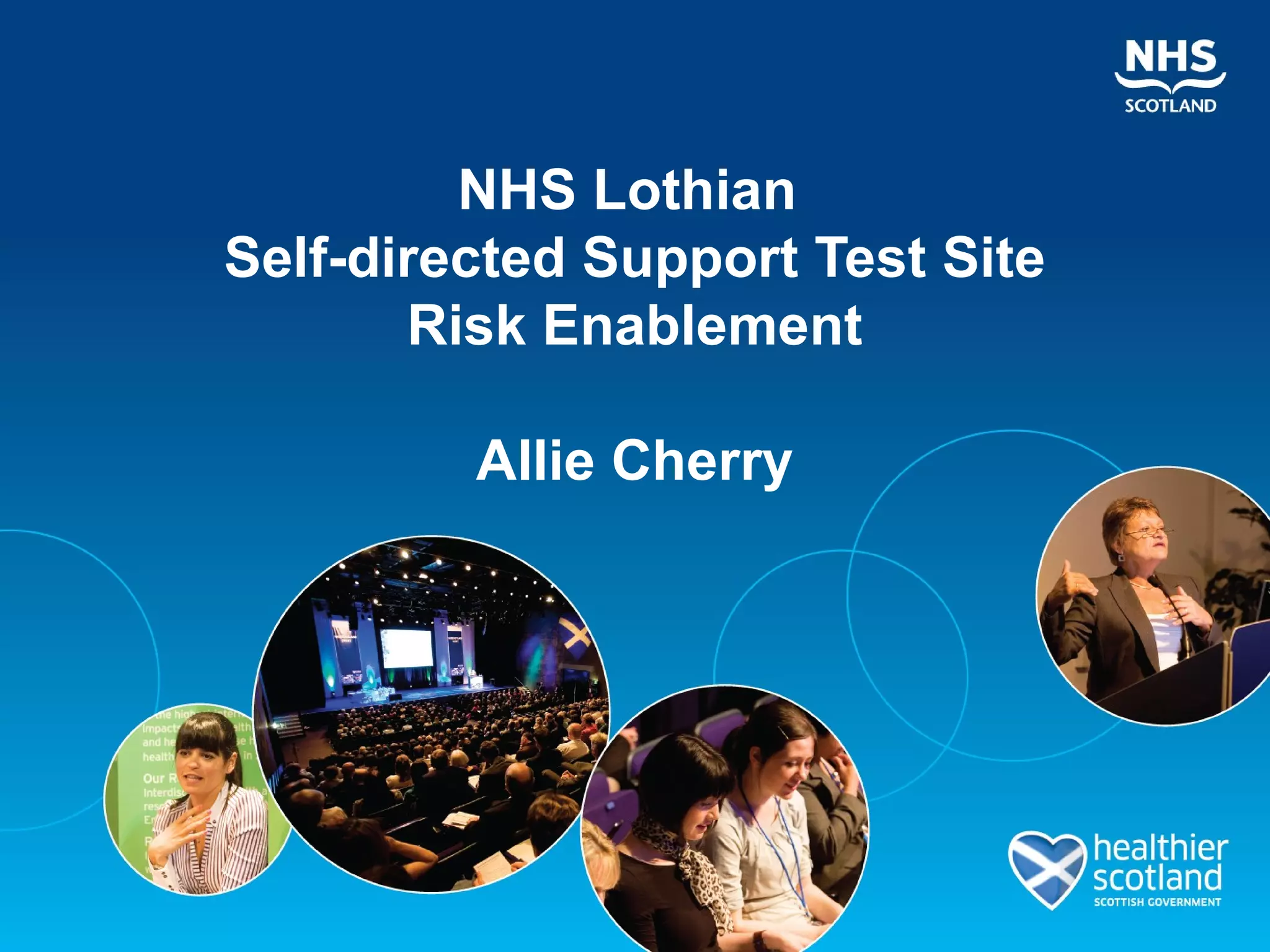
NHS Lothian
Self-directed Support Test Site
       Risk Enablement

         Allie Cherry
Self-directed Support is in line with;

•   Equally Well
•   Better Health, Better Care
•   Shifting the Balance of Care / Control
•   Gaun Yersel!: Self Management Strategy
•   The Patient Rights (Scotland) Act 2011
• “Self-directed support can help people to stay
  healthy and independent for longer.

• Self-directed support means that people can choose
  how they get support and where they get it from.”

                  Scottish Government SDS
                  Strategy Consultation Paper, 2010
Self-directed Support Options

•   Direct payment
•   Individual Service Fund
•   Directly Provided Services
•   A combination of options 1, 2 & 3
NHS Lothian Test Site - evaluation

  Learning & Development requirements of NHS
  staff

  Support staff to be confident in having SDS
  conversation, individuals are able to make an
  informed choice regarding the options available.

  Risk averse nature of some staff
Risk Enablement

“Risk enablement is concerned with managing these
risks effectively and finding a balance between the
need to protect vulnerable people and promoting the
rights of the individual. Individuals will be allowed to
take informed risks if they understand their
responsibilities and the implications of their
choices.”
                                In Control 2011
Risk enablement takes a tailored approach to risk and
goes beyond the physical components (e.g. risk of
falling), to consider the psychosocial elements (e.g.
impact on self-identity).

AHPs person-centred values base and skills in
rehabilitation & reablement make them ideally placed to
take a lead role in implementing risk enablement within
acute hospital settings & throughout the journey of care.
Risk Enablement & Self-directed support


 “Self-directed support promotes the choice and control of
 an individual in making decisions about their life and
 support. Providing choice and control for people who use
 social care means allowing people to take the risks they
 choose.”
Self-directed Support Test Site
“Risk Assessment

•   What is Risk? Risk is in everything we do, from crossing
    the road to choosing what we eat. We are all responsible for
    keeping ourselves safe, and it is important we do so.

•   What do I have to do? When you have a Self Directed
    Support Plan, NHS Lothian needs to be sure you have
    thought about how to keep safe.

•   Health Risks Please write down how these services or
    pieces of equipment might be bad for your health, and what
    you will do to stop that happening, if there are no risks
    please say so.”

                                NHSL SDS Planning Document
“If you are buying a service
    When buying a service you will need to check that
    the person has the right qualifications. Please
    answer Yes / No to the questions below, and ask
    for photocopies of their certificates.

•   Is the person a member of a professional body?
•   Do they have professional insurance?
•   Are they qualified to deliver the service?
•   Are you happy they will meet your outcomes?”
                            NHSL SDS Planning Document
SDS Test Site Process

• Health professional carries out standard
  assessment for patient.
• Health outcomes discussed and agreed
• Health professional discusses alternative to NHS
  standard provision inc risk assessment
• Patient is supported to complete SDS plan inc Risk
  Assessment section.
• Health professional signs off SDS Plan
Mr A – Multiple Sclerosis
  Weekly horse riding sessions with Riding for the
  Disabled 30 sessions @ £7.00 / session = £210

Anticipated Outcomes
      •   Improved physical & mental wellbeing
      •   Increased walking distance & balance
      •   Improved posture & muscle strength
      •   Increased stamina
      •   Increased energy levels & concentration
Mr A – Evaluation
• “I can still walk”

• Mr A has found riding to be very beneficial,
  particularly in maintaining muscle stability and
  mobility
• "SDS gave me the prod to do it and try it". The fact it
  was funded made Mr A more determined to get
  benefits from it
Kenny’s Story
DVD produced by City of Edinburgh Council
Allie Cherry
Project Manager – Self-directed Support Test Site

allie.cherry@luht.scot.nhs.uk

0131 465 5556
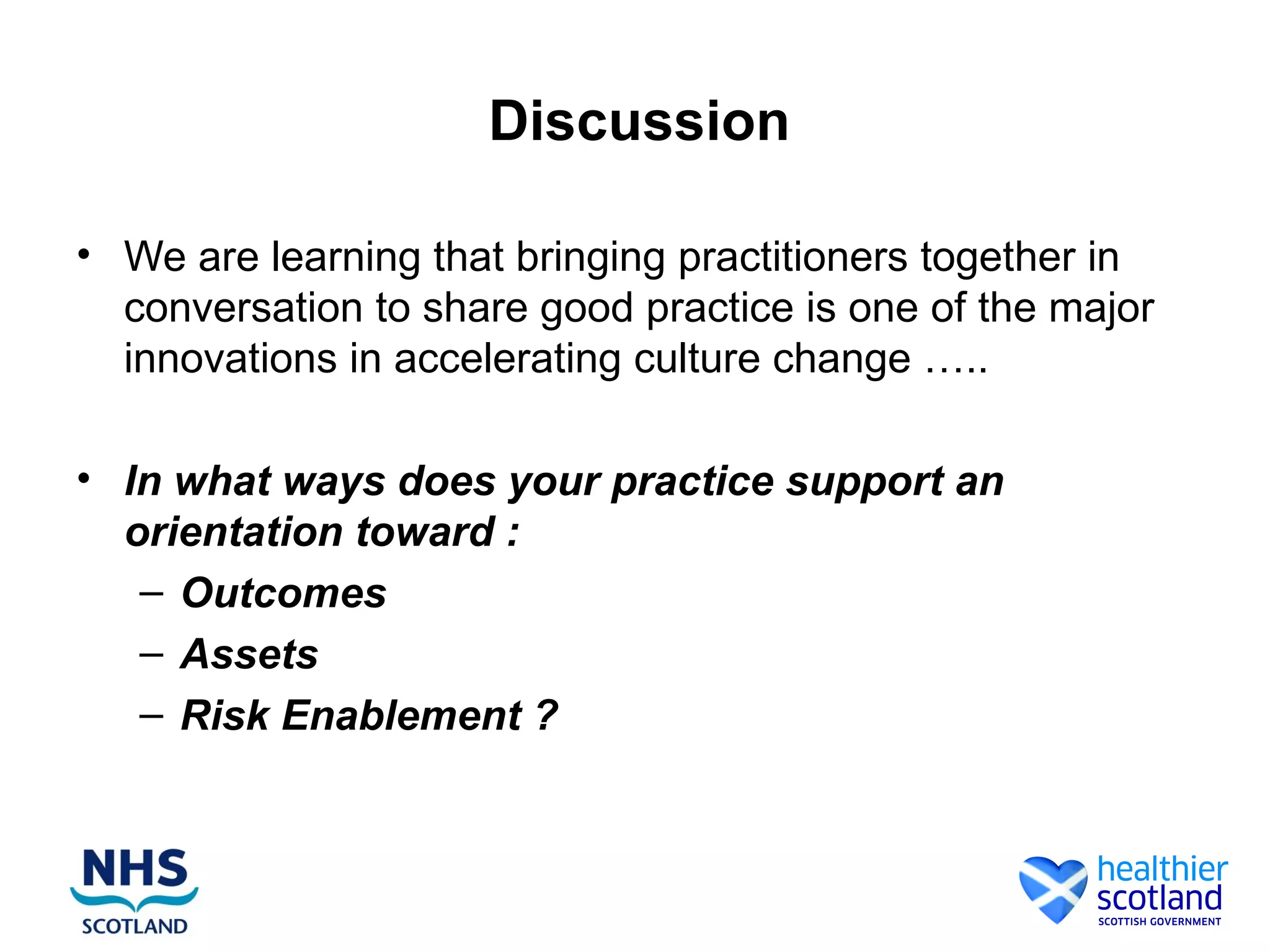
Discussion

• We are learning that bringing practitioners together in
  conversation to share good practice is one of the major
  innovations in accelerating culture change …..

• In what ways does your practice support an
  orientation toward :
   – Outcomes
   – Assets
   – Risk Enablement ?
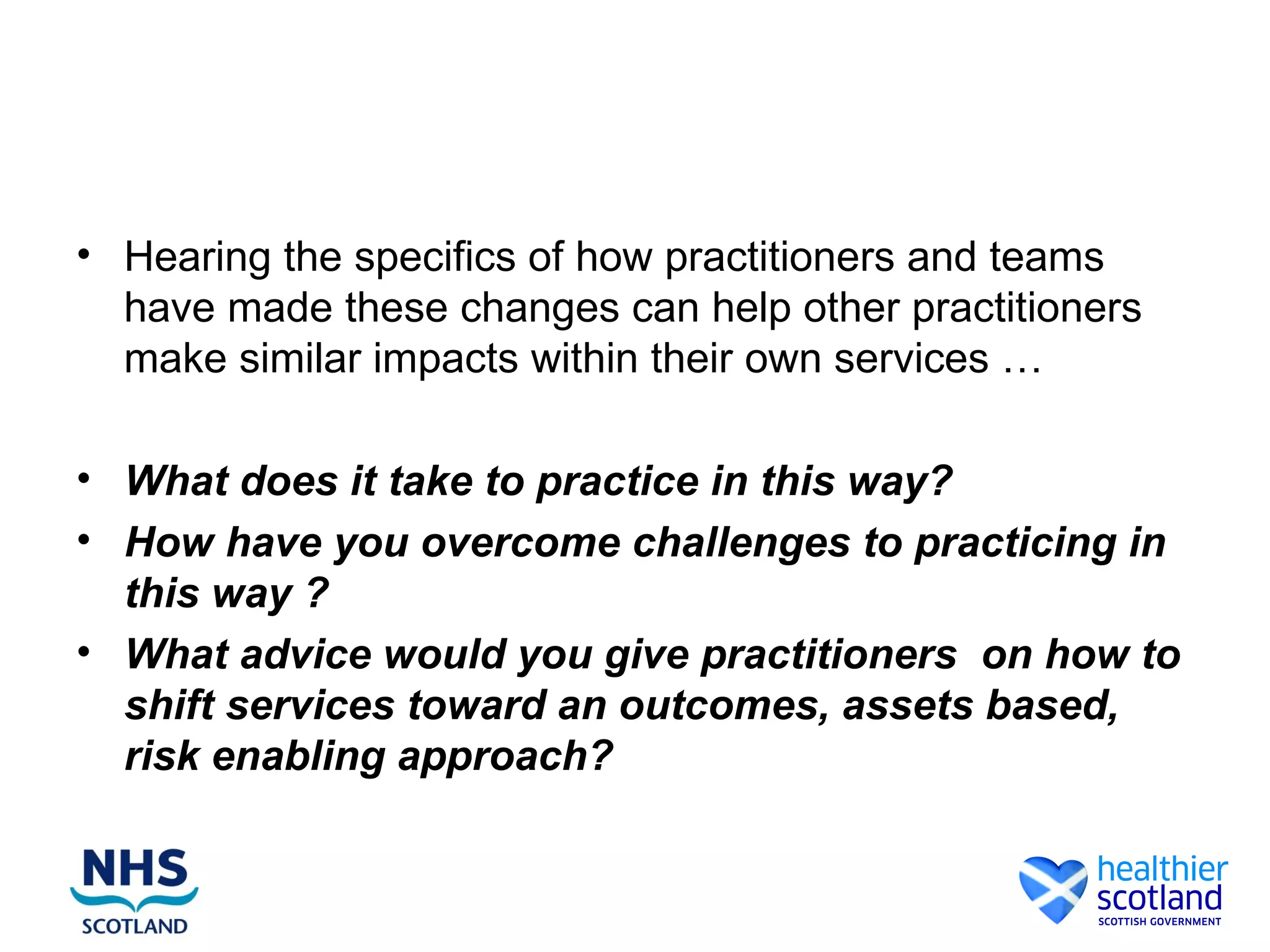
• Hearing the specifics of how practitioners and teams
  have made these changes can help other practitioners
  make similar impacts within their own services …

• What does it take to practice in this way?
• How have you overcome challenges to practicing in
  this way ?
• What advice would you give practitioners on how to
  shift services toward an outcomes, assets based,
  risk enabling approach?
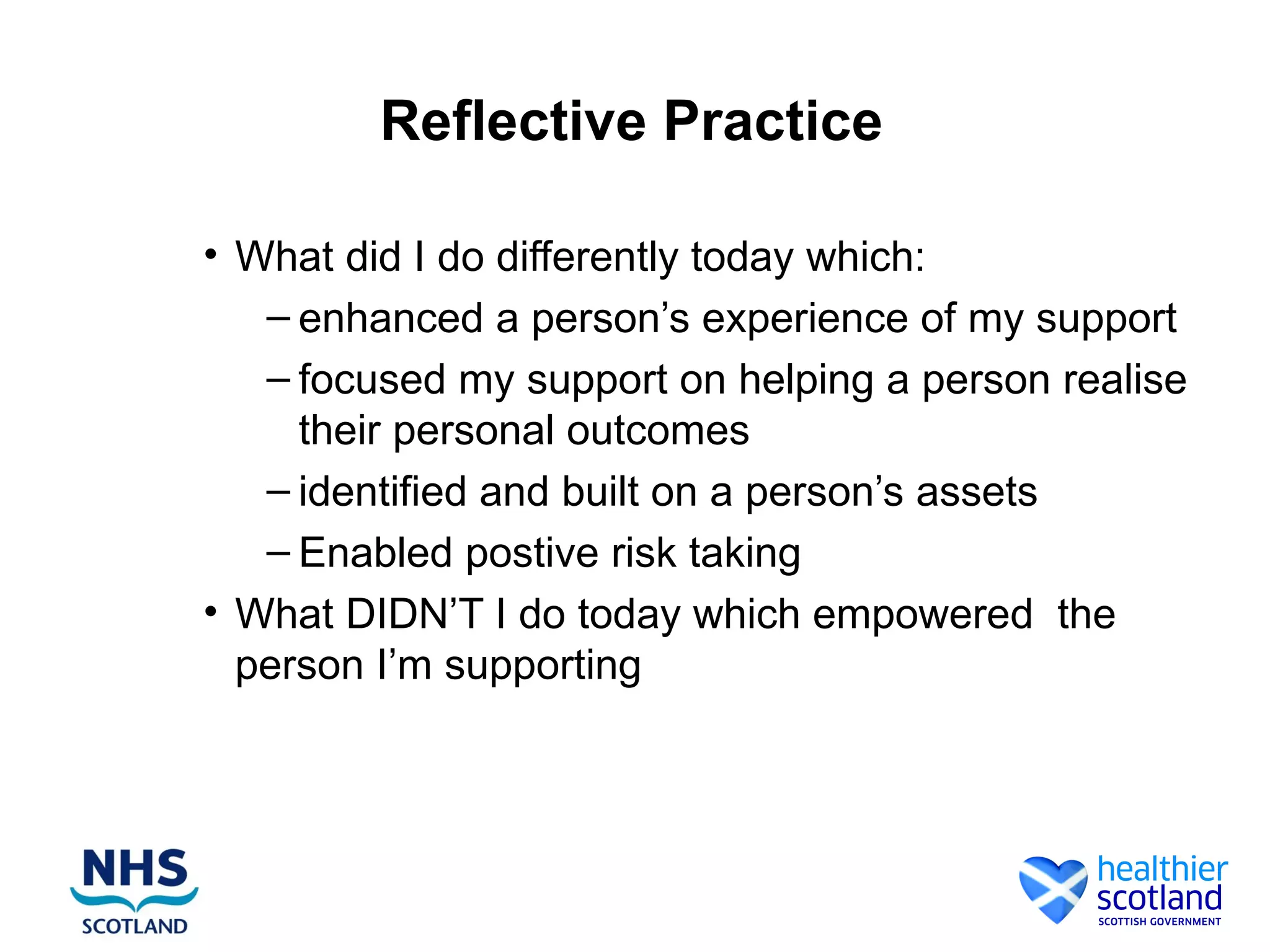
Reflective Practice

• What did I do differently today which:
   – enhanced a person’s experience of my support
   – focused my support on helping a person realise
     their personal outcomes
   – identified and built on a person’s assets
   – Enabled postive risk taking
• What DIDN’T I do today which empowered the
  person I’m supporting
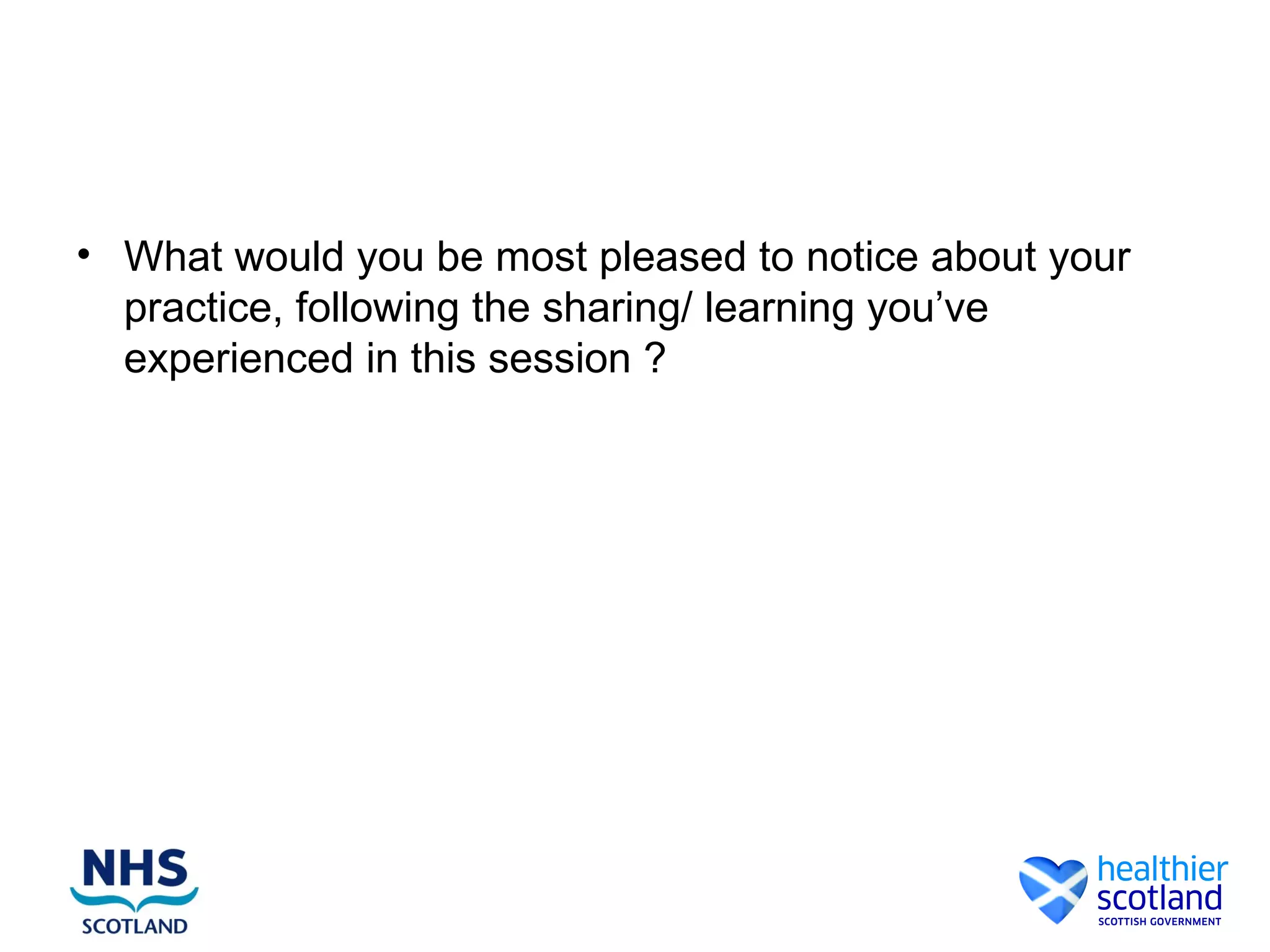
• What would you be most pleased to notice about your
  practice, following the sharing/ learning you’ve
  experienced in this session ?
Parallel Session 4.8 Creative and Innovative Approaches to Empower and Support People to Have Greater Control

Parallel Session 4.8 Creative and Innovative Approaches to Empower and Support People to Have Greater Control

  • 1.
    Creative and InnovativeApproaches to Empower and Support People to have Greater Control
  • 2.
    Assets, Outcomes andRisk Enablement • NHS Quality Strategy • Person-centred • Effective • Safe
  • 3.
    Long Term ConditionsAlliance Scotland • Background • Membership • Shared agenda • Policy
  • 4.
    What is SelfManagement? • Process • Information • Education • Support • Services • Leading Partner
  • 5.
    Assets • Co-production • Shared decision making • Mutuality • Lived experience • People • Partnerships • Support
  • 6.
    Raising Awareness • How do you explain Self Management? • How do you support people to self manage? • People • Professionals
  • 7.
    Conversations that Matter– Becoming Facilitators not Fixers Ross Grieve
  • 8.
    Conversations which SupportSelf Management at Thistle • Relationship based care –person as lead partner • Focus on – – working toward personal outcomes – Identifying and building on assets – ( person’s own resources, self management strategies, social networks, community supports) – Small changes – Relapse management and enabling positive risk taking • Peer support • ,
  • 9.
    Choose the Personyou want to work with
  • 10.
    Choose to bethe Practitioner the person wants to work with
  • 11.
    The Non- ExpertStance • Person as expert and authority in their life • Practitioner as expert in facilitating change • What are the characteristics of a facilitative approach ?
  • 12.
    Considerations • Motivation • “Everyone is motivated for something…..” • Find and work with that motivation • Non – compliance • “ Simply, two people working toward different goals - • but, the person in power gets to call the other non compliant” • Resistance • “There is no resistance - just a person’s unique way of co-operating”
  • 13.
    Meeting the Person •What do I know about this person that tells me they are likely to realise their hopes ?
  • 14.
    How to helpa person define what they want? • Many people know what they don’t want • John, what are you hoping to get from us working together ? • “I don’t know….I’ve been so low. I’m anxious most of the time” • So, if our work proves to be useful for you , what would you hope to be experiencing instead? • “ I don’t know , a bit of hope maybe…. calmness ?” • Ok, so a bit of hope, calmness…. what else ?
  • 15.
    How to helpa person define what they want? • What would people say if they are asked • “ what was helpful about the practitioner asking you what you wanted to get from the work? “
  • 16.
    Negotiate Change intoBeing….now ! • Many concerns (and therefore hopes) can start to change through the process of conversation • Emotional states • “I’ve no confidence, I feel so low , I don’t have control” • Identity • I used to be the main contributor • I just want to be my old self again • Strategy ( self management skills) • I don’t know how to cope with the way my energy changes
  • 17.
    Why does afocus on the future rekindle lost hope ? • The importance of detailed description of the “outcome” people are aspiring toward. • Grounds the description in day to day life • Helps people self correct if hopes appear “unrealistic” • People start to experience the physiological states associated with the future description • People notice times they are already experiencing aspects of the future they want ….
  • 18.
    Identifying and buildingon existing personal resources, self management strategies , renewed identities • Have there been any times recently when you have noticed this ( “this” meaning the description of the future) happening already, even in a small way ? • and strategic questions • How did you manage to do that ? • and perhaps identity questions • What does that say about you , the fact that you managed that, give all that’s been going on for you ?
  • 19.
    Micro - analysis •Co-creating change through conversation • One utterance at a time • What influences what the practitioner says or does next ? • Eg. Traditional role - the need to fix, to do to people • What are we trained to listen out for? • Eg. Information we require for assessment purposes
  • 20.
    Micro - analysis •What happens in conversation when we are trained to listen out for signs of: • coping, resilience , survival • what people want and • descriptions of the future ( personal outcomes) • resources which will enable the future to be realised • ( assets) • Positive risk taking
  • 21.
    Micro- analysis • There’sbeen times recently when I’ve hardly had any sleep ? • What’s different about the times when you have managed to get some sleep?
  • 22.
    Micro- analysis • Mostof the time when I have a good day, I feel so relieved but then the next day I feel awful again - it’s the not being able to predict how I’m going to be, day by day, that I can’t cope with . I can’t plan anything ? • ( practitioner picking upon “ most of the time”) • What’s different about when you have a good day and don’t feel awful the next day… you know - you have another good day?
  • 23.
    Micro- analysis • Isuppose I’ve had good days where I’ve taken it easy but there’s so much to do … • Practitioner chooses to acknowledge difficulty ( but there’s so much to do) and focuses on the “ taking it easy” day) • Sure ( nodding)… and on the good days you took it easy what happened on those days?
  • 24.
    Summary • PERSONAL OUTCOMES •Work with what matters most to people - the personal outcomes which are important to them • ASSETS • Identify and build on a person’s own- – Resources – Social networks – Community supports • RISK ENABLEMENT • in a culture which actively promotes positive risk taking
  • 25.
    NHS Lothian Self-directed SupportTest Site Risk Enablement Allie Cherry
  • 26.
    Self-directed Support isin line with; • Equally Well • Better Health, Better Care • Shifting the Balance of Care / Control • Gaun Yersel!: Self Management Strategy • The Patient Rights (Scotland) Act 2011
  • 27.
    • “Self-directed supportcan help people to stay healthy and independent for longer. • Self-directed support means that people can choose how they get support and where they get it from.” Scottish Government SDS Strategy Consultation Paper, 2010
  • 28.
    Self-directed Support Options • Direct payment • Individual Service Fund • Directly Provided Services • A combination of options 1, 2 & 3
  • 29.
    NHS Lothian TestSite - evaluation Learning & Development requirements of NHS staff Support staff to be confident in having SDS conversation, individuals are able to make an informed choice regarding the options available. Risk averse nature of some staff
  • 31.
    Risk Enablement “Risk enablementis concerned with managing these risks effectively and finding a balance between the need to protect vulnerable people and promoting the rights of the individual. Individuals will be allowed to take informed risks if they understand their responsibilities and the implications of their choices.” In Control 2011
  • 32.
    Risk enablement takesa tailored approach to risk and goes beyond the physical components (e.g. risk of falling), to consider the psychosocial elements (e.g. impact on self-identity). AHPs person-centred values base and skills in rehabilitation & reablement make them ideally placed to take a lead role in implementing risk enablement within acute hospital settings & throughout the journey of care.
  • 33.
    Risk Enablement &Self-directed support “Self-directed support promotes the choice and control of an individual in making decisions about their life and support. Providing choice and control for people who use social care means allowing people to take the risks they choose.”
  • 34.
  • 35.
    “Risk Assessment • What is Risk? Risk is in everything we do, from crossing the road to choosing what we eat. We are all responsible for keeping ourselves safe, and it is important we do so. • What do I have to do? When you have a Self Directed Support Plan, NHS Lothian needs to be sure you have thought about how to keep safe. • Health Risks Please write down how these services or pieces of equipment might be bad for your health, and what you will do to stop that happening, if there are no risks please say so.” NHSL SDS Planning Document
  • 36.
    “If you arebuying a service When buying a service you will need to check that the person has the right qualifications. Please answer Yes / No to the questions below, and ask for photocopies of their certificates. • Is the person a member of a professional body? • Do they have professional insurance? • Are they qualified to deliver the service? • Are you happy they will meet your outcomes?” NHSL SDS Planning Document
  • 38.
    SDS Test SiteProcess • Health professional carries out standard assessment for patient. • Health outcomes discussed and agreed • Health professional discusses alternative to NHS standard provision inc risk assessment • Patient is supported to complete SDS plan inc Risk Assessment section. • Health professional signs off SDS Plan
  • 39.
    Mr A –Multiple Sclerosis Weekly horse riding sessions with Riding for the Disabled 30 sessions @ £7.00 / session = £210 Anticipated Outcomes • Improved physical & mental wellbeing • Increased walking distance & balance • Improved posture & muscle strength • Increased stamina • Increased energy levels & concentration
  • 40.
    Mr A –Evaluation • “I can still walk” • Mr A has found riding to be very beneficial, particularly in maintaining muscle stability and mobility • "SDS gave me the prod to do it and try it". The fact it was funded made Mr A more determined to get benefits from it
  • 41.
    Kenny’s Story DVD producedby City of Edinburgh Council
  • 43.
    Allie Cherry Project Manager– Self-directed Support Test Site allie.cherry@luht.scot.nhs.uk 0131 465 5556
  • 44.
    Discussion • We arelearning that bringing practitioners together in conversation to share good practice is one of the major innovations in accelerating culture change ….. • In what ways does your practice support an orientation toward : – Outcomes – Assets – Risk Enablement ?
  • 45.
    • Hearing thespecifics of how practitioners and teams have made these changes can help other practitioners make similar impacts within their own services … • What does it take to practice in this way? • How have you overcome challenges to practicing in this way ? • What advice would you give practitioners on how to shift services toward an outcomes, assets based, risk enabling approach?
  • 46.
    Reflective Practice • Whatdid I do differently today which: – enhanced a person’s experience of my support – focused my support on helping a person realise their personal outcomes – identified and built on a person’s assets – Enabled postive risk taking • What DIDN’T I do today which empowered the person I’m supporting
  • 47.
    • What wouldyou be most pleased to notice about your practice, following the sharing/ learning you’ve experienced in this session ?