Stronger Communities, Better Lives
Engaging Communities –
        Changing Lives

           Jackie Doe
Healthy Communities Collaborative
       jackie.doe@nhs.net
Perth and Kinross Healthy
            Communities Collaborative
Aims :-
To help local people develop the skills and confidence to
work in co-production with professionals from a range of
agencies and organisations

Objectives :-
To use these partnerships to effect changes in
communities, which would result in improvements in
health care and social well being
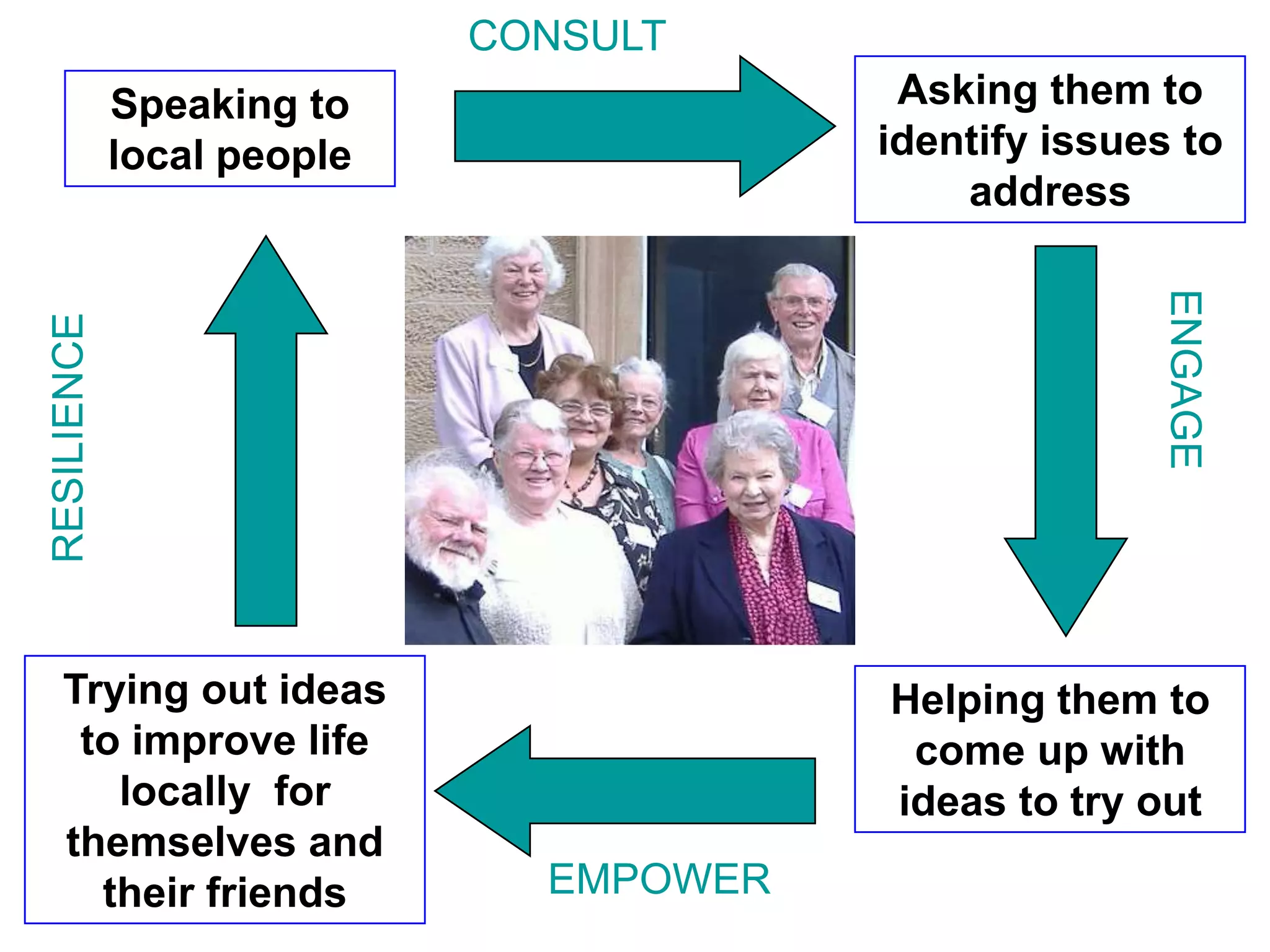
CONSULT
             Speaking to                 Asking them to
             local people               identify issues to
                                            address


                                                      ENGAGE
RESILIENCE


  Trying out ideas                      Helping them to
   to improve life                       come up with
     locally for                        ideas to try out
  themselves and
    their friends             EMPOWER
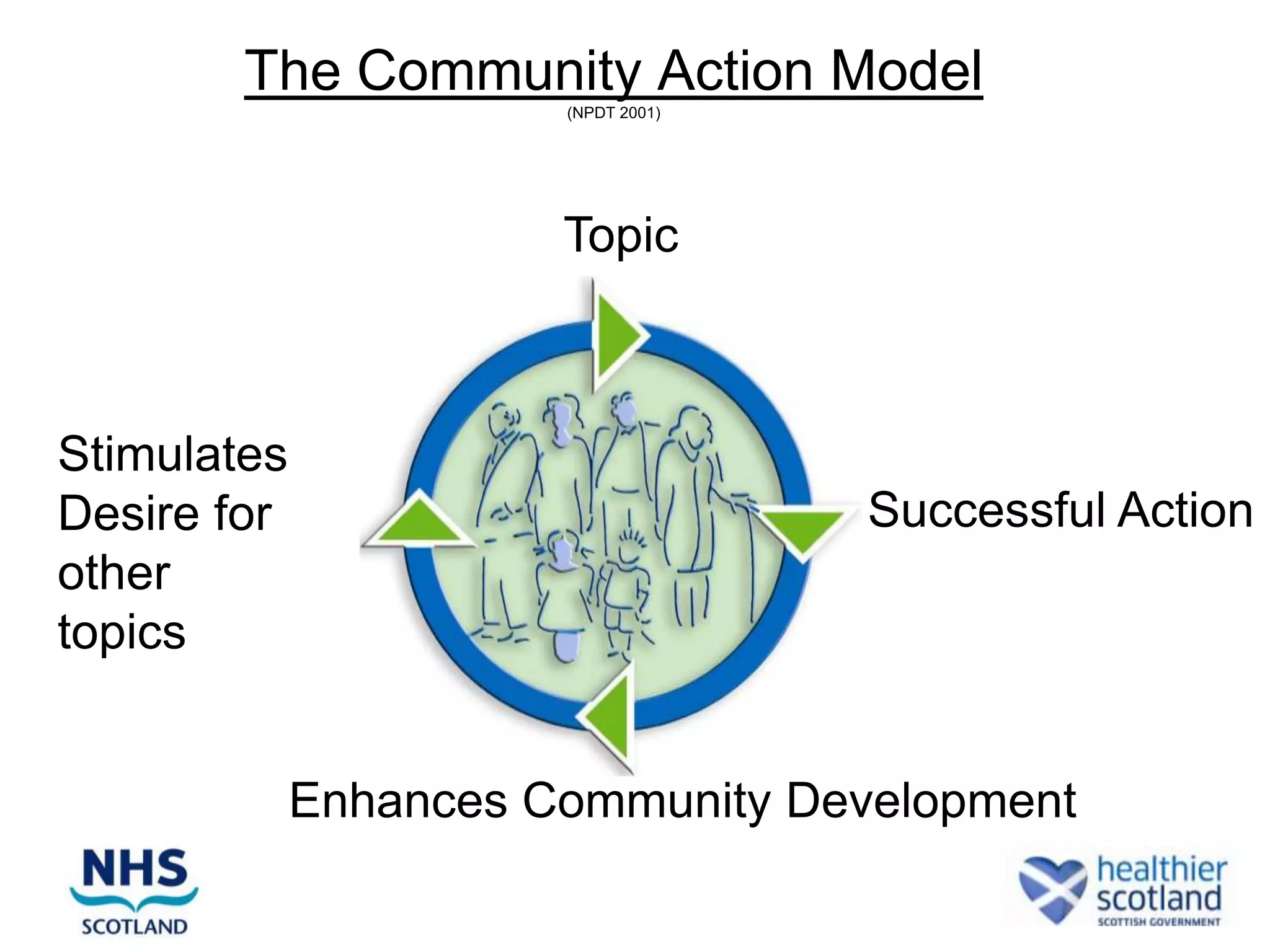
The Community Action Model
                       (NPDT 2001)


                       Topic


Stimulates
Desire for                           Successful Action
other
topics


             Enhances Community Development
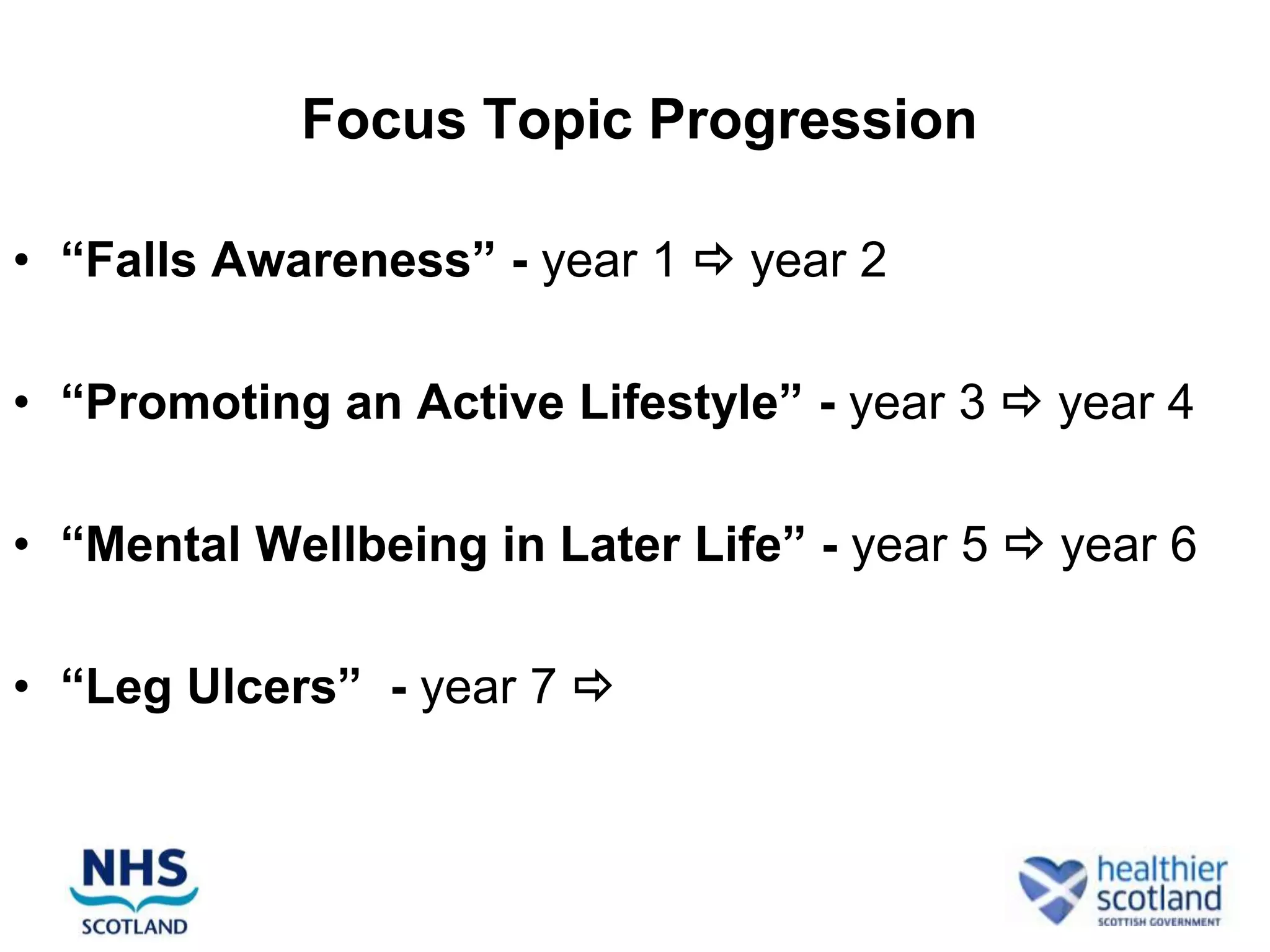
Focus Topic Progression

• “Falls Awareness” - year 1  year 2

• “Promoting an Active Lifestyle” - year 3  year 4

• “Mental Wellbeing in Later Life” - year 5  year 6

• “Leg Ulcers” - year 7 
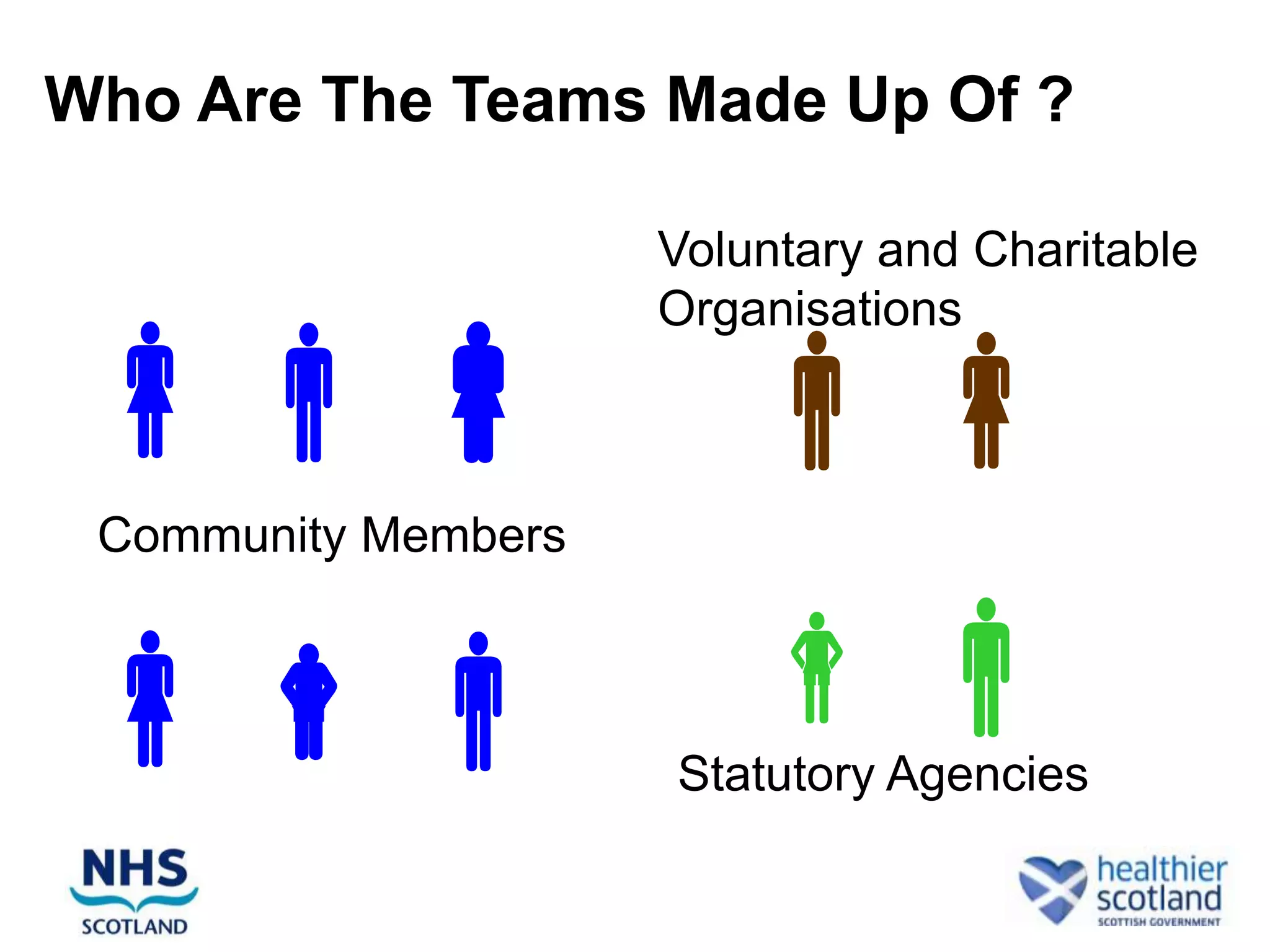
Who Are The Teams Made Up Of ?

                     Voluntary and Charitable
                     Organisations

 
 Community Members


                Statutory Agencies
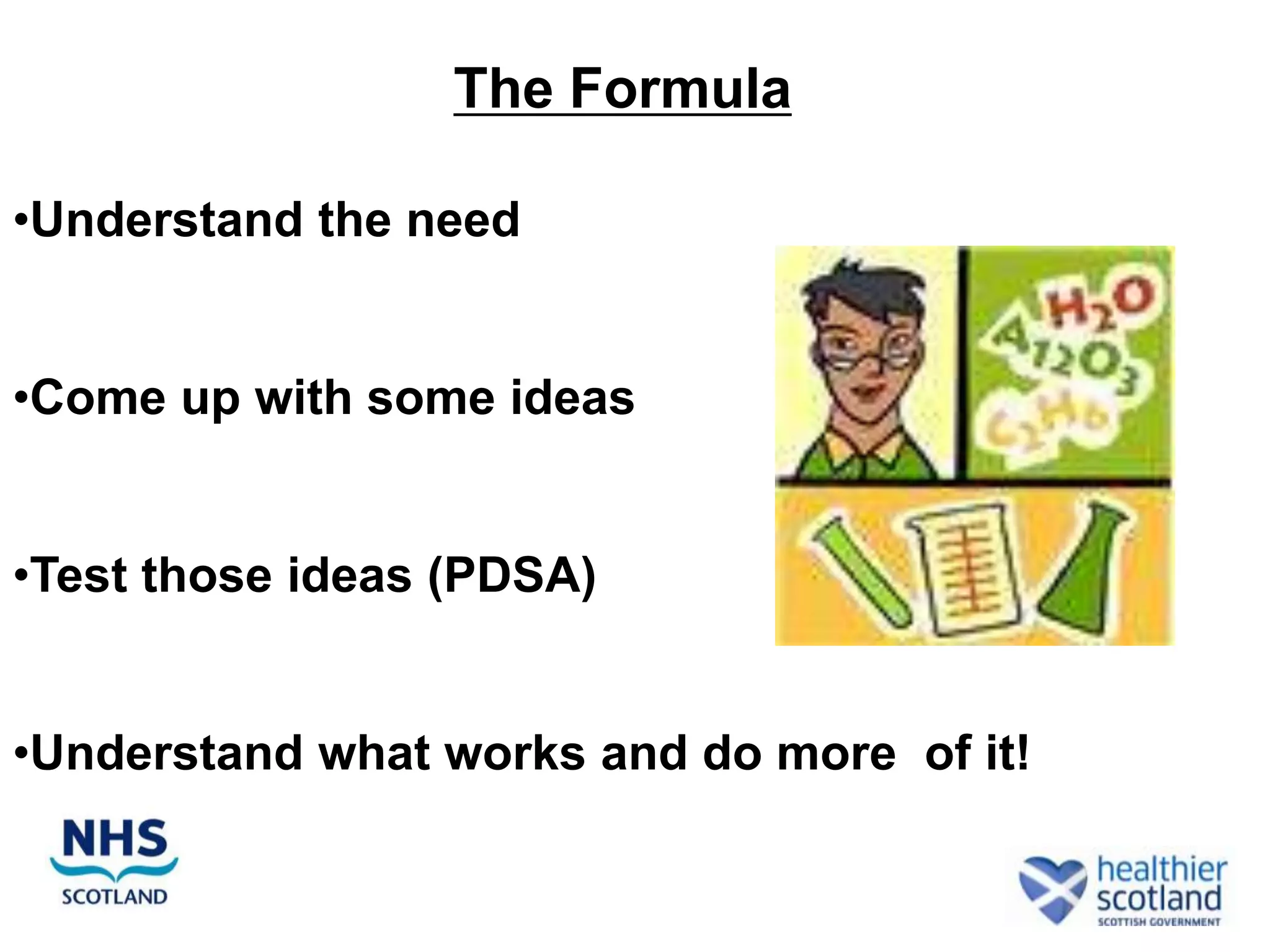
The Formula

•Understand the need


•Come up with some ideas


•Test those ideas (PDSA)


•Understand what works and do more of it!
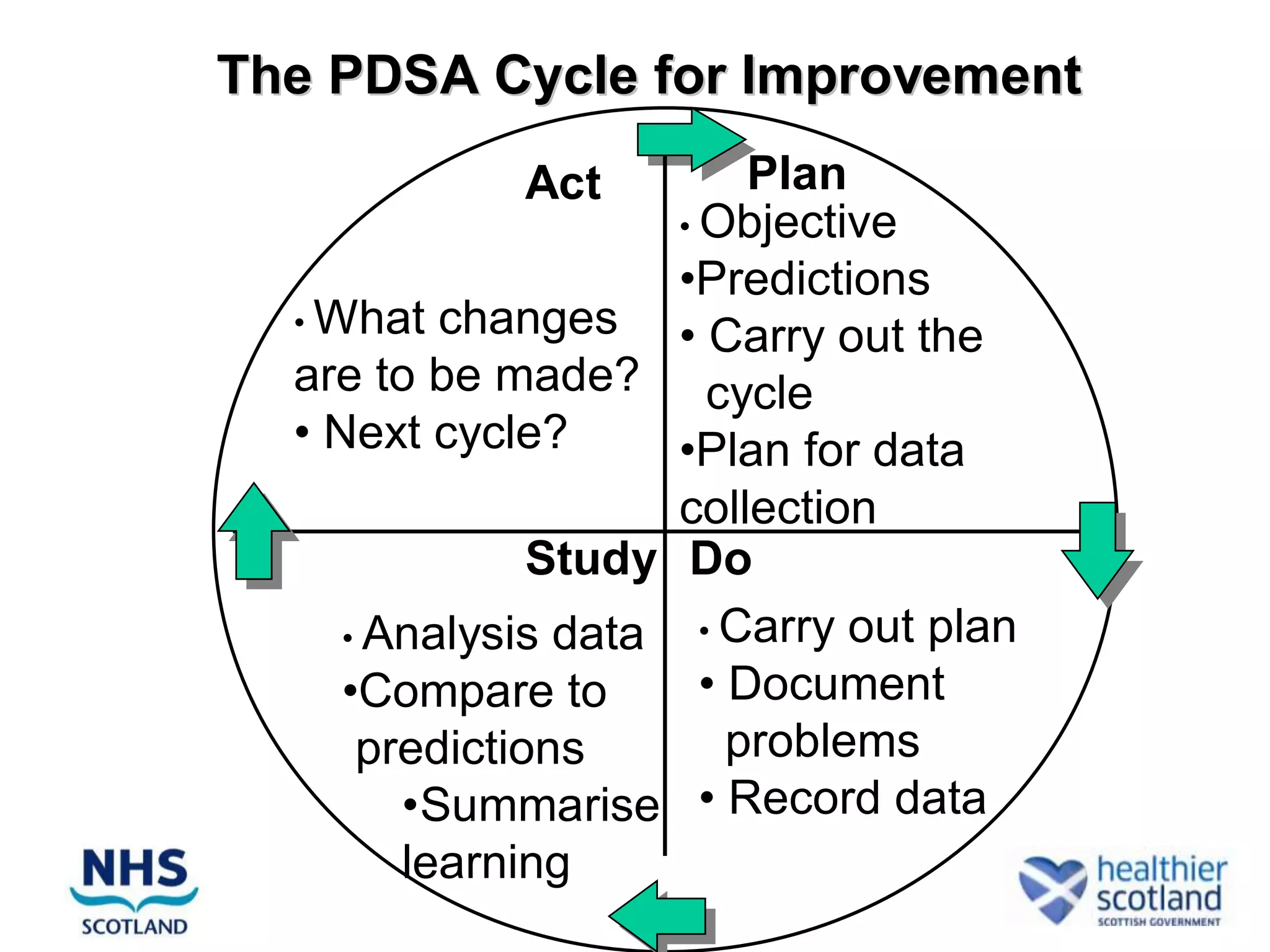
The PDSA Cycle for Improvement
             Act           Plan
                      • Objective
                      •Predictions
  • What changes      • Carry out the
  are to be made?        cycle
  • Next cycle?       •Plan for data
                      collection
             Study     Do
    • Analysis data     • Carry out plan

    •Compare to         • Document
     predictions          problems
       •Summarise       • Record data
       learning
CONSULT

• What exercise opportunities are available?

• If this is a gap, how can we address it?

• Day, time, venue, exercise density and cost

• Suitably qualified instructor

• Publicity

• On going monitoring of numbers
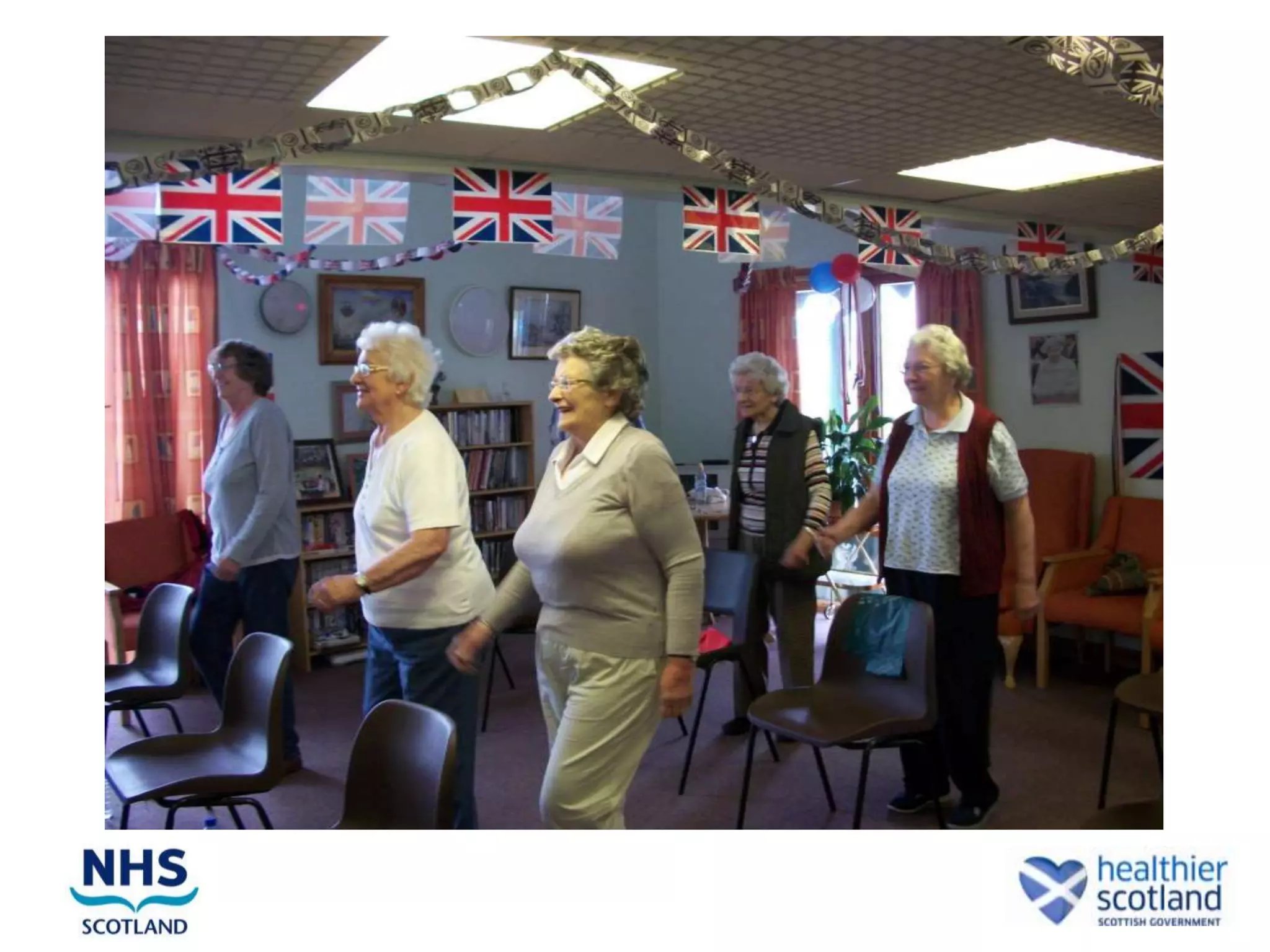
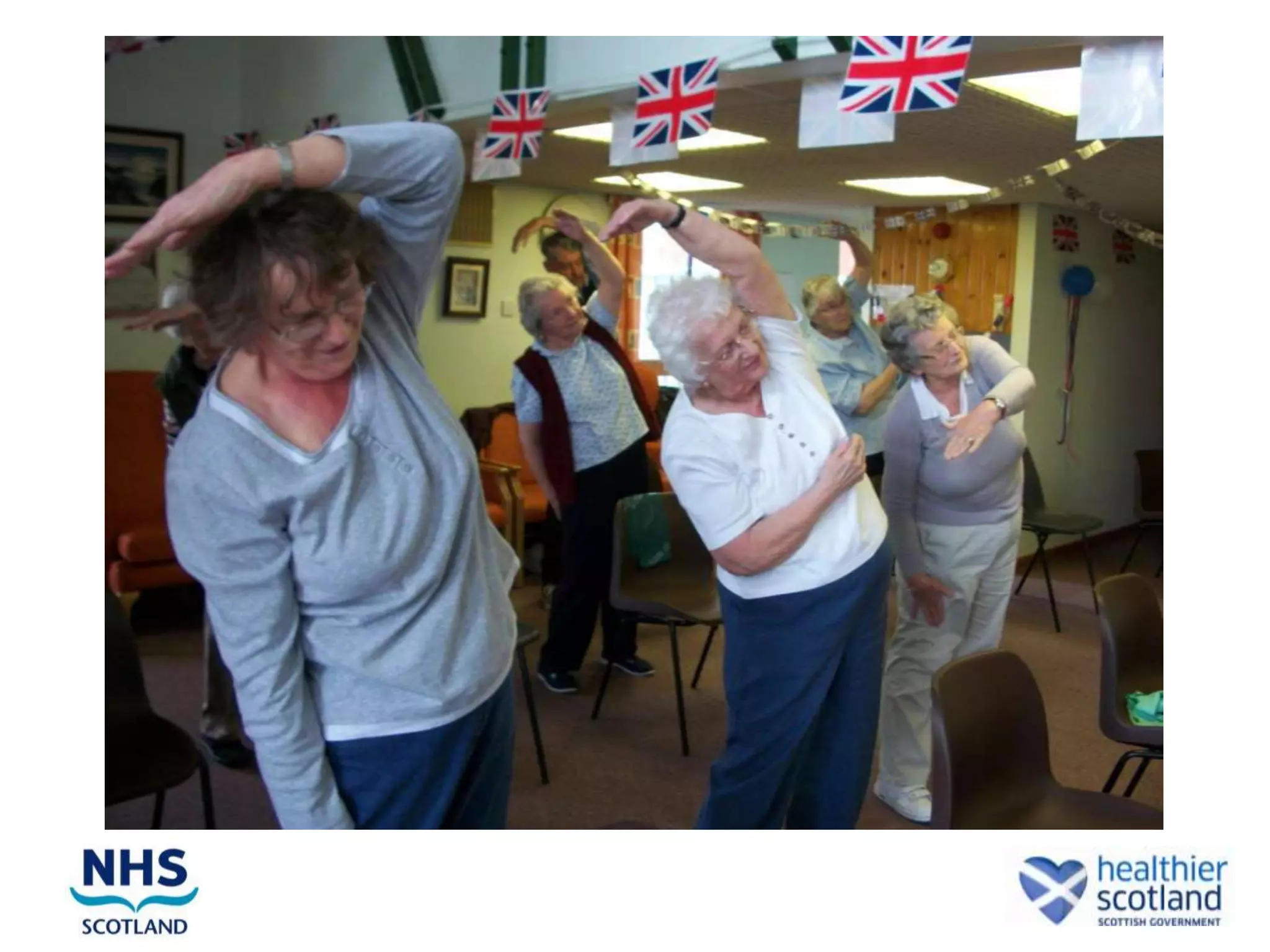
Three Main Features
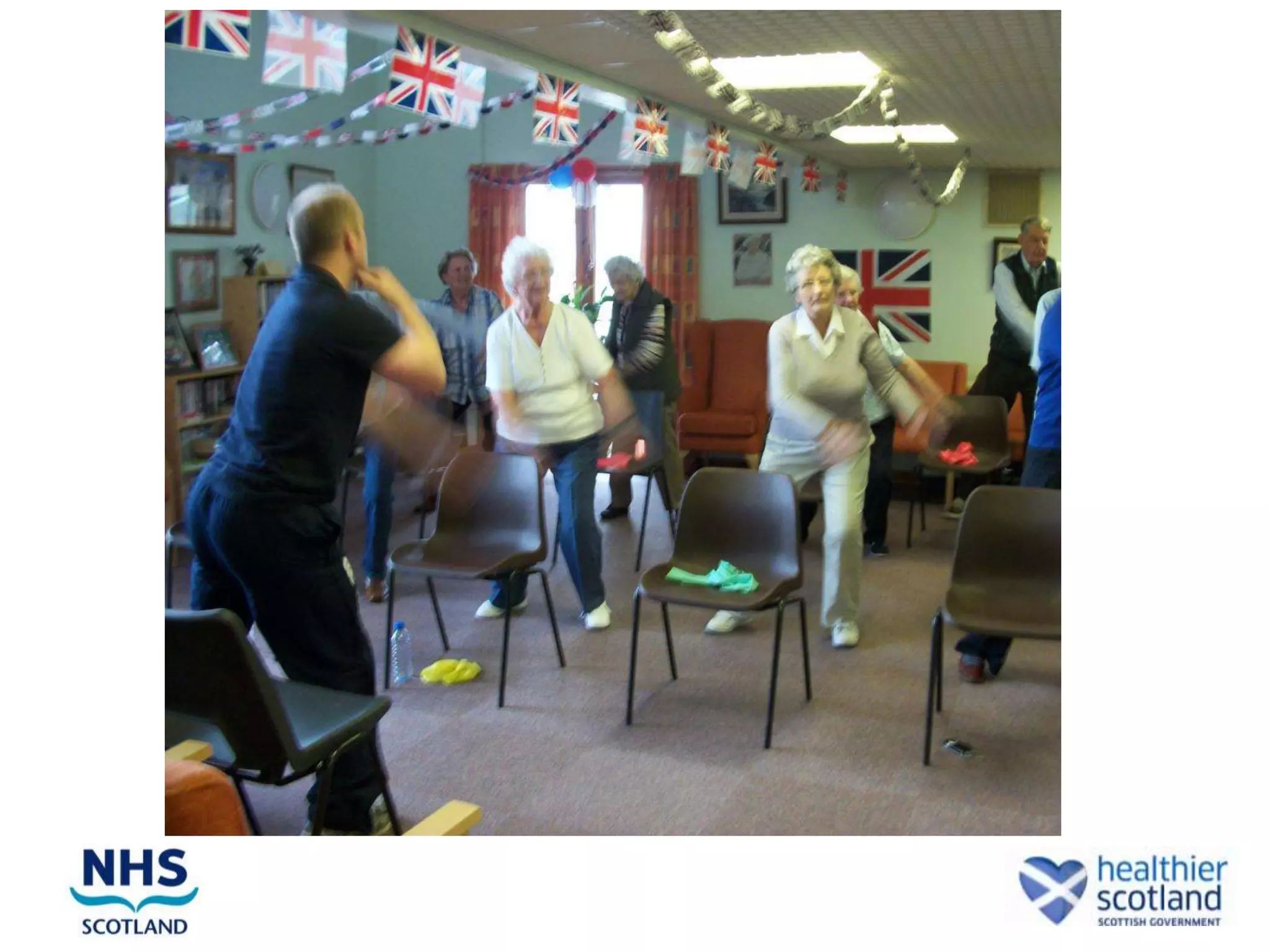
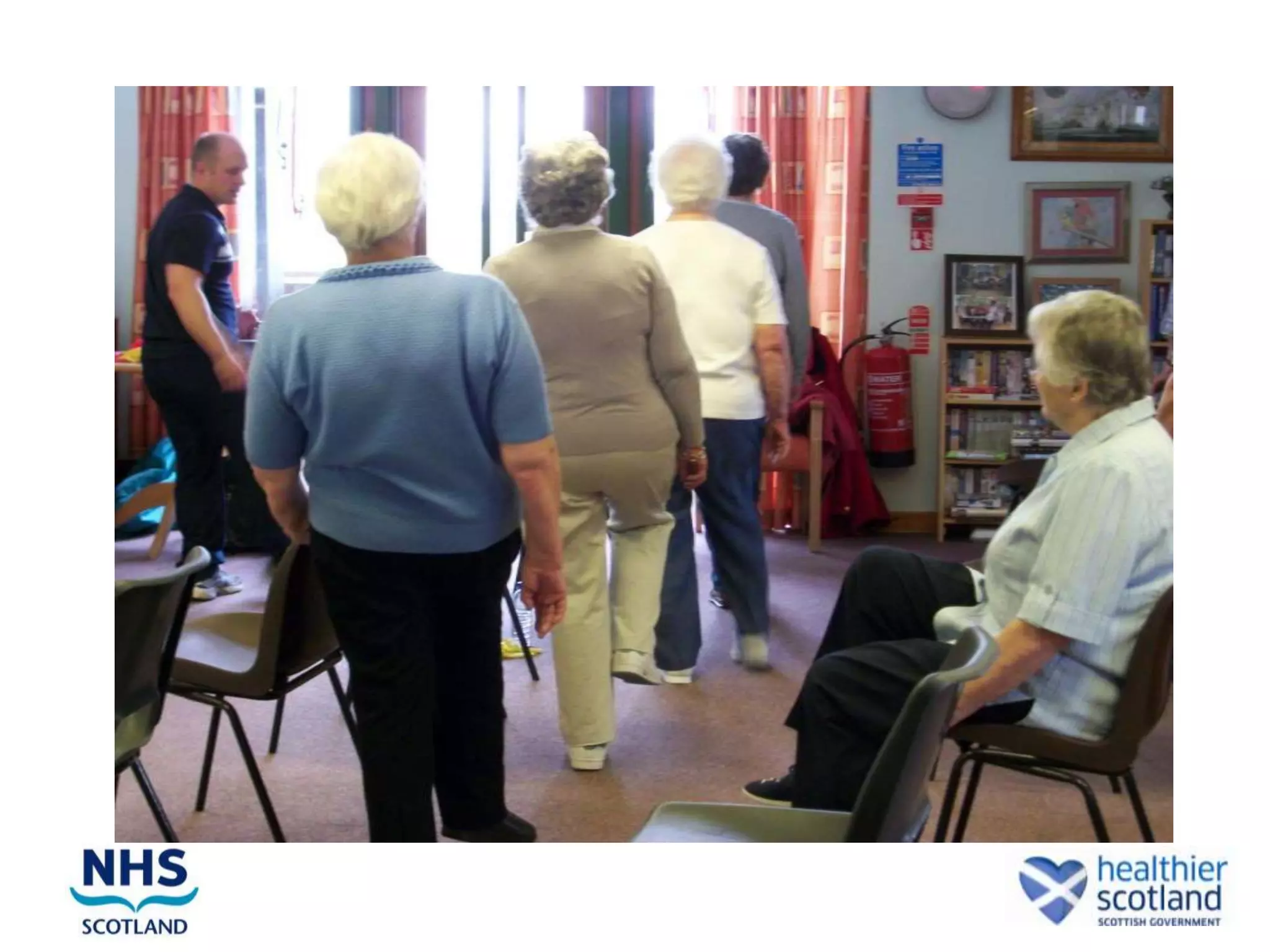
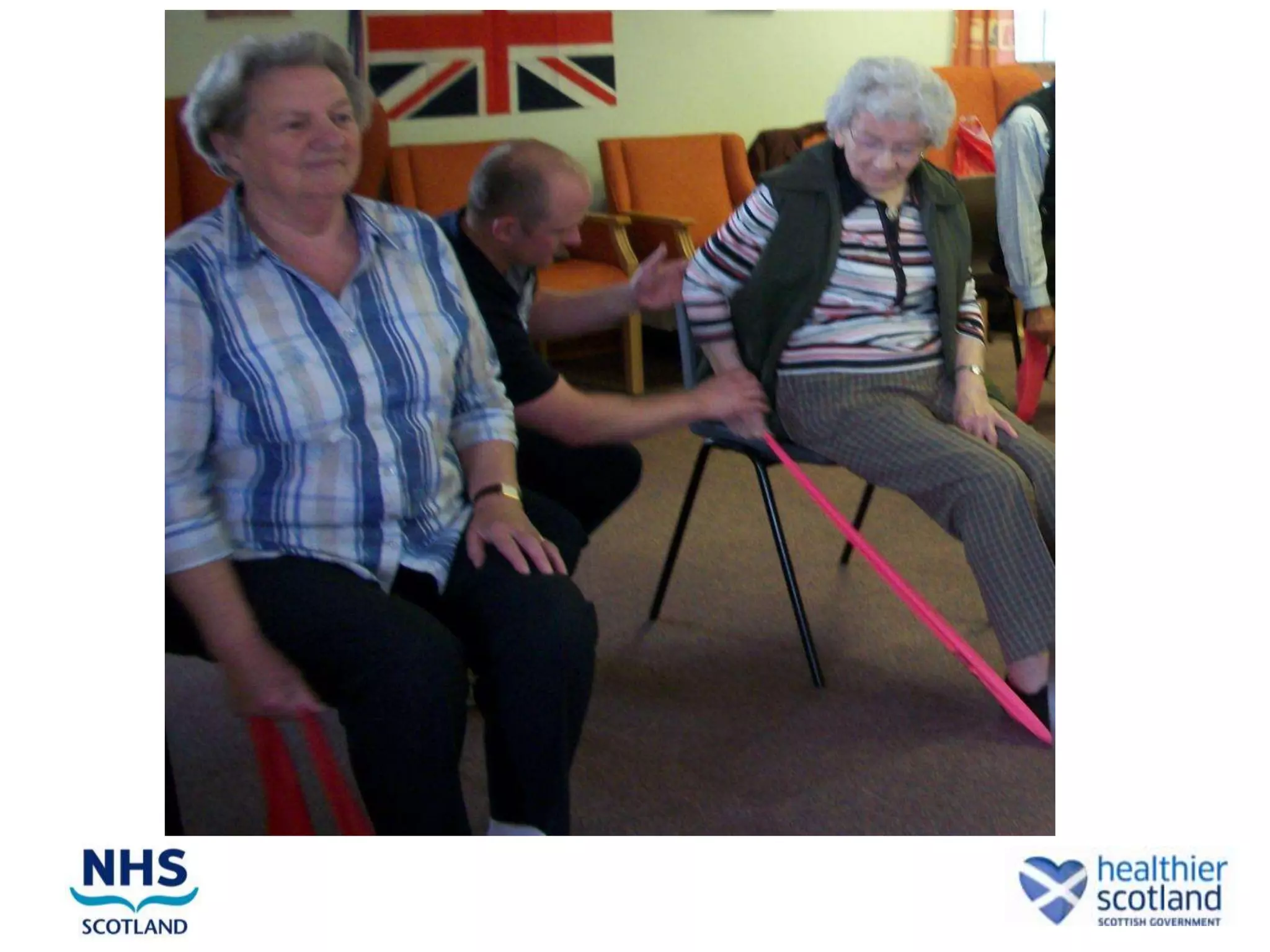
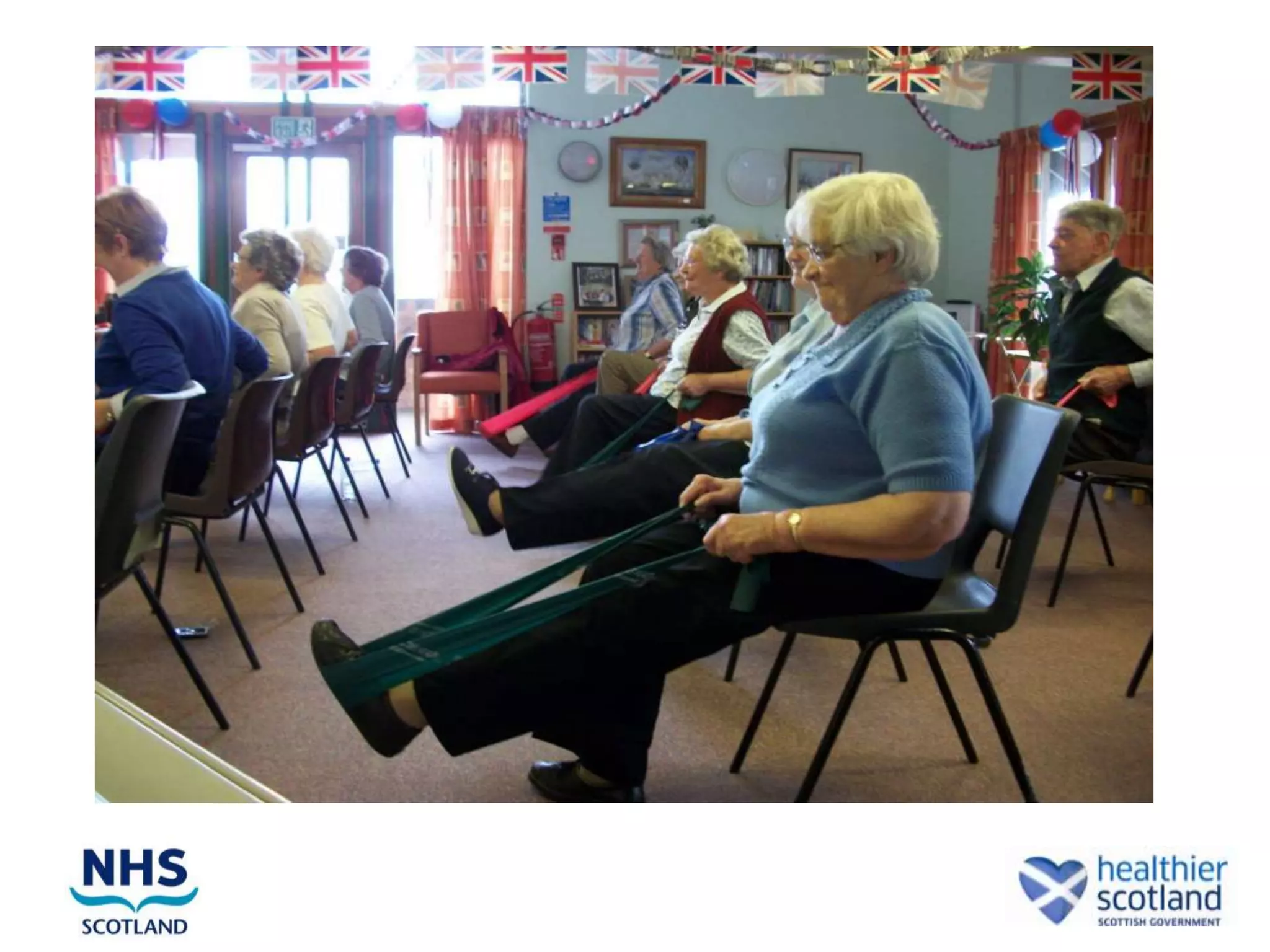
       of Exercise Programme

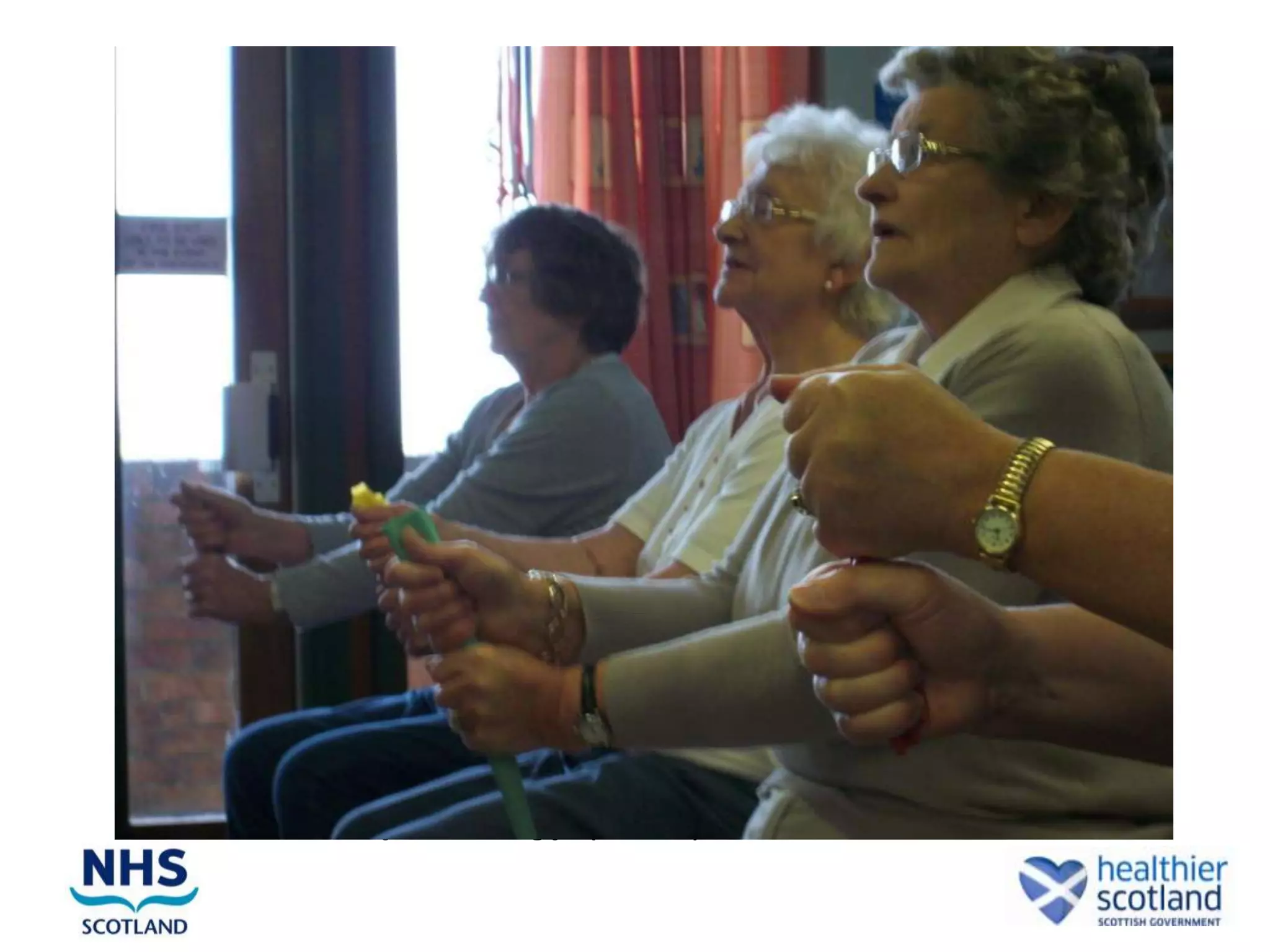
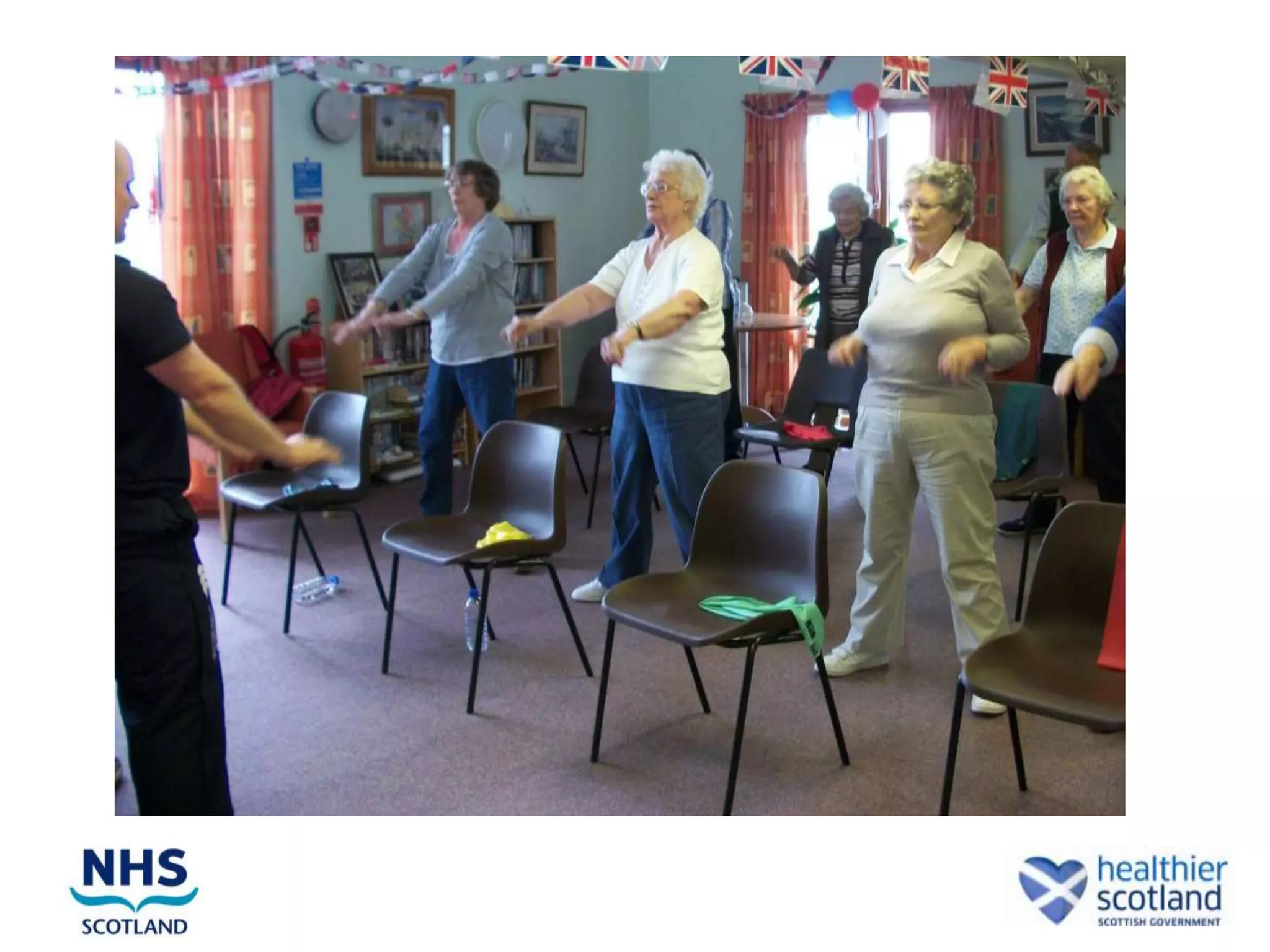
• Strengthening

• Balance Retraining

• Walking
Video clip
CHAIR BASED EXERCISE
                the EVIDENCE
• Strength and Power (Fiatarone 1990, 1994;
  Skelton 1995, 1996)
• Flexability and Functional Ability (McMurdo
  1993; Skelton 1995, 1996)
• Arthritic Pain (Hochberg 1995) & Postural
  Hypotension (Millar 1999)
• Depression (McMurdo 1993)
• Rehabilitation following hip fracture
  (Nicholson 1997)
NUMBER CRUNCHING

• Approximately 46 groups per month

• An average of over 450 older people
  attending per month

• Over 75% did not previously attend formal
  exercise group.
• Approximately 80% report some form of
  health issue ranging from painful joints to
  acknowledged long term conditions
Benefits Reported by Attendees
• My arms are looser, I can reach up behind
  my neck again
• I‟m more flexible, and balance has
  improved, it‟s easier putting on socks
• It gets me out of the house, we have a good
  laugh and it‟s good for us.
• I‟m thinking of using the bus again, it would
  be good to be more independent.
• My wife‟s concentration is better and she‟s
  more settled. We both really enjoyed coming
  to the class (Carer of dementia sufferer)
The Challenges


• On going support

• Transport

• Sustainability

• Community Referral / Social Prescribing
Recent Scottish Policy Drivers
• Better Outcomes for Older People (2004)

• The National Standards for Community
  Engagement (2005)

• Better Health, Better Care ( 2007)

• All Our Futures – Planning for a Scotland with an
  ageing population(2007)

• Reshaping Care for Older People (2010)

• The Quality Strategy (2010)
Some benefits from working this way
• Gives Communities ownership

• Maximises efficiency, people centred

• Shares skills and workload

• Releases community capacity

• Helps build community resilience

• Cost effective
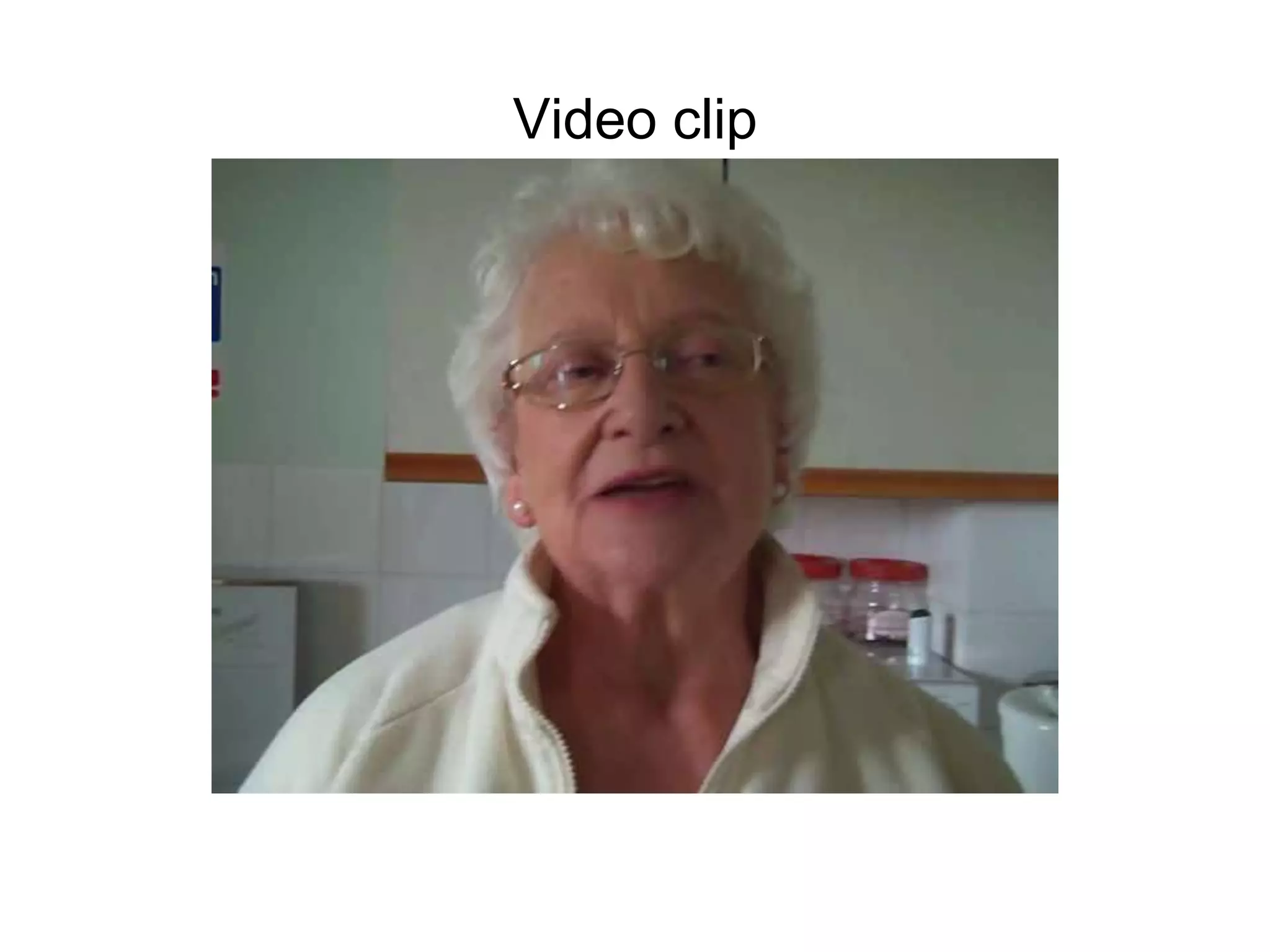
Video clip
And finally, a word from Pat
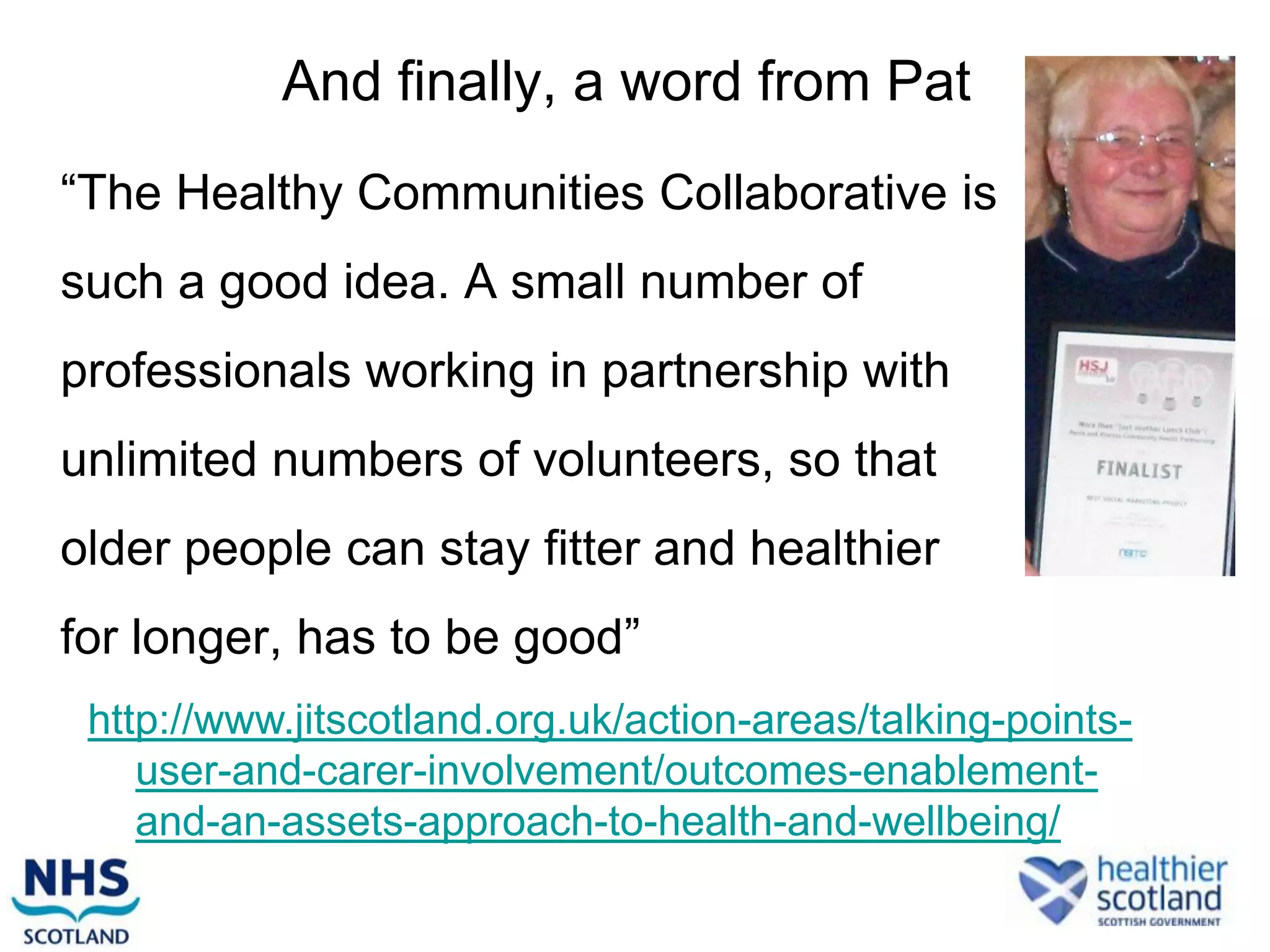
“The Healthy Communities Collaborative is
such a good idea. A small number of
professionals working in partnership with
unlimited numbers of volunteers, so that
older people can stay fitter and healthier
for longer, has to be good”
 http://www.jitscotland.org.uk/action-areas/talking-points-
    user-and-carer-involvement/outcomes-enablement-
    and-an-assets-approach-to-health-and-wellbeing/
Time Banking in
        Perth and Kinross

An exiting new initiative for communities

          Lesley McLaren, PKAVS
       lesley.mclaren@pkavs.org.uk
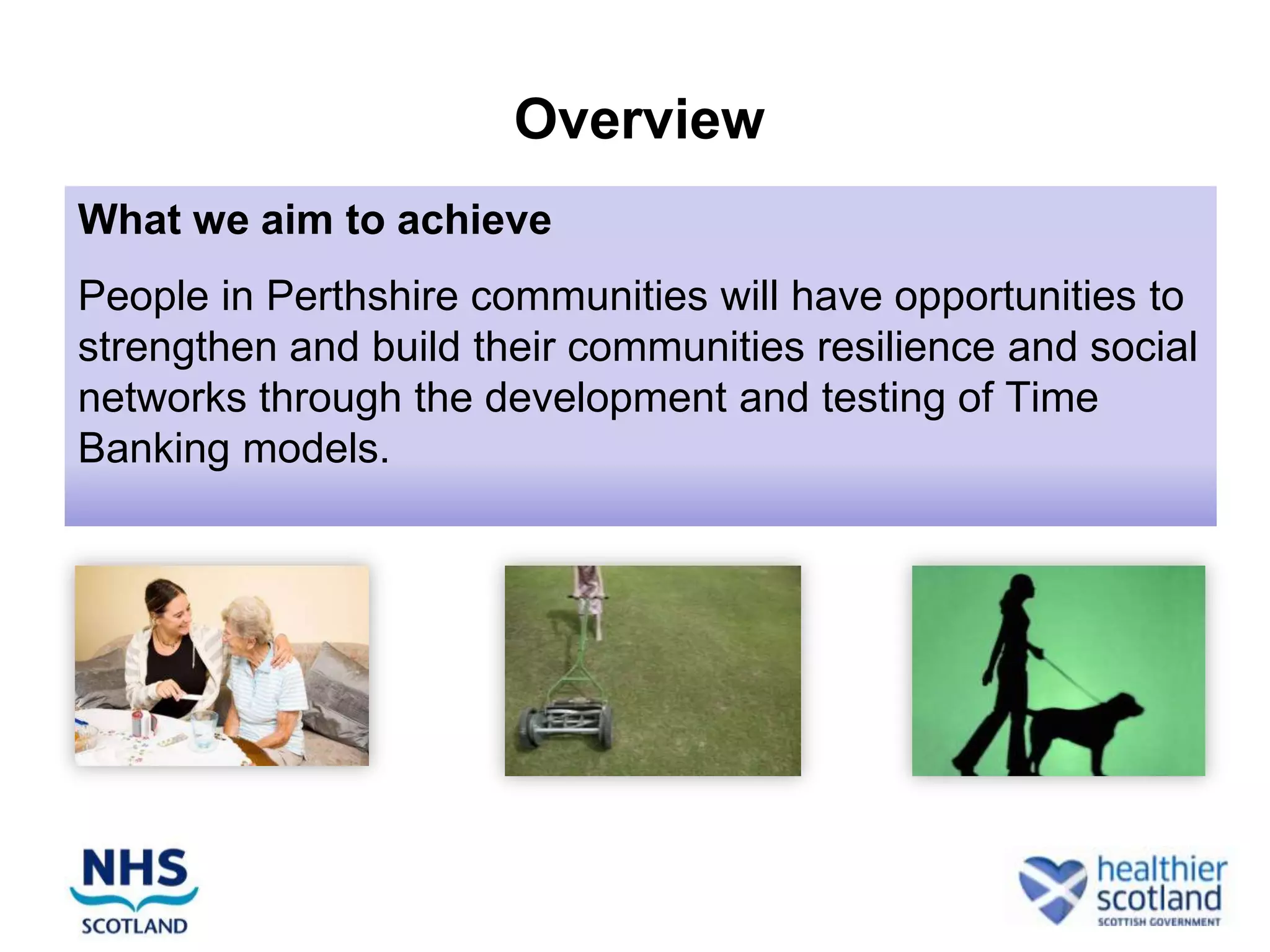
Overview
What we aim to achieve
People in Perthshire communities will have opportunities to
strengthen and build their communities resilience and social
networks through the development and testing of Time
Banking models.
How will this be achieved?
• Introduction of Time Banking into communities
  throughout the region.
• Appointing Brokers – key local people to manage the
  Time Banks on the ground.
• Engage with communities and networking with existing
  groups and organisations.
• Delivering talks and presentations to existing groups in
  both communities.
• Working with and supporting relevant collaborators– NHS
  Tayside, Perth and Kinross Council, Communities
  members.
How will we know we have made a
                difference?

• People will share their talents and skills
• Increased number of people volunteering in the local
  area
• People will express they feel a positive difference in the
  area
• Volunteering benefits the needs of the individual
• Increased opportunities for volunteering
• People will express a sense of belonging and connection
  to others and their community
The Project to Date

                                          This for That
                                        in Coupar Angus


                                       Deeds for Needs
                                         in Aberfeldy


Working with additional Communities to introduce the initiative
              – Stanley, Dunkeld and Pitlochry
     Initiative to be developed throughout the region over
                         next two years
This for That – Coupar Angus


Members                    61 Individuals
                          14 organisations
Hours Exchanged                 1531
Hours donated                   500

Actual number of                322
exchanges
What is being Exchanged?

Examples of                 Attending Meetings
Exchanges                          Baking
                            Painting/Decorating
                              Companionship
                             Community Café
Success Stories      • Bob – Widow, Retired Chemistry
                                    Teacher
                  • John – Wanting to get more involved in
                                Community Life
                   • Matilda – Youngest Member, donated
                              over half her credits
Deeds for Needs - Aberfeldy


Members                   27 Individuals
                          1 organisation
Hours Exchanged                394
Hours donated                  121
Actual number of               66
exchanges
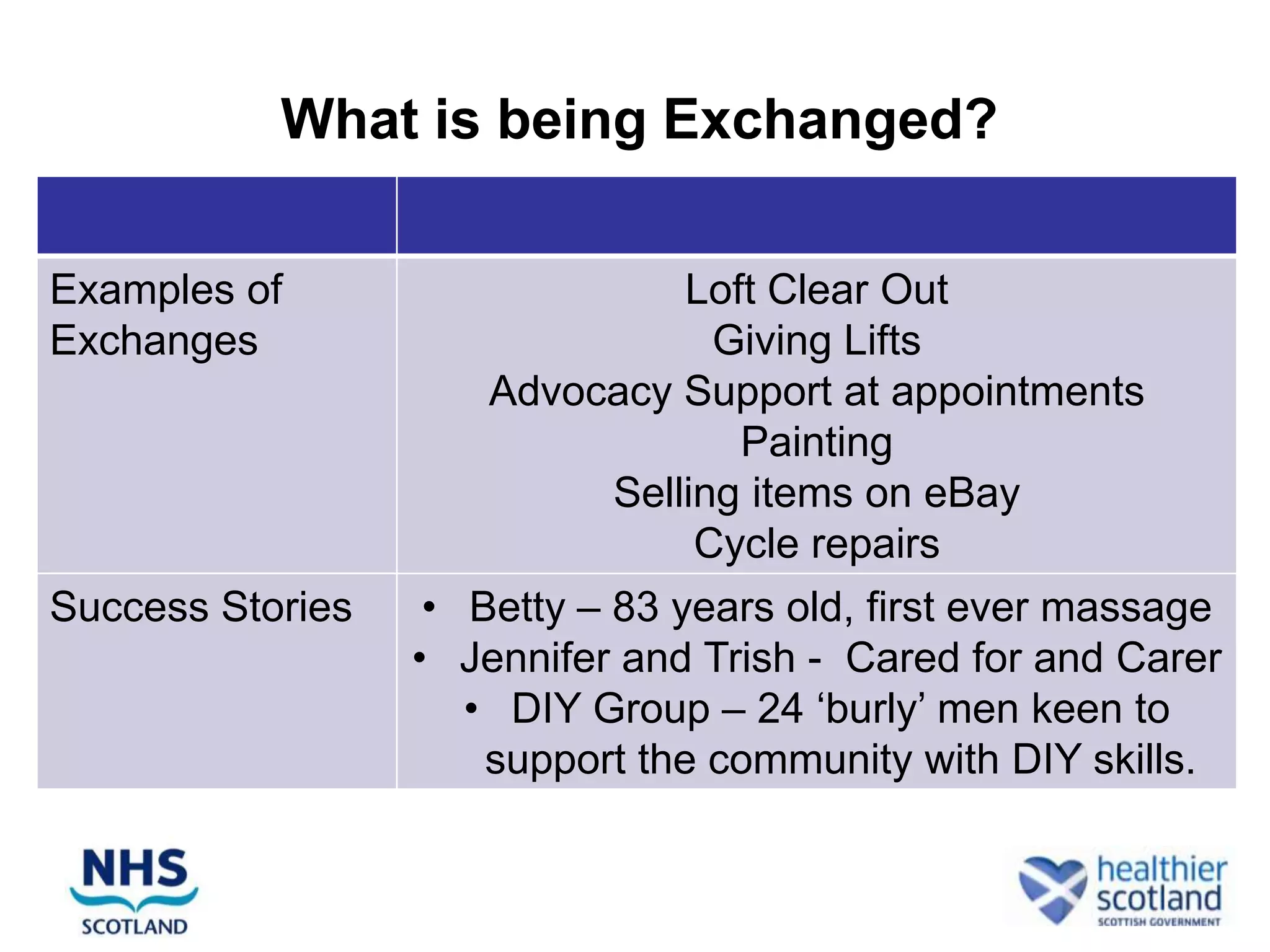
What is being Exchanged?

Examples of                      Loft Clear Out
Exchanges                          Giving Lifts
                      Advocacy Support at appointments
                                    Painting
                             Selling items on eBay
                                  Cycle repairs
Success Stories    • Betty – 83 years old, first ever massage
                  • Jennifer and Trish - Cared for and Carer
                     • DIY Group – 24 „burly‟ men keen to
                      support the community with DIY skills.
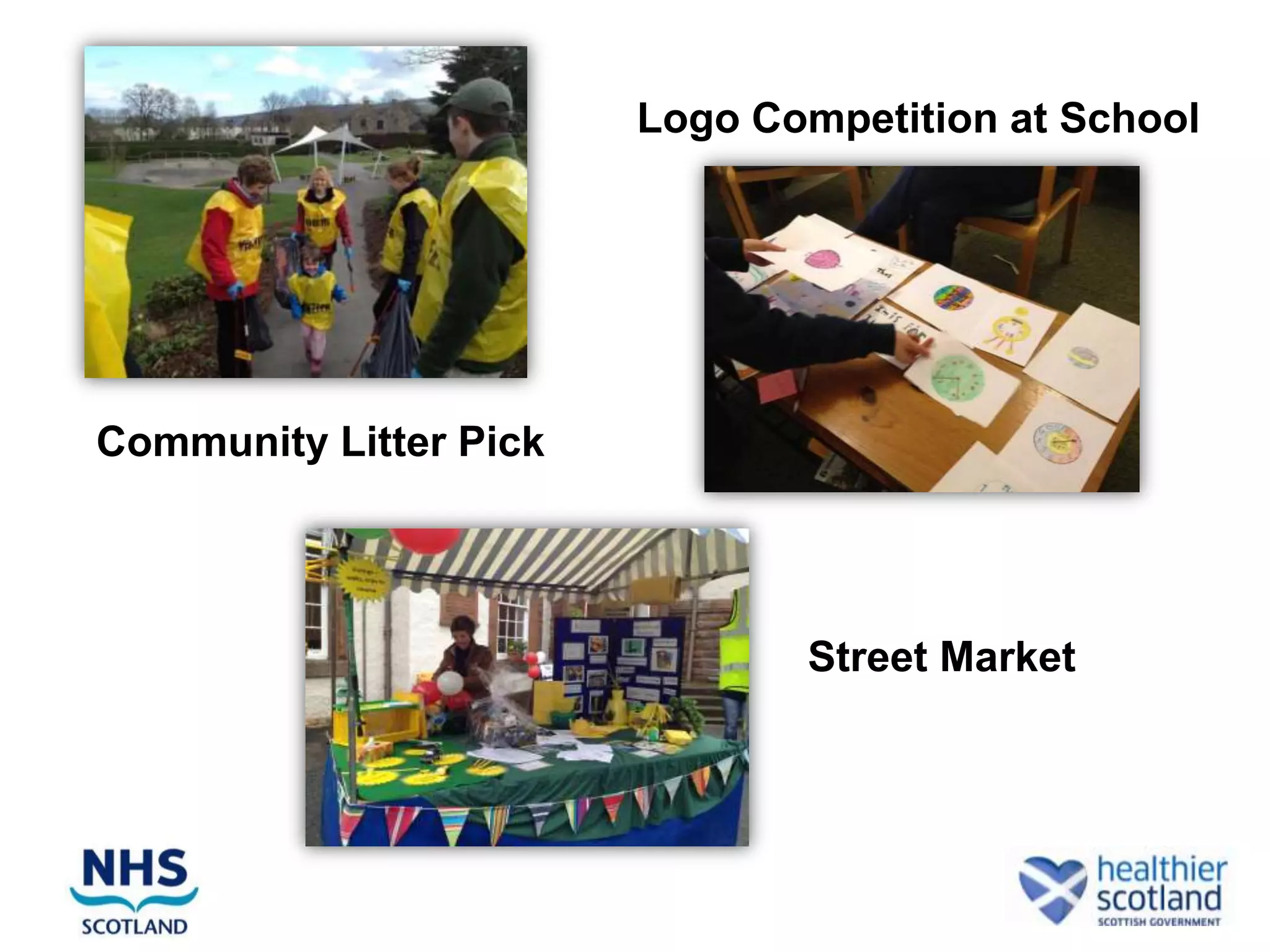
Logo Competition at School


Community Litter Pick


                               Street Market
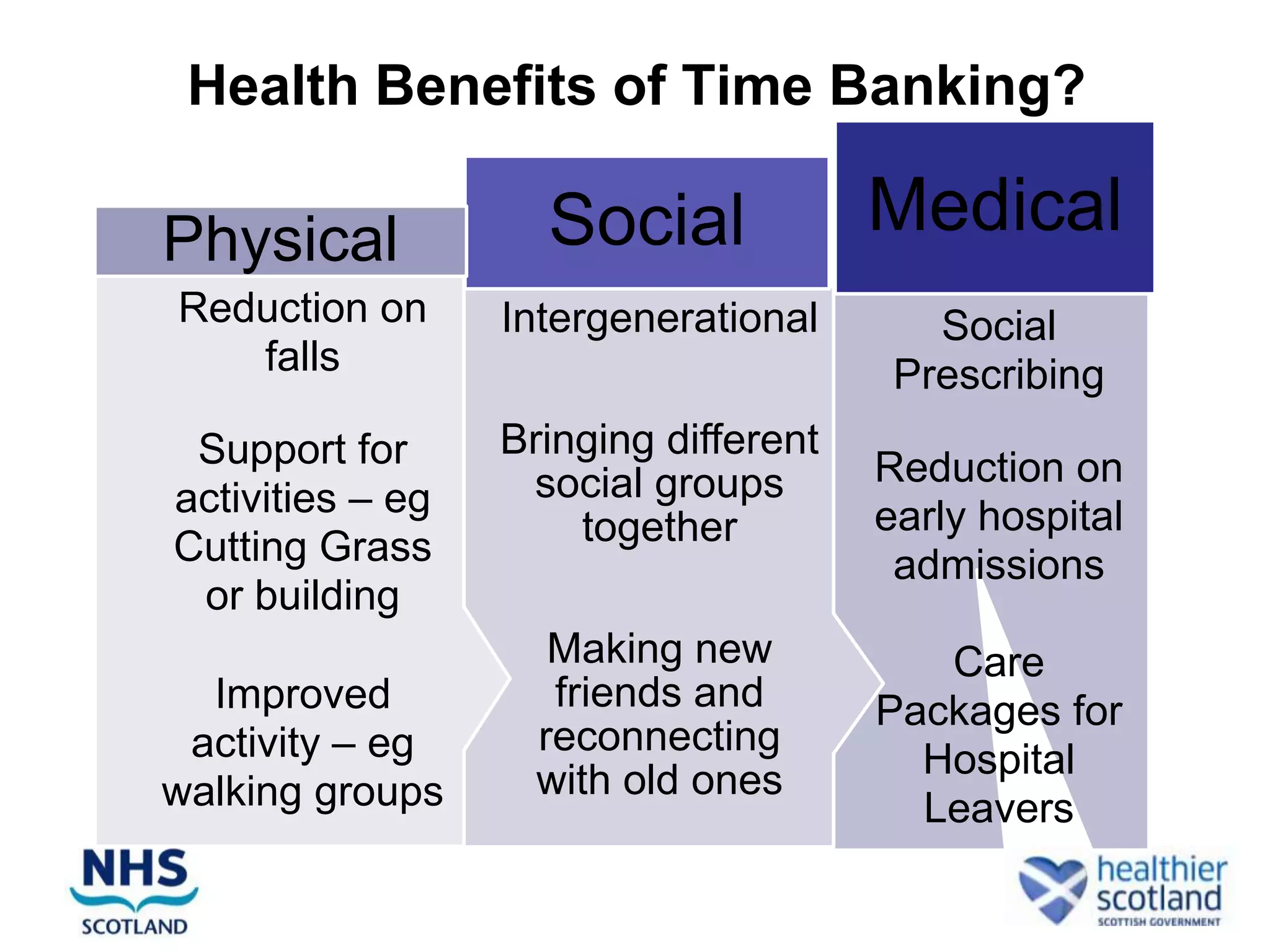
Health Benefits of Time Banking?

Physical            Social             Medical
Reduction on      Intergenerational       Social
   falls                                Prescribing
 Support for      Bringing different
                   social groups       Reduction on
activities – eg                        early hospital
Cutting Grass         together
                                        admissions
 or building
                     Making new           Care
  Improved           friends and       Packages for
 activity – eg      reconnecting
                                         Hospital
walking groups      with old ones
                                         Leavers
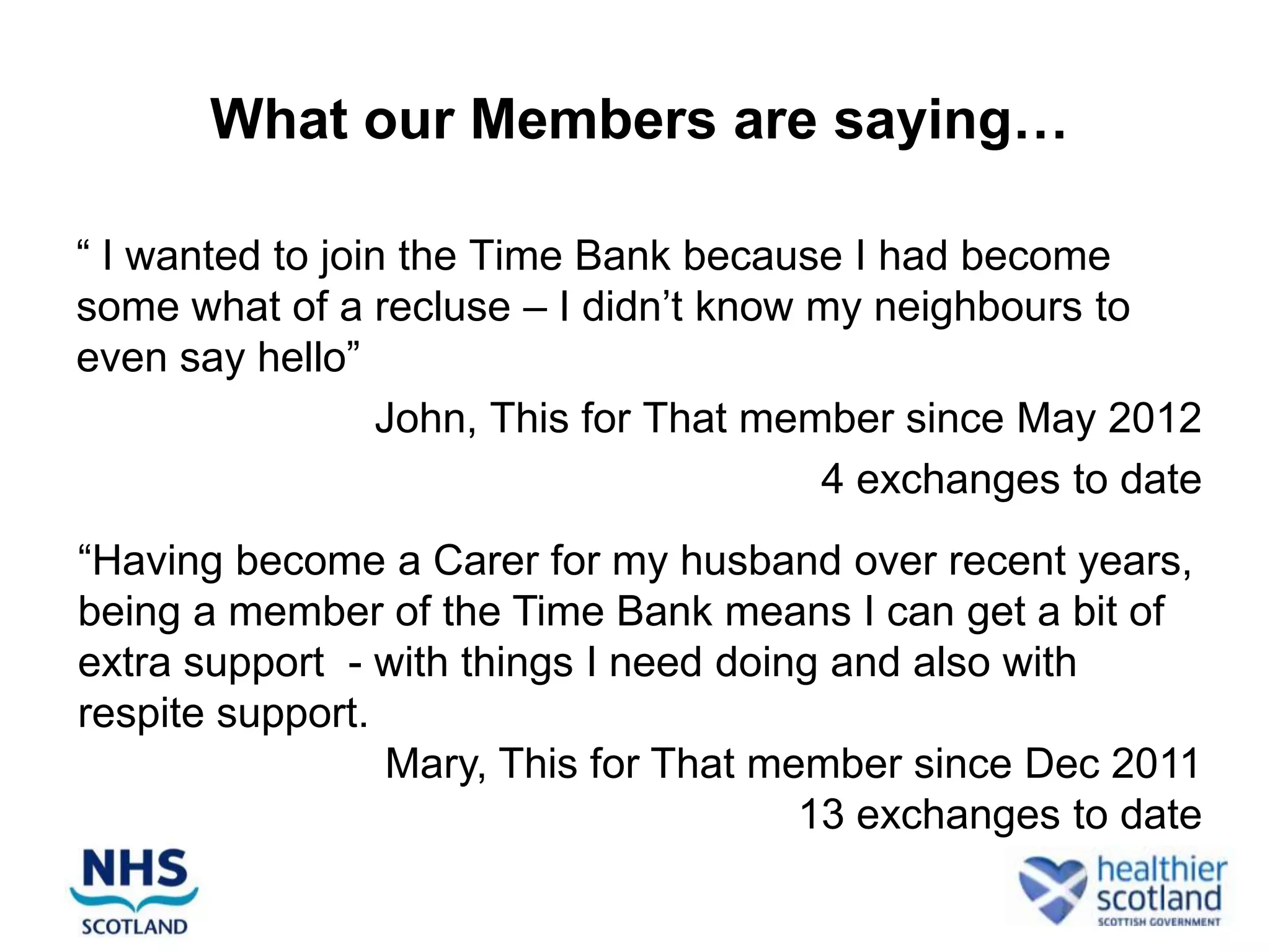
What our Members are saying…

“ I wanted to join the Time Bank because I had become
some what of a recluse – I didn‟t know my neighbours to
even say hello”
                 John, This for That member since May 2012
                                        4 exchanges to date
“Having become a Carer for my husband over recent years,
being a member of the Time Bank means I can get a bit of
extra support - with things I need doing and also with
respite support.
                 Mary, This for That member since Dec 2011
                                       13 exchanges to date
What our Members are saying…
“This for That is bringing members of our community
together. All the Community Groups that have signed up
are now supporting, and most importantly, talking to each
other”
                Saranne, This for That Broker since Oct 2011
                                       38 exchanges to date

“It‟s great to have one port of call to ask for help – I have so
many things around the house that I would like help with”

              Pat, Deeds for Needs member since Mar 2012
                                     7 exchanges to date
The potential of Time Banking is limitless.


    The health benefits to members -
  physically, socially and medically are
             wide and varied.

The stronger the foundations we set now
 the greater the benefits to our friends,
relatives and communities in the future.
Engaging and Transforming Communities

    Gary Malone Manager, Angus Volunteer
     Centre gary@volunteerangus.org.uk
Scottish Co-production Network

 Catriona Ness OD Consultant NHS Tayside
 catriona.ness@nhs.net
Background

• Formed as an informal network in 2010

• Chaired jointly by NHS Tayside and Scottish Community
  Development Centre (SCDC)

• April 2012 – supported by Scottish Government Joint
  Improvement Team to be formally developed in 2012-13
What is the Scottish Co-production Network?

• Building on existing co-production activity

• Learning, debate and development of ideas

• Practice & information exchange

• Supporting dialogue and advancing co-production
  approaches in Scotland
What is co-production?

New Economics Foundation:

‘Co-production means delivering public services in an equal
and reciprocal relationship between professionals, people
using services, their families and their neighbours. Where
activities are co-produced in this way, both services and
neighbourhoods become far more effective agents of
change.’
Key activities

• Network meetings

• National events/seminars

• Learning events

• Support to local networks

• Website/ online forum
Get involved

Contact Olivia Hanley, olivia@scdc.org.uk

Join the network!

Website: watch this space!

Parallel Session 4.5 Stronger Communities... Better Lives?

  • 1.
  • 2.
    Engaging Communities – Changing Lives Jackie Doe Healthy Communities Collaborative jackie.doe@nhs.net
  • 3.
    Perth and KinrossHealthy Communities Collaborative Aims :- To help local people develop the skills and confidence to work in co-production with professionals from a range of agencies and organisations Objectives :- To use these partnerships to effect changes in communities, which would result in improvements in health care and social well being
  • 4.
    CONSULT Speaking to Asking them to local people identify issues to address ENGAGE RESILIENCE Trying out ideas Helping them to to improve life come up with locally for ideas to try out themselves and their friends EMPOWER
  • 5.
    The Community ActionModel (NPDT 2001) Topic Stimulates Desire for Successful Action other topics Enhances Community Development
  • 6.
    Focus Topic Progression •“Falls Awareness” - year 1  year 2 • “Promoting an Active Lifestyle” - year 3  year 4 • “Mental Wellbeing in Later Life” - year 5  year 6 • “Leg Ulcers” - year 7 
  • 7.
    Who Are TheTeams Made Up Of ? Voluntary and Charitable Organisations   Community Members   Statutory Agencies
  • 8.
    The Formula •Understand theneed •Come up with some ideas •Test those ideas (PDSA) •Understand what works and do more of it!
  • 9.
    The PDSA Cyclefor Improvement Act Plan • Objective •Predictions • What changes • Carry out the are to be made? cycle • Next cycle? •Plan for data collection Study Do • Analysis data • Carry out plan •Compare to • Document predictions problems •Summarise • Record data learning
  • 10.
    CONSULT • What exerciseopportunities are available? • If this is a gap, how can we address it? • Day, time, venue, exercise density and cost • Suitably qualified instructor • Publicity • On going monitoring of numbers
  • 11.
    Three Main Features of Exercise Programme • Strengthening • Balance Retraining • Walking
  • 12.
  • 13.
    CHAIR BASED EXERCISE the EVIDENCE • Strength and Power (Fiatarone 1990, 1994; Skelton 1995, 1996) • Flexability and Functional Ability (McMurdo 1993; Skelton 1995, 1996) • Arthritic Pain (Hochberg 1995) & Postural Hypotension (Millar 1999) • Depression (McMurdo 1993) • Rehabilitation following hip fracture (Nicholson 1997)
  • 14.
    NUMBER CRUNCHING • Approximately46 groups per month • An average of over 450 older people attending per month • Over 75% did not previously attend formal exercise group. • Approximately 80% report some form of health issue ranging from painful joints to acknowledged long term conditions
  • 15.
    Benefits Reported byAttendees • My arms are looser, I can reach up behind my neck again • I‟m more flexible, and balance has improved, it‟s easier putting on socks • It gets me out of the house, we have a good laugh and it‟s good for us. • I‟m thinking of using the bus again, it would be good to be more independent. • My wife‟s concentration is better and she‟s more settled. We both really enjoyed coming to the class (Carer of dementia sufferer)
  • 16.
    The Challenges • Ongoing support • Transport • Sustainability • Community Referral / Social Prescribing
  • 17.
    Recent Scottish PolicyDrivers • Better Outcomes for Older People (2004) • The National Standards for Community Engagement (2005) • Better Health, Better Care ( 2007) • All Our Futures – Planning for a Scotland with an ageing population(2007) • Reshaping Care for Older People (2010) • The Quality Strategy (2010)
  • 18.
    Some benefits fromworking this way • Gives Communities ownership • Maximises efficiency, people centred • Shares skills and workload • Releases community capacity • Helps build community resilience • Cost effective
  • 19.
  • 20.
    And finally, aword from Pat “The Healthy Communities Collaborative is such a good idea. A small number of professionals working in partnership with unlimited numbers of volunteers, so that older people can stay fitter and healthier for longer, has to be good” http://www.jitscotland.org.uk/action-areas/talking-points- user-and-carer-involvement/outcomes-enablement- and-an-assets-approach-to-health-and-wellbeing/
  • 21.
    Time Banking in Perth and Kinross An exiting new initiative for communities Lesley McLaren, PKAVS lesley.mclaren@pkavs.org.uk
  • 22.
    Overview What we aimto achieve People in Perthshire communities will have opportunities to strengthen and build their communities resilience and social networks through the development and testing of Time Banking models.
  • 23.
    How will thisbe achieved? • Introduction of Time Banking into communities throughout the region. • Appointing Brokers – key local people to manage the Time Banks on the ground. • Engage with communities and networking with existing groups and organisations. • Delivering talks and presentations to existing groups in both communities. • Working with and supporting relevant collaborators– NHS Tayside, Perth and Kinross Council, Communities members.
  • 24.
    How will weknow we have made a difference? • People will share their talents and skills • Increased number of people volunteering in the local area • People will express they feel a positive difference in the area • Volunteering benefits the needs of the individual • Increased opportunities for volunteering • People will express a sense of belonging and connection to others and their community
  • 25.
    The Project toDate This for That in Coupar Angus Deeds for Needs in Aberfeldy Working with additional Communities to introduce the initiative – Stanley, Dunkeld and Pitlochry Initiative to be developed throughout the region over next two years
  • 26.
    This for That– Coupar Angus Members 61 Individuals 14 organisations Hours Exchanged 1531 Hours donated 500 Actual number of 322 exchanges
  • 27.
    What is beingExchanged? Examples of Attending Meetings Exchanges Baking Painting/Decorating Companionship Community Café Success Stories • Bob – Widow, Retired Chemistry Teacher • John – Wanting to get more involved in Community Life • Matilda – Youngest Member, donated over half her credits
  • 28.
    Deeds for Needs- Aberfeldy Members 27 Individuals 1 organisation Hours Exchanged 394 Hours donated 121 Actual number of 66 exchanges
  • 29.
    What is beingExchanged? Examples of Loft Clear Out Exchanges Giving Lifts Advocacy Support at appointments Painting Selling items on eBay Cycle repairs Success Stories • Betty – 83 years old, first ever massage • Jennifer and Trish - Cared for and Carer • DIY Group – 24 „burly‟ men keen to support the community with DIY skills.
  • 30.
    Logo Competition atSchool Community Litter Pick Street Market
  • 31.
    Health Benefits ofTime Banking? Physical Social Medical Reduction on Intergenerational Social falls Prescribing Support for Bringing different social groups Reduction on activities – eg early hospital Cutting Grass together admissions or building Making new Care Improved friends and Packages for activity – eg reconnecting Hospital walking groups with old ones Leavers
  • 32.
    What our Membersare saying… “ I wanted to join the Time Bank because I had become some what of a recluse – I didn‟t know my neighbours to even say hello” John, This for That member since May 2012 4 exchanges to date “Having become a Carer for my husband over recent years, being a member of the Time Bank means I can get a bit of extra support - with things I need doing and also with respite support. Mary, This for That member since Dec 2011 13 exchanges to date
  • 33.
    What our Membersare saying… “This for That is bringing members of our community together. All the Community Groups that have signed up are now supporting, and most importantly, talking to each other” Saranne, This for That Broker since Oct 2011 38 exchanges to date “It‟s great to have one port of call to ask for help – I have so many things around the house that I would like help with” Pat, Deeds for Needs member since Mar 2012 7 exchanges to date
  • 34.
    The potential ofTime Banking is limitless. The health benefits to members - physically, socially and medically are wide and varied. The stronger the foundations we set now the greater the benefits to our friends, relatives and communities in the future.
  • 35.
    Engaging and TransformingCommunities Gary Malone Manager, Angus Volunteer Centre gary@volunteerangus.org.uk
  • 37.
    Scottish Co-production Network Catriona Ness OD Consultant NHS Tayside catriona.ness@nhs.net
  • 38.
    Background • Formed asan informal network in 2010 • Chaired jointly by NHS Tayside and Scottish Community Development Centre (SCDC) • April 2012 – supported by Scottish Government Joint Improvement Team to be formally developed in 2012-13
  • 39.
    What is theScottish Co-production Network? • Building on existing co-production activity • Learning, debate and development of ideas • Practice & information exchange • Supporting dialogue and advancing co-production approaches in Scotland
  • 40.
    What is co-production? NewEconomics Foundation: ‘Co-production means delivering public services in an equal and reciprocal relationship between professionals, people using services, their families and their neighbours. Where activities are co-produced in this way, both services and neighbourhoods become far more effective agents of change.’
  • 41.
    Key activities • Networkmeetings • National events/seminars • Learning events • Support to local networks • Website/ online forum
  • 42.
    Get involved Contact OliviaHanley, olivia@scdc.org.uk Join the network! Website: watch this space!

Editor's Notes

  • #39 Formed as an informal network in 2010 in collaboration with New Economics Foundation through Meeting the Shared Challenge. As interest in co-pro begins to take root in Scotland – policy context and response to e.g. Chrisitie Commission – looking for responses which look at how we approach public service design and delivery differently. Chaired jointly by NHS Tayside and Scottish Community Development Centre (SCDC) on a voluntary basis until nowApril 2012 – support recieved by Scottish Government Joint Improvement Team to be formally developed in 2012-13 via NHS Tayside and SCDC
  • #40 It aims to beA locus for building on existing co-production activityA space for learning, debate and development of ideas and approaches around co-productionA forum for practice exchange, and sharing of information and resourcesAnd to supporting dialogue around emerging policy on delivering public services differently and advancing co-production approaches in Scotland
  • #41 Many varied definitions of co-production and it is being used across sectors to refer to public service design and delivery. A useful working definition used by nef states that….So the emphasis is on power shift from service provider to an equal relationship between them and communities – where the assets, knowledge, resources and experiences of the communities are integral to developing approaches to achieving better outcomes….
  • #42 The network is being supported by a part-time coordinator – the key activities of my role will be to organise:Network meetings – which will allow practice exchange, as above a place for ideas and information exchange – usually with someone form the network invited to speak or share a piece of workNational events/seminars – plan to have 1 or 2 in either conference or seminar format with demonstrations of co-production in practice and learning opportunitiesA series of learning events -invited practitioners talking on co-production in relation to a theme, e.g. older people, mental health, share practicePart of my role will be to support the development of local networks where there is demand – and over the next few months I will be contacting network members to find out about who is interested in identifying and developing networks locally.Developing a website and online space as a depository of resources, links – this should include a forum for members and will have a newsletter function etc. Promote the network across sectors and linking with relevant networks, consultations etc.
  • #43 I will bring a sheet for contact details and email people with details of how to sign up.Emphasis on contributing TO the network – what can you offer?