1. David J. Bosch, Transforming Mission
Paradigm Shifts in Theology of Mission
2. J. Andrew Kirk, What is Mission?
Theological Explorations
3. Wendy Robins and Gillian Hawney, The
Scandal of the Cross, Evangelism and
Mission Today, London USPG, 1992.
4. T V Philip, Edinburgh to Salvador:
Twentieth Century Ecumenical Missiology
ISPCK,1999.
Mission
• Sending of Missionaries to a particular place
(Ohm 1962)
• Activities by Missionaries
• The geographical area where missionaries work
• Propagation of the gospel (Muller 1987)
• Expansion of the reign of God
• Conversion of the heathen
• Founding of the New Church
Reflecting on Mission
• Mission as ? The word Mission is found in the
New Testament only once in Acts 12:25
• Evangelion – to announce the good news
(evangelism)
• Martyria - to bear witness (IMC 1952)
• Oikumene – to become one in/with Christ
(ecumenism) – Koinonia (fellowship) (IMC 1947)
• Kerygma – to preach (IMC 1947)
• Didache – to teach (IMC 1947)
• Diakonia – to serve (1967 Hoekendijk)
Foundation for Mission
• Warnack (1834-1910) Supernatural and A
Natural foundation for Mission
• Supernatural foundations – scripture,
monotheistic nature of Christian faith
• Natural – Absoluteness; Superiority of
Christianity over others; the acceptability and
adaptability of Christianity to all people and
conditions; Christianity is stronger than other
religions; superior achievements of Christian
missions
Theological Motives of Mission
• The motive of conversion (decision and
commitment) – saved souls
• Eschatological motive (reign of God as a
future reality without present realities)
• Plantatio ecclesial (church planting) –
need for gathering a community
• The philanthropic – issues of justice and
improved society (Freytage)
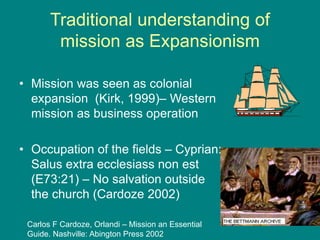
Traditional understanding of
mission as Expansionism
• Mission was seen as colonial
expansion (Kirk, 1999)– Western
mission as business operation
• Occupation of the fields – Cyprian:
Salus extra ecclesiass non est
(E73:21) – No salvation outside
the church (Cardoze 2002)
Carlos F Cardoze, Orlandi – Mission an Essential
Guide. Nashville: Abington Press 2002
• The conquest of other religions
(Rutti 1972) – Conquistadores
Portuguese and Spanish (Kirk) –
Roman emperor and Pope
integration as God’s reign
• Authority with the sender (church
or sponsoring institutions) –
Apostolate (Roman Catholic
traditions – Kirk)
Crisis – Danger and Opportunity
• Church in Crisis – as a sign being
spoken against - Kraemer
• Crisis is the combination of danger and
opportunity - Koyama
• What is this Crisis? What mission has to
do with this crisis? -
a. The advance of science, technology and
secularization
b. Dechristianization of the West
c. Migration of people of many faiths –
devotees of other faith becomes
missionaries and aggressive mission
d. Subjugation of people of colour, caste and
race
e. Divided World –Rich and Poor – Anger
and frustration - reluctance
f. Western ecclesial ways, theologies and
practices were no more predominant and
normative.
Mission in India
• Sword and forced religion (Goa)
• S(X)aviour and liberated Catholics (South)
• Bread and Mass Conversion (North and
South)
• Tribal leaders and masses (North East)
• Indigenous missions (North)
• New Means and Confusions
(Confusion called Conversion – Sunder raj)
Four Impure Motives of Mission
• Cultural (Transfer of Superior Culture)
• Romantic Motive (Tour to exotic countries)
• Imperialist (colonial authorities)
• Ecclesiastical Colonialism (to export
Churches’ own confession and order to
other territories)
• Verkuyl (1978)
Mission Lunatic??!
• Schultz – In our missionary outreach we
resemble a lunatic who carries the harvest
into his burning barn (1930) – many do not
proclaim the Gospel rather individualism
and the values of the West – ‘Intra-muros’
– the outcome of the mission is
determined by what happens inside the
church not outside in the mission field.
Critique of these definitions
 If everything is mission, nothing is mission
(Neill 1959)
 The Specture of Panmissionism (Freytag
1961)
Mission according to Bosch
 Christian faith is intrinsically Missionary – Universal
Impact – Ultimate Truth (Stackhouse 1988)
 Looking at the World from a Christian Perspective –
reforms, analysis and appraisal
 Dynamic relationship between God and the World –
God’s self communication in Jesus
 Recognition of the tension between Divine providence
and human Confusion
 Church as Missionary existence – Universal Gospel with
Universal Proclamation
 Church as sacrament and sign – mediation and pointer
Contd…
• No division between foreign mission and Home
Mission
• Difference between Mission and Missions
• The whole church bringing the whole gospel to
the whole world
• Participating in the struggles of people – God’s
yes
• Evangelism
• God’s No to the world –not merely a political
religion
Sugirtharajah
• Conversion to Reorientation
Evangelising the Evangelizer and conversion
within the tradition
• Revival to Revitalising
Recovering some forgotten aspects –
compassionate God
• Sharing to distribution – of wealth
Critical remark on Sugirtharajah – inward looking alone is not
holistic mission – witnessing an aspect of mission
Mission - signposts
• Incarnation – solidarity with victims
• Cross – Kenosis – self emptying
• Resurrection – message of joy, hope and
victory – Crucified and risen (theosis)
• Ascension – inaugurated eschatology –
living between ascension and parousia
• Pentecost –spiritual community
• Parousia – triumph of God in the retun of
Christ
For me Mission means
Being and Becoming a Christian –
Gandhi: If Christians would really live
according to the teachings of Christ, as
found in the Bible, all of India would be
Christian today.
1. Reconciling people with God and with each
others
Bishop Tutu In his oration at the funeral of
activist leader Steve Biko, who died in 1977 of
head injuries suffered while in police detention,
Tutu urged the crowd to pray for their
oppressors in hopes they would realize that
non-whites were also human beings, all
children of the same God. He related a similar
theme at another funeral: “Do not hate. Let us
choose the peaceful way to freedom.”
• Against his background Tutu brings a theology
that "seeks to restore the oppressor's humanity
by releasing and enabling the oppressed to see
their oppressors as peers under God." This is
his ubuntu theology, so named after an African
idea of community. Tutu shows that human
beings are defined not by their race but by their
createdness in God's image, which brings value
and dignity to all people. That imago Dei thus
breaks down racial barriers. Tutu declares "we
can be human only in ... community, in koinonia,
in peace."
Engaging with people in search (meanings) for God,
for life and for neighbours through Christ
-Vivekananda: You are all Sons of God,
immortal spirit. "Know", he declared, "the
Kingdom of Heaven is within you." "I and my
Father are one." Dare you stand up and say,
not only that "I am the Son of God", but I shall
also find in my heart of hearts that "I and my
Father are one"? That was what Jesus of
Nazareth said. He never talks of this world and
of this life.

David J Bosch.ppt

  • 1.
    1. David J.Bosch, Transforming Mission Paradigm Shifts in Theology of Mission 2. J. Andrew Kirk, What is Mission? Theological Explorations 3. Wendy Robins and Gillian Hawney, The Scandal of the Cross, Evangelism and Mission Today, London USPG, 1992. 4. T V Philip, Edinburgh to Salvador: Twentieth Century Ecumenical Missiology ISPCK,1999.
  • 2.
    Mission • Sending ofMissionaries to a particular place (Ohm 1962) • Activities by Missionaries • The geographical area where missionaries work • Propagation of the gospel (Muller 1987) • Expansion of the reign of God • Conversion of the heathen • Founding of the New Church
  • 3.
    Reflecting on Mission •Mission as ? The word Mission is found in the New Testament only once in Acts 12:25 • Evangelion – to announce the good news (evangelism) • Martyria - to bear witness (IMC 1952) • Oikumene – to become one in/with Christ (ecumenism) – Koinonia (fellowship) (IMC 1947) • Kerygma – to preach (IMC 1947) • Didache – to teach (IMC 1947) • Diakonia – to serve (1967 Hoekendijk)
  • 4.
    Foundation for Mission •Warnack (1834-1910) Supernatural and A Natural foundation for Mission • Supernatural foundations – scripture, monotheistic nature of Christian faith • Natural – Absoluteness; Superiority of Christianity over others; the acceptability and adaptability of Christianity to all people and conditions; Christianity is stronger than other religions; superior achievements of Christian missions
  • 5.
    Theological Motives ofMission • The motive of conversion (decision and commitment) – saved souls • Eschatological motive (reign of God as a future reality without present realities) • Plantatio ecclesial (church planting) – need for gathering a community • The philanthropic – issues of justice and improved society (Freytage)
  • 6.
    Traditional understanding of missionas Expansionism • Mission was seen as colonial expansion (Kirk, 1999)– Western mission as business operation • Occupation of the fields – Cyprian: Salus extra ecclesiass non est (E73:21) – No salvation outside the church (Cardoze 2002) Carlos F Cardoze, Orlandi – Mission an Essential Guide. Nashville: Abington Press 2002
  • 7.
    • The conquestof other religions (Rutti 1972) – Conquistadores Portuguese and Spanish (Kirk) – Roman emperor and Pope integration as God’s reign • Authority with the sender (church or sponsoring institutions) – Apostolate (Roman Catholic traditions – Kirk)
  • 8.
    Crisis – Dangerand Opportunity • Church in Crisis – as a sign being spoken against - Kraemer • Crisis is the combination of danger and opportunity - Koyama • What is this Crisis? What mission has to do with this crisis? - a. The advance of science, technology and secularization b. Dechristianization of the West
  • 9.
    c. Migration ofpeople of many faiths – devotees of other faith becomes missionaries and aggressive mission d. Subjugation of people of colour, caste and race e. Divided World –Rich and Poor – Anger and frustration - reluctance f. Western ecclesial ways, theologies and practices were no more predominant and normative.
  • 10.
    Mission in India •Sword and forced religion (Goa) • S(X)aviour and liberated Catholics (South) • Bread and Mass Conversion (North and South) • Tribal leaders and masses (North East) • Indigenous missions (North) • New Means and Confusions (Confusion called Conversion – Sunder raj)
  • 11.
    Four Impure Motivesof Mission • Cultural (Transfer of Superior Culture) • Romantic Motive (Tour to exotic countries) • Imperialist (colonial authorities) • Ecclesiastical Colonialism (to export Churches’ own confession and order to other territories) • Verkuyl (1978)
  • 12.
    Mission Lunatic??! • Schultz– In our missionary outreach we resemble a lunatic who carries the harvest into his burning barn (1930) – many do not proclaim the Gospel rather individualism and the values of the West – ‘Intra-muros’ – the outcome of the mission is determined by what happens inside the church not outside in the mission field.
  • 13.
    Critique of thesedefinitions  If everything is mission, nothing is mission (Neill 1959)  The Specture of Panmissionism (Freytag 1961)
  • 14.
    Mission according toBosch  Christian faith is intrinsically Missionary – Universal Impact – Ultimate Truth (Stackhouse 1988)  Looking at the World from a Christian Perspective – reforms, analysis and appraisal  Dynamic relationship between God and the World – God’s self communication in Jesus  Recognition of the tension between Divine providence and human Confusion  Church as Missionary existence – Universal Gospel with Universal Proclamation  Church as sacrament and sign – mediation and pointer
  • 15.
    Contd… • No divisionbetween foreign mission and Home Mission • Difference between Mission and Missions • The whole church bringing the whole gospel to the whole world • Participating in the struggles of people – God’s yes • Evangelism • God’s No to the world –not merely a political religion
  • 16.
    Sugirtharajah • Conversion toReorientation Evangelising the Evangelizer and conversion within the tradition • Revival to Revitalising Recovering some forgotten aspects – compassionate God • Sharing to distribution – of wealth Critical remark on Sugirtharajah – inward looking alone is not holistic mission – witnessing an aspect of mission
  • 17.
    Mission - signposts •Incarnation – solidarity with victims • Cross – Kenosis – self emptying • Resurrection – message of joy, hope and victory – Crucified and risen (theosis) • Ascension – inaugurated eschatology – living between ascension and parousia • Pentecost –spiritual community • Parousia – triumph of God in the retun of Christ
  • 18.
    For me Missionmeans Being and Becoming a Christian – Gandhi: If Christians would really live according to the teachings of Christ, as found in the Bible, all of India would be Christian today.
  • 19.
    1. Reconciling peoplewith God and with each others Bishop Tutu In his oration at the funeral of activist leader Steve Biko, who died in 1977 of head injuries suffered while in police detention, Tutu urged the crowd to pray for their oppressors in hopes they would realize that non-whites were also human beings, all children of the same God. He related a similar theme at another funeral: “Do not hate. Let us choose the peaceful way to freedom.”
  • 20.
    • Against hisbackground Tutu brings a theology that "seeks to restore the oppressor's humanity by releasing and enabling the oppressed to see their oppressors as peers under God." This is his ubuntu theology, so named after an African idea of community. Tutu shows that human beings are defined not by their race but by their createdness in God's image, which brings value and dignity to all people. That imago Dei thus breaks down racial barriers. Tutu declares "we can be human only in ... community, in koinonia, in peace."
  • 21.
    Engaging with peoplein search (meanings) for God, for life and for neighbours through Christ -Vivekananda: You are all Sons of God, immortal spirit. "Know", he declared, "the Kingdom of Heaven is within you." "I and my Father are one." Dare you stand up and say, not only that "I am the Son of God", but I shall also find in my heart of hearts that "I and my Father are one"? That was what Jesus of Nazareth said. He never talks of this world and of this life.