•Database and Data Warehousing
•History of data warehousing
•Evolution in organization use of data warehouses
•Data Warehouse Architecture
•Benefits of data warehousing
•Strategic uses of data warehousing
•Disadvantages of data warehouses
•Data mart
•Data mining
• Text mining
•Data mining for decision support
•OLAP
•Data warehousing integration
•Business intelligence
The Difference…
DWH Constitute Entire Information Base For All
Time..
Database constitute real time Information
DWH supports DM And Business Intelligence
Database is used to run the Business
DWH is how to run The Business
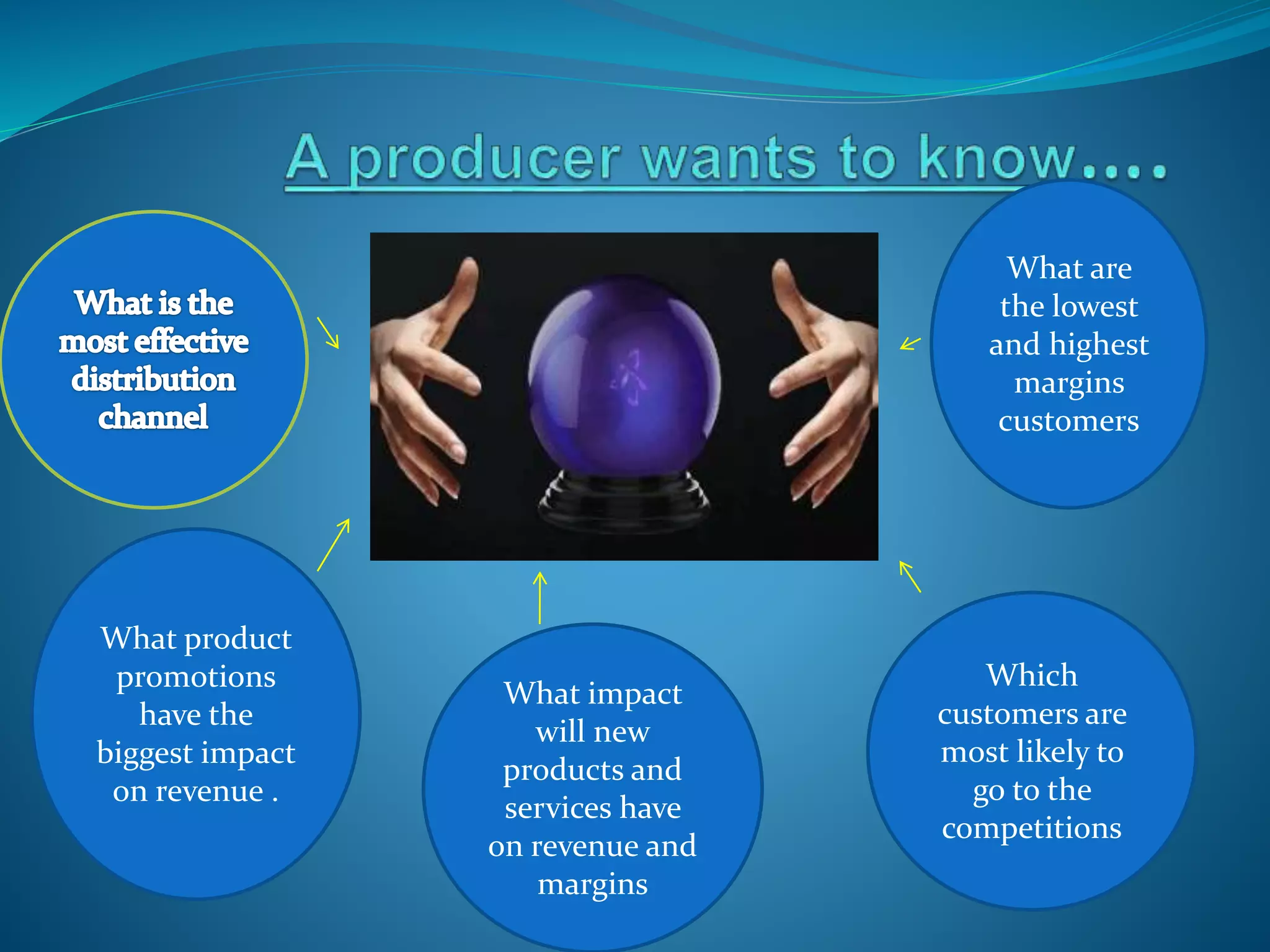
What product
promotions
have the
biggest impact
on revenue .
What impact
will new
products and
services have
on revenue and
margins
What are
the lowest
and highest
margins
customers
Which
customers are
most likely to
go to the
competitions
A single, complete and consistent store of
data obtained from a variety of different
sources made available to end users in a what
they can understand and use in a business
context..
A process of transforming data into
information and making it available
to users in a timely enough manner
to make difference.
Technique for assembling and managing
data from various sources for the purpose
of answering business questions. Thus
making decisions that were not previous
possible
DATA WAREHOUSING IS.
Subject Oriented:
 Data that gives information about a particular subject instead
of about a company's ongoing operations.
Integrated:
 Data that is gathered into the data warehouse from a variety of
sources and merged into a coherent whole.
Time-variant:
 All data in the data warehouse is identified with a particular time
period.
Non-volatile:
 Data is stable in a data warehouse. More data is added but data is
never removed.
 Data warehousing is combining data from multiple and
usually varied sources into one comprehensive and easily
manipulated database
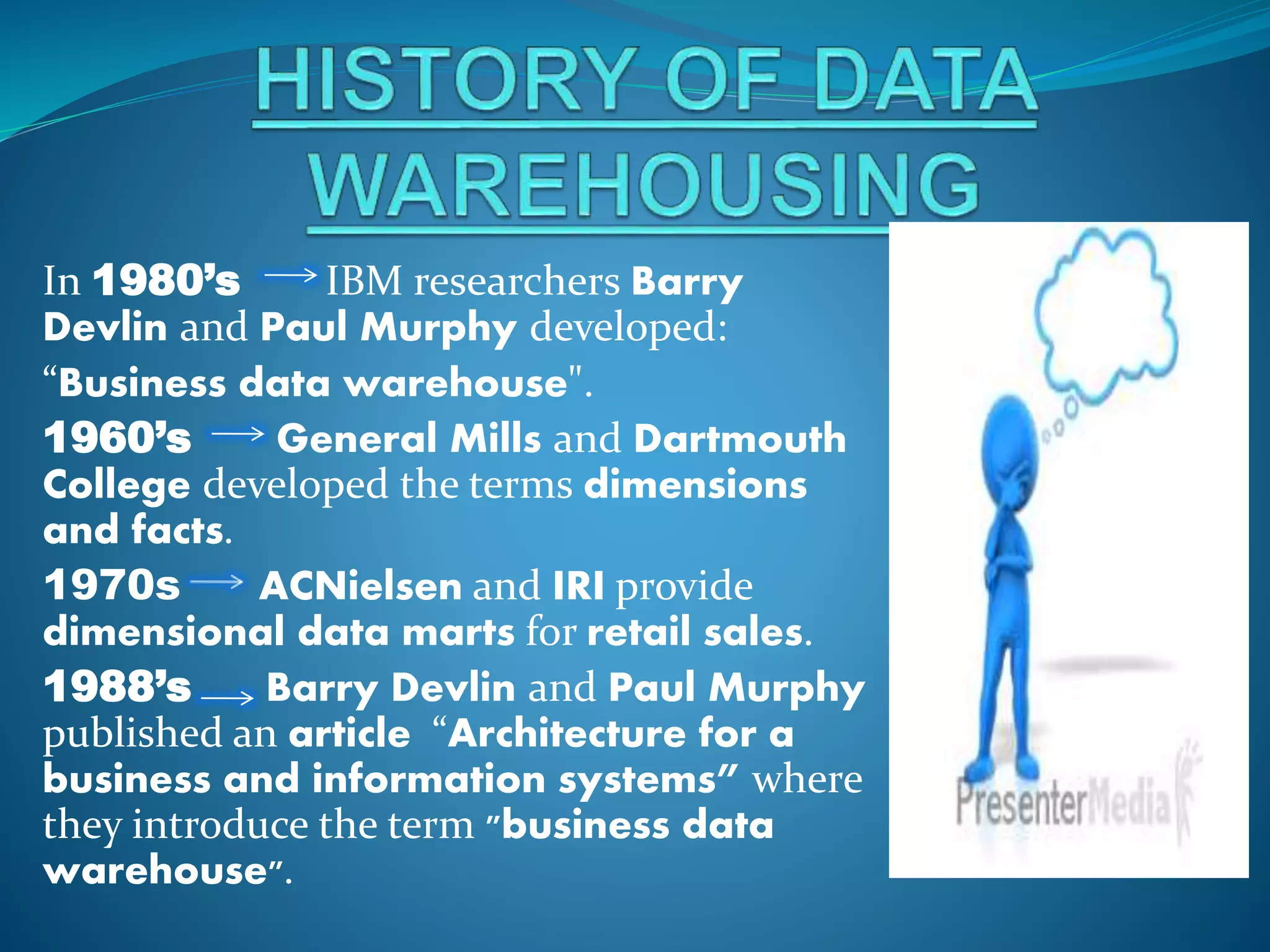
In 1980’s IBM researchers Barry
Devlin and Paul Murphy developed:
“Business data warehouse".
1960’s General Mills and Dartmouth
College developed the terms dimensions
and facts.
1970s ACNielsen and IRI provide
dimensional data marts for retail sales.
1988’s Barry Devlin and Paul Murphy
published an article “Architecture for a
business and information systems” where
they introduce the term "business data
warehouse".
BUSINESS ADVANTAGES
• It provides added value to company’s costumers by
allowing them to access better information when data
warehousing is coupled with internet.
• It provides a look at activities that cross functional lines.
• It reports on trends across multidivisional , multinational
operating units , including trends and relationships in
areas such as production planning etc.
• It provides “costumer-centric” view of company’s
heterogeneous data by helping to integrate data from sales
, services , manufacturing and distribution etc.
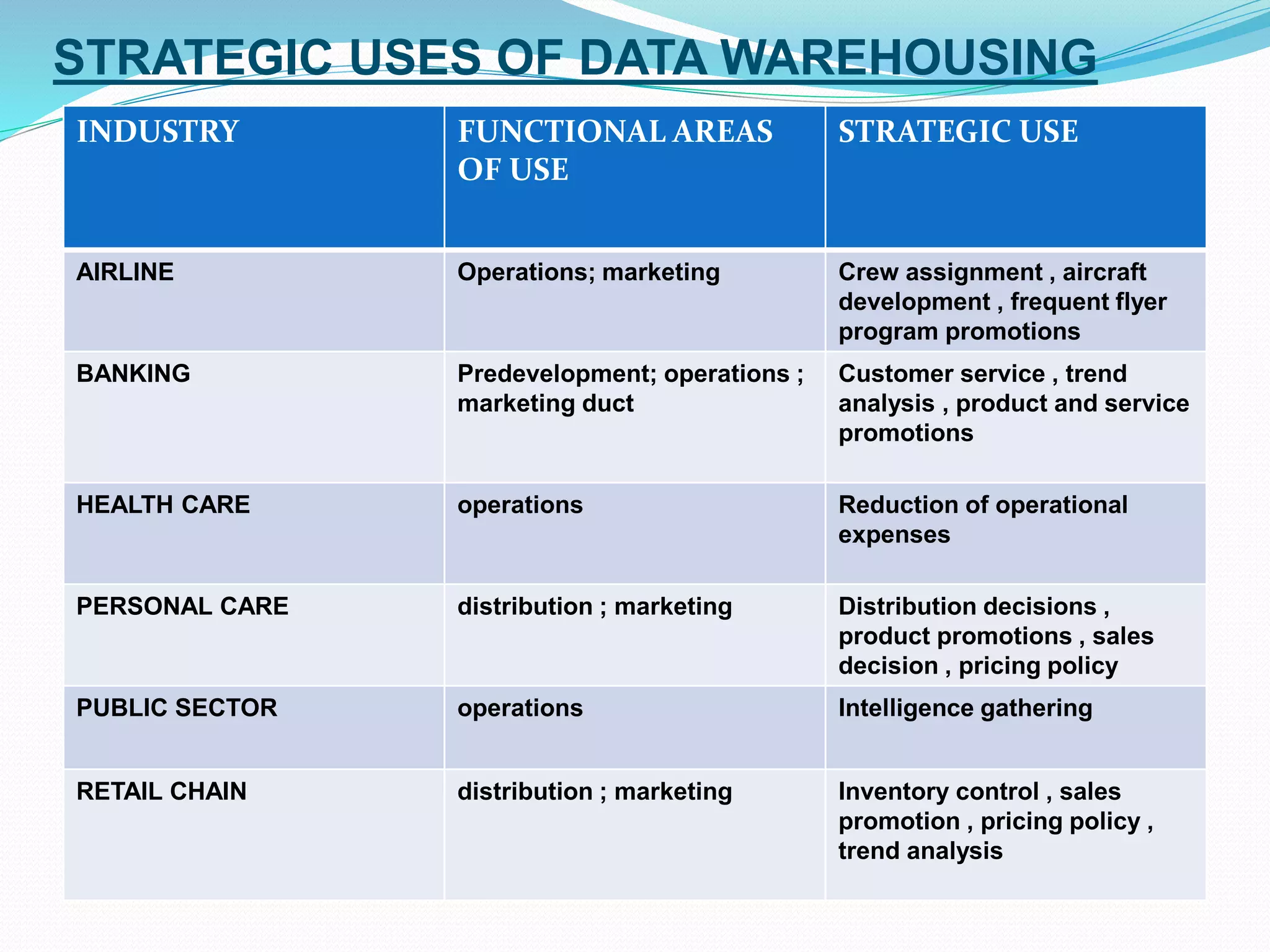
STRATEGIC USES OF DATA WAREHOUSING
INDUSTRY FUNCTIONAL AREAS
OF USE
STRATEGIC USE
AIRLINE Operations; marketing Crew assignment , aircraft
development , frequent flyer
program promotions
BANKING Predevelopment; operations ;
marketing duct
Customer service , trend
analysis , product and service
promotions
HEALTH CARE operations Reduction of operational
expenses
PERSONAL CARE distribution ; marketing Distribution decisions ,
product promotions , sales
decision , pricing policy
PUBLIC SECTOR operations Intelligence gathering
RETAIL CHAIN distribution ; marketing Inventory control , sales
promotion , pricing policy ,
trend analysis
DISADVANTAGES OF DATA
WAREHOUSING
• Data warehouses are not optimal environment for
unstructured data.
• Because data must be extracted , transformed and
loaded into the warehouse , there is an element of
latency in data warehouse data.
• Over their life , data warehouses can have high costs .
Maintenance costs are high.
• Date warehouses can get outdated relatively quickly .
There is a cost of delivering suboptimal information to
the organization.
DATA MART
 A data mart is scaled down
version of a data warehouse
that focuses on a particular
subject area.
 A data mart is a subset of an
organizational data store usually
oriented to a specific purpose
that may be distributed to meet
basic needs.
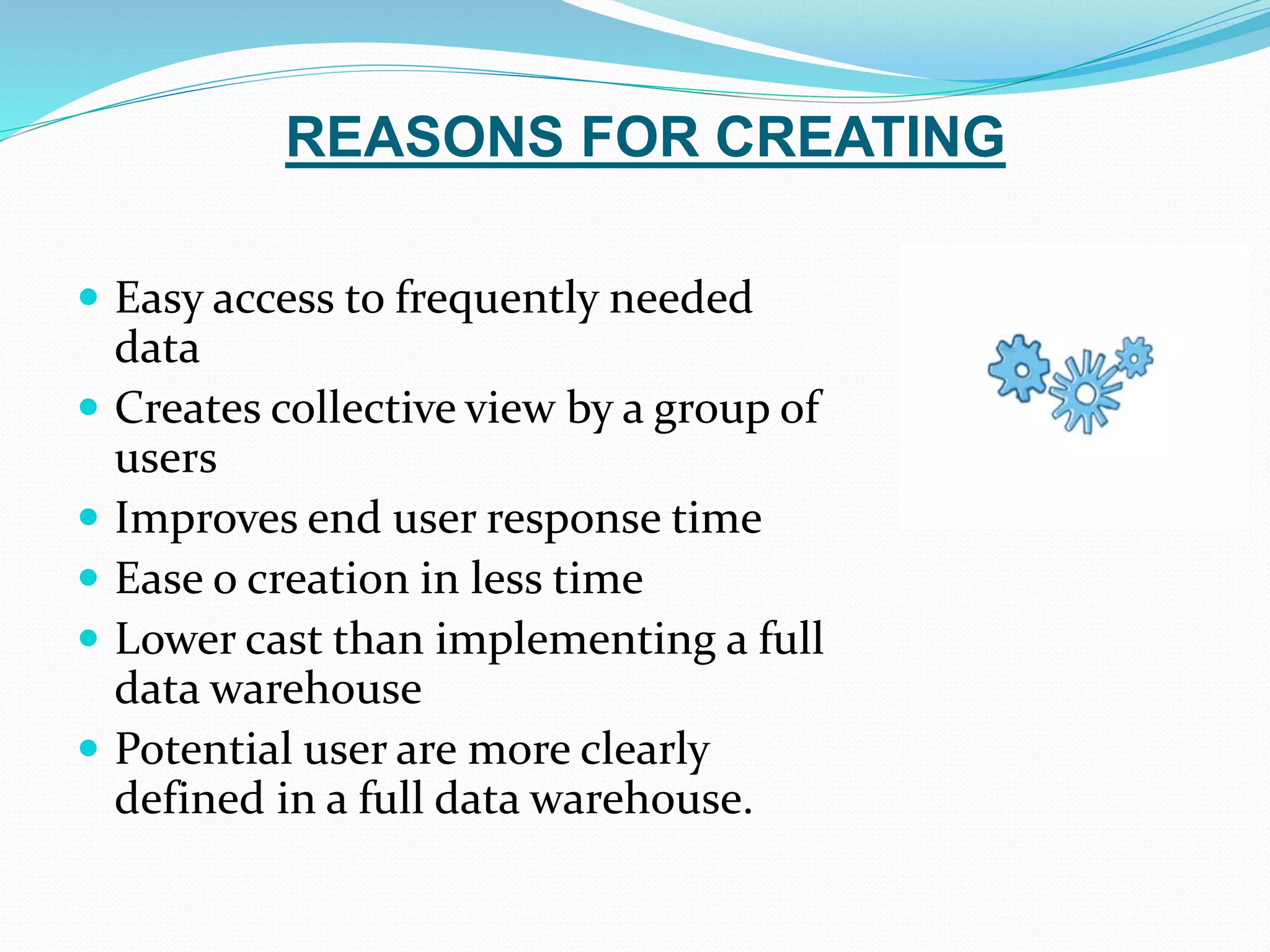
REASONS FOR CREATING
 Easy access to frequently needed
data
 Creates collective view by a group of
users
 Improves end user response time
 Ease o creation in less time
 Lower cast than implementing a full
data warehouse
 Potential user are more clearly
defined in a full data warehouse.
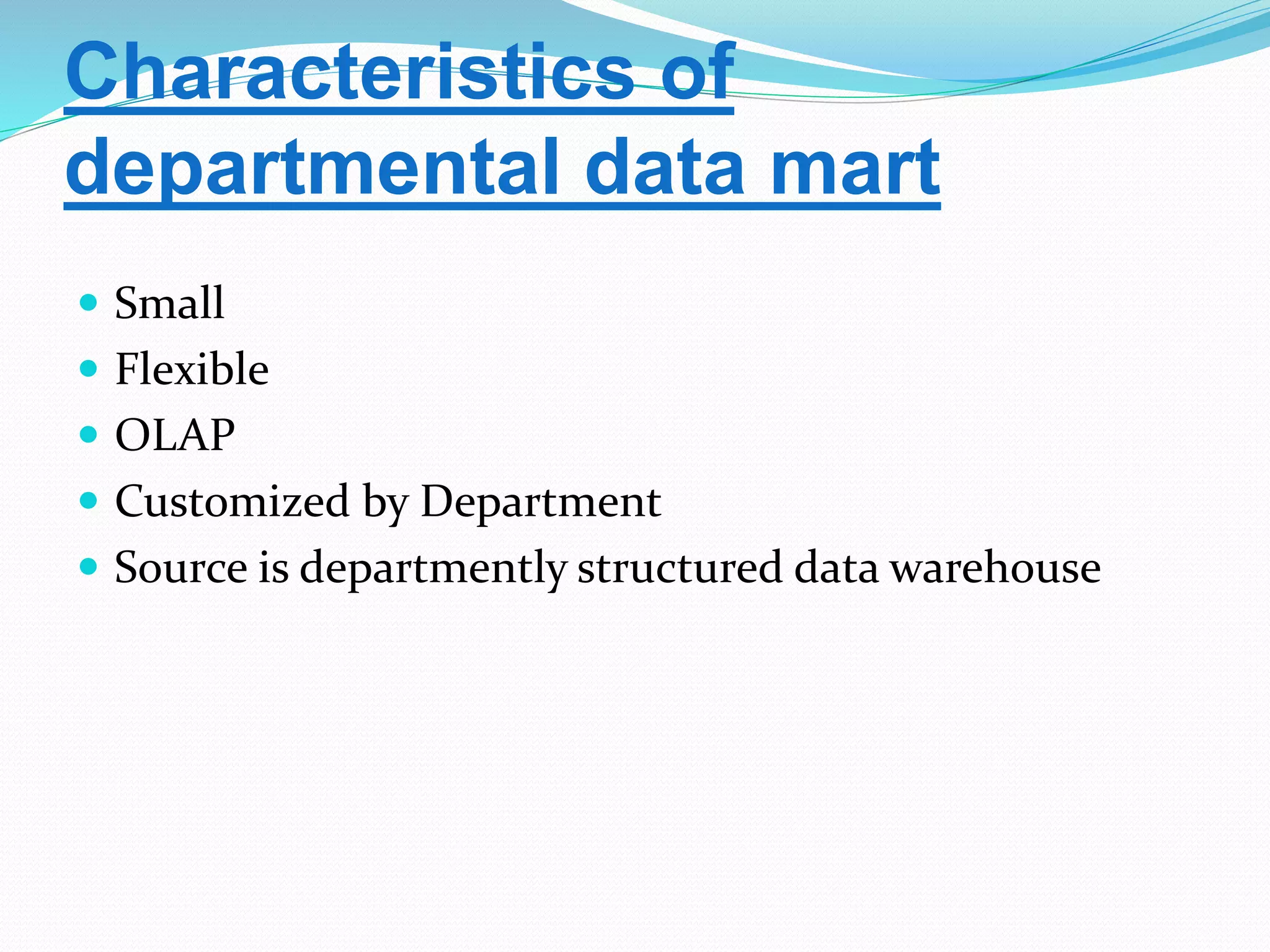
Characteristics of
departmental data mart
 Small
 Flexible
 OLAP
 Customized by Department
 Source is departmently structured data warehouse
DATA MINING
 Data Mining is a process of
extracting information from
company’s various data base
and re-organizing it for
other purpose what the
database were originally
intended for.
 Data mining is different for
different organization based
upon nature of data and
organization.
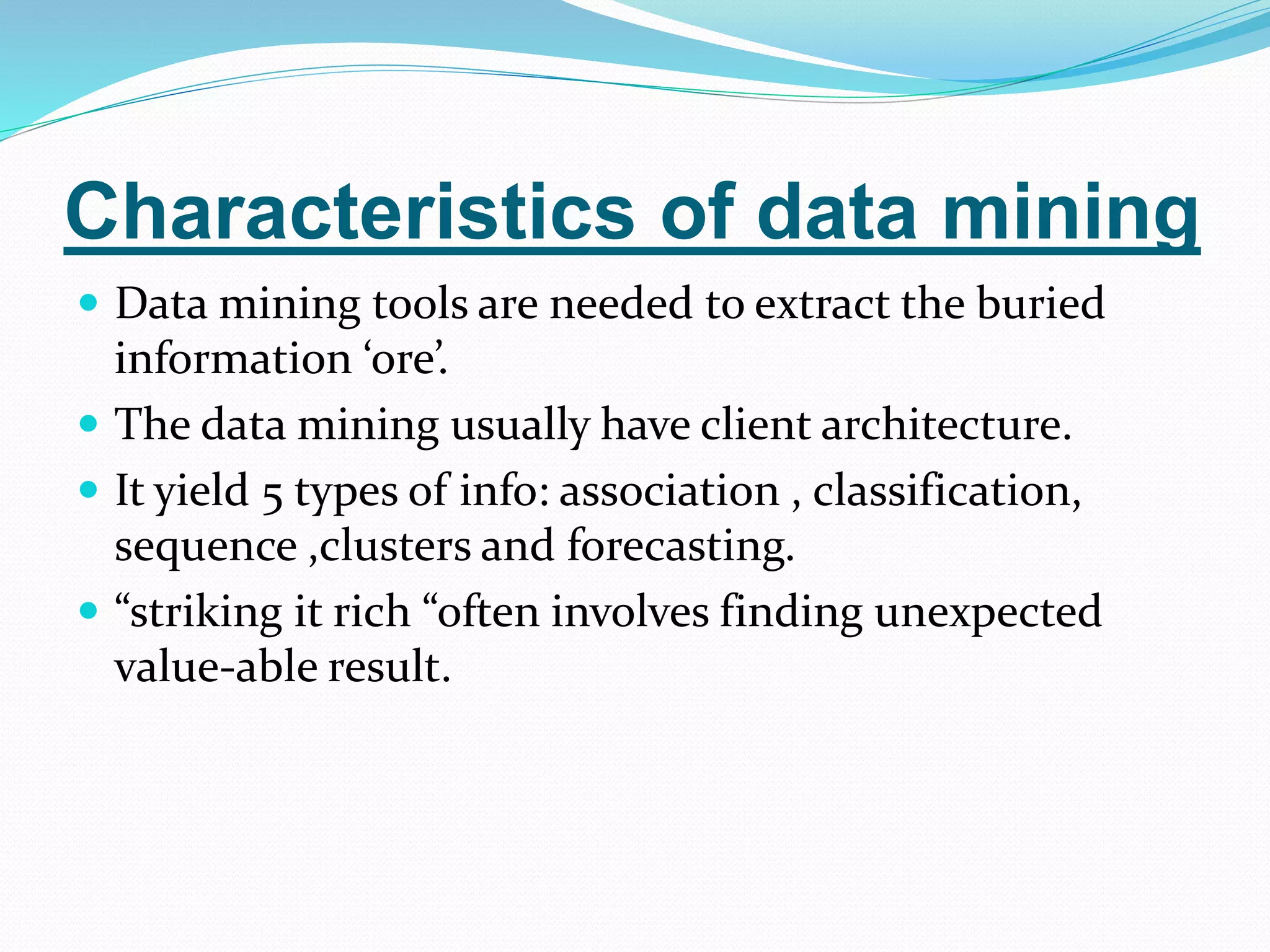
Characteristics of data mining
 Data mining tools are needed to extract the buried
information ‘ore’.
 The data mining usually have client architecture.
 It yield 5 types of info: association , classification,
sequence ,clusters and forecasting.
 “striking it rich “often involves finding unexpected
value-able result.
TEXT MINING:-
 Text mining is the application of data
mining to non-structured or less structured
text files
 Operates with less structured information.
 Frequently focused on document format
rather than document content
TEXT MINING HELPS IN…
 Find the “hidden” contents of document , including
additional useful relationships.
 Relate documents across previously unnoticed
divisions( e.g. : Discover that customers in two
different product divisions have the same
characteristics)
 Group documents by common themes ( EG : Identify
all the customers of an insurance firm who have
similar complaints or cancel their policies)
DATA MINING FOR DECISION
SUPPORT
 Automated prediction of trends and
behavior for ex,targeted marketing
 Automated discovery of previously
unknown patterns : for exp
detecting fraudulent credit card
transactions and identifying
anomalous data representing data
entry-keying errors
 Data run on information and the
knowledge of how to put that
information to use
 Knowledge is not readily available , it is continuously
constructed from data and in a process that may not be
simple or easy
 The transformation of the data into knowledge may b
accomplished in several ways
 Data collection from various sources stored in simple
data bases.
BUSINESS INTELLIGENCE
 One ultimate use of data
gathered and processed in
data life cycle is for
Business.
 Such tools can be employed
by end user to access data ,
ask queries ,create CRM
activities ,etc.
 Business intelligence
generally involves the
creation or use of a data
warehouse.
APPLICATIONS OF
BUSINESS INTELLIGENCE
 Financial Modeling
 Budgeting
 Resource Allocation
 Competitive Intelligence
 Using the business intelligence software the user can
ask queries ,request ad-hoc reports , or conduct any
other analysis.
HOW BUSINESS
INTELIGENCE WORK
 The process starts with raw data which are usually
kept in corporate database.
 Through all this information may be scattered
across multiple systems.
 In the Data Ware House(or mart) tables can be
linked, and data cubes are formed.
Datawarehouse

Datawarehouse

  • 3.
    •Database and DataWarehousing •History of data warehousing •Evolution in organization use of data warehouses •Data Warehouse Architecture •Benefits of data warehousing •Strategic uses of data warehousing •Disadvantages of data warehouses •Data mart •Data mining • Text mining •Data mining for decision support •OLAP •Data warehousing integration •Business intelligence
  • 4.
    The Difference… DWH ConstituteEntire Information Base For All Time.. Database constitute real time Information DWH supports DM And Business Intelligence Database is used to run the Business DWH is how to run The Business
  • 5.
    What product promotions have the biggestimpact on revenue . What impact will new products and services have on revenue and margins What are the lowest and highest margins customers Which customers are most likely to go to the competitions
  • 6.
    A single, completeand consistent store of data obtained from a variety of different sources made available to end users in a what they can understand and use in a business context..
  • 7.
    A process oftransforming data into information and making it available to users in a timely enough manner to make difference.
  • 8.
    Technique for assemblingand managing data from various sources for the purpose of answering business questions. Thus making decisions that were not previous possible
  • 9.
    DATA WAREHOUSING IS. SubjectOriented:  Data that gives information about a particular subject instead of about a company's ongoing operations. Integrated:  Data that is gathered into the data warehouse from a variety of sources and merged into a coherent whole. Time-variant:  All data in the data warehouse is identified with a particular time period. Non-volatile:  Data is stable in a data warehouse. More data is added but data is never removed.  Data warehousing is combining data from multiple and usually varied sources into one comprehensive and easily manipulated database
  • 10.
    In 1980’s IBMresearchers Barry Devlin and Paul Murphy developed: “Business data warehouse". 1960’s General Mills and Dartmouth College developed the terms dimensions and facts. 1970s ACNielsen and IRI provide dimensional data marts for retail sales. 1988’s Barry Devlin and Paul Murphy published an article “Architecture for a business and information systems” where they introduce the term "business data warehouse".
  • 11.
    BUSINESS ADVANTAGES • Itprovides added value to company’s costumers by allowing them to access better information when data warehousing is coupled with internet. • It provides a look at activities that cross functional lines. • It reports on trends across multidivisional , multinational operating units , including trends and relationships in areas such as production planning etc. • It provides “costumer-centric” view of company’s heterogeneous data by helping to integrate data from sales , services , manufacturing and distribution etc.
  • 12.
    STRATEGIC USES OFDATA WAREHOUSING INDUSTRY FUNCTIONAL AREAS OF USE STRATEGIC USE AIRLINE Operations; marketing Crew assignment , aircraft development , frequent flyer program promotions BANKING Predevelopment; operations ; marketing duct Customer service , trend analysis , product and service promotions HEALTH CARE operations Reduction of operational expenses PERSONAL CARE distribution ; marketing Distribution decisions , product promotions , sales decision , pricing policy PUBLIC SECTOR operations Intelligence gathering RETAIL CHAIN distribution ; marketing Inventory control , sales promotion , pricing policy , trend analysis
  • 13.
    DISADVANTAGES OF DATA WAREHOUSING •Data warehouses are not optimal environment for unstructured data. • Because data must be extracted , transformed and loaded into the warehouse , there is an element of latency in data warehouse data. • Over their life , data warehouses can have high costs . Maintenance costs are high. • Date warehouses can get outdated relatively quickly . There is a cost of delivering suboptimal information to the organization.
  • 14.
    DATA MART  Adata mart is scaled down version of a data warehouse that focuses on a particular subject area.  A data mart is a subset of an organizational data store usually oriented to a specific purpose that may be distributed to meet basic needs.
  • 15.
    REASONS FOR CREATING Easy access to frequently needed data  Creates collective view by a group of users  Improves end user response time  Ease o creation in less time  Lower cast than implementing a full data warehouse  Potential user are more clearly defined in a full data warehouse.
  • 16.
    Characteristics of departmental datamart  Small  Flexible  OLAP  Customized by Department  Source is departmently structured data warehouse
  • 17.
    DATA MINING  DataMining is a process of extracting information from company’s various data base and re-organizing it for other purpose what the database were originally intended for.  Data mining is different for different organization based upon nature of data and organization.
  • 18.
    Characteristics of datamining  Data mining tools are needed to extract the buried information ‘ore’.  The data mining usually have client architecture.  It yield 5 types of info: association , classification, sequence ,clusters and forecasting.  “striking it rich “often involves finding unexpected value-able result.
  • 19.
    TEXT MINING:-  Textmining is the application of data mining to non-structured or less structured text files  Operates with less structured information.  Frequently focused on document format rather than document content
  • 20.
    TEXT MINING HELPSIN…  Find the “hidden” contents of document , including additional useful relationships.  Relate documents across previously unnoticed divisions( e.g. : Discover that customers in two different product divisions have the same characteristics)  Group documents by common themes ( EG : Identify all the customers of an insurance firm who have similar complaints or cancel their policies)
  • 21.
    DATA MINING FORDECISION SUPPORT  Automated prediction of trends and behavior for ex,targeted marketing  Automated discovery of previously unknown patterns : for exp detecting fraudulent credit card transactions and identifying anomalous data representing data entry-keying errors  Data run on information and the knowledge of how to put that information to use
  • 22.
     Knowledge isnot readily available , it is continuously constructed from data and in a process that may not be simple or easy  The transformation of the data into knowledge may b accomplished in several ways  Data collection from various sources stored in simple data bases.
  • 23.
    BUSINESS INTELLIGENCE  Oneultimate use of data gathered and processed in data life cycle is for Business.  Such tools can be employed by end user to access data , ask queries ,create CRM activities ,etc.  Business intelligence generally involves the creation or use of a data warehouse.
  • 24.
    APPLICATIONS OF BUSINESS INTELLIGENCE Financial Modeling  Budgeting  Resource Allocation  Competitive Intelligence  Using the business intelligence software the user can ask queries ,request ad-hoc reports , or conduct any other analysis.
  • 25.
    HOW BUSINESS INTELIGENCE WORK The process starts with raw data which are usually kept in corporate database.  Through all this information may be scattered across multiple systems.  In the Data Ware House(or mart) tables can be linked, and data cubes are formed.