Business Intelligence
3/28/2013
How Large is a Petabyte?
= 4 x
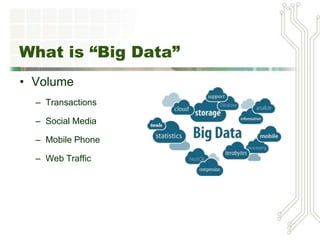
What is “Big Data”
• Volume
– Transactions
– Social Media
– Mobile Phone
– Web Traffic
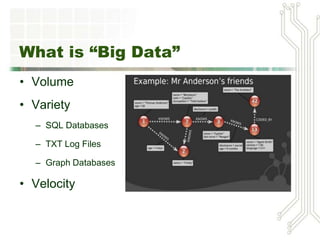
What is “Big Data”
• Volume
• Variety
– SQL Databases
– TXT Log Files
– Graph Databases
• Velocity
What is “Big Data”
• Volume
• Variety
• Velocity
– Rate of Collection
– Need for Agility
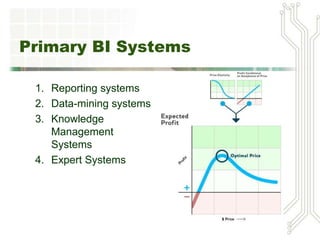
Primary BI Systems
1. Reporting systems
2. Data-mining systems
3. Knowledge
Management
Systems
4. Expert Systems
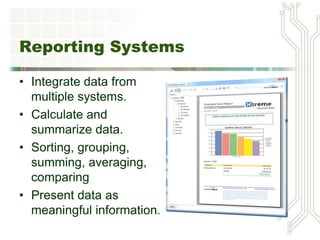
Reporting Systems
• Integrate data from
multiple systems.
• Calculate and
summarize data.
• Sorting, grouping,
summing, averaging,
comparing
• Present data as
meaningful information.
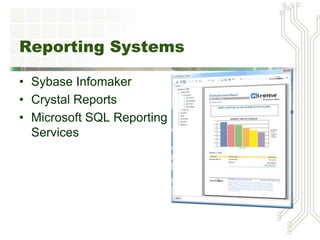
Reporting Systems
• Sybase Infomaker
• Crystal Reports
• Microsoft SQL Reporting
Services
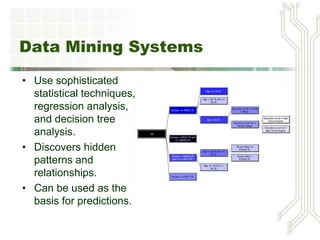
Data Mining Systems
• Use sophisticated
statistical techniques,
regression analysis,
and decision tree
analysis.
• Discovers hidden
patterns and
relationships.
• Can be used as the
basis for predictions.
Data Mining Systems
• MS Business
Intelligence
Development Studio
• SAS Enterprise
Miner
• WEKA
Knowledge Management
Systems
• Collect and share
human knowledge.
• Best practices
• Employee training
• Process
documentation
• Collaboration &
Communication
Knowledge Management
Systems
• Sharepoint Server
• Kwiki, TikiWiki,
Twiki, Zwiki
• Google Docs
• Google Sites
• Evernote
Expert Systems
• Uses rules and logic
(i.e. IF > THEN)
• Automates and
standardizes
decision making.
• Examples: Medical,
HR, Finance,
Stocks, Games
• IFTTT
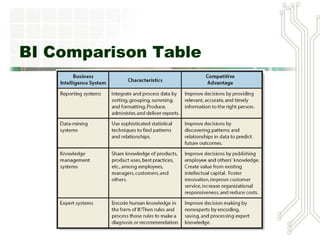
BI Comparison Table
Business Intelligence Problems
• Raw data usually unsuitable for
sophisticated reporting or data
mining
• Dirty data (misspelled, wrong type,
missing, duplication, inconsistent)
• Multi-dimensionality
• Wrong granularity (summary vs.
detail)
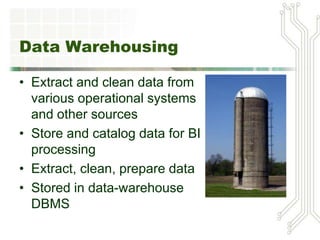
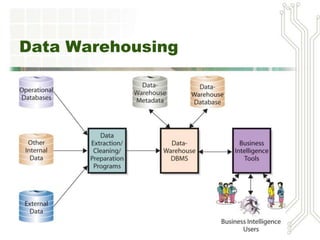
Data Warehousing
• Extract and clean data from
various operational systems
and other sources
• Store and catalog data for BI
processing
• Extract, clean, prepare data
• Stored in data-warehouse
DBMS
Data Warehousing
Data Mart
• Created to address particular needs
• Smaller than data warehouse
• Users may not have data management
expertise
• Data extracted from data warehouse for a
functional area
BI & MRV
MRV could:
• Develop a plan to organize storage of data and how
management might use it;
• Use a reporting system to provide information about
how much repeat business each guide generates;
• Identify high value customers and customer referrals;
• Analyze equipment inventory usage to guide future
equipment purchases.

MIS: Business Intelligence

  • 1.
  • 3.
    How Large isa Petabyte? = 4 x
  • 4.
    What is “BigData” • Volume – Transactions – Social Media – Mobile Phone – Web Traffic
  • 5.
    What is “BigData” • Volume • Variety – SQL Databases – TXT Log Files – Graph Databases • Velocity
  • 6.
    What is “BigData” • Volume • Variety • Velocity – Rate of Collection – Need for Agility
  • 7.
    Primary BI Systems 1.Reporting systems 2. Data-mining systems 3. Knowledge Management Systems 4. Expert Systems
  • 8.
    Reporting Systems • Integratedata from multiple systems. • Calculate and summarize data. • Sorting, grouping, summing, averaging, comparing • Present data as meaningful information.
  • 9.
    Reporting Systems • SybaseInfomaker • Crystal Reports • Microsoft SQL Reporting Services
  • 10.
    Data Mining Systems •Use sophisticated statistical techniques, regression analysis, and decision tree analysis. • Discovers hidden patterns and relationships. • Can be used as the basis for predictions.
  • 11.
    Data Mining Systems •MS Business Intelligence Development Studio • SAS Enterprise Miner • WEKA
  • 12.
    Knowledge Management Systems • Collectand share human knowledge. • Best practices • Employee training • Process documentation • Collaboration & Communication
  • 13.
    Knowledge Management Systems • SharepointServer • Kwiki, TikiWiki, Twiki, Zwiki • Google Docs • Google Sites • Evernote
  • 14.
    Expert Systems • Usesrules and logic (i.e. IF > THEN) • Automates and standardizes decision making. • Examples: Medical, HR, Finance, Stocks, Games • IFTTT
  • 15.
  • 16.
    Business Intelligence Problems •Raw data usually unsuitable for sophisticated reporting or data mining • Dirty data (misspelled, wrong type, missing, duplication, inconsistent) • Multi-dimensionality • Wrong granularity (summary vs. detail)
  • 17.
    Data Warehousing • Extractand clean data from various operational systems and other sources • Store and catalog data for BI processing • Extract, clean, prepare data • Stored in data-warehouse DBMS
  • 18.
  • 19.
    Data Mart • Createdto address particular needs • Smaller than data warehouse • Users may not have data management expertise • Data extracted from data warehouse for a functional area
  • 20.
    BI & MRV MRVcould: • Develop a plan to organize storage of data and how management might use it; • Use a reporting system to provide information about how much repeat business each guide generates; • Identify high value customers and customer referrals; • Analyze equipment inventory usage to guide future equipment purchases.

Editor's Notes

  • #5 Volume is actually a benefit. The benefit gained from the ability to process large amounts of information is the main attraction of big data analytics. Having more data beats out having better models: simple bits of math can be unreasonably effective given large amounts of data. If you could run that forecast taking into account 300 factors rather than 6, could you predict demand better? This volume presents the most immediate challenge to conventional IT structures. It calls for scalable storage, and a distributed approach to querying. Many companies already have large amounts of archived data, perhaps in the form of logs, but not the capacity to process it.