This document discusses data structures and provides an introduction and overview. It defines data structures as specialized formats for organizing and storing data to allow efficient access and manipulation. Key points include:
- Data structures include arrays, linked lists, stacks, queues, trees and graphs. They allow efficient handling of data through operations like traversal, insertion, deletion, searching and sorting.
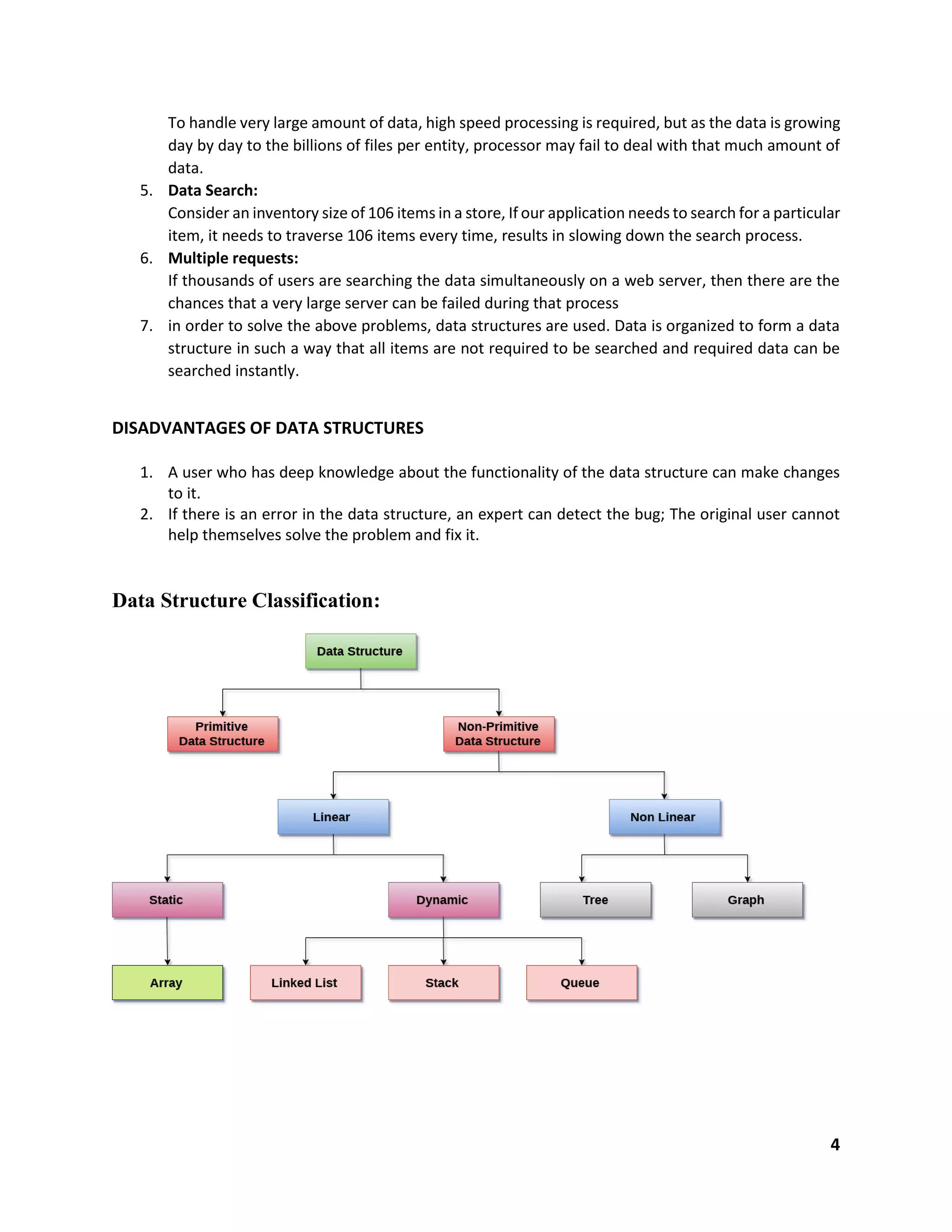
- Linear data structures arrange elements in a sequential order while non-linear structures do not. Common examples are discussed.
- Characteristics of data structures include being static or dynamic, homogeneous or non-homogeneous. Efficiency and complexity are also addressed.
- Basic array operations like traversal, insertion, deletion and searching are demonstrated with pseudocode examples

![5
LINEAR DATA STRUCTURES:
A data structure is called linear if all of its elements are arranged in the linear order. In linear data
structures, the elements are stored in non-hierarchical way where each element has the successors and
predecessors except the first and last element.
Types of Linear Data Structures are given below:
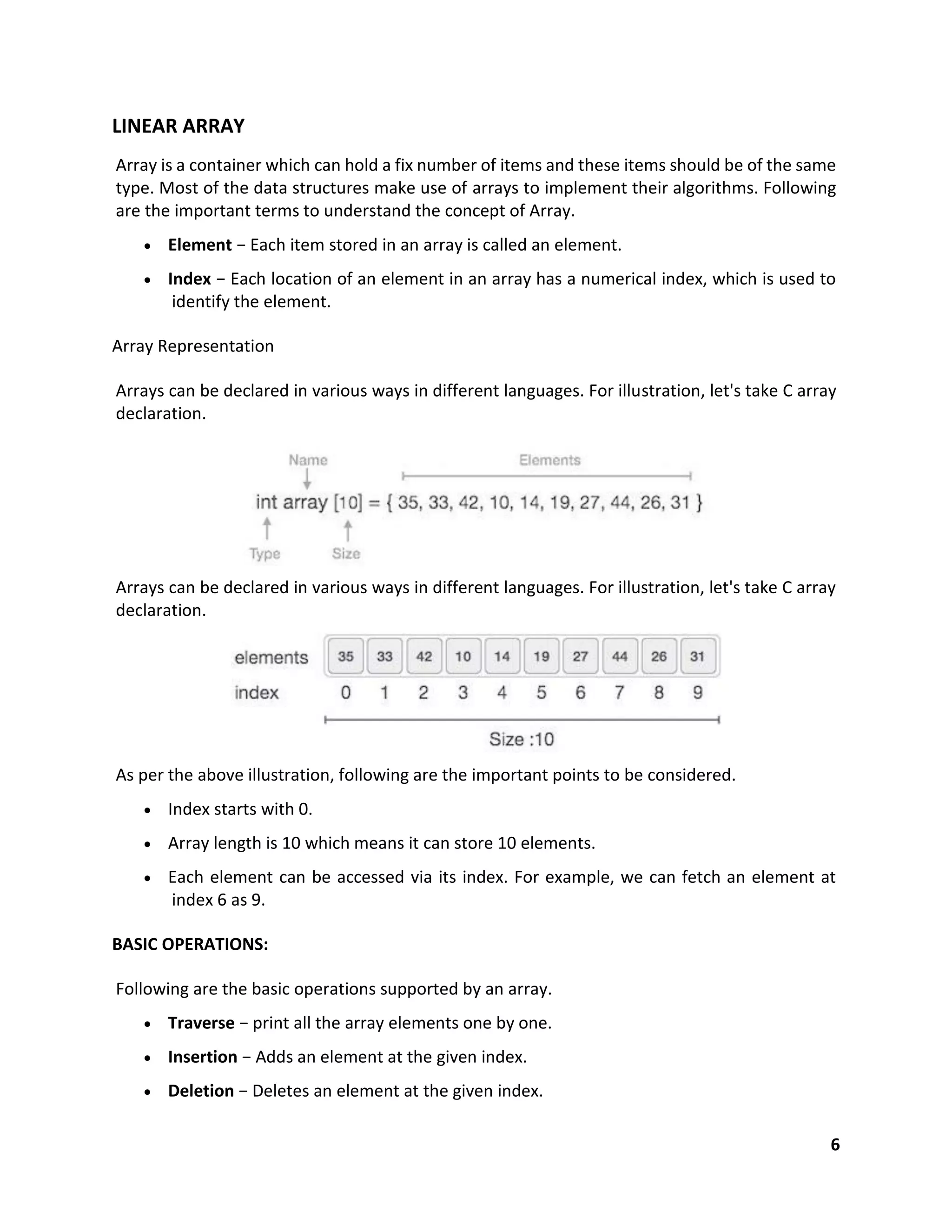
Arrays: An array is a collection of similar type of data items and each data item is called an element of the
array. The data type of the element may be any valid data type like char, int, float or double.
The elements of array share the same variable name but each one carries a different index number known
as subscript. The array can be one dimensional, two dimensional or multidimensional.
The individual elements of the array age are:
age[0], age[1], age[2], age[3],......... age[98], age[99].
Linked List: Linked list is a linear data structure which is used to maintain a list in the memory. It can be
seen as the collection of nodes stored at non-contiguous memory locations. Each node of the list contains
a pointer to its adjacent node.
Stack: Stack is a linear list in which insertion and deletions are allowed only at one end, called top.
A stack is an abstract data type (ADT), can be implemented in most of the programming languages. It is
named as stack because it behaves like a real-world stack, for example: - piles of plates or deck of cards
etc.
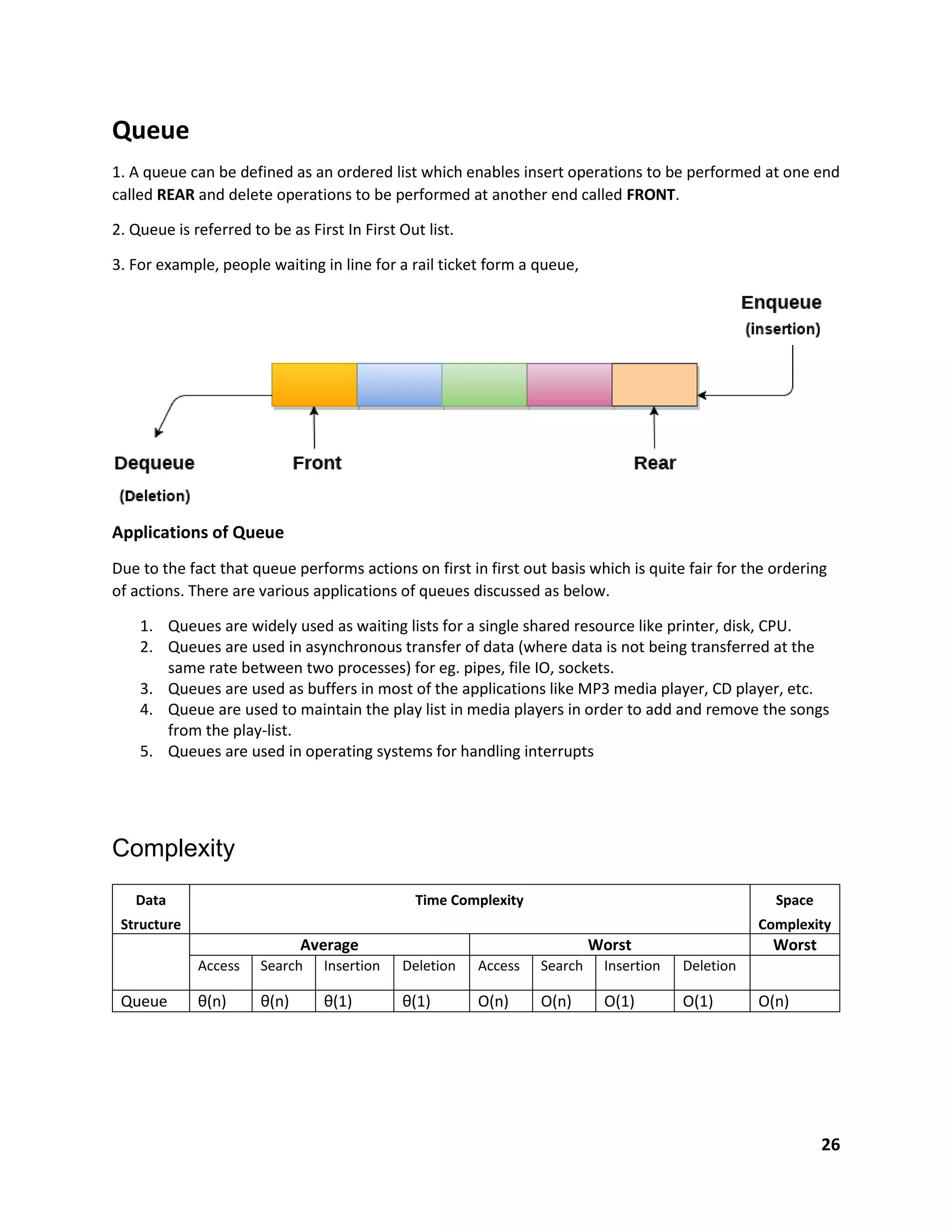
Queue: Queue is a linear list in which elements can be inserted only at one end called rear and deleted
only at the other end called front.
It is an abstract data structure, similar to stack. Queue is opened at both end therefore it follows First-In-
First-Out (FIFO) methodology for storing the data items.
NON LINEAR DATA STRUCTURES:
This data structure does not form a sequence i.e. each item or element is connected with two or more
other items in a non-linear arrangement. The data elements are not arranged in sequential structure.
Types of Non Linear Data Structures are given below:
Trees: Trees are multilevel data structures with a hierarchical relationship among its elements known as
nodes. The bottommost nodes in the herierchy are called leaf node while the topmost node is called root
node. Each node contains pointers to point adjacent nodes.
Tree data structure is based on the parent-child relationship among the nodes. Each node in the tree can
have more than one children except the leaf nodes whereas each node can have atmost one parent except
the root node. Trees can be classfied into many categories which will be discussed later in this tutorial.
Graphs: Graphs can be defined as the pictorial representation of the set of elements (represented by
vertices) connected by the links known as edges. A graph is different from tree in the sense that a graph
can have cycle while the tree can not have the one.](https://image.slidesharecdn.com/ds123notes-220706070619-99ef0d33/75/Datastructures-Notes-6-2048.jpg)
![7
Search − Searches an element using the given index or by the value.
Update − Updates an element at the given index.
In C, when an array is initialized with size, then it assigns defaults values to its elements in
following order.
Data Type Default Value
bool false
char 0
int 0
float 0.0
double 0.0f
void
wchar_t 0
Insertion Operation:
Insert operation is to insert one or more data elements into an array. Based on the requirement,
a new element can be added at the beginning, end, or any given index of array.
Here, we see a practical implementation of insertion operation, where we add data at the end
of the array –
Algorithm
Let Array be a linear unordered array of MAX elements.
Example
Result
Let LA be a Linear Array (unordered) with N elements and K is a positive integer such that K<=N.
Following is the algorithm where ITEM is inserted into the Kth position of LA –
1. Start
2. Set J = N
3. Set N = N+1
4. Repeat steps 5 and 6 while J >= K
5. Set LA[J+1] = LA[J]
6. Set J = J-1](https://image.slidesharecdn.com/ds123notes-220706070619-99ef0d33/75/Datastructures-Notes-8-2048.jpg)
![8
7. Set LA[K] = ITEM
8. Stop
Example
Following is the implementation of the above algorithm –
#include <stdio.h>
main() {
int LA[] = {1,3,5,7,8};
int item = 10, k = 3, n = 5;
int I = 0, j = n;
printf(“The original array elements are :n”);
for(I = 0; i<n; i++) {
printf(“LA[%d] = %d n”, I, LA[i]);
}
n = n + 1;
while( j >= k) {
LA[j+1] = LA[j];
j = j – 1;
}
LA[k] = item;
printf(“The array elements after insertion :n”);
for(I = 0; i<n; i++) {
printf(“LA[%d] = %d n”, I, LA[i]);
}
}
When we compile and execute the above program, it produces the following result
Output
The original array elements are :
LA[0] = 1
LA[1] = 3
LA[2] = 5
LA[3] = 7
LA[4] = 8
The array elements after insertion :
LA[0] = 1
LA[1] = 3](https://image.slidesharecdn.com/ds123notes-220706070619-99ef0d33/75/Datastructures-Notes-9-2048.jpg)
![9
LA[2] = 5
LA[3] = 10
LA[4] = 7
LA[5] = 8
Deletion Operation:
Deletion refers to removing an existing element from the array and re-organizing all elements
of an array.
Algorithm
Consider LA is a linear array with N elements and K is a positive integer such that K<=N. Following
is the algorithm to delete an element available at the Kth position of LA.
1. Start
2. Set J = K
3. Repeat steps 4 and 5 while J < N
4. Set LA[J] = LA[J + 1]
5. Set J = J+1
6. Set N = N-1
7. Stop
Example
Following is the implementation of the above algorithm −
#include <stdio.h>
void main() {
int LA[] = {1,3,5,7,8};
int k = 3, n = 5;
int i, j;
printf("The original array elements are :n");
for(i = 0; i<n; i++) {
printf("LA[%d] = %d n", i, LA[i]);
}
j = k;
while( j < n) {
LA[j-1] = LA[j];
j = j + 1;
}
n = n -1;](https://image.slidesharecdn.com/ds123notes-220706070619-99ef0d33/75/Datastructures-Notes-10-2048.jpg)
![10
printf("The array elements after deletion :n");
for(i = 0; i<n; i++) {
printf("LA[%d] = %d n", i, LA[i]);
}
}
When we compile and execute the above program, it produces the following result −
Output
The original array elements are :
LA[0] = 1
LA[1] = 3
LA[2] = 5
LA[3] = 7
LA[4] = 8
The array elements after deletion :
LA[0] = 1
LA[1] = 3
LA[2] = 7
LA[3] = 8
Search Operation:
You can perform a search for an array element based on its value or its index.
Algorithm
Consider LA is a linear array with N elements and K is a positive integer such that K<=N. Following
is the algorithm to find an element with a value of ITEM using sequential search.
1. Start
2. Set J = 0
3. Repeat steps 4 and 5 while J < N
4. IF LA[J] is equal ITEM THEN GOTO STEP 6
5. Set J = J +1
6. PRINT J, ITEM
7. Stop](https://image.slidesharecdn.com/ds123notes-220706070619-99ef0d33/75/Datastructures-Notes-11-2048.jpg)
![11
Example
Following is the implementation of the above algorithm −
#include <stdio.h>
void main() {
int LA[] = {1,3,5,7,8};
int item = 5, n = 5;
int i = 0, j = 0;
printf("The original array elements are :n");
for(i = 0; i<n; i++) {
printf("LA[%d] = %d n", i, LA[i]);
}
while( j < n){
if( LA[j] == item ) {
break;
}
j = j + 1;
}
printf("Found element %d at position %dn", item, j+1);
}
When we compile and execute the above program, it produces the following result −
Output
The original array elements are :
LA[0] = 1
LA[1] = 3
LA[2] = 5
LA[3] = 7
LA[4] = 8
Found element 5 at position 3
Update Operation:
Update operation refers to updating an existing element from the array at a given index.
Algorithm
Consider LA is a linear array with N elements and K is a positive integer such that K<=N. Following
is the algorithm to update an element available at the Kth position of LA.](https://image.slidesharecdn.com/ds123notes-220706070619-99ef0d33/75/Datastructures-Notes-12-2048.jpg)
![12
1. Start
2. Set LA[K-1] = ITEM
3. Stop
EXAMPLE Following is the implementation of the above algorithm −
#include <stdio.h>
void main() {
int LA[] = {1,3,5,7,8};
int k = 3, n = 5, item = 10;
int i, j;
printf("The original array elements are :n");
for(i = 0; i<n; i++) {
printf("LA[%d] = %d n", i, LA[i]);
}
LA[k-1] = item;
printf("The array elements after updation :n");
for(i = 0; i<n; i++) {
printf("LA[%d] = %d n", i, LA[i]);
}
}
When we compile and execute the above program, it produces the following result −
Output
The original array elements are :
LA[0] = 1
LA[1] = 3
LA[2] = 5
LA[3] = 7
LA[4] = 8
The array elements after updation :
LA[0] = 1
LA[1] = 3
LA[2] = 10
LA[3] = 7
LA[4] = 8](https://image.slidesharecdn.com/ds123notes-220706070619-99ef0d33/75/Datastructures-Notes-13-2048.jpg)
![15
while x not found
if upperBound < lowerBound
EXIT: x does not exists.
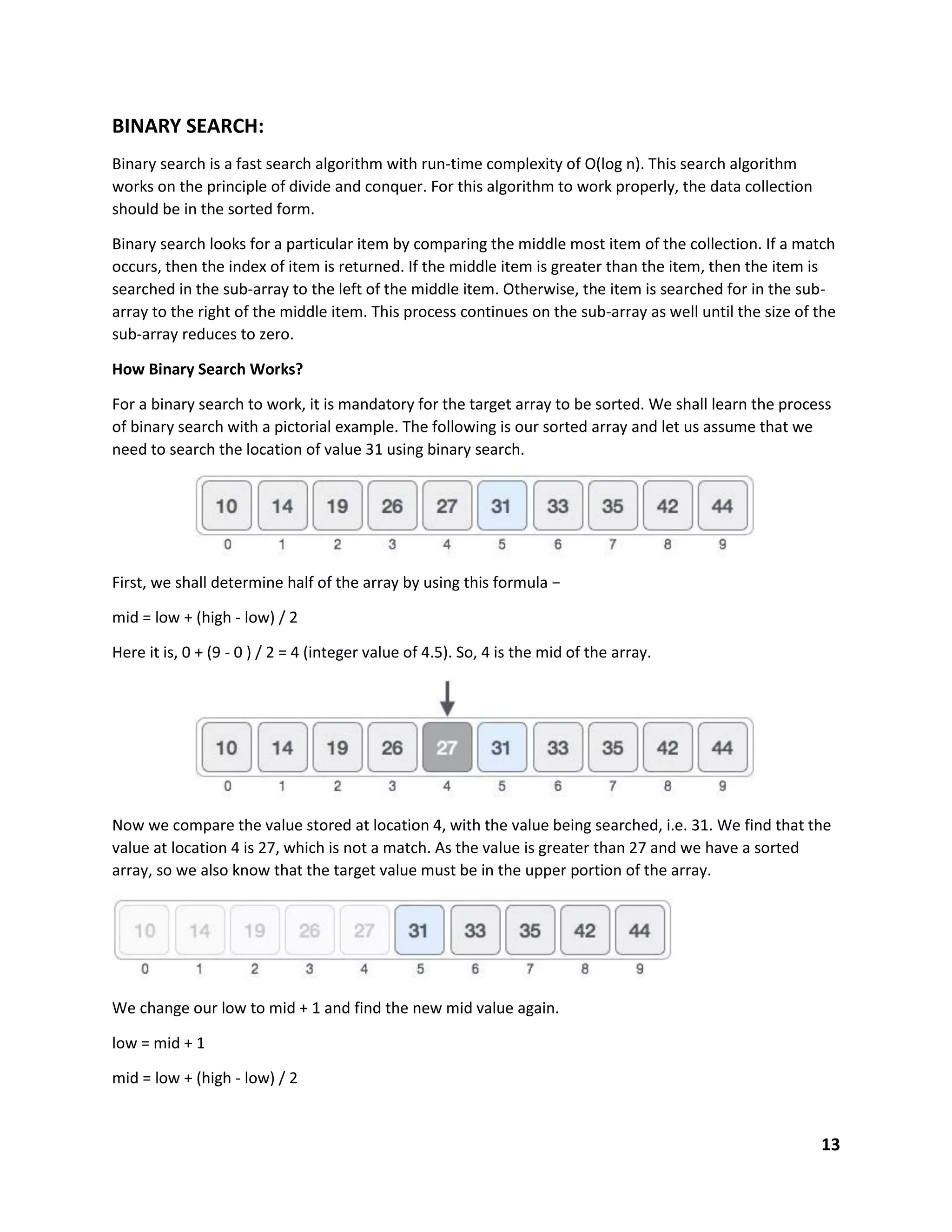
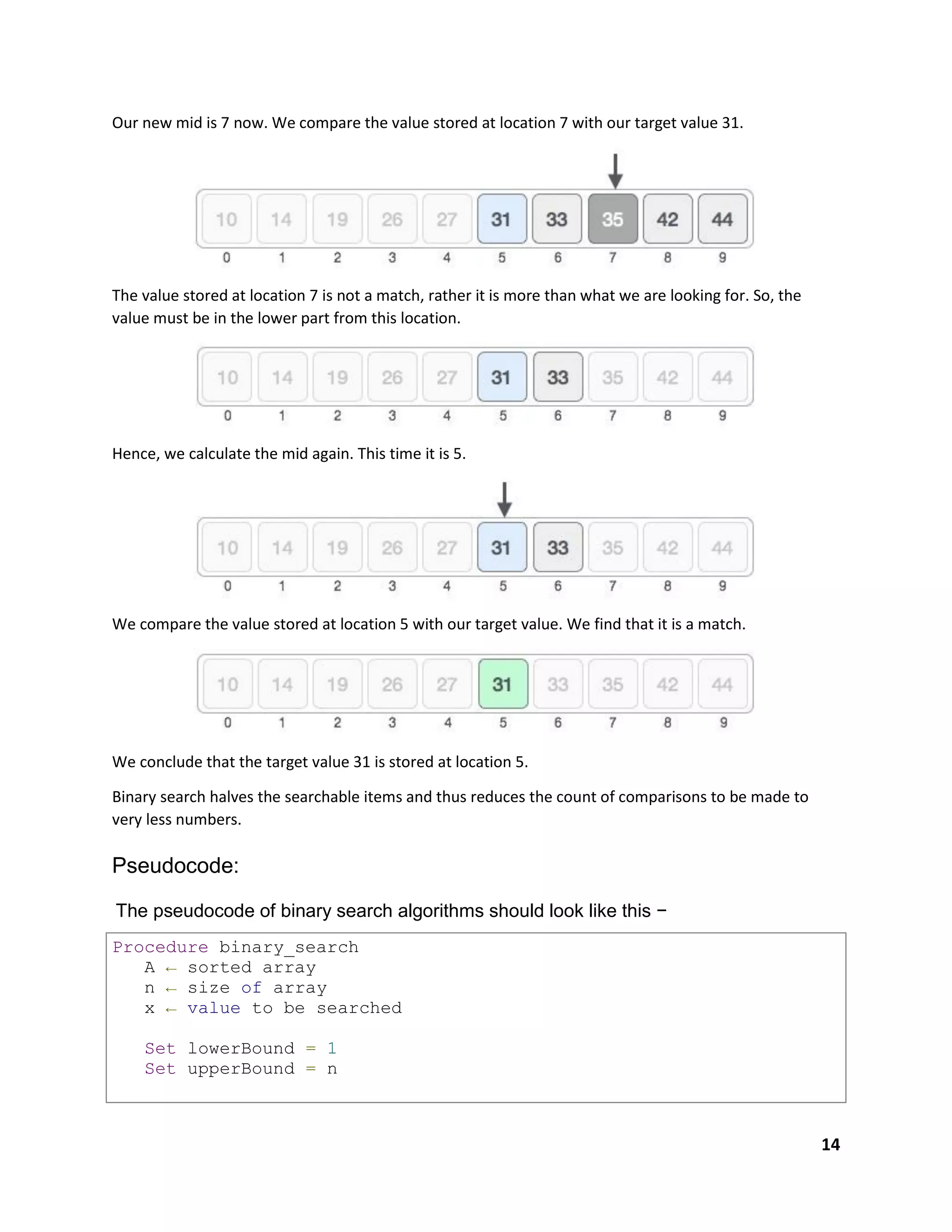
set midPoint = lowerBound + ( upperBound - lowerBound ) / 2
if A[midPoint] < x
set lowerBound = midPoint + 1
if A[midPoint] > x
set upperBound = midPoint - 1
if A[midPoint] = x
EXIT: x found at location midPoint
end while
end procedure
SORTING
Sorting refers to arranging data in a particular format. Sorting algorithm specifies the way to
arrange data in a particular order. Most common orders are in numerical or lexicographical
order.
The importance of sorting lies in the fact that data searching can be optimized to a very high
level, if data is stored in a sorted manner. Sorting is also used to represent data in more readable
formats. Following are some of the examples of sorting in real-life scenarios −
Telephone Directory − The telephone directory stores the telephone numbers of people sorted by
their names, so that the names can be searched easily.
Dictionary − The dictionary stores words in an alphabetical order so that searching of any word
becomes easy.
In-place Sorting and Not-in-place Sorting:
Sorting algorithms may require some extra space for comparison and temporary storage of few
data elements. These algorithms do not require any extra space and sorting is said to happen
in-place, or for example, within the array itself. This is called in-place sorting. Bubble sort is an
example of in-place sorting.
However, in some sorting algorithms, the program requires space which is more than or equal
to the elements being sorted. Sorting which uses equal or more space is called not-in-place
sorting. Merge-sort is an example of not-in-place sorting.](https://image.slidesharecdn.com/ds123notes-220706070619-99ef0d33/75/Datastructures-Notes-16-2048.jpg)
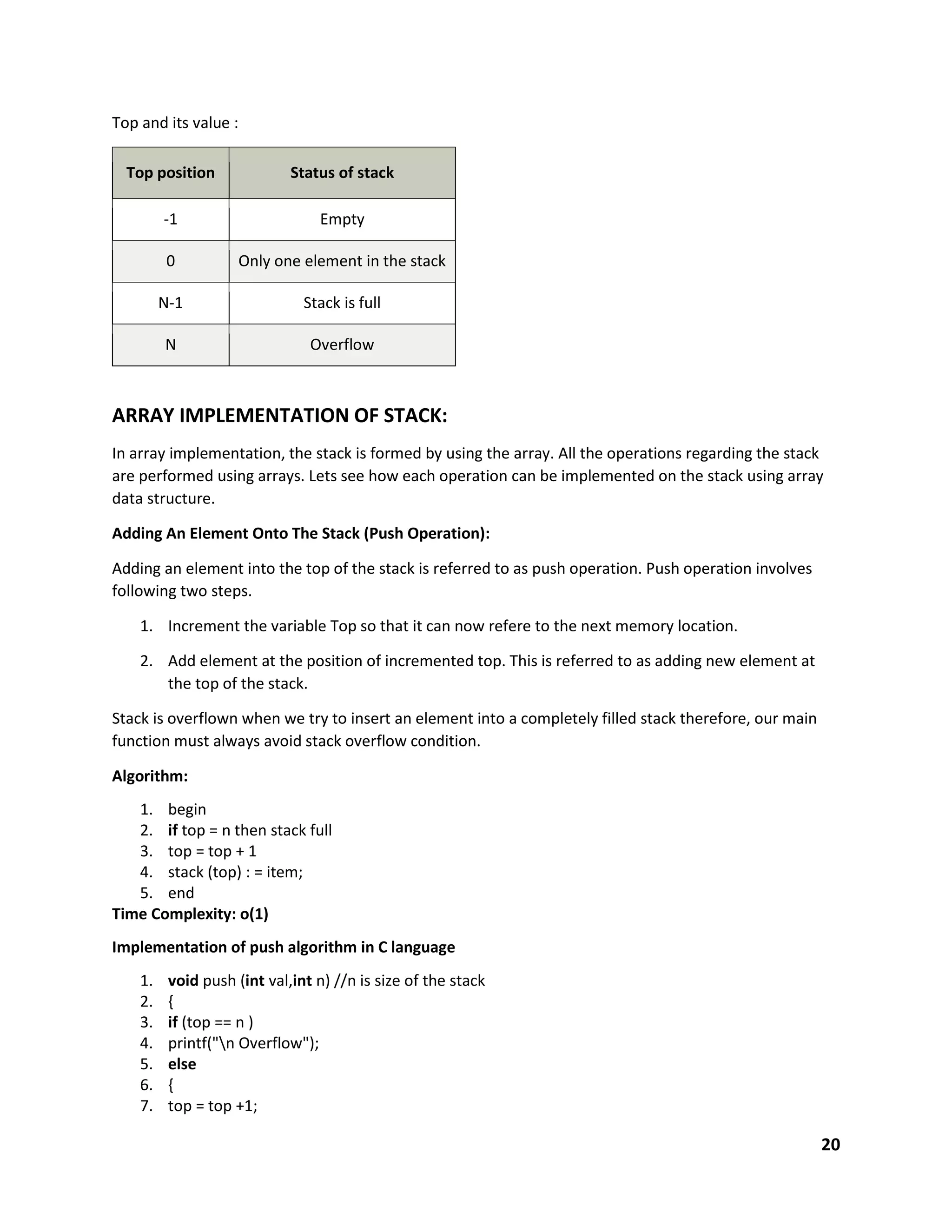
![21
8. stack[top] = val;
9. }
10. }
Deletion Of An Element From A Stack (Pop Operation):
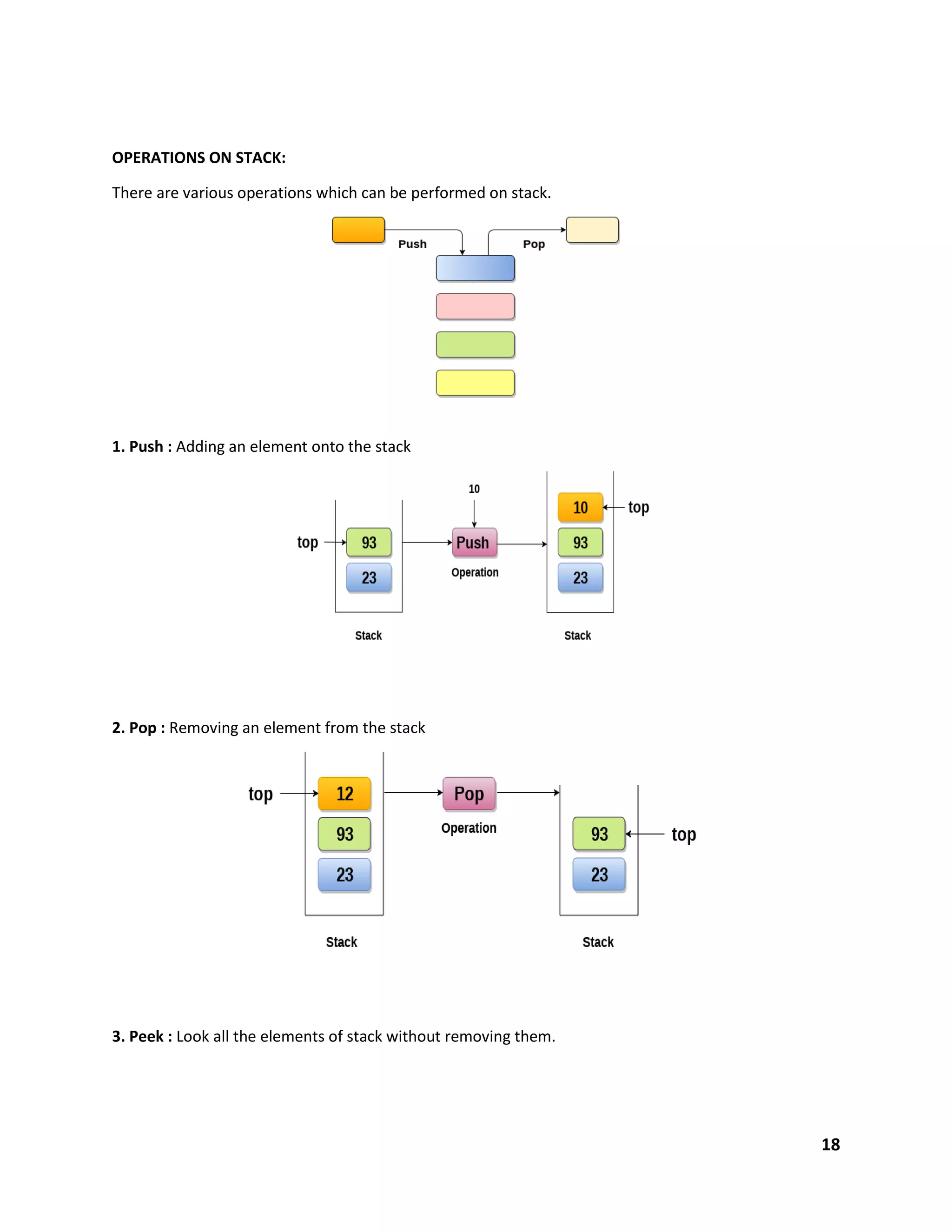
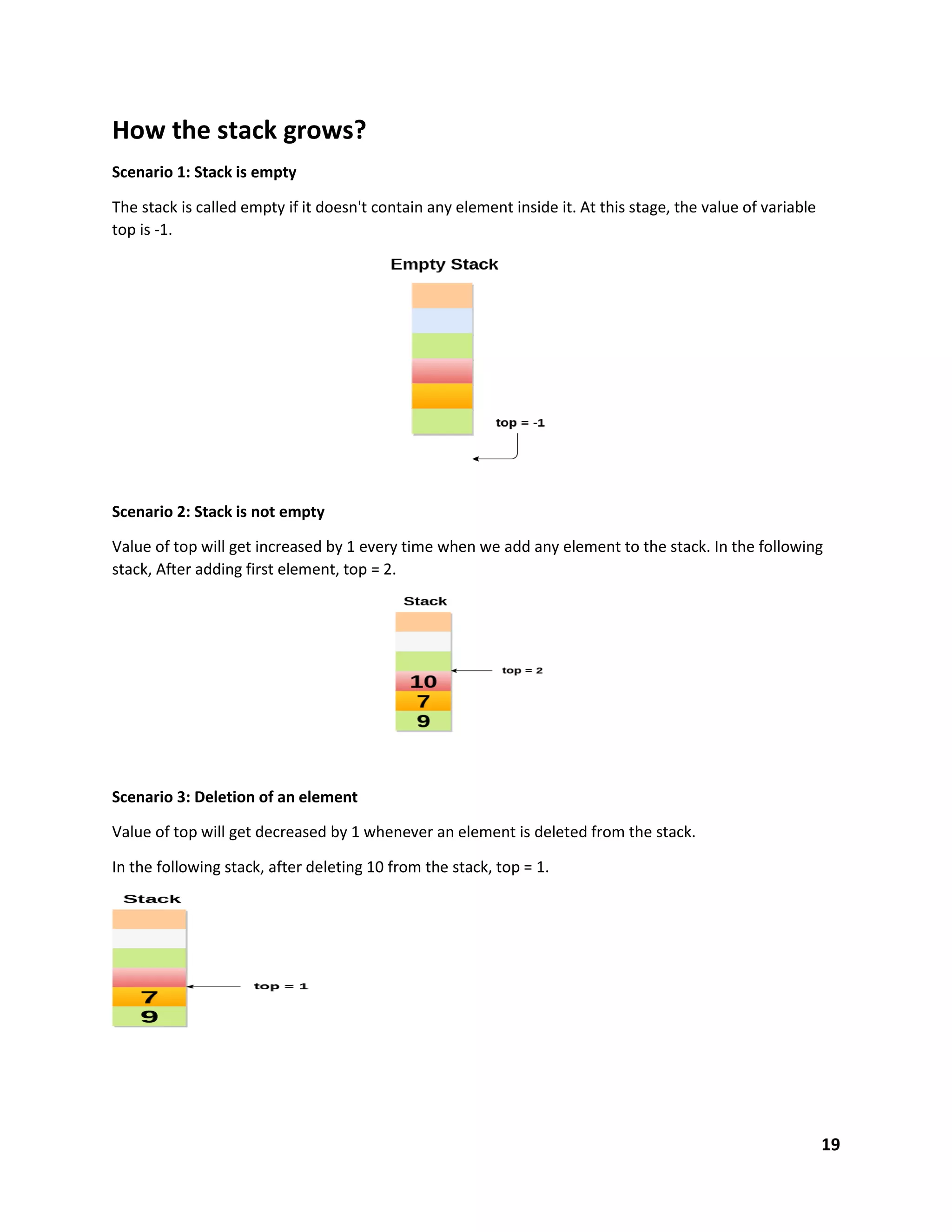
Deletion of an element from the top of the stack is called pop operation. The value of the variable top
will be incremented by 1 whenever an item is deleted from the stack. The top most element of the stack
is stored in an another variable and then the top is decremented by 1. the operation returns the deleted
value that was stored in another variable as the result.
The underflow condition occurs when we try to delete an element from an already empty stack.
Algorithm :
1. begin
2. if top = 0 then stack empty;
3. item := stack(top);
4. top = top - 1;
5. end;
Time Complexity : o(1)
Implementation of POP algorithm using C language
1. int pop ()
2. {
3. if(top == -1)
4. {
5. printf("Underflow");
6. return 0;
7. }
8. else
9. {
10. return stack[top - - ];
11. }
12. }
Visiting Each Element Of The Stack (Peek Operation):
Peek operation involves returning the element which is present at the top of the stack without deleting
it. Underflow condition can occur if we try to return the top element in an already empty stack.
Algorithm :
PEEK (STACK, TOP)
1. Begin
2. if top = -1 then stack empty
3. item = stack[top]](https://image.slidesharecdn.com/ds123notes-220706070619-99ef0d33/75/Datastructures-Notes-22-2048.jpg)
![22
4. return item
5. End
Time complexity: o(n)
Implementation of Peek algorithm in C language
1. int peek()
2. {
3. if (top == -1)
4. {
5. printf("Underflow");
6. return 0;
7. }
8. else
9. {
10. return stack [top];
11. }
12. }
LINKED LIST IMPLEMENTATION OF STACK:
Instead of using array, we can also use linked list to implement stack. Linked list allocates the memory
dynamically. However, time complexity in both the scenario is same for all the operations i.e. push, pop
and peek.
In linked list implementation of stack, the nodes are maintained non-contiguously in the memory. Each
node contains a pointer to its immediate successor node in the stack. Stack is said to be overflown if the
space left in the memory heap is not enough to create a node.
The top most node in the stack always contains null in its address field. Lets discuss the way
in which, each operation is performed in linked list implementation of stack.
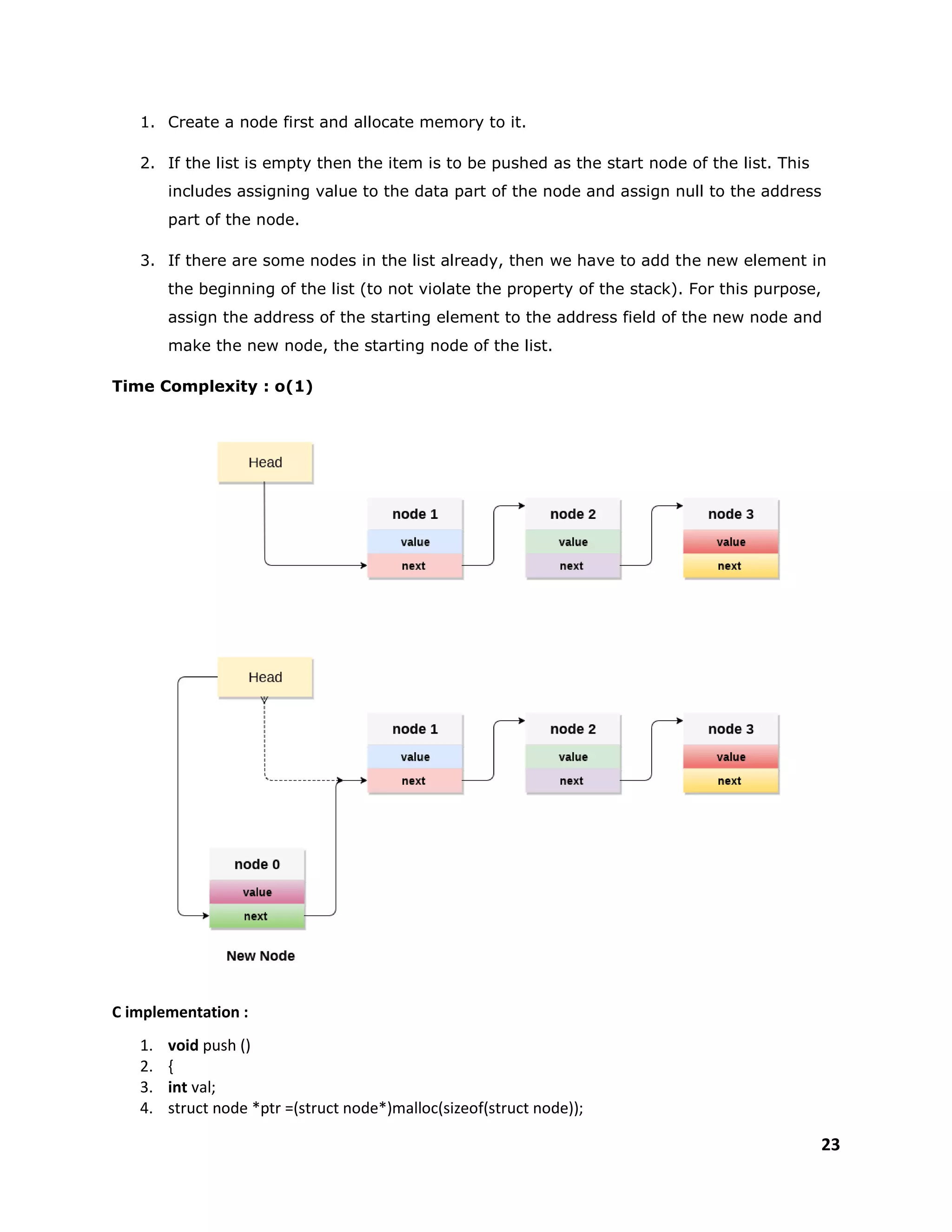
Adding A Node To The Stack (Push Operation):
Adding a node to the stack is referred to as push operation. Pushing an element to a stack
in linked list implementation is different from that of an array implementation. In order to
push an element onto the stack, the following steps are involved.](https://image.slidesharecdn.com/ds123notes-220706070619-99ef0d33/75/Datastructures-Notes-23-2048.jpg)