The (Data) Platform Fallacy
Outcome over Output - Pull over Push
Dr. Stefan Kühn
data2day 2023
Outline
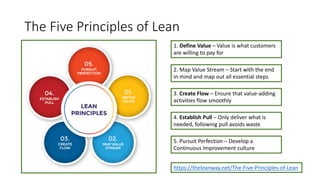
The Five Principles of Lean
1. Define Value – Value is what customers
are willing to pay for
2. Map Value Stream – Start with the end
in mind and map out all essential steps
3. Create Flow – Ensure that value-adding
activities flow smoothly
4. Establish Pull – Only deliver what is
needed, following pull avoids waste
5. Pursuit Perfection – Develop a
Continuous Improvement culture
https://theleanway.net/The-Five-Principles-of-Lean
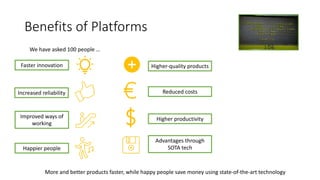
Benefits of Platforms
We have asked 100 people …
Faster innovation Higher-quality products
Increased reliability
Improved ways of
working
Advantages through
SOTA tech
Reduced costs
Higher productivity
Happier people
More and better products faster, while happy people save money using state-of-the-art technology
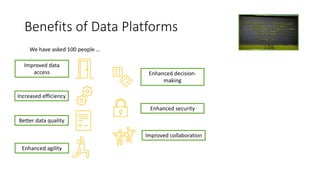
Benefits of Data Platforms
We have asked 100 people …
Improved data
access Enhanced decision-
making
Increased efficiency
Better data quality
Enhanced security
Improved collaboration
Enhanced agility
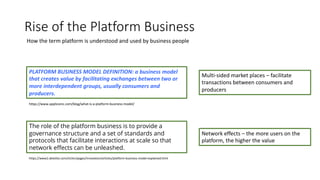
Rise of the Platform Business
Network effects – the more users on the
platform, the higher the value
Multi-sided market places – facilitate
transactions between consumers and
producers
https://www2.deloitte.com/ch/en/pages/innovation/articles/platform-business-model-explained.html
https://www.applicoinc.com/blog/what-is-a-platform-business-model/
PLATFORM BUSINESS MODEL DEFINITION: a business model
that creates value by facilitating exchanges between two or
more interdependent groups, usually consumers and
producers.
The role of the platform business is to provide a
governance structure and a set of standards and
protocols that facilitate interactions at scale so that
network effects can be unleashed.
How the term platform is understood and used by business people
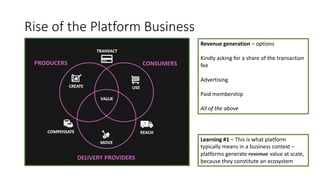
Rise of the Platform Business
Revenue generation – options
Kindly asking for a share of the transaction
fee
Advertising
Paid membership
All of the above
Learning #1 – This is what platform
typically means in a business context –
platforms generate revenue value at scale,
because they constitute an ecosystem
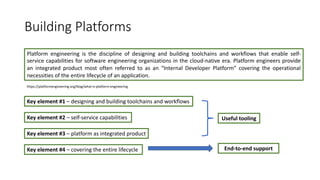
Building Platforms
Platform engineering is the discipline of designing and building toolchains and workflows that enable self-
service capabilities for software engineering organizations in the cloud-native era. Platform engineers provide
an integrated product most often referred to as an “Internal Developer Platform” covering the operational
necessities of the entire lifecycle of an application.
https://platformengineering.org/blog/what-is-platform-engineering
Key element #1 – designing and building toolchains and workflows
Key element #2 – self-service capabilities
Key element #3 – platform as integrated product
Key element #4 – covering the entire lifecycle
Useful tooling
End-to-end support
Exploring Reality
„There’s a tendency in intellectual circles to protect and embolden a thesis at the expense of exploring reality
and this is happening.“
https://www.the-ntwk.com/post/the-platform-fallacy-unravelling-platform-narrative-to-clarify-corporate-strategy
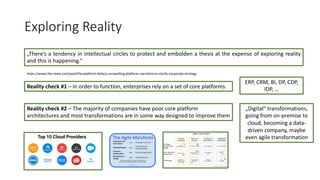
Reality check #1 – In order to function, enterprises rely on a set of core platforms.
Reality check #2 – The majority of companies have poor core platform
architectures and most transformations are in some way designed to improve them
ERP, CRM, BI, DP, CDP,
IDP, …
„Digital“ transformations,
going from on-premise to
cloud, becoming a data-
driven company, maybe
even agile transformation
Exploring Reality
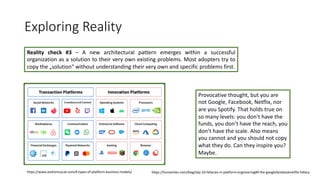
Reality check #3 – A new architectural pattern emerges within a successful
organization as a solution to their very own existing problems. Most adopters try to
copy the „solution“ without understanding their very own and specific problems first.
Provocative thought, but you are
not Google, Facebook, Netflix, nor
are you Spotify. That holds true on
so many levels: you don’t have the
funds, you don’t have the reach, you
don’t have the scale. Also means
you cannot and you should not copy
what they do. Can they inspire you?
Maybe.
https://humanitec.com/blog/top-10-fallacies-in-platform-engineering#9-the-googlefacebooknetflix-fallacy
https://www.andremuscat.com/4-types-of-platform-business-models/
My Personal Top 3 Platform Fallacies
Learning #2 – Focus on the real problem,
and support people that drive real value
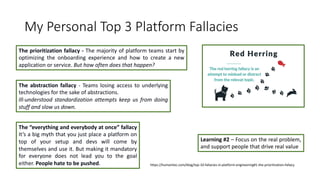
The prioritization fallacy - The majority of platform teams start by
optimizing the onboarding experience and how to create a new
application or service. But how often does that happen?
The abstraction fallacy - Teams losing access to underlying
technologies for the sake of abstractions.
Ill-understood standardization attempts keep us from doing
stuff and slow us down.
The “everything and everybody at once” fallacy
It’s a big myth that you just place a platform on
top of your setup and devs will come by
themselves and use it. But making it mandatory
for everyone does not lead you to the goal
either. People hate to be pushed. https://humanitec.com/blog/top-10-fallacies-in-platform-engineering#1-the-prioritization-fallacy
How to support people driving real value
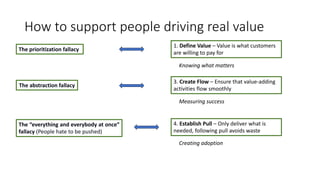
The prioritization fallacy
The abstraction fallacy
The “everything and everybody at once”
fallacy (People hate to be pushed)
1. Define Value – Value is what customers
are willing to pay for
3. Create Flow – Ensure that value-adding
activities flow smoothly
4. Establish Pull – Only deliver what is
needed, following pull avoids waste
Knowing what matters
Measuring success
Creating adoption
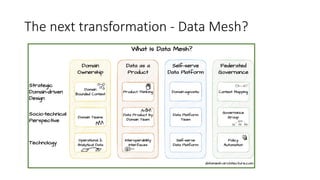
The next transformation - Data Mesh?
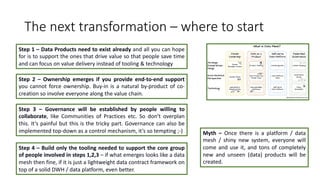
The next transformation – where to start
Step 1 – Data Products need to exist already and all you can hope
for is to support the ones that drive value so that people save time
and can focus on value delivery instead of tooling & technology
Step 2 – Ownership emerges if you provide end-to-end support
you cannot force ownership. Buy-in is a natural by-product of co-
creation so involve everyone along the value chain.
Myth – Once there is a platform / data
mesh / shiny new system, everyone will
come and use it, and tons of completely
new and unseen (data) products will be
created.
Step 3 – Governance will be established by people willing to
collaborate, like Communities of Practices etc. So don‘t overplan
this. It‘s painful but this is the tricky part. Governance can also be
implemented top-down as a control mechanism, it‘s so tempting ;-)
Step 4 – Build only the tooling needed to support the core group
of people involved in steps 1,2,3 – if what emerges looks like a data
mesh then fine, if it is just a lightweight data contract framework on
top of a solid DWH / data platform, even better.
Thanks for your attention is all you need
data2day 2023 | Karlsruhe | 2023-10-12 | Dr. Stefan Kühn | The Platform Fallacy
Find me on LinkedIn

data2day2023_SKuehn_DataPlatformFallacy.pdf

  • 1.
    The (Data) PlatformFallacy Outcome over Output - Pull over Push Dr. Stefan Kühn data2day 2023
  • 2.
  • 3.
    The Five Principlesof Lean 1. Define Value – Value is what customers are willing to pay for 2. Map Value Stream – Start with the end in mind and map out all essential steps 3. Create Flow – Ensure that value-adding activities flow smoothly 4. Establish Pull – Only deliver what is needed, following pull avoids waste 5. Pursuit Perfection – Develop a Continuous Improvement culture https://theleanway.net/The-Five-Principles-of-Lean
  • 4.
    Benefits of Platforms Wehave asked 100 people … Faster innovation Higher-quality products Increased reliability Improved ways of working Advantages through SOTA tech Reduced costs Higher productivity Happier people More and better products faster, while happy people save money using state-of-the-art technology
  • 5.
    Benefits of DataPlatforms We have asked 100 people … Improved data access Enhanced decision- making Increased efficiency Better data quality Enhanced security Improved collaboration Enhanced agility
  • 6.
    Rise of thePlatform Business Network effects – the more users on the platform, the higher the value Multi-sided market places – facilitate transactions between consumers and producers https://www2.deloitte.com/ch/en/pages/innovation/articles/platform-business-model-explained.html https://www.applicoinc.com/blog/what-is-a-platform-business-model/ PLATFORM BUSINESS MODEL DEFINITION: a business model that creates value by facilitating exchanges between two or more interdependent groups, usually consumers and producers. The role of the platform business is to provide a governance structure and a set of standards and protocols that facilitate interactions at scale so that network effects can be unleashed. How the term platform is understood and used by business people
  • 7.
    Rise of thePlatform Business Revenue generation – options Kindly asking for a share of the transaction fee Advertising Paid membership All of the above Learning #1 – This is what platform typically means in a business context – platforms generate revenue value at scale, because they constitute an ecosystem
  • 8.
    Building Platforms Platform engineeringis the discipline of designing and building toolchains and workflows that enable self- service capabilities for software engineering organizations in the cloud-native era. Platform engineers provide an integrated product most often referred to as an “Internal Developer Platform” covering the operational necessities of the entire lifecycle of an application. https://platformengineering.org/blog/what-is-platform-engineering Key element #1 – designing and building toolchains and workflows Key element #2 – self-service capabilities Key element #3 – platform as integrated product Key element #4 – covering the entire lifecycle Useful tooling End-to-end support
  • 9.
    Exploring Reality „There’s atendency in intellectual circles to protect and embolden a thesis at the expense of exploring reality and this is happening.“ https://www.the-ntwk.com/post/the-platform-fallacy-unravelling-platform-narrative-to-clarify-corporate-strategy Reality check #1 – In order to function, enterprises rely on a set of core platforms. Reality check #2 – The majority of companies have poor core platform architectures and most transformations are in some way designed to improve them ERP, CRM, BI, DP, CDP, IDP, … „Digital“ transformations, going from on-premise to cloud, becoming a data- driven company, maybe even agile transformation
  • 10.
    Exploring Reality Reality check#3 – A new architectural pattern emerges within a successful organization as a solution to their very own existing problems. Most adopters try to copy the „solution“ without understanding their very own and specific problems first. Provocative thought, but you are not Google, Facebook, Netflix, nor are you Spotify. That holds true on so many levels: you don’t have the funds, you don’t have the reach, you don’t have the scale. Also means you cannot and you should not copy what they do. Can they inspire you? Maybe. https://humanitec.com/blog/top-10-fallacies-in-platform-engineering#9-the-googlefacebooknetflix-fallacy https://www.andremuscat.com/4-types-of-platform-business-models/
  • 11.
    My Personal Top3 Platform Fallacies Learning #2 – Focus on the real problem, and support people that drive real value The prioritization fallacy - The majority of platform teams start by optimizing the onboarding experience and how to create a new application or service. But how often does that happen? The abstraction fallacy - Teams losing access to underlying technologies for the sake of abstractions. Ill-understood standardization attempts keep us from doing stuff and slow us down. The “everything and everybody at once” fallacy It’s a big myth that you just place a platform on top of your setup and devs will come by themselves and use it. But making it mandatory for everyone does not lead you to the goal either. People hate to be pushed. https://humanitec.com/blog/top-10-fallacies-in-platform-engineering#1-the-prioritization-fallacy
  • 12.
    How to supportpeople driving real value The prioritization fallacy The abstraction fallacy The “everything and everybody at once” fallacy (People hate to be pushed) 1. Define Value – Value is what customers are willing to pay for 3. Create Flow – Ensure that value-adding activities flow smoothly 4. Establish Pull – Only deliver what is needed, following pull avoids waste Knowing what matters Measuring success Creating adoption
  • 13.
  • 14.
    The next transformation– where to start Step 1 – Data Products need to exist already and all you can hope for is to support the ones that drive value so that people save time and can focus on value delivery instead of tooling & technology Step 2 – Ownership emerges if you provide end-to-end support you cannot force ownership. Buy-in is a natural by-product of co- creation so involve everyone along the value chain. Myth – Once there is a platform / data mesh / shiny new system, everyone will come and use it, and tons of completely new and unseen (data) products will be created. Step 3 – Governance will be established by people willing to collaborate, like Communities of Practices etc. So don‘t overplan this. It‘s painful but this is the tricky part. Governance can also be implemented top-down as a control mechanism, it‘s so tempting ;-) Step 4 – Build only the tooling needed to support the core group of people involved in steps 1,2,3 – if what emerges looks like a data mesh then fine, if it is just a lightweight data contract framework on top of a solid DWH / data platform, even better.
  • 15.
    Thanks for yourattention is all you need data2day 2023 | Karlsruhe | 2023-10-12 | Dr. Stefan Kühn | The Platform Fallacy Find me on LinkedIn